{{currentView.title}}
March 09, 2026
Iran Updates, January 2026
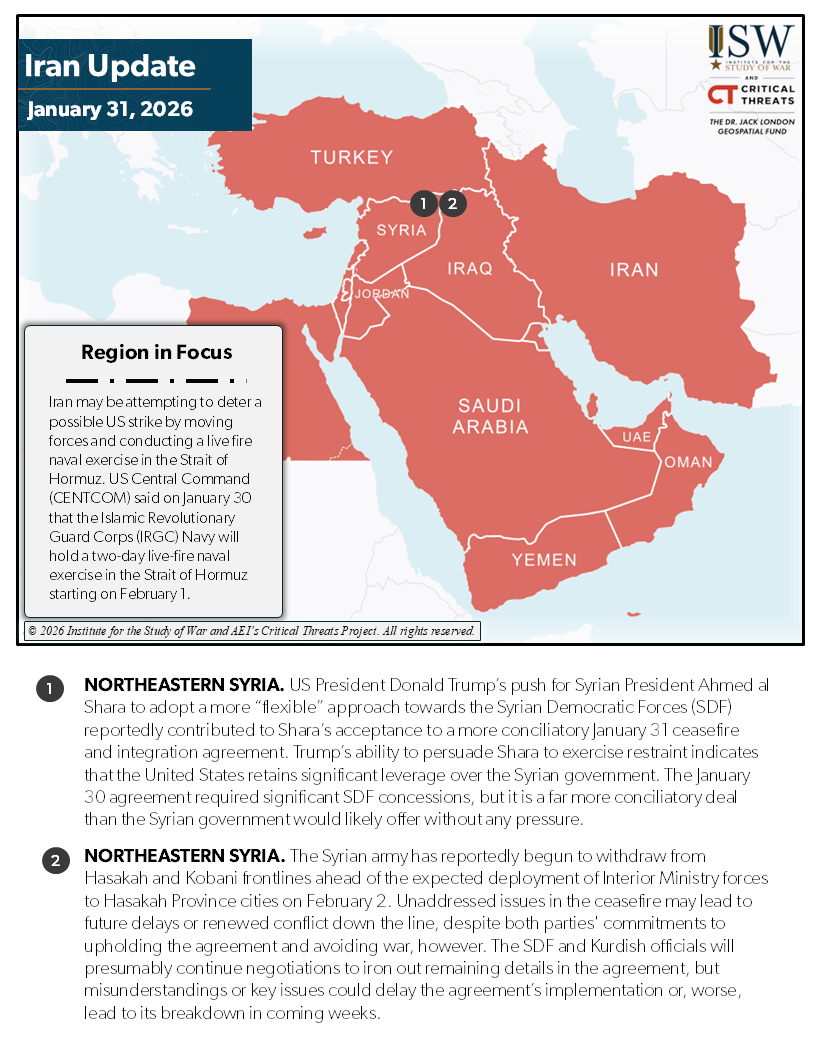
Iran may be attempting to deter a possible US strike by moving forces and conducting a live-fire naval exercise in the Strait of Hormuz. US Central Command (CENTCOM) said on January 30 that the Islamic Revolutionary Guard Corps (IRGC) Navy will hold a two-day live-fire naval exercise in the Strait of Hormuz starting on February 1.[i] CENTCOM urged the IRGC to conduct the exercise in a “safe and professional” manner and to avoid placing international maritime navigation at “unnecessary risk.”[ii] Iranian Foreign Affairs Minister Abbas Araghchi stated on X on January 31 that freedom of navigation and the safe passage of commercial ships through the Strait of Hormuz are vital for Iran and its neighbors and claimed that ”outside forces in the region” have historically fueled escalation.[iii] Iranian Armed Forces General Staff-affiliated outlet Defa Press claimed on January 29 that the IRGC Navy deployed “hundreds of fast, missile-launching, and support vessels in close proximity” to the USS Abraham Lincoln aircraft carrier.[iv] Commercially available satellite imagery from January 27 also showed the IRGC Navy’s “Shahid Bagheri” drone carrier about six kilometers off the coast of Bandar Abbas in the Strait of Hormuz.[v] These naval deployments and the upcoming exercise are notable because Iran did not employ its naval forces during the June 2025 Israel-Iran War. A policy analyst close to the regime stated on January 31 that the “naval-missile” exercise in the Strait of Hormuz and the Persian Gulf aims to deter any possibility of a naval blockade by demonstrating Iran’s military resolve to counter it.[vi]
US President Donald Trump’s push for Syrian President Ahmed al Shara to adopt a more “flexible” approach towards the Syrian Democratic Forces (SDF) reportedly contributed to Shara’s acceptance of a more conciliatory January 31 ceasefire and integration agreement.[vii] Trump and Shara spoke on January 27 and discussed the Syrian government’s ceasefire with the SDF, after which Trump described the situation in Syria as “working out very well.”[viii] Unspecified sources told regional media on January 30 that Trump encouraged Shara to be ”more flexible” in a recent call.[ix] The SDF and Syrian government were in the process of finalizing an agreement to integrate SDF’s military and security forces, administrative structures, and remaining SDF-held territory into the Syrian state when Trump and Shara spoke. The two parties announced the new agreement on January 30 after Trump and Shara’s January 27 call.[x]
Trump’s ability to persuade Shara to exercise restraint indicates that the United States retains significant leverage over the Syrian government. The January 30 agreement required significant SDF concessions, but it is a far more conciliatory deal than the Syrian government would likely offer without any pressure. The Syrian government has sought a highly centralized system of governance since its formation in December 2024 and appeared close to achieving that objective militarily by causing the collapse of the SDF on January 17 and 18, 2025. The new agreement requires the SDF to integrate into security services, but does allow the SDF to form four brigades solely comprised of former SDF fighters in northern Syria.[xi] The Syrian government initially proposed that all SDF fighters must be fully integrated on an “individual basis” into existing Syrian army units in a January 18 agreement.[xii] The new agreement also dictates that the Syrian army will not enter Hasakah and Qamishli cities, likely in an attempt to avoid possible intercommunal violence from abusive army units.[xiii] Avoiding harm to Kurdish communities was a stated US objective that Trump explicitly referred to in his January 19 call with Shara, according to the readout. Shara also likely decided to temporarily halt the Syrian government offensive on SDF territory in northeastern Syria after a phone call with US President Donald Trump on January 19.[xiv]
The Syrian army has reportedly begun to withdraw from Hasakah and Kobani frontlines ahead of the expected deployment of Interior Ministry forces to Hasakah Province cities on February 2. xix CTP-ISW has not observed any military engagements between SDF and Syrian government forces since CTP-ISW's last data cut off on January 30. A French analyst, citing local journalists and Kurdish media, reported that the Syrian army has withdrawn from positions along the Hasakah Province and Kobani frontlines.[xv] Kurdish media also reported that Syrian army units withdrew from positions along the outskirts of Hasakah City towards Shaddadi on January 31, which would corroborate Syrian officials’ statements that the Syrian army will not enter Hasakah or Qamishli cities.[xvi] Units from at least 10 Syrian army divisions have operated along the Hasakah frontlines since the Syrian army advanced into the province on January 18.[xvii]
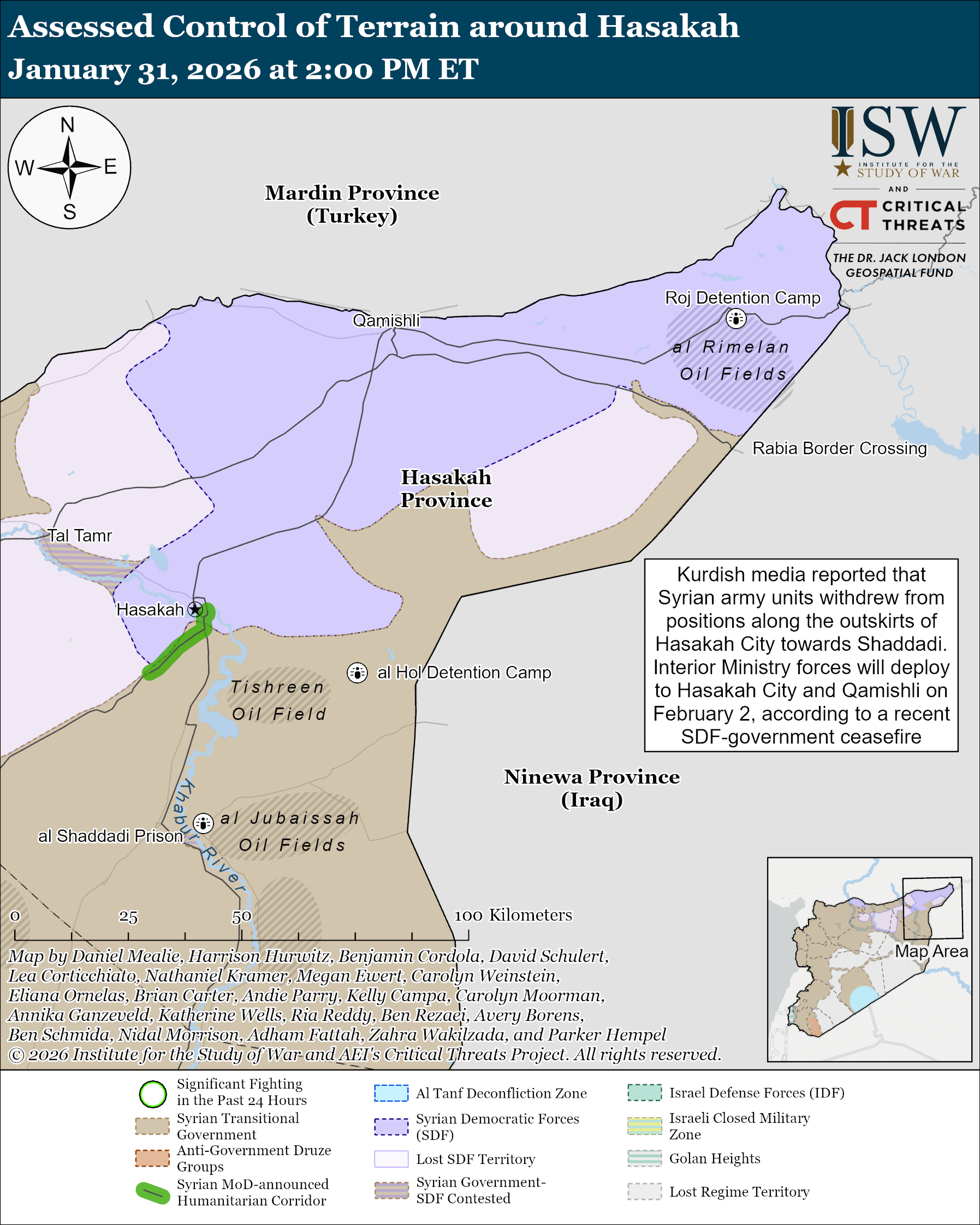
Syrian government and Kurdish officials have continued to express their commitment to the January 30 ceasefire and integration agreement. A Syrian Foreign Ministry official told UK-based, Qatari-owned media on January 31 that the agreement is expected to be implemented within a month, but that the Syrian government is “not rushing” and will prioritize “peaceful solutions” and “political” means while overseeing the implementation of the agreement.[xviii] Kurdish Democratic Union Party (PYD) officials also praised the agreement for de-escalating and decreasing the risk of another Syrian civil war on January 30 and 31.[xix] The officials added that they will continue to advocate for core Kurdish demands as participants within the Syrian state.[xx] Senior PYD member Aldar Khalil said on January 31 that the PYD will continue its political and legal struggle in the Syrian government, the People’s Assembly, the government, and the constitutional committee.[xxi] Khalil‘s remarks are consistent with those of Autonomous Administration of North and East Syria (AANES) Foreign Affairs Co-Chair Ilham Ahmed on January 30, who promised that Kurdish officials would continue to advocate for core Kurdish demands as participants within the Syrian state.[xxii] SDF and AANES officials had long supported decentralization and demanded it as a condition to integrate into the Syrian state.[xxiii] They have now acceded to Shara’s demands to integrate the SDF and AANES into the state without decentralization.[xxiv]
Unaddressed issues in the ceasefire may lead to future delays or renewed conflict down the line, despite both parties' commitments to upholding the agreement and avoiding war, however. There is no publicly available full text of the ceasefire agreement at this time, only public announcements that articulate a few vague elements of the ceasefire.[xxv] The January 30 agreement includes eight clauses that describe the integration of the SDF’s military and security forces, AANES’s administrative structures, and remaining SDF-held territory in Hasakah and Aleppo provinces into the Syrian state.[xxvi] Interior Ministry forces will enter Hasakah and Qamishli cities on February 2 for a ”specific period,” but no party has commented on how long forces that are from the region will retain a security presence in these cities after the SDF-affiliated Asayish integrates into local forces.[xxvii] The agreement text that both the SDF and Syrian government released similarly did not address the future of control over border crossings, airports, and oil and gas fields in northern Syria. Syrian government officials have separately maintained that the state would take over all Syrian border crossings, but SDF officials have not acknowledged this decision at the time of writing this.[xxviii] A Syrian journalist reported on January 31 that the government will assume control of Qamishli Airport and the Semalka Crossing on February 4.[xxix] Ilham Ahmed also said during a January 30 press conference that the Women’s Protection Units (YPJ) will form a brigade in the Syrian army, but Al Monitor reported on January 30 that the Syrian government rejected the formation of a women’s brigade in the latest rounds of talks.[xxx] The Syrian government and the SDF’s fundamentally different interpretations of the March 10 Agreement led to a ten-month delay, which resulted in the January 2026 government offensive to compel the SDF to integrate. The SDF and Kurdish officials will presumably continue negotiations to iron out remaining details in the agreement, but misunderstandings or key issues could delay the agreement’s implementation or, worse, lead to its breakdown in the coming weeks.
The Syrian Defense Ministry recently arrested some Syrian military personnel, including a relatively senior officer, for crimes and failure to follow orders. These arrests represent nascent steps by the ministry to uphold the chain of command and Syrian laws. The Syrian Defense Ministry arrested 72nd Division Military Security head Wissam Abdul Rahman (aka Abu Jamal al Shami) on January 30 for his failure to follow orders to stop operations by his forces east of the Euphrates River during an unspecified ceasefire in January 2025.[xxxi] The 72nd Division consists of units from multiple opposition militias, including Sultan Mehmed Faith Division, Ahrar al Sham, Sultan Murad Division, and Liwa al Waqqas.[xxxii] Syrian military security and police in Raqqa Province separately arrested Rami al Dahsh, a Syrian army soldier, for cutting the braid of a female Kurdish fighter.[xxxiii] These arrests will need to be expanded upon to ensure adequate command-and-control and adherence to the law, but the arrests represent some willingness on the part of the Syrian government to respond to abuses and insubordinate officers.
Key Takeaways
- Iranian Naval Activity: Iran may be attempting to deter a possible US strike by moving forces and conducting a live-fire naval exercise in the Strait of Hormuz. US Central Command (CENTCOM) said on January 30 that the Islamic Revolutionary Guard Corps (IRGC) Navy will hold a two-day live-fire naval exercise in the Strait of Hormuz starting on February 1. A policy analyst close to the regime stated on January 31 that the exercise in the Strait of Hormuz and the Persian Gulf aims to deter any possibility of a naval blockade by demonstrating Iran’s military resolve to counter it.
- US-Syria Relations: US President Donald Trump’s push for Syrian President Ahmed al Shara to adopt a more “flexible” approach towards the Syrian Democratic Forces (SDF) reportedly contributed to Shara’s acceptance of a more conciliatory January 31 ceasefire and integration agreement. Trump’s ability to persuade Shara to exercise restraint indicates that the United States retains significant leverage over the Syrian government. The January 30 agreement required significant SDF concessions, but it is a far more conciliatory deal than the Syrian government would likely offer without any pressure.
- Ceasefire in Northeastern Syria: The Syrian army has reportedly begun to withdraw from Hasakah and Kobani frontlines ahead of the expected deployment of Interior Ministry forces to Hasakah Province cities on February 2. Unaddressed issues in the ceasefire may lead to future delays or renewed conflict down the line, despite both parties' commitments to upholding the agreement and avoiding war, however. The SDF and Kurdish officials will presumably continue negotiations to iron out remaining details in the agreement, but misunderstandings or key issues could delay the agreement’s implementation or, worse, lead to its breakdown in the coming weeks.
Iran has shown little willingness to concede to US demands on the missile program, regional proxy network, and nuclear capabilities. These three items form the long-standing pillars of Iranian defense strategy, and changing them would require a long strategic rethink in Tehran. The United States and Iran are in talks to attempt to avert US military action against Iran. Iranian Foreign Affairs Minister Abbas Araghchi reiterated in a press conference in Istanbul on January 30 that the Iranian regime is ready to resume talks with the United States if negotiations are “fair and equitable,” but it will not be bullied into negotiations nor give up its missiles and defense capabilities.[i] This comes as the United States recently relayed its demands for a deal to Iran.[ii] Three of these demands, which the United States proposed to Iran in the first round of nuclear negotiations in early 2025, require Iran to halt its missile and nuclear programs and its support for regional proxies. Iranian officials do not believe that conceding to these demands would resolve US-Iran tensions, even if they decided to accept the demands, according to a political analyst close to the regime on January 22.[iii] The same analyst, along with an Iranian political scientist, confirmed on January 22 and 23 that the United States introduced a fourth demand: Iran’s recognition of the State of Israel, a condition that is entirely antithetical to the beliefs of the Islamic Republic under Iranian Supreme Leader Ali Khamenei and the ideology he espouses.[iv] Iranian officials have demonstrated an unwillingness to concede on any of these US demands, even amid several diplomatic meetings Araghchi and President Masoud Pezeshkian held with intermediary countries on January 30 to encourage them to convince the United States to not conduct military action against Iran.[v]
Iranian Supreme National Security Council Secretary (SNSC) Ali Larijani met with Russian President Vladimir Putin in Moscow on January 30 to discuss current developments and bilateral economic ties, according to Iranian and Russian media.[vi] Larijani’s visit to Russia comes amid a flurry of diplomatic efforts by Iranian officials to avert US military action against Iran.[vii] Larijani leads Iran’s highest national security decision-making body and played a central role in orchestrating the regime’s brutal protest crackdown in December 2025 and January 2026, for which the US Treasury sanctioned Larijani on January 15.[viii]
The Syrian government has compelled moderate Kurdish leaders to drop their opposition to Syrian President Ahmed al Shara’s model of state centralization. Kurdish officials in the Syrian Democratic Forces (SDF) and Autonomous Administration of North and East Syria (AANES) had long supported decentralization and demanded it as a condition to integrate into the Syrian state. They have now acceded to Shara’s demands to integrate the SDF and AANES into the state without decentralization. The Syrian government forced the SDF to capitulate to integrate into the state through diplomatic and political engagements with Arab tribal leaders and US, French, and Iraqi Kurdish mediators, and a large-scale military operation to seize SDF-held territory in northeastern Syria. The Syrian government and SDF agreed on January 30 to integrate SDF’s military and security forces, administrative structures, and remaining SDF-held territory in Hasakah and Aleppo provinces into the Syrian state.[ix] SDF Commander Mazloum Abdi said in an interview with Kurdish media on January 30 that his main goal for the agreement was to ”stop the war and protect the rights of Kurdish people” during recent talks with the Syrian government.[x] Moderate SDF leaders, including SDF Commander Mazloum Abdi and AANES Foreign Affairs Co-Chair Ilham Ahmed, have acknowledged that the SDF and AANES will abide by the agreement, which the Syrian government and the SDF will begin to implement on February 2.[xi] Several integration agreements and ceasefires between the Syrian government and SDF have failed in the ten months since both parties agreed to integrate the SDF into the state on March 10, 2025.[xii]
The SDF and AANES agreed to dissolve into Syrian security and administrative structures. The agreement integrates the SDF into the Syrian army as four brigades comprised of SDF fighters that will operate in northern Syria.[xiii] Three of these SDF brigades will form a division in the northeast, possibly alongside other non-SDF brigades.[xiv] SDF fighters will form another brigade that operates in the Kobani area as part of an existing Aleppo-based Syrian division.[xv] The new brigades will be rebuilt from entirely new SDF-manned units rather than reflagged SDF units. The Syrian army maintains four Aleppo-based divisions: the 60th, 72nd, 76th, and 80th divisions.[xvi] These divisions consist of a mix of Hayat Tahrir al Sham fighters and Turkish-backed Syrian National Army factions that have participated in Turkish offensives targeting the Kurds.[xvii] Contingents of each of these units have fought against SDF-affiliated fighters on the Kobani frontlines within the past week.[xviii]
The SDF may have made a significant concession on its demand to retain its structures within the Syrian army and integrate as a ”bloc,” which SDF leaders have been refusing because it leaves Kurdish areas without a reliable defense force of their own.[xix] Syrian government officials told Syrian and Western media that SDF fighters would join these four brigades as “individuals,” suggesting that the Syrian government will not re-flag existing SDF units as brigades, battalions, or regiments in the new army.[xx] It is unclear at this time what the command structure of these units will look like—including how officers will be selected for the new units—or how the Syrian army will form new units out of existing SDF units and factions. The integration of SDF-affiliated forces into specific brigades may allow for these units to retain certain characteristics of former SDF units, depending on how these brigades are formed. A previous SDF-government agreement from October 2025 allowed the SDF three full divisions.[xxi]
Syrian internal security forces will also enter Hasakah and Qamishli cities for a “specific period” in order to secure the area and assume control over government institutions while SDF-affiliated internal security forces prepare to the join state security services.[xxii] Interior Ministry forces will enter Hasakah and Qamishli cities on February 2 and begin taking steps to secure the area. Syrian state media reported that the state will take over “all civilian and governmental institutions, crossings, and ports.”[xxiii] Ilham Ahmed said that all employees in local institutions would be from the area, including guards at border crossings.[xxiv] AANES officials and employees in Hasakah will retain their positions and eventually be integrated into Syrian state administrative structures.[xxv] AANES employees in Deir ez Zor and Raqqa have also retained their positions in the days since the Syrian government gained control over Deir ez Zor and Raqqa provinces.[xxvi]
Several indicators suggest that hardline SDF leaders may refuse to abide by the SDF’s new agreement to integrate, which risks instigating new conflict between government forces and Kurdish fighters as the agreement is implemented. Ilham Ahmed cited the danger that some may reject or break the agreement during her press conference.[xxvii] She noted that ”different circles” are not in favor of the SDF’s agreement with the Syrian government and may ”work against it.”[xxviii] CTP-ISW continues to assess that hardliners within the SDF may contribute to future instability within Syria, even though Abdi and Shara have come to an agreement that ends the immediate fighting in northeastern Syria and creates a plan to integrate SDF fighters into state security services.[xxix] One scenario would involve an insurgency by hardline People's Protection Units (YPG) or other Kurdistan Workers’ Party (PKK)-aligned elements who refuse to join Syrian defense and security forces and decide to resume attacks against the Syrian government.[xxx] Several SDF-affiliated fighters have ignored previous ceasefires mandated by SDF leadership and attacked Syrian government forces in recent weeks.[xxxi] The government used attacks by these spoilers to justify additional advances against the SDF.
Kurdish leaders such as Ilham Ahmed have not yet acknowledged any SDF efforts to address hardliners who may threaten the implementation of the deal or mitigate the risks that they pose. An unspecified Syrian government source told a DC-based, Syria-focused analyst that Interior Ministry forces are entering Hasakah and Qamishli on February 2 in order to provide time for “opponents” of the agreement to evacuate.[xxxii] The departure of ”opponents” of the agreement may refer to the possible voluntary withdrawal of cadres from the area or to an internal SDF decision to force certain hardline commanders and fighters to withdraw from the area. A January 18 agreement between Abdi and Shara (that Abdi later reneged on) specified that the SDF commit to removing non-Syrian leaders and PKK fighters from Syrian territory.[xxxiii] CTP-ISW has not yet observed evidence that SDF leaders are forcing certain elements to withdraw from Syria.
The SDF and Syrian government’s ceasefire and integration agreement does offer a pathway toward the stabilization of northern Syria that will address certain US policy goals in the wake of the government offensive, even if some SDF-affiliated fighters do not abide by its terms. The Syrian government’s offensive into northeastern Syria created conditions for a possible scenario in which Syrian government forces would have advanced into Kurdish areas and confronted both Kurdish fighters and civilians, possibly leading to another catastrophic round of communal-based violence.[xxxiv] This scenario would have also made it extraordinarily difficult for US forces present in Syria to successfully move ISIS detainees from Syria to Iraq, while also increasing force protection requirements for US forces.
The January 30 agreement does not address core Kurdish demands for constitutional rights for Kurds and a decentralized governance system, and high-ranking Kurdish officials have indicated that they will continue to advocate for core Kurdish demands using political means from within the Syrian state. One of the impediments to any progress in negotiations between the SDF and Syrian government over the past year has been both sides’ fundamentally conflicting visions for the future of the Syrian state since the fall of the Assad regime. Shara has sought a unitary and highly centralized state.[xxxv] The Kurdish population’s well-founded fears of the Syrian central government after years of oppression under both Bashar and Hafez al Assad and extreme violence at the hands of the figures who now form the government have caused the SDF to be very hesitant to cede power back to Damascus unless more devolution of power occurs. [xxxvi] The SDF, therefore, sought a decentralized federal system that made no substantial changes to the present SDF governance model for the areas under SDF control.[xxxvii] This system would feature ostensibly representative local leaders, though in practice, many would have probably been drawn from the ranks of the SDF.[xxxviii] AANES officials will retain their positions in both the northeast and Kobani regions and may be able to functionally retain a degree of local autonomy, but will defer to the Syrian government-appointed Aleppo governor and newly appointed Hasakah governor.[xxxix] The Syrian government has also taken several steps in recent days to implement aspects of Shara’s Decree No. 13, including naturalizing Kurdish citizens stripped of their citizenship under the Assad regime and permitting Kurdish language instruction in schools.[xl] These liberties are not represented in the Syrian constitution, however, as Syrian Kurds have demanded since the fall of the regime.[xli] The Kurds seek constitutional protections because they perceive that the government could easily revoke a decree.
The Syrian government may have compelled moderate SDF leaders to give up on efforts to resist integration into the Syrian state, but Ilham Ahmed indicated that SDF officials will continue to advocate for core Kurdish demands within the state.[xlii] Ahmed said in a press conference on January 30 that the SDF’s “armed resistance will come to an end with the implementation of this agreement.“[xliii] Ahmed said that "our work" now shifts to a different phase characterized by ”legal” and ”political” struggle.[xliv] The Kurdish delegation that Kurdish political parties formed in April 2025 to advocate for decentralization from the government will visit Damascus to discuss Kurdish constitutional rights in the constitution.[xlv]
The SDF’s planned integration into the Syrian state will create less chaotic conditions and enable a smoother handover of counter-Islamic State in Iraq and al Sham (ISIS) responsibilities and facilities to the Syrian government relative to the chaotic situation caused by the government’s full assault on SDF-held areas in mid-January 2026. US forces began to transfer ISIS detainees to Iraq on January 21 after several uncoordinated handovers of ISIS detention centers to the Syrian government by the SDF resulted in the escape of detainees.[xlvi] The United States has transferred fewer than 600 of about 7,000 ISIS detainees from Syria to Iraq as of January 30.[xlvii] The ceasefire agreement will certainly create less chaotic conditions that will make the transfer of detainees less dangerous, but the agreement may further reduce Iraqi officials’ urgency to accept the detainees. Iraqi officials reportedly asked the United States to slow the rate of transfers to allow for negotiations with other countries about the repatriation of their ISIS-affiliated nationals.[xlviii]
A more organized handover will reduce the risk that ISIS reconstitutes itself at all or that ISIS detainees escape from custody and reinvigorate the organization, but building the counter-ISIS capacity of Syrian government forces will still take time. ISIS fighters killed two General Security Service personnel in Deir ez Zor Province on January 29, which was the organization’s first attack since the start of the Syrian government’s offensive against the SDF on January 12.[xlix] The Syrian government has the know-how and capabilities it needs to implement a counter-ISIS campaign in northeastern Syria, and the government’s campaign may be more capable than SDF counter-ISIS efforts once the government establishes itself in northeastern Syria. But transfers of control are by definition challenging and complex even under the best circumstances. Commanders executing a planned transfer of control, or relief-in-place, would conduct reconnaissance of an area to familiarize themselves with the tactical situation, including the areas they will occupy, the way that the enemy is arrayed, and the disposition of the unit currently occupying the area.[l] Many Syrian Army and Interior Ministry commanders deployed to Deir ez Zor and other areas in northeastern Syria will be local to those areas, but they will likely be returning from internal exile and therefore not familiar with the current tactical situation. The Syrian government will need to familiarize itself with the tactical situation that the SDF was intimately familiar with, given its decade of experience fighting ISIS in the area, to successfully operate in the newly-seized ISIS support zones and to secure ISIS detention facilities.
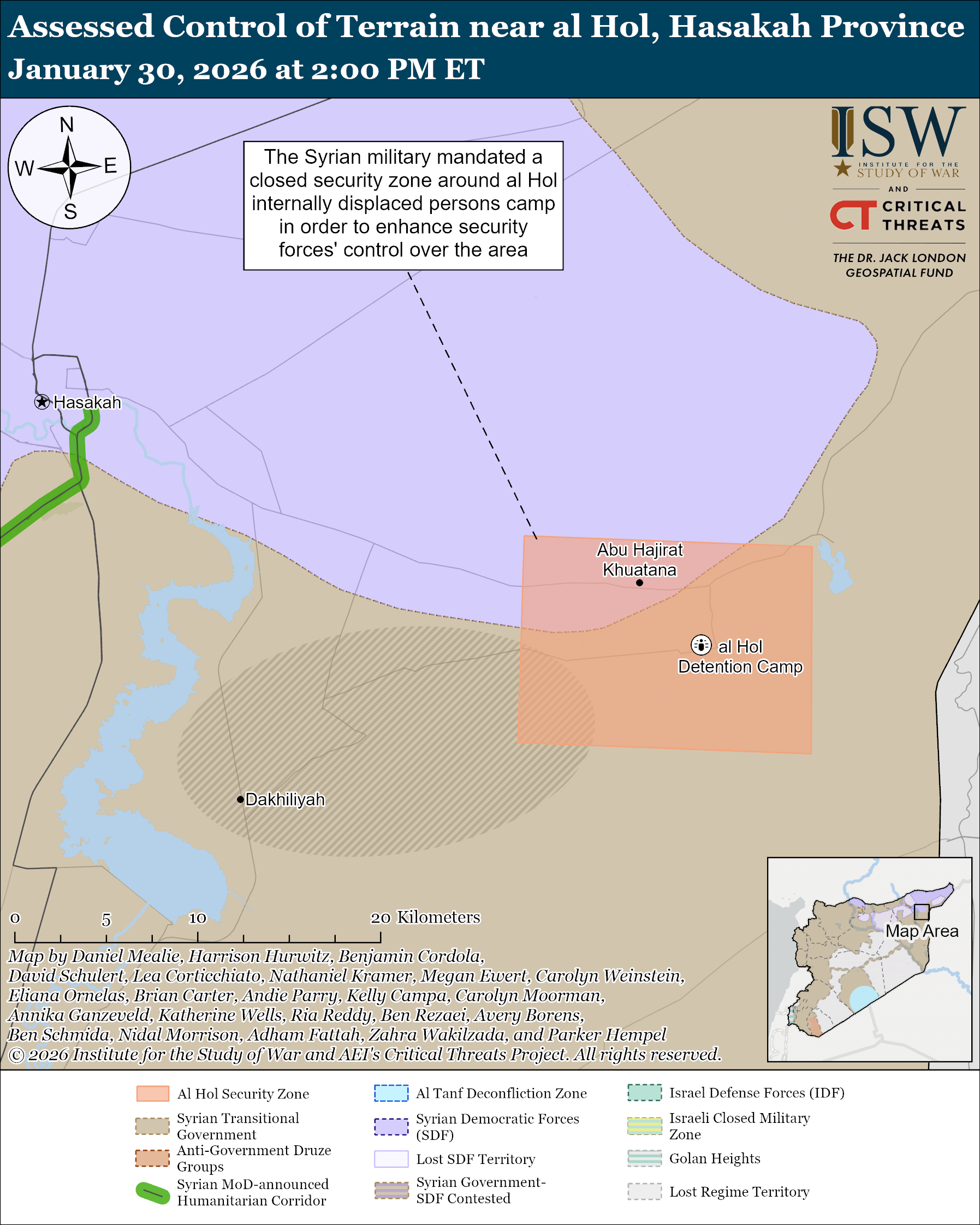
This process will be iterative and will take time, regardless of the Syrian military’s institutional capability to take on the counter-ISIS fight. The current government efforts to control al Hol illustrate this reality. The Syrian military declared the area around al Hol internally displaced persons (IDP) camp to be a closed security zone on January 30 in order to enhance the control of security forces over the area after seizing the camp on January 20.[li] The Syrian government has experienced some initial challenges in managing al Hol, partially due to undisciplined and ineffective Ministry of Defense units and insufficient training to control the camp.[lii] The government has established new tactics, techniques, and procedures (TTP) to rectify earlier mistakes, though it would certainly be able to learn from the SDF or US forces that previously controlled the camp. The Syrian government reportedly aims to close al Hol and al Roj IDP camps in Hasakah Province by the end of 2026.[liii]
State of Law Coalition head and former Iraqi Prime Minister Nouri al Maliki appears to be attempting to preserve his nomination as prime minister-designate amid US and domestic opposition. Maliki discussed government formation with US Charge d’Affaires Joshua Harris on January 30, likely in an attempt to assuage US concerns over another Maliki premiership.[liv] The United States has recently expressed its opposition to Maliki in multiple ways, including a message to the Shia Coordination Framework via embassy channels that noted that the United States views Maliki’s previous terms between 2006 and 2014 “in a negative light” and implied the United States opposed him.[lv] US President Donald Trump reiterated the US position on January 27 when he stated that Iraq experienced “poverty and total chaos” under Maliki and threatened that the United States “will no longer help Iraq” if Maliki becomes prime minister.[lvi] Multiple unspecified framework leaders reportedly held bilateral and small group meetings to “formulate an initial position” on Trump’s statement prior to an official framework meeting later on January 28.[lvii] One group of unspecified framework leaders wants to move forward with Maliki’s nomination, while the other group is concerned about the potential loss of international support or Iraq’s “isolation,” according to three unspecified framework sources speaking to Iraqi media on January 28.[lviii] The framework has not announced any official reversal of Maliki’s nomination or indicated a plan to do so at the time of this writing.
Maliki also met with Iranian-backed Iraqi Supreme Judicial Council head Faiq Zaidan on January 29, likely to confirm Zaidan’s support for a Maliki premiership.[lix] Zaidan stated during the meeting that the Iraqi judiciary rejects foreign interference in Iraqi affairs, in reference to Trump’s statement about Maliki.[lx] Iraq analyst Sajad Jiyad reported on January 28 that National State Forces Alliance head Ammar al Hakim and Asaib Ahl al Haq head Qais al Khazali had attempted to encourage current Iraqi Prime Minister Mohammad Shia al Sudani to compete with Maliki for the premiership after Sudani had withdrawn from the race on January 13, but Sudani had refused to do so without the support of most framework members and Zaidan.[lxi] Khazali and Hakim have led the framework opposition to Maliki.[lxii] CTP-ISW assessed on January 28, however, that Sudani still probably seeks the framework to nominate him as prime minister after the US opposition to Maliki.[lxiii]
A State of Law parliamentarian threatened Parliament Speaker and Progress Party member Hebet al Halbousi’s position if the Progress Party does not support Maliki for the premiership.[lxiv] This parliamentarian's threat indicates that Maliki may be concerned that opposition to him could delay his formation of a government. State of Law parliamentarian Othman al Shaibani threatened on January 30 that Halbousi could lose his position “if the political dispute over Halbousi’s performance and his commitment to previous understandings continues.”[lxv] Shaibani said that State of Law had supported Hebet al Halbousi’s nomination for speaker after the Progress Party head and cousin of Hebet al Halbousi, Mohammad al Halbousi, received Maliki’s blessing.[lxvi]
Shaibani’s comments are consistent with CTP-ISW's January 26 assessment that Maliki may have offered the Azm Alliance spoils to back him. Shaibani implied that the Sunni Azm Alliance could fill the speaker position.[lxvii] The National Sunni Political Council, which includes the Progress Party, the Azm Alliance, and the National Decision Alliance, released a statement on January 24 warning the framework against appointing Maliki as prime minister.[lxviii] The Azm Alliance and the National Decision Alliance have since issued statements supporting Maliki, and one Azm Alliance member said that Mohammad al Halbousi led the drafting of that statement.[lxix] The Progress Party released another statement on January 28 that implied that the party will not participate in a government led by Maliki.[lxx] Shaibani’s remark that the Azm Alliance could fill the speakership, coupled with the Azm Alliance’s subversion of the Halbousis and rapid reversal to support Maliki, strongly indicates that Maliki offered Azm the speakership specifically.[lxxi]
There is no public agreement between State of Law and the Progress Party, so it is not clear what Shaibani’s reference to an “understanding” between Maliki and Progress Party head Mohammad al Halbousi refers to.[lxxii] It is unlikely, however, that Mohammad al Halbousi promised Maliki the premiership in exchange for State of Law’s support for Hebet al Halbousi’s nomination as speaker, given Maliki’s history of driving instability in Iraq. Maliki pursued sectarian and authoritarian policies while in office that led to the rise of ISIS in Iraq.[lxxiii] Shaibani‘s comments are almost certainly retaliation for the Progress Party‘s opposition to Maliki.[lxxiv]
CTP-ISW continues to assess that framework parties and Sunni parties opposed to Maliki could attempt to block the presidential election in order to try to delay or prevent Maliki from becoming prime minister. Parliament must elect a president by a simple majority with a two-thirds quorum before the newly elected president selects the prime minister designate to form a government.[lxxv] The framework blocked the 2022 presidential election by preventing the quorum in order to prevent Shia nationalist cleric Muqtada al Sadr from forming a government without Iranian-backed parties.[lxxvi] Ongoing disputes between the KDP and the Patriotic Union of Kurdistan (PUK) over the presidency likely contributed to the Iraqi parliament’s postponement of its scheduled session to elect the new Iraqi president on January 27.[lxxvii]
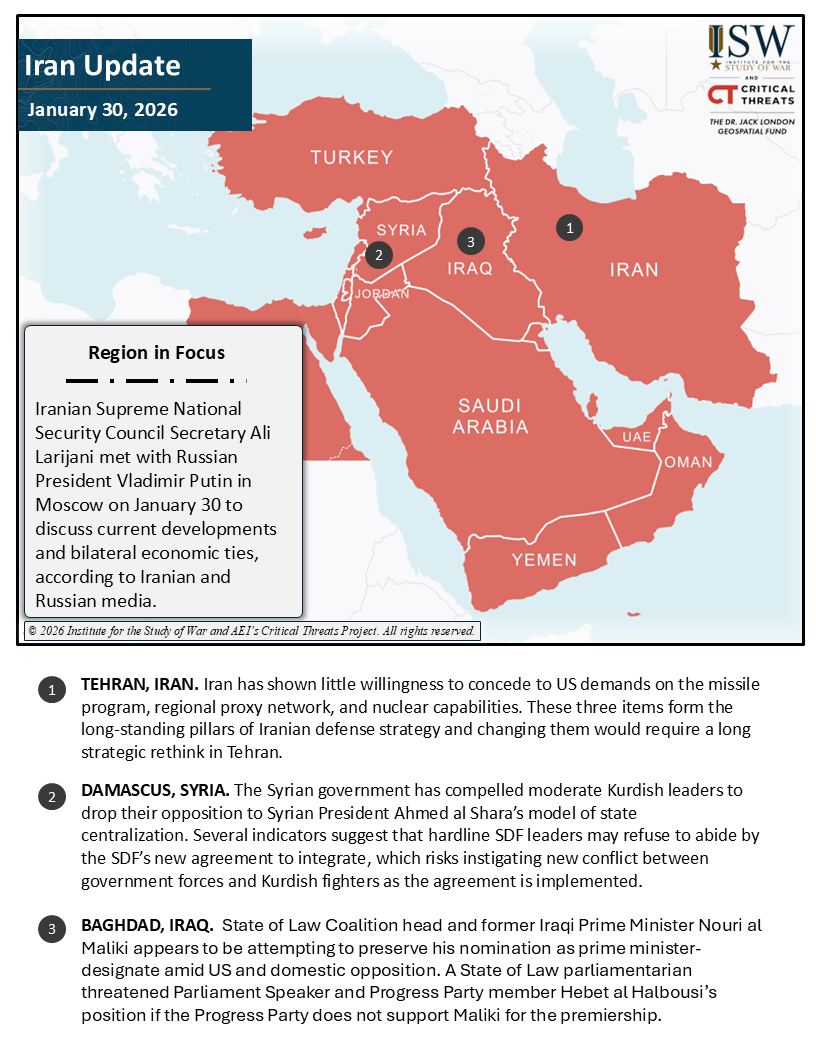
Key Takeaways
- US-Iran Nuclear Negotiations: Iran has shown little willingness to concede to US demands on the missile program, regional proxy network, and nuclear capabilities. These three items form the long-standing pillars of Iranian defense strategy, and changing them would require a long strategic rethink in Tehran.
- Iranian-Russian Cooperation: Iranian Supreme National Security Council Secretary (SNSC) Ali Larijani met with Russian President Vladimir Putin in Moscow on January 30 to discuss current developments and bilateral economic ties, according to Iranian and Russian media. Larijani’s visit to Russia comes amid a flurry of diplomatic efforts by Iranian officials to avert US military action against Iran.
- Syrian Democratic Forces (SDF) Integration into the Syrian State: The Syrian government has compelled moderate Kurdish leaders to drop their opposition to Syrian President Ahmed al Shara’s model of state centralization. Several indicators suggest that hardline SDF leaders may refuse to abide by the SDF’s new agreement to integrate, which risks instigating new conflict between government forces and Kurdish fighters as the agreement is implemented.
- Nouri al Maliki’s Aims for the Iraqi Premiership: State of Law Coalition head and former Iraqi Prime Minister Nouri al Maliki appears to be attempting to preserve his nomination as prime minister-designate amid US and domestic opposition. A State of Law parliamentarian threatened Parliament Speaker and Progress Party member Hebet al Halbousi’s position if the Progress Party does not support Maliki for the premiership.
Iran is likely trying to deter US military action against Iran by deploying forces and conducting naval exercises in the Strait of Hormuz. Iranian Armed Forces General Staff (AFGS)-affiliated outlet Defa Press claimed on January 29 that the Islamic Revolutionary Guards Corps (IRGC) Navy deployed “hundreds of fast, missile-launching, and support vessels in close proximity” to the USS Abraham Lincoln aircraft carrier, which is operating in the Arabian Sea.[i] Commercially available satellite imagery also showed that the IRGC Navy’s “Shahid Bagheri” drone carrier is currently six kilometers off the coast of Bandar Abbas, a major port city that is located on the Strait of Hormuz.[ii] The IRGC Navy’s deployment of fast attack craft (FAC) and “missile-launching” vessels is consistent with Iran’s asymmetric naval strategy that counters larger and more technologically advanced naval forces through high speed and short-range missile capabilities.[iii] Western media outlets separately reported on January 29 that the IRGC Navy will conduct a two-day, live-fire exercise in the Strait of Hormuz on February 1 and 2.[iv] The IRGC Navy’s upcoming live-fire exercise is likely a response to the USS Abraham Lincoln’s arrival in the Middle East and likely meant to deter the United States from attacking Iran. The deployment of naval assets and the upcoming exercise are also notable because Iran did not use any naval assets during the June 2025 Israel-Iran War. IRGC Spokesperson Ali Mohammad Naeini claimed in November 2025 that Iran did not use its naval forces during the war because there was “no need” to expand the war.[v]
Iran could respond to potential US military action by threatening US naval assets and obstructing international shipping in the Strait of Hormuz. Iranian officials have long threatened to disrupt shipping in the Strait as a way to deter the United States from implementing sanctions or taking military action against Iran.[vi] One of Iranian Supreme Leader Ali Khamenei’s advisers to the Defense Council, Ali Shamkhani, warned Iranian adversaries in October 2025 that Iran’s response to any escalation in the Strait would not be “limited.”[vii] Some regime-affiliated outlets have expressed support for disrupting international shipping to inflict an economic cost on the United States.[viii] One such outlet claimed that Iran could increase the price of oil to such a degree that it would “collapse” the US economy.[ix] Iran responded to the United States’ maximum pressure campaign in 2019 by threatening international shipping, including by seizing a British oil tanker, harassing vessels transiting the Strait of Hormuz, and conducting an attack targeting Saudi oil facilities.[x]
Iranian media outlets circulated a January 29 Al Jazeera report that claimed that the Iranian Navy will hold a joint military exercise with the People’s Republic of China (PRC) and Russia in the Sea of Oman and the Indian Ocean “in the coming days.”[xi] The reports did not specify whether the Artesh or IRGC Navy will participate in the exercise. Iran, the PRC, and Russia have held annual naval exercises in the Gulf of Oman in recent years, usually in the month of March.[xii] Russian and Chinese media have not confirmed the exercise at the time of this writing.
Iran is continuing to rebuild its nuclear facilities and trying to fortify them against future attacks. Recent US intelligence found that Iran is trying to rebuild its nuclear facilities “deeper underground,” according to a person familiar with recent US intelligence speaking to CNN on January 29. [xiii] It is unclear which specific nuclear facilities Iran is trying to rebuild “deeper underground.” It is possible that the facilities include the Mount Kolang Gaz La (Pickaxe Mountain) facility near the Natanz Nuclear Facility in Esfahan Province, although the United States and Israel have not targeted this facility and Iran would therefore not need to “rebuild” it. Unspecified analysts told the Washington Post in September 2025 that the Mount Kolang Gaz La facility’s underground halls may be between 260 and 330 feet deep, which is deeper than Fordow.[xiv] The International Atomic Energy Agency has never inspected this facility, which indicates that Iran could seek to limit international visibility into the site’s purpose.[xv] The Iranian regime is likely rebuilding its nuclear facilities deeper underground to reduce their vulnerability to deep-penetration munitions, such as the GBU-57 massive ordnance penetrator (MOP). The United States dropped 12 30,000-pound GBU-57 MOPs on Fordow in June 2025, targeting the site’s ventilation shafts that led to a centrifuge cascade hall located at least 200 feet underground.[xvi]
The CNN report comes as Iran has taken steps to rebuild parts of its nuclear program that could potentially support the development of a nuclear weapon. Iran is encasing a newly built facility at Taleghan 2 at the Parchin Military Complex with a concrete “sarcophagus” to harden the facility against potential airstrikes, according to the Institute for Science and International Security. [xvii] Iran previously used Taleghan 2 to test explosives that are needed to detonate a nuclear device before it suspended its nuclear weapons program in 2003.[xviii] Iran’s efforts to rebuild its nuclear facilities come as the 2026 National Defense Strategy noted that the Iranian regime has “left open the possibility that [it] will try again to obtain a nuclear weapon.”[xix]
Iran likely seeks Chinese support to strengthen its domestic security and repressive capabilities, which signals the regime’s continued concern about renewed unrest. AFGS-affiliated media reported that Law Enforcement Command (LEC) Commander Brigadier General Ahmad Reza Radan met with the PRC ambassador to Iran in Tehran on January 29 to finalize a security memorandum of understanding (MoU) between the LEC and the PRC's Public Security Ministry.[xx] The LEC serves as Iran’s primary internal security force and acts as the regime’s first line of defense against unrest. The MoU aims to strengthen bilateral cooperation between the two institutions on public and political security.[xxi] Iran has repeatedly sought Chinese assistance to expand its domestic repression apparatus. The US Department of Justice announced in February 2020 that Chinese company Huawei has supported Iran’s domestic surveillance efforts since at least the 2009 Green Movement protests.[xxii] Radan met with Chinese Public Security Minister Wang Xiaohong in 2023 and 2024 and signed a law enforcement cooperation MoU during their 2024 meeting.[xxiii] CTP previously assessed that Iran also likely modeled its digital authoritarian practices on the Chinese Communist Party’s approach to social control.[xxiv] The Iranian regime imposed a nationwide internet shutdown on January 8 to conceal its unprecedentedly brutal crackdown on protests and prevent Iranians from being able to organize protests.[xxv] The regime has sustained its extreme securitization efforts, which reflects its concerns over renewed protests.[xxvi]
The Syrian government and the Syrian Democratic Forces (SDF) are expected to announce the details of their January 27 agreement by January 31 at the latest. Syrian President Ahmed al Shara and SDF Commander Mazloum Abdi reportedly reached an “understanding” on January 27, agreeing to a ceasefire on all fronts and to the deployment of Syrian internal security forces to Hasakah City, Qamishli, and other Kurdish-majority areas.[xxvii] A Western journalist based in Qamishli reported that Abdi arrived in Damascus on January 29 to sign a “comprehensive accord” with Shara.[xxviii] An Autonomous Administration of North and East Syria (AANES) official told Kurdish media on January 29 that an SDF-Damascus deal is expected to be officially announced within the next 24 to 48 hours.[xxix] The terms of the agreement outlined by the AANES official largely mirror those published by Syrian media on January 27, with one modification.[xxx] This modification stipulates that the SDF and the Syrian government will jointly administer border crossings and airports, which differs from the January 27 Syrian media report that the government would solely control border crossings.[xxxi] A Syrian government and US source involved in the January 27 negotiations told a Washington-based Syria researcher on January 29 that the SDF is expected to hand over control of border crossings, oil and natural gas facilities, as well as prisons and camps to the Syrian government under the agreement, however.[xxxii]
There have been multiple incidents of SDF fighters acting independently, which indicate that there may be some fracturing within the SDF. CTP-ISW continues to assess that the SDF’s leadership may fracture over a decision to agree to Shara’s terms for the SDF to integrate into the Syrian state, which would risk instigating serious conflict between government forces and Kurdish fighters.[xxxiii] SDF fighters acting independently have previously jeopardized agreements between the Syrian government and the SDF on multiple occasions.[xxxiv] SDF fighters ambushed a Syrian Defense Ministry patrol in Maskana, Aleppo Province, on January 17 shortly after the SDF agreed to withdraw from its positions in Deir Hafer and Maskana.[xxxv] The SDF fighters’ ambush invalidated the withdrawal agreement and set conditions for the MoD’s offensive across SDF territory.[xxxvi] SDF-affiliated Asayish fighters also continued fighting and refused to withdraw from Kurdish-majority neighborhoods in Aleppo City on January 9, which violated a January 8 US-mediated ceasefire between the Syrian government and the SDF.[xxxvii] SDF fighters who reject any agreement Abdi makes with the Syrian government to integrate into the Syrian army could similarly take independent action and conduct attacks on government forces, which would risk igniting a broader conflict between government forces and Syrian Kurds.
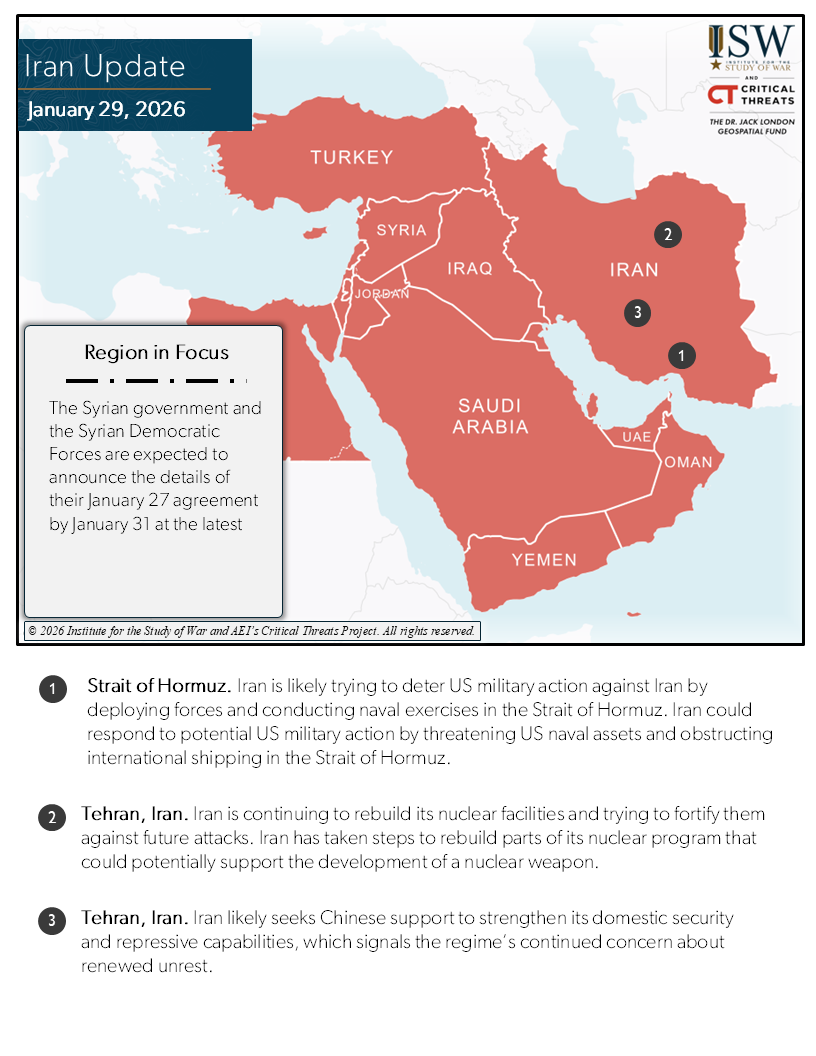
Key Takeaways
- Iranian Naval Activity: Iran is likely trying to deter US military action against Iran by deploying forces and conducting naval exercises in the Strait of Hormuz. Iran could respond to potential US military action by threatening US naval assets and obstructing international shipping in the Strait of Hormuz.
- Iranian-Chinese-Russian Naval Cooperation: Iranian outlets circulated a January 29 Al Jazeera report that claimed that the Iranian Navy will hold a joint military exercise with the People’s Republic of China and Russia in the Sea of Oman and the Indian Ocean “in the coming days.” Russian and Chinese media have not confirmed the exercise at the time of this writing.
- Iran’s Nuclear Program: Iran is continuing to rebuild its nuclear facilities and trying to fortify them against future attacks. Iran has taken steps to rebuild parts of its nuclear program that could potentially support the development of a nuclear weapon.
- Iranian-Chinese Security Relations: Iran likely seeks Chinese support to strengthen its domestic security and repressive capabilities, which signals the regime’s continued concern about renewed unrest.
- Syrian Government-SDF Conflict: The Syrian government and the Syrian Democratic Forces (SDF) are expected to announce the details of their January 27 agreement by January 31 at the latest. There have been multiple incidents of SDF fighters acting independently, which indicate that there may be some fracturing within the SDF.
President Donald Trump condemned on January 27 the Shia Coordination Framework’s nomination of State of Law Coalition head and former Iraqi Prime Minister Nouri al Maliki as prime minister designate.[i] It is unclear if the framework will insist on Maliki’s nomination or bow to US pressure against Maliki. The Shia Coordination Framework is a loose coalition of Shia political parties, some of which Iran backs. Trump stated on January 27 that Iraq experienced “poverty and total chaos” when Maliki was prime minister between 2006 and 2014.[ii] Trump threatened that the United States “will no longer help Iraq” if Maliki becomes prime minister again but did not provide further details.[iii] Maliki, as well as many Iranian-backed Iraqi actors, condemned Trump’s statement as a violation of Iraqi sovereignty.[iv] Three framework sources told Iraqi media on January 28 that multiple unspecified framework leaders held bilateral and small group meetings to “formulate an initial position” regarding Trump’s statement prior to an official framework meeting later on January 28.[v] One group of unspecified framework leaders wants to move forward with Maliki’s nomination, while the other group is concerned about the potential loss of international support or Iraq’s “isolation,” according to the framework sources.[vi] It is unclear which framework members are in each group, but Asaib Ahl al Haq head Qais al Khazali, National State Forces Alliance head Ammar al Hakim, and former Prime Minister Haider al Abadi all originally opposed Maliki’s nomination as prime minister designate.[vii] Trump’s statement on January 27 is reportedly not the first time the United States has expressed its opposition to another term for Maliki. The United States sent a message to the framework via embassy channels that caused “sharp internal debate” and “physical friction” between unspecified framework leaders during a meeting on January 24, according to a senior framework official speaking to Iraqi media.[viii] The message reportedly included calls to disarm Iranian-backed Iraqi militias and exclude them from Iraqi government formation while noting that the United States views Maliki’s previous terms “in a negative light.”[ix] A Kurdistan Democratic Party (KDP)-affiliated journalist reported on January 28 that the January 24 US message did not “veto” Maliki’s nomination but highlighted unspecified risks if the framework selected Maliki.[x] The framework ultimately pushed through Maliki via a majority vote, despite objections from at least Khazali, Hakim, and Abadi.[xi]
Current Prime Minister Mohammad Shia al Sudani probably seeks for the framework to nominate him as prime minister designate amid US opposition to Maliki. Unspecified informed political sources told Iraqi media on January 28 that Sudani had expected the United States’ rejection of Maliki as part of his plan to sabotage Maliki’s chances of obtaining the premiership.[xii] CTP-ISW assessed on January 13 that Sudani probably withdrew from the premiership race to sabotage Maliki’s chances of obtaining the position.[xiii] Sudani reportedly conditioned his withdrawal on Maliki receiving the approval of all framework leaders, Grand Ayatollah Ali al Sistani, Shia nationalist cleric Muqtada al Sadr, and unspecified Kurdish and Sunni political parties.[xiv] Maliki failed to meet these conditions and the spokesperson of Sudani’s Reconstruction and Development Coalition announced on January 25 the coalition’s support for Maliki, but it is possible that Sudani was still counting on the United States opposing Maliki even when he withdrew from the premiership race and his coalition later announced its support for Maliki.[xv] The coalition’s spokesperson, after announcing the coalition’s support for Maliki, stated that the coalition would form a parliamentary coordinating committee to “unify positions and visions” with the next Iraqi government.[xvi] CTP-ISW assessed on January 26 that Maliki may have offered Sudani political spoils to persuade Sudani to forgo the premiership.[xvii] Sudani could view these potential spoils as a back-up option in case Maliki becomes prime minister, but Sudani would presumably prefer to serve a second term as prime minister instead. It is unclear if the framework would select Sudani for the premiership even if Maliki is rejected, however. An unidentified framework source rejected on January 28 the notion that Sudani would become prime minister if the framework retracts Maliki’s nomination and claimed that the framework would choose a new or “compromise candidate.”[xviii] Iraq analyst Sajad Jiyad reported on January 28 that Iran told the framework to select either Sudani or Maliki for the premiership, however.[xix]
CTP-ISW continues to assess that framework parties and Sunni parties opposed to Maliki could attempt to block the presidential election in order to try to delay or prevent Maliki from becoming prime minister. An Asaib Ahl al Haq political bureau member acknowledged in an interview that Khazali does not support Maliki but would if a “broad national consensus” supports Maliki.[xx] It is unclear what this Asaib Ahl al Haq member means by “broad national consensus.” Several Sunni political parties also oppose Maliki. The Progress Party, which was the best performing Sunni party in the 2025 parliamentary elections, announced on January 28 that it would not participate in a government “led by personalities that return Iraqis to the memory of sectarian conflicts,” in reference to Maliki.[xxi] Maliki pursued sectarian and authoritarian policies while in office that led to the rise of the Islamic State of Iraq and al Sham (ISIS).[xxii] The Sunni National Political Council similarly warned the framework in a statement on January 24 about the “deep political, security, and economic crises” that occurred under Maliki’s leadership.[xxiii] Multiple Sunni parties, including the Progress Party, formed the Sunni National Political Council in November 2025 to unify their political efforts and positions on key issues.[xxiv] Two of the council’s five parties, the Azm Alliance and the National Determination Alliance, issued statements on January 24 and 25 in support of Maliki.[xxv] Two smaller Sunni parties on the council have not issued statements regarding Maliki’s nomination, which suggests that they agree with the council’s statement rejecting Maliki. These parties could join an effort by Khazali and other framework members opposed to Maliki to block the presidential election. Parliament must elect a president by a simple majority with a two-thirds quorum before the newly elected president selects the prime minister designate to form a government.[xxvi] The framework blocked the 2022 presidential election by preventing the quorum in order to prevent Shia nationalist cleric Muqtada al Sadr from forming a government without Iranian-backed parties.[xxvii] Ongoing disputes between the KDP and the Patriotic Union of Kurdistan (PUK) over the presidency likely contributed to the Iraqi parliament’s postponement of its scheduled session to elect the new Iraqi president on January 27.[xxviii]
The Iranian regime is very unlikely to accede to the United States’ demands regarding nuclear negotiations despite US pressure on the regime to agree to a nuclear deal. US President Donald Trump stated on January 28 that a “massive armada” is heading toward Iran and urged Iran to “make a deal,” warning that a potential US attack on Iran would be “far worse” than the United States’ attack on Iranian nuclear facilities in June 2025.[xxix] Unspecified officials told the New York Times on January 28 that US-Iran talks have made no progress over the past week and that there are no indications that Iran plans to accede to President Trump’s demands.[xxx] The United States has demanded that Iran cease uranium enrichment, limit the range and size of its ballistic missile stockpile, and cease support for the Axis of Resistance.[xxxi] Iran has historically relied on its ballistic missile program and the Axis of Resistance as its main forms of deterrence and defense against Israel and the United States and Iranian officials have repeatedly emphasized that Iran will not negotiate on these issues.[xxxii] Iranian Foreign Affairs Minister Abbas Araghchi stated on January 28 that Iran welcomes a “mutually beneficial, fair, and equitable” nuclear deal that ensures Iran’s right to “peaceful nuclear technology,” which is a reference to uranium enrichment.[xxxiii] Araghchi’s remark indicates that Iran has not softened its position on domestic uranium enrichment. Araghchi’s emphasis on a “nuclear” deal also suggests that Iran will not accede to broader demands that extend beyond the nuclear issue.
The Iranian regime has offered incentives for conscripts, possibly to try to increase the size of the Iranian armed forces amid reports of some security forces members’ disaffection with the regime’s brutal crackdown on the recent protests. The Law Enforcement Command’s (LEC) Public Service Organization announced on January 28 that it is reducing mandatory service time, allowing deployment delays, assigning recruits to units based on skill sets, and forgiving absences from mandatory service.[xxxiv] The LEC oversees Iran’s nationwide mandatory conscription system.[xxxv] The announcement of incentives for conscripts comes amid reports of some security forces opposing the regime’s crackdown on the recent protests. A senior LEC officer from an unspecified Kurdish city in northwestern Iran told TIME on January 9 that his family had urged him to leave the LEC and that he opposed having to use live fire against protesters.[xxxvi] Anti-regime media, citing unspecified sources in Iran, similarly reported on January 22 that many LEC members are “unhappy with the situation” and are being forced to go to work under threat.[xxxvii] Iranian authorities previously arrested “dozens” of security forces in Kermanshah Province who refused to fire on protesters, according to a Norway-based human rights group on January 8.[xxxviii] The regime could be trying to increase the size of its armed forces in order to compensate for security forces members who could be reticent to use lethal force or could defect in future waves of domestic unrest.
The status of the reported January 27 Syrian government–Syrian Democratic Forces (SDF) agreement remains unclear, but a momentary halt in fighting in northeastern Syria on January 28 suggests that diplomatic efforts to end the conflict have progressed. Engagements between Syrian Ministry of Defense (MoD) and SDF forces along the Kobani and Qamishli axes largely ceased from dawn until midday Syria time on January 28.[xxxix] Local sources reported MoD drone strikes near Rumalyn, Hasakah Province, and sporadic MoD-SDF engagements near Ras al Ayn, Hasakah Province, in the afternoon on January 28, however.[xl] The cessation of large-scale fighting and MoD advances in northeastern Syria on January 28 follows a Syrian media report on January 27 that the Syrian government and SDF agreed to a ceasefire on all front lines and the deployment of Syrian internal security forces to Hasakah City, Qamishli, and other unspecified areas.[xli] The January 27 report claimed that the Syrian government and the SDF would announce and implement the agreement by January 29, but neither the Syrian government nor the SDF has commented on the reported agreement at the time of this writing.[xlii]
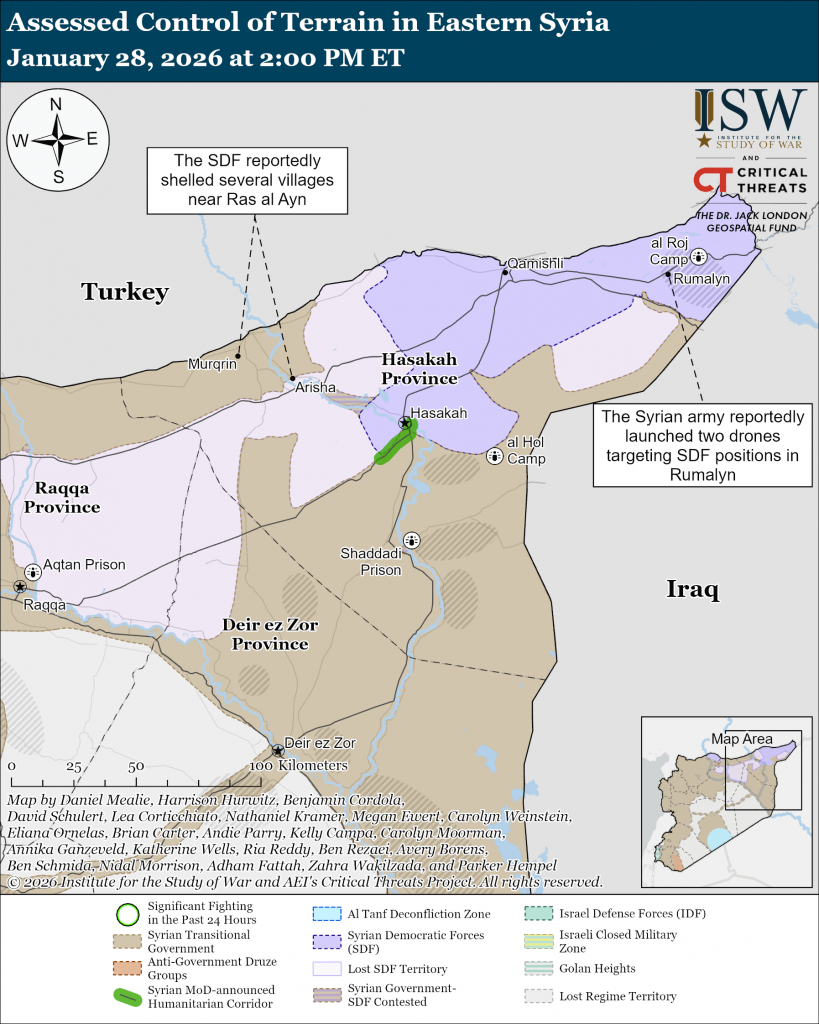
The Syrian MoD has reportedly employed Turkish drones and weapons systems in its offensive against the SDF. The MoD likely received these systems as part of a previous Turkish-Syrian security agreement. A spokesperson for the SDF’s People’s Protection Units (YPG) told Western media on January 27 that the Syrian MoD has utilized Turkish drones and armored vehicles during its offensive against the SDF.[xliii] The SDF has reported multiple Turkish drone strikes on its positions since MoD-SDF fighting began on January 12, but it is unclear whether the Turkish or Syrian military operated those drones.[xliv] The YPG spokesperson added that the Turkish military has limited its drone strikes on SDF positions to rural areas, which supports CTP-ISW's previous assessment that the Turkish military has provided the MoD with limited air support during its offensive.[xlv] Turkey has denied its involvement in the MoD’s offensive, however.[xlvi] The Syrian MoD likely received Turkish military equipment, including drones, as part of the August 2025 security agreement between Turkey and Syria, which provided Turkish training, technical support, and military equipment to the MoD.[xlvii] The Turkish Chief of Staff discussed developments in Syria with his Syrian counterpart in a phone call on January 28.[xlviii]
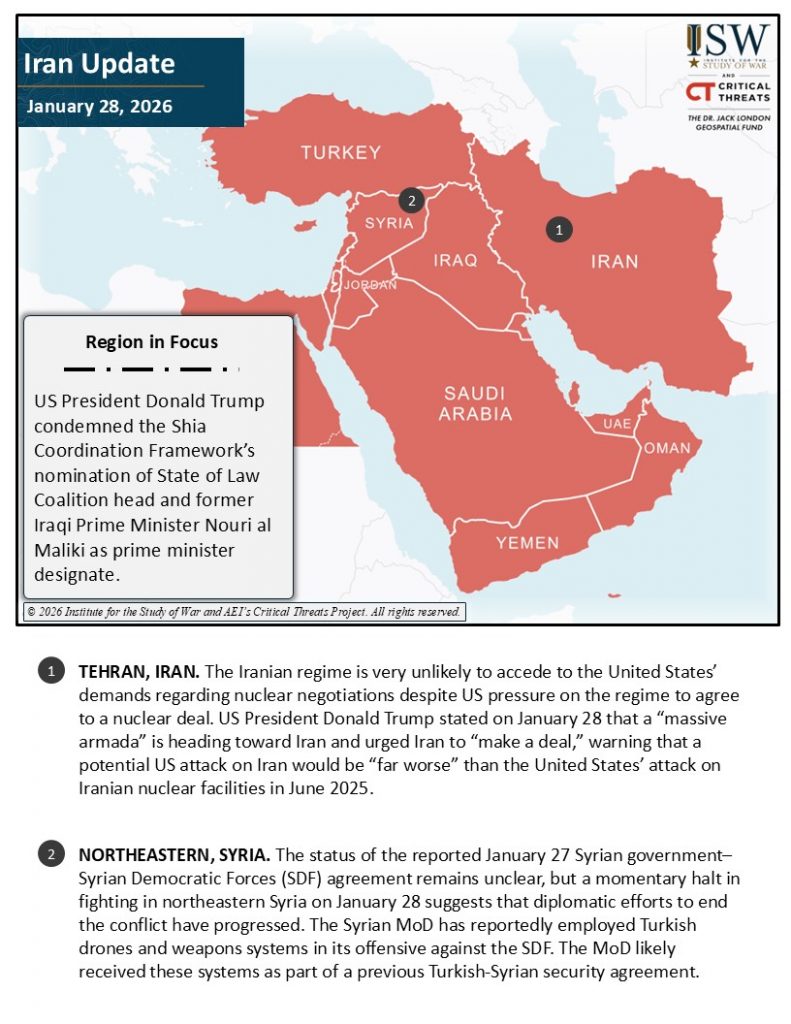
Key Takeaways
- US Rejection of Nouri al Maliki for the Iraqi Premiership: US President Donald Trump condemned on January 27 the Shia Coordination Framework’s nomination of State of Law Coalition head and former Iraqi Prime Minister Nouri al Maliki as prime minister designate. It is unclear if the framework will insist on Maliki’s nomination or bow to US pressure against Maliki.
- US-Iran Nuclear Negotiations: The Iranian regime is very unlikely to accede to the United States’ demands regarding nuclear negotiations despite US pressure on the regime to agree to a nuclear deal. US President Donald Trump stated on January 28 that a “massive armada” is heading toward Iran and urged Iran to “make a deal,” warning that a potential US attack on Iran would be “far worse” than the United States’ attack on Iranian nuclear facilities in June 2025.
- Iranian Regime Security Forces: The Iranian regime has offered incentives for conscripts, possibly to try to increase the size of the Iranian armed forces amid reports of some security forces members’ disaffection with the regime’s brutal crackdown on the recent protests. The Law Enforcement Command’s (LEC) Public Service Organization announced on January 28 that it is reducing mandatory service time, allowing deployment delays, assigning recruits to units based on skill sets, and forgiving absences from mandatory service.
- Syrian Government-Syrian Democratic Forces (SDF) Ceasefire: The status of the reported January 27 Syrian government–Syrian Democratic Forces (SDF) agreement remains unclear, but a momentary halt in fighting in northeastern Syria on January 28 suggests that diplomatic efforts to end the conflict have progressed. The Syrian MoD has reportedly employed Turkish drones and weapons systems in its offensive against the SDF. The MoD likely received these systems as part of a previous Turkish-Syrian security agreement.
The Iranian regime’s ongoing crackdown is exacerbating the economic collapse that spurred the Winter 2026 protests. The crackdown will therefore fail to address the underlying causes of the protests and could create more grievances that drive future protests. The Iranian regime's ongoing securitization measures, which include a costly and prolonged internet shutdown, are accelerating Iran's economic collapse. The country’s economic collapse was the initial trigger for these demonstrations in late December 2025.[i] The crackdown’s economic consequences have struck individual Iranians and businesses alike. The Iranian rial again fell to an all-time low on January 27 (see graphic below), and the price of basic goods has increased 60 percent since mid-December.[ii] The internet shutdown costs the regime about $37 million USD daily.[iii] Iranian online businesses, which are a major part of Iran’s digital economy and generate $1 billion USD annually, have incurred at least $2 million USD in losses daily during the shutdown.[iv] The shutdown has lasted 20 days and is the third-longest internet shutdown globally in history, according to regional media.[v] The regime has made only isolated efforts to compensate businesses, such as by announcing an eight-stage compensation plan for online businesses on January 27.[vi] It is unclear how the government intends to pay for this or future compensation packages, given that the regime is already struggling to generate government revenue. The regime’s challenges in generating revenue have also contributed to protester grievances because the challenges have forced the regime to raise taxes.[vii] The regime’s response prioritizes securitization over addressing root economic causes, which makes future protests more likely.[viii]
The regime’s decision to persist with its crackdown indicates that the regime continues to fear protests and understands that protests only temporarily stopped due to the widespread securitization and fear caused by the regime’s extreme violence.[ix] The violent crackdown may slow or stop protests temporarily, but it will not stop protests from occurring again in the future. This violence will temporarily deter people from protesting, but anger and frustration with the regime remain. Anecdotal reports from protester funerals and other commemorations in recent weeks indicate that Iranians continue to detest the regime and could protest if security pressure were lifted.[x] The regime has killed thousands of protesters, and security forces have arrested 41,880 people—more than double the number arrested in the 2022 Mahsa Amini protests.[xi] Iranian judiciary officials have meanwhile threatened to show “no leniency” towards the arrested protesters.[xii] The internet shutdown demonstrates that the regime recognizes the fundamental reality that the unrest remains an existential threat due to the widespread nature of frustration at the economic situation and anger at the extreme violence the regime employed.[xiii]
The internet shutdown is also liable to contribute to political grievances. The long-lasting internet shutdown has stripped the Iranian people of long-running modern conveniences that they have become accustomed to, including access to an internet-based economy and the ability to communicate relatively easily. The continued imposition of the shutdown will likely continue to aggravate the Iranian people and can create the conditions that can lead to further uprisings. Many Egyptians during the 2011 Tahrir Square protests—according to one study, as many as 27.5% of protesters—only became active protesters after the internet shutdown, for example.[xiv]
Pro-government Syrian media reported that the Syrian Democratic Forces (SDF) and Syrian government reached a new “understanding” on January 27 to deploy Ministry of Interior (MoI) forces to Hasakah Province, which would be a tangible step towards the civil integration of the province into the Syrian state. Syrian President Ahmed al Shara met with SDF Commander Mazloum Abdi and Autonomous Administration of North and East Syria official Ilham Ahmed in Damascus on December 17, reportedly along with US and French mediators.[xv] Unspecified sources told a Turkey-based, pro-government Syrian media outlet that Shara and Abdi agreed to a ceasefire on all fronts and to the deployment of MoI forces to Hasakah City, Qamishli, and other unspecified areas.[xvi] A January 20 agreement between Shara and Abdi had banned government forces from entering Hasakah City, Qamishli, and Kurdish-majority towns and villages.[xvii] The sources said that the agreement will be announced and implemented within the next few days.[xviii] Neither the Syrian government nor the SDF has officially acknowledged the ”understanding” as described by the aforementioned Syrian outlet’s sources, but the outlet has access to and consistently cites Syrian government officials and those with knowledge of the negotiations with the SDF. Shara spoke with US President Donald Trump after he met with Abdi on January 27.[xix] Trump told reporters after his call with Shara that he is ”very happy about” the situation in Syria and that it is”working out very well.”[xx] An anti-SDF, Deir ez Zor-based source alleged on January 27 that SDF-affiliated internal security forces asked fighters for initial registration information for those who seek to work under the Syrian state‘s Interior Ministry.[xxi]
The deployment of MoI forces, which is a gendarmerie that has already deployed to secure most of government-controlled northeastern Syria, would represent a significant step towards the civil integration of the area into the state that the SDF has largely refused to indulge thus far.[xxii] Shara initially gave Abdi four days (later extended by an additional 15 days) to consult with SDF leaders and secure their agreement to Shara’s terms for the integration of the SDF and present a practical plan for the integration of the remaining SDF-held territory into the Syrian state.[xxiii] SDF fighters will reportedly remain deployed to their current positions as part of the new ”understanding,” which suggests that Shara and Abdi have not yet agreed upon a clear mechanism to integrate SDF fighters into state security services.[xxiv] Some hardline elements within the SDF’s leadership may pressure Abdi to reject Shara’s terms for the SDF’s integration, given how Kurdistan Workers’ Party (PKK)-aligned leaders have subverted and delayed previous rounds of negotiations.[xxv]
Other non-SDF Kurdish political factions are pressuring Abdi to disregard the People’s Protection Units (YPG) and its political wing, the Democratic Union Party (PYD). Syrian media reported that the Kurdish National Council (KNC), a coalition of Syrian Kurdish political parties that does not include the PYD, urged Abdi to avoid any future “catastrophic” military conflicts with the Syrian government and prioritize negotiations and dialogue during a meeting in Hasakah on January 25.[xxvi] The KNC reportedly holds the SDF and PYD ”responsible” for the conflict in the northeast, according to unspecified sources.[xxvii] The PYD is the KNC’s political rival. The KNC’s request that Abdi disregard pressure from the PYD, and therefore the YPG, to reject Shara’s agreements is notable given that the KNC unified with the PYD and other Kurdish political parties in April 2025 to call for a unified entity that would administer all Kurdish-majority regions in northeastern Syria.[xxviii] The KNC has historically aligned itself with the Kurdistan Democratic Party (KDP) and its president, Masoud Barzani.[xxix] Barzani has emerged as a key interlocutor between Shara and Abdi, who has largely urged restraint and dialogue from both sides.[xxx]
CTP-ISW continues to assess that the SDF’s leadership may fracture over a decision to agree to Shara’s terms for the SDF to integrate into the Syrian state, which would risk instigating serious conflict between government forces and Kurdish fighters. Abdi and Shara may come to an agreement that ends the immediate fighting in northeastern Syria and creates a plan to integrate SDF fighters into state security services, but CTP-ISW is considering that hardliners within the SDF may contribute to future instability within Syria in the following two ways:
- One scenario would involve an insurgency by hardline YPG elements who decide to resume attacks or launch an insurgency against the Syrian government, even if Abdi and other more moderate SDF leaders formally accept Shara’s terms. A senior PKK leader recently called on Kurdish fighters to ”do whatever is necessary” to respond to the war that the Syrian government has launched to remove the “will and status” of the Kurdish people.[xxxi] A suicide attack targeting Syrian government forces that the SDF recently claimed on January 26 indicates that hardline, ideological fighters remain present along frontlines.[xxxii] These fighters are unlikely to accept their own integration into the Syrian state.
This insurgency would likely be slightly more violent and a greater threat to the government than the pro-Assad insurgency that the Syrian government has faced in western Syria since the fall of the Assad regime. Pro-Assad insurgents have formed small groups and intermittently targeted government forces, though the vast majority of these attacks are ineffective. Pro-Assad groups lack unity and widespread public support. Many Alawites do not support Assad’s return. The YPG has better positioned itself as the defender of the Kurdish people over the last decade and may have greater support relative to pro-Assad groups. The YPG is also a relatively unified organization. - A second scenario would entail the formation of a widespread Kurdish insurgency that is not restricted to hardline YPG fighters and includes many nominally unaffiliated Kurds in northeastern Syria. YPG fighters would still form the core of the insurgency’s leadership in this scenario. The Syrian government is currently deliberately undermining the SDF and YPG by introducing limited Kurdish rights and conducting outreach to Kurdish notables, which is likely designed to politically subvert the SDF and YPG to prevent future military resistance. Shara has used similar strategies of political subversion to prevent possible adversaries from resisting him militarily (described below).[xxxiii]
Either of the two above scenarios could contribute to a most dangerous course of action in which either Shara or Abdi decides that neither party can move forward with a peaceful agreement to integrate the SDF. A scenario in which Syrian government forces advance into Kurdish areas and confront both Kurdish fighters and civilians could lead to another catastrophic round of communal-based violence. This scenario would also make it extraordinarily difficult for the US forces present in Syria to successfully move ISIS detainees from Syria to Iraq and increase force protection requirements for US forces.
Shara is likely meeting with Kurdish officials from northern Syria in an effort to prevent or mitigate widespread fighting from breaking out between government forces and Kurdish fighters or civilians who are not aligned with the YPG. Shara met with 15 Kurdish notables and community figures from Kobani in Tabqa, Raqqa Province, on an unspecified date after the government seized the city on January 17, according to Kurdish sources.[xxxiv] Shara reiterated that his state would protect Kurdish rights, and the leaders reportedly left the meeting “reassured.”[xxxv] Some of the Kurdish community figures that Shara met with are close to the SDF leadership, while other figures present at the meeting oppose the SDF.[xxxvi] Syrian government forces have surrounded Kobani since January 19 and have continued to engage SDF-affiliated fighters in the Kobani countryside each day, which has increased the risk of violence between the majority Arab Syrian army forces, local Arab tribes, remaining SDF-affiliated fighters, and Kurdish civilians in the area. CTP-ISW has not observed reports that locals in Kobani have armed themselves, but the presence of government forces outside of cities with significant Kurdish populations since January 19 has led many Kurdish residents in Hasakah City, Qamishli, and the Kurdish rural areas near both cities to arm themselves and form local “popular battalions” to defend against any government incursions.[xxxvii] Residents of Kobani have described government forces’ surrounding the city as reminiscent of ISIS’s siege on Kobani in 2014, which is an analogy that may drive some residents to take action to defend the city.[xxxviii] This analogy also implicitly reinforces the idea that the YPG is the sole capable defender of the Kurdish people due to the YPG’s pivotal role in the 2014 Siege of Kobani by ISIS.
Shara’s outreach to Kurdish notables also likely aims to align influential figures from Kobani with the Syrian government and politically weaken the SDF- or YPG-affiliated factions that are currently fighting the government. Such an effort would be consistent with Shara’s historical strategies to co-opt other civil and military groups during the Syrian civil war as the leader of Jabhat al Nusra and later Hayat Tahrir al Sham (HTS). HTS used a combination of incentives, agreements, and repression to politically undermine factions and councils in Idlib Province and draw them into HTS’s sphere of influence between 2020 and 2024, for example.[xxxix] Shara later employed a similar strategy to suppress the Daraa-based Eighth Brigade in April 2025 after it attempted to resist government control by first politically undermining the group in southern Daraa, which enabled Shara’s government to destroy the group without a fight.[xl] Efforts to liaise with and build trust with Kurdish notables may seek to weaken the influence of Kurdish hardliners, such as some fighters and leaders within the YPG, among other influential Kurdish contingents. Shara reportedly criticized the SDF’s leadership for prioritizing territorial acquisition over Kurdish rights, which appears to be an attempt to drive a wedge between Kurdish leaders and the SDF.[xli] The Syrian government has repeatedly blamed Kurdistan Workers’ Party (PKK)-aligned leaders for subverting and delaying previous rounds of negotiations.
The Syrian government is experiencing some initial challenges in managing al Hol internally displaced persons camp (IDP), partially due to undisciplined and ineffective Ministry of Defense (MoD) units and insufficient training to control the camp. These challenges can be remedied in time, and the Syrian government appears to be learning from some mistakes and correcting its procedures accordingly. Local Syrian sources reported that some camp residents have made multiple escape attempts from al Hol camp in Hasakah Province since Syrian government forces took control of the camp from the SDF on January 20.[xlii] Only one of these escape attempts on January 25 succeeded, however.[xliii] The al Hol camp is the largest IDP camp in Syria and currently contains 14,500 Syrians, 3,700 Iraqis, and 6,000 third-country nationals, some of whom are ISIS supporters.[xliv] A pro-government Syrian source reported that some foreign and ”Arab” women (presumably referring to non-Syrian Arab women) attempted to escape on January 26.[xlv] These individuals are far more likely to be ISIS supporters compared to the camp’s 14,500 Syrians because the foreigners traveled to Syria in the middle of a brutal civil war. ISIS women in al Hol are ardent ISIS supporters who actively support the group by recruiting children and others in the camp.[xlvi]
ISIS families and their supporters have attempted several escape attempts in recent days. An Egyptian member of the 82nd Division, which contains foreign fighters from al Qaeda-affiliated Ansar al Tawhid successfully smuggled Egyptian and Chechen ISIS families from the camp on January 25.[xlvii] Syrian General Security Service (GSS) forces killed the 82nd Division member on January 26.[xlviii] A local Syrian source reported that dozens of ISIS-affiliated families attempted a separate escape from al Hol on January 26 by cutting the camp’s perimeter fence, but GSS forces caught them before they could escape.[xlix] The GSS first deployed to al Hol IDP camp on January 21 after “many” detainees escaped from the camp when the MoD took control of the camp, according to the camp’s director.[l]
GSS and the Syrian government appear to be learning from these early failures and near failures. The deployment of the GSS to al Hol is a positive step; the GSS is a relatively effective and well-disciplined force that has performed well in counterinsurgency efforts against Assadist insurgents in western Syria after the Defense Ministry’s forces massacred Alawites there in March 2025.[li] The GSS deployed additional forces and began monitoring the camps with drones on January 27 in response to the escape attempts by ISIS-affiliated detainees.[lii] The chaotic and uncoordinated nature of the Syrian government takeover of northeastern Syria, coupled with the SDF collapse, has forced the GSS to relearn lessons that the United States and its SDF partners have previously learned. The SDF spent years developing counter-ISIS operations in al Hol, and the United States provided the SDF with intelligence, surveillance, and reconnaissance (ISR) assets to monitor the camp, capabilities the GSS currently lacks.[liii]
The Syrian government began recruiting and training internal security personnel from provinces it has seized from the SDF to bolster security in newly captured areas. The Syrian Ministry of Interior (MoI) began recruitment of GSS forces in Raqqa, Deir ez Zor, and Hasakah provinces on January 21.[liv] The MoI transported the new GSS recruits to an academy in Damascus City, where they began a two-month training course on January 26. The recruits will return to their respective provinces after training.[lv] The GSS deployed units to Deir ez Zor, Aleppo, and Raqqa provinces on January 19 in an effort to establish basic security in the area, which will prevent looting and other criminal activity and reduce the risk of score settling.[lvi]
The MoI has also begun settling the status of SDF fighters in territory the Syrian government captured from the SDF. The MoI opened centers for SDF fighters to settle their status with the Syrian government and hand over their weapons in Raqqa and Deir ez Zor provinces on January 25 and in Aleppo Province on January 27.[lvii] Most SDF fighters who settled their status with the government were reportedly Arabs who surrendered after the SDF’s Arab contingent collapsed during the MoD’s January 16 offensive.[lviii] This settlement process resembles a previously successful government program to settle the status of Assad regime conscripts, which required fighters to surrender weapons and register their details in exchange for a temporary card that allowed them to return to civilian life and provided protection from arbitrary arrest.[lix] Previous Assadist conscript settlement efforts did not result in conscripts being systematically targeted after they settled their status. Former SDF fighters at settlement centers in Deir ez Zor and Raqqa provinces told pro-government media that authorities treated them well and did not harass them after they settled their status on January 27.[lx]
Key Takeaways
- Iranian Regime Stability: The Iranian regime’s ongoing crackdown is exacerbating the economic collapse that spurred the Winter 2026 protests. The crackdown will therefore fail to address the underlying causes of the protests and could create more grievances that drive future protests. The regime’s decision to persist with its crackdown indicates that the regime continues to fear protests and understands that protests only temporarily stopped due to the widespread securitization and fear caused by the regime’s extreme violence.
- Government-SDF Conflict: Pro-government Syrian media reported that the Syrian Democratic Forces (SDF) and Syrian government reached a new “understanding” on January 27 to deploy Interior Ministry forces to Hasakah Province, which would be a tangible step towards the civil integration of the province into the Syrian state. CTP-ISW continues to assess that the SDF’s leadership may fracture over a decision to agree to Shara’s terms for the SDF to integrate into the Syrian state, which would risk instigating serious conflict between government forces and Kurdish fighters.
- Political Subversion of the SDF: The Syrian government is currently politically undermining hardline SDF and YPG positions by introducing limited Kurdish rights and conducting outreach to Kurdish notables, which is likely designed to politically subvert the SDF and YPG to prevent future military resistance. Shara has used similar strategies of political subversion to prevent possible adversaries from resisting him militarily. Shara outreach to Kurdish notables from northern Syria also likely aims prevent or mitigate widespread resistance by the SDF and YPG against government forces.
- Syrian IDP Camp Security: The Syrian government is experiencing some initial challenges in managing al Hol internally displaced persons camp (IDP), partially due to undisciplined and ineffective Defense Ministry units and insufficient training to control the camp. These challenges can be remedied in time, and the Syrian government appears to be learning from some mistakes and correcting its procedures accordingly. The chaotic and uncoordinated nature of the Syrian government takeover of northeastern Syria, coupled with the SDF collapse, has almost certainly forced the Interior Ministry to relearn lessons about guarding these facilities that the United States and its SDF partners have previously learned.
Iraqi Shia Coordination Framework selected State of Law Coalition head and former Prime Minister Nouri al Maliki as prime minister designate on January 24, even though at least four framework members opposed Maliki’s nomination.[i] These dissenting framework members and their parties could attempt to block the Iraqi presidential election in order to try to delay or prevent Maliki from becoming prime minister. The Shia Coordination Framework is a loose coalition of Shia political parties, some of which Iran backs. The framework selected Maliki by a majority vote with National State Forces Alliance head Ammar al Hakim, Asaib Ahl al Haq head Qais al Khazali, and former Prime Minister Haider al Abadi opposing his nomination. Abadi did not participate in the November 2025 parliamentary elections but appears to maintain influence within the framework.[ii] There have been conflicting Iraqi media reports about whether the fourth framework member who opposes Maliki is Labor Minister Ahmed al Asadi or Services Alliance and Kataib al Imam Ali head Shibl al Zaidi.[iii] Asadi is a member of Iraqi Prime Minister Mohammad Shia al Sudani’s coalition.[iv] A National State Forces Alliance parliamentarian told Iraqi media that Hakim did not support Maliki due to Maliki’s “working methods and priorities to run the [Iraqi] state and deal with the crisis at this stage.”[v] Iraqi media reported on January 26 that Maliki rejected Hakim’s request to “chair” the framework and control the Ministry of Oil in return for Hakim’s support for Maliki’s nomination, according to information circulated by “online platforms close to Maliki.”[vi] An unspecified Shia leader told Iraqi media on January 26 that the framework had tried to avoid selecting a prime minister designate via a majority, as opposed to a consensus, due to the “implications of [framework] division.”[vii] This statement suggests that the framework may be aware that opposition to Maliki among some framework members could cause these members to try to delay or prevent Maliki from becoming prime minister. Parliament must elect a president by a simple majority with a two-thirds quorum before the newly elected president selects the prime minister designate to form a government.[viii] The framework blocked the 2022 presidential election by preventing the quorum in order to prevent Shia nationalist cleric Muqtada al Sadr from forming a government without Iranian-backed parties.[ix] Parliament is scheduled to vote on a president on January 27, but the process may last for more than one session given that 18 candidates are currently competing for the presidency.[x] The parties within the framework that oppose Maliki’s nomination control between 48 and 51 seats, depending on who the fourth framework member opposed to Maliki is. 108 seats are required to block the presidential election.[xi]
The spokesperson of Iraqi Prime Minister Mohammad Shia al Sudani’s Reconstruction and Development Coalition stated on January 25 that the coalition supports Maliki’s nomination.[xii] Maliki may have offered Sudani spoils in the new government to persuade Sudani to forgo the premiership. The spokesperson said that the coalition will form a parliamentary coordinating committee to “unify positions and visions” with the next Iraqi government.[xiii] Maliki offered former Prime Minister Ayad Allawi control of the now defunct National Council for Strategic Policies as a spoil following the 2010 elections and successfully secured the premiership despite Allawi’s coalition winning a plurality of votes.[xiv] Maliki may have similarly offered spoils to Sudani to gain Sudani’s support for his premiership. Sudani reportedly conditioned his withdrawal from the premiership race on January 12 on Maliki’s fulfillment of a list of conditions that Maliki unlikely met.[xv] Sudani’s conditions reportedly included the approval of all framework leaders, Grand Ayatollah Ali al Sistani, Shia nationalist cleric Muqtada al Sadr, and unspecified Kurdish and Sunni political parties for Maliki's nomination.[xvi] CTP-ISW assessed on January 13 that Sudani may have wagered that Maliki would fail to meet these conditions, as Sudani would have reportedly received the premiership with the framework’s backing if this had occurred.[xvii] The framework’s nomination of Maliki and Sudani’s coalition’s support for Maliki despite Maliki’s apparent failure to meet these conditions suggests that Maliki has won Sudani’s favor.
Iraqi Sunni political parties are also divided over Maliki’s nomination.[xviii] Some of the Sunni parties that oppose Maliki could join an effort to block the presidential election. The Sunni National Political Council released a statement on January 24, prior to the announcement of Maliki’s nomination, that implicitly warned the framework against selecting Maliki for the premiership.[xix] Multiple Sunni parties, including the Progress Party, the National Determination Alliance, and the Azm Alliance, formed the Sunni National Political Council in November 2025 to unify their political efforts and positions on key issues.[xx] The council’s statement said that the “deep political, security, and economic crises” that occurred under Maliki’s leadership when he was prime minister between 2006 and 2014 led to serious security failures that allowed the Islamic State in Iraq and al Sham (ISIS) to enter Iraq.[xxi] The Azm Alliance and the National Determination Alliance, which is led by current Defense Minister Thabit al Abbasi, issued statements on January 24 and 25 in support of Maliki’s nomination as prime minister designate.[xxii] An Azm Alliance parliamentarian posted on X that the council’s statement only represents the opinion of Progress Party head Mohammad al Halbousi and not the consensus of the council.[xxiii] Iraqi media reported on January 22 that Halbousi’s recent posts on social media indicate that he opposes Maliki.[xxiv] A Progress Party parliamentarian insisted on January 26 that the council’s statement was formed via consensus, however.[xxv] Azm Alliance head Muthanna al Samarrai discussed “entitlements,” which refers to the control of ministries and other political spoils, with Maliki on January 26, which indicates that Maliki may have offered Samarrai spoils in the new government in exchange for the Azm Alliance’s support.[xxvi] The Progress Party, as well as the other two Sunni National Political Council parties that have not commented on the council’s statement, control 36 seats in parliament.[xxvii] Those 36 seats combined with the seats held by framework parties opposed to Maliki means that only 21 to 24 additional parliamentarians would be needed to block the presidential election.
An Iraqi political source told AFP on January 26 that the United States remembers Maliki’s previous terms “in a negative light,” which underscores Maliki’s historic role in driving instability in Iraq.[xxviii] Maliki pursued sectarian and authoritarian policies while in office that led to the rise of ISIS in Iraq.[xxix] Maliki’s mismanagement of the Iraqi Security Forces led to ISIS’s seizure of almost a third of Iraqi territory in 2014.[xxx] The United States ultimately delayed support for Iraq in 2014 until Maliki was removed from power due to his direct role in destabilizing Iraq.[xxxi] Maliki has previously also proven his willingness to work with Iranian-backed Iraqi actors and militias to preserve his personal power, especially after the United States withdrew from Iraq in 2011.[xxxii] A member of Maliki’s coalition claimed on January 25 that Maliki would restrict weapons to the Iraqi state while in office.[xxxiii] An unidentified senior Iraqi official similarly told a Kurdish journalist in December 2025 that Maliki told the United States via unspecified mediators that he would disarm Iranian-backed Iraqi militias if the United States supported his bid for the premiership.[xxxiv] CTP-ISW assessed at the time that Maliki would likely attempt to transform elements of the Iraqi security establishment into a force that he could use to enhance his personal power as prime minister.[xxxv] US Secretary of State Marco Rubio held a phone call with Sudani on January 25 in which Rubio warned against the formation of an Iranian-controlled Iraqi government.[xxxvi] The United States has continuously pressured the Iraqi federal government to reduce Iranian influence in Iraq, including by pushing the government to exclude figures from the new Iraqi government who have ties to Iranian-backed Iraqi militias.[xxxvii]
Several members of Iran’s Axis of Resistance have threatened to retaliate if the United States attacks Iran, likely to try to deter the United States from attacking Iran. These militias are very likely observing and reacting to ongoing discussions in Western and Israeli media about US concerns about a protracted conflict in the Middle East and likely seek to exploit these concerns by threatening to expand a potential conflict. Iranian-backed Iraqi militia Kataib Hezbollah Secretary General Abu Hussein al Hamidawi stated on January 25 that the Axis of Resistance would support Iran against Israel and the United States and called on Kataib Hezbollah fighters to “prepare” themselves.[xxxviii] Unspecified Iraqi sources similarly told Islamic Revolutionary Guards Corps (IRGC)-affiliated media that Iraqi groups have "sounded the trumpet of war" and that "all personnel are being armed and are ready" to attack US bases.[xxxix] The Houthis separately posted a video on January 25 of its January 2024 attack on a British oil tanker with the caption “soon.”[xl] The Houthis likely posted this video to implicitly threaten to resume its attacks against international shipping or US military vessels if the United States attacks Iran. Hezbollah Secretary General Naim Qassem additionally stated on January 26 that Hezbollah would not remain “neutral” if the United States attacks Iran and, more specifically, Iranian Supreme Leader Ali Khamenei.[xli] These statements are likely a response to recent media reports that the United States does not want a wider regional war.[xlii] These groups are likely threatening to get involved and expand a potential conflict in order to try to deter a US attack against Iran.
It is unclear if the Axis of Resistance would react to a US strike on Iran in the same way that it did during the June 2025 Israel-Iran War because these groups may assess that the United States’ current objectives against Iran are different from the objectives it pursued during the war. Hezbollah, the Houthis, and Iranian-backed Iraqi militias previously threatened to intervene in the June 2025 Israel-Iran War if the United States attacked Iran.[xliii] Those threats aimed to deter US participation in the war. The Axis of Resistance failed to meaningfully intervene and impose costs on Israel or the United States for their attacks against Iran despite its threatening statements.[xliv] The Axis of Resistance may assess that the United States’ objectives in a potential attack against Iran are different from the United States’ objective in June 2025 to degrade the Iranian nuclear program.[xlv] The Axis of Resistance may therefore react differently than it did in June 2025, particularly if it perceived that a US attack posed an existential threat to the Iranian regime. US officials suggested to Israeli media on January 26 that a US strike on Iran would seek to facilitate regime change.[xlvi]
Some members of the Axis of Resistance, particularly Lebanese Hezbollah and Iranian-backed Iraqi militias, face domestic constraints that may limit their ability to retaliate if the United States attacks Iran. Lebanese Hezbollah has continuously prioritized reconstitution and avoided direct conflict with Israel and the United States following the November 2024 Israel-Hezbollah ceasefire agreement.[xlvii] Hezbollah has not responded militarily to any Israeli strikes targeting Hezbollah military infrastructure and personnel in recent months, including Israel’s killing of Hezbollah’s “de facto chief of staff” and senior commander Haitham Ali Tabatabai in November 2025.[xlviii] Hezbollah likely opposes any intervention in a potential US-Iran conflict that would threaten the Israel-Hezbollah ceasefire agreement because such action would undermine Hezbollah’s objectives of limiting Israel’s presence and operational scope in Lebanon. A US or Israeli response against Hezbollah would also likely disrupt Hezbollah’s current efforts to reconstitute its forces and weapons stockpiles. Iranian-backed Iraqi militias like Kataib Hezbollah may also be hesitant to intervene in a renewed conflict because the militias’ participation could have repercussions on their domestic political efforts. The ongoing Iraqi government formation process is important for Iraqi militias because it will determine the ability of Iranian-backed actors to dominate Iraq and support Iranian interests within the country.[xlix] An Iraqi militia attack on the United States could prompt some Iraqi political parties to distance themselves from Iranian-backed militias, particularly if militia actions risk dragging Iraq into a conflict with the United States. Militia operations that trigger US action in Iraq are generally unpopular domestically.[l]
Iran has covered the anti-drone cage at the Pilot Fuel Enrichment Plant (PFEP) at the Natanz Nuclear Complex with panels, which the Institute for Science and International Security previously assessed are meant to allow Iran to explore the rubble at the site discreetly.[li] It is unclear if Iran has repaired the anti-drone cage under the panels. Commercially available satellite imagery from January 26 shows that Iran has completely covered the PFEP’s anti-drone cage with panels.[lii] Israeli airstrikes destroyed the PFEP during the Israel-Iran War.[liii] The PFEP housed over 1,700 centrifuges, including IR-2m, IR-4, and IR-6 centrifuges, which Iran used to enrich uranium, including 60 percent enriched uranium.[liv] The Israeli airstrikes almost certainly destroyed or rendered inoperable most, if not all, of the centrifuges at the facility.[lv] Damage to the anti-drone cage and the internal structure was still visible in imagery from December 12, 2025.[lvi] It is unclear if Iran completed rebuilding the anti-drone cage before covering the facility with panels.
Fighting between the Syrian army and the Syrian Democratic Forces (SDF) continued on January 26 but did not collapse the January 20 ceasefire or disrupt ongoing US transfers of ISIS detainees from Syria to Iraq. The Syrian government and the SDF agreed on January 20 to a four-day ceasefire, which they extended by 15 days on January 24.[lvii] The Syrian army and the SDF have continued to engage each other along frontlines in the Kobani and Qamishli countrysides since agreeing to the ceasefire.[lviii] The Syrian army engaged SDF forces in Jabaliyah and Kharabat al Ashaq, Aleppo Province, along the Kobani axis, on January 25 and 26, before advancing and capturing the nearby Lafarge Cement Factory on January 26.[lix] The Lafarge Cement Factory has several tall buildings and structures that provide the Syrian army with clear lines of sight to nearby SDF positions, particularly along the M4 highway.[lx] The Syrian army and SDF forces also engaged each other with heavy weaponry, artillery, and drones near al Safa, Hasakah Province, on the Qamishli axis on January 26.[lxi] Pro-SDF and pro-government sources reported that Turkish drones conducted reconnaissance and struck al Safa on January 26.[lxii] The Syrian army and the SDF did not engage in clashes near Hasakah City and the fighting along the Kobani and Qamishli axes did not disrupt US efforts to transfer ISIS detainees from Syria to Iraq.[lxiii]
The Syrian government and the SDF have made some progress on integration negotiations during the ceasefire. SDF Commander Mazloum Abdi told Kurdish media on January 25 that he proposed individuals for senior positions in the Syrian government, including assistant defense minister and Hasakah governor.[lxiv] The January 18 ceasefire proposal signed by Syrian President Ahmed al Shara and Abdi allowed the SDF to choose appointees for senior roles in the Syrian government. That Abdi is following up on the provisions set out in the January 18 proposal is positive but does not mean that other SDF leaders will agree to Shara’s negotiation terms. CTP-ISW assessed on January 21 that the most likely course of action entails Abdi and a subset of more moderate SDF leaders agreeing to Shara’s terms while some hardline SDF leaders refuse to capitulate and continue to fight.[lxv] Abdi reached out to Iraqi Kurdish leaders Masrour Barzani and Bafel Talabani on January 26 for support in the ongoing negotiations.[lxvi] Iraqi Kurdish leaders have previously facilitated meetings between US officials and Abdi to negotiate the ceasefire and the SDF’s integration.[lxvii]
Ongoing SDF-Syrian government fighting caused the Russian military to abandon its only base in northeastern Syria on January 26. Multiple Syrian sources reported that the Russian military evacuated its forces and equipment from the Qamishli Airport in Hasakah Province on January 26.[lxviii] Russia established a base at the Qamishli Airport in 2019 and later reestablished its presence there in March 2025 after the fall of Assad in December 2024.[lxix] An unspecified Syrian source told Reuters on January 26 that the Russian military would transfer some troops to Hmeimim Airbase in Latakia Province and send others back to Russia.[lxx] The SDF captured some of the Russian military equipment that was left at the base and will likely use it to fight the Syrian army if fighting resumes.[lxxi] The Russian equipment that the SDF captured is unlikely to improve the SDF’s defensive capabilities against MoD offensive operations, however, because the equipment does not appear to be advanced or heavily armored.[lxxii]
Key Takeaways
- Iraqi Government Formation: The Iraqi Shia Coordination Framework selected State of Law Coalition head and former Prime Minister Nouri al Maliki as prime minister designate on January 24, even though at least four framework members opposed Maliki’s nomination. These dissenting framework members and their parties, as well as some Sunni parties that oppose Maliki, could attempt to block the Iraqi presidential election in order to try to delay or prevent Maliki from becoming prime minister. An Iraqi political source told AFP on January 26 that the United States remembers Maliki’s previous terms “in a negative light,” which underscores Maliki’s historic role in driving instability in Iraq.
- The Axis of Resistance’s Efforts to Deter a US Attack on Iran: Several members of Iran’s Axis of Resistance have threatened to retaliate if the United States attacks Iran, likely to try to deter the United States from attacking Iran. These militias are very likely observing and reacting to ongoing discussions in Western and Israeli media about US concerns about a protracted conflict in the Middle East and likely seek to exploit these concerns by threatening to expand a potential conflict. Some members of the Axis of Resistance, particularly Lebanese Hezbollah and Iranian-backed Iraqi militias, face domestic constraints that may limit their ability to retaliate if the United States attacks Iran.
- Repairs at Natanz Nuclear Complex: Iran has covered the anti-drone cage at the Pilot Fuel Enrichment Plant at the Natanz Nuclear Complex with panels, which the Institute for Science and International Security previously assessed are meant to allow Iran to explore the rubble at the site discreetly. It is unclear if Iran has repaired the anti-drone cage under the panels.
- Syrian Government-SDF Conflict: Fighting between the Syrian army and the Syrian Democratic Forces (SDF) continued on January 26 but did not collapse the January 20 ceasefire or disrupt ongoing US transfers of ISIS detainees from Syria to Iraq. The Syrian government and the SDF have made some progress on integration negotiations during the ceasefire.
Key Takeaways
- Dissent Within the Iranian Regime: Some Iranian officials have continued to leak damning information about the regime’s brutal crackdown to Western media, which indicates that some regime personnel may oppose the regime’s crackdown. The leaks also undermine the regime's ongoing information operation that seeks to portray the regime and Iranian security forces as victims of "terrorism" and conceal the regime's use of lethal force.
- Internet Access in Iran: The Iranian regime has not restored international internet access, and there continues to be an internal debate within the regime about restoring it. The debate primarily seems to be between regime factions that assess that restoring the internet could cause a resumption of protests and factions that assess that the economic toll of the internet shutdown could cause internal unrest.
- Syrian government-SDF conflict: The extension of the Syrian government-Syrian Democratic Forces (SDF) ceasefire is enabling the government to deliver humanitarian aid to SDF-controlled areas in northern Syria. The Syrian army established two humanitarian corridors in Kobani and Hasakah City. The Syrian government did not call on civilians in Kobani or Hasakah City to use the corridors to evacuate from these cities, which suggests that government forces do not plan to imminently launch an operation to advance into either city.
Takeaways
- Syria: The Syrian government and the Syrian Democratic Forces (SDF) agreed to extend their ceasefire in northeastern Syria for 15 days on January 24. The continued ceasefire will help ensure that the government offensive does not inflict lasting harm on US counter-Islamic State in Iraq and al Sham (ISIS) objectives in northeastern Syria because it will create stable conditions for Syrian government forces to deploy to and secure ISIS detention facilities. The ceasefire will also enable US forces to continue to transfer ISIS detainees from Syria.
- Iranian Nuclear Program: The Institute for Science and International Security reported on January 22 that Iran is encasing a newly built facility at Taleghan 2 at the Parchin Military Complex in a concrete “sarcophagus” to harden the facility against potential airstrikes. The Institute reported that the facility houses a cylindrical chamber that resembles a high explosive test chamber.
- Iranian Leadership: Anti-regime media claimed on January 24 that Iranian Supreme Leader Ali Khamenei has moved into an underground shelter in Tehran Province, according to two unspecified sources close to the regime. The sources added that Khamenei’s third son, Masoud, has assumed day-to-day oversight of the Supreme Leader’s office and is now the primary conduit for coordination with the government’s executive institutions.
The Syrian government and the Syrian Democratic Forces (SDF) may agree to extend the US-mediated ceasefire, according to Kurdish sources and mediators. The Syrian government and SDF agreed to a ceasefire on January 20 that gave SDF Commander Mazloum Abdi four days to secure other SDF leaders’ agreement to Syrian President Ahmed al Shara’s terms, which include the integration of the SDF and its remaining territory into the Syrian state.[i] Abdi has around 24 hours remaining, as of the time of this writing, to “develop a detailed plan” to integrate the SDF and its territory into the Syrian state. Unspecified Kurdish political sources affiliated with the SDF and the Iraqi Kurdistan Regional Government (KRG) told Qatari-owned, UK-based media on January 23 that Abdi and US Ambassador to Turkey and Special Envoy to Syria Tom Barrack reached an “understanding” to extend the ceasefire between Syrian government forces and the SDF.[ii] Barrack and Abdi met in Erbil, Iraq, on January 22.[iii] The sources said that Barrack and Abdi gave “mutual assurances” that there will be “no return to war.”[iv] A spokesperson for KRG President Nechirvan Barzani, who facilitated the January 22 meeting, told Kurdish media on January 22 that Barzani has urged US mediators and Syrian officials to extend the truce and warned that a short ceasefire of “two to four days” is “insufficient” to resolve the conflict.[v] Abdi and Autonomous Administration of North and East Syria Foreign Affairs Co-Chair Ilham Ahmed support the ceasefire extension, according to Barzani’s spokesperson.[vi] Turkish Foreign Minister Hakan Fidan told Turkish media on January 23 that extending the ceasefire “may be considered” given that the US transfer of Islamic State in Iraq and al Sham (ISIS) detainees from Syria to Iraq is still underway, suggesting that Ankara could also support an extension.[vii]
Abdi may not be able to secure support from other SDF leaders for Shara’s terms, even if the ceasefire is extended to allow him more time to consult with SDF leadership. CTP-ISW assessed on January 21 that the most likely course of action entails Abdi and a subset of more moderate SDF leaders agreeing to Shara’s terms while some hardline SDF leaders refuse to capitulate and continue to fight.[viii] It also remains unclear whether the Syrian government would support the ceasefire’s extension. A Syrian government official told Reuters on January 23 that Syrian and SDF officials have not discussed a ceasefire extension.[ix] The official also said that the government has not yet received a response from Abdi about the SDF’s integration plan.[x]
The ceasefire is facilitating US forces’ transfer of ISIS detainees from Syria to Iraq and enabling Syrian government forces to secure detention facilities and internally displaced persons (IDP) camps that house ISIS supporters. US forces have continued to transfer ISIS detainees from Syria to Iraq since the ceasefire went into effect on January 20, according to Syrian media.[xi] The United States may transfer up to 7,000 ISIS detainees from Syria to Iraqi-controlled facilities, according to US Central Command (CENTCOM).[xii] The US transfer of ISIS detainees from Syria to Iraq mitigates some of the very grave risks that uncoordinated handovers of detention facilities present to US and Syrian counter-ISIS efforts. A successful transfer of all or most of the ISIS detainees will take longer than the 24 hours remaining in the ceasefire, however.[xiii]
An extended ceasefire would enable Syrian government forces to better secure Syrian IDP camps that house ISIS supporters. Syrian Interior Ministry forces deployed on January 21 to al Hol camp, which hosts 14,500 Syrians, 3,700 Iraqis, and 6,000 third country nationals, many of whom are ISIS supporters.[xiv] Certain sections of al Hol camp are functionally under ISIS control.[xv] The SDF and Syrian government did not coordinate the handover of al Hol camp, and the camp’s director said that “many” detainees escaped from al Hol in the chaos as the Syrian army advanced on the camp.[xvi] The SDF still controls al Roj camp, which houses about 2,500 detainees.[xvii] An unspecified senior Syrian official said on January 21 that the Syrian government is engaging with the United States over a possible coordinated handover of al Roj camp.[xviii] Syrian forces have advanced to within 24 kilometers of al Roj camp as of January 23. The success of US efforts to ensure that the government offensive does not inflict lasting harm on US counter-ISIS objectives in northeastern Syria is conditional upon stable conditions on the ground in order for Syrian government forces to deploy to and secure these facilities.
The brief pause in fighting has also enabled the Syrian government and SDF to successfully arrange the handover of Aqtan Prison, which is an ISIS detention facility near Raqqa City.[xix] The Syrian government assumed control over the prison from the SDF on January 23 after a four-day siege on SDF units inside the prison.[xx] A Syrian government source said that an “internationally-sponsored agreement” facilitated the handover.[xxi] About 800 SDF fighters withdrew from the facility to Kobani under the agreement.[xxii] The fighting for control over Aqtan Prison bore similarities to SDF-government fighting at al Shaddadi Prison, which resulted in the release of over 100 ISIS fighters into the surrounding area on January 19.[xxiii] Forces in the area were still searching for about 30 released ISIS fighters as of January 21, according to a Syrian security service member.[xxiv]
Both the SDF and Syrian Ministry of Defense (MoD) continue to send reinforcements to contact lines in Hasakah Province despite indications that the ceasefire could be extended beyond January 24. CTP-ISW previously assessed that the SDF could use the four-day ceasefire to reorganize itself and prepare its hardened, ideological Kurdish People’s Protection Units (YPG) to defend Kurdish villages and cities against future government attacks.[xxv] Kurdish forces reportedly deployed from Qamishli to Hasakah City and contact lines in southern Hasakah Province on January 23.[xxvi] Kurdish residents in Qamishli, Hasakah City, and Tal Tamr have mobilized and organized themselves into popular battalions in anticipation of the government‘s offensive resuming.[xxvii] Kurds are also arriving in Syria from Iraq ”of their own accord” to defend Syrian Kurds, according to an analyst who focuses on the Turkish-Kurdish conflict..[xxviii] Kurdistan Democratic Party (KDP) leader Masoud Barzani stated on January 23 that he would send Kurdish Peshmerga forces to Kobani if given the ”opportunity.”[xxix] It is extremely unlikely that Barzani will have the “opportunity“ to deploy the Peshmerga to Kobani because Kobani is surrounded by Turkish and Syrian actors who would be very unlikely to allow the passage of Peshmerga forces into the exclave. Iraqi Kurdish reinforcements reached Kobani through Turkey in 2014 during the campaign against ISIS only after significant US pressure on Turkey.[xxx] The MoD also deployed additional reinforcements to Hasakah Province on January 23.[xxxi]
The Syrian government has deployed at least three Aleppo-based Syrian divisions along Kobani frontlines that contain militias or fighters that have participated in Turkish-backed offensives targeting the YPG in northern Syria and, in some cases, committed human rights abuses against Kurdish civilians.[xxxii] Turkey launched three successive campaigns in northern Syria against the Kurds during the civil war. These operations, executed with support from Turkish-backed Syrian National Army (SNA) factions, forcibly displaced Kurdish civilians and replaced them with Syrian refugees living in Turkey, which constitutes ethnic cleansing.[xxxiii] The Syrian army has surrounded SDF fighters in Kobani as of January 22, likely as the first part of a multi-stage operation to reduce the SDF forces there.[xxxiv] The units currently deployed along Kobani frontlines would presumably participate in a government assault on Kobani. Syrian army divisions are comprised of re-flagged opposition militias in addition to new recruits, and CTP-ISW cannot confirm with high confidence the individual militias or fighters that are deployed near Kobani. CTP-ISW assesses that there are likely elements of at least three Syrian divisions currently deployed along Kobani frontlines as of January 23:
- The 72nd Division is reportedly operating near Sarrin, south of Kobani.[xxxv] Likely former Hayat Tahrir al Sham (HTS) commander Brigadier General Aqil Mohammad al Amer commands the division, but it is unclear which 72nd Division units are present near Kobani.[xxxvi] The 72nd Division contains elements from several SNA militias that participated in Turkish-backed offensives targeting Kurdish fighters in northern Syria, including the Sultan Murad Division and Sultan Mehmed Fatih Division.[xxxvii] The Sultan Murad Division committed human rights abuses against Kurdish civilians and detainees throughout the civil war, and the European Union recently sanctioned the Sultan Murad Division in May 2025 for its involvement in human rights abuses on the Syrian coast in March 2025.[xxxviii] The 72nd Division reportedly secured the Sarrin Airport, south of Kobani, on January 23, possibly after deploying to the area from its positions near Tal Abyad, which is in the former SNA-controlled Peace Spring region.[xxxix] Assistant Defense Minister Fahim Issa visited 72nd Division units in the Peace Spring region on December 23 to discuss ”military readiness” and may have discussed coordination for an army offensive against SDF-held territory.[xl]
- The 76th Division is reportedly operating along the eastern bank of the Euphrates River, north of Sarrin.[xli] The division is dominated by the Hamza Division, which is a Turkish-backed Syrian faction that the United States sanctioned in 2023 for committing abuses against Syrian Kurds.[xlii] The Hamza Division also conducted arbitrary killings, torture, and other targeted violence against Alawites in early March 2025.[xliii] The United States and European Union have sanctioned 76th Division commander Brigadier General Sayf al Din Boulad (Sayf Abu Bakr) for committing human rights abuses as commander of the Hamza Division.[xliv] Abu Bakr and the Hamza Division have fought in several Turkish operations against the YPG in northern Syria.[xlv] Syrian media reported that Abu Bakr and the 76th Division secured Tishreen Dam on January 19 and later secured the former site of the Suleiman Shah mausoleum near the Qara Qozak Bridge on January 20.[xlvi] Local media later circulated reports that the 76th Division was operating along government-SDF frontlines near al Shuyoukh, along the eastern bank of the Euphrates River.[xlvii]
- The 80th Division is reportedly operating in the southern Kobani countryside.[xlviii] Brigadier General Ahmed Mohammad Rizq commands the 80th Division.[xlix] Rizq is a prominent commander within Harakat Nour al Din al Zenki, which is an Aleppo-based militia that HTS co-opted and subordinated to itself in 2019.[l] The unit contains numerous former Harakat Nour al Din al Zenki fighters, but also likely contains the Mutasim Division, which is a former SNA militia that participated in Turkey’s Operation Euphrates Shield in 2016.[li] Syrian media reported on January 23 that the 80th Division's Third Brigade is also deployed in the Kobani countryside.[lii] Elements of the 80th Division recently participated in government forces’ assault on Deir Hafer.[liii]
Reports of atrocities and summary executions in northeastern Syria risk causing a resumption of intense government-SDF fighting or broader ethnic violence. There continue to be reports of SDF violence against Arab civilians and captured combatants in the Kobani and Hasakah regions.[liv] The Syrian government acknowledged the violence and called on Arab tribes in northeastern Syria to refrain from conducting reprisal attacks.[lv] Syrian President Ahmed al Shara’s Tribal Affairs Adviser, Jihad Issa al Sheikh, said that ethnic-motivated “separatist organizations” intend to “drag Arab tribes into war with the Kurds” and warned the tribes not to deviate from the government’s orders.[lvi] The government has also attempted to address atrocities and extrajudicial violence by creating reporting mechanisms to “redress any injustice or harm” in Deir ez Zor, Raqqa, and Hasakah provinces.[lvii] The SDF has continued to spread evidence of MoD abuses and atrocities against Kurds during the offensive.[lviii]
The Iranian regime has decided to restore international internet access nationwide over the next 24 hours, according to Islamic Revolutionary Guards Corps (IRGC)-affiliated media on January 23.[lix] The regime may assess that the internet shutdown’s negative economic consequences are more likely to reignite protests than allowing Iranian citizens to access the internet. IRGC-affiliated media reported that the regime began restoring international internet access in unspecified locations in Esfahan and Fars provinces on January 22 and would “gradually” restore internet in other provinces.[lx] Internet monitor NetBlocks also observed a “slight rise” in internet connectivity in Iran on January 22.[lxi] Regime elements, including President Masoud Pezeshkian, previously indicated the regime’s awareness of the internet shutdown’s negative impact on the Iranian economy.[lxii] An IRGC-affiliated Telegram channel warned on January 21 that the economic consequences of the shutdown risked “stirring discontent.” Netblocks estimates that the countrywide internet shutdown costs the Iranian economy over $37 million USD per day.[lxiii] The secretary of the Iranian National Security Council told Iranian media on January 21 that this council and the Supreme National Security Council were prioritizing “security” over the economy in regard to the shutdown.[lxiv] These decision-making bodies may have concluded that continuing the internet shutdown poses a greater threat to Iran’s internal security than restoring internet access.
It remains unclear whether the regime will restore international internet access to the whole population, however. Internet monitor Filterwatch reported on January 15 that the Iranian regime is planning to provide international internet access only to individuals with “security clearance.”[lxv] Such a plan would significantly limit the number of Iranian citizens who could interact with internet users outside Iran. Filterwatch added that “users’ access to international internet will never return to its previous form,” which suggests that the regime may restrict who can access the international internet or further restrict the content that Iranians can view online even after it has claimed to “reopen” the international internet.[lxvi]
The Iranian regime is continuing to fail to provide its population with basic services, such as water and energy, which could increase the population’s grievances toward the regime. Iran continues to face a nationwide shortage of natural gas, which is essential for heating systems during winter months. Several provinces across Iran announced the closure of schools, government offices, and banks on January 24 to conserve natural gas.[lxvii] The regime-owned National Iranian Gas Company reported that natural gas consumption reached a record high and called on Iranians to manage their national gas consumption, particularly in northern and northeastern Iran, on January 23.[lxviii] Gas shortages during the winter have previously triggered protests in northern Iran.[lxix]
The regime has also failed to address ongoing water shortages. Reservoirs across Iran are, on average, 35 percent full.[lxx] Iran’s water crisis is particularly acute in Tehran, where four of the reservoirs that provide water to the city are six percent full and therefore unusable..[lxxi] Commercially available satellite imagery between September 2024 and January 2026 corroborates Iranian media reports about decreasing water levels at the Karaj and Latyan reservoirs near Tehran City.[lxxii] The regime attempted to source more water in August 2025 by connecting eastern Tehran City to the Taleghan Reservoir in Alborz Province via a pipeline.[lxxiii] The Taleghan Reservoir’s water levels remain low too, however. Regime-affiliated media reported on January 23 that the reservoir’s water levels have decreased by 56 percent since 2024 and is only 23 percent full.[lxxiv] The only solution that regime officials have provided for the water crisis in Tehran City has been to evacuate residents to another location. Evacuating Tehran’s almost 15 million residents would be a tremendous undertaking and would require the regime to have a place to send citizens that has water, energy, and other basic necessities. The regime has neither stated where it would send Tehran residents nor presented a plan or made visible preparations to evacuate the city. The regime’s continued failure to address the energy and water crises sets Iran on a trajectory toward a possible humanitarian crisis and further popular unrest.
The United States threatened to limit the Iraqi federal government's access to its oil revenue as part of a broader US effort to curb Iranian influence within the Iraqi government. Four unspecified sources told Western media on January 23 that the United States recently threatened senior Iraqi officials with US sanctions, including sanctions targeting Iraq’s oil revenue account at the New York Federal Reserve, if Iranian-backed Iraqi militias are included in the next government.[lxxv] The Central Bank of Iraq (CBI) has managed an account at the New York Federal Reserve on behalf of the Iraqi Finance Ministry since 2003 that holds the Iraqi federal government’s revenue from oil exports in US dollars.[lxxvi] Oil revenue accounts for about 90 percent of Iraq’s state budget.[lxxvii] Curtailing Iraqi government access to its oil revenue account would very likely hinder the Iraqi government's ability to fund domestic spending and provide liquidity for Iraqi banks.
This US threat is part of a broader US effort to limit Iranian influence in Iraq by pressuring the Iraqi government to exclude Iranian-backed Iraqi political actors from Iraq’s government. Five Iraqi officials told Qatari media in December 2025 that the United States told the Shia Coordination Framework and the Iraqi federal government that it will not engage with any prime minister or appointee to the Foreign Affairs Ministry, Defense Ministry, Interior Ministry, Counterterrorism Service, National Intelligence Service, or Iraqi Army Chief of Staff position who has ties to Iranian-backed Iraqi militias.[lxxviii] The Shia Coordination Framework is a loose coalition of Shia political parties, some of which Iran backs. Five unspecified sources told the Financial Times on January 3 that US officials demanded the replacement of newly-elected Iraqi First Deputy Parliament Speaker Adnan Fayhan, who is a member of Sadiqoun, the political bloc of Iranian-backed Iraqi militia Asaib Ahl al Haq.[lxxix]
Key Takeaways
- The SDF-Syrian Government Ceasefire: The Syrian government and the Syrian Democratic Forces (SDF) may agree to extend the US-mediated ceasefire, according to Kurdish sources and mediators. The ceasefire is facilitating US forces’ transfer of ISIS detainees from Syria to Iraq and enabling Syrian government forces to secure detention facilities and internally displaced persons camps that house ISIS supporters.
- Syrian Government Forces near Kobani: The Syrian government has deployed at least three Aleppo-based Syrian divisions along Kobani frontlines that contain militias or fighters that have participated in Turkish-backed offensives targeting the YPG in northern Syria and, in some cases, committed human rights abuses against Kurdish civilians.
- Internet Shutdown in Iran: The Iranian regime has decided to restore international internet access nationwide over the next 24 hours, according to Islamic Revolutionary Guards Corps (IRGC)-affiliated media on January 23. The regime may assess that the internet shutdown’s negative economic consequences are more likely to reignite protests than allowing Iranian citizens to access the internet. It remains unclear whether the regime will restore international internet access to the whole population, however.
- Iran’s Social Service Failures: The Iranian regime is continuing to fail to provide its population with basic services, such as water and energy, which could increase the population’s grievances toward the regime. The regime’s continued failure to address the energy and water crises sets Iran on a trajectory toward a possible humanitarian crisis and further popular unrest.
- Iranian Influence in Iraq: The United States threatened to limit the Iraqi federal government's access to its oil revenue as part of a broader US effort to curb Iranian influence within the Iraqi government.
The Syrian government surrounded Syrian Democratic Forces (SDF) fighters in Kobani, likely as the first part of a multi-stage operation to reduce the SDF forces there. Civilians have fled to Kobani as fighting approached their villages south of Kobani, leading to a larger than standard population there.[i] Civilians in Kobani have no access to electricity or water, though it is unclear at this time whether SDF shelling caused electricity and water infrastructure to fail or if the government deliberately cut Kobani’s access to those resources.[ii] The government claims that SDF caused the outages by damaging energy infrastructure near Tishreen Dam.[iii] This explanation is questionable because such damage would presumably cause outages throughout northern Syria, depending on which infrastructure received damage. The SDF also claimed that the government cut off internet access. Syrian forces and the SDF engaged each other in the entire southern and southwestern countryside of Kobani on January 22 despite the ceasefire.[iv] Syrian government forces appear to control the east-west M4 highway as of January 20, which will also aid their deployment to Kobani and cut off an SDF retreat from Kobani in the absence of a negotiated settlement.[v] A YPJ commander confirmed on January 22 that Kobani is surrounded by government forces and that the SDF is unable to receive reinforcements.[vi]
The next phases of this operation may include the opening of an evacuation route to enable civilians to leave before the main assault. The pattern of events and government deployments around Kobani resembles recent government isolate-and-reduce operations against the SDF in Aleppo City and Deir Hafer, which suggests the Syrian military will employ a similar concept of operations. The Syrian military forced the surrender of SDF-held territory, including the Kurdish exclaves of Ashrafiyeh and Sheikh Maqsoud in Aleppo City, in early January 2026 by cutting off electricity to Ashrafiyeh and Sheikh Maqsoud on January 4, offering an evacuation route on January 7, and surrounding the territory with three divisions by January 8.[vii] The Syrian military then forced the surrender of SDF-held Deir Hafer days later by cutting off electricity to the town on January 12, surrounding it with several divisions by January 13, and announcing an evacuation option on January 14.[viii] The final assault began in Aleppo on January 8 and in Deir Hafer on January 17.[ix] The Deir Hafer and Aleppo cases suggest that the government will open the evacuation corridor sometime in the next several days, and the assault will occur several days after that, probably after the ceasefire (assuming it fails). The Syrian Interior Ministry posted a video of its personnel ready to “deploy to Kobani” on January 22, suggesting that it expects to enter the city soon.[x]
Government forces operating in northeastern Syria have committed isolated violations against local populations, which could trigger the resumption of intense fighting between Kurdish and government forces or broader ethnic violence.[xi] The Military Security and Police Command at the Ministry of Defense acknowledged on January 22 that its fighters had committed violations during the last week, so fighting “despite the clear directives and instructions that were circulated to all relevant units and entities.”[xii] The government has begun legal proceedings against the violators and removed them from the frontlines.[xiii] The government’s public reiteration of its expectations will not be sufficient to stop future violations, however. Violations continue to be a concern because Shara has deployed divisions to the northeast containing abusive militias that have previously launched unsanctioned attacks on minority communities, including Kurds, and significantly destabilized the situation by doing so.[xiv] Reports of violations by elements of the SDF continue to spread on social media and can also trigger reprisals from Syrian government forces.[xv] A series of coordinated attacks that Alawite insurgents launched on government positions on the Syrian coast in March 2025 triggered violent reprisals from Syrian security forces and non-government militias that do not answer to the government’s orders.[xvi] A scenario in which Syrian government forces advance into dense Kurdish areas, such as Kobani, and confront both Kurdish fighters and civilians could lead to another catastrophic round of communal-based violence.
SDF Commander Mazloum Abdi held “productive and constructive” discussions with US officials in Erbil on January 22 about the SDF’s integration into the Syrian state.[xvii] Abdi and the Autonomous Administration of North and East Syria Foreign Affairs Co-Chair Ilham Ahmed met with US Ambassador to Turkey and Special Envoy to Syria Tom Barrack and US Central Command Commander Admiral Brad Cooper.[xviii] Iraqi Kurdistan Regional Government President Nechirvan Barzani facilitated the meeting.[xix] The Syrian government and SDF are currently parties to a ceasefire that allows Abdi four days to secure their agreement to Shara’s terms, which include the integration of the SDF and its remaining territory into the Syrian state.[xx] Abdi’s meetings in Erbil are likely part of his efforts to ”develop a detailed plan” to integrate the SDF and its territory into the Syrian state. The current SDF-government ceasefire gives Abdi about 48 remaining hours to continue these consultations, as of this writing.[xxi]
Neither Abdi nor US officials indicated that any progress has been made towards a permanent ceasefire between the SDF and the Syrian government. Barrack said in a statement after his meeting with Abdi that the United States fully supports “advancing the integration process outlined in the January 18 agreement.”[xxii] The January 18 agreement, which Abdi and Shara both agreed to before Abdi backed out the next day, outlined broad SDF concessions on several of the demands that the SDF has made over the past year, including a clause requiring that the SDF integrates ”on an individual basis” into the Syrian defense and interior ministries.[xxiii] The SDF has long demanded that its fighters integrate as a ”bloc” into the Syrian army, for example.[xxiv] Kurdish media reported that Abdi and Barrack’s meeting resulted in a ”preliminary framework” that integrates Kurdish areas into the Syrian state while retaining some local Kurdish governing authority, citing a participant in the meeting.[xxv] The parties reportedly discussed integrating SDF fighters into the Syrian army under a ”collective structure” rather than individually, as the January 18 agreement specified.[xxvi] Abdi also spoke with Syrian Foreign Minister Asaad al Shaibani on January 22.[xxvii] The phone call went ”smoothly,” according to two unspecified sources familiar with the negotiations.[xxviii]
The Iranian regime is trying to downplay the scale of its brutal crackdown on the protests, despite implicitly admitting its crackdown has been the deadliest in Iran’s modern history. The Iranian National Security Council (NSC) claimed on January 21 that the death toll of the recent protests is 3,117 and that 2,427 of those are the deaths of security forces and “innocent” civilians who were caught in the crosshairs of “terrorist attacks.”[xxix] The regime killed about 1,500 and 550 people during the 2019 and 2022 Mahsa Amini protests, respectively.[xxx] The regime’s claimed death toll for the current wave of protests exceeds the previous two protest death tolls combined, even if the regime’s numbers are accurate. The regime’s numbers are almost certainly lower than the real death toll, however. United Nations Special Representative for Human Rights in Iran Mai Soto estimated on January 19 that the death toll is at least 5,000, adding that reports from doctors inside Iran stated that the number could be 20,000 or more.[xxxi] The regime is also trying to inflate the number of security force deaths by conflating civilians with police. Anti-regime media reported on January 21 that security forces compelled the family of a deceased protester to claim that their son was a Basij member in exchange for his body, which allows the regime to portray itself as the victims of “terrorists.”[xxxii] The regime is also concerned with controlling the outflow of information regarding the death tolls. Iranian President Masoud Pezeshkian stated during a meeting with Iranian medical professionals on January 21 that it is very important to “convince” the medical community about the regime’s narrative on the protests because it would help reduce tensions and control “social consequences.”[xxxiii] Iranian doctors and hospitals can correctly assess the true death toll in Iran and have reported it to Western media.[xxxiv]
Some Iranian security personnel have been reluctant or refused to violently suppress protests. Security forces’ willingness to suppress protests will be a determining factor in the regime’s ability to contain future unrest. The Islamic Revolutionary Guards Corps (IRGC) Intelligence Organization previously issued a statement on January 9 that it is “dealing with possible acts of abandonment,” which may indicate concerns about refusal of orders, desertion, or defection.[xxxv] Anti-regime media, citing unspecified sources in Iran, reported on January 22 that “many” Iranian Law Enforcement Command (LEC) members are “unhappy with the situation,” and are being forced to show up at work under threat of harm.[xxxvi] The LEC is Iran’s national police force and is the regime’s first line of defense during unrest.[xxxvii] Recent reporting also suggests some Iranian security personnel have refused orders, including reports that authorities arrested “dozens” of security forces in Kermanshah Province for refusing to fire on protesters, according to Norway-based human rights group Hengaw on January 8.[xxxviii] An Israeli media outlet separately reported on January 20 that hundreds of junior and mid-level IRGC and Basij officers have defected, according to Western intelligence agencies.[xxxix] It is unclear why these Western intelligence sources would give information to an Israeli outlet before giving this information to a Western outlet, though it is not implausible that they would do so. Norway-based Human Rights media reported on January 21 that Iranian authorities sentenced conscript Javid Khales to death for refusing an order to shoot at protesters, which suggests an effort by the regime to deter others from refusing similar orders.[xl] The regime is unlikely to lose the ability to deploy the LEC, Basij, and IRGC forces, but it could lose the willingness of some personnel to use lethal force, which could make repression less consistent across different locations in the future.
The Shia Coordination Framework continues to debate State of Law Coalition head and former Prime Minister Nouri al Maliki’s nomination as prime minister. The Shia Coordination Framework is a loose coalition of Shia political parties, some of which Iran backs. National State Forces Alliance head Ammar al Hakim and Asaib Ahl al Haq head Qais al Khazali continue to oppose Maliki obtaining the position.[xli] Maliki held separate meetings with Hakim and Khazali on January 18 and 20, almost certainly to gain their support for his premiership bid.[xlii] Current Prime Minister Mohammad Shia al Sudani reportedly conditioned his withdrawal from the race on January 12 on Maliki meeting a list of conditions that Maliki is unlikely to meet at the time of this writing.[xliii] Maliki needs to receive the approval from all framework leaders, Grand Ayatollah Ali al Sistani, Shia nationalist cleric Muqtada al Sadr, and unspecified Kurdish and Sunni political parties in order to win another term, according to information that unspecified actors leaked to Kurdish media.[xliv] CTP-ISW assessed on January 13 that Sudani may be wagering that Maliki will fail to meet these reported conditions, as Sudani would reportedly receive the premiership with the framework’s backing if this occurs.[xlv] Iraqi media noted that recent tweets by Progress Party head Mohammad al Halbousi indicate that Halbousi opposes Maliki serving another term, which means that Maliki may fail to meet another of Sudani’s reported conditions.[xlvi] Iraqi government formation historically includes competition between rival political blocs for power and resources, which is reflected in the framework’s continued debates over the selection of the next prime minister.[xlvii]
Iran has publicly and privately weighed in on Iraqi government formation, including the selection of the prime minister, but the regime’s preferred scenario is unclear. Political sources told Iraqi media on January 22 that different groups within the framework are interpreting a recent Iranian message regarding the premiership differently.[xlviii] An unspecified framework group in support of Maliki said that Iran’s message endorsed Maliki’s selection.[xlix] A framework member aligned with Hakim said in a recent interview that the Iranian message advocated for framework consensus but did not support a particular candidate.[l] A source from the framework “camp” that is neutral regarding Maliki’s bid for the premiership denied that Iran has intervened at all due to its preoccupation with “internal and regional affairs.”[li] Lebanese media similarly noted contradictory reports regarding Iranian messaging. Unspecified political sources told Hezbollah-affiliated al Akhbar news on January 22 that unspecified framework leaders recently sent a request to Iranian Supreme Leader Ali al Khamenei for intervention “on behalf of a compromise candidate.”[lii] Khamenei responded by calling for a consensus candidate without endorsing a specific name, according to the same unspecified framework leaders.[liii] “Informed sources” separately told al Akhbar on January 22 that Khamenei sent a message via IRGC Quds Force Commander Brigadier General Esmail Ghaani that endorsed Maliki for prime minister.[liv] Ghaani last visited Baghdad on January 8, when he met with unspecified Iranian-backed militia leaders to discuss militia disarmament.[lv] Iran has vaguely expressed that Iraqi government formation should “support stability and strengthen the [Iraqi] political process” via a letter Iranian Foreign Minister Abbas Araghchi sent to Iraqi Foreign Minister Fuad Hussein on January 6.[lvi]
The threat of instability in Syria spreading to Iraq could stoke further opposition to Maliki obtaining another term as prime minister. Unidentified political sources told Iraqi media on January 21 that unspecified framework parties have argued that security events on the Iraq-Syria border necessitate a review of the framework’s mechanism for nominating the prime minister, due to concerns about Maliki serving another term.[lvii] The Iraqi federal government, especially Sudani, has taken several steps to enhance border security amid the Syrian government’s offensive against the SDF, which includes mobilizing Iraqi army and Popular Mobilization Forces (PMF) units along the border.[lviii] The PMF is an Iraqi state security service that is primarily comprised of Iranian-backed Iraqi militias who answer to Iran instead of the prime minister.[lix] The unidentified framework parties are reportedly concerned that Iraqi Sunnis and the Syrian government could view appointing Maliki to the premiership as a “provocative message,” due to Maliki's ongoing opposition to Syrian President Ahmed al Shara as well as Maliki’s historic relationship with the former Assad regime.[lx] Maliki publicly criticized Sudani’s invitation for Shara to attend the Arab Summit in Baghdad in May 2025.[lxi] Maliki also exacerbated Sunni grievances towards the Shia-dominated Iraqi federal government while in office, which explains why some framework parties think Iraqi Sunnis would view him serving another term negatively.[lxii] Maliki’s sectarian tendencies have even caused tension with other framework members. Maliki attempted to try to prevent the implementation of a law favored by Sunnis in February 2025, despite consensus by Iran and the rest of the framework to support the law’s implementation to prevent conflict between Shia and Sunni parties in Iraq.[lxiii]
Key Takeaways
- Syrian Government Operations in Kobani: The Syrian government surrounded Syrian Democratic Forces (SDF) fighters in Kobani, likely as the first part of a multi-stage operation to reduce the SDF forces there. The next phases of this operation may include the opening of an evacuation route to enable civilians to leave before the main assault.
- Syrian Government Violence Against Civilians: Government forces operating in northeastern Syria have committed isolated violations against local populations, which could trigger the resumption of intense fighting between Kurdish and government forces or broader ethnic violence. The Military Security and Police Command at the Ministry of Defense acknowledged on January 20 that its fighters had committed violations during the last week, so fighting “despite the clear directives and instructions that were circulated to all relevant units and entities.”
- SDF-US Discussions: SDF Commander Mazloum Abdi held “productive and constructive” discussions with US officials in Erbil on January 22 about the SDF’s integration into the Syrian state. Neither Abdi nor US officials indicated that any progress has been made towards a permanent ceasefire between the SDF and the Syrian government. Barrack said in a statement after his meeting with Abdi that the United States fully supports “advancing the integration process outlined in the January 18 agreement.
- Iran's Protest Crackdown: The Iranian regime is trying to downplay the scale of its brutal crackdown on the protests, despite implicitly admitting its crackdown has been the deadliest in Iran’s modern history. Some Iranian security personnel have been reluctant or refused to violently suppress protests. Security forces’ willingness to suppress protests will be a determining factor in the regime’s ability to contain future unrest.
- Iraqi Government Formation: The Shia Coordination Framework continues to debate State of Law Coalition head and former Prime Minister Nouri al Maliki’s nomination as prime minister. The threat of instability in Syria spreading to Iraq could stoke further opposition to Maliki obtaining another term as prime minister.
The Syrian Democratic Force (SDF) leadership may fracture over a decision to agree to Syrian President Ahmed al Shara's terms for the SDF to integrate into the Syrian state, which would risk instigating serious conflict between government forces and Kurdish fighters. Syrian President Ahmed al Shara provided a major concession to SDF Commander Mazloum Abdi in a “mutual understanding” on January 20 by granting Abdi four days to consult with SDF leaders and secure their agreement to Shara’s terms, which include the integration of the SDF and its remaining territory into the Syrian state.[i] Some hardline elements within the SDF’s leadership may pressure Abdi to reject Shara’s terms for the SDF’s integration, given how Kurdistan Workers’ Party (PKK)-aligned leaders have subverted and delayed previous rounds of negotiations under which the Syrian government offered far more favorable terms to the SDF.[ii]
CTP-ISW assesses that the most likely course of action entails Abdi and a subset of more moderate SDF leaders agreeing to Shara’s terms, while some hardline SDF leaders refuse to capitulate and continue to fight. Abdi may be able to rally enough support for a new agreement to integrate the SDF and avoid further bloodshed among some SDF leaders, but there have been no indications that hardline SDF leaders have softened their positions. The Qandil-based PKK leadership appears to be encouraging Kurds in Syria to resist the Syrian government offensive, which is likely influencing hardline People’s Protection Units (YPG) leaders’ decision-making. Senior PKK official Murat Karayilan released a statement to Kurdish media on January 20, in which he claimed that Turkey, Hayat Tahrir al Sham, and the Islamic State in Iraq and Syria (ISIS) have launched a joint “war” on Kurds in Syria that seeks to “redesign the region” so that Kurdish people do not have “will and status.”[iii] Such inflammatory language undermines moderate positions. Karyilan encouraged Syrian Kurds to ”do whatever is necessary.”[iv]
CTP-ISW continues to assess that some hardline SDF elements could decide to resume attacks against the government or launch a Kurdish insurgency at any point, even if Abdi and other SDF leaders formally accept Shara’s terms. Karayilan advised Syrian Kurds to “organize yourselves” and “determine the appropriate path and method” to respond to Syrian government attacks, but added that Kurds should “not rush.”[v] Hardline SDF leaders may interpret such a remark as a call to launch an insurgency campaign against the Syrian government, even if Abdi and other leaders agree to Shara’s terms and the government assumes control over Kurdish-majority areas. These hardliners could wait to launch an insurgency for an opportune moment rather than beginning operations immediately after Abdi announces that the SDF accepts the deal. These leaders previously refused Abdi’s orders to stop fighting in Aleppo City in early January, which created the conditions for the current government offensive.[vi] Any campaign or attacks could also involve fighters who are not Syrian and do not answer to Abdi. Kurdish media have circulated reports on January 21 that fighters from Iraqi Kurdistan have arrived in Hasakah, allegedly to support the SDF’s fight against the Syrian government.[vii]
Both Abdi and Shara will need to maintain significant oversight and pressure on their own forces in order to ensure that SDF hardliners’ possible refusal to capitulate does not spark widespread fighting that further destabilizes northern Syria. Maintaining this oversight and control over their forces will be extraordinarily difficult. Abdi will need to exert enormous pressure on the YPG and other hardline factions within the SDF to exercise restraint, given their possible motivations to fight the Syrian government, as noted above. The Syrian government’s offensive on northeastern Syria has created extremely chaotic conditions on the ground, in which relatively small-scale attacks or violations can spiral into the resumption of intense fighting between Kurdish and government forces. Shara has pledged to keep his forces outside of Kurdish towns and villages but has deployed divisions to the northeast containing abusive militias that have previously launched unsanctioned attacks on minority communities, including Kurds, and significantly destabilized the situation by doing so.[viii] Syrian and Kurdish media have already accused Syrian government forces of abusing Kurdish female fighters captured during the offensive.[ix] Shara, for his part, will need to ensure that his forces maintain discipline in response to attacks from hardline SDF fighters or cells. A series of coordinated attacks that Alawite insurgents launched on government positions on the Syrian coast in March 2025 triggered violent reprisals from Syrian security forces and non-government militias that do not answer to the government’s orders.[x]
The most dangerous scenario would involve either Shara or Abdi deciding that neither party can move forward with a peaceful agreement to integrate the SDF. Any combination of the factors described above could lead Shara or Abdi to this conclusion. The Syrian army will likely enter Hasakah City, Qamishli, and other Kurdish towns and villages in the absence of an agreement after the four-day ceasefire expires. A scenario in which Syrian government forces advance into Kurdish areas and confront both Kurdish fighters and civilians could lead to another catastrophic round of communal-based violence. This scenario would also make it extraordinarily difficult for the US forces present in Syria to successfully move ISIS detainees from Syria to Iraq and increase force protection requirements for US forces.
Direct Turkish intervention in northeastern Syria could disrupt efforts Shara and Abdi make towards peace. Various senior US officials have engaged the Turkish president to discuss Syria in recent days. The United States has continued to engage with Turkey since the Syrian government began its offensive in northeastern Syria. US Ambassador to Turkey and Special Envoy to Syria Tom Barrack met with Turkish Foreign Minister Hakan Fidan in Ankara on January 20.[xi] US President Donald Trump also discussed the fighting in northeastern Syria during a “fruitful” phone call with Turkish President Recep Tayyip Erdogan on January 21.[xii] Erdogan later told Turkish parliamentarians that he hopes that the SDF’s integration can be solved ”without any more bloodshed,” but that any SDF provocation would be a ”suicide attempt.”[xiii] CTP-ISW has not observed Turkish ground forces participating in or supporting the Syrian ground offensive, though Turkey may be providing limited air support.[xiv]
Syria Mapping Note: CTP-ISW recoded all data under the Turkish-backed Syrian National Army layer as the Syrian Transitional Government layer. We also recoded all data under the SNA-SDF Contested layer as Syrian Government-SDF Contested. The coalition of pro-Turkish Syrian opposition militias known as the Syrian National Army (SNA) has largely been incorporated into Syrian state entities and Syrian security services as of January 26, 2026. The Turkey-based Syrian Interim Government and its military force, the SNA, formally dissolved into the Syrian transitional government in January 2025.[xv]
CTP-ISW assesses that the SNA’s military units have been nearly if not completely subsumed into the Syrian transitional government, though these units’ structures and economic networks may remain relatively unchanged.[xvi] The Syrian transitional government bears full security and administrative responsibilities over the northern Aleppo countryside that the SNA formerly controlled. Many SNA units formerly active in this area have now been incorporated into Syrian army divisions and internal security services.[xvii] Syrian government security services also operate across the “Peace Spring” region, and the Syrian government controls the Tal Abyad and Ras al Ain border crossings.[xviii] Turkey still maintains military positions within formerly SNA-coded territory.[xix]
Syrian Ministry of Defense (MoD) forces continued to advance and consolidate control over positions that the SDF recently abandoned, but also to set future military conditions for renewed offensive operations if the current ceasefire fails. All recently confirmed MoD advances into SDF territory since the January 20 ceasefire went into effect occurred in areas the SDF had reportedly already withdrawn from. Local sources reported that MoD forces advanced into three villages near Jabal Abdulaziz in western Hasakah Province on January 20 without SDF resistance, indicating that the SDF had abandoned those positions.[xx] Local sources separately reported that the MoD continued to advance on Kobani, northern Aleppo Province, taking control of at least five villages north of the Qara Qozak Bridge without SDF resistance on January 21.[xxi] The MoD also advanced from Tal Hamis to Tal Brak in Hasakah Province after the SDF withdrew from its positions there on January 21.[xxii] The MoD advance on Tal Brak cut off the main SDF supply road between Hasakah City and Qamishli City, which may disrupt the SDF’s ability to reinforce Hasakah City from Qamishli if the current ceasefire fails. The MoD's uncontested advances in SDF territory indicates that the MoD is exploiting the ceasefire period to shape future battles against the SDF by securing key terrain and disrupting SDF lines of communication in preparation for renewed hostilities should the ceasefire collapse.
The US transfer of ISIS detainees from Syria to Iraq can mitigate some of the very grave risks that dangerous and uncoordinated handovers of detention facilities present to US and Syrian counter-ISIS efforts. A successful transfer of all or most of the ISIS detainees will take longer than the 72 hours remaining in the ceasefire, however. US Central Command (CENTCOM) announced on January 21 that US forces moved 150 fighters from a Hasakah facility to an unspecified “secure facility” in Iraq.[xxiii] The United States may transfer up to 7,000 ISIS detainees from Syria to Iraqi-controlled facilities, according to CENTCOM.[xxiv] ISIS detention facilities in northeastern Syria hold an estimated 8,500 ISIS fighters in total.[xxv] The government's sudden offensive against the SDF in northern Syria caused a chaotic SDF withdrawal that has prevented an organized handover of SDF security responsibilities, including the SDF's control of ISIS detention facilities, but also internally displaced persons (IDP) camps that house ISIS supporters. Government-SDF fighting at Shaddadi Prison resulted in the breakout of as many as 200 ”low-level” ISIS fighters into the surrounding area on January 19, though the Syrian government claimed that only 120 fighters were released.[xxvi]
US forces transferred ISIS fighters from the al Sinaa facility in the Ghuwayran area of Hasakah City on January 21, according to Western and Syrian media.[xxvii] This facility was at particular risk due to its proximity to possible fighting around Hasakah City, but also because it is not a purpose-built prison facility.[xxviii] ISIS previously attacked this facility in 2022, which enabled nearly 100 fighters (but possibly many more) to escape the facility.[xxix] The SDF has made improvements to the facility since 2022, but keeping ISIS fighters in the facility while the conflict continues near Hasakah would be extremely risky. A BBC Salafi-jihadi analyst noted on January 21 that high-profile Islamic State (IS) supporters circulated a call to action from IS leadership to mobilize support for detainees in Syrian IDP camps and detention facilities, including the Ghuwayran facility.[xxx]
The success of US efforts to ensure that the government offensive does not inflict lasting harm on US counter-ISIS objectives in northeastern Syria is conditional upon stable conditions on the ground and securing other at-risk facilities, such as IDP camps that house ISIS supporters. US efforts to transfer up to 7,000 ISIS detainees from Syria to Iraq may extend beyond the remaining three days of the government-SDF ceasefire, and a premature resumption of SDF-government fighting risks seriously disrupting US operations. CENTCOM Commander Admiral Brad Cooper spoke with Shara on January 21 to discuss the importance of Syrian government forces adhering to the ceasefire with the SDF to support the detainee’s transfer to Iraq.[xxxi] Cooper shared an expectation with Shara that Syrian forces would not take any steps to interfere with the mission.[xxxii]
The lack of appropriately trained security forces to oversee IDP camps, such as al Hol and al Roj, also presents a serious threat to counter-ISIS efforts in northern Syria. Certain sections of al Hol camp are functionally under ISIS control.[xxxiii] Al Hol’s director said that camp detainees attacked administrative offices after the SDF withdrew from the camp on January 20.[xxxiv] The Syrian government accused the SDF of withdrawing from the camp with no coordination.[xxxv] The camp director said that “many” detainees escaped from al Hol in the chaos as the Syrian army advanced on the camp, consisting of mostly Syrian IS-linked men and some foreign fighters.[xxxvi] Dozens of suspected IS wives also escaped.[xxxvii] IS supporters online have reportedly urged sympathizers to travel to the al Hol area to provide shelter and transportation for escaped IS detainees.[xxxviii] Syrian Interior Ministry forces received al Hol camp from the Syrian army on January 21.[xxxix] The Interior Ministry is Syria’s primary counter-ISIS force, but it is not clear how well internal security forces will be able to reassert control over al Hol and manage the camp from now on without significant training to do so, given that the Syrian government assumed control of the camp with very little warning. The United States previously trained security forces at al Hol.
The United States’ transfer of ISIS detainees from Syria to Iraq comes as the Iraqi federal government continues to take steps to prevent instability in Syria from spreading into Iraq. Iraqi Foreign Minister Faud Hussein and US Charge d’Affaires Joshua Harris almost certainty discussed the transfer of ISIS detainees during their meeting in Baghdad on January 21.[xl] The US announcement also follows phone calls between Iraqi Prime Minister Mohammad Shia al Sudani and both Syrian President Ahmed al Shara and SDF Commander Mazloum Abdi on January 20 and 21, respectively.[xli] Iraqi government officials remain concerned that instability in Syria will cause the threat of ISIS to spill over into Iraq.[xlii] An unidentified Shia Coordination Framework leader told Iraqi media on January 20 that the Iraqi federal government is considering a proposal by the framework leader to send a security delegation to Damascus to discuss Iraq-Syria border security.[xliii] The Shia Coordination Framework is a loose coalition of Shia political parties, some of which Iran backs.
Iraqi officials, specifically Sudani, and security forces have recently taken steps to enhance border security, likely due to this spillover concern. Sudani inspected the readiness of military units along the Iraqi border on January 21.[xliv] Sudani chaired a security meeting at the Iraqi Army 7th Infantry Division Headquarters in al Qaim, western Anbar Province, which included Iraqi Interior Minister Abdul Amir Shammari, Army Chief of Staff Lieutenant General Abdul Amir Yarallah, and other Iraqi military figures.[xlv] Iranian-backed Iraqi militia Kataib Hezbollah commands several Popular Mobilization Forces (PMF) brigades that control the al Qaim border crossing.[xlvi] The PMF is an Iraqi state security service primarily comprised of Iranian-backed Iraqi militias that answer to Iran instead of Sudani.[xlvii] Sudani also attended a security briefing at the Sixth Region Border Forces Command Headquarters in Sinjar District, Ninewa Province, on January 21.[xlviii] The PMF 74th Brigade, which operates under the Ninewa Operations Command, reinforced its presence in Sinjar District on January 21.[xlix] The PMF Ninewa Operational Commander is affiliated with the Iranian-backed Badr Organization.[l] A security source additionally told Iraqi militia-affiliated media on January 21 that the PMF 75th Brigade mobilized eight regiments at the Rabia border crossing in Ninewa Province.[li]
Iranian-backed Iraqi actors are blaming the United States for the instability in Syria, which the Iraqi actors believe could spread to Iraq. Iranian-backed Iraqi militia Iraqi Resistance Collective claimed that US “agencies and interests” are legitimate targets due to the United States’ “incitement of the al Jolani terrorist gangs” and the release of ISIS detainees from Syrian prisons.[lii] A Kataib Hezbollah-affiliated parliamentarian called the US transfer of ISIS detainees from Syria to Iraq a “violation of sovereignty” in a January 21 statement.[liii] The parliamentarian claimed that the United States has abandoned the SDF to Jabhat al Nusra, which refers to the Syrian government.[liv] Iranian-backed Iraqi actors tend to consider Shara and the Syrian government to be “terrorists” due to Shara’s past with al Qaeda in Iraq.[lv] Iranian-backed Iraqi militia Kataib Sayyid al Shuhada Secretary General Abu Alaa al Walai said on January 21 that Kataib Sayyid al Shuhada would support [Syrian] Kurds if ”terrorism violates their security and dignity.”[lvi] Iranian-backed Iraqi militias share some overlapping objectives with Syrian and Iraqi Kurds, such as concerns about Turkish presence in Syria and Iraqi Kurdistan. Iranian-backed Iraqi militias have also worked with the PKK-linked Sinjar Resistance Units in Sinjar District, which may explain Walai’s statement.[lvii]
Some Islamic Revolutionary Guards Corps (IRGC) elements do not approve of the regime’s internet shutdown. An IRGC-affiliated Telegram channel said that the Iranian regime’s decision to maintain the internet shutdown is counterproductive to Iran’s “national security interest” because the shutdown has fueled public resentment.[lviii] The account is run by IRGC "fans," so it is likely not speaking directly for IRGC commanders but may be speaking on behalf of some IRGC elements. Iranians have had some access to some domestic sites and messaging platforms for the past few days, according to a regime cybersecurity spokesperson. The IRGC-affiliated Telegram channel highlighted on January 20 how this limited access is not enough to resolve the shutdown’s negative economic impact on the Iranian “digital middle class.”[lix] A Tehran shopkeeper separately told Western media on January 20 that their business had gone down by 90 percent because of the internet shutdown and the protests, and noted that the limited internet access has not alleviated these effects.[lx] Iranian Internet monitor NetBlocks estimates that the country-wide internet shutdowns cost over $37 million USD per day.[lxi] The Telegram channel’s concern is consistent with CTP-ISW's independent and ongoing assessment that the regime is unlikely to address the underlying economic factors that triggered the recent protest movement and is rather fueling these economic drivers, which makes it possible that protests could resume.[lxii]
This is not the first time that this Telegram channel has criticized the regime’s internet shutdown. CTP-ISW observed that the channel published and then quickly removed a message on January 19, which criticized the Iranian government for the mixed signals it has given on lifting internet restrictions.[lxiii] The channel’s January 19 post voiced an opinion that contradicts the regime’s official position.[lxiv] Regime officials previously announced that it would ”gradually” lift the internet shutdown when, in reality, the regime’s plan will make international internet and messaging platforms only accessible to vetted and trusted individuals.[lxv] Regime officials have also given different information on the plan‘s timeline, with some officials stating that the regime is implementing this plan and others stating that the internet would not be restored until the end of the 40-day mourning period.[lxvi] It is unclear why the Telegram channel deleted its first post criticizing the regime, but later posted and did not delete a similar critique. The Telegram channel may have felt more comfortable publishing criticism of the regime‘s internet shutdown on January 21 compared to January 19, or Iran’s deteriorating socio-economic situation may have reached a point that IRGC elements felt obliged to speak out. These two conclusions are not mutually exclusive.
The IRGC-affiliated Telegram channel's criticism of the regime’s internet shutdown could be an indication of the IRGC’s parochial economic interests in restoring the internet. The internet shutdown has almost certainly disproportionately affected the regime’s security apparatus and the IRGC writ large since their commercial and business work relies heavily on having access to international websites.[lxvii] The IRGC is heavily involved in the Iranian economy. The regime’s plan to relax the internet shutdown allows regime members to access the internet, but would not allow most Iranians to access the internet. This plan indicates that the regime seeks to allow regime insiders to benefit from internet access while still being able to control the narrative within Iran and use repressive measures despite the shutdown’s economic costs for the average Iranian.[lxviii]
The Iranian regime reportedly acknowledged on January 20 the first reported Artesh casualty of the recent protests. The Artesh is Iran's conventional military, in contrast to the IRGC, which is an ideological institution. US-based human rights activists reported on January 20 that Iranian regime-linked outlets stated that First Lieutenant Amin Salimi was shot and killed “while on mission” in Khavaran neighborhood, eastern Tehran, on January 10, which is when protests peaked.[lxix] The regime did not provide any details about Salimi‘s assignment, which makes it unclear what role he might have played in the protests. Salimi’s collar insignia indicates that he served in an Artesh electronic warfare unit, though the regime could have digitally altered the collar insignia. An Artesh electronic warfare unit would probably be responsible for supporting communications disruption efforts, including internet shutdown.[lxx] The Artesh previously issued a statement on January 10 in which it vowed to protect national interests, strategic infrastructure, and public property.[lxxi] Artesh Commander Major General Amir Hatami also noted on January 14 that security forces, including the Law Enforcement Command, Basij, and Artesh, ”neutralized the enemy‘s plot“ during the protests.[lxxii]
Iranian Foreign Affairs Minister Abbas Araghchi intentionally obscured the violent reality of the regime’s crackdown on protests, in which the regime killed thousands of protesters and arrested thousands more, in a January 20 op-ed in the Wall Street Journal.[lxxiii]Araghchi may have also published this op-ed in an attempt to dissuade the United States from taking any punitive actions against the regime. Araghchi reiterated the regime’s talking point that the protests began peacefully but that ”foreign and domestic terrorist[s]” then attacked police officers and civilians.[lxxiv] Araghchi claimed that the regime had to respond to the ”terrorists” to protect its citizens facing ”horrors.”[lxxv] There is substantial evidence that the regime killed civilians intentionally, and many eyewitnesses have reported that the government forces indiscriminately fired into crowds of protesters.[lxxvi] The regime has engaged in an unprecedented level of brutality against the protesters, with death toll estimates ranging from 2,000 to 20,000 dead and around 19,000 arrested.[lxxvii] The regime also instituted a nationwide internet shutdown, which suggests that it was trying to hide its brutal crackdown on protesters.[lxxviii] A regime trying to argue that ”terrorists” caused the killing would presumably want footage of the ”terrorists” broadcast to the world. Araghchi blamed ”Israel and its proxies in the White House” for causing the protests and for trying to provoke the United States into striking Iran.[lxxix]
Key Takeaways
- Internal SDF Decision-Making: The Syrian Democratic Force (SDF) leadership may fracture over a decision to agree to Syrian President Ahmed al Shara's terms for the SDF to integrate into the Syrian state, which would risk instigating serious conflict between government forces and Kurdish fighters. CTP-ISW assesses that the most likely course of action entails Abdi and a subset of more moderate SDF leaders agreeing to Shara’s terms while some hardline SDF leaders refuse to capitulate and continue to fight, which would lead to an insurgency. The most dangerous scenario would involve either Shara or Abdi deciding that neither party can move forward with a peaceful agreement to integrate the SDF, which could lead to widespread violence without any obvious or quick off-ramps.
- Syrian Government Offensive in Northeastern Syria: Syrian Ministry of Defense forces continued to advance and consolidate control over positions that the SDF recently abandoned, but also to set future military conditions for renewed offensive operations if the current ceasefire fails.
- The Status of Syrian ISIS Detention Facilities and IDP Camps: The US transfer of ISIS detainees from Syria to Iraq can mitigate some of the very grave risks that dangerous and uncoordinated handovers of detention facilities present to US and Syrian counter-ISIS efforts. A successful transfer of all or most of the ISIS detainees will take longer than the 72 hours remaining in the ceasefire, however.
- Iraqi Border Security Concerns: The United States’ transfer of ISIS detainees from Syria to Iraq comes as the Iraqi federal government continues to take steps to prevent instability in Syria from spreading into Iraq. Iranian-backed Iraqi actors are blaming the United States for the instability in Syria, which the Iraqi actors believe could spread to Iraq.
- Criticism of the Iranian Regime’s Securitization: Some Islamic Revolutionary Guards Corps (IRGC) elements do not approve of the regime’s internet shutdown. An IRGC-affiliated Telegram channel said that the Iranian regime’s decision to maintain the internet shutdown is counterproductive to Iran’s “national security interest” because the shutdown has fueled public resentment.
- Iranian Security Forces’ Protest Casualties: The Iranian regime reportedly acknowledged on January 20 the first reported Artesh casualty of the recent protests.
- Iranian Information Operation: Iranian Foreign Affairs Minister Abbas Araghchi intentionally obscured the violent reality of the regime’s crackdown on protests, in which the regime killed thousands of protesters and arrested thousands more, in a January 20 op-ed in the Wall Street Journal. Araghchi may have also published this op-ed in an attempt to dissuade the United States from taking any punitive actions against the regime.
Syrian President Ahmed al Shara likely decided to temporarily halt the Syrian government offensive on Syrian Democratic Forces-held (SDF) territory in northeastern Syria after a phone call with US President Donald Trump on January 19.[i] Shara and SDF Commander Mazloum Abdi failed on January 19 to finalize a ceasefire that both men had agreed to the day prior on January 18, reportedly due to Abdi’s request for five days to consult with other SDF leaders on Shara's demands.[ii] Syrian government forces then advanced toward the remaining SDF-held regions with large Kurdish populations.[iii] Shara and Trump discussed the “protection of the Kurdish people” during their January 19 phone call, according to a Syrian readout of the call.[iv] Shara later provided a major concession to Abdi in a “mutual understanding” on January 20 by granting Abdi four days to consult with SDF leaders and secure their agreement to Shara’s terms, which include the SDF’s integration into the Syrian state and the handover of Hasakah Province to the state.[v] This is a major concession because Shara could have continued his advance and attempted to finish his efforts to destroy the SDF while it was disorganized and militarily vulnerable. The four day pause also provides Abdi an opportunity to prepare defenses if he cannot secure agreement within the SDF to accept the deal (more on preparing defenses below). Shara pledged that the Syrian army will not enter Hasakah City, Qamishli, or Kurdish villages” in the event of an agreement.”[vi] Trump said during a January 20 press conference that his administration is “trying to protect the Kurds” in Syria, further suggesting that his call influenced Shara to enact a brief ceasefire to reduce harm to Kurdish communities.[vii] The Syrian Ministry of Defense (MoD) announced on January 20 a full ceasefire on “all sectors,” and the SDF affirmed its commitment to the agreement.[viii]
A four-day ceasefire that slows the government’s takeover of Hasakah Province may enable the Syrian government and SDF to organize a more orderly transition of control over Islamic State in Iraq and al Sham (ISIS) detention facilities and camps holding ISIS supporters, which have been subject to uncoordinated and dangerous handovers. These conditions must be set rapidly because there is a very high risk of ISIS breakouts at this time. The government's sudden offensive against the SDF in northern Syria caused a chaotic SDF withdrawal that has prevented an organized handover of SDF security responsibilities, including the SDF's control of ISIS detention facilities and internally displaced persons (IDP) camps that house ISIS supporters. The MoD backfilled the SDF on January 20 at the al Hol IDP camp—the largest in Syria with 10,000 Syrians and 6,000 third country nationals, many of whom are ISIS supporters.[ix] The Syrian government accused the SDF of abandoning the camp with no coordination and “releas[ing]” residents, and the SDF accused the Syrian army of taking the camp by force.[x] The SDF also claimed that government forces continued to engage SDF forces at Aqtan Prison, which is an ISIS detention center north of Raqqa City, on January 20.[xi] A brief pause in fighting near Hasakah may allow the government to divert more resources to ensuring the safe handover of previously SDF-held detention centers and IDP camps, which has largely not taken place thus far. Government-SDF fighting at Shaddadi Prison resulted in the breakout of over 100 ISIS fighters into the surrounding area on January 19, for example.[xii] Hasakah City, which the government has pledged to remain outside of for four days, hosts ISIS detainees at a center in the Ghuwayran neighborhood.[xiii] ISIS previously attacked this facility in 2022, which enabled nearly 100 fighters (but possibly many more) to escape the facility.[xiv]
The Syrian army will likely enter Hasakah City, Qamishli, and other Kurdish towns and villages in the absence of an agreement after the four-day ceasefire expires and is currently setting conditions to do so. Syrian civil institutions will enter Hasakah City, Qamishli, and other areas in the event of an agreement, but it is unclear how these institutions will be protected.[xv] The Syrian army will likely use the four-day pause to solidify its control and presence in other areas of Hasakah Province. The Syrian army reportedly deployed to positions that Shammari tribal fighters seized in northeastern Hasakah Province on January 20, such as the Yaroubiyah border crossing with Iraq and Tel Hamis.[xvi] Iraqi and Syrian media reported that the fighters are members of the Sanadid Forces, which is an SDF-affiliated unit that consists of about 4,500 fighters from the Shammar tribe.[xvii] Some Arab SDF contingents have defected since the beginning of the government offensive.[xviii] The Syrian army’s capture of territory in the SDF’s rear provides the government with significant tactical advantages if or when fighting resumes.
Syrian MoD forces also continued to advance on Kobani, northern Aleppo Province, on January 20.[xix] Syrian forces have seized Sarrin, which is roughly 16 kilometers south of Kobani.[xx] Syrian forces have also taken a key bridge over the northern Euphrates River that will provide Syrian forces a more direct route to Kobani from government territory.[xxi] Syrian forces appear to control the majority of the east-west M4 highway as of January 20, which will also aid their deployment to Kobani and cut off an SDF retreat from Kobani in the absence of a negotiated settlement.[xxii] Syrian President Ahmed al Shara and the Syrian MoD committed to not entering Kurdish villages and towns on January 20, but it is unclear at the time of this writing if MoD forces will halt their advance before entering Kobani, as the city is not explicitly mentioned in the agreement.[xxiii]
Shara’s concession to Abdi may enable the SDF to reorganize its forces for a defense against future government attacks. Abdi confirmed on January 20 that the SDF has “withdrawn” and consolidated forces within Kurdish-majority areas in Syria.[xxiv] The SDF could use the four days to reorganize itself and prepare its hardened, ideological Kurdish People’s Protection Units (YPG) to defend Syrian Kurdish villages and cities. Many YPG commanders have fought for decades as part of the Kurdish insurgency.[xxv]
Shara’s decision to deploy units accused of human rights abuses to Hasakah Province could exacerbate tensions in sensitive Kurdish-majority areas, though the pause will create an opportunity to replace these units if Shara chooses to do so. Shara’s decision to exploit advantageous military conditions for a rapid government advance into Hasakah Province on January 18 and 19 likely led him to choose to risk deploying units accused of human rights abuses against Kurds into sensitive Kurdish-majority areas. The Syrian army’s 72nd Division, which consists of several pro-Turkish militias that fought in Turkish offensives targeting Kurdish forces during the Syrian civil war, advanced into Hasakah City on January 19, for example.[xxvi] Elements of the 72nd Division were already in place northwest of Hasakah City and therefore a logical if extremely dangerous choice to exploit success on the ground, especially since Shara has prioritized destroying SDF control over northeastern Syria over all other priorities during this offensive. A Syria analyst circulated a report on January 20 that suggests that the 76th Division is deployed within Hasakah Province.[xxvii] The 76th Division is led by US-sanctioned commander Sayf Abu Bakr and largely consists of former fighters from the Hamza Division, which the United States and European Union sanctioned in 2023 and 2025, respectively, for committing abuses against minorities, including Kurds.[xxviii] The deployment of the 76th Division, if accurate, risks further destabilizing the situation in northeastern Syria by introducing actors who have set conditions and created a culture within their units where atrocities against certain minorities are acceptable and perhaps even encouraged.[xxix] The atrocities committed in March 2025 by the 76th Division significantly worsened the security situation in western Syria, for example.[xxx]
Some hardline elements within the SDF’s leadership may pressure Abdi to reject Shara’s terms for the SDF’s integration. Abdi will “consult” with other SDF leaders on a “detailed plan” for the integration of the SDF and its remaining territory into the Syrian state over the next four days.[xxxi] The Syrian government will likely advance into Hasakah City and Qamishli if the SDF does not agree to Shara’s terms. The SDF affirmed its willingness to “move forward with the implementation of the January 18 agreement” in a statement on January 20 about Shara and Abdi’s new agreement, but existing divisions within the SDF make it far from clear whether Abdi will be able to sell Shara’s terms to his fellow SDF leaders.[xxxii] US and Syrian officials have blamed the prolongment and lack of progress in government-SDF negotiations on PKK-linked leaders within the SDF’s leadership, whose hardline demands have prevented pragmatic SDF leaders from making progress with the government.[xxxiii] Syrian media reported that PKK-aligned leaders have placed “immense pressure” on Abdi to renounce his January 18 agreement with Shara.[xxxiv] Shara has not compromised on any of his core demands, including the handover of Hasakah Province and the SDF’s integration into the defense and interior ministries. Abdi may not be able to secure any concessions from Shara that would possibly convince hardliners within the SDF to surrender territory to the Syrian government.
Some YPG or hardline SDF elements could resume attacks against the government or launch a Kurdish insurgency even if Abdi formally accepts Shara’s terms. Hardliners in Aleppo refused Abdi’s orders to implement a ceasefire there in early January, which led to the current government offensive.[xxxv] CTP-ISW assessed on January 15 that divisions between SDF leaders aligned with the PKK and leaders who are not risks triggering future military engagements between the Syrian government and SDF in northern Syria.[xxxvi] Syrian forces would presumably respond if attacked, which could reignite or expand fighting, particularly given the deployment of problematic Syrian army units.
The government has moved to quickly assert control over Deir ez Zor, Aleppo, and Raqqa provinces, which may reduce the risk of tribal violence in these areas. The Arab Bakara, Jabour, Shammar, and Aqidat tribes defected from the SDF and Kurdish-majority units from the SDF retreated into the Kurdish heartland in northeastern Syria from Deir ez Zor and Raqqa provinces.[xxxvii] The Syrian Interior Ministry deployed the General Security Service (GSS) to areas of Raqqa and Deir ez Zor provinces that were seized on January 17 and 18 by Arab tribes previously aligned with the SDF.[xxxviii] The GSS has successfully intervened in minor instances of score settling between members of the same tribe over collaborating with the SDF.[xxxix] Arab tribe members killed at least 15 other tribesmen in instances of score settling in Raqqa City immediately after the SDF withdrew from the city, but GSS deployments to the city on January 18 have reduced reports of interpersonal violence.[xl] The GSS’s efforts to restore security have been aided by the rapid deployment of civil authorities to newly seized areas to provide administrative services.[xli] Syrian authorities appointed Abdel Rahman Salameh as Raqqa Province governor on January 19.[xlii] Salameh previously served as secretary-general to Shara and supervised former SDF-held Afrin, Azaz, al Bab, Jarablus, and Manbij as the deputy governor of Aleppo Province.[xliii] Syrian government officials are also securing control over water, oil, agricultural, and electricity infrastructure in former SDF-held territory.[xliv]
Lebanese officials likely seek to avoid high-level negotiations with Israel because such negotiations would presumably require the Lebanese government to make firm commitments to disarm Hezbollah across all Lebanese territory, which it has thus far been hesitant to do. The Israel-Lebanon ceasefire monitoring committee has recently halted its frequent meetings, reportedly due to disagreements among its members over the mechanism’s role and Hezbollah’s disarmament. The mechanism, which oversees the implementation of the November 2024 Israel-Hezbollah ceasefire agreement, has not held any meetings since January 7, and postponed its January 10 and 17 meetings.[xlv] Israeli and Lebanese officials held frequent direct meetings through the mechanism between December 2025 and early January 2026 to resolve outstanding issues and reduce tensions.[xlvi] The meetings produced limited results, however.[xlvii] US and Israeli officials reportedly requested that Lebanon “raise the level of its negotiations” with Israel, which presumably means engaging in higher-level negotiations with Israeli officials.[xlviii] The United States also reportedly proposed the creation of a Lebanese-Israeli political and military committee to manage “hostilities” and efforts to disarm Hezbollah.[xlix] Lebanese sources told Lebanese media on January 20 that the Lebanese government is “attached” to the mechanism and has called for a mechanism meeting to be held immediately.[l] Lebanese officials have routinely rejected any direct negotiations with Israel outside of the mechanism until Israel ceases its operations and withdraws from Lebanon.[li] High-level talks with Israel outside the mechanism would presumably require the Lebanese government to make firm decisions and commitments to disarm Hezbollah. The Lebanese government is likely reticent to make such commitments because it has sought to avoid taking aggressive action against Hezbollah and is increasingly unwilling to disarm Hezbollah, particularly north of the Litani River, due to its fear of civil unrest.[lii] Hezbollah has frequently rejected disarmament and threatened to incite internal unrest and protests in Lebanon if the Lebanese Armed Forces (LAF) tries to disarm the group.[liii]
Israel reportedly supports negotiating with the Lebanese government outside of the mechanism and confining the mechanism’s discussions to economic cooperation, according to Lebanese media.[liv]Increased economic cooperation between Israel and Lebanon would help build trust between the two countries and may erode support for Hezbollah among the Lebanese population. Israeli officials have continuously called since December 2025 for mechanism meetings to focus solely on economic cooperation.[lv] Israeli officials have stressed the need to establish an economic zone along the Israel-Lebanon border to create “strategic depth” and reduce the risk of cross-border Hezbollah attacks.[lvi] US officials have also emphasized that economic measures are a key means to weaken Hezbollah.[lvii] Economic cooperation with mechanism members, specifically Israel and the United States, could help the Lebanese government receive the financial support it needs to reinstate itself as the primary provider of services in Lebanon. Hezbollah has historically conducted activities that fill a social service and development void that the Lebanese government has failed to fill itself, which enables the group to maintain its support base and position itself as a critical provider.[lviii] Sustained economic support for the Lebanese government could undermine Hezbollah’s ability to maintain its Shia support base, which in turn would make it easier for the Lebanese state to destroy the group militarily and/or politically.
The Lebanese government’s unwillingness to participate in high-level talks with Israeli officials and take meaningful steps to disarm Hezbollah may undermine efforts to prevent a renewed conflict in Lebanon. Israeli, US, and European officials have warned since October 2025 that Israel will launch an expanded operation in Lebanon if the Lebanese government does not take action to disarm Hezbollah.[lix] Israel previously delayed an operation in December 2025 to allow for greater dialogue with the Lebanese government.[lx] Israeli media noted on January 19, however, that the United States is intensifying pressure on the Lebanese government and may “grant” Israel “greater freedom of action” north of the Litani River if the Lebanese government does not demonstrate “a genuine willingness” to disarm Hezbollah.[lxi]
The Iranian regime has expanded its crackdown beyond protesters by targeting merchants and businesses that supported the protests, which risks exacerbating tensions between the regime and a part of the Iranian population that the regime has long relied on for support. Merchants in Tehran began protesting on December 28, 2025, in response to worsening economic conditions and the rapid devaluation of the Iranian rial.[lxii] Shopkeepers and merchants across Iran subsequently went on strike in support of the protests.[lxiii] Engaging in economic strikes is typically less dangerous than participating in protests given that security forces are less likely to violently confront business keepers who go on strike but do not participate in protests. The Tehran Prosecutor’s Office announced on January 20 that it has opened cases against 60 businesses that directly or indirectly supported calls for protests on January 8 and 9.[lxiv] Tehran Prosecutor Ali Salehi previously signaled a hardline judicial approach to the protests, dismissing US President Donald Trump’s statements about canceled executions as “baseless nonsense” and emphasizing that the judiciary’s response to protesters will be “decisive, deterrent, and swift."[lxv] Iranian Supreme Court Head Mohammad Jafar Montazeri similarly stated on January 20 that the judiciary must file “special cases” against individuals who incited “riots,” including individuals who closed their shops or stopped conducting business during the protests.[lxvi] Anti-regime media separately reported on January 19 that the regime has frozen the bank accounts of several business owners who went on strike in Esfahan Province.[lxvii] Iranian authorities also arrested and seized the assets of Mohammad Saedinia, who is the owner of a popular cafe chain in Qom Province, on January 13 for "inciting unrest" after he joined the national strike.[lxviii] Islamic Revolutionary Guards Corps (IRGC)-affiliated media claimed on January 19 that the value of Saedinia’s assets “is almost equal to the financial damage caused” by protesters in Tehran.[lxix] The Iranian regime has previously arrested and threatened to execute merchants who went on strike during past protest waves in order to stop protest activity.[lxx] The regime’s current crackdown on merchants will likely exacerbate the grievances of the demographic that initiated the current protest movement, particularly as the regime has not signaled any willingness or intention to implement fundamental economic reforms to address the underlying issues that plague the Iranian economy.
The Iranian regime has threatened to attack US strategic assets in the Middle East if the United States strikes Iran, very likely to try to deter any US action against the regime. Armed Forces General Staff (AFGS)-affiliated outlet Defa Press listed on January 20 several US bases in the Middle East that the Islamic Revolutionary Guards Corps (IRGC) Aerospace Force could target.[lxxi] Defa Press claimed that the IRGC Aerospace Force could target these bases with Fateh-110 and Khalij-e Fars missiles and Shahed, Arash, and Hadid 110 drones.[lxxii] Iran previously attacked al Udeid Airbase in Qatar during the June 2025 Israel-Iran War.[lxxiii] AFGS Cultural Deputy Brigadier General Abolfazl Shekarchi separately warned on January 20 that Iran would respond to any attempt to harm Supreme Leader Ali Khamenei with a strong retaliation.[lxxiv] These threats came after an adviser to Iranian Parliament Speaker Mohammad Bagher Ghalibaf suggested on January 19 that Iran did not use its maximum capabilities during the Israel-Iran War because the regime was anticipating a larger conflict in the future.[lxxv]
US-led international coalition forces completed their planned withdrawal from Ain al Asad Airbase in Anbar Province, Iraq, on January 17, which marked the end of the first phase of the US withdrawal from Iraq.[lxxvi] Iraqi Army Chief of Staff Lieutenant General Abdul Amir Rashid Yarallah oversaw the deployment of Iraqi military units to the base and inspected the base’s facilities to confirm operational readiness on January 17.[lxxvii] The United States and Iraq agreed in September 2024 that US-led international coalition forces would withdraw from federal Iraq by September 2025 and that the remaining forces would withdraw from the country by the end of 2026.[lxxviii] Iraqi Prime Minister Mohammad Shia al Sudani announced in late October 2025 that 250 to 350 US “military advisers and support personnel” would remain at Ain al Asad to support US operations against ISIS in Syria.[lxxix] The Iraqi Defense Ministry director of media and moral guidance said on January 20 that remaining coalition advisers are based in Erbil, Iraqi Kurdistan.[lxxx] A US official told Reuters in late September 2025 that the United States would reduce its military personnel from 2,500 to less than 2,000 and redeploy most of the remaining personnel to the Iraqi Kurdistan Region from federal Iraq.[lxxxi] CTP-ISW assessed on September 18 that the US withdrawal from federal Iraq increases the United States’ reliance on positions in Iraqi Kurdistan to counter ISIS in the region.[lxxxii] The withdrawal of US forces from Ain al Asad also attaches greater weight to the United States maintaining a productive US-Kurdish relationship.
Key Takeaways
- Syrian Government Offensive in Northeastern Syria: Syrian President Ahmed al Shara likely decided to temporarily halt the Syrian government offensive on Syrian Democratic Forces-held (SDF) territory in northeastern Syria after a phone call with US President Donald Trump on January 19. Shara and Trump discussed the “protection of the Kurdish people.” Shara later provided a major concession to Abdi in a “mutual understanding” on January 20 by granting Abdi four days to consult with SDF leaders and secure their agreement to Shara’s terms, which include the SDF’s integration into the Syrian state and the handover of Hasakah Province to the state. The four-day pause provides Abdi an opportunity to prepare defenses if he cannot secure agreement within the SDF to accept the deal.
- Status of ISIS Detention Facilities and IDP Camps: A four-day ceasefire that slows the government’s takeover of Hasakah Province may enable the Syrian government and SDF to organize a more orderly transition of control over Islamic State in Iraq and al Sham (ISIS) detention facilities and camps holding ISIS supporters, which have been subject to uncoordinated and dangerous handovers. The MoD backfilled the SDF on January 20 at the al Hol IDP camp—the largest in Syria with 10,000 Syrians and 6,000 third country nationals, many of whom are ISIS supporters.
- Internal SDF Decision-Making: Some hardline elements within the SDF’s leadership may pressure Abdi to reject Shara’s terms for the SDF’s integration. Abdi will “consult” with other SDF leaders on a “detailed plan” for the integration of the SDF and its remaining territory into the Syrian state over the next four days. Some YPG or hardline SDF elements could resume attacks against the government or launch a Kurdish insurgency even if Abdi formally accepts Shara’s terms.
- Iranian Regime Crackdown: The Iranian regime has expanded its crackdown beyond protesters by targeting merchants and businesses that supported the protests, which risks exacerbating tensions between the regime and a part of the Iranian population that the regime has long relied on for support.
- Iranian Threats to US Forces: The Iranian regime has threatened to attack US strategic assets in the Middle East if the United States strikes Iran, very likely to try to deter any US action against the regime.
- US Military Presence in Iraq: US-led international coalition forces completed their planned withdrawal from Ain al Asad Airbase in Anbar Province, Iraq, on January 17, which marked the end of the first phase of the US withdrawal from Iraq.
Key Takeaways
- SDF Collapse and Risks for the US Counter-ISIS Mission: The United States’ framework for sustaining success against the Islamic State in Iraq and al Sham (ISIS) in northeastern Syria is collapsing. The risk that fighting in the northeast will significantly imperil the US mission to combat ISIS remains high unless negotiations or Kurdish operations can slow the pace of government advance towards Kurdish-majority areas. The current conditions in northern Syria also risk fueling a Kurdish insurgency that will further create massive setbacks for the Global Coalition’s counter-ISIS campaign.
- SDF Collapse and Risks for Communal Violence Against the Kurds: The Syrian government’s takeover risks facilitating serious communal violence against the Kurds, particularly as government forces enter Kurdish-majority areas. The Syrian government has deployed potentially problematic units into sensitive areas, possibly due to Shara’s decision to exploit the opportunity to take over certain SDF-held areas.
- Iranian Regime’s Crackdown on Protesters: Iranian President Masoud Pezeshkian, Parliament Speaker Mohammad Bagher Ghalibaf, and Judiciary Chief Gholam Hossein Mohseni Ejei have rhetorically favored leniency toward protesters but continue to support the regime’s normal hardline approach to protesters, including executions.
- Internet Shutdown in Iran: The regime will likely continue its internet shutdown despite indications that Pezeshkian and members of his administration may support lifting restrictions on the internet.
Key Takeaways
- Iranian Information Operation: Elements of the Iranian regime leaked information about purported plans to moderate regime behavior domestically and internationally. A former regime official close to Supreme National Security Council Secretary Ali Larijani told an English-language diaspora outlet that Larijani is pushing to moderate regime policies and conduct major economic and social reforms. The leak is likely meant to dissuade the United States from attacking Iran in response to the brutal regime crackdown on protests. The leakers likely seek to portray the regime as rehabilitating itself and to imply that attacking the regime would be counterproductive.
- Iranian Protest Suppression: The regime is conducting a large-scale arrest campaign following the protests and signaling its plans to execute some of the arrested. The regime is continuing and increasing its oppression against the Iranian public in order to prevent any protest activity, even short of going out to the street, which indicates the regime believes that the threat it faced from this protest wave has not passed.
- Iranian Regime Securitization: The Iranian regime has allowed Iranians access to domestic websites on the internet as part of the phase planned to resume internet access. The regime shut down the internet in response to the protests on January 8.
- SDF Collapse: The ceasefire that Syrian Democratic Forces (SDF) Commander Mazloum Abdi and Syrian President Ahmed al Shara signed on January 18 outlines broad SDF concessions on several of the issues that the SDF has attempted to demand over the past year. The new SDF-Syrian government agreement may not be any more lasting or effective than the March 10 Agreement. Conflict between the SDF and Syrian government may continue in the coming days and weeks that destabilizes northern Syria and threatens US interests in Syria.
Key Takeaways
- The Iranian Regime’s Securitization: The regime’s plan to limit most internet and communication access in Iran to trusted Iranians demonstrates that the regime does not believe that the threat from this protest movement has passed and that the regime sees the protesters as enemies who will challenge its survival. The regime is implementing a phased plan that will lift the internet shutdown, but will not restore unfettered access for all Iranians. The regime likely hopes to control the narrative outside of the country by only allowing regime supporters access to the international internet.
- The Regime’s Response to Protests: The regime’s response to the decrease in protests indicates that the regime has no intention of solving the root causes of the protest movement, which will make the next round of protests almost a certainty. Khamenei could begin to solve some of these issues if he prioritized improving Iran’s economic situation over the pursuit of nuclear weapons.
The regime will likely tighten security around possible upcoming protest dates due to its fears of renewed unrest. IranWire reported on January 15 that Iranian government spokesperson Fatemeh Mohajerani told media activists that the regime does not plan to restore domestic access to the international internet until the end of the 40-day mourning period for those killed in the recent protests.[i] The 40th day of mourning marks the end of the initial mourning period and is often observed with public commemorations and gatherings in Shia Islam. The 40th day could bring many Iranians out in the streets as they commemorate those killed during the protests. The regime has historically tried to block funeral and commemoration ceremonies because they often turn into anti-regime protests. Protests and clashes with security forces erupted at a gathering to mark the end of the 40-day mourning period for Hadis Najafi, a protester killed during the Mahsa Amini movement.[ii] The regime also feared unrest after the end of the 40-day mourning period for those killed in November 2019 and briefly blocked mobile services on December 25 in anticipation.[iii] Protest activity peaked on January 8 and 9, which is also when the regime expanded its use of lethal force and killed a significant number of protesters.[iv] The end of the 40-day mourning period for those killed on January 8 is February 17.
The regime likely also fears public gatherings for Nowruz, the Iranian new year, could evolve into anti-regime protests. Nowruz will take place on March 20, 2026. Nowruz will bring many Iranians out into public spaces, which increases the likelihood of protests. Iranian security forces arrested dozens of people across at least three provinces during Nowruz in 2025 to suppress public gatherings and dissent.[v] The recent unprecedented protests have likely heightened regime paranoia that any public gathering could escalate into mass unrest.
It remains unclear whether the regime will securitize in targeted pulses around February 17 and Nowruz or sustain its current securitization for more than two months. Prolonged securitization would likely severely strain Iran’s economy. NetBlocks estimates that country-wide internet shutdowns cost over $1.5 million per hour, which means that the shutdown losses would exceed $1 billion USD by February 17 and $2 billion USD by Nowruz if maintained continuously.[vi] Extended security force mobilizations also risk exhausting security forces, potentially diminishing their willingness and ability to continue to suppress protesters. Exhaustion in the security forces could be more pronounced if Iran needs to use units for both protest suppression and border security. The regime still faces uncertainty about how the population will respond once some security measures are lifted.
The Iranian regime appears to be concerned about Kurdish militancy in northwestern Iran, which may cause the regime to divert personnel and resources toward border security and constrain its protest-suppression capacity. IRGC Ground Forces Commander Brigadier General Mohammad Karami inspected the IRGC Ground Forces 3rd Hamzeh Seyyed ol Shohada Special Forces Division in Urmia, West Azerbaijan Province, on January 16.[vii] Karami stated that the Iranian armed forces are ”ready to respond to any attack.”[viii] Karami's inspection comes after Armed Forces General Staff (AFGS)-affiliated outlet Defa Press praised on January 12 the IRGC Ground Forces’ ability, including the IRGC Hamzeh Seyyed ol Shohada Operational Base and the Saberin Special Forces Brigade, to “confront terrorists in any situation.[ix] Hamzeh Seyyed ol Shohada Operational Base oversees IRGC Ground Force units in West Azerbaijan and Kurdistan provinces and is considered to be the IRGC’s most important guard against political opposition in Kurdish-populated areas.[x] The Saberin Special Forces Brigade is a specialized counterterrorism brigade that fought to defend the Assad regime in Syria in 2015 and suppressed protesters in Tehran and other major cities during the Mahsa Amini movement in 2022.[xi] The regime recently deployed the IRGC Ground Forces 29th Nabi Akram Division to Kermanshah Province on January 8, which indicates that the Iranian regime is treating the Kurdish-populated areas of western and northwestern Iran as priority theaters, where it must simultaneously manage cross-border militancy risks and domestic dissent.[xii] Turkey’s intelligence service warned the IRGC that armed Kurdish separatist groups have been attempting to cross the Iranian “in recent days,” according to three unspecified sources familiar with the matter speaking to Reuters on January 14.[xiii] Iranian efforts to ensure border security will further stretch the bandwidth of its security forces, even without protests, due to the intense securitization the regime has imposed nationwide.
There are reports of a new protest in Zahedan, Sistan and Baluchistan Province, on January 16. Protest activity in Zahedan is unique and may not reflect a resurgence in protest activity across Iran, however. A small group of protesters reportedly chanted anti-regime slogans, such as “Khamenei is a murderer” and “his rule is invalid.”[xiv] The protest reportedly occurred after prominent Iranian Sunni cleric Moulana Abdol Hamid’s Friday sermon, during which Abdol Hamid condemned the regime’s brutality and suppression of protests.[xv] The regime generally treats Abdol Hamid carefully due to his ability to energize protesters in Zahedan against the regime. Zahedan saw protests long after the end of Mahsa Amini protests in the rest of Iran, even after the violent regime crackdown in September 2022, known as ”Bloody Friday.”[xvi] Footage circulated on social media on January 16 shows security forces increasing their presence around Maki Mosque in Zahedan, which is where Abdol Hamid gives his sermons.[xvii] Security forces’ on-the-ground presence but continued inaction against Abdol Hamid indicates that the regime still does not seek to confront Abdol Hamid or Zahedan residents. The regime may also be exercising caution in engaging protesters in southeastern Iran due to the presence of Baloch, Salafi-jihadi groups that have consistently attacked Iranian security forces.[xviii] A violent crackdown could give those groups an opportunity to expand recruitment. The regime has not attempted to prevent Abdol Hamid from delivering his sermons and has also been either unwilling or unable to shut down his website at the time of this writing, despite the country-wide internet blackout.[xix]
There are additional reports that Iranian-backed Iraqi militias have deployed to Iran within the “past few weeks” to support the regime’s crackdown on protests.[xx] Anti-regime media sources have cited similar reports during previous waves of protests in Iran.[xxi] An Iraqi security source told CNN on January 15 that nearly 5,000 Iraqi militia fighters have entered Iran from the Shaib border crossing in Maysan Province and the Zurbatiya border crossing in Wasit Province.[xxii] A European military source corroborated the report that militiamen entered Iran, but told CNN on January 15 that only 800 militia fighters had crossed into Iran from Diyala, Maysan, and Basra provinces in Iraq under the pretense of religious pilgrimages.[xxiii] CNN also cited an unspecified “European military assessment“ that assessed that Kataib Hezbollah, Harakat Hezbollah al Nujaba, Kataib Sayyid al Shuhada, and Badr Organization militiamen entered Iran from Iraq.[xxiv] This assessment stated that the militia fighters have helped the Iranian regime suppress protests in multiple areas of Iran, including in Hamedan City, Hamedan Province.[xxv]
The details cited by both the European military source and the European military assessment are consistent with recent anti-regime media reports about Iraqi militia deployments to Iran.[xxvi] Anti-regime outlet Iran International reported on January 6 that unspecified Iraqi government officials were ”aware” of the fighters’ deployments, which have occurred under the guise of pilgrimage trips to the Imam Reza Shrine in Mashhad, Iran.[xxvii] Several social media users also claimed on January 1 and 2 that members of the Iranian-backed Popular Mobilization Forces (PMF), which is an Iraqi security service that contains militias backed by Iran, are suppressing protests in Iran, including in Hamedan City, Hamedan Province.[xxviii] CTP-ISW observed 13 protests in Hamedan City between December 29 and January 8, five of which were medium-sized and eight of which were small.[xxix] The militias’ deployments, if true, could bolster the regime’s efforts to contain the protests and ongoing nationwide securitization and could provide additional support if protests begin again. Iraqi militias may be more willing than Iranian security forces to use violence and lethal force against protesters, given that they are Iraqis, not Iranians, and lack personal connections to the Iranian communities that were protesting. Anti-regime media have circulated reports about the deployment of Iranian proxy forces to Iran to suppress protests during periods of unrest, including during the Masha Amini protests.[xxx] Iranian security forces notably helped the PMF violently suppress protests in Iraq in 2019.[xxxi]
The Syrian Ministry of Defense (MoD) appears to have begun its assault to capture Syrian Democratic Forces (SDF)-held territory in the Deir Hafer salient in eastern Aleppo Province on January 16 amid recent US de-escalation attempts.[xxxii] The Syrian MoD began a limited offensive operation against the SDF in a salient east of Aleppo City and west of the Euphrates River on January 13.[xxxiii] A US convoy arrived in Deir Hafer to meet with local SDF commanders, which reportedly included Mazloum Abdi’s deputy, the commander of the Women's Protection Unity (YPJ), and the SDF commander of the Deir Hafer front, on January 16, before departing prior to the MoD launching its assault.[xxxiv] The MoD closed the Deir Hafer humanitarian corridor after US forces withdrew from Deir Hafer on January 16.[xxxv] The MoD has previously closed humanitarian corridors before conducting assaults on SDF positions, as in Ashrafiyeh and Sheikh Maqsoud, Aleppo City, on January 8 and January 9, respectively.[xxxvi] The MoD issued evacuation orders for four locations in Deir Hafer that it identified as SDF drone bases that MoD forces intended to strike on January 16.[xxxvii] The SDF reported that MoD artillery ”instense[ly]” shelled Deir Hafer after the MoD issued the evacuation orders.[xxxviii] The MoD claimed that the SDF deployed a Kurdistan Worker Party (PKK) commander and a former Assad-era militia commander to Tabqa, Raqqa Province, on January 16 and cited this deployment to justify its January 16 assault on Deir Hafer.[xxxix] SDF commander Mazloum Abdi announced on January 16 that SDF forces will withdraw from their positions in Deir Hafer on January 17 at 7 AM local time ”based on calls from mediators.”[xl]
This ground operation will likely remain limited to eastern Aleppo Province. The MoD launched this offensive to remove SDF commanders and personnel whom the MoD believed were operating as part of the PKK, not the SDF.[xli] Turkey has assumed a similar policy position in recent days by taking care to differentiate between the SDF and the PKK, which it has not historically done.[xlii] The United States was also reportedly unhappy about the substantial influence the PKK had over the SDF in Aleppo and the decision to stand and fight in Aleppo City.[xliii] US officials alleged that the PKK, not the SDF, ordered the Kurdish forces in Aleppo to stand and fight.[xliv] Other sources speaking to Reuters on January 16 warned that the SDF-MoD fighting “could” escalate into a broader conflict, but there are no indications at this time that a broader conflict over eastern Syria is likely.[xlv] One unspecified MoD official said that up to five Syrian divisions could take part in an offensive against the SDF in Deir ez Zor Province, but there have been no large-scale troop movements towards eastern Syria.[xlvi] The MoD also represents an extremely diverse set of political actors, and it's unclear for whom or on what authority the unspecified MoD official was speaking. Five divisions may be required in theory, and the Syrian government has presumably created plans to attack the SDF if Shara orders the army to do so.[xlvii] But a war plan does not necessarily constitute an imminent threat. There have been several smaller deployments, but these are not indicative of an offensive because they lack the combat power and necessary equipment to cross the Euphrates.[xlviii] The Syrian government also called on tribal leaders to refrain from attacking the SDF in Deir ez Zor in a statement on January 10.[xlix] The Syrian government would surely want support from tribal fighters against the SDF in order to weaken the SDF and make it defend from multiple directions.
The Syrian government likely seeks to resume negotiations after the SDF withdraws from eastern Aleppo.[l] Shara issued a decree on January 16 that affirmed that Syrian Kurds are an ”integral” and ”authentic” part of the Syrian people.[li] Shara’s decree provided key rights, such as declaring Nowruz, the Kurdish New Year, a national holiday in Syria and considering Kurdish a national language that is permitted in public and private schools located in Kurdish-majority areas.[lii] Shara issued the decree practically simultaneously with the MoD‘s assault on the Deir Hafer salient, likely to coerce the SDF to resume integration negotiations with the Syrian government.[liii] A Kurdish activist noted on January 16 that Shara’s decree falls short of several key SDF demands because it lacks constitutional guarantees for Kurdish rights and fails to address decentralization and power-sharing with SDF leadership.[liv] The decree could serve as a useful trust-building mechanism and undermine the position of some Kurdish hardliners within the SDF, however. Shara’s presidential decree precedes US Special Envoy to Syria Tom Barrack‘s reported meeting with SDF commander Mazloum Abdi that is expected to take place in Erbil, Iraq, on January 17 as part of an intensified US effort to prevent a broader conflict between the MoD and the SDF.[lv]
Key Takeaways
- The Iranian Regime’s Securitization: The regime will likely tighten security around possible upcoming protest dates due to its fears of renewed unrest. It remains unclear whether the regime will securitize in targeted pulses around February 17 and Nowruz or sustain its current securitization for more than two months. Prolonged securitization would likely severely strain Iran’s economy and could risk exhausting security forces.
- Anti-Regime Kurdish Militant Group Activity: The Iranian regime appears to be concerned about Kurdish militancy in northwestern Iran, which may cause the regime to divert personnel and resources toward border security and constrain its protest-suppression capacity.
- Iranian Protests: There are reports of a new protest in Zahedan, Sistan and Baluchistan Province, on January 16. Protest activity in Zahedan is unique and may not reflect a resurgence in protest activity across Iran, however.
- Rumored Iraqi Militia Deployments: There are additional reports that Iranian-backed Iraqi militias have deployed to Iran within the “past few weeks” to support the regime’s crackdown on protests. Anti-regime media sources have cited similar reports during previous waves of protests in Iran.
- Syrian Military Operations in Aleppo Province: The Syrian Ministry of Defense appears to have begun its assault to capture Syrian Democratic Forces (SDF)-held territory in the Deir Hafer salient in eastern Aleppo Province on January 16 amid recent US de-escalation attempts. This ground operation will likely remain limited to eastern Aleppo Province.
Iranian regime’s extreme securitization of society and brutal crackdown on protests appear to have suppressed the protest movement for now. The regime’s widespread mobilization of security forces is unsustainable, however, which makes it possible that protests could resume. The regime has also not addressed and likely will not address the underlying grievances that triggered this protest movement. The regime has reportedly imposed a curfew to prevent Iranians from going out at night, which is when protests often take place.[i] Two sources in Tehran and a resident in Tabriz, East Azerbaijan Province, told a BBC Persian reporter and anti-regime media, respectively, that the regime has told Iranians not to leave their homes after 8:00 PM.[ii] The regime has also deployed security forces to patrol towns and cities across Iran. A resident in Tabriz told anti-regime media on January 15 that security forces are deployed in “all areas” of Tabriz, including in “small neighborhoods far from the city center.”[iii] An unspecified foreign diplomat in Iran similarly told the Washington Post on January 14 that security forces are “all over the town.”[iv] An individual in Tehran separately told a Paris-based journalist on January 15 that the regime has deployed tanks in Tehran.[v] CTP-ISW has not observed any images or videos to corroborate this report, but the deployment of tanks would likely be meant to intimidate civilians and deter them from protesting.
The regime’s pervasive securitization measures and violent crackdown on protests appear to have suppressed protest activity for now. CTP-ISW recorded zero protests on January 15, which marks the second consecutive day that CTP-ISW has not recorded any protest activity in Iran. Various sources in Iran told Western media that protest activity has subsided in recent days in response to the regime’s brutal crackdown. An individual who participated in protests in Tehran told the Wall Street Journal on January 15 that clashes between security forces and protesters in Tehran intensified after January 8, but that Tehran “was quiet” by January 12.[vi] The protester stated that it was “as if we realized what had happened to us and how many had been killed.”[vii] Iranians separately told Reuters on January 14 and 15 that the protests appear to have subsided since January 12.[viii] An unspecified foreign diplomat in Iran similarly told the Washington Post on January 14 that the protests have “generally subsided” and that “the fear factor has gained the upper hand.”[ix] The regime has used unprecedented brutality to quell the recent protests, and this brutality appears to have deterred some Iranians from continuing to demonstrate against the regime, at least for the time being.[x] A US-based human rights organization reported on January 15 that the regime has killed at least 2,677 individuals and arrested 19,097 individuals since December 28.[xi]
The regime’s mobilization of security forces to securitize society is unsustainable, which makes it possible that protests could resume when the regime is no longer able to sustain this mobilization. Mobilizing security forces for long periods of time risks burning out and exhausting these forces. Senior law enforcement, military, and intelligence officials previously held discussions about security forces’ “exhaustion” during the Mahsa Amini protest movement.[xii] The regime is also taking other measures to securitize society, such as sustaining its nationwide internet shutdown, that impose a significant cost on the regime.[xiii] The regime’s willingness to sustain these securitization measures highlights how the regime still perceives its population as a serious threat. It is unclear, however, how long the regime will be able to sustain these measures.
The regime is also unlikely to address the underlying factors that triggered this protest movement, which makes it possible that protests could resume. The protest movement was initiated by merchants and shopkeepers in Tehran in late December 2025 in response to Iran’s deteriorating economic conditions, including the fall of the value of the Iranian rial to a record low of 1,432,000 rials to one US dollar on December 28.[xiv] The value of the rial has since further depreciated to 1,482,500 rials to one US dollar on January 6 before depreciating slightly to 1,429,500 rials to one US dollar on January 15.[xv] The regime has not introduced any economic reforms during the protest movement and is unlikely to fundamentally transform its economic policy in response to the protests. It is conceivable that the regime’s brutal crackdown has deterred Iranians from protesting for the time being, but the regime’s unwillingness to implement meaningful reforms creates the conditions for further protests. A Tehran resident told the Wall Street Journal on January 15 that he doesn’t think that the current “calm” in Tehran “will hold” and that the situation in Iran is “very volatile.”[xvi] These statements reflect how the regime may have suppressed protest activity for now but that the situation could rapidly change.
Iranian leaders are reportedly moving their US currency reserves abroad, which indicates their lack of faith in Iran’s banking system and may indicate concerns about the future of the regime. US Treasury Secretary Scott Bessent stated on January 14 that Iranian officials have transferred “tens of millions of [US] dollars” out of Iran to unspecified locations.[xvii] An Israeli news outlet similarly reported on January 14 that Iranian officials have moved around $1.5 billion USD out of Iran in the past 48 hours and that Supreme Leader Ali Khamenei’s son, Mojtaba Khamenei, has moved $328 million USD of that total to Dubai, citing a source familiar with Islamic Revolutionary Guards Corps (IRGC) activities.[xviii] Iranian officials’ transfer of money out of Iran reflects their lack of confidence in Iran’s fragile banking system. Regime-affiliated Bank Ayandeh dissolved in October 2025 after suffering nearly $5 billion USD in losses.[xix] The Iranian Central Bank folded Bank Ayandeh into regime-controlled Bank Melli and attempted to cover up the economic shock of Bank Ayandeh’s dissolution by printing more money, which in turn worsened the inflation cycle, weakened the value of the rial against the US dollar, and increased prices.[xx] Iran’s economic crisis requires structural changes in the regime’s monetary and fiscal systems that would require unraveling decades of mismanagement.[xxi] The regime has indicated that it is unwilling to implement fundamental economic reforms and instead employs stopgap measures to keep the Iranian economy afloat. Iranian leaders’ reported money transfers will reduce the amount of hard currency in Iran, which will in turn likely make Iran’s banking crisis more acute and inhibit the regime’s ability to solve its liquidity crisis. These conditions will likely exacerbate Iranians’ economic grievances that triggered the protest movement in Iran in late 2025.
The Iranian regime is conducting an information operation to portray itself and Iranian security forces as victims of “terrorism,” despite the regime’s violent crackdown on protests. Iranian Foreign Affairs Minister Abbas Araghchi told Fox News on January 14 that “terrorist elements led from outside” entered the protests, carried out operations similar to the Islamic State in Iraq and al Sham (ISIS), and shot security forces and civilians.[xxii] Araghchi claimed that "terrorist elements" captured police officers, burned them alive, and beheaded them.[xxiii] Araghchi’s statements signal that the regime still views its own population as a critical security threat and is doubling down on its narrative that protestors are “ISIS” members and “terrorists” to justify its use of violence and lethal force. The regime also uses the narrative that protesters are “terrorists” to treat the public as a hostile force rather than as a population that has legitimate grievances. The regime is also trying to conceal its use of lethal force. Anti-regime sources have reported that Iranian security forces have pressured some families seeking to recover their relatives’ bodies from hospitals or morgues to sign statements attributing the deaths of their relatives to “terrorists” or claiming that their relative was a Basij member.[xxiv] The regime’s widespread internet shutdown enables the regime to perpetuate this information operation because the shutdown restricts independent reporting and limits the circulation of evidence about the regime’s crackdown on protesters.
Hezbollah may be hesitant to conduct any direct action against Israel or the United States to support Iran that could trigger a full-scale conflict and disrupt the group’s reconstitution efforts. Statements by Hezbollah officials indicate that the group is prioritizing domestic issues in Lebanon, including its reconstitution and efforts to prevent disarmament.[xxv] Hezbollah released a statement on January 13 in which it expressed support for the Iranian regime but notably did not offer any military support to Iran or threaten to retaliate against the United States or Israel if they attack Iran.[xxvi] Hezbollah was previously unwilling and likely unable to defend Iran or retaliate against US or Israeli targets during the Israel-Iran War in June 2025, despite previously serving as one of Iran’s primary deterrents against Israel and the United States.[xxvii] Hezbollah has also not responded militarily to any Israeli strikes targeting Hezbollah military infrastructure and personnel in recent months, including Israel’s killing of Hezbollah’s “de facto chief of staff” and senior commander Haitham Ali Tabatabai in November 2025.[xxviii] Hezbollah’s continued hesitancy to act directly against Israel and the United States suggests that the group fears escalation due to its weaker position and the inherent unpredictability of military escalation, which could rapidly spiral out of Hezbollah’s control. Any Hezbollah attack directly targeting US or Israeli forces would presumably prompt a US or Israeli response and could threaten the November 2024 Israel-Hezbollah ceasefire agreement. The United States plays a key role in upholding the November 2024 ceasefire agreement, particularly through its role in the ceasefire monitoring committee and efforts to reduce tensions between Israel and Lebanon.[xxix] Hezbollah likely opposes any action that would threaten the ceasefire agreement because such action would undermine Hezbollah’s objectives of limiting Israel’s presence and operational scope in Lebanon. A US or Israeli response against Hezbollah would also likely disrupt Hezbollah’s current efforts to regenerate its forces and replenish its weapons stockpiles.[xxx]
Divisions within the Syrian Democratic Forces (SDF), which have reportedly impeded the year-long integration negotiations, threaten to prolong fighting between the SDF and the Syrian government in eastern Aleppo Province and risk further destabilizing northeastern Syria. The SDF appears to have reinforced its defenses along the western bank of the Euphrates River in the wake of a new Syrian government operation that aims to force the SDF to withdraw from its salient and the surrounding areas.[xxxi] A Deir Hafer-based SDF commander told Kurdish media on January 13--the day that the Syrian government announced its operation in eastern Aleppo--that the SDF would defend the area if the government attacked.[xxxii] SDF fighters fired drones and small arms targeting Syrian army positions and sent reinforcements from SDF-held areas in Raqqa Province to Deir Hafer, Aleppo Province, on January 13, according to anti-SDF media.[xxxiii] The Syrian government may attempt to advance into either Maskanah or Deir Hafer in the coming days after civilians exit the area via a government-established humanitarian corridor.[xxxiv] The degree to which SDF-affiliated fighters in Aleppo commit to defending against possible government advances will likely influence the scale and length of fighting in eastern Aleppo Province.
SDF and Autonomous Administration of North and East Syria (AANES) leaders have offered divergent approaches on how the SDF should engage the Syrian government in eastern Aleppo. Some Kurdish leaders have framed the government’s Aleppo operation as the beginning of a Turkish-Syrian effort to capture SDF-held areas by force.[xxxv] Such beliefs are probably in part influencing the SDF’s apparent decision to reinforce and defend Deir Hafer and Maskanah.[xxxvi] The co-chair of the Democratic Union Party (PYD), which is the People’s Protection Units’ (YPG) political wing, alleged on January 14 that the Syrian government has its “eyes” on Raqqa, Tabqa, and Kobani and that the SDF is currently making “defensive arrangements.”[xxxvii] The AANES closed all routes from SDF-controlled territory into government-held territory in Raqqa and Deir ez Zor provinces on January 15.[xxxviii]
More moderate elements of the SDF and AANES’s leadership have urged restraint and emphasized the need to return to dialogue. AANES official Ilham Ahmed, who is directly involved in SDF integration negotiations with Damascus, condemned the Syrian government for launching an operation and ”declaring war” on Kurds, but affirmed that the AANES supports dialogue with the Syrian government.[xxxix] The commander of the SDF-affiliated Northern Democratic Brigade announced on January 14 that he considers contributing to the escalation between the SDF and Syrian government ”illogical” and that his forces are moving toward ”integration and not engagement” with the Syrian government.[xl] The commander’s views do not appear to reflect those of forces on the ground in eastern Aleppo, however, since Northern Democratic Brigade forces do not appear to be deployed in eastern Aleppo.[xli]
US and Syrian officials have blamed the prolongation and lack of progress in negotiations between the Syrian government and SDF on some SDF leaders’ alignment with the Kurdistan Workers’ Party (PKK). The SDF is a coalition that is dominated by the YPG. Many YPG commanders formerly fought in the PKK, but most of these commanders had stopped engaging in any serious PKK-driven, anti-Turkey operations by the time that the United States began working with the YPG in 2014.[xlii] US, Syrian, and Turkish officials have recently blamed the stalled negotiations on the influence of PKK-linked leaders within the SDF, whose hardline demands have reportedly prevented pragmatic SDF leaders from making progress with the government.[xliii] An unspecified US military source blamed PKK-aligned cadres for impeding negotiations with the Syrian government.[xliv] A Washington-based Syria analyst, citing US, Turkish, European, and Syrian officials involved in the negotiations, reported that the SDF demanded new, more stringent conditions from the Syrian government after SDF Commander Mazloum Abdi and Syrian President Ahmed al Shara made an informal agreement on the terms of the SDF’s military integration in October 2025.[xlv] Syrian President Ahmed al Shara made a similar observation in an interview with Erbil-based Kurdish media on January 13, in which he claimed that the SDF has ”multiple leaders.”[xlvi] The subversion of government-SDF negotiations by PKK-aligned elements of the SDF also reportedly led to the prolongment of fighting in Aleppo City on January 9.[xlvii] Shara accused PKK leadership in the Qandil mountains of ordering SDF-affiliated forces in Aleppo City to ignore an internationally-mediated ceasefire and continue to fight.[xlviii]
Ongoing divisions within SDF leadership between those aligned with the PKK and those who are not risk prolonging fighting in eastern Aleppo Province and triggering future military engagements between the Syrian government and SDF in northern Syria. The SDF is currently engaged in talks with the Syrian government and the United States, which could end the fighting and facilitate a ceasefire or an SDF withdrawal like the January 10 agreement did in Aleppo City.[xlix] Disagreements over the terms of a ceasefire among the SDF’s leadership or the presence of SDF-affiliated fighters on the ground who may not obey a ceasefire risk prolonging or worsening the conflict. Disunity within the SDF that continues to stall negotiations also risks contributing to the outbreak of further SDF-Syrian government conflict in northeastern Syria. Senior Syrian officials have long referred to Syrian military action against the SDF as an undesirable but possibly inevitable outcome if talks fail completely.[l] The Syrian government likely remains committed to negotiations with the SDF at this time as a preferable option given that any major offensive against SDF-controlled territory in Raqqa or Deir ez Zor provinces would further destabilize Syria.[li] Turkey, which may be providing air support for the Syrian government’s operation in eastern Aleppo, has previously threatened to conduct such an offensive if the SDF refuses to integrate into the Syrian state.[lii] Turkish Foreign Minister Hakan Fidan said on January 15 that “the use of force remains an option” if the SDF and Syrian government do not resolve their issues through dialogue.[liii] The Turkish Ground Forces commander visited Turkish bases located along the Syria border on January 15 as Turkey simultaneously sent reinforcements to northern Raqqa Province, which indicates that Turkish forces are present in Syria and could support any future government operation against the SDF.[liv]
The Syrian government likely seeks to discourage Arab tribes in SDF-controlled eastern Syria from mobilizing against the SDF in order to maintain stability in northeastern Syria as it fights the SDF in eastern Aleppo Province.[lv] The Syrian government’s Office of Tribes and Clans head, Jihad Issa al Sheikh, urged Arab tribes and Kurdish communities on January 10 to reject escalation and pursue dialogue, warning that war between Arabs and Kurds would fracture Syrian society, invite foreign interference, and devastate local communities.[lvi] Sheikh called on Arab tribes to de-escalate tensions with Syria‘s Kurdish community and stop amassing weapons.[lvii] Sheikh described Kurds as “an integral part of Syria” whose rights and ”sacrifices” cannot be denied.[lviii] Sheikh noted that individuals advocating for war will bear full political, moral, and historical responsibility for its consequences.[lix]
The Syrian government’s call for Arab tribes in SDF-controlled parts of eastern Syria to de-escalate indicates that the Syrian government seeks a limited operation in eastern Aleppo rather than a campaign to destroy the SDF. Arab tribes in SDF-controlled Deir ez Zor Province have intermittently fought against the SDF since the fall of Assad in December 2024.[lx] Members of the Bakara Tribe in al Kasrah, Deir ez Zor Province, mobilized against the SDF in October 2025 in response to the SDF’s killing of a tribesman.[lxi] The al Shaytat clan separately mobilized against the SDF in September 2025 after SDF forces reportedly killed an unarmed civilian in Gharanij, Deir ez Zor Province.[lxii] Sheikh, a member of the Bakara tribe, previously played an instrumental role in securing the defection of Sunni Arabs loyal to the Assad regime prior to its collapse, including the al Baqir Brigade, which was an IRGC-supported Sunni militia comprised of Bakara tribesmen in Aleppo City.[lxiii] Sheikh was also likely involved in securing the defection of Bakara tribesmen loyal to the SDF during the Syrian Ministry of Defense (MoD)-SDF fighting in Ashrafiyeh, Aleppo City, on January 8.[lxiv] The Syrian government would presumably seek to mobilize Arab tribes against the SDF if it sought to conduct a full-scale campaign against the SDF and the government’s efforts to de-escalate tensions between Arab tribes and the SDF indicate that it does not intend to conduct such a campaign.
Unspecified Arab tribes appear to have ignored Sheikh’s January 10 statement and conducted sporadic attacks on SDF positions in eastern Syria in the lead up to and during the MoD’s January 12 offensive against the SDF in eastern Aleppo. A local anti-SDF source reported that unspecified groups of Arab tribesmen attacked several SDF positions in Dhiban, al Hawaij, Baghouz, and al Sousa in Deir ez Zor Province on January 11.[lxv] Tribal leaders described the January 11 attacks as the opening phase of a broader “liberation operation.”[lxvi] An unnamed tribal leader said that the attacks were in response to continued SDF raids and the SDF’s arrests of Arab tribal members during its counter-ISIS operations in the area, however.[lxvii] Arab tribes reportedly conducted a general mobilization across SDF-controlled eastern Syria on January 12.[lxviii] A local anti-SDF source also reported that unspecified Arab tribesmen targeted an SDF checkpoint in al Shaafa, Deir ez Zor Province, with machine guns on January 12.[lxix] Unspecified Arab tribesmen attacked an SDF checkpoint in al Sousa, Deir ez Zor Province, on January 15.[lxx] These attacks and the mobilization of Arab tribes amid the ongoing MoD offensive on the SDF-controlled Deir Hafer salient will likely impose new security requirements on the SDF even if the MoD operation remains limited.
Key Takeaways
- The Iranian Regime’s Suppression of Protests: The Iranian regime’s extreme securitization of society and brutal crackdown on protests have likely suppressed the protest movement for now. The regime’s widespread mobilization of security forces is unsustainable, however, which makes it possible that protests could resume. The regime has also not addressed and likely will not address the underlying grievances that triggered this protest movement.
- Economic Instability in Iran: Iranian leaders are reportedly moving their US currency reserves abroad, which indicates their lack of faith in Iran’s banking system and may indicate concerns about the future of the regime. Iranian leaders’ reported money transfers will reduce the amount of hard currency in Iran, which will in turn likely make Iran’s banking crisis more acute and inhibit the regime’s ability to solve its liquidity crisis.
- Iranian Information Operation: The Iranian regime is conducting an information operation to portray itself and Iranian security forces as victims of “terrorism,” despite the regime’s violent crackdown on protests. The regime uses the narrative that protesters are “terrorists” to treat the public as a hostile force rather than as a population that has legitimate grievances.
- Hezbollah Strategic Calculus: Hezbollah may be hesitant to conduct any direct action against Israel or the United States to support Iran that could trigger a full-scale conflict and disrupt the group’s reconstitution efforts.
- SDF-Syrian Government Fighting in Aleppo Province: Divisions within the Syrian Democratic Forces (SDF), which have reportedly impeded the year-long integration negotiations, threaten to prolong fighting between the SDF and the Syrian government in eastern Aleppo Province and risk further destabilizing northeastern Syria.
- Tribal Activity in Syria: The Syrian government likely seeks to discourage Arab tribes in SDF-controlled eastern Syria from mobilizing against the SDF in order to maintain stability in northeastern Syria as it fights the SDF in eastern Aleppo Province, which indicates that the Syrian government seeks a limited operation in eastern Aleppo rather than a campaign to destroy the SDF.
Correction: We updated our Assessed Control of Terrain around Manbij, January 14, 2026 map on January 15, 2026, given that we misreported the position of al Busai, Raqqa Province, as north of Tabqa. al Busai is 12 kilometers southwest of Tabqa. ISW reuploaded the map to reflect the correct location of al Busai relative to Tabqa.
Some Iranians are resisting the regime, in some cases violently, which reinforces the regime’s view that the protests retain the potential to transform into a revolution. The regime will likely succeed in quelling this resistance if it can retain the loyalty of security forces and prevent those who are resisting the regime from acquiring the wherewithal to challenge the regime’s ability and willingness to sustain its crackdown. The regime has abandoned any effort it made in the beginning of this protest movement to distinguish between legitimate economic protests and illegitimate anti-regime protests. Iranian media and officials, including those who expressed sympathy for protesters in the beginning of this protest movement, are categorically describing protesters as “terrorists.”[i] Iranian Justice Minister Amir Hossein Rahimi stated on January 14 that any protester who has participated in protests after January 8—which is when the rate and scope of the protests expanded dramatically—is guilty of taking part in an “internal war.”[ii] Rahimi’s statement highlights how the regime has stopped showing any tolerance toward protests, as it did to an extent in the beginning of the protest movement, and views any protest as a serious threat to the regime.
The extent and extremity of the regime’s use of violence to quell the protests further demonstrate that the regime views the protests as a proto-revolution. Reports from eyewitnesses and protesters in Iran describe an unprecedented degree of regime brutality toward protesters. Iranians told BBC Persian on January 11 that the scale of deaths and injuries in the current protest movement is “unprecedented and incomparable” to previous protest waves.[iii] Amnesty International reported on January 14 that regime security forces have committed “unlawful killings...on an unprecedented scale.”[iv] Western media outlets have reported protester death toll estimates between 2,000 and 20,000.[v] These numbers surpass the approximately 1,500 protesters who were killed in 2019 and approximately 550 protesters who were killed during the 2022-2023 Mahsa Amini movement.[vi] A US-based human rights organization also estimated that the regime has arrested over 10,000 individuals in the current wave of protests thus far.[vii] The regime previously arrested around 7,000 individuals in the 2019 protests and 20,000 individuals during the Mahsa Amini movement. The regime arrested the 20,000 individuals over a roughly three-month period, whereas the regime has arrested 10,000 individuals in the past two and a half weeks.
CTP-ISW recorded zero protests on January 14, but the regime is sustaining repressive measures that impose a significant cost on the regime. This suggests that the regime does not perceive that the threat from protests has subsided. The regime is maintaining security force mobilizations, which risks exhausting and burning out these forces. Security forces are patrolling streets in towns and cities across Iran to prevent Iranians from holding demonstrations.[viii] Sources in Chalus, Mazandaran Province, for example, told a BBC Persian reporter on January 11 that “security forces with machine guns have been stationed in all streets.”[ix] The widespread deployment of security patrols is likely contributing to the decrease in recorded protest activity because these patrols are likely deterring some Iranians from participating in protests. The sustained mobilization of security forces increases the risk that the regime will burn out these forces, potentially diminishing their willingness and ability to continue to suppress protesters. Iranian reformist media previously reported in September 2022—days after the Mahsa Amini movement began—that then-Law Enforcement Commander Hossein Ashtari discussed security forces’ exhaustion and bandwidth constraints with senior military and intelligence officials.[x] Security forces will likely experience similar exhaustion if the regime continues to mobilize them for a long period of time.
The regime has also suggested that it will sustain its nationwide internet shutdown for at least another week. Internet shutdowns have a detrimental effect on the Iranian economy, and a sustained shutdown will likely exacerbate the poor economic conditions that triggered this protest movement. Islamic Revolutionary Guards Corps (IRGC)-affiliated media reported on January 14 that “relevant institutions” will decide in the “next week or two” whether to grant greater internet access to the population.[xi] Iranian officials have frequently acknowledged that internet shutdowns prevent Iranians from being able to conduct business and therefore have a negative impact on the Iranian economy.[xii] NetBlocks estimates that internet shutdowns cost Iran over $1.5 million per hour.[xiii] A resident in Tehran separately told anti-regime media on January 14 that most shops in Tehran remain closed.[xiv] The closure of businesses would likely compound the negative impact that the internet shutdown is having on the Iranian economy. The current protest movement was initiated by merchants and shopkeepers in Tehran in late December 2025 in response to Iran’s deteriorating economic conditions.[xv]
Some Iranians are resisting the regime’s efforts to contain protests, which further indicates that the regime has not regained control over the security situation. A Europe-based outlet that appears to have sources in Iran reported on January 13 that some Iranians in Shiraz, Fars Province, are fighting back against security forces using knives and machetes.[xvi] The outlet reported that security forces have struggled to contain crowds by using tear gas and batons and have resorted to using military weapons.[xvii] The outlet added that communities are “self-organizing” and assisting individuals who are resisting the regime, such as by providing them with safe houses, to sustain protest activity.[xviii] Resisting security forces that are armed with military weapons is inherently more dangerous than participating in peaceful protests, which demonstrates the commitment of those who are resisting security forces to fight the regime. IRGC-affiliated media reported an increase in security personnel deaths in Fars Province between January 11 and 12, which could corroborate this report of resistance in Shiraz.[xix] Shiraz was previously a hotspot for unrest during the 2019 protests.[xx] Western and anti-regime media separately reported on January 12 and 14, respectively, that protests continue to take place in Esfahan and eastern Tehran, which highlights how Iranians are continuing to resist security forces in areas outside of Shiraz.[xxi]
The regime will likely succeed in quelling this resistance if it can retain the loyalty of security forces and prevent those who are resisting security forces from successfully challenging the regime’s ability and willingness to sustain its crackdown. The regime has not indicated any intention to stop using lethal force and brutality to quell the current unrest. The most likely way for protesters to be successful would be through the defection of security forces because protesters are unlikely to degrade the regime’s ability to sustain its crackdown. Security forces are the basis of the regime’s stability, and the loss of security forces’ willingness to suppress unrest could pose an existential threat to the regime. CTP-ISW has not observed reports of defections, although the IRGC Intelligence Organization stated on January 9 that it is “dealing with possible acts of abandonment.”[xxii] This statement suggests that some Iranian security forces may have already defected or that the regime is very concerned about this possibility.
Iranian regime officials have leaked various protester death counts to Western media. The leak of high protester death counts by some regime officials indicates that these officials may be disaffected by the regime’s brutal crackdown on the protests. Two Iranian officials told the New York Times and Reuters on January 13 that 3,000 and 2,000 people have been killed in the protests, respectively.[xxiii] Both officials claimed that “terrorists” caused the deaths, and the official speaking to the New York Times emphasized that the number of deaths included “hundreds” of security officers.[xxiv] These claims suggest that these officials support the regime’s violent crackdown and seek to emphasize the role of “terrorists” in the current unrest to justify the crackdown. A source close to the Supreme National Security Council (SNSC), two sources in the Iranian presidential office, and several IRGC sources contrastingly told anti-regime media that the protester death count is “at least” 12,000.[xxv] The leak of such a high protester death count by regime officials suggests that some members of the regime may oppose the regime’s brutal crackdown on the protests. These leaks come amid reports that there are divisions among Iranian security forces over how to respond to the protests.[xxvi]
The Iranian regime’s concern about cross-border Kurdish militant activity will likely cause the regime to divert resources to address this threat, which would stretch the bandwidth of Iranian security forces that are suppressing protests. The regime is currently attempting to simultaneously defend against Kurdish militant activity and suppress protests in Iran’s border provinces, particularly in Ilam, Kermanshah, and West Azerbaijan provinces.[xxvii] Turkey’s intelligence service warned the IRGC that armed Kurdish separatist groups were attempting to cross from Iraq into Iran “in recent days,” according to three unspecified sources familiar with the matter speaking to Reuters on January 14.[xxviii] The Reuters report follows several attacks by Kurdish anti-regime groups against Iranian military sites in recent days. The Kurdistan National Guard announced on January 9 that it attacked an IRGC base in Nourabad, Lorestan Province, and injured three IRGC members.[xxix] The Kurdistan Freedom Party (PAK) separately claimed responsibility for an attack on IRGC positions in Kermanshah Province on January 12 that killed an unspecified number of IRGC personnel.[xxx] The uptick in Kurdish militant activity in western and northwestern Iran in recent days will likely force the regime to divert personnel and resources to confront this issue that it would have otherwise used to quell protests.
The regime’s confrontation with Kurdish militant groups in western and northwestern Iran comes as the regime has simultaneously sought to suppress intense protest activity in these areas.[xxxi] The regime has only deployed IRGC Ground Forces units to suppress protests in western and northwestern Iran, which suggests that the intensity of protests in these areas have challenged the Law Enforcement Command and Basij’s ability to contain them.[xxxii] The regime has deployed the 29th Nabi Akram Division to suppress protests in Kermanshah and has threatened to deploy units that operate under the Hamzeh Seyyed ol Shohada Operational Base to suppress protests in northwestern Iran, for example.[xxxiii] A Kurdish human rights organization reported on January 9 that security forces in Eslamabad-e Gharb, Kermanshah Province, sought reinforcements but could not receive reinforcements due to a shortage of forces.[xxxiv] The bandwidth constraints that security forces are reportedly facing in western Iran are exacerbated by Kurdish militant attacks and the regime may not be able to simultaneously confront both issues effectively. The regime previously not only threatened escalation but also shelled anti-regime Kurdish militant positions in the Iraqi Kurdistan Region (IKR) during the Mahsa Amini movement, but Iranian security forces have notably neither threatened to do so nor done so during the current protest movement.[xxxv] The lack of kinetic action against Kurdish militant groups suggests that security forces may be facing bandwidth constraints as they try to confront the Kurdish militancy issue and protest activity simultaneously.
Iran has continued to coordinate with Turkey and Iraq in an effort to contain cross-border Kurdish militant activity. Iranian Foreign Affairs Minister Abbas Araghchi discussed the recent protests in Iran, and likely cross-border Kurdish militant activity, in a phone call with Turkish Foreign Minister Hakan Fidan on January 14.[xxxvi] Iranian SNSC Secretary Ali Larijani separately discussed the implementation of the March 2023 Iran-Iraq security agreement in a phone call with Iraqi National Security Adviser Qassem al Araji on January 14.[xxxvii] The March 2023 agreement requires Iraqi authorities to disarm and relocate Kurdish anti-regime groups away from the Iran-Iraq border.[xxxviii]
The Syrian government is likely preparing to launch an assault on the southern flank of Syrian Democratic Forces (SDF)-held territory in eastern Aleppo Province in order to isolate SDF fighters that are positioned further north in Deir Hafer. The Syrian Ministry of Defense (MoD) began a limited offensive operation against the SDF in a salient east of Aleppo City and west of the Euphrates River on January 13.[xxxix] The Syrian government’s stated objective is to secure the majority of the SDF-controlled salient, which includes Deir Hafer and territory along the western bank of Lake Assad.[xl] The government said that it intends to prevent further SDF reinforcements to the area and deny the SDF’s ability to launch drone attacks targeting government territory.[xli]
Several indicators suggest that the Syrian army is preparing for a possible assault on Maskanah, which is an SDF-held city located between Deir Hafer and the rest of SDF-controlled territory, in order to isolate Deir Hafer from SDF supply lines and reinforcements. The Syrian MoD declared on January 14 that it will open a humanitarian corridor for eight hours on January 15 to allow civilians to safely evacuate Maskanah and Deir Hafer and travel to government-controlled territory.[xlii] The MoD has sent more Syrian army reinforcements to the Deir Hafer frontlines since January 13, including reportedly deploying the coastal Syria-based 50th Division, which is led by likely former HTS commander Brigadier General Mahmoud Hamdi.[xliii] The Syrian government closed the desert road that connects Maskanah to government-held territory to the west, which indicates that military forces may be traveling in the area.[xliv] A northern Syria-based source reported on January 13 that “large” Syrian army reinforcements arrived on Maskanah’s outskirts.[xlv] The Syrian army has continued to shell SDF positions in Deir Hafer since January 13, and the SDF said that MoD forces attempted to infiltrate the SDF-controlled village of Zubaida, south of Deir Hafer, on January 13.[xlvi] One objective of the MoD’s operations around Deir Hafer may be to fix SDF forces around Deir Hafer to them from reinforcing the SDF’s southern flank.
Turkey may be providing air support for the Syrian government in the government’s operation against the SDF in eastern Aleppo. The SDF alleged that Turkish Bayraktar drones struck Maskanah in addition to an SDF position in al Buasi, north of Tabqa, Raqqa Province, on January 13.[xlvii] Turkey provided significant air support to the Syrian National Army factions that engaged the SDF along the western bank of the Euphrates River in the months between the Assad regime’s collapse and the Syrian government-SDF ceasefire in April 2025.[xlviii] The Turkish Defense Ministry said on January 8 that the Turkish army is “ready to provide the necessary support” to the Syrian government in a conflict with the SDF.[xlix] Turkish involvement in the MoD’s operations could signal that the MoD seeks to expand operations against the SDF further into SDF-controlled territory. The Syrian government would probably need significant Turkish support to conduct any large-scale operations into northern and eastern Syria. CTP-ISW noted on January 13 that the Syrian government’s operation in Deir Hafer does not appear at this time to be part of a larger-scale countrywide military campaign against the SDF, however.[l]
The United States is attempting to de-escalate tensions among the involved parties. US Central Command (CENTCOM) Commander Admiral Brad Cooper called on all parties to "exercise maximum restraint” and “return to the negotiating table in good faith” on January 13.[li] US Special Envoy to Syria and Ambassador to Turkey Tom Barrack held a “productive and candid” conversation with Turkish Foreign Minister Hakan Fidan in Ankara on January 14.[lii] Barrack, who recently appeared to have played a role in encouraging Turkey to show restraint toward the SDF during a December 16 visit to Ankara, almost certainly discussed the eastern Aleppo operation with Fidan, given both men’s involvement in the Syrian government’s negotiations with the SDF.[liii]
Key Takeaways
- Iranian Threat Perception: The Iranian regime views the protests as a proto-revolution that it must crush completely and immediately. Some Iranians are resisting the regime, in some cases violently, which reinforces the regime’s view that the protests retain the potential to transform into a revolution. The regime will likely succeed in quelling this resistance if it can retain the loyalty of security forces and prevent those who are resisting the regime from acquiring the wherewithal to challenge the regime’s ability and willingness to sustain its crackdown.
- Deaths of Protesters in Iran: Iranian regime officials have leaked various protester death counts to Western media. The leak of high protester death counts by some regime officials indicates that these officials may be disaffected by the regime’s brutal crackdown on the protests.
- Anti-Regime Kurdish Militant Group Activity: The Iranian regime’s concern about cross-border Kurdish militant activity will likely cause the regime to divert resources to address this threat, which would stretch the bandwidth of Iranian security forces that are suppressing protests. Iran has continued to coordinate with Turkey and Iraq in an effort to contain cross-border Kurdish militant activity.
- Syrian Military Operations in Aleppo Province: The Syrian government is likely preparing to launch an assault on the southern flank of Syrian Democratic Forces (SDF)-held territory in eastern Aleppo Province in order to isolate SDF fighters that are positioned further north in Deir Hafer. Turkey may be providing air support for the Syrian government in the government’s operation against the SDF in eastern Aleppo.
The Iranian regime is using an unprecedented level of brutality to suppress protests.The actual death toll is likely significantly higher relative to the 1,500 people killed during the 2019 protests, though CTP-ISW cannot independently determine the number of protester deaths. Western media outlets have reported death toll estimates in Iran ranging from 2,000 to 20,000, and anecdotal information is consistent with the regime killing thousands in its crackdown.[i] The regime killed approximately 1500 people in the span of two weeks during the 2019 economic protests.[ii] Regime security forces have fired on crowds indiscriminately—in some cases with machine guns—and killed scores of citizens across numerous locations.[iii] Some Iranians who have bypassed the internet shutdown have reported very high volumes of dead protesters on the streets and in hospitals and morgues.[iv] Some reports alleged the presence of 700-1,000 dead protesters at just one morgue in Tehran, not accounting for other locations around the capital or the country overall.[v] Other Iranians have claimed that the regime's crackdown is much greater than the one it conducted in November 2019, during which security forces killed around 1,500 protesters.[vi] This anecdotal information is most consistent with the regime killing many thousands in its crackdown.
This level of brutality may be discouraging protesters and decreasing the rate of protest activity. A protester from Shiraz told TIME on January 11 that the police attacks have been particularly violent compared to previous protests and that the protest turnout in Shiraz on January 9 ”was inhibited by aggressive security forces.”[vii] CTP-ISW assessed on January 12 that the rate of protest activity across Iran may have decreased due to the regime’s brutal crackdown on the protests.
Reports of protest activity across Iran continued at a relatively low level on January 13. We assess with low-to-medium confidence that protests are occurring beyond what we have recorded, however, and that the regime has successfully limited the amount of information leaving Iran. CTP-ISW recorded 7 protests across 6 provinces on January 13, compared to 156 protests across 27 provinces on January 8.[viii] CTP-ISW continued to record protests primarily in large cities, such as Tehran, Esfahan, and Tabriz. The Iranian regime has historically struggled to suppress unrest in less populated and rural areas more than in urban areas. It would therefore be surprising if protests continued to take place in large cities and not in smaller towns and villages.
The regime has continued to take steps to severely restrict the flow of information out of Iran. The regime has maintained a nationwide internet blackout, designed to prevent Iranians from sharing videos of protests and the regime’s crackdown, since January 8. Iranian security forces reportedly launched a massive operation on January 12 to search homes in several cities across Iran, including Tehran, and seize satellite dishes, according to Norway-based human rights group Hengaw.[ix] The collection of satellite dishes would allow the regime to disrupt the use of Starlink and other satellite connectivity by Iranians who seek to share videos of protests with foreign media.[x]
Russia is likely helping the Iranian regime suppress protests and maintain control in the face of both protests and insurgent attacks. Politico reported on January 13 that Russia supplied Iran with Russian-made Spartak armored vehicles and attack helicopters in recent weeks.[xi] Iran received these systems before the protests began, but Iran likely acquired these systems for use in internal disturbances, including protests. Iran is very unlikely to use such equipment in any conventional modern conflict. Israel and the United States, Iran’s key adversaries, use long-range missiles and aircraft that could destroy attack helicopters long before the helicopter could engage the aircraft. Attack helicopters are more capable at fighting insurgencies or addressing internal conflicts due to the lack of serious enemy air defenses that could inhibit helicopter operations.[xii] Iran is facing both large-scale protests and small insurgent attacks along its borders. Armored vehicles can be used to bolster the regime’s efforts to suppress the protests and broader counter-insurgency efforts. Russia previously sent Iran Spartak armored vehicles in 2023, and Iranian border guards began operating them in November 2025.[xiii] These border guards could help support counterinsurgent operations against Balochi or Kurdish militias that operate in border areas and are conducting attacks amid the protests (see below). Russian Security Council Secretary Sergei Shoigu held a phone call with SNSC Secretary Ali Larijani on January 13, almost certainly to discuss ongoing protests in Iran.[xiv] Iran previously sought Russia’s help to quell protests in 2022.[xv]
The overlap of protest activity and reported militancy in border areas is placing additional strain on the regime’s security apparatus and risks allowing each to intensify the threat posed by the other. Recent regime responses to the protests, including the deployment of the IRGC Ground Forces to some cities, indicate bandwidth constraints among security forces. Reports indicate that the Iranian security forces arrested at least 550 Baloch protesters in Zahedan, Chabahar, and Iranshahr, over the past five days.[xvi] Prominent Iranian Sunni cleric Moulana Abdol Hamid escalated his criticism of the regime’s response to the protests in a January 13 post on X. Hamid stated that the killing of protesters constituted a “horrific and unprecedented catastrophe” that plunged the Iranian nation into grief and rage.[xvii] Abdol Hamid warned that those responsible would be held accountable both "in this world and the hereafter."[xviii] Abdol Hamid’s statement marks an intensification from his January 9 sermon, in which he urged peaceful change and called on security forces to avoid confronting protesters.[xix] CTP-ISW previously assessed that Hamid may be reemerging as a catalyst for protests in southeastern Iran, which would compound the bandwidth constraints that Iranian security forces are reportedly facing. Abdol Hamid was a catalyst for protests in Zahedan during and after the Mahsa Amini movement. A medium-sized anti-regime protest, which CTP-ISW defines as a protest with 100-1,000 participants, broke out in Zahedan after Abdol Hamid’s January 9 sermon.
A recent uptick in anti-regime militant activity in southeastern Iran may exacerbate the regime's bandwidth constraints by creating additional security challenges for the regime in southeastern Iran. Anti-regime militant activity in southeastern Iran will only further strain security force capacity as the protests continue. Iranian media reported on January 13 that Iranian security forces arrested several “terrorist teams” operating und n Zahedan, Sistan and Baluchistan Province.[xx] Islamic Revolutionary Guards Corps (IRGC)-affiliated Tasnim News Agency claimed on January 13 that those groups entered Iran from the east and established seven safe houses in Zahedan.[xxi] The Iranian Law Enforcement Command (LEC) and Sistan and Baluchistan border guards separately arrested a group of “smugglers” and seized several weapons in border areas on January 13.[xxii] The Mubarizoun Popular Front (MPF), which is a coalition of Baloch organizations, separately claimed responsibility for two attacks targeting LEC personnel in Sistan and Baluchistan Province on January 7 and 10.[xxiii] The MPF stated on January 1 that it is monitoring the regime’s response to the protests and emphasized that it will respond to any instances of regime violence, which suggests a potential willingness to escalate if conditions deteriorate.[xxiv]
There also continue to be unconfirmed reports of Kurdish militant activity in northwestern Iran. The Kurdistan Freedom Party (PAK), which is an Iranian Kurdish militant group, issued a statement on January 13, claiming responsibility for attacks against IRGC positions in Kermanshah Province on January 12.[xxv] The group claimed that multiple teams conducted a coordinated attack and killed IRGC personnel.[xxvi] The group stated that the operation was retaliation for the death of PAK fighters.[xxvii] IRGC Ground Forces Nabi Akram Unit members have been involved in the suppression of protests in Kermanshah.[xxviii] The Kurdistan National Guard separately announced on January 9 that its “Zagros Tornado units” attacked an IRGC base in Nourabad, Lorestan Province, and injured three IRGC members.
Militant groups operating in Iran’s border regions do not represent the ongoing protest movement, however. The recent uptick in anti-regime militant activity in southeastern Iran suggests that these groups may exploit the current unrest and the bandwidth issues facing regime security forces to advance their objectives. These groups are likely not solely focused on overthrowing the regime but are also positioning themselves for a potential post-regime environment in which they could pursue greater ambitions, including autonomy in Kurdish and Baloch areas.[xxix] Militant activity challenges the regime by diverting security forces and stretching resources across multiple regions, which may allow these groups to operate more freely. It is possible that regime collapse could create conditions for these groups’ separatist aims, which would have consequences beyond Iran into the broader Middle East and South Asia. The regime could use gains by these groups to support its framing that the protests are driven by ”terrorists,” just as Syrian President Bashar al Assad falsely claimed that all Syrian protesters were jihadists during the early stages of the Syrian Civil War.
US President Donald Trump is continuing to consider various options to intervene in the ongoing protests in Iran. Some US officials believe that Iran may be trying to delay a US attack on Iran rather than aiming to engage in sincere diplomacy, according to two officials speaking to the New York Times.[xxx] The Pentagon presented Trump on January 13 with a range of strike options and targets in Iran, including Iran’s nuclear program and ballistic missile sites, according to a US official.[xxxi] The official stated that a cyberattack on Iran's domestic security apparatus is more likely, however.[xxxii] The official added that any attack is ”at least several days away.” President Trump also wrote on Truth Social on January 13 that he has canceled all meetings with Iranian officials until the regime stops killing protesters and emphasized that “help is on the way.”[xxxiii] He later added that US citizens in Iran should leave Iran.[xxxiv] Trump separately announced on January 12 that any country conducting business with Iran will face a 25 percent tariff on its bilateral trade with the United States.[xxxv]
Iranian-backed Iraqi militia Kataib Hezbollah threatened on January 12 to take unspecified kinetic action against the United States if it attacks Iran.[xxxvi] Iranian-backed Iraqi militias, including Kataib Hezbollah, notably did not follow through with their threats to conduct major attacks targeting the United States after the United States struck Iranian nuclear sites during the Israel-Iran War in June 2025. Kataib Hezbollah Secretary General Abu Hussein al Hamidawi released a statement on January 12 that emphasized the “legitimate and moral duty” of Iranian-backed Iraqi militias to support Iran amid US preparations to attack Iran.[xxxvii] Hamidawi warned the “American enemy” that it would “pay a double price” if the United States attacked Iran.[xxxviii]
The Iranian-backed Iraqi militias may be taking inspiration from recent Iranian threats to target US forces and following the intent of Iranian officials. Hamidawi’s threat comes after Iranian Parliament Speaker Mohammad Bagher Ghalibaf stated on January 11 that Iran could target US or Israeli military bases in the region if the United States attacks Iran.[xxxix] A likely Iranian-backed Iraqi militia facade group also threatened on January 10 to attack the US Embassy in Baghdad and US interests in the Middle East in response to US support for the ongoing protests in Iran.[xl] Iran’s partners in Iraq conducted a few unclaimed attacks on US military bases in Iraq during the Israel-Iran War, but did not pursue greater kinetic action after the US struck Iranian nuclear sites.[xli] The militias’ show of restraint in June 2025 was probably partially a response to a concern that attacking the United States would have negative political ramifications for the militias’ political wings in the November 2025 elections.[xlii] Iranian-backed Iraqi actors continue to vie to maintain their control of the Iraqi state during the ongoing Iraqi government formation process following the elections, however. The militias could reassess attacks on the United States at any time, however, including if the US strikes in Iran seriously threatened regime stability. There have been several unconfirmed reports that Iranian-backed Iraqi militias, including Kataib Hezbollah, are helping the Iranian regime suppress protests.[xliii]
Current Iraqi Prime Minister Mohammad Shia al Sudani withdrew from the premiership race on January 12, probably in an effort to sabotage State of Law Coalition head Nouri al Maliki’s chances of obtaining the position.[xliv] Sudani also leads the Reconstruction and Development Coalition, which is a large Shia coalition in parliament. The Reconstruction and Development Coalition spokesperson announced on January 12 that Sudani has withdrawn from the premiership race to break the “deadlock” within the Shia Coordination Framework, which is a coalition of Shia parties including some that Iran backs.[xlv] The framework, as the largest bloc in parliament, has debated for weeks who to select for the next prime minister.[xlvi] Unspecified framework members told Iraqi media on January 12 that Sudani withdrew himself from consideration in order to “expose” Maliki to an “expected barrage of political and religious vetoes” to his candidacy that could weaken Maliki’s position during the government formation process.[xlvii] Sudani reportedly said that he would withdraw from the race if all framework leaders, Grand Ayatollah Ali al Sistani, Shia nationalist cleric Moqtada al Sadr, and unspecified Kurdish and Sunni political parties approved Maliki as prime minister, according to information that unspecified actors leaked to Kurdish media.[xlviii] The leaked information also suggested that if Maliki failed to meet these conditions, Sudani would receive the premiership with the backing of the framework.[xlix]
Sudani may be wagering that Maliki will fail to meet the five reported conditions. Iraqi media reported on January 12 that framework leader and National State Forces Alliance head Ammar al Hakim does not support Maliki, although Maliki’s senior adviser denied that Hakim opposed Maliki on January 13.[l] Sistani, Iraq’s highest religious authority, reportedly refused to intervene in the selection of the next prime minister when Hakim asked for Sistani’s thoughts on Maliki, which suggests that Sistani is unlikely to weigh in positively or negatively about Maliki.[li] Sistani only intervenes in Iraqi politics in dire situations, such as when he refused to support Maliki’s bid for a third term in 2014 as the Islamic State of Iraq and al Sham (ISIS) ravaged the country.[lii] Maliki is also unlikely to gain support from Sadr due to the longstanding enmity between Sadr and Maliki.[liii]
Maliki may be attempting to meet these conditions. The State of Law Coalition has recently expressed support for Parliament Secretary-General Hamid al Ghazi, who is close to Sadr, which may indicate that Maliki’s coalition is attempting to induce Sadr’s support for Maliki’s prime minister bid.[liv] Maliki‘s adviser also stated that unidentified Sunni political parties, the Patriotic Union of Kurdistan, and the Kurdistan Democratic Party support Maliki’s bid for the premiership, but none of these parties have publicly declared or implicitly signaled that they support Maliki.[lv] Maliki has a long history of sectarian behavior, but Sunni parties may still support Maliki if he can offer them enough inducements to encourage their cooperation.[lvi]
It is unclear if the framework would allow Sudani to serve another term even if Maliki failed to meet Sudani’s reported five conditions, however. Multiple framework leaders, including Maliki, have opposed Sudani serving a second term in office due, in part, to some actions that Sudani has taken against Iranian-backed interests in Iraq while in office.[lvii] These actions have eroded some framework parties’ confidence that they can control and co-opt Sudani, and Iranian-aligned Iraqi actors have historically sought prime ministers who are perceived as malleable and susceptible to framework influence.[lviii]
A Maliki premiership would be severely detrimental to US interests in Iraq, even if it supports efforts to “disarm” Iraqi militias. The United States reportedly told the Shia Coordination Framework and the Iraqi federal government that the United States will not engage with any prime minister or appointee to the Foreign Affairs Ministry, Defense Ministry, Interior Ministry, Counterterrorism Service, National Intelligence Service, or Iraqi Army Chief of Staff who has ties to Iranian-backed Iraqi militias, according to five Iraqi officials speaking to al Araby al Jadeed on December 11.[lix] Maliki may have less overt ties to Iranian-backed Iraqi militias than other Iraqi figures that the United States wants excluded from government formation, but he would still likely pursue problematic policies regarding the militias. Maliki reportedly told the United States via unidentified mediators that he would disarm Iranian-backed Iraqi militias if the United States supported his bid to become prime minister, according to an unidentified senior Iraqi official speaking to a Kurdish journalist on December 3.[lx] The State of Law Coalition denied on December 6 that Maliki contacted the United States about militia disarmament.[lxi]
These soft commitments by Maliki, if true, do not outweigh the risks he poses to US interests and stability in Iraq. CTP-ISW continues to assess that Maliki would likely attempt to transform elements of the Iraqi security establishment, including the partially Iranian-backed Popular Mobilization Forces (PMF), into a force that he could use to enhance his personal power as prime minister. This effort would harm Iraqi stability because Maliki would probably pursue authoritarian, sectarian, and extralegal policies that are similar to the policies he pursued when he previously served as prime minister, which led to the rise of ISIS.[lxii] The United States delayed its military support for Iraq against ISIS in 2014 until Maliki was removed from power due to his direct role in destabilizing Iraq.[lxiii]
The Syrian Ministry of Defense (MoD) began a limited offensive operation against the Syrian Democratic Forces (SDF) in a salient east of Aleppo City and west of the Euphrates River.[lxiv] The MoD may have launched the operation to defeat and remove SDF fighters who are responsive to PKK control from the Aleppo area. A number of Asayish fighters in Sheikh Maqsoud and Ashrafiyeh ignored a US-mediated ceasefire over the city on January 9 and continued to attack government forces, despite SDF Commander Mazloum Abdi's presumed agreement to the ceasefire.[lxv] The MoD said that the operation was necessary due to the presence of PKK fighters and Assad regime remnants in Deir Hafer, which is consistent with Turkish reports that SDF forces in Aleppo may be more responsive to the PKK than to SDF control.[lxvi] The Syrian government also alleged that Deir Hafer-based SDF forces fired a series of drones at Aleppo City during the fighting on January 10 that struck some civilian infrastructure, including a government building where the governor and other ministers were attending a conference.[lxvii] Deir Hafer is the westernmost city that the SDF still holds in Aleppo Province and the salient where MoD and SDF engagements have previously occurred most frequently. Turkish officials believe that the PKK interfered with SDF efforts to end the fighting in Aleppo by encouraging SDF forces in Aleppo to stand and fight despite SDF Commander Mazloum Abdi and AANES official Ilham Ahmed’s efforts to end the fighting.[lxviii] These comments indicate that Turkey is beginning to distinguish between the SDF and PKK in Syria, which is a significant policy change. The MoD achieved complete control over the Kurdish-controlled neighborhoods in Aleppo and forced the last SDF-affiliated fighters to withdraw to Deir Hafer on January 11.[lxix] These forces were supposed to withdraw to northeastern Syria, according to Abdi, but it is unclear if and how many of the Aleppo-based fighters actually left Deir Hafer.[lxx]
The stated objective of the MoD’s operation is to advance and secure the majority of the Deir Hafer salient, including the towns of Deir Hafer, Babiri, and Maskana, in order to prevent further mobilization of SDF reinforcements there and to deny the SDF’s ability to launch drone attacks on government territory such as the SDF’s January 10 drone attacks on Aleppo City.[lxxi] The MoD’s capture of the Deir Hafer salient would limit the SDF’s ability to threaten the MoD's rear and flanks if the MoD launched a larger offensive across the Euphrates River, where MoD forces are currently confined to the vulnerable Qara Qozok Bridge and Tishreen Dam crossings. MoD seizure of the Deir Hafer salient would further consolidate SDF defense on the east bank of the Euphrates, however.
The MoD and SDF have undertaken the following lines of effort to achieve their respective objectives. The SDF reportedly destroyed three bridges near Umm Tina, Tell Maaz, and Rasm al Harmel villages to disrupt MoD advances along the northern and western flanks of the salient on January 13.[lxxii] The 20-meter-wide al Jer canal divides most of the northern and western flanks of the Deir Hafer salient—and therefore the SDF–MoD frontlines—acting as a barrier that forces must cross to reach the opposite side.[lxxiii] Local pro-government sources claimed the SDF deployed landmines near Babiri village on January 13, likely to create a defensive barrier because Babiri and the nearby water plant are the only areas of Deir Hafer salient not bisected by the canal.[lxxiv] The SDF also reportedly deployed sniper units to Deir Hafer itself and nearby villages to halt MoD advances on January 13.[lxxv] The SDF separately conducted a drone strike in MoD-controlled Humaymah, to which the MoD responded by conducting counter-battery artillery strikes on Deir Hafer on January 13.[lxxvi] The MoD conducted multiple drone and artillery strikes on SDF positions within the Deir Hafer salient, including strikes on Deir Hafer, Umm al Mara, and Rasm al Krum on January 13.[lxxvii] MoD drone strikes also targeted the SDF-controlled Jirah Airbase, likely to disrupt SDF efforts to reinforce its frontlines in the salient on January 13.[lxxviii] MoD reportedly prevented the SDF from destroying the bridge that connects MoD-controlled Rasm al Imam to SDF-controlled Rasm al Krum which could allow for MoD forces to cross the al Jer canal and begin advances on Deir Hafer, as the road is the most direct northern route to Deir Hafer.[lxxix] The MoD and SDF both deployed reinforcements to the Deir Hafer salient on January 13, with the MoD reinforcements reportedly including drone units and recently produced multiple launch rocket systems (MLRS).[lxxx]
The Syrian operation in Deir Hafer does not appear at this time to be part of a larger-scale nationwide military campaign that the Syrian government is launching against the SDF. The MoD launched the Deir Hafer operation after accusing the SDF of mobilizing alongside “terrorist PKK militias” and of launching drone strikes from the area that struck civilian areas.[lxxxi] The MoD’s specific reference to the presence of the possibly PKK-linked fighters and the drone attacks that struck Aleppo suggests that this operation is an effort to protect a major Syrian city rather than a nationwide operation to destroy the SDF.[lxxxii] The Syrian government has not yet explicitly connected this objective to its strategic aims regarding the Kurds’ integration into the Syrian state, nor articulated any objectives in other regions of northern or eastern Syria.
CTP-ISW has not observed strong indicators to suggest that the Syrian government is actively preparing for an expanded campaign that might stretch into other regions or northern and eastern Syria. Turkish media have described such an operation as a large-scale, multi-pronged offensive on northeastern Syria.[lxxxiii] Such an operation would probably require the involvement of Raqqa and Deir ez Zor province-based Syrian army units, including former Syrian National Army (SNA) fighters that have been based in the SNA-controlled Peace Spring enclave since 2019.[lxxxiv] CTP-ISW has not observed the significant deployment of forces or equipment to SDF-government frontlines in Raqqa or Deir ez Zor provinces as of this writing, though the Syrian army reportedly deployed some reinforcements to the Euphrates River line in Deir ez Zor Province in early December 2025.[lxxxv] Assistant Minister of Defense Fahim Issa additionally visited Syrian army units in the Peace Spring area on December 23 to discuss ”military readiness” and deployments in the area.[lxxxvi]
The Syrian government’s operations against the SDF in Aleppo may not necessarily remain “limited,” however. The MoD's goal to reduce the SDF’s salient in Deir Hafer is a logical first step in any larger military campaign designed to compel the SDF to integrate into the Syrian state. Senior Syrian officials have long referred to Syrian or Turkish military action against the SDF as an undesirable but possibly inevitable outcome; however, they may still decide to pursue a larger military campaign in the coming weeks or months.[lxxxvii]
Turkey’s involvement in the MoD’s Aleppo operations, if it occurred, would be an indicator that the MoD may seek to expand the fighting beyond Deir Hafer, western bank of the Euphrates River, but CTP-ISW has not observed any Turkish involvement in Deir Hafer at this time. Turkey has long considered the SDF to be a terrorist organization due to its ties to the PKK and has conducted multiple offensives targeting the SDF's dominant faction, the People’s Protection Units (YPG), along the Syrian-Turkish border.[lxxxviii] Turkey is reportedly not participating in Syrian operations in Aleppo at this time, but the Turkish Defense Ministry said on January 8 that the Turkish army is “ready to provide the necessary support” to the Syrian government in a conflict with the SDF, despite Turkey’s current restraint.[lxxxix] AANES official Ilham Ahmed warned on January 13 that the current events in Aleppo increase the risk of ”external interference,” likely referring to Turkey.[xc]
Key Takeaways
- Protests in Iran: Reports of protest activity across Iran continued at a relatively low level on January 13. CTP-ISW recorded 7 protests across 6 provinces on January 13, compared to 156 protests across 27 provinces on January 8. We assess with low-to-medium confidence that protests are occurring beyond what we have recorded, however, and that the regime has successfully limited the amount of information leaving Iran.
- Iranian Regime Crackdown on Protests: The Iranian regime is currently engaged in an unprecedented level of brutality to suppress protests. The actual death toll is likely higher relative to the 1,500 people killed during the 2019 protests, though CTP-ISW cannot independently determine the number of protester deaths.
- Anti-regime Militancy in Iran: A recent uptick in anti-regime militant activity in southeastern Iran may exacerbate the regime's bandwidth constraints by creating additional security challenges for the regime in southeastern Iran.
- SDF-Government Conflict in Aleppo: The Syrian Ministry of Defense (MoD) began a limited offensive operation against the Syrian Democratic Forces (SDF) in a salient east of Aleppo City and west of the Euphrates River. The MoD may have launched the operation to defeat and remove SDF fighters who are responsive to PKK control from the Aleppo area. The Syrian operation in Deir Hafer does not appear at this time to be part of a larger-scale nationwide military campaign that the Syrian government is launching against the SDF. The Syrian government’s operations against the SDF in Aleppo may not necessarily remain “limited,” however.
- Iraqi Government Formation: Current Iraqi Prime Minister Mohammad Shia al Sudani withdrew from the premiership race on January 12, probably in an effort to sabotage State of Law Coalition head Nouri al Maliki’s chances of obtaining the position. A Maliki premiership would be severely detrimental to US interests in Iraq, even if it supports efforts to “disarm” Iraqi militias.
CTP-ISW has recorded significantly less protest activity across Iran since January 8.[i] We assess with low-to-medium confidence that protests are occurring beyond what we have recorded, however, and that the regime has successfully limited the amount of information leaving Iran. CTP-ISW recorded 14 protests across six provinces on January 12, compared to 156 protests across 27 provinces on January 8.[ii] CTP-ISW recorded protests primarily in large cities, such as Tehran, Mashhad, and Karaj, on January 12.[iii] The Iranian regime has historically struggled to suppress unrest in less populated and rural areas more than in urban areas and it would therefore be surprising if protests continued to take place in large cities and not in smaller towns and villages.[iv] Iranians are also likely able to access tools like Starlink satellites more readily in urban areas and use these tools to share videos of protests with foreign media.[v] The regime’s internet shutdown therefore likely explains, at least partially, the decrease in recorded protest activity since January 8.[vi]
There are several indications that protests continue to take place in areas where we did not record protests on January 12. Fox News’s chief foreign correspondent reported on January 12 that he was able to contact a source in Esfahan who confirmed that protests continue to take place in the city.[vii] CTP-ISW has not recorded protests in Esfahan since January 9, which suggests that protesters in Esfahan have been unable to share videos of protests due to the internet shutdown. Islamic Revolutionary Guards Corps (IRGC)-affiliated Tasnim News Agency separately updated its security personnel death count on January 12 from 114 to 121.[viii] Tasnim recorded seven additional security personnel deaths in Fars Province on January 12, which suggests that protests, or at least the regime’s crackdown on anti-regime dissidents, have continued to take place in this province. CTP-ISW last reported a protest in Fars Province on January 10.[ix] Tasnim’s death count likely does not account for the full scale of security personnel deaths, given that CTP-ISW has recorded three security personnel deaths in Tehran Province, while Tasnim has not reported any deaths in this province.[x]
It is possible that the rate of protest activity across Iran has decreased due to the regime’s brutal crackdown on the protests. A Norway-based human rights group reported on January 11 that the regime has killed at least 544 people and arrested more than 10,681 people since the beginning of the protests on December 28.[xi] Some estimates suggest that the protester death count is in the thousands. CTP-ISW has recorded 83 incidents across 24 provinces of security forces shooting live ammunition at protesters since December 28.[xii] Hospitals and medical centers in Iran have also reported being overwhelmed by the number of wounded protesters. The regime’s brutality could discourage some individuals from participating in the protests and thereby reduce the rate of protests.[xiii]
Iranian Armed Forces General Staff (AFGS)-affiliated media threatened on January 12 to deploy more IRGC Ground Forces units to suppress protests.[xiv] The threat indicates that the regime continues to perceive protests as a significant threat to its stability, which is consistent with our assessment that protests are occurring beyond what we have recorded. AFGS-affiliated outlet Defa Press praised the ability of the IRGC Ground Forces Hamzeh Seyyed ol Shohada Operational Base and the Saberin Special Forces Brigade to “confront terrorists in any situation,” suggesting that the IRGC could deploy these units to suppress protests.[xv] Iranian officials and media have repeatedly described protesters as “terrorists.” The Hamzeh Seyyed ol Shohada Operational Base, which oversees IRGC Ground Forces units in West Azerbaijan and Kurdistan provinces, is considered the IRGC’s most important guard against political opposition in Kurdish-populated areas.[xvi] Brigadier General Amanollah Goshtasbi has commanded this base since March 2025.[xvii] The United States sanctioned Goshtasbi for his role in suppressing and killing Baloch citizens during the Mahsa Amini movement while serving as the IRGC Ground Forces Salman Corps commander in Sistan and Baluchistan Province.[xviii] The Saberin Special Forces Brigade is a specialized counterterrorism brigade that fought in Syria to defend the Assad regime in 2015 and suppressed protests in Tehran and other major cities during the Mahsa Amini movement.[xix] Brigadier General Ahmad Ali Feizollahi has commanded the Saberin Special Forces Brigade since June 2023.[xx] Feizollahi previously commanded the IRGC Ground Forces Ansar-e Rasoul Special Forces unit and reportedly ordered forces to shoot directly at protesters in Javanroud, Kermanshah Province, in November 2022.[xxi]
IRGC Ground Forces units have already deployed to several locations in western Iran, which suggests that the Law Enforcement Command (LEC) and Basij may be struggling to contain protests in these provinces. The 29th Nabi Akram Operational Division deployed to suppress protests in Kermanshah City, Kermanshah Province, on January 8.[xxii] The 29th Nabi Akram Operational Division operates under the IRGC Ground Forces Najaf-e Ashraf Operational Base, which oversees IRGC Ground Forces units in Kermanshah, Ilam, and Hamedan provinces.[xxiii] IRGC Ground Forces Command Brigadier General Mohammad Karami recently appointed Brigadier General Mohsen Najaf Karimi as the Najaf-e Ashraf Operational Base commander in November 2025.[xxiv] The United Kingdom and European Union sanctioned Karimi for perpetrating serious human rights violations in his role as commander of the IRGC Ruhollah Corps in Markazi Province during the regime’s crackdown on the 2022-2023 Mahsa Amini protests.[xxv] A Kurdish human rights organization separately reported a “large deployment” of IRGC forces to Bukan, West Azerbaijan Province, on January 10.[xxvi] It is possible that the IRGC forces in Bukan operate under the Hamzeh Seyyed ol Shohada Operational Base given that this base is headquartered in Urumiyeh, West Azerbaijan Province.[xxvii] A BBC Persian journalist additionally circulated unverified reports of IRGC deployments in Ilam Province on January 8.[xxviii] IRGC-affiliated media reported on January 12 that protesters killed IRGC Colonel Mehdi Rahimi in Ilam City, Ilam Province, which could corroborate the recent reports of IRGC deployments in Ilam.[xxix]
The Iranian regime is likely encouraging pro-regime demonstrations as a counter-protest tactic to broadcast public support for the regime, discredit the protest movement, and possibly even directly confront protesters in the streets. The regime called on the Iranian people on January 12 to participate in pro-regime protests.[xxx] IRGC-affiliated media reported that pro-regime protesters demonstrated in at least 13 cities, including Tehran.[xxxi] Iranian President Masoud Pezeskhian attended a pro-regime rally in Tehran on January 12.[xxxii] The call for regime supporters to take to the streets inherently creates a risk that anti-regime protesters will encounter pro-regime supporters, many of whom are likely members of Iranian security institutions, such as the Basij.[xxxiii] The regime is almost certainly aware of this risk and may seek to frame any engagements between pro- and anti-regime protesters as an attack by protesters on civilians and perpetuate its narrative that anti-regime protesters are “terrorists” and “rioters.” The presence of additional security members in public areas could also help the regime quickly quell protests and prevent them from becoming large-scale demonstrations. The regime lastly likely seeks to use the pro-regime rallies to demonstrate that it maintains public support and to retain its legitimacy.
The Masoud Pezeshkian administration has expressed willingness to resume nuclear negotiations with the United States in an effort to de-escalate tensions with the United States amid Iranian concerns about potential US strikes on Iran. CTP-ISW has not observed any indications that Iran has softened its red lines for negotiations with the United States. Two sources “with knowledge” told Axios on January 12 that Iranian Foreign Affairs Minister Abbas Araghchi recently contacted US Special Envoy to the Middle East Steve Witkoff in an effort to “de-escalate” tensions with the United States or “buy more time” before potential US military action against Iran.[xxxiv] Araghchi and Witkoff discussed the possibility of meeting “in the coming days,” according to the sources.[xxxv] Trump confirmed on January 11 that Iran reached out to the United States to propose negotiations for a nuclear deal.[xxxvi] The Axios report comes after Omani Foreign Affairs Minister Sayyid Badr Albusaidi met with Iranian President Masoud Pezeshkian, Supreme National Security Council Secretary Ali Larijani, and Araghchi in Tehran on January 10.[xxxvii] Political insiders in Tehran told UK-based Amwaj Media on January 12 that Albusaidi may have relayed a message from the Trump administration during his visit.[xxxviii] Oman has historically served as a mediator between Iran and the United States. The Pezeshkian administration’s efforts to de-escalate tensions with the United States come as Trump has warned that the United States could intervene in the ongoing protests. Trump stated on January 11 that the United States is “looking at” options to support Iranian protesters.[xxxix] US officials told the Wall Street Journal on January 12 that Trump is weighing diplomacy against military strikes but currently “favors” using military action against Iran.[xl] Iran has refused to negotiate its ability to enrich uranium, support the Axis of Resistance, and develop its ballistic missile program in negotiations with the United States.[xli] CTP-ISW has not observed any indications that Iran is willing to make concessions on these issues.
The Syrian government and the Syrian Democratic Forces (SDF) reached a ceasefire on January 10 after government forces captured Kurdish-controlled neighborhoods in Aleppo City. Syrian Ministry of Defense (MoD) forces, including armored units, advanced into Sheikh Maqsoud in Aleppo City on January 9 and secured the neighborhood on January 10 after engaging SDF-affiliated internal security forces, known as the Asayish.[xlii] The SDF then conducted five drone attacks targeting civilian infrastructure, including a government building, in Aleppo City on January 10 after the MoD captured Sheikh Maqsoud.[xliii] SDF Commander Mazloum Abdi announced that the SDF agreed to an internationally-mediated ceasefire on January 10 that requires Asayish forces to withdraw from Aleppo City to SDF-controlled territory in northeastern Syria.[xliv] Local Syrian sources reported that the last Asayish fighters withdrew from Sheikh Maqsoud to SDF-controlled Deir Hafer, Aleppo Province, on January 10.[xlv] The fighting between Syrian government forces and the SDF began on January 6, and Sheikh Maqsoud was the last Kurdish neighborhood under Asayish control after the MoD captured the majority of the Ashrafiyeh and Bani Zaid neighborhoods on January 8.[xlvi]
Syrian government forces’ capture of Kurdish-controlled neighborhoods in Aleppo City and the Asayish’s withdrawal from the city will prevent the implementation of certain parts of the April 1 agreement. The April 1 agreement is a 14-point agreement between the Syrian government and the SDF that stipulates the integration of Ashrafiyeh and Sheikh Maqsoud into Aleppo City’s municipality, as well as the integration of the Asayish into local police forces.[xlvii] The agreement was never fully implemented and significant episodes of fighting have broken out between government forces and the Asayish since April 2025.[xlviii] The agreement would have allowed the Asayish to effectively continue to police its own communities, but the Asayish will no longer be able to do so given its forced withdrawal from Aleppo City. The Asayish’s possession of heavy weapons violated the April 1 agreement, which required the SDF to remove such weapons from Aleppo City.[xlix]
The ongoing risk of new bouts of conflict between the Syrian transitional government and the SDF along eastern Aleppo frontlines underscores the need for the Syrian government and SDF to implement previous agreements. Syrian media reported that the MoD and SDF sent reinforcements to their respective positions along frontlines near Deir Hafer and Tishreen Dam on January 11 following the Asayish’s withdrawal from Aleppo City on January 10.[l] The MoD claimed that it observed the SDF moving fighters and heavy equipment toward frontlines in Deir Hafer.[li] The SDF denied the MoD’s claim, and a local source observed SDF convoys transferring civilians to Deir Hafer on the same day, likely after evacuating Aleppo City.[lii] A military source told Syrian state media that the MoD deployed additional reinforcements, including armored units and heavy artillery, to SDF-MoD frontlines near Deir Hafer on January 12.[liii] The SDF and MoD separately engaged each other with drones near Tishreen Dam on January 11.[liv] Sporadic bouts of fighting have erupted between the Syrian government and SDF near Tishreen Dam and Deir Hafer in recent months, though these frontlines have remained relatively unchanged. Tensions along these frontlines are unlikely to ease until both the Syrian government and SDF take meaningful steps to fully integrate the SDF into the Syrian state and security apparatus.
Key Takeaways
- Iranian Protests: CTP-ISW has recorded significantly less protest activity across Iran since January 8. We assess with low-to-medium confidence that protests are occurring beyond what we have recorded, however, and that the regime has successfully limited the amount of information leaving Iran. The regime’s internet shutdown likely explains, at least partially, the decrease in recorded protest activity since January 8. It is possible that the rate of protest activity across Iran has also decreased due to the regime’s brutal crackdown on the protests.
- Regime Crackdown: Iranian Armed Forces General Staff (AFGS)-affiliated media threatened on January 12 to deploy more IRGC Ground Forces units and specialized forces to suppress protests. The threat indicates that the regime continues to perceive protests as a significant threat to its stability, which is consistent with our assessment that protests are occurring beyond what we have recorded. IRGC Ground Forces units have already deployed to several locations in western Iran, which suggests that the Law Enforcement Command (LEC) and Basij may be struggling to contain protests in these provinces.
- US-Iran Negotiations: The Masoud Pezeshkian administration has expressed willingness to resume nuclear negotiations with the United States in an effort to de-escalate tensions with the United States amid Iranian concerns about potential US strikes on Iran. CTP-ISW has not observed any indications that Iran has softened its red lines for negotiations with the United States.
- SDF-Government Conflict in Aleppo: The Syrian government and the Syrian Democratic Forces (SDF) reached a ceasefire on January 10 after government forces captured Kurdish-controlled neighborhoods in Aleppo City. Syrian government forces’ capture of Kurdish-controlled neighborhoods in Aleppo City and the Asayish’s withdrawal from the city will prevent the implementation of certain parts of the April 1 agreement.
Note: CTP-ISW has resumed publishing daily Iran Updates to cover the ongoing protests in Iran. CTP-ISW's weekend updates will only include analysis on the protests, while our weekday updates will also include analysis on Iraq, Syria, and Lebanon.
Key Takeaways
- Iranian Regime Rhetoric about the Protests: Some Iranian regime officials have framed the ongoing protests as the next phase of the Israel-Iran War. The Iranian security establishment has repeatedly stressed since June 2025 that it believes that the Israel-Iran War is ongoing, despite the fact that the 12-day military conflict ended in June.
- Iranian Threat to Attack US Forces: Parliament Speaker Mohammad Bagher Ghalibaf warned the United States against “miscalculations” on January 11 and threatened that Iran could target US military bases in the region or Israel if the United States attacks Iran. Ghalibaf’s threat is likely a response to recent Western media reports that US President Donald Trump is considering various options to intervene in the ongoing protests.
- Security Force Crackdown: The regime may be labeling Iranian protesters as “terrorists” and connecting the ongoing protests to the United States and Israel as a tactic to motivate hesitant security officers to forcefully crack down on the protests.
- Iranian Security Personnel Deaths: More Iranian security officers have died during the current protests than in any other protest wave in Iran. IRGC-affiliated media reported on January 11 that at least 114 regime security personnel from the Law Enforcement Command (LEC), Basij, and IRGC have been killed since the start of the protests on December 28. The actual death count for Iranian security personnel is likely higher than the number that IRGC-affiliated media reported given that CTP-ISW has observed reports of security personnel casualties in areas, such as Tehran Province, that IRGC-affiliated media did not include in its death count.
- Protest Rate and Information Availability: CTP-ISW recorded a lower rate of protest activity across Iran on January 11 compared to recent days. The lower rate of protests that CTP-ISW recorded is likely due to the regime’s nationwide internet shutdown and crackdown on the use of Starlink satellites.
Some Iranian regime officials have framed the ongoing protests as the next phase of the Israel-Iran War. The Islamic Revolutionary Guards Corps (IRGC) attributed the ongoing protests to Israel and the United States on January 11, arguing that the "riots" have killed hundreds of people and are an "extension of the 12-day war" with the United States and Israel.[i] The IRGC claimed that the United States and Israel have equipped and armed "terrorists" to cause chaos in Iran.[ii] Iranian President Masoud Pezeshkian similarly claimed on January 11 that the United States and Israel aim to incite internal unrest in Iran under the pretext of economic issues.[iii] Parliament Speaker Mohammad Bagher Ghalibaf declared on January 11 that Iran is at war with the United States and Israel on four fronts: cognitive, economic, military, and terrorism.[iv] The “military” front likely refers to the 12-day kinetic conflict in June, while “terrorism” likely refers to the regime’s view of the ongoing protests. Ghalibaf warned the United States against “miscalculations” and threatened that Iran could target US military bases in the region or Israel if the United States attacks Iran.[v] He noted that Iran will not limit itself to being reactive and will respond based on its threat perception.[vi]
The regime may be labeling Iranian protesters as “terrorists” and connecting the ongoing protests to the United States and Israel as a tactic to motivate hesitant security officers to forcefully crack down on the protests. The IRGC Intelligence Organization released a statement on January 10 that it is “dealing with possible acts of abandonment.”[vii] This statement suggests that some Iranian security forces may have already defected or that the regime is very concerned about this possibility. A Kurdish human rights organization previously reported on January 8 that the regime had arrested “dozens” of security officers in Kermanshah City who refused to fire on protesters.[viii] The regime may be framing protesters as “terrorists” and linking them to the United States and Israel to increase security forces’ willingness to use lethal force against protesters and reduce the risk of defections. The regime’s framing of protesters as “terrorists” and characterization of the protests as a continuation of the Israel-Iran War further indicate that the regime is approaching the ongoing protests as a military issue rather than a law enforcement one.
Ghalibaf’s threat to attack US bases or Israel is likely a response to recent Western media reports that US President Donald Trump is considering various options to intervene in the ongoing protests. The Wall Street Journal reported on January 11 that Trump and senior officials, including Secretary of State Marco Rubio, Defense Secretary Pete Hegseth, and Joint Chiefs of Staff Chairman General Dan Caine, will receive a briefing on January 13 about response options to Iran’s protests, though the officials are not expected to make a final decision during that meeting.[ix] The New York Times separately reported on January 10 that Trump is “seriously considering” military strikes against Iran in response to the Iranian regime’s violent crackdown on the protests, but “has not made a final decision.”[x] Unspecified US officials said that advisers presented Trump with a range of potential strike targets, including unspecified non-military sites in Tehran and facilities linked to Iranian security services involved in suppressing protests.[xi] Axios similarly reported on January 11 that Trump has considered military strikes, a carrier strike group deployment to the Middle East, and cyber or information operations to support protests in Iran but has not yet made a decision, according to US officials.[xii]
CTP-ISW recorded a lower rate of protest activity across Iran on January 11 compared to recent days. The lower rate of protests that CTP-ISW recorded is likely due to the regime’s nationwide internet shutdown and crackdown on the use of Starlink satellites. CTP-ISW has recorded 22 protests across nine provinces since 0000 local time on January 11, 11 of which were medium-sized (100-1,000 participants) and six of which were large (>1000 participants).[xiii] The decrease in recorded protest activity is at least partly due to the regime’s nationwide internet shutdown that has been in effect for over three days.[xiv] The Iranian regime has also begun jamming Starlink signals to prevent Iranians from being able to use Starlink satellites.[xv] About half of the protests that CTP-ISW has recorded since its last data cutoff took place in Tehran, which may be explained by Iranians’ ability to access tools like Starlink more readily in larger cities than in less urban areas.[xvi] Reports of arrests, deaths, and violence from regime and anti-regime outlets in Lorestan, Kurdistan, Sistan and Baluchistan, South Khorasan, and Golestan provinces suggest that protests are taking place across Iran but that protesters in these areas have been unable to share footage of protests with foreign media.[xvii] State media reported that the Mashhad anti-narcotics police head was killed in protests in Mashhad on January 11, demonstrating the intensity of protests there despite limited footage of the demonstrations.[xviii] CTP-ISW has not recorded protests in Kermanshah Province since January 9, despite the province experiencing intense and violent protest activity before that date.[xix]
More Iranian security officers have died during the current protests than in any other protest wave in Iran. IRGC-affiliated media reported on January 11 that at least 114 regime security personnel from the Law Enforcement Command (LEC), Basij, and IRGC have been killed since the start of the protests on December 28.[xx] The LEC is the regime’s main internal security service and is responsible for conducting ordinary policing activities and maintaining social control.[xxi] The Basij is a paramilitary organization that largely focuses on disseminating regime propaganda, suppressing domestic dissent, and conducting civil defense activities.[xxii] The regime has also deployed the IRGC Ground Forces in some areas during the current wave of protests, although it is unclear whether all of the IRGC deaths reported by IRGC-affiliated media are deaths of IRGC Ground Forces members. Iranian media reported that Esfahan Province has the highest number of LEC and IRGC deaths at 30, followed by 9 Basij and IRGC deaths in Ghazvin Province.[xxiii] The data indicates that the IRGC has mainly been active in western Iran, which is consistent with recent reports of IRGC Ground Forces deployments in Kermanshah and West Azerbaijan provinces.[xxiv] The actual death count for Iranian security personnel is likely higher than the number that IRGC-affiliated media reported given that CTP-ISW has observed reports of security personnel casualties in areas, such as Tehran Province, that IRGC-affiliated media did not include in its death count.[xxv] Over 70 regime security personnel died in the 2022-2023 Mahsa Amini movement, which was the deadliest wave of protests until this wave.[xxvi]
Recent Baloch anti-regime activity and reported Iranian efforts to use Iranian-backed Iraqi militias to suppress the protests indicate that the regime may be facing significant security bandwidth constraints. Baloch anti-regime coalition Mobarizoun Popular Front (MPF) fighters killed one Law Enforcement Command (LEC) officer and injured another in an attack on an LEC patrol vehicle in Dashtiari County, Sistan and Baluchistan Province, on January 11.[xxvii] The MPF announced that it conducted the attack in response to Iranian security forces’ continued suppression of protests across Iran.[xxviii] The MPF conducted a similar attack and killed an LEC commander in Iranshahr, Sistan and Baluchistan Province, on January 7 in response to ”the killing and suppression of protesters in various parts” of Iran.[xxix] CTP-ISW has observed protests in Zabol, Iranshahr, Zahedan, and Chabahar in Sistan and Baluchistan Province since the start of the protests on December 28.[xxx] Regime forces used live fire, tear gas, and rubber bullets to disperse a medium-sized protest in Zahedan on January 9.[xxxi] That the MPF continues to be able to conduct attacks targeting Iranian security personnel in southeastern Iran suggests that security forces may not have the bandwidth to confront this group while it faces widespread protests across the country.
Iran has reportedly asked Iranian-backed Iraqi militias, including Kataib Hezbollah, for assistance in suppressing the protests, according to a Fox News correspondent citing unspecified sources on January 11.[xxxii] Anti-regime media and social media users previously claimed on January 6 that around 800 Iranian-backed Iraqi militia fighters have deployed to Iran since January 2 through border crossings in Diyala, Maysan, and Basra provinces.[xxxiii] The Iraqi fighters are reportedly members of Kataib Hezbollah, Harakat Hezbollah al Nujaba, Kataib Sayyid al Shuhada, and the Badr Organization, among other militias.[xxxiv] IRGC Quds Force Commander Brigadier General Esmail Ghaani met with unspecified Iraqi militia leaders in Baghdad between January 6 and 8, according to informed Iraqi sources speaking to regional media on January 8.[xxxv] Iran likely seeks to use Iranian-backed Iraqi militias to bolster the number of forces it has to suppress the current unrest. Iran’s use of Iranian-backed Iraqi militias to suppress the protests suggests that Iranian security forces may face bandwidth constraints and difficulties in suppressing the protests on their own.
Key Takeaways
- Intensification of the Iranian Regime’s Crackdown on Protests: The Iranian regime has shifted from labeling protesters as “rioters” to describing them as “terrorists,” which signals that the regime has taken an uncompromising stance toward the ongoing protests. The regime will likely use its characterization of protesters as “terrorists” to justify further cracking down on the protests. The regime has killed hundreds of protesters and injured hundreds more in its violent crackdown on the protests.
- Protests in Iran: Protest activity has continued to take place across Iran amid the Iranian regime’s continued nationwide internet shutdown. CTP-ISW has recorded 60 protests across 15 provinces since 0000 local time on January 10, 25 of which were medium-sized and eight of which were large.
- US Policy in Iran: US officials told the Wall Street Journal on January 10 that US officials have held “preliminary discussions” about taking military action against the Iranian regime. The officials stated that there is no sign of an imminent attack on Iran, however.
The Iranian regime has shifted from labeling protesters as “rioters” to describing them as “terrorists,” which signals that the regime has taken an uncompromising stance toward the ongoing protests.[i] The regime will likely use its characterization of protesters as “terrorists” to justify further cracking down on the protests. Supreme National Security Council Secretary Ali Larijani distinguished on January 9 between protesters with legitimate economic demands and “urban semi-terrorist[s]” who conduct armed attacks. Islamic Revolutionary Guards Corps (IRGC)-affiliated media has repeatedly described protesters as “terrorists” and compared them to Islamic State in Iraq and al Sham (ISIS) fighters.[ii] The “terrorist” label portrays protesters as an existential security threat that warrants a forceful and violent response.
The regime has also explicitly signaled its willingness to use lethal force to suppress protests. Ammar Headquarters Central Council member Hossein Yetka, who is close to Iranian Supreme Leader Ali Khamenei and his son, Mojtaba Khamanei, called on Basij members and regime supporters to mobilize and warned Iranians not to complain if “shots are fired or if something happens to someone."[iii] Yekta served in the IRGC Ground Forces Habib Ibn Mazaher Battalion during the Iran-Iraq War.[iv] Many former members of that battalion, such as Hossein Taeb, Mehdi Taeb, Alireza Panahian, and Hassan Mohaghegh, have held or currently hold influential positions in the regime, especially related to internal security.[v] An anti-regime outlet reported in November 2022 that Yekta is linked to a network of individuals within the regime who finance the regime’s repression apparatus.[vi]
The regime is increasingly approaching the protests as a military issue rather than a law enforcement or crowd control issue. The Artesh, which is Iran’s conventional military, issued a statement on January 10 in which it vowed to protect national interests, strategic infrastructure, and public property. The statement, similar to senior regime officials and state media, framed the protests as a plot by Iran’s adversaries, namely the United States and Israel, to disrupt public security.[vii] The Artesh statement comes amid an unverified report of the deployment of Artesh forces in Karaj, Alborz Province, on January 10.[viii] It is notable that the Artesh has indicated that it could get involved in the protests given that it has historically played a limited role in suppressing domestic unrest. It is unclear what role the Artesh would play in the regime’s crackdown on the protests and whether Artesh personnel would demonstrate the same willingness to repress protesters as more ideological security institutions, such as the IRGC and Basij. The regime has also reportedly continued to deploy IRGC forces to suppress the unrest.[ix] A citizen in Bukan, West Azerbaijan Province, told a Kurdish human rights organization on January 10 that IRGC forces had deployed to this city.[x] IRGC Ground Forces Nabi Akram Unit members have also been involved in the suppression of protests in Kermanshah.[xi] An unspecified eyewitness in western Iran told Reuters on January 10 that IRGC forces were deployed to western Iran and opened fire on protesters.[xii] CTP-ISW assessed on January 8 that the regime has taken the rare step of using the IRGC Ground Forces to suppress protests because it has likely determined that these protests represent a dire security threat to the regime.[xiii]
There are further indications that the ongoing protests are challenging the ability and willingness of Iranian security forces to crack down on the protests. The IRGC Intelligence Organization released a statement on January 10 that it is “dealing with possible acts of abandonment.”[xiv] This statement suggests that some Iranian security forces may have already defected or that the regime is very concerned about this possibility. A Law Enforcement Command (LEC) officer from an unspecified Kurdish-majority city in northwestern Iran told TIME on January 7 that Iranian security forces disagree over whether a “massive” regime crackdown on protests will contain the protests or incite further unrest.[xv] The officer said that all of the officers at his station believe the regime is collapsing.[xvi] The officer added that he works in the LEC for money, “not to kill people.”[xvii] A Kurdish human rights organization previously reported on January 8 that the regime had arrested “dozens“ of security force members in Kermanshah City who refused to fire on protesters.[xviii] The regime may have started to frame protesters as “terrorists” to increase security forces’ willingness to use lethal force against protesters and reduce the risk of defections. The regime’s potential deployment of the Artesh would further indicate that the protests are challenging security forces’ ability and willingness to repress the unrest. The Artesh is generally less ideological and more representative of the Iranian population than the IRGC, which increases the risk that Artesh members could defect.[xix] The deployment of the Artesh, which is not trained to control civil unrest, would also indicate that Iranian security forces may face bandwidth constraints given that the regime would likely not deploy the Artesh unless it absolutely had to.[xx]
Protest activity has continued to take place across Iran amid the Iranian regime’s continued nationwide internet shutdown. CTP-ISW has recorded 60 protests across 15 provinces since 0000 local time on January 10, 25 of which were medium-sized and eight of which were large.[xxi] CTP-ISW defines medium protests as protests with between 100 and 1,000 participants and large protests as protests with more than 1,000 participants. CTP-ISW recorded a decrease in the rate of protests on January 10 compared to the 116 protests across 22 provinces that it recorded on January 9.[xxii] The decrease in recorded protest activity is at least partly due to the Iranian regime's nationwide internet shutdown that has been in effect for over 48 hours.[xxiii] CTP-ISW’s protest data since its last data cutoff likely reflects only part of the protest activity that has taken place in Iran since that time given that the internet shutdown restricts protesters’ ability to publish and share videos of the protests. Protesters have continued to reportedly use Starlink, which is a satellite-based internet service, to send reports of protests to foreign media.[xxiv]
The regime has killed hundreds of protesters and injured hundreds more in its violent crackdown on the protests. A Tehran-based doctor told TIME on January 9 that six hospitals in Tehran have recorded at least 217 protester deaths since January 8.[xxv] Local Iranian sources in Tehran told anti-regime media on January 10 that "a large number” of protesters have been shot and killed by Iranian security forces in Tehran since January 8.[xxvi] Several Iranian medical professionals told Western media on January 9 and 10 that Iranian hospitals are overwhelmed with casualties from the protests.[xxvii] A doctor similarly told the BBC on January 9 that Farabi Hospital in Tehran is in “crisis mode” due to the number of wounded protesters.[xxviii] A doctor told Reuters on January 10 that “large numbers” of injured protesters have been brought to hospitals in northwestern Iran since January 9 with head injuries, broken limbs, deep cuts, and gunshot wounds.[xxix] Unspecified sources told anti-regime media on January 8 that Iranian security agencies have threatened doctors and instructed them not to treat injured protesters in an effort to prevent information about protest-related injuries from leaving hospitals, citing unspecified sources.[xxx] Iranian security agencies told doctors to report any injured protesters who sought treatment to the security agencies immediately.[xxxi] Unspecified observers reported that Iranian security forces have begun to forcibly remove protesters from medical facilities.[xxxii] Iranian security forces previously raided a hospital in Ilam Province where injured protesters were being treated on January 5.[xxxiii]
There are unconfirmed reports of Kurdish militant activity in northwestern Iran. The Kurdistan National Guard announced on January 9 that its “Zagros Tornado units” attacked an IRGC base in Nourabad, Lorestan Province, and injured three IRGC members.[xxxiv] CTP-ISW cannot verify this attack at the time of this writing. It is unclear if the Kurdistan National Guard has ties to other Kurdish anti-regime groups that operate in northwestern Iran, such as the Kurdistan Workers’ Party (PKK)-linked Kurdistan Free Life Party (PJAK). Iranian state media outlet Mehr News separately reported on January 10 that Iranian authorities killed a group of PJAK fighters who were attempting to enter Iran from Iraq in rural areas of Ilam and Kermanshah provinces.[xxxv] Iranian leaders have historically accused Kurdish groups in Iraqi Kurdistan of operating in Iranian border provinces and inciting social unrest. Those concerns grew particularly acute during the 2022-2023 Mahsa Amini protests, which were partly concentrated among Kurdish communities in northwestern Iran.[xxxvi] These Kurdish anti-regime groups do not represent the ongoing protest movement and its grievances.
US officials told the Wall Street Journal on January 10 that US officials have held “preliminary discussions” about taking military action against the Iranian regime. The officials stated that there is no sign of an imminent attack on Iran, however.[xxxvii] US President Donald Trump warned Iranian leadership on January 9 that the United States would get involved if the regime fires at protesters.[xxxviii] Trump issued a similar social media statement on January 10 stating that the United States is ready to help Iranian protesters achieve freedom.[xxxix] A US official told the Wall Street Journal on January 10 that the Trump administration has discussed launching airstrikes targeting unspecified Iranian military sites to follow through on Trump’s repeated warnings to the regime.[xl] Another US official stated that there is no consensus on what military action to take.[xli] The US officials added that the United States has not moved any equipment or personnel to prepare for military action and that there is no “sign of an imminent attack on Iran.”[xlii]
The Iranian regime has sustained its nationwide internet shutdown, likely to disrupt protest coordination and obscure the scale of its crackdown.[i] Reports indicate that Iran’s internet connectivity has remained at approximately one percent of normal levels since 3:00 PM ET on January 8.[ii] The Iranian regime has historically imposed internet blackouts during periods of major unrest, including during the 2019 protests, when the regime killed around 1,500 protesters in less than two weeks.[iii] The internet shutdown reflects the regime’s concerns about the momentum of the protests and international scrutiny on its repression. The regime likely shut down the internet to disrupt protesters’ ability to communicate with one another and organize protests. The regime has also expanded its use of lethal force to crack down on protests beyond western and central Iran, and the internet shutdown is likely meant to hide the extent and brutality of the regime’s crackdown across Iran.[iv] A Norway-based Iranian human rights organization reported on January 9 that Iranian security forces have killed at least 51 protesters, including nine minors, and wounded hundreds of others since December 28.[v] Anti-regime media reported on January 9 that Iranian security forces killed at least 10 protesters during demonstrations in Fardis, Alborz Province.[vi]
Widespread protest activity has continued to take place across Iran amid the internet shutdown. CTP-ISW has recorded 116 protests across 22 provinces since 3:30 PM ET on January 8.[vii] Twenty of these protests were large protests, which CTP-ISW defines as protests with more than 1,000 participants.[viii] CTP-ISW's protest data since its last data cutoff likely reflects only part of the protest activity that has taken place in Iran since that time given that the internet shutdown restricts protesters’ ability to publish and share videos of the protests. Some protesters have reportedly used Starlink, which is a satellite-based internet service, to send reports of protests to foreign media.[ix]
The protests in Iran may have expanded to such an extent that they are challenging Iranian security forces’ ability to suppress them. Regime security forces in Eslamabad-e Gharb, Kermanshah Province, retreated during intense clashes with protesters and were unable to receive reinforcements due to a shortage of security forces, according to a Kurdish human rights organization.[x] This report suggests that some Iranian security forces may be facing bandwidth constraints. CTP-ISW has not observed reports of security forces redeploying to other provinces, which could indicate that there is not a surplus of forces to reinforce areas with significant protest activity. The current scale of the protests and their distribution across wide swaths of Iran further complicate the regime’s efforts to contain the protests. The New York Times reported on January 8 that security forces fled a protest in Bushehr City in southern Iran due to the large size of the protest, which highlights the challenge that large-scale protests pose to the regime’s ability to impose control.[xi]
The Iranian regime may increasingly rely on the Islamic Revolutionary Guards Corps (IRGC) to suppress the protests as local Law Enforcement Command (LEC) forces reportedly face bandwidth constraints. An unspecified senior Iranian government official told the New York Times on January 8 that the Iranian regime is struggling to find a way to contain the “avalanche” of protests.[xii] The official added that the IRGC would likely take over suppression efforts.[xiii] Anti-regime media reported on January 9 that clashes between protesters and security forces in Kermanshah Province killed at least 10 IRGC Ground Forces Nabi Akram Unit members.[xiv] The Nabi Akram Unit is headquartered in Kermanshah City and is subordinate to the Najaf-e Ashraf Operational Base, which oversees IRGC Ground Forces units in Kermanshah, Hamedan, and Ilam provinces.[xv] The deaths of IRGC soldiers are notable because these individuals are from a military force, not the police, and should be more capable in violent situations. Social media users have also reported that the regime has deployed the IRGC in Ilam Province, although the regime has not confirmed this deployment at the time of this writing.[xvi]
Protesters damaged regime institutions in multiple cities across Iran on January 8 and 9.[xvii] Anti-regime media reported that protesters set fire to an Islamic Republic of Iran Broadcasting (IRIB) building in Esfahan on January 8.[xviii] Anti-regime media has also circulated videos of protesters burning the Iranian flag and images of Supreme Leader Ali Khamenei.[xix] Tehran Mayor Alireza Zakani acknowledged damage to economic and public infrastructure on January 9.[xx] Iranian officials have historically used protesters’ destruction of regime property to crack down on protests and frame protesters as rioters.[xxi]
Anti-regime media reported on January 9 that Iranians are unable to withdraw cash from Iran’s largest bank. This banking disruption, if true, could exacerbate the current unrest in Iran. Anti-regime media reported that Iran’s largest bank, Bank Melli, experienced a bank run and has suspended cash withdrawals.[xxii] Bank Melli’s suspension of cash withdrawals could exacerbate the current protests, which began on December 28 in response to Iran’s deteriorating economic conditions.
Senior Iranian regime officials reaffirmed their hardline stance on the protests and willingness to sustain the regime’s violent crackdown on the protests. Supreme Leader Ali Khamenei warned on January 9 that the regime will “not back down" against “saboteurs.”[xxiii] Khamenei noticeably used more aggressive rhetoric in his January 9 speech compared to his January 4 speech, where he distinguished between acceptable economic protests and “useless” anti-regime demonstrations.[xxiv] Iran’s highest national security and foreign policy decision-making body, the Supreme National Security Council, released a statement on January 9 echoing Khamenei's comments. The council warned that “security forces and the judiciary will not make any concessions to the saboteurs.”[xxv] The IRGC Intelligence Organization similarly justified the suppression of protests as a way to halt “the spread of insecurity” in a statement on January 9.[xxvi] A Tehran prosecutor announced on January 9 that the Iranian judiciary will not be lenient toward “armed terrorists" and will charge protesters who use firearms or bladed weapons with moharebeh (enmity against God), which is a charge that is punishable by death.[xxvii] The Iranian regime previously used the charge of moharebeh to sentence individuals who participated in the Mahsa Amini protest movement to death.[xxviii]
Prominent Iranian Sunni cleric Moulana Abdol Hamid may be reemerging as a catalyst for protests in southeastern Iran, which would compound the bandwidth constraints that Iranian security forces are reportedly facing. Abdol Hamid stated during his Friday sermon that Iranians believe that Iran is at an “impasse” and are seeking major, peaceful changes to ensure capable and inclusive governance and build positive relations with the world.[xxix] Abdol Hamid also urged security forces not to confront protesters, to avoid escalating tensions, and respect citizens’ right to peaceful protest.[xxx] A medium-sized anti-regime protest, which CTP-ISW defines as a protest with 100-1,000 participants, broke out in Zahedan after Abdol Hamid’s January 9 sermon.[xxxi] Security forces used live fire, plastic pellets, and tear gas to try to disperse the protesters.[xxxii] Smaller protests separately took place in Chabahar, Sistan and Baluchistan Province, for the first time on January 9.[xxxiii] Abdol Hamid was a catalyst for protests in Zahedan during and after the Mahsa Amini movement. Zahedan residents began holding weekly protests after Friday prayers in late September 2022, after security forces violently suppressed protesters in an event that became known as “Bloody Friday."[xxxiv] Zahedan residents continued to hold weekly Friday protests even after the Mahsa Amini protest movement culminated in other parts of the country.[xxxv] The resumption of protest activity in southeastern Iran during the current wave of protests could further constrain Iranian security forces as security forces also contend with unrest in other parts of the country.
Israel’s January 9 airstrikes may indicate that the Lebanese Armed Forces (LAF) has had moderate success in disarming Hezbollah south of the Litani River. The Israel Defense Forces (IDF) conducted at least 32 airstrikes targeting Hezbollah weapons production sites, weapons depots, artillery launch sites and launchers, and other military sites across Lebanon on January 9.[xxxvi] These strikes mark the third wave of Israeli strikes in recent weeks, following strikes on at least 14 Hezbollah targets on December 18 and 17 targets on January 2.[xxxvii] Israel’s January 2 and 9 strikes focused on Hezbollah targets north of the Litani River, in contrast to the December 18 strikes that primarily focused on targets along the Litani River. Israel’s January 9 strikes notably came a day after the LAF announced that it had mostly disarmed Hezbollah south of the Litani River and will begin preparations for the next disarmament phase.[xxxviii] The recent shift in the location of large waves of Israeli airstrikes from south of the Litani to north of the Litani suggests that Israel perceives a reduced threat south of the Litani. Israel’s January 2 and 9 airstrikes targeted areas between the Litani and Awali rivers, which is where the LAF’s next disarmament phase is expected to take place.[xxxix] The shift in the IDF’s targeting pattern suggests that the LAF’s success in disarming Hezbollah and reducing the threat the group poses to Israel influences Israel’s military activities in Lebanon. The IDF occasionally conducts one-off airstrikes targeting Hezbollah reconstitution activities in southern Lebanon when it identifies threats.[xl]
The concentration of Israeli strikes north of the Litani River is consistent with Hezbollah’s reported weapons movements. Lebanese security and military sources told Emirati media in December 2025 that Hezbollah is deploying its full combat capabilities to north of the Litani River.[xli] Israeli security sources similarly noted that Hezbollah has pushed the bulk of its “power” north of the Litani River and that Hezbollah maintains a significant number of underground sites in mountainous areas north of the Litani River.[xlii] Lebanese security sources told Emirati media on January 6 that Hezbollah has moved fighters and weapons to mountainous areas north of the Litani River, including the Iqlim al Tuffah region, al Rihan, and Jezzine District.[xliii] Israel’s January 9 airstrikes targeted Hezbollah sites in all three of these mountainous areas.[xliv]
Syrian army and Syrian Democratic Forces (SDF)-affiliated fighters resumed fighting in Kurdish neighborhoods of Aleppo City on January 9 after some SDF-affiliated fighters and a local Kurdish council rejected the January 8 US-mediated ceasefire. Syrian government forces and SDF-affiliated internal security forces, known as the Asayish, began fighting in the historically Kurdish Ashrafiyeh and Sheikh Maqsoud neighborhoods of Aleppo City on January 6.[xlv] Syrian Ministry of Defense (MoD) and Ministry of Interior (MoI) forces reportedly advanced and secured the majority of Ashrafiyeh and Bani Zaid neighborhoods on the evening of January 8.[xlvi] The MoD announced a US-mediated ceasefire with the SDF on January 8, which took effect on the morning of January 9.[xlvii] The ceasefire required SDF-affiliated Asayish forces to withdraw from Aleppo City to northeast Syria between 3:00 and 9:00 AM local time.[xlviii] MoI forces arranged the Asayish forces’ evacuation via buses and cleared roadblocks near Sheikh Maqsoud neighborhood to allow the Asayish withdrawal on January 9 but were reportedly attacked by a group of Asayish forces that reportedly rejected the ceasefire.[xlix] A separate group of Asayish forces, as well as the Kurdish Neighborhood Council of Aleppo, also rejected the ceasefire and vowed to continue fighting on January 9.[l] The MoD then designated Sheikh Maqsoud a military zone and opened a humanitarian corridor for civilians in the al Wared area on January 9.[li] The MoD issued evacuation orders for at least five locations that it identified as Asayish positions in Sheikh Maqsoud that it intended to strike.[lii] A Syrian source said the MoD launched ground operations to advance and secure Sheikh Maqsoud on January 9.[liii] SDF-MoD fighting since January 6 has killed at least nine civilians, according to Reuters.[liv] The Kurdish Neighborhood Council’s rejection of the ceasefire agreement will likely negatively impact future relations between the council and the Aleppo government.
Key Takeaways
- Internet Shutdown in Iran: The Iranian regime has sustained its nationwide internet shutdown, likely to disrupt protest coordination and obscure the scale of its repression. Widespread protest activity has continued to take place across Iran amid the internet shutdown.
- Protests in Iran: The protests in Iran may have expanded to such an extent that they are challenging Iranian security forces’ ability to suppress them. Protesters damaged regime institutions in multiple cities across Iran on January 8 and 9. The Iranian regime may increasingly rely on the Islamic Revolutionary Guards Corps to suppress the protests as local Law Enforcement Command forces reportedly face bandwidth constraints.
- Iranian Regime’s Crackdown on Protests: Senior Iranian regime officials reaffirmed their hardline stance on the protests and willingness to sustain the regime’s violent crackdown on the protests. The regime has expanded its use of lethal force to crack down on protests beyond western and central Iran.
- Israeli Airstrikes in Lebanon: Israel’s January 9 airstrikes may indicate that the Lebanese Armed Forces (LAF) has had moderate success in disarming Hezbollah south of the Litani River. The pattern of Israel’s major strike waves suggests that Israel conducts airstrikes only where it perceives a threat and refrains from large-scale strikes in locations where it deems the LAF has effectively reduced Hezbollah’s threat to Israel.
- Syrian Government-SDF Fighting in Aleppo City: Syrian army and Syrian Democratic Forces (SDF)-affiliated fighters resumed fighting in Kurdish neighborhoods of Aleppo City on January 9 after some SDF-affiliated fighters and a local Kurdish council rejected the January 8 US-mediated ceasefire.
Protest activity in Iran has expanded dramatically in both rate and magnitude since January 7, including in major cities like Tehran and in northwestern Iran. Protesters demonstrated in at least 156 instances across 27 provinces on January 8, which almost doubles the number of protests recorded on January 7.[i] The individual protests are also much larger than those prior to January 8 and include 60 medium-sized protests (over 100 participants) throughout the country.[ii]
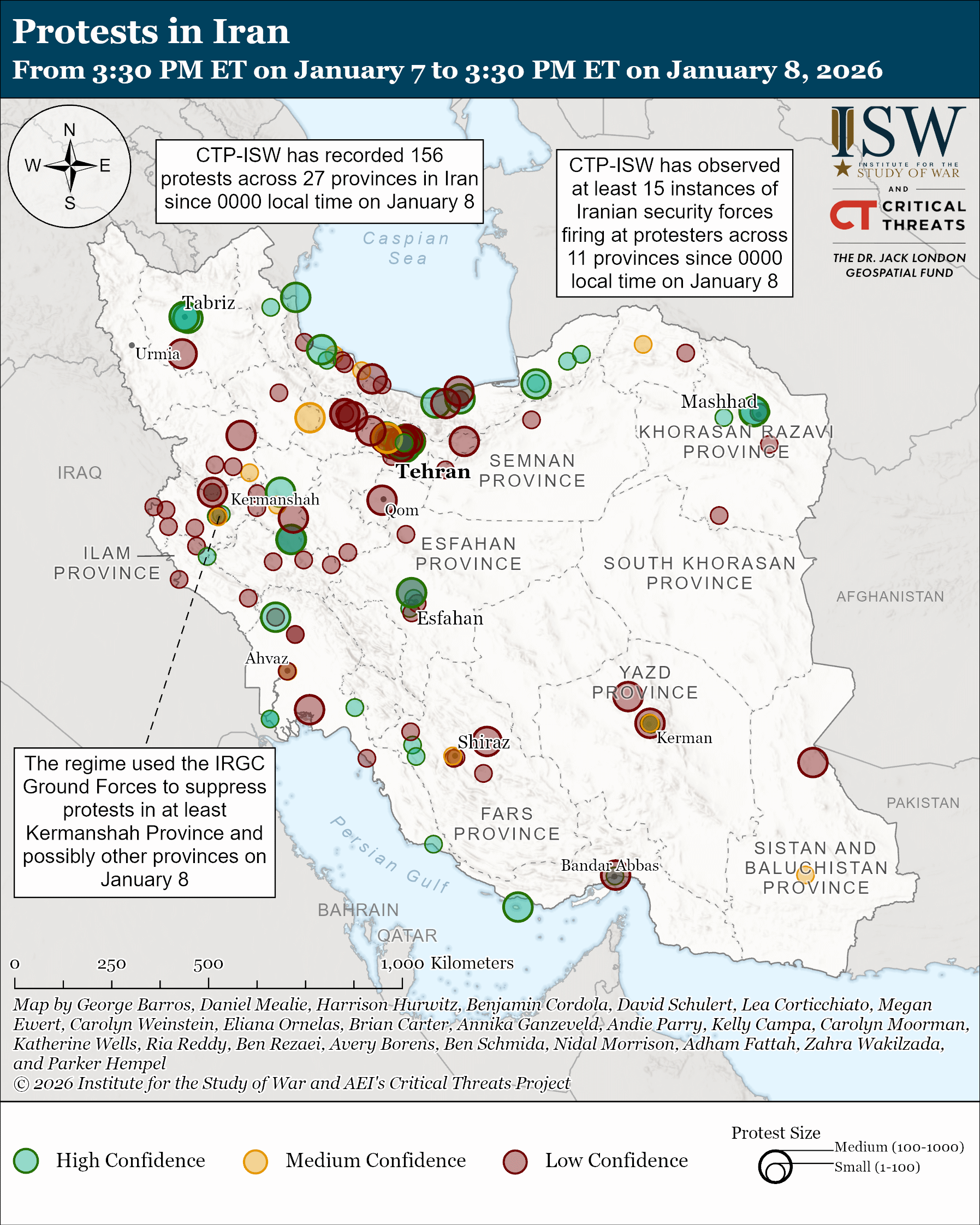
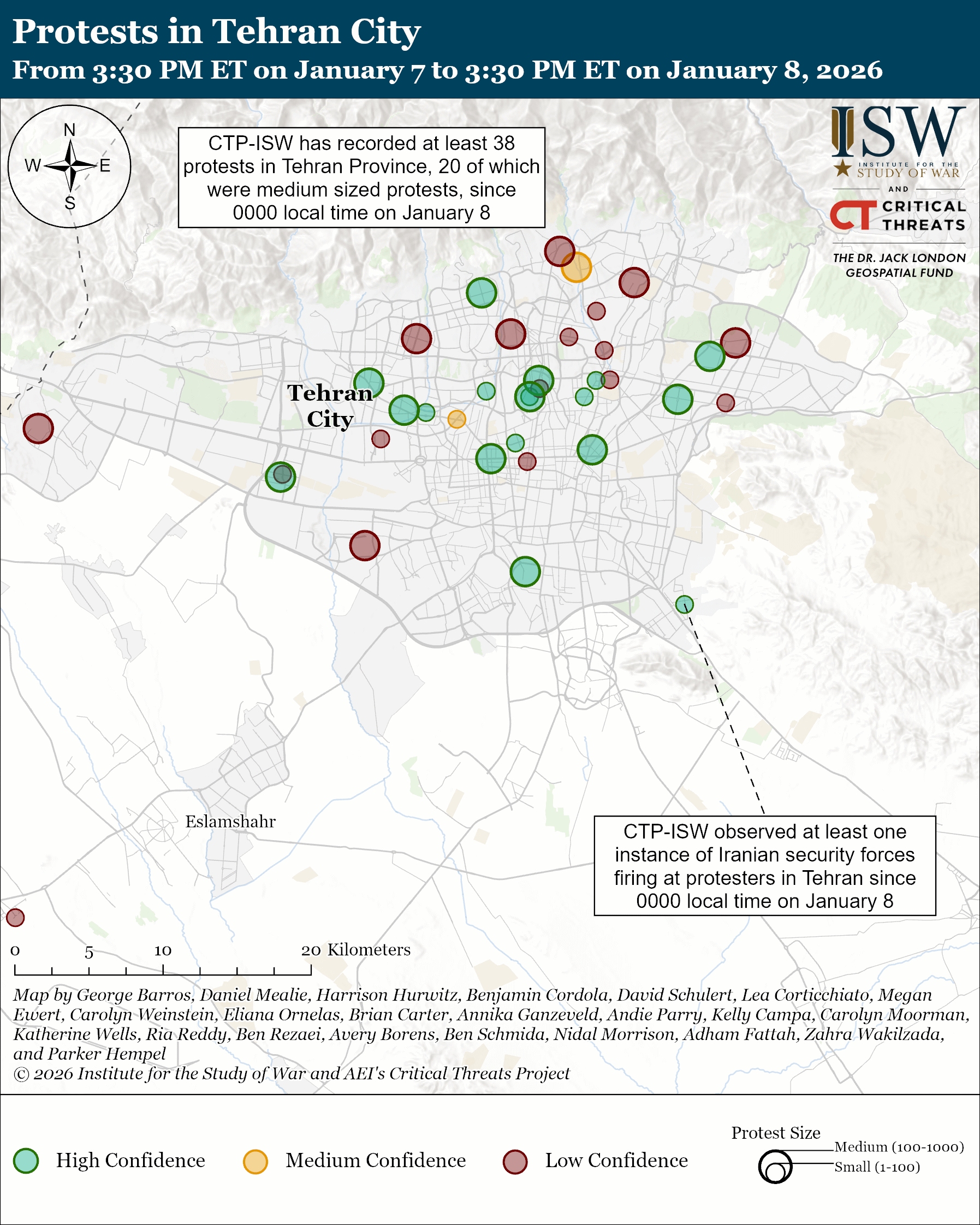
Protests and strikes have expanded to the Kurdish-populated Kurdistan Province in northwestern Iran. CTP-ISW has recorded six protests in Kurdistan Province.[iii] The Kurdish Democratic Party of Iran (KDPI), Komala Party of Iranian Kurdistan, and Kurdistan Workers’ Party (PKK)-linked Kurdistan Free Life Party (PJAK), among others, called for a nationwide “general strike” on January 8 in response to the regime’s violent crackdown on protests in Kermanshah, Ilam, and Lorestan provinces.[iv] Islamic Revolutionary Guards Corps (IRGC)-affiliated Tasnim News denounced the Kurdish groups’ call for a general strike, accusing them of attempting to incite riots.[v] The regime previously accused Kurdish opposition groups of inciting protests in Kurdish areas during the Mahsa Amini movement.[vi]
Iranian leaders have long-standing concerns about Kurdish separatism and militancy in the western and northwestern provinces.[vii] Iranian leaders have historically accused Kurdish militias in Iraq of operating in the border provinces and inciting social unrest. Those concerns grew particularly acute during the 2022-23 Mahsa Amini protests, which were partly concentrated among Kurdish communities that the regime worried the Kurdish militias could try to co-opt.[viii] The regime appeared especially prepared to use extreme force to suppress protests in the western and northwestern provinces during the Mahsa Amini protests, at one point deploying the IRGC Ground Forces to conduct what the regime described as clearing operations across several towns and villages.[ix] The expansion of the ongoing protests to northwestern Iran will reignite regime anxieties about Kurdish separatism and militancy there. That could in turn drive the regime to adopt an especially brutal crackdown in those areas, which may already happening in Kermanshah and Ilam provinces.
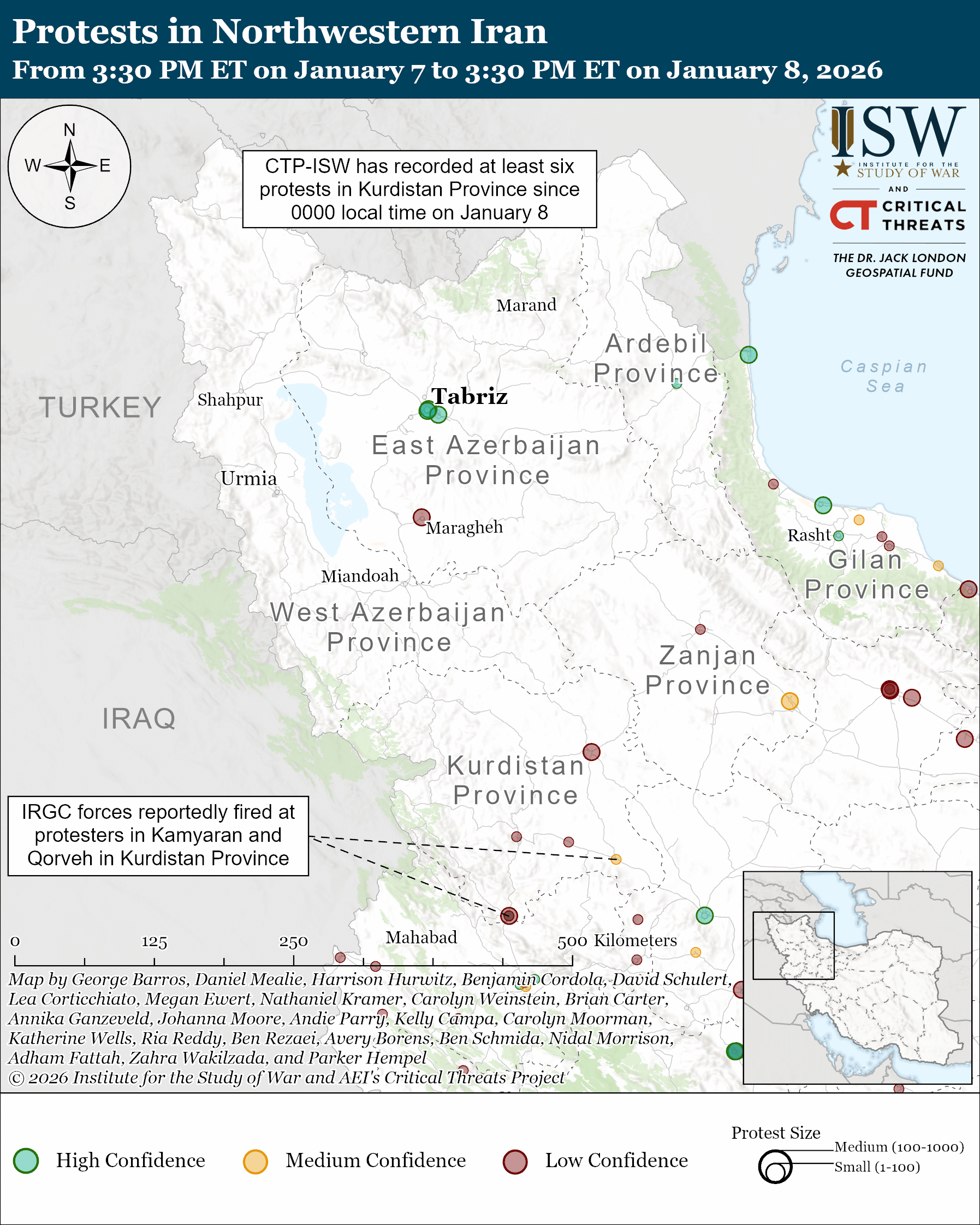
The regime has likely determined that these protests represent an extremely dire security threat and has intensified its crackdown accordingly, including by taking the rare step of using the Islamic Revolutionary Guards Corps (IRGC) Ground Forces to suppress protests in at least one province.[x] The regime used the IRGC Ground Forces to suppress protests in at least Kermanshah Province and possibly other provinces on January 8.[xi] This is a rare step; the regime only deployed the IRGC Ground Forces once during the Mahsa Amini protests, but it did so in Kurdish-populated areas. Kermanshah Province, where there are reports of IRGC Ground Forces activity, has a large Kurdish population.[xii] The regime tends to rely most heavily on the LEC and paramilitary Basij to manage social unrest and suppress protests.[xiii] The regime maintains elite Basij units that specialize in crowd control and repression and activates them when protests escalate meaningfully. The regime relies on the IRGC Ground Forces in the most extreme circumstances, during which the regime tends to approach protests as an insurgency rather than gatherings of aggrieved citizens. The IRGC Ground Forces is the final regime defense against civil upheaval and thus uses extreme levels of force to quell demonstrations.[xiv]
The use of the IRGC Ground Forces in Kermanshah and the reports of casualties there suggest that the regime is approaching the protests there as an insurgency rather than riots or protests. Norway-based human rights organization Hengaw claimed that two IRGC Ground Forces members were killed during the protests in Kermanshah City on January 8, citing Iranian state media outlets.[xv] The deaths of the IRGC soldiers are notable because these individuals are from a military force, not the police, and should be more capable of protecting themselves. It is unclear what caused their deaths, though the deaths of two soldiers during protests indicate that the clashes between protesters and security forces have become particularly intense in Kermanshah City. Hengaw also claimed that forces from the Nabi Akram Operational Division fired live rounds at protesters in Kermanshah City, where the unit is based, on January 8.[xvi]
The use of the IRGC Ground Forces could indicate bandwidth constraints among security forces in addition to a shift in how the regime perceives the protests, however. The rapid expansion of the protests in space and magnitude may have outstripped the ability of the LEC and Basij to cover every protest. The lack of LEC and Basij manpower would require the regime to use the IRGC Ground Forces to continue to suppress ongoing protests.[xvii]
The regime arrested several security forces members on January 8 who reportedly refused orders to fire at protesters, according to a Norway-based human rights organization.[xviii] This is the only instance CTP-ISW has observed of security forces refusing orders at this time. Should this trend expand, however, it could cause major bandwidth constraints that would further limit the regime’s ability to suppress protests.
IRGC-affiliated media reported on January 8 that a Law Enforcement Command (LEC) member died of a stabbing injury he sustained on duty while attempting to contain protesters in Malard.[xix] Protesters killed two LEC officers during protests in Lordegan, Chaharmahal and Bakhtiari Provinces, as well as an unspecified security force member in Malekshahi, Ilam Province.[xx] The Iranian regime could use the deaths of security personnel as justification to intensify its suppression of Iranian protesters and contribute to the regime’s perception that it is suppressing insurgents rather than protesters or rioters.
The regime has also responded with sweeping internet shutdowns.[xxi] The regime has spent years developing its ability to impose localized internet shutdowns.[xxii] The regime has elected for a countrywide shutdown is dramatic and reflects how dire Iranian leaders perceive the situation. Countrywide internet shutdowns precede bloody crackdowns, as was the case during the Aban protests in November 2019. Reuters reported that the regime killed around 1,500 protesters during this period.[xxiii]
The internet shutdown across Iran could severely limit the open-source information available to CTP-ISW. Our updates during the shutdown will likely reflect only some of the protest activity on a given day. Nevertheless, the continuation of the internet shutdown is an indicator in itself that a meaningful amount of protest activity is still occurring.
IRGC Quds Force Commander Brigadier General Esmail Ghaani reportedly urged unity among unspecified Iranian-backed Iraqi militia leaders on the issue of disarmament during a visit to Baghdad between January 6 and 8. Ghaani’s visit and his urgings demonstrate the continued divisions among Iraqi militias over disarmament.[xxiv] “Informed” Iraqi sources told Asharq al Awsat that Ghaani emphasized the prevention of “internal differences or escalation” regarding disarmament during a meeting with unspecified Iraqi militia leaders in Baghdad.[xxv] Multiple prominent Iranian-backed Iraqi militia members have expressed varying positions on disarmament in recent weeks, even as the militias’ official coordinating body has attempted to maintain a unified face.[xxvi] Ghaani’s visit to Baghdad follows a statement by the Iraqi Resistance Coordination Committee on January 4 that rejected calls for Iranian-backed Iraqi militias to disarm due to the continued presence of US and Turkish forces in Iraqi Kurdistan.[xxvii] The Iraqi Resistance Coordination Committee is a coordinating body for Iranian-backed Iraqi militias.[xxviii] Kataib Hezbollah, Kataib Sayyid al Shuhada, Harakat Hezbollah al Nujaba, Harakat Ansar Allah al Awfiya, and Asaib Ahl al Haq signed the statement.[xxix] CTP-ISW previously noted the inconsistencies between the committee’s statement and the positions that some of the militias that signed it have expressed about disarmament.[xxx] There may also be splits within as well as among the militias. A senior member of Asaib Ahl al Haq’s rejection of the statement on January 5 indicates that there may even be splinters within Asaib Ahl al Haq on the topic.[xxxi] The United States has continuously pressured the Iraqi federal government to disarm Iranian-backed Iraqi militias, including throughout 2025.[xxxii]
Ghaani may have attempted to increase militia support for disarmament in line with Iran’s reported efforts to push its larger partner militias in Iraq into politics. Iraqi political insiders told UK-based Amwaj media in November 2025 that Iran has encouraged unspecified Iranian-backed Iraqi militias to focus on political engagement instead of armed resistance, possibly to discourage US sanctions enforcement that would prevent Iran from using the Iraqi economy to evade sanctions.[xxxiii] Some prominent Iranian-backed Iraqi militias, including Kataib Hezbollah and Harakat Hezbollah al Nujaba, have refused to disarm.[xxxiv] Other militias, such as Kataib Sayyid al Shuhada, have attempted to obfuscate the relationship between the militias and the Iraqi state.[xxxv] Kataib Sayyid al Shuhada Spokesperson Kazem al Fartousi claimed on December 20 that weapons are already restricted to the Iraqi state, and the militias therefore do not need to disarm.[xxxvi] Fartousi’s comments ignore the reality that many Iranian-backed Iraqi militias, such as Kataib Sayyid al Shuhada, possess weapons and are neither integrated into the Iraqi security forces nor answer to the Iraqi prime minister.[xxxvii]
Ghaani probably also discussed anti-regime Kurdish groups operating in Iraqi Kurdistan with Iraqi officials during his reported visit to Baghdad. Ghaani has reportedly discussed anti-regime Kurdish group activity with Iraqi officials during previous protest waves in Iran.[xxxviii] Unidentified Iraqi and Kurdish officials told AP in November 2022 that Ghaani threatened that Iran would conduct a ground operation into Iraqi Kurdistan if Iraq did not secure the Iran-Iraq border against anti-regime Kurdish groups.[xxxix] Iran has historically accused Kurdish opposition groups and Israel of using Iraqi Kurdistan to facilitate operations in Iran.[xl] Iran views Iraqi Kurdistan as a rear area from which anti-regime Kurdish groups can foment instability against the regime.[xli] IRGC-affiliated Tasnim news called on officials in Iraqi Kurdistan to prevent anti-regime groups from threatening Iranian national security after seven Kurdish groups, including anti-regime groups, called for a general strike across Iran on January 8.[xlii] Iraqi National Security Advisor Qasim al Araji also discussed border security with Iranian Military Attache to Iraq Majid Gholipour in Baghdad on January 7.[xliii]
The Syrian government secured areas of Kurdish neighborhoods in Aleppo City on January 8 as fighting between the Syrian army and Syrian Democratic Forces (SDF)-affiliated fighters continued for a third day. Initial fighting between the Syrian government and SDF-affiliated internal security forces, known as the Asayish, began on the city’s western outskirts on January 6 and spread to Sheikh Maqsoud and Ashrafiyeh.[xliv] Ashrafiyeh and Sheikh Maqsoud are two historically Kurdish neighborhoods in Aleppo City that the SDF agreed to integrate into the Aleppo City municipality and under Syrian state control on April 1. The Asayish has maintained de facto security control over these neighborhoods since April 1, however.[xlv] The fighting ceased for two or three hours in the morning of January 8 to allow for the government and the SDF to attempt to negotiate—with Turkish and US mediation—a permanent end to the fighting.[xlvi] Syrian sources reported that the talks did not produce any results, however, and the Syrian army announced the launch of a “limited military operation” in the area.[xlvii] Three divisions, including an armored division, deployed to the area under the “Aleppo Operations Authority,” a command room supervised by Syrian Chief of the General Staff Major General Ali al Nassan.[xlviii] The 60th and 72nd divisions—which consist of a mix of Hayat Tahrir al Sham fighters, Syrian National Army fighters, and new recruits—have both been involved in fighting the SDF along frontlines in eastern Aleppo Province.[xlix]
Syrian forces attempted to suppress Asayish mortars and snipers in Aleppo City before advancing into and securing parts of the Ashrafiyeh neighborhood.[l] SDF mortar shelling and gunfire have continued to target government positions and impact civilian sites across Aleppo City since January 6.[li] The Syrian Ministry of Defense issued evacuation orders for at least nine specific buildings or blocks that it claimed were Asayish positions in Sheikh Maqsoud and Bani Zaid, a neighborhood that lies between government-controlled territory and the two historically Kurdish neighborhoods.[lii] The Syrian army reportedly struck several Asayish positions with drones and artillery a few hours later, according to Syrian and SDF media.[liii] Syrian army armor then advanced into southern Ashrafiyeh and engaged Asayish fighters, who either surrendered or withdrew to Sheikh Maqsoud.[liv] Syrian state-owned media claimed that residents and notables of Ashrafiyeh and Bani Zaid requested that Syrian government forces enter the neighborhood and facilitated their entry.[lv] Interior Ministry forces deployed to Ashrafiyeh to secure the area.[lvi]
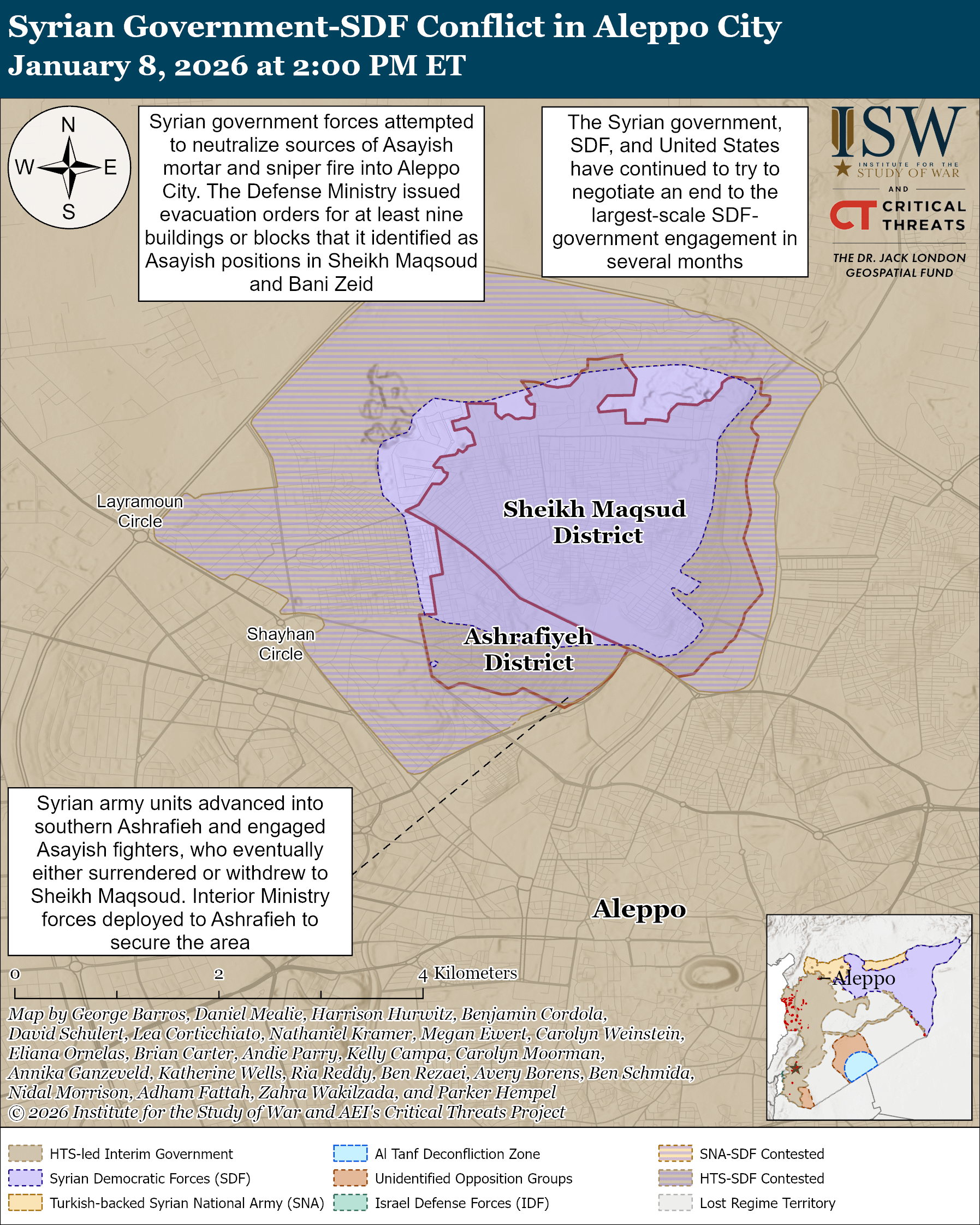
The recent fighting in Aleppo indicates that the previous SDF-government agreement has been largely insufficient in its current form to integrate Kurdish forces into the Syrian state and prevent new rounds of conflict. The April 1 agreement is a 14-point agreement between the Syrian government and the SDF that stipulates the integration of Ashrafiyeh and Sheikh Maqsoud into the city's municipality, as well as the integration of the Asayish into local police forces.[lvii] The agreement has never been fully implemented, and several significant episodes of fighting have broken out between government forces and the Asayish since April 2025.[lviii] The Syrian government, SDF, and the United States will need to update previous agreements and possibly develop new frameworks to integrate SDF-affiliated forces into the state. The government has now seized parts of Ashrafiyeh and may advance into Sheikh Maqsoud in the coming hours or days, which would complete the reduction of the SDF exclave.[lix] Any new agreement would need to specify the role that now-detained Asayish fighters would play in a new Syrian state, for example. The government demanded the “withdrawal of militia groups” and an end to the fighting, but affirmed that Kurds are the government’s ”integral” and ”full partners.”[lx] The demand that militia groups withdraw suggests that the Syrian government will force the Asayish fighters to leave Aleppo rather than allow them to join local forces, as per the old agreement. US Special Envoy to Syria Tom Barrack and senior US military leaders have continued to work with the Syrian government and the SDF to de-escalate fighting, according to Western and Syrian media on January 8.[lxi]
The Lebanese cabinet reviewed on January 8 the Lebanese Armed Forces (LAF)’s progress in disarming Hezbollah in southern Lebanon and tasked the LAF to develop a plan to disarm the group north of the Litani River.[lxii] The LAF told the Lebanese cabinet on January 8 that it has entered an “advanced stage” of its Hezbollah disarmament plan and is now focused on expanding and securing its presence in southern Lebanon.[lxiii] The LAF noted that it is still working to address unexploded ordnance and Hezbollah tunnels in the area.[lxiv] The Lebanese cabinet emphasized that the LAF needs to implement all of the plan’s phases and develop a plan to disarm Hezbollah north of the Litani River, which the LAF is to present to the cabinet in February 2026.[lxv] The timeline is unclear for both the implementation and completion of the next phase of the LAF’s plan. Hezbollah officials rejected the cabinet‘s request and emphasized that Israel must halt its operations and withdraw from Lebanese territory.[lxvi] Iranian Foreign Affairs Minister Abbas Araghchi echoed this sentiment on January 8, noting that the first goal of his ongoing visit to Beirut is to discuss Israel’s presence in Lebanon with senior Lebanese officials.[lxvii]
Israeli officials are calling into question the LAF’s ability to disarm Hezbollah faster than Hezbollah can rearm itself, irrespective of the LAF’s ongoing efforts. The Israeli Foreign Ministry stated on January 8 that the LAF’s efforts to disarm Hezbollah have been “limited” and added that Hezbollah is rearming faster than it is being disarmed.[lxviii] Israeli officials and sources similarly stated that the LAF’s progress statement contradicts the “reality” on the ground as Hezbollah has not been disarmed and is still present in southern Lebanon.[lxix] Israeli media reported on January 8 that Israel views the LAF’s statement as a signal for Israel to step in to disarm Hezbollah.[lxx] Several Israeli media outlets have indicated that an Israeli operation in Lebanon is not a question of if but rather a question of when, noting that Israel will be required to launch a major operation in Lebanon.[lxxi] These Israeli outlets reported that the Israel Defense Forces (IDF)’s operational plans are ready and that the decision now lies with the Israeli political echelon.[lxxii]
Lebanese security and military sources’ recent leaks to Emirati media about Hezbollah’s military readiness suggest that these sources may be attempting to discourage Israel from launching an operation in Lebanon by portraying Hezbollah as capable of withstanding an Israeli operation and imposing costs on Israel. Lebanese security sources told Emirati media on January 6 that Hezbollah has begun secretly repositioning combat units and “strategic” weapons north of the Litani River to “absorb” Israeli strikes and maintain its ability to respond.[lxxiii] ”Informed” Lebanese security sources told Emirati media on January 7 that Hezbollah is replacing its overt military and security leaders with ”unknown” officials and adopting a stricter communications policy to make it harder for Israel to target its leadership.[lxxiv] The sources stated that Israel would confront unfamiliar Hezbollah leaders in a new conflict and noted that Hezbollah’s preemptive steps would help the group minimize the effects of an Israeli operation.[lxxv] Lebanese security and military sources told Emirati media on January 8 that Hezbollah is in the advanced stage of ”maximum readiness” as the group has raised its missile readiness, minimized its footprint to avoid detection, and moved fighters to non-fixed positions.[lxxvi] These leaks coincided with reported internal Israeli deliberations over the timing of a potential Israeli operation in Lebanon. Israeli media reported on January 6 that Israeli officials are increasingly hesitant about executing the IDF’s attack plan in Lebanon at this time and are weighing several external factors into a decision regarding conflict with Hezbollah.[lxxvii] These external factors are presumably related to international politics and not Hezbollah’s preparations, however. Hezbollah may be taking some steps to prepare for an Israeli operation, but these leaks nevertheless support Hezbollah’s objective by attempting to insert uncertainty into the calculus of the Israeli government.
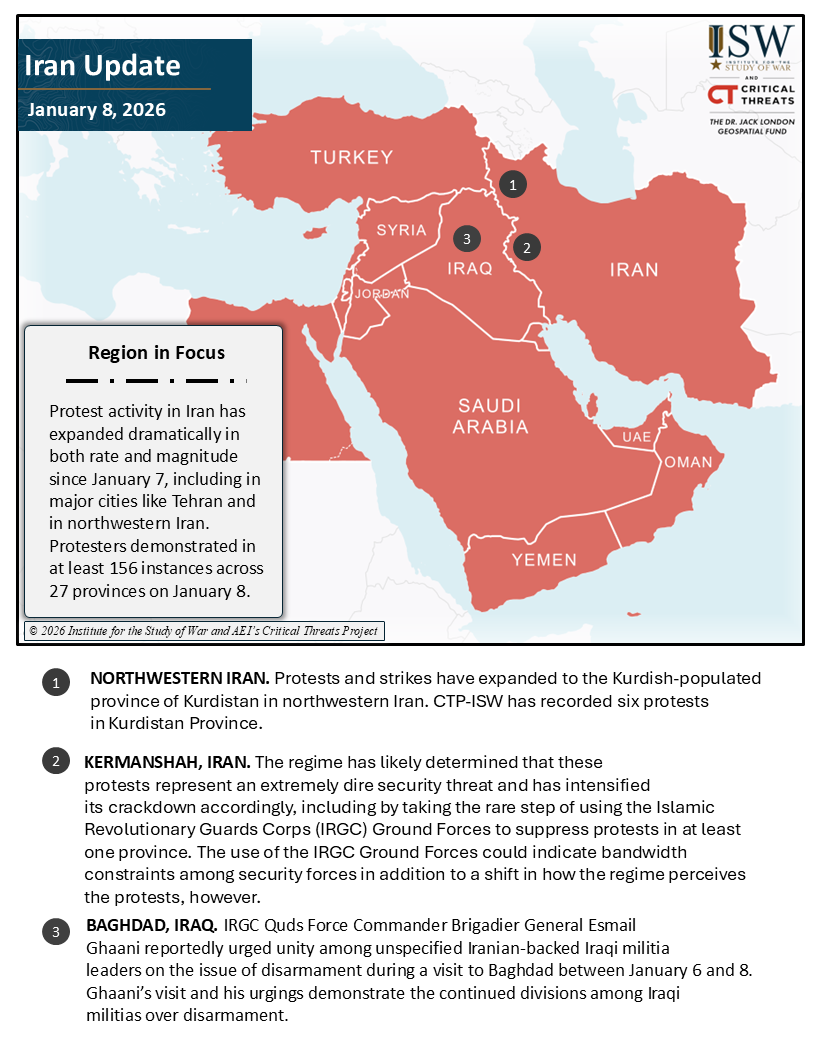
Key Takeaways
- Protests in Iran: Protest activity in Iran has expanded dramatically in both rate and magnitude since January 7, including in major cities like Tehran and in northwestern Iran. Protesters demonstrated in at least 156 instances across 27 provinces on January 8, which almost doubles the number of protests recorded on January 7.
- Protests in Kurdish-Populated Provinces: Protests and strikes have expanded to the Kurdish-populated province of Kurdistan in northwestern Iran. CTP-ISW has recorded six protests in Kurdistan Province.
- Iranian Regime Security Perceptions: The regime has likely determined that these protests represent an extremely dire security threat and has intensified its crackdown accordingly, including by taking the rare step of using the Islamic Revolutionary Guards Corps (IRGC) Ground Forces to suppress protests in at least one province. The use of the IRGC Ground Forces could indicate bandwidth constraints among security forces in addition to a shift in how the regime perceives the protests, however.
- IRGC Quds Force Commander Visit to Iraq: IRGC Quds Force Commander Brigadier General Esmail Ghaani reportedly urged unity among unspecified Iranian-backed Iraqi militia leaders on the issue of disarmament during a visit to Baghdad between January 6 and 8. Ghaani’s visit and his urgings demonstrate the continued divisions among Iraqi militias over disarmament.
- Syrian Government-SDF Fighting in Aleppo City: The Syrian government secured areas of Kurdish neighborhoods in Aleppo City on January 8 as fighting between the Syrian army and Syrian Democratic Forces (SDF)-affiliated fighters continued for a third day. The recent fighting in Aleppo indicates that the previous SDF-government agreement has been largely insufficient in its current form to integrate Kurdish forces into the Syrian state and prevent new rounds of conflict.
- Hezbollah Disarmament: The Lebanese cabinet reviewed on January 8 the Lebanese Armed Forces (LAF)’s progress in disarming Hezbollah in southern Lebanon and tasked the LAF to develop a plan to disarm the group north of the Litani River. Israeli officials are calling into question the LAF’s ability to disarm Hezbollah faster than Hezbollah can rearm itself, irrespective of the LAF’s ongoing efforts.
CTP-ISW has recorded 89 protests across 21 provinces in Iran since its last data cutoff on January 6. CTP has adjusted its data cutoff for protests in Iran to 3:30 PM ET to correspond with 12 AM Tehran time.[i] CTP-ISW recorded eight protests across seven provinces in Iran between 2:00 and 3:30 PM ET on January 6.[ii] Protests have continued to primarily take place in western Iran and in smaller, less-populated areas. CTP-ISW has recorded 19 protests in Tehran City since its last data cutoff, however.[iii] CTP-ISW has also recorded 14 medium-sized protests since its last data cutoff, which CTP-ISW defines as protests with more than 100 participants.[iv]
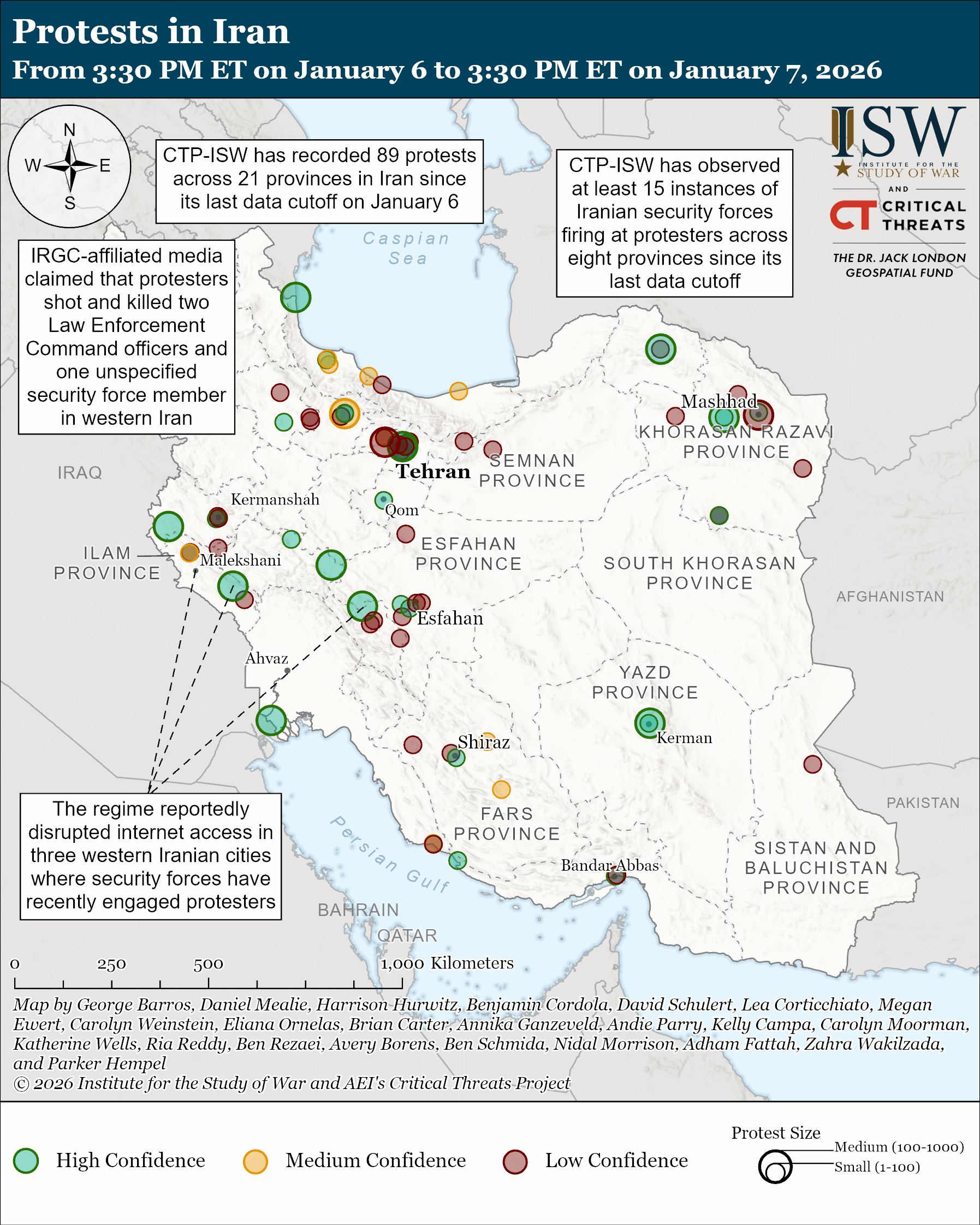
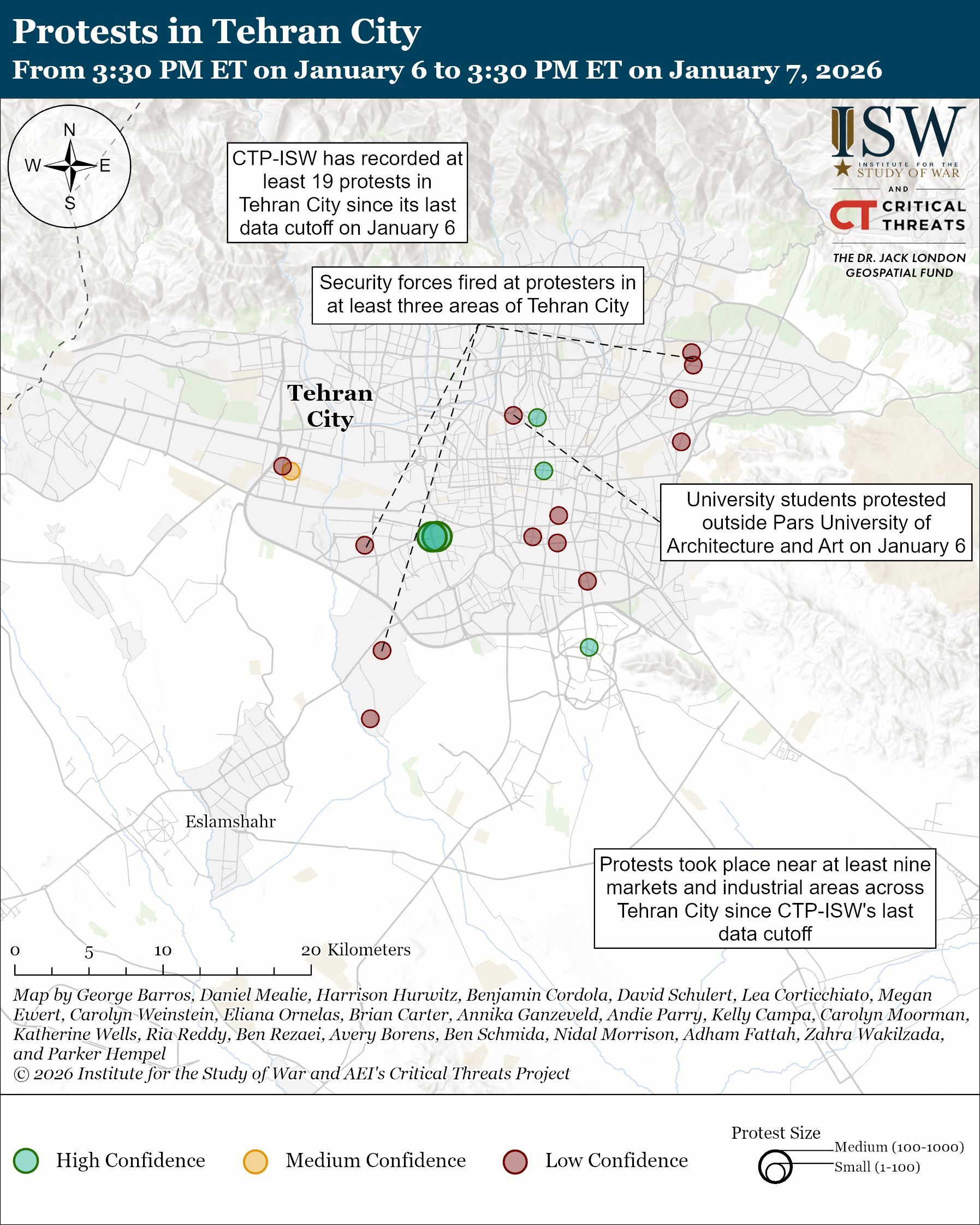
The regime continues to use violence and lethal force to suppress the protests. CTP-ISW has recorded 15 instances of security forces firing at protesters across eight provinces since its last data cutoff, most of which were concentrated in Tehran, Fars, Kermanshah, and Chaharmahal and Bakhtiari provinces.[v] The regime reportedly disrupted internet access in Lordegan, Chaharmahal and Bakhtiari Province, and Malekshahi and Abdanan cities, Ilam Province, where security forces have clashed with protesters, according to an internet access researcher on January 7.[vi] The regime has arrested at least 2,078 citizens and killed at least 24 protesters since December 28, according to a US-based human rights organization focused on Iran on January 6.[vii]
Islamic Revolutionary Guards Corps (IRGC)-affiliated media reported on January 7 that protesters killed two Law Enforcement Command (LEC) officers during protests in Lordegan, Chaharmahal and Bakhtiari Province, as well as an unspecified security force member in Malekshahi, Ilam Province.[viii] These reports mark the first time that the regime has publicly announced the death of security forces members since the start of the protests on December 28. The regime previously claimed on January 1 that protesters had killed a member of the Basij, but this claim turned out to be false.[ix] The Iranian regime could use the deaths of security personnel as justification to intensify its suppression of Iranian protesters.
An Iranian media outlet affiliated with one of Iranian Supreme Leader Ali Khamenei’s representatives to the Defense Council, Ali Shamkhani, implicitly criticized security forces’ recent raid on a hospital in Ilam Province.[x] Security forces raided a hospital in Malekshahi County, Ilam Province, on January 5, where injured protesters were being treated.[xi] The outlet argued that the incident represents “a serious test of how the government engages society during crises” and that “issuing conciliatory statements, declaring responsibility, and accepting the possibility of error” do not diminish the regime’s authority but rather strengthen it.[xii] The outlet’s implicit criticism of the raid is notable given that other parts of the regime have justified the raid.[xiii]
A group of seven Kurdish organizations, including anti-regime groups, called for a general strike across Iran on January 8.[xiv] The Kurdish Democratic Party of Iran (KDPI), Komala Party of Iranian Kurdistan, and Kurdistan Free Life Party (PJAK), among others, called for a nationwide “general strike” on January 8 in response to the regime’s violent crackdown on protests in Kermanshah, Ilam, and Lorestan provinces.[xv] CTP-ISW has recorded 67 protests in Kermanshah, Ilam, and Lorestan provinces since December 28.[xvi] The organizations’ call for a general strike is notable given that the regime previously accused Kurdish opposition groups of inciting protests in Kurdish areas during the Mahsa Amini movement.[xvii] The IRGC previously struck anti-regime Kurdish militant positions in Iraqi Kurdistan in October 2022.[xviii] Significant protest activity took place in Kurdistan and West Azerbaijan provinces, which have large Kurdish populations, during the Mahsa Amini movement.[xix] CTP-ISW has not observed any protests in Kurdistan Province nor significant protest activity in West Azerbaijan Province thus far in the current wave of protests, however.
The Mobarizoun Popular Front (MPF), which is a coalition of Baloch anti-regime groups, killed an Iranian Law Enforcement Command (LEC) officer in Iranshahr, Sistan and Baluchistan Province, on January 7 in response to the regime’s violent crackdown on protesters across Iran.[xx] The MPF claimed that it killed the Shahr-e Deraz LEC commander in response to “the killing and suppression of protesters in various parts of our country.”[xxi] The MPF claimed that the commander previously served as the Iranshahr LEC Information Protection Organization commander and had killed “Baloch fuel workers” in recent months.[xxii] The MPF previously warned on January 1 that it would respond to “every bullet” fired by Iranian security forces at protesters.[xxiii] CTP-ISW has not recorded any protests in Iranshahr at the time of this writing. The MPF’s January 7 attack marks the first time that the MPF has conducted an attack in Iranshahr. The MPF previously conducted its first attack in Zahedan, Sistan and Baluchistan Province, in early December 2025.[xxiv]
Anti-regime media and some social media users claimed that Iranian-backed Iraqi militias have deployed to Iran to support the Iranian regime’s crackdown on protests.[xxv] CTP-ISW is unable to verify these reports, and anti-regime media has circulated similar reports during previous waves of protests. Anti-regime outlet Iran International reported on January 6 that around 800 Iranian-backed Iraqi militia fighters have deployed to Iran since January 2 through border crossings in Diyala, Maysan, and Basra provinces, citing unsourced “information.”[xxvi] The Iraqi fighters are reportedly members of Kataib Hezbollah, Harakat Hezbollah al Nujaba, Kataib Sayyid al Shuhada, and the Badr Organization, among other militias.[xxvii] Iran International added that unspecified Iraqi government officials are aware of the fighters’ deployments, which have occurred under the guise of pilgrimage trips to the Imam Reza Shrine in Mashhad, Iran.[xxviii] Iranian-backed Iraqi militias frequently use their control of many Iran-Iraq border crossings to smuggle items, such as weapons, in and out of Iraq.[xxix] Several social media users have also claimed in recent days that members of the Iranian-backed Popular Mobilization Forces (PMF) are suppressing protests in Iran, including in Hamedan City, Hamedan Province.[xxx] The PMF is an Iraqi state security service that includes many Iranian-backed Iraqi militias that tend to report to Iran instead of the Iraqi prime minister.[xxxi] The militias’ deployments, if true, could bolster the regime’s efforts to contain the protests. Iraqi militias may also be more willing than Iranian security forces to use violence and lethal force against protesters given that they lack personal connections to the Iranian communities that are protesting. Anti-regime media often circulates reports about the deployment of Iranian proxy forces to Iran to suppress protests during periods of unrest. Iran International, citing Israeli media, reported in 2022 that Iranian-backed Iraqi militias under the PMF deployed to Iran during the Masha Amini protest movement to help the Iranian regime contain the protests, for example.[xxxii] The former head of Tehran’s Revolutionary Court, Musa Ghazanfarabadi, also implied in 2019 to Iranian religious students in Qom that Axis of Resistance groups, including Iranian-backed Iraqi militias, could support the regime’s suppression of future protest movements in Iran.[xxxiii] Iranian security forces notably helped the PMF violently suppress protests in Iraq in 2019.[xxxiv]
Saudi Arabia and Saudi-backed Presidential Leadership Council (PLC) President Rashad al Alimi altered the composition of the PLC by pressuring Southern Transitional Council (STC) members to sideline STC President and former PLC Vice President Aidarous al Zubaidi and other hardline secessionists. Saudi Arabia and Saudi-backed Yemeni actors have been trying to reunify Yemen’s anti-Houthi factions, de-escalate the conflict between the ROYG and the STC, and reassert the ROYG’s control over southern Yemen. The PLC convened an emergency meeting in Riyadh on January 7 and announced that it expelled Zubaidi from the council and referred him to the attorney general for prosecution on charges including "high treason.”[xxxv] Zubaidi, who recently announced the STC’s intent to form an independent state in southern Yemen, did not board a Riyadh-bound flight in Aden on January 6 after Saudi Arabia and Saudi-backed Yemeni actors, including Alimi, pressured him to travel to Riyadh to meet with the PLC.[xxxvi] The Saudi-led military coalition claimed that Zubaidi fled Aden after refusing to travel to Riyadh.[xxxvii] The coalition struck weapons and equipment depots in Dhaleh Governorate after it received intelligence that Zubaidi had moved a “large military force” to Dhaleh.[xxxviii] Zubaidi is from Dhaleh Governorate.[xxxix]
Several STC-aligned actors appear to be cooperating with Saudi Arabia and Alimi’s efforts to sideline Zubaidi and other hardline secessionists, though the STC continues to publicly support Zubaidi.[xl] Two of Zubaidi’s partners, PLC Vice President Tariq Saleh and STC Vice President and PLC Vice President Abu Zaraa al Muharrami, were present during the meeting in which the PLC decided to expel Zubaidi.[xli] Only Zubaidi and STC Vice President and PLC Vice President Farah al Bahsani—who had aligned with Zubaidi, Saleh, and Muharrami in supporting the STC’s takeover of eastern Yemeni territory in early December 2025—did not attend the PLC meeting.[xlii] President Alimi summoned these STC leaders to Riyadh on January 4.[xliii] CTP-ISW previously noted that Saudi Arabia could use the summons to reprimand the STC and attempt to compel it to de-escalate with Alimi and northern Yemeni factions within the Republic of Yemen Government (ROYG).”[xliv] Saleh and Muharrami’s activity in Riyadh since their arrival, including meetings with Saudi and Saudi-backed PLC members, suggests that both men have succumbed to pressure from Alimi and Saudi Arabia to end cooperation with Zubaidi and other secessionists. Muharrami’s Southern Giant Forces have assumed control over several positions across Aden on January 6 and 7 at the Saudi-led coalition’s request, according to local media and the coalition’s spokesperson.[xlv] A Yemen analyst reported on January 7 that other STC forces are cooperating with the Southern Giant Forces in Aden.[xlvi]
The PLC also dismissed two ministers and several Hadrami military commanders on January 7, possibly as part of an effort to purge supporters of Zubaidi or secession from ROYG political and security institutions.[xlvii] PLC President Alimi fired the ROYG’s transport and planning and international cooperation ministers on January 7 and placed both ministers under investigation as part of “urgent measures to control the security situation and strengthen state sovereignty.”[xlviii] Alimi and his ally, Hadramawt Governor Salem al Khanbashi, also dismissed commanders in Mahra and Hadramawt governorates on January 7 and referred them to courts-martial, which Saudi-backed Yemeni forces recently seized from the STC during a counteroffensive.[xlix] Neither Alimi nor Khanbashi attributed these individuals’ dismissals to support for the STC’s takeover, but the PLC notably took action against these individuals on the same day that the PLC expelled Zubaidi from the PLC and accused him of treason.
Several former Assad regime officers are reportedly attempting to organize insurgent activity against the Syrian government from Lebanese territory.[l] The Lebanese Armed Forces (LAF) does not appear to have taken actions to meaningfully disrupt these officers’ efforts to organize and support insurgent activity. Numerous Assad regime members fled to Lebanon in December 2024 after the fall of the Assad regime, including prominent Assad regime figures such as Assad’s senior adviser, Bassam al Hassan, and Fourth Division General Ghiath Dalla.[li] Dalla, who reportedly lives "just over” the Syrian border in Lebanon, has continued to organize Assadist insurgent activity from Lebanon, according to recent Western and Arab media investigations.[lii] Former Tiger Forces Commander Suhail al Hassan, who has attempted to recruit and equip Assadist insurgents, has met with collaborators in Lebanon over the past year and reportedly purchased a large office along the Lebanon-Syria border to use as a “headquarters” for future operations in Syria.[liii] Hassan claimed, according to documents obtained by the New York Times and Al Jazeera, that at least 20 former Assad regime pilots are living in Lebanon and intend to join Assadist insurgent groups.[liv] A Syrian transitional government delegation reportedly submitted a list of names of Assad regime officers living in Lebanon to the Lebanese government on December 22 and demanded that Lebanon transfer them to Syria.[lv] The Syrian government has long demanded that Lebanon extradite former Syrian regime officials accused of war crimes, which the Lebanese government has not yet done.[lvi]
Recent investigations into former Assad regime officials operating from Lebanon reportedly prompted Lebanese authorities to carry out raids and arrests nationwide. Lebanese Deputy Prime Minister Tarek Matri stated on January 2 that the investigations were “cause for concern” and publicly called on Lebanese security forces to investigate and "take appropriate measures.”[lvii] Lebanese media reported that the LAF raided an Alawite-majority neighborhood in Tripoli in search of Assad regime remnants on January 3.[lviii] The LAF announced that it arrested 35 Syrians in northern and eastern Lebanon districts on smuggling and weapons charges on January 4.[lix] Several Syrian and international media outlets claimed that the LAF arrested Assad regime remnants during this arrest campaign.[lx]
There are several indications that Alawite insurgent groups currently active in Syria may have ties to former regime networks in Lebanon. The Syrian government has alleged that Suhail al Hassan has ties to the Alawite insurgent group known as the Men of Light, for example.[lxi] Another Syrian insurgent group, Fawj Azra’il al Jabal, praised Lebanon for allegedly refusing the Syrian government’s December 22 request to extradite regime officers living in Lebanon, which suggests that Fawj Azra’il al Jabal may have connections to some of the officers in Lebanon.[lxii] The LAF’s recent arrest campaign in northern Lebanon that resulted in the arrest of 35 Syrians also prompted an aggressive reaction on social media from the Coastal Shield Brigade, another Alawite insurgent group currently active along the Syrian coast.[lxiii] The Coastal Shield Brigade’s reaction to the arrests suggests that the group possibly has ties to the insurgent or smuggling networks that were targeted in the arrests.[lxiv]
The Lebanese army can play a meaningful role in disrupting former regime networks in Lebanon that are attempting to destabilize the new Syrian government as part of the Lebanese government’s improved relationship with Syria since December 2024. CTP-ISW recently assessed that the current scale, performance, and organizational structure of Assadist insurgents suggest that the threat of these insurgents to Syrian government forces remains low at this time.[lxv] These networks may expand if allowed time and space to recruit and organize in both Syria and Lebanon, however.
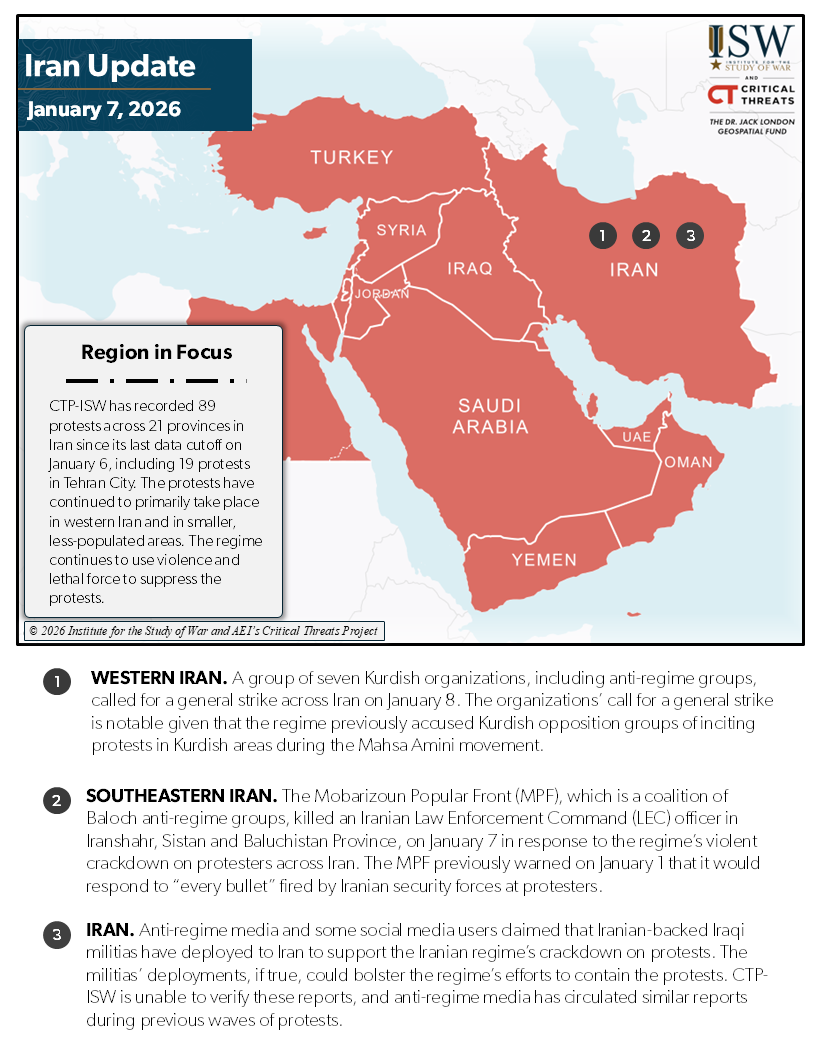
Key Takeaways
- Iranian Protests: CTP-ISW has recorded 89 protests across 21 provinces in Iran since its last data cutoff on January 6, including 19 protests in Tehran City. The protests have continued to primarily take place in western Iran and in smaller, less-populated areas. The regime continues to use violence and lethal force to suppress the protests. The regime reportedly disrupted internet access in parts of Chaharmahal and Bakhtiari and Ilam provinces.
- Iranian Protests: A group of seven Kurdish organizations, including anti-regime groups, called for a general strike across Iran on January 8. The organizations’ call for a general strike is notable given that the regime previously accused Kurdish opposition groups of inciting protests in Kurdish areas during the Mahsa Amini movement.
- Baloch Insurgency: The Mobarizoun Popular Front (MPF), which is a coalition of Baloch anti-regime groups, killed an Iranian Law Enforcement Command (LEC) officer in Iranshahr, Sistan and Baluchistan Province, on January 7 in response to the regime’s violent crackdown on protesters across Iran. The MPF previously warned on January 1 that it would respond to “every bullet” fired by Iranian security forces at protesters.
- Rumored Iraqi Militia Deployments: Anti-regime media and some social media users claimed that Iranian-backed Iraqi militias have deployed to Iran to support the Iranian regime’s crackdown on protests. The militias’ deployments, if true, could bolster the regime’s efforts to contain the protests. CTP-ISW is unable to verify these reports, and anti-regime media has circulated similar reports during previous waves of protests.
- Changes Within Yemen’s PLC: Saudi Arabia and Saudi-backed Presidential Leadership Council (PLC) President Rashad al Alimi altered the composition of the PLC by pressuring Southern Transitional Council (STC) members to sideline STC President and former PLC Vice President Aidarous al Zubaidi and other hardline secessionists.
- Assadist Insurgent Networks in Lebanon: Several former Assad regime officers are reportedly attempting to organize insurgent activity against the Syrian government from Lebanese territory. The Lebanese Armed Forces (LAF) does not appear to have taken actions to meaningfully disrupt these officers’ efforts to organize and support insurgent activity, despite recent arrests that are rumored to have targeted Assad regime networks.
The rate of protests across Iran declined slightly on January 5 and 6 compared to the rate of protests between January 2 and 4. CTP-ISW recorded at least 43 protests across Iran between January 5 at 2 pm EST and January 6 at 2 pm ET, and 37 protests between January 4 at 2 pm ET and January 5 at 2 pm ET.[i] The day-by-day breakdown of protests since January 1 illustrates that the protest rate has declined since January 4 at 2 pm ET:[ii]
- 81 protests occurred across 23 provinces between January 3 at 2 pm ET and January 4 at 2 pm ET.
- 62 protests occurred across 18 provinces between January 2 at 2 pm ET and January 3 at 2 pm ET.
- 70 protests occurred across 22 provinces between January 1 at 2 pm ET and January 2 at 2 pm ET.
The Iranian weekend—which is on Friday and Saturday—may have driven the higher rate of protests from Friday, January 2, to Sunday, January 4. CTP-ISW observed an increase in protests across Tehran on January 5 and 6, however, in contrast to the declining national rate on January 5 and January 6. Nineteen protests took place in Tehran between January 5 and 6, while only eight protests occurred in Tehran between January 4 and 5.[iii] A medium-sized protest occurred in Abadan, Ilam Province, during which Iranian Law Enforcement Command personnel waved at protesters from the rooftop of a nearby police building.[iv] Iranian authorities have arrested nearly 1,000 people and killed at least 25 people, including four minors, since the protests started on December 28, according to a Norway-based Kurdish Iranian rights group.[v] CTP-ISW has not observed a demographic or geographic change in protests since its last data cutoff at 2 pm on January 5.
The Iranian regime warned on January 6 that it would take unspecified preemptive measures to counter any US and/or Israeli attempts to exploit the ongoing protests across Iran that threaten Iranian regime security, almost certainly to deter US and Israeli activity against Iran.[vi] The Defense Council condemned Iran’s adversaries’ “intensifying threatening language and interventionist threats” on January 6 in the council’s first official statement since its establishment in August 2025.[vii] The council is presumably referring to US President Donald Trump's January 2 warnings that the United States could intervene if Iranian security forces shoot or kill Iranian protesters.[viii] Iran’s highest national security and foreign policy decision-making body, the Supreme National Security Council, established the Defense Council to restructure Iran‘s defense strategy and restore deterrence through “hard power” following the Israel-Iran War.[ix] The Defense Council warned on January 6 that “Iran does not consider itself limited to reacting after the action and considers objective signs of threat as part of the security equation,” which implies the possibility of Iranian preemptive action.[x] A preemptive action is taken to prevent an imminent attack or threat from an adversary, whereas a preventive action is taken to avert a future, non-imminent threat.[xi] A political analyst close to the Iranian regime, Mostafa Najafi, stated on January 6 that the Defense Council issued the January 6 statement after receiving ”multiple signals regarding the urgency of potential threats.”[xii] Najafi assessed that Iran is “highly unlikely” to launch a preemptive strike, however, and that the only way for Iran alter the current position that Iran, the US, and Israel are in is through the “restoration of deterrence.”[xiii] An unspecified Iranian official separately told Reuters on January 5 that these external pressures have narrowed the regime’s room to maneuver between protests and hardening US demands, leaving Iranian leaders with the perception that there are “few viable options and high risks on every path.”[xiv] Mahdi Mohammadi, an advisor to Iranian Parliament Speaker Mohammad Bagher Ghalibaf, similarly stated on X on January 5 that the “boundary" between the current state of the unknown and war, as well as "psychological operations and physical operations, and preemption and response, has become extremely faint” and even “intertwined.”[xv]
The Iranian regime is likely trying to appease protesters by approving economic reforms, such as subsidies for basic goods. The Iranian Parliament approved the revised second edition of the 2026-2027 budget bill on January 5.[xvi] The bill mandates that the Iranian government will increase public sector salary raises from 20 percent up to 43 percent, keep the value-added tax (VAT) rate at ten percent, and provide $8.8 billion in subsidized credits for the purchase of basic goods like eggs, oil, and red meat.[xvii] It is noteworthy that the first edition of the budget bill only increased public sector salaries by 20 percent, which some Iranian officials criticized as being insufficient to keep up with the current 42.2 percent inflation rate in Iran.[xviii] The updated subsidy will reportedly provide about 80 million Iranians approximately seven dollars a month per person for four months, which is still extremely low.[xix] The average Iranian monthly wage is around $200.[xx] It is unclear if the approved budget will appease protesters demanding economic reform, as some Iranian social media users mocked the subsidy amount as wholly insufficient.[xxi]
The Iraqi Resistance Coordination Committee published a statement on January 4 that rejects calls for Iranian-backed Iraqi militias to disarm due to the ongoing presence of US and Turkish forces in Iraqi Kurdistan.[xxii] The Iraqi Resistance Coordination Committee is a coordinating body comprised of several Iranian-backed Iraqi militias.[xxiii] Kataib Hezbollah, Kataib Sayyid al Shuhada, Harakat Hezbollah al Nujaba, Harakat Ansar Allah al Awfiya, and Asaib Ahl al Haq signed the January 4 statement.[xxiv] The Karbala Brigades, which the United States has sanctioned as a Kataib Sayyid al Shuhada offshoot, also signed the statement.[xxv] This statement comes amid continued US pressure on the Iraqi federal government to disarm Iranian-backed Iraqi militias.[xxvi]
The Iraqi Resistance Coordination Committee’s statement is inconsistent with the expressed positions of Kataib Sayyid al Shuhada and Asaib Ahl al Haq on disarmament. Kataib Sayyid al Shuhada Spokesperson Kazem al Fartousi claimed on December 20 that weapons are already restricted to the Iraqi state and the militias and thus do not need to disarm.[xxvii] Fartousi’s comments ignore the reality that many Iranian-backed Iraqi militias, such as Kataib Sayyid al Shuhada, possess weapons and are neither integrated into the Iraqi security forces nor answer to the Iraqi prime minister.[xxviii] Asaib Ahl al Haq head Qais al Khazali appeared to support disarmament in a December 19 speech to his supporters.[xxix] Asaib Ahl al Haq then reiterated on January 6 its “clear and declared position since 2017” that weapons should exclusively belong to the Iraqi state.[xxx] Asaib Ahl al Haq’s military spokesperson denied on December 22, however, that the group intends to surrender its weapons.[xxxi] The Iraqi Resistance Coordination Committee’s January 4 statement is consistent with other militias’ positions on disarmament. Kataib Hezbollah and Harakat Hezbollah al Nujaba, for example, each issued statements on December 20 that rejected calls to disarm and restrict weapons to the state due to the ongoing presence of foreign forces in Iraq.[xxxii] Harakat Ansar al Awfiya leader Haider al Ghrawi issued a contrasting statement on December 19 that called for Iranian-backed Iraqi militias to disarm and restrict weapons to the Iraqi state.[xxxiii]
Saudi Arabia and Saudi-backed Yemeni actors continue to pressure the Emirati-backed Southern Transitional Council (STC) and to reassert the internationally-recognized Republic of Yemen Government (ROYG)’s control over southern Yemen. STC President and Presidential Leadership Council (PLC) Vice President Aidarous al Zubaidi likely traveled to Riyadh on January 6 under Saudi-led political pressure to participate in a Saudi-hosted southern Yemeni dialogue conference alongside other UAE-backed STC leaders.[xxxiv] The Riyadh-based, Saudi-supported Yemeni President and PLC President, Rashad al Alimi, summoned STC leaders to Riyadh on January 4 for “discussions” and to prepare for the Saudi-hosted conference during which southern Yemeni factions will discuss "solutions to the southern cause.”[xxxv] Saudi Arabia almost certainly backs Alimi’s summons in order to reunify Yemen’s anti-Houthi factions and de-escalate the conflict between the ROYG and the STC. Saudi Arabia frequently uses the legitimacy of its Yemeni partners to provide a Yemeni veneer to Saudi political maneuvers.
Saudi Arabia and Saudi-backed Yemeni actors have likely, over the past day, increased political pressure on Zubaidi, who did not attend the January 4 meeting, to travel to Riyadh to meet with Alimi and Saudi officials.[xxxvi] The Southern Giant Brigades' commander, STC Vice President and PLC Vice President Abu Zahraa Muharrami, travelled to Riyadh after Alimi‘s initial summons and met with Saudi Defense Minister Khalid bin Salman on January 3 and 4 to discuss Saudi-Yemeni coordination to stabilize Yemen.[xxxvii] The STC’s Southern Giant Brigades then assumed security control of Aden’s Maashiq Palace, where Zubaidi lives, on January 6.[xxxviii] The Southern Giant Brigades presumably assumed control over Maashiq Palace with Saudi approval, given Muharrami’s public willingness to cooperate with the Saudis and his meetings that preceded the deployment.[xxxix] A Yemeni journalist stated that the Giant Brigades are expected to transfer control of the palace to Saudi-backed Yemeni forces upon their eventual arrival in Aden.[xl] Al Jazeera’s Yemen affairs editor reported that Zubaidi ”was given a brief deadline” to depart from Aden before unspecified ”further measures” took place.[xli]
The Saudi-backed National Shield Forces’ (NSF) consolidation of territorial gains from a recent counteroffensive and westward advance also contributes to the Saudi-led pressure effort to compel the Emirati-backed STC to cooperate with the ROYG. The NSF, supported by Saudi airstrikes, forced the STC to withdraw from Hadramawt and Mahra governorates between January 3 and 5.[xlii] Local authorities in Mahra governorate confirmed on January 6 that the NSF took full control over the governorate’s public facilities.[xliii] Several indicators suggest that the NSF will continue to advance westward and consolidate NSF control over STC-controlled territory. The NSF deployed to key positions within the STC-controlled Shabwa Governorate on January 6 after coordinating with local authorities in Ataq on January 5.[xliv] Shabwa Governorate's UAE-backed governor has reiterated his support for the ROYG and Saudi-led Yemeni dialogue in recent days.[xlv] Several Yemeni sources suggested that the NSF was expected to arrive in Aden, which the STC controls, in the near future.[xlvi]
US officials met with Saudi and Yemeni actors in Riyadh to discuss Yemeni stability on January 6 amid Saudi efforts to reassert the ROYG’s control over Yemen. Alimi and PLC Vice President and STC Vice President Tariq Saleh separately met with US Ambassador to Yemen Stephen Fagin and US Senior Advisor for Arab and African Affairs Massad Boulos.[xlvii] The United States supports a unified Yemen under the ROYG, which is recognized by the UN, and US and other Western officials have reiterated their long-standing support for the ROYG in recent statements and calls with Yemeni and Saudi officials.[xlviii]
Key Takeaways
- Protests in Iran: The rate of protests across Iran declined slightly on January 5 and 6 compared to the rate of protests between January 2 and 4. CTP-ISW recorded at least 43 protests across Iran between January 5 at 2 pm EST and January 6 at 2 pm ET, and 37 protests between January 4 at 2 pm ET and January 5 at 2 pm ET.
- Iranian Preemptive Action Threats: The Iranian regime warned on January 6 that it would take unspecified preemptive measures to counter any US and/or Israeli attempts to exploit the ongoing protests across Iran that threaten Iranian regime security, almost certainly to deter US and Israeli activity against Iran. The Defense Council condemned Iran’s adversaries’ “intensifying threatening language and interventionist threats” on January 6 in the council’s first official statement since its establishment in August 2025.
- Iranian Economic Reform: The Iranian regime is likely trying to appease protesters by approving economic reforms, such as subsidies for basic goods. The Iranian Parliament approved the revised second edition of the 2026-2027 budget bill on January 5.
- Iranian-backed Iraqi Militia Disarmament: The Iraqi Resistance Coordination Committee published a statement on January 4 that rejects calls for Iranian-backed Iraqi militias to disarm due to the ongoing presence of US and Turkish forces in Iraqi Kurdistan. Kataib Hezbollah, Kataib Sayyid al Shuhada, Harakat Hezbollah al Nujaba, Harakat Ansar Allah al Awfiya, and Asaib Ahl al Haq signed the January 4 statement.
- Saudi Pressure Campaign in Yemen: Saudi Arabia and Saudi-backed Yemeni actors continue to pressure the Emirati-backed Southern Transitional Council (STC) and to reassert the internationally recognized Republic of Yemen Government (ROYG)’s control over southern Yemen. STC President and Presidential Leadership Council (PLC) Vice President Aidarous al Zubaidi likely traveled to Riyadh on January 6 under Saudi-led political pressure to participate in a Saudi-hosted southern Yemeni dialogue conference alongside other UAE-backed STC leaders.
CTP-ISW recorded a total of at least 179 protests in 24 provinces across Iran since CTP-ISW's last data cut-off on January 2 at 2 pm ET.[i] The following number of protests have occurred since January 2:
- 62 protests occurred across 18 provinces between January 2 at 2 pm ET and January 3 at 2 pm ET.[ii]
- 81 protests occurred across 23 provinces between January 3 at 2 pm ET and January 4 at 2 pm ET.[iii]
- 37 protests occurred across 15 provinces between January 4 at 2 pm ET and January 5 at 2 pm ET.[iv]
CTP-ISW has recorded a total of 369 protests in 28 of the 31 provinces across Iran since the protests began on December 28.[v]
CTP-ISW recorded 17 medium-sized protests, which CTP-ISW defines as more than 100 participants, across Iran since January 2.[vi] The Governor of Qom Province told Iranian state media on January 4 that around 150 to 200 people participated in the protests in Qom Province on the night of January 2 and 400 to 450 people on January 3, most of whom were between the ages of 14 and 28.[vii] CTP-ISW cannot confirm the number of protestors in Qom on these dates.
Some protesters have continued to clash with Iranian security forces since January 2 in response to the regime’s protest suppression efforts. An individual brandished a rifle and shot into the air while chanting “Death to Khamenei,” allegedly in a protest in Sarableh, Ilam Province, on January 4.[viii] CTP-ISW cannot confirm if this incident happened at a protest or if the video was new. Iranian protesters also threw Molotov cocktails at Iranian security forces in Shazand, Markazi Province, and Lahijan, Gilan Province, on January 4 and 5, respectively.[ix]
The Iranian regime appears to have shifted toward a harsher and more coercive crackdown after top Iranian officials began differentiating between “rioters” and “protesters” and calling for crackdowns on “rioters.” Iranian Supreme Leader Ali Khamenei delivered a speech on January 4, stating that while protesting is acceptable, it differs “from rioting.”[x] Khamenei added that speaking with “rioters” is useless and noted that “rioters should be put in their place.”[xi] Iranian Judiciary Chief Gholam Hossein Mohseni Ejei similarly called for the judiciary to act decisively against rioters and said that ”this time [the regime] will show no mercy to the rioters.”[xii] Mohseni Ejei also stated on X on January 5 that “this time, we [the regime] will show no mercy to the rioters.”[xiii] Armed Forces General Staff Chief Major General Abdol Rahim Mousavi stated during a meeting with Law Enforcement Command (LEC) commanders on January 4 that the LEC will “put the rioters in their place” with public support.[xiv]
These aggressive statements by top officials come amid growing reports of arrests and casualties linked to the protests. Iranian authorities have arrested nearly 1,000 people, including minors, and killed at least 16 people since the protests started on December 28.[xv] Several media outlets reported that Iranian security forces raided a hospital in Ilam City, Ilam Province, to arrest wounded protesters.[xvi] Security forces also fired tear gas into the hospital compound and entered the wards and rooms to search for injured protesters.[xvii] Malekshahi, Ilam Province, in western Iran, has been a main focal point of protest activity and regime repression in recent days.[xviii] Islamic Revolutionary Guards Corps (IRGC)-affiliated Fars News Agency claimed on January 3 that some unrest in western provinces has taken the form of “organized cells” and ”semi-militant attacks.”[xix] The IRGC Hazrat-e Abolfazl Unit in Lorestan Province, western Iran, also issued a statement on January 5 and warned that the “appeasement period” toward “elements of unrest” has ended, citing recent remarks by the Supreme Leader.[xx]
Iranian officials appear to have considered a less violent approach to contain the protests, but have since shifted toward a harder and more coercive crackdown after Khamenei’s January 4 speech. Three unspecified Iranian officials told the New York Times on January 4 that the Iranian Supreme National Security Council (SNSC) held an emergency meeting on January 2 to discuss containing the protests with “less violence” in order to avoid .[xxi] The SNSC convened on January 2, before Khamenei’s speech on January 4. Both Mousavi and Mohseni Ejei are also SNSC .[xxii] Mousavi’s and Mohseni Ejei’s statements suggest that the regime has shifted toward a harsher approach to suppress ongoing protests, however.
Iranian officials believe that recent US threats have limited their ability to respond effectively to protests. Unspecified Iranian officials told Reuters on January 5 that US President Donald Trump's threat to intervene in Iranian protests has complicated Iran's efforts to quell recent anti-government protests.[xxiii] Trump told reporters on January 4 that the United States will “hit [Iran] hard” if the Iranian regime continues to violently target protesters as it has done in the past.[xxiv] One Iranian official noted that some Iranian officials fear that the United States may target Iran after the January 3 US strikes in Venezuela.[xxv] Another unspecified Iranian official noted that these external pressures have narrowed the regime’s room to maneuver between public anger and protests, and hardening US demands, leaving Iranian leaders with the perception that there are "few viable options and high risks on every path."[xxvi]
The IRGC reportedly conducted a missile and air defense exercise on January 4 in multiple cities, including Tehran and Shiraz, which suggests that Iran is increasingly concerned about a renewed conflict with Israel after Israeli Prime Minister Benjamin Netanyahu’s visit to Washington.[xxvii] IRGC-affiliated media previously reported on December 22 that the IRGC Aerospace Force launched missiles as part of a missile exercise in unspecified locations in five provinces.[xxviii] Iran reportedly conducted a missile launch in an unspecified location in Ilam Province, near Iran’s western border with Iraq, on December 30.[xxix] CTP-ISW cannot independently verify these reports. Iran’s reported missile exercises highlight the regime’s concerns about a renewed Iran-Israeli conflict as Iran tries to prepare its air defense systems and missile capabilities. The Israel Defense Forces (IDF) established air superiority over western Iran and Tehran by destroying over 40 Iranian air defense systems in the first 24 hours of the June 2025 Iran-Israel War.[xxx]
The Riyadh-based, Saudi-supported Yemeni President and Presidential Leadership Council (PLC) President, Rashad al Alimi, summoned Southern Transitional Council (STC) leaders to Riyadh on January 4 for “discussions,” likely as part of a Saudi effort to pressure the STC to end its hostilities against the Saudi-backed National Shield Forces (NSF).[xxxi] Emirati-backed STC forces seized key areas of Hadramawt and Mahra governorates in eastern Yemen in early December 2025, which triggered an NSF counteroffensive on January 2.[xxxii] A Yemen analyst reported that Alimi summoned senior STC leadership, including STC Vice President and PLC Vice President Abu Zaraa al Muharrami, for a PLC meeting in Riyadh on January 4.[xxxiii] Alimi summoned the STC officials to discuss recent events in southern Yemen and to prepare for a Saudi-hosted conference for all southern Yemeni factions ”to discuss just solutions to the southern cause,” which Alimi requested on January 2.[xxxiv] STC President and PLC Vice President Aidarous al Zubaidi reportedly did not attend the January 4 PLC meeting, however.[xxxv] STC leadership, including Muharrami and STC Vice President and PLC Vice President Tariq Saleh, also met with Saudi Defense Minister Khalid bin Salman in Riyadh on January 3 and 4 to discuss Saudi-Yemeni coordination to stabilize Yemen.[xxxvi]
Saudi Arabia almost certainly backs Alimi’s summons in order to reunify Yemen’s anti-Houthi factions and de-escalate the conflict between the Republic of Yemen Government (ROYG) and STC. Yemeni actors will presumably view Alimi’s summons as a summons from Saudi Arabia. Saudi Arabia frequently uses the legitimacy of its Yemeni partners to provide a Yemeni veneer to Saudi political maneuvers. Saudi Arabia similarly gathered Yemeni factions in Riyadh in 2022 before orchestrating the ouster of former Yemeni President Abed Rabbo Mansour Hadi and his replacement with Alimi.[xxxvii] Saudi Arabia could use the summons to reprimand the STC and attempt to compel it to de-escalate with Alimi and northern Yemeni factions within the ROYG.
STC officials’ support for the Saudi dialogue conference suggests that the STC may be willing to ease tensions and increase dialogue with the Yemeni government.[xxxviii] STC-affiliated media reported on January 5 that Zubaidi and STC leadership held a cabinet meeting in Aden, during which STC members praised Saudi Arabia’s efforts to hold the southern Yemeni dialogue conference and affirmed their readiness to “actively participate in ensuring the conference’s success.”[xxxix]
The Saudi-backed NSF, supported by Saudi airstrikes, forced the Emirati-backed STC to withdraw from Hadramawt and Mahra governorates between January 3 and 5. It is unclear to what degree the STC withdrew under pressure, but there were relatively few ground engagements reported in Yemeni media.[xl] The NSF, with significant Saudi air support, advanced from Khashaa, Hadramawt Governorate, through Wadi Hadramawt to seize al Qatn and Seiyun, Hadramawt Governorate, on January 2 and 3, according to local Yemeni media.[xli] NSF commander and ROYG Hadramawt Governor Salem al Khanbashi called on STC forces to withdraw from both areas.[xlii] Saudi Arabia supported Khanbashi’s call and conducted airstrikes targeting the STC units that did not comply.[xliii] Yemeni media reported that NSF forces then seized al Adwas, Hadramawt Governorate, on January 3, and allowed STC forces to withdraw to Aden Governorate after surrendering heavy weaponry and armored vehicles.[xliv] Yemeni and the Associated Press reported that NSF units seized Mukalla, Hadramawt Governorate, and al Ghaydah, Mahra Governorate, on January 4, and have since begun to establish ”security and stability duties” in Mahra Governorate.[xlv] Military sources told Yemeni media on January 4 that the STC has begun to reinforce positions in Shabwa Governorate with STC units that withdrew from Hadramawt Governorate alongside reinforcements from Aden, Lahij, and Dahle governorates.[xlvi] Yemeni media reported that NSF forces began to advance toward Shabwa Governorate on January 5.[xlvii]
Syrian government and Syrian Democratic Forces (SDF) leadership met in Damascus on January 4 to negotiate the SDF’s integration into the Syrian state after the initial integration deadline passed on December 31, 2025.[xlviii] The SDF’s media office announced on January 4 that the parties did not finalize an integration agreement, but that periodic meetings will continue.[xlix] The SDF delegation consisted of SDF commander Mazloum Abdi and General Command members Sozdar Derik and Sipan Hemo.[l] SDF sources reported that Combined Joint Task Force-Operation Inherent Resolve Commander Brigadier General Kevin Lambert also attended the meeting.[li]
This meeting indicated that the Syrian transitional government and Turkey have chosen—at least in the near term—to pursue diplomacy rather than using military force to integrate northeastern Syria and the SDF into the state, even as the agreement term ”expired.”[lii] Turkey has repeatedly threatened to attack the SDF if it failed to integrate into the Syrian state by the end of 2025 and has expressed concerns about the future security situation in northeastern Syria if the SDF retains its current influence there.[liii] Turkey slightly reversed this position throughout December 2025, and on December 31, the Turkish government said that it supports the Syrian government’s efforts to extend negotiations.[liv]
The SDF and Syrian government still disagree over fundamental issues for the future of Syria, however. SDF officials reiterated their fundamental negotiating positions before the meeting, including the centralization of state power, which indicates that the Syrian government and the SDF still disagree on their vision for a Syrian state.[lv] The Syrian transitional government insists that a central authority should rule Syria through appointed governors and views SDF decentralization as a path toward secession.[lvi] The SDF views decentralization as a way to secure local authority over regional affairs and sees the government’s push to concentrate power in Damascus as an attempt to impose autocratic rule.[lvii]
Key Takeaways
- Iranian Protests: CTP-ISW recorded a total of at least 179 protests in 24 provinces across Iran since CTP-ISW's last data cut-off on January 2 at 2 pm ET. Some protesters have continued to clash with Iranian security forces since January 2 in response to the regime’s protest suppression efforts.
- Iranian Regime Response to Protests: The Iranian regime appears to have shifted toward a harsher and more coercive crackdown after top Iranian officials began differentiating between “rioters” and “protesters” and calling for crackdowns on “rioters.” Iranian officials believe that recent US threats have limited their ability to respond effectively to protests.
- Iran’s Defense Strategy: The Islamic Revolutionary Guards Corps reportedly conducted a missile and air defense exercise on January 4 in multiple cities, including Tehran and Shiraz, which suggests that Iran is increasingly concerned about a renewed conflict with Israel after Israeli Prime Minister Benjamin Netanyahu’s visit to Washington.
- Saudi-Backed Efforts in Yemen: The Riyadh-based, Saudi-supported Yemeni President and Presidential Leadership Council President, Rashad al Alimi, summoned Southern Transitional Council (STC) leaders to Riyadh on January 4 for “discussions,” likely as part of a Saudi effort to pressure the STC to end its hostilities against the Saudi-backed National Shield Forces (NSF). STC officials’ support for the Saudi dialogue conference suggests that the STC may be willing to ease tensions and increase dialogue with the Yemeni government. The Saudi-backed NSF, supported by Saudi airstrikes, forced the Emirati-backed STC to withdraw from Hadramawt and Mahra governorates between January 3 and 5.
- SDF Integration: Syrian government and Syrian Democratic Forces (SDF) leadership met in Damascus on January 4 to negotiate the SDF’s integration into the Syrian state after the initial integration deadline passed on December 31, 2025. The SDF and Syrian government still disagree over fundamental issues for the future of Syria, however.
The rate and geographic scope of protests in Iran increased on January 1 and 2. CTP-ISW recorded 56 protests on January 1 and 70 protests on January 2, compared to 31 protests on December 31.[i] Protests took place in 17 out of Iran’s 31 provinces between December 28 and 31 and have since spread to five additional provinces, including Ghazvin, Kohgiluyeh and Boyerahmad, Mazandaran, North Khorasan, and Sistan and Baluchistan provinces.[ii] Protests have also spread to a greater number of cities within individual provinces. CTP-ISW recorded one protest in Chaharmahal and Bakhtiari Province on December 31 and three protests in three cities in Chaharmahal and Bakhtiari Province on January 1, for example.[iii] Protests have primarily taken place in medium-sized and small towns instead of in major cities. CTP-ISW has not observed significant protest activity in provinces with large Kurdish populations, such as Kurdistan and West Azerbaijan Province. The lack of protest activity in these provinces thus far is notable given that a significant portion of protests during the Mahsa Amini movement took place in Kurdistan and West Azerbaijan provinces.[iv]
The protests in Iran have become more violent since January 1, primarily in less populated and more rural areas. Iranian security forces have killed protesters in at least the following locations: Kuhdasht, Lorestan Province, Fuladshahr, Esfahan Province, Marvdasht, Fars Province, Azna, Lorestan Province, and Lordegan, Chaharmahal and Bakhtiari Province.[v] Security forces previously fired live ammunition at crowds of protesters in Fasa, Fars Province, and Kuhdasht, Lorestan Province, on December 31.[vi] The concentration of the use of lethal force in more rural areas reflects Iranian security forces’ reduced capacity to suppress unrest and impose control in these areas.
The Iranian regime claimed that a protester whom security forces killed during protests in Kuhdasht was a member of the Basij, likely in an effort to obfuscate the regime’s use of violence and lethal force against protesters.[vii] The Basij is a paramilitary organization that largely focuses on producing and disseminating propaganda, suppressing domestic dissent, and conducting civil defense activities.[viii] A Kurdish human rights organization reported that the regime refused to hand over the protester’s body to his family or allow his family to hold a funeral until they publicly stated that their family member was a member of the regime.[ix] The protester’s father confirmed that his son was not a member of the Basij, however.[x]
Several funerals for killed protesters transformed into anti-regime protests on January 2. Funerals for killed protesters transformed into anti-regime protests in Kuhdasht, Lorestan Province, and Marvdasht, Fars Province, with protesters chanting slogans such as “I will kill, I will kill whoever killed my brother.”[xi] Attendees at the funeral in Kuhdasht threw stones at and pushed back security forces.[xii] The Iranian regime has historically sought to prevent Iranians from holding funeral and commemoration ceremonies for killed protesters given that these ceremonies can often turn into protests against the regime.[xiii]
Protesters have in some instances responded violently to security forces’ use of violence and force. Social media users circulated a video of protesters throwing a Molotov cocktail at security forces in Arak, Markazi Province on December 31.[xiv] Protesters have also reportedly set fire to regime property in multiple cities, including a security vehicle in Lorestan Province, a Basij building in Hamedan Province, and a seminary building in Chaharmahal and Bakhtiari Province.[xv] Iranian media claimed that 13 Law Enforcement Command (LEC) and Basij members were injured by stones thrown by protesters in Kuhdasht.[xvi] The regime previously claimed that three security forces members were injured in Fasa, Fars Province, on December 31.[xvii] The Lorestan LEC Deputy for Cultural and Social Affairs claimed that LEC officers arrested a protester who had a “pistol” on January 1, although there is no evidence that the protester used or intended to use the weapon against security forces.[xviii]
Iranian officials have threatened that Iran could attack US interests in the Middle East if the United States intervenes in the ongoing protests. US President Donald Trump stated on January 2 that “If Iran [shoots] and violently kills peaceful protesters...the United States of America will come to [protesters’] rescue.”[xix] Iranian Parliament Speaker Mohammad Bagher Ghalibaf responded to Trump’s statement, warning that US “adventurism” would make US bases and forces in the Middle East “legitimate target[s].”[xx] Former IRGC Commander Mohsen Rezaei separately stated that any “hostile action” would “destroy” Israel, US bases, and regional stability.[xxi] Supreme National Security Council Secretary Ali Larijani similarly warned that US interference in the protests would destabilize the Middle East and destroy US interests, adding that the United States should “be mindful of [its] soldiers’ safety.”[xxii]
Anti-regime protests spread to Sistan and Baluchistan Province in southeastern Iran on January 2.[xxiii] Protesters gathered after Friday prayers in Zahedan, which is the largest city in Sistan and Baluchistan Province. Prominent Sunni cleric Moulana Abdol Hamid addressed the ongoing anti-regime protests in his sermon on January 2, stating that peaceful protests constitute a legal and legitimate right.[xxiv] Abdol Hamid criticized how Iranian officials handle the economy and stated that “Iranians’ lives have reached a dead end.”[xxv] Abdol Hamid urged protesters to keep protests peaceful and urged security forces not to use violence against protesters. Zahedan residents began holding weekly protests after Friday prayers in late September 2022, after security forces violently suppressed protesters in an event that became known as “Bloody Friday." Zahedan residents continued to hold weekly Friday protests even after the Mahsa Amini protest movement culminated in other parts of the country.[xxvi]
The newly established Mobarizoun Popular Front (MPF), which is a coalition of Baloch organizations, issued a statement on January 2 in which it declared support for the ongoing protests as a legitimate response to severe “livelihood pressures and structural discrimination."[xxvii] The MPF stated that it will not directly intervene in the protests "so as not to provide an excuse for abuse, distortion of facts, and organized repression" by the regime.[xxviii] Sistan and Baluchistan Province has long posed an internal security challenge for the Iranian regime due to recurring anti-regime activity in the province. Jaish al Adl, which is part of the MPF, and other Baloch groups frequently conduct attacks targeting Iranian regime security forces and institutions in Sistan and Baluchistan Province.[xxix]
A senior Shia cleric acknowledged public grievances and the regime’s shortcomings and mismanagement on January 1. Prominent Shia cleric Grand Ayatollah Hossein Nouri Hamedani blamed government mismanagement for the current protests during a meeting with Islamic Republic of Iran Broadcasting (IRIB) head Peyman Jebelli on January 1.[xxx] Nouri Hamedani stated that Iranians are “fed up with high prices” and livelihood hardships and that the declining value of the national currency has left people “confused” and feeling economic pressure.[xxxi] Nouri Hamedani also stated that the “lack of leadership and proper management are the cause of these [economic] problems” and that the problems must be solved to satisfy the people.[xxxii] Nouri Hamedani previously called on Iranian officials during the Mahsa Amini movement in 2022 to listen to protesters’ demands and resolve their grievances.[xxxiii]
The Southern Transitional Council (STC) is taking initial steps toward declaring an independent “State of South Arabia” and seceding from the Republic of Yemen, which could risk increasing fighting between Emirati-backed and Saudi-backed Yemeni forces in and outside of Hadramawt Governorate and exacerbating tensions between Saudi Arabia and the United Arab Emirates (UAE). The STC is a UAE-backed political organization that controls some military forces in southern Yemen and has long had secessionist aims. STC President and Presidential Leadership Council (PLC) Vice President Aidarous al Zubaidi declared the beginning of a two-year transitional period for a future independent state on January 2.[xxxiv] The STC also released a constitutional declaration for the independent and sovereign "State of South Arabia,” the borders of which will correspond with those of the former People’s Democratic Republic of Yemen, which controlled southern Yemen prior to Yemen’s unification in 1990.[xxxv] The STC has indicated that it seeks to establish an independent state in southern Yemen since it launched an offensive in early December 2025 and seized key areas of Hadramawt and Mahra governorates.[xxxvi] The 30-article constitutional declaration outlines the structure of the “State of South Arabia” following the two-year transition period and will, according to Zubaidi, go into effect on January 2, 2028.[xxxvii] The declaration states that the STC will use the two-year transition period to hold a popular referendum and build state institutions, including a democratic political system with separation of powers and a free-market economy.[xxxviii] Zubaidi called for the Central Bank in Aden to organize a mechanism to collect revenue.[xxxix] The publication of a constitutional declaration and Zubaidi’s comments mark the most tangible steps that the STC has taken since its offensive toward the establishment of an independent southern Yemeni state.
Zubaidi said that the STC seeks to establish dialogue with “all concerned parties in the South and North,” presumably referring to the Republic of Yemen Government (ROYG).[xl] Saudi-backed PLC leaders and non-UAE-backed actors, including PLC President Rashid al Alimi, maintain that they are the rightful leaders of the ROYG and have continued to call for the withdrawal of STC forces from Mahra and Hadramawt governorates as the "only option for restoring normalcy” in the region.[xli] Zubaidi said that the STC’s declaration will achieve southern Yemen’s aspirations in a “gradual and safe manner” and provide the ROYG with a “stable and responsible” partner during the transition.[xlii] Zubaidi called on the international community to promote dialogue between the STC and ROYG.[xliii] Zubaidi also emphasized the STC’s commitment to participating in the anti-Houthi coalition during the transition.[xliv]
Saudi-backed Yemeni forces’ new operation to recapture areas of Hadramawt Governorate risks increasing fighting between UAE- and Saudi-backed Yemeni group amid the STC’s initial steps toward establishing an independent southern state. Alimi appointed Hadramawt Governor Salem al Khanbashi on January 2 to command the Saudi-backed National Shield Forces (NSF) in Hadramawt Governorate.[xlv] Khanbashi immediately announced a new military operation to retake military positions from the STC in Hadramawt Governorate.[xlvi] Khanbashi’s announcement follows reports that around 20,000 NSF fighters had gathered in al Wadiah and al Abr districts in Hadramawt Governorate near the Saudi-Yemeni border on December 17.[xlvii] The NSF seized the 37th Strategic Brigade military base in Khashaa, which is located along a key route that connects Wadi Hadramawt to other parts of southern Yemen. Pro-ROYG Hadrami tribal forces also seized the 1st Military Region Command Headquarters in Seiyun, according to Khanbashi.[xlviii] Local Yemeni media reported on January 2 that Saudi-backed forces advanced east toward al Qatn and Seiyun.[xlix] The Saudi Air Force struck at least seven STC positions in Hadramawt, including Khashaa and Seiyun.[l]
The STC is reportedly redeploying forces from its fronts with the Houthis in western Yemen to reinforce STC positions in Hadramawt Governorate in response to the NSF’s operation. Military sources told Yemeni media on January 1 that six brigades from the STC’s Southern Giant Forces redeployed from positions along the western frontlines with the Houthis to reinforce STC positions in Hadramawt Governorate.[li] The sources said that UAE-backed National Resistance Forces backfilled the Southern Giant Forces’s positions.[lii] The Southern Giant Forces, which is commanded by STC Vice President and PLC Vice President Abu Zaraa al Muharrami, is primarily based in southwestern Yemen and has played a significant role in fighting the Houthis in Shabwa and Marib governorates in central Yemen.[liii] The STC may not be able to continue to backfill positions along Houthi frontlines if the fighting between Saudi-backed forces and the STC increases in eastern Yemen and requires further STC reinforcements to protect the territory that would comprise the State of South Arabia. The Houthis could exploit the conflict between UAE- and Saudi-backed forces for their own territorial gains if the STC continues to redeploy forces from the front lines in western Yemen to Hadramawt and other eastern Yemeni Governorates.
Israel conducted at least 17 airstrikes targeting Hezbollah military infrastructure across Lebanon, including a training facility and weapons depots, on January 2.[liv] These strikes marked Israel’s most extensive wave of airstrikes in Lebanon in recent months. The Israel Defense Forces (IDF) reportedly struck Hezbollah targets in several areas of Jezzine, Nabatieh, Sidon, Bint Jbeil, and Western Bekaa districts in southwestern Lebanon.[lv] The IDF stated on January 2 that it struck a Hezbollah Radwan Force training compound and several other Hezbollah buildings that Hezbollah used to store combat equipment.[lvi] The Radwan Force is Hezbollah’s elite special operations unit that conducts cross-border infiltrations and attacks on Israeli positions.[lvii] The IDF has regularly conducted airstrikes targeting Hezbollah fighters, weapons, and infrastructure since the November 2024 Israel-Hezbollah ceasefire agreement in order to prevent Hezbollah’s reconstitution and remove any threat to northern Israeli towns.[lviii] Israel conducted at least 14 airstrikes targeting several Hezbollah sites across Lebanon, including a training facility and weapons depots, on December 18, for example.[lix]
The IDF is reportedly continuing to prepare to launch an operation against Hezbollah in Lebanon, according to Lebanese, Israeli, and Emirati media. Unspecified Western sources told Emirati media on January 1 that recent intelligence reports that circulated among Western diplomats showed that Israel is mobilizing special rapid intervention units along the Israel-Lebanon border in order to “preemptively intervene” in the event of any development on Israel’s northern front.[lx] Western sources told the Emirati outlet that the deployment indicates Israel’s readiness to conduct a “preemptive” operation in Lebanese territory.[lxi] The Israeli defense establishment is also reportedly working to raise the IDF’s readiness to launch an operation against Hezbollah in Lebanon “to the extent necessary.”[lxii] Lebanese and Israeli media reported on January 2 that the IDF is preparing options for action against Hezbollah and will present these options to Israeli Prime Minister Benjamin Netanyahu in “the near future.”[lxiii] Netanyahu will reportedly hold a security cabinet meeting to make “exceptional” decisions about Lebanon soon.[lxiv] CTP-ISW is unable to verify the Emirati media report that Israel has deployed units along the Israel-Lebanon border.
US President Donald Trump reportedly asked Netanyahu to not launch an operation against Hezbollah at this time in order to allow for dialogue with Lebanon during their December 29 meeting.[lxv] Netanyahu warned Trump about Hezbollah’s reconstitution during their meeting.[lxvi] US sources told Lebanese media on December 31 that Israel’s military plan to “deter” Hezbollah “exists and is ready.”[lxvii] Two unspecified sources familiar with the matter told Israeli media on January 2 that the Trump administration does not rule out the possibility of an Israeli operation in Lebanon.[lxviii] Israeli and Lebanese officials will reportedly hold their third direct talks on January 7, 2026.[lxix]
Key Takeaways
- Iranian Protests: The rate and geographic scope of protests in Iran increased on January 1 and 2. The protests in Iran have become more violent since January 1, primarily in less populated and more rural areas. Protesters have in some instances responded violently to security forces’ use of violence and force.
- Iranian Protests: Anti-regime protests spread to Sistan and Baluchistan Province in southeastern Iran on January 2. Sistan and Baluchistan Province has long posed an internal security challenge for the Iranian regime due to recurring anti-regime activity in the province. The newly established Mobarizoun Popular Front (MPF), which is a coalition of Baloch organizations, issued a statement on January 2 in which it declared support for the ongoing protests.
- STC Efforts to Establish an Independent Southern Yemeni State: The Southern Transitional Council (STC) is taking initial steps toward declaring an independent state in southern Yemen and seceding from the Republic of Yemen, which could risk increasing fighting between Emirati-backed and Saudi-backed Yemeni forces in and outside of Hadramawt Governorate and exacerbating Saudi-Emirati tensions. STC President and Presidential Leadership Council (PLC) Vice President Aidarous al Zubaidi declared the beginning of a two-year transitional period for a future independent state and a new constitutional declaration for the “State of South Arabia.” Saudi-backed Yemeni forces’ new operation to recapture areas of Hadramawt Governorate risks increasing fighting between UAE- and Saudi-backed Yemeni groups.
- Israeli Efforts to Prevent Hezbollah’s Reconstitution: The IDF is reportedly continuing to prepare to launch an operation against Hezbollah in Lebanon, according to Lebanese, Israeli, and Emirati media. US President Donald Trump reportedly asked Netanyahu to not launch an operation against Hezbollah at this time in order to allow for dialogue with Lebanon. Israel conducted its most extensive wave of airstrikes in Lebanon in recent months targeting Hezbollah infrastructure.
Previous Iran Updates
- December 2025
- November 2025
- October 2025
- September 2025
- August 2025
- July 2025
- June 2025
- May 2025
- April 2025
- March 2025
- February 2025
- January 2025
- December 2024
- November 2024
- October 2024
- September 2024
- August 2024
- July 2024
- June 2024
- May 2024
- April 2024
- March 2024
- February 2024
- January 2024
- December 2023
- November 2023
- October 2023