{{currentView.title}}
January 17, 2026
Iran Update, January 17, 2026
Non-Protest Data Cutoff: 2:00 PM ET
Protest Data Cutoff: 3:30 PM ET
The Critical Threats Project (CTP) at the American Enterprise Institute and the Institute for the Study of War (ISW) publish the Iran Update, which provides insights into Iranian and Iranian-sponsored activities that undermine regional stability and threaten US forces and interests. CTP-ISW publishes the Iran Update daily.
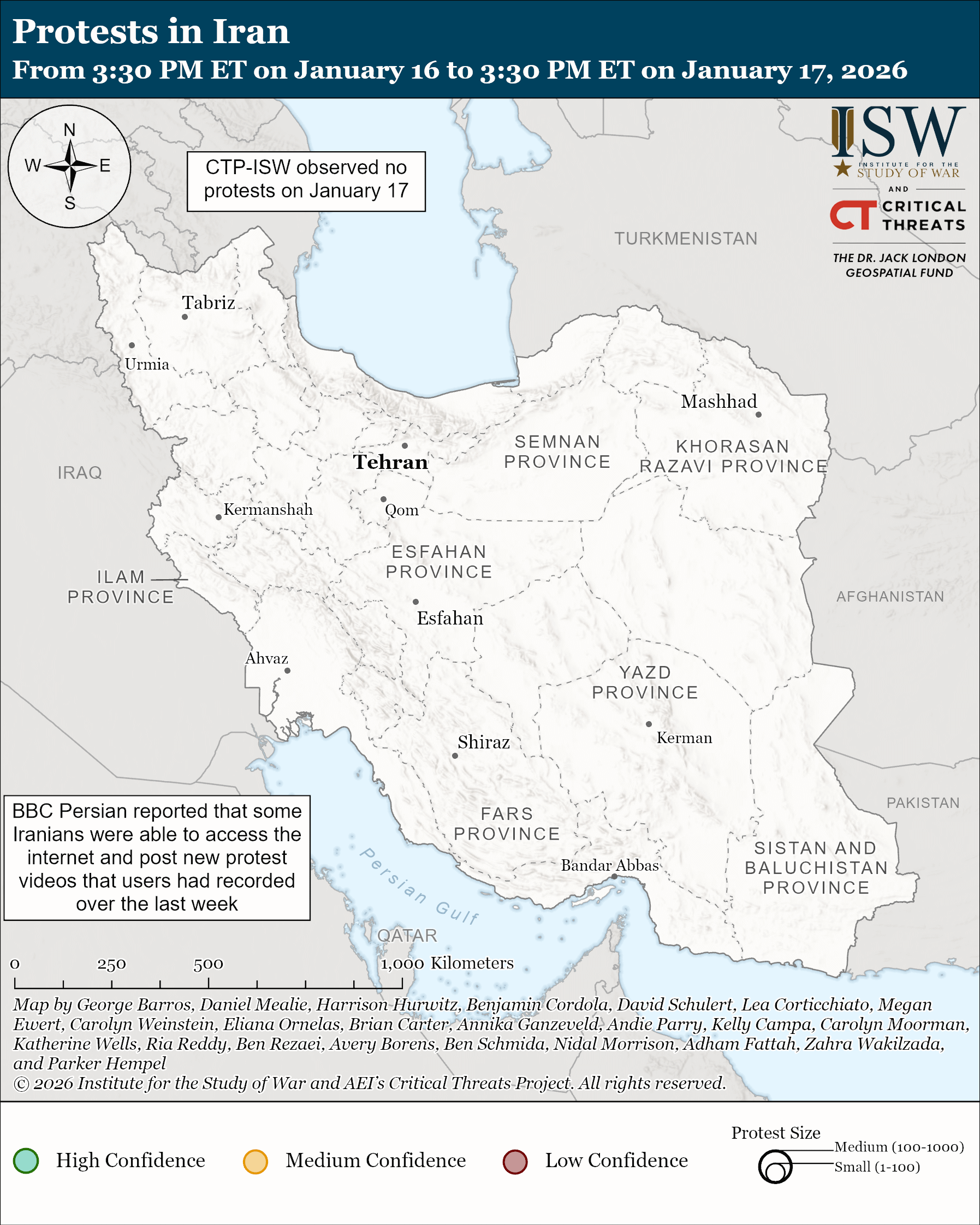
Click here to see CTP-ISW’s new interactive map showing the locations of daily protests in Iran since December 28, 2025. CTP-ISW will continue to publish daily static maps depicting the Iranian protests in forthcoming Iran Updates.
Click here to see CTP and ISW’s interactive map of assessed control of terrain in Syria, and here to see CTP and ISW’s interactive map of Israeli ground operations. The Syria map is updated daily alongside the static Syria maps in this report. CTP-ISW ended daily maps of Israeli ground operations in February 2025.
Click here to see CTP-ISW's interactive map showing the total strikes in Iran during the Israel-Iran War, as well as an interactive timelapse showing the strikes day-by-day.
Click here to see CTP-ISW's indicators of Iranian regime instability.
Note: CTP-ISW has resumed publishing daily Iran Updates to cover the ongoing protests in Iran. CTP-ISW's weekend updates will only include analysis on the protests, while our weekday updates will also include analysis on Iraq, Syria, and Lebanon.
Key Takeaways
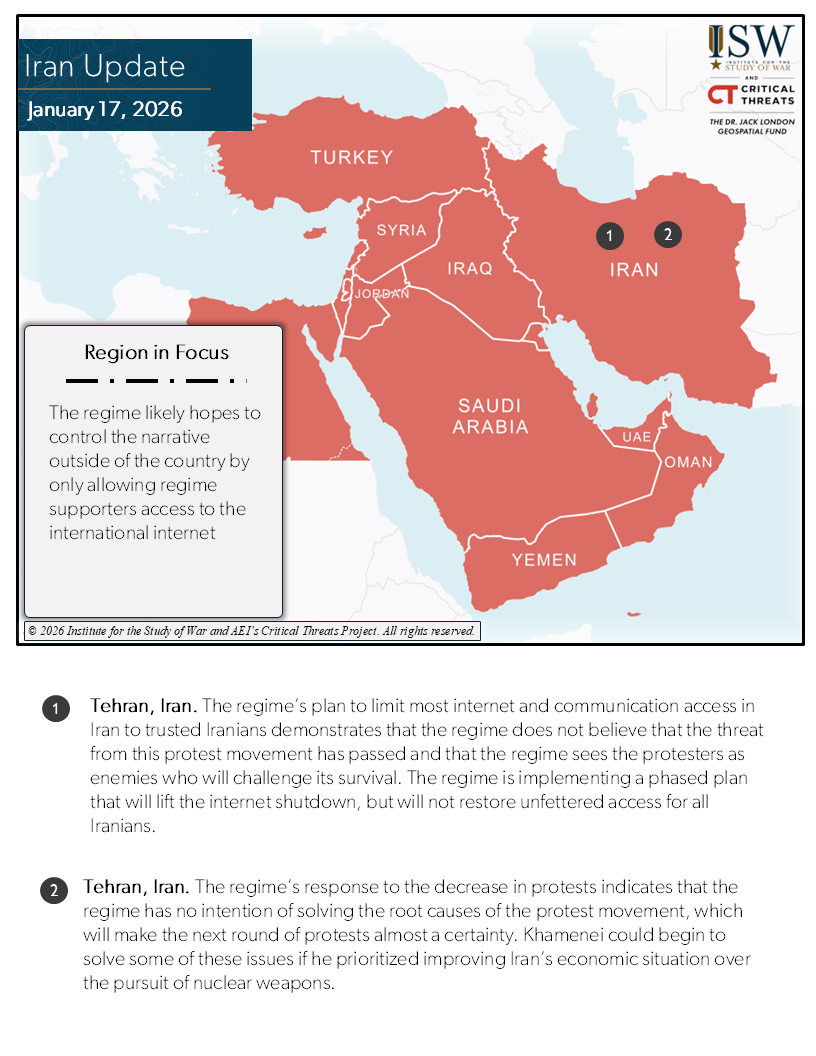
- The Iranian Regime’s Securitization: The regime’s plan to limit most internet and communication access in Iran to trusted Iranians demonstrates that the regime does not believe that the threat from this protest movement has passed and that the regime sees the protesters as enemies who will challenge its survival. The regime is implementing a phased plan that will lift the internet shutdown, but will not restore unfettered access for all Iranians. The regime likely hopes to control the narrative outside of the country by only allowing regime supporters access to the international internet.
- The Regime’s Response to Protests: The regime’s response to the decrease in protests indicates that the regime has no intention of solving the root causes of the protest movement, which will make the next round of protests almost a certainty. Khamenei could begin to solve some of these issues if he prioritized improving Iran’s economic situation over the pursuit of nuclear weapons.
The regime’s plan to limit most internet and communication access in Iran to trusted Iranians demonstrates that the regime does not believe that the threat from this protest movement has passed and that the regime sees the protesters as enemies who will challenge its survival. The regime is implementing a phased plan that will lift the internet shutdown, but will not restore unfettered access for all Iranians. The regime will begin its restoration plan by restoring SMS services, then national internet and domestic messaging platforms, and then international internet access.[i] Messaging apps will only be available to verified and authorized users, which will enable security forces to blacklist certain individuals or groups from using the platforms.[ii] It is not clear on what timeline these phases will be implemented, but a regime spokesperson said on January 16 that the regime would not restore internet access until the 40-day mourning period has passed and may not restore it before Nowruz on March 20, 2026.[iii] A prominent Shia tradition is holding a mourning ceremony 40 days after a death; that the regime killed so many protesters means that thousands of 40-day mourning ceremonies are approaching, which could drive more protests. A US-based digital rights organization focused on Iran corroborated these regime media reports, adding that the regime is implementing a plan to make the international internet accessible only for whitelisted individuals.[iv] Regime officials, including Supreme Cyberspace Councilmember Mahdi Akhavan Bahabadi and SCC Secretary Mohammad Amin Aghamiri, are developing and implementing plans to make international internet and messaging platforms only accessible to people with a high-level security clearance.[v] These plans demonstrate that the regime continues to view Iran’s general population as a threat and that the regime believes the protest movement could resume if given an opportunity to do so.
The regime likely hopes to control the narrative outside of the country by only allowing regime supporters access to the international internet. Regime supporters could echo regime talking points in the international media and on social media, while the opposition is less able to successfully report the reality on the ground. Regime officials and media have repeatedly referred to protesters as “terrorists,” and would likely try to frame the protests as a counterterrorism fight to lessen international opposition to its brutal crackdowns.[vi] The regime calls the protesters ”terrorists” to justify its use of lethal force to the international community while refusing to address the protesters’ legitimate grievances. The regime‘s internet blackout also enables its ability to conceal its use of lethal force because it restricts independent reporting and limits the circulation of evidence about the regime’s crackdown on protesters.[vii]
The regime’s response to the decrease in protests indicates that the regime has no intention of solving the root causes of the protest movement, which will make the next round of protests almost a certainty. Supreme Leader Ali Khamenei has continued to claim that the United States and Israel are supporting the protests to deflect responsibility for the root causes of the protests.[viii] He said protesters were either funded and trained by US and Israeli intelligence services or were “naïve teenagers” influenced by US- and Israeli-trained agents.[ix] Other Iranian officials have similarly blamed external “terrorists” and deflected responsibility.[x] Khamenei’s words are reflective of the regime’s long-running inability to recognize and respond to the demands of its population.
Khamenei did acknowledge that Iran’s economic situation “is not good” and called on the government to take serious steps to address the issues, but these comments are insufficient. Khamenei would need to change the fundamental character of his regime and its political economy in order to respond to the protesters’ demands.[xi] Transparency International ranked Iran 151 out of 180 countries in its Corruption Perceptions Index, which indicates that corruption remains widespread in Iran’s public sector.[xii] The Islamic Revolutionary Guard Corps (IRGC) and its subordinate institutions, such as Khatam ol Anbia Construction Headquarters, have dominance across key sectors and revenue streams, including control over up to half of Iran’s oil exports, which further limits the government’s capacity to deliver economic relief.[xiii] The Khatam ol Anbia Construction Headquarters is an IRGC-controlled civil engineering and construction firm that dominates broad swaths of the economy.[xiv] Iranian leaders would need to fundamentally restructure the economy in order to resolve the issues driving protesters' concerns. The regime has yet to demonstrate any willingness to do so.
Khamenei could begin to solve some of these issues if he prioritized improving Iran’s economic situation over the nuclear program, among other issues. Iran’s leadership long prioritized its nuclear position over sanctions relief.[xv] Senior Iranian officials repeatedly reject core US demands to halt its domestic uranium enrichment, stop funding the Axis of Resistance, and limit its missile capabilities, which consequently sustained the international sanction pressure that constrains government finances.[xvi] The regime faces severe fiscal constraints that US-led sanctions and chronic mismanagement intensify, and recent reporting ties the Iranian rial’s sharp depreciation and high inflation to those pressures.[xvii] These constraints and structural drivers, which caused the protests, will likely persist and could fuel renewed protests.

[i] https://t.me/defapress_ir/47208
[ii] https://t.me/Tasnimnews/383796
[iii] https://iranwire.com/fa/news-1/147691-%D9%81%D8%A7%D8%B7%D9%85%D9%87-%D9%85%D9%87%D8%A7%D8%AC%D8%B1%D8%A7%D9%86%DB%8C-%D9%85%D9%86%D8%AA%D8%B8%D8%B1-%D8%A7%DB%8C%D9%86%D8%AA%D8%B1%D9%86%D8%AA-%D8%A8%DB%8C%D9%86%D8%A7%D9%84%D9%85%D9%84%D9%84%DB%8C-%D9%86%D8%A8%D8%A7%D8%B4%DB%8C%D8%AF/
[iv] https://filter.watch/english/2026/01/15/iran-enters-a-new-age-of-digital-isolation-2/
[v] https://filter.watch/english/2026/01/15/iran-enters-a-new-age-of-digital-isolation-2/ ; https://sanctionssearch.ofac.treas.gov/Details.aspx?id=42556 ; https://web.archive.org/web/20130313093656/http://www.bahabad.gov.ir/c/journal_articles/view_article_content?groupId=1462&articleId=14507&version=1.0
[vi] https://t.me/defapress_ir/47091 ; https://www.foxnews.com/politics/top-iranian-official-downplays-death-toll-blames-israeli-plot-us-considers-strikes ;
[vii] https://www.iranintl.com/en/202601151162 ; https://home.treasury.gov/news/press-releases/sb0364
[viii] https://farsi.khamenei dot ir/speech-content?id=62370
[ix] https://farsi.khamenei dot ir/speech-content?id=62370
[x] https://x.com/FoxNews/status/2011542072130687300
[xi] https://farsi.khamenei dot ir/speech-content?id=62370
[xii] https://www.transparency.org/en/countries/iran
[xiii] https://home.treasury.gov/news/press-releases/tg539 ; https://www.reuters.com/world/middle-east/irans-revolutionary-guards-extend-control-over-tehrans-oil-exports-sources-say-2024-12-18/
[xiv] https://www.criticalthreats.org/analysis/iran-update-february-27-2023 ; https://home.treasury.gov/news/press-releases/tg539
[xv] https://www.reuters.com/world/middle-east/iran-will-not-compromise-right-enrichment-says-official-2025-06-12/ ; https://www.criticalthreats.org/analysis/iran-update-june-26-2025
[xvi] https://www.reuters.com/world/middle-east/edgy-iran-seeks-saudi-leverage-revive-stalled-nuclear-talks-with-us-2025-11-20/ ;
[xvii] https://www.reuters.com/world/middle-east/irans-currency-crash-hits-iraqs-pilgrimage-industry-2026-01-14/
View Citations