{{currentView.title}}
January 25, 2026
Iran Update, January 25, 2026
Kelly Campa, Kelly Campa, Adham Fattah, Adham Fattah, Carolyn Moorman, Carolyn Moorman, Ria Reddy, Ria Reddy, Annika Ganzeveld and Annika Ganzeveld
The Critical Threats Project (CTP) at the American Enterprise Institute and the Institute for the Study of War (ISW) publish the Iran Update, which provides insights into Iranian and Iranian-sponsored activities that undermine regional stability and threaten US forces and interests. CTP-ISW publishes the Iran Update daily.
Click here to see CTP-ISW’s new interactive map showing the locations of daily protests in Iran since December 28, 2025. CTP-ISW will continue to publish daily static maps depicting the Iranian protests in forthcoming Iran Updates.
Click here to see CTP and ISW’s interactive map of assessed control of terrain in Syria, and here to see CTP and ISW’s interactive map of Israeli ground operations. The Syria map is updated daily alongside the static Syria maps in this report. CTP-ISW ended daily maps of Israeli ground operations in February 2025.
Click here to see CTP-ISW's interactive map showing the total strikes in Iran during the Israel-Iran War, as well as an interactive timelapse showing the strikes day-by-day.
Click here to see CTP-ISW's indicators of Iranian regime instability.
Note: CTP-ISW will publish updates on January 24 and 25 providing analysis about developments in Iran and Syria. We will resume full coverage on Monday, January 26.
Key Takeaways
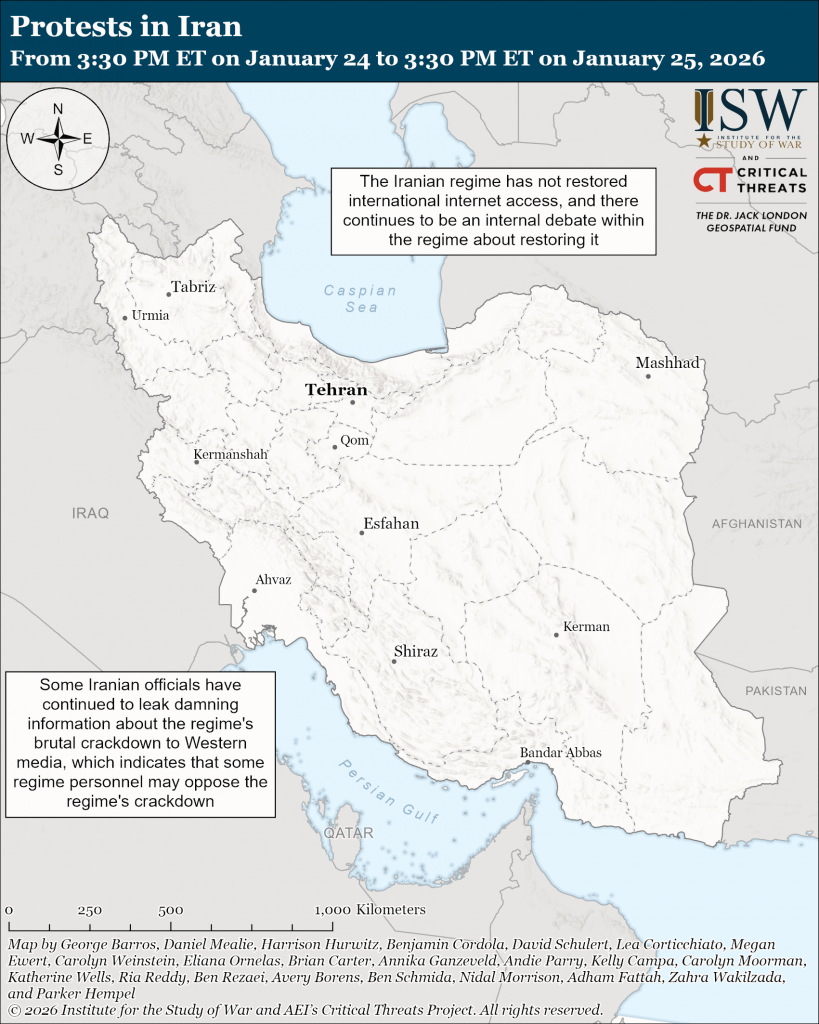
- Dissent Within the Iranian Regime: Some Iranian officials have continued to leak damning information about the regime’s brutal crackdown to Western media, which indicates that some regime personnel may oppose the regime’s crackdown. The leaks also undermine the regime's ongoing information operation that seeks to portray the regime and Iranian security forces as victims of "terrorism" and conceal the regime's use of lethal force.
- Internet Access in Iran: The Iranian regime has not restored international internet access, and there continues to be an internal debate within the regime about restoring it. The debate primarily seems to be between regime factions that assess that restoring the internet could cause a resumption of protests and factions that assess that the economic toll of the internet shutdown could cause internal unrest.
- Syrian government-SDF conflict: The extension of the Syrian government-Syrian Democratic Forces (SDF) ceasefire is enabling the government to deliver humanitarian aid to SDF-controlled areas in northern Syria. The Syrian army established two humanitarian corridors in Kobani and Hasakah City. The Syrian government did not call on civilians in Kobani or Hasakah City to use the corridors to evacuate from these cities, which suggests that government forces do not plan to imminently launch an operation to advance into either city.
Iranian officials have continued to leak damning information about the regime's brutal crackdown to Western media, which indicates that some regime personnel may oppose the regime's crackdown. The New York Times reported on January 25 that Iranian Supreme Leader Ali Khamenei ordered the Supreme National Security Council (SNSC) on January 9 to crush the protests "by any means necessary," citing two Iranian officials briefed on Khamenei's directive.[i] The officials stated that security forces were ordered to shoot to kill and "show no mercy.” Anti-regime media similarly reported on January 13 that Khamenei had issued a direct order to kill protesters and that the SNSC had issued an order for security forces to use live fire against protesters.[ii] Khamenei’s directive to the SNSC and the SNSC’s order to security forces to use live fire are consistent with reports that SNSC Secretary Ali Larijani played a leading role in the regime's crackdown.[iii] The United States Treasury Department sanctioned Larijani on January 15 and reported that he was "responsible for coordinating the response to the protests on behalf of the Supreme Leader of Iran.”[iv] Two senior Iranian officials separately told TIME on January 25 that 30,000 people may have been killed on January 8 and 9.[v] Other Iranian sources, including sources from the SNSC and Islamic Revolutionary Guards Corps (IRGC), have previously reported high protest death counts to Western media.[vi] Leaks of high protester death counts by regime officials suggest that some members of the regime may oppose the regime’s brutal crackdown on the protests. The leaks also undermine the regime's ongoing information operation that seeks to portray itself and Iranian security forces as victims of "terrorism" and conceal its use of lethal force.[vii]
The Iranian regime has not restored international internet access, and there continues to be an internal debate within the regime about restoring it. The debate primarily seems to be between regime factions that assess that restoring the internet could cause a resumption of protests and factions that assess that the economic toll of the internet shutdown could cause internal unrest. The regime shut down the internet on January 8 to prevent Iranians from being able to organize protests and to conceal the regime’s brutal crackdown on the protests.[viii] Internet monitor Netblocks reported on January 25 that the internet shutdown in Iran has continued despite “brief connectivity spikes.”[ix] Islamic Revolutionary Guards Corps (IRGC)-affiliated media reported on January 23 that international internet access would be restored across all provinces by January 24.[x] The Iranian Information and Communications Technology Ministry denied this report on January 25 and stated that the ministry “is diligently pursuing improvements in the accessibility situation.”[xi] Conflicting messaging from IRGC-affiliated outlets suggests that there are divisions within the IRGC over whether to restore internet access. IRGC-affiliated Tasnim News Agency criticized on January 25 individuals who support restoring internet access for economic reasons and argued that a safe security environment is necessary for economic activity.[xii] An IRGC-affiliated Telegram channel conversely said on January 21 that the Iranian regime’s decision to maintain the internet shutdown undermines Iran’s “national security interest” because the economic consequences of the shutdown risk fueling public resentment.[xiii]
A political analyst close to the Iranian regime stated on January 24 that the recent protests were “one of the most alarming incidents of the past century” and represented a crisis that is “slowly deepening.””[xiv] These statements are consistent with CTP-ISW's assessment that protests could resume because the regime has neither addressed nor indicated a willingness to address its population’s grievances.[xv] The analyst, Mostafa Najafi, assessed that the recent protests represented an "escalating trend” and described large-scale protests in 2017, 2019, 2022, and 2025 as “successive eruptions of an unresolved structural dissatisfaction.”[xvi] Najafi stated that the periods between each of these protest waves were periods of "condensed anger and expectation.” He stated that each protest wave in Iran "accumulates the unanswered demands" of previous waves, which reflects Najafi’s awareness that the regime’s failure to address its population’s grievances or provide concessions after protests only further deepens the population’s dissatisfaction with the regime. Najafi also assessed that the size and intensity of the recent protests compared to past waves reflect the Iranian population’s "eroding trust" in the regime.[xvii] CTP-ISW previously assessed that the recent protests were the most serious domestic unrest the regime has faced, and that the regime responded to this unrest with an unprecedented level of brutality.[xviii] Najafi’s statements are consistent with CTP-ISW’s assessment that the regime’s refusal to address the underlying grievances that triggered the recent and previous protest movements could cause protests to reemerge in the future.[xix]
The extension of the Syrian government-Syrian Democratic Forces (SDF) ceasefire is enabling the government to deliver humanitarian aid to SDF-controlled areas in northern Syria. The Syrian army established two humanitarian corridors in Kobani and Hasakah City to enable civilians to access aid, medical treatment, and basic necessities.[xx] The first humanitarian aid convoy carrying medical supplies, food, and fuel arrived in Kobani on January 25.[xxi] The supply of aid is particularly necessary for residents and internally displaced persons in Kobani because the city has not had access to electricity, water, essential food supplies, or internet since at least January 20.[xxii] CTP-ISW noted on January 22 that it is unclear whether SDF shelling caused electricity and water infrastructure in Kobani to fail or if the government deliberately cut the city's access to those resources.[xxiii] Syrian government forces are positioned on the outskirts of Kobani and Hasakah at the time of this writing but are not allowed to enter either city under the ceasefire agreement, which the Syrian government and SDF extended on January 24.[xxiv] The Interior Ministry’s A1 Special Missions Unit deployed to secure the Kobani corridor near the M4 highway on January 25.[xxv]
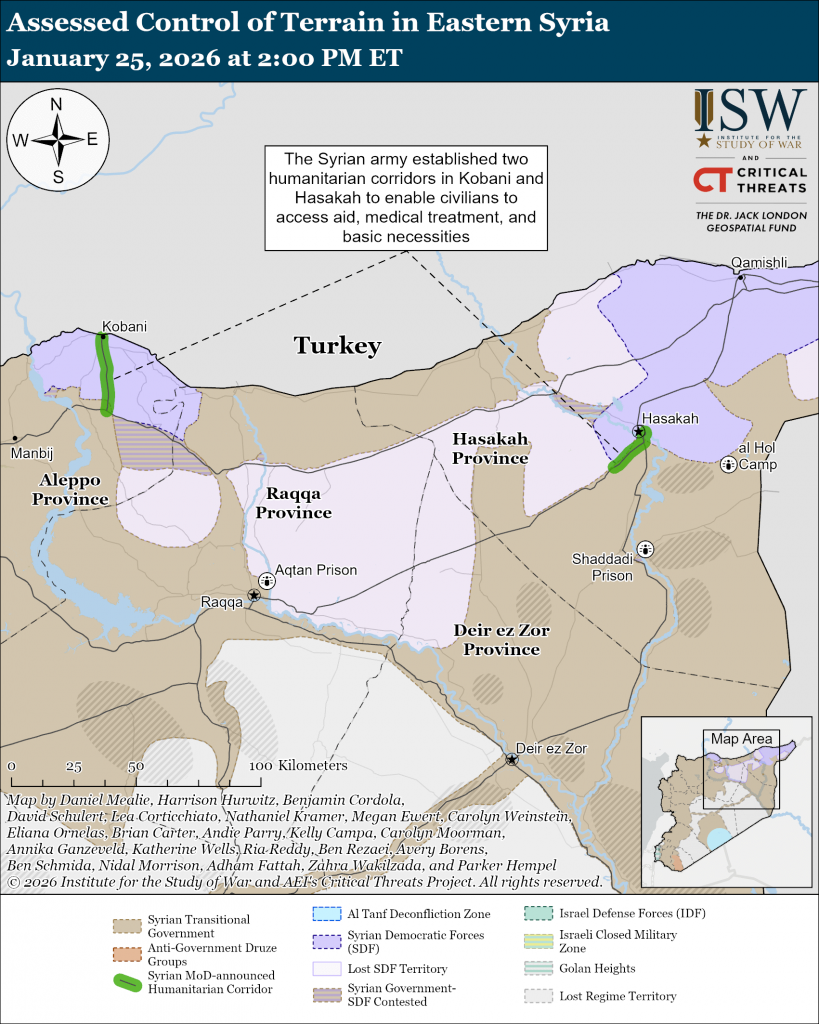
The Syrian government did not call on civilians in Kobani or Hasakah City to use the corridors to evacuate from these cities, which suggests that government forces do not plan to imminently launch an operation to advance into either city. The Syrian Defense Ministry and SDF both affirmed on January 24 their commitment to extend the current ceasefire by 15 days.[xxvi] The pattern of events and government deployments around Kobani resembles recent government isolate-and-reduce operations against the SDF in Aleppo City and Deir Hafer, which suggests that the Syrian military could employ a similar approach in Kobani.[xxvii] This approach would include opening an evacuation route to enable civilians to leave Kobani before launching an assault on the city. The Syrian government calling on civilians to evacuate would be an indicator of imminent military operations in the Kobani area.[xxviii]
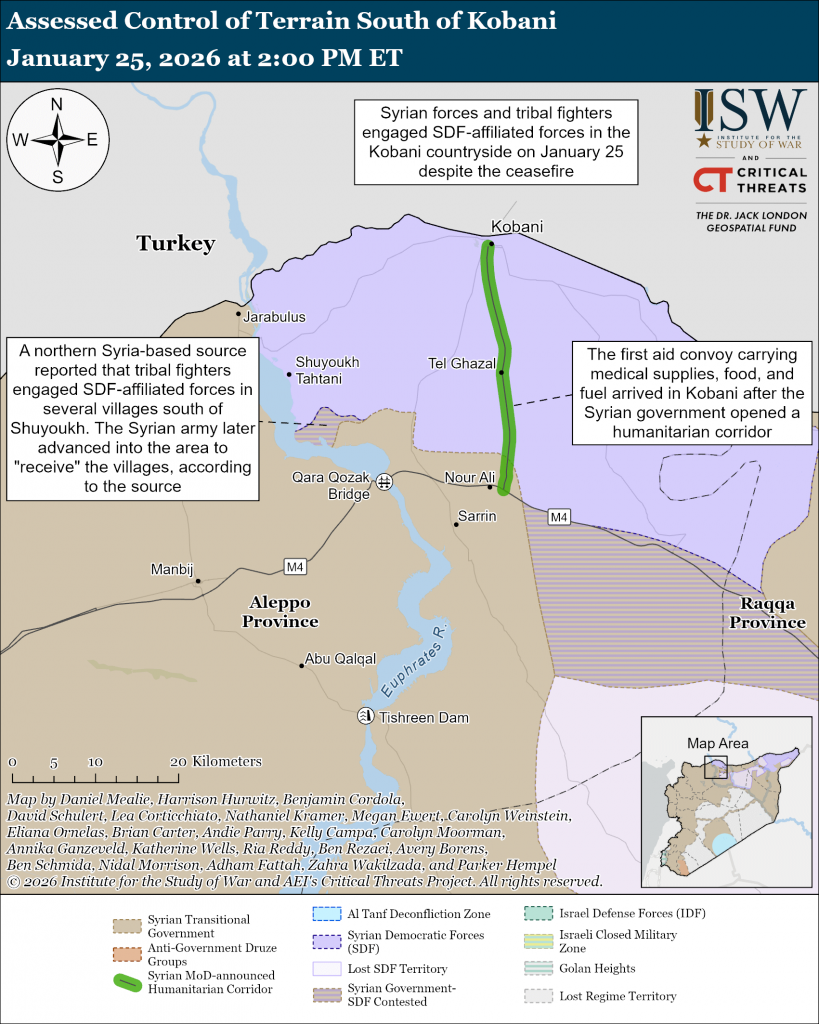
Syrian forces and tribal fighters engaged SDF-affiliated forces in the Kobani countryside on January 25 despite the ceasefire.[xxix] Both the SDF and Syrian government accused the other side of launching attacks near Kobani on January 25. Syrian state media said that the SDF fired over 15 drones targeting the Sarrin area and mortared a village near Jarabulus from positions across the Euphrates River.[xxx] The SDF said that the Syrian army attacked its forces along several axes around Kobani on January 25.[xxxi] CTP-ISW assessed on January 23 that the Syrian government has deployed at least three Aleppo-based Syrian divisions along Kobani frontlines that contain militias or fighters that have participated in Turkish-backed offensives targeting the Kurdish People’s Protection Units (YPG) in northern Syria.[xxxii] The deployment of these units could be contributing to the Syrian army's lack of adherence to the ceasefire along these frontlines in some instances. The YPG said that the ceasefire "only exists on paper” in the Kobani region in a social media post on January 25, referring to the reported government attacks in the area.[xxxiii]
The mobilization of tribal fighters in the Kobani countryside is also contributing to fighting south of Kobani. A northern Syria-based source reported that tribal fighters from villages along the eastern bank of the Euphrates River, south of al Shuyoukh, engaged SDF-affiliated forces in the area that were preventing movement along the main road that connects al Shuyoukh to Sarrin.[xxxiv] The Syrian army deployed to several villages that tribal fighters cleared of SDF-affiliated forces, according to the source.[xxxv] The large-scale mobilization of tribal fighters across Raqqa, Deir ez Zor, and Hasakah provinces significantly contributed to the SDF’s collapse and the government’s seizure of Arab-majority areas from the SDF between January 17 and 20 .[xxxvi] Tribal fighters based in northeastern Syria are not subject to the Syrian government’s ceasefire with the SDF.
The Syrian government and SDF will continue to engage in dialogue over the next 15 days, according to the SDF.[xxxvii] The ceasefire agreement, which the Syrian government and SDF extended by 15 days on January 24, effectively tasked SDF Commander Mazloum Abdi with securing support from other SDF leaders for Syrian President Ahmed al Shara’s terms, which include the integration of the SDF and its remaining territory into the Syrian state.[xxxviii] CTP-ISW assessed on January 31 that Abdi may not be able to secure support from other SDF leaders for Shara’s terms even if the ceasefire is extended to give him more time to consult with SDF leadership.[xxxix] Abdi met with a Kurdish National Council-affiliated delegation to discuss the ceasefire on January 25, according to pro-SDF media.[xl] Abdi also spoke with Kurdistan Democratic Party President Masoud Barzani on January 25.[xli] Barzani has acted as a mediator between Abdi and the Syrian government in recent weeks.[xlii]

[i] https://www.nytimes.com/2026/01/25/world/middleeast/iran-how-crackdown-was-done.html
[ii] https://www.iranintl.com/en/202601130145
[iii] https://iranwire.com/en/news/147783-ali-larijani-masterminded-the-massacre-says-former-official/
[iv] https://home.treasury.gov/news/press-releases/sb0364
[v] https://time.com/nextgen-preview/7228edd7c55f97e885492382190da5ed793b2bc4232f62e28dc1fe33fca070ed/article/7357635/
[vi] https://www.iranintl.com/en/202601130145
[vii] https://www.criticalthreats.org/analysis/iran-update-january-15-2026 ; https://www.iranintl.com/en/202601151162
[viii] https://x.com/netblocks/status/2009313506726957230
[ix] https://x.com/netblocks/status/2015352026381639764?s=20
[x] https://t.me/farsna/408990
[xi] https://t.me/Tasnimnews/384944
[xii] https://t.me/Tasnimnews/384883
[xiii] https://t.me/sepah_pasdaran/177797
[xiv] https://x.com/Mostafa_Najafii/status/2015147710274310644
[xv] https://www.criticalthreats.org/analysis/iran-update-january-15-2026
[xvi] https://x.com/Mostafa_Najafii/status/2015147710274310644
[xvii] https://x.com/Mostafa_Najafii/status/2015147710274310644
[xviii] https://understandingwar.org/research/middle-east/indicators-of-iranian-regime-instability/ ;
https://understandingwar.org/research/middle-east/iran-update-january-13-2026/
[xix] https://www.criticalthreats.org/analysis/iran-update-january-15-2026
[xx] https://t.me/sana_gov/156468
[xxi] https://x.com/QalaatAlMudiq/status/2015356764758188261; https://x.com/vvanwilgenburg/status/2015446304336339364; https://x.com/vvanwilgenburg/status/2015357193407639751; https://thenewregion.com/posts/4387
[xxii] https://x.com/vvanwilgenburg/status/2015180380794429722; https://x.com/vvanwilgenburg/status/2015182569747173873; https://x.com/vvanwilgenburg/status/2015379492747821437 ; https://npasyria.com/en/134826/
[xxiii] https://understandingwar.org/research/middle-east/iran-update-january-22-2026
[xxiv] https://t.me/Sy_Defense/1499 , https://x.com/SDF_Syria/status/2015160163313893765
[xxv] https://x.com/DeirEzzore/status/2015428596341317926; https://www.eremnews dot com/news/arab-world/jd8odtg
[xxvi] https://t.me/Sy_Defense/1499 , https://x.com/SDF_Syria/status/2015160163313893765
[xxvii] https://understandingwar.org/research/middle-east/iran-update-january-22-2026
[xxviii] https://understandingwar.org/research/middle-east/iran-update-january-22-2026
[xxix] https://x.com/SDF_Syria/status/2015405622083141673
[xxx] https://t.me/sana_gov/156542 ; https://t.me/AlekhbariahSY/194231
[xxxi] https://x.com/SDF_Syria/status/2015405622083141673
[xxxii] https://understandingwar.org/research/middle-east/iran-update-january-23-2026/
[xxxiii] https://x.com/YpgInt/status/2015426534287315455
[xxxiv] https://x.com/DeirEzzore/status/2015443731135057953; https://x.com/DeirEzzore/status/2015363151303168065
; https://t.me/AbomosaabSharkea/165295; https://www.facebook.com/permalink.php?story_fbid=pfbid02vuBxF32jSQTzbpt6HNxrGuiK8fASVH122u8BdXRib2zsdTzFfmWwVBdvNsMg9xEBl&id=100066442900211&__cft__[0]=AZZMmfOszg4JJMPRhKG_omcBwDZxw2NqoJ3-dTlaLk926Z3Gfx1ckVhbSE5i13iRJEBzgVFlTl2d_uVIkm2qbJhkVk5XT_JF45B1U4fH4En8IDzrOPTyhKY64GbfXHSv8sg9d-7pQxOUXsr-jq0WRxyBWi_GcRelbyWVvtLLpXXc7uxVGTrLIKr6gJvqhdVCuq0&__tn__=%2CO%2CP-R; https://www.facebook.com/permalink.php?story_fbid=pfbid02vuBxF32jSQTzbpt6HNxrGuiK8fASVH122u8BdXRib2zsdTzFfmWwVBdvNsMg9xEBl&id=100066442900211&__cft__[0]=AZZMmfOszg4JJMPRhKG_omcBwDZxw2NqoJ3-dTlaLk926Z3Gfx1ckVhbSE5i13iRJEBzgVFlTl2d_uVIkm2qbJhkVk5XT_JF45B1U4fH4En8IDzrOPTyhKY64GbfXHSv8sg9d-7pQxOUXsr-jq0WRxyBWi_GcRelbyWVvtLLpXXc7uxVGTrLIKr6gJvqhdVCuq0&__tn__=%2CO%2CP-R
[xxxv] https://x.com/DeirEzzore/status/2015451648856879254
[xxxvi] https://x.com/QalaatAlMudiq/status/2012805719095906530; https://x.com/QalaatAlMudiq/status/2012815243538292867; https://x.com/BarracudaVol1/status/2012818515275686139?s=20; https://x.com/QalaatAlMudiq/status/2012827776739405866; https://x.com/Me1Ray/status/2012592197192073373?s=20; https://x.com/BarracudaVol1/status/2012559574482436599?s=20; https://x.com/qalaatalmudiq/status/2013625754869694765?s=46;
[xxxvii] https://x.com/SDF_Syria/status/2015160163313893765
[xxxviii] https://x.com/HmzhMo/status/2013634444297371709
[xxxix] https://www.criticalthreats.org/analysis/iran-update-january-23-2026
[xl] https://www.facebook.com/permalink.php?story_fbid=pfbid0cgam5SsNtrvuAJD4n39JpNF4QKv6YqxYgpN6Deaa6xfj5Gwb5NN43WJB9pZJJNeMl&id=100066442900211&rdid=iIUE85BxD7TqN7vH#
[xli] https://www.rudaw dot net/sorani/kurdistan/250120268
[xlii] https://www.middleeasteye.net/news/us-envoy-accused-sdf-chief-trying-drag-israel-internal-syria-matters-sources-say; https://t.me/AlekhbariahSY/193572
View Citations