{{currentView.title}}
January 15, 2026
Iran Update, January 15, 2026
Annika Ganzeveld, Kelly Campa, Katherine Wells, Ben Rezaei, Parker Hempel, Carolyn Moorman and Avery Borens
Non-Protest Data Cutoff: 2:00 PM ET
Protest Data Cutoff: 3:30 PM ET
The Critical Threats Project (CTP) at the American Enterprise Institute and the Institute for the Study of War (ISW) publish the Iran Update, which provides insights into Iranian and Iranian-sponsored activities that undermine regional stability and threaten US forces and interests. CTP-ISW publishes the Iran Update daily.
Click here to see CTP and ISW’s interactive map of assessed control of terrain in Syria, and here to see CTP and ISW’s interactive map of Israeli ground operations. The Syria map is updated daily alongside the static Syria maps in this report. CTP-ISW ended daily maps of Israeli ground operations in February 2025.
Click here to see ISW-CTP's interactive map showing the total strikes in Iran during the Israel-Iran War, as well as an interactive timelapse showing the strikes day-by-day.
Click here to see ISW-CTP’s new interactive map showing the locations of daily protests in Iran since December 28, 2025. ISW-CTP will continue to publish daily static maps depicting the Iranian protests in forthcoming Iran Updates.
Iranian regime’s extreme securitization of society and brutal crackdown on protests appear to have suppressed the protest movement for now. The regime’s widespread mobilization of security forces is unsustainable, however, which makes it possible that protests could resume. The regime has also not addressed and likely will not address the underlying grievances that triggered this protest movement. The regime has reportedly imposed a curfew to prevent Iranians from going out at night, which is when protests often take place.[i] Two sources in Tehran and a resident in Tabriz, East Azerbaijan Province, told a BBC Persian reporter and anti-regime media, respectively, that the regime has told Iranians not to leave their homes after 8:00 PM.[ii] The regime has also deployed security forces to patrol towns and cities across Iran. A resident in Tabriz told anti-regime media on January 15 that security forces are deployed in “all areas” of Tabriz, including in “small neighborhoods far from the city center.”[iii] An unspecified foreign diplomat in Iran similarly told the Washington Post on January 14 that security forces are “all over the town.”[iv] An individual in Tehran separately told a Paris-based journalist on January 15 that the regime has deployed tanks in Tehran.[v] CTP-ISW has not observed any images or videos to corroborate this report, but the deployment of tanks would likely be meant to intimidate civilians and deter them from protesting.
The regime’s pervasive securitization measures and violent crackdown on protests appear to have suppressed protest activity for now. CTP-ISW recorded zero protests on January 15, which marks the second consecutive day that CTP-ISW has not recorded any protest activity in Iran. Various sources in Iran told Western media that protest activity has subsided in recent days in response to the regime’s brutal crackdown. An individual who participated in protests in Tehran told the Wall Street Journal on January 15 that clashes between security forces and protesters in Tehran intensified after January 8, but that Tehran “was quiet” by January 12.[vi] The protester stated that it was “as if we realized what had happened to us and how many had been killed.”[vii] Iranians separately told Reuters on January 14 and 15 that the protests appear to have subsided since January 12.[viii] An unspecified foreign diplomat in Iran similarly told the Washington Post on January 14 that the protests have “generally subsided” and that “the fear factor has gained the upper hand.”[ix] The regime has used unprecedented brutality to quell the recent protests, and this brutality appears to have deterred some Iranians from continuing to demonstrate against the regime, at least for the time being.[x] A US-based human rights organization reported on January 15 that the regime has killed at least 2,677 individuals and arrested 19,097 individuals since December 28.[xi]
The regime’s mobilization of security forces to securitize society is unsustainable, which makes it possible that protests could resume when the regime is no longer able to sustain this mobilization. Mobilizing security forces for long periods of time risks burning out and exhausting these forces. Senior law enforcement, military, and intelligence officials previously held discussions about security forces’ “exhaustion” during the Mahsa Amini protest movement.[xii] The regime is also taking other measures to securitize society, such as sustaining its nationwide internet shutdown, that impose a significant cost on the regime.[xiii] The regime’s willingness to sustain these securitization measures highlights how the regime still perceives its population as a serious threat. It is unclear, however, how long the regime will be able to sustain these measures.
The regime is also unlikely to address the underlying factors that triggered this protest movement, which makes it possible that protests could resume. The protest movement was initiated by merchants and shopkeepers in Tehran in late December 2025 in response to Iran’s deteriorating economic conditions, including the fall of the value of the Iranian rial to a record low of 1,432,000 rials to one US dollar on December 28.[xiv] The value of the rial has since further depreciated to 1,482,500 rials to one US dollar on January 6 before depreciating slightly to 1,429,500 rials to one US dollar on January 15.[xv] The regime has not introduced any economic reforms during the protest movement and is unlikely to fundamentally transform its economic policy in response to the protests. It is conceivable that the regime’s brutal crackdown has deterred Iranians from protesting for the time being, but the regime’s unwillingness to implement meaningful reforms creates the conditions for further protests. A Tehran resident told the Wall Street Journal on January 15 that he doesn’t think that the current “calm” in Tehran “will hold” and that the situation in Iran is “very volatile.”[xvi] These statements reflect how the regime may have suppressed protest activity for now but that the situation could rapidly change.
Iranian leaders are reportedly moving their US currency reserves abroad, which indicates their lack of faith in Iran’s banking system and may indicate concerns about the future of the regime. US Treasury Secretary Scott Bessent stated on January 14 that Iranian officials have transferred “tens of millions of [US] dollars” out of Iran to unspecified locations.[xvii] An Israeli news outlet similarly reported on January 14 that Iranian officials have moved around $1.5 billion USD out of Iran in the past 48 hours and that Supreme Leader Ali Khamenei’s son, Mojtaba Khamenei, has moved $328 million USD of that total to Dubai, citing a source familiar with Islamic Revolutionary Guards Corps (IRGC) activities.[xviii] Iranian officials’ transfer of money out of Iran reflects their lack of confidence in Iran’s fragile banking system. Regime-affiliated Bank Ayandeh dissolved in October 2025 after suffering nearly $5 billion USD in losses.[xix] The Iranian Central Bank folded Bank Ayandeh into regime-controlled Bank Melli and attempted to cover up the economic shock of Bank Ayandeh’s dissolution by printing more money, which in turn worsened the inflation cycle, weakened the value of the rial against the US dollar, and increased prices.[xx] Iran’s economic crisis requires structural changes in the regime’s monetary and fiscal systems that would require unraveling decades of mismanagement.[xxi] The regime has indicated that it is unwilling to implement fundamental economic reforms and instead employs stopgap measures to keep the Iranian economy afloat. Iranian leaders’ reported money transfers will reduce the amount of hard currency in Iran, which will in turn likely make Iran’s banking crisis more acute and inhibit the regime’s ability to solve its liquidity crisis. These conditions will likely exacerbate Iranians’ economic grievances that triggered the protest movement in Iran in late 2025.
The Iranian regime is conducting an information operation to portray itself and Iranian security forces as victims of “terrorism,” despite the regime’s violent crackdown on protests. Iranian Foreign Affairs Minister Abbas Araghchi told Fox News on January 14 that “terrorist elements led from outside” entered the protests, carried out operations similar to the Islamic State in Iraq and al Sham (ISIS), and shot security forces and civilians.[xxii] Araghchi claimed that "terrorist elements" captured police officers, burned them alive, and beheaded them.[xxiii] Araghchi’s statements signal that the regime still views its own population as a critical security threat and is doubling down on its narrative that protestors are “ISIS” members and “terrorists” to justify its use of violence and lethal force. The regime also uses the narrative that protesters are “terrorists” to treat the public as a hostile force rather than as a population that has legitimate grievances. The regime is also trying to conceal its use of lethal force. Anti-regime sources have reported that Iranian security forces have pressured some families seeking to recover their relatives’ bodies from hospitals or morgues to sign statements attributing the deaths of their relatives to “terrorists” or claiming that their relative was a Basij member.[xxiv] The regime’s widespread internet shutdown enables the regime to perpetuate this information operation because the shutdown restricts independent reporting and limits the circulation of evidence about the regime’s crackdown on protesters.
Hezbollah may be hesitant to conduct any direct action against Israel or the United States to support Iran that could trigger a full-scale conflict and disrupt the group’s reconstitution efforts. Statements by Hezbollah officials indicate that the group is prioritizing domestic issues in Lebanon, including its reconstitution and efforts to prevent disarmament.[xxv] Hezbollah released a statement on January 13 in which it expressed support for the Iranian regime but notably did not offer any military support to Iran or threaten to retaliate against the United States or Israel if they attack Iran.[xxvi] Hezbollah was previously unwilling and likely unable to defend Iran or retaliate against US or Israeli targets during the Israel-Iran War in June 2025, despite previously serving as one of Iran’s primary deterrents against Israel and the United States.[xxvii] Hezbollah has also not responded militarily to any Israeli strikes targeting Hezbollah military infrastructure and personnel in recent months, including Israel’s killing of Hezbollah’s “de facto chief of staff” and senior commander Haitham Ali Tabatabai in November 2025.[xxviii] Hezbollah’s continued hesitancy to act directly against Israel and the United States suggests that the group fears escalation due to its weaker position and the inherent unpredictability of military escalation, which could rapidly spiral out of Hezbollah’s control. Any Hezbollah attack directly targeting US or Israeli forces would presumably prompt a US or Israeli response and could threaten the November 2024 Israel-Hezbollah ceasefire agreement. The United States plays a key role in upholding the November 2024 ceasefire agreement, particularly through its role in the ceasefire monitoring committee and efforts to reduce tensions between Israel and Lebanon.[xxix] Hezbollah likely opposes any action that would threaten the ceasefire agreement because such action would undermine Hezbollah’s objectives of limiting Israel’s presence and operational scope in Lebanon. A US or Israeli response against Hezbollah would also likely disrupt Hezbollah’s current efforts to regenerate its forces and replenish its weapons stockpiles.[xxx]
Divisions within the Syrian Democratic Forces (SDF), which have reportedly impeded the year-long integration negotiations, threaten to prolong fighting between the SDF and the Syrian government in eastern Aleppo Province and risk further destabilizing northeastern Syria. The SDF appears to have reinforced its defenses along the western bank of the Euphrates River in the wake of a new Syrian government operation that aims to force the SDF to withdraw from its salient and the surrounding areas.[xxxi] A Deir Hafer-based SDF commander told Kurdish media on January 13--the day that the Syrian government announced its operation in eastern Aleppo--that the SDF would defend the area if the government attacked.[xxxii] SDF fighters fired drones and small arms targeting Syrian army positions and sent reinforcements from SDF-held areas in Raqqa Province to Deir Hafer, Aleppo Province, on January 13, according to anti-SDF media.[xxxiii] The Syrian government may attempt to advance into either Maskanah or Deir Hafer in the coming days after civilians exit the area via a government-established humanitarian corridor.[xxxiv] The degree to which SDF-affiliated fighters in Aleppo commit to defending against possible government advances will likely influence the scale and length of fighting in eastern Aleppo Province.
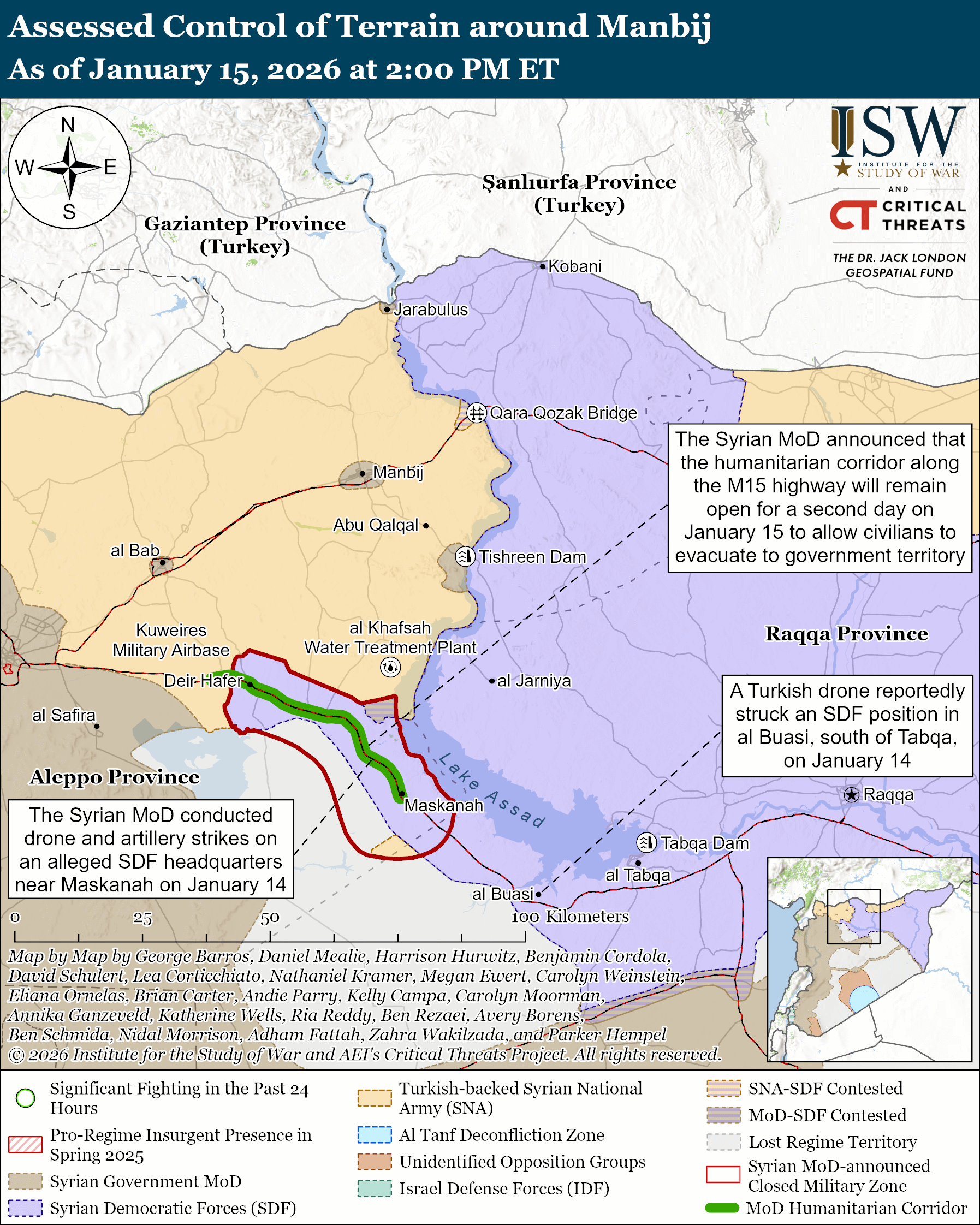
SDF and Autonomous Administration of North and East Syria (AANES) leaders have offered divergent approaches on how the SDF should engage the Syrian government in eastern Aleppo. Some Kurdish leaders have framed the government’s Aleppo operation as the beginning of a Turkish-Syrian effort to capture SDF-held areas by force.[xxxv] Such beliefs are probably in part influencing the SDF’s apparent decision to reinforce and defend Deir Hafer and Maskanah.[xxxvi] The co-chair of the Democratic Union Party (PYD), which is the People’s Protection Units’ (YPG) political wing, alleged on January 14 that the Syrian government has its “eyes” on Raqqa, Tabqa, and Kobani and that the SDF is currently making “defensive arrangements.”[xxxvii] The AANES closed all routes from SDF-controlled territory into government-held territory in Raqqa and Deir ez Zor provinces on January 15.[xxxviii]
More moderate elements of the SDF and AANES’s leadership have urged restraint and emphasized the need to return to dialogue. AANES official Ilham Ahmed, who is directly involved in SDF integration negotiations with Damascus, condemned the Syrian government for launching an operation and ”declaring war” on Kurds, but affirmed that the AANES supports dialogue with the Syrian government.[xxxix] The commander of the SDF-affiliated Northern Democratic Brigade announced on January 14 that he considers contributing to the escalation between the SDF and Syrian government ”illogical” and that his forces are moving toward ”integration and not engagement” with the Syrian government.[xl] The commander’s views do not appear to reflect those of forces on the ground in eastern Aleppo, however, since Northern Democratic Brigade forces do not appear to be deployed in eastern Aleppo.[xli]
US and Syrian officials have blamed the prolongation and lack of progress in negotiations between the Syrian government and SDF on some SDF leaders’ alignment with the Kurdistan Workers’ Party (PKK). The SDF is a coalition that is dominated by the YPG. Many YPG commanders formerly fought in the PKK, but most of these commanders had stopped engaging in any serious PKK-driven, anti-Turkey operations by the time that the United States began working with the YPG in 2014.[xlii] US, Syrian, and Turkish officials have recently blamed the stalled negotiations on the influence of PKK-linked leaders within the SDF, whose hardline demands have reportedly prevented pragmatic SDF leaders from making progress with the government.[xliii] An unspecified US military source blamed PKK-aligned cadres for impeding negotiations with the Syrian government.[xliv] A Washington-based Syria analyst, citing US, Turkish, European, and Syrian officials involved in the negotiations, reported that the SDF demanded new, more stringent conditions from the Syrian government after SDF Commander Mazloum Abdi and Syrian President Ahmed al Shara made an informal agreement on the terms of the SDF’s military integration in October 2025.[xlv] Syrian President Ahmed al Shara made a similar observation in an interview with Erbil-based Kurdish media on January 13, in which he claimed that the SDF has ”multiple leaders.”[xlvi] The subversion of government-SDF negotiations by PKK-aligned elements of the SDF also reportedly led to the prolongment of fighting in Aleppo City on January 9.[xlvii] Shara accused PKK leadership in the Qandil mountains of ordering SDF-affiliated forces in Aleppo City to ignore an internationally-mediated ceasefire and continue to fight.[xlviii]
Ongoing divisions within SDF leadership between those aligned with the PKK and those who are not risk prolonging fighting in eastern Aleppo Province and triggering future military engagements between the Syrian government and SDF in northern Syria. The SDF is currently engaged in talks with the Syrian government and the United States, which could end the fighting and facilitate a ceasefire or an SDF withdrawal like the January 10 agreement did in Aleppo City.[xlix] Disagreements over the terms of a ceasefire among the SDF’s leadership or the presence of SDF-affiliated fighters on the ground who may not obey a ceasefire risk prolonging or worsening the conflict. Disunity within the SDF that continues to stall negotiations also risks contributing to the outbreak of further SDF-Syrian government conflict in northeastern Syria. Senior Syrian officials have long referred to Syrian military action against the SDF as an undesirable but possibly inevitable outcome if talks fail completely.[l] The Syrian government likely remains committed to negotiations with the SDF at this time as a preferable option given that any major offensive against SDF-controlled territory in Raqqa or Deir ez Zor provinces would further destabilize Syria.[li] Turkey, which may be providing air support for the Syrian government’s operation in eastern Aleppo, has previously threatened to conduct such an offensive if the SDF refuses to integrate into the Syrian state.[lii] Turkish Foreign Minister Hakan Fidan said on January 15 that “the use of force remains an option” if the SDF and Syrian government do not resolve their issues through dialogue.[liii] The Turkish Ground Forces commander visited Turkish bases located along the Syria border on January 15 as Turkey simultaneously sent reinforcements to northern Raqqa Province, which indicates that Turkish forces are present in Syria and could support any future government operation against the SDF.[liv]
The Syrian government likely seeks to discourage Arab tribes in SDF-controlled eastern Syria from mobilizing against the SDF in order to maintain stability in northeastern Syria as it fights the SDF in eastern Aleppo Province.[lv] The Syrian government’s Office of Tribes and Clans head, Jihad Issa al Sheikh, urged Arab tribes and Kurdish communities on January 10 to reject escalation and pursue dialogue, warning that war between Arabs and Kurds would fracture Syrian society, invite foreign interference, and devastate local communities.[lvi] Sheikh called on Arab tribes to de-escalate tensions with Syria‘s Kurdish community and stop amassing weapons.[lvii] Sheikh described Kurds as “an integral part of Syria” whose rights and ”sacrifices” cannot be denied.[lviii] Sheikh noted that individuals advocating for war will bear full political, moral, and historical responsibility for its consequences.[lix]
The Syrian government’s call for Arab tribes in SDF-controlled parts of eastern Syria to de-escalate indicates that the Syrian government seeks a limited operation in eastern Aleppo rather than a campaign to destroy the SDF. Arab tribes in SDF-controlled Deir ez Zor Province have intermittently fought against the SDF since the fall of Assad in December 2024.[lx] Members of the Bakara Tribe in al Kasrah, Deir ez Zor Province, mobilized against the SDF in October 2025 in response to the SDF’s killing of a tribesman.[lxi] The al Shaytat clan separately mobilized against the SDF in September 2025 after SDF forces reportedly killed an unarmed civilian in Gharanij, Deir ez Zor Province.[lxii] Sheikh, a member of the Bakara tribe, previously played an instrumental role in securing the defection of Sunni Arabs loyal to the Assad regime prior to its collapse, including the al Baqir Brigade, which was an IRGC-supported Sunni militia comprised of Bakara tribesmen in Aleppo City.[lxiii] Sheikh was also likely involved in securing the defection of Bakara tribesmen loyal to the SDF during the Syrian Ministry of Defense (MoD)-SDF fighting in Ashrafiyeh, Aleppo City, on January 8.[lxiv] The Syrian government would presumably seek to mobilize Arab tribes against the SDF if it sought to conduct a full-scale campaign against the SDF and the government’s efforts to de-escalate tensions between Arab tribes and the SDF indicate that it does not intend to conduct such a campaign.
Unspecified Arab tribes appear to have ignored Sheikh’s January 10 statement and conducted sporadic attacks on SDF positions in eastern Syria in the lead up to and during the MoD’s January 12 offensive against the SDF in eastern Aleppo. A local anti-SDF source reported that unspecified groups of Arab tribesmen attacked several SDF positions in Dhiban, al Hawaij, Baghouz, and al Sousa in Deir ez Zor Province on January 11.[lxv] Tribal leaders described the January 11 attacks as the opening phase of a broader “liberation operation.”[lxvi] An unnamed tribal leader said that the attacks were in response to continued SDF raids and the SDF’s arrests of Arab tribal members during its counter-ISIS operations in the area, however.[lxvii] Arab tribes reportedly conducted a general mobilization across SDF-controlled eastern Syria on January 12.[lxviii] A local anti-SDF source also reported that unspecified Arab tribesmen targeted an SDF checkpoint in al Shaafa, Deir ez Zor Province, with machine guns on January 12.[lxix] Unspecified Arab tribesmen attacked an SDF checkpoint in al Sousa, Deir ez Zor Province, on January 15.[lxx] These attacks and the mobilization of Arab tribes amid the ongoing MoD offensive on the SDF-controlled Deir Hafer salient will likely impose new security requirements on the SDF even if the MoD operation remains limited.
Key Takeaways
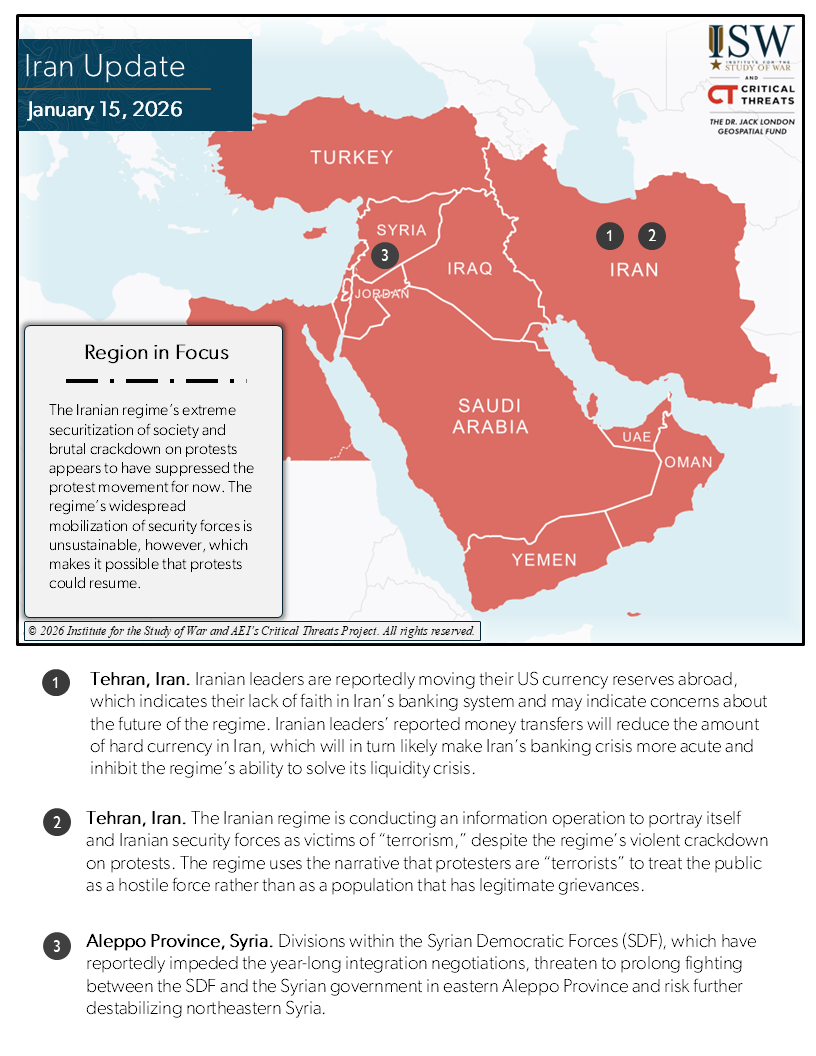
- The Iranian Regime’s Suppression of Protests: The Iranian regime’s extreme securitization of society and brutal crackdown on protests have likely suppressed the protest movement for now. The regime’s widespread mobilization of security forces is unsustainable, however, which makes it possible that protests could resume. The regime has also not addressed and likely will not address the underlying grievances that triggered this protest movement.
- Economic Instability in Iran: Iranian leaders are reportedly moving their US currency reserves abroad, which indicates their lack of faith in Iran’s banking system and may indicate concerns about the future of the regime. Iranian leaders’ reported money transfers will reduce the amount of hard currency in Iran, which will in turn likely make Iran’s banking crisis more acute and inhibit the regime’s ability to solve its liquidity crisis.
- Iranian Information Operation: The Iranian regime is conducting an information operation to portray itself and Iranian security forces as victims of “terrorism,” despite the regime’s violent crackdown on protests. The regime uses the narrative that protesters are “terrorists” to treat the public as a hostile force rather than as a population that has legitimate grievances.
- Hezbollah Strategic Calculus: Hezbollah may be hesitant to conduct any direct action against Israel or the United States to support Iran that could trigger a full-scale conflict and disrupt the group’s reconstitution efforts.
- SDF-Syrian Government Fighting in Aleppo Province: Divisions within the Syrian Democratic Forces (SDF), which have reportedly impeded the year-long integration negotiations, threaten to prolong fighting between the SDF and the Syrian government in eastern Aleppo Province and risk further destabilizing northeastern Syria.
- Tribal Activity in Syria: The Syrian government likely seeks to discourage Arab tribes in SDF-controlled eastern Syria from mobilizing against the SDF in order to maintain stability in northeastern Syria as it fights the SDF in eastern Aleppo Province, which indicates that the Syrian government seeks a limited operation in eastern Aleppo rather than a campaign to destroy the SDF.
Iran
The US Treasury Department sanctioned “the architects of the Iranian regime’s brutal crackdown on peaceful demonstrators” on January 15.[lxxi] The United States sanctioned Iranian Supreme National Security Council (SNSC) Secretary Ali Larijani.[lxxii] The SNSC is Iran’s highest national security and foreign policy decision-making body and plays a central role in determining how the regime responds to widespread protests, including authorizing and coordinating crackdowns by security forces.[lxxiii] The United States also sanctioned the Law Enforcement Command (LEC) and IRGC commanders of Lorestan and Fars provinces.[lxxiv] The US Treasury Department stated that security forces in Fars Province have killed numerous peaceful demonstrators since protests began in December 2025.[lxxv] The department added that security forces in Lorestan Province shot multiple civilians and withheld bodies to coerce families to falsely identify their relatives as government “martyrs.”[lxxvi] The United States also sanctioned five individuals and 18 entities for laundering proceeds from Iranian petroleum and petrochemical sales to foreign markets through clandestine shadow banking networks.[lxxvii]
Iraq
US Special Envoy to Iraq Mark Savaya announced on January 14 that the US Treasury Department will conduct a comprehensive review of the Iraqi banking sector and suggested that the department will impose sanctions on unspecified Iraqi actors and networks in the near future.[lxxviii] The department’s review is part of a US effort to isolate Iran from the international financial system and hinder transnational Iranian smuggling efforts.[lxxix] Savaya met with representatives from the US Treasury Department and its Office of Foreign Assets Control on January 14.[lxxx] Savaya and the representatives agreed that the Treasury Department will review the payment records and financial transactions of Iraqi institutions, companies, and individuals linked to financing and enabling terrorist activities.[lxxxi] Savaya added that the representatives discussed “forthcoming” sanctions on Iraq that will target “malign actors and networks that undermine [Iraq’s] financial integrity and state authority,” which almost certainly refers to Iranian-backed actors and entities linked to them.[lxxxii] Three unspecified Iraqi officials similarly told Qatari media in early December 2025 that US officials told the Iraqi federal government that the United States will soon sanction Iraqi individuals and political, economic, and commercial entities involved in financial activities on Iran’s behalf.[lxxxiii] An Iraqi Foreign Ministry official also told Qatari media that the United States may sanction “prominent figures” within Iranian-backed Iraqi militias that have parliamentary representation.[lxxxiv] Iran and its Iraqi partners have historically tried to evade international sanctions on Iranian banks and oil exports through the exploitation of Iraq’s financial system and by smuggling Iranian oil in Iraqi territorial waters.[lxxxv] The United States sanctioned several government and commercial entities in 2025 in an effort to reduce Iranian influence in Iraq.[lxxxvi]
Syria
See topline section.
Arabian Peninsula
CTP-ISW has temporarily suspended its coverage of Yemen beginning on January 9 to prioritize coverage of the protests in Iran.
Palestinian Territories and Lebanon
See topline section.

[i] https://x.com/FSeifikaran/status/2011561411814846886?s=20 ; https://x.com/IranIntl/status/2011814551600169223
[ii] https://x.com/FSeifikaran/status/2011561411814846886?s=20 ; https://x.com/IranIntl/status/2011814551600169223
[iii] https://x.com/IranIntl/status/2011814551600169223
[iv] https://www.washingtonpost.com/national-security/2026/01/14/us-iran-troops-withdraw-qatar/
[v] https://x.com/DeepaParent/status/2011739976967618808?s=20
[vi] https://www.wsj.com/world/middle-east/irans-heavy-crackdown-quells-protests-8e757172
[vii] https://www.wsj.com/world/middle-east/irans-heavy-crackdown-quells-protests-8e757172
[viii] https://www.reuters.com/world/china/trump-sees-iranian-crackdown-easing-tehran-denies-man-be-executed-2026-01-15/
[ix] https://www.washingtonpost.com/national-security/2026/01/14/us-iran-troops-withdraw-qatar/
[x] https://www.criticalthreats.org/analysis/iran-update-january-13-2026
[xi] https://x.com/hra_news/status/2011928322268188679
[xii] https://understandingwar.org/research/middle-east/iran-crisis-update-september-28/
[xiii] https://x.com/netblocks/status/2011838716562542678 ; https://netblocks.org/cost/
[xiv] https://www.bbc.com/news/articles/cqj2llkjv8vo ; https://www.bon-bast dot com/chart
[xv] https://www.bon-bast dot com/chart ; bonbast dot com
[xvi] https://www.wsj.com/world/middle-east/irans-heavy-crackdown-quells-protests-8e757172
[xvii] https://x.com/overton_news/status/2011606123372048805?s=20
[xviii] https://x.com/c14israel/status/2011543437460586850?s=20
[xix] https://www.wsj.com/world/middle-east/bank-collapse-iran-protests-83f6b681?gaa_at=eafs&gaa_n=AWEtsqdrro0Pn9km8bOyi8mpfvKh606MEfvvBFwcHJuNpgfyi0CaoDupP7D8KGeY7hY%3D&gaa_ts=6967c2d9&gaa_sig=MJwraOYvmoUAoYrIO4Krzd_vSsPUh8vDXU5uAe3kLH3AN5gVUBk3PGoBbLpZCDWluG-cvHug1lpQqTJ6P2DSbQ%3D%3D; https://www.ft.com/content/f69e8d51-713c-4b37-8ce6-2fd808c1d088
[xx] https://www.wsj.com/world/middle-east/bank-collapse-iran-protests-83f6b681?gaa_at=eafs&gaa_n=AWEtsqdrro0Pn9km8bOyi8mpfvKh606MEfvvBFwcHJuNpgfyi0CaoDupP7D8KGeY7hY%3D&gaa_ts=6967c2d9&gaa_sig=MJwraOYvmoUAoYrIO4Krzd_vSsPUh8vDXU5uAe3kLH3AN5gVUBk3PGoBbLpZCDWluG-cvHug1lpQqTJ6P2DSbQ%3D%3D
[xxi] https://www.dw.com/en/iran-starts-2026-facing-protests-inflation-and-sanctions/a-75360572; https://www.aei.org/wp-content/uploads/2019/06/Astan-Quds-Razavi.pdf
[xxii] https://x.com/FoxNews/status/2011542072130687300
[xxiii] https://x.com/FoxNews/status/2011542072130687300
[xxiv] https://www.iranintl.com/en/202601151162 ; https://home.treasury.gov/news/press-releases/sb0364
[xxv] https://arabic.rt dot com/prg/هل-انتهى-دور-سلاح-حزب-الله-1748063/نيوزميكر/ ; https://t.me/mmirleb/10138
[xxvi] https://t.me/mmirleb/10138
[xxvii] https://www.aei.org/articles/the-deafening-silence-of-irans-proxies/
[xxviii] https://x.com/idfonline/status/1992638038166405151
[xxix] https://lb.usembassy.gov/pentalateral-members-convene-for-12th-meeting-laf-operations-ongoing-in-lebanon/ ; https://lb.usembassy.gov/joint-statement-from-the-united-states-and-french-embassies-in-lebanon-and-unifil/ ; https://www.axios.com/2025/12/03/israel-lebanon-talks-border-ceasefire ; https://understandingwar.org/research/middle-east/iran-update-december-4-2025/
[xxx] https://x.com/idfonline/status/2011863297058906536 ; https://x.com/idfonline/status/2010422437243146579 ; https://x.com/idfonline/status/2010344536250233095?s=20 ; https://x.com/idfonline/status/2009581121567088854
[xxxi] https://understandingwar.org/research/middle-east/iran-update-january-13-2026/
[xxxii] https://x.com/vvanwilgenburg/status/2011146208358850615
[xxxiii] https://t.me/AlekhbariahSY/192284
[xxxiv] https://understandingwar.org/research/middle-east/iran-update-january-14-2026; https://x.com/SDF_Syria/status/2011219204066713665 ; https://x.com/DeirEzzore/status/2011369425405198691 ; https://x.com/geo27752/status/2011392140937445420 ; https://www.facebook.com/permalink.php?story_fbid=pfbid021n3ADQTZv3iXN8vzMjyP3oKuALa3jK6EWYN9nucSCPZvtj2mibSAC6QrQb7R8oKwl&id=100066442900211&__cft__[0]=AZZPkEgt0XvyF2C4TWiqxzEVgTClhSFfrQXR6x-YURaMtj0QRrG9qXVRWDeSxB4a-EeyAwvQPrseOR0aa-rVXc1KcLrVkUr6niKbK4f-WYy8N_rsM5RZ6Z4IEX7LZjlCYpcLJ6UhQa6M9o8oPy8rCmIsBbQNGKz0LXiq2VCPQW2ulQ&__tn__=%2CO%2CP-R
[xxxv] https://www.facebook.com/reel/1402218174783586; https://www.facebook.com/permalink.php?story_fbid=pfbid02vw3GDxGPdLSzM1Qvfa9pawE1MXj2ynoSMrB5f1jqCJzyAJ7WAqLKj1HJ6F59J1Zkl&id=61580850927425
[xxxvi] https://www.facebook.com/reel/1402218174783586; https://www.facebook.com/permalink.php?story_fbid=pfbid02vw3GDxGPdLSzM1Qvfa9pawE1MXj2ynoSMrB5f1jqCJzyAJ7WAqLKj1HJ6F59J1Zkl&id=61580850927425
[xxxvii] https://www.facebook.com/permalink.php?story_fbid=pfbid02vw3GDxGPdLSzM1Qvfa9pawE1MXj2ynoSMrB5f1jqCJzyAJ7WAqLKj1HJ6F59J1Zkl&id=61580850927425
[xxxviii] https://www.facebook.com/photo?fbid=1263414239223365&set=pcb.1263414282556694
[xxxix] https://npasyria dot com/231036; https://t.me/TelevisionSyria/75053
[xl] https://x.com/abo_omar_idleb/status/2011305843224981884
[xli] https://x.com/abo_omar_idleb/status/2011305843224981884
[xlii] Michael Knights, Wladimir van Wilgenburg, Accidental Allies the US-Syrian Democratic Forces Partnership Against the Islamic State, Washington Institute for Near East Policy, 2021, https://www.washingtoninstitute.org/media/4640, page 11
[xliii] https://mei.edu/publication/how-damascus-and-the-sdf-came-to-blows-in-aleppo-and-what-might-come-next; https://www.linkedin.com/pulse/turkey-draws-line-between-sdf-pkk-major-policy-shift-wjyye?; https://t.me/AlekhbariahSY/192424;
[xliv] https://mei.edu/publication/how-damascus-and-the-sdf-came-to-blows-in-aleppo-and-what-might-come-next
[xlv] https://mei.edu/publication/how-damascus-and-the-sdf-came-to-blows-in-aleppo-and-what-might-come-next/
[xlvi] https://t.me/AlekhbariahSY/192424; https://x.com/hxhassan/status/2011518202044358727
[xlvii] https://understandingwar.org/research/middle-east/iran-update-january-9-2026; https://understandingwar.org/research/middle-east/iran-update-january-13-2026
[xlviii] https://t.me/AlekhbariahSY/192424; https://x.com/hxhassan/status/2011518202044358727; https://x.com/hxhassan/status/2011557424168370627
[xlix] https://www.rudawarabia dot net/arabic/middleeast/syria/150120263; https://npasyria dot com/231036; https://x.com/MazloumAbdi/status/2010131709929689323
[l] https://x.com/zakorahmed0/status/2010038964539818384 ; https://www.newarab.com/news/sharaa-says-turkey-may-attack-sdf-if-they-dont-join-syrian-govt ; https://www.milliyet dot com.tr/gundem/kasim-ayi-sonrasinda-sdgye-harekat-imasi-7448561; https://www.economist.com/middle-east-and-africa/2025/02/03/an-interview-with-ahmed-al-sharaa-syrias-president; https://shafaq dot com/en/World/Syrian-Defense-Ministry-signals-potential-military-action-against-SDF; https://www.reuters.com/world/middle-east/sectarian-violence-risks-dividing-syria-despite-sharaas-diplomacy-2025-09-15
[li] https://t.me/AlekhbariahSY/192424; https://x.com/hxhassan/status/2011518202044358727; https://understandingwar.org/research/middle-east/iran-update-december-17-2025; https://sana dot sy/presidency/2284448/
[lii] https://x.com/SDF_Syria/status/2011517371497005379
[liii] https://www.rudawarabia dot net/arabic/middleeast/syria/150120263
[liv] https://x.com/leventkemaI/status/2011872635404370175 ; https://t.me/AbomosaabSharkea/163796
[lv] https://x.com/zakorahmed0/status/2010038964539818384 ; https://x.com/SimNasr/status/2010689703817658458
[lvi] https://x.com/zakorahmed0/status/2010038964539818384 ; https://x.com/SimNasr/status/2010689703817658458 ; https://www.france24 dot com/en/middle-east/20260115-syria-sunni-clans-hold-key-to-stability-ending-sectarian-strife-sharaa
[lvii] https://x.com/zakorahmed0/status/2010038964539818384 ; https://x.com/SimNasr/status/2010689703817658458 ;
[lviii] https://x.com/zakorahmed0/status/2010038964539818384 ; https://x.com/SimNasr/status/2010689703817658458 ;
[lix] https://x.com/zakorahmed0/status/2010038964539818384 ; https://x.com/SimNasr/status/2010689703817658458 ;
[lx] https://understandingwar.org/research/middle-east/iran-update-october-28-2025/
[lxi] https://understandingwar.org/research/middle-east/iran-update-october-28-2025/ ; https://www.enabbaladi dot net/780740/%d8%a7%d8%b4%d8%aa%d8%a8%d8%a7%d9%83%d8%a7%d8%aa-%d9%81%d9%8a-%d8%af%d9%8a%d8%b1-%d8%a7%d9%84%d8%b2%d9%88%d8%b1-%d8%a8%d8%b9%d8%af-%d9%85%d9%82%d8%aa%d9%84-%d8%b4%d8%a7%d8%a8-%d8%b9%d9%84%d9%89-%d9%8a/
[lxii] https://www.enabbaladi dot net/773501/%D8%B9%D8%B4%D9%8A%D8%B1%D8%A9-%D8%AA%D8%B9%D9%84%D9%86-%D8%A7%D9%84%D9%86%D9%81%D9%8A%D8%B1-%D8%B6%D8%AF-%D9%82%D8%B3%D8%AF-%D8%A8%D8%B9%D8%AF-%D9%82%D8%AA%D9%84-%D8%B4%D8%A7%D8%A8-%D9%88%D8%AD/# ; https://understandingwar.org/research/middle-east/iran-update-september-12-2025/
[lxiii] https://www.france24 dot com/en/middle-east/20260115-syria-sunni-clans-hold-key-to-stability-ending-sectarian-strife-sharaa
[lxiv] https://x.com/SimNasr/status/2009312013231804704
[lxv] https://t.me/AbomosaabSharkea/163511 https://t.me/AbomosaabSharkea/163495
[lxvi] https://www.enabbaladi dot net/791453/%D8%AF%D9%8A%D8%B1-%D8%A7%D9%84%D8%B2%D9%88%D8%B1-%D9%85%D9%82%D8%A7%D8%AA%D9%84%D9%88-%D8%A7%D9%84%D8%B9%D8%B4%D8%A7%D8%A6%D8%B1-%D9%8A%D8%B5%D8%B9%D9%91%D8%AF%D9%88%D9%86-%D9%87%D8%AC%D9%85%D8%A7/
[lxvii] https://www.enabbaladi dot net/791453/%D8%AF%D9%8A%D8%B1-%D8%A7%D9%84%D8%B2%D9%88%D8%B1-%D9%85%D9%82%D8%A7%D8%AA%D9%84%D9%88-%D8%A7%D9%84%D8%B9%D8%B4%D8%A7%D8%A6%D8%B1-%D9%8A%D8%B5%D8%B9%D9%91%D8%AF%D9%88%D9%86-%D9%87%D8%AC%D9%85%D8%A7/
[lxviii] https://www.enabbaladi dot net/791453/%D8%AF%D9%8A%D8%B1-%D8%A7%D9%84%D8%B2%D9%88%D8%B1-%D9%85%D9%82%D8%A7%D8%AA%D9%84%D9%88-%D8%A7%D9%84%D8%B9%D8%B4%D8%A7%D8%A6%D8%B1-%D9%8A%D8%B5%D8%B9%D9%91%D8%AF%D9%88%D9%86-%D9%87%D8%AC%D9%85%D8%A7/
[lxix] https://t.me/AbomosaabSharkea/163654 ; https://x.com/nahermedia/status/2010863308912672839
[lxx] https://x.com/nahermedia/status/2011846159132676376 https://x.com/DeirEzzore/status/2011846770746089504 https://t.me/AbomosaabSharkea/163960
[lxxi] https://home.treasury.gov/news/press-releases/sb0364
[lxxii] https://home.treasury.gov/news/press-releases/sb0364
[lxxiii] https://www.icj.org/wp-content/uploads/2013/05/Iran-Constitution-of-the-Islamic-Republic-of-Iran-1989-eng.pdf ; https://www.unitedagainstnucleariran.com/government-institution/supreme-national-security-council-snsc
[lxxiv] https://home.treasury.gov/news/press-releases/sb0364
[lxxv] https://home.treasury.gov/news/press-releases/sb0364
[lxxvi] https://home.treasury.gov/news/press-releases/sb0364 ; https://www.iranintl.com/en/202601151162
[lxxvii] https://home.treasury.gov/news/press-releases/sb0364
[lxxviii] https://x.com/Mark_Savaya/status/2011600469299511628
[lxxix] https://understandingwar.org/research/middle-east/iran-update-october-10-2025/
[lxxx] https://x.com/Mark_Savaya/status/2011600469299511628
[lxxxi] https://x.com/Mark_Savaya/status/2011600469299511628
[lxxxii] https://x.com/Mark_Savaya/status/2011600469299511628
[lxxxiii] https://www.alaraby dot co.uk/politics/خاص-عقوبات-أميركية-مرتقبة-تستهدف-شخصيات-وجهات-عراقية
[lxxxiv] https://www.alaraby dot co.uk/politics/خاص-عقوبات-أميركية-مرتقبة-تستهدف-شخصيات-وجهات-عراقية
[lxxxv] https://www.wsj.com/politics/national-security/iraq-banks-u-s-fed-iran-financing-0c3e740c ; https://www.reuters.com/world/middle-east/fuel-oil-smuggling-network-rakes-1-billion-iran-its-proxies-2024-12-03/ ; https://www.state.gov/releases/office-of-the-spokesperson/2025/07/sanctions-on-oil-smugglers-exporting-iranian-oil/
[lxxxvi] https://home.treasury.gov/news/press-releases/sb0233 ; https://ofac.treasury.gov/recent-actions/20251009_33 ; https://home.treasury.gov/news/press-releases/sb0277
View Citations