{{currentView.title}}
January 18, 2026
Iran Update, January 18, 2026
Data Cutoff: 2:00 PM ET
The Critical Threats Project (CTP) at the American Enterprise Institute and the Institute for the Study of War (ISW) publish the Iran Update, which provides insights into Iranian and Iranian-sponsored activities that undermine regional stability and threaten US forces and interests. CTP-ISW publishes the Iran Update daily.
Click here to see CTP and ISW’s interactive map of assessed control of terrain in Syria, and here to see CTP and ISW’s interactive map of Israeli ground operations. The Syria map is updated daily alongside the static Syria maps in this report. CTP-ISW ended daily maps of Israeli ground operations in February 2025.
Click here to see ISW-CTP's interactive map showing the total strikes in Iran during the Israel-Iran War, as well as an interactive timelapse showing the strikes day-by-day.
Click here to see ISW-CTP’s new interactive map showing the locations of daily protests in Iran since December 28, 2025. ISW-CTP will continue to publish daily static maps depicting the Iranian protests in forthcoming Iran Updates.
Key Takeaways
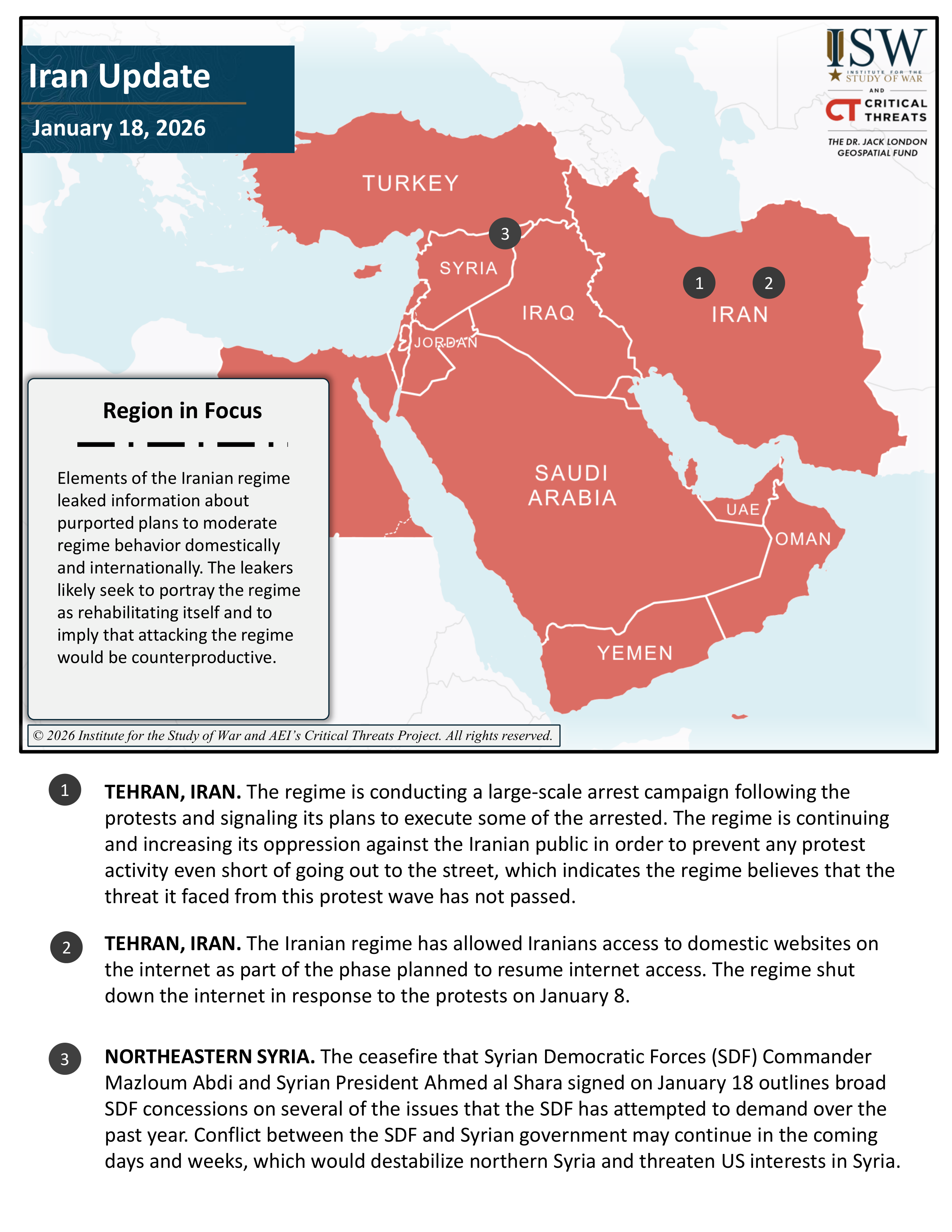
- Iranian Information Operation: Elements of the Iranian regime leaked information about purported plans to moderate regime behavior domestically and internationally. A former regime official close to Supreme National Security Council Secretary Ali Larijani told an English-language diaspora outlet that Larijani is pushing to moderate regime policies and conduct major economic and social reforms. The leak is likely meant to dissuade the United States from attacking Iran in response to the brutal regime crackdown on protests. The leakers likely seek to portray the regime as rehabilitating itself and to imply that attacking the regime would be counterproductive.
- Iranian Protest Suppression: The regime is conducting a large-scale arrest campaign following the protests and signaling its plans to execute some of the arrested. The regime is continuing and increasing its oppression against the Iranian public in order to prevent any protest activity, even short of going out to the street, which indicates the regime believes that the threat it faced from this protest wave has not passed.
- Iranian Regime Securitization: The Iranian regime has allowed Iranians access to domestic websites on the internet as part of the phase planned to resume internet access. The regime shut down the internet in response to the protests on January 8.
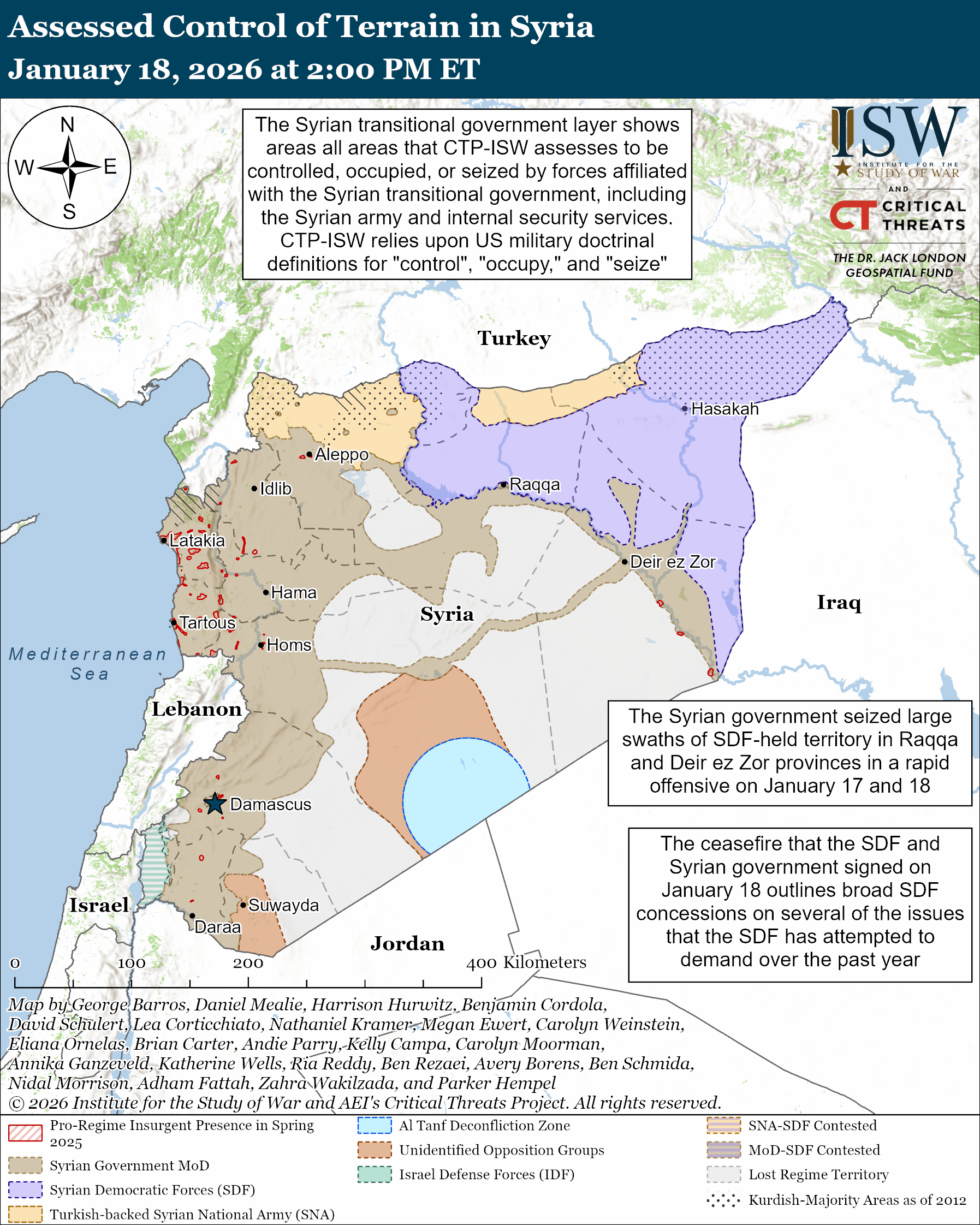
- SDF Collapse: The ceasefire that Syrian Democratic Forces (SDF) Commander Mazloum Abdi and Syrian President Ahmed al Shara signed on January 18 outlines broad SDF concessions on several of the issues that the SDF has attempted to demand over the past year. The new SDF-Syrian government agreement may not be any more lasting or effective than the March 10 Agreement. Conflict between the SDF and Syrian government may continue in the coming days and weeks that destabilizes northern Syria and threatens US interests in Syria.
Elements of the Iranian regime leaked information about purported plans to moderate regime behavior domestically and internationally.[i] The leak is likely meant to dissuade the United States from attacking Iran in response to the brutal regime crackdown on protests. A former regime official close to Supreme National Security Council Secretary Ali Larijani told an English-language diaspora outlet that Larijani is pushing to moderate regime policies and conduct major economic and social reforms.[ii] The source alleged that Supreme Leader Ali Khamenei backs Larijani in that effort.[iii] The source added that Larijani’s success depends on the United States and Israel, implying that attacks on Iran would disrupt efforts to moderate and reform.[iv] The leakers likely seek to portray the regime as rehabilitating itself and to imply that attacking the regime would be counterproductive.
Serious regime moderation depends entirely on Supreme Leader Khamenei, however, who has continued to signal his commitment to the hardline positions that he has maintained for decades. Khamenei gave a speech on January 17 during which he reiterated his uncompromising stance toward the protests, labeling them as foreign agents and terrorists.[v] Khamenei also emphasized the need to improve the economy but articulated no novel thoughts on how to do so.[vi] Khamenei would have a strong incentive to debut major reforms if he were seriously considering them. That he did not raise doubt about the extent to which Khamenei supports reforms and, in fact, indicates that he will more likely retain his previously held hardline views.
The leakers separately tried to validate relatively moderate regime figures and frame them as influential voices.[vii] The leakers claimed that Khamenei and Larijani enthusiastically support Foreign Affairs Minister Abbas Araghchi. That selective disclosure of information is likely meant to empower Araghchi, especially before foreign officials who doubt the extent to which he speaks with serious authority. The leakers further tried to connect Larijani and Araghchi to former moderate President Hassan Rouhani and his foreign minister, Mohammad Javad Zarif, to reinforce the idea that the band of pragmatic leaders is resurgent in Iran.
The portrayal of Larijani as a pragmatic reformer clashes with his record as SNSC secretary. Larijani has overseen the most brutal crackdown that the regime has ever conducted, which the leakers acknowledged and likened to the Tiananmen Square massacre.[viii] The extent of the crackdown has become clearer, as more information has become available. An unspecified Iranian official told Reuters that at least 5,000 people had died, including 500 security officers.[ix] The actual death count could be significantly higher, however. Iranian doctors using Starlink told The Times that around 16,500 protesters had died and around 330,000 were injured.[x] This is consistent with an Iranian cultural activist who described the circumstances as “urban warfare.”[xi]
The regime is conducting a large-scale arrest campaign following the protests and signaling its plans to execute some of the arrested. The Iranian intelligence apparatus has announced hundreds of arrests across the country in recent days.[xii] Judiciary spokesperson Ashagr Jahangir announced that the Judiciary will quickly hand out sentences tantamount to moharebeh -- enmity against God -- that carry the charge of the death penalty and “deterrent punishments that we will soon witness.”[xiii] Supreme Court Head Mohammad Jafar Montazeri stated that the Supreme Court is prioritizing “terrorist and rioting” cases and “no slightest leniency.”[xiv]
The regime is continuing and increasing its oppression against the Iranian public in order to prevent any protest activity, even short of going out to the street, which indicates the regime believes that the threat it faced from this protest wave has not passed. Tehran residents told the Wall Street Journal on January 18 that Basij members have patrolled Tehran’s streets on motorbikes in recent days, with some shouting, “Don’t come out! We’ll shoot you!”[xv] The Basij also warned residents to stay away from the windows.[xvi] Those Basij may belong to the elite Imam Ali battalions, which are an elite, anti-riot force that is known for its common use of motorbikes for crowd control and intimidation. The regime most likely does not want protesters chanting anti-regime slogans from the window as an alternative to protesting on the street, which could maintain the protests’ momentum, especially because the regime has continued to claim that the protests are over.[xvii] The pervasive security presence is preventing protesters from coming into the streets--rather than the citizens’ lack of desire to protest the regime.
The Iranian regime has allowed Iranians access to domestic websites on the internet as part of the phase planned to resume internet access. The regime shut down the internet in response to the protests on January 8.[xviii] The Iranian regime began its gradual plan to lift internet restrictions on January 18, with users reporting the return of access to search engines, such as Google, but only with access to Iranian websites.[xix] Ordinary internet connectivity in Iran remained disrupted on January 18, however.[xx] Iranian state media reported on January 18 that users had access to local messaging platforms.[xxi]
Iranian state media acknowledged that there were some dissenting voices over the internet shutdown when it was first implemented on January 8.[xxii] IranCell Communications Services Company’s Board of Directors replaced Chief Executive Officer (CEO) Alireza Rafiei, who had been in the position for a year, with Mohammad Hossein Soleimani on January 18.[xxiii] Iranian state media reported that the reason for the change was that the operator had violated the regime-imposed internet and communications shutdown on January 8, which facilitated the protests, according to unspecified sources.[xxiv]
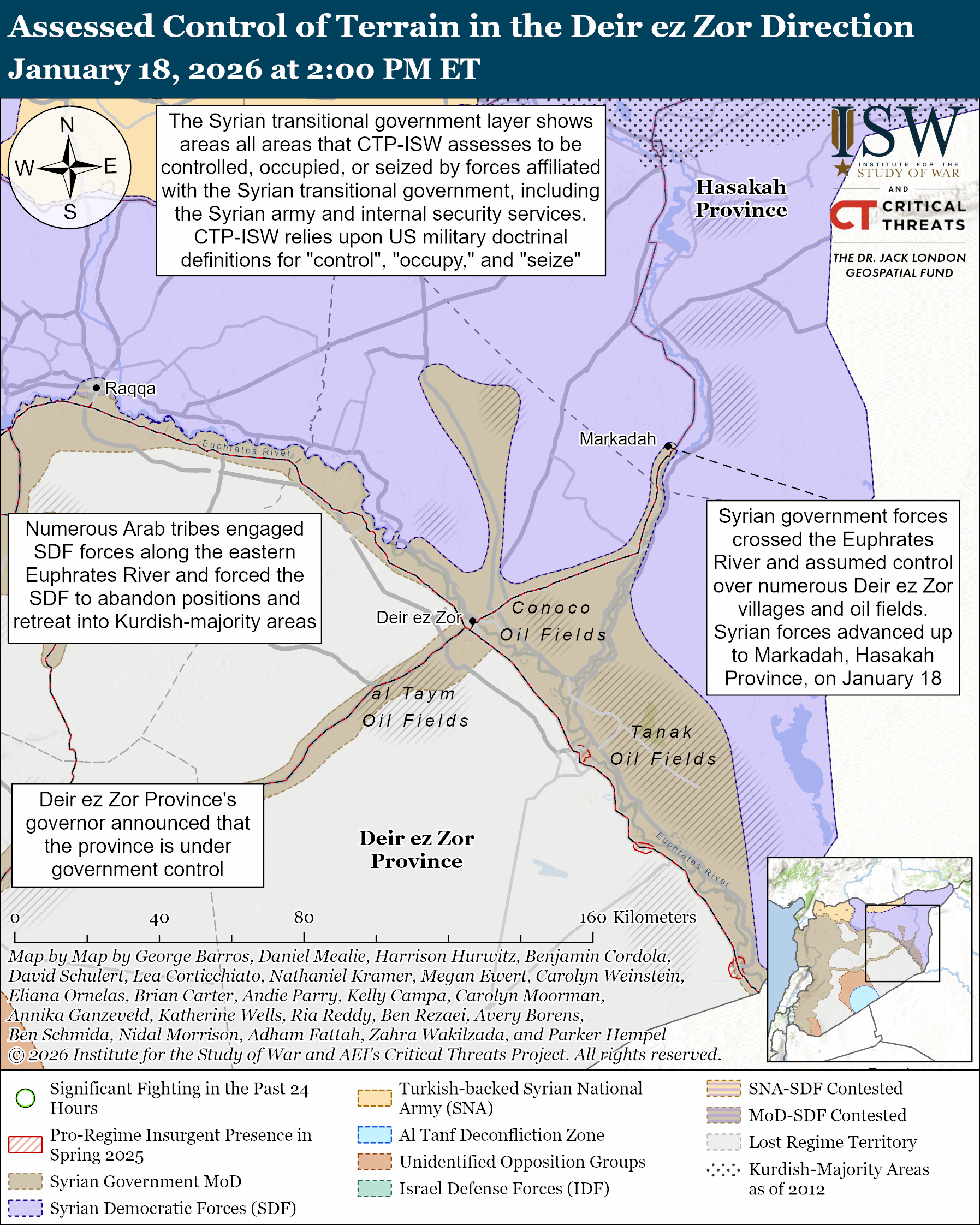
The ceasefire that Syrian Democratic Forces (SDF) Commander Mazloum Abdi and Syrian President Ahmed al Shara signed on January 18 outlines broad SDF concessions on several of the issues that the SDF has attempted to demand over the past year. The Syrian government seized large swaths of SDF-held territory in Raqqa and Deir ez Zor provinces in a rapid offensive on January 17 and 18.[xxv] The government advanced through the southern Raqqa countryside, seizing the SDF-held city of Tabqa, SDF-held oil fields in the Raqqa desert, and SDF-held towns in Raqqa along the southern bank of the Euphrates River before advancing into Raqqa City.[xxvi] Government forces simultaneously advanced across the Euphrates River in Deir ez Zor Province and assumed control of SDF-held villages and oil fields.[xxvii] The sudden loss of territory forced the SDF to capitulate to long-held government demands in a ceasefire agreement that Syrian President Ahmed al Shara and SDF commander Mazloum Abdi signed on January 18.[xxviii]
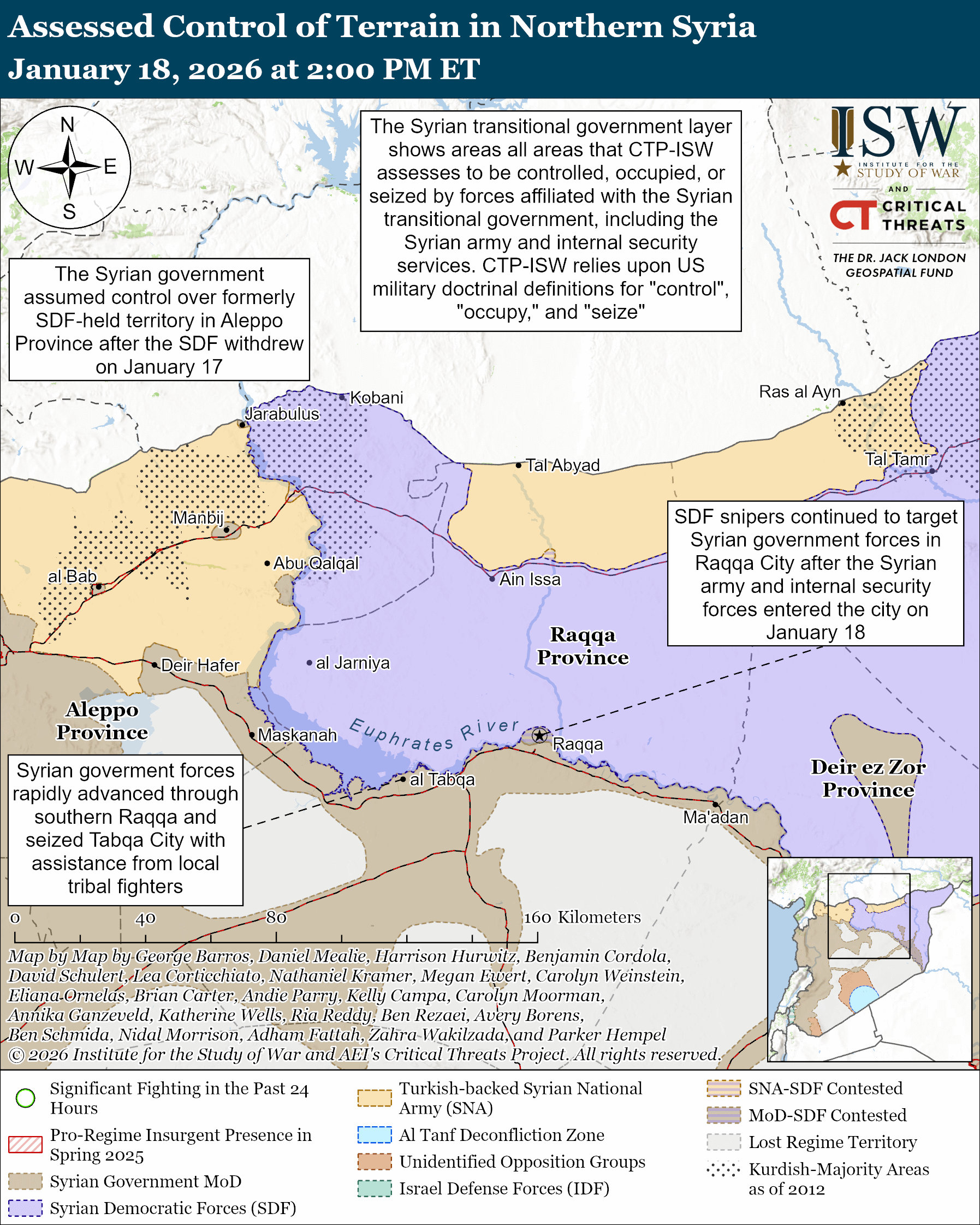
The SDF agreed to immediately hand over administrative and military control of Raqqa and Deir ez Zor provinces to the Syrian government.[xxix] All civil institutions in Hasakah Province will also integrate into the Syrian state’s administrative structures.[xxx] The SDF will hand over all border crossings and oil and gas fields in northeastern Syria. The agreement also specified that the SDF integrate all forces into the defense and interior ministries on an “individual basis.” These requirements notably contrast with the demands that the SDF presented to the Syrian government in December 2025.[xxxi] US, Syrian, and Turkish officials recently alleged that hardliners within the SDF were responsible for new, more stringent requests in negotiations that banned the Syrian government from entering northeastern Syria and allowed the SDF to maintain control of border regions.[xxxii] That the SDF agreed to significant concessions on key issues that hardliners have demanded in recent months signals the degree to which the Syrian government’s offensive into Raqqa and Deir ez Zor collapsed the SDF and diminished its leverage for negotiations.
The new SDF-Syrian government agreement may not be any more lasting or effective than the March 10 Agreement. The March 10 Agreement called for the SDF to merge all civil and military institutions within northeastern Syria—covering Raqqa, Deir ez Zor, and Hasakah provinces—into the Syrian state, in addition to all border crossings, airports, and oil and gas fields.[xxxiii] The SDF and Syrian government's fundamentally different interpretations of the agreement prevented any progress from taking place. This led to a ten months-long negotiations process that prevented any real progress or integration from taking place.[xxxiv]
Conflict between the SDF and Syrian government may continue in the coming days and weeks that destabilizes northern Syria and threatens US interests in Syria, despite the January 18 ceasefire. SDF snipers continued to engage Syrian government forces in Raqqa City after the ceasefire went into effect, according to Syrian media.[xxxv] The fighting between the SDF-affiliated Asayish and Aleppo City demonstrated that some SDF fighters do not necessarily answer to SDF commander Mazloum Abdi.[xxxvi] Numerous SDF fighters remain in Raqqa City and are likely scattered throughout the Raqqa and Deir ez Zor countrysides. SDF-affiliated fighters may continue to engage Syrian government forces across northeastern Syria in the coming days and weeks.
The SDF, which is a broad Kurdish-Arab coalition formed by the United States in 2015, may also be a weaker force than it was even days previously.[xxxvii] The large-scale mobilization of tribal fighters across Raqqa and Deir ez Zor provinces significantly contributed to the SDF’s collapse and the government’s seizure of Arab-majority areas from the SDF.[xxxviii] The SDF has historically used a heavy-handed approach with Arab communities and suppressed certain Arab groups while empowering others.[xxxix] Citizens’ longstanding grievances against the SDF include limited reconstruction in Arab areas, repeated SDF abuses of the local populations, and a lack of representative Arab leadership.[xl] The SDF was largely unable to defend against tribal attacks, and the rapid collapse of the SDF in Arab-majority areas and subsequent withdrawal to Kurdish-majority areas demonstrates that the SDF was unwilling to commit to defending these areas against tribal fighters.[xli] It is unclear how many SDF fighters have defected or surrendered to the Syrian government since the offensive began.
The Syrian government’s seizure of nearly all of Deir ez Zor and Raqqa provinces and advance up to the Hasakah Province border provides it with significant territorial advantages that it did not have over the past year, including the possibly imminent deployments to effectively surround the SDF-controlled Kurdish heartlands in northern Aleppo and Hasakah Province.[xlii] Syrian government forces reportedly began to advance north and east from Raqqa City on January 18, likely in order to consolidate full government control over Raqqa Province.[xliii] Syrian forces may effectively surround Kurdish-majority areas within the coming days in Hasakah Province and the northern Aleppo countryside around Kobani if they continue to advance at their current rate without sustained opposition from the SDF.
The new territorial changes in Syria also present serious risks to US interests and policy objectives to stabilize Syria, however. The SDF has largely been stripped of the protective Arab-majority belt around Kurdish areas, and thus the resumption of any conflict between government forces, tribal fighters, and SDF fighters would present a direct threat to Kurdish-majority areas. The Syrian government's proximity to Kurdish-majority areas could, in a worst-case scenario, enable Syrian government-affiliated forces or pro-Turkish forces to commit an ethnic cleansing campaign in Kurdish areas, as Turkish-backed forces have done in the past in Syria.[xliv] Turkey, which has facilitated ethnic cleansing against Syrian Kurds in several campaigns during the Syrian civil war, maintains a close relationship with the Syrian government and may calculate that SDF-affiliated fighters constitute a significant enough threat to Turkish domestic interests to warrant another operation.
The resumption of serious conflict between the United States’ two Syrian counter-ISIS partners could have dire consequences on current US and Syrian counter-ISIS efforts in Syria. Any large-scale conflict between the Syrian army, internal security forces, and SDF risks drawing manpower and resources from both parties’ efforts to contain ISIS in northeastern Syria, in addition to across the country. ISIS could use the lack of committed forces to seize weapons, move fighters, and take steps to reconstitute forces, as it did during the ensuing power vacuum that followed the collapse of the Assad regime in December 2024.[xlv] US forces completed their planned withdrawal from the Ain al Assad air base in Anbar, Iraq, on January 17, which increases the US reliance on positions in Iraqi Kurdistan to continue counter-ISIS efforts in the region.[xlvi] US forces’ withdrawal from Ain al Assad attaches even greater weight to the United States maintaining a productive US-Kurdish partnership.
Syrian President Ahmed al Shara is expected to meet with Abdi on January 19 to discuss the SDF’s future in Syria.[xlvii] Shara recently issued a decree on January 16 that affirmed that Syrian Kurds are an ”integral” and ”authentic” part of the Syrian people and provided Syrian Kurds with key rights, such as declaring Nowruz, the Kurdish New Year, a national holiday in Syria and designating Kurdish as a national language that is permitted in public and private schools located in Kurdish-majority areas.[xlviii] Neither his decree nor the January 18 government-SDF ceasefire addresses the principal issues that Syrian Kurds have demanded since the fall of the regime as a matter of protection and security: constitutional guarantees for Kurdish rights and decentralization.[xlix] US officials and interlocutors should continue to press the Syrian government to engage with Kurdish demands in order to eliminate potential instigators of future conflict.
Iran
See topline section.
Iraq
Iraqi Foreign Minister Fuad Hussein met with Iranian SNSC Secretary Ali Larijani, Foreign Minister Abbas Araghchi, and Parliament Speaker Bagher Ghalibaf separately in Tehran on January 18.[l] Hussein’s visit to Tehran follows a recent phone call on January 14 between Larijani and Iraqi National Security Adviser Qassem al Araji, in which Larijani and Araji discussed the implementation of the March 2023 Iran-Iraq security agreement.[li] The March 2023 agreement requires Iraqi authorities to disarm and relocate Kurdish anti-regime groups away from the Iran-Iraq border.[lii] The Iranian regime has long been concerned about cross-border Kurdish militant activity.[liii] The regime is currently attempting to simultaneously defend against Kurdish militant activity and suppress protests in Iran’s border provinces, particularly in Ilam, Kermanshah, and West Azerbaijan provinces.[liv]
Senior Iran-backed Iraqi militia Kataib Hezbollah commander Abu Talib al Saidi threatened on January 16 that the group would target US military bases in Iraq and the Middle East if the United States intervenes in Iran.[lv] Saidi’s threat comes after Kataib Hezbollah Secretary General Abu Hussein al Hamidawi released a statement on January 12 that warned the “American enemy” it would “pay a double price” if the United States attacked Iran.[lvi] CTP-ISW assessed on January 13 that Iranian-backed Iraqi militias may be taking inspiration from recent Iranian threats to target US forces and following the intent of Iranian officials.[lvii]
Syria
See topline section.
Arabian Peninsula
Nothing significant to report.
Palestinian Territories and Lebanon
Nothing significant to report.

[i] https://iranwire.com/en/news/147783-ali-larijani-masterminded-the-massacre-says-former-official/
[ii] https://iranwire.com/en/news/147783-ali-larijani-masterminded-the-massacre-says-former-official/
[iii] https://iranwire.com/en/news/147783-ali-larijani-masterminded-the-massacre-says-former-official/
[iv] https://iranwire.com/en/news/147783-ali-larijani-masterminded-the-massacre-says-former-official/
[v] https://farsi.khamenei dot ir/speech-content?id=62370
[vi] https://farsi.khamenei dot ir/speech-content?id=62370
[vii] https://iranwire.com/en/news/147783-ali-larijani-masterminded-the-massacre-says-former-official/
[viii] https://iranwire.com/en/news/147783-ali-larijani-masterminded-the-massacre-says-former-official/
[ix] https://www.reuters.com/business/media-telecom/iranian-official-says-verified-deaths-iran-protests-reaches-least-5000-2026-01-18/
[x] https://www.thetimes.com/world/middle-east/article/iran-young-protesters-news-nsdztp5t2
[xi] https://t.me/mehrnews/344375
[xii] https://t.me/Tasnimnews/383921; https://t.me/Tasnimnews/383911; https://t.me/Tasnimnews/383908; https://t.me/Tasnimnews/383832; https://t.me/iribnews/312075; https://t.me/Tasnimnews/383829 ;
https://x.com/hra_news/status/2012879677422018770; https://t.me/Tasnimnews/383826
[xiii] https://www.wsj.com/world/middle-east/iranian-regime-seeks-to-project-normality-after-quelling-protests-a7ba6781?gaa_at=eafs&gaa_n=AWEtsqdMR0hsyhlRQzxcs4xPl6wGHxp4RrS9xLEcu_xDmug05wtoo8CQ0fcO_0vMcgw%3D&gaa_ts=696ceb4f&gaa_sig=QxSfMyct48HWzTP2TfaxcGKtsc7MmBiDra7EQCvYNA5ZIwF54NUmNinIvftbjfDN4F897cwtGFHN_qtoxThlDw%3D%3D; https://t.me/Tasnimnews/383843; https://t.me/Tasnimnews/383847; https://t.me/Tasnimnews/383849; https://t.me/Tasnimnews/383845
[xiv] https://t.me/Tasnimnews/383882
[xv] https://www.wsj.com/world/middle-east/iranian-regime-seeks-to-project-normality-after-quelling-protests-a7ba6781?gaa_at=eafs&gaa_n=AWEtsqdMR0hsyhlRQzxcs4xPl6wGHxp4RrS9xLEcu_xDmug05wtoo8CQ0fcO_0vMcgw%3D&gaa_ts=696ceb4f&gaa_sig=QxSfMyct48HWzTP2TfaxcGKtsc7MmBiDra7EQCvYNA5ZIwF54NUmNinIvftbjfDN4F897cwtGFHN_qtoxThlDw%3D%3D
[xvi] https://www.wsj.com/world/middle-east/iranian-regime-seeks-to-project-normality-after-quelling-protests-a7ba6781?gaa_at=eafs&gaa_n=AWEtsqdMR0hsyhlRQzxcs4xPl6wGHxp4RrS9xLEcu_xDmug05wtoo8CQ0fcO_0vMcgw%3D&gaa_ts=696ceb4f&gaa_sig=QxSfMyct48HWzTP2TfaxcGKtsc7MmBiDra7EQCvYNA5ZIwF54NUmNinIvftbjfDN4F897cwtGFHN_qtoxThlDw%3D%3D
[xvii] https://x.com/IranIntl/status/2012877194091983083; https://iranwire.com/en/news/147783-ali-larijani-masterminded-the-massacre-says-former-official/; https://www.leader dot ir/fa/content/28501
[xviii] https://t.me/farsna/408252; https://t.me/defapress_ir/47208
[xix] https://x.com/netblocks/status/2012894437165121810; https://t.me/farsna/408252; https://t.me/defapress_ir/47208
[xx] https://x.com/netblocks/status/2012894437165121810
[xxi] https://t.me/Tasnimnews/383823
[xxii] https://t.me/Tasnimnews/383923
[xxiii] https://t.me/Tasnimnews/383923
[xxiv] https://t.me/Tasnimnews/383923
[xxv] https://understandingwar.org/research/middle-east/syrian-government-offensive-forces-syrian-kurdish-group-to-capitulate; https://www.wsj.com/world/middle-east/syrian-presidents-forces-make-strategic-gains-against-u-s-backed-sdf-87259aa6?gaa_at=eafs&gaa_n=AWEtsqeaM70afyqXqIk4xFoMmb_VKV1E52T4F0QB39hOg6I3IDS6Gcat38HlvIkkS1g%3D&gaa_ts=696d9982&gaa_sig=azWDE6doT5MN2F4SAmWbexB5PzUXGhXXvLzj-ke06ZlDJjZgTG7_UhUz8A-KR-19m4sxkTKF8DzZzmmB1JHVgg%3D%3D
[xxvi] https://x.com/AlekhbariahSY/status/2012578149532332056; https://t.me/AlekhbariahSY/192874; https://x.com/QalaatAlMudiq/status/2012486909809795497; https://t.me/AlekhbariahSY/192878; https://x.com/AlekhbariahSY/status/2012558200994730346; https://x.com/QalaatAlMudiq/status/2012805719095906530; https://x.com/QalaatAlMudiq/status/2012589113883468076; https://x.com/AlekhbariahSY/status/2012626250573975820; https://x.com/QalaatAlMudiq/status/2012894556153352274
[xxvii] https://www.aljazeera dot net/news/2026/1/18/عاجل-سانا-عن-مديرية-إعلام-الرقة-قوات; https://x.com/QalaatAlMudiq/status/2012815243538292867; https://x.com/QalaatAlMudiq/status/2012827776739405866
[xxviii] https://t.me/SyPresidency/1990
[xxix] https://t.me/SyPresidency/1990
[xxx] https://t.me/SyPresidency/1990
[xxxi] https://mei.edu/publication/how-damascus-and-the-sdf-came-to-blows-in-aleppo-and-what-might-come-next/
[xxxii] https://mei.edu/publication/how-damascus-and-the-sdf-came-to-blows-in-aleppo-and-what-might-come-next/
[xxxiii] https://www.meforum.org/mef-online/the-sdf-syrian-agreement-translation-and-overview
[xxxiv] https://understandingwar.org/research/middle-east/iran-update-december-2-2025; https://understandingwar.org/research/middle-east/iran-update-december-30-2025 ; https://understandingwar.org/research/middle-east/iran-update-october-14-2025
[xxxv] https://x.com/QalaatAlMudiq/status/2012961728103846084
[xxxvi] https://understandingwar.org/research/middle-east/iran-update-january-15-2026/
[xxxvii] https://ecfr.eu/special/mena-armed-groups/syrian-democratic-forces-syria/
[xxxviii] https://x.com/QalaatAlMudiq/status/2012805719095906530; https://x.com/QalaatAlMudiq/status/2012815243538292867; https://x.com/BarracudaVol1/status/2012818515275686139?s=20; https://x.com/QalaatAlMudiq/status/2012827776739405866; https://x.com/Me1Ray/status/2012592197192073373?s=20; https://x.com/BarracudaVol1/status/2012559574482436599?s=20
[xxxix] https://understandingwar.org/backgrounder/iran-update-december-12-2024 ; https://understandingwar.org/research/middle-east/the-syrian-democratic-forces-arab-coalition-is-crumbling-creating-opportunities-for-isis-iran-and-turkey/
[xl] https://shaam dot org/reports/battleground-reports/hsad-alahdath-almydanyh-lywm-alarbaaa-06-09-2023 ; https://twitter.com/DeirEzzore/status/1697893012250964341 ; https://newlinesmag.com/argument/assads-hidden-hand-in-the-uprising-against-the-kurds-in-eastern-syria
[xli] https://x.com/QalaatAlMudiq/status/2012805719095906530; https://x.com/QalaatAlMudiq/status/2012815243538292867; https://x.com/BarracudaVol1/status/2012818515275686139?s=20; https://x.com/QalaatAlMudiq/status/2012827776739405866; https://x.com/Me1Ray/status/2012592197192073373?s=20; https://x.com/BarracudaVol1/status/2012559574482436599?s=20
[xlii] https://www.aljazeera dot net/news/2026/1/18/عاجل-سانا-عن-مديرية-إعلام-الرقة-قوات
[xliii] https://www.aljazeera dot net/news/2026/1/18/عاجل-سانا-عن-مديرية-إعلام-الرقة-قوات; \
[xliv] https://www.hrw.org/news/2024/02/29/syria-abuses-impunity-turkish-occupied-territories; https://www.ecchr.eu/en/case/crimes-in-syria-the-neglected-atrocities-of-afrin./
[xlv] https://t.me/TelevisionSyria/58011; https://x.com/nahermedia/status/1927365616312164756; https://understandingwar.org/research/middle-east/iran-update-special-report-syria-after-the-israel-iran-war-june-13-july-3-2025
[xlvi] https://apnews.com/article/iraq-us-ain-assad-troops-withdraw-coalition-3da685f80b49fe2c33a430958e36f771
[xlvii] https://www.reuters.com/world/europe/syrian-forces-advance-deeper-into-usbacked-kurdishcontrolled-northeast-2026-01-18/;
[xlviii] https://sana dot sy/presidency/2376054/ ; https://x.com/USAMBTurkiye/status/2012925459093233947
[xlix] https://www.reuters.com/world/europe/syrian-forces-advance-deeper-into-usbacked-kurdishcontrolled-northeast-2026-01-18/
[l] https://t.me/defapress_ir/47242 ; https://www.presstv dot ir/Detail/2026/01/18/762493/US-evacuation--Ain-al-Asad-base-bolsters-Iraq-national-sovereignty-Iran-FM
[li] https://t.me/defapress_ir/47139 ; https://www.reuters.com/world/middle-east/iraq-iran-sign-deal-tighten-border-security-2023-03-19/
[lii] https://www.voanews.com/a/iraq-moves-iranian-kurdish-groups-away-from-border-/7265414.html
[liii] https://www.voanews.com/a/iraq-moves-iranian-kurdish-groups-away-from-border-/7265414.html
[liv] https://www.iranintl.com/en/202211230632 ;
https://x.com/hra_news/status/2009296059290317188?s=20 ; https://x.com/IranIntl/status/2009293760677445686 ; https://x.com/ManotoNews/status/2009286608730660939?s=20 ; https://x.com/HengawO/status/2009297482467901541?s=20 ; https://x.com/FSeifikaran/status/2009318179592655100 ; https://x.com/FSeifikaran/status/2009328918965420146 ; https://x.com/bbcpersian/status/2009335091021885753?s=20
[lv] https://shafaq dot com/en/Iraq/EXCLUSIVE-Kataib-Hezbollah-threatens-US-bases-if-Washington-strikes-Iran
[lvi] https://t.me/centerkaf/5395
[lvii] https://understandingwar.org/research/middle-east/iran-update-january-13-2026/
View Citations