{{currentView.title}}
January 13, 2026
Iran Update, January 13, 2026
The Critical Threats Project (CTP) at the American Enterprise Institute and the Institute for the Study of War (ISW) publish the Iran Update, which provides insights into Iranian and Iranian-sponsored activities that undermine regional stability and threaten US forces and interests. CTP-ISW publishes the Iran Update daily.
Click here to see CTP and ISW’s interactive map of assessed control of terrain in Syria, and here to see CTP and ISW’s interactive map of Israeli ground operations. The Syria map is updated daily alongside the static Syria maps in this report. CTP-ISW ended daily maps of Israeli ground operations in February 2025.
Click here to see ISW-CTP's interactive map showing the total strikes in Iran during the Israel-Iran War, as well as an interactive timelapse showing the strikes day-by-day.
Click here to see ISW-CTP’s new interactive map showing the locations of daily protests in Iran since December 28, 2025. ISW-CTP will continue to publish daily static maps depicting the Iranian protests in forthcoming Iran Updates.
The Iranian regime is using an unprecedented level of brutality to suppress protests. The actual death toll is likely significantly higher relative to the 1,500 people killed during the 2019 protests, though CTP-ISW cannot independently determine the number of protester deaths. Western media outlets have reported death toll estimates in Iran ranging from 2,000 to 20,000, and anecdotal information is consistent with the regime killing thousands in its crackdown.[i] The regime killed approximately 1500 people in the span of two weeks during the 2019 economic protests.[ii] Regime security forces have fired on crowds indiscriminately—in some cases with machine guns—and killed scores of citizens across numerous locations.[iii] Some Iranians who have bypassed the internet shutdown have reported very high volumes of dead protesters on the streets and in hospitals and morgues.[iv] Some reports alleged the presence of 700-1,000 dead protesters at just one morgue in Tehran, not accounting for other locations around the capital or the country overall.[v] Other Iranians have claimed that the regime's crackdown is much greater than the one it conducted in November 2019, during which security forces killed around 1,500 protesters.[vi] This anecdotal information is most consistent with the regime killing many thousands in its crackdown.
This level of brutality may be discouraging protesters and decreasing the rate of protest activity. A protester from Shiraz told TIME on January 11 that the police attacks have been particularly violent compared to previous protests and that the protest turnout in Shiraz on January 9 ”was inhibited by aggressive security forces.”[vii] CTP-ISW assessed on January 12 that the rate of protest activity across Iran may have decreased due to the regime’s brutal crackdown on the protests.
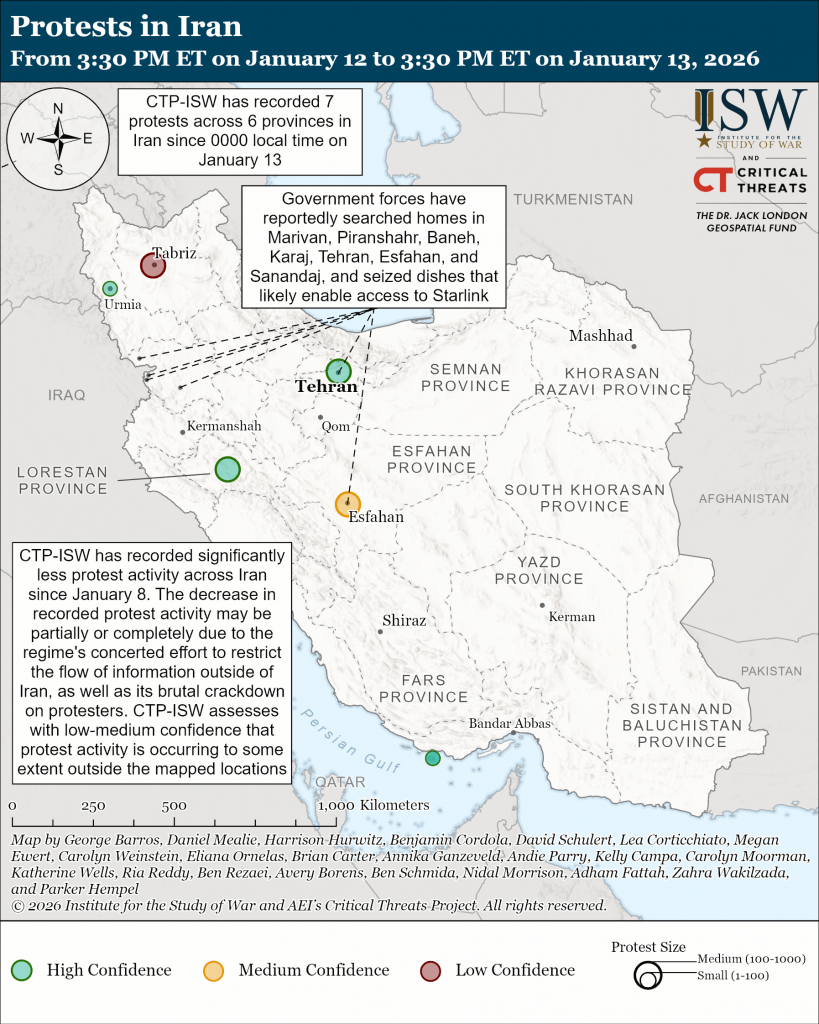
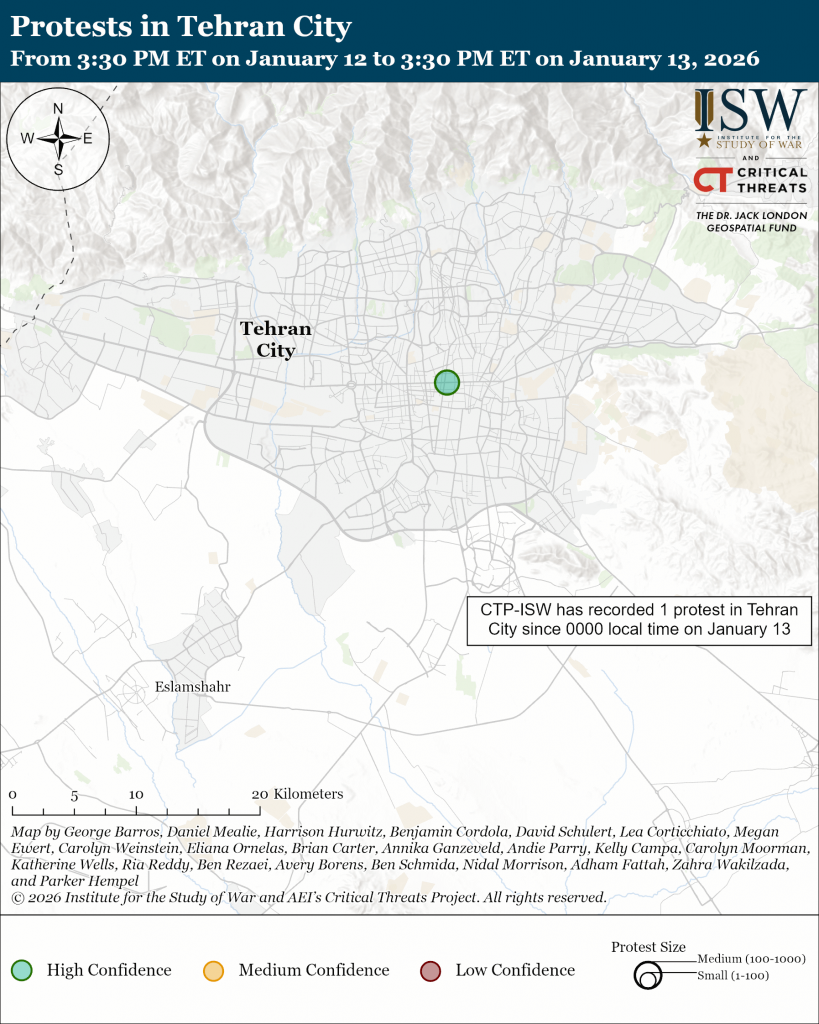
Reports of protest activity across Iran continued at a relatively low level on January 13. We assess with low-to-medium confidence that protests are occurring beyond what we have recorded, however, and that the regime has successfully limited the amount of information leaving Iran. CTP-ISW recorded 7 protests across 6 provinces on January 13, compared to 156 protests across 27 provinces on January 8.[viii] CTP-ISW continued to record protests primarily in large cities, such as Tehran, Esfahan, and Tabriz. The Iranian regime has historically struggled to suppress unrest in less populated and rural areas more than in urban areas. It would therefore be surprising if protests continued to take place in large cities and not in smaller towns and villages.
The regime has continued to take steps to severely restrict the flow of information out of Iran. The regime has maintained a nationwide internet blackout, designed to prevent Iranians from sharing videos of protests and the regime’s crackdown, since January 8. Iranian security forces reportedly launched a massive operation on January 12 to search homes in several cities across Iran, including Tehran, and seize satellite dishes, according to Norway-based human rights group Hengaw.[ix] The collection of satellite dishes would allow the regime to disrupt the use of Starlink and other satellite connectivity by Iranians who seek to share videos of protests with foreign media.[x]
Russia is likely helping the Iranian regime suppress protests and maintain control in the face of both protests and insurgent attacks. Politico reported on January 13 that Russia supplied Iran with Russian-made Spartak armored vehicles and attack helicopters in recent weeks.[xi] Iran received these systems before the protests began, but Iran likely acquired these systems for use in internal disturbances, including protests. Iran is very unlikely to use such equipment in any conventional modern conflict. Israel and the United States, Iran’s key adversaries, use long-range missiles and aircraft that could destroy attack helicopters long before the helicopter could engage the aircraft. Attack helicopters are more capable at fighting insurgencies or addressing internal conflicts due to the lack of serious enemy air defenses that could inhibit helicopter operations.[xii] Iran is facing both large-scale protests and small insurgent attacks along its borders. Armored vehicles can be used to bolster the regime’s efforts to suppress the protests and broader counter-insurgency efforts. Russia previously sent Iran Spartak armored vehicles in 2023, and Iranian border guards began operating them in November 2025.[xiii] These border guards could help support counterinsurgent operations against Balochi or Kurdish militias that operate in border areas and are conducting attacks amid the protests (see below). Russian Security Council Secretary Sergei Shoigu held a phone call with SNSC Secretary Ali Larijani on January 13, almost certainly to discuss ongoing protests in Iran.[xiv] Iran previously sought Russia’s help to quell protests in 2022.[xv]
The overlap of protest activity and reported militancy in border areas is placing additional strain on the regime’s security apparatus and risks allowing each to intensify the threat posed by the other. Recent regime responses to the protests, including the deployment of the IRGC Ground Forces to some cities, indicate bandwidth constraints among security forces. Reports indicate that the Iranian security forces arrested at least 550 Baloch protesters in Zahedan, Chabahar, and Iranshahr, over the past five days.[xvi] Prominent Iranian Sunni cleric Moulana Abdol Hamid escalated his criticism of the regime’s response to the protests in a January 13 post on X. Hamid stated that the killing of protesters constituted a “horrific and unprecedented catastrophe” that plunged the Iranian nation into grief and rage.[xvii] Abdol Hamid warned that those responsible would be held accountable both "in this world and the hereafter."[xviii] Abdol Hamid’s statement marks an intensification from his January 9 sermon, in which he urged peaceful change and called on security forces to avoid confronting protesters.[xix] CTP-ISW previously assessed that Hamid may be reemerging as a catalyst for protests in southeastern Iran, which would compound the bandwidth constraints that Iranian security forces are reportedly facing. Abdol Hamid was a catalyst for protests in Zahedan during and after the Mahsa Amini movement. A medium-sized anti-regime protest, which CTP-ISW defines as a protest with 100-1,000 participants, broke out in Zahedan after Abdol Hamid’s January 9 sermon.
A recent uptick in anti-regime militant activity in southeastern Iran may exacerbate the regime's bandwidth constraints by creating additional security challenges for the regime in southeastern Iran. Anti-regime militant activity in southeastern Iran will only further strain security force capacity as the protests continue. Iranian media reported on January 13 that Iranian security forces arrested several “terrorist teams” operating und n Zahedan, Sistan and Baluchistan Province.[xx] Islamic Revolutionary Guards Corps (IRGC)-affiliated Tasnim News Agency claimed on January 13 that those groups entered Iran from the east and established seven safe houses in Zahedan.[xxi] The Iranian Law Enforcement Command (LEC) and Sistan and Baluchistan border guards separately arrested a group of “smugglers” and seized several weapons in border areas on January 13.[xxii] The Mubarizoun Popular Front (MPF), which is a coalition of Baloch organizations, separately claimed responsibility for two attacks targeting LEC personnel in Sistan and Baluchistan Province on January 7 and 10.[xxiii] The MPF stated on January 1 that it is monitoring the regime’s response to the protests and emphasized that it will respond to any instances of regime violence, which suggests a potential willingness to escalate if conditions deteriorate.[xxiv]
There also continue to be unconfirmed reports of Kurdish militant activity in northwestern Iran. The Kurdistan Freedom Party (PAK), which is an Iranian Kurdish militant group, issued a statement on January 13, claiming responsibility for attacks against IRGC positions in Kermanshah Province on January 12.[xxv] The group claimed that multiple teams conducted a coordinated attack and killed IRGC personnel.[xxvi] The group stated that the operation was retaliation for the death of PAK fighters.[xxvii] IRGC Ground Forces Nabi Akram Unit members have been involved in the suppression of protests in Kermanshah.[xxviii] The Kurdistan National Guard separately announced on January 9 that its “Zagros Tornado units” attacked an IRGC base in Nourabad, Lorestan Province, and injured three IRGC members.
Militant groups operating in Iran’s border regions do not represent the ongoing protest movement, however. The recent uptick in anti-regime militant activity in southeastern Iran suggests that these groups may exploit the current unrest and the bandwidth issues facing regime security forces to advance their objectives. These groups are likely not solely focused on overthrowing the regime but are also positioning themselves for a potential post-regime environment in which they could pursue greater ambitions, including autonomy in Kurdish and Baloch areas.[xxix] Militant activity challenges the regime by diverting security forces and stretching resources across multiple regions, which may allow these groups to operate more freely. It is possible that regime collapse could create conditions for these groups’ separatist aims, which would have consequences beyond Iran into the broader Middle East and South Asia. The regime could use gains by these groups to support its framing that the protests are driven by ”terrorists,” just as Syrian President Bashar al Assad falsely claimed that all Syrian protesters were jihadists during the early stages of the Syrian Civil War.
US President Donald Trump is continuing to consider various options to intervene in the ongoing protests in Iran. Some US officials believe that Iran may be trying to delay a US attack on Iran rather than aiming to engage in sincere diplomacy, according to two officials speaking to the New York Times.[xxx] The Pentagon presented Trump on January 13 with a range of strike options and targets in Iran, including Iran’s nuclear program and ballistic missile sites, according to a US official.[xxxi] The official stated that a cyberattack on Iran's domestic security apparatus is more likely, however.[xxxii] The official added that any attack is ”at least several days away.” President Trump also wrote on Truth Social on January 13 that he has canceled all meetings with Iranian officials until the regime stops killing protesters and emphasized that “help is on the way.”[xxxiii] He later added that US citizens in Iran should leave Iran.[xxxiv] Trump separately announced on January 12 that any country conducting business with Iran will face a 25 percent tariff on its bilateral trade with the United States.[xxxv]
Iranian-backed Iraqi militia Kataib Hezbollah threatened on January 12 to take unspecified kinetic action against the United States if it attacks Iran.[xxxvi] Iranian-backed Iraqi militias, including Kataib Hezbollah, notably did not follow through with their threats to conduct major attacks targeting the United States after the United States struck Iranian nuclear sites during the Israel-Iran War in June 2025. Kataib Hezbollah Secretary General Abu Hussein al Hamidawi released a statement on January 12 that emphasized the “legitimate and moral duty” of Iranian-backed Iraqi militias to support Iran amid US preparations to attack Iran.[xxxvii] Hamidawi warned the “American enemy” that it would “pay a double price” if the United States attacked Iran.[xxxviii]
The Iranian-backed Iraqi militias may be taking inspiration from recent Iranian threats to target US forces and following the intent of Iranian officials. Hamidawi’s threat comes after Iranian Parliament Speaker Mohammad Bagher Ghalibaf stated on January 11 that Iran could target US or Israeli military bases in the region if the United States attacks Iran.[xxxix] A likely Iranian-backed Iraqi militia facade group also threatened on January 10 to attack the US Embassy in Baghdad and US interests in the Middle East in response to US support for the ongoing protests in Iran.[xl] Iran’s partners in Iraq conducted a few unclaimed attacks on US military bases in Iraq during the Israel-Iran War, but did not pursue greater kinetic action after the US struck Iranian nuclear sites.[xli] The militias’ show of restraint in June 2025 was probably partially a response to a concern that attacking the United States would have negative political ramifications for the militias’ political wings in the November 2025 elections.[xlii] Iranian-backed Iraqi actors continue to vie to maintain their control of the Iraqi state during the ongoing Iraqi government formation process following the elections, however. The militias could reassess attacks on the United States at any time, however, including if the US strikes in Iran seriously threatened regime stability. There have been several unconfirmed reports that Iranian-backed Iraqi militias, including Kataib Hezbollah, are helping the Iranian regime suppress protests.[xliii]
Current Iraqi Prime Minister Mohammad Shia al Sudani withdrew from the premiership race on January 12, probably in an effort to sabotage State of Law Coalition head Nouri al Maliki’s chances of obtaining the position.[xliv] Sudani also leads the Reconstruction and Development Coalition, which is a large Shia coalition in parliament. The Reconstruction and Development Coalition spokesperson announced on January 12 that Sudani has withdrawn from the premiership race to break the “deadlock” within the Shia Coordination Framework, which is a coalition of Shia parties including some that Iran backs.[xlv] The framework, as the largest bloc in parliament, has debated for weeks who to select for the next prime minister.[xlvi] Unspecified framework members told Iraqi media on January 12 that Sudani withdrew himself from consideration in order to “expose” Maliki to an “expected barrage of political and religious vetoes” to his candidacy that could weaken Maliki’s position during the government formation process.[xlvii] Sudani reportedly said that he would withdraw from the race if all framework leaders, Grand Ayatollah Ali al Sistani, Shia nationalist cleric Moqtada al Sadr, and unspecified Kurdish and Sunni political parties approved Maliki as prime minister, according to information that unspecified actors leaked to Kurdish media.[xlviii] The leaked information also suggested that if Maliki failed to meet these conditions, Sudani would receive the premiership with the backing of the framework.[xlix]
Sudani may be wagering that Maliki will fail to meet the five reported conditions. Iraqi media reported on January 12 that framework leader and National State Forces Alliance head Ammar al Hakim does not support Maliki, although Maliki’s senior adviser denied that Hakim opposed Maliki on January 13.[l] Sistani, Iraq’s highest religious authority, reportedly refused to intervene in the selection of the next prime minister when Hakim asked for Sistani’s thoughts on Maliki, which suggests that Sistani is unlikely to weigh in positively or negatively about Maliki.[li] Sistani only intervenes in Iraqi politics in dire situations, such as when he refused to support Maliki’s bid for a third term in 2014 as the Islamic State of Iraq and al Sham (ISIS) ravaged the country.[lii] Maliki is also unlikely to gain support from Sadr due to the longstanding enmity between Sadr and Maliki.[liii]
Maliki may be attempting to meet these conditions. The State of Law Coalition has recently expressed support for Parliament Secretary-General Hamid al Ghazi, who is close to Sadr, which may indicate that Maliki’s coalition is attempting to induce Sadr’s support for Maliki’s prime minister bid.[liv] Maliki‘s adviser also stated that unidentified Sunni political parties, the Patriotic Union of Kurdistan, and the Kurdistan Democratic Party support Maliki’s bid for the premiership, but none of these parties have publicly declared or implicitly signaled that they support Maliki.[lv] Maliki has a long history of sectarian behavior, but Sunni parties may still support Maliki if he can offer them enough inducements to encourage their cooperation.[lvi]
It is unclear if the framework would allow Sudani to serve another term even if Maliki failed to meet Sudani’s reported five conditions, however. Multiple framework leaders, including Maliki, have opposed Sudani serving a second term in office due, in part, to some actions that Sudani has taken against Iranian-backed interests in Iraq while in office.[lvii] These actions have eroded some framework parties’ confidence that they can control and co-opt Sudani, and Iranian-aligned Iraqi actors have historically sought prime ministers who are perceived as malleable and susceptible to framework influence.[lviii]
A Maliki premiership would be severely detrimental to US interests in Iraq, even if it supports efforts to “disarm” Iraqi militias. The United States reportedly told the Shia Coordination Framework and the Iraqi federal government that the United States will not engage with any prime minister or appointee to the Foreign Affairs Ministry, Defense Ministry, Interior Ministry, Counterterrorism Service, National Intelligence Service, or Iraqi Army Chief of Staff who has ties to Iranian-backed Iraqi militias, according to five Iraqi officials speaking to al Araby al Jadeed on December 11.[lix] Maliki may have less overt ties to Iranian-backed Iraqi militias than other Iraqi figures that the United States wants excluded from government formation, but he would still likely pursue problematic policies regarding the militias. Maliki reportedly told the United States via unidentified mediators that he would disarm Iranian-backed Iraqi militias if the United States supported his bid to become prime minister, according to an unidentified senior Iraqi official speaking to a Kurdish journalist on December 3.[lx] The State of Law Coalition denied on December 6 that Maliki contacted the United States about militia disarmament.[lxi]
These soft commitments by Maliki, if true, do not outweigh the risks he poses to US interests and stability in Iraq. CTP-ISW continues to assess that Maliki would likely attempt to transform elements of the Iraqi security establishment, including the partially Iranian-backed Popular Mobilization Forces (PMF), into a force that he could use to enhance his personal power as prime minister. This effort would harm Iraqi stability because Maliki would probably pursue authoritarian, sectarian, and extralegal policies that are similar to the policies he pursued when he previously served as prime minister, which led to the rise of ISIS.[lxii] The United States delayed its military support for Iraq against ISIS in 2014 until Maliki was removed from power due to his direct role in destabilizing Iraq.[lxiii]
The Syrian Ministry of Defense (MoD) began a limited offensive operation against the Syrian Democratic Forces (SDF) in a salient east of Aleppo City and west of the Euphrates River.[lxiv] The MoD may have launched the operation to defeat and remove SDF fighters who are responsive to PKK control from the Aleppo area. A number of Asayish fighters in Sheikh Maqsoud and Ashrafiyeh ignored a US-mediated ceasefire over the city on January 9 and continued to attack government forces, despite SDF Commander Mazloum Abdi's presumed agreement to the ceasefire.[lxv] The MoD said that the operation was necessary due to the presence of PKK fighters and Assad regime remnants in Deir Hafer, which is consistent with Turkish reports that SDF forces in Aleppo may be more responsive to the PKK than to SDF control.[lxvi] The Syrian government also alleged that Deir Hafer-based SDF forces fired a series of drones at Aleppo City during the fighting on January 10 that struck some civilian infrastructure, including a government building where the governor and other ministers were attending a conference.[lxvii] Deir Hafer is the westernmost city that the SDF still holds in Aleppo Province and the salient where MoD and SDF engagements have previously occurred most frequently. Turkish officials believe that the PKK interfered with SDF efforts to end the fighting in Aleppo by encouraging SDF forces in Aleppo to stand and fight despite SDF Commander Mazloum Abdi and AANES official Ilham Ahmed’s efforts to end the fighting.[lxviii] These comments indicate that Turkey is beginning to distinguish between the SDF and PKK in Syria, which is a significant policy change. The MoD achieved complete control over the Kurdish-controlled neighborhoods in Aleppo and forced the last SDF-affiliated fighters to withdraw to Deir Hafer on January 11.[lxix] These forces were supposed to withdraw to northeastern Syria, according to Abdi, but it is unclear if and how many of the Aleppo-based fighters actually left Deir Hafer.[lxx] 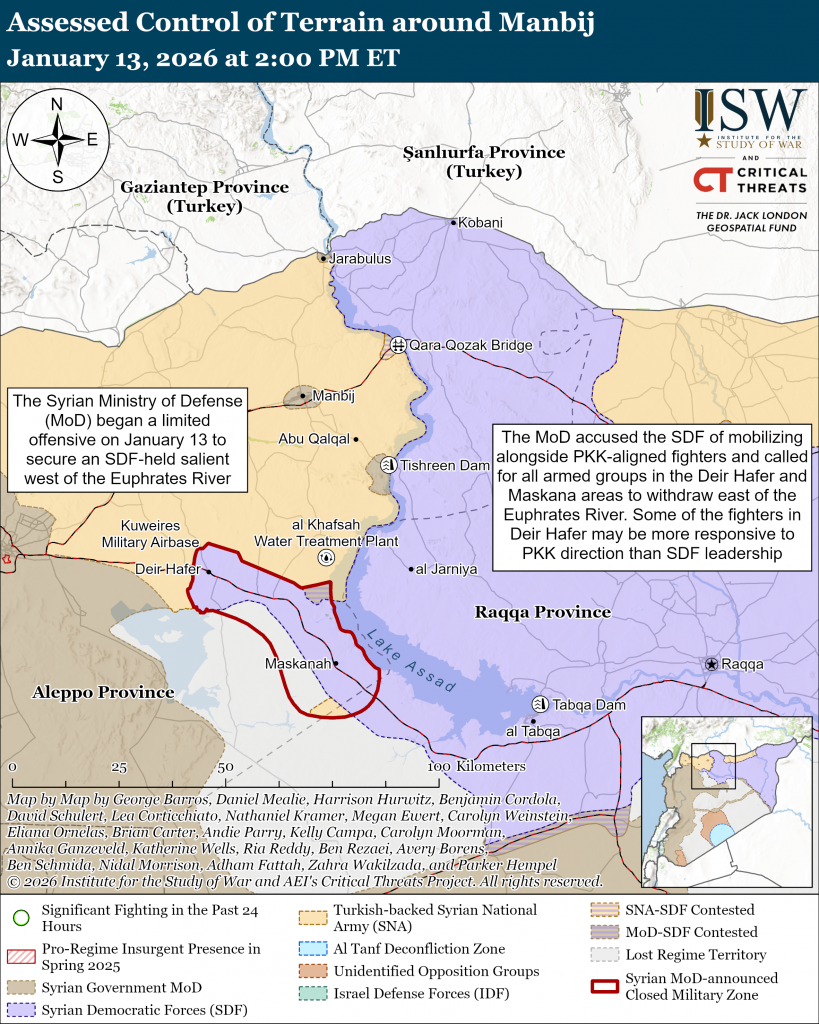
The stated objective of the MoD’s operation is to advance and secure the majority of the Deir Hafer salient, including the towns of Deir Hafer, Babiri, and Maskana, in order to prevent further mobilization of SDF reinforcements there and to deny the SDF’s ability to launch drone attacks on government territory such as the SDF’s January 10 drone attacks on Aleppo City.[lxxi] The MoD’s capture of the Deir Hafer salient would limit the SDF’s ability to threaten the MoD's rear and flanks if the MoD launched a larger offensive across the Euphrates River, where MoD forces are currently confined to the vulnerable Qara Qozok Bridge and Tishreen Dam crossings. MoD seizure of the Deir Hafer salient would further consolidate SDF defense on the east bank of the Euphrates, however.
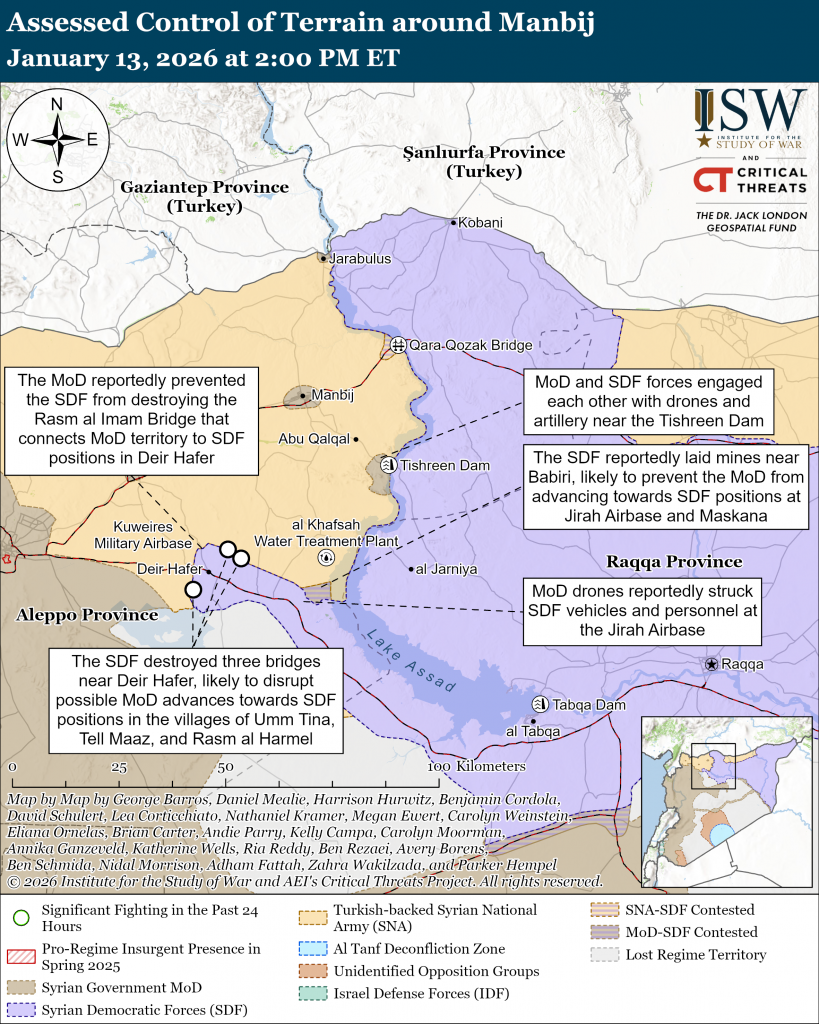
The MoD and SDF have undertaken the following lines of effort to achieve their respective objectives. The SDF reportedly destroyed three bridges near Umm Tina, Tell Maaz, and Rasm al Harmel villages to disrupt MoD advances along the northern and western flanks of the salient on January 13.[lxxii] The 20-meter-wide al Jer canal divides most of the northern and western flanks of the Deir Hafer salient—and therefore the SDF–MoD frontlines—acting as a barrier that forces must cross to reach the opposite side.[lxxiii] Local pro-government sources claimed the SDF deployed landmines near Babiri village on January 13, likely to create a defensive barrier because Babiri and the nearby water plant are the only areas of Deir Hafer salient not bisected by the canal.[lxxiv] The SDF also reportedly deployed sniper units to Deir Hafer itself and nearby villages to halt MoD advances on January 13.[lxxv] The SDF separately conducted a drone strike in MoD-controlled Humaymah, to which the MoD responded by conducting counter-battery artillery strikes on Deir Hafer on January 13.[lxxvi] The MoD conducted multiple drone and artillery strikes on SDF positions within the Deir Hafer salient, including strikes on Deir Hafer, Umm al Mara, and Rasm al Krum on January 13.[lxxvii] MoD drone strikes also targeted the SDF-controlled Jirah Airbase, likely to disrupt SDF efforts to reinforce its frontlines in the salient on January 13.[lxxviii] MoD reportedly prevented the SDF from destroying the bridge that connects MoD-controlled Rasm al Imam to SDF-controlled Rasm al Krum which could allow for MoD forces to cross the al Jer canal and begin advances on Deir Hafer, as the road is the most direct northern route to Deir Hafer.[lxxix] The MoD and SDF both deployed reinforcements to the Deir Hafer salient on January 13, with the MoD reinforcements reportedly including drone units and recently produced multiple launch rocket systems (MLRS).[lxxx]
The Syrian operation in Deir Hafer does not appear at this time to be part of a larger-scale nationwide military campaign that the Syrian government is launching against the SDF. The MoD launched the Deir Hafer operation after accusing the SDF of mobilizing alongside “terrorist PKK militias” and of launching drone strikes from the area that struck civilian areas.[lxxxi] The MoD’s specific reference to the presence of the possibly PKK-linked fighters and the drone attacks that struck Aleppo suggests that this operation is an effort to protect a major Syrian city rather than a nationwide operation to destroy the SDF.[lxxxii] The Syrian government has not yet explicitly connected this objective to its strategic aims regarding the Kurds’ integration into the Syrian state, nor articulated any objectives in other regions of northern or eastern Syria.
CTP-ISW has not observed strong indicators to suggest that the Syrian government is actively preparing for an expanded campaign that might stretch into other regions or northern and eastern Syria. Turkish media have described such an operation as a large-scale, multi-pronged offensive on northeastern Syria.[lxxxiii] Such an operation would probably require the involvement of Raqqa and Deir ez Zor province-based Syrian army units, including former Syrian National Army (SNA) fighters that have been based in the SNA-controlled Peace Spring enclave since 2019.[lxxxiv] CTP-ISW has not observed the significant deployment of forces or equipment to SDF-government frontlines in Raqqa or Deir ez Zor provinces as of this writing, though the Syrian army reportedly deployed some reinforcements to the Euphrates River line in Deir ez Zor Province in early December 2025.[lxxxv] Assistant Minister of Defense Fahim Issa additionally visited Syrian army units in the Peace Spring area on December 23 to discuss ”military readiness” and deployments in the area.[lxxxvi]
The Syrian government’s operations against the SDF in Aleppo may not necessarily remain “limited,” however. The MoD's goal to reduce the SDF’s salient in Deir Hafer is a logical first step in any larger military campaign designed to compel the SDF to integrate into the Syrian state. Senior Syrian officials have long referred to Syrian or Turkish military action against the SDF as an undesirable but possibly inevitable outcome; however, they may still decide to pursue a larger military campaign in the coming weeks or months.[lxxxvii]
Turkey’s involvement in the MoD’s Aleppo operations, if it occurred, would be an indicator that the MoD may seek to expand the fighting beyond Deir Hafer, western bank of the Euphrates River, but CTP-ISW has not observed any Turkish involvement in Deir Hafer at this time. Turkey has long considered the SDF to be a terrorist organization due to its ties to the PKK and has conducted multiple offensives targeting the SDF's dominant faction, the People’s Protection Units (YPG), along the Syrian-Turkish border.[lxxxviii] Turkey is reportedly not participating in Syrian operations in Aleppo at this time, but the Turkish Defense Ministry said on January 8 that the Turkish army is “ready to provide the necessary support” to the Syrian government in a conflict with the SDF, despite Turkey’s current restraint.[lxxxix] AANES official Ilham Ahmed warned on January 13 that the current events in Aleppo increase the risk of ”external interference,” likely referring to Turkey.[xc]
Key Takeaways
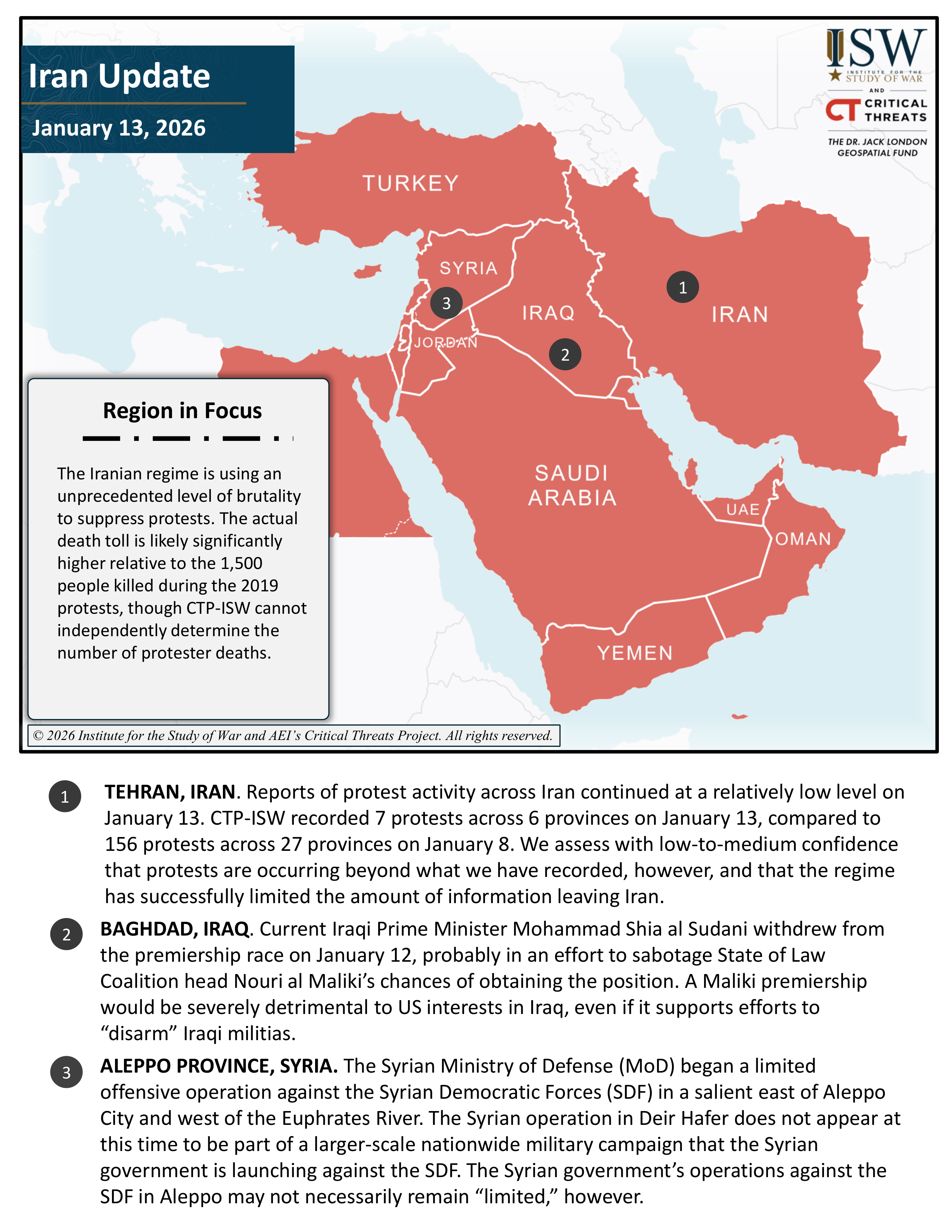
- Protests in Iran: Reports of protest activity across Iran continued at a relatively low level on January 13. CTP-ISW recorded 7 protests across 6 provinces on January 13, compared to 156 protests across 27 provinces on January 8. We assess with low-to-medium confidence that protests are occurring beyond what we have recorded, however, and that the regime has successfully limited the amount of information leaving Iran.
- Iranian Regime Crackdown on Protests: The Iranian regime is currently engaged in an unprecedented level of brutality to suppress protests. The actual death toll is likely higher relative to the 1,500 people killed during the 2019 protests, though CTP-ISW cannot independently determine the number of protester deaths.
- Anti-regime Militancy in Iran: A recent uptick in anti-regime militant activity in southeastern Iran may exacerbate the regime's bandwidth constraints by creating additional security challenges for the regime in southeastern Iran.
- SDF-Government Conflict in Aleppo: The Syrian Ministry of Defense (MoD) began a limited offensive operation against the Syrian Democratic Forces (SDF) in a salient east of Aleppo City and west of the Euphrates River. The MoD may have launched the operation to defeat and remove SDF fighters who are responsive to PKK control from the Aleppo area. The Syrian operation in Deir Hafer does not appear at this time to be part of a larger-scale nationwide military campaign that the Syrian government is launching against the SDF. The Syrian government’s operations against the SDF in Aleppo may not necessarily remain “limited,” however.
- Iraqi Government Formation: Current Iraqi Prime Minister Mohammad Shia al Sudani withdrew from the premiership race on January 12, probably in an effort to sabotage State of Law Coalition head Nouri al Maliki’s chances of obtaining the position. A Maliki premiership would be severely detrimental to US interests in Iraq, even if it supports efforts to “disarm” Iraqi militias.
Iran
See topline section.
Iraq
See topline section.
Syria
See topline section.
Arabian Peninsula
CTP-ISW has temporarily suspended its coverage of Yemen beginning on January 9 to prioritize coverage of the protests in Iran.
Palestinian Territories and Lebanon
Hezbollah released a statement on January 13 that expressed support for the Iranian regime amid ongoing protests but notably did not offer Iran military support or threaten to retaliate against the United States or allies if they attack Iran.[xci] Hezbollah affirmed the group’s support for the Iranian regime and echoed the regime’s rhetoric, framing the protests as a US and Israeli effort to “destabilize Iran from within.”[xcii] Hezbollah notably did not, however, offer to provide Iran with military support or threaten to retaliate against the US or allies if they attacked Iran.[xciii] Hezbollah was similarly unwilling, or unable, to contribute meaningfully to Iran’s defense or retaliate against US or Israeli targets during the Iran-Israel War in June 2025, despite previously operating as Iran’s primary deterrent against Israel and the United States.[xciv] Hezbollah’s statement comes amid recent indications that the Lebanese Armed Forces have had moderate success disarming Hezbollah south of the Litani River.[xcv] Hezbollah does still retain ballistic missiles and long-range rockets north of the Litani that it could use to attack Israel.[xcvi] Israel continues to strike Hezbollah sites north of the Litani.[xcvii]

[i] https://www.reuters.com/world/middle-east/about-2000-killed-iran-protests-official-says-2026-01-13/ ; https://www.cbsnews.com/news/iran-protest-death-toll-over-12000-feared-higher-video-bodies-at-morgue/
[ii] https://www.reuters.com/article/world/special-report-irans-leader-ordered-crackdown-on-unrest-do-whatever-it-take-idUSKBN1YR0QO/
[iii] https://www.nytimes.com/2026/01/13/world/middleeast/iran-protester-deaths.html
[iv] https://x.com/BahmanKalbasi/status/2011196328228069784; https://iranhumanrights.org/2026/01/exclusive-interview-physician-treating-protesters-in-iran-describes-mass-casualties-overwhelmed-hospitals; https://x.com/Vahid/status/2010367357865136363
[v] https://x.com/mehdiy_fa/status/2010750072120865185
[vi] https://x.com/bbcpersian/status/2010476742625128630?s=20; https://www.reuters.com/article/world/special-report-irans-leader-ordered-crackdown-on-unrest-do-whatever-it-take-idUSKBN1YR0QO/
[vii] https://time.com/7345347/iran-protests-death-toll-estimate-thousands/
[viii] https://www.criticalthreats.org/analysis/iran-update-january-8-2026 ; https://x.com/zarGEOINT/status/2010823089462931879
; https://x.com/Soheilx/status/2010798706048843969 ; https://x.com/MarioLeb79/status/2010797425230049627?s=20 ; https://x.com/mhmiranusa/status/2010896789583393139?s=20 ; https://x.com/bbcpersian/status/2011067535169294542 ; https://x.com/bbcpersian/status/2011126709253218740
[ix] https://x.com/HengawO/status/2011074798760206583?s=20 ; https://x.com/FSeifikaran/status/2011011896518873285?s=20 ; https://x.com/FSeifikaran/status/2011050132578713755?s=20
[x] https://www.wsj.com/world/middle-east/iran-is-hunting-down-starlink-users-to-stop-protest-videos-from-going-global-d8b49602?gaa_at=eafs&gaa_n=AWEtsqe7RdqeofP80u9uzbO85A1Ep6D9AOmNDnJUrjFotDNBhh20ROxBl2UUAHjT810%3D&gaa_ts=69669dd0&gaa_sig=6bVF_ClLc5cP54pt-eLkOIlil9ISsLHuUpnPPZGzxIGoLtDZByeeBJ1QhVcOors1O0f5vIU7Be_jz4Hy2Wd20w%3D%3D
[xi] https://www.politico.eu/article/vladimir-putin-ukraine-venezuela-iran-power-project-faces/
[xii] https://www.airuniversity.af.edu/JEMEAA/Display/Article/2329429/the-use-of-helicopters-against-guerrillas-the-israeli-model/#:~:text=The%20AH%20holds%20another%20advantage,advantage%20that%20of%20inestimable%20value.
[xiii] https://defencesecurityasia dot com/en/russia-iran-spartak-mrap-border-guard-upgrade-2023/ ; https://x.com/imp_navigator/status/1992631180496130148
[xiv] https://t.me/sepah_pasdaran/177481
[xv] https://www.reuters.com/world/white-house-concerned-moscow-may-be-advising-iran-best-practices-manage-protests-2022-10-26/#:~:text=Reuters%20Plus-,White%20House:%20Concerned%20Moscow%20may%20be%20advising%20Iran,best%20practices%20to%20manage%20protests&text=WASHINGTON%2C%20Oct%2026%20(Reuters),%2C%22%20Jean%2DPierre%20said.
[xvi] https://x.com/iranhrs99/status/2011111544021528788?s=20 ; https://x.com/bazdashti_ha/status/2011122854629126176
[xvii] https://x.com/AbdolhamidNet/status/2011163406619815992
[xviii] https://x.com/AbdolhamidNet/status/2011163406619815992
[xix] https://abdolhamid dot net/persian/2026/01/09/30879/
[xx] https://www.tasnimnews dot ir/fa/news/1404/10/23/3493404
[xxi] https://www.tasnimnews.ir/fa/news/1404/10/23/3493404
[xxii] https://t.me/iribnews/311607
[xxiii] https://t.me/jmmfront/104 ; https://t.me/jmmfront/119
[xxiv] https://t.me/jmmfront/97
[xxv] https://x.com/PAKenglishh/status/2011137160376959056 ;
https://landinfo dot no/wp-content/uploads/2018/04/Iran-Increased-Kurdish-military-activity-in-Iran.pdf
[xxvi] https://x.com/PAKenglishh/status/2011137160376959056
[xxvii] https://x.com/PAKenglishh/status/2011137160376959056
[xxviii] https://x.com/HengawO/status/2009288146228281812 ; https://t.me/mehrnews/343631
[xxix] https://www.kurdishpeace dot org/research/security-and-defense/israel-iran-war-how-will-kurdish-actors-respond/ ; https://www.rferl.org/a/jaish-al-adl-new-group-iran-opposition/33621554.html
[xxx] https://www.nytimes.com/2026/01/12/us/politics/trump-iran-options-diplomacy-strikes.html
[xxxi] https://www.nytimes.com/2026/01/12/us/politics/trump-iran-options-diplomacy-strikes.html
[xxxii] https://www.nytimes.com/2026/01/12/us/politics/trump-iran-options-diplomacy-strikes.html
[xxxiii] https://www.usatoday.com/story/news/politics/2026/01/13/trump-iran-military-strikes/88157244007/
[xxxiv] https://x.com/Faytuks/status/2011137904450609346?s=20
[xxxv] https://x.com/WhiteHouse/status/2010831284621262933?s=20
[xxxvi] https://t.me/centerkaf/5395
[xxxvii] https://t.me/centerkaf/5395
[xxxviii] https://t.me/centerkaf/5395
[xxxix] https://x.com/RadioFarda_/status/2010244006957977794
[xl] SITE Intelligence Group, “Seeing American Hand in Stoking Iranian Protests, Iraq-based Militant Group Threatens Attack on U.S. Embassy and Interests,” January 10, 2026, available by subscription at https://www.siteintelgroup.com. ; https://www.washingtoninstitute.org/policy-analysis/three-new-facade-groups-launched-iraq
[xli] https://understandingwar.org/research/middle-east/iran-update-special-report-iraq-after-the-israel-iran-war-june-13-july-3-2025/
[xlii] https://understandingwar.org/research/middle-east/iran-update-special-report-june-20-2025-evening-edition/ ; https://almadapaper dot net/405502/ ; https://t.me/Alwaadalsadeq3/21286 ; https://x.com/Akram_Alkabee/status/1935621345271824734/photo/1 ; https://t.me/centerkaf/5063
[xliii] https://x.com/LucasFoxNews/status/2010356533687623730?s=20 ; https://www.iranintl.com/202601071200; https://x.com/shoratasmi3242/status/2006977855968694300 ; https://x.com/news24global98/status/2006842369350709759 ; https://x.com/rbehrouzdo/status/2007120592789745765
[xliv] https://shafaq dot com/ar/%D8%B3%DB%8C%D8%A7%D8%B3%D8%A9/%D8%A7%D9%84%D8%A7%D8%B7%D8%A7%D8%B1-%D8%A7%D9%84%D8%AA%D9%86%D8%B3%D9%8A%D9%82%D9%8A-%D9%8A%D8%AC%D8%AA%D9%85%D8%B9-%D9%85%D8%B7%D9%84%D8%B9-%D8%A7%D9%84%D8%A7%D8%B3%D8%A8%D9%88%D8%B9-%D8%A7%D9%84%D9%85%D9%82%D8%A8%D9%84-%D9%84%D8%AD%D8%B3%D9%85-%D8%AA%D8%B1%D8%B4%D9%8A%D8%AD-%D8%A7%D9%84%D9%85%D8%A7%D9%84%D9%83%D9%8A-%D9%84%D8%B1-%D8%A7%D8%B3%D8%A9-%D8%A7%D9%84%D9%88%D8%B2%D8%B1%D8%A7 ; https://www.kurdistan24 dot net/ar/story/886716/%D8%AA%D9%86%D8%A7%D8%B2%D9%84-%D9%85%D9%84%D8%BA%D9%88%D9%85-%D8%A7%D9%84%D8%B3%D9%88%D8%AF%D8%A7%D9%86%D9%8A-%D9%8A%D8%B6%D8%B9-5-%D8%B4%D8%B1%D9%88%D8%B7-%D8%AA%D8%B9%D8%AC%D9%8A%D8%B2%D9%8A%D8%A9-%D9%85%D9%82%D8%A7%D8%A8%D9%84-%D8%AA%D8%B3%D9%84%D9%8A%D9%85-%D8%B3%D8%AF%D8%A9-%D8%A7%D9%84%D8%AD%D9%83%D9%85-%D9%84%D9%84%D9%85%D8%A7%D9%84%D9%83%D9%8A
[xlv] https://almadapaper dot net/424194/
[xlvi] https://almadapaper dot net/423440/ ; https://www.shafaq dot com/ar/%D8%B3%DB%8C%D8%A7%D8%B3%D8%A9/%D8%A7%D9%84-%D8%B7%D8%A7%D8%B1-%D8%A7%D9%84%D8%AA%D9%86%D8%B3%D9%8A%D9%82%D9%8A-%D9%8A%D8%AD%D8%AF%D8%AF-%D9%85%D9%87%D9%84%D8%A9-%D8%B3%D8%A8%D9%88%D8%B9%D9%8A%D9%86-%D9%84%D8%AD%D8%B3%D9%85-%D9%85%D8%B1%D8%B4%D8%AD-%D8%B1-%D9%8A%D8%B3-%D8%A7%D9%84%D9%88%D8%B2%D8%B1%D8%A7
[xlvii] https://almadapaper dot net/424162/
[xlviii] https://www.kurdistan24 dot net/ar/story/886716/%D8%AA%D9%86%D8%A7%D8%B2%D9%84-%D9%85%D9%84%D8%BA%D9%88%D9%85-%D8%A7%D9%84%D8%B3%D9%88%D8%AF%D8%A7%D9%86%D9%8A-%D9%8A%D8%B6%D8%B9-5-%D8%B4%D8%B1%D9%88%D8%B7-%D8%AA%D8%B9%D8%AC%D9%8A%D8%B2%D9%8A%D8%A9-%D9%85%D9%82%D8%A7%D8%A8%D9%84-%D8%AA%D8%B3%D9%84%D9%8A%D9%85-%D8%B3%D8%AF%D8%A9-%D8%A7%D9%84%D8%AD%D9%83%D9%85-%D9%84%D9%84%D9%85%D8%A7%D9%84%D9%83%D9%8A
[xlix] https://www.kurdistan24 dot net/ar/story/886716/%D8%AA%D9%86%D8%A7%D8%B2%D9%84-%D9%85%D9%84%D8%BA%D9%88%D9%85-%D8%A7%D9%84%D8%B3%D9%88%D8%AF%D8%A7%D9%86%D9%8A-%D9%8A%D8%B6%D8%B9-5-%D8%B4%D8%B1%D9%88%D8%B7-%D8%AA%D8%B9%D8%AC%D9%8A%D8%B2%D9%8A%D8%A9-%D9%85%D9%82%D8%A7%D8%A8%D9%84-%D8%AA%D8%B3%D9%84%D9%8A%D9%85-%D8%B3%D8%AF%D8%A9-%D8%A7%D9%84%D8%AD%D9%83%D9%85-%D9%84%D9%84%D9%85%D8%A7%D9%84%D9%83%D9%8A
https://shafaq dot com/ar/سیاسة/ر-اسة-الحكومة-السوداني-تنازل-لصالح-المالكي-واتفاق-على-تشكيل-نيابي ; https://en.964media dot com/44175/
[li] https://shafaq dot com/ar/%D8%B3%DB%8C%D8%A7%D8%B3%D8%A9/%D8%A7%D9%84%D8%A7%D8%B7%D8%A7%D8%B1-%D8%A7%D9%84%D8%AA%D9%86%D8%B3%D9%8A%D9%82%D9%8A-%D9%8A%D8%AC%D8%AA%D9%85%D8%B9-%D9%85%D8%B7%D9%84%D8%B9-%D8%A7%D9%84%D8%A7%D8%B3%D8%A8%D9%88%D8%B9-%D8%A7%D9%84%D9%85%D9%82%D8%A8%D9%84-%D9%84%D8%AD%D8%B3%D9%85-%D8%AA%D8%B1%D8%B4%D9%8A%D8%AD-%D8%A7%D9%84%D9%85%D8%A7%D9%84%D9%83%D9%8A-%D9%84%D8%B1-%D8%A7%D8%B3%D8%A9-%D8%A7%D9%84%D9%88%D8%B2%D8%B1%D8%A7
[lii] https://en.964media dot com/44090/
[liii] https://www.al-monitor dot com/originals/2022/07/following-tape-leak-sadr-demands-maliki-quit-iraqi-politics ; https://understandingwar.org/wp-content/uploads/2018/02/Malikis-Authoritarian-Regime-Web.pdf ; https://x.com/salih_m_iraqi/status/1905319183518150830
[liv] https://en.964media dot com/44175/
[lv] https://en.964media dot com/44175/
[lvi]https://www.pbs.org/wgbh/frontline/article/in-their-own-words-sunnis-on-their-treatment-in-malikis-iraq/
[lvii] https://understandingwar.org/research/middle-east/post-iraqi-election-disunity-among-iranian-backed-parties-could-threaten-their-influence-in-iraq/
[lviii] https://understandingwar.org/research/middle-east/post-iraqi-election-disunity-among-iranian-backed-parties-could-threaten-their-influence-in-iraq/
[lix] https://www.alaraby dot co.uk/politics/خاص-واشنطن-تلوح-بعقوبات-ضد-العراق-ومقاطعة-أيّ-رئيس-وزراء-من-الفصائل
[lx] https://x.com/LawkGhafuri/status/1996326733751210057
[lxi] https://www.rudaw dot net/sorani/middleeast/iraq/061220251
[lxii] https://understandingwar.org/research/middle-east/iran-update-december-4-2025/
[lxiii] https://www.dohainstitute dot org/en/PoliticalStudies/Pages/The_US_and_Iran_Concur_Maliki_Had_to_Go.aspx ; https://understandingwar.org/wp-content/uploads/2018/02/Malikis-Authoritarian-Regime-Web.pdf
[lxiv] https://x.com/AlekhbariahSY/status/2010999229217472959
[lxv] https://t.me/Sy_Defense/1477 ; https://x.com/Charles_Lister/status/2009427268796301370; https://x.com/QalaatAlMudiq/status/2009577335645675734 ; https://x.com/QalaatAlMudiq/status/2009581031565976057 ; https://www.enabbaladi dot net/791124/%d8%ad%d9%84%d8%a8-%d8%a7%d8%b3%d8%aa%d9%87%d8%af%d8%a7%d9%81-%d9%8a%d8%b9%d8%b1%d9%82%d9%84-%d8%a5%d8%ac%d9%84%d8%a7%d8%a1-%d8%b9%d9%86%d8%a7%d8%b5%d8%b1-%d9%82%d8%b3%d8%af-%d8%a5%d9%84%d9%89/
[lxvi] https://x.com/AlekhbariahSY/status/2010999229217472959 ; https://www.linkedin.com/pulse/turkey-draws-line-between-sdf-pkk-major-policy-shift-wjyye/
[lxvii] https://www.enabbaladi dot net/791196/%d8%a7%d9%84%d8%ac%d9%8a%d8%b4-%d9%8a%d8%b3%d9%8a%d8%b7%d8%b1-%d8%b9%d9%84%d9%89-%d8%a7%d9%84%d8%b4%d9%8a%d8%ae-%d9%85%d9%82%d8%b5%d9%88%d8%af-%d9%81%d9%8a-%d8%ad%d9%84%d8%a8/ ; https://x.com/QalaatAlMudiq/status/2009935960184865147 ; https://x.com/QalaatAlMudiq/status/2009974270898909235 https://x.com/QalaatAlMudiq/status/2009975954215522507 https://x.com/QalaatAlMudiq/status/2009981114199461898 ; https://x.com/QalaatAlMudiq/status/2009983198047146067 ; https://x.com/QalaatAlMudiq/status/2010013822703312991
[lxviii] https://www.linkedin.com/pulse/turkey-draws-line-between-sdf-pkk-major-policy-shift-wjyye/
[lxix] https://understandingwar.org/research/middle-east/iran-update-january-12-2026/
[lxx] https://x.com/MazloumAbdi/status/2010131709929689323 ; https://x.com/QalaatAlMudiq/status/2010280626214097334
[lxxi] https://x.com/AlekhbariahSY/status/2010999229217472959 ; https://www.enabbaladi dot net/791196/%d8%a7%d9%84%d8%ac%d9%8a%d8%b4-%d9%8a%d8%b3%d9%8a%d8%b7%d8%b1-%d8%b9%d9%84%d9%89-%d8%a7%d9%84%d8%b4%d9%8a%d8%ae-%d9%85%d9%82%d8%b5%d9%88%d8%af-%d9%81%d9%8a-%d8%ad%d9%84%d8%a8/ ; https://x.com/QalaatAlMudiq/status/2009935960184865147 ; https://x.com/QalaatAlMudiq/status/2009974270898909235
[lxxii] https://x.com/DeirEzzore/status/2011030463541030928 ; https://x.com/DeirEzzore/status/2011005268700672498 ; https://x.com/QalaatAlMudiq/status/2011038738957136122 ;
https://x.com/DeirEzzore/status/2011030463541030928 https://x.com/DeirEzzore/status/2011030463541030928
[lxxiii] https://understandingwar.org/research/middle-east/iran-update-september-2-2025/
[lxxiv] https://x.com/DeirEzzore/status/2011052890450981291
[lxxv] https://x.com/DeirEzzore/status/2011059501592346685 https://x.com/DeirEzzore/status/2011059736947671092 ; https://x.com/DeirEzzore/status/2011091730678849704 ; https://t.me/AbomosaabSharkea/163680
[lxxvi] https://t.me/AbomosaabSharkea/163682 ; https://t.me/sana_gov/154378
[lxxvii] https://x.com/SDF_Syria/status/2011064149040640338 https://x.com/DeirEzzore/status/2011064200316276834
https://x.com/SDF_Syria/status/2011078182754271468
[lxxviii] https://t.me/AbomosaabSharkea/163718
[lxxix] https://x.com/DeirEzzore/status/2011090405492973979 ; https://t.me/AlekhbariahSY/192227
[lxxx] https://x.com/nahermedia/status/2011057470467174777 ; https://x.com/QalaatAlMudiq/status/2011098953555566777 ; https://t.me/AbomosaabSharkea/163673
[lxxxi] https://x.com/AlekhbariahSY/status/2010999229217472959
[lxxxii] https://x.com/AlekhbariahSY/status/2010999229217472959
[lxxxiii] https://www.turkiyegazetesi dot com.tr/dunya/halk-meydanlarda-ordu-teyakkuzda-suriyede-80-bin-asker-operasyon-icin-hazir-1753948?s=4; https://www.turkiyegazetesi dot com.tr/gundem/suriyede-teror-orgutu-icin-son-25-gun-sdgye-operasyona-biz-de-destek-veririz-1753464?s=1; https://understandingwar.org/research/middle-east/iran-update-august-18-2025/
[lxxxiv] https://t.me/Sy_Defense/1439
[lxxxv] https://x.com/DeirEzzore/status/1997025268062666917; https://x.com/DeirEzzore/status/1997706546814627902
[lxxxvi] https://t.me/Sy_Defense/1439
[lxxxvii] https://x.com/zakorahmed0/status/2010038964539818384; https://www.newarab.com/news/sharaa-says-turkey-may-attack-sdf-if-they-dont-join-syrian-govt ; https://www.milliyet.com.tr/gundem/kasim-ayi-sonrasinda-sdgye-harekat-imasi-7448561; https://www.economist.com/middle-east-and-africa/2025/02/03/an-interview-with-ahmed-al-sharaa-syrias-president; https://shafaq dot com/en/World/Syrian-Defense-Ministry-signals-potential-military-action-against-SDF; https://www.reuters.com/world/middle-east/sectarian-violence-risks-dividing-syria-despite-sharaas-diplomacy-2025-09-15
[lxxxviii] https://www.mfa dot gov.tr/pkk.tr.mfa ; https://www.aa dot com.tr/en/middle-east/2-syrian-army-soldiers-killed-in-sdf-attack-in-northeast/3748960 ; https://www.aa dot com.tr/tr/politika/disisleri-bakani-fidan-turkiye-bekasina-yonelik-tum-tehditleri-kaynaginda-yok-etme-gucune-ve-kararliligina-sahiptir/3446537
[lxxxix] https://www.aa dot com.tr/en/middle-east/turkiye-says-operation-against-sdf-in-aleppo-being-carried-out-entirely-by-syrian-army/3793335
[xc] https://t.me/TelevisionSyria/75053
[xci] https://t.me/mmirleb/10138
[xcii] https://t.me/mmirleb/10138 ; https://t.me/defapress_ir/47122 ; https://t.me/iribnews/311189
[xciii] https://t.me/mmirleb/10138
[xciv] https://www.aei.org/articles/the-deafening-silence-of-irans-proxies/
[xcv] https://understandingwar.org/research/middle-east/iran-update-january-9-2026/
[xcvi] https://x.com/idfonline/status/1971482664839348341 ; https://x.com/idfonline/status/1981303231415300295
[xcvii] https://understandingwar.org/research/middle-east/iran-update-january-9-2026/
View Citations