{{currentView.title}}
January 11, 2026
Iran Update, January 11, 2026
Non-Protest Data Cutoff: 2:00 PM ET
Protest Data Cutoff: 3:30 PM ET
The Critical Threats Project (CTP) at the American Enterprise Institute and the Institute for the Study of War (ISW) publish the Iran Update, which provides insights into Iranian and Iranian-sponsored activities that undermine regional stability and threaten US forces and interests. CTP-ISW publishes the Iran Update daily.
Click here to see ISW-CTP’s new interactive map showing the locations of daily protests in Iran since December 28, 2025. ISW-CTP will continue to publish daily static maps depicting the Iranian protests in forthcoming Iran Updates.
Click here to see CTP and ISW’s interactive map of assessed control of terrain in Syria, and here to see CTP and ISW’s interactive map of Israeli ground operations. The Syria map is updated daily alongside the static Syria maps in this report. CTP-ISW ended daily maps of Israeli ground operations in February 2025.
Click here to see ISW-CTP's interactive map showing the total strikes in Iran during the Israel-Iran War, as well as an interactive timelapse showing the strikes day-by-day.
Note: CTP-ISW has resumed publishing daily Iran Updates to cover the ongoing protests in Iran. CTP-ISW's weekend updates will only include analysis on the protests, while our weekday updates will also include analysis on Iraq, Syria, and Lebanon.
Key Takeaways
- Iranian Regime Rhetoric about the Protests: Some Iranian regime officials have framed the ongoing protests as the next phase of the Israel-Iran War. The Iranian security establishment has repeatedly stressed since June 2025 that it believes that the Israel-Iran War is ongoing, despite the fact that the 12-day military conflict ended in June.
- Iranian Threat to Attack US Forces: Parliament Speaker Mohammad Bagher Ghalibaf warned the United States against “miscalculations” on January 11 and threatened that Iran could target US military bases in the region or Israel if the United States attacks Iran. Ghalibaf’s threat is likely a response to recent Western media reports that US President Donald Trump is considering various options to intervene in the ongoing protests.
- Security Force Crackdown: The regime may be labeling Iranian protesters as “terrorists” and connecting the ongoing protests to the United States and Israel as a tactic to motivate hesitant security officers to forcefully crack down on the protests.
- Iranian Security Personnel Deaths: More Iranian security officers have died during the current protests than in any other protest wave in Iran. IRGC-affiliated media reported on January 11 that at least 114 regime security personnel from the Law Enforcement Command (LEC), Basij, and IRGC have been killed since the start of the protests on December 28. The actual death count for Iranian security personnel is likely higher than the number that IRGC-affiliated media reported given that CTP-ISW has observed reports of security personnel casualties in areas, such as Tehran Province, that IRGC-affiliated media did not include in its death count.
- Protest Rate and Information Availability: CTP-ISW recorded a lower rate of protest activity across Iran on January 11 compared to recent days. The lower rate of protests that CTP-ISW recorded is likely due to the regime’s nationwide internet shutdown and crackdown on the use of Starlink satellites.
Some Iranian regime officials have framed the ongoing protests as the next phase of the Israel-Iran War. The Islamic Revolutionary Guards Corps (IRGC) attributed the ongoing protests to Israel and the United States on January 11, arguing that the "riots" have killed hundreds of people and are an "extension of the 12-day war" with the United States and Israel.[i] The IRGC claimed that the United States and Israel have equipped and armed "terrorists" to cause chaos in Iran.[ii] Iranian President Masoud Pezeshkian similarly claimed on January 11 that the United States and Israel aim to incite internal unrest in Iran under the pretext of economic issues.[iii] Parliament Speaker Mohammad Bagher Ghalibaf declared on January 11 that Iran is at war with the United States and Israel on four fronts: cognitive, economic, military, and terrorism.[iv] The “military” front likely refers to the 12-day kinetic conflict in June, while “terrorism” likely refers to the regime’s view of the ongoing protests. Ghalibaf warned the United States against “miscalculations” and threatened that Iran could target US military bases in the region or Israel if the United States attacks Iran.[v] He noted that Iran will not limit itself to being reactive and will respond based on its threat perception.[vi]
The regime may be labeling Iranian protesters as “terrorists” and connecting the ongoing protests to the United States and Israel as a tactic to motivate hesitant security officers to forcefully crack down on the protests. The IRGC Intelligence Organization released a statement on January 10 that it is “dealing with possible acts of abandonment.”[vii] This statement suggests that some Iranian security forces may have already defected or that the regime is very concerned about this possibility. A Kurdish human rights organization previously reported on January 8 that the regime had arrested “dozens” of security officers in Kermanshah City who refused to fire on protesters.[viii] The regime may be framing protesters as “terrorists” and linking them to the United States and Israel to increase security forces’ willingness to use lethal force against protesters and reduce the risk of defections. The regime’s framing of protesters as “terrorists” and characterization of the protests as a continuation of the Israel-Iran War further indicate that the regime is approaching the ongoing protests as a military issue rather than a law enforcement one.
Ghalibaf’s threat to attack US bases or Israel is likely a response to recent Western media reports that US President Donald Trump is considering various options to intervene in the ongoing protests. The Wall Street Journal reported on January 11 that Trump and senior officials, including Secretary of State Marco Rubio, Defense Secretary Pete Hegseth, and Joint Chiefs of Staff Chairman General Dan Caine, will receive a briefing on January 13 about response options to Iran’s protests, though the officials are not expected to make a final decision during that meeting.[ix] The New York Times separately reported on January 10 that Trump is “seriously considering” military strikes against Iran in response to the Iranian regime’s violent crackdown on the protests, but “has not made a final decision.”[x] Unspecified US officials said that advisers presented Trump with a range of potential strike targets, including unspecified non-military sites in Tehran and facilities linked to Iranian security services involved in suppressing protests.[xi] Axios similarly reported on January 11 that Trump has considered military strikes, a carrier strike group deployment to the Middle East, and cyber or information operations to support protests in Iran but has not yet made a decision, according to US officials.[xii]
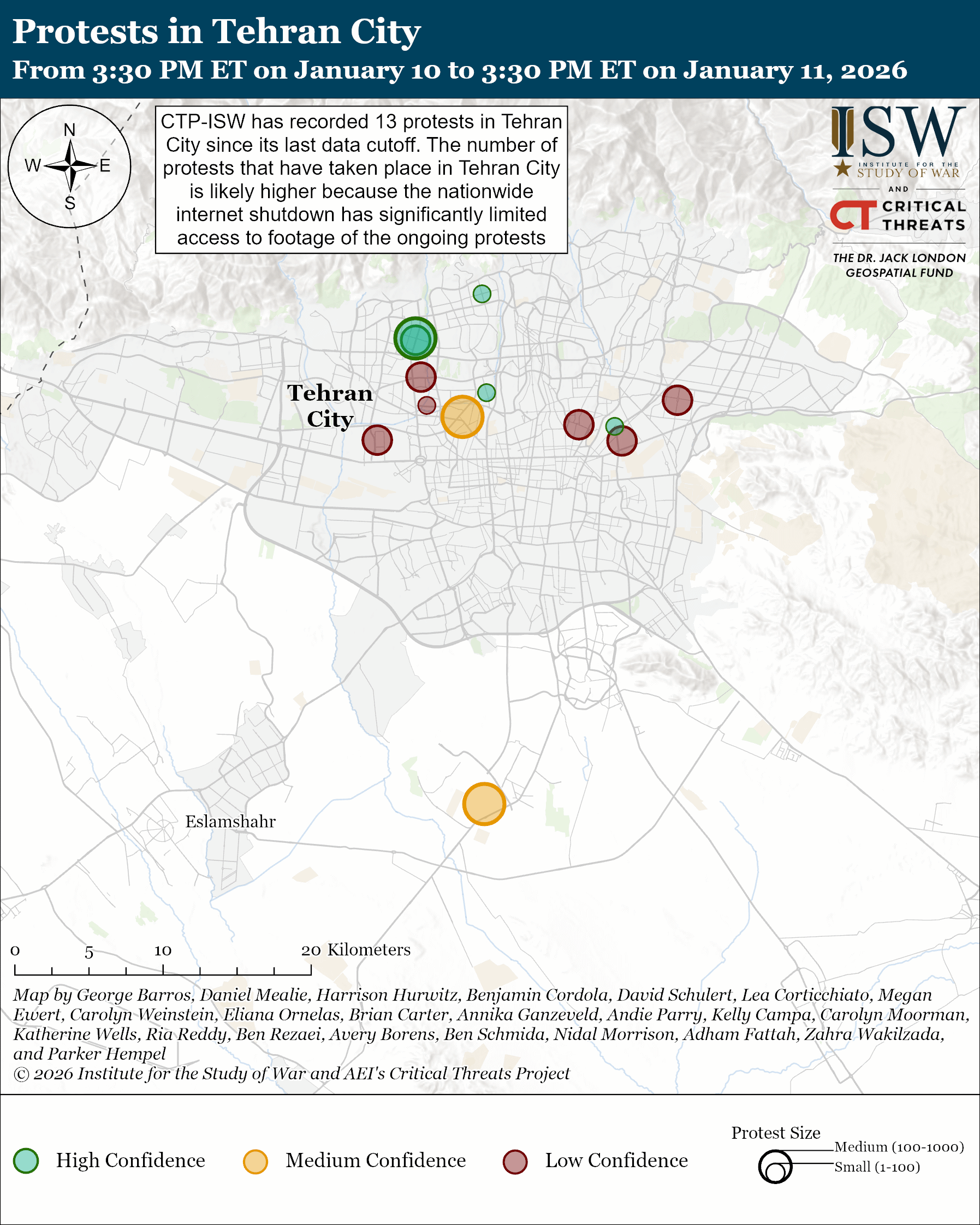
CTP-ISW recorded a lower rate of protest activity across Iran on January 11 compared to recent days. The lower rate of protests that CTP-ISW recorded is likely due to the regime’s nationwide internet shutdown and crackdown on the use of Starlink satellites. CTP-ISW has recorded 22 protests across nine provinces since 0000 local time on January 11, 11 of which were medium-sized (100-1,000 participants) and six of which were large (>1000 participants).[xiii] The decrease in recorded protest activity is at least partly due to the regime’s nationwide internet shutdown that has been in effect for over three days.[xiv] The Iranian regime has also begun jamming Starlink signals to prevent Iranians from being able to use Starlink satellites.[xv] About half of the protests that CTP-ISW has recorded since its last data cutoff took place in Tehran, which may be explained by Iranians’ ability to access tools like Starlink more readily in larger cities than in less urban areas.[xvi] Reports of arrests, deaths, and violence from regime and anti-regime outlets in Lorestan, Kurdistan, Sistan and Baluchistan, South Khorasan, and Golestan provinces suggest that protests are taking place across Iran but that protesters in these areas have been unable to share footage of protests with foreign media.[xvii] State media reported that the Mashhad anti-narcotics police head was killed in protests in Mashhad on January 11, demonstrating the intensity of protests there despite limited footage of the demonstrations.[xviii] CTP-ISW has not recorded protests in Kermanshah Province since January 9, despite the province experiencing intense and violent protest activity before that date.[xix]

More Iranian security officers have died during the current protests than in any other protest wave in Iran. IRGC-affiliated media reported on January 11 that at least 114 regime security personnel from the Law Enforcement Command (LEC), Basij, and IRGC have been killed since the start of the protests on December 28.[xx] The LEC is the regime’s main internal security service and is responsible for conducting ordinary policing activities and maintaining social control.[xxi] The Basij is a paramilitary organization that largely focuses on disseminating regime propaganda, suppressing domestic dissent, and conducting civil defense activities.[xxii] The regime has also deployed the IRGC Ground Forces in some areas during the current wave of protests, although it is unclear whether all of the IRGC deaths reported by IRGC-affiliated media are deaths of IRGC Ground Forces members. Iranian media reported that Esfahan Province has the highest number of LEC and IRGC deaths at 30, followed by 9 Basij and IRGC deaths in Ghazvin Province.[xxiii] The data indicates that the IRGC has mainly been active in western Iran, which is consistent with recent reports of IRGC Ground Forces deployments in Kermanshah and West Azerbaijan provinces.[xxiv] The actual death count for Iranian security personnel is likely higher than the number that IRGC-affiliated media reported given that CTP-ISW has observed reports of security personnel casualties in areas, such as Tehran Province, that IRGC-affiliated media did not include in its death count.[xxv] Over 70 regime security personnel died in the 2022-2023 Mahsa Amini movement, which was the deadliest wave of protests until this wave.[xxvi]

Recent Baloch anti-regime activity and reported Iranian efforts to use Iranian-backed Iraqi militias to suppress the protests indicate that the regime may be facing significant security bandwidth constraints. Baloch anti-regime coalition Mobarizoun Popular Front (MPF) fighters killed one Law Enforcement Command (LEC) officer and injured another in an attack on an LEC patrol vehicle in Dashtiari County, Sistan and Baluchistan Province, on January 11.[xxvii] The MPF announced that it conducted the attack in response to Iranian security forces’ continued suppression of protests across Iran.[xxviii] The MPF conducted a similar attack and killed an LEC commander in Iranshahr, Sistan and Baluchistan Province, on January 7 in response to ”the killing and suppression of protesters in various parts” of Iran.[xxix] CTP-ISW has observed protests in Zabol, Iranshahr, Zahedan, and Chabahar in Sistan and Baluchistan Province since the start of the protests on December 28.[xxx] Regime forces used live fire, tear gas, and rubber bullets to disperse a medium-sized protest in Zahedan on January 9.[xxxi] That the MPF continues to be able to conduct attacks targeting Iranian security personnel in southeastern Iran suggests that security forces may not have the bandwidth to confront this group while it faces widespread protests across the country.
Iran has reportedly asked Iranian-backed Iraqi militias, including Kataib Hezbollah, for assistance in suppressing the protests, according to a Fox News correspondent citing unspecified sources on January 11.[xxxii] Anti-regime media and social media users previously claimed on January 6 that around 800 Iranian-backed Iraqi militia fighters have deployed to Iran since January 2 through border crossings in Diyala, Maysan, and Basra provinces.[xxxiii] The Iraqi fighters are reportedly members of Kataib Hezbollah, Harakat Hezbollah al Nujaba, Kataib Sayyid al Shuhada, and the Badr Organization, among other militias.[xxxiv] IRGC Quds Force Commander Brigadier General Esmail Ghaani met with unspecified Iraqi militia leaders in Baghdad between January 6 and 8, according to informed Iraqi sources speaking to regional media on January 8.[xxxv] Iran likely seeks to use Iranian-backed Iraqi militias to bolster the number of forces it has to suppress the current unrest. Iran’s use of Iranian-backed Iraqi militias to suppress the protests suggests that Iranian security forces may face bandwidth constraints and difficulties in suppressing the protests on their own.

[i] https://t.me/Tasnimnews/383050
[ii] https://t.me/Tasnimnews/383050
[iii] http://www.tasnimnews dot com/fa/news/1404/10/21/3492309; https://t.me/Tasnimnews/383004; https://t.me/sepah_pasdaran/177421
[iv] https://t.me/Tasnimnews/382969
[v] https://x.com/RadioFarda_/status/2010244006957977794
[vi] https://x.com/RadioFarda_/status/2010244006957977794
[vii] https://t.me/iribnews/311193
[viii] https://x.com/HengawO/status/2009326792146903541
[ix] https://www.wsj.com/world/middle-east/major-trump-briefing-on-iran-options-planned-for-tuesday-5827429f?mod=hp_lead_pos1
[x] https://www.nytimes.com/2026/01/10/us/politics/trump-iran-strikes.html
[xi] https://www.nytimes.com/2026/01/10/us/politics/trump-iran-strikes.html
[xii] https://www.axios.com/2026/01/11/trump-iran-protest-options-death-toll
[xiii] https://x.com/ManotoNews/status/2010089458310529054 ;
https://x.com/ManotoNews/status/2010090397788450988 ;
https://x.com/john_marquee/status/2010094079447846951;
https://x.com/RadioFarda_/status/2010100421243674711 ;
https://x.com/IranIntl/status/2010102317924679896 ;
https://x.com/IranIntl/status/2010103011134300440 ;
https://x.com/bbcpersian/status/2010105997290090769 ;
https://x.com/ManotoNews/status/2010108657716105654 ;
https://x.com/RadioFarda_/status/2010109355832529162 ;
https://x.com/mhmiranusa/status/2010123040567279874 ;
https://x.com/ManotoNews/status/2010125586149323241 ;
https://x.com/IranIntl/status/2010271873397919774 ;
https://x.com/IranIntl/status/2010273951453196351 ;
https://x.com/IranIntl/status/2010324494150156362 ;
https://x.com/IranIntl/status/2010338385752101053 ;
https://x.com/ManotoNews/status/2010345061863837730 ;
https://x.com/IranIntl/status/2010384878362149280 ;
https://x.com/ManotoNews/status/2010410103355388199 ;
https://x.com/IranIntl/status/2010423925738524808 ;
https://x.com/IranIntl/status/2010432660078768512 ;
https://x.com/ManotoNews/status/2010435803248529596 ;
https://x.com/IranIntl/status/2010441072581705866
[xiv] https://x.com/netblocks/status/2010389646828798094
[xv] https://www.forbes.com/sites/zakdoffman/2026/01/11/kill-switch-iran-shuts-down-starlink-internet-for-first-time/
[xvi] https://www.bbc.com/news/articles/cj9rengvnp9o ; https://x.com/RadioFarda_/status/2010100421243674711 ; https://x.com/ManotoNews/status/2010089458310529054 ;
https://x.com/ManotoNews/status/2010090397788450988 ;
https://x.com/RadioFarda_/status/2010100421243674711
https://x.com/IranIntl/status/2010103011134300440 ;
https://x.com/bbcpersian/status/2010105997290090769 ;
https://x.com/mhmiranusa/status/2010123040567279874 ;
https://x.com/IranIntl/status/2010273951453196351 ;
https://x.com/IranIntl/status/2010324494150156362 ;
https://x.com/IranIntl/status/2010338385752101053 ;
https://x.com/IranIntl/status/2010384878362149280 ;
https://x.com/ManotoNews/status/2010410103355388199 ;
https://x.com/ManotoNews/status/2010435803248529596 ;
https://x.com/IranIntl/status/2010441072581705866
[xvii] https://x.com/hra_news/status/2010335356978180412 ; https://x.com/hra_news/status/2010355914633568332 ; https://x.com/hra_news/status/2010365076721619342 ; https://t.me/Tasnimnews/382989?t=25 ; https://t.me/Tasnimnews/383003
[xviii] https://t.me/iribnews/311430
[xix] https://x.com/KurdistanHRN_En/status/2010030060217004334?s=20 ; https://x.com/KurdistanHRN/status/2010377088927138216 ; https://t.me/Tasnimnews/382835 ; https://x.com/HengawO/status/2009661108643360792
[xx] https://www dot tasnimnews.com/fa/news/1404/10/21/3491793
[xxi] https://understandingwar.org/research/middle-east/explainer-the-iranian-armed-forces/
[xxii] https://understandingwar.org/research/middle-east/explainer-the-iranian-armed-forces/
[xxiii] https://www dot tasnimnews.com/fa/news/1404/10/21/3491793
[xxiv] https://x.com/KurdistanHRN/status/2010055598000201969?s=20 ; https://x.com/HengawO/status/2009288146228281812?s=20
[xxv] https://www.criticalthreats.org/analysis/iran-update-january-8-2026
[xxvi] https://understandingwar.org/research/middle-east/iran-crisis-update-december-27/
[xxvii] https://www dot radiozamaneh.com/874567/
[xxviii] https://t.me/jmmfront/119
[xxix] https://t.me/jmmfront/106; https://t.me/jmmfront/104
https://www.instagram.com/bbcpersian/reel/DTAbAceCjp2/ ;
https://x.com/beyondthewalls2/status/2007544267544436850 ;
https://x.com/IranIntl/status/2007578448407990344;
https://x.com/IranIntl/status/2007712430021816645;
https://x.com/hra_news/status/2008941809490182645?s=20;
https://x.com/RadioZamaneh/status/2009311236068950394;
https://x.com/RadioZamaneh/status/2009322615060795788;
https://x.com/bbcpersian/status/2009587518371402082?s=20;
https://x.com/IranIntl/status/2009681356477882791?s=20
[xxxi] https://x.com/RadioFarda_/status/2009580150220861819?s=20 ; https://x.com/bbcpersian/status/2009587518371402082?s=20
[xxxii] https://x.com/LucasFoxNews/status/2010356533687623730?s=20
[xxxiii] https://www.iranintl.com/202601071200; https://x.com/shoratasmi3242/status/2006977855968694300 ; https://x.com/news24global98/status/2006842369350709759 ; https://x.com/rbehrouzdo/status/2007120592789745765
[xxxiv] https://www.iranintl.com/202601071200
[xxxv] https://aawsat dot com/العالم-العربي/المشرق-العربي/5227688-مساعٍ-إيرانية-لاحتواء-الخلافات-بين-الفصائل-العراقية-المسلحة
View Citations