{{currentView.title}}
March 09, 2026
Ukraine Invasion Updates, January 2026
Russian Offensive Campaign Assessment, January 31, 2026
Russian forces’ months of strikes have significantly degraded and damaged the Ukrainian energy grid, which is now facing significant problems even during the moratorium on Russian strikes against Ukrainian energy infrastructure. Ukraine’s power grid suffered a significant shutdown of the 400-kilowatt (kW) line between the Romanian and Moldovan power systems and the 750-kW line between western and central Ukraine on the morning of January 31. Ukrainian Energy Minister Denys Shmyhal reported on January 31 that the cause of the shutdown was an unspecified technological disruption, not a Russian strike.[1] The Ukrainian Ministry of Finance stated that a cyberattack did not cause the outages.[2] The Moldovan Energy Ministry stated that "serious problems" in the Ukrainian power grid caused the 400-kW line to disconnect, and Ukrainian Energy Research Center Director Oleksandr Kharchenko stated that existing damage to Ukraine's energy system "complicated" the situation.[3] Shmyhal stated that the shutdowns caused cascading power outages in the Ukrainian power grid, activated protections at Ukrainian substations, and forced operators to unload Ukraine's nuclear power plants.[4] Shmyhal reported emergency shutdowns in Kyiv City and Kyiv, Zhytomyr, and Kharkiv oblasts. Shmyhal reported that Ukrainian authorities restored power to critical infrastructure in Kyiv City and Kyiv and Dnipropetrovsk oblasts by 1400 local time and were working to restore power to civilian consumers in Kharkiv, Zhytomyr, and Odesa oblasts.[5]
Russian strikes did not directly cause the large-scale outages, but the Russian strike campaign has already damaged and compromised the Ukrainian power grid to the point where the degraded grid is fragile and prone to significant disruptions due to technical malfunctions. Shmyhal notably reported on January 16 that Russian forces have struck every power plant in Ukraine since February 2022.[6] The Kremlin agreed to a week-long moratorium on strikes against some Ukrainian energy infrastructure on January 29 only after inflicting severe damage to Ukraine’s national energy grid. The enduring cascading blackouts in Ukraine through January 31 during the ceasefire further demonstrate how the temporary moratorium does not mark a significant Russian concession.[7]
A US delegation met with lead Russian negotiator and Russian Direct Investment Fund (RDIF) CEO Kirill Dmitriev in Miami, Florida, on January 31. US Special Envoy to the Middle East Steve Witkoff reported on January 31 that he, US Treasury Secretary Scott Bessent, former Senior Advisor to the US President Jared Kushner, and senior advisor to US President Donald Trump’s Board of Peace Josh Gruenbaum met with Dmitriev in Miami.[8] Witkoff called the talks "productive" and "constructive" but did not offer details about the discussions. The United States will meet with Russian and Ukrainian delegations in Abu Dhabi on February 1, and ISW will continue to monitor for additional reports of ongoing negotiations.
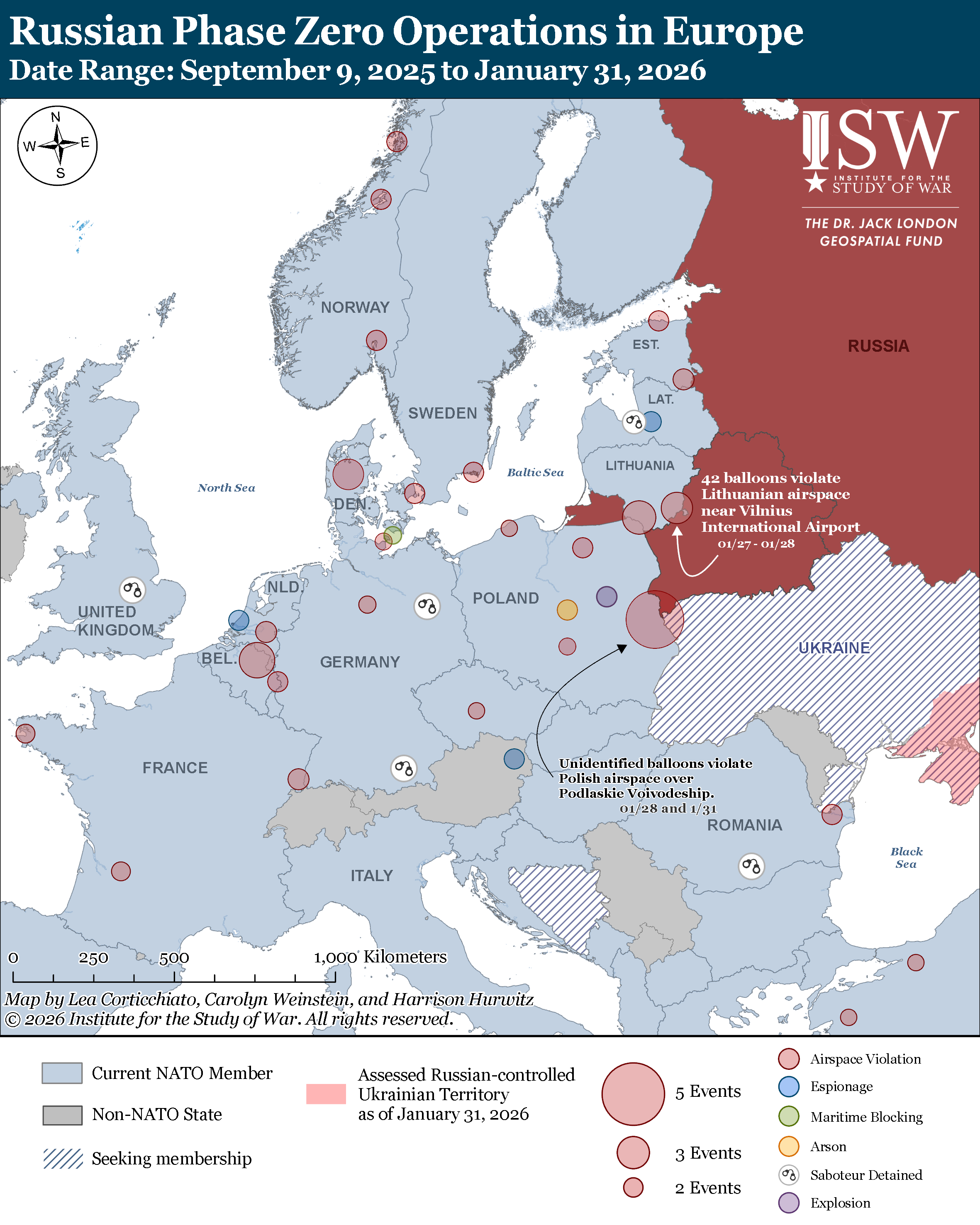
Belarusian balloons illegally entered Polish airspace on the night of January 30 to 31 for the second time within 72 hours. The Polish Armed Forces Operational Command reported that Polish military radar detected objects entering Polish airspace from Belarus overnight and that the objects were highly likely balloons.[9] Polish authorities temporarily restricted airspace over Podlaskie Voivodeship (along Poland’s eastern border with Belarus) in response. Belarusian balloons also entered Polish airspace on the night of January 28 to 29 and have frequently violated Polish and Lithuanian airspace since October 2025.[10] ISW continues to assess that Russia has de facto annexed Belarus and that Russia is using airspace incursions of Poland and Lithuania from Belarus as part of its “Phase Zero” effort — the informational and psychological condition-setting phase — to prepare for a possible NATO-Russia war in the future.[11]
Key Takeaways:
- Russian forces’ months of strikes have significantly degraded and damaged the Ukrainian energy grid, which is now facing significant problems even during the moratorium on Russian strikes against Ukrainian energy infrastructure.
- A US delegation met with lead Russian negotiator and Russian Direct Investment Fund (RDIF) CEO Kirill Dmitriev in Miami, Florida, on January 31.
- Belarusian balloons illegally entered Polish airspace on the night of January 30 to 31 for the second time within 72 hours.
- Ukrainian forces recently advanced in northern Kharkiv Oblast and the Kostyantynivka-Druzhkivka tactical area. Russian forces advanced in the Kostyantynivka-Druzhkivka tactical area and near Pokrovsk and Hulyaipole.
Russian Offensive Campaign Assessment, January 30, 2026
The Kremlin disagreed with the US position that territorial control of Donetsk Oblast remains the only unresolved issue at the US-Ukraine-Russia peace negotiations. US Secretary of State Marco Rubio stated on January 28 that the United States, Ukraine, and Russia have narrowed peace negotiations to only "one central issue," which concerns Donetsk Oblast.[1] Russian Presidential Aide Yuriy Ushakov, who is often the sole Kremlin official to comment on US-Russian talks in recent months, disagreed with Rubio's characterization of the peace process during a Russian state TV interview on January 29.[2] Ushakov also stated during an interview with another state TV channel that territorial issues are the “most important” but that “many other issues remain” on the agenda.[3] Ushakov's comments to Russian state TV channels suggest that the Kremlin is continuing to set domestic information conditions likely in an effort to justify Russia's refusal to make concessions for a negotiated peace settlement.
The Kremlin acknowledged and reportedly agreed to US President Donald Trump's request for a temporary moratorium on striking Ukrainian energy infrastructure. Kremlin Spokesperson Dmitry Peskov acknowledged on January 30 that Trump made a “personal request” to Russian President Vladimir Putin to refrain from striking Kyiv until February 1 and confirmed that the Kremlin agreed to Trump's request.[4] Ukrainian President Volodymyr Zelensky reported on January 30 that Russian forces did not conduct strikes against energy facilities in Ukraine on the night of January 29 to 30 but that Russian forces did strike energy infrastructure in several oblasts during the day on January 29.[5] Zelensky noted that Russian forces are now instead targeting Ukrainian logistics. Several Duma deputies insisted that the strikes moratorium is not a major Russian concession and indicated that Russian forces will not cease hostilities.[6] Prominent Russian milbloggers complained that the ceasefire does not support Russia and questioned Russian officials’ hesitation to comment on earlier ceasefire reports.[7] ISW continues to assess that the reported moratorium on energy strikes does not mark a significant Russian condescension as the Kremlin has been consistently rejecting a long-term ceasefire, including on January 29.[8]
Russian forces continue to execute Ukrainian prisoners-of-war (POW) on the battlefield in violation of international law. The servicemember of a Ukrainian border unit reported on January 25 that elements of the Russian Senezh Spetsnaz Center (formerly subordinated to the Russian General Staff's Main Directorate [GRU] and now directly subordinated to the Russian General Staff) executed multiple Ukrainian border guards who had surrendered to the Russian forces during a cross-border attack in Chernihiv Oblast in December 2025.[9] Russian forces have sharply increased extrajudicial executions of Ukrainian prisoners-of-war (POWs) on the frontline since late 2024 in violation of international law, particularly in areas of heavy combat.[10] ISW continues to assess that the Russian military command is endorsing and sometimes ordering war crimes on the battlefield and that Russia is torturing and abusing Ukrainian civilian prisoners as part of the wider military modus operandi.[11]
Key Takeaways:
- The Kremlin disagreed with the US position that territorial control of Donetsk Oblast remains the only unresolved issue at the US-Ukraine-Russia peace negotiations.
- The Kremlin acknowledged and reportedly agreed to US President Donald Trump's request for a temporary moratorium on striking Ukrainian energy infrastructure.
- Russian forces continue to execute Ukrainian prisoners-of-war (POW) on the battlefield in violation of international law.
- Russian forces recently advanced near Lyman, in the Kostyantynivka-Druzhkivka tactical area, and in western Zaporizhia Oblast.
Russian Offensive Campaign Assessment, January 29, 2026
US Secretary of State Marco Rubio confirmed that the United States and Ukraine have finalized security guarantees for Ukraine. Rubio stated on January 28 that it “could [be] argue[d]” that the United States and Ukraine have finalized security guarantees.[i] Rubio stated that the United States will play a “key role” in security guarantees for Ukraine and noted that there is a “general consensus” on the possible deployment of a small contingent of European troops to Ukraine with US support.[ii] Rubio also stated that the United States may send a representative to the planned upcoming Ukrainian-Russian negotiations in Abu Dhabi on February 1, but that US Special Envoy to the Middle East Steve Witkoff and former Senior Advisor to the US President Jared Kushner will not participate.[iii]
The Kremlin continues to reject Western security guarantees for Ukraine, however. Russian Foreign Minister Sergey Lavrov gave an interview to Turkish media outlets on January 29 in which he rejected the terms of Western security guarantees to Ukraine by falsely dismissing Western security guarantees as an attempt to protect the "illegitimate" Ukrainian government and reiterating Russian commitment to the security guarantees framework Russia presented during the 2022 Istanbul negotiations.[iv] The draft 2022 Istanbul amounted to Ukraine's full capitulation to Russia by imposing harsh limits against the size and activity of Ukraine's military while imposing no such restrictions on Russia, as well as providing Russia with veto power over the ability of states guaranteeing Ukraine's security to respond to future armed conflict in Ukraine.[v] Lavrov also reiterated the Kremlin’s commitment to the demands that Russian President Vladimir Putin laid out in his June 2024 speech to the Russian Ministry of Foreign Affairs (MFA), in which Putin demanded the capitulation to Russia’s original war demands of both Ukraine and NATO.[vi] Lavrov also falsely claimed that the current Ukrainian government poses a persistent threat to Russian security.
Other Russian officials continue to reiterate Russia’s commitment to achieving its original war demands on the battlefield. Chechen Republic Head Ramzan Kadyrov asserted on January 29 that the Kremlin should not negotiate with Ukraine and should instead continue the war.[vii] The Russian Federation Council and State Duma deputies, who often act as bullhorns for the Kremlin’s rhetorical lines, also reiterated the Kremlin’s commitment to advancing on the frontline and false claims that Ukraine has no right to the territories that Russia has illegally annexed, and called for Ukraine to capitulate to Russia to make negotiations easier.[viii] The Kremlin has continuously rejected any meaningful security guarantees for Ukraine proposed during the peace process.[ix] The Kremlin’s continued refusal of security guarantees for Ukraine suggests that it remains committed to Putin’s theory of victory — the theory that Russia can win in Ukraine by outlasting Ukraine’s ability to fight and the West’s desire to support Ukraine.[x]
US President Donald Trump stated that Russian President Vladimir Putin has agreed to a week-long moratorium on strikes against some Ukrainian energy infrastructure, as the Kremlin continued to reiterate its unwillingness to commit to a long-term ceasefire. Trump stated on January 29 that he asked Putin to halt strikes against Kyiv and unspecified various towns for a week as of an unspecified date.[xi] Ukrainian President Volodymyr Zelensky did not directly confirm the reported short-term ceasefire and responded to Trump's statement by noting that Ukraine is undergoing an extreme winter and thanking Trump and the United States for their “efforts to stop” Russian strikes on Ukraine’s energy sector.[xii] Russian officials have not confirmed this reported energy strikes moratorium, however. Kremlin Spokesperson Dmitry Peskov refused to comment on initial reports of an alleged agreement with Ukraine regarding a moratorium on long-range strikes against energy infrastructure.[xiii] Russian Foreign Minister Sergei Lavrov also reiterated on January 29 that a long-term ceasefire of 60 or more days is "unacceptable" to Russia, claiming that Ukraine can use any ceasefire to rest, rearm, and reconstitute its military.[xiv] Russian milbloggers claimed on January 29 that the Russian military command issued an order on January 28 to halt long-range strikes from 0700 on January 29 through February 3.[xv] The milbloggers claimed that the moratorium includes all targets in Kyiv City and Oblast as well as all energy infrastructure throughout Ukraine. Some of the milbloggers hedged that it is unclear how accurate this information is, however.[xvi] The precise terms of this strikes moratorium remain unclear, and ISW will continue to monitor for further clarification.
The reported week-long moratorium on energy strikes does not mark a significant Russian concession, given that Russia continues to reject a long-term ceasefire and has previously offered similar short-term moratoriums to advance its political objectives. A temporary moratorium against long-range strikes can benefit Russia if both Russia and Ukraine participate in the moratorium. Russian forces will be able to amass drone and missile stockpiles that it can use to launch large, combined strikes in the future, while Ukraine ceases its strikes against Russian energy infrastructure.[xvii] The Kremlin has previously offered short-term ceasefires as part of a cognitive warfare effort to portray the Kremlin as acting in good faith while rejecting Ukrainian and US calls for a longer or permanent moratorium on long-range strikes against civilian infrastructure.[xviii] A Kremlin affiliated Russian milblogger emphasized in a response that the ceasefire is only temporary but criticized the Kremlin for accepting the ceasefire, claiming that the Kremlin is losing valuable leverage against Ukraine by halting the strikes.[xix] The milblogger also claimed that the energy strikes moratorium is tied to the next round of Ukraine-Russia talks in Abu Dhabi, reportedly scheduled for February 1. Other Russian milbloggers also criticized the strikes moratorium and expressed relief that the moratorium is so short, so Russia can continue to pressure Ukraine through its strike on energy infrastructure.[xx] Another milblogger asserted that Russia's war in Ukraine is part of a larger war and therefore if Russia makes concessions "at one point" then the Kremlin will leverage these concessions to advance its objectives.[xxi]
Russian forces are using cheap Molniya fixed-wing first-person view (FPV) drones equipped with Starlink satellite terminals to conduct battlefield air interdiction (BAI) against Ukrainian highways at an operational depth (about 25 to 100 or more kilometers from the frontline). Ukrainian Ministry of Defense (MoD) advisor on defense technology and drone and electronic warfare (EW) expert Serhiy “Flash” Beskrestnov reported on January 29 that Russian forces have recently begun conducting several Molniya fixed-wing first-person view (FPV) drone strikes per day against Ukrainian vehicles traveling along the E-50 Pokrovsk-Pavlohrad highway, roughly 50 kilometers from the frontline.[xxii] Ukrainian military sources told Ukrainian broadcaster Suspilne on January 29 that Russian forces began employing Molniya drones in ongoing strikes against a section of the E-50 highway running between Troitske (roughly 35 kilometers behind the frontline) and Pavlohrad (roughly 78 kilometers behind the frontline) roughly two weeks ago (about mid-January 2026).[xxiii] Russian forces have been employing fixed-wing drones against targets at an operational depth from the frontline for months, including using Molniyas and other drones as “mothership drones” to carry one or more shorter-range drones to areas far from the front line, including in strikes against Zaporizhzhia City in early October 2025.[xxiv] Russian forces have recently begun equipping Molniya-2 fixed-wing FPV drones with Starlink satellite terminals to significantly expand their range and resistance to Ukrainian EW.[xxv] The recent strikes against the E-50 Pokrovsk-Pavlohrad highway appear to be part of an attempt to replicate prior Russian BAI campaigns against Ukrainian ground lines of communication (GLOCs) supplying Pokrovsk and Hulyaipole against other parts of the frontline with relatively cheap Molniya drones.[xxvi] Ukrainian Defense Minister Mykhailo Fedorov reported on January 29 that SpaceX and the Ukrainian MoD are cooperating to prevent Russian forces from using the Starlink system to guide Russian drones in strikes against targets in Ukraine.[xxvii]
The Russian Ministry of Defense (MoD) appears to be conducting a dedicated recruitment campaign for the Unmanned Systems Forces (USF) at Russian universities. Russian science outlet T-Invariant published an investigation on January 28 into the Russian MoD’s new dedicated recruitment effort for the USF at Russian universities.[xxviii] T-Invariant spoke to several students at Russian universities, including several in Moscow City, who reported receiving a letter from their university informing the students that they failed their exams and faced expulsion and student debt. The letters stated that university officials would hold off from expelling the students for three days while the students considered a recruitment offer from the Russian MoD. The MoD reportedly offers a one-year fixed term military service contract with the USF in which the students are "guaranteed" to be released from military service if they decline to sign another contract upon the expiration of their initial contract; that the students can only serve in USF units and that the MoD cannot transfer the students to non-USF units; and that the students will receive financial benefits. T-Invariant reported that the Russian MoD began recruiting USF drone operators at Russian universities in December 2025 by offering salaries of 5.2 to 5.5 million rubles (about $69,103 to 73,090) per year and promises to place the students about 20 kilometers behind the frontlines. T-Invariant reported that these initial efforts at Russian universities were insufficient to attract students from the Russian Higher School of Economics, a prestigious, Moscow-based university. A Russian lawyer reported on January 24 that he received a copy of a guidebook from the Russian MoD for military centers in universities across Russia on expanding recruitment efforts for the USF, including recruitment of both male and female students.[xxix] The lawyer noted that the universities were to advertise special contracts guaranteeing only one year of service, but assessed that Russian President Vladimir Putin's September 2022 order establishing partial mobilization would likely supersede the language of a contract restricting service to only one year. Russian opposition outlet Verstka reported on January 27 that Russian military recruiters are characterizing these special contracts as a "bait and switch" that promised to put individuals in specific units but actually has no guarantee of an assignment into such units.[xxx] These reports are consistent with recent Russian reporting that the MoD had intensified its recruitment campaign for the USF at Russian universities.[xxxi] ISW continues to assess that Russia may intend to use at least some of those recruited for the USF to staff the conventional Russian ground forces.[xxxii]
Ukraine and Russia exchanged killed-in-action (KIA) servicemembers on January 29. Official Ukrainian sources reported on January 29 that Russia returned to Ukraine the remains of 1,000 KIA soldiers in what was the first repatriation event of 2026.[xxxiii] Russian Presidential Aide Vladimir Medinsky claimed that Ukraine returned to Russia the bodies of returned 38 KIA servicemembers.[xxxiv] It is unclear why the number of exchange KIA between Russia and Ukraine differed, but Russia routinely augments the number of KIA personnel provided to Ukraine to create a false perspective that Ukraine is suffering far higher losses than Ukraine.[xxxv] Russian forces are losing more personnel than Ukraine; however, due to Russian tactics that favor highly attritional assaults.[xxxvi] Russia has also delivered unlabeled remains that may include Russian servicemembers to artificially augment the number of claimed Ukrainian KIA personnel as part of this cognitive warfare effort.[xxxvii]
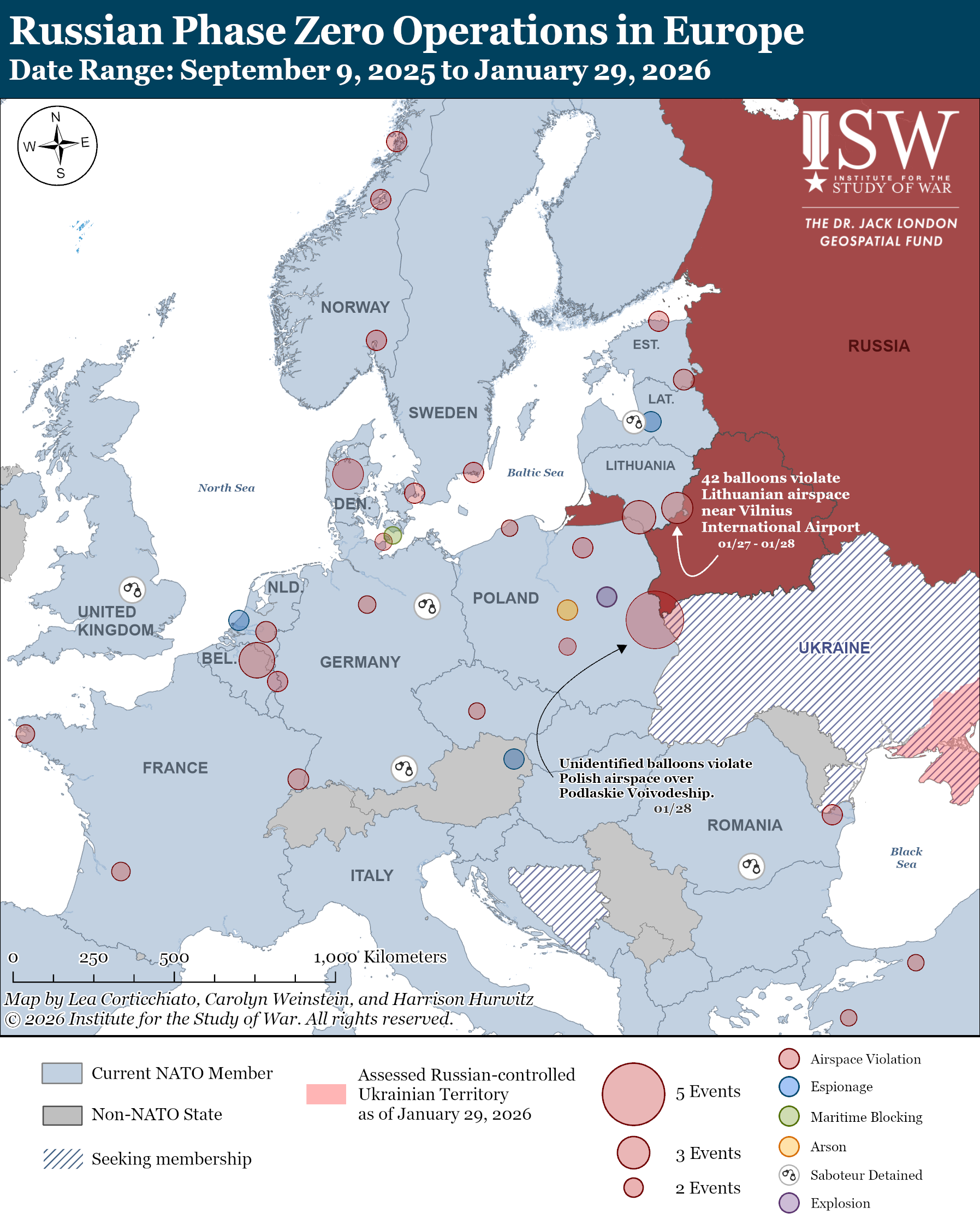
Belarusian balloons illegally entered Lithuanian and Polish airspace on the nights of January 27 to 28 and January 28 to 29, respectively. Lithuanian National Crisis Management Center Head Vilmantas Vitkauskas reported on January 28 that Lithuanian authorities detected 42 balloons entering Lithuanian airspace from Belarus on the night of January 27 to 28, the largest number of Belarusian balloons violating Lithuanian airspace since the start of these balloon incursions in October 2025.[xxxviii] Vitkauskas stated that Lithuanian authorities shut down Vilnius International Airport three times on the evening of January 27 in response to the balloons. Vitkauskas stated that Lithuanian authorities recovered eight balloons with smuggled cargo on the morning of January 28, found the remains of several other balloons, and arrested four people. The Polish Armed Forces Operational Command reported on January 29 that Polish military radar detected balloon-like objects entering Polish airspace from Belarus late on January 28 and temporarily restricted airspace over Podlaskie Voivodeship (along Poland's eastern border with Belarus) in response.[xxxix] Belarusian balloons have frequently violated Polish and Lithuanian airspace since October 2025.[xl] ISW continues to assess that Russia is intensifying its covert and overt attacks against Europe and that Russia has entered “Phase Zero” – the informational and psychological condition-setting phase – to prepare for a possible NATO-Russia war in the future.[xli] ISW continues to assess that Russia has de facto annexed Belarus and that Belarusian incursions into NATO airspace are very likely part of Russia’s broader Phase Zero effort.[xlii]
Key Takeaways:
- Russian forces recently advanced in western Zaporizhia Oblast.
- US Secretary of State Marco Rubio confirmed that the United States and Ukraine have finalized security guarantees for Ukraine.
- The Kremlin continues to reject Western security guarantees for Ukraine, however.
- US President Donald Trump stated that Russian President Vladimir Putin has agreed to a week-long moratorium on some Ukrainian energy infrastructure, as the Kremlin reiterated its unwillingness to commit to a long-term ceasefire.
- The reported week-long moratorium on energy strikes does not mark a significant Russian concession, given that Russia continues to reject a long-term ceasefire and has previously offered similar short-term moratoriums to advance its political objectives.
- Russian forces are using cheap Molniya fixed-wing first-person view (FPV) drones equipped with Starlink satellite terminals to conduct battlefield air interdiction (BAI) against Ukrainian highways at an operational depth (about 25 to 100 or more kilometers from the frontline).
- The Russian Ministry of Defense (MoD) appears to be conducting a dedicated recruitment campaign for the Unmanned Systems Forces (USF) at Russian universities.
- Ukraine and Russia exchanged killed-in-action (KIA) servicemembers on January 29.
- Belarusian balloons illegally entered Lithuanian and Polish airspace on the nights of January 27 to 28 and January 28 to 29, respectively.
Russian Offensive Campaign Assessment, January 28, 2026
The People's Republic of China (PRC) continues to provide critical support to Russia's defense industrial base (DIB), including to produce Oreshnik missiles and Shahed long-range drones. The Telegraph reported on January 28 that it has identified $10.3 billion worth of technology and advanced equipment that the PRC has sent to Russia during an unspecified time frame.[1] The Telegraph reported that Russia is using Chinese computer numerical control machines (CNC) to produce Oreshnik intermediate-range ballistic missiles (IRBMs) at the Votkinsk Plant in the Republic of Udmurtia and to produce Shahed-type drones at the Alabuga Special Economic Zone (ASEZ) in the Republic of Tatarstan. The Telegraph found that the PRC also supplies millions of dollars' worth of microchips, memory boards, ball bearings, telescopic sights, and mounted piezoelectric crystals to Russia. The PRC continues to refrain from directly supplying Russia with weapons but is supplying components and equipment, many of which are dual-use, to the Russian DIB instead. ISW continues to assess that the PRC's supplies to the Russian DIB have enabled Russia to improve and scale up its production of drones that Russian forces use to launch long-range strikes against the Ukrainian rear and to strike the Ukrainian near rear to generate battlefield air interdiction (BAI) effects along the front line.[2]
Ukrainian forces continued their strike campaign against Russian military assets near the front line and in the Russian near rear on the night of January 27 to 28. The Ukrainian General Staff reported that Ukrainian forces struck military assets in the Russian near rear, including a manpower concentration and drone control point near Velyka Novosilka, Donetsk Oblast (roughly 23 kilometers from the front line); a manpower concentration near Hryhorivka, Donetsk Oblast (roughly 13 kilometers from the front line); and an ammunition depot near Nyzhnya Duvanka, Luhansk Oblast (roughly 25 kilometers from the front line).[3] The Ukrainian General Staff reported that Ukrainian forces also struck Russian military assets near the front line, including manpower concentrations near Shakhove (east of Dobropillya) and Hulyaipole; a battalion command post near Berezove (southeast of Oleksandrivka); and a manpower concentration in Kolotylivka, Belgorod Oblast (west of Sumy City and north of Hrabovske). Ukrainian forces began increasing their mid-range strike campaign in late December 2025 and are undertaking their own battlefield air interdiction (BAI) campaign to parallel Russia's BAI campaign that enabled Russian advances in Fall 2025.[4] Ukrainian forces likely seek to use their mid-range strikes to counter recent Russian advances.
Key Takeaways:
- The People's Republic of China (PRC) continues to provide critical support to Russia's weapons production, including Oreshnik missiles and Shahed long-range drones.
- Ukrainian forces continued their strike campaign against Russian military assets near the front line and in the Russian near rear on the night of January 27 to 28.
- Ukrainian forces recently advanced near Pokrovsk.
Russian Offensive Campaign Assessment, January 27, 2026
The United States is reportedly pushing Ukraine to cede the remainder of Donetsk Oblast to Russia in exchange for US security guarantees. ISW continues to assess that Ukrainian concessions of territory that Russia is unlikely to seize quickly or easily militarily would be a strategic mistake.[1] The Financial Times (FT) reported on January 27, citing sources familiar with ongoing peace talks, that the Trump administration is signaling that the United States' provision of security guarantees to Ukraine is contingent on Ukraine agreeing to a peace settlement that would likely involve ceding all of the territory of Donbas (Luhansk and Donetsk oblasts) to Russia.[2] Two FT sources stated that the United States suggested that it would provide more weaponry to bolster Ukraine's peacetime forces if Ukraine agreed to withdraw from all of Donbas. Two sources indicated that the proposed US security guarantees include a pledge that “mirrors” NATO’s Article 5 clause and a promise to conduct a coordinated military response in the case of a "sustained" Russian attack against post-war Ukraine. One of the sources suggested that the proposed guarantees may be “too vague” for Ukraine but “too broad” for Russia.
ISW continues to assess that Russia would need to expend significant amounts of resources, time, and personnel to seize the rest of Donbas.[3] Russian forces are unlikely to seize the remainder of Donetsk Oblast before August 2027, assuming Russian forces are able to sustain their rate of advance from late November 2025.[4] The Russian rate of advance slowed in late December 2025 and early January 2026, likely in part due to adverse weather conditions, and Russian efforts to seize the rest of Donetsk Oblast could take longer than ISW previously forecasted.[5] A Ukrainian withdrawal from Ukrainian-held territory in Donetsk Oblast would put Russian forces in more advantageous positions to renew attacks against southwestern and central Ukraine in the future after rest and reconstitution.[6] A strong Ukrainian military and robust Western security guarantees are necessary to effectively deter such future Russian aggression, but Russian officials have repeatedly rejected these security guarantees.[7] Russian Foreign Intelligence Service (SVR) Head Sergei Naryshkin, for example, claimed on January 26 that European states in the Coalition of the Willing are imposing conditions on a peace settlement that are "completely unacceptable" to Russia – likely referring to the coalition's efforts to finalize a plan to deploy troops to post-war Ukraine.[8] Russian State Duma Defense Committee Deputy Chairperson Alexei Zhuravlyov explicitly rejected on January 27 the deployment of troops from NATO states in post-war Ukraine.[9] The Kremlin remains unlikely to accept any settlement that includes meaningful security guarantees for Ukraine. The Kremlin's continued refusal of security guarantees for Ukraine and persistent dismissals of the negotiating process suggests that it remains committed to Russian President Vladimir Putin's theory of victory — the theory that Russia can win in Ukraine by outlasting Ukraine's ability to fight and the West's desire to support Ukraine.[10]
The Russian military command continues to present demonstrable lies and exaggerations about Russian battlefield gains in order to push Ukraine and the West to concede to the demands that Russia remains unable to achieve militarily. Russian Chief of the General Staff Army General Valery Gerasimov inspected the Russian Western Grouping of Forces on January 27 and heard reports from the grouping commander, Colonel General Sergei Kuzovlev.[11] Gerasimov claimed that Russian forces are advancing in virtually all directions on the battlefield and have seized 17 settlements and over 500 square kilometers since January 1. ISW has observed evidence indicating that Russian forces advanced or established a presence following infiltration missions in only 265.45 square kilometers between January 1 and 27, however. Gerasimov further claimed that the Russian Dnepr Grouping of Forces advanced within 12 to 14 kilometers of the southern and southeastern outskirts of Zaporizhzhia City.[12] ISW has only observed evidence to assess that Russian forces have advanced to roughly 18 kilometers south of the city, however. Gerasimov highlighted that Russian forces are expanding the "buffer zones" in Kharkiv, Sumy, and Dnipropetrovsk oblasts.[13] Gerasimov stated that the Russian Central Grouping of Forces, which has been concentrating on seizing Pokrovsk, is now developing an offensive toward Dobropillya (north of Pokrovsk).
Gerasimov particularly emphasized the Western Grouping of Forces' alleged successes near Kupyansk. Gerasimov claimed that Russian forces seized Kupyansk-Vuzlovyi (southeast of Kupyansk) and are attacking toward Kivsharivka (just southeast of Kupyansk-Vuzlovyi) and Hlushkivka (further southeast of Kupyansk-Vuzlovyi).[14] Gerasimov claimed that elements of the Russian 1st Guards Tank Army (GTA, Moscow Military District [MMD]) are destroying encircled Ukrainian forces on the east (left) bank of the Oskil River and that Russian forces have blockaded 800 Ukrainian servicemembers within a four-by-six-kilometer area near Kupyansk. The Ukrainian Joint Forces Task Force refuted Gerasimov's claim that Russian forces seized Kupyansk-Vuzlovyi and reported that Ukrainian forces maintain full control over the settlement.[15] ISW has also not observed evidence of a Russian presence within Kupyansk-Vuzlovyi. ISW has only observed evidence of recent Russian infiltration missions roughly 3.5 kilometers from the northern boundary of Kupyansk-Vuzlovyi and roughly 8.5 kilometers from the eastern boundary of the settlement.[16] ISW observed evidence on January 8 of Russian forces conducting an infiltration mission into eastern Podoly (just northeast of Kupyansk-Vuzlovyi), but a Kremlin-affiliated Russian milblogger acknowledged on January 16 that Ukrainian forces had liberated Podoly and a Russian milblogger reporting on the Russian Western Grouping of Forces further stated on January 16 that Ukrainian forces had cleared Russian infiltrators from Podoly.[17]
The Russian Ministry of Defense (MoD) has been lying about the scale of Russian advances for months, provoking repeated criticisms from even pro-war Russian milbloggers. Russian military officials have repeatedly presented inflated claims of Russian advances across the frontline in recent weeks.[18] Russian President Vladimir Putin and senior Russian military leaders have been exaggerating advances in the Kupyansk direction in particular, claiming that Russian forces seized the town in November 2025 despite ample visual evidence and Ukrainian and Russian reporting to the contrary.[19] Pro-war Russian milbloggers have repeatedly refuted the Russian MoD's exaggerations and continued to widely deny Gerasimov's January 27 claims. A prominent Russian milblogger involved in crowdfunding for the Russian military stated that Gerasimov presented a "beautiful report" (a phrase Russian milbloggers often use to criticize false battlefield reports).[20] A Kremlin-affiliated milblogger stated that Russian forces in the Kostyantynivka direction are submitting false reports but to a lesser extent than those in the "notorious" Kupyansk direction.[21] One Russian milblogger stated that Russian forces do not control any settlements near Kupyansk-Vuzlovyi.[22] Another milblogger stated that the Russian MoD's reports about the Kupyansk direction continue to exist in a "parallel reality."[23] The milblogger claimed that even the "most optimistic estimates" assess that Russian forces have only just reached the outskirts of Kupyansk-Vuzlovyi, while other estimates find that Russian forces are "still a long way off." The milblogger sarcastically stated that there may be a "hidden side of Kupyansk" where "all these strange events" like the Russian MoD's regular seizures and encirclements are occurring, as there are no alternative explanations.
The Russian military command has been boasting about the seizure of small, rural villages and presenting these seizures as alleged evidence of the prowess of the Russian military to further the false narrative that Russian victory in Ukraine is inevitable. Gerasimov highlighted the seizures of Symynivka, Starytsya (both northeast of Kharkiv City), Kupyansk-Vuzlovyi, Bondarne (southeast of Slovyansk), Zakitne (east of Slovyansk), Pryvillya (northeast of Kostyantynivka), and Novoyakovlivka (southeast of Zaporizhzhia City) and ongoing fighting within Kutkivka (north of Kupyansk), Kivsharivka, Hlushkivka (both southeast of Kupyansk), Drobysheve, Yarova, Sosnove (all northwest of Lyman), Ozerne (southeast of Lyman), Novyi Donbas (east of Dobropillya), Hryshyne (northwest of Pokrovsk), and Bilytske (north of Pokrovsk).[24] Data from the UN Humanitarian Data Exchange indicates that the largest of these settlements (Drobysheve) has a total area of about 8.3 square kilometers, but most of the settlements Gerasimov listed have a total area of less than two square kilometers. Senior Russian military commanders have been presenting long lists of settlements in their public reports in order to generate informational effects and create the appearance of sweeping Russian advances across the entire theater.[25] The Russian military command is trying to create an alternate battlefield reality in order to influence the ongoing US-led peace talks and to convince Ukraine and the West that Ukraine should accept Russia’s demands now out of fear of future Russian offensives or breakthroughs.[26] The seizure of small, rural villages only a few square kilometers in area does not portend Russia's ability to seize the much larger and heavily fortified cities in Ukraine's Fortress Belt in Donetsk Oblast in the near future
Russian officials continue to indicate that Russia's demands go beyond control of territory in eastern Ukraine, despite the Kremlin's efforts to claim to Western audiences that Donbas is the main issue in ongoing peace talks. Lead Russian negotiator and Russian Direct Investment Fund (RDIF) CEO Kirill Dmitriev responded to the January 27 FT article about US security guarantees tied to Ukrainian territorial concessions, claiming that Ukraine's withdrawal from Donbas is the "path of peace" for Ukraine.[27] Russian State Duma Defense Committee Member Andrei Kolesnik claimed that the only possible solution to the war is for Ukraine to withdraw from the rest of Donbas.[28] Russia's territorial demands, however, extend beyond Donbas, as evidenced by Gerasimov's repeated references to buffer zones in Kharkiv, Sumy, and Dnipropetrovsk oblasts during his January 27 report.[29] Russian officials have claimed that these buffer zones are necessary to protect Russian-occupied areas in Luhansk and Donetsk oblasts, but the latest public version of the 20-point US-Ukrainian-European peace plan called for Russia to withdraw from northern Ukraine and Dnipropetrovsk Oblast.[30]
Russia's demands extend beyond Ukrainian territory and include demands for NATO and the West. Russian Foreign Intelligence Service (SVR) Head Sergei Naryshkin claimed in a January 26 interview with Kremlin newswire RIA Novosti that a peace settlement must address the alleged "root causes" of the war.[31] Duma Defense Committee Deputy Chairperson Alexei Zhuravlyov also stated on January 27 in an interview with Russian state TV channel Rossiya-1 that Donbas is not the main issue and questioned how Russia will deal with NATO and alleged Ukrainian neo-Nazism.[32] Naryshkin's and Zhuravlyov's statements refer to Russia's 2021 and 2022 demands for the cessation of NATO expansion, the rollback of NATO to its 1997 borders, and the replacement of the current democratically elected Ukrainian government with a Russian-selected regime. Russian ultranationalist outlet Tsargrad tied Russia's territorial demands in eastern Ukraine with Russia's wider war aims in an editorial piece published on January 27.[33] Tsargrad questioned why Kremlin officials are calling for Ukraine's withdrawal from eastern Ukraine but not from Zaporizhia and Kherson oblasts. Tsargrad then amplified a Russian milblogger claiming that Russia will agree to only a temporary ceasefire if Ukraine withdraws from Donbas and that a temporary ceasefire will allow Ukraine to "consider" Russia's other demands, such as Ukraine's "denazification" and "demilitarization."[34] ISW continues to assess that Russian officials' statements aimed at domestic Russian audiences, such as Naryshkin's and Zhuravlyov's statements to Russian state outlets, confirm that Russia's demands are not limited to territory in eastern Ukraine.[35]
Russia will not be satisfied with a peace settlement that does not meet all of its demands and is instead using informational tools to push for Ukraine's pre-emptive capitulation. The Kremlin has been engaged in a wide cognitive warfare campaign that aims to push the West and Ukraine to give in to all of Russia's demands now out of fear of future Russian offensives.[36] Russian officials promoted narratives on January 26 and 27 that aim to paint the Russian military and economy as able to militarily achieve all of Russia's demands in a protracted war — in line with Russian President Vladimir Putin’s theory of victory.[37] Naryshkin claimed that Russian forces are "consistently" advancing throughout the theater, that the Russian defense industrial base (DIB) is developing at an "accelerated pace," and that the Russian economy is resilient.[38] Naryshkin also claimed that the Russian population supports Putin's policies and the Russian military. Naryshkin referenced the Burevestnik and Oreshnik ballistic missiles and Poseidon unmanned underwater vehicle that Russia debuted in 2024 and 2025 – an attempt to use implicit threats to push the West and Ukraine to capitulate. Duma Defense Committee Member Andrei Kolesnik claimed that Russia can only resolve the war through military means and dismissed ongoing US-led diplomatic efforts.[39] Kolesnik called on Ukraine to "realize" that resistance is "futile" and claimed that Ukraine does not have the potential to stop Russian advances.[40] Kolesnik and Zhuravlyov claimed that Russian forces will inevitably seize Donbas "sooner or later."[41] The Kremlin has also been demanding that any peace settlement not include meaningful security guarantees for Ukraine — a demand which Naryshkin repeated on January 27.[42] This cognitive warfare effort hopes to accomplish what Russia will fail to do militarily — secure victory over all of Ukraine.
Russian forces conducted a Shahed drone strike against a civilian passenger train in Kharkiv Oblast on January 27, killing at least five people. Ukrainian President Volodymyr Zelensky reported that a Russian drone strike hit a civilian passenger train near Barvinkove, Kharkiv Oblast (roughly 49 kilometers from the frontline) on January 27.[43] Zelensky reported that there were over 200 passengers on board, with 18 passengers in the car that Russian forces struck. The Kharkiv Oblast Prosecutor's Office reported that the strike killed at least five civilians.[44] Ukrainian Deputy Prime Minister and Development Minister Oleksiy Kuleba reported that Russian forces struck the train with three Shahed drones.[45] A Ukrainian soldier who was among the passengers told Ukrainian outlet Hromadske that a Shahed drone struck the train and that another Shahed did not reach the train, presumably crashing on the ground nearby.[46] ISW assesses that Russian forces have been leveraging recent drone adaptations, including equipping drones with artificial intelligence (AI), integrated cameras, and radio control capabilities, to increasingly target moving trains across Ukraine.[47] ISW has not observed reports as of this writing confirming that Russian forces used Shaheds with cameras or other adaptations to strike the moving train, but the use of multiple drones suggests that the strike was deliberate. Russian strikes causing disproportionate civilian loss of life, civilian injuries, and damage to civilian objects compared to the expected military gain from striking a civilian passenger train carrying a limited number of military personnel are likely a violation of international law.[48]
Russian forces continue to commit war crimes on the battlefield, including in areas where Russian forces have recently intensified offensive operations. Geolocated footage published on January 27 shows Russian first-person view (FPV) drone operators striking and killing two civilians in Hrabovske (southeast of Sumy City).[49] The Ukrainian 14th Army Corps (AC) reported on January 27 that Russian forces executed the two civilians as they were attempting to leave occupied territory near Hrabovske.[50] The 14th AC stated that the Russian FPV drones first hit and instantly killed a woman and that a second strike hit a wounded man next to the deceased woman. Russian forces launched a series of cross-border attacks in Hrabovske on the night of December 19 to 20, during which Russian forces forcibly deported about 50 civilians.[51] Russian sources credited elements of the Russian 34th Motorized Rifle Brigade (49th Combined Arms Army [CAA], Southern Military District [SMD]) with launching the December 2025 attacks, and ISW has observed reports of the brigade operating near Hrabovske as recently as January 10.[52]
Key Takeaways:
- The United States is reportedly pushing Ukraine to cede the remainder of Donetsk Oblast to Russia in exchange for US security guarantees. ISW continues to assess that Ukrainian concessions of territory that Russia is unlikely to seize quickly or easily militarily would be a strategic mistake.
- The Russian military command continues to present demonstrable lies and exaggerations about Russian battlefield gains in order to push Ukraine and the West to concede to the demands that Russia remains unable to achieve militarily.
- The Russian Ministry of Defense (MoD) has been lying about the scale of Russian advances for months, provoking repeated criticisms from even pro-war Russian milbloggers.
- The Russian military command has been boasting about the seizure of small, rural villages and presenting these seizures as alleged evidence of the prowess of the Russian military to further the false narrative that Russian victory in Ukraine is inevitable.
- Russian officials continue to indicate that Russia's demands go beyond control of territory in eastern Ukraine, despite the Kremlin's efforts to claim to Western audiences that Donbas is the main issue in ongoing peace talks.
- Russia will not be satisfied with a peace settlement that does not meet all of its demands and is instead using informational tools to push for Ukraine's pre-emptive capitulation.
- Russian forces conducted a Shahed drone strike against a civilian passenger train in Kharkiv Oblast on January 27, killing at least five people.
- Russian forces continue to commit war crimes on the battlefield, including in areas where Russian forces have recently intensified offensive operations.
- Russian forces recently advanced near Slovyansk, in the Kostyantynivka-Druzhkivka tactical area, and near Pokrovsk.
Russian Offensive Campaign Assessment, January 26, 2026
The United States and Europe are finalizing security and economic guarantees with Ukraine that aim to deter future Russian aggression and rebuild Ukraine's post-war economy. Ukrainian President Volodymyr Zelensky stated on January 25 that the US-Ukrainian document on US security guarantees for Ukraine is "100 percent ready" and that Ukraine is waiting for the United States to set a date and place for its signing.[i] Zelensky stated that the document will then go to the Ukrainian Verkhovna Rada (parliament) and US Congress for ratification. Zelensky stated that Europe will provide another "layer" of security guarantees, including security guarantees from the Coalition of the Willing and Ukraine's future European Union (EU) membership.[ii] Zelensky stated that EU membership is an "economic security guarantee" and that Ukraine aims to join the EU in 2027. Long-term efforts to rebuild Ukraine’s economy, including by integrating Ukraine into the EU market, are essential for Ukraine’s future security and prosperity but are not a substitute for robust security guarantees that deter future Russian aggression, such as those from the United States and Coalition of the Willing.[iii] Such security and economic guarantees have emerged from the peace process that US President Donald Trump has led in recent weeks, and ISW continues to assess that the Kremlin is attempting to push Trump to abandon this US-led process and concede to Russian demands.[iv]
The Kremlin continues to exploit the lack of clarity about the outcome of the August 2025 US-Russian Alaska summit to falsely portray Ukraine – not Russia – as the unwilling negotiating partner. Lead Russian negotiator and Russian Direct Investment Fund (RDIF) CEO Kirill Dmitriev claimed on January 26 that Ukrainian President Volodymyr Zelensky is delaying the peace process by not accepting territorial concessions.[v] Kremlin Spokesperson Dmitry Peskov claimed that the territorial issue, which Peskov claimed is part of the "Anchorage formula," is fundamentally important to Russia.[vi] Peskov claimed that it would be a "mistake" to expect any significant results from the recent Ukrainian-Russian-US trilateral talks in Abu Dhabi.[vii] Russian State Duma Deputy from occupied Crimea Mikhail Sheremet claimed that Zelensky has abandoned the negotiation process by refusing to withdraw Ukrainian forces from Ukrainian-held parts of Donbas (Luhansk and Donetsk oblasts).[viii]
Kremlin officials have been claiming that the Alaska summit achieved a joint US-Russian understanding and agreement to end the war in Ukraine despite no publicly available joint documents or communiques emerging from the summit.[ix] Kremlin officials have not specified the details of the alleged "Anchorage formula" but have insisted that Ukraine’s withdrawal from all of Donbas is an important condition for a peace settlement.[x] A source close to the Kremlin recently told Reuters that the Kremlin considers the “Anchorage formula” to include Ukraine ceding all of Donbas to Russia and freezing the current frontlines elsewhere in southern and eastern Ukraine.[xi] The Kremlin has long demanded that Ukraine cede parts of Donetsk Oblast that Russian forces currently do not occupy.[xii] ISW continues to assess that Russian forces will likely only be able to complete the seizure of Donetsk Oblast in August 2027, assuming Russian forces are able to maintain their late 2025 rate of advance.[xiii] The Kremlin is demanding that Ukraine cede the unoccupied parts of Donetsk Oblast in order to save Russia the time and resources needed to seize it militarily. Ukraine has made significant concessions as a result of the recent US-led peace talks, such as working to change Ukrainian laws to allow for elections during the current period of martial law.[xiv] The Kremlin is attempting to blame Ukraine for delaying the peace process despite Russia's demonstrated unwillingness to offer any compromises on Russia's original war aims.[xv]
The Kremlin is reviving its use of nuclear arms control rhetoric to push the United States to make concessions on Ukraine in return for normalizing US-Russian relations. Russian Security Council Deputy Chairperson Dmitry Medvedev gave an interview to Russian state business outlet Kommersant published on January 26 about the New Strategic Arms Reduction Treaty (New START) nuclear arms control treaty, which expires on February 5, 2026.[xvi] Medvedev reiterated Russian President Vladimir Putin's offer of informally agreeing to adhere to the terms of New START for another year upon its expiration, but only if the United States does the same. Medvedev claimed that the United States has not responded to this proposal and that the prospects of broader US-Russian arms control cooperation aredependent upon the United States accepting Putin's proposal. Medvedev claimed that the United States and Russia must first normalize bilateral relations before Russia can cooperate on bilateral arms control measures. Medvedev also levied thinly veiled threats if the United States does not shift its focus away from peace efforts and toward normalizing US-Russia bilateral relations as the Kremlin desires. Medvedev claimed that US-Russian arms control cooperation contributes to strategic stability but warned that other states could seek nuclear weapons in the absence of this stability. Medvedev asserted that Russia will counter any threats to its security and referenced the Burevestnik and Oreshnik ballistic missiles and Poseidon unmanned underwater vehicle that Russia debuted in 2024 and 2025.
Putin and other senior Kremlin officials have repeatedly demonstrated that the Kremlin is not wavering from its original war demands and intends to achieve its objectives militarily if it cannot do so diplomatically.[xvii] Kremlin officials have often emphasized their commitment to Russia's demands around high-profile negotiations, including following the August 2025 US-Russian summit in Alaska and the recent January 23 to 24 trilateral talks in Abu Dhabi.[xviii] The Kremlin has been attempting to use the prospect of improved bilateral US-Russia relations to distract the United States from peace efforts in Ukraine since US President Donald Trump took office in January 2025 and began leveraging the New START treaty in this effort in Summer-Fall 2025.[xix] The Kremlin likely aims to convince the United States to concede to Russian demands on Ukraine in return for improved bilateral US-Russian relations. The Kremlin may also aim to push the United States to abandon the peace process in Ukraine without finalizing a peace settlement in exchange for strategic arms talks, therefore allowing Russia to continue its war unimpeded and without US pressure to make meaningful concessions.
Russian forces are increasingly using Starlink satellite systems to extend the range of BM-35 strike drones to conduct mid-range strikes against the Ukrainian rear. Ukrainian Ministry of Defense (MoD) advisor on defense technology and drone and electronic warfare (EW) expert Serhiy “Flash” Beskrestnov reported on January 26 that Russian forces used a Starlink-equipped BM-35 drone to strike Dnipro City (approximately 86 kilometers from the frontline) for the first time.[xx] This strike comes less than two weeks after Beskrestnov reported the first recorded usage of Starlink-equipped BM-35 drones on January 15.[xxi] Beskrestnov noted that the BM-35 drone is more fuel efficient than Russian Molniya fixed-wing first-person view (FPV) drones and has a range of up to 500 kilometers. ISW has only observed evidence that the Russian Rubikon Center for Advanced Unmanned Technologies is fielding BM-35 drones to date.[xxii] Russian forces first began fielding the BM-35 in September 2025 and intensified BM-35 strikes in early January 2026.[xxiii] Russian milbloggers and the Rubikon Center itself claimed that Rubikon drone operators employed BM-35s in January 12 to 13 strikes on cargo vessels near Odesa City and a January 17 strike against a Patriot air defense system southwest of Kharkiv City.[xxiv] Russian forces appear to be increasingly relying on Starlinks to increase the range of operation of strike drones while increasingly drone resilience against Ukrainian EW. The reported 500-kilometer range of Starlink-equipped BM-35 drones places most of Ukraine, all of Moldova, and parts of Poland, Romania, and Lithuania in range of these drones if launched from Russia or occupied Ukraine. ISW has observed reports of Starlink-equipped Shahed long-range strike drones beginning in September 2024 and of Rubikon equipping Molniya strike drones with Starlink systems beginning in December 2025.[xxv] ISW continues to assess that Russian mid-range strikes, especially those conducted by Rubikon units, seek to exploit Ukraine’s scarcity of air defense systems.[xxvi] The threat of Russian mid-range strikes underscores Ukraine’s urgent need for point-defense air defense systems to down drones, as electronic warfare (EW) systems are likely insufficient to defend Ukraine’s critical infrastructure from such a geographically pervasive threat.[xxvii]
Russia’s domestic populace is increasingly bearing the economic costs of Russia's war in Ukraine. Russian opposition outlet Meduza reported on January 26 that prices for almost all essential goods and services in Russia have been rising since December 2025, shortly after Russian President Vladimir Putin signed a law in November 2025 that increased the value-added tax (VAT) from 20 to 22 percent as of January 1, 2026.[xxviii] Russian independent investigative outlet 7×7-Horizontal Russia reported on January 23 that Russian civilians began reporting sharp food price increases since January 1.[xxix] 7×7-Horizontal Russia noted that Russian Federal State Statistics Service (Rosstat) data indicates that the official inflation rate was 1.26 percent from January 1 to 12, while prices of essential goods rose by 1.72 percent, meaning that the 26.7 percent of the price increase of essential goods is due to factors other than the Russian inflation rate. The disparity between the reported Russian inflation rate and price growth reduces consumer purchasing power and causes a decline in real income (an individual's income after adjusting for inflation rates). Radio Free Europe/Radio Liberty's (RFE/RL) Russia service reported on December 28, 2025, that prices for essential goods and services rose across Russia throughout 2025 due to military spending and sanctions.[xxx] RFE/RL reported that excise taxes (taxes imposed per good that businesses often pass on to the consumer) and logistics costs drove up the prices of fuel, utilities, alcohol, and cigarettes in Russia, with gasoline prices rising twice as fast as the official inflation rate. RFE/RL reported that prices for common household items rose between 10 and 25 percent throughout 2025.
The Kremlin has prioritized the Russian defense industrial base (DIB) and funding its war in Ukraine, which has led to Russian banks passing lending pressures from the Russian DIB onto consumers.[xxxi] Labor shortages and competition between defense and civilian sectors have also inflated wages and fueled inflation and price spikes.[xxxii] Russia's domestic economic issues are also having outsized impacts on occupied Ukraine, with reported inflation rates of 106.9 percent in occupied Crimea at the beginning of 2026, causing price spikes in passenger transport services, fuel, private education, healthcare, and housing.[xxxiii] The increased VAT, which is functionally removing money from the Russian population as businesses pass most tax increases onto consumers, has only exacerbated already high prices and placed even more of the burden of Russia's costly war in Ukraine onto the Russian people.[xxxiv]
Key Takeaways:
- The United States and Europe are finalizing security and economic guarantees with Ukraine that aim to deter future Russian aggression and rebuild Ukraine's post-war economy.
- The Kremlin continues to exploit the lack of clarity about the outcome of the August 2025 US-Russian Alaska summit to falsely portray Ukraine – not Russia – as the unwilling negotiating partner.
- The Kremlin is reviving its use of nuclear arms control rhetoric to push the United States to make concessions on Ukraine in return for normalizing US-Russian relations.
- Russian forces are increasingly using Starlink satellite systems to extend the range of BM-35 strike drones to conduct mid-range strikes against the Ukrainian rear.
- Russia’s domestic populace is increasingly bearing the economic costs of Russia's war in Ukraine.
- Russian forces recently advanced in northern Sumy and Kharkiv oblasts, in the Dobropillya tactical area, and near Slovyansk.
Russian Offensive Campaign Assessment, January 25, 2026
Kremlin officials continue to reiterate Russia's commitment to its original war aims and reject Western security guarantees for Ukraine, amid continued reporting that negotiations will resume in the coming days. Two US officials told Politico on January 24 that Ukrainian and Russian delegations will meet in Abu Dhabi again on February 1.[i] US Special Envoy to the Middle East Steve Witkoff stated on January 24 that the Russian-Ukrainian-US trilateral talks in Abu Dhabi were "very productive" and confirmed that the delegations made plans to continue talks next week.[ii] Russian Deputy Foreign Minister Sergei Ryabkov reiterated on January 24 Russia's commitment to the alleged "fundamental understandings" that Russia claims that Russia and the US developed at the August 2025 US-Russian Alaska summit.[iii] Kremlin officials have repeatedly exploited the lack of clarity about the outcome of the August 2024 Alaska summit to obfuscate Russia's efforts to impede the peace process and claim that the summit achieved a joint US-Russian understanding and agreement to end the war in Ukraine despite the lack of a clear joint outcome or communiqué.[iv] The Russian Ministry of Foreign Affairs (MFA) amplified an interview from its Second Department of Commonwealth of Independent States (CIS) Director Alexei Polischuk on January 25 in which he reiterated Russia's commitment to resolving the so-called "root causes" of the war, which Polischuk defined as Ukrainian neutrality and non-nuclear status, restoring protections for ethnic Russians and Russian speakers in Ukraine, ousting Ukraine's current government, and resolving "security threats" against Russia – all a restatement of elements of Russia's original war aims.[v] Polishchuk also reiterated Russia's rejection of postwar security guarantees for Ukraine, including the deployment of a foreign peacekeeping contingent to Ukraine. Polishchuk stated that the negotiating parties should finalize a peace agreement before negotiating security guarantees, rejecting both the timeline and component agreements of the effort that US President Donald Trump's team is leading.
Kremlin Spokesman Dmitry Peskov made a statement suggesting that the Kremlin is using its participation in ongoing negotiations with the United States to stave off a significant increase in US pressure against Russia that could impede its war effort. Peskov stated on January 24 that Trump's "knee-jerk" foreign policy methods do not align with Russia's own and that the Kremlin views these methods as designed to force others to "bend over the knee."[vi] Peskov claimed that those who "bend" to Trump "will continue to bend over" and that it is imperative that Russia not bend to Trump. The Kremlin has been pursuing a balancing act since February 2025 between posturing strength to its populace and allies while engaging the United States enough to avoid additional American pressure that could compel Russian President Vladimir Putin to compromise from his original war aims and engage in meaningful negotiations to end the war.[vii] Peskov's overt criticism of Trump’s mode of foreign policy and assertion that Russia must not compromise in the face of US pressure suggests that the Kremlin seeks to ensure that the Trump administration does not dole out additional restrictive measures directly against Russia. Peskov’s statement may be a tacit Kremlin acknowledgement of Russia’s own vulnerabilities to increased pressure. ISW continues to assess that the West, including the United States, has failed to invalidate Putin’s theory of victory and that the Kremlin has offered no indication of a willingness to compromise.[viii] The United States and Europe may be able to invalidate Putin’s theory of victory and compel Russia to make concessions through additional pressure, such as augmenting Ukrainian military capabilities, sanctioning and seizing foreign Russian assets, and reducing Russia’s access to resources it needs to sustain its long-term war effort.[ix]
Russia continues to intensify recruitment efforts for the Russian Unmanned Systems Forces (USF) that may also staff the conventional Russian ground forces. Russian state business outlet Kommersant reported on January 22 that the Russian Ministry of Defense (MoD) launched a federal recruitment drive for contract soldiers in the Russian USF.[x] Kommersant reported that the Russian MoD is now offering one-year contracts stipulating that the MoD can only place the recruit in the USF, cannot transfer the recruit to non-USF units (such as infantry), and must discharge the recruit upon the expiration of the original contract if the recruit refuses to sign a renewal. Russian MoD representatives told Kommersant that the MoD seeks young candidates with analytical skills, computer proficiency, fine motor skills, and vestibular stability – prioritizing technological professionals and students. Other reporting suggests that the Russian MoD may use at least some individuals recruited for the USF in the conventional Russian ground forces, however. Russian opposition outlet Astra confirmed on January 24 that the Russian MoD has been conducting a recruitment campaign at Russian universities since mid-January 2026.[xi] Astra spoke to students at Russian universities who attended a Russian MoD recruitment presentation and stated that the MoD forced students to sign an acknowledgement that they understood that the contract was for a year and that they could leave after one year of service. Astra reported that the Higher School of Economics in Moscow acknowledged in a separate response to a lawyer that Russian students were not signing a special contract for the USF but rather a standard MoD contract. Astra reported that the lawyer stated this standard contract could allow the Russian military command to assign these recruits as infantry and send them to the frontlines, possibly keeping the students in the military even after the expiration of the one-year contract. ISW previously assessed that the Kremlin is trying various means to increase recruitment to offset high casualties on the frontlines, which include using the need to protect critical infrastructure as a thin justification to conceal wider efforts to prepare active reservists for deployment.[xii] The Kremlin has also concentrated compulsory partial call-up efforts in Russia‘s central regions to shield larger and more politically sensitive population centers, such as Moscow City, from compulsory force generation efforts.[xiii]
Ukrainian Defense Minister Mykhailo Fedorov appointed Serhiy “Flash” Beskrestnov as a Ministry of Defense (MoD) advisor on defense technology on January 25. Fedorov noted on January 25 that Beskrestnov is one of Ukraine's best experts in the field of drones, electronic warfare (EW), and Russian military decision making; Beskrestnov will focus on developing systemic solutions against Russian strike and reconnaissance drones.[xiv]
Key Takeaways:
- Kremlin officials continue to reiterate Russia's commitment to its original war aims and reject Western security guarantees for Ukraine, amid continued reporting that negotiations will resume in the coming days.
- Kremlin Spokesman Dmitry Peskov made a statement suggesting that the Kremlin is using its participation in ongoing negotiations with the United States to stave off a significant increase in US pressure against Russia that could impede its war effort.
- Russia continues to intensify recruitment efforts for the Russian Unmanned Systems Forces (USF) that may also staff the conventional Russian ground forces.
- Ukrainian Defense Minister Mykhailo Fedorov appointed Serhiy “Flash” Beskrestnov as a Ministry of Defense (MoD) advisor on defense technology on January 25.
- Ukrainian forces recently advanced in western Zaporizhia Oblast. Russian forces recently advanced near Borova, in the Kostyantynivka-Druzhkivka tactical area, and near Novopavlivka.
Russian Offensive Campaign Assessment, January 24, 2026
US, Ukrainian, and Russian delegations concluded a second day of trilateral talks in Abu Dhabi, United Arab Emirates (UAE) on January 24. Ukrainian President Volodymyr Zelensky characterized the talks as constructive and reported on January 24 that the delegations discussed parameters for ending Russia's war in Ukraine, the necessity of US involvement in ending the war, and security guarantees necessary to end the war.[i] Zelensky stated that Ukraine is ready to hold another round of trilateral meetings if all sides are willing, potentially during the week of January 25 to 31. A source in the Ukrainian delegation told Ukrainian broadcaster Suspilne that the trilateral talks on January 24 were three hours long and that senior White House officials characterized the meeting as "productive."[ii]
Kremlin officials continue to respond to ongoing negotiations by reiterating Russia's commitment to Russian President Vladimir Putin's original maximalist war aims in Ukraine while attempting to rhetorically shift the blame for the Kremlin's own reticence onto Ukraine. Kremlin Spokesperson Dmitry Peskov stated on January 23 that it is important to implement the "Anchorage formula" as negotiations continue.[iii] Kremlin officials often attempt to exploit the lack of clarity about the outcome of the August 2025 US-Russian Alaska Summit to claim that the summit achieved a joint US-Russian understanding and agreement to end the war in Ukraine, and present the agreement in ways that benefit Russia -- including by obfuscating Russia's own efforts to impede the peace process.[iv] The Russian Ministry of Foreign Affairs (MFA) told Kremlin-affiliated outlet Izvestiya on January 24 that Russia insists that Ukraine must end its alleged prosecution of the Ukrainian Orthodox Church Moscow Patriarchate (UOC MP), the Kremlin-controlled Russian Orthodox Church's (ROC) subordinate element in Ukraine, as a condition for peace in Ukraine.[v] Kremlin officials frequently demand that any military or diplomatic end to the war addresses the war's "root causes."[vi] "The Kremlin has frequently used the concept of "root causes" as shorthand to call back to its original maximalist war justifications and demands, and has cloaked the issue of the UOC MP in this root causes language.[vii] The Kremlin has long controlled the ROC's spiritual doctrine and has used the UOC MP as an extension of the Kremlin and a tool of Russia's hybrid warfare that seeks to enforce Russian ideologies in Ukrainian society and persecute religious minorities in occupied Ukraine.[viii] Russian MFA Spokesperson Maria Zakharova also seized on an alleged Ukrainian strike in occupied Kherson Oblast to claim that Ukraine took steps to escalate the war and is unwilling to negotiate, setting conditions for Russia's own rejection of a peace deal that does not meet all of its demands.[ix] The Kremlin has used the allegation of Ukrainian strikes to justify and deflect blame away from Russia for stalled peace negotiations, including with the claimed strike against Putin's residence in Novgorod Oblast on December 29, and in occupied Khorly, Kherson Oblast on January 1. These dates have each conveniently aligned with peace talks -- including a Putin call with US President Donald Trump.[x] Kremlin officials have continuously and explicitly rejected a peace on any terms other than those Russia dictates.[xi] The Kremlin continues to demonstrate its unwillingness to engage in good faith negotiations to end its war in Ukraine and to portray Ukraine rather than Russia as the impediment in the peace process -- particularly by invoking the ambiguity around the August 2025 Anchorage summit and claimed Ukrainian strikes against Russia and occupied Ukraine.[xii]
Russia launched another combined missile and drone strike overnight on January 23 to 24 primarily targeting Ukrainian energy infrastructure throughout Ukraine, particularly Kyiv City. The Ukrainian Air Force reported on January 24 that Russian forces launched six Iskander-M ballistic missiles/S-300 air defense missiles; two Zirkon hypersonic cruise missiles; 12 Kh-22/32 cruise missiles; one Kh-59/69 cruise missile; and 375 Shahed-type, Gerbera-type, Italmas-type, and other drones, of which roughly 250 were Shaheds.[xiii] The Ukrainian Air Force reported that Ukrainian forces downed nine Kh-22/32s, five Iskander-M/S-300s, one Kh-59/69, and 357 drones, that two missiles and 18 drones struck 12 locations, and that there is no information on the location of four missiles. Ukrainian Deputy Prime Minister and Development Minister Oleksiy Kuleba reported that Russian strikes killed one civilian and wounded dozens in Kyiv City and left over 800,000 subscribers in Kyiv City and over 400,000 subscribers in Chernihiv City without power.[xiv] Ukrainian officials reported that Russian forces launched 25 Shaheds and at least one Iskander-M against Kharkiv City overnight, injuring at least 31 civilians and damaging at least 44 buildings, including a civilian infrastructure facility.[xv] Ukraine's Energy Ministry reported that Russian strikes also caused power outages in Kyiv, Chernihiv, and Kharkiv oblasts and that hourly power outages are in effect for most of Ukraine.[xvi]
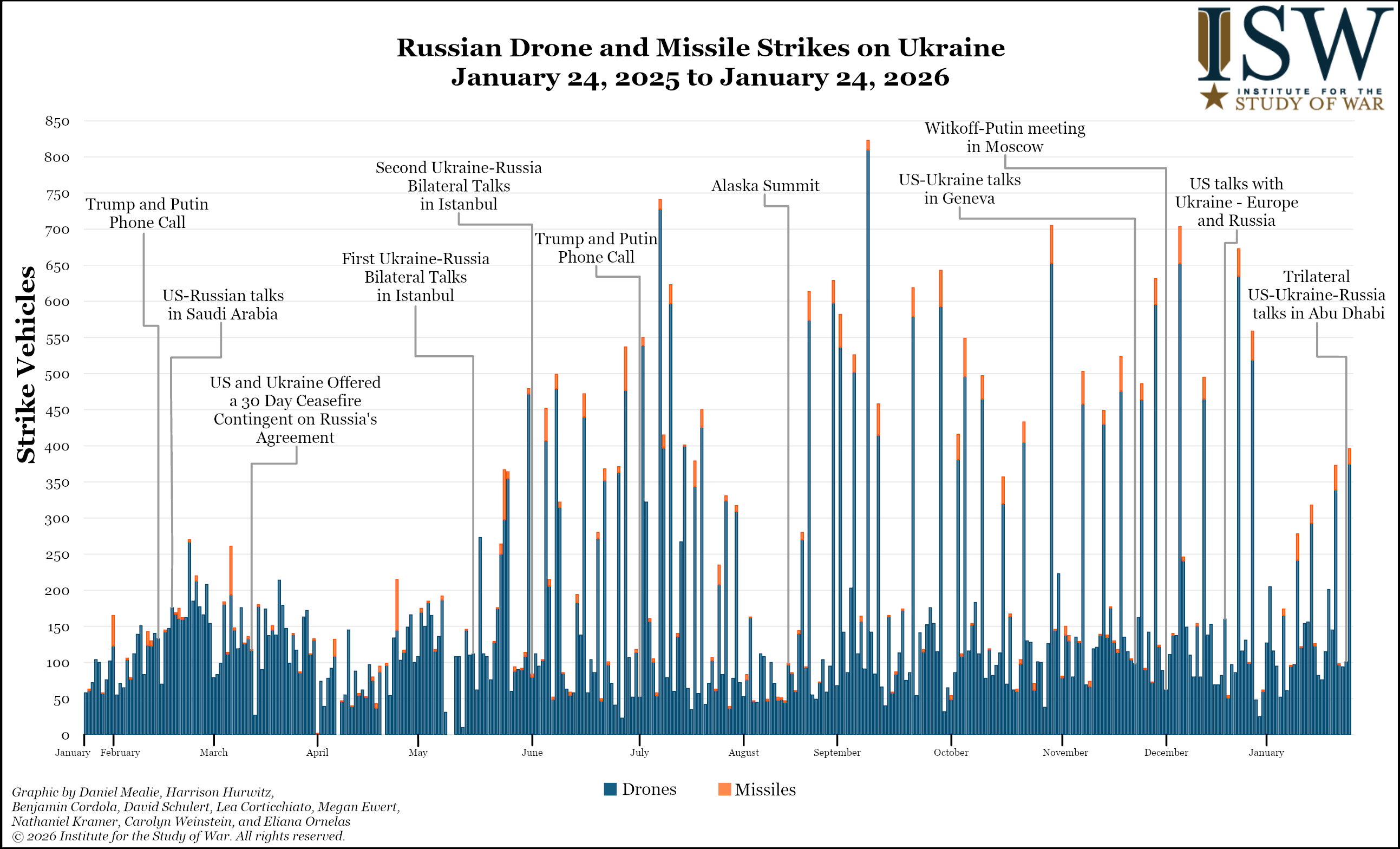
Russia's intensified long-range strike campaign targeting Ukrainian energy infrastructure throughout Fall 2025 and Winter 2025-2026 has significantly degraded Ukraine's energy grid, disproportionately effecting Ukrainian civilians. Maksym Timchenko, the head of Ukraine’s largest private energy company DTEK, told Reuters on January 23 that Russian strikes against DTEK energy infrastructure have degraded DTEK's total power generation capacity by 60 to 70 percent and caused damages estimated at $64 to 70 billion to repair.[xvii] Timchenko stated that the temperature in Ukraine has fluctuated between negative 15 and 20 degrees Celsius (five to negative four degrees Fahrenheit) for the past two weeks. Timchenko stated that Russian strikes cause rolling blackouts that leave Ukrainian civilians with only three to four hours of power per day. Russia likely intends to degrade Ukraine's power generation capacity and ability to provide Ukrainians with heat in the dead of winter, including by attempting to split Ukraine’s energy grid in half and create energy islands that are cut off from Ukraine’s electricity generation, deliveries, and transmission systems.[xviii] Russia began increasing the intensity of its strikes against Ukraine's energy infrastructure throughout Fall 2025 into Winter 2025-2026 with the goal of causing large scale disruptions to the Ukrainian power system, in what ISW continues to assess is a Russian effort to degrade Ukraine’s energy security and industrial capacity and demoralize the Ukrainian populace.[xix]
Russia’s continued devastating strike campaign against Ukrainian energy infrastructure emphasizes Ukraine’s urgent need for additional air defense systems and munitions for a holistic and well-rounded air defense umbrella. Ukrainian President Volodymyr Zelensky stated on January 23 that US President Donald Trump agreed to provide Ukraine with an unspecified number of PAC-3 interceptors for Patriot air defense systems to combat Russia's continued long-range strike campaign.[xx] Ukrainian Air Force Spokesperson Colonel Yuriy Ihnat recently noted that Ukraine's shootdown rate of Russia's long-range strike packages is high, but that the drones and missiles that breach Ukraine's air defenses cause extensive damage.[xxi] Russian forces often launch no or few missiles for multiple days in a row before launching strike packages with a significant quantity of missiles, likely stockpiling missiles between strike series in order to maximize damage with larger strike packages.[xxii] Russia has also been equipping Shahed drones with cluster warheads and mines that detonate after being downed, innovating strike tactics, and adapting Shahed technology to enable the drones to change targets in real time--all of which have the effect of maximizing the damage Shahed drones can inflict on Ukrainian targets.[xxiii] Russia’s increasingly large strike packages highlight the critical importance of Western assistance in bolstering Ukraine’s air defense capabilities, particularly with US-made Patriot air defense systems that can effectively counter Russian ballistic missile threats.[xxiv] Ukraine also requires partner support to maintain a diverse air defense umbrella comprised of not only high-end Patriot systems, but also interceptor drones, well-equipped mobile fire groups, and fighter jets.
Independent reporting continues to indicate that Russian forces and authorities continue systematically abusing Ukrainian prisoners of war (POWs) in Russian detention in violation of international law. Human Rights Watch published a report on December 11, 2025, detailing Russia's systematic physical and psychological abuse and torture of Ukrainian POWs, including interviews with six Ukrainian POWs, all captured in 2022, and who spent two to three years in Russian detention.[xxv] All six of the interviewed Ukrainian POWs described Russian forces committing violence against the POWs at all stages of the detention process between the frontline and more permanent detention facilities in Russia and occupied Ukraine. One of the POWs detailed a Russian battlefield commander torturing him for information about the Ukrainian military in a near-rear areas. All six POWs described how Russia frequently transferred personnel between permanent detention facilities and that the guards would beat the POWs upon their arrival at the new facility. Four of the POWs stated that Russian military personnel committed violent acts against POWs, not just sdetention facility staff. Five of the six POWs stated that Russian forces committed sexual violence against them, including rape. Human Rights Watch reported that Russian forces and authorities inflicted the worst abuse against Ukrainians who joined the military before 2022, soldiers with high ranks or serving in especially valuable roles, and against younger soldiers. Human Rights Watch reported that Russian forces and authorities steal the personal items and clothing from POWs, and four of the POWs described being left without adequate clothing items. Human Rights Watch detailed that Russian authorities deny POWs food, hygiene items, and clothing in adequate amounts and conditions; deny POWs sufficient time and facilities for personal hygiene; and overcrowd the detention facilities, contributing to significant health problems, including malnutrition and "catastrophic" weight loss among the POWs. Human Rights Watch reported that Russia aims to break the personality and dignity of the Ukrainian POWs.
Thousands of Ukrainians remain in Russian detention and are subject to this abuse. The Organization for Security and Cooperation in Europe (OSCE) estimated on September 22, 2025 that Russian forces took at least 13,500 Ukrainian soldiers as POWs between February 2022 and September 2025 and that between 6,000 to 10,000 remained in Russian detention as of September 2025.[xxvi] The OSCE noted that Russia has at least 222 detention sites for Ukrainian POWs, most of which are in occupied Donetsk and Luhansk oblasts and the remainder are largely scattered throughout Russia. The OSCE reported that Russia detained Ukrainian POWs and civilians for "countering the special military operation" -- Russia's vague shorthand to avoid acknowledging that it's illegal invasion of Ukraine is a war –in order to deny Ukrainian POWs the protections afforded to persons considered hors de combat in international law. Russian forces have sharply increased extrajudicial executions of Ukrainian POWs on the frontline since late 2024 in violation of international law, particularly in areas of heavy combat.[xxvii] ISW continues to assess that the Russian military command is endorsing and sometimes ordering war crimes on the battlefield and that Russia is torturing and abusing Ukrainian civilian prisoners as part of the wider military modus operandi.[xxviii]
Russian milbloggers continue to highlight the inconsistency between the Russian military command’s claims of advances and the reality on the battlefield particularly in the Kupyansk direction. A Russian milblogger published an image on January 23 reportedly showing encircled Russian servicemembers in central Kupyansk, reporting that Ukrainian forces have encircled the servicemembers for the past three months and that Russian forces cannot reinforce or resupply the position.[xxix] The milblogger stated that the Russian servicemembers have managed to hold their position by retrieving ammunition and weapons from dead Ukrainian soldiers. Another Russian milblogger responded to this report by criticizing the gap between the Russian military command’s exaggerated claims of Russian control of Kupyansk and the reality for Russian forces in the town.[xxx] The milblogger further criticized the Russian General Staff for demanding exaggerated claims of advances from subordinate echelons that sometimes result in an eight-to-10-kilometer gap between claimed Russian advances and the real frontline, including in the Pokrovsk and Slovyansk directions and in western Zaporizhia Oblast.[xxxi] Another milblogger criticized the Russian military command on January 17 for the discrepancy between the claimed battlefield victories and the actual situation for Russian forces on the ground.[xxxii] The milblogger criticized the Russian military command for wasting personnel on flag-raising missions in areas that Russian forces do not control to support these claimed advances, but noted that these Russian personnel frequently die on such missions. A third Kremlin-affiliated milblogger warned on January 17 that the situation with inflated gains in the Kostyantynivka direction could become as bad as the Kupyansk direction, publishing a map showing the discrepancy between the inflated claims and the "actual" extent of Russian advances in the area (actual as claimed by the milblogger, which is likely also somewhat inflated).[xxxiii] Russian milbloggers have increasingly been rejecting the alternate battlefield reality that Russian President Vladimir Putin and senior Russian military commanders are trying to create, but the Russian military command appears to remain committed to this alternative reality.[xxxiv]
Ukrainian Defense Minister Mykhailo Fedorov appointed former Deputy Digital Transformation Minister Valeria Ionan as a Ukrainian Ministry of Defense (MoD) advisor on international projects.[xxxv] Fedorov stated that Ionan will focus on systemic international assistance to Ukraine's defense projects and strengthening existing and creating new partnerships.
Key Takeaways:
- US, Ukrainian, and Russian delegations concluded a second day of trilateral talks in Abu Dhabi, United Arab Emirates (UAE) on January 24.
- Kremlin officials continue to respond to ongoing negotiations by reiterating Russia's commitment to Russian President Vladimir Putin's original maximalist war aims in Ukraine while attempting to rhetorically shift the blame for the Kremlin's own reticence onto Ukraine.
- Russia launched another combined missile and drone strike overnight on January 23 to 24 primarily targeting Ukrainian energy infrastructure throughout Ukraine, particularly Kyiv City.
- Russia's intensified long-range strike campaign targeting Ukrainian energy infrastructure throughout Fall 2025 and Winter 2025-2026 has significantly degraded Ukraine's energy grid, disproportionately effecting Ukrainian civilians.
- Russia’s continued devastating strike campaign against Ukrainian energy infrastructure emphasizes Ukraine’s urgent need for additional air defense systems and munitions for a holistic and well-rounded air defense umbrella.
- Independent reporting continues to indicate that Russian forces and authorities continue systematically abusing Ukrainian prisoners of war (POWs) in Russian detention in violation of international law.
- Thousands of Ukrainians remain in Russian detention and are subject to this abuse.
- Russian milbloggers continue to highlight the inconsistency between the Russian military command’s claims of advances and the reality on the battlefield particularly in the Kupyansk direction.
- Ukrainian Defense Minister Mykhailo Fedorov appointed former Deputy Digital Transformation Minister Valeria Ionan as a Ukrainian Ministry of Defense (MoD) advisor on international projects.
- Ukrainian forces recently advanced in the Kostyantynivka-Druzhkivka tactical area. Russian forces recently advanced in the Kostyantynivka-Druzhkivka tactical area and near Slovyansk.
Russian Offensive Campaign Assessment, January 23, 2026
Russian President Vladimir Putin met with a US delegation in Moscow on the night of January 22 to 23 and agreed to trilateral US, Russian, and Ukrainian working group meetings in Abu Dhabi on January 23 and 24. Russian Presidential Aide Yuriy Ushakov stated that Putin met with US Special Envoy to the Middle East Steve Witkoff, former Senior Advisor to the US President Jared Kushner, and Josh Gruenbaum, senior advisor to US President Donald Trump's Board of Peace.[1] Ushakov stated that the parties discussed Trump's meeting with Ukrainian President Volodymyr Zelensky in Davos, Switzerland on January 22 and other US meetings with Ukrainian and European delegations in December 2025 and January 2026. Ushakov stated that Putin agreed that Russia will meet with Ukraine and the United States at trilateral working group meetings to discuss security issues in Abu Dhabi on January 23 and 24. Ushakov stated that Russian General Staff’s Main Directorate (GRU) Head Admiral Igor Kostyukov will lead a Russian delegation consisting of representatives of the Russian Ministry of Defense (MoD) in the trilateral talks.[2] Zelensky reported on January 23 that Ukrainian Defense Council Secretary Rustem Umerov is leading the Ukrainian delegation, which includes Ukrainian Presidential Office Head Kyrylo Budanov, Ukrainian Servant of the People Party Head Davyd Arakhamia, Advisor to the Ukrainian Presidential Office Head Oleksandr Bevz, First Deputy Head of the Ukrainian Presidential Office Serhiy Kyslytsya, First Deputy Ukrainian Defense Council Secretary Yevhenyi Ostryanskyi, Ukrainian Chief of the General Staff Major General Andriy Hnatov, Head of Ukraine’s Main Military Intelligence Directorate (GUR) Oleh Ivashchenko, GUR Deputy Head Major General Vadym Skibitskyi, and First Deputy Head of Ukraine’s Security Service (SBU) Oleksandr Poklad.[3] Ushakov additionally stated that the lead Russian negotiator and Russian Direct Investment Fund (RDIF) CEO Kirill Dmitriev and Witkoff will hold bilateral working group meetings on economic issues in Abu Dhabi.[4]
The Kremlin is trying to push Trump to abandon the negotiation process with Ukraine and Europe that he has been leading and to concede to the demands Russia made at the August 2025 US-Russia summit in Alaska. Ushakov stated after Putin's January 22-23 meeting with the US delegation that "there is no hope" of achieving a long-term settlement to the war without resolving the territorial issue according to the "formula" the United States and Russia allegedly agreed to in Alaska.[5] Kremlin Spokesperson Dmitry Peskov stated on January 23 that the Kremlin considers it "inadvisable" to "publicly delve into the details" of the "Anchorage formula" but that Ukraine's withdrawal of its forces from all of Donbas (Luhansk and Donetsk oblasts) is an important condition for a peace settlement.[6] A source close to the Kremlin told Reuters that the Kremlin considers the "Anchorage formula" to include Ukraine ceding all of Donbas to Russia and freezing the current frontlines elsewhere in southern and eastern Ukraine.[7] Trump has led conversations with Ukraine and Europe in recent weeks that have made significant progress in determining the conditions necessary to ensure an enduring and reliable peace in Ukraine. These US-led talks have notably led to Ukraine making considerable concessions, such as changing Ukrainian laws to allow for elections during the current period of martial law.[8] Trump also worked with Ukraine and Europe to alter the initial US-proposed 28-point peace plan into the latest iteration of the 20-point plan, signaling the administration's commitment to working with Ukraine and Europe to secure a just end to the war. ISW continues to assess that the Kremlin has been trying to manipulate the lack of publicly available agreements resulting from the Alaska Summit, presenting the alleged US-Russian agreements in ways that benefit Russia.[9] The Kremlin has been using the ambiguity around the summit to try to conceal the way Russia — not Ukraine — has been impeding the negotiations process by maintaining its original war demands. Russia is likely attempting to convince Trump to walk away from US efforts to work with Ukraine and Europe by offering the ambiguous "Alaska formula" as a way to end the war.
The Kremlin is engaged in an informational campaign aimed at Ukraine's partners that attempts to present control over Donbas as the main issue left to discuss in peace talks, but Russian officials' statements for domestic audiences have repeatedly confirmed that Russia's demands go beyond eastern Ukraine. Peskov repeated Kremlin demands for Ukraine's withdrawal of its forces from all of Donbas on January 23.[10] A Reuters source close to the Kremlin discussed Russian demands about southern and eastern Ukraine, but did not specify Russian demands about Russian-occupied areas in Sumy and Kharkiv oblasts in northern Ukraine.[11] Kremlin officials often reference the "buffer zones" Russian advances have created in Sumy and Kharkiv oblasts, with Russian Defense Minister Andrei Belousov claiming in December 2025 that Russian advances in and near Kupyansk, Kharkiv Oblast, are necessary to protect Russian-occupied territory in northern Luhansk Oblast.[12] Russian State Duma officials, whose rhetoric largely targets the Russian population and not international audiences, continue to demonstrate their dissatisfaction with any agreement that freezes the current lines in southern Ukraine. Duma Defense Committee Member Andrei Kolesnik, for example, stated on January 23 that Russia needs international and Ukrainian recognition of the "constituent entities" outlined in the Russian Constitution, referring to all of Crimea and Luhansk, Donetsk, Zaporizhia, and Kherson oblasts.[13]
Kremlin officials, including Putin, have also recently reiterated Russia's other demands that are unrelated to Ukrainian territory, namely demands that NATO halt expansion and roll back to its 1997 borders.[14] Russian Federation Council Foreign Affairs Committee Chairperson Grigory Karasin stated on January 23 that Russian negotiators in Abu Dhabi have the authority to demand resolutions to the strategic and political issues that Russia outlined at the start of its full-scale invasion — likely including Russia's 2021 ultimatums to NATO.[15] Putin has repeatedly demonstrated that his demands are greater than those encapsulated in the US-proposed 28-point plan and subsequent US-Ukrainian-European peace plans.[16]
Long-term support for Ukraine's economy and reconstruction is essential for Ukraine's security, but it is not a substitute for robust security guarantees that deter future Russian aggression. Zelensky noted on January 23 that Trump supports the idea of a free trade zone in Ukraine, which Zelensky noted will help Ukrainian businesses, and European Commission President Ursula von der Leyen reported that the EU has almost completed work with the United States and Ukraine on a "prosperity package" for Ukraine's reconstruction.[17] Politico reported on January 23 that a draft of the prosperity plan outlines a 10-year agreement that includes fast-tracking Ukraine's EU membership and investments from the US, EU, and international organizations into Ukraine's recovery.[18]
Economic support for Ukraine will be insufficient to safeguard Ukraine's future security, however. Ukraine requires reliable security guarantees that credibly and effectively deter future Russian aggression, ensure the strength of the Ukrainian military, and include a strong partner-led reassurance force. Zelensky noted on January 23 that he is ready to sign the main US-Ukrainian security guarantees document that the Ukrainian Verkhovna Rada and US Congress will ratify, and von der Leyen reported that the EU is also making progress towards finalizing the security guarantees that the Coalition of the Willing discussed in Paris on January 6.[19] The Kremlin has repeatedly stated that Russia views any security guarantees required to ensure a lasting peace as unacceptable and has repeatedly demanded significant reductions in the Ukrainian military and rejected foreign troop deployments to post-war Ukraine.[20]
Kremlin officials indicated that Russia wants to use its assets frozen in the United States to benefit the Russian economy and offset the cost of Russia's full-scale invasion — as ISW recently assessed. Ushakov stated after Putin's January 22-23 meeting with the US delegation that the parties discussed Putin's proposal to contribute $1 billion to Trump's Board of Peace from Russian assets currently frozen in the United States.[21] Ushakov reiterated Putin's other proposal that the remaining funds in the United States go toward reconstructing Ukrainian territories that sustained damage during the war.[22] Peskov clarified on January 23 that Russian assets could help rebuild territory in Donbas, and Zelensky stated that Putin proposed that the funds go towards rebuilding Kursk Oblast.[23] The Kremlin is demanding that Ukraine hand over all of Donbas to Russia, suggesting that the Kremlin hopes to use the frozen assets to rebuild Russian-occupied areas of Ukraine, not Ukrainian-held areas. ISW recently assessed that Putin's initial January 21 proposal to use the frozen funds for reconstruction likely did not include the Ukrainian-held territories that Russian strikes have severely damaged.[24] The use of frozen Russian assets to rebuild Russian-occupied Ukraine or Kursk Oblast would effectively release the funds back to Russia and offset the costs Russia incurred with its 2022 invasion of Ukraine. Russian access to additional funds for the reconstruction of occupied Ukraine would allow Russia to maximize its economic exploitation of Ukrainian territories, thereby funneling profits back into the Russian economy and supporting Russian efforts to forcibly integrate occupied Ukraine into Russia.
The Kremlin is likely preparing to carefully manage the succession plan for Chechen Republic Head Ramzan Kadyrov in order to avoid a tumultuous transfer of power that may result in unrest in Chechnya and divert Chechen resources from the war in Ukraine. Russian opposition outlet Vazhnye Istorii reported on January 23 that a source close to the Kremlin and the ruling United Russia party stated that the Kremlin is working to find a solution to possible succession problems in Chechnya against the backdrop of reports that Kadyrov is seriously ill and that his son and possible successor, 18-year-old Adam, was recently in a car accident.[25] A Russian insider source claimed on January 22 that Adam Kadyrov required surgery for fractures, facial injuries, and spleen injuries following the January 16 car crash.[26] Vazhnye Istorii noted that Kadyrov is promoting his son, Adam, to be his successor, as ISW has previously assessed, and noted that Adam Kadyrov cannot legally govern the republic until he turns 30.[27] A former Federal Security Service (FSB) officer and a member of the Chechen diaspora stated that the next leader will likely be someone from the Benoi teip (a Chechen clan), the largest teip in Chechnya, to which Kadyrov is a member. Vazhnye Istorii reported that Russian State Duma Deputy for Chechnya Adam Delimkhanov and Chechen Republic Parliament Deputy Magomed Daudov, who are both part of the Benoi teip, may take over as head of the Chechen Republic - presumably until Adam Kadyrov turns 30. Delimkhanov has held influence in a variety of spheres in Chechnya, including by coordinating Chechen forces fighting in Ukraine, fulfilling diplomatic roles, and navigating political and religious tensions between Russian and Chechen societies.[28] Russian opposition outlet Novaya Gazeta Europe reported in May 2025 that Kadyrov tasked Delimkhanov with acting as a "coach-mentor" to Adam Kadyrov, including by connecting him with political and criminal contacts in Russia and abroad.[29]
Russian President Vladimir Putin has long relied on Kadyrov’s control over Chechnya to maintain stability in the area, which historically had a tense relationship with Moscow before the accession of the Kadyrov regime. A tense power struggle in the region could lead to unrest and internal fighting, which would require attention from Moscow. Elements of the Russian 58th Combined Arms Army ([CAA], Southern Military District [SMD]) are stationed in Chechnya, and numerous Chechen units are currently operating in Ukraine.[30] Kadyrov's control over Chechnya has allowed Putin to employ these forces in the war in Ukraine without having to make considerations for issues in Chechnya that would require the attention of Russia's military and security services. The Kremlin may not have sufficient forces to handle any future unrest emerging from internal Chechen power struggles while also maintaining its current deployments in Ukraine. The Kremlin is likely to prioritize finding a solution to Chechen succession issues that avoids the potential for regional unrest.
Ukrainian Defense Minister Mykhailo Fedorov appointed Serhiy Sternenko to advise the Ukrainian Ministry of Defense (MoD) on scaling up the use of drones on the front.[31] Fedorov stated that Sternenko will focus on systematizing drone supplies and increasing the lethality of underperforming Ukrainian drone units. Sternenko is a prominent Ukrainian volunteer and fundraiser who has previously provided the Ukrainian military with first-person view (FPV) fiber optic drones and FPV drones with autonomous detection and strike capabilities.[32] Sternenko created the largest non-state FPV drone supplier for the Ukrainian military on January 15, 2025.[33] Sternenko survived a Russian intelligence-sponsored assassination attempt in May 2025.[34] Sternenko met with Ukrainian President Volodymyr Zelensky on January 15 to discuss legislative support for volunteers helping the Ukrainian military and targeted work with Ukrainian brigades.[35]
Key Takeaways:
- Russian President Vladimir Putin met with a US delegation in Moscow on the night of January 22 to 23 and agreed to trilateral US, Russian, and Ukrainian working group meetings in Abu Dhabi on January 23 and 24.
- The Kremlin is trying to push Trump to abandon the negotiation process with Ukraine and Europe that he has been leading and to concede to the demands Russia made at the August 2025 US-Russia summit in Alaska.
- The Kremlin is engaged in an informational campaign aimed at Ukraine's partners that attempts to present control over Donbas as the main issue left to discuss in peace talks, but Russian officials' statements for domestic audiences have repeatedly confirmed that Russia's demands go beyond eastern Ukraine.
- Long-term support for Ukraine's economy and reconstruction is essential for Ukraine's security, but is not a substitute for robust security guarantees that deter future Russian aggression.
- Kremlin officials indicated that Russia wants to use its assets frozen in the United States to benefit the Russian economy and offset the cost of Russia's full-scale invasion, as ISW recently assessed.
- The Kremlin is likely preparing to carefully manage the succession plan for Chechen Republic Head Ramzan Kadyrov in order to avoid a tumultuous transfer of power that may result in unrest in Chechnya and divert Chechen resources from the war in Ukraine.
- Ukrainian Defense Minister Mykhailo Fedorov appointed Serhiy Sternenko to advise the Ukrainian Ministry of Defense (MoD) on scaling up the use of drones on the front.
- Russian forces recently advanced near Slovyansk and Novopavlivka.
Russian Offensive Campaign Assessment, January 22, 2026
Russian President Vladimir Putin's meeting with US envoys in Moscow ended after the completion of this update and will be covered in ISW's January 23 report.
Ukrainian and US officials continued meetings in Switzerland on January 22. Ukrainian President Volodymyr Zelensky met with US President Donald Trump at the World Economic Forum in Davos, Switzerland on January 22.[i] Zelensky stated that they discussed air defenses for Ukraine. Ukrainian Defense Council Secretary Rustem Umerov reported that he, Ukrainian Servant of the People Party Head Davyd Arakhamia, and Ukrainian Presidential Advisor Oleksandr Kamyshin met with former Senior Advisor to the US President Jared Kushner and US Special Envoy to the Middle East Steve Witkoff in Davos to discuss Ukraine's economic development, post-war recovery, and security guarantees.[ii] Witkoff and Kushner met with Russian President Vladimir Putin in Moscow on the night of January 22, but the meeting has not concluded as of this writing. ISW will report on the US-Russia meeting as information becomes available.
Witkoff and Western outlets offered limited reporting about what the US-Russian meeting may discuss. Witkoff stated on January 22 that peace talks still need to resolve one issue but did not specify.[iii] Witkoff stated that Trump is considering ideas such as a "tariff-free zone" for Ukraine to boost its economy.[iv] FT reported that two sources stated that the United States and Ukraine have discussed proposing a limited ceasefire in which Russia would stop strikes against Ukrainian energy infrastructure and Ukraine would stop strikes against Russian oil refineries and shadow fleet tankers.[v]
Putin is trying to use Trump's Board of Peace to curry favor with Trump and negotiate the release of frozen Russian assets to fuel the Russian economy. Putin stated on January 21 that Russia is considering Trump's proposal to join Trump's Board of Peace and that Russia could send the required one billion dollars from frozen Russian assets held in the United States.[vi] Putin stated that the remaining frozen Russian assets in the United States could go towards rebuilding "territories damaged by the fighting" after a Russia-Ukraine peace treaty. Putin stated that he would address the issue in his meeting with Witkoff and Kushner. Putin is likely referring to Russian-occupied territories, not Ukrainian-held territories ravaged by Russian strikes. Putin appears to be trying to negotiate the unfreezing of Russian assets not only to fund Trump's Board of Peace but also to rebuild the areas that Russian forces have damaged in Russia's full-scale invasion. The use of frozen Russian assets to rebuild Russian-occupied Ukraine would effectively release the funds back to Russia and offset the costs Russia caused by invading in 2022. Funding towards reconstruction in occupied Ukraine would put this money back into the Russian economy and would help Russia further integrate occupied Ukraine's economy, society, and infrastructure into the central Russian system.
There is conflicting reporting about possible US, Ukrainian, and Russian meetings in the United Arab Emirates (UAE) on January 23 and 24. Zelensky stated that US, Ukrainian, and Russian officials will hold a trilateral meeting in the UAE on January 23 and 24.[vii] Zelensky’s office clarified to the Financial Times (FT) that a trilateral meeting was still unconfirmed and that the United States and Ukraine are still waiting for Russia's response.[viii] An unspecified source told FT that Russian officials told the United States that Putin was open to holding parallel talks with Ukraine, with US mediators shuttling between the Russian and Ukrainian delegations. Witkoff stated that he and Kushner would go to Abu Dhabi to participate in "working group" meetings discussing "military-to-military" issues and Ukrainian "prosperity" after their meeting with Putin in Moscow.[ix] Zelensky has repeatedly reiterated that he is open to bilateral or trilateral meetings with Putin and that Ukraine is open to direct negotiations, but Putin has often resisted such meetings.[x]
The Russian military command is reportedly prioritizing the provision of light motorized vehicles to Russian troops, further demonstrating how the Russian military is optimizing itself for positional warfare. Ukrainian military observer Kostyantyn Mashovets reported on January 22 that the Russian military command plans to provide over 2,600 light vehicles, including buggies, motorcycles, and all-terrain vehicles (ATVs), from the Russian General Staff reserve to Russian assault units in 2026, with the Russian defense industrial base (DIB) delivering about 4,200 vehicles in the first quarter of 2026.[xi] Mashovets stated that the Russian military command is relying on "non-systemic purchases," such as volunteer assistance, donations, and budgetary contributions from individual oblasts, to meet its total goals. Russian forces are largely using light motorized vehicles to transport infantry closer to frontline positions.[xii] The Russian military command's focus on light vehicle production and provision further demonstrates ISW's ongoing assessment that Russian forces have optimized themselves for positional warfare in Ukraine and that Russian advances will likely remain constrained to a foot pace in the near to medium-term.[xiii]
The Russian military command is reportedly introducing a tactical-level situational awareness system to help streamline battlefield decision-making, seeking to use artificial intelligence to compensate for the low level of junior officer training and initiative in the Russian military, among other things. Mashovets reported that the Russian military command is accelerating the implementation of the Svod situational awareness system for tactical commanders.[xiv] Mashovets stated that the system will collect different types of intelligence, including satellite data, aerial photography, electronic and engineering reconnaissance data, and open-source intelligence, into a single information space that will enable real-time target detection and identification. Mashovets stated that the system will also analyze data, including with help from AI, and will model scenarios for operations and missions taking into account changing dynamics. Mashovets added that Russian forces will likely begin testing the system in combat units at the battalion level across elements of the Russian Central Grouping of Forces, starting in the 2nd and 41st combined arms armies (CAAs, Central Military District [CMD]) in April and May 2026. The Central Grouping of Forces is currently overseeing offensive operations in the Pokrovsk direction.
The Svod system likely aims to replicate the functionality of similar Ukrainian IT systems that help with target detection and identification. The Svod system, particularly its use of AI, likely further aims to help with real-time decision-making on the battlefield at the tactical level. ISW continues to assess that the Russian military command has optimized its military decision-making process around a system designed to use lower quality individual service members who choose a plan from a playbook of battle orders and execute it with minimal alterations.[xv] The highly tactical nature of the Svod system reflects the Russian military command’s need to micromanage junior officers with limited training to compensate for a Russian military hierarchy that discourages autonomy. Russian efforts to integrate technologies such as AI as tactical decision-support tools are thus likely in part attempts to empower tactical units and commanders. The Russian military command appears to be trying to fulfill its long-held goal of offsetting junior officer incompetence by generating templated yet responsive decision-making platforms. It is unclear if Russia's elite Rubikon Center for Advanced Unmanned Technologies will be incorporated into the Svod system. Russian Defense Minister Andrei Belousov stated in August 2025 that the newly created Svod system will undergo combat testing between September and November 2025, and the reason for the delays is unclear.[xvi]
The Russian General Staff is reportedly creating a new drone brigade that will incorporate a large variety of unmanned systems, likely as part of wider efforts to centralize drone units in the Russian military. Mashovets reported that the Russian military command plans to create the 50th Unmanned Systems Brigade of the Supreme Command from the Grom-Kaskad drone brigade (reportedly of the 4th Air Force and Air Defense Army, Russian Aerospace Forces [VKS]) by December 2026.[xvii] Mashovets reported that the brigade will include crews from a variety of unmanned ground vehicles (UGVs), unmanned surface vehicles (USVs), and unmanned aerial vehicles (UAVs), including reconnaissance UAVs, Lancet loitering munitions, Geran strike UAVs, fiber-optic UAVs, and interceptor UAVs. Mashovets reported that a major general will lead the brigade, that the brigade will consist of approximately 7,000 servicemembers, and that the brigade would be stationed in various Russian oblasts and in occupied Donetsk Oblast.[xviii] The Russian military command reportedly plans to form the brigade in four stages - to be completed by February 1, April 1, and September 1, and December 1.[xix] Mashovets reported that the brigade will be exclusively subordinated to the Russian General Staff through the commander of the Unmanned Systems Forces.
The reported size and commander's rank of the 50th Unmanned Systems Brigade do not correspond with the traditional characteristics of a brigade. The Russian General Staff may be trying to fit an elite organizational structure into the Russian order of battle, and the brigade will likely not function as a brigade in reality. The new brigade appears part of wider efforts to establish control over and centralize informal drone units in the Russian military.[xx] It is unclear how this brigade will relate to or interact with the Rubikon Center. ISW will continue to monitor reports of the brigade’s development and functional role on the battlefield.
European states are increasingly seizing Russian shadow fleet tankers following a series of similar US actions in recent weeks. French President Emmanuel Macron stated that the French Navy boarded and diverted a Russian shadow fleet oil tanker in the Mediterranean Sea on the morning of January 22.[xxi] Macron stated that the tanker was travelling from Russia and was under international sanctions. The French Maritime Prefecture of the Mediterranean later confirmed that French authorities inspected and diverted the Grinch cargo tanker in the Alboran Sea as it was en route from Murmansk, Russia, and confirmed suspicions that the vessel was flying a false flag.[xxii] The French Maritime Prefecture reported that the UK cooperated with France in the inspection, and French military officials told the Associated Press (AP) that the UK gathered and shared intelligence that enabled French forces to intercept the vessel.[xxiii] Data from the Starboard Maritime Intelligence ship-tracking platform indicates that the Grinch sailed under the Comoros Islands flag and confirmed that the ship left an area near Murmansk on January 5. Ukrainian President Volodymyr Zelensky applauded the French seizure of the tanker and called for states to apprehend more Russian tankers operating near European shores.[xxiv] France has previously taken action against the Russian shadow fleet, boarding a tanker in late September 2025.[xxv] The January 22 seizure comes against the backdrop of similar US actions to seize tankers tied to the Russian shadow fleet in the Caribbean Sea off the coast of Venezuela.[xxvi]
Ukrainian Defense Minister Mykhailo Fedorov dismissed five deputy defense ministers on January 22. Fedorov reported that he dismissed Anatoliy Klochko, Oleksandr Kozenko, Mykola Shevtsov, Volodymyr Zaverukha, and Hanna Hvozdiar.[xxvii] Fedorov stated that some of the dismissed deputy ministers will continue to work in the Ukrainian Ministry of Defense (MoD) in other areas as advisors or heads of project offices.
Key Takeaways:
- Ukrainian and US officials continued meetings in Switzerland on January 22.
- Putin is trying to use Trump's Board of Peace to curry favor with Trump and negotiate the release of frozen Russian assets to fuel the Russian economy.
- There is conflicting reporting about possible US, Ukrainian, and Russian meetings in the United Arab Emirates (UAE) on January 23 and 24.
- The Russian military command is reportedly prioritizing the provision of light motorized vehicles to Russian troops, further demonstrating how the Russian military is optimizing itself for positional warfare.
- The Russian military command is reportedly introducing a tactical-level situational awareness system to help streamline battlefield decision-making, seeking to use artificial intelligence to compensate for the low level of junior officer training and initiative in the Russian military, among other things.
- The Russian General Staff is reportedly creating a new drone brigade that will incorporate a large variety of unmanned systems, likely as part of wider efforts to centralize drone units in the Russian military.
- European states are increasingly seizing Russian shadow fleet tankers following a series of similar US actions in recent weeks.
- Ukrainian Defense Minister Mykhailo Fedorov dismissed five deputy defense ministers on January 22.
- Ukrainian forces recently advanced in the Kostyantynivka-Druzhkivka tactical area and in eastern Zaporizhia Oblast. Russian forces recently advanced near Slovyansk, in the Dobropillya tactical area, and near Pokrovsk and Novopavlivka.
Russian Offensive Campaign Assessment, January 21, 2026
US officials will meet with Ukrainian officials on January 21 and 22 and with Russian President Vladimir Putin on January 22 to continue peace negotiations. US Special Envoy to the Middle East Steve Witkoff met with lead Russian negotiator and Russian Direct Investment Fund (RDIF) CEO Kirill Dmitriev on the sidelines of the World Economic Forum in Davos, Switzerland on January 20, and US President Trump stated on January 21 that he will meet with Ukrainian President Volodymyr Zelensky at the forum on January 22.[1] Witkoff stated that he and former Senior Advisor to the US President Jared Kushner would meet with Ukrainian officials, including Ukrainian Defense Council Secretary Rustem Umerov, on the evening of January 21 and will meet with Putin in Russia on January 22.[2] Kremlin Spokesperson Dmitry Peskov confirmed that Witkoff and Kushner will meet with Putin on January 22.[3] Witkoff stated that negotiations on the 20-point peace plan are "down to land deals now."[4] Witkoff stated that he and Kushner will travel to the United Arab Emirates to meet with "working groups" after the meeting in Russia.
The Kremlin remains committed to its original war aims and is not publicly showing any new willingness to commit to meaningful compromises to end its war against Ukraine. Bloomberg reported on January 21 that unspecified sources stated that Putin received a draft peace plan earlier in January 2025 from Dmitriev and that the Kremlin viewed the proposal as a significant step forward even though it fell short of a finalized agreement.[5] The sources noted that many issues that are important to Russia are either not included in the draft plan or framed in "unsatisfactory" ways. Bloomberg's sources stated that US recognition of occupied Crimea and other unspecified occupied territories of Ukraine as under Russian control is a priority for Putin and that Russia remains opposed to the deployment of NATO troops to Ukraine as part of future security guarantees for Ukraine. The sources stated that Russia is seeking protections for the Russian language and the Russian Orthodox Church (a Kremlin-controlled arm of influence) in Ukraine.
Russian Security Council Chairperson Dmitry Medvedev stated on January 21 that Russia is "reclaim[ing] its own lands" in Ukraine through the war and Russia's illegal, sham referendums in occupied Luhansk, Donetsk, Zaporizhia, and Kherson oblasts in 2022.[6] Medvedev claimed that these lands and people have been part of Russia "for centuries." Medvedev's statements are in line with repeated Kremlin statements, including those calling for Ukraine to cede "Novorossiya" to Russia — referring to an invented region that Kremlin officials often claim is “integral” to Russia and that includes not only Crimea and the four oblasts that Russia has illegally annexed, but also Kharkiv, Dnipropetrovsk, Mykolaiv, and Odesa oblasts. The US-proposed 28-point peace plan only allowed for Russian occupation of Crimea, all of Luhansk and Donetsk oblasts, and the currently occupied parts of Zaporizhia and Kherson oblasts, requiring Russia to cede occupied territories outside of these five regions, including in Kharkiv, Mykolaiv, and Dnipropetrovsk oblasts.[7]
Russia's position remains fundamentally unchanged, as Kremlin officials have repeatedly called for a future peace settlement to address the alleged "root causes" of the war, including Ukraine's alleged discrimination against Russian-speakers and the Russian Orthodox Church in Ukraine.[8] Kremlin officials have also repeatedly rejected the use of foreign troops in security guarantees for post-war Ukraine — a core element of the peace plan that the Trump administration has thus far negotiated. The Kremlin is attempting to position itself as a reliable negotiating partner interested in peace while indicating that its commitment to achieving its original war aims is unchanged.
Reports of the draft list of the top United Russia candidates for the September 2026 State Duma elections have reportedly generated internal Kremlin discussions that not only reflect factional maneuvering to gain power but also show the Kremlin's concern about the Russian public's attitude toward a protracted war. Russian opposition outlet Meduza reported on January 21 that sources close to the Russian Presidential Administration and United Russia stated that the recently reported list of top five leaders to represent United Russia in the September 2026 elections is not finalized and that the content and even the format of the list could still significantly change.[9] Meduza's sources stated that Russian Defense Minister Andrei Belousov and lead Russian negotiator and Russian Direct Investment Fund (RDIF) CEO Kirill Dmitriev could become candidates on the list. Russian outlets recently reported that Russian Security Council Chairperson Dmitry Medvedev was on the list, and Meduza's sources stated that Medvedev is trying to position himself at the top in order to change his image in the eyes of the Russian elite and public away from being seen an "internet troll" in an "obscure position."[10] Meduza's sources noted that some Russian officials do not support Medvedev's inclusion on the list, with Russian Presidential Administration Deputy Head Sergei Kiriyenko reportedly fearful that Medvedev's inclusion would strengthen Medvedev's position as a potential successor to Russian President Vladimir Putin and Duma Speaker Vyacheslav Volodin threatened by Medvedev possibly replacing him in that role. Meduza sources stated that United Russia will struggle with Medvedev at the top the list due to his "controversial image" and "clearly pro-war" position as the Russian people are "tired of war" and that other war-related figures on the list could exacerbate the perception of United Russia as a "party of war." A source assessed that the Kremlin political bloc is including people related to the war on the list in order to please Putin, who wants to see war-related figures emerge as the new elite in Russia. A source stated that the list will need to completely change if there is peace or a truce in Ukraine, including possibly to include Dmitriev (likely since he has been leading the Russian negotiating team in peace talks). Meduza's sources also reported that there are disagreements within the Kremlin about United Russia's future platform and ideological messaging, with some calling for a platform of self-sacrifice and collectivism while Kiriyenko is advocating for a campaign with "hints at post-war development." Meduza's sources largely presented internal debates about the United Russia list as centered around concerns about Russian domestic attitudes about the war, suggesting the Russian inner circle is divided about the wisdom of campaigning on a platform directly or indirectly promoting a protracted war in Ukraine and calling for more sacrifices from the Russian people.
The United States seized another oil tanker involved with shipping sanctioned Russian oil off the coast of Venezuela. US Southern Command reported on January 20 that it seized the Sagitta tanker as part of US President Donald Trump’s quarantine of sanctioned vessels in the Caribbean Sea.[11] The US Office of Foreign Assets Control (OFAC) sanctioned the Sagitta in January 2025 for transporting Russian crude oil.[12] Ukraine’s Main Military Intelligence Directorate (GUR) reported that the vessel sailed under the flag of Guyana as of January 16 and that the tanker exported Russian oil and oil products, including to the People’s Republic of China (PRC) and India.[13] Data from the Starboard Maritime Intelligence ship-tracking platform indicates that the ship has sailed under both the Panamanian and Guyanese flags and that the ship has not turned on its automatic identification systems (AIS) signal since May 11, 2025, at the entrance to the Strait of Hormuz.
Key Takeaways:
- US officials will meet with Ukrainian officials on January 21 and 22 and with Russian President Vladimir Putin on January 22 to continue peace negotiations.
- The Kremlin remains committed to its original war aims and is not publicly showing any new willingness to commit to meaningful compromises to end its war against Ukraine.
- Reports of the draft list of the top United Russia candidates for the September 2026 State Duma elections have reportedly generated internal Kremlin discussions that not only reflect factional maneuvering to gain power but also show the Kremlin's concern about the Russian public's attitude toward a protracted war.
- The United States seized another oil tanker involved with shipping sanctioned Russian oil off the coast of Venezuela.
- Ukrainian forces recently advanced in western Zaporizhia Oblast. Russian forces recently advanced in the Kostyantynivka-Druzhkivka tactical area and in western Zaporizhia Oblast
Russian Offensive Campaign Assessment, January 20, 2026
Russian strikes against Ukrainian energy infrastructure cut power to electrical substations powering the Chornobyl Nuclear Power Plant on January 20, consistent with a recent warning from Ukrainian military intelligence. International Atomic Energy Agency (IAEA) Director General Rafael Grossi reported on January 20 that military activity damaged several Ukrainian electrical substations vital for nuclear safety at the Chornobyl Nuclear Power Plant (NPP) and cut all power to the NPP — the second time since about January 12 that Russian strikes have damaged substations supporting the Chornobyl NPP.[1] The Ukrainian Energy Ministry reported that engineers have since restored power to the Chornobyl NPP as of January 20.[2] Ukraine’s Main Military Intelligence Directorate (GUR) warned on January 17 that Russia was planning strikes on electricity transmission substations, which Ukrainian nuclear power plants depend on to operate.[3] Grossi stated on January 16 that IAEA teams had observed military activities or air raid alarms at all five nuclear sites in Ukraine from January 11 to 18.[4]
Russia downplayed the impact of Russian strikes on the Chornobyl NPP even as it continues to pose increasing threats to all of Ukraine's NPPs. Russian Permanent Representative to the UN in Vienna Mikhail Ulyanov — who also represents Russia to the IAEA — responded to the Chornobyl NPP power outage by criticizing "attempts to create the impression" that "minor power outages" at NPPs are "fraught with the possibility of a nuclear catastrophe."[5] Ulyanov claimed that Russia is not deliberately attempting to degrade power supplies to Ukraine's NPPs and criticized Ukraine for seeking assistance from the IAEA in the aftermath of Russian strikes. Reporting on Ulyanov's statement, Russian state newswire TASS characterized Ukraine's condemnations of the strikes as "dramatization," further diminishing the impact of Russian strikes.[6] Ulyanov claimed that the IAEA's document on the International Nuclear and Radiological Event Scale states that power outages pose "zero nuclear threat" as justification for his dismissive statements.[7]
Ulyanov is deliberately ignoring the context of this power outage amid the systemic threat and damages that Russia has caused to Ukrainian NPPs throughout the course of the war. The January 20 Russian strike against a substation supporting the Chornobyl NPP was not an isolated incident, as Russia conducts repeat strikes against individual substations and other electricity generation and transmission infrastructure in Ukraine.[8] These repeated strikes significantly raise the possibility of either destroying the infrastructure object or damaging it so seriously that it takes months or years to render operable again. Russian strikes and other military operations have directly impacted Ukrainian NPPs, particularly the Chornobyl NPP. A Russian Shahed drone notably struck the sarcophagus containing the Chornobyl NPP's melted-down nuclear reactor in February 2025, damaging the containment structure so severely that it could no longer adequately contain the radiation from the reactor without significant repairs.[9] Repeated power outages also strain the ability of NPPs to conduct their base safety functions, as demonstrated by Russia's occupation of the Zaporizhzhia NPP (ZNPP), which has suffered dozens of partial power outages since February 2022.[10] The ZNPP has suffered at least 10 total power outages in its entire operational history, all of which occurred due to Russian military activity since the start of Russia's full-scale invasion.[11] Russia has also heavily militarized the ZNPP by storing military equipment next to the ZNPP's nuclear reactors, stationing military personnel at and around the ZNPP, and launching drones from the ZNPP's grounds.[12] The Kremlin has continually attempted to portray Ukraine as an unsafe steward of the ZNPP and other nuclear power plants to obfuscate that the greatest threat to Ukrainian nuclear security is not Ukraine but is actually Russia and its continued war.[13] The Kremlin likely seeks to downplay its role in the degradation of Ukraine's nuclear power plants and ongoing threat to nuclear security as part of efforts to continue justifying its war effort, including the Russian long-range strike campaign that seeks to destroy Ukrainian energy infrastructure and deprive Ukrainians of heat in the dead of winter.
Russian missile and drone strikes overnight on January 19 to 20 significantly damaged additional energy infrastructure throughout Ukraine, particularly Kyiv City. The Ukrainian Air Force reported on January 20 that Russian forces launched 18 Iskander-M ballistic missiles/S-300 air defense missiles; one Zirkon hypersonic cruise missile; 15 Kh-101 cruise missiles; and 339 Shahed-type, Gerbera-type, Italmas-type, and other drones, of which roughly 250 were Shaheds.[14] The Ukrainian Air Force reported that Ukrainian forces downed 14 Iskander-M/S-300s, 13 Kh-101s, and 315 drones, that five missiles and 24 drones struck 11 locations, and that downed debris fell on 12 locations. Ukrainian Air Force Spokesperson Colonel Yuriy Ihnat reported that Ukrainian forces were unable to down the Zirkon hypersonic missile, which struck an infrastructure facility in Vinnytsia Oblast.[15] Ukraine’s largest private energy company, DTEK, reported that Russian strikes left 173,000 households in Kyiv City without power after restoring power to another 162,000 households that also lost power.[16] Ukraine's Energy Ministry reported that Russian strikes also caused power outages in Kyiv, Odesa, Dnipropetrovsk, Sumy, Rivne, and Kharkiv oblasts.[17]
Ukrainian President Volodymyr Zelensky reported that Ukraine received a shipment of air defense missiles on January 18, which significantly supported Ukraine's capability to down a majority of the Russian drones and missiles in the January 19 to 20 strike.[18] Ihnat noted on January 20 that Ukraine's shootdown rate for this strike package was relatively high but that the drones and missiles that did breach Ukraine's air defenses caused extensive damage.[19] Russia has been conducting a long-range strike campaign that purposefully targets Ukrainian civilian and energy infrastructure and disproportionately impacts civilians throughout the war and has intensified these strikes in recent months.[20] Russian forces often launch no or few missiles for multiple days in a row before launching strike packages with a significant quantity of missiles, likely stockpiling their missiles between strike series in order to launch larger strike packages to maximize damage.[21] Russia's increasingly large strike packages highlight the critical importance of Western assistance in bolstering Ukraine's air defense capabilities, particularly with US-made Patriot air defense systems that can effectively counter Russian ballistic missile threats.[22]
Russian Foreign Minister Sergey Lavrov reiterated the Kremlin's commitment to its original war demands against the background of expected peace talks at the World Economic Forum in Davos, Switzerland on January 20, and falsely accused Ukraine of beginning the war by attacking Russia. Lavrov gave a speech and held a press conference outlining Russia's foreign policy in 2025 and reiterated Russia's commitment to addressing the so-called "root causes" of its war in Ukraine.[23] Lavrov and other Kremlin officials have repeatedly defined these "root causes" as NATO expansion and alleged discrimination against Russian people, the Russian language, and the Russian Orthodox Church (a Kremlin-controlled arm of influence) in Ukraine.[24] Lavrov also reiterated on January 20 the Kremlin's rejection of any peace deal that does not cede all of "Novorossiya" to Russia and that provides Ukraine with security guarantees from Europe. Novorossiya is an invented region that the Kremlin often claims is "integral" to Russia and includes areas of eastern and southern Ukraine beyond the oblasts that Russia has illegally annexed.[25] Lavrov explicitly rejected the US-Ukrainian-European 20-point peace plan and listed demands inconsistent with terms in the original US-proposed 28-point peace plan, including the demand for territories that go beyond those that Russia has illegally annexed.[26] Lavrov also rejected a possible temporary or permanent ceasefire in Ukraine because Ukraine could "then attack the Russian Federation again" — falsely accusing Ukraine of having attacked Russia in the past, whereas Russia has been the one to initiate all military aggression against Ukraine. Senior Kremlin officials, including Russian President Vladimir Putin, have repeatedly demonstrated that Russia will not be satisfied with a peace settlement that does not meet Russia's uncompromising terms or that only pertains to Ukraine and does not radically restructure NATO.[27] Lavrov's January 20 statements set conditions for Russia to justify to domestic audiences its rejection of any terms that emerge from talks at the Davos Summit.
Drone operators of the Russian Rubikon Center for Advanced Unmanned Technologies are increasingly conducting mid-range strikes against Ukraine's high value, Western-provided air defenses and rocket launchers. Rubikon posted geolocated footage on January 20 showing a first-person view (FPV) drone striking a High Mobility Artillery Rocket System (HIMARS) moving along a road on the night of January 19 to 20 near Novobakhmetieve (northwest of Pokrovsk and roughly 43 kilometers from the frontline).[28] A Russian milblogger claimed that the signal and image quality of the footage suggest that Rubikon used a drone leveraging communications with a Starlink system.[29] Rubikon also posted geolocated footage on January 17 of an FPV drone striking the launcher and AN/MPQ-53 radar station of a Patriot air defense system near Berezivka (just southwest of Kharkiv City and roughly 44 kilometers from the front line).[30] Russian milbloggers claimed that Rubikon used a BM-35 strike drone but disagreed whether Russian forces hit a real Patriot system or a decoy.[31] One milblogger noted that the FPV strike on the Patriot demonstrates how some Russian frontline drones can now fly far beyond Kharkiv City (roughly 23 kilometers from the frontline), especially with the help of "mothership drones" (such as Molniya fixed-wing FPV drones) that carry one or more shorter-range drones to areas far from the front line.[32] Russian forces equip Molniya-2 drones with Starlink satellite systems and have long leveraged "mothership" drones that can carry and extend the range of FPV drones, increasing the range and efficiency of Russian drone strikes against Ukraine's near rear.[33] ISW continues to assess that Russian forces are trying to exploit Ukraine’s scarcity of air defense systems, underscoring Ukraine’s urgent need for point-defense air defense systems to down reconnaissance and strike drones, as electronic warfare (EW) systems are likely insufficient to defend Ukrainian infrastructure and high-value targets from such a geographically pervasive threat.[34]
Ukrainian forces reportedly created a tactical kill zone that denies Russian forces from using vehicles within 20 to 25 kilometers of the front line or using infantry within one kilometer of the front line near Kupyansk — a capability that Ukraine should deepen and expand across the entire theater. A Ukrainian drone unit reported on January 20 that Ukrainian forces created a kill zone using unmanned systems near Kupyansk that can destroy up to 88 percent of Russian forces before they approach Ukrainian positions.[35] The unit reported that unmanned systems deny Russian infantry movement and maneuver within one kilometer of the frontline and deny Russian vehicles and mechanized equipment movement and maneuver within a range equal to or greater than 20 to 25 kilometers from the front line. ISW assesses that Ukrainian forces could likely deny Russian advances and enable Ukrainian counterattacks across the theater if Ukrainian forces can replicate the reported effects achieved in Kupyansk across the entirety of the theater, and at greater operational depths, such that Ukrainian forces deny Russian infantry from maneuvering within even deeper sections of the front line. Ukraine could significantly degrade the effectiveness of Russian infiltration tactics if Ukrainian forces deny Russian forces from operating vehicles within 50 + kilometers of the front line, thereby forcing the Russian infantry to infiltrate greater and untenable distances on foot, for example.
Russian forces are using training missiles to strike ground targets in Ukraine, possibly by equipping them with live warheads. Ukrainian sources reported that Russian forces struck ground targets in Ukraine with RM-48U surface-to-air training missiles for the first time on January 19 to 20, which Ukrainian sources characterized as an "ersatz ballistic missile."[36] RM-48U missiles are decommissioned 5V55 and 48N6 surface-to-air missiles for S-300/400 air defense systems that Russian forces have modified for training purposes. Ukraine's Main Military Intelligence Directorate (GUR) told The New Voice of Ukraine (NV) that Russia had over 400 RM-48U missiles stockpiled as of December 1, 2025.[37] Ukrainian outlets noted that it is unclear if Russian forces used the decoy version of the RM-48U missile in the January 20 strike or a missile with a live warhead.[38] A Russian milblogger claimed that Russian forces conducted tests of surface-to-surface missiles for the 51P6 launcher of the S-400 system at the Kapustin Yar launch site in Astrakhan Oblast in October 2023, claiming these missiles have a higher range and accuracy than the "outdated" 5V55 missiles Russia launches at ground targets from the S-300 system.[39] Russia has long used S-300 and S-400 surface-to-air missiles to strike ground targets in Ukraine, particularly against Kharkiv City, and Russia switching to modifying a training missile rather than using existing missiles in stockpiles indicates that Russia may be running low on its S-300 and S-400 missile stockpiles, given their frequent and unconventional usage in Ukraine.[40]
Ukrainian President Volodymyr Zelensky appointed Colonel Pavlo Yelizarov as the new deputy commander of Ukraine’s Air Force on January 20. Zelensky noted that Yelizarov will assist in integrating a new air defense approach encompassing mobile fire groups, interceptor drones, and other light air defense capabilities.[41] Ukrainian Defense Minister Mykhailo Fedorov stated that Yelizarov will be responsible for developing Ukraine's drone interception capabilities in order to create an "anti-drone dome" protecting Ukraine.[42] Yelizarov previously served as the commander of the Lasar Group, a Ukrainian National Guard drone unit reportedly responsible for 20 percent of all Ukrainian strikes against Russian tanks.[43]
Key Takeaways:
- Russian strikes against Ukrainian energy infrastructure cut power to electrical substations powering the Chornobyl Nuclear Power Plant on January 20, consistent with a recent warning from Ukrainian military intelligence.
- Russia downplayed the impact of Russian strikes on the Chornobyl NPP, even as Russia continues to pose increasing threats to all of Ukraine's NPPs.
- Ulyanov is deliberately ignoring the context of this power outage amid the systemic threat and damages that Russia has caused to Ukrainian NPPs throughout the course of the war.
- Russian missile and drone strikes overnight on January 19 to 20 significantly damaged additional energy infrastructure throughout Ukraine, particularly Kyiv City.
- Russian Foreign Minister Sergey Lavrov reiterated the Kremlin's commitment to its original war demands against the background of expected peace talks at the World Economic Forum in Davos, Switzerland on January 20, and falsely accused Ukraine of beginning the war by attacking Russia.
- Drone operators of the Russian Rubikon Center for Advanced Unmanned Technologies are increasingly conducting mid-range strikes against Ukraine's high value, Western-provided air defenses and rocket launchers.
- Ukrainian forces reportedly created a tactical kill zone that denies Russian forces from using vehicles within 20 to 25 kilometers of the frontline or using infantry within one kilometer of the frontline near Kupyansk — a capability that Ukraine should deepen and expand across the entire theater.
- Russian forces are using training missiles to strike ground targets in Ukraine, possibly by equipping them with live warheads.
- Ukrainian President Volodymyr Zelensky appointed Colonel Pavlo Yelizarov as the new deputy commander of Ukraine’s Air Force on January 20.
- Russian forces recently advanced in northern Kharkiv Oblast and near Pokrovsk.
Russian Offensive Campaign Assessment, January 19, 2026
The Kremlin reportedly established a list of the top five State Duma candidates to represent the Kremlin’s United Russia ruling party in the September 2026 State Duma elections. Three sources told Russian outlet RBK on January 19 that the Russian Presidential Administration’s office and ruling United Russia Party decided on the top five leaders to represent United Russia in the September 2026 State Duma elections: Russian Security Council Chairperson Dmitry Medvedev, Russian Foreign Minister Sergei Lavrov, Russian Yunarmia Chief of the General Staff Captain Vladislav Golovin, Maryana Lysenko (a prominent Russian doctor who led City Clinical Hospital No. 52 and received the title of Hero of Labor for her work combatting the COVID-19 pandemic in Russia), and Kremlin-coopted and Kremlin-awarded Russian milblogger Yevgeny Poddubny.[i] The candidates in these recurring lists historically have been domestically popular political figures who hold prominent positions in the Russian political sphere, including other senior government posts, and who will likely decline their parliamentary seats in favor of retaining their more powerful or lucrative positions that they currently occupy.
Putin’s reported platforming of hardline pro-war public figures highlights a Kremlin effort to present pro-war figures as the role models who embody Russia’s informal state ideology and political priorities going into 2026. The list is not officially confirmed and is not final. The final unified federal list can contain up to 15 candidates, however the ballot will only list the first five candidates representative of the United Russia Party's, and thereby Russian President Vladimir Putin's, political agenda.[ii] RBK’s sources indicated that Putin decides on the final list of candidates himself.[iii] RBK reported that Medvedev, who frequently represents fringe Kremlin positions and has previously issued veiled and overt nuclear threats aimed at Europe and the United States, will likely rank first on the list.[iv]
Medvedev’s position on the list is noteworthy. Medvedev has threatened Europe with language that directly mirrors the Kremlin’s false justifications for its invasion of Ukraine.[v] Medvedev also staunchly continues to support Putin’s war in Ukraine, frequently parroting Kremlin narratives to justify the continuation of the war.[vi] Medvedev’s reported position on the United Russia list suggests that Medvedev’s bellicose public statements — including those threating Europe and the United States — are representative of the Kremlin’s promoted messaging, rather than his own idiosyncratic inflammatory remarks. Lavrov similarly is a pro-war ally of Putin, frequently justifying Russia’s war in Ukraine and invoking the ”root causes” of the war (a term that the Kremlin has long used as shorthand to mean its original maximalist war justifications and demands).[vii] Lavrov recently claimed that a peace settlement to Russia's war in Ukraine needs to resolve the issue of those living in Novorossiya — an invented region that Kremlin officials often claim is “integral” to Russia and that includes all of eastern and southern Ukraine, including those that Russia has not illegally annexed.[viii] The reported list also notably includes a Russian milblogger that was not fully Kremlin-controlled prior to Russia's full-scale invasion of Ukraine in 2022 – Yevgeny Poddubny. The Kremlin coopted Poddubny in December 2022 and has since used him to disseminate official narratives in the Russian ultranationalist information space.[ix] The reported inclusion of Poddubny on the list indicates Putin's commitment to the continued militarization of Russian society and the preparation of the domestic audience for a protracted war in Ukraine and potential future war with NATO.[x] It is unclear how these five individuals are related to Putin’s announced “Year of the Unity of the Peoples of Russia ” which Putin stated would be a major focus in 2026.[xi] Pro-war politics may in fact supersede the thematic focus over the Year of the Unity of the Peoples of Russia in 2026.
The list, if genuine, suggests that Putin is attempting to further cement a pro-war ideological vanguard in Russian political life by platforming public figures who push Putin's war and larger pro-war political agenda. RBK characterized Lavrov and Medvedev as domestically popular, with sources reportedly claiming that Medvedev is especially popular with the Russian cleavage that prefers “to vote for the government."[xii] RBK similarly amplified Kremlin-controlled domestic polling that positions Lavrov as “one of the most popular politicians in Russia.” The candidates strongly endorse Russia’s war in Ukraine, aggressive and hawkish rhetoric toward Europe, and nationalistic messaging that encourages Russian society to rally around the Kremlin line. The reported list is not indicative of Russian Duma election results, but is noteworthy as it offers Putin an opportunity to publicly define early in the year his political and ideological positions that all Russians should emulate. Most if not all of the five mentioned candidates will likely waive their positions, so the list is a symbolic representation of Putin’s endorsement of their public support of the war, and another indicator that Putin continues to condition Russian society for protracted war against Ukraine and possibly NATO.
Russia reportedly has begun using unmanned ground vehicles (UGVs) equipped with thermobaric artillery launchers to adapt artillery to current drone-dominated battlefield conditions. A Ukrainian-telegram channel published footage on January 19 that shows Russian forces testing the Malvina-M — the first Russian unmanned ground vehicle (UGV) equipped with thermobaric artillery.[xiii] Ukrainian defense outlet Militarnyi reported on January 19 that Russian engineers integrated 220mm guide rails from the TOS-1A Solntsepek thermobaric artillery system with the Malvina-M UGV.[xiv] Thermobaric weapons, also known as vacuum or aerosol bombs, are a specialized type of explosive munition that generates a significant overpressure explosion and extreme heat by dispersing and igniting an aerosol cloud of explosives while sucking out the surrounding oxygen.[xv] Traditional thermobaric artillery systems are effective in destroying fortified structures such as entrenched infantry positions and bunkers. Russia’s principal thermobaric artillery launcher, the TOS-1A, is a large, expensive, relatively slow-moving vehicle on a tank chassis with a short firing range that requires Russian forces to bring the system within about six kilometers of the frontline, making them highly susceptible to Ukrainian drones. Russia's integration of thermobaric artillery onto UGV platforms could allow Russian forces to conceal and launch thermobaric artillery much closer to the frontline and mitigate factors that degrade the effectiveness of traditional heavy thermobaric artillery systems.
Key Takeaways:
- The Kremlin reportedly established a list of the top five State Duma candidates to represent the Kremlin’s United Russia ruling party in the September 2026 State Duma elections.
- Putin’s reported platforming of hardline pro-war public figures highlights a Kremlin effort to present pro-war figures as the role models who embody Russia’s political priorities going into 2026.
- The list, if genuine, suggests that Putin is attempting to further cement a pro-war ideological vanguard in Russian political life by platforming public figures who push Putin's war and larger pro-war political agenda.
- Russia reportedly has begun using unmanned ground vehicles (UGVs) equipped with thermobaric artillery launchers to adapt artillery to current drone-dominated battlefield conditions.
- Russian forces have reportedly split the grouping operating in the Kostyantynivka-Druzhkivka tactical area into two tactical groups: the Dzerzhinsk (the Russian name for Toretsk) and Bakhmut tactical groups.
- Ukrainian forces recently advanced in the Kostyantynivka-Druzhkivka tactical area. Russian forces recently advanced in Sumy and Kharkiv oblasts and near Slovyansk.
Russian Offensive Campaign Assessment, January 18, 2026
Russian forces are reportedly preparing to conduct long-range strikes against substations powering Ukraine’s nuclear power plants. Ukraine’s Main Military Intelligence Directorate (GUR) and Ukrainian President Volodymyr Zelensky warned on January 17 that Russia is considering strikes on electricity transmission substations on which Ukrainian nuclear power plants depend to operate.[1] The GUR stated that Russia seeks to disconnect the nuclear power plants from Ukraine's energy grid, leaving Ukrainian civilians without electricity and heat. Recent Russian strikes have threatened Ukrainian-controlled nuclear power plants. International Atomic Energy Agency (IAEA) Director General Rafael Grossi reported on January 16 that military activity damaged an electrical substation critical to Chornobyl Nuclear Power Plant operations over the past week (roughly since January 12).[2] Grossi stated that IAEA teams have reported military activities or air raid alarms at all five nuclear sites in Ukraine over the past week. Zelensky stated on January 16 that Ukraine needs about 18 gigawatts of power to meet domestic consumption needs in the winter but that Ukraine's power generation capacity can currently only produce 11 gigawatts of power — a number that would likely decrease significantly should Russian strikes disconnect one or more Ukrainian nuclear power plants from the energy grid.[3]
This warning comes as Russia continues its long-range strike campaign against Ukrainian energy infrastructure, resulting in widespread blackouts. The Ukrainian Air Force reported that Russian forces launched 201 Shahed-type, Gerbera-type, and other drones — of which 120 were Shahed-type drones —from the directions of Kursk and Oryol cities; Millerovo, Rostov Oblast; Primorsko-Akhtarsk, Krasnodar Krai; occupied Cape Chauda, Crimea; and occupied Donetsk City on the night of January 17 to 18.[4] Ukrainian officials indicated that 30 Russian drones struck 15 locations, including critical infrastructure in Kharkiv and Zaporizhzhia cities and in Odesa Oblast.[5] Ukrainian Energy Minister Denys Shmyhal reported on January 16 that Russian forces have struck every power plant in Ukraine since February 2022 and have inflicted 612 total strikes on Ukraine’s energy infrastructure.[6] Shmyhal noted that problems with energy are the most severe in Kyiv City and in Kyiv, Odesa, Dnipropetrovsk, Kharkiv, and other frontline oblasts.[7] Kyiv City Mayor Vitaliy Klitschko stated that Kyiv City only has half the electricity that it needs and called on residents to leave the city if possible.[8] ISW continues to assess that Russia has been attempting to split Ukraine’s energy grid and create energy islands that are cut off from Ukraine’s electricity generation, deliveries, and transmission systems.[9] ISW has also observed reports that Russian forces are striking Ukraine’s energy grid in an effort to divide it into two parts along an east-west divide.[10] Russia's continued devastating strike campaign against Ukrainian energy infrastructure emphasizes Ukraine's urgent need for additional air defense systems and munitions, particularly amid reports that Russia's campaign may soon turn toward nuclear power plants in the dead of winter.
Russian state media amplified a Kremlin-affiliated former Ukrainian politician’s statements to prepare the Russian domestic populace for the Kremlin's rejection of peace in the near-team amid ongoing US, Ukrainian, and European negotiations. Kremlin-affiliated former Ukrainian Verkhovna Rada Deputy Viktor Medvedchuk — a close personal ally of Russian President Vladimir Putin, whom Putin initially wanted to install in place of Ukrainian President Volodymyr Zelensky following Russia’s 2022 full-scale invasion — claimed in an interview with Kremlin newswire TASS on January 18 that “there will be no peace in Ukraine in 2026."[11] Medvedchuk also reiterated claims that "time is on the Kremlin's side" and emphasized the Kremlin's commitment to achieving its original war aims without negotiating with Ukraine. Medvedchuk also reiterated the Kremlin’s longstanding rhetoric falsely framing Russia's invasion of Ukraine as a war against the West, claiming that the Ukrainian government is illegitimate, and rejecting Ukrainian elections (which the Kremlin itself has demanded to secure a peace deal) on anything but Russia's terms.[12] Putin and Kremlin officials have repeatedly used these rhetorical lines to emphasize Russia’s commitment to its original war aims and its theory of victory that maintains that the Russian military and economy can outlast Ukraine and Western support for Ukraine — a theory the West can help disprove with support to Ukraine.[13] The Kremlin uses Medvedchuk to make more extreme statements than Putin and Kremlin officials themselves make through a voice claiming to represent Ukraine. The Kremlin is likely using Medvedchuk's January 18 interview to justify Russia’s rejection of peace efforts to resolve its war in Ukraine. Medvedchuk’s statements come against the backdrop of ongoing US-European Union-Ukraine peace talks to develop a peace plan and the most recent round of Ukraine-US talks in Miami on January 16.[14] ISW continues to assess that the Kremlin likely intends to reject outright any peace proposal that does not acquiesce to Russia's full demands, including terms that result from the recent negotiations.[15]
Key Takeaways:
- Russian forces are reportedly preparing to conduct long-range strikes against substations powering Ukraine’s nuclear power plants.
- This warning comes as Russia continues its long-range strike campaign against Ukrainian energy infrastructure, resulting in widespread blackouts.
- Russian state media amplified a Kremlin-affiliated former Ukrainian politician’s statements to prepare the Russian domestic populace for the Kremlin's rejection of peace in the near-team amid ongoing US, Ukrainian, and European negotiations.
- Russian forces recently advanced in western Zaporizhia Oblast.
Russian Offensive Campaign Assessment, January 17, 2026
US and Ukrainian officials held another round of peace negotiations in Miami, Florida on January 17.[1] Ukrainian Presidential Office Head Kyrylo Budanov, Ukrainian Defense Council Secretary Rustem Umerov, and Ukrainian Servant of the People Party Head Davyd Arakhamia arrived to the United States to discuss details of a peace agreement with US Special Envoy to the Middle East Steve Witkoff, former Senior Advisor to the US President Jared Kushner, and US Army Secretary Daniel Driscoll on January 17.[2] The outcome of these negotiations is unclear as of this writing, and ISW will continue to monitor reports of US-Ukrainian peace negotiations in the coming days.
European countries appear to be cracking down against oil tankers associated with the shadow fleets of Russia and its allies. Bloomberg reported on January 16 that an unregistered oil tanker claiming to be the Arcusat turned back from a heading between Denmark and Sweden toward German waters to sail north toward Russia’s Arctic coast.[3] Bloomberg reported that prominent shipping organizations did not find a ship linked to the tanker's claimed registration identity and that the Arcusat originated from a Chinese shipyard and disappeared from records in April 2025. Bloomberg reported that data shows that the Arcusat has sailed under different flags, including the flags of Tanzania and Cameroon. The German Federal Police recently denied the Tavian, another name for the Arcusat, entry into German territorial waters - the first time a European country has turned away a shadow fleet tanker from its territorial waters. The German Federal Police stated that it has recently denied several Russian ships passage through German territorial waters.[4] The Italian Guardia di Finanza and Customs Agency of Brindisi seized on January 17 a Tuvalu-flagged ship illegally carrying 33,000 tons of Russian ferrous material after it sailed from Russian territorial waters in the Black Sea.[5] Ukrainian defense outlet Militarnyi reported that monitoring service data indicates that the detained ship is likely the Turkish-owned bulk carrier Hizer Reis.[6] Commercially available maritime tracking data indicates that the ship stopped at a port in Novorossiysk from November 13 and 16, and monitoring services indicated that the vessel sailed frequently between Turkish and Russian ports.[7] European countries appear to be increasingly cracking down on vessels affiliated with Russia and its allies, whose shadow fleets are often intermingled. Dozens of shadow fleet tankers off the coast of Venezuela have reportedly switched to using Russian flags in recent months, and many shadow fleet vessels with Russian associations are sanctioned for carrying cargo in support of the Iranian regime.[8]
NATO jets scrambled in response to another Russian military aircraft flight close to NATO airspace. NATO Air Command reported that Italian Eurofighter Typhoon fighter jets based in Estonia intercepted a Russian Be-200 multirole amphibious aircraft approaching the Baltic Sea during the day on January 16.[9] The January 16 interception is part of a broader pattern of Russian flights close to and violations of NATO airspace, likely intended to gauge NATO responses to Russian aggression.[10] ISW continues to assess that Russia is intensifying its “Phase Zero” campaign to destabilize Europe, undermine NATO’s cohesion, and set the political, informational, and psychological conditions for a potential future Russian war against NATO.[11]
Key Takeaways:
- US and Ukrainian officials held another round of peace negotiations in Miami, Florida on January 17.
- European countries appear to be cracking down against oil tankers associated with the shadow fleets of Russia and its allies.
- NATO jets scrambled in response to another Russian military aircraft flight close to NATO airspace.
- Ukrainian forces recently advanced near Kupyansk and Pokrovsk.
Russian Offensive Campaign Assessment, January 16, 2026
Russian milbloggers continue to loudly reject the alternate battlefield reality that Russian President Vladimir Putin and senior Russian military commanders are trying to create. Russian Defense Minister Andrei Belousov inspected the Russian Western Grouping of Forces on January 16 and heard reports from the grouping commander, Colonel General Sergei Kuzovlev.[1] Kuzovlev claimed that Russian forces in the Kupyansk direction seized Kucherivka (east of Kupyansk), Podoly, and Kurylivka (both southeast of Kupyansk) in December 2025. Belousov specifically asked if Russian forces are clearing Kupyansk, to which Kuzovlev responded that Russian forces control all areas of Kupyansk and that Ukrainian attempts to break through into the town have been unsuccessful. Belousov's and Kuzovlev's claims about Russian control over Kupyansk follow similar claims from Russian General Staff Army General Valery Gerasimov on January 15 about the seizure of Kupyansk and the imminent seizure of Kupyansk-Vuzlovyi (south of Kupyansk).[2] Senior Russian commanders have been issuing similar exaggerations about Kupyansk since November 2025.[3] Ukrainian forces have largely liberated most of Kupyansk and the surrounding area, however.[4] ISW continues to assess that the Russian military command is committing to its false claims about the seizure of Kupyansk, despite ample visual evidence and Ukrainian and Russian reporting to the contrary.[5]
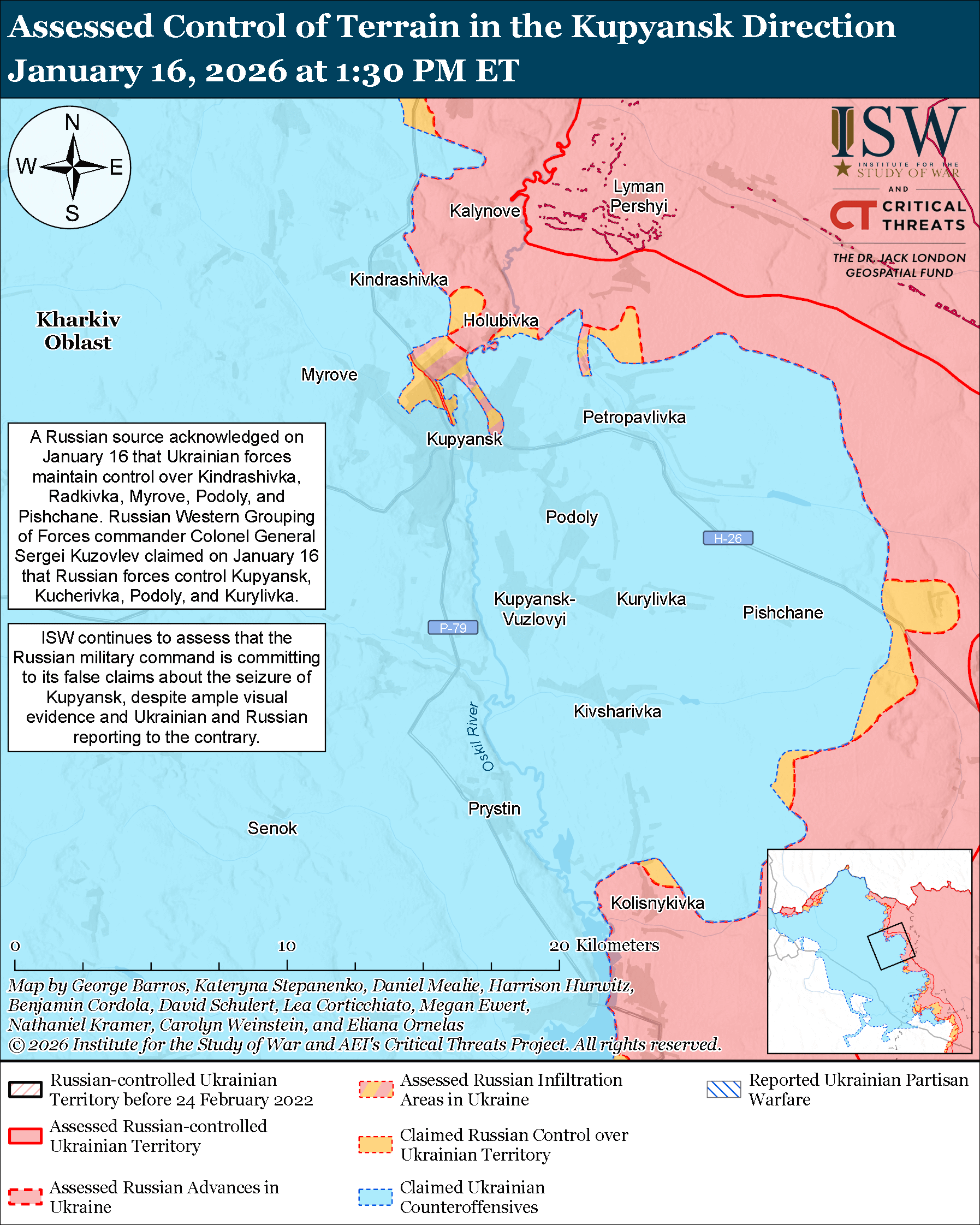
Russian milbloggers, including a Kremlin-affiliated milblogger and multiple pro-war ultranationalist milbloggers, vehemently refuted the Russian military command's repeated false claims about Kupyansk and nearby settlements. Russian milbloggers denied that Russian forces control Kupyansk, Kupyansk-Vuzlovyi, Podoly, Kurylivka, and Petropavlivka (east of Kupyansk), with some describing the Russian presence in Kupyansk as "several pockets of defense" and a "localized defense."[6] The Kremlin-affiliated milblogger stated that there is video evidence showing a Ukrainian presence within Kupyansk and Kupyansk-Vuzlovyi.[7] The milblogger stated that footage from about one week ago (roughly January 9) shows Russian artillery continuing to fire on Podoly, despite the Russian Ministry of Defense (MoD) claiming on January 4 that Russian forces had seized the settlement.[8] The milblogger stated that the Russian Western Grouping of Forces is "in no hurry" to stop sending "embellished" reports to higher-ups, directly citing Belousov's January 16 meeting with Kuzovlev as an example.
A Russian milblogger reporting on the Western Grouping of Forces stated that Gerasimov's presentation of a "parallel reality" failed to mention the surrounded Russian soldiers in Kupyansk, who held out "longer than anyone expected" but whom other Russian forces cannot reach.[9] The milblogger noted that only a "handful" of Russian forces have been able to reach Kupyansk-Vuzlovyi, but that Ukrainian forces have already destroyed them. The milblogger stated that a group of Russian forces was filming a flag-raising video in Kupyansk-Vuzlovyi (likely to support Russian officials' false claims of its seizure in the near future) before Ukrainian forces struck the group. The milblogger noted that the final moments of the video "will not be published anywhere." The milblogger stated that Russian forces only recently reached Petropavlivka and Podoly but have been unable to gain control over the settlements, despite Russian MoD claims that Russian forces seized them as of November 21 and January 4, respectively.[10]
One Russian milblogger stated in direct response to Belousov's January 16 meeting that statements about Russian control over Kupyansk are "not only inaccurate" but "do not even come close to reflecting the actual situation on the ground," as Russian forces have not controlled Kupyansk "for a single day."[11] Milbloggers widely complained about repeated "failures" in the area and criticized the practice of sending "beautiful reports" alleging Russian advances to higher-ups.[12] Russian milbloggers complained that the Western Grouping of Forces' practice of "groundlessly" claiming advances is leading to insufficient Russian countermeasures to the Ukrainian offensive to liberate the area, high losses "in the hundreds", difficulties in unit coordination, and "brutal" assaults.[13]
The Russian military command has displayed a clear pattern of publicly presenting false information about the battlefield as part of a wider cognitive warfare effort that aims to influence US decision-making about ongoing peace negotiations. These Kremlin claims aim to spread the false narrative that a Russian victory in Ukraine is inevitable and to convince Ukraine and the West that Ukraine should accept Russia’s demands now out of fear of future Russian offensives or breakthroughs. Kupyansk has become a particular point of neuralgia for the Russian military command, likely due to the fear that the battlefield realities in the area will undermine the narratives about Russia's military prowess that Putin and senior Russian military commanders have been trying to spread.
Falling Russian oil and gas revenues and Russia's continued depletion of its liquid reserves will likely complicate Kremlin efforts to fund a protracted war in Ukraine. Bloomberg reported on January 15 that Russian oil and gas revenues in 2025 dropped to a five-year low amid declining gas exports due to Western sanctions and falling crude oil prices.[14] The Russian Ministry of Finance stated on January 15 that Russia's federal budget received a total of 8.48 trillion rubles (roughly $108 billion USD) in oil and gas taxes in 2025, which Bloomberg noted is a decrease of 24 percent compared to 2024.[15] Bloomberg noted that Russia's federal budget received fewer rubles for each barrel produced and sold in 2025 due to the strengthened ruble. The strengthened ruble increased Russia's purchasing power on the global market, making parallel imports cheaper amid Western sanctions, but had adverse effects on Russia's export profits.[16] Russia's oil and gas revenues accounted for roughly 30 percent of Russia's total federal revenues in 2024 but fell 22 percent year on year in 2025.[17] Russian Finance Minister Anton Siluanov acknowledged in September 2025 that Russian authorities expect the share of Russia’s revenues from oil and gas sales to fall by roughly 30 percent in 2026.[18]
Russia has also gradually depleted its liquid reserves over the last four years of its war in Ukraine. Bloomberg reported that Russia has spent more than half of its sovereign wealth fund to bridge the widening gap between revenues and spending and has turned to expensive borrowing that will take years to pay back.[19] The sovereign wealth fund is a state-owned investment fund from which Russia pulls money to avoid incurring debt, but Russia has been steadily depleting the fund's liquid reserve to fund its war, including by selling its gold reserves in late November 2025.[20] Putin has grossly mismanaged Russia's economy, which is suffering due to unsustainably high spending on the Russian military and the Russian defense industrial base (DIB), significant labor shortages, and reductions in Russia's sovereign wealth fund.[21] ISW continues to assess that increased Western sanctions on Russia — in tandem with continued Western military support to Ukraine — will likely further impact the Russian economy and Russia's ability to fund a protracted war.[22]
Insufficient infrastructure investments in Russia's Far East are likely hurting Russian economic agreements with the People's Republic of China (PRC). Russian state business outlet Kommersant reported on January 16 that the PRC halted electricity purchases from Russia as of January 1 after Russian export prices rose above domestic Chinese prices for the first time.[23] Kommersant stated that the PRC refused to purchase the minimum contracted volumes under its long-term agreement, despite the contract running through 2037. Kommersant stated that electricity prices in Russia's Far East have been rising since the beginning of 2026 and that price dynamics indicate that electricity prices could be up to 42 percent higher than in January 2025. Kommersant credited the rising prices to "market liberalization" in the Far East. Russian President Vladimir Putin acknowledged in September 2024, however, that energy shortages in the Far East were holding back industrial and infrastructure projects, and Russian authorities have not maintained energy infrastructure in the region, causing power shortages and rising prices for residents.[24] Years of neglect of the Far East's infrastructure likely contributed to the shortages and price spikes that led to the PRC halting electricity purchases.
Ukrainian forces are countering recent Russian Shahed strike drone adaptations that allowed Russian forces to target Ukrainian aircraft, highlighting the short offense-defense technological cycle in the war. Ukrainian drone charity Wild Hornets posted footage on January 15 showing Ukrainian forces successfully using a Sting interceptor drone to down a Russian jet powered Shahed (Geran) drone equipped with an R-60 air-to-air missile.[25] Ukrainian electronic and radio warfare expert Serhiy “Flash” Beskrestnov reported on December 1 that Ukrainian forces downed for the first time a Russian Shahed drone equipped with an R-60 missile meant to destroy Ukrainian helicopters and tactical aircraft that hunt Shaheds, and Ukraine’s Main Military Intelligence Directorate (GUR) confirmed on December 15 that Russian forces modified their Shahed drones with the R-60 missiles.[26] Russian forces have continuously adapted their Shahed drones to maximize their damage potential, including a recent innovation of attaching man-portable air defense systems (MANPADS) to Shaheds to target mobile components of the Ukrainian air defense umbrella.[27] Ukrainian and Russian forces have been engaged in an offense-defense technological race throughout the full-scale invasion, and Ukrainian forces have repeatedly innovated new air defense measures to combat modifications to Russia's long-range strike campaign.[28] ISW continues to assess that Western support for Ukraine’s interceptor drone program is vital not only for Ukraine’s defense against Russian strikes against the frontline and the rear but also for the defense of Europe.[29]
Media reports suggest that a car accident seriously injured Adam Kadyrov, the son of Chechen Republic Head Ramzan Kadyrov and possible successor, but ISW cannot independently verify these reports. Two unspecified sources told Radio Free Europe/Radio Liberty's North Caucasus service Kavkaz Realii that Adam Kadyrov is unconscious in intensive care at a hospital in Grozny, Republic of Chechnya, following a car accident.[30] A Chechen opposition outlet claimed that Adam Kadyrov’s motorcade encountered an unidentified obstacle and crashed.[31] The outlet cited local reports about a large convoy of vehicles, including ambulances, driving toward the Grozny airport and authorities flying Kadyrov and other victims to Moscow City for medical treatment.[32] A source reportedly affiliated with Ukraine's Main Military Intelligence Directorate (GUR) told Ukrainian news agency Ukrinform on January 11 that Ramzan Kadyrov is undergoing inpatient dialysis for kidney failure and is in the process of selecting a new leader of the Republic of Chechnya.[33] Kadyrov previously appointed Adam, who is currently 18 years old, to a senior position within the Chechen government, and ISW has previously observed reports indicating that Kadyrov was likely planning on positioning Adam as his successor.[34]
Ukraine’s European partners announced new aid to support the Ukrainian military and energy grid. The Finnish Ministry of Defense (MoD) announced on January 16 that Finland will provide a military aid package worth 98 million euros (roughly $114 million) to Ukraine and that the contents of the package are classified.[35] Czech President Petr Pavel stated on January 16 that the Czech Republic will provide Ukraine with unspecified combat aircraft capable of downing drones and may also supply early warning systems, including passive radars.[36] United Kingdom Defense Secretary John Healy told Bloomberg on January 15 that the United Kingdom will open a business center in Kyiv City in 2026 to assist defense startups in accelerating sales of air defense systems and drones.[37] The United Kingdom announced on January 16 that it will provide 20 million pounds (roughly $26.7 million) to support repairs to Ukrainian energy infrastructure that intensified Russian strikes have damaged.[38] Ukrainian Deputy Prime Minister Oleksiy Kuleba reported on January 16 that Italy will provide Ukraine with about 80 industrial boilers worth a total of 1.85 million euros (roughly $2.1 million) and with capacities ranging from 550 to 3,000 kilowatts (kW).[39] Norwegian Foreign Minister Espen Barth Eide announced on January 12 that Norway will provide $200 million to Ukraine to restore energy infrastructure, including immediate energy needs and gas procurement.[40]
Key Takeaways:
- Russian milbloggers continue to loudly reject the alternate battlefield reality that Russian President Vladimir Putin and senior Russian military commanders are trying to create.
- The Russian military command has displayed a clear pattern of publicly presenting false information about the battlefield as part of a wider cognitive warfare effort that aims to influence US decision-making about ongoing peace negotiations.
- Falling Russian oil and gas revenues and Russia's continued depletion of its liquid reserves will likely complicate Kremlin efforts to fund a protracted war in Ukraine.
- Insufficient infrastructure investments in Russia's Far East are likely hurting Russian economic agreements with the People's Republic of China (PRC).
- Ukrainian forces are countering recent Russian Shahed strike drone adaptations that allowed Russian forces to target Ukrainian aircraft, highlighting the short offense-defense technological cycle in the war.
- Media reports suggest that a car accident seriously injured Adam Kadyrov, the son of Chechen Republic Head Ramzan Kadyrov and possible successor, but ISW cannot independently verify these reports.
- Ukraine’s European partners announced new aid to support the Ukrainian military and energy grid.
- Russian forces recently advanced near Slovyansk, Pokrovsk, and Hulyaipole.
Russian Offensive Campaign Assessment, January 15, 2026
Russian President Vladimir Putin continues to demonstrate that he will not be satisfied with a peace settlement that only pertains to Ukraine and does not radically restructure NATO. Putin claimed on January 15 that Russia’s war in Ukraine is a "direct response" to the West ignoring Russia’s interests by expanding NATO, despite alleged public promises to Russia not to do so.[1] Russia issued ultimatums in late 2021 to NATO that amounted to the destruction of the alliance and required an overhaul of the European security architecture, including demands that NATO roll back to its 1997 borders.[2] Putin has repeatedly demonstrated that his demands are greater than those encapsulated in the US-proposed 28-point plan and subsequent peace plans.[3] Putin remains committed to his original war goals from 2021 and 2022, which extend beyond territory and are not limited to Ukraine.
The Kremlin continues to forward the false narrative that Ukraine’s defenses are on the verge of collapse, but data on Russian gains since the start of the full-scale invasion demonstrates otherwise. Kremlin Spokesperson Dmitry Peskov claimed on January 15 that the situation is deteriorating for Ukraine every day and that Ukraine's "corridor for decision-making" is "narrowing," implying that Ukraine should give in to Russia's demands now before Ukraine is unable to defend itself and must capitulate in the future.[4] Ukrainian defenses are not on the verge of collapse, however, and Ukrainian forces have been able to prevent Russian forces from militarily achieving Russian President Vladimir Putin's goal of subjugating all of Ukraine. At the height of Russian gains in Ukraine in March 2022, Russian forces had seized 26.16 percent of Ukraine. The subsequent Ukrainian counteroffensive to push Russian forces back from Kyiv City and northern Ukraine, however, reduced this to 20.21 percent by the end of April 2022. Russia's territorial control continued to decrease to 17.84 percent by the end of 2022 following Ukraine's Kharkiv and Kherson counteroffensives. The extent of Russia's control over Ukraine stayed relatively constant in 2023, 2024, and 2025. Russian forces controlled between 17.9 and 18.52 percent of Ukraine in 2023 and 2024, and this figure rose to 19.32 percent by the end of 2025. Russian forces have thus occupied an additional 1.5 percent of Ukraine's territory in the last three years. Russian gains have been marginal and reduced to a foot pace as Russian forces have had to resort to highly attritional infantry-led assaults and have been unable to restore mechanized maneuver to the battlefield. Russian gains will likely continue to be slow and grinding and are unlikely to lead to a quick collapse of the frontline.
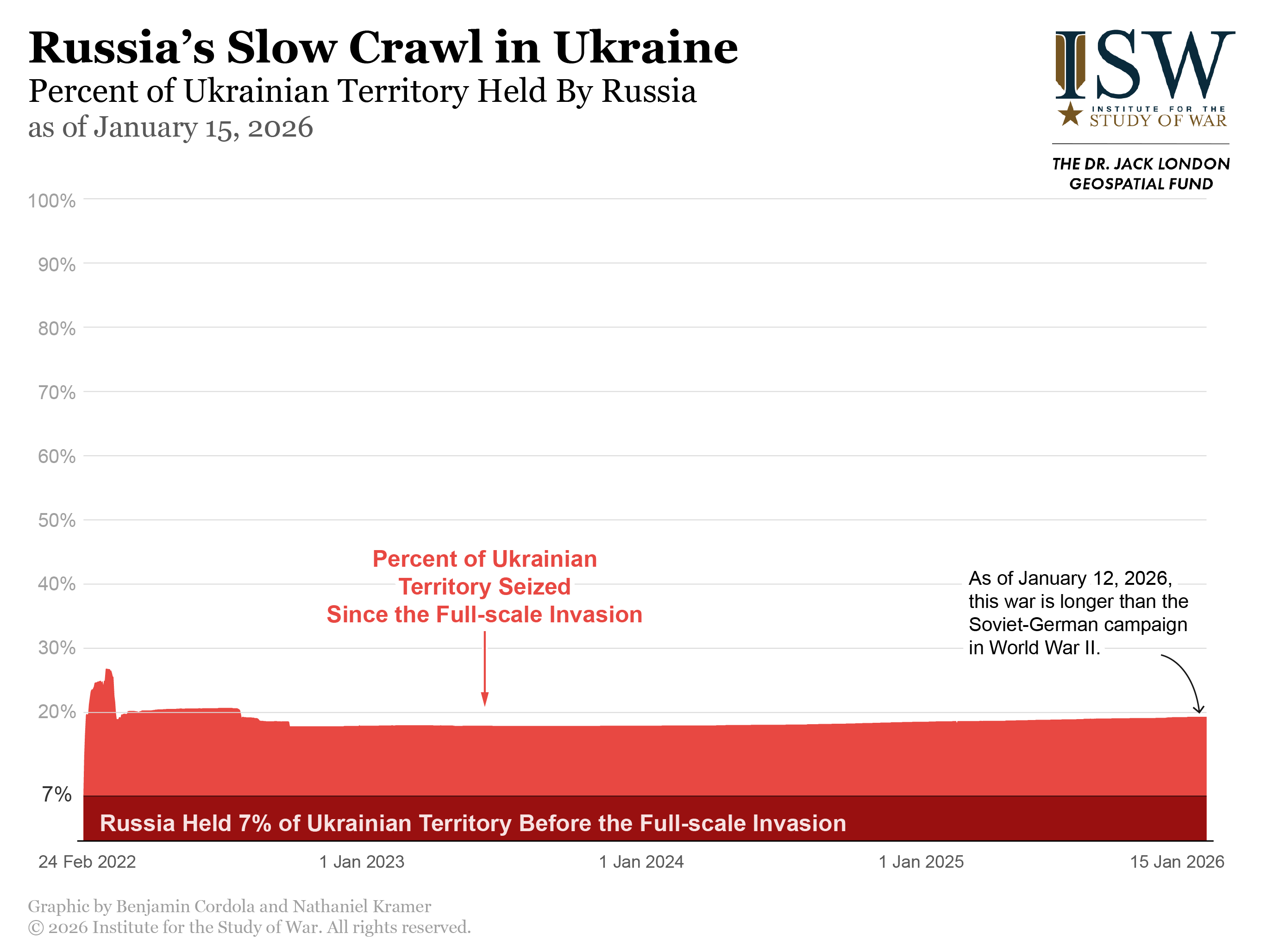
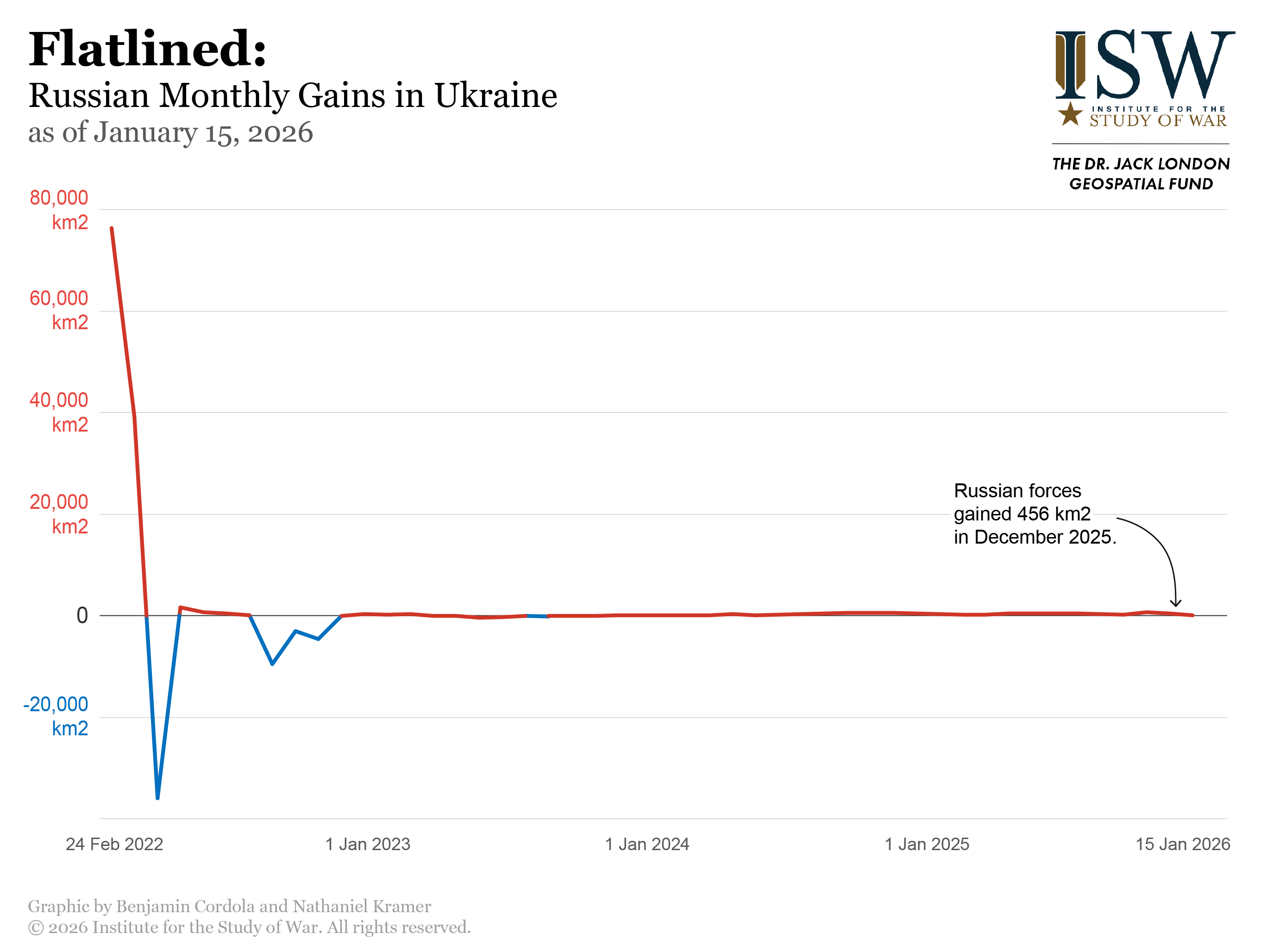
Russian General Staff Army General Valery Gerasimov continues to offer demonstrable lies and exaggerations about Russian battlefield gains to forward the Kremlin's false narrative that a Russian military victory is inevitable. Gerasimov claimed on January 15 that Russian forces are advancing in virtually all directions on the front and that Ukrainian attempts to stop Russian advances have been unsuccessful.[5] Gerasimov claimed that Russian forces seized more than 300 square kilometers of territory in the first two weeks of January 2026.[6] ISW has observed evidence indicating that Russian forces increased their presence (either through infiltration missions or assaults) in only 73.82 square kilometers between December 31 and January 13 — about one-quarter of the gains that Gerasimov claimed.
Gerasimov boasted about the seizure of two small, rural border villages in northern Ukraine as alleged evidence of extensive Russian successes on the battlefield. Gerasimov stated that Russian forces are expanding the buffer zone in Sumy and Kharkiv oblasts and specifically highlighted the recent seizure of Hrabovske (southwest of Sumy City) and claimed seizure of Komarivka (northwest of Sumy City).[7] The frontline in these areas has been largely dormant for years, and the recent limited Russian cross-border attacks into these small villages in late December 2025 and mid-January 2026 likely aimed to generate informational effects.[8] The Kremlin is trying to portray these small-scale attacks as the opening of a new sector of the front and evidence that Ukrainian defenses are collapsing across the theater. ISW continues to assess, however, that there are no indications that Russian forces are launching a major ground offensive in these areas.[9]
The Russian military command remains committed to its false claims that Russian forces have seized Kupyansk, despite ample visual evidence and Ukrainian and Russian reporting to the contrary. Gerasimov claimed that elements of the Russian Western Grouping of Forces continue to eliminate the surrounded Ukrainian forces on the east back of the Oskil River in the Kupyansk direction.[10] Gerasimov claimed that Ukrainian forces have tried to "demonstrate their presence" within Kupyansk, including through flag raisings, since the Russian military command claimed to have seized the town in November 2025.[11] Gerasimov claimed that Russian forces are engaged in street fighting in Kupyansk-Vuzhlovyi (south of Kupyansk) and are completing the seizure of the settlement.[12] Ukrainian forces have largely liberated most of Kupyansk and the surrounding area, however, despite Russian Western Grouping of Forces Commander Colonel General Sergei Kuzovlev claiming on December 29 that Russian forces will complete the encirclement of Ukrainian forces in Kupyansk in January to February 2026.[13] Ukrainian forces are currently clearing the remaining Russian forces in the town, and President Volodymyr Zelensky reported on December 22 that only about 80 to 100 Russian servicemembers remained in the settlement.[14] Ukrainian forces have also largely eliminated the Russian presence near Kupyansk-Vuzhlovyi, demonstrating the extent of Gerasimov's exaggerations. ISW only observed evidence on January 8 of Russian forces conducting an infiltration mission into eastern Podoly (just northeast of Kupyansk-Vuzhlovyi) and has not observed evidence of a Russian presence in or near Kupyansk-Vuzhlovyi since then.[15] Russian milbloggers, including many within the pro-war ultranationalist community, have acknowledged that the Russian military command's repeated claims about Kupyansk are false.[16] Gerasimov's January 15 claims are part of a demonstrated Kremlin pattern of publicly presenting false information about the battlefield. These Kremlin efforts aim to spread the false narrative that a Russian victory in Ukraine is inevitable and to convince Ukraine and the West that Ukraine should accept Russia's demands now out of fear of future Russian offensives.
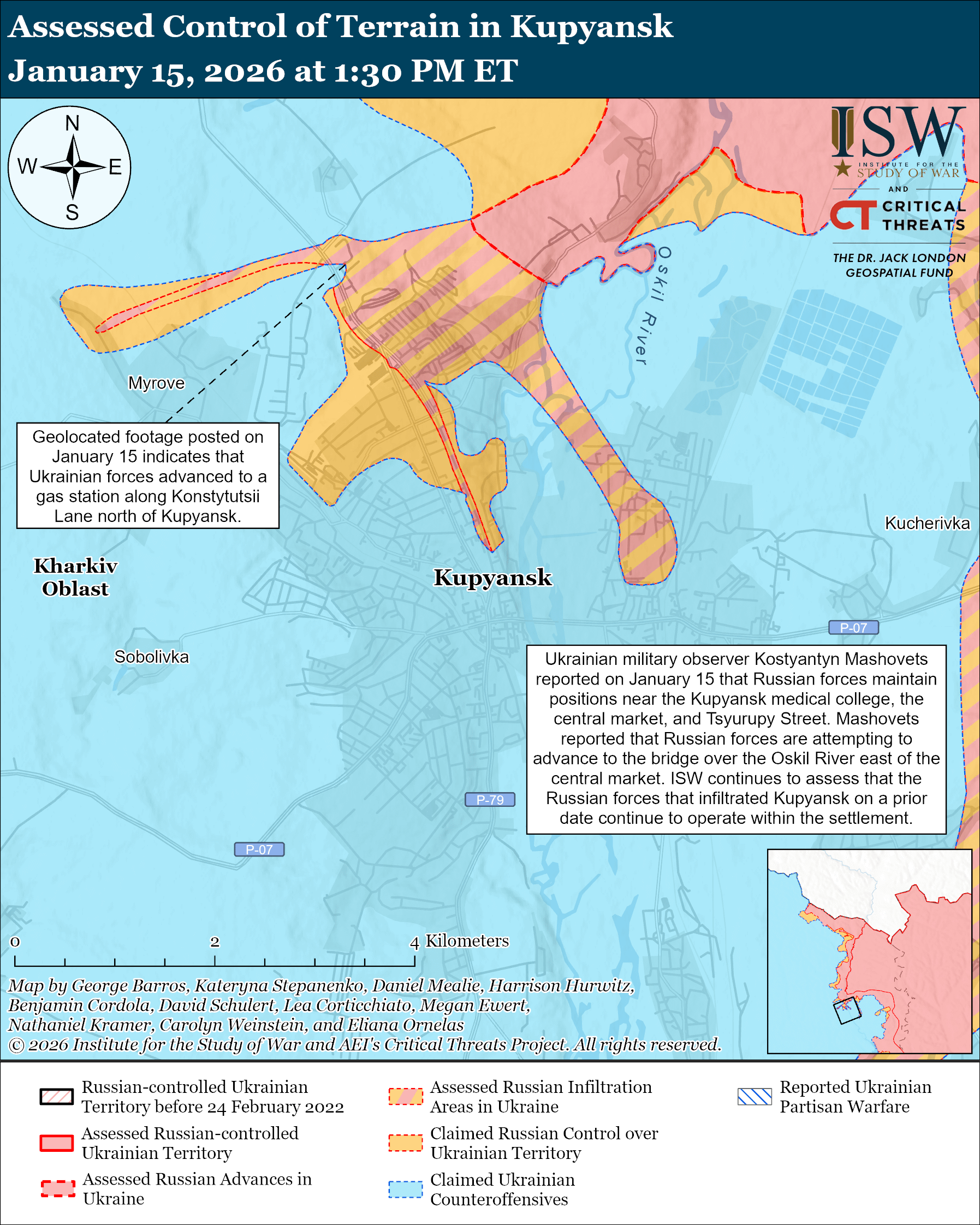
Key Takeaways:
- Russian President Vladimir Putin continues to demonstrate that he will not be satisfied with a peace settlement that only pertains to Ukraine and does not radically restructure NATO.
- The Kremlin continues to forward the false narrative that Ukraine’s defenses are on the verge of collapse, but data on Russian gains since the start of the full-scale invasion demonstrate otherwise.
- Russian General Staff Army General Valery Gerasimov continues to offer demonstrable lies and exaggerations about Russian battlefield gains to forward the Kremlin's false narrative that a Russian military victory is inevitable.
- The Russian military command remains committed to its false claims that Russian forces have seized Kupyansk, despite ample visual evidence and Ukrainian and Russian reporting to the contrary.
- Gerasimov's January 15 claims are part of a demonstrated Kremlin pattern of publicly presenting false information about the battlefield. These Kremlin efforts aim to spread the false narrative that a Russian victory in Ukraine is inevitable and to convince Ukraine and the West that Ukraine should accept Russia's demands now out of fear of future Russian offensives.
- Ukrainian forces recently advanced near Kupyansk, Slovyansk, and in the Kostyantynivka-Druzhkivka tactical area. Russian forces recently advanced near Pokrovsk.
Russian Offensive Campaign Assessment, January 14, 2026
Russian advances slowed in late December 2025 and early January 2026, likely due to less advantageous winter weather conditions and the end of efforts to meet arbitrary deadlines at the end of the year. ISW observed evidence indicating that Russian forces increased their presence (either through infiltration missions or assaults) in 276.44 square kilometers of Ukraine between December 1 and 17; 89.05 square kilometers between December 17 and 31; and 73.82 square kilometers between December 31 and January 13. The 7-day moving average of Russian gains in late 2025 peaked on December 1 and 2 and then steadily declined through the end of the year. Russian forces were able to take advantage of poor weather conditions in Fall and early Winter 2025 that hindered Ukrainian drone operations to make relatively faster advances.[1] ISW previously noted, however, that these advantageous weather conditions were not permanent.[2] Russian forces are likely struggling to maintain this faster rate of advance as colder temperatures have set in, complicating Russian forces' ability to successfully implement their new offensive template that heavily relies on infantry infiltration missions that must traverse dozens of kilometers of territory on foot with limited supplies.[3] Russian forces may also have initially increased their tempo of offensive operations in December 2025 in order to meet demands from the Russian military command to reach certain objectives by the end of the year.
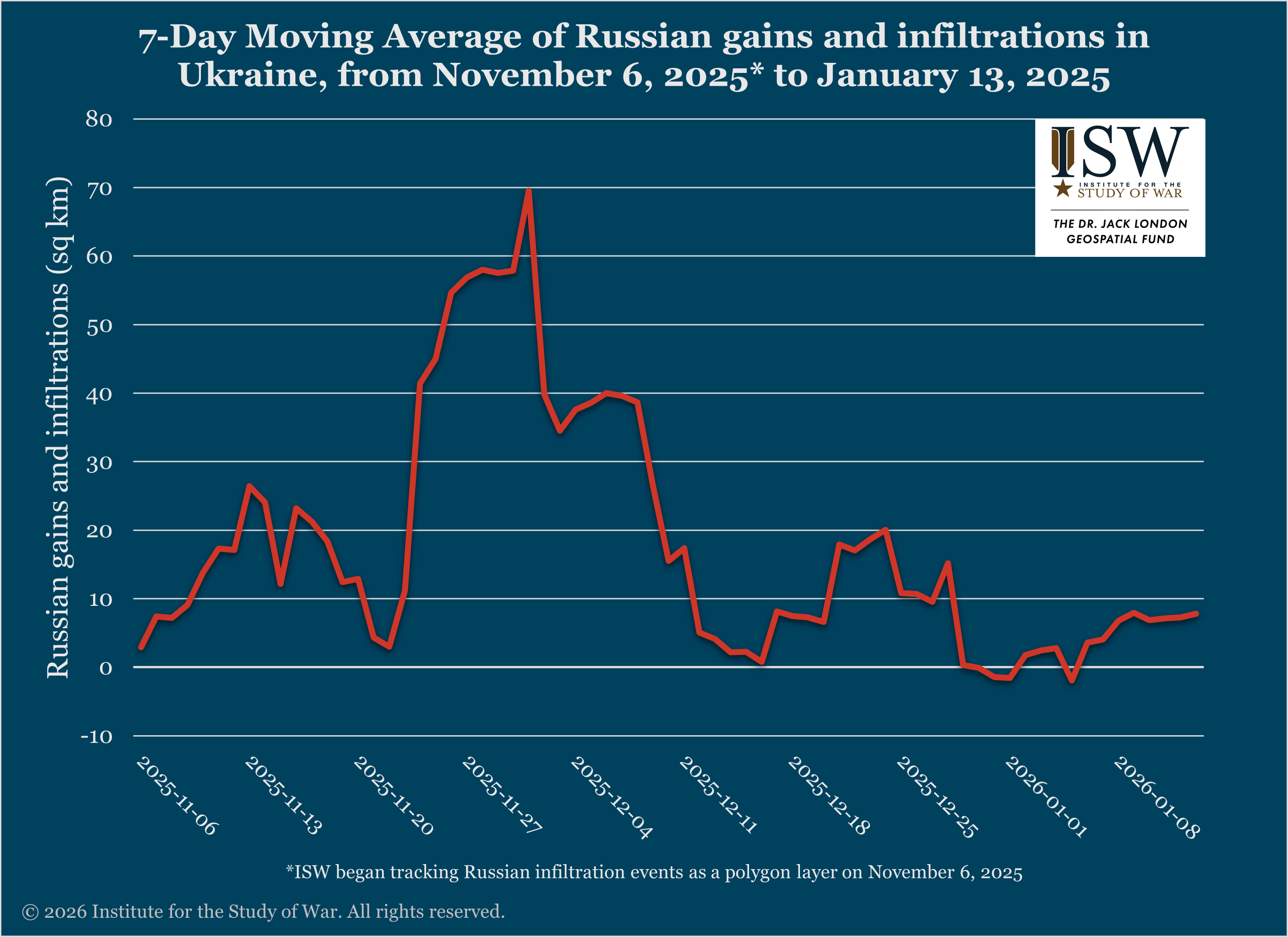
Russian Foreign Minister Sergei Lavrov indicated that Russia's objectives in Ukraine go beyond the territory that is currently under discussion in the latest peace plans to include all of Kharkiv, Dnipropetrovsk, Mykolaiv, and Odesa oblasts. Lavrov stated on January 14 that a future peace settlement will need to resolve the "issue of the fate of the people living in Crimea, Novorossiya, and Donbas."[4] Novorossiya is an invented region that Kremlin officials often claim is “integral” to Russia.[5] Novorossiya includes not only Crimea and the four oblasts that Russia has illegally annexed, but also Kharkiv, Dnipropetrovsk, Mykolaiv, and Odesa oblasts. Kremlin officials have repeatedly labelled Odesa City a “Russian” city and publicly discussed “Novorossiya” as a part of the Russian Federation.[6] The US-proposed 28-point peace plan only allowed for Russian occupation of Crimea, all of Luhansk and Donetsk oblasts, and the currently occupied parts of Zaporizhia and Kherson oblasts, requiring Russia to cede occupied territories outside of these five regions, including in Kharkiv, Mykolaiv, and Dnipropetrovsk oblasts.[7] Lavrov's January 14 reference to Novorossiya is not a new demand but is further evidence that Russia's demands are greater than those encapsulated in the original 28-point plan. Lavrov's statement was likely an attempt to set conditions ahead of a possible upcoming meeting between US Special Envoy to the Middle East Steve Witkoff, former Senior Advisor to the US President Jared Kushner, and Russian President Vladimir Putin in Russia.[8]
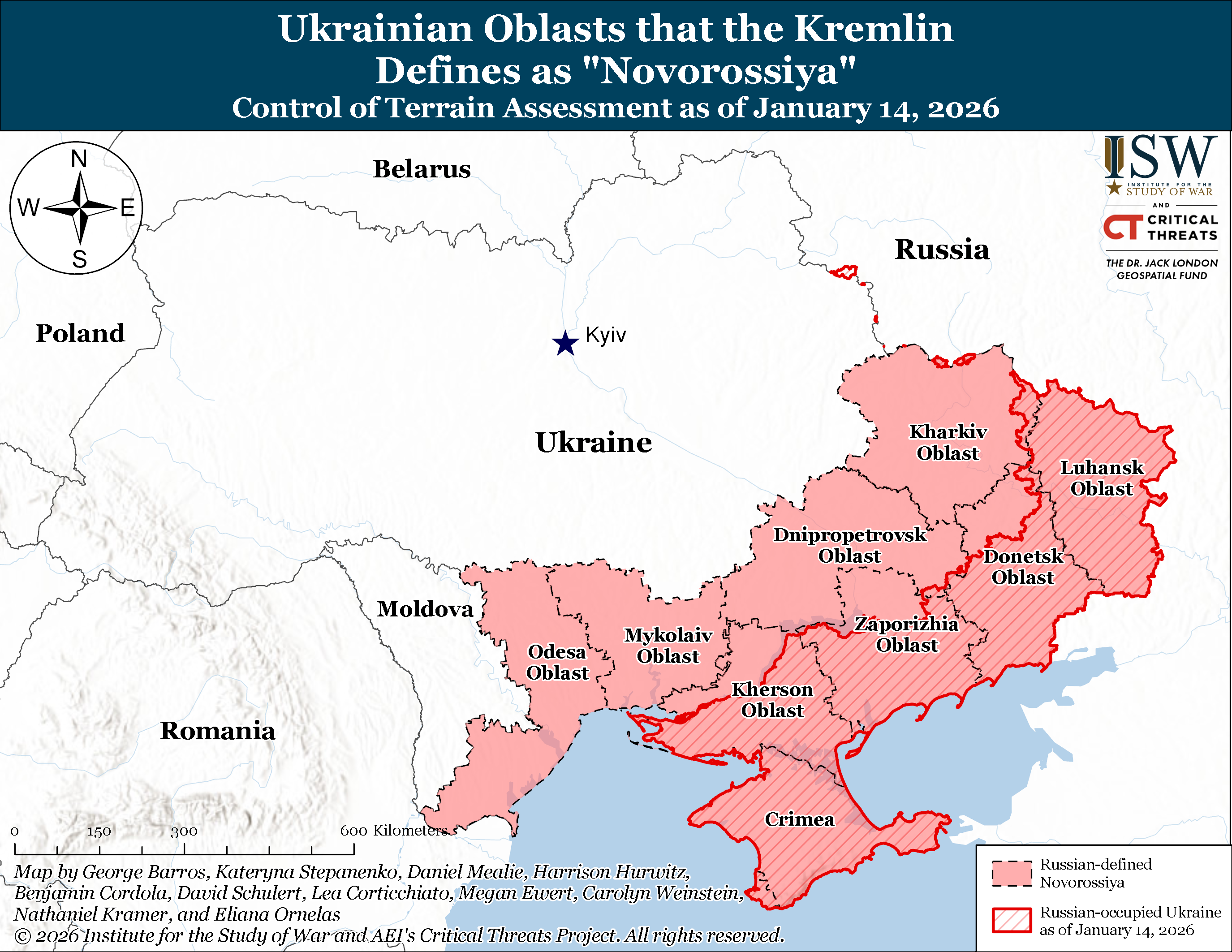
Kremlin officials continue to insist that the United States, Ukraine, and Europe accept Russian demands, rejecting recent US-led peace efforts to find compromises to end the war. Lavrov claimed on January 14 that Russia is willing to negotiate with Europe but dismissed discussions of either a permanent or 60-day ceasefire.[9] Ukrainian President Volodymyr Zelensky has called for a temporary ceasefire to allow Ukraine to hold elections as a step toward ending Russia's war.[10] Kremlin officials have repeatedly called for elections in Ukraine, yet Lavrov's statement is a rejection of the very measures necessary for Ukraine to fulfill these demands.[11] Lavrov also claimed that a ceasefire would allow the West more time to support Ukraine, obfuscating the fact that the Kremlin has been delaying the peace process for months in order to protract the war and achieve Russia's original war aims through military means.[12]
Russian State Duma deputies similarly dismissed the peace proposals currently under discussion within the US-led peace process. Duma Defense Committee Member Andrei Kolesnik stated that Russia is only open to negotiations with Europe about "something tangible," "not just meaningless, formal documents," possibly referring to the US-Ukrainian-European 20-point peace plan or agreements on security guarantees currently under discussion within the Coalition of the Willing.[13] Kolesnik stated that Europe must present approaches that Russia can "at least discuss." Duma Deputy from occupied Crimea Mikhail Sheremet reiterated Kremlin statements that foreign troops sent to post-war Ukraine to guarantee a settlement would be "legitimate" targets for the Russian military.[14] Lavrov's and the Duma deputies' statements come against the backdrop of reports that four unspecified Duma deputies are going to meet with members of the US Congress to discuss peace talks in the near future.[15] The Kremlin statements continue to demonstrate that Russia is increasingly uninterested in discussing the agreements that have emerged from the peace process that US President Donald Trump has been leading since the presentation of the November 2025 28-point peace plan.
Russian forces are continuing their cognitive warfare campaign that uses small-scale cross-border attacks in previously dormant frontline areas in northern Ukraine to try to convince the West that the frontlines in Ukraine are collapsing. The Russian Ministry of Defense (MoD) claimed on January 14 that Russian forces seized Komarivka, a border settlement roughly 90 kilometers northwest of Sumy City and about 67 kilometers north of the main Russian salient in northern Sumy Oblast.[16] The Russian MoD claimed that the seizure is part of efforts to establish a "buffer zone" in northern Kharkiv and Sumy oblasts.[17] ISW has not observed evidence to confirm the MoD's claim, and Russian milblogger reporting on the claimed seizure was limited. Select Russian milbloggers mostly amplified the MoD's claim, with some attributing the alleged seizure to elements of the Russian 80th Arctic Motorized Rifle Brigade (14th Army Corps [AC], Leningrad Military District [LMD]).[18] The Kremlin began in late December 2025 a cognitive warfare campaign using cross-border attacks with the seizure of Hrabovske (southwest of Sumy City and immediately on the international border) and advances into Sotnytskyi Kozachok (northwest of Kharkiv City, immediately on the international border).[19] ISW continues to assess that the Kremlin likely aims to portray these limited cross-border attacks as a broad new Russian offensive that reinforces the Kremlin's narrative that a Russian military victory in Ukraine is inevitable.[20]
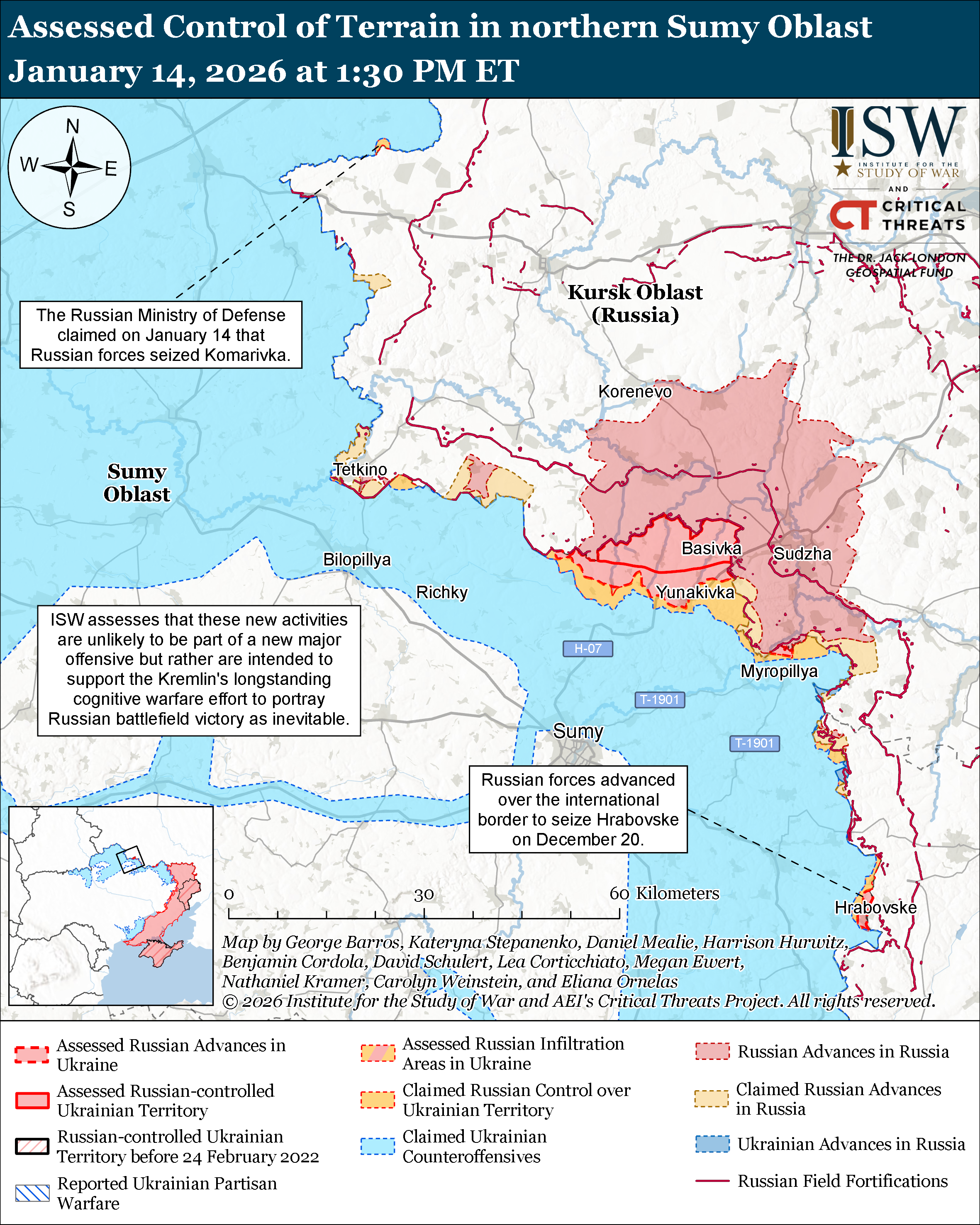
Russian forces have still not set conditions for a major ground offensive in northern Sumy or Kharkiv oblasts, however, and ISW continues to assess that these cross-border attacks are not part of a major Russian offensive. The frontline near Komarivka has been dormant since 2022, and ISW has not observed any indicators that Russian forces have prepared to launch a significant new offensive into Ukraine from the north. Russian forces have not conducted a sustained battlefield air interdiction (BAI) campaign to degrade Ukrainian logistics to defensive positions and to prepare the battlefield for ground assaults along the international border in northern Sumy and Kharkiv oblasts, as Russian forces did in the Pokrovsk and Hulyaipole directions.[21] ISW also has not observed indications of a major redeployment of Russian forces to conduct such an offensive. ISW has most often observed reports of the 80th Arctic Motorized Rifle Brigade operating in Kherson Oblast, but elements of its 33rd Motorized Rifle Battalion have reportedly been operating in border areas in northern Ukraine since at least Winter 2024-2025.[22]
The recent Russian cross-border attacks near Hrabovske and Sotnytskyi Kozachok have not resulted in any notable Russian advances since they began on December 20 and 21, indicating that the Russian military command is not redeploying the additional forces that would be needed to conduct a major offensive in the area.[23] The areas that Russian forces have been targeting in these various cross-border attacks are small border villages, and Russian forces have not made significant advances toward any operationally significant objective. The Kremlin will nonetheless likely attempt to portray these limited cross-border attacks against rural villages as part of a broad new Russian offensive in order to reinforce the false narrative that Ukrainian defenses are collapsing across the theater and that a Russian military victory in Ukraine is inevitable.[24] ISW continues to assess that the frontlines in Ukraine are in no danger of imminent collapse — particularly as the rate of Russian advance has slowed in recent weeks.[25]
Russian Foreign Minister Sergei Lavrov highlighted Russia's partnerships with Venezuela and Iran on January 14 while criticizing the Trump Administration's recent actions in Venezuela. Lavrov stated on January 14 that Russia remains committed to maintaining strategic relations and agreements with Venezuela and condemned recent US military operations in Venezuela.[26] Lavrov also responded to potential US tariffs against countries doing business with Iran, stating that no third party can change the "fundamental nature of relations" between Russia and Iran. Lavrov claimed that the United States abandoned its principles, showing that the United States is "unreliable" and that its "competitive position" is "steadily deteriorating." Russia has relied heavily on Iran for weapons supplies and technology, particularly to fuel Russia's long-range drone strikes against Ukraine throughout the full-scale invasion.[27] Russia signed strategic partnership agreements with Iran and Venezuela in January and May 2025, respectively.[28]
The Ukrainian Verkhovna Rada approved several personnel changes within the Ukrainian government on January 14. The Rada approved former Minister of Digital Transformation Mykhailo Fedorov as the new minister of defense on January 14.[29] The Rada also approved former Ukrainian Defense Minister Denys Shmyhal as the new minister of energy and first deputy prime minister.[30] Ukrainian President Volodymyr Zelensky stated on January 14 that Fedorov will prioritize finding systematic solutions to Ukraine's mobilization and recruitment problems, increasing Ukrainian air defenses, and auditing defense financing.[31] Zelensky stated that Fedorov will also focus on increasing drone supplies to Ukrainian forces, including by purchasing specialized drones to strike Russian forces at a greater depth from the front.
Polish officials reported that Russia conducted cyberattacks against the Polish energy grid in late December 2025. Polish Deputy Prime Minister and Digital Affairs Minister Krzysztof Gawkowski reported on January 13 that Russia launched a cyberattack on Poland’s energy infrastructure at the end of December 2025 that risked causing a blackout in Poland.[32] Polish Energy Minister Milosz Motyka stated that the attack was the largest cyberattack against Poland's energy infrastructure in recent years, and targeted a thermal power plant and several renewable energy sources across Poland.[33] The Russian cyberattack is likely part of the Kremlin’s ”Phase Zero” campaign aimed at setting political, informational, and psychological conditions for a potential future war against NATO.[34]
Key Takeaways:
- Russian advances slowed in late December 2025 and early January 2026, likely due to less advantageous winter weather conditions and the end of efforts to meet arbitrary deadlines at the end of the year.
- Russian Foreign Minister Sergei Lavrov indicated that Russia's objectives in Ukraine go beyond the territory that is currently under discussion in the latest peace plans to include all of Kharkiv, Dnipropetrovsk, Mykolaiv, and Odesa oblasts.
- Kremlin officials continue to insist that the United States, Ukraine, and Europe accept Russian demands, rejecting recent US-led peace efforts to find compromises to end the war.
- Russian forces are continuing their cognitive warfare campaign that uses small-scale cross-border attacks in previously dormant frontline areas in northern Ukraine to try to convince the West that the frontlines in Ukraine are collapsing.
- Russian forces have still not set conditions for a major ground offensive in northern Sumy or Kharkiv oblasts, however, and ISW continues to assess that these cross-border attacks are not part of a major Russian offensive.
- Russian Foreign Minister Sergei Lavrov highlighted Russia's partnerships with Venezuela and Iran on January 14 while criticizing the Trump Administration's recent actions in Venezuela.
- The Ukrainian Verkhovna Rada approved several personnel changes within the Ukrainian government on January 14.
- Polish officials reported that Russia conducted cyberattacks against the Polish energy grid in late December 2025.
- Neither Russian nor Ukrainian forces made confirmed advances on January 14.
Russian Offensive Campaign Assessment, January 13, 2026
Russian strikes caused significantly more civilian casualties in Ukraine in 2025 compared to previous years. Bloomberg reported on January 12 that a comprehensive assessment by unspecified European governments found that Russian strikes killed roughly 2,400 Ukrainian civilians and injured almost 12,000 in 2025 — nearly a 30 percent increase from 2024.[1] The report noted that Russian strikes killed over 2,000 civilians (about 83 percent of the total 2025 deaths) after US President Donald Trump's March 2025 phone call with Russian President Vladimir Putin, in which they agreed to start talks toward a ceasefire, and that Russian strikes killed over 220 of these civilians after the initial reports about the 28-point peace plan in November 2025. The UN Human Rights Monitoring Mission in Ukraine (HRMMU) similarly reported on January 12 that conflict-related violence in Ukraine killed 2,512 civilians and injured 12,142 in 2025 — 31 percent higher than in 2024 and 70 percent higher than 2023.[2] The UN HRMMU noted that Russian strikes against Ukrainian-controlled areas caused 97 percent of the total civilian casualties in 2025. The UN HRMMU reported that Russia conducted its deadliest individual strike of 2025 on November 19 against Ternopil City, which killed at least 28 and injured at least 99.
Russia dramatically increased the size, scale, and destructiveness of its strike packages throughout 2025, which likely contributed to the increase in civilian casualties. Russian forces only launched three strike packages containing over 200 projectiles in 2024, with the largest consisting of 287 projectiles in December 2024.[3] In contrast, Russian forces launched 42 strike packages containing over 300 projectiles in 2025, with the largest comprised of 823 projectiles in September 2025.[4] Bloomberg noted that the European government report found that Russian strikes have killed roughly 15,000 civilians and injured more than 40,000 since the start of the full-scale invasion in February 2022.[5] Ukrainian Ground Forces Commander Colonel General Oleksandr Syrskyi reported on January 13 that Russian forces have launched over 13,300 missiles and 142,300 drones against Ukraine since the start of the full-scale invasion.[6] Russia has been able to dramatically increase the size and frequency of its strike packages by scaling up production with support from partners such as North Korea, Iran, and the People's Republic of China (PRC).[7] The makeup of Russian strike packages and Russian strike tactics have also increased civilian harm, as ISW previously reported.[8]
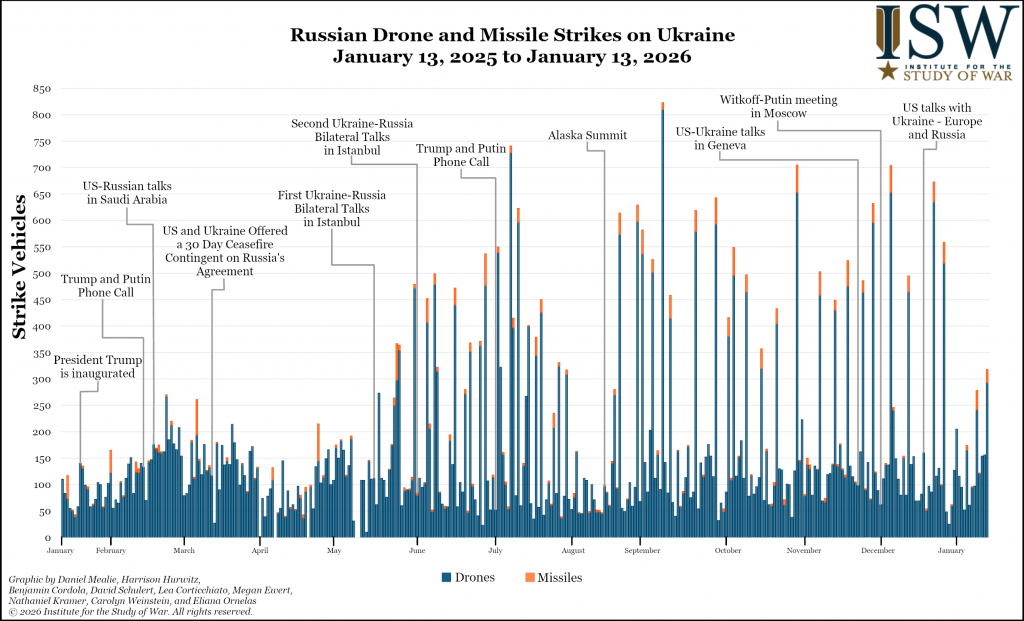
Russian forces conducted a series of missile and drone strikes against Ukraine on the night of January 12 to 13 that significantly damaged energy infrastructure throughout Ukraine and hit a postal terminal in Kharkiv Oblast. The Ukrainian Air Force reported that Russian forces launched 18 Iskander-M ballistic missiles/S-300 air defense missiles from Kursk, Bryansk, and Voronezh oblasts and seven Iskander-K cruise missiles from Kursk and Belgorod oblasts.[9] The Ukrainian Air Force reported that Russian forces also launched 293 Shahed-type, Gerbera-type, and other drones — of which about 200 were Shahed-type drones — from the directions of Oryol and Kursk cities; Shatalovo, Smolensk Oblast; Millerovo, Rostov Oblast; Primorsko-Akhtarsk, Krasnodar Krai; and occupied Kacha, Crimea. The Ukrainian Air Force reported that the Russian ballistic missiles targeted Kharkiv, Zaporizhia, Dnipropetrovsk, and Kyiv oblasts and that Ukrainian forces downed two Iskander-M/S-300 missiles, five Iskander-K missiles, and 240 drones as of 0930 local time on January 13. The Ukrainian Air Force reported that an unspecified number of missiles and 48 drones struck 24 locations. Ukrainian officials reported that Russian forces struck residential, educational, railroad, port, and energy infrastructure in Dnipropetrovsk, Zhytomyr, Zaporizhia, Kyiv, Odesa, Sumy, Kharkiv, and Donetsk oblasts.[10] Ukrainian President Volodymyr Zelensky stated that Russian strikes largely targeted energy generation infrastructure and substations.[11] Ukraine’s largest private energy company, DTEK, reported that Russian strikes significantly damaged two power facilities in Odesa City, leaving 46,000 families without power.[12] Ukrainian officials reported that Russian forces struck a postal terminal in Kharkiv Oblast with two missiles and then four drones, killing four civilians.[13] Russian forces often launch no or few missiles for multiple days in a row before launching strike packages with a significant quantity of missiles, likely stockpiling their missiles between strike series in order to launch larger strike packages to maximize damage against Ukraine.[14] Zelensky warned on January 12 that Ukrainian intelligence has information that Russian forces are preparing a new massive drone and missile strike, possibly in the coming days.[15] Zelensky noted that Russian forces are trying to take advantage of the cold weather in Ukraine, likely to maximize the consequences of strikes on the Ukrainian energy grid. Zelensky similarly warned about a new massive Russian strike on the afternoon of January 8 before the Russian Oreshnik ballistic missile strike on Lviv Oblast on the night of January 8 to 9.[16]
Ukrainian officials reported on January 12 that Russian drones also struck two vessels in the Black Sea — a Panamanian-flagged civilian vessel waiting to enter the port of Chornomorsk, Odesa Oblast, and a San Marino-flagged dry cargo ship that was leaving the port.[17] The Russian Rubikon Center for Advanced Unmanned Technologies posted geolocated footage on January 12 showing drone strikes against two cargo ships near Odesa City. Russian milbloggers claimed that Rubikon elements struck the two foreign-flagged ships with BM-35 strike drones.[18] Rubikon elements conducted drone strikes against a Ukrainian helicopter in Poltava Oblast and a transport aircraft in Mykolaiv Oblast in late December 2025, demonstrating how Rubikon is becoming increasingly involved in strikes in the Ukrainian rear.[19]
Russia continues to scale up the production and innovation of inexpensive strike drones that have succeeded in generating favorable battlefield effects for Russian forces. Russian forces have recently begun equipping Molniya-2 fixed-wing first-person view (FPV) drones with Starlink satellite systems, which has dramatically increased their battlefield efficiency.[20] Ukrainian military observer Kostyantyn Mashovets reported on January 13 that Russia has heavily invested in the production of Molniya-2 variants, but that reports that Russia spent over $1 billion to produce over 900,000 such drones from January to August 2025 are exaggerated by at least double.[21] Mashovets noted that the Molniya-2 drone is resistant to electronic warfare (EW) jamming, is sometimes equipped with Starlink terminals, and has a favorable price to performance ratio for Russian forces. Russia's Rubikon Center for Unmanned Technologies began employing Starlink-enabled Molniya-2 variants in December 2025, reportedly increasing the range of this drone variant to over 230 kilometers compared to 50 kilometers (the range of Molinyas operating on a mobile network).[22] Russia has been expanding and scaling drone production and adaptation to support its ongoing efforts to generate battlefield air interdiction (BAI) effects across the frontline.[23] Russia's BAI campaign involves strikes against important logistics targets in the Ukrainian near- and operational-rear, including roads, railways, and bridges, to facilitate subsequent Russian offensive operations in the weeks and months that follow by degrading Ukraine’s ability to sustain its frontline forces.[24] Russian technological adaptations have facilitated recent Russian advances, and Russia will likely continue to focus on scaling the production of inexpensive drones that have proven effective in the current battlespace.
Russian forces are struggling with other technological aspects of the battlespace, however, including with the effectiveness of some guided artillery munitions. Mashovets reported that current success rate of Russia's Krasnopol guided artillery munitions was around 50 percent as of November 2025, compared to 66 to 67 percent in 2022 when Russian forces first began widely using Krasnopols, and a peak effectiveness of over 70 percent at an unspecified time.[25] Mashovets noted that there are several variables limiting the effectiveness of this munition on the frontline. Mashovets reported that Ukrainian electronic warfare (EW) jamming is responsible for 75 to 80 precent of Krasnopol guidance system failures or guidance system instability. Mashovets noted that Krasnopol crews cannot conduct reconnaissance on the ground under threat of Ukrainian drone strikes, and that drone spotting for Krasnopol strikes is also ineffective and can contribute to premature detonation. Mashovets stated that most munition targeting systems are also not optimized for terrain obstacles including heavy vegetation and dense urban areas.[26] Mashovets noted that the Krasnopol-D variant can conduct strikes in suboptimal terrain conditions but that the Russian military command heavily restricts the use of these munitions to frontline areas where Russian forces are focusing on offensive operations. Russian forces have sought to improve the Krasnopol munition's ability to operate under suboptimal weather, terrain, and EW conditions, but Mashovets' January 13 report indicates that Russia has failed to implement these improvements at the scale necessary to increase the munition's overall performance in the current battlespace environment.[27]
Western sanctions on aircraft components will likely continue to constrain Russia's ability to produce military aircraft. Russia plans to significantly replenish the Russian Aerospace Forces (VKS) in 2026 to both replace losses and further enhance VKS capabilities, but will likely struggle to achieve replenishment or modernization at scale.[28] Russian Prime Minister Mikhail Mishustin stated in July 2025 that the Russian government planned to allocate at least 765 billion rubles ($9.6 billion) for fixed-wing and rotary-wing aircraft production from 2026 to about 2031.[29] Mashovets reported on January 13 that the VKS hopes to receive 82 aircraft and 84 helicopters in 2026, including two Tu-169M2 strategic bombers; seven Il-78 aerial refueling aircraft; 47 tactical fighter airframes, including 13 Su-57 steals, two Su-30SM2s, 17 Su-35Ss, and 15 Su-34NVO frontline bombers; 26 training aircraft; 59 attack helicopters, including 20 Ka-52Ms, 34 Mi-28NMs, five Ka-35s, and one land version of the Ka-31 naval military helicopter; and 25 transport and combat helicopters.[30] Russia has struggled to produce, repair, and modernize its military aircraft throughout the war, amid ongoing sanctions, persistent quality issues, and manufacturing delays, however.[31] Russian aircraft also heavily rely on foreign components, which Russia attempts to import in violation of Western sanctions through various smuggling schemes that have high volatility.[32] Mashovets also noted that financial factors and crises in related industries cause great variability in aircraft production speed.[33] Russia will therefore likely struggle to meet these production goals in 2026 amidst ongoing Western sanctions. ISW has previously assessed that Russia may deprioritize the aircraft industry to prioritize other areas of the Russian defense production, such as drones and weapons needed on the battlefield in Ukraine.[34] If Russia does prioritize other sectors of defense production, its ability to fulfil VKS production and replenishment will likely be greatly hindered.
Ukrainian forces continued their long-range strike campaign against Russian defense industrial and energy assets. The Ukrainian General Staff reported that Ukrainian forces used an unspecified Ukrainian-made missile to strike the Atlant Aero drone production facility in Taganrog, Rostov Oblast on the night of January 12 to 13.[35] The Ukrainian General Staff reported a fire at the Atlant Aero enterprise, which designs, manufactures, and tests Molniya fixed-wing drones and components for Orion reconnaissance drones. Geolocated footage published on January 13 shows a fire near the drone facility in Taganrog.[36] Russian opposition outlet Astra reported that locals speculated that Ukrainian forces also hit the Beriev Aircraft Repair Plant in Taganrog.[37] Rostov Oblast Governor Yury Slyusar claimed that Russian forces destroyed seven drones over Taganrog and Krasnosulinsky Raion, and that drone debris damaged an industrial facility, residential buildings, gas lines, and vehicles in Taganrog.[38]
Ukrainian Center for Countering Disinformation Head Lieutenant Andriy Kovalenko, who frequently reports on successful Ukrainian strikes, stated on January 12 that a strike caused a fire at the Oryol thermal power plant (TPP) in Oryol City.[39] A Ukrainian source posted footage showing a fire at the Oryol TPP, and Ukrainian defense outlet Militarnyi reported that the footage of the smoke and bright burning color indicates damage to industrial infrastructure, likely a power unit or an auxiliary system.[40] Militarnyi noted that the Oryol TPP supplies energy to Oryol City and nearby military facilities.
Unidentified drones struck multiple oil tankers off the Russian coast in the Black Sea. Western outlets and Russian opposition sources reported on January 13 that drones struck two oil tankers sailing in the Black Sea toward the Caspian Pipeline Consortium (CPC) terminal near Novorossiysk, Krasnodar Krai.[41] The drones reportedly struck the Kazakh-chartered Matilda tanker and the Delta Harmony, a tanker under the management of Greek company Delta Tanker.[42] The drone strikes reportedly caused minimal damage to the tankers and caused no injuries. Reuters reported that Delta Tankers stated that earlier reports from industry sources that the strikes hit another of its tankers were untrue, and Greek company TMS similarly denied reports that drones hit one of its tankers.[43] The actor involved in the drone strikes is unclear.
The Russian Ministry of Defense (MoD) reportedly dismissed Russian Navy Deputy Commander for Coastal and Ground Forces Lieutenant General Sukhrab Akhmedov. Russian sources claimed on January 13 that the Russian MoD removed Akhmedov from his post.[44] Akhmedov previously commanded the Russian 155th Naval Infantry Brigade (Pacific Fleet) and later the 20th Combined Arms Army (CAA, Moscow Military District [MMD]).[45] The Russian military command reportedly removed Akhmedov from his command of the 20nd CAA in May 2024 following Russian information space complaints about his command of the highly attritional assaults near Vuhledar, Donetsk Oblast in Winter 2022-2023 as 155th Naval Infantry Brigade commander and additional complaints about his role in a Ukrainian strike against a Russian rear area near Kreminna, Luhansk Oblast in Summer 2023 that resulted in significant casualties.[46] Russian milbloggers claimed that Akhmedov was dismissed from his most recent position due to failed Russian mechanized assaults in the Dobropillya tactical area that resulted in heavy casualties in December 2025.[47] One Russian milblogger claimed that Akhmedov oversaw elements of the 55th and 155th naval infantry brigades (both of the Pacific Fleet) and 810thth Naval Infantry Brigade (Black Sea Fleet) when they suffered heavy losses in northern Sumy Oblast.[48] Russian forces exploited a tactical breakthrough toward Dobropillya in August 2025 and seized a narrow salient that they failed to hold, and Ukrainian forces have since recaptured much of this territory.[49]
Key Takeaways:
- Russian strikes caused significantly more civilian casualties in Ukraine in 2025 compared to previous years.
- Russia dramatically increased the size, scale, and destructiveness of its strike packages throughout 2025, which likely contributed to the increase in civilian casualties.
- Russian forces conducted a series of missile and drone strikes against Ukraine on the night of January 12 to 13 that significantly damaged energy infrastructure throughout Ukraine and hit a postal terminal in Kharkiv Oblast.
- Russia continues to scale up the production and innovation of inexpensive strike drones that have succeeded in generating favorable battlefield effects for Russian forces.
- Russian forces are struggling with other technological aspects of the battlespace, however, including with the effectiveness of some guided artillery munitions.
- Western sanctions on aircraft components will likely continue to constrain Russia's ability to produce military aircraft.
- Ukrainian forces continued their long-range strike campaign against Russian defense industrial and energy assets.
- Unidentified drones struck multiple oil tankers off the Russian coast in the Black Sea.
- The Russian Ministry of Defense (MoD) reportedly dismissed Russian Navy Deputy Commander for Coastal and Ground Forces Lieutenant General Sukhrab Akhmedov.
- Russian forces recently advanced near Borova, in the Kostyantynivka-Druzhkivka tactical area, and in western Zaporizhia Oblast.
Russian Offensive Campaign Assessment, January 12, 2026
The Russian people are increasingly feeling the effects of the Kremlin's continued prioritization offense industrial base (DIB). In a January 12 meeting with Russian President Vladimir Putin, Russian First Deputy Prime Minister Denis Manturov highlighted Russia's industrial development growth in 2025, primarily within the Russian DIB.[i] Manturov claimed that investment in the manufacturing sector grew 23 percent or roughly five trillion rubles (roughly $64 billion) in the first nine months of 2025 and that manufacturing industries were growing at the rate of about three percent at the end of 2025 despite recent cooling of the Russian economy. Manturov said that the Russian government's Industrial Development Fund, which provides low-interest loans to Russian manufacturers, was the main driver of growth in the manufacturing sector. Manturov stated that the Russian DIB employs 3.8 million people, having added an additional 800,000 workers over the last three years. The Russian government has struggled to find financing for its DIB amidst heavy Western sanctions and restrictions and has introduced a series of measures to increase the capital available to the Russian DIB, including through the Industrial Development Fund, off-budget subsidies, and policies strongarming banks into providing preferential lending to defense industrial enterprises.[ii] The Russian Central Bank also lowered its key interest rate four times in 2025, likely as part of the Russian government’s efforts to make more capital available for the Russian DIB and to lower the price of borrowing money for DIB .[iii]
Putin's prioritization of the Russian DIB is costing the Russian people as Russian banks pass lending pressures from the Russian DIB onto consumers. Russian labor shortages and competition between Russia's defense and civilian sectors have raised average wages across Russian industries, fueling inflation and causing price spikes.[iv] Sev026.[vi] Putin also signed a law in November 2025 increasing the Value-Added Tax (VAT), a federal tax imposed on most Russian goods and services domestically, from 20 to 22 percent — placing more of the burden of Russia's costly war in Ukraine on the Russian people.[vii] ISW continues to assess that increased Western economic pressure on Russia, along with helping Ukraine maintain and even increase pressure on the battlefield, remains critical to changing Putin's calculus and forcing Putin to face more serious tradeoffs between
The Russian Ministry of Defense (MoD) stated that the Russian Oreshnik intermediate-range ballistic missile (IRBM) launched on the night of January 8 to 9 struck a Ukrainian defense industrial enterprise in Lviv City, which is consistent with the available visual evidence. he Russian MoD claimed on January 12 that the Oreshnik IRBM strike against the Lviv State Aircraft Repair Plant in Lviv City halted operations at the plant. The Russian MoD further claimed that the strike damaged production workshops, drone warehouses, and infrastructure at the plant’s airfield. ISW has not observed confirmation or Ukrainian official reporting about the Russian MoD’s claims of the damage. Geolocated footage published on January 9 of the Oreshnik attack indicated that Russian forces struck in the vicinity of southwestern Lviv City, and OSINT analysts on X (formerly Twitter) and Russian milbloggers assessed that the geolocated footage indicated that Russian forces were targeting the Lviv State Aircraft Repair Plant.[xi]
Dozens of shadow fleet tankers off the coast of Venezuela have reportedly switched to using Russian flags in recent months. The Wall Street Journal (WSJ) reported on January 11 that Lloyd’s List Intelligence identified more than 15 tankers involved in shipping sanctioned oil that re-registered as Russian-flagged in the past two weeks (since roughly December 29), and Lloyd’s List editor-in-chief Richard Meade noted that changing flags is likely an attempt to gain protection against raids.[xii] The WSJ reported that most of the shadow fleet had sailed until recently under "obscure," "convenient," or "bogus" flags from countries like Gabon, Liberia, East Timor, and Malawi. TheGlobal Market Intelligence reported that 25 tankers switched to the Russian flag from October to December 2025, with 18 switching in December 2025 alone. Sixteen of the tankers US or UK sanctions. The BBC reported on January 11 that the UK has identified legal mechanisms to enable the UK military to board and detain vessels transporting sanctioned oil in the shadow fleet that are not legitimately flagged.[xiii] Ukrainian President Volodymyr Zelensky applauded the approach that governments are taking against elements of the shadow fleet.[xiv]
Ukraine's Western partners continue to provide weapons and military equipment to Ukraine. German arms manufacturer Rheinmetall reported on January 12 that Ukraine will receive its first five Lynx KF41 infantry fighting vehicles from a December 2025 contract as early as the beginning of 2026.[xv] The UK Ministry of Defense (MoD) reported on January 11 that the UK is developing the Nightfall short-range ballistic missile, with a likely range of more than 500 kilometers, a 200-kilogram warhead, and the ability to operate in areas with heavy electromagnetic interference.[xvi] The UK MoD reported that Ukrainian forces will be able to launch the missile from a range of vehicles, fire multiple missiles in quick succession, and withdraw quickly. The UK MoD noted that the UK will produce 10 missile systems per month at a maximum price of £800,000 (roughly $1 million) per missile. The UK will award contracts to three enterprises in March 2026 to design, develop, and deliver their first missiles within a year for Ukrainian forces to then test.
Ukrainian President Volodymyr Zelensky stated on January 11 that he met with Ukrainian Ground Forces Commander Colonel General Oleksandr Syrskyi to discuss air defense supplies from Ukraine's partners.. ISW continues to assess that Russia's long-range drone strikes seek to exploit Ukraine's scarcity of air defense systems, underscoring Ukraine's urgent need for point-defense air defense systems to defend frontline areas and critical infrastructure in the rear in the face of such a geographically pervasive threat.[xviii]
Key Takeaways:
- The Russian people are increasingly feeling the effects of the Kremlin's continued prioritization of the Russian defense industrial base (DIB).
- The Russian Ministry of Defense (MoD) stated that the Russian Oreshnik intermediate-range ballistic missile (IRBM) launched on the night of January 8 to 9 struck a Ukrainian defense industrial enterprise in Lviv City, which is consistent with the available visual evidence.
- Dozens of shadow fleet tankers off the coast of Venezuela have reportedly switched to using Russian flags in recent months.
- Ukraine's Western partners continue to provide weapons and military equipment to Ukraine.
Russian Offensive Campaign Assessment, January 11, 2026
Russian forces are reportedly fielding a new Geran long-range strike drone variant, the Geran-5, a drone derived from an Iranian interceptor drone design. The Ukrainian Main Military Intelligence Directorate (GUR) reported on January 11 that Russian forces used a new Geran-5 strike drone during combined air strikes against Ukraine sometime between January 1 and 11.[1] The GUR reported that the Geran-5 can carry a warhead of about 90 kilograms, has a stated range of about 1,000 kilometers, and has similar components and assembly to other Geran drones. Russia has likely opened a domestic production line for this new type of drone, enabled through an Iranian technology transfer. Russia produces its Geran drones at the Alabuga Special Economic Zone (ASEZ), though it is unclear where Russia could be producing the Geran-5.[2] Russia likely intends to use the Geran-5 to strike aerial targets, rather than only ground targets, potentially augmenting Russian strike packages and air defense capabilities. The GUR reported that Russian forces are developing a way to launch Geran-5 drones from aircraft, including the Su-25 attack aircraft, and to equip the Geran-5s with R-73 air-to-air missiles. The GUR reported that the Geran-5 is based on the Iranian Karrar air-to-air drone, which can also be launched from fighter jets, is equipped with air-to-air missiles, and is part of Iran's air defense umbrella.[3] Russian forces are increasingly modifying their Shahed/Geran-type drones to target the aerial aspects of Ukraine's air defense umbrella interceptor drones and fighter jets — likely to augment the damage that Russian long-range strike series inflict on Ukraine amid continued Ukrainian air defense innovations.[4]
Ukrainian forces continued their long-range strike campaign against Russian oil infrastructure overnight on January 10 to 11. The Ukrainian General Staff and Ukrainian Special Operations Forces (SSO) reported on January 11 that Ukrainian drones struck the Lukoil drilling platforms in the Filanovsky, Graifer, and Korchagin oil fields in the Caspian Sea overnight and are still conducting a battle damage assessment.[5] Geolocated footage published on January 11 shows Ukrainian drones striking drilling platforms in the Filanovsky, Graifer, and Korchagin oil fields.[6] Ukrainian forces have struck oil infrastructure in the Caspian Sea at least five times since December 10, 2025.[7]
Key Takeaways:
- Russian forces are reportedly fielding a new Geran long-range strike drone variant, the Geran-5, a drone derived from an Iranian interceptor drone design.
- Ukrainian forces continued their long-range strike campaign against Russian oil infrastructure overnight on January 10 to 11.
- Russian forces recently advanced in the Borova, Kostyantynivka-Druzhkivka, and Hulyaipole directions and in western Zaporizhia Oblast.
Russian Offensive Campaign Assessment, January 10, 2026
Available visual evidence indicates that the Russian Oreshnik intermediate-range ballistic missile (IRBM) strike on the night of January 8 to 9 struck a Ukrainian defense industrial enterprise in Lviv City. Geolocated footage published on January 9 of the Oreshnik strike indicates that Russian forces struck in the vicinity of southwestern Lviv City.[1] OSINT analysts on X (formerly Twitter) and Russian milbloggers assessed that the geolocated footage indicates that Russian forces were targeting the Lviv State Aircraft Repair Plant in southwestern Lviv City.[2] Reuters reported on January 9 that a senior Ukrainian official stated that the Oreshnik struck an unspecified state enterprise in Lviv City, and a Ukrainian source reported on the night of January 8 to 9 that the strike hit the southwestern outskirts of the city.[3] A local Ukrainian Telegram channel and some Russian milbloggers had claimed on January 9 that the missile may have targeted the underground gas storage facility in Stryi, Lviv Oblast, but the sources did not provide evidence of a strike on Stryi, and Ukrainian officials and expert sources denied the claims at the time.[4] Ukrainian Verkhovna Rada Member Serhiy Nahornyak also stated on January 9 that gas infrastructure in Lviv Oblast was not the target of the strike and that Russian forces struck an unspecified facility that is not connected to gas supplies.[5] A pro-Russian Ukrainian Telegram channel, whose website Ukrainian authorities banned in 2019, was among the first to report that Russian forces may have struck gas infrastructure in Stryi, but amplified on January 10 the geolocated footage indicating that Russian forces had struck southwestern Lviv City.[6] Russian media have notably been amplifying the various reports from the pro-Russian Ukrainian channel about the Oreshnik strike.[7]
Russian officials are explicitly using the recent Oreshnik strike to deter Western states from deploying troops to post-war Ukraine, in line with ISW's assessment about the purpose of the strike. Russian Security Council Chairperson Dmitry Medvedev, on January 10, on his English-language X account, threatened that Russia could use Oreshnik missiles to strike European or NATO troops that deploy to post-war Ukraine as part of security guarantees.[8] Russian State Duma International Affairs Committee Chairperson Leonid Slutsky stated on January 9 that Russian retaliation against future "blatant violations of red lines" is "inevitable."[9] ISW recently assessed that the Kremlin likely targeted the westernmost part of Ukraine with an Oreshnik missile to deter Europe and the United States from providing security guarantees to Ukraine, particularly the deployment of a multinational assurance force, as the Coalition of the Willing is currently discussing.[10]
The United Kingdom (UK) is preparing for the possible deployment of troops to Ukraine as part of security guarantees in a future peace agreement. The UK government announced on January 9 the allocation of £200 million (about $268 million) to prepare British forces to deploy as part of a multinational force to post-war Ukraine.[11] The funding will go toward upgrading vehicles, communications systems, counter-drone protections, and force-protection equipment. The Kremlin has repeatedly stated that Western security guarantees would be “unacceptable” for Russia and that foreign troops would be “legitimate” targets for the Russian military.[12]
Ukraine continues to collaborate with its Western partners to expand the production of the interceptor drones that are crucial to Ukraine's ability to down Russian long-range drones on the front and in the rear. UK Defense Minister John Healey announced on January 9 that the UK will begin production of the Ukrainian-designed "Octopus" interceptor drones, which can intercept Russian Shahed-type drones, in January 2025.[13] Healey stated that the UK aims to make thousands of these Octopus drones per month for Ukraine and noted that the production cost of each Octopus drone is less than 10 percent of the cost of the Russian Shahed-type drone. Healey stated that the UK will update the design every six weeks in order to stay ahead of Russian technological adaptations. Russian forces have been increasingly adapting and modifying their Shahed-type drones, including by adding integrated cameras and radio control capabilities that have allowed Russian forces to strike moving targets such as locomotives and by equipping Shaheds with thermobaric warheads and man-portable air defense systems (MANPADS).[14] Ukrainian and Russian forces have been engaged in an offense-defense race to develop new technologies throughout the full-scale invasion, as Russian forces have escalated their long-range strike campaign and Ukrainian forces have responded by innovating new air defense countermeasures. Russia’s continued efforts to degrade Ukrainian air defenses through constant innovation and adaptation underscore the need for a flexible, well-rounded, and well-provisioned Ukrainian air defense umbrella, including an arsenal of interceptor drones. ISW continues to assess that Ukraine's ability to field technological adaptations at scale ahead of Russian adaptations is crucial for Ukraine's ability to offset Russia's quantitative materiel advantages.[15] ISW continues to assess that Western support for Ukraine’s interceptor drone program is vital not only for Ukraine’s defense against Russian strikes against the frontline and the rear but also for the defense of Europe.[16]
Key Takeaways:
- Available visual evidence indicates that the Russian Oreshnik intermediate-range ballistic missile (IRBM) strike on the night of January 8 to 9 struck a Ukrainian defense industrial enterprise in Lviv City.
- Russian officials are explicitly using the recent Oreshnik strike to deter Western states from deploying troops to post-war Ukraine, in line with ISW's assessment about the purpose of the strike.
- The United Kingdom (UK) is preparing for the possible deployment of troops to Ukraine as part of security guarantees in a future peace agreement.
- Ukraine continues to collaborate with its Western partners to expand the production of the interceptor drones that are crucial to Ukraine's ability to down Russian long-range drones on the front and in the rear.
- Ukrainian forces recently advanced in the Kostyantynivka-Druzhkivka tactical area.
Russian Offensive Campaign Assessment, January 9, 2026
Ukrainian and Russian officials confirmed that Russian forces conducted an Oreshnik intermediate-range ballistic missile (IRBM) strike against Lviv Oblast on the night of January 8 to 9, likely as part of the Kremlin's reflexive control campaign that aims to deter Western support for Ukraine. The Ukrainian Air Force reported that Russian forces launched a medium-range ballistic missile from the Kapustin Yar test site in Astrakhan Oblast overnight, and the Russian Ministry of Defense (MoD) confirmed that Russian forces used an Oreshnik missile.[i] Ukraine's Security Service (SBU) posted pictures on January 9 of fragments from the Oreshnik missile in Lviv Oblast and reported that Russian forces launched the missile from Kapustin Yar.[ii] Ukrainian outlet Ukrainska Pravda stated that Ukrainian monitoring channels reported that Russian forces may have used an Oreshnik missile without a warhead, and the BBC's Russia service similarly assessed that the warhead most likely carried dummy warheads.[iii] Lviv City Mayor Andriy Sadovyi stated that the strike marked the first time a Russian ballistic missile struck Lviv Oblast.[iv] Russian forces have struck Lviv Oblast with drones and non-ballistic missiles before.[v]
A local Ukrainian Telegram channel and some Russian milbloggers, citing unspecified local Ukrainian Telegram channels, claimed that the missile may have targeted the underground gas storage facility in Stryi, Lviv Oblast, but Ukrainian officials and expert sources denied these claims.[vi] Ukrainian Verkhovna Rada Member Serhiy Nahornyak stated that Lviv Oblast suffered gas supply problems due to the shockwave from the Oreshnik strike, but that the region's gas infrastructure was not the target of the strike.[vii] Nahornyak stated that Russian forces struck a facility that is not connected to gas supplies and that there was no critical damage to gas infrastructure in Lviv Oblast. Ukrainian electronic and radio warfare expert Serhiy “Flash” Beskrestnov noted that the Oreshnik strike against Lviv Oblast pierced two floors and burned an archive housing documents in a basement, and that Russian claims about a deep strike penetrating dozens of meters into the ground are unrealistic.[viii] A Kremlin-affiliated Russian milblogger noted that the Oreshnik with a conventional warhead could not have damaged the underground gas storage facility, as the facility is hundreds of meters underground and would require either a nuclear weapon or an extremely powerful "seismic" impact to cause even partial damage.[ix] Another Russian milblogger noted that the available footage of the strike does not show the "expected" explosion.[x]
The Kremlin likely targeted the westernmost part of Ukraine with an Oreshnik missile to deter Europe and the United States from providing security guarantees to Ukraine. The Russian MoD attempted to justify the strike as a response to the claimed Ukrainian drone strike targeting Russian President Vladimir Putin's residence in Valdai, Novgorod Oblast on the night of December 28 to 29.[xi] Western media outlets reported that the Central Intelligence Agency (CIA) found that there was no attempted strike against Putin's residence, however, in line with ISW's assessment.[xii] The Oreshnik strike was likely instead part of Russia's nuclear saber-rattling and aimed to scare Western countries from providing military support to Ukraine, particularly from deploying forces to Ukraine as part of a peace agreement. The Coalition of the Willing has recently been working to finalize the details of security guarantees for post-war Ukraine, including the deployment of a multinational assurance force to Ukraine.[xiii] The Kremlin has repeatedly stated that such Western security guarantees would be "unacceptable" for Russia and that foreign troops would be "legitimate" targets for the Russian military.[xiv] The use of a nuclear-capable missile with a multiple independently targetable reentry vehicle (MIRV) payload targeting far-western Ukraine was likely meant to threaten the Coalition of the Willing and deter such troop deployments, which would likely enter Ukraine after the war from the west and could potentially operate away from the front line in western Ukraine. Putin framed Russia's first use of the Oreshnik missile against Ukraine in November 2024 as a direct response to Ukrainian ATACMS and Storm Shadow strikes against military objects in Russia, demonstrating how Russia has used the Oreshnik to conduct performative strikes in the past to discourage Western military support for Ukraine.[xv]
Russian forces conducted a long-range combined drone and missile strike on the night of January 8 to 9 that resulted in massive power outages, particularly in Kyiv Oblast. The Ukrainian Air Force reported that Russian forces launched 13 Iskander-M ballistic missiles/S-400 air defense missiles from Bryansk Oblast, 22 Kalibr cruise missiles from the Black Sea, and one medium-range ballistic missile from the Kapustin Yar test site in Astrakhan Oblast.[xvi] The Ukrainian Air Force reported that Russian forces also launched 242 Shahed-type, Gerbera-type, and other drones — of which roughly 150 were Shahed drones — from the directions of Kursk and Oryol cities; Millerovo, Rostov Oblast; Primorsko-Akhtarsk, Krasnodar Krai; occupied Donetsk Oblast; and occupied Cape Chauda and Hvardiiske, Crimea. The Ukrainian Air Force reported that Ukrainian forces downed 226 drones, eight Iskander-M/S-400 missiles, and 10 Kalibr missiles. The Ukrainian Air Force reported that 18 missiles and 16 drones struck 19 locations in Ukraine.
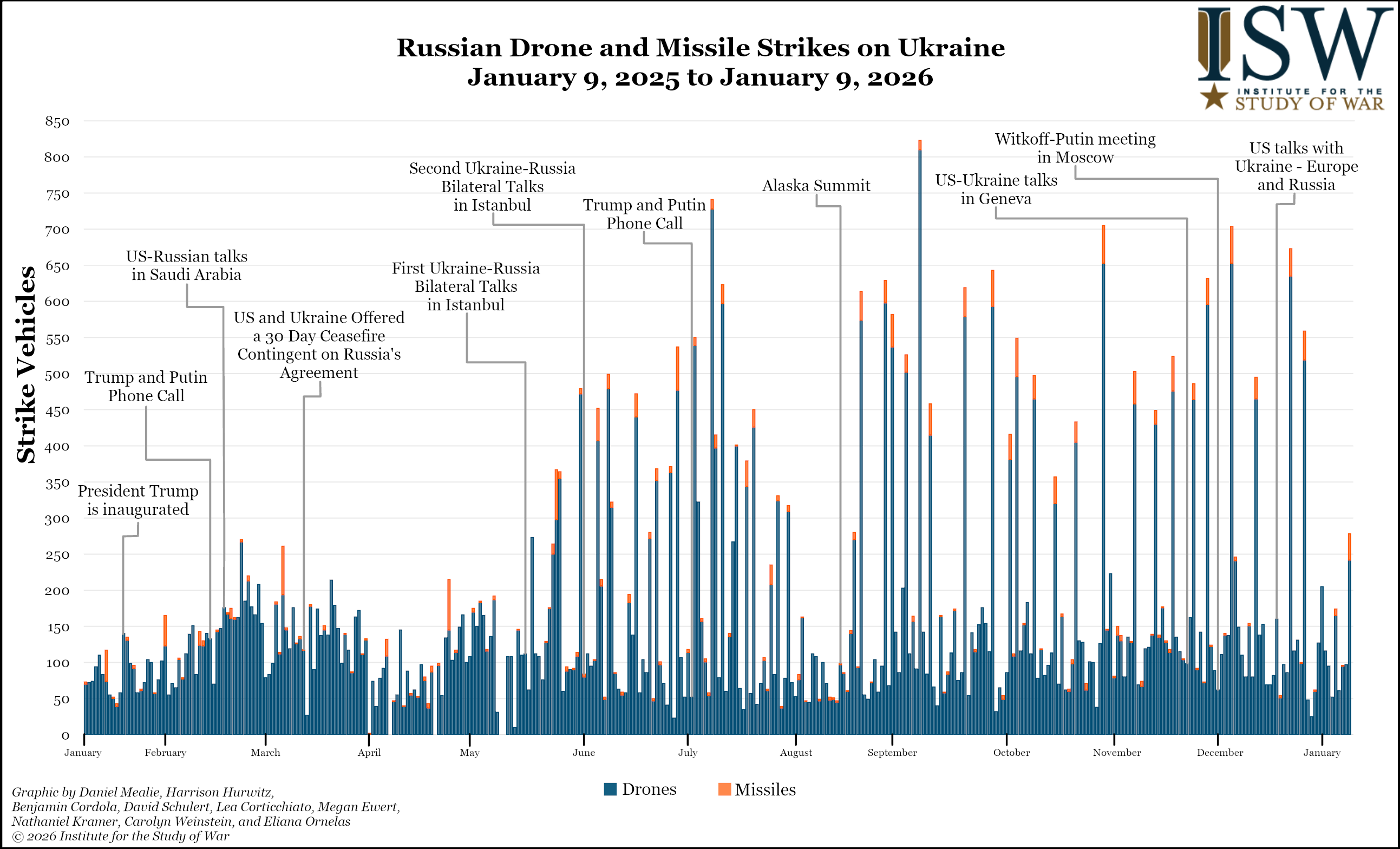
Ukrainian officials reported that the Russian strikes damaged critical, residential, educational, and transport infrastructure in Kyiv City and Kyiv Oblast.[xvii] Ukrainian President Volodymyr Zelensky reported that four people in Kyiv City died, and Ukrainian Prime Minister Yulia Svyrydenko reported that the strikes injured at least 25 people.[xviii] Zelensky reported that Russian forces conducted a "double tap" strike against rescue workers responding to an initial strike against residential buildings in Kyiv City.[xix] Geolocated footage published on January 9 shows a damaged ambulance in Kyiv City.[xx] Zelensky noted that Russian drones damaged the Qatari Embassy in Kyiv City, which the embassy later confirmed.[xxi] Ukrainian officials reported that two Iskander-M missiles also struck civilian infrastructure in Kryvyi Rih, Dnipropetrovsk Oblast, injuring at least 23 and killing one.[xxii] Ukrainian officials also reported that Russian forces struck port infrastructure in Odesa Oblast during the day on January 9, damaging two civilian vessels.[xxiii] Ukrainian officials reported that Russian strikes significantly damaged electricity transmission systems and power generation infrastructure, leaving at least 500,000 consumers in Kyiv City and 3,000 in Chernihiv Oblast without power.[xxiv] The Ukrainian Ministry of Energy reported that Ukrainian authorities restored power to over one million people in Dnipropetrovsk Oblast after the Russian strikes on the night of January 7 to 8, but that over 34,000 people in the region remain without power as of the morning of January 9.[xxv]
The US Navy seized another oil tanker with links to Russia that was attempting to bypass US sanctions against Venezuelan oil. US Southern Command reported on January 9 that the US Navy and Department of Homeland Security boarded and seized the Olina oil tanker in the Caribbean Sea.[xxvi] The Wall Street Journal (WSJ) reported that the Olina has the same unique ship identifying number as the Minerva M, which the United States sanctioned in January 2025 for transporting Russian oil.[xxvii] The WSJ reported that the Olina loaded 700,000 barrels of crude oil from a Venezuelan terminal on December 24, 2025. The Olina previously sailed under a Panamanian flag, and the international shipping registry listed the tanker as having an invalid registration for flying a false flag of Timor-Leste.[xxviii] The ship last transmitted its position in mid-November 2025 near Venezuela.[xxix]
Multiple oil tankers operating near Venezuela have reregistered under Russian flags in recent weeks. The New York Times (NYT) reported on January 9 that a sanctioned oil tanker leaving Venezuela, the Veronica, recently changed its name to Galileo and its flag to Russia this week in an effort to evade US Coast Guard boarding attempts.[xxx] The NYT reported on January 7, citing the official Russian vessel registry, that five oil tankers operating in Venezuelan waters in recent weeks — all under US sanctions for shipping either Russian or Iranian oil — recently switched to Russian flags and declared home ports in Sochi or Taganrog, Russia.[xxxi] The Russian Ministry of Transport also authorized the Bella-1, which the United States seized on January 7, to fly under the Russian flag as of December 24.[xxxii]
Key Takeaways:
- Ukrainian and Russian officials confirmed that Russian forces conducted an Oreshnik intermediate-range ballistic missile (IRBM) strike against Lviv Oblast on the night of January 8 to 9, likely as part of the Kremlin's reflexive control campaign that aims to deter Western support for Ukraine.
- The Kremlin likely targeted the westernmost part of Ukraine with an Oreshnik missile to deter Europe and the United States from providing security guarantees to Ukraine.
- Russian forces conducted a long-range combined drone and missile strike on the night of January 8 to 9 that resulted in massive power outages, particularly in Kyiv Oblast.
- The US Navy seized another oil tanker with links to Russia that was attempting to bypass US sanctions against Venezuelan oil.
- Ukrainian forces recently advanced near Hulyaipole. Russian forces advanced in northern Sumy Oblast and in the Kostyantynivka-Druzhkivka tactical area.
Russian Offensive Campaign Assessment, January 8, 2026
Ukrainian forces struck Russia's state-owned Kombinat Kristal oil storage facility near Engels, Saratov Oblast on the night of January 7 to 8. The Ukrainian General Staff reported that Ukraine's Main Military Intelligence Directorate (GUR) and the Unmanned Systems Forces struck the oil storage facility and caused a large fire.[1] The Ukrainian General Staff reported that the facility provides fuel for the Russian military's Engels-2 Air Base and noted that strike will create logistical issues for Russia's strategic aircraft based at the airfield. Geolocated footage published on January 8 shows a large fire at the storage facility, and Russian sources noted that the fire continued to burn into the morning of January 8.[2] Saratov Oblast Governor Roman Busargin claimed that debris from a falling drone struck an unspecified industrial facility near Engels but later acknowledged that the strike caused a fire in the area.[3]
Ukrainian forces struck a command post of the Russian 8th Combined Arms Army (CAA) (Southern Military District [SMD]) on January 8 in occupied Khartsyzk, Donetsk Oblast.[4] The Ukrainian General Staff reported that the 8th CAA used this command post to coordinate operations in Kurakhove.[5] Russian sources amplified reports on January 8 that a Ukrainian purported Storm Shadow strike against Lgov, Kursk Oblast on December 30 killed at least one serviceman in the Russian 104th Airborne (VDV) Regiment (76th VDV Division) and three servicemen in the 76th VDV Division.[6]
Key Takeaways:
- Ukrainian forces struck Russia's state-owned Kombinat Kristal oil storage facility near Engels, Saratov Oblast on the night of January 7 to 8.
- Ukrainian forces struck a command post of the Russian 8th Combined Arms Army (CAA) (Southern Military District [SMD]) on January 8 in occupied Khartsyzk, Donetsk Oblast.
- Russian forces advanced in Kursk Oblast, in Toretsk, and near Kurakhove.
- Russian forces are increasingly using drones attached to fiber optic cables in Ukraine.
Russian Offensive Campaign Assessment, January 7, 2026
Russian forces recently advanced in northwestern Toretsk following several weeks of higher tempo Russian offensive operations and gains in the area. Geolocated footage published on January 6 indicates that Russian forces recently advanced along Kvitkova Street and reached the northwestern administrative boundary of Toretsk.[1] A Russian milblogger claimed that Russian forces advanced along Pyrohova Street in northern Toretsk, but ISW has not observed confirmation of this claim.[2] Another Russian milblogger claimed that Russian forces occupy roughly 90 percent of Toretsk, but ISW has only observed geolocated footage to assess that Russian forces occupy approximately 71 percent of the settlement as of January 7.[3] Russian forces intensified offensive operations in the Toretsk direction in June 2024, likely to reduce the Ukrainian salient in the area and deny Ukrainian forces the ability to shell rear Russian areas in the Chasiv Yar and Pokrovsk directions, both of which were Russian main efforts at the time.[4] Russian forces originally committed limited combat power, including elements of the Russian 51st Combined Arms Army (CAA) (formerly 1st Donetsk People's Republic Army Corps [DNR AC]), Territorial Troops, and some elements of the Central Military District [CMD], to intensified operations near Toretsk in June 2024.[5] Russian forces have made creeping and grinding gains within Toretsk and the nearby settlements since June 2024 but have intensified offensive operations in recent weeks and made tactical gains within northern and northwestern Toretsk.[6]
Russian forces appear to be shifting assault tactics in Toretsk in order to overwhelm Ukrainian forces and facilitate tactical gains within the settlement. A spokesperson of a Ukrainian brigade operating in the Toretsk direction reported on January 5 that Russian forces are now attacking in platoons of up to 20 soldiers after previously attacking in fireteams of roughly five personnel.[7] A Russian milblogger claimed on January 7 that Russian forces had made recent gains in Toretsk by attacking in multiple areas at once instead of focusing attacks in one location.[8] Russian forces are likely leveraging their superior manpower quantities to intensify offensive operations and advance within Toretsk.
Russian forces likely intend to exploit their advances in northwestern Toretsk to push further west of Toretsk and Shcherbynivka and along the T-05-16 Toretsk-Kostyantnivka highway towards the southernmost point of Ukraine's fortress belt in Kostyantynivka. Russian forces may intend to consolidate their positions in northwestern Toretsk and central Shcherbynivka (west of Toretsk) to advance along the T-05-16 highway towards Kostyantynivka through Nelipivka, Pleshchiivka, and Ivanopillia and the fields around these settlements in an effort to threaten the southern tip of Ukraine's Kostyantynivka-Druzhkivka-Kramatorsk fortress belt, which forms the backbone of Ukraine's Donetsk Oblast defense. Russian forces may also attempt to leverage further advances northwest of Toretsk and south of Chasiv Yar towards Bila Hora and Oleksandro-Shultyne to collapse the Ukrainian pocket in this area and level the frontline west and southwest of Kostyantynivka. Such advances would complicate Ukraine's ability to counterattack into Russia's near rear southeast of Chasiv Yar, including towards Klishchiivka, and would allow Russian forces to deploy additional artillery systems within range of Kostyantynivka and operate first-person-view (FPV) drones within range of the town. Russian forces may also attempt to advance west and northwest of Niu York and Leonidivka towards the H-20 Donetsk City-Kostyantynivka highway and H-32 Pokrovsk-Kostyantynivka highway to pressure Kostyantynivka further from the south and create a more stable southern flank for a push on Kostyantynivka. Russian forces will likely be able to accomplish more rapid advances in the fields and small settlements north and west of Toretsk than they have been able to make in their grinding advances in urban Toretsk. Russian units in this area may attempt to replicate the short, tactically significant mechanized assaults that Russian forces conducted in the Kurakhove and Vuhledar directions in Fall 2024 if they have adequate armored vehicle reserves for this sector.[9]
Russian forces may attempt to leverage tactical gains within and near Toretsk and east of Pokrovsk to eliminate the Ukrainian salient southwest of Toretsk. Russian forces may attempt to leverage gains within Toretsk and in the Toretsk-Shcherbynivka-Niu York area with recent Russian gains east of Pokrovsk to eliminate the Ukrainian pocket between Vozdvyzhenka (east of Pokrovsk) and Toretsk. Russian advances east of Pokrovsk and west of Toretsk may be part of an ongoing effort to make opportunistic gains that seize any territory, regardless of that territory’s relative insignificance.
Russian forces are likely attempting to break out of Toretsk's urban environment and advance into more open and rural areas that are similar to the areas where Russian forces have made significant gains in other sectors of the front in recent months. Russian forces achieved their most rapid rates of advance while operating in the fields and small settlements in the Pokrovsk, Kurakhove, and Vuhledar directions in Fall 2024 but have struggled to make rapid advances in urban areas including Toretsk.[10] Russian forces have spent the last six months advancing roughly 12 kilometers through Toretsk and have been fighting through Chasiv Yar since April 2024.[11] Russian forces have, in contrast, advanced roughly 18 kilometers west of Selydove since Russian forces seized the settlement in late October 2024 and roughly 20 kilometers north and northwest of Vuhledar since Russian forces seized the settlement in early October 2024.[12] Russian positions in northwestern Toretsk are currently 12 kilometers from the southeastern outskirts of Kostyantynivka, and Russian forces would likely attempt to advance directly along the T-05-16 Toretsk-Kostyantynivka highway. Russian forces could possibly be able to threaten significant Ukrainian positions in Kostyantynivka within the coming two or three months but only if they are able to achieve a rate of advance in the open areas northwest of Toretsk similar to the rate at which they have advanced in the Kurakhove and Pokrovsk directions. The Russian force grouping in Toretsk is likely smaller than the groupings in the Pokrovsk, Kurakhove, and Vuhledar directions, however, likely does not have prioritized access to Russian reserves, and may not be capable of committing enough troops and materiel to the frontline to accomplish these rates of advance.
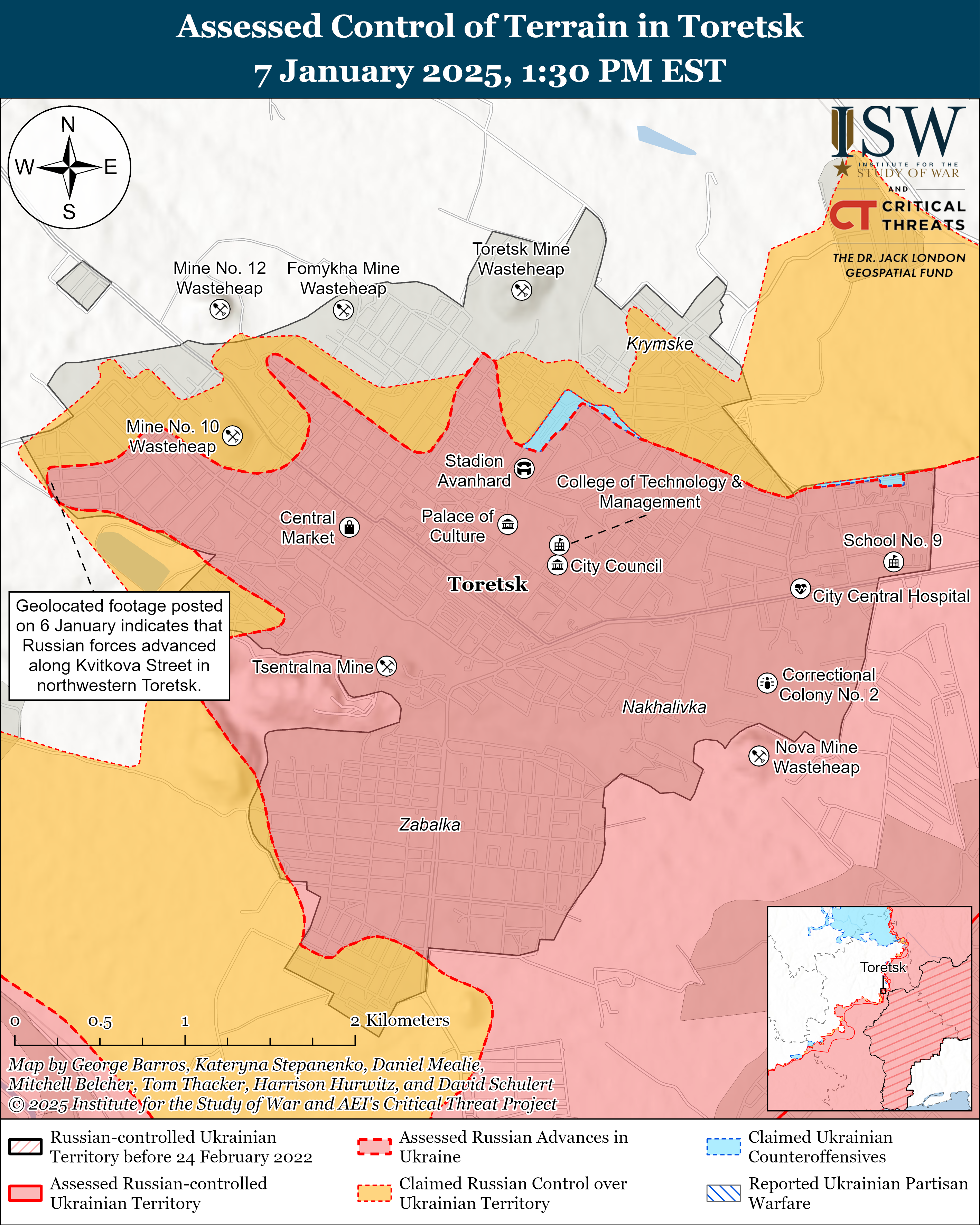
Russian forces are unlikely to pose a significant threat to Kostyantynivka unless the Russian military command reinforced the existing force grouping in the area with troops from other frontline areas. Elements of the Russian 51st Combined Arms Army (CAA) (formerly 1st Donetsk People's Republic Army Corps [DNR AC]), including its 132nd and 9th motorized rifle brigades and 80th "Sparta" Separate Reconnaissance Battalion, have been the main forces conducting offensive operations in Toretsk.[13] Ukrainian military observer Kostyantyn Mashovets stated in mid-December 2024 that elements of the 55th Motorized Rifle Brigade (41st CAA, Central Military District [CMD]) are also operating in Toretsk, but ISW has not observed Russian reporting of this brigade operating in the area.[14] The Russian military command may decide to continue offensive operations in the Toretsk direction with the 51st CAA forces that are currently deployed in the area, which would likely result in slower, gradual advances as these limited forces are likely degraded after six months of urban combat.
The Russian military command could choose to redeploy forces from other sectors of the front to the Toretsk direction. The Russian military command could redeploy forces from the Pokrovsk and Kurakhove directions to the Toretsk direction in the future. The Russian military command has been prioritizing offensive operations in the Pokrovsk and Kurakhove directions recently and would likely not redeploy forces from these areas to the Toretsk direction until Russian forces had achieved their objectives in these areas. Russian forces' priority objective in the Pokrovsk direction remains unclear at this time, however, as Russian forces appear to be advancing east and southwest of Pokrovsk in order to envelop the town while also advancing westward from the area south of Pokrovsk towards the Donetsk-Dnipropetrovsk Oblast border.[15] Russian forces in the Kurakhove direction are currently focused on eliminating the Ukrainian pocket near the Sukhi Yaly River but may also prioritize continued advances westward towards the border area in the future.[16] A Russian milblogger claimed on January 7 that the Russian military command recently withdrew elements of the 5th and 110th motorized rifle brigades (both of the 51st CAA) from combat operations near Kurakhove in order to rest and reconstitute and will redeploy these forces to an unspecified frontline area at a future date.[17] The Russian military command will likely choose to recommit the 5th and 110th brigades to a priority sector of the front, which could be Toretsk if the command chooses to make that a priority.
The Russian military command may continue to prioritize the Pokrovsk and Kurakhove direction but deprioritize offensive operations in another sector of the front, such as the Kupyansk or Borova directions, in order to redeploy forces to the Toretsk direction. Russian forces have been conducting offensive operations at varying intensities along the entire front as part of efforts to pin down Ukrainian forces and maintain the strategic initiative.[18] The Russian military command may prefer to maintain this continuous pressure on Ukrainian forces throughout the frontline over redeploying forces to the Toretsk direction, although the Russian offensive operations towards Kostyantynivka from the Toretsk area may offer Russian forces the opportunity to make the most operationally significant advances along the frontline. ISW is not prepared to offer a forecast of how the Russians will weigh the effort near Toretsk at this time.
The Ukrainian General Staff stated that Ukrainian forces struck a command post of the Russian 810th Naval Infantry Brigade (Black Sea Fleet [BSF], Southern Military District [SMD]) in Belaya, Kursk Oblast on January 7.[19] The Ukrainian General Staff did not report if the strike killed or wounded Russian personnel. Ukrainian forces previously conducted a strike, reportedly with HIMARS, against a different 810th Naval Infantry Brigade command post near Lgov, Kursk Oblast on December 25, killing the brigade’s deputy commander and other staff officers.[20]
Key Takeaways:
- Russian forces recently advanced in northwestern Toretsk following several weeks of higher tempo Russian offensive operations and gains in the area.
- Russian forces likely intend to exploit their advances in northwestern Toretsk to push further west of Toretsk and Shcherbynivka and along the T-05-16 Toretsk-Kostyantnivka highway towards the southernmost point of Ukraine's fortress belt in Kostyantynivka.
- Russian forces may attempt to leverage tactical gains within and near Toretsk and east of Pokrovsk to eliminate the Ukrainian salient southwest of Toretsk.
- Russian forces are likely attempting to break out of Toretsk's urban environment and advance into more open and rural areas that are similar to the areas where Russian forces have made significant gains in other sectors of the front in recent months.
- Russian forces are unlikely to pose a significant threat to Kostyantynivka unless the Russian military command reinforced the existing force grouping in the area with troops from other frontline areas.
- The Ukrainian General Staff stated that Ukrainian forces struck a command post of the Russian 810th Naval Infantry Brigade (Black Sea Fleet [BSF], Southern Military District [SMD]) in Belaya, Kursk Oblast on January 7.
- Ukrainian forces recently advanced in Kursk Oblast, and Russian forces recently advanced near Kupyansk, Toretsk, and Pokrovsk and in Kursk Oblast.
- The Kremlin continues to promote the "Time of Heroes" program, which aims to place veterans of the Russian full-scale invasion of Ukraine in positions in local, regional, and federal governments.
Russian Offensive Campaign Assessment, January 6, 2026
Ukrainian forces continued their long range strike campaign against Russian military and energy infrastructure overnight on January 5 to 6. The Ukrainian General Staff reported on January 6 that Ukrainian forces struck the 100th Arsenal of the Russian Main Missile and Artillery Directorate (GRAU) near Neya, Kostroma Oblast.[1] Sources within Ukraine’s Security Service (SBU) told Ukrainian media outlets that the strike caused secondary explosions of ammunition.[2] The sources added that the arsenal supplied ammunition depots in the Russian Central and Moscow military districts. Geolocated footage published on January 6 shows a smoke plume near the arsenal.[3] Kostroma Oblast Governor Sergei Sitnikov claimed on January 6 that falling drone fragments started a fire at an unspecified military base in Neysky Raion, and announced the opening of an evacuation point for residents of southern Neya.[4] The Ukrainian General Staff reported on January 6 that Ukrainian forces also struck the Gerkon Plus oil depot near Streletskie Khutora, Usmansky Okrug, Lipetsk Oblast, starting a fire.[5] Sources within the SBU told Ukrainian media outlets that the depot supplies oil to Tambov, Voronezh, and Lipetsk oblasts.[6] Geolocated footage published on January 6 shows a fire at the depot.[7] Lipetsk Oblast Governor Igor Artamonov claimed on January 6 that falling drone fragments started a fire at an unspecified industrial facility in Usmansky Okrug.[8]
Ukrainian President Volodymyr Zelensky met with leaders of states in the Coalition of the Willing in Paris on January 6 to discuss possible security guarantees for post-war Ukraine. The Coalition of the Willing issued a statement reiterating that ensuring Ukraine's sovereignty and lasting security will be an "integral" part of a future peace agreement.[9] The coalition stated that it is ready to commit to politically and legally binding guarantees that will activate upon the start of a ceasefire. The guarantees will include a US-led ceasefire monitoring and verification mechanism; the long-term military assistance and armament of Ukraine; a multinational force to support deterrence measures in the air, at sea, and on land; binding commitments to support Ukraine in the event of renewed Russian aggression, including the use of military capabilities, intelligence and logistics support, diplomatic initiatives, and the implementation of additional sanctions on Russia; and deepening long-term defense cooperation with Ukraine, including joint training and defense industrial production. Kremlin officials have repeatedly labelled such Western security guarantees for Ukraine, particularly the deployment of foreign troops, as "unacceptable" to Russia.[10]
A German military document reportedly describes how Russia is using covert attacks against German infrastructure to prepare for a potential Russia-North Atlantic Treaty Organization (NATO) war in the future, in line with ISW's ongoing assessments. Western outlets reported in late December 2025 and early January 2026 that a German military document states that Russia is intensifying its covert attacks on key German infrastructure, likely as possible preparation for a wider conflict.[11] The document reportedly also frames Russian cyber operations and influence campaigns as preparation for a military confrontation. The document further notes that Germany expects Russia to target German energy and defense infrastructure early, given Germany's role as a NATO hub for moving and sustaining forces and forecasts that Russia will see Germany as a priority target for long range missile strikes, armed drones, and special forces after an open armed attack on NATO's eastern flank. The document presents an assessment that Russia will develop these capabilities and "strategic options" by 2029 at the latest, even if Russia's war against Ukraine continues unchanged. ISW continues to assess that Russia would likely be able to pose a significant threat to NATO earlier than many Western estimates, particularly in the event of a future ceasefire in Ukraine that would free up Russian forces and allow Russia to rearm and reconstitute.[12] Russian covert attacks against German infrastructure are likely a line of effort within Russia’s "Phase Zero" campaign—the informational and psychological condition-setting phase—to prepare for a possible NATO-Russia war in the future.[13]
Key Takeaways:
- Ukrainian forces continued their long range strike campaign against Russian military and energy infrastructure overnight on January 5 to 6.
- Ukrainian President Volodymyr Zelensky met with leaders of states in the Coalition of the Willing in Paris on January 6 to discuss possible security guarantees for post-war Ukraine.
- A German military document reportedly describes how Russia is using covert attacks against German infrastructure to prepare for a potential Russia-NATO war in the future, in line with ISW's ongoing assessments.
- Russian forces recently advanced in the Siversk and Hulyaipole directions.
Russian Offensive Campaign Assessment, January 5, 2026
Russia is modifying its Shahed long-range strike drones to target Ukrainian aircraft as part of a wider effort to innovate and maximize long-range drone capabilities. Ukrainian electronic and radio warfare expert Serhiy “Flash” Beskrestnov published images and footage on January 4 showing a downed Shahed drone equipped with a man-portable air defense system (MANPADS), likely a Verba MANPADS, operating as a remotely launched short range air defense system. Beskrestnov reported that Russian forces fielded the modified drones for the first time overnight on January 3 to 4.[1] The footage indicates that Russia mounted the Verba MANPADS on the top of the drone and mounted an antenna for remote control on the wing stabilizer. Beskrestnov stated that Russian forces also modified the Shahed with a camera and a radio modem, allowing the drone operator to control the drone as it flies. The MANPADS are positioned to fire in front of the drone as it flies, indicating that Russian forces likely intend to use this adaptation to target Ukrainian fighter jets and helicopters operating as part of Ukraine's air defense umbrella. Verba MANPADS have an operational range of roughly six kilometers and a maximum altitude of trajectory of about 4.5 kilometers when fired from the ground.[2] Russian forces have continuously innovated modifications to Shahed drones throughout the war to maximize capabilities and damage potential. Previous modifications have allowed Russian forces to target mobile components of the Ukrainian air defense umbrella, including Ukrainian mobile target groups on the ground and aircraft in the air.[3] Russian forces previously equipped Shahed drones with other air-to-air weapons as part of the effort to degrade Ukrainian air defenses.[4]
Ukrainian and Russian forces have been engaged in an offense-defense race since 2022 to develop new technology, as Russian forces have escalated their long-range strike campaign and Ukrainian forces have responded by innovating new air defense measures to combat the strikes.[5] Ukrainian drones have developed interceptor drones capable of downing Russian drones.[6] The MANPADS on the Shahed drones are front-facing, leaving the drones vulnerable to Ukrainian interceptor drones that approach Russian drones from behind. Russia’s continued efforts to degrade Ukrainian air defenses through constant innovation and adaptation underscore the need for a flexible, well-rounded, and well-provisioned Ukrainian air defense umbrella, including an arsenal of interceptor drones.
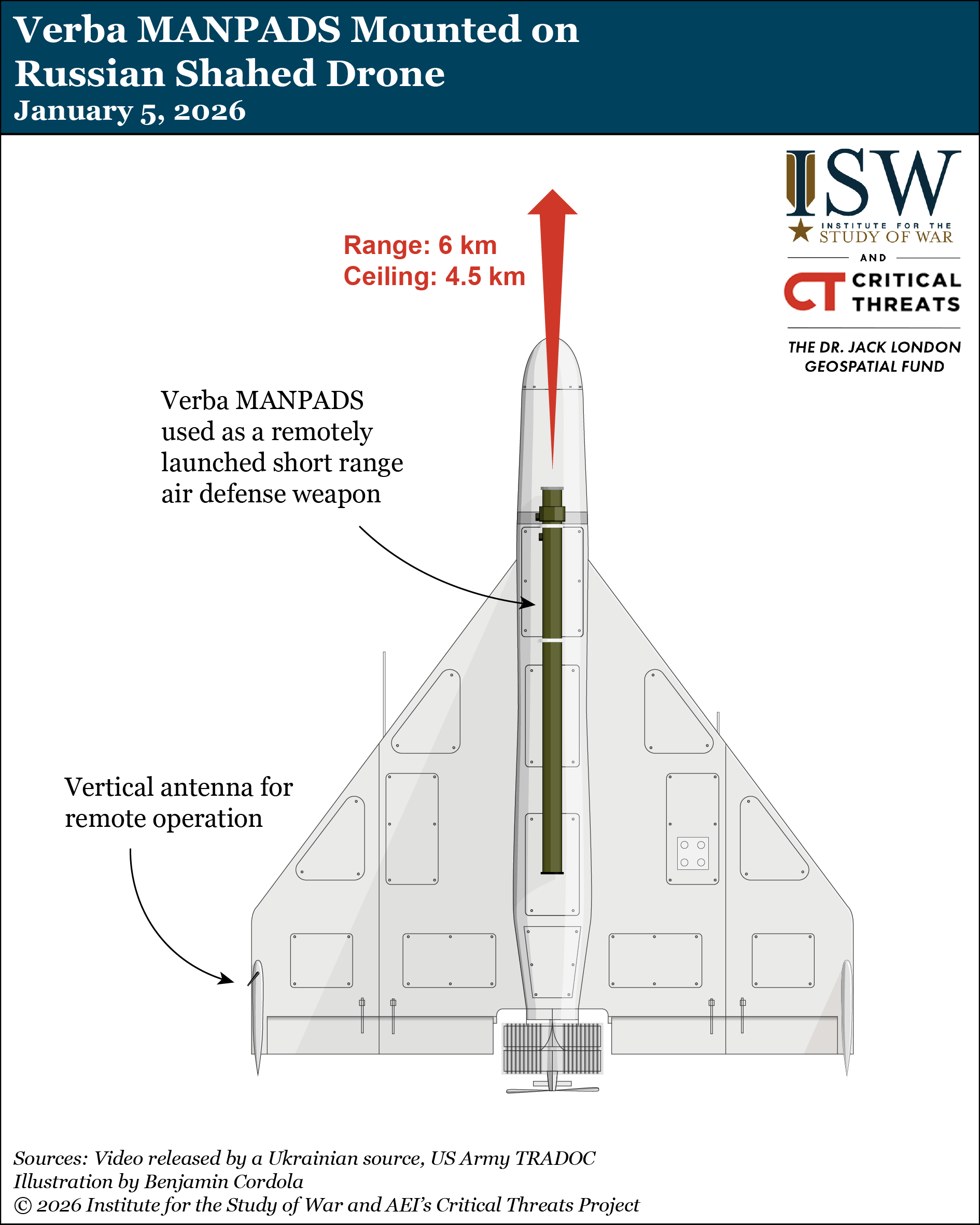
Russian forces struck a hospital in Kyiv City and an American-owned enterprise in Dnipropetrovsk Oblast during missile and long-range drone strikes overnight on January 4 to 5. The Ukrainian Air Force reported that Russian forces launched nine Iskander-M ballistic missiles/S-300 air defense missiles from Bryansk and Voronezh oblasts and 165 Shahed, Gerbera, and other types of long-range strike drones from Millerovo, Rostov Oblast; Kursk and Oryol cities, and Shatalovo, Smolensk Oblast.[7] The Ukrainian Air Force reported that Ukrainian forces downed 137 drones and that 26 Russian drones struck 10 locations. Geolocated footage published on January 5 shows the Medikom Medical Center burning in Kyiv City following a Russian drone strike.[8] Ukrainian officials reported that the Russian strike against the medical center in Kyiv City killed at least one patient and injured at least three others, and that there were about 70 patients at the facility at the time of the strike.[9] Additional geolocated footage published on January 5 shows a drone strike and explosion at an American-owned vegetable oil enterprise in Dnipro City, Dnipropetrovsk Oblast.[10] Dnipropetrovsk Oblast officials corroborated reports of a strike against the enterprise and reported that the strike spilled 300 metric tons of vegetable oil.[11] Ukrainian officials reported that Russian forces also struck energy infrastructure in Kharkiv and Kyiv oblasts.[12]
Ukrainian President Volodymyr Zelensky announced further personnel changes within the Ukrainian government and security services on January 5. Zelensky signed a decree on January 5 appointing Major General Yevheniy Khmara, head of the Alpha Special Operations Center of Ukraine’s Security Service (SBU), as acting head of the SBU.[13] SBU Head Lieutenant General Vasyl Malyuk announced his resignation on January 5 but stated that he will remain in the SBU to direct asymmetric operations.[14] Zelensky stated on January 5 that he and Malyuk discussed potential candidates to head the SBU permanently.[15]
European authorities are investigating deliberate damage to undersea cables in the Baltic Sea for the second time since December 31. Lithuanian National Crisis Management Center Head Vilmantas Vitkauskas stated on January 5 that Lithuanian and Latvian authorities are investigating deliberate damage to an undersea optics cable in the Baltic Sea that occurred on the evening of January 2.[16] Vitkauskas stated that authorities are currently investigating an unspecified ship and its crew, currently docked in the port of Liepaja, but did not name the ship or its affiliation or attribute the damage to a specific actor. Finnish and Estonian authorities reported damage to an undersea communications cable between Estonia and Finland due to deliberate cutting on December 31 and detained the crew of the Fitburg, a ship carrying sanctioned Russian steel products from St. Petersburg, under suspicion of cutting the cables, but have not yet attributed a specific actor to the incident.[17] The December 31 and January 2 undersea cable incidents come against the backdrop of Russia’s intensifying “Phase Zero” campaign to destabilize Europe, undermine NATO’s cohesion, and set the political, informational, and psychological conditions for a potential future Russian war against NATO.[18]
Key Takeaways:
- Russia is modifying its Shahed long-range strike drones to target Ukrainian aircraft as part of a wider effort to innovate and maximize long-range drone capabilities.
- Russian forces struck a hospital in Kyiv City and an American-owned enterprise in Dnipropetrovsk Oblast during missile and long-range drone strikes overnight on January 4 to 5.
- Ukrainian President Volodymyr Zelensky announced further personnel changes within the Ukrainian government and security services on January 5.
- European authorities are investigating deliberate damage to undersea cables in the Baltic Sea for the second time since December 31.
- Ukrainian forces recently advanced in the Kupyansk direction. Russian forces recently advanced in the Kostyantynivka-Druzhkivka tactical area.
Russian Offensive Campaign Assessment, January 4, 2026
Russian officials continue to respond to the US military operation in Venezuela, but the response from senior Kremlin decisionmakers remains relatively muted. Russian Foreign Minister Sergey Lavrov and Belarusian Foreign Minister Mikhail Ryzhenkov discussed the US operation in Venezuela during a phone call on January 3 and issued a joint, boilerplate condemnation of US actions and called for the United States to return Venezuelan President Nicolas Maduro and his wife to Venezuela.[i] Russian Security Council Chairperson Dmitry Medvedev heavily criticized the US military operation in a comment to Kremlin newswire TASS, accusing US President Donald Trump of violating international laws and expressing Russia's support for Maduro.[ii] Medvedev also used the US operation to seize Maduro in order to threaten German Chancellor Friedrich Merz and Ukrainian President Volodymyr Zelensky.[iii] Russian State Duma deputies also criticized the US operation, claiming that the United States rejects the sovereignty of states in the Western Hemisphere and aims to establish control over Venezuelan oil reserves.[iv] The Kremlin's response to the US operation in Venezuela has been boilerplate thus far.[v] The Kremlin will likely have to balance its responses between maintaining its credibility as a partner to other states with its continued efforts to cater to the Trump administration.
Ukrainian President Volodymyr Zelensky appointed Ukrainian State Border Guard Service First Deputy Head Major General Valeriy Vavrynyuk as acting head of the State Border Guard Service on January 4.[vi]
Key Takeaways:
- Russian officials continue to respond to the US military operation in Venezuela, but the response from senior Kremlin decisionmakers remains relatively muted.
- Ukrainian President Volodymyr Zelensky appointed Ukrainian State Border Guard Service First Deputy Head Major General Valeriy Vavrynyuk as acting head of the State Border Guard Service on January 4.
- Ukrainian forces advanced near Pokrovsk. Russian forces recently advanced in the Kostyantynivka-Druzhkivka tactical area.
Russian Offensive Campaign Assessment, January 3, 2025
The Russian Ministry of Foreign Affairs (MFA) issued a boilerplate response condemning the US military operation against Venezuela on January 3. The Russian MFA condemned the US operation and reaffirmed Russia's support for the Venezuelan leadership's policies to protect Venezuelan national interests.[1] The MFA called for the United States and Venezuela to find a resolution through dialogue and stated that Russia is prepared to assist in these efforts. Russian Foreign Minister Sergei Lavrov spoke on January 3 with Venezuelan Vice President Delcy Rodríguez and reiterated the MFA's statements during the call.[2] The Russian MFA denied a January 3 report from Reuters claiming that Rodriguez is in Russia.[3] Russian milbloggers responded to the US operation in Venezuela, including by criticizing the Venezuelan military as weak and unprepared and highlighting Russia's missile stockpiles and nuclear deterrence capabilities in comparison.[4]
Ukraine met with national security advisors from its Western allies and partners in Kyiv on January 3. Ukrainian President Volodymyr Zelensky reported on January 3 that he met with the national security advisors of member states of the Coalition of the Willing and representatives of the European Council, European Commission, and NATO.[5] Zelensky reported that the officials discussed a framework peace plan, security guarantees, and the reconstruction and economic recovery of Ukraine. First Deputy Foreign Minister Serhiy Kyslytsya stated that Ukraine presented the main documents from the ongoing peace negotiations to the national security advisors ahead of the January 6 meeting of leaders of the Coalition of the Willing states in Paris.[6]
Ukrainian President Volodymyr Zelensky announced further personnel changes within the Ukrainian government and military. Zelensky reported on January 2 that he proposed current Minister of Digital Transformation Mykhailo Fedorov to take the position of minister of defense.[7] Zelensky noted that Fedorov can implement his experience in facilitating Ukraine’s “Drone Line” project (which aims to integrate drone and ground operations in the Ukrainian military) and digitalizing state services and processes in the defense sector. Zelensky proposed to appoint current Ukrainian Defense Minister Denys Shmyhal as the new minister of energy and first deputy prime minister.[8] Zelensky additionally announced that he will appoint First Deputy Foreign Minister Serhiy Kyslytsya as the first deputy head of the Office of the President and noted that Kyslytsya will continue to work in the Ukrainian negotiating delegation.[9] Zelensky further reported that he is considering new candidates to head the military administrations in Vinnytsia, Dnipropetrovsk, Poltava, Ternopil, and Chernihiv oblasts.[10]
Key Takeaways:
- The Russian Ministry of Foreign Affairs (MFA) issued a boilerplate response condemning the US military operation against Venezuela on January 3.
- Ukraine met with national security advisors from its Western allies and partners in Kyiv on January 3.
- Ukrainian President Volodymyr Zelensky announced further personnel changes within the Ukrainian government and military.
- Ukrainian forces recently advanced in the Kupyansk direction. Russian forces recently advanced in northern Kharkiv Oblast and in the Kostyantynivka-Druzhkivka tactical area.
Russian Offensive Campaign Assessment, January 2, 2026
Russian officials accused Ukraine of conducting a strike against a hotel and cafe in occupied Khorly, Kherson Oblast, that reportedly killed at least 28 people and injured at least 50, and called for the intensification of Russia's war efforts, including its campaign of strikes against Ukrainian civilian infrastructure.[i] Russian occupation authorities claimed that about 100 people had gathered at the cafe and hotel for New Year celebrations when three Ukrainian drones struck the cafe and hotel minutes apart just after midnight on January 1, causing a fire that trapped people inside the building.[ii] Occupation authorities and Russian sources claimed that five Ukrainian drones continued to fly overhead following the strike, preventing first responders from immediately responding.[iii] Russian and occupation officials claimed that there were no military personnel at the cafe and hotel at the time of the strike or military targets nearby and accused Ukraine of deliberately targeting civilians.[iv] Former Russian space agency Roscosmos head and Zaporizhia Oblast occupation senator Dmitry Rogozin claimed that soldiers and medics of the 4th company of the BARS-Sarmat Special Purpose Center military were in Khorly at the time of the strike and provided assistance, however.[v] Occupation authorities claimed that at least one of the drones had a payload of 10 to 20 kilograms of trinitrotoluene (TNT) and later claimed that at least one drone had an incendiary warhead that caused a massive fire.[vi] Kherson Oblast occupation head Vladimir Saldo briefed Russian President Vladimir Putin on the strike and its aftermath on January 1.[vii] Russian authorities and media published images showing fragments of a drone that allegedly struck the cafe and hotel.[viii] Geolocated footage published on January 1 shows a fire at the cafe and hotel, and Russian authorities published additional images showing widespread destruction at the site of the fire.[ix]
Ukraine rejected Russian claims that it targeted civilians in occupied Khorly. Ukrainian General Staff Spokesperson Captain Dmytro Lykhovyi responded to the Russian claims on January 1, stating that Russian political and military leadership is spreading disinformation and false statements.[x] Lykhovyi stated that the Ukrainian General Staff published an "exhaustive" list of strikes that Ukrainian forces conducted against areas in Russia and occupied Ukraine overnight on December 31 to January 1, and this list did not include any strikes against occupied Kherson Oblast.[xi] An anonymous source in Ukraine's defense forces told AFP in response to a question about the Khorly strike on January 2 that Ukraine did conduct a strike but that Ukrainian forces targeted a military gathering that had been closed to civilians.[xii] A local Crimea-based Telegram account reported on January 1 that Russian soldiers, their families, and local occupation officials were at the hotel and cafe at the time of the strike.[xiii] The available footage of the fire is sufficient for ISW to assess that there was very likely a strike that significantly damaged the cafe and hotel in occupied Khorly, though ISW is not prepared to assess the intended target of the strike. ISW has observed no statements or evidence to assess that the strike was a Russian false flag operation.
The strike against occupied Khorly reportedly killed Russian occupation officials. Russian authorities have published the names of 12 people killed at the hotel and cafe as of this report, and at least three are tied to the Russian occupation administration.[xiv] BBC's Russia service reported on January 2 that Sergei Bogan, who died in the strike, is the former head of the Russian Ministry of Internal Affairs (MVD) in occupied Kalanchak, Kherson Oblast (a larger settlement about 16 kilometers north of Khorly) and that his wife is a current member of the Nova Kakhovka occupation administration.[xv] It is currently unclear if Bogan's wife was also at the Khorly cafe and hotel at the time of the strike. The BBC reported that the strike also killed Mikhail Voloshko, the head of the Kalanchak occupation administration's information technology department, and Iryna Dyagileva, who previously served as an occupation election commissioner in occupied Crimea and has since run for office in the occupation government.[xvi] The strike also killed Makhmud Admisayev, who reportedly frequently travelled between Russia and occupied Crimea with a school official of occupied Havrylivka, Kherson Oblast.[xvii] The strike also killed the owner of the cafe and hotel, who reportedly began collaborating with Russian occupation officials in 2023.[xviii] Available information about the remainder of the identified victims is limited as of this report.
Russian officials seized on the Khorly strike to call for the intensification of Russia's years-long intensive strike campaign against Ukrainian critical infrastructure. Russian officials responded to the Khorly strike on January 1 and 2 around a few common themes: that the strike only strengthens Russia's commitment to rapidly achieving its war goals, which include unseating the Ukrainian government and that Ukraine would use a potential ceasefire to plan more strikes.[xix] Russian officials called on Russia to strike Ukrainian critical infrastructure in response, absurdly claiming that Russia has been abstaining from such strikes and never hits civilian objects.[xx] Russia has been conducting a long-range strike campaign that purposefully targets Ukrainian civilian and energy infrastructure and disproportionately impacts civilians throughout the war and has intensified these strikes in recent months.[xxi] Russian forces launched over 54,000 long-range drones and over 1,900 missiles against Ukraine just in 2025 and adapted these weapons to inflict maximum damage, which has increased damage against civilian areas and civilian casualties.[xxii] The Kremlin may secondarily intend to use the Khorly strike as justification for its continued lack of engagement in the peace process.
Ukraine warned that Russia is likely preparing a false flag operation that will inflict significant casualties to disrupt ongoing peace negotiations. The Ukrainian Foreign Intelligence Service (SZRU) reported on January 1 that the Kremlin is preparing large scale false flag attacks, likely on the eve of or during Orthodox Christmas (January 6 and 7), at a religious building or other symbolic location in Russia or occupied Ukraine to disrupt US-led peace negotiations.[xxiii] The SZRU reported that the Kremlin has been spreading new false claims to prepare Russians and foreign audiences for further escalation, following the alleged attempt to strike on Putin's residence on the night of December 28 to 29. The SZRU noted that Russia will likely conduct the attack from a frontline location and plans to use fragments of Western-made drones as manufactured evidence of Ukraine's supposed involvement.
The Russian Ministry of Defense (MoD) continues to present alleged evidence to support its claim that Ukrainian drone strikes targeted Russian President Vladimir Putin’s residence in Novgorod Oblast on the night of December 28 to 29 but this evidence remains unpersuasive. The Russian MoD published footage on January 1 showing Russian General Staff’s Main Directorate (GRU) Head Admiral Igor Kostyukov handing over supposed route data and a flight controller of a drone that allegedly targeted Putin's residence to the US military attaché at the US Embassy in Russia.[xxiv] Kostyukov claimed that Russia decoded the alleged Ukrainian drone's data, "unequivocally" confirming that Ukraine targeted Putin's residence.[xxv] The circumstances of the alleged December 28 to 29 strike continue not to conform to the pattern of observed evidence that typically follows Ukrainian deep strikes, and the Kremlin's continued claims and presentations of alleged evidence continue not to account for these discrepancies.[xxvi]
Ukraine announced on January 1 that it received and deployed two more Patriot air defense systems to protect Ukrainian cities and critical infrastructure following recent agreements with Germany.[xxvii] Patriot air defense systems remain Ukraine’s only air defense systems capable of reliably downing Russian ballistic missiles. ISW continues to assess that a denser Ukrainian air defense umbrella, including additional Patriot systems, would degrade Russia’s ability to conduct successful long-range strikes.[xxviii]
Ukrainian President Volodymyr Zelensky announced several personnel changes within the Ukrainian government and military on January 2. Ukrainian Main Military Intelligence Directorate (GUR) Head Lieutenant General Kyrylo Budanov stated that he has accepted Zelensky's offer to head the Office of the Ukrainian President.[xxix] Zelensky stated that Ukrainian Foreign Intelligence Service (SZR) Head Oleh Ivashchenko would replace Budanov as the GUR head.[xxx] Zelensky also announced that Serhiy Deineko is stepping down from his position as head of Ukraine’s State Border Service but will continue to work within the Ministry of Internal Affairs.[xxxi] Zelensky stated that Ukrainian Internal Affairs Minister Ihor Klymenko will propose candidates to replace Deinenko.
Finnish and Estonian authorities reported damage to an undersea communications cable between Estonia and Finland that may be due to deliberate cutting on December 31.[xxxii] Estonian authorities reported that the damage site is located within the Estonian exclusive economic zone (EEZ) and that a cargo vessel had been travelling in the area at the time the damage occurred.[xxxiii] Finnish Border Guards located and intercepted the Fitburg cargo ship and have since arrested at least two crewmembers and interviewed the remainder under suspicion of deliberately damaging the undersea cable.[xxxiv] Albros Shipping & Trading, a Turkish company based in Istanbul, manages the Fitburg, which was traveling from St. Petersburg, Russia, to Haifa, Israel, under the flag of Saint Vincent and the Grenadines when Finnish authorities intercepted it.[xxxv] Finnish authorities reported that the Fitburg was carrying illegal Russian steel products.[xxxvi] Estonian Central Criminal Police Chief Leho Lauri reported on January 1 that Estonia and Finland will form an international investigations team in response to the December 31 cable event.[xxxvii] Finnish authorities have not officially attributed the damage to any specific actor. The December 31 cable incident comes against the backdrop of Russia's intensifying “Phase Zero” campaign to destabilize Europe, undermine North Atlantic Treaty Organization (NATO)’s cohesion, and set the political, informational, and psychological conditions for a potential future Russian war against NATO.[xxxviii]
Key Takeaways:
- Russian officials accused Ukraine of conducting a strike against a hotel and cafe in occupied Khorly, Kherson Oblast, that reportedly killed at least 28 people and injured at least 50, and called for the intensification of Russia's war efforts, including its campaign of strikes against Ukrainian civilian infrastructure.
- Ukraine rejected Russian claims that it targeted civilians in occupied Khorly.
- The strike against occupied Khorly killed Russian occupation officials.
- Russian officials seized on the Khorly strike to call for the intensification of Russia's years-long intensive strike campaign against Ukrainian critical infrastructure.
- Ukraine warned that Russia is likely preparing a false flag operation that will inflict significant casualties to disrupt ongoing peace negotiations.
- The Russian Ministry of Defense (MoD) continues to present alleged evidence to support its claim that Ukrainian drone strikes targeted Russian President Vladimir Putin’s residence in Novgorod Oblast on the night of December 28 to 29, but this evidence remains unpersuasive.
- Ukraine announced on January 1 that it received and deployed two more Patriot air defense systems to protect Ukrainian cities and critical infrastructure following recent agreements with Germany.
- Ukrainian President Volodymyr Zelensky announced several personnel changes within the Ukrainian government and military on January 2.
- Finnish and Estonian authorities reported damage to an undersea communications cable between Estonia and Finland that may be due to deliberate cutting on December 31.
- Russian forces recently advanced in the Kostyantynivka-Druzhkivka tactical area and in western Zaporizhia Oblast.