{{currentView.title}}
December 23, 2025
2025 Year in Review: Africa File
To receive the weekly Africa File or triweekly Congo War Security Review via email, please subscribe here. Follow CTP on X, LinkedIn, and BlueSky.
Note: CTP is not publishing the Africa File the weeks of December 25 and January 1 due to the Christmas and New Year's holiday seasons. The Africa File will resume as normal the week of January 8.
CTP's Africa Team has expanded its unparalleled regular and in-depth analysis and forecasting across the continent throughout 2025. In addition to the weekly Africa File report series, CTP launched the triweekly Congo War Security Review in February, published 12 special reports, and launched interactive maps of Salafi-jihadi operations in Somalia and West Africa. CTP's reports and graphics have been quoted in several prominent media outlets, including Agence France-Presse, The Associated Press, BBC, CNN, Deutsche Welle, Fox News, Newsweek, The New York Times, Reuters, The Wall Street Journal, and many more. CTP also held its first public event, discussing the role of middle powers in the Horn of Africa, and began publishing regular op-eds as part of CTP's efforts to expand its role as a source and platform for discussion of pressing US policy questions. CTP also began the weekly Africa File YouTube series in July, making top-level analysis more accessible to non-expert audiences. Please see below for some of this year's major trends that the team covered this year and where things stand heading into 2026.
The team looks forward to continuing these efforts and more, including an interactive map of the eastern DRC conflict and a six-part report series beginning in January 2026 that will cover middle power competition and regional conflict in the Horn of Africa. We thank every person who reads our work for your support and hope that you continue to trust CTP as your go-to source for developments and analysis on security challenges in Africa. Have a happy holiday season, and we will see you in 2026!
Key Takeaways:
- External Geopolitical Competition. External powers continued to vie for influence in Africa, particularly in conflict-affected areas, such as the Sahel and Horn of Africa.
- Democratic Republic of the Congo. The Rwandan-backed M23 rebellion in the eastern DRC escalated to its most severe level in more than a decade, driven by major Rwandan-supported offensives at the beginning and end of 2025 amid US-backed peace efforts throughout most of the year.
- Sudan. The Rapid Support Forces (RSF) currently holds the momentum in Sudan’s civil war after a promising start to the year for the Sudanese Armed Forces (SAF), with a showdown for central Sudan now looming heading into 2026.
- Ethiopia. Ethiopian Prime Minister Abiy Ahmed’s ambitions for Ethiopia to be the predominant power in the Horn of Africa sharply contrast with an emerging anti-Ethiopia regional bloc and increasing domestic turmoil in 2025.
- Somalia. The Somali Federal Government faced military and political setbacks throughout 2025, including al Shabaab overturning nearly all gains from a landmark, US-backed offensive in central Somalia in 2022 and deteriorating ties with multiple federal member states.
- West Africa. Al Qaeda and Islamic State affiliates continued to strengthen and expand in West Africa in 2025, especially in the Sahel, where al Qaeda’s Sahelian affiliate has escalated its insurgency in economically and politically sensitive parts of southern and western Mali in the second half of 2025.
- Constitutional and Democratic Governance. Coups and illegitimate elections continued to challenge constitutional and democratic governance throughout 2025, amid growing popular backlash driven by youth-led protests against corrupt and ineffective governments across the continent.
External Geopolitical Competition
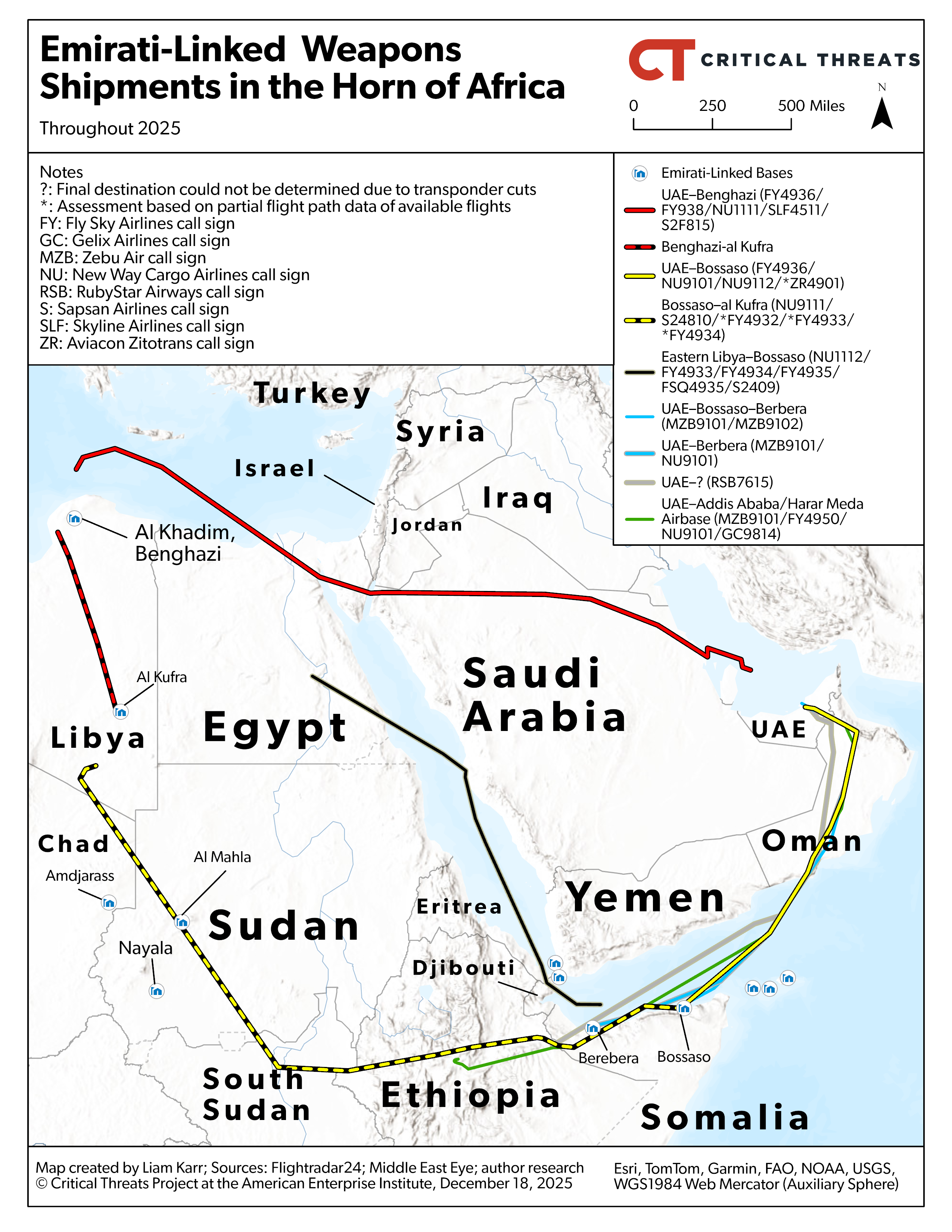
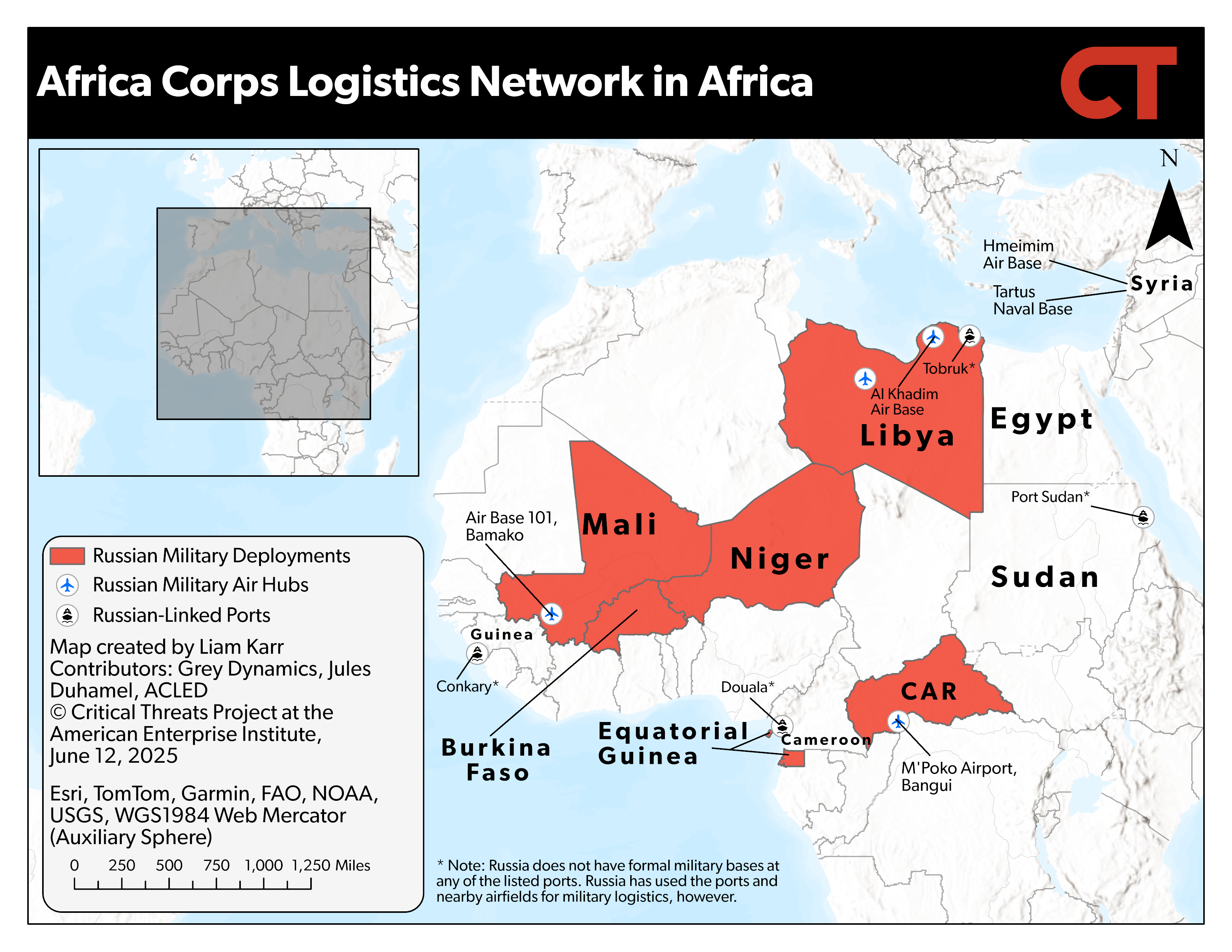
External powers continued to vie for influence in Africa, particularly in conflict-affected areas, such as the Sahel and Horn of Africa. Russia officially rebranded its military presence in Africa from the Wagner Group to the Ministry of Defense–controlled Africa Corps amid setbacks to its prestige, given the deteriorating security situation in the Russian-aligned Sahel countries. This reality has not stopped the Kremlin from pursuing efforts to expand its access and influence from the landlocked Sahel states to the West African Atlantic coast via states like Equatorial Guinea, Togo, and São Tomé and Príncipe. “Middle powers”—the Gulf States and Turkey—expanded their influence in West Africa and heavily impacted conflict dynamics in the Sudanese civil war amid escalating Middle Power competition across the Horn of Africa. CTP will be launching a six-part report series beginning in January 2026 that will cover middle power competition in the broader Red Sea, the blocs of African actors on the other side of this competition, and how the competition could impact the trajectory of several simmering conflicts across the Horn of Africa.
- Saudi-UAE Red Sea Competition, December 2025
- [Event] Africa and Middle Powers: Implications for the Horn, Red Sea, and US–Africa Policy, AEI Event, November 2025
- [Op-ed] The U.S. Can Outcompete China in Africa, November 2025
- [Op-ed] Can Turkey Help the U.S. in Africa, October 2025
- [Op-ed] Unleashing US Nuclear Energy in Africa Is Good for Business, Bad for China and Russia, October 2025
- Turkish Troops to Niger, September 2025
- Russia, US Compete in West Africa, July 2025
- Wagner Out, Africa Corps In, June 2025
Democratic Republic of the Congo
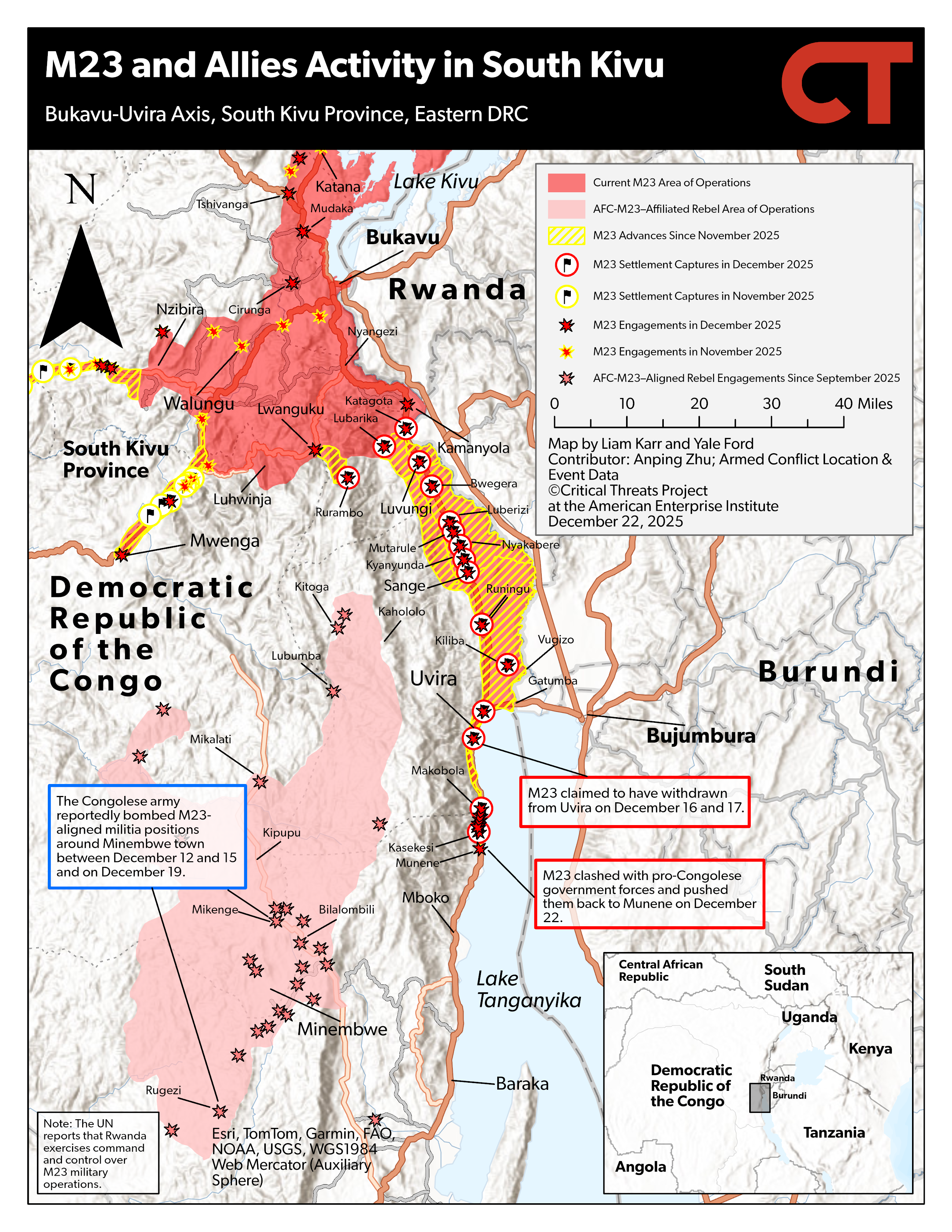
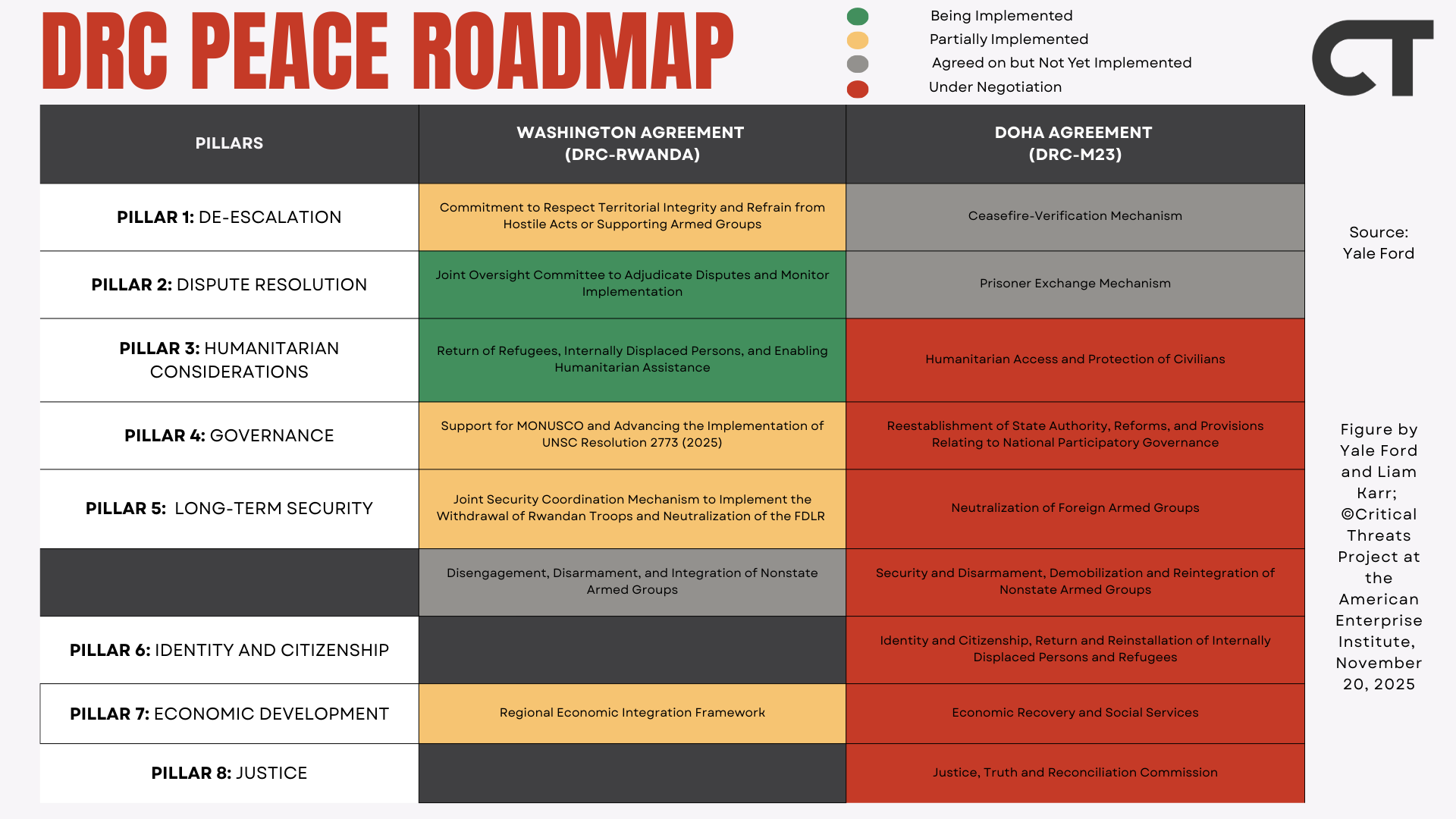
The Rwandan-backed M23 rebellion in the eastern DRC escalated to its most severe level in more than a decade, driven by major Rwandan-supported offensives at the beginning and end of 2025 amid US-backed peace efforts throughout most of the year. M23 captured Goma and Bukavu, the provincial capitals of North and South Kivu in the eastern Democratic Republic of the Congo (DRC), in early 2025, marking the biggest escalation of the conflict since M23 resurged in 2021. Outside political actors and major players in the Great Lakes region took advantage of the expanded M23 conflict to strengthen their influence in the eastern DRC, including neighboring Burundi and Uganda. The front lines largely stabilized by March, after Rwanda deconflicted with Burundi, and international peace efforts backed by the United States and Qatar between the DRC, M23, and Rwanda kicked off. M23 began building an extensive parallel state and adding thousands of new recruits to its ranks, however, and both sides reinforced their positions on the frontlines and began accusing each other of preparing offensives and negotiating in bad faith throughout mid-2025. Peace efforts reached new high toward the end of the year with a Qatari-brokered roadmap agreement for future negotiations between the Congolese government and M23 in mid-November and the signing of the US-brokered Washington Accords between the DRC and Rwanda in early December, but these successes immediately faced setbacks as the year ended with a renewed M23-Rwanda offensive on Uvira town in South Kivu, leaving the situation fraught heading into 2026.
- What M23's Capture of Uvira Means for the DRC, Wider Region, and Peace Talks, December 2025
- [Op-ed] What Trump’s ‘Historic’ Rwanda-DR Congo Peace Deal Doesn’t Achieve, December 2025
- DRC-M23 Doha Peace Framework—A Long Road Ahead, November 2025
- M23’s State-Building Project, September 2025
- Challenges to Sustainable DRC-M23 Peace, August 2025
- US-DRC-Rwanda Peace Deal—A Beginning, Not an End, June 2025
- Uganda in the DRC’s M23 Conflict—Friend to All, Enemy to None, April 2025
- M23 March Threatens Expanded Conflict in DR Congo and Regional War in the Great Lakes, January 2025
- Subscribe to the tri-weekly Congo War Security Review
Sudan
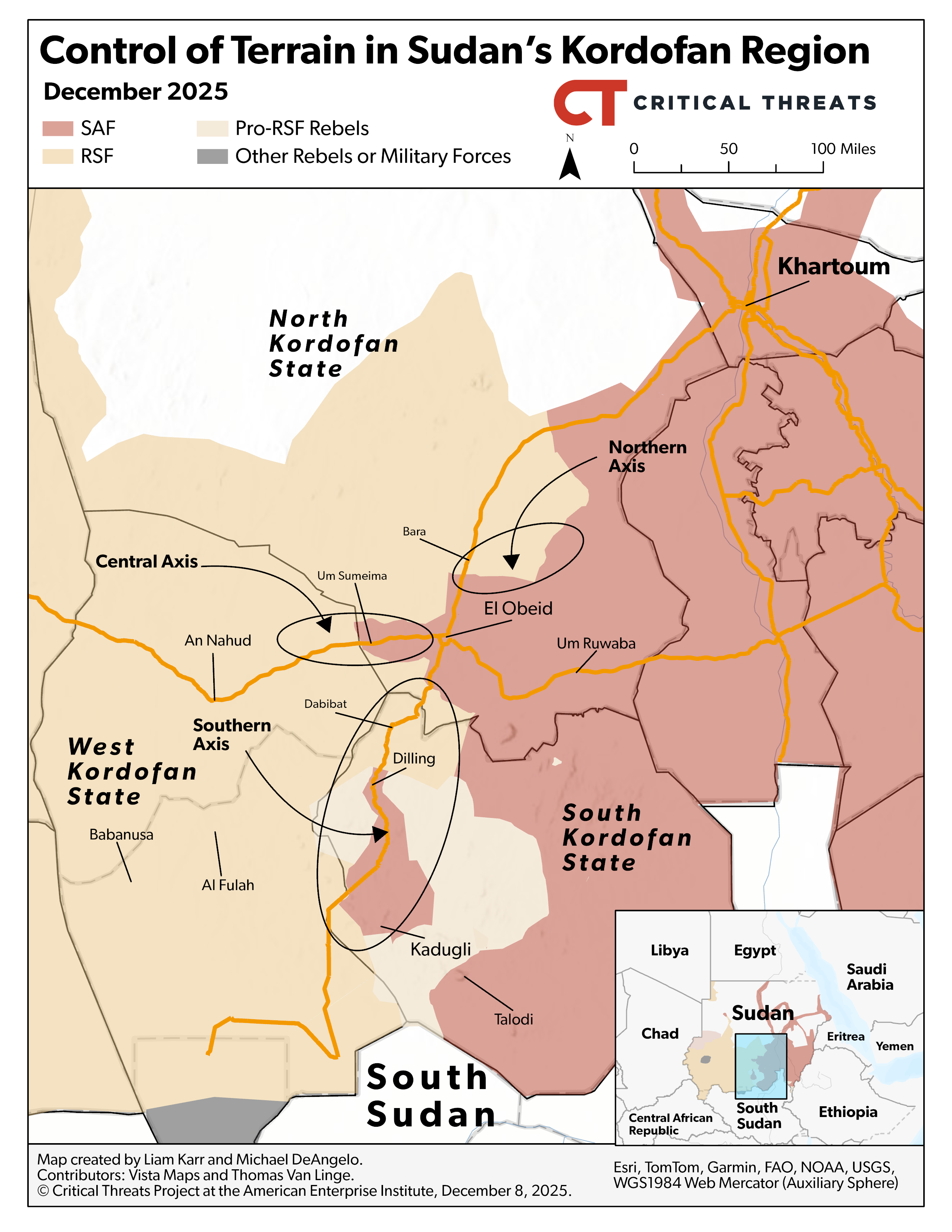
The Rapid Support Forces (RSF) currently holds the momentum in Sudan’s civil war after a promising start to the year for the Sudanese Armed Forces (SAF), with a showdown for central Sudan now looming heading into 2026. The Sudanese civil war had three phases in 2025: (1) a groundbreaking Sudanese Armed Forces’ (SAF) offensive from January to May; (2) an effective Rapid Support Forces’ (RSF) counteroffensive that halted the SAF advance by July; (3) and an RSF dry season offensive that has consolidated of the de facto partition of Sudan and centered in central Sudan from October onwards. The SAF’s offensive enabled the military to retake Khartoum and Omdurman—the capital area’s twin cities—and advance toward western Sudan. The RSF launched a counteroffensive in April that eventually established the current frontlines around el Obeid, the SAF’s headquarters in central Sudan. The RSF has since captured all major population centers in western and west-central Sudan, including cities like el Fasher that the RSF had besieged for the majority of the war. The RSF’s recent advances have caused both warring parties to concentrate their efforts on three axes around el Obeid, setting the stage for a potentially decisive battle for the city before the rainy season begins in late spring 2026. US-led “Quad” peace efforts with Egypt, Saudi Arabia, and the United Arab Emirates intensified in the second half of 2025 amid an onslaught of human rights violations by both Sudanese factions, including a likely RSF genocide in el Fasher of at least 60,000 people. Continued external backing of the warring parties, including Quad members’ and others’ continued provision of drones and other advanced weaponry, has obstructed progress and continued to fuel the war, however.
- [Op-ed] Trump’s Turn to End Genocide and War in Sudan, December 2025
- Sudan Partition Hardens, December 2025
- El Fasher Falls, October 2025
- [Op-ed] Trump Can Prevent a Genocide in Sudan, August 2025
- Attritional Battles in Sudan, July 2025
- [Op-ed] Trump’s Dual Opportunity in Sudan, July 2025
- SAF Liberates Khartoum, March 2025
Ethiopia
Ethiopian Prime Minister Abiy Ahmed’s ambitions for Ethiopia to be the predominant power in the Horn of Africa sharply contrast with an emerging anti-Ethiopia regional bloc and increasing domestic turmoil in 2025. Abiy inaugurated the Grand Ethiopian Renaissance Dam (GERD) and escalated calls for Ethiopia to obtain access to the sea, with both projects integral to Abiy’s broader vision of regional supremacy. Eritrea and Ethiopia have mobilized along their border in response, sparking fears of a regional war, while Egypt, Eritrea, Somalia, and the SAF-backed Sudanese government have broadly increased cooperation in response to the perceived threats that the GERD and Ethiopia’s sea ambitions pose. The Pretoria peace agreement in Tigray continued to face severe challenges in 2025, with hardline Tigray People’s Liberation Front (TPLF) factions launching a de facto coup against the federal government-backed Tigray Interim Administration in March. The federal government and TPLF have since escalated their rhetoric and action against each other, leaving the TPLF to align with Eritrea and the Pretoria agreement at risk of collapse. The federal government has also dealt with an escalating Amhara ethnonationalist Fano insurgency, which has only furthered the divide between Ethiopia’s regional ambitions and the internal stressors challenging the federal government.
- Drone Strike on Tigrayan Forces, November 2023
- New Fano Offensive in Ethiopia, October 2025
- Ethiopia Launches GERD, September 2025
- [Op-ed] Ethiopia Conflict Threatens to Create Another Challenge for Trump in Africa, July 2025
- Tigray Threatens to Spark the Next Eritrean-Ethiopian War, March 2025
Somalia
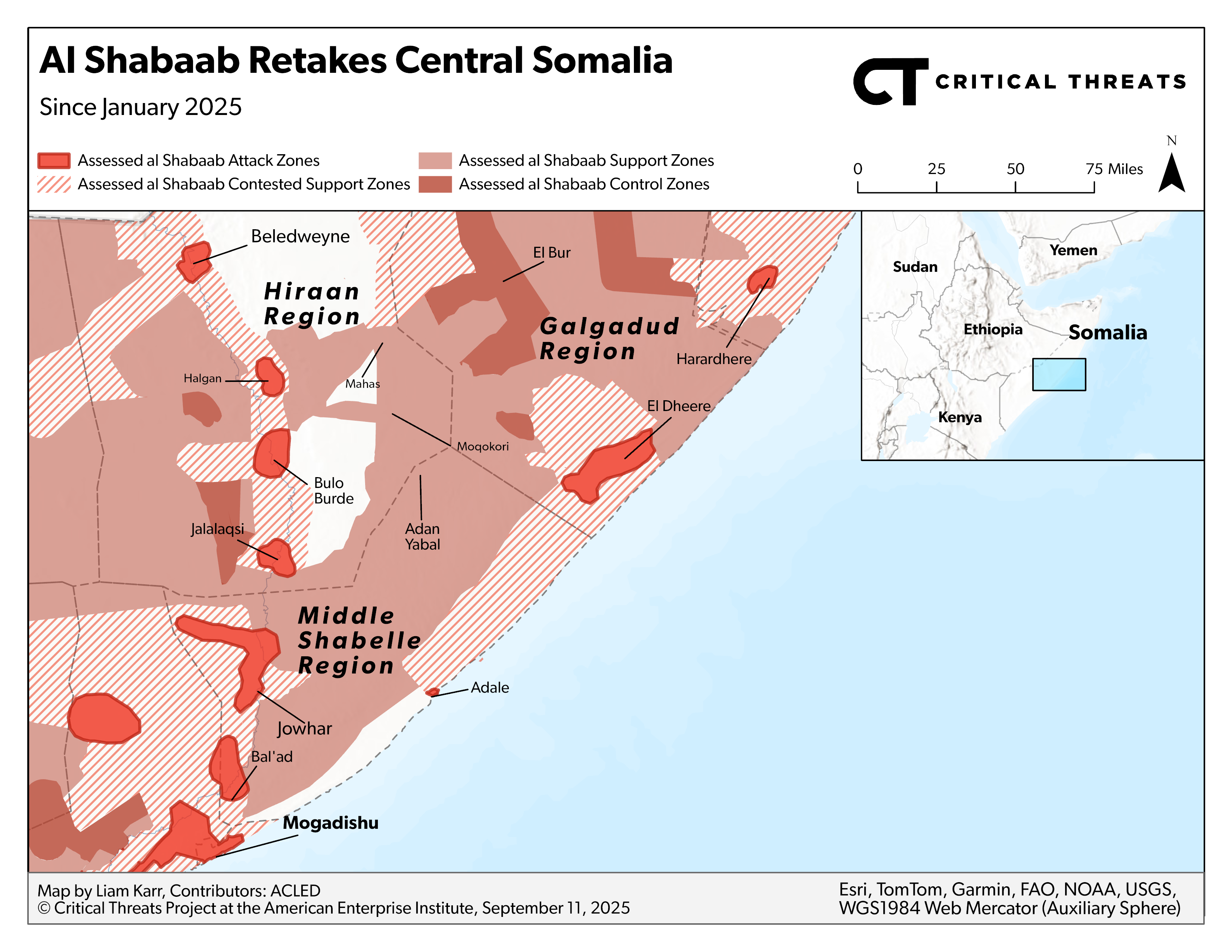
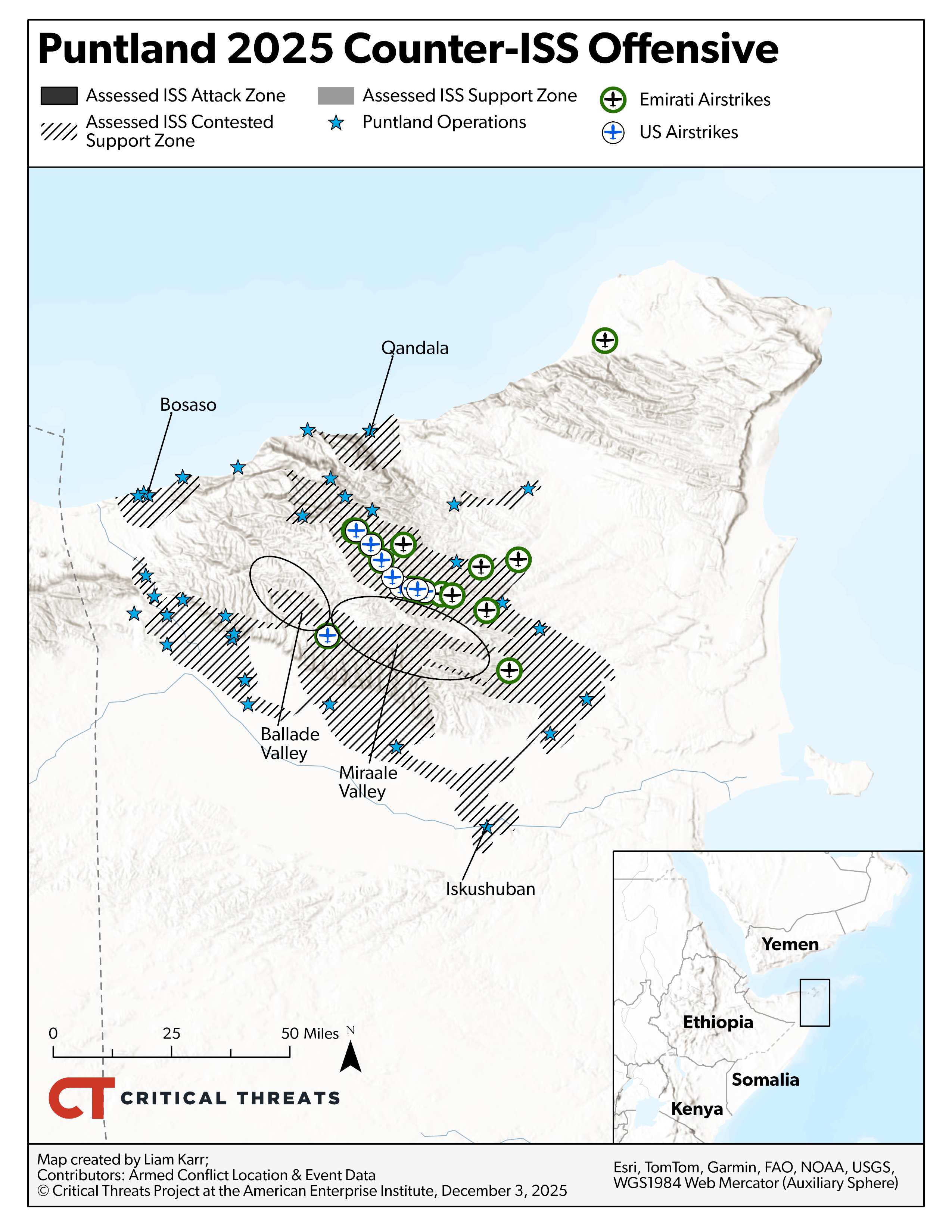
The Somali Federal Government faced military and political setbacks throughout 2025, including al Shabaab overturning nearly all gains from a landmark, US-backed offensive in central Somalia in 2022 and deteriorating ties with multiple federal member states. Relations between the Somali Federal Government (SFG) and the Jubbaland and Puntland state governments and Somali opposition sharply deteriorated in 2025 after the SFG went ahead with plans to hold direct elections for the upcoming 2026 federal elections, which would upend the powersharing dynamics of Somalia’s current quota-based system. Opposition factions responded by establishing the Somali Future Council political coalition to obstruct the SFG’s implementation of the reforms, setting the stage for disputed and violent elections, diminished Mogadishu influence in pro-opposition states, and possibly even a parallel government. The growing divide came amid an al Shabaab offensive in central Somalia and US-backed anti-Islamic State Somalia Province (ISS) campaign in northern Somalia. Al Shabaab relinked its support zones in central Somalia to its heartland in southern Somalia, positioning the group to increase pressure on Mogadishu. Puntland forces backed by the United States and United Arab Emirates have waged a successful campaign against ISS in northern Somalia, however, which has significantly degraded but not defeated ISS.
- Somali-US Counter-IS Operations, December 2025
- Somali Election Disputes Loom, October 2025
- Al Shabaab Retaking Central Somalia, April 2025
West Africa
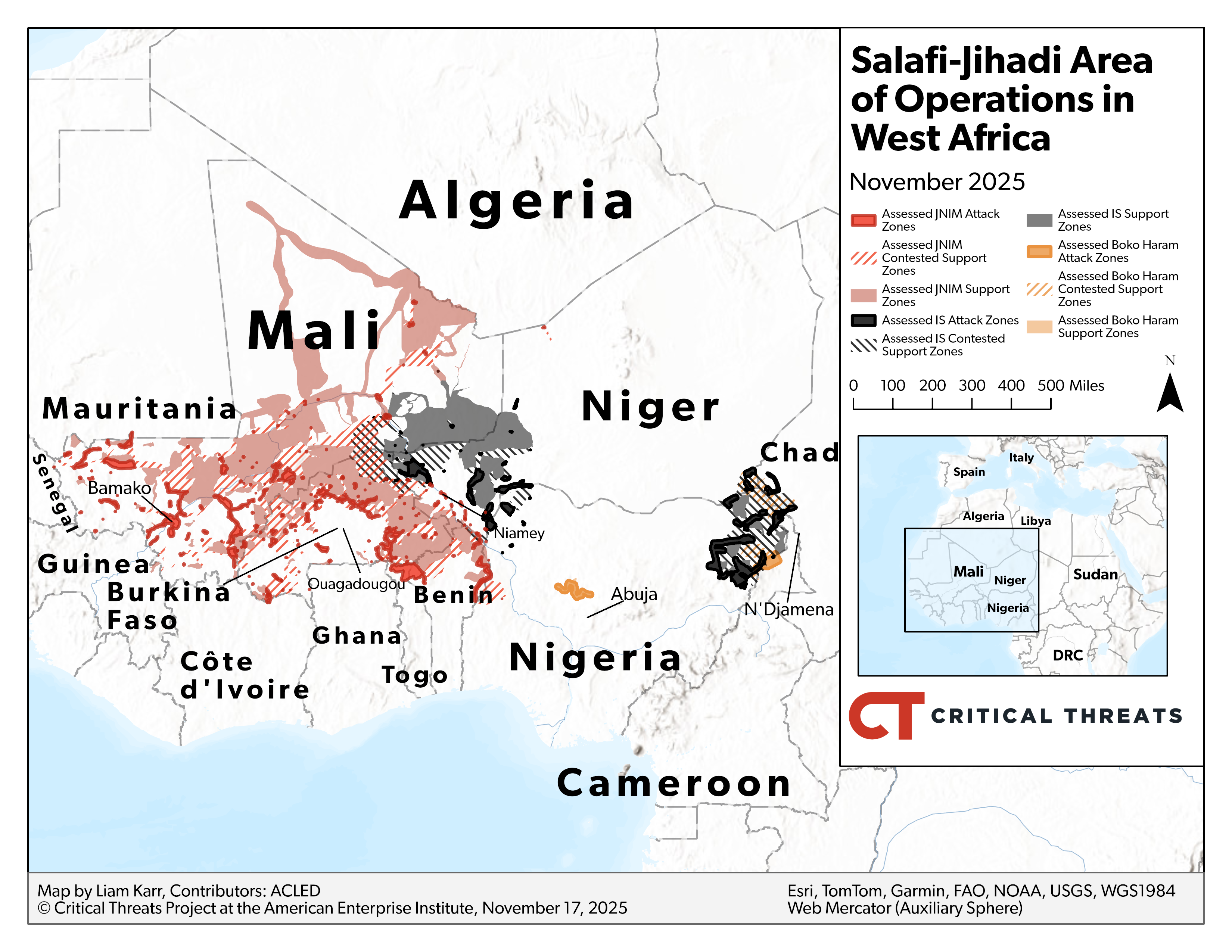
Al Qaeda and Islamic State affiliates continued to strengthen and expand in West Africa in 2025, especially in the Sahel, where al Qaeda’s Sahelian affiliate has escalated its insurgency in economically and politically sensitive parts of southern and western Mali in the second half of 2025. Jama’at Nusrat al Islam wa al Muslimeen (JNIM) conducted a series of attacks on major cities in western Mali in July, including the regional capital Kayes and a Senegalese border post for the first time, and subsequently launched a fuel blockade against the Malian capital and other major towns across southern and western Mali beginning in September. The blockade has involved JNIM checkpoints where militants enforce select shari’a law provisions, such as mandatory veiling and gender segregation. JNIM and IS Sahel Province (ISSP) both operationalized rear support zones in northwestern Nigeria in 2025, leading to some of the groups’ first claims in Nigeria and an increase in cross-border attacks on neighboring Benin and Niger. Lake Chad–based IS West Africa Province (ISWAP) and Boko Haram strengthened amid deteriorating regional security cooperation in the Lake Chad border zones, but infighting between the two groups continues to prevent either from consolidating unchecked dominance in the area. IS and its affiliates continue to pose a regional and possibly international attack risk, as evidenced by ISSP kidnappings of foreign civilians and multiple ISSP-linked cells in Morocco in 2025.
- Salafi-Jihadi Areas of Operation in West Africa Interactive Map and Campaign Analysis, November 2025
- Islamic State Kidnaps American, October 2025
- ISSP Poses Clear Transnational Threat, February 2025
Constitutional and Democratic Governance
Coups and illegitimate elections continued to challenge constitutional and democratic governance throughout 2025, amid growing popular backlash driven by youth-led protests against corrupt and ineffective governments across the continent. There were three coup attempts in Africa in 2025, all of which occurred in the last quarter of 2025 in very different contexts. The military successfully took charge in Guinea-Bissau and Madagascar, the latter of which occurred during massive youth-led protests, while the Beninese government thwarted the coup attempt with the help of the Economic Community of West African States. Juntas in Gabon and Guinea engineered elections to extend their stay in power, while the Nigerien junta postponed elections. Togolese President Faure Gnassingbé reformed the country’s election system in what the opposition deemed a constitutional coup that will de facto extend his 20-year stay in power, and Ivorian President Alassane Ouattara secured a fourth term in peaceful elections where major opposition figures were barred from running. Cameroon’s 92-year-old President Paul Biya won an eighth term, and Samia Suluhu Hassan and the Tanzanian ruling party won disputed elections, both of which resulted in mass protests and state-sanctioned violence against civilian protestors in Cameroon and Tanzania.
- Benin Coup, December 2025
- Guinea-Bissau Coup, December 2025
- Deadly Crackdown in Tanzania, November 2025
- Anti-Biya Protests in Cameroon, October 2025
- What the Madagascar Coup Means for Africa, Mining, and Competition in the Indian Ocean, October 2025
- Togo Constitutional Changes, April 2025