{{currentView.title}}
March 09, 2026
Ukraine Invasion Updates, February 2026
Russian Offensive Campaign Assessment, February 28, 2026
Russian officials largely condemned the February 28 US and Israeli strikes against Iran, consistent with Russian rhetoric around the June 2025 Israel-Iran war. Russian Foreign Minister Sergey Lavrov had a phone call with Iranian Foreign Minister Abbas Araghchi following the strikes on Iran on February 28 in which Lavrov condemned the strikes, calling for the United States and Israel to immediately cease all hostilities and resume efforts for a diplomatic solution to resolve the issues g the United States, Iran, and Israel.[i] The Russian Ministry of Foreign Affairs (MFA) issued a similar condemnation on February 28, calling the strikes unprovoked and a violation of international law.[ii] The MFA criticized the United States and Israel for conducting the strikes after recently pursuing efforts to negotiate with Iran and claimed that the strikes violate international law and risk regional and global destabilization. The MFA called for a return to diplomacy and expressed Russia's willingness to help facilitate renewed talks. Russian Security Council Deputy Chairperson Dmitry Medvedev directly criticized US President Donald Trump for striking Iran, claiming on his English and Russian language social media channels that the "peacekeeper" has "shown his true colors."[iii] Russian State Duma International Affairs Committee Chairperson Leonid Slutsky and International Affairs Committee First Deputy Head Alexei Chepa, whose target audience is the Russian population and who often act as bullhorns for the Kremlin’s true diplomatic and military aims, similarly criticized US aims in striking Iran and called for both the United Nations Security Council (UNSC) and the broader .[iv] Chepa expressed hope that the United States will become preoccupied with the conflict in Iran and "forget" about Ukraine and assessed that the new conflict will likely delay a peace deal in Ukraine.[v]
Russia's boilerplate condemnations of the strikes against Iran highlight the continued limits of Russia's ability to support Iran and the asymmetry of the Russian-Iranian relationship. Russia issued similar condemnations of the June 2025 war and was unable to provide Iran with more support in defending against Israeli and later US strikes.[vi] Russia's war in Ukraine is constraining Russia’s ability to provide military support to Ira.[vii] The Kremlin has to balance competing interests of sustaining its relationship with its allies, including Iran, while also attempting to reset the US-Russia relationship on Russia's terms, including avoiding additional US sanctions.[viii]
Ukrainian authorities implicated soldiers and the commander of the Russian 136th Motorized Rifle Brigade (58th Combined Arms Army, Southern Military District) for using in Vovchansk, Kharkiv Oblast from September 2024 to June 2025 in violation of international law. Ukraine's Security Service (SBU) reported on February 27 that 136th Motorized Rifle Brigade Commander Colonel Ruslan Nazarenko gave orders to fire K-51 and RG-Vo aerosol grenades containing CS gas (chlorobenzalmalononitrile) and CN gas (Chloroacetophenone) on Ukrainian positions using drone drops at least 14 times from September 2024 to June 2025.[ix] The SBU also identified eight Russian soldiers in the 136th Motorized Rifle Brigade who used the munitions. CS and CN gases are classified as riot control agents (RCA), the usage of which violates the Chemical Weapons Convention (CWC) to which Russia is a signatory.[x] ISW observed reports that Russian forces significantly increased their usage of RCAs against Ukrainian forces throughout 2024 and 2025 in violation of the CWC.[xi]
Key Takeaways:
- Russian officials largely condemned the February 28 US and Israeli strikes against Iran, consistent with Russian rhetoric around the June 2025 Israel-Iran war.
- Russia's boilerplate condemnations of the strikes against Iran highlight the continued limits of Russia's ability to support Iran and the asymmetry of the Russian-Iranian relationship.
- Ukrainian authorities implicated soldiers and the commander of the Russian 136th Motorized Rifle Brigade (58th Combined Arms Army, Southern Military District) for using chemical agents in Vovchansk, Kharkiv Oblast from September 2024 to June 2025 in violation of international law.
- Ukrainian and Russian forces both recently advanced in the Kostyantynivka-Druzhkivka tactical area and near Hulyaipole.
Russian Offensive Campaign Assessment, February 27, 2026
Russian forces have likely begun artillery and drone preparation of the battlefield for the anticipated Russian Spring-Summer 2026 offensive against Ukraine’s Fortress Belt in Donetsk Oblast. Russian forces shelled Bilenke (roughly 14 kilometers from the frontline and immediately northeast of Kramatorsk, the northern tip of the Fortress Belt — a series of fortified cities that have constituted the backbone of Ukrainian defenses in Donetsk Oblast since 2014) on February 26 and 27 — the first time that Russian forces have hit Kramatorsk or its suburbs with tube artillery.[1] The artillery strikes against Bilenke likely mark the beginning of Russian artillery preparation ahead of the expected Spring-Summer 2026 Russian offensive. Russian forces will likely begin the ground assault phase of this offensive in the near-term following the artillery preparation phase. Russian forces have also been conducting a the use of air power to strike targets in the frontline’s operational rear (roughly 20 to kilometers from the line of contact) to impact tactical battlefield operations, and Russia has largely been waging its BAI campaign with drone strikes.[2] Geolocated footage published on February 26 shows Russian drone strikes against a civilian cyclist on the H-20 Kostyantynivka-Slovyansk highway northwest of Kostyantynivka and against Ukrainian forces in Oleksiievo-Druzhkivka, both at the south of the Fortress Belt.is the main ground line of communication (GLOC) connecting the cities of the Fortress Belt. Russian forces have been using monthslong BAI campaigns as part of a broader campaign design aimed at degrading Ukrainian defensive capabilities and frontline positions ahead of Russian ground offensives.[4] A Ukrainian servicemember operating in the Slovyansk direction reported on February 26 that the Russian military command is deploying reinforcements to the Slovyansk direction, another indicator that Russia plans to prioritize offensive operations against the Fortress Belt in the near-term.[5] A Russian ground offensive to seize the Fortress Belt will likely be a that would cost the Russian military command significant time, manpower, and resources.[6] Russian forces have so far been unable or unwilling to concentrate the resources required for a decisive offensive operation, particularly against the Fortress Belt.[7]
Russia is reportedly expanding recruitment efforts in higher educational institutions to staff the Russian Unmanned Systems Forces (USF). T reported on February 27 that the Russian Ministry of Defense (MoD) has expanded its recruitment efforts to at least 95 educational institutions across Russia and pressured students to sign contracts with the MoD during face-to-face meetings at 90 of these institutions.[8] The BBC Russian Service noted that the 95 educational institutions do not include institutions where the Russian MoD is conducting "indirect recruitment," such as opening unmanned systems centers at Russian universities. The Boted that Russian universities are publicizing successful recruitment efforts, likely to entice more students to sign contracts with the MoD. Germany-based Russian opposition outlet Echo reported February 26 that the Russian MoD is recruiting students from at least 57 universities and 13 colleges and technical colleges in 24 federal subjects, including occupied Crimea and has expanded its recruitment campaign to include all students, not just those underperforming academically. Echo noted that the Russian MoD is promising to students that they will only serve in USF units (a preferable military occupation that faces lower risk to life and limb than infantry) but that at least some of the contracts contain language that would allow the MoD to send the recruits to any Russian military unit, not just a USF unit.[9] Echo reported that the Russian MoD is utilizing a ”carrot and stick” tactic by offering benefits including large salaries, a guaranteed single year of service, and also by coercing and threatening students into signing contracts. Russian opposition outlet Meduza reported on February 26 that the Nikolai Lunin Novosibirsk College of Transport Technologies organized a three-day screening of propaganda films about Russians who allegedly "betrayed" Russia because the students had refused to volunteer for military service.[10]ussian forces are increasingly struggling to hit recruitment targets, with Russia's casualty rate outpacing the recruitment rate in January 2026, for the first time since the start of the full-scale invasion.
The Kremlin is continuing to crack down on pro-war information space figures that it cannot fully co-opt or subordinate to state control as part of wider efforts to consolidate the information space under the Kremlin’s control. Russian forcement agencies announced on February 27 that Russian authorities detained Russian news outlet Readovka founder and former editor-in-chief Alexey Kostylev under suspicion of “large-scale fraud.”[13] A spokesperson for the investigation told TASS that Russian authorities suspect Kostylev of embezzling approximately one billion rubles (about $13 million) from the Russian Ministry of Defense (MoD) during execution of government contracts. Russian opposition media outlets reported that Readovka previously a far-right media outlet that did not have close ties to the Russian government until the outbreak of the war in 2022, at which point the outlet began supporting the war.[15] Russian opposition media outlet Astra amplified reports that Russian forces cut funding for Readovka in March of 2025 and that Andrey Tkachenko, who reportedly has ties with the Kremlin, took over the outlet in March 2025.[16] ISW has previously observed that the Kremlin has a long-running campaign to both co-opt and coerce Russian milbloggers in order to eliminate criticism of the Kremlin and consolidate control over the Russian information space.[17] ISW has not collected evidence that the Kremlin succeeded in co-opting Kostylev, as it did with other prominent milbloggers or Telegram administrators[18] Russian authorities’ detainment of Kostylev is set against the background of other Kremlin crackdowns against the information space such as the throttling of Telegram.[19] ISW has previously assessed that the Kremlin is considerin enacting domestically unpopular measures such as rolling involuntary reserve callups, and the Kremlin is likely setting conditions to repress backlash, especially from the highly influential pro-war sphere.[20]
Swedish Defense Minister Pal Jonson told Swedish outlet SVT on February 26 that the Russian drone approached the Charles de Gaulle while it was docked in Malmo, Sweden on February 25, likely violating Swedish airspace.[23] French General Staff Spokesperson Colonel Guillaume Vernet told Agence France-Presse (AFP) on February 26 that a Swedish system jammed the drone about seven nautical miles (roughly 13 kilometers) from the Charles de Gaulle.[24] Unidentified drones previously overflew a French nuclear submarine base in December 2025.[25] Such drone sightings are part of a pattern of aerial incursions into NATO airspace, possibly with the purpose of reconnoitering known European military bases, equipment, and defense infrastructure.[26] ISW continues to assess that Russia is increasingly engaging in covert and overt attacks against Europe and that ongoing Russian and suspected Russian airspace violations are likely part of Russia’s “Phase Zero” effort — Russia’s broader informational and psychological condition-setting effort that aims to prepare for a possible NATO-Russia war in the future.[27]
Russian forces likely used white phosphorus in Kostyantynivka and may have indiscriminately affected civilian areas in violation of international law. Geolocated footage published on February 27 shows a Russian strike with what appears to be white phosphorus munitions against southwestern Kostyantynivka, Donetsk Oblast.[28] A Ukrainian brigade operating in the Kostyantynivka direction reported that Russian forces used white phosphorus in the strike and immediately after struck the area with a FAB-1500 guided glide bomb.[29] While ISW cannot assess whether the impacted area contained civilians, civilians still remain in Kostyantynivka. The Ukrainian brigade reported that roughly 2,000 civilians remain in Kostyantynivka. Protocol III of the Convention on Conventional Weapons prohibits the use of incendiary weapons, such as white phosphorus, against civilian targets or in areas with concentrations of civilians.[30] Russian forces notably have used white phosphorous and incendiary munitions allegedly in violation of international law in Ukraine before
Key Takeaways:
- Russian forces have likely begun artillery and drone preparation of the battlefield for the anticipated Russian Spring-Summer 2026 offensive against Ukraine’s Fortress Belt in Donetsk Oblast.
- Russia is reportedly expanding recruitment efforts in higher educational institutions to staff the Russian Unmanned Systems Forces (USF).
- emlin is continuing to crack down on pro-war information space figures that it cannot fully co-opt or subordinate to state control as part of wider efforts to consolidate the information space under the Kremlin’s control.
- A Russian drone approached the French aircraft carrier Charles de Gaulle in the Swedish port of Malmo on February 25.
- Russian forces likely used white phosphorus in Kostyantynivka and may have indiscriminately affected civilian areas in violation of international law.
- Ukrainian forces recently advanced in the Kostyantynivka-Druzhkivka tactical area and near Oleksandrivka. Russian forces recently advanced near Hulyaipole.
Russian Offensive Campaign Assessment, February 26, 2026
Russia launched another massive missile and drone strike against Ukraine on the night of February 25 to 26, primarily targeting energy infrastructure. The Ukrainian Air Force reported that Russian forces launched 420 drones and 39 missiles against Ukraine overnight – the fourth Russian strike of over 400 projectiles in February 2026.[i] The Ukrainian Air Force reported that Russian forces launched 11 Iskander-M ballistic missiles/S-300 surface-to-air missiles; 24 Kh-101 cruise missiles; two Zirkon/Onyx anti-ship missiles; two Kh-69 cruise missiles; and 420 Shahed-type, Gerbera-type, Italmas-type, and other drones, of which roughly 280 were Shaheds. The Ukrainian Air Force reported that Ukrainian air defenses downed 374 drones and 32 missiles, that five missiles and 46 drones struck 32 locations, and that downed debris fell on 15 locations. Ukrainian President Volodymyr Zelensky reported that Russian forces struck gas infrastructure in Poltava Oblast, electrical substations in Kyiv and Dnipropetrovsk oblasts, and caused additional damage in Chernihiv, Zaporizhia, Kharkiv, Kirovohrad, and Kyiv oblasts and Kyiv City.[ii] Ukraine’s largest energy company, DTEK, reported that Russian overnight strikes targeted a large substation of DTEK subsidiary Odesa Electric Networks, significantly damaging the substation.[iii] DTEK noted that Russian strikes have inflicted ”colossal destruction” on 45 percent of DTEK Odesa’s large substations. Ukrainian First Deputy Minister of Energy Artem Nekrasov reported that Russian overnight strikes left consumers in Dnipropetrovsk, Odesa, Donetsk, Zaporizhia, Poltava, and Kharkiv oblasts without electricity.[iv]
The appearance of ballistic, cruise, and anti-ship missiles in the February 25-26 strike package is reflective of a wider pattern in Russia's strike campaign. Russia has launched strike packages with 25 or more missiles five additional times in February 2026, most recently on February 22. Russian forces often launch no or few missiles for multiple days in a row before launching strike packages with a significantly higher quantity of missiles, likely stockpiling missiles between strike series to maximize damage by launching several missiles alongside a large quantity of drones to overwhelm Ukraine's air defenses.[v] Russian forces have also modified their drones and missiles to inflict more damage, including by equipping Shahed drones with mines and cluster munitions, and such measures have disproportionately affected civilian and energy infrastructure.[vi] Russia also launches these larger strike packages to coincide with the days before and after bilateral and trilateral peace negotiations.[vii] Russia notably launched this most recent strike package on the eve of bilateral US-Ukrainian talks on February 26 in Geneva. Russia’s increasingly large and diverse strike packages continue to highlight the critical importance of Western assistance in bolstering Ukraine’s air defense capabilities, both with high-end US-made Patriot air defense systems that can effectively counter Russian ballistic missiles and other lower-end forms of air defense, for a holistic, well-equipped air defense umbrella.[viii]
The US and Ukraine continue bilateral engagements as part of ongoing peace negotiations. Ukrainian President Volodymyr Zelensky and US President Donald Trump spoke by phone on February 25 to discuss ongoing negotiations and preparation for upcoming bilateral and trilateral talks.[ix] US and Ukrainian delegations also met in Geneva, Switzerland, on February 26, led by US Special Envoy to the Middle East Steve Witkoff and former Senior Advisor to the US President Jared Kushner, and Ukrainian Defense Council Secretary Rustem Umerov, respectively.[x] Umerov stated ahead of the talks that parties planned to discuss the proposed prosperity package for Ukraine, mechanisms for economic support and recovery, investment tools, and preparations for the next round of trilateral talks, which will reportedly take place in early March 2026.[xi]
Ukraine's and SpaceX’s efforts to shut off Russian forces’ access to Starlink terminals continues to disrupt Russian drone operations across the frontline. Ukrainian 3rd Army Corps Commander Brigadier General Andriy Biletsky told the Independent on February 26 that Starlink outages have cut the effectiveness of Russia's drone campaign by roughly 20 to 40 percent in the last two weeks.[xii] The Independent noted that Ukrainian forces in the 3rd Army Corps' area of responsibility (AoR), which is roughly 1,300 kilometers long, have retaken territory near Pokrovsk, north of Lyman, and near Hulyaipole since the Starlink block on February 1.[xiii] Biletsky stated that Russian forces will likely partially regain communication capabilities within a month or two through other means, such as satellite communication, but that Russian forces will not likely be able to fully restore the level of efficiency they had with Starlink for the next three to five years. Russian forces had been using Starlink terminals both for frontline communication and to extend drone ranges to strike further into the Ukrainian rear and generate battlefield air interdiction (BAI) effects.[xiv] ISW has observed evidence over the last several weeks that the Starlink block has prevented Russian forces from conducting tactical and mid-range strikes and ground operations at the same tempo and depth as they had been in prior weeks.[xv] Ukrainian forces have also exploited recent Starlink blocks to launch localized counterattacks along the Dnipropetrovsk-Zaporizhia Oblast border and liberate significant territory in southern Ukraine.[xvi] Russian forces are finding workarounds to the block, including by resorting to local SIM cards and relay drones, but these mechanisms have thus far not completely compensated for the loss of Starlink.[xvii]
The People's Republic of China (PRC) remains a critical enabler of Russia's war in Ukraine. Industry sources told Russian business newspaper Vedomosti on February 26 that Russia’s sole domestic optic fiber producer, the Optic Fiber Systems plant in Saransk, Republic of Mordovia, has been offline since Ukrainian drones struck the plant in May 2025.[xviii] The plant reportedly produced roughly four million kilometers of optic fiber annually and supplied roughly 20 Russian cable manufacturers that used the material to produce fiber-optic cables, which Russian forces use on the battlefield. The CEO of a telecommunications news outlet told Vedomosti that the plant disruption has left Russia entirely dependent on the PRC for optical fiber. The industry sources told Vedomosti that the PRC suppliers have increased the price of one kilometer of optical fiber for Russian buyers from 16 yuan ($2.34) at the start of 2025 to 40 yuan ($5.85) in January 2026, a 150 percent increase in one year. Sources noted to Vedomosti that Russian cable manufacturers will likely have to raise their prices due to the supply issues and that this is the main risk to the industry. ISW has not observed evidence that Russian forces are experiencing battlefield fiber optic cable shortages, which may suggest that the PRC's supply of optical fiber is currently sufficient to meet demand. Russian forces may also be using stockpiled cables predating the May 2025 strike. Russian forces also reportedly use fiber-optics for ground communication.[xix] Russian forces have been using fiber-optic cables since Spring 2025 to make drones more resistant to electronic warfare (EW) interference and to extend the range of tactical drones up to 60 kilometers.[xx] ISW continues to assess that the supply of PRC-origin components to Russia has been crucial to the Russian defense industrial base’s ability to adapt, innovate, and continue the war against Ukraine.[xxi]
A Russian fiber-optic first-person view (FPV) drone reached the outskirts of Kharkiv City for the first time on February 25. The Kharkiv Oblast Prosecutor’s Office reported on February 25 that a Russian fiber-optic FPV drone reached Kyivskyi Raion on the northern outskirts of Kharkiv City for the first time.[xxii] The Russian Anvar Spetsnaz Detachment (possibly referring to the BARS-25 Anvar volunteer detachment) published geolocated footage on February 25 showing a Russian fiber-optic drone striking a vehicle traveling along the M-03 highway on the northern outskirts of Kharkiv City, indicating that Russian forces flew another fiber-optic FPV drone as far as roughly 21 kilometers from the international border.[xxiii] Ukrainian Ministry of Defense (MoD) advisor on defense technology and drone and electronic warfare (EW) expert Serhiy “Flash” Beskrestnov noted on February 25 that Russian forces would have had to find a suitable and long ground corridor through which to fly the drone, as the area is densely populated and contains obstacles that could sever fiber-optic wires in flight.[xxiv] Russian forces are now able to conduct fiber-optic FPV strikes against Kharkiv City itself, and such strikes against Ukrainian ground lines of communication (GLOCs) in the area could foreshadow a battlefield air interdiction (BAI) campaign in northern Kharkiv Oblast. Such increases in fiber-optic FPV range will also allow Russian forces to harass civilian populations in Kharkiv City, similarly to how Russian forces have been using tactical drones to make life near the frontline untenable for civilians.[xxv]
Russia is reportedly deploying elements of at least one newly re-formed military unit to the Kupyansk direction. Artillery crews and signalmen of the Russian 68th Separate Command Battalion of the 34th Artillery Division (Moscow Military District [MMD]) are reportedly conducting combat operations in the Kupyansk direction.[xxvi] ISW first observed reports that Russia began re-forming the 34th Artillery Division, a Soviet-era formation, in January 2024 and observed indications in January 2026 that it was actively staffing the division.[xxvii] The 34th Artillery Division may be part of then-Russian Defense Minister Sergei Shoigu's military reforms, which started in late 2022 and early 2023 and aimed in part to reconstitute the MMD and Leningrad Military District (LMD).[xxviii] Russia's deployment of a new unit to the Kupyansk direction is notable as Russian forces are preparing for an expected Spring-Summer 2026 offensive.[xxix] Russian forces may be setting conditions to prioritize offensive operations in the Kupyansk direction at some point during this offensive, though current indications suggest the primary Russian effort will likely focus on the Fortress Belt in Donetsk Oblast.[xxx] Russian forces may also be tapping into operational or strategic reserves to defend against Ukrainian counterattacks in the Kupyansk direction, diverting resources from offensive operations or preparations elsewhere.[xxxi] Ukrainian military observer Kostyantyn Mashovets previously noted that all of the reserves of the Russian Western Grouping of Forces (responsible for the Kupyansk-Borova-Lyman directions, including efforts to advance on Slovyansk from the north) are fighting in the Kupyansk direction and are therefore unable to support Russian offensive operations in the Slovyansk direction.[xxxii] Russia has been unwilling to dedicate sufficient resources to a single, decisive offensive operation, as it would have to redeploy forces from elsewhere on the frontline for such an effort.[xxxiii] The Kremlin seeks to maintain the facade that Russian forces are advancing across all areas of the theater simultaneously – a facade that the Ukrainian counterattacks in the Kupyansk direction or anywhere that Russian forces are not pursuing offensive operations would actively disprove.[xxxiv]
The People's Republic of China (PRC) reportedly issued a warning to Chinese citizens in Russia about a law compelling service in the Russian military. Hong Kong-based media outlet South China Morning Post reported on February 26 that the PRC Consulate in Russia called on Chinese citizens living in Russia to "take note of" a new Russian law requiring male permanent residents under the age of 65 to serve at least one year with the Russian military.[xxxv] The South China Morning Post referenced a Russian November 2025 law that requires foreign citizens and stateless men aged 18 to 65 who are "legally capable" to serve in the Russian military for at least one year to apply for Russian citizenship or a residency permit.[xxxvi] The November 2025 Russian law grants exceptions to Belarusian citizens, men who provide proof that they have already fulfilled the service requirement in the Russian military, and men who provide documentation from Russian military enlistment and recruitment centers that they are unfit for military service. Russian state media notably did not publicize these aspects of the decree at the time.[xxxvii] The PRC consulate reportedly did not directly warn PRC citizens against serving in the Russian military but called on PRC citizens in Russia to "make prudent decisions" to "ensure lawful residency status in Russia."[xxxviii] The PRC consulate's warning is an indicator that the PRC may be concerned that Russia will coerce its citizens living in Russia into military service through this law. Russia has conducted raids against migrants with expired permits or who are undocumented and coerced them into military service under threat of criminal charges or deportation.[xxxix] Forcing foreigners to serve in the Russian military as a condition for a residency permit or citizenship is a significant escalation in its recruitment mechanisms. ISW has recently observed indicators that the Kremlin is preparing for rolling call-ups of its involuntary reserve to mitigate manpower shortages from Russia's slowing recruitment rates.[xl] The PRC consulate's statement may be a supporting indicator that Russia is ready to conduct involuntary reserve call-ups and other coercive force generation mechanisms that could affect its citizens living in Russia.
Key Takeaways:
- Russia launched another massive missile and drone strike against Ukraine on the night of February 25 to 26, primarily targeting energy infrastructure.
- The US and Ukraine continue bilateral engagements as part of ongoing peace negotiations.
- Ukraine's and SpaceX’s efforts to shut off Russian forces’ access to Starlink terminals continues to disrupt Russian drone operations across the frontline.
- The People's Republic of China (PRC) remains a critical enabler of Russia's war in Ukraine.
- A Russian fiber-optic first-person view (FPV) drone reached the outskirts of Kharkiv City for the first time on February 25.
- Russia is reportedly deploying elements of at least one newly re-formed military unit to the Kupyansk direction.
- The PRC reportedly issued a warning to Chinese citizens in Russia about a law compelling service in the Russian military.
- The PRC consulate's warning is an indicator that the PRC may be concerned that Russia will coerce its citizens living in Russia into military service through this law.
- Ukrainian forces recently advanced in the Kostyantynivka-Druzhkivka tactical ar Russian forces recently advanced in northern Sumy Oblast, the Kostyantynivka-Druzhkivka tactical area, near Pokrovsk, and in western Zaporizhia Oblast.
Russian Offensive Campaign Assessment, February 25, 2026
ISW has not observed evidence of Ukrainian forces operating within Pokrovsk since late January 2025, indicating that Russian forces seized the entire town on a prior date. Russian forces have failed to capitalize on the seizure of Pokrovsk and make further operationally significant advances, demonstrating that the Russian seizure of the rest of Donetsk Oblast is not imminent or inevitable. ISW last observed Ukrainian forces operating on January 28, and therefore assesses that Russian forces likely completed the capture of the settlement sometime in the past few weeks.[i] The Russian campaign for Pokrovsk, a town with a pre-war population of 60,000, has been underway for almost two full years. Russian forces started their drive toward Pokrovsk in February 2024 after seizing Avdiivka (roughly 39 kilometers southeast of Pokrovsk) and began setting conditions to take Pokrovsk through direct frontal assaults in March 2024.[ii] Russian forces did not seize most of Pokrovsk until December 2025 — 21 months after starting frontal assaults on the town. Russian forces continued to fight to seize most of Myrnohrad (just east of Pokrovsk) for another month after that, with the Russian Ministry of Defense (MoD) claiming on December 28 that Russian forces seized the town.[iii] The Russian MoD claimed that Russian forces fully seized Pokrovsk in early December 2025 and heavily emphasized that Pokrovsk was a critical step in accomplishing Russia's strategic battlefield objectives.[iv] Russian Chief of the General Staff Army General Valery Gerasimov claimed on December 9 that the seizure of Pokrovsk was "crucial" for Russian efforts to seize the rest of Donetsk Oblast, and Russian President Vladimir Putin claimed in his annual Direct Line address on December 19 that the seizure "opened up" multiple directions of advance for the Russian military.[v] Pokrovsk was operationally significant given its use as an important logistics hub, but Russian strikes denied Ukrainian forces the ability to fully leverage the town for logistics as early as July 2025.[vi] Pokrovsk had long ceased to be an operationally significant town by the time Russian forces intensified their push to capture the town in Winter 2025.
The seizure of Pokrovsk has also not "opened up" major Russian advances to take the rest of Donetsk Oblast as Kremlin officials previously alleged. Russian forces have not significantly advanced northwest or west from Pokrovsk since December 2025 and have yet to even seize Hryshyne (just two kilometers northwest of Pokrovsk). Russian gains past Pokrovsk have not yet set operational conditions to support future offensive efforts towards the Fortress Belt, which ISW assesses will be Russia's main operational effort in the coming months. Russia's slow and costly seizure of Pokrovsk does not portend Russian advances elsewhere in Donetsk Oblast — Pokrovsk is a much smaller town both in area and population than Kramatorsk and Slovyansk, which make up the northern tip of Ukraine's heavily fortified Fortress Belt in Donetsk Oblast. Russian forces' long and costly battle to take Pokrovsk and their subsequent inability to significantly advance beyond the town refute the Kremlin's repeated claims that Russian forces will be able to easily and swiftly seize the Fortress Belt.
The Kremlin appears to have been successful in enacting a reflexive control campaign aimed at influencing the decision-making of the British- and French-led Coalition of the Willing. Diplomatic and defense sources told The Telegraph on February 24 that some members of the Coalition of the Willing have privately stated that their contributions of troops to guarantee the security of post-war Ukraine are dependent on Russian President Vladimir Putin granting permission for such deployments.[vii] A senior diplomatic source stated that Kremlin statements about Russian forces specifically targeting foreign troop deployments in Ukraine mean that the coalition "need[s] to send a different kind of force." Another diplomatic source assessed that European states have "essentially handed Putin a veto" over the coalition's plans. Divisions within the Coalition of the Willing are likely the result of a monthslong coordinated Kremlin reflexive control campaign — a method by which Russia attempts to make an opponent freely arrive at a pre-determined decision — that aimed to prevent the West from agreeing on security guarantees for Ukraine. The Kremlin has repeatedly rejected Western security guarantees for Ukraine, stating that foreign troops in Ukraine would be "legitimate targets" for Russian forces.[viii] The Kremlin has also been using a baseless Russian Foreign Intelligence Service (SVR) claim that the United Kingdom (UK) and France were giving Ukraine a “dirty bomb” or nuclear weapon to disrupt the ongoing discussions about Western security guarantees for Ukraine.[ix] Kremlin officials continued on February 25 to reiterate the SVR's allegations, claiming that alleged nuclear weapons transfers to Ukraine would threaten Russian security and calling for retaliatory Russian responses that aim to invoke fear in the UK and France.[x] Meaningful security guarantees, including European deterrence forces, will be a vital part of any future agreement that ensures a lasting peace in Ukraine. Security guarantees without significant deterrence measures will not prevent Russia from renewing its aggression against Ukraine at a time of its choosing and are particularly important to justify any territorial concessions Ukraine may be forced to accept. Russia has been explicitly rejecting any meaningful security guarantees as they impede the Kremlin's ability to achieve its longstanding strategic goal of gaining control over all of Ukraine. Any sort of Russian veto would undermine the foundations upon which the current US-led negotiations are built to ensure a lasting peace.
Insider reports continue to indicate that Russia is uninterested in meaningful peace negotiations and is preparing for a protracted war. A source close to the Russian Foreign Ministry (MFA) told Russian opposition outlet Verstka on February 25 that Russia’s position in negotiations ”has not changed at all" and that Russia "must achieve" its war goals.[xi] A source in the Kremlin's domestic policy bloc stated that fundamental differences remain unresolved in negotiations, such as Ukraine's de jure recognition of Russia's illegal annexation of Ukrainian territories and prohibitions on NATO troops operating on Ukrainian territory. The source assessed that these issues "cannot be resolved." Two political strategists close to the United Russia party stated that the party is preparing a "military agenda" for its campaign in the September 2026 State Duma elections. The sources stated that no one in the party "seriously expects" the war to end, so the party is not making any plans to restructure their work should there be a radical shift in the future. ISW has observed similar reports about Kremlin efforts to incorporate the protracted war into its political agenda and its plans for the upcoming elections, including by endorsing candidates who strongly support the war.[xii] These insider statements suggest that the Kremlin is planning for the war to continue at a minimum until September, but likely much longer.
The Kremlin is also reportedly purposely delaying negotiations to shape the battlefield to Russia's benefit. A source in the Kremlin’s domestic policy bloc told Verstka that the Kremlin is feigning active negotiations but is in reality trying to drag out the process.[xiii] The sources stated that the Kremlin views the negotiations process as a “tool” to contain the conflict from escalating in a way that is unfavorable to Moscow. The source gave an example of what this Russian stall tactic has achieved, noting that Ukraine will not obtain Tomahawk missiles from the United States as long as Russia remains at the negotiating table. Verstka's report indicates that the Kremlin is not only uninterested in meaningful negotiations to end the war but is also actively trying to sabotage ongoing efforts to enable Russia to continue hostilities from a more advantageous battlefield position. This report coheres with ISW's longstanding assessment that Russia is protracting negotiations to make gains on the battlefield and achieve Russia's goals militarily.[xiv]
The Kremlin continues to manufacture justifications for a future Telegram ban. Deputy Chairperson of the Russian Duma Committee on Information Policy, Information Technology, and Communications Andrei Svintsov stated on February 24 that the Russian Federal Security Service (FSB) may propose recognizing Telegram as a "terrorist accomplice" in the next two to three months if Telegram continues to ignore Russian law.[xv] Svintsov claimed that the FSB has ”credible information” that Telegram is linked to over 150,000 crimes in Russia, many of which Svintsov claimed had some connection to terrorist threats. Telegram founder Pavel Durov stated on February 24 that Russian authorities opened a criminal case against him for aiding terrorism.[xvi] The Russian Government's official newspaper Rossiskaya Gazeta and Russian newspaper Komsomolskaya Pravda claimed on February 24, citing FSB materials, that Russian authorities are investigating Durov for assisting terrorist activity.[xvii] The Kremlin has been setting conditions to justify intensified internet censorship measures, including a possible future ban on Telegram, by claiming that Telegram and other foreign messaging platforms have been violating Russian laws and are not sufficiently protecting Russian citizens.[xviii] Svintsov's statements suggest that this condition-setting effort will continue for multiple months before the Kremlin makes a final decision to ban Telegram. The Kremlin is setting conditions now to later deflect blame for a future ban onto Telegram itself, claiming that Telegram failed to take the offered opportunities to adjust its policies to comply with Russian law.
The Kremlin is also increasing its efforts to control the Russian population’s ability to access Western-origin content on the internet. A Russian court fined Google over 22 million rubles (roughly $288,000) on February 25 for distributing virtual private network (VPN) services to Russian citizens on the Google Play app store.[xix] The Kremlin has been targeting VPNs, which Russians have widely used to access the foreign platforms the Kremlin has banned in recent years.[xx] The Kremlin is not banning VPNs outright but has been disincentivizing their use and making them harder to access.[xxi] Russia, for example, passed laws in recent months that prohibit advertisements for VPNs and make the use of a VPN an aggravating circumstance in criminal cases.[xxii] ISW continues to assess that the Kremlin's intensified internet censorship efforts are aimed at strengthening control over the information space ahead of limited, rolling involuntary reserve callups that are likely to be domestically unpopular and could generate domestic backlash.[xxiii]
Ukraine continues to expand joint production in Europe with its Western partners. The Ukrainian Council of Defense Industry announced that four Ukrainian defense manufacturers signed joint production agreements on February 24 worth up to 800 million euros (about $945 million) to produce unmanned aerial vehicle (UAV) and unmanned ground vehicle (UGV) with two Finnish companies, a Latvian company, and a Danish company under the Build with Ukraine initiative, which aims to co-produce weapons and military equipment in partner states.[xxiv] Ukrainian Ambassador to the United Kingdom (UK) Valerii Zaluzhnyi reported on February 24 that a Ukrainian company opened its first drone production facility in the UK.[xxv] Ukraine's defense platform Brave1 and the French Defense Innovation Agency signed a letter of intent on February 25 to create a joint grant program to support Ukrainian and French defense startups.[xxvi] ISW continues to assess that Ukraine’s partners stand to benefit from continuing to aid the Ukrainian defense industrial base (DIB) with joint production, as Ukraine’s experience in an accelerated offense-defense technological cycle will allow its partners to bolster their own defenses and domestic DIBs.[xxvii] The establishment of joint Ukrainian-European production facilities outside of Ukraine throughout Europe will also ensure continued Ukrainian defense industrial production in the face of intensified Russian long-range strikes across Ukraine.[xxviii]
Ukraine’s Western partners continued to provide military aid to Ukraine on February 24. Lithuanian Minister for National Defense Robertas Kaunas announced that Lithuania will transfer 30 missiles for RBS-70 man-portable air defense systems (MANPADS) to Ukraine.[xxix] Canadian Minister of National Defense David McGuinty announced that Canada will provide two billion Canadian dollars (about $1.4 billion) worth of military assistance to Ukraine in 2026 and 2027.[xxx] McGuinty also announced that Canada will donate over 400 armored vehicles to Ukraine, including 66 Light Armored Vehicle 6 (LAV 6) armored personnel carriers and 383 Senator armored cars. Estonian Prime Minister Kristen Michal announced that Estonia will contribute an additional 11 million euros (about $13 million) for Ukrainian air defense and ammunition needs through the Prioritized Ukrainian Requirements List (PURL) initiative, which funds NATO states’ purchases of US-made weapons for Ukraine.[xxxi]
Key Takeaways:
- ISW has not observed evidence of Ukrainian forces operating within Pokrovsk since late January 2025, indicating that Russian forces seized the entire town on a prior date. Russian forces have failed to capitalize on the seizure of Pokrovsk and to make further operationally significant advances, demonstrating that the Russian seizure of the rest of Donetsk Oblast is not imminent or inevitable.
- The Kremlin appears to have been successful in enacting a reflexive control campaign aimed at influencing the decision-making of the British- and French-led Coalition of the Willing.
- Insider reports continue to indicate that Russia is uninterested in meaningful peace negotiations and is preparing for a protracted war.
- The Kremlin is also reportedly purposely delaying negotiations to shape the battlefield to Russia's benefit.
- The Kremlin continues to manufacture justifications for a future Telegram ban.
- The Kremlin is also increasing its efforts to control the Russian population’s ability to access Western-origin content on the internet.
- Ukraine continues to expand joint production in Europe with its Western partners.
- Ukraine’s Western partners continued to provide military aid to Ukraine on February 24.
- Ukrainian forces recently advanced near Pokrovsk, Oleksandrivka, and in western Zaporizhia Oblast. Russian forces recently advanced in the Kostyantynivka-Druzhkivka tactical area, in the Dobropillya tactical area, near Pokrovsk, and near Hulyaipole.
Russian Offensive Campaign Assessment, February 23, 2026
Kremlin officials used the February 23 Defender of the Fatherland Day holiday to set conditions to mitigate any domestic backlash that may result from limited rolling reserve involuntary callups in the future. Defender of the Fatherland Day is a holiday on the day of the creation of the Red Army in 1918 that honors the contemporary Russian military. Russian President Vladimir Putin claimed at an awards ceremony in honor of Defenders of the Fatherland Day that Russian soldiers have on their shoulders an "enormous responsibility" for the Russian people and Russia's "common cause.[1] Putin also claimed that a "sense of patriotism and responsibility for the fate of the Motherland" unifies all Russian soldiers despite their different nationalities and faiths.[2]
Putin's persistent invocation of "responsibility" in his February 23 speech appears to be a narrative condition-setting effort aimed at demanding that Russian society make additional sacrifices for his war effort, including by providing more troops through future involuntary reserve callups. ISW continues to assess that Putin is preparing to conduct limited, rolling involuntary reserve callups in the future to fulfill Russia's force generation needs.[3] Putin's focus on responsibility in his speeches – not only the responsibility of Russian soldiers but also that of all Russians – is likely an attempt to instill a sense of civic duty in the Russian people to lessen possible blowback to potential involuntary mobilization measures. Putin is likely aware of the domestic discontent such involuntary reserve callups could generate and is trying to preemptively garner more support from the population by normalizing the concept of sacrifice and responsibility before he initiates such call-ups.
Russian Security Council Chairperson Dmitry Medvedev appeared to use his February 23 public appearance to support this wider condition-setting effort. Medvedev met with Russian military personnel on February 23 and notably wore a military uniform, despite the fact that he is not a member of the military and is no longer the commander-in-chief.[4] Medvedev claimed that Russia "needs" victory but that the "price of victory matters" and urged Russian soldiers to "take care of themselves...[and] their loved ones." Kremlin officials often publicly state that Russia is prepared to keep fighting in order to achieve its original war aims in Ukraine, and Medvedev's explicit statement about the "price" of such a victory is a notable inflection in that it represents an acceptance of social cost.[5] Medvedev is implying that Russian authorities will "take care" of any involuntarily mobilized personnel and will not simply send them to die - likely in an effort to subdue any societal concern resulting from future involuntary reserve callups. Russian forces, however, have long been reliant on highly attritional tactics on the battlefield, securing advances with disproportionately high losses.[6] The Russian military has furthermore become heavily optimized for such slow, infantry-led positional warfare, suggesting that the Russian military command does not foresee any major shift in tactics that would significantly reduce the casualty rate.[7] Medvedev's February 23 appearance seeks to socialize the concept of loss and sacrifice amongst the entire Russian population.
Putin is setting conditions to offset the significant financial issues that any future limited involuntary reserve callup would cause. Putin held a meeting with the widows of Russian servicemembers who died in Ukraine, in which he claimed that the "Motherland" for which their husbands died will always be with the widows.[8] Putin expressed his support for the women and their children as they "get back on their feet" and stated that he would continue to demand that all levels of government pay "constant attention" to supporting veterans' families. The wide-ranging social benefits that the Russian government has been offering soldiers and their families in order to boost voluntary recruitment are significantly straining the Russian budget.[9] Future limited, rolling involuntary reserve callups would significantly increase the financial burden on the Russian government, and Putin may be preparing to curtail these benefits and compensations as he starts callups in order to grant the Russian economy some breathing room. Putin will likely also need to more evenly balance the compensations and benefits that contract soldiers and involuntary mobilized personnel receive to avoid discontent about any inequities within the Russian force. Putin is likely aware that such changes could spark domestic backlash, having witnessed online criticisms toward his previous policies that reduced the Kremlin's payouts to Russian soldiers.[10] Putin's February 23 meeting with the widows is an effort to persuade Russian society that the Russian government is not going to completely abandon soldiers, even if the Kremlin calls up more troops and reduces their benefits and payouts. Putin's outreach to widows specifically is noteworthy, as disgruntled groups of veterans' wives and mothers historically were able to lead large Soviet and Russian social movements, including by protesting the Soviet invasion of Afghanistan and the Russian wars in Chechnya.[11] The Kremlin has also recently intensified its internet censorship campaign, likely in order to prevent domestic backlash to future policy decisions that are likely to be unpopular at home, such as the start of limited, rolling reserve callups and the reduction of benefits and payouts to soldiers.[12]
Ukrainian forces continue to liberate territory in southern Ukraine. Geolocated footage published on February 21 indicates that Ukrainian forces recently advanced east of Verbove (southeast of Oleksandrivka).[13] Geolocated footage published on February 22 shows a Ukrainian servicemember operating in northwestern Ternuvate (northwest of Hulyaipole), indicating that Ukrainian forces recently liberated the settlement, contrary to Russian sources' claims that Russian forces maintain control over the settlement.[14] ISW has not observed visual evidence to suggest that Russian forces maintain positions in Ternuvate since February 6, 2026. Ukrainian Southern Defense Forces Spokesperson Colonel Vladyslav Voloshyn reported on February 23 that Russian claims that Russian forces control Ternuvate are untrue.[15] Voloshyn stated that a Russian group infiltrated the settlement two weeks ago (roughly around February 9) but that Ukrainian forces "destroyed" the group. Voloshyn noted that some limited Russian soldiers may remain in Ternuvate but that Russian forces do not control the settlement--likely in reference to the doctrinal definition of control, which is a tactical mission task that requires the commander to maintain physical influence over a specified area to prevent its use by an enemy or to create conditions necessary for successful friendly operations.
ISW assesses that Ukrainian forces recently liberated Andriivka, Ostapivske, Pishchane, Nechaivka (all northwest of Ternuvate), Radisne, Nove Zaporizhzhia (both west of Ternuvate) due to the fact that ISW has not observed visual evidence indicating a Russian presence in any of these settlements in over two weeks (since at least February 9). ISW has not observed significant evidence indicating a Russian presence in Pishchane, Nechaivka, Radisne, and Nove Zaporizhzhia since February 8. Voloshyn stated that Ternuvate is located 10 to 12 kilometers from the front, supporting ISW's assessment that Ukrainian forces also recently liberated the area east and northeast of Ternuvate.[16] ISW continues to assess that Ukrainian forces are leveraging Russian forces' communications challenges following the February 1 SpaceX block of Russian Starlink terminals in order to advance in this area.[17] Voloshyn noted on February 17 that changing weather conditions and successful Ukrainian strikes against Russian logistics are also contributing to Ukrainian successes.[18]
Ukrainian officials have offered differing assessments of control of terrain in southern Ukraine, in large part reflecting the tactical intricacies of the current frontline situation. Ukrainian Commander in Chief Colonel General Oleksandr Syrskyi and Voloshyn stated on February 23 that Ukrainian forces have liberated over 400 square kilometers and eight settlements in the Oleksandrivka direction since the end of January 2025.[19] Voloshyn added that Ukrainian forces are counterattacking along the Zaporizhia-Dnipropetrovsk Oblast administrative border and in the Hulyaipole direction.[20] Ukrainian President Volodymyr Zelensky stated on February 20 that Ukrainian forces liberated 300 square kilometers in unspecified areas in southern Ukraine in an unspecified time frame.[21] The Ukrainian Airborne Assault Forces stated on February 22 that Ukrainian forces liberated over 300 square kilometers and have cleared eight settlements in the Oleksandrivka direction since Ukrainian forces began more significant tactical counterattacks in the area (since roughly February 9).[22] It is unclear at this time why Ukrainian officials are giving different figures, but some variation may be due to differences in the geographic and temporal bounds.
ISW has observed evidence to assess that Ukrainian forces have liberated 200 square kilometers in some areas of the Novopavlivka, Oleksandrivka, and Hulyaipole directions between February 1 and 23, but lost 35 square kilometers in other areas of those three directions during the same time frame. ISW's mapping methodology may underestimate Ukrainian advances. ISW's mapping methodology depicts the furthest assessed extent of Russian advances until open-source evidence emerges that allows ISW to confidently assess that Russian forces no longer hold those positions. Available footage and reports that meet ISW's threshold for changing its maps are often limited, and ISW's maps can continue to depict areas where an earlier Russian presence has significantly decreased or even disappeared as still within the "Assessed Russian advances" until a preponderance of reporting and footage indicates otherwise. The frontline in Ukraine, especially near the Dnipropetrovsk-Zaporizhia Oblast administrative border, has become porous with a lack of contiguous lines over time, resulting in Ukrainian and Russian positions intermingling in a way that adds additional complexity to assessing the true control of terrain (COT). ISW will continue to monitor reports and footage about Ukrainian counterattacks and COT in southern Ukraine and will refine its maps from assessments based on these pieces of evidence.
Russia is strengthening its ability to collect intelligence and disrupt enemy satellite communications, which may bolster its strategic capabilities in the event of a future potential confrontation with NATO. The Financial Times (FT) reported on February 4, citing European security officials and other unspecified sources, that the Russian Luch-1 and Luch-2 space vehicles intercepted communications of at least a dozen key satellites carrying government and military communications over Europe at an unspecified time.[23] FT reported that Russian space vehicles have shadowed European satellites for weeks at a time more intensively over the last three years and that Luch-2 in particular has approached European satellites 17 times since its launch in 2023. A senior European intelligence official assessed that the Luch vehicles are likely positioning themselves within the narrow cone of data beams transmitting from Earth-based stations to the satellites, which were launched years ago without advanced technology, and are unable to encrypt their sensitive information. FT reported that the European intelligence official stated that the Luch vehicles are unlikely to be able to jam or destroy the European satellites, but likely provided Russia with data on how to disrupt the satellites from the ground or in orbit. FT reported that Russia may be able to beam false commands to the satellites in order to manipulate their thrusters to knock other satellites out of alignment. Russia is likely strengthening its ability to gather data from space satellites and to disrupt Western communications as part of its "Phase Zero" campaign to prepare for a possible future war with NATO.[24]
Key Takeaways:
- Kremlin officials used the February 23 Defender of the Fatherland Day holiday to set conditions to mitigate any domestic backlash that may result from limited rolling reserve involuntary callups in the future.
- Putin is setting conditions to offset the significant financial issues that any future limited involuntary reserve callup would cause.
- Ukrainian forces continue to liberate territory in southern Ukraine.
- Ukrainian officials have offered differing assessments of control of terrain in southern Ukraine, in large part reflecting the tactical intricacies of the current frontline situation.
- Russia is strengthening its ability to collect intelligence and disrupt enemy satellite communications, which may bolster its strategic capabilities in the event of a future potential confrontation with NATO.
- Ukrainian forces recently advanced near Kupyansk and Oleksandrivka. Russian forces recently advanced in the Kostyantynivka-Druzhkivka tactical area.
Russian Offensive Campaign Assessment, February 22, 2026
Russian forces conducted another large, combined strike package overnight on February 21 to 22 and appear to be shifting their target set from primarily energy infrastructure to include Ukrainian water and railway infrastructure. The Ukrainian Air Force reported that Russian forces launched 347 drones and missiles against Ukraine overnight.[1] The Ukrainian Air Force reported that Russian forces launched 297 Shahed-type, Gerbera-type, Italmas-type, and other strike drone types – of which roughly 200 were Shaheds – from the directions of Bryansk, Kursk, and Oryol cities; Shatalovo, Smolensk Oblast; Millerovo, Rostov Oblast; Primorsko-Akhtarsk, Krasnodar Krai; and occupied Crimea. The Ukrainian Air Force reported that Russian forces also launched 50 missiles, including four Zirkon hypersonic cruise missiles from occupied Crimea; 22 Iskander-M/S-400 ballistic missiles from Bryansk and Belgorod oblasts and occupied Donetsk Oblast; 18 Kh-101 cruise missiles from Volgograd Oblast; and two Iskander-K and four Kh-59/69 cruise missiles from Kursk Oblast. The Ukrainian Air Force reported that Ukrainian forces downed 274 drones and 33 missiles, including all the Iskander-K and Kh-59/69 cruise missiles and all but one of the Kh-101 cruise missiles. The Ukrainian Air Force reported that 14 missiles and 23 strike drones struck 14 locations and that falling debris hit five locations. The Ukrainian Air Force reported that Russian forces primarily targeted Kyiv, Odesa, Kirovohrad, and Poltava oblasts.
Ukrainian President Volodymyr Zelensky reported that Russian forces targeted Ukrainian logistics, including railway infrastructure, and water supply infrastructure in cities, rather than focusing on energy infrastructure.[2] Ukrainian Deputy Prime Minister and Development Minister Oleksiy Kuleba reported that Russian forces struck railway infrastructure in Donetsk, Zaporizhia, Mykolaiv, and Odesa oblasts, damaging two locomotives.[3] Ukrainian officials reported that Russian strikes also damaged civilian, commercial, medical, residential, and energy infrastructure in Kyiv City and Kyiv, Odesa, Sumy, Mykolaiv, Dnipropetrovsk, and Zaporizhia oblasts, and injured at least 19 civilians and killed one in Mykolaiv and Kyiv oblasts.[4] Mykolaiv Oblast Head Vitaliy Kim reported that Russian strikes overnight caused power outages for at least 16,000 customers in Mykolaiv City.[5] The shifting Russian target set comes after Russian strikes intended to break Ukraine's energy grid in the dead of winter, though Russian forces will likely continue efforts to further degrade Ukraine's energy infrastructure using long-range strikes.[6]
Ukrainian officials accused Russian intelligence services of coordinating an improvised explosive device (IED) attack on a shopping center in Lviv City on February 22 that killed one and injured at least 25. Ukrainian President Volodymyr Zelensky reported on February 22 that Russia coordinated the attack in Lviv City and recruited the perpetrators via Telegram.[7] The Lviv Oblast National Police reported on February 22 that Russian special services recruited a woman from Rivne Oblast to make and plant IEDs at predetermined locations.[8] The Lviv Oblast National Police reported that the law enforcement arrived at a retail store to investigate a break-in just after midnight and that the first explosive detonated after law enforcement arrived on scene. The Lviv Oblast National Police reported that a second device detonated after additional law enforcement arrived at the scene of the explosions, killing one law enforcement officer and severely wounding at least six other law enforcement personnel. It is currently unclear how many others of the 25 total wounded are members of Ukrainian law enforcement.
Russia is likely escalating a sabotage campaign intended to degrade Ukrainians' trust in their security and destabilize Ukrainian society. Lviv City Mayor Andriy Sadovyi stated on February 22 that Russia wants to destabilize the situation in Ukraine and noted that Russia deliberately chose to conduct the attack in Lviv City because many tourists and military personnel were in the city at the time of the attack.[9] Ukrainian and Moldovan authorities recently prevented a Russian plot to assassinate several prominent political and defense figures, and Ukraine's Security Service (SBU) warned at the time that Russia intends to use these high-profile assassinations to spread panic and destabilize the socio-political situation in Ukraine.[10] Russian agents assassinated former Ukrainian Verkhovna Rada Chairperson Andriy Parubiy in August 2025.[11] Zelensky warned after the Lviv City attack that Ukrainian intelligence indicates that Russia will likely continue such attacks.[12] Russia will likely continue such attacks and assassination attempts to further its goal of destabilizing Ukraine, and may also seize on reports of attacks or arrests connected with foiled plots to promote narratives aimed at spreading panic and distrust within Ukrainian society.
Russia is reportedly selling man-portable air defense systems (MANPADS) to Iran, likely to repair its reputation among Iran and Russia's other allies. The Financial Times (FT) reported on February 22 citing leaked internal documents and several people familiar with the matter that Russia and Iran concluded a 500 million euro (about $589 million) deal for Iran's purchase of 500 Verba MANPADS, 2,500 9M336 surface-to-air missiles (SAM), and 500 Mowgli-2 night vision sights to be delivered from Russia in three tranches from 2027 to 2029.[13] One person familiar with the deal told FT that it is possible that Russia could deliver a small number of the deliveries early. FT noted that Iran requested Verbas from Russia in July 2025, just weeks after the June 2025 Israel-Iran war obliterated Iran's air defense capabilities. FT noted that there have been several cargo flights from Russia to Iran in December 2025 and January 2026, and Iranian Ambassador to Russia Kazem Jalali confirmed that recent flights from Russia contained military cargo. Russia has relied heavily on its allies, especially members of the Adversary Entente, for military and economic support since launching its full-scale invasion of Ukraine in February 2022 but has not been able to reciprocate this support.[14] Russia has failed to support its allies in their own conflicts in recent years due to the needs of its war effort in Ukraine, and these allies have suffered, with some even distancing themselves from Russia as a result.[15] The Kremlin likely seeks to repair relations with Iran in the near-term by delivering weapons and equipment on such a timeline that the Kremlin believes will not impact its war effort. Russia reportedly delivered attack helicopters and Spartak armored vehicles to Iran in mid-January 2026, including at least one Mi-28 helicopter that was part of a November 2023 deal.[16] The Kremlin may also assess that it can delay any weapons deliveries beyond their contracted dates, as it has with other allies since its full-scale invasion.[17]
Key Takeaways:
- Russian forces conducted another large, combined strike package overnight on February 21 to 22 and appear to be shifting their target set from primarily energy infrastructure to include Ukrainian water and railway infrastructure.
- Ukrainian officials accused Russian intelligence services of coordinating an improvised explosive device (IED) attack on a shopping center in Lviv City on February 22 that killed one and injured at least 25.
- Russia is likely escalating a sabotage campaign intended to degrade Ukrainians' trust in their security and destabilize Ukrainian society.
- Russia is reportedly selling man-portable air defense systems (MANPADS) to Iran, likely to repair its reputation among Iran and Russia's other allies.
- Russian forces recently advanced near Slovyansk.
Russian Offensive Campaign Assessment, February 21, 2026
Ukrainian forces continue to hold defensive lines and push back Russian advances in southern Ukraine. Ukrainian President Volodymyr Zelensky told AFP in an interview published on February 20 that Ukrainian forces have liberated 300 square kilometers of territory in an unspecified area of southern Ukraine.[i] Zelensky did not specify the timeframe or the exact locations of these recent Ukrainian advances, but AFP characterized Zelensky as suggesting that Ukrainian forces are "taking advantage" of the situation, following the recent SpaceX block on Russian forces’ usage of Starlink terminals, which supported such Ukrainian advances.
Available open source evidence indicates that Ukrainian forces have liberated multiple settlements around Dnipropetrovsk-Zaporizhia Oblast administrative border in recent weeks.[ii] ISW has observed evidence to assess that Ukrainian forces have liberated at least 168.9 square kilometers of territory in southern Ukraine since January 1, 2026. A Kremlin-affiliated Russian milblogger published a map on February 20 acknowledging that Ukrainian forces advanced east of Novopavlivka.[iii] ISW has not observed visual evidence in 2026 to assess that Russian forces maintain positions in northern Novopavlivka, and geolocated footage published on February 20 shows Ukrainian forces operating in eastern Novopavlivka.[iv] Geolocated footage published on February 20 indicates that Ukrainian forces recently advanced in central Ternove (southeast of Oleksandrivka).[v] A Ukrainian military source reported on February 18 that Ukrainian forces advanced to northwestern Verbove, indicating that Ukrainian forces likely liberated Orestopil, Vovche, Novooleksandrivka, and Hai (all southeast of Oleksandrivka) on recent prior dates.[vi] ISW will continue to refine its control of terrain assessment as more information becomes available.
The Kremlin is intensifying its efforts to restrict Internet usage and set informational conditions to block Telegram in Russia. Russian President Vladimir Putin signed a law on February 20, requiring Russian cell operators to disconnect communications at the request of the Federal Security Service (FSB) in cases “established by regulatory legal acts of the President of the Russian Federation.”[vii] Russian opposition outlet Meduza noted on February 20 that the law allows the FSB to block communications in all of Russia or specific federal subjects without explanation.[viii] Meduza reported that the initial version of the bill specified that the FSB would only be granted these powers in cases of “emerging security threats,” but that legislators removed this language that could restrain the scope of Russian censorship by the bill’s second reading. Russian authorities have previously disconnected large swaths of Russia from the internet to suppress dissent under the pretext of national security.[ix] The Kremlin has been intensifying its efforts in recent weeks to restrict access to Telegram, WhatsApp, and other Western social media platforms, news sites, and internet services as part of broader efforts to regain control over the Russian information space and dismantle the open internet in Russia.[x] The Kremlin has been manufacturing justifications to ban Telegram in order to coerce Russian citizens to abandon other messaging apps for the state-controlled messenger app Max.[xi] The Kremlin may use its expanded powers to create an information blackout in the event of a possible mobilization or to further tighten state control over the Russian information space.
Russian authorities are likely setting information conditions to block Telegram in Russia by accusing the platform of being compromised by Ukrainian intelligence or endangering Russian operational security. The FSB additionally claimed to Kremlin newswire TASS on February 21 that it possesses information showing that Ukrainian forces and intelligence are capable of rapidly obtaining data posted in Telegram and using this information “for military purposes,” and that Russian forces’ usage of Telegram has threatened the lives of Russian servicemembers within the past three months.[xii] The FSB’s statement comes against the backdrop of Russian authorities’ recent throttling of Telegram despite Russian forces’ widespread usage of the platform.[xiii] The Russian Ministry of Defense (MoD) and prominent Kremlin television propagandist Vladimir Solovyov published footage on February 21 of Russian servicemembers claiming that Russian forces use their own encrypted “military messenger” rather than Telegram for communications.[xiv] A Russian servicemember also claimed that Russian forces do not use Telegram as its dangerous and threatens the lives of Russian forces. A Russian milblogger claimed, however, that Russian forces only possess a military messenger “locally” and expressed skepticism of Russian authorities' claims about the military messenger’s supposed capabilities — consistent with other recent milblogger claims that Telegram outages are having negative effects on Russian command and control (C2).[xv] The milblogger noted that the FSB’s statement indicates that Russian authorities have already made a decision, presumably to block Telegram, and are leveraging Russian state media to shape public opinion against the messenger.[xvi] Another Russian milblogger claimed that the blocking of Telegram is an attempt by the Russian ruling class to suppress Telegram as it is a communications platform that the Russian authorities cannot control.[xvii] The milblogger also noted that a division is emerging in Russia between internet users who use the Russian-controlled internet and internet users who use VPNs and platforms that Russian authorities do not fully control for now. Russian milbloggers’ skeptical reaction to Russian officials’ statements denouncing Telegram demonstrates the extent to which Russian authorities have lost credibility regarding the blocking of Telegram among the milblogger community.
Ukrainian forces continued their long-range strike campaign against Russian defense industrial and energy assets on the night of February 20 to 21, including with Ukrainian-produced FP-5 Flamingo cruise missiles. The Ukrainian General Staff reported that Ukrainian forces conducted a FP-5 Flamingo missile strike against the Russian state-owned Votkinsk Machine Building Plant in Votkinsk, Udmurtia Republic (roughly 1230 kilometers from the international border).[xviii] The Ukrainian General Staff reported that the Votkinsk Plant produces Yars-series intercontinental ballistic missiles (ICBM), submarine-launched Bulava ballistic missiles (SLBM), 9M723-1 type Iskander-M ballistic missiles, and 9-S-7760 Kinzhal aeroballistic missiles. Russian opposition outlet Astra and a Ukrainian open-source intelligence project reported that the plant also produces Topol-M missile systems and Oreshnik intermediate-range ballistic missiles (IRBM).[xix] Geolocated footage published on February 20 shows smoke rising from the Votkinsk Plant.[xx] Udmurtia Republic Governor Aleksandr Brechalov acknowledged that Ukrainian drones struck and damaged an unspecified facility in Udmurtia.[xxi] The Ukrainian General Staff reported that Ukrainian forces also struck the Neftegorsk gas processing plant in Samara Oblast (roughly 850 kilometers from the international border), causing fires.[xxii] Ukrainian military outlet Militarnyi reported that the Neftegorsk gas processing plant processes associated petroleum gas and has an annual processing capacity of 0.7-0.75 billion cubic meters.[xxiii] Heat anomalies detected by the NASA FIRMS/VIIRS sensors indicate that there were fires at the Neftegorsk gas processing plant on February 21.[xxiv] Samara Oblast Governor Vyacheslav Fedorishchev acknowledged that Ukrainian drones struck two unspecified industrial sites in Samara Oblast.[xxv] Geolocated footage published on February 21 shows fires and smoke plumes at the Elektrovypriamitel-ZSP plant in Saransk, Mordovia Republic, after a reported explosion.[xxvi] It is unclear if the reported explosion was the result of a Ukrainian strike.
Ukrainian forces continued their mid-to-long-range strike campaign against Russian military assets in occupied Ukraine on the night of February 20 to 21. The Ukrainian General Staff reported that Ukrainian forces struck two Project 22460 Okhotnik border patrol vessels near occupied Inkerman, Crimea (roughly 237 kilometers from the frontline) and two Be-12 amphibious aircraft at the Yevpatoria aircraft repair plant in occupied Yevpatoria, Crimea (165 kilometers from the frontline).[xxvii] The Ukrainian General Staff reported that Ukrainian forces also struck a Russian Tornado multiple launch rocket system (MLRS) system near occupied Astrakhanka, Zaporizhia Oblast (roughly 61 kilometers from the frontline); a Russian materiel and technical depot in occupied Polohy, Zaporizhia Oblast (roughly ten kilometers from the frontline); a fuel and lubricants warehouse in occupied Donetsk City (roughly 45 kilometers from the frontline); and a Russian production and maintenance workshop near occupied Nova Karakuba, Donetsk Oblast (roughly 65 kilometers from the frontline).[xxviii] The Ukrainian Unmanned Systems Forces (USF) posted geolocated footage on February 21 showing Ukrainian forces striking a Russian 76th Airborne (VDV) Division drone operators’ concentration point in occupied Selydove, Donetsk Oblast (roughly 17 kilometers from the frontline).[xxix] ISW has observed a notable increase in Ukrainian mid-range strikes against Russian military assets in occupied Ukraine since December 2025, as Ukrainian forces undertake their own battlefield air interdiction (BAI) campaign to parallel Russia’s BAI campaign that enabled Russian advances in Fall 2025.[xxx]
Russia has been using Belarusian infrastructure to support Russian drone operations against Ukraine and incursions into NATO airspace. Pro-Ukrainian hacker groups announced on February 20 that the hackers conducted a six-month cyber operation using dozens of hacked Russian military personnel accounts to gain access to Russian drone monitoring systems.[xxxi] The hacker groups reported that Russian forces used civilian infrastructure in Belarus, including cellular towers, to lay out routes and provide stable signals for Russian drone strikes against targets in northern and western Ukraine, including energy and railway infrastructure. The hacker groups reported that Russian strikes overnight on September 9 to 10, 2025, during which Russian drones crossed into NATO airspace in Poland through Belarus, were actually a test of Belarusian civilian and cellular infrastructure for Russian drone strikes.[xxxii] The hacker groups noted that Russian forces used incursions into NATO airspace to plan strikes against logistics routes in both Ukraine and Poland to cut flows of Western military assistance to Ukraine. These operations are likely part of Russia's "Phase Zero" campaign, which it has been intensifying destabilize Europe and undermine NATO cohesion in preparation for a possible NATO-Russia war in the future.[xxxiii] ISW continues to assess that Russia has de facto annexed Belarus and that Belarus is a cobelligerent in Russia's war against Ukraine.[xxxiv]
Key Takeaways:
- Ukrainian forces continue to hold defensive lines and push back Russian advances in southern Ukraine.
- The Kremlin is intensifying its efforts to restrict Internet usage and set informational conditions to block Telegram in Russia.
- Ukrainian forces continued their long-range strike campaign against Russian defense industrial and energy assets on the night of February 20 to 21, including with Ukrainian-produced FP-5 Flamingo cruise missiles.
- Ukrainian forces continued their mid-to-long-range strike campaign against Russian military assets in occupied Ukraine on the night of February 20 to 21.
- Russia has been using Belarusian infrastructure to support Russian drone operations against Ukraine and incursions into NATO airspace.
- Ukrainian forces recently advanced near Kupyansk, Novopavlivka, and Oleksandrivka.
Russian Offensive Campaign Assessment, February 18, 2026
Ukrainian, US, and Russian representatives concluded trilateral and multilateral negotiations in Geneva, Switzerland, on February 18.[1] Ukrainian President Volodymyr Zelensky and Ukrainian Defense Council Secretary Rustem Umerov stated that Ukrainian, US, and Russian representatives met in two groups focusing on military and political issues, respectively, on February 17 and 18.[2] Zelensky and Umerov noted that Ukrainian and US representatives also met with British, French, German, Italian, and Swiss representatives on February 17. Zelensky and Umerov stated that meetings on February 18 concerned security parameters and implementation mechanisms as well as humanitarian steps, such as prisoner-of-war (POW) exchanges and the release of imprisoned civilians. Zelensky stated that the US representatives called on Russia and Ukraine to refrain from strikes, likely referring to long-range strikes against energy infrastructure, and reiterated Ukraine's willingness to do so.[3] Reuters reported on February 18 that the talks lasted two hours.[4] Russian Presidential Aide Vladimir Medinsky, who led the Russian delegation to the February 17 to February 18 Geneva talks, stated that the negotiations were difficult but "businesslike."[5]
Medinsky leading the Russian delegation to Geneva is notable as the Kremlin is likely using him to stall negotiations. Russian General Staff’s Main Directorate (GRU) Head Admiral Igor Kostyukov led the Russian delegation to the first two rounds of trilateral talks in Abu Dhabi, United Arab Emirates (UAE) in late January and early February 2026, but Zelensky expressed concern on February 17 that the change in the delegation's leadership suggests that Russia would use the Geneva talks to buy more time for its war effort.[6] Zelensky noted that Medinsky tends to discuss the so-called "historical roots" of the war, which Ukrainian and US officials have previously noted that Kremlin officials bring up during negotiations to stall discussions of a serious peace deal.[7]
Ukraine continues to offer significant concessions to advance the peace negotiations process, including compromising on territorial concessions. Zelensky told Axios on February 17 that Ukraine is prepared to discuss a troop withdrawal in Donbas but called on Russia to pull back Russian troops an equivalent distance.[8] Zelensky stated that Ukraine and the United States agree that the Ukrainian people would have to vote on any agreement to end the war, but noted that the Ukrainian people would reject a peace deal that involved Ukraine unilaterally withdrawing from eastern Donbas. Zelensky reiterated Ukraine's willingness to hold elections in line with Russia's demands but noted that Ukraine needs a ceasefire to safely hold the elections. Zelensky reiterated the need for a bilateral meeting with Putin to negotiate territorial issues directly — a meeting that Putin has repeatedly refused.[9] US President Donald Trump notably stated after the August 2025 Alaska summit that Putin had agreed to meet with Zelensky, but Putin has not yet done so.[10]
Russian officials signaled that Russia would not be satisfied with just territorial concessions and reiterated commitment to Russia's original war goals, which include dismantling the NATO alliance. The Russian Embassy in Belgium told Russian state Izvestia newspaper on February 17 that Russia will demand that NATO legally enshrine a non-expansion clause in accordance with a "draft treaty" that Russia created in December 2021 — referring to Russia's December 2021 pre-war ultimatums of the United States and NATO.[11] These ultimatums amounted to the destruction of the current NATO alliance by calling for NATO to halt deployment of forces or weapons systems to member states that joined NATO after 1997.[12] These ultimatums also aimed to force the West to reverse its "open door" policy, rule out eastward enlargement, and abandon partnerships on NATO’s eastern flank, including Ukraine.[13] These demands of Ukraine and NATO are part of Russia's original war demands, and a Russian embassy reiterating these demands amid ongoing negotiations continues to signal that Russia would not be satisfied with a deal that does not concede to all these demands of Ukraine, NATO, and the United States — even if the deal meets some of Russia's territorial demands. through its demands of NATO[14]
Russian officials, including Russian Ministry of Foreign Affairs (MFA) Spokesperson Maria Zakharova, invoked on February 17 and 18 the so-called "spirit" or "understandings" that the US and Russian delegations allegedly reached during the August 2025 Alaska summit.[15] Kremlin officials often attempt to exploit the lack of clarity about the outcome of the Alaska summit to claim that the summit achieved a joint US-Russian understanding and agreement to end the war in Ukraine, and present the agreement in ways that benefit Russia — including by obfuscating Russia’s own efforts to impede the peace process.[16] This "understanding" remains ambiguous as there have been no formal agreements as a result of the meeting, with Trump noting after the summit that the US and Russian delegations reached “no deal.”[17] Kremlin officials have consistently reiterated their commitment to achieving their original war aims militarily or diplomatically and have demonstrated no willingness to compromise from these aims to achieve a peace in Ukraine.[18]
Russian President Vladimir Putin is likely setting informational conditions to restart limited, rolling involuntary reserve call-ups as Russia appears to be struggling to replace its losses in Ukraine with existing force generation mechanisms. The Russian State Duma adopted a bill in its first reading on February 18 that would strengthen preventative measures against the "distortion of historical truth" and "evasion of the duty to defend the Fatherland."[19] The bill likely aims to provide Russia with a legal justification to prosecute Russians who criticize involuntary reserve call-ups. Russian State Duma Committee on Security and Anti-Corruption Deputy Chairperson Anatoly Vyborny stated that the bill's primary objective is to shape the Russian public consciousness to think of evading service to the Russian "Motherland" as "socially unacceptable."[20] The Kremlin has also throttled Telegram in recent days, likely in an attempt to consolidate control over the information space and limit criticisms of the Russian government or war effort.[21] Putin likely seeks to normalize limited, rolling call-ups in an effort to sustain the size of the Russian force grouping in Ukraine, rather than conduct another partial call-up as in September 2022 or declare general mobilization. Putin likely aims to use these limited call-ups to maintain Russia's loss rates and the current tempo of offensive operations — not to significantly build up the Russian force grouping fighting in Ukraine and flood the front with more forces.
The Kremlin has been setting conditions to allow it to conduct a rolling, involuntary reserve call-up since at least October 2025.[22] The Russian Cabinet of Ministers approved a bill in October 2025 that would allow Russia to deploy reservists from its active reserve in expeditionary deployments outside of Russia without an official Kremlin declaration of mobilization or a state of war.[23] The bill also allows the Kremlin to mobilize active reservists to perform special tasks in armed conflicts and counterterrorism operations. Russian President Vladimir Putin signed a decree on November 4, 2025, allowing the Russian military to conduct conscription processes year-round rather than only twice a year, which may improve Russia's military registration and enlistment offices' administrative capacity to process the rolling involuntary reserve call-ups amidst the semi-annual conscription cycles.[24] Putin signed another decree on December 8, 2025, authorizing the compulsory call-up of an unspecified number of Russian inactive reservists who will undergo compulsory “military assemblies” in the Russian Armed Forces, National Guard (Rosgvardia), Federal Security Service (FSB), Ministry of Emergency Situations military rescue units, and other state security agencies in 2026.[25] ISW assessed that that decree would likely allow the Kremlin to covertly call up members of its strategic inactive reserve.[26]
Putin is resorting to preparations for further involuntary reserve call-ups from a place of weakness, as Russia is likely preparing to attempt to offset Russia’s near exhaustion of its expensive voluntary recruitment system in 2026. Putin has long been trying to balance "butter and guns" - the need to prevent societal discontent about another large-scale partial involuntary reserve call-up, the need to maintain the tempo of Russian offensive operations on the battlefield, and the need to maintain the workforce in both the civilian and defense industrial sectors of the already strained Russian economy. The September 2022 partial call-up of 300,000 reservists led to widescale domestic backlash and the exodus of an estimated 700,000 to 900,000 economically mobile Russians from the country.[27] Putin must balance the workforce needs of the Russian economy, which Russian officials have stated will require at least 2.4 million additional workers by 2030.[28] Russia is already suffering from labor shortages, and the Kremlin has claimed that Russian manufacturing industries have a shortage of about 800,000 workers, while trade, construction, and service industries have a shortage of about 1.5 million workers — all due to Russia's war effort.[29] A large-scale call-up would potentially take thousands of workers away from not only the civilian sectors of the economy, but the Russian defense industrial base (DIB), affecting Russia's ability to produce enough materiel to maintain its battlefield tempo.
The Russian military must simultaneously maintain its force generation mechanisms to, at a minimum, replace Russia's battlefield losses. Russian officials have indicated that Russia's recruitment rate has been barely able to replace its monthly loss rates for much of the war, but Russia's ability to recruit volunteers to fight in Ukraine appears to be slowing.[30] Bloomberg reported on February 11, citing Western officials, that Russia sustained about 9,000 more battlefield casualties than it was able to replace in January 2026 after years of Russia's recruitment rate meeting its replacement rate.[31] The Russian military's ability to replace its losses is crucial for Putin's theory of victory, which rests on the assumption that the Russian military can maintain its current advances, albeit slow and grinding, long enough to outlast Ukraine's ability to defend itself and the West's willingness to support Ukraine.[32]
Putin has refused to conduct another partial involuntary reserve call-up since September 2022, despite the slowing tempo of Russian advances in recent years and the Russian military's consistent inability to achieve Putin's strategic objectives on the battlefield. Putin likely fears more domestic backlash like that the Kremlin experienced in the aftermath of the September 2022 call-up, and Kremlin officials have repeatedly attempted to quell any fears of another call-up in recent years by claiming that Russia's ongoing force generation recruitment mechanisms are sufficient and Russia does not need another call-up.[33] The Kremlin is also facing social pressure to conduct rotations and relieve mobilized servicemen who had fought in Ukraine since Fall 2022. Russian society, including ultranationalist milbloggers, has consistently complained about Russia's poor conduct of the September 2022 partial involuntary reserve call-up and the need for Russia to provide some relief to mobilized personnel still fighting on the frontline.[34] A Russian source suggested that about 78,000 Russian personnel mobilized in September 2022 were fighting against Ukraine as of May 2025.[35]
ISW assessed in February 2025 that the high personnel, economic, and societal costs of Russia's war would force the Kremlin to make difficult choices about.[36] The Kremlin's efforts to prepare Russian society for more partial reserve callups suggest that Putin is now grappling with these difficult choices in February 2026, four years into the war, as ISW previously forecasted. The Kremlin is likely pushing for Ukraine to capitulate to Russia's long-held demands in ongoing peace negotiations imminently to secure its war aims without having to make uncomfortable sacrifices to do so.
Russian officials' messaging about the recent throttling of Telegram remains disjointed as the Kremlin attempts to navigate the repeated backlash the restrictions have generated among Russian milbloggers. Kremlin officials, including Kremlin Spokesperson Dmitry Peskov and Russian State Duma Defense Committee Chairperson Andrei Kartapolov, recently denied that Russian forces were significantly using Telegram on the frontline or even using the platform at all.[37] Peskov's and Kartapolov's claims sparked significant milblogger backlash, and Kremlin officials appear now to be backtracking on these previous claims. Russian Minister of Digital Development, Communications, and Mass Media Maksut Shadayev acknowledged on February 18 that Russian forces began using Telegram at the start of the full-scale invasion, but claimed that Russian authorities have not made a decision to restrict Telegram in the war zone in Ukraine at this time.[38] Shadayev stated that he hopes Russian forces will adapt and switch to using Russian platforms "within some time." Chief of the Main Communications Directorate of the Russian Armed Forces Lieutenant General Valery Tishkov also acknowledged on February 17 that Russian forces were using Starlink terminals on the frontline but claimed that only "individual" Russian units were using the terminals and "primarily to mislead Ukrainian forces."[39] Russian propagandist Vladimir Solovyov claimed on February 18 that Russian troops at command posts use chats on both Telegram and Russian state messaging platform Max and that "everything is functioning properly."[40] Solovyov claimed that Russian authorities are not slowing down or blocking Telegram, so any Russian units experiencing communications issues with Telegram should submit a request to their superiors directly to resolve the problem.
Kremlin officials' and affiliates' February 17 and 18 statements acknowledged that Russian forces have been using Telegram but still attempted to downplay the consequences of the recent SpaceX block on Russian forces' usage of Starlinks, likely to address the continued backlash within the information space about the Telegram restrictions. Some Russian milbloggers, however, continued on February 18 to criticize Kremlin officials, particularly Shadayev, for dismissing the negative effects of the latest Telegram restrictions.[41] The varying Kremlin claims about whether or not Russian forces use Telegram on the battlefield continue to demonstrate that the Kremlin is sensitive to Russian milblogger complaints, a key pro-war community that the Kremlin has long sought to coopt and control.[42]
The Kremlin is looking for new excuses to justify its intensified Telegram censorship campaign. Shadayev also attempted on February 18 to justify the decision to throttle Telegram, claiming that foreign intelligence agencies are now "systematically" accessing Russian troops' Telegram correspondence in order to gain information to use against Russian forces.[43] Russian federal censor Roskomnadzor initially stated on February 10 that it throttled Telegram in order to force it to comply with Russian laws and called for Telegram to protect Russian citizens from fraud and to combat extremism and terrorism.[44] The Kremlin appears to be trying to find new ways to justify the decision to significantly restrict Telegram, likely in response to the widespread backlash. The Kremlin may hope that claims that foreign intelligence services were exploiting Telegram to harm Russian forces on the battlefield will appeal to the pro-war, ultranationalist milblogger community.
Key Takeaways:
- Ukrainian, US, and Russian representatives concluded trilateral and multilateral negotiations in Geneva, Switzerland, on February 18.
- Ukraine continues to offer significant concessions to advance the peace negotiations process, including compromising on territorial concessions.
- Russian officials signaled that Russia would not be satisfied with just territorial concessions and reiterated commitment to Russia's original war goals, which include dismantling the NATO alliance.
- Russian President Vladimir Putin is likely setting informational conditions to restart limited, rolling involuntary reserve call-ups as Russia appears to be struggling to replace its losses in Ukraine with existing force generation mechanisms.
- Putin likely aims to use these limited call-ups to maintain Russia's loss rates and the current tempo of offensive operations — not to significantly build up the Russian force grouping fighting in Ukraine and flood the front with more forces.
- The Kremlin has been setting conditions to allow it to conduct a rolling, involuntary reserve call-up since at least October 2025.
- Putin is resorting to preparations for further involuntary reserve call-ups from a place of weakness, as Russia is likely preparing to attempt to offset Russia’s near exhaustion of its expensive voluntary recruitment system in 2026.
- The Kremlin is likely pushing for Ukraine to capitulate to Russia's long-held demands in ongoing peace negotiations imminently to secure its war aims without having to make uncomfortable sacrifices to do so.
- Russian officials' messaging about the recent throttling of Telegram remains disjointed as the Kremlin attempts to navigate the repeated backlash the restrictions have generated among Russian milbloggers.
- The Kremlin is looking for new excuses to justify its intensified Telegram censorship campaign.
- Ukrainian forces recently advanced near Pokrovsk. Russian forces recently advanced in northern Sumy Oblast, in the Kostyantynivka-Druzhkivka tactical area, and near Velykyi Burluk.
Russian Offensive Campaign Assessment, February 17, 2026
Russian forces conducted another large, combined strike package against Ukrainian energy infrastructure overnight on February 16 to 17 — the eve of trilateral US-Ukrainian-Russian negotiations in Geneva. The Ukrainian Air Force reported that Russian forces launched 425 drones and missiles against Ukraine overnight.[1] The Ukrainian Air Forces reported that Russian forces launched 396 Shahed-type, Gerbera-type, Italmas-type, and other strike drone types — of which roughly 250 were Shaheds — from the directions of Kursk, Oryol, and Bryansk cities; Millerovo, Rostov Oblast; Primorsko-Akhtarsk, Krasnodar Krai; Shatalovo, Smolensk Oblast; and occupied Hvardiiske, Crimea. The Ukrainian Air Force reported that Russian forces also launched 29 missiles, including four Iskander-M ballistic missiles from Rostov Oblast and occupied Crimea; 20 Kh-101 cruise missiles from the Caspian Sea; four Iskander-K cruise missiles from Kursk Oblast; and one Kh-59/69 cruise missile from the airspace over occupied Donetsk Oblast. The Ukrainian Air Force reported that Ukrainian forces downed 367 drones and 25 missiles, including all of the Iskander-K, Kh-101, and Kh-59/69 cruise missiles. The Ukrainian Air Force reported that the four ballistic missiles and 18 strike drones struck 13 locations and that falling debris fell at eight locations. Ukrainian officials reported that Russian forces struck energy and transport infrastructure in Sumy, Chernihiv, Dnipropetrovsk, Ivano-Frankivsk, Kharkiv, and Odesa oblasts.[2] Russian strikes caused power outages for at least 28,000 consumers in Kharkiv Oblast and tens of thousands of people in Odesa City.[3]
Russian forces have been launching large strike packages in recent months in the days before and after bilateral and trilateral negotiations but are likely refraining from fully maximizing Russia's strike capabilities in order to avoid upsetting US President Donald Trump. Russian forces have consistently launched large strike packages of roughly 400 to 700 drones and missiles in the days right before and after major negotiations in recent months, such as the August 2025 US-Russia Alaska summit, the November 2025 US-Ukraine talks in Geneva, the November 2025 US-Russian talks in Moscow, US-Ukrainian-European and US-Russian talks in December 2025, and two rounds of US-Ukrainian-Russian talks in Abu Dhabi in late January and early February 2026.[4] The largest Russian strike package of the war thus far consisted of 823 drones and missiles in early September 2025, and all the strike packages Russian forces have launched around these bilateral and trilateral talks are far below this record.[5] Ukrainian officials warned in Summer 2025 that Russia intended to increase its strike packages to include over 1,000 drones per day by Fall 2025, and Russia may be deliberately curtailing the size of these strike packages to maintain the facade that the Kremlin is interested in meaningful negotiations and to avoid Trump's ire.[6]
The ongoing talks in Geneva will reportedly discuss another possible short-term moratorium on energy strikes.[7] Russia used similar moratoriums in March-April 2025 and in January-February 2026 to claim it was interested in peace while stockpiling drones and missiles for subsequent devastating strikes after the moratorium lifted.[8] Ukrainian President Volodymyr Zelensky warned on the evening of February 16, citing Ukrainian intelligence, that Russian forces were preparing another large, combined missile and drone strike against Ukrainian energy infrastructure.[9] The Kremlin may seek to portray its compliance with another moratorium on energy strikes as a major Russian concession while preparing to launch another devastating strike against Ukraine in the near future.[10]
Russian strike packages against Ukraine are dangerous regardless of their size. Russian strike packages — even those below 500 drones and missiles — have inflicted devastating damage on Ukraine's energy and civilian infrastructure.[11] Russian forces have been altering their strike tactics, warheads, and the composition of their strike packages in order to maximize damage and disproportionately impact civilians, especially as Russia has intensified its efforts in recent months to collapse the Ukrainian energy grid.[12] The Ukrainian Ministry of Defense (MoD) reported that Russian forces launched 96 ballistic missiles in January 2026 — the largest number of ballistic missiles that Russian forces have launched during a single month of the war thus far.[13] Ukraine has adapted its air defense to down many but not all the Russian drones and missiles in a strike package, and Russian forces have concentrated their fire on targets for devastating effects. Ukrainian Air Force Spokesperson Colonel Yuriy Ihnat reported that Ukrainian forces downed all the cruise missiles that Russia launched on February 16 to 17, mostly with Ukrainian F-16 and Mirage fighter jets.[14] Ihnat noted that Ukrainian forces did not down any of the ballistic missiles overnight. Ukraine requires advanced Western-provided air defense systems to down ballistic missiles, forcing Ukraine to husband Western-provided systems and missiles, which remain in very short supply.[15]
Kremlin officials and Kremlin-affiliated media sources reaffirmed Russia's unwillingness to compromise as trilateral talks started in Geneva on February 17. US, Ukrainian, and Russian delegations began trilateral talks in Geneva on February 17 and will continue on February 18.[16] A source told Kremlin newswire TASS that the talks will cover at least five tracks — territorial, military, political, economic, and security issues.[17] ISW will continue to monitor reports about the trilateral talks in the coming days.
Russian State Duma deputies and Federation Council senators, whose target audience is the Russian population and who often act as bullhorns for the Kremlin’s true diplomatic and military aims, continue to advance the Kremlin's boilerplate rhetorical lines about Russia's original war demands that go beyond territory in eastern Ukraine. Duma Defense Committee Chairperson Andrei Kartapolov claimed that Ukraine will only be able to "win" when it joins the Russian Federation — reiterating Russia's long-term goal of destroying an independent Ukraine.[18] Duma Defense Committee Deputy Chairperson Yuri Shvytkin claimed that Russia's military achievements and technological superiority create a "favorable backdrop" for a future diplomatic settlement — furthering the Kremlin's false narrative that Ukraine and the West should give in to Russia's demands now at the negotiating table out of fear of future Russian actions on the battlefield.[19] Deputies and senators continued to claim that Russia should only negotiate with the United States, and that Russia and the United States together should act in the "spirit of Anchorage" — a reference to the Kremlin's insistence that the United States and Russia came to an alleged agreement during the August 2025 Alaska Summit to end the war based on Russian President Vladimir Putin's public demands for Ukrainian and NATO capitulation.[20]
Russian ultranationalist television network Tsargrad published an op-ed by a Russian journalist that claimed that Russia is trying to use ongoing negotiations to "create the impression" that Russia seriously desires to resolve the most complex issues in the war.[21] The journalist claimed that Russia will only be able to achieve peace on its terms when the Ukrainian frontlines collapse, which the article claimed is "still a long way off." The journalist claimed that the Russian delegation must not give Ukraine and the West any reason to blame Russia for the lack of progress in the negotiations. Kremlin-affiliated Russian oligarch and Orthodox nationalist Konstantin Malofeev founded Tsargrad, which serves an informational role of conditioning the Russian nationalist community to support the Kremlin’s war effort.[22] Malofeev often appeals to Russian nationalists to convince them that Russia has no other choice but to fight against Ukraine and NATO. The op-ed in Tsargrad likely aims to condition Russian ultranationalists — a key constituency of Putin — to believe that Russia has no intention of abandoning its original war aims or of compromising to end Russia's war. ISW continues to assess that the Kremlin has not prepared Russian society for the idea of possible Russian concessions and compromises to end the war.[23]
Russian Presidential Aide and former Security Council Secretary Nikolai Patrushev used escalatory language to try to push the West to stop the seizures of Russian shadow fleet tankers. Patrushev responded in an interview with Russian state newspaper Argumenty i Fakty (AiF) published on February 17 to recent Western seizures of Russian shadow fleet oil tankers.[24] Patrushev claimed that Russia must give a “firm rebuff” to alleged British, French, and Baltic attempts to block Russia's access to the Atlantic Basin. Patrushev stated that Russia must have a permanent naval presence in the “main maritime directions” around the world in order to deter ”Western pirates.” Patrushev accused European countries of pursuing military escalation and NATO of planning to blockade Kaliningrad Oblast. Patrushev warned that the Russian Navy would forcibly break any future blockade if the parties cannot resolve the situation peacefully. Patrushev claimed that the Russian Navy, which he described as the “most powerful and flexible geopolitical instrument" of the Russian armed forces, can counter alleged Western attempts to paralyze Russia’s foreign trade. Patrushev called for BRICS to take on a "full-fledged strategic maritime dimension." Patrushev implicitly accused the United States and Europe of trying to impose a blockade on Russia — an exaggerated response to the seizures of a few Russian tankers, including those as far from Russia as the Indian Ocean and Caribbean Sea.[25] Patrushev is trying to claim that Russia would view any Western interference with Russia's illegal shadow fleet as a blockade on Russia that would justify an aggressive Russian response. These efforts aim to intimidate the Trump administration and push the United States and Europe to stop their tank seizures. The Russian Navy cannot credibly back up such escalatory threats, however.
Patrushev baselessly criticized Finland for preparing to attack Russia. Patrushev particularly highlighted Finland in his wider criticisms of NATO's alleged preparation for offensive action against Russia.[26] Patrushev complained that Finland, which is Russia's direct northwestern neighbor and shares a land and maritime border, is acquiring corvettes with weapons that can easily reach northwestern Russia. Patrushev's complaints are meaningless, as Finnish vessels docked within Finnish waters would inherently be able to strike northwestern Russia given their geographic proximity. Patrushev's February 17 complaints about Finland are only the latest in a string of Kremlin threats against Finland that aim to set conditions to justify any possible future Russian aggression against NATO.[27]
Key Takeaways:
- Russian forces conducted another large, combined strike package against Ukrainian energy infrastructure overnight on February 16 to 17 — the eve of trilateral US-Ukrainian-Russian negotiations in Geneva.
- Russian forces have been launching large strike packages in recent months in the days before and after bilateral and trilateral negotiations but are likely refraining from fully maximizing Russia's strike capabilities in order to avoid upsetting US President Donald Trump.
- Russian strike packages against Ukraine are dangerous regardless of their size.
- Kremlin officials and Kremlin-affiliated media sources reaffirmed Russia's unwillingness to compromise as trilateral talks started in Geneva on February 17.
- Russian Presidential Aide and former Security Council Secretary Nikolai Patrushev used escalatory language to try to push the West to stop the seizures of Russian shadow fleet tankers.
- Patrushev baselessly criticized Finland for preparing to attack Russia.
- Russian forces recently advanced near Borova, in the Kostyantynivka-Druzhkivka tactical area, and near Pokrovsk.
Russian Offensive Campaign Assessment, February 16, 2026
Russian officials are unlikely to deviate from their original war demands during the upcoming February 17 to 18 trilateral US-Ukrainian-Russian talks in Geneva, Switzerland. Kremlin Spokesperson Dmitry Peskov stated on February 16 that Russian Presidential Aide Vladimir Medinsky will head the Russian delegation at the upcoming trilateral meetings.[1] Peskov noted that the Russian delegation will also include Russian Deputy Foreign Minister Mikhail Galuzin and Russian General Staff's Main Intelligence Directorate (GRU) First Deputy Head Lieutenant General Vladimir Kostyukov.[2] Peskov stated that Russian Direct Investment Fund (RDIF) CEO Kirill Dmitriev will be in Geneva but will be attending a working group on economic cooperation, likely referring to the US-Russian bilateral economic group.[3]
Peskov stated that the Geneva talks would discuss a "broader" range of issues than previous talks in Abu Dhabi and would particularly discuss territorial issues.[4] Russian Deputy Foreign Minister Sergei Ryabkov stated that the Kremlin has instructed the Russian delegation to act within the framework that Russian President Vladimir Putin and US President Donald Trump allegedly agreed to during the August 2025 Alaska Summit.[5] Kremlin officials have previously claimed that the Alaska Summit agreed to principles based on Putin's June 2024 speech to the Russian Ministry of Foreign Affairs (MFA), in which Putin insisted on capitulation to Russia’s demands of both Ukraine and the North Atlantic Treaty Organization (NATO).[6] The Kremlin has repeatedly demonstrated its full commitment to achieving its original war aims, including those not related to territory in eastern Ukraine.[7]
Russia may try to exploit another temporary moratorium on strikes against energy infrastructure to falsely claim that Russia is making a concession. Ukrainian Defense Council Secretary Rustem Umerov stated on February 14 that Ukraine will raise the issue of another temporary energy strikes ceasefire in the Geneva meetings.[8] Russia has previously used temporary moratoriums on energy strikes in March-April 2025 and in January-February 2026 to stockpile drones and missiles for subsequent devastating strikes.[9] The Kremlin agreed to the January-February 2026 moratorium on strikes against some Ukrainian energy infrastructure only after inflicting severe damage to Ukraine’s national energy grid. The Kremlin will likely again try to portray its adherence to any future short-term moratorium as a significant concession, even though the Kremlin will likely use those days to stockpile weapons for larger strike packages. Russian forces have also already degraded Ukraine's energy grid such that Ukraine faces major power issues even when Russia temporarily stops its strikes. Ukraine's energy grid suffered significant shutdowns during the January-February 2025 strikes moratorium due to the months and years worth of damage the grid had already sustained.[10] Ukrainian President Volodymyr Zelensky reported on February 14 that Russian strikes have damaged every power plant in Ukraine, and Ukraine may again face major power issues during a future moratorium.[11]
Russia appears to be investing in centralized incubators for drone technology and is setting up bespoke roles and units to support specific drone capability development efforts. These drone capability development efforts include supporting drone units’ ability to conduct tactical tasks that support Russia’s battlefield air interdiction (BAI) campaign, as well as drone-based air defense. Former Russian space agency Roscosmos head and Zaporizhia Oblast occupation senator Dmitry Rogozin stated on February 16 that the BARS-Sarmat Unmanned Systems Special Purpose Center (formerly BARS-Sarmat Detachment), which Rogozin oversees, is expanding its roster of specialized roles, expanding combat units, and conducting additional recruitment.[12] The BARS-Sarmat Center is a key research and development (R&D) organization for Russian drone capabilities and develops and tests hardware and operational concepts before proliferating new technologies and drone tactics more broadly across Russian drone units.[13] The official Telegram channel of the BARS-Sarmat Unmanned Systems Special Purpose Center stated that the center is not just a group of drone operators but a comprehensive structure that integrates reconnaissance, strike capabilities, electronic warfare (EW), engineering development, production, and training under one organization.[14] The BARS-Sarmat Center stated that it also includes two specialized detachments — the ”Dnepr” and ”Stalingrad” detachments — which specialize in operating drones at operational depths of up to 30 to 35 kilometers and a separate “Bagration” air defense detachment, which specializes in intercepting Ukrainian drones using unmanned systems. The BARS-Sarmat Center stated that it is developing a “new” military specialty role called the “soldier technologist” — a role likely designed to facilitate the development and integration of drone capabilities across Russian combat forces writ large. The BARS-Sarmat Center also includes a specialized detachment — the Ustinov Scientific and Technical Detachment — which manufactures and modernizes equipment considering combat experience from the front. Each of these new units notably focuses on different elements of Russia’s BAI campaign, including enabling mid-range strikes, interceptor drones, and technological adaptations. Russia’s BAI campaigns have been largely responsible for facilitating Russian advances on the battlefield in Fall and Winter 2025. Russia’s investment in specialized units meant to develop, refine, and proliferate Russian drone capabilities is noteworthy. ISW previously observed reports that Russian plans to reorganize the BARS-Sarmat Center and at least five separate Russian Unmanned Systems Forces (USF) regiments into six USF brigades, and the further development and expansion of the center may allow Russia to more quickly disseminate successful drone developments across the Russian military.[15]
The Kremlin appears to be adapting its tactics to conduct sabotage attacks in Europe. Western intelligence officials stated to the Financial Times (FT) on February 15 that former Wagner Group recruiters, who previously recruited Russians to fight in Ukraine, are now organizing Kremlin-sponsored sabotage attacks in Europe.[16] Sources told FT that the Russian General Staff Main Intelligence Directorate (GRU) is leveraging Wagner's recruitment network in Europe while attempting to maintain at least two degrees of separation from the agents to maintain plausible deniability. The Wagner Group recruiters are reportedly trying to attract Europeans, particularly those who are "economically vulnerable" or lack purpose or direction in their lives, to conduct arson attacks or to pose as putative Nazi propagandists in Europe. FT's February 15 report follows earlier reports that Russia's sabotage campaign deintensified in 2025, likely as the Kremlin reassessed its tactics.[17] US and European officials told Bloomberg in August 2025 that the decline may have been due to Kremlin efforts to regain control over the unreliable local criminals it often used for these attacks.[18] The officials noted at the time that many potential recruits were likely less willing to participate in Russia's attacks, given that several agents were arrested and prosecuted. The GRU also reportedly was redirecting resources away from the European sabotage campaign and towards the war in Ukraine. The Kremlin began a campaign to reassert control over the Wagner Group and other irregular forces and integrate them into Russian state services starting in late 2022 and intensified this campaign following the Wagner Group's mutiny in June 2023.[19] The GRU appears to be leveraging former Wagner Group elements to fulfill the GRU's needs in Europe, potentially allowing the GRU to focus more of its organic resources on Ukraine. Russia may reintensify its sabotage campaign in 2026 by shifting from using unreliable organized crime networks to financially motivated individual agents.
At least one Ukrainian FP-5 Flamingo cruise missile did not cause damage to Russia's Kapustin Yar launch site in Astrakhan Oblast in January 2025. A Ukrainian open source intelligence (OSINT) outlet published on February 16 satellite imagery collected on an unspecified date showing a six-meter crater near the fence of a preparation area at Kapustin Yar.[20] The Ukrainian General Staff reported that Ukrainian forces conducted a strike series that included Flamingo missiles against Kapustin Yar in January 2025 and later stated that the strikes damaged a technical facility that serviced missiles, an assembly building, and a logistics warehouse.[21] This recent satellite imagery suggests that at least one of the Flamingo missiles reached Kapustin Yar but that it either missed its intended target or that Russian forces intercepted the missile. The available satellite imagery is limited in scope, and other Ukrainian missiles may have struck other areas of Kapustin Yar. A Russian milblogger claimed on February 16 that Ukrainian forces launched four total Flamingo missiles in the strike package.[22]
Key Takeaways:
- Russian officials are unlikely to deviate from their original war demands during the upcoming February 17 to 18 trilateral US-Ukrainian-Russian talks in Geneva, Switzerland.
- Russia may try to exploit another temporary moratorium on strikes against energy infrastructure to falsely claim that Russia is making a concession.
- Russia appears to be investing in centralized incubators for drone technology and is setting up bespoke roles and units to support specific drone capability development efforts. These drone capability development efforts include supporting drone units’ ability to conduct tactical tasks that support Russia’s battlefield air interdiction (BAI) campaign, as well as drone-based air defense.
- The Kremlin appears to be adapting its tactics to conduct sabotage attacks in Europe.
- At least one Ukrainian FP-5 Flamingo cruise missile did not cause damage to Russia's Kapustin Yar launch site in Astrakhan Oblast in January 2025.
- Ukrainian forces recently advanced in the Kostyantynivka-Druzhkivka tactical area. Russian forces recently advanced in the Kostyantynivka-Druzhkivka tactical area and near Pokrovsk.
Russian Offensive Campaign Assessment, February 15, 2026
The Kremlin continues to discuss future elections in Ukraine to advance its false claim that the current Ukrainian government is illegitimate and insists on means of controlling Ukraine's politics. In an interview with Kremlin newswire TASS on February 15, Russian Deputy Foreign Minister Mikhail Galuzin repeated the debunked claim that Ukrainian President Volodymyr Zelensky is "illegitimate" and said that Russian President Vladimir Putin's March 2025 proposal for the United Nations (UN) to create a temporary external administration in Ukraine is still an option.[i] Galuzin claimed that UN governance would allow for "democratic" elections and the establishment of a government with which Russia can sign a peace treaty and "legitimate" documents on future bilateral cooperation – implying that Russia cannot sign binding agreements with the current Ukrainian government and that any future elections that the current government would oversee would be undemocratic. The Kremlin's calls for UN governance over Ukraine are a rejection of Ukraine's sovereignty and legitimacy. UN Secretary General Antonio Guterres and White House National Security Council Spokesperson James Hewitt rejected such proposals when Putin first presented them in March 2025, stating that UN governance would be a violation of the legitimate Ukrainian government, the Ukrainian Constitution, and the Ukrainian people's right of choice.[ii] The Kremlin's proposal for UN election oversight is an attempt to give Russia, a permanent member of the UN Security Council, veto power over any resolution that does not establish a UN governance system that will produce Russia's desired outcome of a pro-Kremlin political arrangement in Kyiv.
The Kremlin continues to signal that it will reject any election result that does not produce such a pro-Russia government in Ukraine. Galuzin claimed that Ukraine will try to prevent "Ukrainian citizens" living in Russia from voting in a future Ukrainian election.[iii] The Kremlin is setting conditions to claim that any future Ukrainian election that does not "sufficiently" allow "Ukrainians" under Russian control to vote is not free and fair. It is far from clear how the Kremlin would determine who is a Ukrainian for purposes of voting, considering the intensive, forced passportization efforts Russia has undertaken to coerce Ukrainians in territories under Russian control to renounce their Ukrainian citizenship in favor of Russian citizenship.[iv] The Kremlin's pressure on Ukraine to hold an election before a final peace agreement comes into effect ensures that Ukrainian authorities would be completely unable to oversee electoral processes within the Russian Federation, always granting that the Kremlin would give any Ukrainian government it does not already control the right to do so. The Kremlin likely further aims to use "Ukrainians," or at least those whom the Russians decide are Ukrainians for purposes of the election, voting in Russia to enable massive Russian election interference. Galuzin trumpeted the 2024 Russian presidential election as alleged evidence of the viability of wartime elections. Kremlin officials have similarly claimed that Russia's illegal sham referendums in occupied Luhansk, Donetsk, Zaporizhia, and Kherson oblasts in 2022 show that Ukraine does not need an extended ceasefire to hold elections.[v] Russian elections and referendums in 2022 and 2024 were neither free nor fair; they were autocratic and rigged.[vi] The Russian legal regime in place during those events, moreover, did not explicitly ban elections, whereas the Ukrainian Constitution and martial law legislation do. Zelensky has repeatedly indicated his intent to hold free, fair, and democratic elections in accordance with the Ukrainian Constitution and law as soon as possible.[vii]
Russian Foreign Minister Sergei Lavrov recently claimed that any postwar Ukraine must be ”friendly“ and ”benevolent” to Russia, explicitly rejecting any future Ukrainian government that is not pro-Kremlin.[viii] Russian insistence on elections in Ukraine as somehow tied to the legitimacy of any peace agreement is disingenuous, as the Kremlin has made it clear that it will deny the legitimacy of any Ukrainian government that does not allow Russian control over its composition and political orientation. ISW will outline Russia’s efforts to use calls for Ukrainian elections to manipulate the Ukrainian political process and establish the narrative basis for violating any peace agreements made with the current Ukrainian government in a forthcoming special report.
Long-term, meaningful US security guarantees for Ukraine must precede a war termination agreement to prevent the Kremlin from following through on its stated intent to reject such guarantees after Ukraine has committed to ceding territory. Ukrainian President Volodymyr Zelensky reported on February 14 that he met with US Secretary of State Marco Rubio and had a telephone conversation with US Special Envoy to the Middle East Steve Witkoff and former Senior Advisor to the US President Jared Kushner.[ix] Zelensky stated that the United States is proposing security guarantees for post-war Ukraine that would last 15 years but called for guarantees for at least 20 years, if not longer.[x] Zelensky also called on the United States to provide security guarantees "first" – echoing Zelensky's February 14 statement that any security guarantees agreement must precede any war termination agreement.[xi] Zelensky stated that Russia is looking to control the whole of Ukraine – in line with ISW’s long-running assessments.[xii] Kremlin officials have repeatedly rejected any meaningful Western security guarantees for Ukraine.[xiii] Any future Ukrainian territorial concessions made before a US-Ukrainian security guarantees agreement would commit Ukraine to the withdrawals before security guarantees are in place and without reason to expect that Russia would even accept such guarantees.[xiv] Russian officials also repeatedly rejected US President Donald Trump’s and Zelensky’s proposal for a ceasefire that would allow for a sustainable peace agreement to be concluded and implemented.[xv] ISW continues to assess that accepting the Kremlin's demanded sequencing of agreements runs the high risk of leaving Ukraine open to rapidly renewed Russian attack with no assurance of US or other partner military support to deter or respond to such an attack and therefore of producing a "peace agreement" likely to fail rapidly.
Russia’s long-term goal is to occupy all of Ukraine, and Russian officials have repeatedly attempted to justify Russia’s territorial expansion in the face of pressure to negotiate a peace settlement. Kremlin rhetoric and Russia’s efforts on the battlefield indicate that Russia's objectives extend beyond simply controlling territory in Donbas (Donetsk and Luhansk oblasts). Russian forces are currently conducting offensive operations across the entire frontline, rather than focusing their efforts on seizing the rest of Donetsk Oblast. ISW observed a report that the Russian military command is also preparing for a possible summer 2026 offensive in Zaporizhia Oblast.[xvi] Kremlin officials often claim that all of Zaporizhia and Kherson oblasts are part of the Russian Federation and that Russia intends for areas of occupied Kharkiv Oblast to act as a "buffer zone" to protect occupied Luhansk Oblast.[xvii] The Kremlin has also demonstrated its commitment to its original war aims, including the replacement of the current Ukrainian government with a pro-Russian puppet government that would grant Russia political control over Ukraine even if Russia does not physically control all of its territory.[xviii] Consistent Kremlin rhetoric about Russia's commitment to its original war aims, particularly statements aimed at domestic audiences in Russia, demonstrates that the Kremlin is not preparing Russian society to give up on these original goals.[xix] The Kremlin's repeated rejections of meaningful Western security guarantees for Ukraine aim to set conditions for Russia to renew its aggression in the future at a time of its choosing in pursuit of these wider, long-term goals.
General Staff Army General Valery Gerasimov continues to aggrandize Russian seizures of small villages and fields to influence ongoing negotiations and push the West and Ukraine to give in to Russian territorial demands. Gerasimov claimed on February 15 that Russian forces seized 12 settlements and 200 square kilometers of Ukrainian territory in the first half of February 2026.[xx] ISW has observed evidence to assess that Russian forces seized roughly 203 square kilometers between February 1 and 14. Gerasimov made a big deal out of Russian gains in tiny villages throughout the frontline in an effort to frame these advances as significant. Gerasimov’s report obscures the fact that the seizures of these small villages and open fields do not require the same resources and effort as large, well-defended cities like those that Russian forces will have to take to seize the rest of Donetsk Oblast. Russian aggrandizement of the seizures of tiny villages also takes advantage of the fact that most people have no idea where or how large the named locations are.
Gerasimov attempted to downplay Ukrainian successes in eastern Zaporizhia Oblast. Gerasimov acknowledged recent Ukrainian counterattacks in the Hulyaipole direction but claimed that elements of the Russian Eastern Grouping of Forces are repelling the attacks. Gerasimov also claimed that Russian forces continue to expand the "buffer zone” in Sumy and Kharkiv oblasts and highlighted the claimed seizures of Sydorivka and Popivka (both northwest of Sumy City). ISW previously assessed that Russian forces were conducting limited cross-border attacks in previously dormant areas of northern Sumy Oblast to convince the West that the frontlines in Ukraine are collapsing and that Ukraine should concede to all of Russia’s demands.[xxi]
Russian gains continue to move at a footpace and do not portend the collapse of the Ukrainian lines. Russia's weekly advances between late November 2025 and mid-February 2026 have fluctuated widely. At their height, Russian forces seized 141 square kilometers the week of January 25-31, but Russian gains subsequently fell to 74 square kilometers in the past week (February 8 to 14). Ukrainian forces liberated territory in November and December 2025, decreasing Russian gains during some weeks. Ukrainian forces liberated territory in the Kharkiv, Kostyantynivka, Pokrovsk, and Novopavlivka directions in late November and early December, such that Russian forces lost control over 106 square kilometers of Ukrainian territory. Ukrainian forces also liberated much of Kupyansk and its surroundings in late December, and Russian forces lost control over 305 square kilometers.
Recent Ukrainian tactical counterattacks have reportedly liberated multiple small settlements along the Yanchur and Haichur rivers in the Oleksandrivka and Hulyaipole directions. Ukrainian military observer Kostyantyn Mashovets stated on February 15 that the tempo of Russian advances in the Oleksandrivka and Hulyaipole directions began to slow about one week ago (starting roughly February 8) and has since largely stopped.[xxii] Mashovets assessed that Ukrainian forces have been able to significantly reduce Russian advances in a few narrow sectors of the Oleksandrivka and Hulyaipole directions, pushing Russian forces back nine to 9.5 kilometers in some areas. Mashovets, noted, however, that Ukrainian forces are not conducting a "counteroffensive" - in line with recent Ukrainian official statements denying Russian milblogger claims that Ukrainian forces launched a "counteroffensive" in the area.[xxiii] ISW uses the term "counteroffensive" to refer to a large-scale operational-level undertaking such as those that liberated much of Kharkiv Oblast and western Kherson Oblast in 2022. It uses the term "counterattack" to refer to the smaller, tactical actions Ukrainian forces have been conducting recently in Zaporizhia Oblast. Mashovets stated that Ukrainian forces pushed Russian forces from Oleksiivka and Orestopil and advanced to Berezove and Ternove (all southeast of Oleksandrivka). Mashovets stated that Ukrainian forces also pushed Russian forces from Danylivka; liberated Vyshneve, Yehorivka, Zlahoda, and Rybne (all southeast of Oleksandrivka along the Yanchur River); and are fighting for Pryvilne (just southeast of Rybne along the Yanchur River).
Mashovets reported that Ukrainian forces pushed Russian forces from Ternuvate and Kosivtseve (both northwest of Hulyaipole); crossed the Haichur River; liberated Dobropillya (north of Hulyaipole and east of the Haichur River); and are currently operating east of Dobropillya. Mashovets reported that Ukrainian forces pushed Russian forces from Pryluky and Olenokostyantynivka (both northwest of Hulyaipole), crossed the Haichur River, and have begun fighting for Varvarivka (just south of Pryluky and east of the Haichur River). Mashovets reported that Ukrainian counterattacks along the Tsvitkove-Zaliznychne line (northwest to west of Hulyaipole) stopped Russian advances but that Russian forces still advanced up to 1.2 kilometers south of Zaliznynche.
These Ukrainian counterattacks are likely leveraging the recent block on Russian forces' access to Starlink, which Russian milbloggers have claimed is causing communications and command and control (C2) issues on the battlefield.[xxiv] Mashovets reported on February 5 that the Russian military command is preparing for the summer 2026 offensive in the Slovyansk-Kramatorsk direction and/or the Orikhiv-Zaporizhzhia City direction but that Russian forces are struggling to seize the necessary starting positions to launch the offensive on the command's intended timeline.[xxv] Recent tactical Ukrainian counterattacks in the Oleksandrivka and Hulyaipole directions have likely further hindered Russian forces' ability to properly prepare for a summer offensive toward Orikhiv and Zaporizhzhia City from the east.
Russia is reportedly testing a stratospheric communications system as an alternative to Starlink, which some Russian milbloggers have already dismissed as an inadequate replacement. The Russian Foundation for Advanced Research Projects, a Kremlin-established advanced military research agency, claimed to Kremlin newswire TASS on February 12 that Russia conducted the maiden flight of the Barrage-1 unmanned stratospheric platform, which could carry 5G Non-Terrestrial Network (NTN) off-ground communications equipment.[xxvi] The research agency claimed that the platform can carry up to 100 kilograms and fly at an altitude of 20 kilometers. Russian milbloggers framed the test of the Barrage-1 as part of efforts to find an alternative to Starlink after Russian forces in Ukraine recently lost access to the SpaceX system.[xxvii] Russian milbloggers cautioned, however, that Barrage is not a full replacement for Starlink, with one Kremlin-affiliated Russian milblogger stating that a single launched aerostat cannot replace a low-orbit constellation of several thousand satellites but may play a role in a layered communications system.[xxviii] Ukrainian Ministry of Defense (MoD) advisor on defense technology and drone and electronic warfare (EW) expert Serhiy “Flash” Beskrestnov called on Ukrainian forces to use S-300 air defense systems to strike objects like the Barrage-1 system at altitudes of 20-30 kilometers.[xxix]
Key Takeaways:
- The Kremlin continues to discuss future elections in Ukraine to advance its false claim that the current Ukrainian government is illegitimate and insists on means of controlling Ukraine's politics.
- The Kremlin continues to signal that it will reject any election result that does not produce such a pro-Russia government in Ukraine.
- Long-term, meaningful US security guarantees for Ukraine must precede a war termination agreement to prevent the Kremlin from following through on its stated intent to reject such guarantees after Ukraine has committed to ceding territory.
- General Staff Army General Valery Gerasimov continues to aggrandize Russian seizures of small villages and fields to influence ongoing negotiations and push the West and Ukraine to give in to Russian territorial demands.
- Russian gains continue to move at a footpace and do not portend the collapse of the Ukrainian lines.
- Recent Ukrainian tactical counterattacks have reportedly liberated multiple small settlements along the Yanchur and Haichur rivers in the Oleksandrivka and Hulyaipole directions.
- Russia is reportedly testing a stratospheric communications system as an alternative to Starlink, which some Russian milbloggers have already dismissed as an inadequate replacement.
- Ukrainian forces recently advanced in northern Kharkiv Oblast and in the Oleksandrivka and Hulyaipole directions.
Russian Offensive Campaign Assessment, February 14, 2026
Ukrainian President Volodymyr Zelensky reiterated Ukraine’s willingness to compromise ahead of trilateral US-Ukrainian-Russian talks in Geneva, Switzerland, on February 17 to 18. Zelensky stated on February 14 that Ukraine is ready to hold elections as quickly as possible, provided a sustained ceasefire, and called for a two-month ceasefire and security guarantees in order to do so.[1] Zelensky noted that if a two-month ceasefire is not possible, then Ukraine at least needs "many days" to prepare for elections.[2] Zelensky stated that any security guarantees agreement must precede any war termination agreement.[3] Meaningful security guarantees are crucial to any future peace agreement that allows Russia to occupy parts of Ukraine. Concluding peace agreements ahead of security guarantees entails Ukrainian surrender of critical territory with no assurance of Ukraine receiving necessary guarantees against future Russian aggression.[4]
Russian officials continue to insist that the issues and terms impeding a peace agreement go beyond Russia's territorial demands. Russian State Duma Defense Committee Deputy Chairperson Alexei Zhuravlyov, who often acts as a bullhorn for the Kremlin’s true diplomatic and military aims, reiterated on February 14 that Russia "will not be satisfied" with only Ukraine’s surrender of Luhansk, Donetsk, Zaporizhia, and Kherson oblasts, and that Russia must additionally achieve regime change in Kyiv to remove any allegedly "Russophobic" and neo-Nazi government.[5] Senior Kremlin officials have similarly recently claimed that post-war Ukraine must be "friendly" to Russia, implying that Russia will only be satisfied with a Ukraine led by a pro-Russian government that implements pro-Russian policies.[6] Kremlin officials have repeatedly rejected meaningful Western security guarantees for Ukraine and demonstrated their commitment to achieving Russia's war goals militarily if it cannot do so diplomatically.[7] US Secretary of State Marco Rubio notably stated on February 14 that negotiations to end the war have “narrowed” to the “hardest questions to answer,” but that the United States is unsure if Russia is serious about ending the war.[8] Rubio stated that the United States does not know under what terms Russia is willing to end the war or whether the United States can find terms that are acceptable to Ukraine and to which Russia will also agree.
Russian forces continue to suffer disproportionately high casualties in return for marginal territorial gains. NATO General Secretary Mark Rutte stated on February 13 that Russian forces are advancing at the “stilted speed of a garden snail," yet suffered 35,000 deaths in December 2025 and 30,000 deaths in January 2026.[9] Rutte's numbers largely cohere with data from the Ukrainian General Staff, which maintains that Russian forces suffered about 35,100 casualties in December and 31,680 casualties in January. ISW continues to assess that the Russian rate of advance, even at its relatively quicker tempo in late 2025, has been constrained to a footpace and comes at disproportionately high infantry casualty costs.[10] ISW has observed open-source evidence to assess that Russian forces advanced in or infiltrated through an estimated 462 square kilometers in December 2025 and roughly 364 square kilometers in January 2026 - suggesting that Russian forces suffered roughly 76 casualties per square kilometer seized or infiltrated through in December 2025 and 87 casualties per square kilometer seized or infiltrated through in January 2026. Ukrainian President Volodymyr Zelensky stated in an interview published on February 13 that Russian forces have recently suffered 170 casualties for every kilometer of territory gained.[11] ISW's calculations are based only on evidence observable in the open source, and it is unclear if Zelensky is referring only to territory that Russian forces control or is also including areas in which Russian forces have infiltrated but do not control. True Russian losses are very likely higher than what is confirmable from open sources. Russian forces have long suffered such a disproportionately high casualty rate, having suffered an average of 83 casualties per square kilometer gained in all of 2025.[12] The Russian rate of advance slowed in late December 2025 and January 2026, but Russian losses did not significantly decrease, showing how these slowing advances have come at an even greater cost.[13]
Ukraine’s and SpaceX’s efforts to shut off Russian forces' access to Starlink terminals in Ukraine are reportedly disrupting Russian Rubikon Center for Advanced Unmanned Technologies’ short- and mid-range drone strikes in the immediate term, as ISW recently forecasted. The commander of a Ukrainian unmanned systems brigade told BBC Ukrainian Service that Russian forces will likely spend about six months trying to find an alternative to Starlink.[14] The commander noted that Ukraine's Unmanned Systems Forces (USF), unlike the Russian Rubikon Center, cannot focus exclusively on strikes against Russian logistics and the Russian operational rear, as the Ukrainian USF must also spend time and resources helping Ukrainian infantry hold the frontline and repel Russian infantry attacks.[15] Russian forces, particularly from the Rubikon Center, were using Starlink terminals to extend the ranges of their drones in order to strike further into the Ukrainian rear to generate effects of battlefield air interdiction (BAI).[16] Rubikon often publishes footage on its Telegram channel highlighting strikes against specific frontline or rear settlements, but has not offered this level of geographic detail about any of the strikes since February 4 -- just days after SpaceX blocked unregistered Starlink terminals in Ukraine.[17] Rubikon has continued to post about its strikes across the frontline since February 4 but has not provided specific locational details, suggesting that SpaceX's decision to restrict Russian forces' access to Starlink on February 1 has been negatively impacting Rubikon's strike campaign.[18] ISW assessed on February 5 that Ukraine's efforts to shut down Russian forces' access to Starlink terminals would likely impact Russian BAI efforts, preventing Russian forces from conducting these strikes at the same tempo and depth as in prior weeks.[19]
Key Takeaways:
- Ukrainian President Volodymyr Zelensky reiterated Ukraine’s willingness to compromise ahead of trilateral US-Ukrainian-Russian talks in Geneva, Switzerland on February 17 to 18.
- Russian officials continue to insist that the issues and terms impeding a peace agreement go beyond Russia's territorial demands.
- Russian forces continue to suffer disproportionately high casualties in return for marginal territorial gains.
- Ukraine’s and SpaceX’s efforts to shut off Russian forces' access to Starlink terminals in Ukraine are reportedly disrupting Russian Rubikon Center for Advanced Unmanned Technologies’ short- and mid-range drone strikes in the immediate term, as ISW recently forecasted.
- Ukrainian forces recently advanced in the Oleksandrivka direction. Russian forces recently advanced in northern Kharkiv Oblast, in the Borova and Slovyansk directions, and in the Kostyantynivka-Druzhkivka tactical area.
Russian Offensive Campaign Assessment, February 13, 2026
Western reporting suggests that the United States has accepted Russia's demanded sequence of having Ukraine cede territory to Russia before receiving formal US or European security guarantee commitments. Western reporting suggests that the United States will not finalize a security agreement with Ukraine until after Ukraine and Russia reach a peace agreement and that the United States is pushing Ukraine to make concessions in order to conclude a peace agreement by Summer 2026.[i] The Kremlin has continuously attempted to convince the Trump administration that territory is the only significant issue left unresolved in peace negotiations, particularly Russia's claim to the remainder of Donetsk Oblast and in southern Ukraine, and has attempted to portray Ukraine as the intransigent negotiating party for refusing to cede strategically important territory that Russian forces have been unable to capture through force.[ii] Ukraine, however, has indicated multiple times that it is willing to consider withdrawing its forces from the remainder of Donetsk Oblast (although not to recognize Russian control over the parts of the oblast it does not currently occupy) in exchange for meaningful Western security guarantees — a significant Ukrainian concession.[iii] Russia has refused to compromise on its demands for additional territory beyond the current line of control in Donetsk Oblast. The Kremlin has been publicly focusing on territory in part to distract from its own rejection of any meaningful Western security guarantees for Ukraine — a refusal that senior Kremlin officials have constantly reiterated around the recent trilateral US-Ukrainian-Russian negotiations in Abu Dhabi, United Arab Emirates (UAE).[iv] Kremlin officials have consistently objected to Western security guarantees for Ukraine, particularly the deployment of any Western troops or military assets to Ukraine as part of a peacekeeping contingent or ceasefire monitoring mechanism — continuing to demonstrate that territorial discussions are not the only significant issue left unresolved in negotiations and that Russia, not Ukraine, remains inflexible in its demands.[v] Russia is rejecting the guarantees Ukraine requires to be able to safely conclude the war and make any territorial concessions, should Ukraine choose to do so. Russia is unlikely to accept any meaningful security guarantees for Ukraine even if the United States and Ukraine concede to Russia's territorial demands, however. The sequence of agreements that Russia is insisting on and that the United States has reportedly accepted thus entails Ukrainian surrender of critical territory with no assurance of receiving necessary guarantees against future Russian aggression.
Meaningful security guarantees are crucial to any peace agreement that allows Russia to occupy parts of Ukraine, especially if Ukraine withdraws from territory it currently holds. Ukraine has repeatedly offered to freeze the frontline as a basis for territorial negotiations, even as Russian President Vladimir Putin continues to demand additional territory that Russian forces have been unable to occupy in over 10 years of conflict and nearly four years of full-scale war.[vi] A Ukrainian withdrawal from the remainder of unoccupied Donetsk Oblast would have Ukraine cede its Fortress Belt, the fortified defensive line in Donetsk Oblast that has served as the backbone of Ukraine’s defenses in the oblast since 2014.[vii] Russia has spent years attempting to seize the Fortress Belt militarily, and Russian forces could take at least two to three more years to seize the Fortress Belt based on their rate of advance as of November 2025, which has slowed in the first month of 2026.[viii] A Ukrainian concession of its most valuable defense line to the Kremlin would provide Russia with more advantageous positions to renew aggression against southwestern and central Ukraine in the future while depriving Ukraine of extensive fortified positions it would need to defend against this aggression.[ix] A peace agreement acceptable to Russia would certainly include territorial stipulations given the current Russian demands, and the reported US refusal to conclude a security agreement with Ukraine before Ukraine agrees to such stipulations means that the territorial stipulations and any Ukrainian withdrawals would come into effect before US-Ukrainian security guarantees are in place and without any guarantee that Russia would accept meaningful guarantees. Ukraine would therefore likely have to conduct a withdrawal without these protections amid the threat of a renewed Russian effort. This sequencing of agreements runs the high risk of leaving Ukraine open to rapidly renewed Russian attack with no assurance of US or other partner military support to deter or respond to such an attack.[x]
Putin’s rejection of meaningful Western security guarantees for Ukraine is a greater impediment to a prospective peace deal than Ukraine’s position on ceding its territories. The Kremlin has continuously attempted to portray Ukraine as the main impediment to a peace in Ukraine to disguise Russia's own refusal to make concessions and participate in good-faith negotiations.[xi] The Kremlin has continuously stalled and delayed peace negotiations and doubled down on accomplishing Putin's original war aims. These aims include Ukraine’s complete withdrawal from all of Luhansk, Donetsk, Zaporizhia, and Kherson oblasts; Ukraine’s abandonment of its NATO membership aspirations and commitment to neutrality; Ukraine’s demilitarization (the Russian demand for limits on the Ukrainian military such that Ukraine cannot defend itself), Ukraine’s denazification (the Russian demand for the replacement of the current Ukrainian government with a pro-Russian puppet government), international recognition of Russia’s illegal annexations of the four Ukrainian oblasts and Crimea in international agreements; and the lifting of all Western sanctions against Russia.[xii] Ukraine has offered significant concessions to some Russian demands in pursuit of peace, including ceding territory, changing Ukrainian law, and holding elections in wartime, as long as Ukraine receives the security guarantees it needs to cede territories and hold elections safely. The Kremlin is attempting to distract from the fact that its refusal to compromise is the main impediment to peace by falsely insisting that Ukraine's refusal to make territorial concessions without security guarantees is the one and only impediment to peace, therefore deflecting US pressure from Russia to Ukraine.[xiii]
The Kremlin likely sees an opportunity to manipulate the US-led negotiations process into another means through which Russia can achieve its unchanging military and political objectives, which it has failed to achieve in nearly four years of war. Russia's demand that Ukraine withdraw from the remainder of Donetsk Oblast without preconditions and the Kremlin's rejection of a ceasefire to conduct negotiations are further evidence that Russia will accept nothing short of its full war demands.[xiv] The Kremlin has continuously doubled down on its pre-war demands, which extend beyond Ukraine and include demands of NATO, and has indicated that it will seek to achieve these goals militarily if it cannot achieve them diplomatically.[xv] The Kremlin has been pursuing a balancing act between posturing strength to its populace and allies while engaging the United States in negotiations enough to avoid additional US pressure while continuing to achieve its military and political objectives in Ukraine.[xvi]
Russian President Vladimir Putin's unwavering determination to conquer more Ukrainian territory and gain full political control over Ukraine is severely degrading Russia's military and economy at the cost of the Russian population, and Russia will increasingly have to reckon with this degradation in the coming year. Putin and other Kremlin officials are engaged in a cognitive warfare effort that aims to portray Ukrainian defenses as on the brink of imminent collapse and a Russian victory as inevitable in an attempt to push Ukraine and the West to capitulate to Russia’s demands now before Ukraine's battlefield situation worsens.[xvii] Russia is feeling the effects of four years of attritional war, however, suffering significant material, manpower, and economic challenges that Putin's commitment to the war is only exacerbating.[xviii] The Russian rate of advance is constrained to a footpace at its fastest, and costs disproportionately high infantry casualties relative to Russia's marginal rate of advance.[xix] The Kremlin’s force generation apparatus has also shown signs of strain as it has had to meet Russia's replacement rate, struggling to sustain high payments to recruits and to recruit from its existing manpower pools, forcing the Kremlin to target new demographics, including students.[xx] Putin’s commitment to his war aims is causing and exacerbating high losses on the battlefield, labor shortages, and economic problems that will likely only grow and have disproportionate effects on the civilian populace. ISW has long assessed that Russia would begin suffering more severe economic and military issues in 2026-2027, and these stress points in the war effort are beginning to show.[xxi] These stressors in combination with increased Western military support to Ukraine and harsher economic pressure could force Putin to change his calculus and consider making actual negotiations.
The Russian Central Bank lowered its key interest rate for the first time in 2026 and fifth time in the last 12 months, likely in an attempt to increase capital available for the Russian defense industrial base (DIB) and maintain the facade of domestic economic stability.[xxii] The Russian Central Bank announced on February 13 that it lowered its key interest rate from 16 to 15.5 percent.[xxiii] The Russian Central Bank claimed that Russian unemployment is at a historical low and that wage growth is outpacing productivity growth. Russia’s extremely low unemployment rate reflects the fact that Russia is experiencing labor shortages, however, and is likely causing wage inflation in the civilian and defense sectors, contributing to overall inflation.[xxiv] Russian Central Bank Chairperson Elvira Nabiullina acknowledged on February 13 that inflation accelerated in January 2026 but claimed that this was a “one-off” and that Russia passed the peak of inflationary pressure in December 2025 and January 2026.[xxv] The Russian government has struggled to finance its DIB amidst heavy Western sanctions and restrictions and has introduced a series of measures to increase the capital available to the Russian DIB, including through the Industrial Development Fund, off-budget subsidies, and policies strongarming banks into providing preferential lending to defense industrial enterprises.[xxvi] The Central Bank lowered its key interest rate four times between June and October 2025 from an initial rate of 21 percent and likely lowered it again on February 13, 2026 to make more capital available to the Russian DIB and to lower the price of borrowing money for DIB producers, as Russia struggles with liquidity problems due to its unsustainable wartime spending.[xxvii] The Russian Central Bank stated on February 13 that it intends to lower the key rate to between 13.5 and 14.5 percent in 2026, likely in order to maintain the facade of economic stability.[xxviii]
Russia is incurring high levels of external debt and has gradually depleted its liquid reserves to fund its war in Ukraine, ignoring the long-term economic implications of the Kremlin’s economic policies. The Russian Ministry of Finance claimed on February 13 that the Russian government's external debt (debt owed to nonresident debtors) exceeded $60 billion for the first time since 2006.[xxix] Russian outlet RBK reported that the Russian Central Bank estimates that Russia’s total external debt, including government and private debt, is roughly $319.8 billion as of January 1, 2026, a $30 billion (10 percent) increase from January 1, 2025.[xxx] Russia has steadily depleted its sovereign wealth fund’s liquid reserves in order to fund the war and has had to resort to selling its physical gold reserves in November 2025 due to unsustainable spending.[xxxi] Russia also raised its value-added tax (VAT) from 20 to 22 percent as of January 1, 2026, in an attempt to buttress federal budget deficits from unsustainably high defense spending, placing the burden of Putin’s costly war in Ukraine directly on the Russian population.[xxxii] Putin’s economic policies demonstrate that the Russian economy is not as resilient to Western sanctions, monetary constraints, and the cost of the war effort as the Kremlin is attempting to project and is therefore vulnerable to increased Western pressure.[xxxiii]
Ukraine’s European allies continue to provide military aid to Ukraine through the Ramstein format, including via the purchase of US-produced weapons. Ukrainian Defense Minister Mykhailo Fedorov announced on February 13 that Ukraine’s Western partners will provide Ukraine with a series of aid packages totaling $38 billion that will fund drones, air defense, artillery, and other military assistance in 2026.[xxxiv] Fedorov reported that over $6 billion is earmarked for specific military assistance, including over $2.5 billion for Ukrainian drones, nearly $2 billion for air defense, and more than $500 million for the purchase of US weapons through the Prioritized Ukraine Requirements List (PURL) initiative that funds NATO states’ purchases of US-made weapons for Ukraine. The Norwegian Ministry of Defense (MoD) announced on February 13 that Norway and France signed a new agreement to provide Ukraine with surveillance, situational awareness, and air-to ground capabilities, the first stage of which includes a Norwegian loan of about 365 million euros (about $433 million) and a French loan of 260 million euros (about $309 million) for procuring French-made guided aerial bombs for Ukraine.[xxxv] Swedish Defense Minister Pål Jonson stated on February 13 that the EU is providing Ukraine with a loan of 90 billion euros (roughly $106.8 billion) to purchase Swedish Gripen fighter jets and unspecified air defenses.[xxxvi] German Defense Minister Boris Pistorius stated on February 12 that Germany will supply Ukraine with five additional PAC-3 Patriot air defense interceptor missiles if other partner countries agree to supply 30 PAC-3 interceptors.[xxxvii] Fedorov’s $38 billion figure includes aid packages from the United Kingdom and the Netherlands that were reported on February 12.[xxxviii]
Key Takeaways:
- Western reporting suggests that the United States has accepted Russia's demanded sequence of having Ukraine cede territory to Russia before receiving formal US or European security guarantee commitments.
- Meaningful security guarantees are crucial to any peace agreement that allows Russia to occupy parts of Ukraine, especially if Ukraine withdraws from territory it currently holds.
- Putin’s rejection of meaningful Western security guarantees for Ukraine is a greater impediment to a prospective peace deal than Ukraine’s position on ceding its territories.
- The Kremlin likely sees an opportunity to manipulate the US-led negotiations process into another means through which Russia can achieve its unchanging military and political objectives, which it has failed to achieve in nearly four years of war.
- Russian President Vladimir Putin's unwavering determination to conquer more Ukrainian territory and gain full political control over Ukraine is severely degrading Russia's military and economy at the cost of the Russian population, and Russia will increasingly have to reckon with this degradation in the coming year.
- Russian President Vladimir Putin's unwavering determination to conquer more Ukrainian territory and gain full political control over Ukraine is severely degrading Russia's military and economy at the cost of the Russian population, and Russia will increasingly have to reckon with this degradation in the coming year.
- The Russian Central Bank lowered its key interest rate for the first time in 2026 and fifth time in the last 12 months, likely in an attempt to increase capital available for the Russian defense industrial base (DIB) and maintain the facade of domestic economic stability.
- Ukraine’s European allies continue to provide military aid to Ukraine through the Ramstein format, including via the purchase of US-produced weapons.
- Ukrainian forces recently advanced near Oleksandrivka and Hulyaipole. Russian forces recently advanced near Slovyansk.
Russian Offensive Campaign Assessment, February 12, 2026
Russia is blocking WhatsApp and other Western social media platforms, media outlets, and means of bypassing internet restrictions as part of an intensification of the Kremlin's campaign to reassert control over the Russian information space and prevent access to the global internet.[i] Meta-owned messaging application WhatsApp reported on the evening of February 11 that the Russian government attempted to fully block access to WhatsApp and isolate over 100 million users.[ii] Kremlin Spokesperson Dmitry Peskov confirmed on February 12 that Russia began restricting WhatsApp due to Meta's alleged unwillingness to comply with Russian laws, likely referring to Russia's heavy censorship laws.[iii] Peskov stated that Russia would only remove the restrictions on WhatsApp if Meta is willing to comply with Russian laws and engage with Russian authorities.
Russian opposition outlets reported on February 11 that Russian federal censor Roskomnadzor blocked WhatsApp, YouTube, Facebook, Facebook Messenger, Instagram, the Tor browser, the BBC, Radio Free Europe/Radio Liberty (RFE/RL), RFE/RL's Systema investigative project, Deutsche Welle, the Moscow Times, virtual private network (VPN) service Windscribe, and a site for installing applications onto Android smartphones to bypass application stores.[iv] The opposition outlets reported that Roskomnadzor removed these sites from Russia's National Domain Name System (NSDS), part of Russia's sovereign "RuNet" internet system that uses state-controlled domain name servers (DNS) to match IP addresses with domain addresses and connect users with websites. Russian telecommunications providers are legally required to use the NSDS, therefore routing internet traffic through the RuNet-controlled DNS and prevent users from accessing websites not on the NSDS.[v] Russian opposition outlet Vazhnye Istorii noted that it is unclear when Roskomnadzor removed these websites from the NSDS and that users can manually bypass these blocks by changing the DNS server their devices use to browse the internet.[vi] Vazhnye Istorii reported that Roskomnadzor only blocked the WhatsApp web browser and that many users are still able to send messages through the WhatsApp application on their devices. Vazhnye Istorii reported that Roskomnadzor began throttling WhatsApp in December 2025 and that while there have been spikes in reports of issues with WhatsApp and YouTube in recent days, these spikes are still relatively small and do not suggest widespread issues accessing the services.
The Kremlin's restrictions against WhatsApp and other Western social media platforms, news outlets, and online services follow Russian throttling of Telegram on February 9 and 10.[vii] The Kremlin is likely intensifying efforts to restrict access to Telegram, WhatsApp, and other Western social media platforms, news sites, and internet services in order to incentivize Russians to switch to state-controlled messenger app Max, as previous Russian efforts to do so have been largely ineffective.[viii] ISW will outline the Kremlin’s intensified efforts to regain control over the Russian information space and dismantle the open internet in Russia in a forthcoming special edition.
Ukrainian forces are conducting localized and opportunistic counterattacks near the Dnipropetrovsk-Zaporizhia Oblast administrative border, likely to take advantage of recent blocks on Starlink terminals and Telegram. Geolocated footage published on February 12 shows Russian strikes against static Ukrainian positions east of the Haichur River, including east of and in southern Dobropillya and north of Varvarivka (both northwest of Hulyaipole).[ix] This footage indicates that Ukrainian forces likely maintained control of these positions prior to February 12 and are likely using localized counterattacks to reconnect these frontline positions to each other. Russian forces likely bypassed these Ukrainian positions during infiltration missions to exaggerate the extent of Russian gains in the area. ISW began observing reports of limited and localized Ukrainian counterattacks near the Dnipropetrovsk-Zaporizhia Oblast administrative border on February 9.[x] Russian milbloggers initially portrayed these counterattacks as a broader Ukrainian "counteroffensive," but Ukrainian military sources and some Russian milbloggers have since indicated that the Ukrainian counterattacks are limited in scale and span.[xi] Russian milbloggers have continued to claim that Ukrainian forces are conducting counterattacks north and northwest of Hulyaipole, but noted that the situation on the ground is unclear due to degraded Russian communications on the frontline.[xii]
Ukrainian tactical counterattacks in this area are likely an opportunistic response to favorable battlefield conditions. A senior NATO official told the BBC's Russia service on February 11 that at least some of the Ukrainian battlefield successes in eastern Zaporizhia Oblast are due to SpaceX's efforts to prevent Russian forces from using Starlink terminals in early February 2026.[xiii] A Kremlin-affiliated Russian milblogger claimed that there are "new complicating factors" to Russian communication issues from restrictions on Russian Starlink access.[xiv] The milblogger is likely alluding to Russia's restrictions on the use of Telegram since February 9, which Russian forces on the frontline have also used for communications. Russian milbloggers have been warning that the Kremlin's decision to block Telegram at the same time as SpaceX's restrictions on Russian Starlink usage will severely impact Russian communications in the near-term.[xv] Ukrainian counterattacks in the Dnipropetrovsk-Zaporizhia Oblast border area likely seek to exploit these recent Russian communication and command-and-control (C2) challenges.
Ukrainian forces conducted a series of missile and drone strikes against Russian military, defense industrial, and oil infrastructure on the night of February 11 to 12, including with Ukrainian-produced FP-5 Flamingo cruise missiles. The Ukrainian General Staff reported that Ukrainian forces conducted a FP-5 Flamingo strike on an arsenal of the Russian Main Missile and Artillery Directorate (GRAU) near Kotluban, Volgograd Oblast (roughly 320 kilometers from the international border).[xvi] The Ukrainian General Staff reported that the GRAU arsenal near Kotluban is one of Russia’s largest storehouses for ammunition, missiles, and other explosives and that the strike caused secondary detonations. Geolocated footage published on February 12 shows fires and secondary detonations near the Kotluban GRAU arsenal.[xvii] Volgograd Oblast Governor Andrei Bocharov acknowledged that Ukrainian strikes caused a fire at a Russian Ministry of Defense (MoD) facility near Kotluban, likely in reference to the GRAU arsenal.[xviii] The Ukrainian General Staff reported that Ukrainian forces also struck the Ukhta Oil Refinery in Komi Republic (roughly 1,750 kilometers from the international border), causing fires near the AVT crude processing units and the visbreaker processing units.[xix] The Ukrainian General Staff reported that the Ukhta Oil Refinery can process up to 4.2 million tons of oil per year and supplies the Russian military. Geolocated footage published on February 12 shows smoke plumes at the Ukhta Oil Refinery.[xx] The Ukrainian General Staff reported that Ukrainian forces also struck the Michurinsk Progress Plant, which produces advanced equipment for aviation and missile control systems, in Michurinsk, Tambov Oblast, causing fires.[xxi] Geolocated footage shows Ukrainian drones striking the Michurinsk Progress Plant.[xxii] Tambov Oblast Governor Yevgeny Pervyshov acknowledged that the Ukrainian strike hit a Magnit store immediately next to the Progress plant in Michurinsk and caused a fire.[xxiii]
Available independent reporting continues to indicate that 2025 was the deadliest year for Ukrainian citizens since Russia's 2022 full-scale invasion of Ukraine. The open-source project Conflict Intelligence Team (CIT) reported on February 9 that the Russians caused conflict-related violence in Ukraine, including in occupied areas, killed at least 2,919 civilians, and injured 17,775 in 2025 — increases of 12 percent and 25 percent, respectively, from 2024.[xxiv] The CIT reported that drone strikes killed at least 1,376 civilians and injured at least 10,089 — more casualties than all other types of weapons combined and almost three times higher than the civilian casualty rates resulting from drone strikes in 2024. These numbers are consistent with findings from the UN Human Rights Monitoring Mission in Ukraine (HRMMU) and a reported European government assessment of 2025 civilian casualties from January 12.[xxv] The UN HRMMU noted that Russian strikes against Ukrainian-controlled areas caused 97 percent of the total civilian casualties in 2025. The CIT noted that Russian strikes inflicted the highest civilian casualties in Kherson Oblast, killing 359 civilians and injuring 2,903 in 2025 — an increase of 24 percent and 35 percent from 2024, respectively. This increase in civilian casualties is notable despite the lack of large-scale combat activity in the Kherson direction. Russian forces pervasively employ "human safari” tactics in Kherson Oblast using tactical drones, especially first-person view (FPV) drones, to strike civilians and civilian infrastructure.[xxvi] Russian forces have also integrated intentional civilian harm into their wider operation battlefield air interdiction (BAI) template, indicating that the Russian military is using FPV drones to weaponize civilian harm as an intentional tool of war.[xxvii]
The United Kingdom (UK) and the Netherlands announced new military aid, particularly to support Ukrainian air defense. UK Defense Secretary John Healey announced on February 11 and 12 that the UK is providing Ukraine with a new aid package worth about £540 million (about $735.5 million).[xxviii] Healey stated that the UK is joining the Prioritized Ukraine Requirements List (PURL), which funds NATO states’ purchases of US-made weapons for Ukraine, and that the UK is allocating £150 million (about $204 million) to this effort.[xxix] Healey announced that the other £390 million (about $531 million) of this package is funding 1,000 UK-manufactured Lightweight Multirole Missiles to help Ukraine counter Russian drone and missile strikes.[xxx] Dutch Defense Minister Ruben Brekelmans announced on February 12 that the Netherlands will transfer F-16 flight simulators to Ukraine to accelerate pilot training and expand Ukraine’s ability to generate qualified F-16 aircrews.[xxxi] Ukraine continues to require a well-provisioned and holistic air defense umbrella, comprised of both high-end US-made Patriot air defense systems and fighter jets, as well as lower-cost interceptor drones and missiles, in order to defend against increasingly intense and diverse Russian strike packages.[xxxii]
Key Takeaways:
- Russia is blocking WhatsApp and other Western social media platforms, media outlets, and means of bypassing internet restrictions as part of an intensification of the Kremlin's campaign to reassert control over the Russian information space and prevent access to the global internet.
- Ukrainian forces are conducting localized and opportunistic counterattacks near the Dnipropetrovsk-Zaporizhia Oblast administrative border, likely to take advantage of recent blocks on Starlink terminals and Telegram.
- Ukrainian forces conducted a series of missile and drone strikes against Russian military, defense industrial, and oil infrastructure on the night of February 11 to 12, including with Ukrainian-produced FP-5 Flamingo cruise missiles.
- Available independent reporting continues to indicate that 2025 was the deadliest year for Ukrainian citizens since Russia's 2022 full-scale invasion of Ukraine.
- The United Kingdom (UK) and the Netherlands announced new military aid, particularly to support Ukrainian air defense.
- Ukrainian forces recently advanced near Borova and Hulyaipole. Russian forces recently advanced in northern Kharkiv Oblast and near Slovyansk.
Russian Offensive Campaign Assessment, February 11, 2026
Kremlin officials recently have been repeating the same messages about Russia's commitment to its original war aims in Ukraine to various media sources that reach international and domestic audiences. Russian Foreign Minister Sergei Lavrov has given interviews to three different media sources in the past three days, repeating the same Kremlin lines in each.[1] Lavrov gave an interview on February 9 to TV BRICS, a Russian newswire service covering BRICS states and candidate states; an interview on February 10 to Russian state channel NTV, which also broadcasts in the United States, Canada, and Belarus; and an interview on February 11 to "Empathy Manuchi," a popular Russian podcast channel from Russian propagandist Vyacheslav Manucharov on RuTube (Russia's analogue of YouTube).[2] "Empathy Manuchi" RuTube channel caters to a younger Russian audience and promotes Russian state propaganda, including interviews with Russian MFA Spokesperson Maria Zakharova and Russian propagandist and RT Editor-in-Chief Margarita Simonyan.[3] Lavrov's three interviews were likely intended to reach audiences in the West and Russia's allied and partner states, as well as younger audiences within Russia. Russian Security Council Chairperson Dmitry Medvedev similarly held a three-way interview on February 1 with Reuters, Kremlin newswire TASS, and pro-war Russian milblogger and head of the WarGonzo social media military project Semyon Pegov that was likely intended to simultaneously influence Russian and Western audiences.[4] These interviews likely aim to shape the public perception in various countries about ongoing negotiations and to garner domestic and international support for Russia's position.
Kremlin messaging in these various interviews is consistent, with Kremlin officials repeating Russia's unwavering commitment to its demands. Lavrov and Medvedev both referenced the agreements to end the war that the United States and Russia allegedly made at the August 2025 Alaska Summit.[5] Lavrov and Medvedev directly pointed to Russian President Vladimir Putin's June 2024 speech to the Russian Ministry of Foreign Affairs (MFA), wherein Putin demanded that Ukraine and NATO capitulate to Russia’s original war demands and cede the illegally annexed Luhansk, Donetsk, Zaporizhia, and Kherson oblasts — including unoccupied areas of these regions. Lavrov and Medvedev also repeated the Kremlin's rejection of Western security guarantees for post-war Ukraine — reinforcing how the Kremlin does not view the territorial issue as the only significant issue left unresolved in negotiations.
Lavrov explicitly reiterated Russia's 2021 and 2022 demands of NATO and Ukraine in his February 11 interview with a Russian propagandist channel. Lavrov used his February 11 interview with "Empathy Manuchi" to reiterate Russia's 2021 demands that NATO halt its expansion and not deploy forces to any states that joined after 1997, asserting that "security is non-negotiable" for Russia.[6] Lavrov stated that Ukraine "is obligated" to repeal its laws about the use of the Russian language and the Ukrainian Orthodox Church Moscow Patriarchate (UOC MP) and that Russia "will not change these positions." Lavrov's reiteration of Russia's commitment to its original war aims to a propaganda channel demonstrates how the Kremlin is not socializing Russians, particularly the pro-war segments of Russian society, to the possibility of Russian compromises in order to end the war.
The United States, Ukraine, and Russia may hold another round of trilateral talks on February 17 to 18. Ukrainian President Volodymyr Zelensky told Bloomberg on February 11 that Ukraine accepted the US offer to host another round of talks in the United States on February 17 to 18.[7] Zelensky stated that it is unclear, however, if Russia would agree to participate in the talks. Zelensky also told journalists on February 11 that Russian officials have not confirmed their participation in a trilateral meeting in Miami and will likely demand that the parties meet again in Abu Dhabi.[8] Zelensky stated that the next round of meetings may discuss Ukraine's postwar economy and the US-Ukrainian prosperity plan.[9] Zelensky called on Ukraine, the United States, and Russia to use future trilateral talks to further discuss the US proposal to establish a "free economic zone" as a buffer zone in Donbas. The Kremlin, however, explicitly rejected in December 2025 the proposal to establish a demilitarized zone in Donetsk Oblast.[10] Zelensky also stated that Ukraine has not received an answer from Russia about a US proposal to renew the moratorium on energy infrastructure strikes.[11]
The Kremlin appears to be subordinating two major security institutions under Russian Chief of the General Staff Army General Valery Gerasimov, a Putin loyalist. Russian President Vladimir Putin signed on February 11 a decree designating the Russian General Staff as the primary command body for Rosgvardia troops.[12] The decree states that the General Staff will organize the command and control (C2) of Rosgvardia troops and their application in peacetime and wartime; will participate in the development of plans for developing Rosgvardia troops; and will maintain Rosgvardia's combat and mobilization readiness. The decree also stipulates that the General Staff is responsible for the training, combat support, intelligence organization, and development of C2 systems for Rosgvardia troops. A Russian insider source claimed on February 3 that the Russian Security Council may be planning to abolish the Ministry of Emergency Situations (MChS) and merge some of its employees with Rosgvardia.[13] The insider source claimed that the Security Council may move the MChS's rescue corps, consisting of roughly 50,000 employees, to Rosgvardia and supplement the corps' employees with sappers and other unspecified specialists.
Putin likely aims for these changes to protect his regime, particularly as the Rosgvardia failed to engage Wagner forces during the Wagner mutiny in June 2023.[14] Putin created Rosgvardia in 2016 by subordinating some security forces from the Ministry of Internal Affairs (MVD) under his direct control.[15] Putin likely deliberately vaguely defined Rosgvardia's responsibilities to grant him direct authority to control protests and to coup-proof his regime. Putin may have perceived Rosgvardia as an emerging threat to his regime, particularly after Rosgvardia's insufficient response to the 2023 mutiny and after Rosgvardia's leadership attempted to exploit the mutiny and Russia's military failures in Ukraine to expand its authority.[16] The subordination of Rosgvardia to the General Staff is also likely a continuation of Putin's efforts to centralize irregular forces fighting in Ukraine under the command of the Russian Ministry of Defense (MoD), similar to how the Russian MoD's Africa Corps replaced the Wagner Group following the Wagner mutiny.[17] The subordination of Rosgvardia and parts of the MChS to the General Staff would significantly increase Gerasimov's control over Russia's security personnel, highlighting that Putin is rewarding Gerasimov for his loyalty and that Gerasimov retains a central place in Putin's inner circle. Rosgvardia's subordination to the General Staff will likely also streamline military personnel recruitment into the Russian MoD, as the Russian MoD and Rosgvardia previously competed for recruits and conscripts.
Russian milbloggers issued new complaints about the Kremlin's handling of the recent throttling of Telegram, continuing domestic backlash against further Kremlin censorship efforts. Kremlin Spokesperson Dmitry Peskov stated on February 11 that he cannot imagine that Russian forces are using Telegram or other messenger platforms for frontline communications.[18] Russian State Duma Defense Committee Chairperson Andrei Kartapolov similarly claimed that Russian forces ”minimally” use Telegram during combat operations.[19] Russian sources accused Peskov and Kartapolov of lying or not understanding how Russian forces use the platform, with one milblogger questioning if Kartapolov receives "distorted" reports about the situation on the ground.[20] Russian milbloggers first complained about Russian federal censor Roskomnadzor’s throttling of Telegram on February 9 and 10, claiming that it would have serious implications on Russian command and control (C2).[21] The Kremlin appears to have deemed it necessary to respond to the milbloggers' February 9-10 complaints, which only triggered further criticism. The milbloggers' widespread criticisms highlight how the Kremlin is trying to balance its longer-term censorship objectives, including a possible full block on Telegram in the future, with the need to avoid domestic backlash.
US Ambassador to NATO Matt Whitaker highlighted the success of the Prioritized Ukrainian Requirements List (PURL) initiative, which funds NATO purchases of US-manufactured weapons for Ukraine. Whitaker stated on February 11 that 21 NATO member states, Australia, and New Zealand have contributed $4.5 billion to PURL since the program's launch in Summer 2025.[22] Whitaker stated that Norway, the Netherlands, and Germany have especially provided significant contributions to PURL. Whitaker noted that unspecified states would announce new commitments to PURL at a NATO ministerial meeting on February 12.
Key Takeaways:
- Kremlin officials recently have been repeating the same messages about Russia's commitment to its original war aims in Ukraine to various media sources that reach international and domestic audiences.
- Lavrov explicitly reiterated Russia's 2021 and 2022 demands of NATO and Ukraine in his February 11 interview with a Russian propagandist channel.
- The United States, Ukraine, and Russia may hold another round of trilateral talks on February 17 to 18.
- The Kremlin appears to be subordinating two major security institutions under Russian Chief of the General Staff Army General Valery Gerasimov, a Putin loyalist.
- Russian milbloggers issued new complaints about the Kremlin's handling of the recent throttling of Telegram, continuing domestic backlash against further Kremlin censorship efforts.
- US Ambassador to NATO Matt Whitaker highlighted the success of the Prioritized Ukrainian Requirements List (PURL) initiative, which funds NATO purchases of US-manufactured weapons for Ukraine.
- Ukrainian forces recently advanced near Hulyaipole. Russian forces recently advanced in northern Sumy Oblast, and near Velykyi Burluk, Borova, and Slovyansk.
Russian Offensive Campaign Assessment, February 10, 2026
Russian Foreign Minister Sergei Lavrov continued to explicitly blame the United States on February 10 for the lack of progress in ending Russia’s war against Ukraine and reinvoked the Spring 2022 Istanbul talks to justify Russia’s rejection of Ukraine receiving meaningful security guarantees. Lavrov used a February 10 interview with Russian state outlet NTV to accuse the United States of acting in bad faith during peace negotiations by imposing new sanctions on Russia and placing secondary tariffs on importers of Russian oil, reiterating his February 9 criticism that the United States is to blame for the lack of progress to end the war.[1] Lavrov claimed that US policies toward Russia under US President Donald Trump are “moving in the wrong direction.” Russian State Duma International Affairs Committee First Deputy Head Alexei Chepa echoed Lavrov’s criticism of US policies toward Russia, noting that US “actions rather than words” demonstrate that the United States remains an “adversary” to Russia.[2] Lavrov also explicitly referred to Russia’s position codified in the 2022 Istanbul Protocols, to which the Kremlin periodically refers to as the appropriate basis for a peace agreement, to justify Russia’s continued rejection of meaningful security guarantees for Ukraine.[3] Lavrov specifically called for the composition and decision-making framework of the guarantees proposed in the 2022 Istanbul Protocol draft document. The 2022 Istanbul Protocol draft document stipulated that Russia – the aggressor in the war in Ukraine – would be treated as a neutral ”guarantor state” of Ukraine; that Russia and the People’s Republic of China (PRC) would have veto power over a mechanism to respond to future aggression in Ukraine; and that Ukraine commit to neutrality, severe restrictions on military size and composition, and never accepting military assistance from its allies.[4] The Kremlin has been attempting to push the United States to abandon the recent US-led negotiations with Ukraine and Europe in favor of a US-Russian settlement based almost entirely on Russia’s demands, which have not changed over the course of the war.[5]
The Kremlin throttled Telegram on February 9 and 10 – a significant intensification of Russia's three-year campaign to reassert control over the Russian information space. Website and online services monitoring platforms registered a significant rise in complaints about access and usage of Telegram in Russia on the morning of February 9, declining on the evening, and rising again on the morning of February 10.[6] Russian outlet RBK claimed on February 10 that a source in the Russian IT industry and two sources in unspecified "relevant" Russian agencies stated that Russian federal censor Roskomnadzor decided to start throttling Telegram on February 10.[7] Roskomnadzor confirmed to Russian business outlet Kommersant that it is restricting Telegram's operations in order to force it to comply with Russian laws.[8] Roskomnadzor claimed that Telegram needs to protect Russian citizens from fraud and create conditions to combat extremism and terrorism. Russian authorities began to restrict calls on Telegram in August 2025, but the February 9-10 throttling marks a more significant Kremlin effort to block access to the platform. Russian opposition outlet Verstka reported that sources close to the Russian Presidential Administration stated that the recent throttling of Telegram is a "test" and that Russian authorities may completely block Telegram ahead of the September 2026 State Duma elections, as the Kremlin fears a negative domestic reaction to the United Russia Party winning 70 percent of the vote.[9] A Verstka source stated that the Kremlin may completely block Telegram due to worries about society's mood about the upcoming Duma elections and attitudes toward the war in Ukraine, but a source claimed to Verstka that the Kremlin has not yet decided to fully block Telegram.
Russian milbloggers complained about the Telegram restrictions on February 10 and expressed concern about possible implications on Russian command and control (C2).[10] A Russian milblogger claimed that Telegram slowdowns will have a "profound" negative impact on Russian military communications.[11] Another Russian milblogger claimed that Russian authorities began to slow down Telegram "some time ago" and that the decision is "clumsy" as Telegram serves as a "lifeline" for Russian military communications.[12] The milblogger claimed that the throttling of Telegram will negatively impact interoperability among air defense units and maneuver groups that need to be able to cooperate in the face of Ukrainian drone strikes. Telegram slowdowns could exacerbate C2 issues Russian forces are reportedly facing after SpaceX shut down Russian Starlink terminals operating in Ukraine as of February 1.[13] Russian strikes and assaults have not stopped entirely since the shutdown of Starlink and throttling of Telegram, however, and Russian forces likely maintain alternative C2 networks, such as mesh networks, that they can use in the meantime.
The Kremlin has been engaged in a widespread censorship campaign to regain control over the Russian information space since late 2022, when the Kremlin began to censor, arrest, and coopt Russian milbloggers who criticized the Kremlin and its methods of waging war in Ukraine.[14] Russian authorities justified their initial efforts to deliberately restrict Telegram by blaming the platform for enabling scammers to commit fraud against Russian citizens.[15] The Kremlin introduced the state-controlled messenger app Max in March 2025 and has been attempting to entice and coerce Russian citizens to abandon other messaging platforms for Max.[16] The Max platform has remained largely unpopular among Russians, however.[17] The Kremlin is likely more significantly restricting Telegram now in order to incentivize Russians to switch to Max, as previous Russian efforts to do so have been largely ineffective. Telegram founder Pavel Durov assessed on February 10 that Russia is restricting access to Telegram to force Russian citizens to switch to Max.[18] ISW will outline the Kremlin's intensified efforts to regain control over the Russian information space and dismantle the open internet in Russia in a forthcoming special edition.
Russia's ability to acquire foreign machine tools despite Western sanctions is reportedly allowing Russia to increase its production of tank and artillery barrels- a key constraining factor on Russia’s defense industrial base (DIB). Ukrainian open source intelligence outlet Frontelligence Insight reported on February 9, citing internal Russian procurement documents that Russia is modernizing the Uralmash Plant No. 9, which manufactures barrels for the Koalitsiya and Msta self-propelled howitzers and for various Russian tanks, including the T-14 Armata, T-90, and modernized T-62 and T-72.[19] Frontelligence Insight reported that Russia has been modernizing the Uralmash Plant No. 9 since 2016 and that the plant has acquired at least 22 of machine tools manufactured by companies in Taiwan, the United Kingdom, Germany, and Italy for its production efforts. Frontelligence Insight noted that Russia determined it cannot compensate for its dependency on foreign machine tools for its defense industrial base (DIB) and that the planning documents indicate that Russia feels confident about its ability to acquire these machine tools despite Western sanctions.
Russia's struggles to acquire foreign-produced machine tools have historically limited its DIB production, including tank and artillery barrels. Russia was reportedly able to produce about 50 artillery barrels per year as of October 2024 – a major bottleneck to Russia's ability to produce new and maintain existing artillery systems.[20] Russia has not been able to produce tanks and artillery systems to match its losses of these systems in Ukraine, but successful sanctions evasion schemes may allow Russia to scale up its rate of production and refurbishment of artillery systems in particular.[21] Russia's production of the precision machine tools it needs for its DIB has atrophied in the past 30 years, and Russia has been increasingly relying on the PRC to obtain these machine tools.[22] Russia will likely continue to intensify its sanctions evasion efforts to acquire foreign-made machine tools for both its near- and long-term armament efforts, highlighting the critical importance of Western sanctions in countering these efforts and inhibiting Russia's war machine.
Unconfirmed media reports suggest that Japan may fund non-lethal military aid to Ukraine through the Prioritized Ukrainian Requirements List (PURL) initiative. Japanese outlet NHK reported on February 10, citing anonymous NATO officials, that Japan plans to join the PURL initiative, which funds NATO purchases of US-manufactured weapons for Ukraine, and plans to announce this publicly in the coming days.[23] The anonymous NATO officials reportedly stated that Japan would only fund non-lethal defense equipment, including radar systems and body armor. Japanese Chief Cabinet Secretary Minoru Kihara denied media reports about Japan joining PURL, noting that Japan will still continue to provide economic and humanitarian support to Ukraine.[24] It is unclear how Japan would be able to join the PURL initiative. Article 9 of the Japanese Constitution stipulates that Japan renounce war and the "threat or use of force as a means of settling international disputes," which has historically precluded the Japanese government from providing military support to any country.[25]
NATO jets intercepted another Russian fighter jet close to NATO airspace in the Baltic Sea in late January 2026. The Spanish Ministry of Defense (MoD) reported on January 28 that Spanish EF-18M Hornet jets intercepted a Russian Su-30SM2 fighter jet flying over the Baltic Sea close to NATO airspace as a part of the NATO Baltic Air Policing mission.[26] ISW continues to assess that Russia is intensifying its ”Phase Zero” campaign to destabilize Europe and undermine NATO cohesion in preparation for a possible NATO-Russia war in the future.[27]
Key Takeaways:
- Russian Foreign Minister Sergei Lavrov continued to explicitly blame the United States on February 10 for the lack of progress in ending Russia’s war against Ukraine and reinvoked the Spring 2022 Istanbul talks to justify Russia’s rejection of Ukraine receiving meaningful security guarantees.
- The Kremlin throttled Telegram on February 9 and 10 – a significant intensification of Russia's three-year campaign to reassert control over the Russian information space.
- Russia's ability to acquire foreign machine tools despite Western sanctions is reportedly allowing Russia to increase its production of tank and artillery barrels- a key constraining factor on Russia’s defense industrial base (DIB).
- Unconfirmed media reports suggest that Japan may fund non-lethal military aid to Ukraine through the Prioritized Ukrainian Requirements List (PURL) initiative.
- NATO jets intercepted another Russian fighter jet close to NATO airspace in the Baltic Sea in late January 2026.
- Ukrainian forces recently advanced in the Dobropillya tactical area. Russian forces recently advanced in northern Sumy Oblast, in the Kostyantynivka-Druzhkivka tactical area, near Hulyaipole, and in western Zaporizhia Oblast.
Russian Offensive Campaign Assessment, February 9, 2026
Russian Foreign Minister Sergei Lavrov explicitly blamed the United States on February 9 for the lack of progress in ending Russia's war against Ukraine. Lavrov used a February 9 interview with TV BRICS, a Russian outlet covering BRICS states and candidate states, to accuse the United States of reneging on the peace proposals the United States itself allegedly proposed at the August 2025 US-Russia Alaska Summit by imposing new sanctions on Russia, seizing Russian shadow fleet tankers, and placing secondary tariffs on importers of Russian oil.[1] Lavrov claimed that the United States and Russia "seemingly...resolv[ed]" the war at the Alaska Summit and moved toward “broad and mutually beneficial collaboration,” but the United States has since "creat[ed] artificial barriers" to cooperation. Kremlin Spokesperson Dmitry Peskov similarly claimed on February 9 that the United States and Russia reached a "number of understandings" in Alaska, which Peskov claimed could lead to a “breakthrough” in peace negotiations.[2] The Kremlin has been exploiting the lack of publicly available documents from the Alaska Summit to claim that Russia and the United States came to an understanding to end the war during the meeting.[3] Kremlin officials have claimed that the Alaska Summit agreed to principles based on Russian President Vladimir Putin’s June 2024 speech to the Russian Ministry of Foreign Affairs (MFA), in which Putin insisted on capitulation to Russia’s original war demands of both Ukraine and NATO.[4] Kremlin officials have been trying to push the United States to abandon the recent US-led negotiations with Ukraine and Europe in favor of a US-Russian settlement based almost entirely on Russia's demands.[5]
Lavrov reiterated Russia's demand for effective control over Ukraine's post-war government and the size and composition of its military. Lavrov stated that he has "no doubt" that Russia will prevent the deployment of "any weapons that threaten [Russia] on Ukrainian territory" in order to ensure Russia's security.[6] The Kremlin has long demanded Ukraine's "demilitarization" to prevent Ukraine from being able to defend itself.[7] Lavrov's February 9 statement demonstrates that Russia wants to dictate not only the number of troops in Ukraine's post-war military but also the weapons and equipment in Ukraine's arsenal, a position codified in the 2022 Istanbul Protocols, to which the Kremlin periodically refers as the appropriate basis for a peace agreement.[8] The limitations in the Istanbul Protocols would have left Ukraine helpless against future Russian aggression. Lavrov's demand about Western weapons would likely prohibit any meaningful Western military assistance to post-war Ukraine in the future, rejecting US-backed efforts to stand up a strong Ukrainian military to guarantee Ukraine's security after a peace settlement. Lavrov further claimed that a peace settlement must eliminate Ukraine's "Nazi roots" in order to ensure Russia's security and the rights of ethnic Russians and Russian-speakers in "Crimea, Donbas, and Novorossiya."[9] The Kremlin has called for the "denazification" of Ukraine since 2022 in order to demand the removal of the current Ukrainian government and its replacement with a pro-Russian puppet government. Lavrov's reference to "Novorossiya" - an amorphous invented region in southern and eastern Ukraine that extends beyond Crimea and the four oblasts that Russia has illegally annexed – continues to demonstrate that Russia's territorial demands go beyond Luhansk, Donetsk, Zaporizhia, and Kherson oblasts.[10] Lavrov also stated that Russia must ensure its security in the face of an alleged European threat to "unleash a war" against Russia.[11] Russia issued ultimatums to NATO in 2021, demanding “security guarantees” from the United States and NATO that amounted to the destruction of the current NATO alliance, with demands that NATO reverse the deployment of forces or weapons systems to member-states that joined NATO after 1997.[12] Lavrov's February 9 statements are all implicit reiterations of Putin's original war aims from 2021 and 2022 that amount to complete Ukrainian and NATO capitulation, effectively signaling that any peace deal that does not address Russian demands of not only Ukraine but also of NATO and the West will not satisfy Russia. The Kremlin's insistence on these demands are calls for the United States to discard the negotiations process that the United States has conducted with Ukraine and Europe since the publication of the US-proposed 28-point plan.
Russian State Duma deputies are explicitly demanding that the United States concede to all Russian demands. Duma International Affairs Committee Deputy Chairperson Svetlana Zhurova stated on February 9 that a draft peace deal could be ready by March 2025, but only if Ukraine and the West agree to Russia's terms.[13] Kremlin officials, including Lavrov, have repeatedly made demands that amount to nothing less than complete Ukrainian capitulation. Zhurova, however, is explicitly stating what Lavrov has been implying - that the Kremlin will not agree to any peace settlement that does not concede to all of its 2021 and 2022 war demands. The Kremlin is trying to deflect blame for the lack of progress away from Russia and onto Ukraine, Europe, and now the United States.
Russian forces are likely falsely claiming that Ukrainian forces are conducting a "counteroffensive" near the Dnipropetrovsk-Zaporizhia Oblast administrative border to rectify earlier false reports about alleged Russian advances in the area. A Russian milblogger claimed that Ukrainian forces are taking advantage of foggy weather and the recent block on Russian forces' use of Starlink terminals in Ukraine to conduct a "counteroffensive" near Sosnivka, Novooleksandrivka (both southeast of Oleksandrivka), and Nechaivka (north of Hulyaipole).[14] The milblogger claimed that Ukrainian forces have advanced to Ternuvate (northwest of Hulyaipole). A Kremlin-affiliated Russian milblogger claimed that Ukrainian forces launched a "local counteroffensive" in eastern Zaporizhia Oblast for the first time in a long time.[15] Other milbloggers similarly claimed that Ukrainian forces are counterattacking, including with armored vehicles, near Velykomykhailivka (east of Oleksandrivka), Orestopil (southeast of Oleksandrivka), Ternuvate, Pryluky, Zarichne, Pishchane, and Dobropillya (all north of Hulyaipole) during foggy weather and reduced Russian communications capabilities.[16] The milbloggers claimed that Ukrainian forces have pushed Russian forces out of positions west of Pryluky and in Prydorozhnie (northwest of Hulyaipole).[17]
Ukrainian Southern Defense Forces Spokesperson Colonel Vladyslav Voloshyn reported that Ukrainian forces maintain control over Ternuvate after Russian forces unsuccessfully tried to conduct a flag raising in the settlement to provide alleged evidence of its seizure.[18] Voloshyn stated that the frontline is currently at least 10-15 kilometers from Ternuvate. Voloshyn denied, however, Russian milbloggers' claims about an alleged Ukrainian "counteroffensive" at the Dnipropetrovsk-Zaporizhia Oblast border.[19] Voloshyn reported that Ukrainian forces in the area are conducting reconnaissance and search missions to identify Russian infiltration and sabotage groups, but noted that these Ukrainian actions do not constitute a counteroffensive. Voloshyn noted that Russian forces have been inflating their advances in the area and assessed that they are now trying to use claims of a Ukrainian counteroffensive to manage their lies. ISW has observed widespread complaints from Russian milbloggers themselves about the systematic practice of Russian commanders sending false reports to their superiors about alleged advances.[20] Russian forces – and subsequently some Russian milbloggers – likely overstated recent Russian advances in the Oleksandrivka and Hulyaipole directions and are now trying to use the guise of a Ukrainian "counteroffensive" to justify recessing Russian advances back to the forward positions that Russian forces have likely maintained for some time.
Russian and Ukrainian sources recently reported that Russian forces have increased the range of their guided glide bombs to 200 kilometers, but this is not a new Russian innovation. A Russian milblogger claimed on February 6, and a Ukrainian OSINT source stated on February 8, that Russian forces are employing UMPB-5R guided glide bombs with a range of up to 200 kilometers.[21] Reports of Russian forces using glide bombs with such ranges are not new, however. Ukrainian electronic and radio warfare expert Serhiy “Flash” Beskrestnov reported in October 2025 that Russian forces introduced the UMPB-5R bombs with an extended range of 100 to 180 kilometers.[22] Ukrainian Main Military Intelligence Directorate (GUR) Deputy Chief Major General Vadym Skibitskyi also stated in November 2025 that Russia planned in 2025 to produce 500 of the longer-range glide bomb variants that can fly up to 200 kilometers.[23]
India will reportedly dramatically decrease or halt its direct and indirect purchases of Russian oil. Refining and trade sources told Reuters on February 8 that Indian refiners are not buying Russian oil for delivery in April 2026 and will likely continue to avoid such purchases beyond this time frame.[24] A trader reported that Indian oil refiners Indian Oil, Bharat Petroleum, and Reliance Industries have already scheduled some deliveries for March but are no longer accepting offers to load Russian oil in March and April. Sources noted that most other Indian refiners have stopped buying Russian crude. Sources indicated that Russian-backed private refiner Nayara, which relies solely on Russian oil, may be allowed to keep buying Russian oil since other crude sellers pulled back after the EU sanctioned Nayara in July 2025. Sources noted, however, that Nayara does not plan to import Russian crude in April 2026 due to a maintenance shutdown at the facility. Sources assessed that Indian refiners may order Russian oil but only if the Indian government were to advise such a move. An Indian Ministry of External Affairs spokesperson stated that India is attempting to diversify its energy sources. US President Donald Trump stated on February 2 that Indian Prime Minister Modi agreed to stop buying Russian oil and to increase purchases of US and possibly Venezuelan oil as part of US efforts to end the war in Ukraine.[25] ISW has previously assessed that a curb in India’s purchase of Russian oil would likely further strain the Russian budget and hinder Russia’s ability to fund its war effort in Ukraine without suffering more economic consequences.[26]
The United States seized another Russian shadow fleet oil tanker. The US Department of Defense (DoD) reported on February 9 that the United States conducted a right-of-visit, maritime interdiction, and boarded the Aquila II on the night of February 8 to 9 in the area of responsibility of US Indo-Pacific Command (INDOPACOM).[27] The DoD stated that the vessel was violating the US quarantine of sanctioned vessels in the Caribbean Sea and noted that the DoD tracked the vessel from the Caribbean Sea to the Indian Ocean. Data from the Starboard Maritime Intelligence ship-tracking platform indicates that the Aquila II sailed under the Panamanian flag and briefly transmitted its automatic identification systems (AIS) signal in the Indian Ocean on February 8. Starboard data indicates that the ship’s last AIS transmission before that was near the Strait of Hormuz on March 10, 2025. The United States sanctioned Sunne Co Limited, which owns the Aquilla II, in 2025 for its involvement in illegally transporting Russian oil above the G7 price cap.[28]
Likely Belarusian balloons violated Polish airspace on the night of February 8 to 9. The Polish Armed Forces Operational Command reported that Polish radar detected balloon-like objects violating Polish airspace overnight.[29] The command did not explicitly state from which direction the balloons entered Polish airspace, but balloons have violated Polish airspace from Belarus five times since January 27.[30] ISW continues to assess that Russia has de facto annexed Belarus and that Russia is likely using airspace incursions into NATO states like Lithuania and Poland from Belarus as part of its “Phase Zero” effort — the informational and psychological condition-setting phase — to prepare for a possible NATO-Russia war in the future.[31]
Key Takeaways:
- Russian Foreign Minister Sergei Lavrov explicitly blamed the United States on February 9 for the lack of progress in ending Russia's war against Ukraine.
- Lavrov reiterated Russia's demand for effective control over Ukraine's post-war government and the size and composition of its military.
- Russian State Duma deputies are explicitly demanding that the United States concede to all Russian demands.
- Russian forces are likely falsely claiming that Ukrainian forces are conducting a "counteroffensive" near the Dnipropetrovsk-Zaporizhia Oblast administrative border to rectify earlier false reports about alleged Russian advances in the area.
- Russian and Ukrainian sources recently reported that Russian forces have increased the range of their guided glide bombs to 200 kilometers, but this is not a new Russian innovation.
- India will reportedly dramatically decrease or halt its direct and indirect purchases of Russian oil.
- The United States seized another Russian shadow fleet oil tanker.
- Likely Belarusian balloons violated Polish airspace on the night of February 8 to 9.
- Ukrainian forces recently advanced near Velykyi Burluk. Russian forces recently advanced in northern Sumy Oblast, near Velykyi Burluk, Kupyansk, Slovyansk, and in the Kostyantynivka-Druzhkivka tactical area.
Russian Offensive Campaign Assessment, February 8, 2026
Russian forces are continuing their cognitive warfare campaign that uses small-scale cross-border attacks in previously dormant frontline areas in northern Ukraine to try to convince the West that the frontlines in Ukraine are collapsing. The Russian Ministry of Defense (MoD) claimed on February 8 that Russian forces seized Sydorivka (northwest of Sumy City on the international border).[1] A Russian milblogger claimed that the seizure is part of efforts to establish a “buffer zone” in northern Sumy Oblast and credited elements of the Russian 80th Arctic Motorized Rifle Brigade (14th Army Corps [AC], Leningrad Military District [LMD]) with allegedly seizing the settlement.[2] ISW has not observed visual evidence to confirm the Russian MoD’s claim. Sydorivka is just east of Komarivka, a previously dormant area of the front where Russian forces launched cross-border attacks in December 2025.[3] A Russian milblogger reportedly affiliated with the Russian Northern Grouping of Forces claimed that the Russian military command plans to create more than 20 assault groups from elements of the Russian 2nd Motorized Rifle Regiment (Russian Strategic Missile Forces [RVSN] and reportedly under the operational control of the Russian Northern Grouping of Forces) to attack deeper into Sumy Oblast from Bila Bereza (northwest of Sydorivka on the international border) and Komarivka.[4] The milblogger claimed that elements of the Russian 104th Airborne (VDV) Regiment (76th VDV Division) and 30th Motorized Rifle Regiment (72nd Motorized Rifle Division, 44th AC, LMD) will follow the RVSN troops to consolidate positions. ISW has previously observed reports that the Russian military command is misusing specialist RVSN personnel as assault troops in the Sumy direction.[5]
The Kremlin began in late December 2025 a cognitive warfare campaign using cross-border attacks in northern Sumy and Kharkiv oblasts to try to generate informational effects and influence ongoing negotiations to end the war.[6] The Russian seizure of Hrabovske (southeast of Sumy City); alleged seizures of Komarivka, Bila Bereza, and Popivka (north of Hrabovske); and advances into Sotnytskyi Kozachok (northwest of Kharkiv City) are likely part of this effort.[7] ISW has not observed any evidence to suggest that Russian forces have made significant advances toward any operationally significant objective since the alleged seizures of these small border villages or indicators of Russian preparations for a significant offensive into Ukraine from the north.[8] Russian forces have not conducted a sustained and intense battlefield air interdiction (BAI) campaign to degrade Ukrainian logistics to defensive positions and to prepare the battlefield for ground assaults along the international border in northern Sumy and Kharkiv oblasts, as Russian forces did in the Pokrovsk and Hulyaipole directions.[9] ISW continues to assess that the Kremlin likely aims to portray these limited cross-border attacks as a broad new Russian offensive that reinforces the Kremlin’s narrative that a Russian military victory in Ukraine is inevitable in order to push the West and Ukraine to capitulate to Russia's demands now out of fear of intensified Russian offensive operations in the future.[10]
Russian milbloggers continue to claim that SpaceX’s recent block of unregistered Starlink terminals in Ukraine is hindering Russian combat operations in Ukraine. A Russian milblogger claimed on February 8 that Russian units at various, unspecified sectors of the front are experiencing communication issues after the block and need radio and satellite equipment donations.[11] Another Russian milblogger claimed that the block was "extremely unfortunate."[12] The milblogger claimed that "wise" commanders long ago understood the dangers of Russian forces' reliance on Starlinks and created alternative communication means, but that the block is still negatively impacting combat operations, as Russian forces so far have no equivalent to fully replace Starlink. The milblogger claimed that Russian forces are conducting all communications "on the ground." Russian milbloggers have been complaining about issues with Russian ground operations and tactical strikes since SpaceX worked with Ukrainian officials to shut down Russian troops' access to Starlink within Ukraine on February 5.[13] ISW previously assessed that Russian forces will struggle to maintain their battlefield air interdiction (BAI) campaign at the previously high intensity levels in the near-term unless Russian forces are able to find workarounds to the blocks or adapt new technological solutions to replace Starlink.[14]
Russian forces continue to integrate air-to-air capabilities onto their Shahed-type drones to ensure the drones evade Ukrainian air defenders and to undermine Ukraine's air defense. Ukrainian and Russian sources reported on February 8 that a Ukrainian interceptor drone shot down a Russian Shahed-type drone equipped with R-60 air-to-air missiles that were facing backwards.[15] Russian forces previously equipped Shaheds with forward-facing R-60 missiles in order to destroy Ukrainian helicopters and tactical aircraft that hunt Shaheds.[16] The shift from forward- to backward-facing R-60s suggests that the intended purpose of the modified drone may have shifted. Russian forces were likely first using the drones with forward-facing R-60 missiles specifically to search for and then strike Ukrainian aircraft. Russian forces now appear to be using backward-facing missiles in order to defend the drone if it encounters a Ukrainian aircraft, but then allow the drone to threaten Ukrainian aircraft involved in air defense operations and to continue toward its original target.
Parts of Ukraine's defense industrial base (DIB) have achieved self-sufficiency such that Ukraine can start exports to the West. Ukrainian President Volodymyr Zelensky stated on February 8 that Ukraine is opening its military exports and will open 10 export centers in northern European states and the Baltic states in 2026.[17] Zelensky did not specify which weapons Ukraine will export, but stated that Ukraine will start to jointly produce Ukrainian drones in Germany in mid-February 2025 and that Ukraine and the United Kingdom (UK) have opened joint production lines in the UK. Ukraine began in 2023 to pursue its long-term objective of ensuring the self-sufficiency of its DIB such that Ukraine could be less reliant on foreign military provisions in the future.[18] Western security and financial aid to Ukraine in the past years helped the Ukrainian DIB in these endeavors, and ISW assessed in early 2024 that Ukraine would require considerable Western military assistance for several years before Ukraine achieved self-sufficiency. Ukrainian exports, as well as joint European-Ukrainian and US-Ukrainian production, are mutually beneficial, as the West can use Ukraine's experience fighting a 21st-century war with an accelerated offense-defense technological cycle to bolster its defenses and own DIBs.
The Ukrainian General Staff confirmed that Ukrainian missile strikes in January 2026 damaged parts of Russia's Kapustin Yar launch site. The Ukrainian General Staff reported on February 8 that previous Ukrainian strikes against the Kapustin Yar launch site in Astrakhan Oblast damaged a technical facility that serviced intermediate-range ballistic missiles, an assembly building, and a logistics warehouse.[19] The Ukrainian General Staff reported on February 5 that Ukrainian forces conducted a series of strikes against the Kapustin Yar site with Ukrainian-produced long-range weapons, including FP-5 Flamingo cruise missiles, in January 2026.[20] Russian forces launched their November 2024 and January 2026 Oreshnik intermediate-range ballistic missile (IRBM) strikes against Ukraine from Kapustin Yar.
Key Takeaways:
- Russian forces are continuing their cognitive warfare campaign that uses small-scale cross-border attacks in previously dormant frontline areas in northern Ukraine to try to convince the West that the frontlines in Ukraine are collapsing.
- Russian milbloggers continue to claim that SpaceX’s recent block of unregistered Starlink terminals in Ukraine is hindering Russian combat operations in Ukraine.
- Russian forces continue to integrate air-to-air capabilities onto their Shahed-type drones to ensure the drones evade Ukrainian air defenders and to undermine Ukraine's air defense.
- Parts of Ukraine's defense industrial base (DIB) have achieved self-sufficiency such that Ukraine can start exports to the West.
- The Ukrainian General Staff confirmed that Ukrainian missile strikes in January 2026 damaged parts of Russia's Kapustin Yar launch site.
- Ukrainian forces recently advanced near Hulyaipole.
Russian Offensive Campaign Assessment, February 7, 2026
Russia launched another massive strike against Ukrainian energy infrastructure overnight on February 6 to 7 and specifically targeted substations that support Ukrainian nuclear power plants (NPPs). The Ukrainian Air Force reported that Russian forces launched 408 drones and 39 missiles against Ukraine overnight – the second Russian strike of over 400 projectiles since the brief moratorium on energy infrastructure strikes between about January 29 and February 1.[i] The Ukrainian Air Force reported that Russian forces launched 21 Kh-101 cruise missiles; two Zirkon/Onyx anti-ship missiles; 16 Kalibr cruise missiles; and 408 Shahed-type, Gerbera-type, Italmas-type, and other drones — of which roughly 250 were Shaheds. The Ukrainian Air Force reported that Ukrainian air defenses downed 382 drones and 24 missiles, that 13 missiles and 21 drones struck 19 locations, and that downed debris fell on three locations. Ukrainian officials reported that drones and missiles struck energy infrastructure, including thermal power plants (TPPs) and substations, in Volyn, Lviv, Ivano-Frankivsk, Rivne, and Vinnytsia oblasts.[ii] Ukrainian Minister of Energy Denys Shmyhal reported that Russian forces struck the 750 kV and 330 kV substations that form the backbone of Ukraine's energy grid, the Burshtyn TPP in Ivano-Frankivsk Oblast, and the Dobrotvir TPP in Lviv Oblast.[iii] Ukrainian state energy operator Ukrenergo reported that Russian forces struck key high-voltage substations that support the reactors at NPPs, forcing Ukraine to reduce its energy output and increasing the duration of emergency power outages across the country.[iv] Ukrainian officials reported that Russian strikes also left 600,000 subscribers without power in Lviv Oblast, completely cutting heating and water supply to Burshtyn, Ivano-Frankivsk Oblast.[v]
Russia used the temporary moratorium on energy infrastructure strikes to stockpile drones and missiles for devastating strikes on the nights of February 2 to 3 and February 6 to 7. The February 2 to 3 strike used 71 missiles and 450 drones during some of the coldest temperatures Ukraine has endured all winter.[vi] The Kremlin has attempted to portray Russia's adherence to the short energy infrastructure strikes moratorium as an indicator of Russia's interest in good-faith negotiations.[vii] The fact that Russia conducted two sets of strikes with over 400 projectiles within six days of the lapse of the energy strikes moratorium demonstrates the Kremlin's determination to maximize the suffering of Ukrainian civilians and unwillingness to de-escalate the war or seriously advance the US initiated peace negotiations. Russia instead used the moratorium to its advantage, maximizing damage against Ukraine's collapsing energy grid in the dead of winter. Russian forces have also modified their drones and missiles to inflict more damage, including by equipping Shahed drones with mines and cluster munitions, and such measures have disproportionately affected civilian and energy infrastructure.[viii] Russia’s increasingly large strike packages continue to highlight the critical importance of Western assistance in bolstering Ukraine’s air defense capabilities, both with US-made Patriot air defense systems that can effectively counter Russian ballistic missiles and other forms of air defense for a diverse, well-equipped air defense umbrella.[ix]
The United States is reportedly pushing Ukraine to expedite the negotiation process and agree to a peace agreement while Russia is actively delaying negotiations and rejecting any agreement that does not amount to the complete capitulation of Ukraine. Three sources familiar with the matter told Reuters on February 6 that US and Ukrainian negotiators discussed a goal for Russia and Ukraine to agree on a peace deal by March 2026.[x] The sources stated that US officials called for Ukraine to hold a national referendum on a peace agreement, reportedly as soon as May 2026. The sources indicated that Ukrainian voters would vote on any proposed deal through a referendum and would simultaneously vote in national elections. One source stated that the United States is “in a hurry” to organize an election. Reuters noted that Ukrainian election authorities have projected that it would take roughly six months to change legislation and organize an election under the current conditions. The Kremlin has also repeatedly refused to commit to a ceasefire long enough to permit voting.[xi] US pressure on Ukraine to plan for a vote on a peace agreement soon would be odd considering that the sides reportedly remain far apart on central issues and that the Kremlin continues to refuse compromises offered by both the United States and Ukraine.
Ukrainian President Volodymyr Zelensky told journalists on February 7 that Ukraine agreed to a US-proposed meeting in the United States, likely in Miami, Florida, in one week (around February 12).[xii] Kremlin Spokesperson Dmitry Peskov stated that ”there was no talk about” a meeting in the United States and responded ”no” when asked about whether it is possible to participate in another round of peace negotiations in the United States.[xiii] Russian officials have continuously rejected offers for trilateral negotiations and negotiations at the leadership level to end the war and have continuously set conditions to justify further rejections immediately around the February 4 to 5 Abu Dhabi talks.[xiv] The Kremlin continues to show no willingness to compromise for good-faith peace negotiations or any indication that it will accept anything less than a full Russian victory in Ukraine.[xv]
Russian General Staff Main Intelligence Directorate (GRU) First Deputy Head Lieutenant General Vladimir Alekseyev is reportedly alive following a February 6 assassination attempt.[xvi] Russian state media outlet TASS reported on February 7 that Alekseyev regained consciousness after a surgery and that his injuries are no longer life-threatening.[xvii] A source close to the investigation claimed to Russian business outlet Kommersant that authorities detained two suspects in the assassination attempt, including the suspected shooter.[xviii]
Key Takeaways:
- Russia launched another massive strike against Ukrainian energy infrastructure overnight on February 6 to 7 and specifically targeted substations that support Ukrainian nuclear power plants (NPPs).
- Russia used the temporary moratorium on energy infrastructure strikes to stockpile drones and missiles for devastating strikes on the nights of February 2 to 3 and February 6 to 7.
- The United States is reportedly pushing Ukraine to expedite the negotiation process and agree to a peace agreement while Russia is actively delaying negotiations and rejecting any agreement that does not amount to the complete capitulation of Ukraine.
- Russian General Staff Main Intelligence Directorate (GRU) First Deputy Head Lieutenant General Vladimir Alekseyev is reportedly alive following a February 6 assassination attempt.
- Russian forces recently advanced in the Kostyantynivka-Druzhkivka tactical area and near Pokrovsk.
Russian Offensive Campaign Assessment, February 6, 2026
The Kremlin continues to reject any meaningful security guarantees that would protect Ukraine from complete diplomatic or military capitulation. Russian Foreign Minister Sergei Lavrov reiterated on February 6 the Kremlin's rejection of Western-provided security guarantees in Ukraine and reiterated the Kremlin's support of the "security guarantees" that Russia agreed to in the April 2022 Istanbul talks.[i] The 2022 Istanbul Protocol draft document did not provide the groundwork for meaningful security guarantees and would have left Ukraine defenseless against renewed aggression. The Istanbul Protocol draft stipulated that Russia - the aggressor in the war in Ukraine - would be treated as a neutral ”guarantor state” of Ukraine; that Russia and the People's Republic of China (PRC) would have veto power over a mechanism to respond to future aggression in Ukraine; and that Ukraine commit to neutrality, severe restrictions on military size and composition, and never accepting military assistance from its allies.[ii] Lavrov's February 6 statement is the latest in a series from senior Kremlin officials indicating that the Kremlin continues to view the 2022 Istanbul draft treaty as the basis for any future peace settlement and is unwilling to compromise on its demands of both Ukraine and NATO.[iii] Russian President Vladimir Putin and other Kremlin officials have repeatedly rejected the US-proposed 28-point peace plan or any plan requiring Russia to compromise on any of its original war aims.[iv]
The Russian military command is reportedly planning to deploy its likely limited strategic reserves to a planned Summer 2026 offensive in southern and/or eastern Ukraine. The Russian military likely lacks sufficient reserves to both adequately prepare for such an offensive and achieve the offensive’s objectives, however. Ukrainian military observer Kostyantyn Mashovets assessed on February 5 that Russian forces have begun to prepare for their anticipated Summer 2026 offensive, which Mashovets forecasted will likely begin as soon as late April 2026.[v] Mashovets assessed that Russian forces will likely focus on the Slovyansk-Kramatorsk direction and/or the Orikhiv-Zaporizhzhia City direction. Mashovets noted that Russian forces are struggling to seize the necessary starting positions to launch the summer offensive in the coming months, as Russian forces have become bogged down in achieving tactical objectives in these directions and are failing to advance rapidly enough to meet the Russian military command's deadlines. Mashovets assessed that the Russian military command does not want to use its strategic reserves, which Mashovets reported that Russian command has been trying to accumulate since Fall 2025, in order to accelerate these preparatory tactical actions as doing so would reduce consume reserves needed for the summer campaign. ISW has observed reports that Russia has been forming a strategic reserve from new recruits since July 2025, potentially to facilitate such an offensive, but has been struggling to replace its losses in Ukraine and has had to deploy operational reserves to support ongoing combat operations.[vi] The Russian military command will likely have to choose between deploying its likely limited strategic reserves now to better prepare for the summer offensive or risk using the strategic reserve later in the summer but from less advantageous positions.
Russian forces have been setting conditions for future offensive operations in the Slovyansk-Kramatorsk and Orikhiv-Zaporizhzhia City directions yet have been struggling to make significant advances in the area. Russian forces have been conducting strikes in the Slovyansk and Hulyaipole (northeast of Orikhiv) directions, particularly against Ukrainian ground lines of communication (GLOCs) that supply forward positions, in order to generate battlefield air interdiction (BAI) effects and degrade Ukrainian defenses but have struggled to leverage these preparations to make operationally significant advances.[vii] Russian forces been attacking north and south of Lyman (northeast of Slovyansk) but have been struggling to seize the town and have thus far been limited to small-scale infiltration missions into Lyman.[viii] The recent successful Ukrainian counteroffensive in the Kupyansk direction has also reportedly diverted Russian reserves from the Lyman direction to respond to Ukrainian attacks in and near Kupyansk. Russian forces seized Siversk in December 2025 and are still roughly 23 kilometers from Slovyansk.[ix] Russian forces have also been unable to make significant progress fighting through Kostyantynivka (south of Slovyansk), where Russian forces are mostly relying on small group infiltration missions.[x]
Russian forces made relatively quicker advances in the Hulyaipole direction in November 2025 following an extended battlefield air interdiction (BAI) strike campaign but have not made operationally significant advances since.[xi] Russian forces likely intended to bypass Ukrainian defenses south of Orikhiv from the Hulyaipole direction and to join the Russian efforts in the Orikhiv and Hulyaipole direction to advance on Zaporizhzhia City but have failed to cut the T-0814 Hulyaipole-Orikhiv highway supplying Orikhiv and advance very far toward Orikhiv from the east.[xii] Russian forces in the Hulyaipole direction are still roughly 35 kilometers from Orikhiv. Russian forces have also faced tactical struggles near Orikhiv itself, particularly in Mala Tokmachka (just southeast of Orikhiv) where Russian forces advanced using an at least reduced company-sized mechanized assault in November 2025 but subsequently lost these positions to Ukrainian counterattacks.[xiii] Russian forces have also been entangled in fighting for Stepnohirsk (northwest of Orikhiv and south of Zaporizhzhia City) and other settlements on the eastern bank of the largely dried-up Kakhovka Reservoir despite intensified assaults in the area since July 2025.[xiv]
Russian plans for a summer offensive highlight Russia's determination to achieve its war aims, including the seizure of Donetsk and Zaporizhia oblasts, through military means if need be. Senior Kremlin officials have repeatedly stated that Russia will continue efforts on the battlefield to achieve its aims if it cannot achieve them through negotiations.[xv] The Russian military command’s intention to conduct a large-scale summer offensive — even if Russian forces may struggle to achieve its objectives — demonstrates the Kremlin’s disinterest in finding a solution to end the war via negotiations in the coming weeks or months.
Russian forces likely seized Hulyaipole — a town with a pre-war population of roughly 13,000 – after three months of fighting and are unlikely to make rapid advances beyond Hulyaipole without deprioritizing other areas of the frontline. Geolocated footage published on February 6 shows Ukrainian forces striking Russian positions in northern Zaliznychne (west of Hulyaipole), indicating that Russian forces advanced beyond Hulyaipole at a prior date.[xvi] ISW has not observed evidence in the past few weeks that Ukrainian forces continue to maintain defensive positions in Hulyaipole, and the pattern of recent Russian infiltrations and advances in area suggests that Russian forces hold the town.[xvii] Russian forces began making relatively rapid advances in the Hulyaipole direction in early November 2025 after a months-long battlefield air interdiction (BAI) campaign that degraded Ukrainian logistics and ability to sustain frontline forces and defense against subsequent Russian ground operations.[xviii] Russian forces first infiltrated into Hulyaipole in mid-to-late November 2025, began consolidating positions in the town by mid-December 2025, and claimed to have seized Hulyaipole as of December 27.[xix] These advances were contingent upon both the weather conditions in the area and the Russian prioritization of the effort. The relatively rapid Russian advances in the Hulyaipole direction exploited seasonal foggy and rainy weather conditions that hindered Ukrainian strike and reconnaissance drone operations, which allowed Russian forces to accumulate forces and advance under less threat.[xx] These weather conditions did not last, however, as Russian forces entered the Hulyaipole built up area and winter conditions began degrading infantry operations since late December 2025.[xxi] The Russian military command had also committed elements of at least three combined arms armies (CAAs) to the areas east and northeast of Hulyaipole, while deprioritizing other sectors of the frontline.[xxii] Russian forces initially attempted to maintain simultaneous advances in the Hulyaipole and Oleksandrivka directions, but lacked the combat power to sustain both efforts, causing the Russian military command to deprioritize the Oleksandrivka direction.[xxiii] Russian forces have consistently proven themselves unable to build large enough reserves to be able to flood a sector of the front without redeploying personnel from other areas.[xxiv] Russian forces may seek to accelerate their advance in the Hulyaipole direction to support a potential Summer 2026 offensive toward Zaporizhzhia City from the south, but are likely unable or unwilling to redeploy forces and means from other frontline sectors to accomplish such an objective.
SpaceX's block on unregistered Starlink terminal operations in Ukraine is reportedly hindering Russian ground operations and tactical strikes. Ukrainian General Staff sources told Ukrainian broadcaster Suspilne on February 5 that SpaceX’s efforts to block unregistered Starlink satellite communication terminals have forced Russian forces to reduce the number of assaults on the frontlines and have temporarily stopped all assaults on unspecified areas of the frontline.[xxv] The spokesperson of a Ukrainian brigade operating in the Zaporizhia direction reported that Russian forces reduced their assault operations and first-person view (FPV) drone operations after SpaceX blocked unregistered Starlink terminals.[xxvi] The spokesperson noted that Ukrainian forces no longer have to expend additional resources striking Russian Starlink terminals in order to disable them. The Ukrainian Joint Forces Task Force, whose area of responsibility comprises northern Kharkiv Oblast and the Kupyansk and Lyman directions, reported that the Starlink terminal blocking is affecting both Russian and Ukrainian forces but that is affecting Russian forces more.[xxvii] Russian milbloggers broadly expressed concern about the unregistered terminal block, claiming that the lack of access to Starlink is hindering Russian military operations and that Russian forces are ”scrambling to establish an equivalent.”[xxviii] One milblogger indicated that the Starlink terminal block will likely impact Russian operations in the Kostyantynivka direction.[xxix] A Russian milblogger reportedly affiliated with the Northern Grouping of Forces claimed that some Russian soldiers have managed to operate Starlink terminals, but ISW is unable to confirm this report, and it is unclear how, where, or in what capacity Russian forces would be operating these Starlink terminals.[xxx]
Unknown actors conducted an assassination attempt on Russian General Staff Main Intelligence Directorate (GRU) First Deputy Head Lieutenant General Vladimir Alekseyev in Moscow City on February 6. Russia's Investigative Committee claimed on February 6 that unknown actors fired three shots at Alekseyev near his home in northwestern Moscow City, leaving Alekseyev hospitalized.[xxxi] A Russian insider channel claimed that the assailants shot Alekseyev's torso and that he is in critical condition.[xxxii] Alekseyev was reportedly heavily involved in Russian volunteer formations and private military companies (PMCs), including the Russian Volunteer Corps and the Redut PMC.[xxxiii] Alekseyev reportedly played a significant role in organizing Russia's initial invasion of Ukraine in February 2022, participated in negotiations for a humanitarian corridor from Mariupol in Spring 2022, and was affiliated with the Wagner Group PMC.[xxxiv] Alekseyev reportedly supported Wagner Group Head Yevgeny Prigozhin in Prigozhin's June 2023 rebellion against the Russian Ministry of Defense (MoD).[xxxv] Former Russian officer and imprisoned prominent ultranationalist, Igor Girkin, claimed in 2023 that Alekseyev was responsible for the creation of the Wagner Group.[xxxvi]
Key Takeaways:
- The Kremlin continues to reject any meaningful security guarantees that would protect Ukraine from complete diplomatic or military capitulation.
- The Russian military command is reportedly planning to deploy its likely limited strategic reserves to a planned Summer 2026 offensive in southern and/or eastern Ukraine. The Russian military likely lacks sufficient reserves to both adequately prepare for such an offensive and achieve the offensive’s objectives, however.
- Russian forces have been setting conditions for future offensive operations in the Slovyansk-Kramatorsk and Orikhiv-Zaporizhzhia City directions yet have been struggling to make significant advances in the area.
- Russian forces likely seized Hulyaipole – a town with a pre-war population of roughly 13,000 – after three months of fighting and are unlikely to make rapid advances beyond Hulyaipole without deprioritizing other areas of the frontline.
- SpaceX's block on unregistered Starlink terminal operations in Ukraine is reportedly hindering Russian ground operations and tactical strikes.
- Unknown actors conducted an assassination attempt on Russian General Staff Main Intelligence Directorate (GRU) First Deputy Head Lieutenant General Vladimir Alekseyev in Moscow City on February 6.
- Ukrainian forces recently advanced near Borova. Russian forces recently advanced near Pokrovsk and Hulyaipole and in the Kostyantynivka-Druzhkivka tactical area.
Russian Offensive Campaign Assessment, February 5, 2026
US, Ukrainian, and Russian delegations continued trilateral talks in Abu Dhabi on February 5. Ukrainian Defense Council Secretary Rustem Umerov noted that US, Ukrainian, and Russian delegations met in trilateral consultations and working groups — the same format as the February 4 talks.[1] Ukrainian Presidential Office Head Kyrylo Budanov stated that the talks were "constructive."[2] ISW will continue to monitor reports of the outcomes of the February 4-5 negotiations in Abu Dhabi.
The Kremlin is looking for new narratives to try to convince the United States and Europe to not agree to security guarantees for Ukraine. Russian Foreign Minister Sergei Lavrov used a February 4 interview with Russian state media outlet Russia Today (RT) to once again reject Western security guarantees for Ukraine.[3] Lavrov referenced a recent report from the Financial Times (FT) outlining the reported multi-layered security guarantees agreement that the United States, Europe, and Ukraine have been discussing to respond to a possible Russian invasion of post-war Ukraine.[4] Lavrov claimed that the reported security guarantees document is “practically an ultimatum” to Russia and that Ukraine would stage a false flag attack and blame Russia in order to receive a “carte blanche” from the West to renew fighting. Lavrov rejected a ceasefire that precedes a final peace resolution, claiming that the West will use such a ceasefire to supply Ukraine with weapons. Kremlin officials have repeated the same rhetoric about Western security guarantees in recent months, consistently calling such guarantees “unacceptable” for Russia and labelling foreign troop deployments to Ukraine as “legitimate" Russian targets.[5] The Kremlin, however, appears to now be trying to find new narratives to reject Western security guarantees and to convince the United States and Europe to not agree to them, likely as the United States, Ukraine, and Europe move closer to finalizing the agreement. Kremlin officials started to use new narratives on February 2 and 3, claiming that the presence of foreign troops in Ukraine could lead to a third world war and direct military conflict between nuclear powers.[6] Lavrov's February 4 claim about an alleged Ukrainian false flag attack is likely yet another attempt to find new ways to convince the United States and Europe to not provide security guarantees to Ukraine. RT is a Russian state media outlet with an extensive global reach in various languages, and the Kremlin is likely using Lavrov's interview to disseminate these narratives to international audiences, including those in the United States.
Lavrov implied that Russia's demand for Ukrainian "neutrality" aims to turn Ukraine into a pro-Russian proxy state. Lavrov claimed to RT that the only kind of Ukraine that Russia is "prepared to see as a long-term, eternal neighbor" is a "friendly" Ukraine that is "not necessarily an ally" but is "neutral" and "benevolent."[7] Lavrov's statement offers insight into the additional demands embedded in Russia's original war demand for Ukrainian "neutrality" and indicates that Russia seeks to turn Ukraine into a proxy state even if Russia does not physically control all of Ukraine's territory. Lavrov's insistence that post-war Ukraine be "friendly" and "benevolent" implies that Russia will only be satisfied with a Ukraine led by a pro-Russian government that makes pro-Russian policies. Russia likely aims to turn Ukraine into another Belarus, which ISW assesses Russia has de facto annexed, even as Belarus maintains its borders and government.[8]
The Kremlin continues to reject the parts of the initial US-proposed 28-point peace plan as well as the latest US-Ukrainian-European 20-point peace plan as insufficient to address Russia's demands about minority rights in Ukraine. Lavrov claimed that Russia received a peace plan proposal from the United States before the August 2025 US-Russian Alaska Summit that allegedly included provisions about rights for national minorities and religious freedoms in post-war Ukraine that addressed Russia's concerns.[9] Lavrov claimed, however, that the "latest version" of the 20-point peace plan appears to not include this provision. The draft of the 20-point plan that Ukraine released in December 2025 called for Ukraine to abide by EU regulations on religious and linguistic minorities, however.[10] Lavrov previously effectively rejected the November 2025 28-point peace plan that called for Ukraine to accept EU regulations protecting religious and linguistic minorities, claiming that the provisions were insufficient for Russia.[11] The Kremlin has been exploiting the lack of publicly available documents from the Alaska Summit to claim that Russia and the United States came to an understanding to end the war during the meeting.[12] Kremlin claims that the Alaska Summit provided the only satisfactory resolution to the minorities issue likely aim to create justifications for Russia to reject the latest 20-point peace plan, as well as any subsequent peace plans that do not satisfy Russia's demands. ISW continues to assess that longstanding Russian claims that the Ukrainian government is discriminating against ethnic Russians, Russian-speakers, and Russian Orthodoxy aim to justify the Kremlin's original war demand for the removal of the current government for a pro-Russian puppet government and destruction of Ukraine’s sovereignty.[13] Lavrov's comments to RT about Ukrainian neutrality and minority rights further highlight how Russia is unwilling to compromise and is demanding that any future peace settlement give in to Russia's original war demands from 2022.
Lavrov attempted to portray Russia's adherence to the short-term energy strike ceasefire as an indicator of Russia's interest in good-faith negotiations, even as the Kremlin has routinely used such ceasefires to stockpile weapons for subsequent large-scale strikes. Lavrov responded in the RT interview to a question about damage to Ukraine's energy grid, claiming that "everyone forgets" previous examples of Russia's alleged "goodwill."[14] Lavrov claimed that one example of this goodwill was Russian President Vladimir Putin's support for and Russia's claimed subsequent adherence to the US- and Ukrainian-proposed longer-term energy strikes ceasefire in March and April 2025. Ukraine and the United States proposed the moratorium in late March 2025, but the exact parameters of the ceasefire, including agreements on the list of objects covered or the types of strikes prohibited, were never publicly clear or finalized.[15] Russian forces exploited the lack of clarity to continue to strike Ukrainian energy infrastructure during the ceasefire.[16]
The Kremlin has used its support for short-term ceasefires to try to portray Russia as acting in good faith while consistently rejecting US and Ukrainian calls for a longer or permanent moratorium on long-range strikes against civilian infrastructure.[17] ISW continues to assess that these shorter-term ceasefires, such as the recent energy strikes ceasefire in late January and early February, do not represent a significant Kremlin concession, as Russian forces have often used these ceasefires to stockpile missiles to maximize damage in subsequent strike packages shortly after the ceasefire's expiration.[18] The March-April 2025 temporary ceasefire ended on April 18, 2025, and Russian forces launched a strike package containing 70 missiles on the night of April 23 to 24, 2025 — the highest number of missiles in one strike package in all of 2025.[19] Russian forces similarly conducted a strike with 71 missiles on the night of February 2-3 after the latest temporary ceasefire ended.[20] ISW continues to assess that the Kremlin is trying to portray its adherence to the recent short-term energy strikes moratorium as a significant concession to gain leverage in the peace talks in Abu Dhabi.[21]
US and Russian officials on the sidelines of the Abu Dhabi peace talks have reportedly discussed bilateral military relations, including measures to informally extend the New Strategic Arms Reduction Treaty (New START) that expired on February 5. US European Command (EUCOM) reported that the United States and Russia agreed on February 5 to reestablish high-level military-to-military dialogue following meetings in Abu Dhabi between EUCOM Commander General Alexus Grynkewich and senior Russian and Ukrainian military officials.[22] Russia has notably used backchannels in the past to spread its information operations and influence Western leaders.[23] Three sources told Axios on February 5 that the American and Russian delegations in Abu Dhabi have been discussing a deal to continue New START after its expiration but that the deal still needs presidential approval on both sides.[24] A US official reported that the United States and Russia cannot legally formalize an extension to the treaty but that both parties would continue to operate ”in good faith.“ A source reported that the United States and Russia are discussing plans to observe the terms of the treaty for another six months, during which Russia and the United States would negotiate a new deal. A White House official told Bloomberg that US President Donald Trump will decide the US path forward and will announce this path on his own timeline.[25]
The Russian Ministry of Foreign Affairs (MFA) and Russian officials are using threats of escalation likely to push the United States to renew New START on terms that benefit not only Russia but also the People's Republic of China (PRC). The Russian MFA claimed on February 4 that the United States "deliberately ignored" Russia's earlier proposal to extend New START for one year upon its expiration and that the US approach is "misguided and regrettable.”[26] The Russian MFA claimed that Russia assumes that the parties are no longer bound by any obligations or declarations within the context of the treaty and are "free to choose their next steps." The Russian MFA claimed that Russia intends to act responsibly but remains prepared to take "decisive" countermeasures against additional threats to Russia's national security. Russian Security Council Chairperson Dmitry Medvedev responded to the treaty's expiration, stating that “winter is coming” — issuing an implicit threat in reference to a "nuclear winter" after large-scale nuclear war.[27] Russian State Duma Defense Committee Member Andrei Kolesnik also issued threats, claiming that Russia has all the retaliatory weapons it needs and that the situation will escalate the longer the United States and Russia do not sign a new treaty.[28] Russian State Duma International Affairs Committee Chairperson Leonid Slutsky urged the United States to extend the treaty, claiming that “the ball is in the [United States’] court.”[29]
Kremlin Spokesperson Dmitry Peskov stated on February 5 that Russian President Vladimir Putin and PRC President Xi Jinping discussed the “negative consequences” of the end of New START during their February 4 video call.[30] Peskov stated that Russia ”respects” the PRC’s position that Chinese nuclear potential is incomparable to that of the United States and Russia such that the PRC does not want to participate in strategic arms control talks.[31] The Kremlin is backing the PRC's rejection to enter strategic arms talks with the United States, possibly in exchange for the PRC's ongoing support for Russia's war effort in Ukraine.[32] Russia is likely attempting to use New START's February 5 expiration to divert US attention away from ongoing negotiations about Ukraine. The Kremlin has also been using New START's expiration to push the United States to give in to Russia's demands on Ukraine in exchange for renewed strategic arms talks.[33]
Ukrainian forces recently conducted FP-5 Flamingo cruise missile strikes against the Kapustin Yar launch site in Astrakhan Oblast. The Ukrainian General Staff reported on February 5 that Ukrainian forces conducted a series of strikes against the Kapustin Yar site (approximately 430 kilometers from the Ukrainian-Russian international border) with Ukrainian-produced long-range weapons, including Flamingo missiles, in January 2026.[34] The Ukrainian General Staff reported that Ukrainian forces struck hangar-type buildings, where Russian forces prepare intercontinental and medium-range ballistic missile launches. The Ukrainian General Staff reported that the strike caused various degrees of damage to some buildings at the site but significantly damaged one hangar. Denys Shtilierman, the co-owner and chief designer of Ukraine’s Fire Point defense industrial company that produces the Flamingo missiles, posted footage on February 5 reportedly showing recent Flamingo missile launches, including against Kapustin Yar.[35] Russian forces launched their November 2024 and January 2026 Oreshnik intermediate-range ballistic missile (IRBM) strikes against Ukraine from Kapustin Yar.[36]
Ukraine’s efforts to register Starlink terminals will likely impact Russian battlefield air interdiction (BAI) efforts. Ukrainian Defense Minister Mykhailo Fedorov reported on February 5 that the first group of officially authorized Starlink terminals are operational within the Ukrainian military and that Russian Starlinks cannot operate within Ukraine.[37] Fedorov noted the process to verify Ukrainian Starlinks is ongoing. Several Russian milbloggers complained that Russian forces no longer could use terminals and voiced concerns about the effects that the loss of Starlink capabilities could have on the battlefield.[38] The commander of a Ukrainian unmanned systems brigade reported on February 5 that Russian forces had accumulated a significant number of Starlinks recently and that the terminals provided Russian forces with stable interunit communications.[39] The commander stated that Russian forces began integrating Starlinks to control drones but that efforts to block Russian Starlinks will deny Russian forces the ability to conduct reconnaissance and strike missions and communication between groups and complicate Russian offensive operations. The commander noted that the recent blocks on Russian terminals have not “brought down” Russian forces but have caused Russian forces significant losses.
Russian forces may not be able to conduct their BAI campaign at the same tempo and depth as in recent weeks without Starlink terminals. Russian forces have recently used Starlink-enabled drones to conduct real time targeting and extend the ranges on drones for strikes against moving targets like trains and against Ukrainian vehicles along the E-50 Pokrovsk-Pavlohrad highway in Dnipropetrovsk Oblast.[40] Russian forces will likely struggle to maintain this BAI campaign at the same intensity levels in the near-term unless Russian forces are able to find workarounds to the blocks or adapt new technological solutions to replace Starlink.
Russia and Ukraine conducted a civilian prisoner and prisoner of war (POW) exchange on February 5 following trilateral US-Ukrainian-Russian negotiations in Abu Dhabi. US Special Envoy to the Middle East Steve Witkoff announced on February 5 that the Russian and Ukrainian delegations in Abu Dhabi agreed to exchange a total of 314 personnel.[41] The Russian Ministry of Defense (MoD) stated that Ukraine returned 157 Russian POWs and three civilians from Kursk Oblast, and Ukrainian officials reported that Russia returned 157 Ukrainian POWs and civilians.[42] The United States and United Arab Emirates (UAE) mediated the exchange.
Russian President Vladimir Putin is using the 2026 Year of the Unity of the Peoples of Russia to frame Russia as a multiethnic and multireligious state united around the ongoing war effort. Putin attended a ceremony on February 5 officially opening 2026 as the Year of the Unity of the Peoples of Russia and stated that it is important to remember how Russian ethnic groups emerged.[43] Putin specifically highlighted the emergence of ethnic Russians as a “nation” and a “people” and the historic unification of “various Slavic groups.” Putin noted, however, that a multinational Russia gradually took shape with different cultures but united by “common values.” Putin claimed that Russians are united in their commitment to preserving their land, families, culture, and traditions and claimed that Russian forces fighting in Ukraine are also united despite their differences. Putin’s special emphasis on the centrality of ethnic Russians in Russia’s history but overarching message about Russia’s acceptance of other groups demonstrates how Putin has to balance the multiethnic and multireligious nature of the Russian Federation while placating the pro-war ultranationalist and xenophobic community.[44] ISW continues to assess that Putin is leaning into a concept of civic nationalism more consistent with the Soviet ideal than the Christian nationalism of Russian ultranationalists.[45]
Ukrainian Defense Minister Mykhailo Fedorov appointed Taras Chmut to represent the Ukrainian Ministry of Defense (MoD) on the supervisory board of the Ukrainian Defense Procurement Agency (DPA).[46] Fedorov reported on February 5 that he met with Chmut, who heads the Come Back Alive foundation that provides support to Ukrainian servicemembers, to discuss the MoD’s plans to support the DPA, identify the needs of the frontline, and ensure maximum transparency. Fedorov highlighted the need to ensure quality control and timely deliveries of supplies, to create a procurement system that can quickly respond to changes in the innovation cycle and reduce corruption.
Key Takeaways:
- US, Ukrainian, and Russian delegations continued trilateral talks in Abu Dhabi on February 5.
- The Kremlin is looking for new narratives to try to convince the United States and Europe to not agree to security guarantees for Ukraine.
- Lavrov implied that Russia's demand for Ukrainian "neutrality" aims to turn Ukraine into a pro-Russian proxy state.
- The Kremlin continues to reject the parts of the initial US-proposed 28-point peace plan as well as the latest US-Ukrainian-European 20-point peace plan as insufficient to address Russia's demands about minority rights in Ukraine.
- Lavrov attempted to portray Russia's adherence to the short-term energy strike ceasefire as an indicator of Russia's interest in good-faith negotiations, even as the Kremlin has routinely used such ceasefires to stockpile weapons for subsequent large-scale strikes.
- US and Russian officials on the sidelines of the Abu Dhabi peace talks have reportedly discussed bilateral military relations, including measures to informally extend the New Strategic Arms Reduction Treaty (New START) that expired on February 5.
- The Russian Ministry of Foreign Affairs (MFA) and Russian officials are using threats of escalation likely to push the United States to renew New START on terms that benefit not only Russia but also the People's Republic of China (PRC).
- Ukrainian forces recently conducted FP-5 Flamingo cruise missile strikes against the Kapustin Yar launch site in Astrakhan Oblast.
- Ukraine’s efforts to register Starlink terminals will likely impact Russian battlefield air interdiction (BAI) efforts.
- Russia and Ukraine conducted a civilian prisoner and prisoner of war (POW) exchange on February 5 following trilateral US-Ukrainian-Russian negotiations in Abu Dhabi.
- Russian President Vladimir Putin is using the 2026 Year of the Unity of the Peoples of Russia to frame Russia as a multiethnic and multireligious state united around the ongoing war effort.
- Ukrainian Defense Minister Mykhailo Fedorov appointed Taras Chmut to represent the Ukrainian Ministry of Defense (MoD) on the supervisory board of the Ukrainian Defense Procurement Agency (DPA).
- Ukrainian forces recently advanced in the Kostyantynivka-Druzhkivka tactical area. Russian forces recently advanced in the Kostyantynivka-Druzhkivka tactical area.
Russian Offensive Campaign Assessment, February 4, 2026
US, Ukrainian, and Russian delegations continued trilateral talks in Abu Dhabi, United Arab Emirates (UAE) on February 4. Ukrainian National Security and Defense Council Secretary Rustem Umerov stated on February 4 that the trilateral talks were "meaningful and productive" and that the parties continued to work in separate groups before resuming trilateral negotiations.[i] White House officials noted that US Special Envoy to the Middle East Steve Witkoff and former Senior Advisor to the US President Jared Kushner traveled to Abu Dhabi to participate in negotiations.[ii] Umerov added that US Secretary of the Army Dan Driscoll and Supreme Allied Commander Europe and Commander of US European Command General Alexus Grynkewich participated in the consultations.[iii] US Secretary of State Marco Rubio cautioned that there will likely be no information about the progress of the talks until there is a "breakthrough," even through leaks, and noted that the remaining unresolved issues are the "most difficult."[iv]
Senior Kremlin officials and mouthpieces reiterated Russia's commitments to its war goals and explicitly rejected Western-backed security guarantees for Ukraine, likely to set information conditions to reject any peace deal that does not concede to Russian demands. Russian Ministry of Foreign Affairs (MFA) Spokesperson Maria Zakharova reiterated the Kremlin's characterization of any deployment of Western troops to postwar Ukraine, including through the Coalition of the Willing, as “categorically unacceptable” for Russia.[v] Zakharova claimed that such a deployment would threaten Russia's security and threatened that Russia would consider such troops as legitimate military targets. Zakharova stated that a resolution to the war is impossible unless it addresses Russia's so-called "root causes," which Russia aims to resolve through “military or political means." Kremlin officials use "root causes" as shorthand to refer to Russia’s demands for the rollback of the North Atlantic Treaty Organization (NATO) to its 1997 borders, the destruction of the Ukrainian military, and the replacement of the current democratically elected Ukrainian government with a pro-Russian regime.[vi] Kremlin Spokesperson Dmitry Peskov reiterated on February 4 that Russia will continue its war in Ukraine until the Ukrainian government “makes the appropriate decisions,“ likely meaning until Ukraine capitulates to Russian absolutist demands.[vii] Kremlin-affiliated former Ukrainian Verkhovna Rada Deputy Viktor Medvedchuk — a close personal ally of Russian President Vladimir Putin whom Putin initially wanted to install in place of Ukrainian President Volodymyr Zelensky following Russia’s full-scale invasion — claimed on February 4 that statements about Western troop deployment to Ukraine make negotiations a “dead end” as Russia will “never allow“ the Coalition of the Willing to deploy forces in Ukraine.[viii] Russian State Duma deputies, who often act as bullhorns for the Kremlin’s rhetorical lines, also reiterated the Kremlin’s explicit rejection of postwar security guarantees for Ukraine.[ix]
The United States concluded a deal to transport liquified natural gas (LNG) to Ukraine through the Vertical Gas Corridor. Reuters reported on February 2 that the United States concluded a deal with Greek joint venture Atlantic-See LNG Trade to transport US LNG to Ukraine through a pipeline that passes through Bulgaria, Romania, and Moldova, likely referring to the Vertical Gas Corridor pipeline.[x] The Atlantic-See LNG Trade S.A. stated that it will deliver the first shipment of LNG to Ukraine in March 2026.[xi] The US Embassy in Kyiv confirmed on February 4 the deal to transport LNG through the Vertical Gas Corridor and noted that this deal marks a new route for US energy exports to replace Russian exports in Europe and demonstrates US business support for Ukrainian energy security.[xii]
Russian forces are intensifying their battlefield air interdiction (BAI) campaign in the Kostyantynivka-Druzhkivka tactical area, setting conditions for a future offensive operations against Kostyantynivka using lessons learned from Pokrovsk. The commander of a Ukrainian brigade operating in the Kostyantynivka direction reported on February 4 that Russian forces have recently focused efforts on interdicting Ukrainian logistics rather than conducting combat operations, in part due to freezing temperatures.[xiii] The commander stated that Russian interdiction efforts are forcing Ukrainian forces to rely more heavily on unmanned ground vehicles (UGVs) to supply troops and positions within Kostyantynivka. The commander noted that the brigade's use of UGVs in January 2026 increased twofold and that Ukrainian forces need to procure more UGVs at a cheaper rate to sustain logistics. The commander stated that Russian forces also interdict Ukrainian logistics by surveilling, striking, and remotely mining Ukrainian ground lines of communication (GLOCs) with first-person view (FPV) and sleeper drones; conducting drone ambushes; and destroying Ukrainian UGVs. The commander reported that it is difficult to rotate Ukrainian drone operators out of Kostyantynivka because Russian forces prioritize targeting Ukrainian drone operators, particularly with glide bombs, Molniya fixed-wing drones, and other FPV unmanned aerial vehicles (UAVs). The spokesperson of another Ukrainian brigade operating in the Kostyantynivka-Druzhkivka tactical area reported on January 8 that Russian drone ranges significantly increased in 2025, making it difficult for Ukrainian forces to travel into Kostyantynivka.[xiv] Russian forces began infiltration missions into Kostyantynivka in mid-October 2025 but have thus far not prioritized the seizure of Kostyantynivka in favor of completing the seizure of Pokrovsk.[xv]
Russian forces are likely trying to replicate a new campaign design that Russia has successfully employed in Pokrovsk and later in eastern Zaporizhia Oblast. Russian forces in the Pokrovsk direction have been striking various targets in Ukraine’s near rear at an operational depth of about 25 to 100 or more kilometers. These targets include roads, railways, and bridges that support Ukrainian GLOCs, ahead of subsequent intensified ground operations. Russian forces also targeted Ukrainian drone operators to create exploitable gaps in Ukraine's "wall of drones" defensive line.[xvi] Russian forces spent months conducting BAI campaigns to set conditions for intensified offensive operations in the Pokrovsk and Hulyaipole directions, which ultimately enabled Russian advances in these directions in Fall 2025.[xvii]
The Russian Unmanned Systems Forces (USF) have already reportedly formed seven regiments, 25 battalions, one division, and three detachments separate from the Russian Rubikon Center for Advanced Unmanned Technologies and the BARS-Sarmat Unmanned Systems Special Purpose Center.[xviii] Former Deputy Head of the Ukrainian Main Military Intelligence Directorate (GUR) Major General Ilya Pavlenko stated on February 3 that the Russian USF consists of 87,000 troops and plans to raise one brigade, four regiments, 96 battalions, two divisions, and 82 companies in 2026. Pavlenko stated that Russia also plans to reorganize the BARS-Sarmat Unmanned Systems Special Purpose Center (formerly BARS-Sarmat Detachment, subordinated to Airborne Forces [VDV]) and the existing five USF regiments into six USF brigades.[xix] Pavlenko noted that Russia appears to be reorganizing the BARS Center and existing USF units to improve decision-making and alleviate fragmentation between forces. It is unclear if Russia is planning to integrate Rubikon into the USF or is undertaking efforts to improve cohesion between Rubikon and USF units. Russia has been attempting to build out its USF since mid-2024 and presented its first USF regiment during the May 2025 Victory Day Parade in Moscow.[xx]
Ukrainian President Volodymyr Zelensky appointed Major General Oleh Luhovskyi as the acting head of the Ukrainian Foreign Intelligence Service on February 4.[xxi]
Key Takeaways:
- US, Ukrainian, and Russian delegations continued trilateral talks in Abu Dhabi, United Arab Emirates (UAE) on February 4.
- Senior Kremlin officials and mouthpieces reiterated Russia's commitments to its war goals and explicitly rejected Western-backed security guarantees for Ukraine, likely to set information conditions to reject any peace deal that does not concede to Russian demands.
- The United States concluded a deal to transport liquified natural gas (LNG) to Ukraine through the Vertical Gas Corridor.
- Russian forces are intensifying their battlefield air interdiction (BAI) campaign in the Kostyantynivka-Druzhkivka tactical area, setting conditions for future offensive operations against Kostyantynivka using lessons learned from Pokrovsk.
- The Russian Unmanned Systems Forces (USF) have already reportedly formed seven regiments, 25 battalions, one division, and three detachments separate of the Russian Rubikon Center for Advanced Unmanned Technologies and the BARS-Sarmat Unmanned Systems Special Purpose Center.
- Ukrainian President Volodymyr Zelensky appointed Major General Oleh Luhovskyi as the acting head of the Ukrainian Foreign Intelligence Service on February 4.
- Ukrainian forces recently advanced near Slovyansk and Hulyaipole and in the Kostyantynivka-Druzhkivka tactical area. Russian forces recently advanced near Slovyansk, Pokrovsk, Hulyaipole and in the Kostyantynivka-Druzhkivka tactical area
Russian Offensive Campaign Assessment, February 3, 2026
Russia resumed its combined missile and drone strike campaign against Ukrainian energy infrastructure on the night of February 2 to 3, following the brief moratorium on energy infrastructure strikes. The Ukrainian Air Force reported on February 3 that Russian forces launched 450 drones and 71 missiles at Ukraine overnight.[1] The Ukrainian Air Force reported that Russian forces launched four Zirkon/Onyx anti-ship cruise missiles from occupied Crimea, 32 Iskander-M ballistic missiles/S-300 surface-to-air missiles from Bryansk Oblast and occupied Crimea, seven Kh-22/32 cruise missiles from the Bryansk Oblast airspace, and 28 Kh-101/Iskander-K cruise missiles from the Caspian Sea and Kursk Oblast. The Ukrainian Air Force reported that Russian forces also launched 450 Shahed-, Gerbera-, and Italmas-type, and other drones — of which about 300 were Shahed drones — from Bryansk, Kursk, and Oryol cities; Shatalovo, Smolensk Oblast; Millerovo, Rostov Oblast; and Primorsko-Akhtarsk, Krasnodar Krai. The Ukrainian Air Force reported that Ukraine downed 412 drones, the four Zirkon/Onyx missiles, 11 Iskander-M/S-300 missiles, three Kh-22/32 missiles, and 20 Kh-101/Iskander-K missiles. The Ukrainian Air Force reported that 27 missiles and 31 drones hit 27 locations and that drone debris fell at 17 locations. Ukrainian officials reported that the drones and missiles struck energy infrastructure in Kyiv, Kharkiv, Dnipropetrovsk, Vinnytsia, and Odesa oblasts.[2] Ukrainian sources reported that Russian forces struck combined heat and power plants (CHPP) and substations in Kyiv City and caused complete heat outages in the city's Darnytskyi and Dniprovskyi raions that affected 1,170 high-rise buildings.[3] Russian forces reportedly struck energy infrastructure in Kharkiv Oblast, including CHPP-5 and two substations in Kharkiv City, prompting Ukrainian officials to declare a local state of emergency and leaving over 200,000 consumers without power.[4] Russian forces also reportedly struck thermal power plants in Dnipropetrovsk, Vinnytsia, and Odesa oblasts.[5] Ukrainian officials reported that the Russian strikes against energy infrastructure left 50 settlements in Vinnytsia Oblast and over 50,000 energy consumers in Odesa Oblast without power.[6]
Russia's overnight strike package contained an unusually high number of ballistic missiles, consistent with the Kremlin's ongoing efforts to stockpile missiles to maximize damage against civilian infrastructure. Ukrainian President Volodymyr Zelensky stated that Russian forces used a strike package that was 1.5 times larger than the strike packages Russian forces launched before the trilateral US-Ukrainian-Russian talks in Abu Dhabi on January 23-24.[7] Ukrainian Air Force Spokesperson Colonel Yuriy Ihnat assessed on February 3 that it appears that Russian forces adopted strike packages containing larger numbers of ballistic missiles because these missiles are more difficult for Ukraine to intercept.[8] Ihnat reported that the Kh-22/32, Zirkon, Onyx, and Iskander-M missiles all have a ballistic or semi-ballistic flight path. Ihnat stated that only 10 of the 38 missiles that Ukrainian forces downed were ballistic missiles and that the remainder were cruise missiles. Russian forces often launch no or few missiles for multiple days in a row before launching strike packages with a significantly higher quantity of missiles, likely stockpiling missiles between strike series to maximize damage. Russian forces have also modified their drones and missiles to inflict more damage, including by equipping Shahed drones with mines and cluster munitions, and such measures have disproportionately affected civilian and energy infrastructure.[9] Russia’s increasingly large strike packages highlight the critical importance of Western assistance in bolstering Ukraine’s air defense capabilities, particularly with US-made Patriot air defense systems that can effectively counter Russian ballistic missiles.[10] Ukraine also requires partner support to maintain a diverse air defense umbrella that also incorporates interceptor drones, well-equipped mobile fire groups, fighter jets, and other kinetic and electronic warfare (EW) countermeasures.
The February 2 to 3 strike demonstrates that Russia never intended to use the energy strikes moratorium to de-escalate the war or seriously advance the US-initiated peace negotiations. Ukraine's largest energy company, DTEK, reported that the overnight Russian strike was the most devastating Russian strike thus far in 2026.[11] Zelensky stated that the energy strikes moratorium was supposed to start after the January 23-24 trilateral talks and last until the next round of talks, which were originally scheduled for February 1 but have since been rescheduled to February 4 and 5.[12] Zelensky stated that the United States proposed the moratorium to de-escalate the war and that the US, Ukrainian, and Russian delegations planned to decide on further de-escalation measures in the second round of talks. The Kremlin has previously offered short-term ceasefires to falsely portray the Kremlin as acting in good faith and feign Russia's interest in peaceful war resolution while repeatedly rejecting Ukrainian and US calls for a longer or permanent moratorium on long-range strikes or a ceasefire.[13] The Kremlin will likely attempt to portray its adherence to this short-term energy strikes moratorium as a significant concession to gain leverage in the upcoming peace talks, even though the Kremlin used these few days to stockpile missiles for a larger strike package.
The short-term moratorium does not mark a significant Russian concession, however, as Russian forces continued to target Ukrainian logistics and infrastructure during the moratorium. Zelensky noted that Russian forces struck Ukrainian railroads and other infrastructure during the few days of the energy strikes moratorium — simply switching from targeting energy infrastructure to targeting logistics.[14] Ukraine also suffered a cascading blackout on January 31 despite the energy strikes moratorium in place at that time.[15] Russian forces did not conduct any strikes against energy infrastructure on January 31 that directly caused the outage, but the Ukrainian grid was so degraded from months of Russian strikes that it could not handle a technical malfunction and suffered a widespread failure. The Kremlin agreed to the short-term strikes moratorium only after inflicting severe damage to the Ukrainian energy grid.
The Kremlin continues to explicitly reject the Western security guarantees for Ukraine that aim to prevent another Russian invasion. The Russian Ministry of Foreign Affairs (MFA) and Russian State Duma officials reiterated on February 2 and 3 the Kremlin's rejections of Western security guarantees for Ukraine, again labeling such guarantees as "unacceptable" for Russia and stating that Russia would view foreign troop deployments to Ukraine as "legitimate targets."[16] Russian State Duma deputies explicitly stated that Russia "cannot agree" to US and European security guarantees and claimed that the presence of foreign troops in Ukraine could lead to a third world war and direct military conflict between nuclear powers.[17] Ukrainian President Volodymyr Zelensky has recently stated that US-Ukrainian security guarantee agreements are ready for the parties to sign, and Kremlin officials are likely using narratives about a possible escalation leading to a nuclear war to push the United States to refuse to sign the security guarantees document out of fear. ISW continues to assess that Russia is very unlikely to use nuclear weapons in Ukraine or elsewhere, and that such threats are part of the Russian cognitive warfare effort to undermine the provision of Western security guarantees for Ukraine.[18] The Financial Times (FT) reported on February 2 that the United States, Ukraine, and Europe have been in discussions throughout December 2025 and January 2026 to create a multi-layered security guarantees agreement for post-war Ukraine to deter and defeat renewed Russian aggression.[19] FT stated that the different phases of the plans would include Western diplomatic responses, Ukrainian military responses, and a coordinated US-European military response.
The Kremlin continues to demonstrate its commitment to its original war demands for a peace settlement in Ukraine, particularly those that aim to destroy the North Atlantic Treaty Organization (NATO), ahead of the next round of the US-Ukraine-Russia talks in Abu Dhabi. The Russian MFA stated on February 2 that Russia must examine all peace proposals to assess if they are "acceptable for Russia" and if they comply with Russia's war goals and objectives.[20] The MFA claimed that Ukraine is trying to avoid discussions about the "White House plan," which the MFA claimed is based on the understandings Russia and the United States allegedly agreed upon at the August 2025 Alaska Summit. Kremlin officials have repeatedly exploited the lack of clarity about the outcome of the 2025 Alaska Summit to claim that the United States and Russia had agreed to end the war based on the original Russian demands.[21] The MFA claimed that the Alaska Summit specifically discussed the alleged "root causes" of the war (a phrase the Kremlin often uses to discuss its original war aims from 2021 and 2022) and named NATO expansion and possible Ukrainian NATO membership as a "chief" root cause. Russia issued ultimatums to the United States and NATO in December 2021 before launching its full-scale invasion of Ukraine, demanding "security guarantees" for Russia, such as halting the deployment of forces or weapons systems to member-states that joined NATO after 1997.[22] These demands amounted to the destruction of the current NATO alliance and a radical restructuring of the security architecture in all of Europe - a core Russian grand strategic goal that Russian President Vladimir Putin maintains to this day.[23] ISW continues to assess that the Kremlin has been signaling that any peace deal that does not address Russia's demands of NATO and the West outside of Ukraine will not satisfy Russia, nor lead to a lasting peace that can normalize Russian-European or US-Russian relations.[24]
The Kremlin continues to weaponize religion to demand restrictions on Ukraine's sovereignty despite Russia's own systematic religious repressions in Russia and occupied Ukraine. The Russian MFA claimed that the Ukrainian government is destroying the Ukrainian Orthodox Church Moscow Patriarchate (UOC MP), the Kremlin-controlled Russian Orthodox Church’s (ROC) subordinate element in Ukraine.[25] The MFA claimed that Russia raised its concerns about Ukraine's alleged discrimination of the UOC MP to the United States at the Alaska Summit, where the MFA claimed Russia demanded that a peace settlement require Ukraine to repeal its 2024 law "On the Protection of the Constitutional Order in the Field of Activities of Religious Organizations" and to "restore" the rights of the UOC MP and its practitioners. The MFA asserted that a fair and lasting peace is "impossible" without the fulfillment of these demands.
The UOC MP is not an independent religious organization but rather an extension of the Russian state and an instrument of Russian hybrid warfare.[26] The UOC MP provided material support for Russia’s initial invasion of Crimea and eastern Ukraine in 2014, and Russian soldiers used UOC MP churches as military storage depots, garrisons, field hospitals, and even fighting positions during Russia’s full-scale invasion of Ukraine in 2022, for example.[27] Ukraine's 2024 law on religious organizations bans religious organizations tied to the Russian state, including the ROC.[28] The law did not ban orthodoxy in Ukraine; however, the Ecumenical Patriarch of Constantinople granted the Autocephalous (independent) Orthodox Church of Ukraine (OCU), which is unrelated to the UOC MP and ROC, independence from the Moscow Patriarchate in 2019.[29] Russia, in contrast, passed the "Yarovaya Law" in 2016, requiring all religious organizations and churches in Russia to register with the Russian government. The Russian government refuses to register undesirable religious organizations it seeks to suppress and has used the law to persecute several religious minorities.[30] Russia has applied these repressive practices to its occupation of Ukraine since 2014. Russian demands that Ukraine change its law on the ROC aim to restore the UOC MP as the Kremlin's subversive arm in Ukraine and to dictate limits on Ukraine's sovereignty and ability to create its own legislation.
The Kremlin continues efforts to distract attention from and secure concessions in the upcoming February 4-5 peace talks in Abu Dhabi, which will coincide with the expiration of the New Strategic Arms Reduction Treaty (New START) on February 5. Russian Deputy Foreign Minister Sergei Ryabkov commented on the expiration of New START on February 5, claiming that Russia's nuclear triad is highly modernized and that Russia has created and deployed "significant resources" to guarantee its security.[31] Ryabkov claimed that no one can doubt that Russia can guarantee its security "from all sides" and implied that Russia does not need an arms race to create new weapons to ensure its security. Russian President Vladimir Putin offered to adhere to the terms of New START for another year upon its expiration, but only if the United States does the same.[32] The Kremlin has been using carrots and sticks related to New START to entice and scare the United States into conceding to Russia's demands about Ukraine in exchange for renewed nuclear arms talks. The Kremlin is likely trying to use rhetoric about New START to influence the upcoming US-Ukrainian-Russian talks in Abu Dhabi on February 4 and 5 — the final days of New START before it expires.
The Kremlin has similarly been trying to use the prospect of US-Russian economic deals to persuade the United States to give in to Russia's demands about Ukraine.[33] The Russian MFA claimed on February 2 that US-Russian contacts about a settlement in Ukraine are important but are not the only topics that "deserve attention."[34] The MFA claimed that Russia and the United States, as fellow "great powers," should focus on creating mutually beneficial projects in areas where their interests align, such as hydrocarbons and critical and rare earth minerals.
The Kremlin continues to attempt to disguise and dismiss the economic impacts of its costly war in Ukraine, Western sanctions, and poor economic policy decisions. Russian President Vladimir Putin acknowledged on February 3 that Russia's gross domestic product (GDP) grew only one percent in 2025, compared to 4.1 percent in 2023 and 4.3 percent in 2024, but claimed that the reduction was “man-made” and part of the Russian government’s efforts to curb inflation.[35] Putin claimed that Russian inflation decreased to 5.6 percent by the end of 2025, down from Putin’s claimed high of 9.6 percent in 2024.[36] Putin acknowledged that inflation rose to 6.4 percent year-on-year in January 2026 but claimed that the Russian government expected this rise after Russia increased the value-added tax (VAT) from 20 to 22 percent as of January 1, 2026. The Russian government likely increased the VAT to buttress federal budget deficits that unsustainably high defense spending caused, placing the burden directly on the Russian population.[37] ISW has observed reports of sharp food price increases of up to 25 percent both before and after the VAT tax hike went into effect, suggesting that the true Russian inflation rate is higher than Putin is claiming.[38] The Kremlin’s continued false portrayal of the inflation rate aims to posture that neither the war in Ukraine nor Western sanctions are hurting the Russian economy.[39]
India is reportedly planning to curb its imports of Russian oil, which would likely further strain the Russian budget and deficit and hinder Russia’s ability to fund its war effort without more economic consequences. US President Donald Trump stated on February 2 that Indian Prime Minister Modi agreed to stop buying Russian oil and to increase purchases of US and possibly Venezuelan oil as part of US efforts to end the war in Ukraine.[40] Kremlin Spokesperson Dmitry Peskov stated on February 3 that Russia has not received any notice from India about plans to cut off its imports of Russian oil, however.[41] India is one of the largest importers of Russian oil and continued purchasing Russian crude throughout the summer and fall of 2025 despite Western secondary tariffs against India.[42] Russian oil exports that make up a significant portion of Russia’s federal revenues have largely funded Russia’s war against Ukraine.[43] Russian revenues from oil and gas counted for roughly 30 percent of Russia’s total federal revenues in 2024 but fell 22 percent year-on-year in 2025.[44] Russian Finance Minister Anton Siluanov further acknowledged that Russian authorities expect the share of Russia’s revenues from oil and gas sales to fall by roughly 30 percent in 2026.[45] Russian officials are also reportedly privately expressing concern over Russia's increasingly high spending deficit, despite the Kremlin's public claims of economic stability. Unspecified sources told Bloomberg on January 31 that Russian officials are concerned that federal budget spending will exceed planned levels again in 2026.[46] Bloomberg noted that the Russian government had to drastically revise its deficit target in 2025 from 0.5 percent to 2.6 percent of its GDP. The sources stated that Russia is attempting to find as much as 1.2 trillion rubles (roughly 16 billion USD) in new sources of income to balance a key budget indicator amid declining oil and gas revenues and the unintended consequences of the strengthened ruble. Bloomberg’s calculations found that already weak crude oil prices, coupled with the impacts of Western sanctions, could leave a shortfall of nearly 2.2 trillion rubles (roughly $29 billion) in 2026.
Russian forces are starting to use Gerbera drones as “motherships” to carry strike or reconnaissance drones deeper into the Ukrainian rear. Ukrainian Ministry of Defense (MoD) advisor on defense technology and drone and electronic warfare (EW) expert Serhiy “Flash” Beskrestnov reported on February 3 that Russian forces used a Gerbera drone as a mothership drone to carry a first-person view (FPV) drone for the first time, presumably in Ukraine.[47] Flash stated that Ukrainian forces have not been able to find the original FPV drone, so it is unclear if the FPV drone was a strike or reconnaissance drone. A Russian milblogger claimed that Gerbera drones (which are the much cheaper decoy version of Russia's Shahed/Geran drone) can fly 300 to 600 kilometers.[48] Russian forces have employed other drones, like Molniya fixed-wing FPV drones, as motherships, including to conduct strikes against Zaporizhzhia City in early October 2025.[49] These drones have significantly shorter ranges than Gerbera drones. Russian forces are trying to leverage Gerbera’s already long range to deploy smaller FPV drones further into the rear. Russian forces have also been increasingly employing mothership drones to conduct reconnaissance to enable precision strikes against Ukrainian training grounds, air defense systems, rocket launchers, manpower concentrations, and moving targets in the Ukrainian rear.[50] Gerbera mothership drones will allow Russian forces to deploy reconnaissance drones even deeper into the Ukrainian rear, increasing the number of high-value and difficult targets for Russian forces to strike. Ukrainian forces are unlikely to use air defense systems to down these small FPV drones in the deep rear, emphasizing Ukraine’s need for interceptor drones and point-defense air defense systems, as EW systems are likely insufficient to defend all Ukrainian infrastructure against a geographically pervasive threat.[51]
An unidentified drone recently crashed near a Polish military facility. Polish Radio ZET reported on February 2 that an unidentified drone crashed near an ammunition depot at Poland’s 2nd Radioelectronic Center in Przasnysz (north of Warsaw) on January 28.[52] The 2nd Radioelectronic Center supports reconnaissance and EW missions and monitors the radio space in northeastern Poland, including the Suwalki Gap. Radio ZET reported that an unspecified source stated that Polish authorities suspect that the drone was a reconnaissance drone scanning antenna arrays and that Polish forces were “helpless” and could not stop the drone. The Polish Military Gendarmerie stated on February 2 that the drone did not cause damage and that Polish authorities are investigating the incident.[53] The gendarmerie reported that preliminary findings indicate that the drone did not have a memory or SIM card. Polish authorities have not identified the actor responsible for the incident, but other European authorities have suspected Russia in other drone incidents over European military infrastructure in recent months.[54] ISW continues to assess that Russia is engaged in its “Phase Zero” effort — the informational and psychological condition-setting phase — to prepare for a possible NATO-Russia war in the future.[55]
Key Takeaways:
- Russia resumed its combined missile and drone strike campaign against Ukrainian energy infrastructure on the night of February 2 to 3, following the brief moratorium on energy infrastructure strikes.
- Russia's overnight strike package contained an unusually high number of ballistic missiles, consistent with the Kremlin's ongoing efforts to stockpile missiles to maximize damage against civilian infrastructure.
- The February 2 to 3 strike demonstrates that Russia never intended to use the energy strikes moratorium to de-escalate the war or seriously advance the US-initiated peace negotiations.
- The short-term moratorium does not mark a significant Russian concession, however, as Russian forces continued to target Ukrainian logistics and infrastructure during the moratorium.
- The Kremlin continues to explicitly reject the Western security guarantees for Ukraine that aim to prevent another Russian invasion.
- The Kremlin continues to demonstrate its commitment to its original war demands for a peace settlement in Ukraine, particularly those that aim to destroy the North Atlantic Treaty Organization (NATO), ahead of the next round of the US-Ukraine-Russia talks in Abu Dhabi.
- The Kremlin continues to weaponize religion to demand restrictions on Ukraine's sovereignty despite Russia's own systematic religious repressions in Russia and occupied Ukraine.
- The Kremlin continues efforts to distract attention from and secure concessions in the upcoming February 4-5 peace talks in Abu Dhabi, which will coincide with the expiration of the New Strategic Arms Reduction Treaty (New START) on February 5.
- The Kremlin continues attempts to disguise and dismiss the economic impacts of its costly war in Ukraine, Western sanctions, and poor economic policy decisions.
- India is reportedly planning to curb its imports of Russian oil, which would likely further strain the Russian budget and deficit and hinder Russia’s ability to fund its war effort without more economic consequences.
- Russian forces are starting to use Gerbera drones as “motherships” to carry strike or reconnaissance drones deeper into the Ukrainian rear.
- An unidentified drone recently crashed near a Polish military facility.
- Russian forces recently advanced near Slovyansk, Pokrovsk, and Hulyaipole.
Russian Offensive Campaign Assessment, February 2, 2026
Russian Security Council Chairperson Dmitry Medvedev used a three-way interview with Western and Russian newswires and an ultranationalist milblogger to reaffirm that Russia’s demands for Ukraine "remain unchanged" and to reject security guarantees for Ukraine. Medvedev gave an interview on February 1 to Reuters, Kremlin newswire TASS, and pro-war Russian milblogger and head of the WarGonzo social media military project Semyon Pegov.[1] Medvedev stated that Russian demands for ending the war in Ukraine "remain unchanged" and that Russian President Vladimir Putin voiced these conditions during his June 2024 speech to the Russian Ministry of Foreign Affairs (MFA). Medvedev also stated that Putin relayed these conditions to the United States at the August 2025 US-Russia Alaska Summit. Putin demanded in his June 2024 speech that Ukraine and NATO capitulate to Russia’s original war demands and cede the illegally annexed Luhansk, Donetsk, Zaporizhia, and Kherson oblasts — including unoccupied areas of these regions.[2] Russia's original war demands include Ukraine’s neutrality (the Kremlin's ability to dictate Ukraine’s international alignment), demilitarization (reductions in the Ukrainian military such that Ukraine cannot defend itself), and denazification (the replacement of the current Ukrainian government with a pro-Russian puppet government). Medvedev also stated that Russia considers the “dismantling” of the Ukrainian government to be an “extremely important task” and that the current Ukrainian government “must disappear.” Medvedev questioned the legitimacy of the current Ukrainian government and Ukrainian President Volodymyr Zelensky. Kremlin officials have repeatedly exploited the lack of clarity about the outcome of the 2025 Alaska Summit, including by claiming that the United States and Russia agreed to principles based on Putin’s June 2024 MFA speech during the summit.[3]
Medvedev explicitly rejected proposals from the British and French-led Coalition of the Willing to station foreign troops on Ukrainian territory as part of postwar security guarantees for Ukraine.[4] Medvedev recalled that Putin, Medvedev, and Lavrov have all publicly stated that Russia does not accept such proposals and would consider troops from NATO countries as “legitimate targets.” Medvedev also demanded that Russia receive security guarantees. The Kremlin originally demanded "security guarantees" in its December 2021 ultimatums to the United States and NATO, which amounted to the destruction of the current NATO alliance by calling for halting the deployment of forces or weapons systems to member states that joined NATO after 1997.[5] Medvedev likely deliberately participated in the three-way interview with Reuters, TASS, and Pegov in an effort to disseminate Russia's demands across Russian domestic and ultranationalist audiences, English-speaking outlets, and international media.
Medvedev continued to use nuclear carrots and sticks, likely in an attempt to distract attention from and secure concessions during US-led peace negotiations on Ukraine. Medvedev stated in the interview that Russia's proposal to extend the New Strategic Arms Reduction Treaty (New START), which expires on February 5, remains on the table for the United States to agree to.[6] Putin previously offered to adhere to the terms of New START for another year upon its expiration, but only if the United States does the same.[7] Medvedev claimed in the interview that the risk of a global conflict is high and that the "Doomsday Clock" is moving forward. Medvedev referenced Russia’s updated nuclear doctrine, stating that “no one should have any doubts” about Russia’s willingness to use nuclear weapons if the fate of Russia is at stake. Medvedev’s mix of thinly veiled nuclear threats and comments offering to engage the United States on nuclear arms treaties aims to use issues unrelated to Russia’s war in Ukraine to push the United States into giving in to Russia’s demands on Ukraine — as ISW has long assessed.[8]
Medvedev implicitly threatened and accused Finland of dismantling Russian-Finnish relations. Medvedev claimed that Finland “wiped” out the positive Russian-Finnish relations that emerged after the Soviet Union collapsed. Medvedev issued a subtle threat, claiming that Finland has forgotten how the Soviet Union “crushed” Finland when it was a Nazi ally and that Finland should not joke about its relations with Russia as the 20th-century conflicts were not in Finland’s “favor.” Medvedev referenced Finland’s historical ties to the Soviet Union and Russia, claiming that Finland should “thank” Vladimir Lenin — likely referring to Lenin’s 1917 recognition of Finland’s independence. Putin and other Russian officials have previously threatened Finland, including by using language that mirrors Russia’s justifications for its invasion of Ukraine to Finland.[9] Russian officials’ narratives about Finland have long invoked historic Finnish-Russian ties and Finland’s history as a Nazi ally during the Second World War.[10] These threats come as Russia is expanding its military infrastructure along its border with Finland, likely as part of wider military expansion efforts that seek to prepare Russia for potential future conflict with NATO.[11] ISW continues to assess that Russia remains unlikely to conduct a full-scale invasion of Finland at this time and that Medvedev's statements are likely part of the Kremlin's long-term cognitive warfare campaign to create justifications for a possible conflict with NATO in the future.
Medvedev subtly threatened Russians who do not support Russia's war efforts in Ukraine and possibly against NATO. Medvedev responded to a question from TASS by claiming that Western states, particularly those in Europe, are Russia’s enemies who want to defeat and destroy Russia.[12] Medvedev directly compared the ongoing war against Ukraine to the Second World War, claiming that Russia, like the Soviet Union, is defending the state and the Russian people. Medvedev further claimed that those in Russia who are indifferent to Russian soldiers on the front, who are unwilling to help their own state, and who “lack basic patriotism” are Russia’s “internal enemies.” The Kremlin has often used the mythos of the Second World War to glorify the Russian military and unify the Russian people around the ongoing war effort in Ukraine.[13] Medvedev's statements about external enemies and the Second World War aim to justify to the Russian population the sacrifices the Kremlin has been demanding of them and the need to maintain a war footing for the protracted war in Ukraine or even a possible conflict with NATO in the future. Medvedev’s statements about internal enemies likely aim to threaten those Russians who either oppose the war or the Kremlin itself, and to evoke memories of the Soviet-era “enemies of the people” to set a behavioral standard the Kremlin expects all Russians to adhere to. ISW continues to assess that the Kremlin is transforming Russia into a Soviet-style police state, likely in preparation for expected anti-war sentiment in the Russian population, and continued Kremlin discussion about alleged internal enemies aim to justify these increased repressions.[14][15]
Russian forces continue efforts to seize Lyman and subsequently launch an offensive on Slovyansk, but likely do not have the offensive capability to do so in the short-term, in part due to Ukrainian counterattacks in the Kupyansk direction. Ukrainian military observer Kostyantyn Mashovets reported on February 2 that the main objective of the Russian Western Grouping of Forces in the Lyman direction is to reach the Slovyansk-Kramatorsk agglomeration from the northeast, and that the Russian military command hopes to begin this offensive in May or June 2026.[16] Mashovets reported that Russian forces - namely elements of the 20th Combined Arms Army (CAA, Moscow Military District [MMD]), 25th CAA (Central Military District [CMD]), and the 2nd Motorized Rifle Division (1st Guards Tank Army [GTA], MMD) -- must first seize Lyman and push Ukrainian forces from the north (left) bank of the Siverskyi Donets River in the area. Mashovets assessed that the Russian military command aims to do so by mid-to-late Spring 2026. Mashovets stated that the current Russian offensive operations, including attacks with elements of the 25th CAA from the northwest and with elements of the 20th CAA from the east and northeast, aim to establish favorable positions for a future effort to envelop Lyman.
Russian forces remain unlikely to meet their Spring 2026 deadlines for the Slovyansk direction without receiving additional reinforcements or deprioritizing the Kupyansk offensive. Russian forces first reached Lyman in November 2025 following intensified offensive operations in the area, but have been unable to build on these successes and make tactically significant advances near or within Lyman itself in the following months.[17] The 20th CAA has been operating in the Lyman direction since at least September 2022, and the 25th CAA has been in the area since October 2023.[18] ISW observed reports of elements of the 2nd Motorized Rifle Division operating in the Lyman direction since at least April 2025.[19] These forces are likely degraded and unlikely to achieve the Russian military command's reported timeline without significant reinforcement. Mashovets stated that the Russian Western Grouping of Forces is unlikely to be able to use its reserves in the Lyman area, as Russian forces are currently using all available reserves in the Kupyansk direction. Mashovets assessed that the Russian military command may have to redeploy elements of the 2nd Motorized Rifle Division to the Kupyansk direction in the future — presumably to defend against the ongoing Ukrainian counterattacks that have successfully liberated most of Kupyansk and the surrounding areas. Mashovets noted that the reserves of the Western Grouping of Forces have deployed to the Kupyansk direction to defend against these counterattacks, leaving them unavailable to bolster offensive operations in the Lyman direction.[20]
ISW continues to assess that Russian forces are at least several months away from being able to begin a ground offensive against Ukraine’s Fortress Belt from the north or east. Russian forces would need to complete the seizure of Lyman and advance 14 kilometers from Lyman to Slovyansk (including crossing the Siverskyi Donets River) or would need to traverse 30 kilometers from Siversk (east of Slovyansk) to Slovyansk.[21] Elements of the Russian 3rd CAA (formerly 2nd Luhansk People's Republic Army Corps [LNR AC], Southern Military District [SMD]) operating in the Siversk direction may launch a direct offensive against Slovyansk from the east should they make the requisite advances before the 20th and 25th CAAs can seize Lyman and reach the Siverskyi Donets River. Russian forces in the Lyman direction have been attempting to use Russia’s new offensive campaign design, which consists of an initial monthslong effort to degrade Ukrainian defenses and logistics to forward positions ahead of ground operations.[22] Russian forces were able to employ this new campaign design to make relatively quicker advances in the Pokrovsk and Hulyaipole directions, but the slow rate of Russian advances near and within Lyman suggests that Russian forces have so far not been able to completely degrade Ukrainian defenses in the area.[23] Russian forces would likely have to dedicate significant resources, including infantry and drone operators, to the Lyman direction in order to achieve their desired rate of advance, but this would come at the expense of other areas in the theater, such as offensive operations to complete the seizure of Pokrovsk or defensive operations in the Kupyansk direction.[24] The Kremlin has been attempting for months to convince the West that Russia’s seizure of the Fortress Belt will be easy and swift, but ISW continues to assess that these efforts — either from the south from the Kostyantynivka direction or from the north from the Lyman direction — could take years.[25][26]
The Ukrainian government is working with SpaceX to prohibit all non-registered Starlink satellite terminals from operating in Ukraine as part of joint efforts to counter Russia’s use of Starlink to operate drones in Ukraine. Ukrainian Defense Minister Mykhailo Fedorov reported on February 2 that the Ukrainian government adopted a resolution to only allow officially registered and verified Starlink terminals to operate in Ukraine and to disconnect all other terminals.[27] Fedorov stated that Russian drones equipped with Starlink terminals fly at low altitudes, are resistant to Ukrainian electronic warfare (EW), and are controllable in real time at long distances. Fedorov noted that the Ukrainian military will register their Starlink terminals and that measures allowing only authorized Starlink terminals to operate in Ukraine will deprive Russian forces of technological advantages and safeguard Ukraine’s energy infrastructure. Fedorov did not provide an estimated timeframe on how long individual Ukrainians will have to register and verify their private Starlink terminals. The Ukrainian government has been working recently with SpaceX CEO Elon Musk to counter Russia’s use of Starlink.[28]
Belarus continues to increase the frequency of its balloon incursions into Polish airspace. The Polish Armed Forces Operational Command reported that Polish radar systems recorded the incursion of “balloon-like objects” into Polish airspace on the night of February 1 to 2.[29] The Polish Armed Forces Operational Command noted that there were fewer balloon violations than on previous nights. Belarus has launched balloon-like objects into Polish airspace four times in five days (since January 27).[30] ISW continues to assess that Russia has de facto annexed Belarus and that Russia is likely using airspace incursions into NATO states like Lithuania and Poland from Belarus as part of its “Phase Zero” effort — the informational and psychological condition-setting phase — to prepare for a possible NATO-Russia war in the future.[31]
Key Takeaways:
- Russian Security Council Chairperson Dmitry Medvedev used a three-way interview with Western and Russian newswires and an ultranationalist milblogger to reaffirm that Russia’s demands for Ukraine "remain unchanged" and to reject security guarantees for Ukraine.
- Medvedev continued to use nuclear carrots and sticks, likely in an attempt to distract attention from and secure concessions during US-led peace negotiations on Ukraine.
- Medvedev implicitly threatened and accused Finland of dismantling Russian-Finnish relations.
- Medvedev subtly threatened Russians who do not support Russia's war efforts in Ukraine and possibly against NATO.
- Russian forces continue efforts to seize Lyman and subsequently launch an offensive on Slovyansk, but likely do not have the offensive capability to do so in the short-term, in part due to Ukrainian counterattacks in the Kupyansk direction.
- ISW continues to assess that Russian forces are at least several months away from being able to begin a ground offensive against Ukraine’s Fortress Belt from the north or east.
- The Ukrainian government is working with SpaceX to prohibit all non-registered Starlink satellite terminals from operating in Ukraine as part of joint efforts to counter Russia’s use of Starlink to operate drones in Ukraine.
- Belarus continues to increase the frequency of its balloon incursions into Polish airspace.
- Russian forces recently advanced in northern Kharkiv Oblast, the Kostyantynivka-Druzhkivka tactical area, and near Kupyansk, Pokrovsk, and Hulyaipole.
Russian Offensive Campaign Assessment, February 1, 2026
Russian drones struck a maternity hospital and a bus carrying miners on February 1, causing significant civilian casualties. Ukrainian officials reported that Russian forces struck a maternity hospital in Zaporizhzhia City with unspecified drones during the day on February 1, starting a fire in the gynecological department's reception area and injuring at least six people.[i] Ukrainian officials reported that Russian forces also struck mines belonging to Ukraine's largest private energy company, DTEK, in Dnipropetrovsk Oblast on February 1.[ii] Ukrainian officials reported that four Shahed drones struck a DTEK bus carrying miners near Ternivka, Dnipropetrovsk Oblast, killing at least 12 people and injuring at least 16.[iii] ISW continues to assess that Russia is prioritizing strikes against civilians to continue its long-standing campaign to demoralize the Ukrainian populace.[iv]
The Kremlin continues to use issues unrelated to its war in Ukraine to push the Trump administration to give in to Russia's demands regarding Ukraine. Ukrainian President Volodymyr Zelensky stated that US, Ukrainian, and Russian delegations would hold the next round of trilateral meetings in Abu Dhabi on February 4 and 5, not on February 1 as initially planned.[v] Russian Foreign Minister Sergei Lavrov used an interview with Kremlin journalist Pavel Zarubin on February 1 to try to curry favor with the Trump administration ahead of the upcoming meetings and to convince the United States to only engage in negotiations with Russia, not Ukraine and Europe.[vi] Lavrov compared Russia to the United States as a fellow great power and claimed that the two countries need to implement bilateral economic and trade projects while being sure not to allow any differences to lead to a confrontation, especially a "heated one." Lavrov further claimed that Europe is trying to "drive wedges" between Russia and the United States. The Kremlin has been using a negotiation tactic that tries to frame Russia as a global power comparable to the United States and as an heir to the Soviet Union's "superpower status" since US President Donald Trump assumed office in early 2025.[vii] Lavrov's February 1 statements aim to use the prospects of economic deals or strategic arms talks to entice Trump into conceding to Russia's demands about Ukraine, including the Kremlin's demands that the United States not engage Europe in the peace process.
Insider reports continue to demonstrate that Russia is trying to portray itself to external audiences as a willing negotiator in order to gain control over all of Donetsk Oblast through diplomatic means. Bloomberg reported on January 31, citing unspecified knowledgeable sources, that Russia sees little chance of a breakthrough during ongoing peace talks.[viii] The sources noted that Russian and Ukrainian military delegations have been discussing the technical details of a possible ceasefire implementation agreement, but assessed that a resolution to territorial issues will require leadership-level decisions. The sources stated that Russian President Vladimir Putin considers Ukraine's cession of all of Donetsk and Luhansk oblasts to Russia and the freezing of the current frontline in Zaporizhia and Kherson oblasts to be a "concession," since Russia illegally annexed the entirety of the four oblasts in 2022, even though Russian forces have still not seized the territory of all four regions. Russian officials have made frequent statements demonstrating the Kremlin's maximalist demand that Ukraine cede the entirety of all four oblasts during negotiations.[ix] The initial US-proposed 28-point peace plan called for Ukraine's cessation of all of Donetsk and Luhansk oblasts and the freezing of the frontline in Zaporizhia and Kherson oblasts, and subsequent US-Ukrainian proposals have called for the creation of a demilitarized zone or “free economic zone” in Donetsk Oblast.[x] The Kremlin explicitly rejected in December 2025 the Ukrainian proposal to establish a demilitarized zone in Donestk Oblast, and the Kremlin may be trying to present Russia as amenable to the so-called "concession" of freezing the line in southern Ukraine in order to prevent further US-Ukrainian discussions about a demilitarized or economic zone in unoccupied areas of Donetsk Oblast.[xi] Russian officials will likely continue efforts to present the demand that Ukraine give up all of Donetsk Oblast as a moderate position and a meaningful "concession" in order to extract concessions that would ultimately be strategically harmful to Ukraine. ISW continues to assess that ceding the rest of Donetsk Oblast to Russia would be a strategic mistake, as Russia is unlikely to seize this territory quickly or easily but would then be in a more advantageous position to renew attacks against Ukraine in the future.[xii]
SpaceX CEO Elon Musk restricted Starlink satellite terminals operating in Ukraine in order to counter Russia's use of Starlink on drones. Musk stated on X (formerly Twitter) on February 1 that SpaceX, at Ukraine's request, has taken "effective" steps to stop Russian forces’ use of Starlink and called on Ukrainian authorities to inform SpaceX about any necessary further measures.[xiii] Ukrainian Defense Minister Mykhailo Fedorov stated in response to Musk that SpaceX’s first steps have achieved ”real results” and that Ukraine and SpaceX are working on next steps.[xiv] Musk's and Fedorov's statements come after recent reports that Russian forces, including elements of the Rubikon Center for Advanced Unmanned Technologies, are using Starlink terminals to extend the range of BM-35 strike drones and cheap Molniya-2 fixed-wing first-person view (FPV) drones to conduct mid-range drone strikes against the Ukrainian rear starting in late December 2025.[xv] ISW continues to assess that these Russian strikes are an attempt to replicate prior Russian battlefield air interdiction (BAI) campaigns against Ukrainian ground lines of communication (GLOCs) that enabled recent Russian advances in the Pokrovsk and Hulyaipole directions.[xvi] Russian milbloggers claimed on February 1 that Russian drone operators started to experience Starlink signal blocking when flying drones at speeds of over 75 to 90 kilometers per hour.[xvii] The milbloggers noted that the restrictions have impacted Shahed-type, Molniya, and BM-35 strike drones and caused significant disruptions to Russian Starlink-enabled drones.[xviii] Ukrainian Ministry of Defense (MoD) advisor on defense technology and drone and electronic warfare (EW) expert Serhiy “Flash” Beskrestnov reported on January 31 that the Ukrainian MoD will continue to work with SpaceX and will collect information on Ukrainian military Starlink users in order to prevent the restrictions from affecting Ukrainian forces.[xix]
Russia is building up military infrastructure near the Finnish border, likely as part of wider military expansion efforts that seek to prepare the Russian force for a potential future conflict with NATO. Finnish national broadcaster Yle published satellite images between June 2024 and October 2025 showing Russian construction at the Rybka military base in Petrozavodsk, Republic of Karelia (approximately 175 kilometers from the Finnish border).[xx] Yle reported that the Soviet-era garrison area has been mostly abandoned since the early 2000s but that the 44th Army Corps (AC, Leningrad Military District [LMD]) will use the base. Yle reported that the Rybka military base already contains a large air base and equipment depot. Yle reported that satellite imagery from May and August 2025 shows that Russia is also building a new military town in Kandalaksha, Murmansk Oblast (approximately 115 kilometers from the Finnish border) for the Luptsche-Savino garrison, which Russia started to build in Winter 2024-2025 for a new artillery brigade and an engineering brigade. ISW has previously reported on the expansion of other Russian military infrastructure along the border with Finland.[xxi] Russia restructured the Western Military District (WMD) into the LMD and Moscow Military District (MMD) in 2024, likely in order to improve Russia's strategic command along its northern border and to posture against NATO along the Finnish border.[xxii] The Russian military command also formed the 44th AC in the LMD in 2024 as part of these efforts.[xxiii] Russian officials, including Russian President Vladimir Putin, have previously directly threatened Finland, including by applying language that Russia has used falsely justify its invasions of Ukraine to Finland.[xxiv]
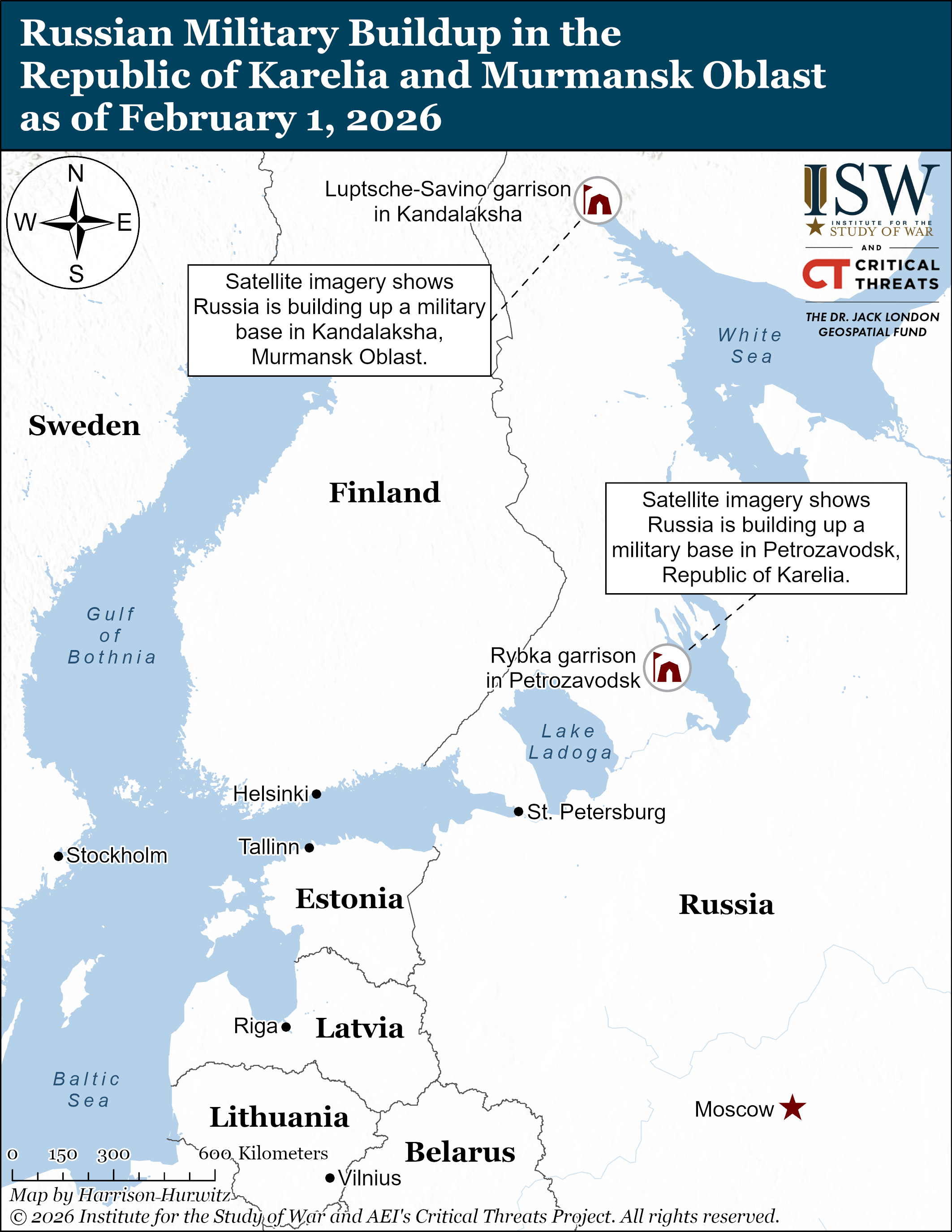
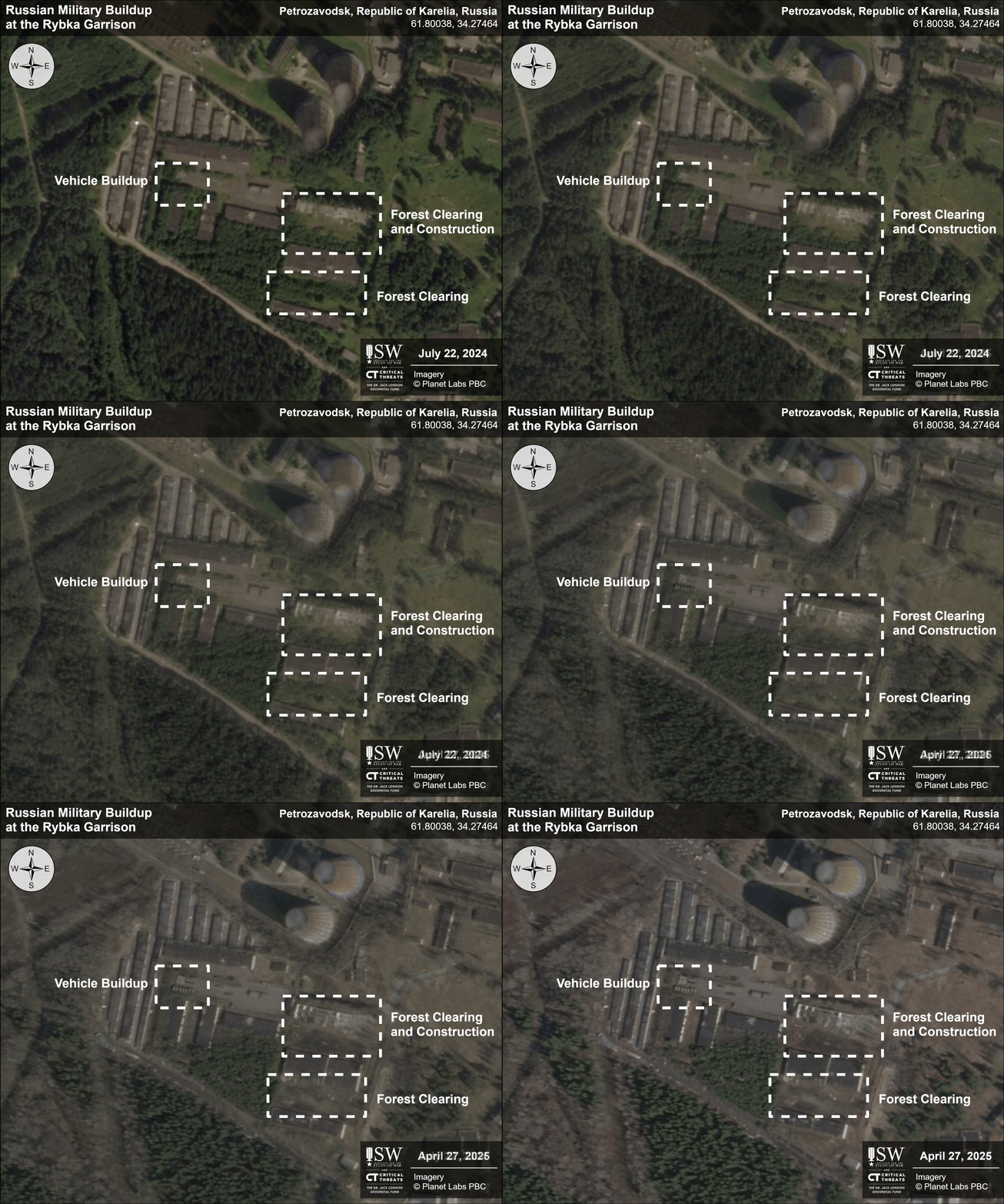
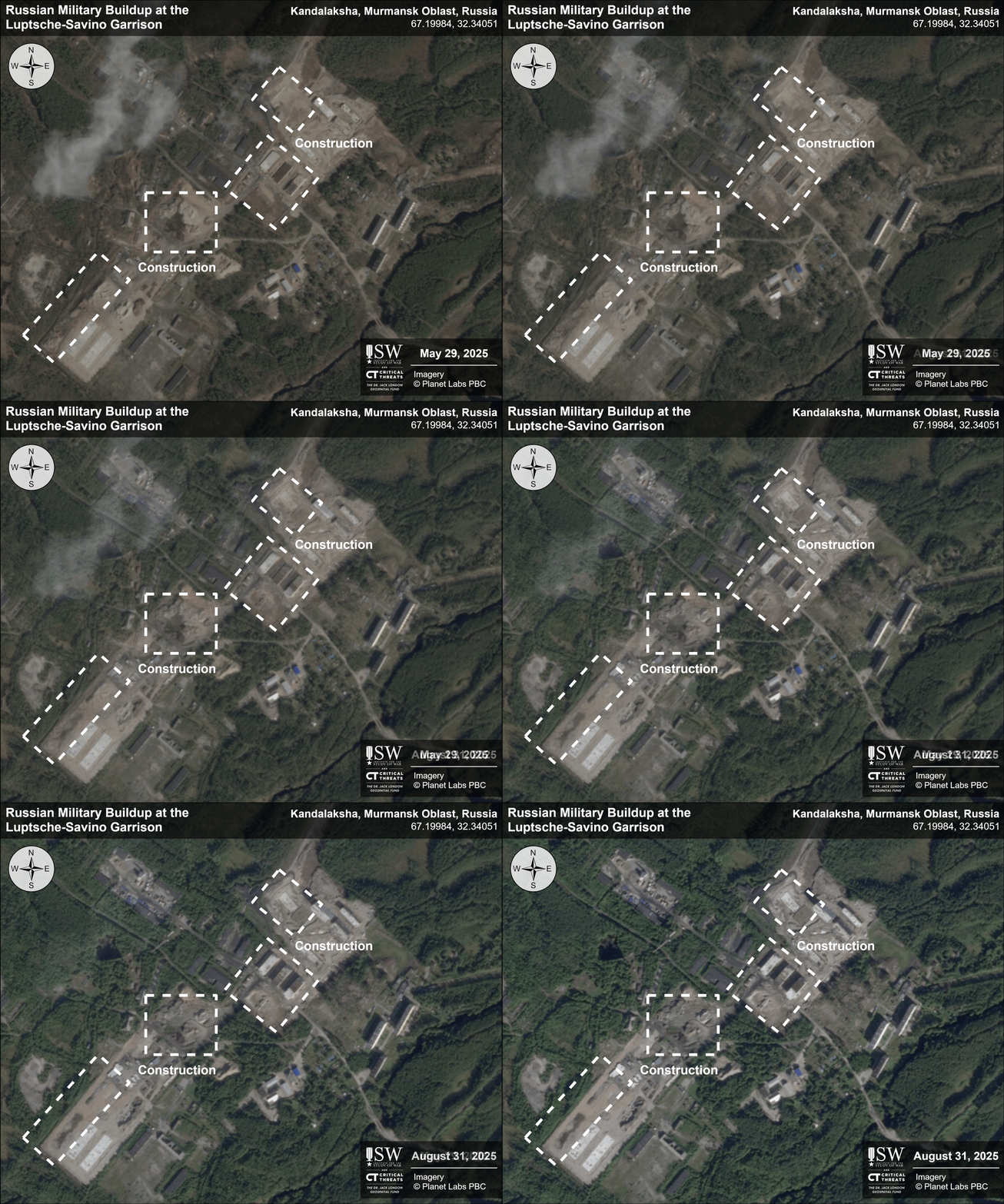
Belarus appears to be increasing the quantity and frequency of Belarusian balloon incursions into Polish and Lithuanian airspace. The Polish Armed Forces Operational Command reported that Belarus launched "balloon-like" objects into Polish airspace on the night of January 31 to February 1 and noted that the balloons aimed to reconnoiter and test Polish air defense reactions.[xxv] Belarus has launched balloon-like objects into Polish airspace three times in the last four days (since January 7), and Lithuania reported a record high of 42 Belarusian balloons in its airspace on the night of January 27 to 28.[xxvi] ISW continues to assess that Russia has de facto annexed Belarus, and Russia is likely using Russia is using airspace incursions of Poland and Lithuania from Belarus as part of its “Phase Zero” effort — the informational and psychological condition-setting phase — to prepare for a possible NATO-Russia war in the future.[xxvii]
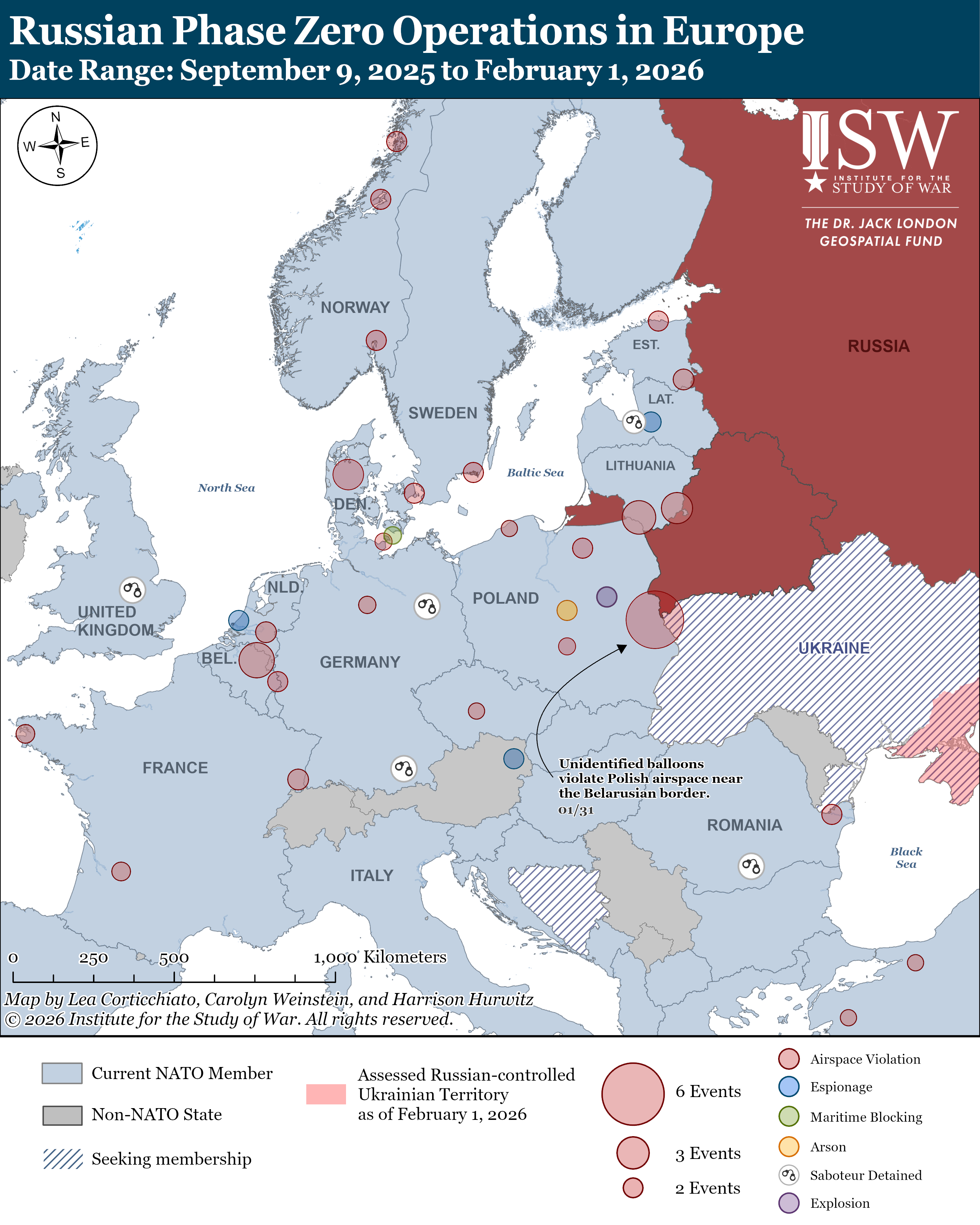
Several unidentified drones flew over German military infrastructure on February 1. German outlet Bild reported on February 1 that roughly 23 drones flew above the Immelmann military airfield in Lower Saxony, Germany on February 1.[xxviii] German authorities have not identified the actor responsible for the drone overflights as of this writing. German authorities previously identified Russia as a possible actor responsible for drone flights over Germany in 2025, however.[xxix]
Key Takeaways:
- Russian drones struck a maternity hospital and a bus carrying miners on February 1, causing significant civilian casualties.
- The Kremlin continues to use issues unrelated to its war in Ukraine to push the Trump administration to give in to Russia's demands regarding Ukraine.
- Insider reports continue to demonstrate that Russia is trying to portray itself to external audiences as a willing negotiator in order to gain control over all of Donetsk Oblast through diplomatic means.
- SpaceX CEO Elon Musk restricted Starlink satellite terminals operating in Ukraine in order to counter Russia's use of Starlink on drones.
- Russia is building up military infrastructure near the Finnish border, likely as part of wider military expansion efforts that seek to prepare the Russian force for a potential future conflict with NATO.
- Belarus appears to be increasing the quantity and frequency of Belarusian balloon incursions into Polish and Lithuanian airspace.
- Several unidentified drones flew over German military infrastructure on February 1.
- Ukrainian forces recently advanced near Slovyansk.