{{currentView.title}}
March 09, 2026
Iran Updates, February 2026
Iran Update, February 26, 2026
Iran is unlikely to accept reported US demands to destroy its nuclear facilities, send its highly enriched uranium to the US, and commit to a permanent deal. US officials have previously stated that the US would strike Iran if the two sides cannot reach a deal.[i] The United States and Iran held a third round of nuclear talks on February 26 in Geneva, Switzerland.[ii] Omani Foreign Affairs Minister Badr al Busaidi stated that there was “significant progress” during the talks and that both sides will hold technical-level discussions in Vienna next week.[iii] US officials’ accounts of the talks suggest that Iran is unlikely to accept reported US demands, however. US officials told the Wall Street Journal on February 26 that US negotiators demanded that Iran dismantle its Fordow, Natanz, and Esfahan nuclear facilities, deliver all of its enriched uranium to the United States, and agree to a permanent deal without sunset clauses.[iv] The officials also said that US negotiators reiterated their zero-enrichment demand but ”could be open” to a scenario in which Iran can enrich a very low level of uranium “for medical purposes.”[v] These accounts are consistent with previous reporting that the US negotiators would consider a proposal that includes “token enrichment” if Iran credibly proved that it could not support building a nuclear weapon.[vi] US negotiators reportedly offered only “minimal sanctions relief,” which contradicts Iranian demands for a more substantial relief package.[vii] An unspecified Iranian source with knowledge of the discussions told CNN on February 26 that ending all US and UNSC sanctions is ”key” in order to reach any deal.[viii] The source added that Iran is not willing to destroy its nuclear facilities, enrich uranium in compliance with the UN International Atomic Energy Agency (IAEA) verification process, or ship enriched uranium out of the country.[ix] US President Donald Trump warned Iran of “bad things” on February 24 if the two sides fail to reach a deal.[x]
The Iranian proposal does not meet core US demands. US officials told the Wall Street Journal that Iran’s proposal would force Iran to reduce enrichment to as low as 1.5 percent, pause enrichment for a number of years, and process its enriched uranium through an Iran-based regional consortium.[xi] Four unspecified Iranian officials told the New York Times on February 26 that Iran would also offer to dilute its 400 kg of 60 percent-enriched uranium in phases and allow IAEA inspectors to oversee all steps.[xii] Diluting enriched uranium in Iran does not meet the stated US demand that Iran transfer all of its nuclear material to the United States. Iran has also previously refused to cooperate with IAEA inspections, which the United States supports to verify Iranian compliance with nuclear enrichment.[xiii] US Vice President JD Vance stated on February 25 that the Trump administration has “seen evidence” that Iran is trying to rebuild its nuclear weapons program.[xiv] US Secretary of State Marco Rubio separately stated on February 25 that Iran is “trying to rebuild elements” of its nuclear program.[xv]
Iran is also trying to offer economic incentives that are unrelated to US demands in order to extract concessions from the United States. Unspecified sources told the Financial Times on February 26 that Iran will offer the United States investments in Iranian oil and gas reserves, mining rights, and critical minerals in an effort to convince US President Donald Trump to agree to a nuclear deal.[xvi] One of the sources added that Iran is examining Venezuela as a case study.[xvii] Iranian officials have publicly stated that Supreme Leader Ali Khamenei granted permission for Iranian negotiators to propose allowing American companies to enter Iran and that Iran’s proposal to the United States would include a pledge to buy American goods.[xviii] These reports are consistent with a member of the Iranian negotiating team’s description of US-Iran discussions on economic cooperation in the fields of oil, gas, and minerals at the first round of US-Iran nuclear talks on February 6.[xix] Iran appears to calculate that the United States is more willing to focus solely on Iran’s nuclear program or concede on its enrichment demand in the ongoing talks if Iran offers economic incentives.
Iran likely remains unwilling to discuss its ballistic missile program and support for its partners and proxies in the region with the United States. US officials told the Wall Street Journal on February 26 that the United States wants Iran to limit its ballistic missile program and support for proxies, but that the talks in Geneva will focus on the nuclear issue.[xx] US Secretary of State Marco Rubio stated on February 25 that Iran's unwillingness to discuss ballistic missiles with the United States is a “big problem” and that talks would eventually need to expand beyond the nuclear program.[xxi] Iranian officials have repeatedly ruled out any negotiations on Iran’s ballistic missile program.[xxii] Iran’s ballistic missile program constitutes a fundamental part of Iran’s defense and deterrence strategy. A Middle Eastern source with knowledge of the US-Iran negotiations told Fox News on February 20 that Supreme Leader Ali Khamenei has refused to allow Iranian negotiators to discuss any concessions on the ballistic missile program because any Iranian concessions on its missile program would be viewed within the regime as ”equivalent to losing a war.”[xxiii]
US Secretary of State Marco Rubio stated on February 25 that Iran is “trying to achieve intercontinental ballistic missiles (ICBMs).”[xxiv] The US Defense Intelligence Agency (DIA) released a public assessment in 2025 that Iran has the capability to develop an ICBM by 2035.[xxv] Rubio added that Iran has tried to launch satellites into space.[xxvi] CTP-ISW assessed in July 2025 that Iran’s efforts to develop its space program could support the development of ICBMs.[xxvii]
Iran continues to undergo efforts to rebuild other aspects of its ballistic missile program.[xxviii] Bloomberg identified on February 25 protective structures surrounding the Khojir Missile Production Complex in Hajarabad, Tehran Province, to prevent chain reactions from explosions.[xxix] Iran is also encasing a newly-built facility at Taleghan 2 at the Parchin Military Complex with a concrete “sarcophagus” to harden the facility against potential airstrikes, according to the Institute for Science and International Security.[xxx] Israel struck Taleghan 2 in October 2024 and Khojir during the June 2025 Israel-Iran War.[xxxi]
Iranian-backed Iraqi militia Kataib Hezbollah threatened Iraqi Kurdistan’s “security and future” if the Kurdistan Regional Government (KRG) supports a US or Israeli attack on Iran.[xxxii] Kataib Hezbollah called on its members on February 26 to prepare for a “war of attrition that may be protracted” and threatened the United States with “irreparable” loss if it strikes Iran.[xxxiii] Kataib Hezbollah Spokesperson Abu Ali al Askari separately said on February 23 that the United States is preparing to attack Iran, which would include passing through Iraqi Kurdistan, and called on Iraqi Kurds to act “rationally.”[xxxiv] Askari’s statements are implied threats to attack the Kurdistan Region in the event of a war between the United States and Iran. The KRG issued a statement on February 23 that Iraqi Kurdistan will not be used as a “launchpad” to attack neighboring countries, in reference to Iran.[xxxv] Iran and Iranian-backed Iraqi militias have both previously conducted attacks targeting Iraqi Kurdistan, including during the 2023-2025 Gaza War.[xxxvi] Iranian-backed Iraqi militias operating under the Islamic Resistance in Iraq moniker launched multiple drones and rockets targeting US forces based in Erbil from October 2023 to January 2024 in response to Israel’s operations in the Gaza Strip.[xxxvii] Iran conducted a ballistic missile attack in Erbil in January 2024 in retaliation for an Israeli strike in Syria that killed three Islamic Revolutionary Guards Corps members in December 2023.[xxxviii] Iran claimed that the January 2024 strike targeted a Mossad facility. The KRG denied Iran’s allegations.[xxxix]
Kataib Hezbollah is the first major Iranian-backed Iraqi militia to threaten the United States over possible US strikes on Iran. Kataib Hezbollah is almost certainly one of the four Iranian-backed Iraqi militias in the Iraqi Resistance Coordination Committee that has reportedly decided to provide military support to Iran and “open fronts” in a potential conflict between Iran and the United States. A senior Iraqi Resistance Coordination Committee source told al Araby al Jadeed on February 22 that the militias’ participation would depend on “developments on the ground, the nature of the confrontation, and its scope.”[xl] The Iraqi Resistance Coordination Committee includes Kataib Hezbollah, Asaib Ahl al Haq, Harakat Hezbollah al Nujaba, Harakat Ansar Awfiya, and Kataib Sayyid al Shuhada and an affiliated front group, according to the committee’s last statement on January 4.[xli] Kataib Hezbollah, unlike some other groups in the Shia Coordination Framework and the Iraqi Resistance Coordination Committee, is a member of both the framework and the coordination committee. Kataib Hezbollah appears to be prioritizing its relationship with Iran and its role in the broader Axis of Resistance over domestic political and economic considerations in Iraq. Kataib Hezbollah, unlike many of the Shia Coordination Framework factions, takes a much more transnational view of regional affairs, given its close relationship with Iran.
Kataib Hezbollah’s threat supports CTP-ISW's February 23 assessment that Iranian-backed Iraqi militias could target US forces in Iraqi Kurdistan in the event of a US or Israeli attack on Iran.[xlii] US-led international coalition forces redeployed from federal Iraq to Iraqi Kurdistan in late 2025 as part of the first phase of the planned US withdrawal from Iraq.[xliii] Iranian-backed Iraqi militias have long attacked US forces in Iraq in response to US or Israeli actions.[xliv] The militias would likely be more willing to target US forces in Iraqi Kurdistan than other US interests, such as the US Embassy in Baghdad, given that a strike on the latter could hurt the militias’ economic interests by deterring economic investment in Baghdad. This demonstrates that even some of the most ideologically motivated Iraqi militias still value their domestic economic and business dealings.
Iranians continued to hold anti-regime protests during 40-day mourning ceremonies across the country. CTP-ISW recorded 11 protests at 40-day ceremonies across five provinces, including five large protests on February 26.[xlv] CTP-ISW defines large protests as protests that it estimates have over 1,000 individuals. The 40th day of mourning marks the end of the initial mourning period and is often observed with public commemorations and gatherings in Shia Islam. These 40-day ceremonies have served as catalysts for renewed demonstrations in recent weeks.[xlvi]
CTP-ISW did not record any protests at Iranian universities on February 26, which is a sudden decline from the rate of campus protests in recent days.[xlvii] CTP-ISW is considering several reasons that could explain the lack of observable university protest activity. Both Iranian security forces and university administrations have increased legal and academic pressure on students in recent days by conducting arrests, summoning students before disciplinary bodies, and issuing temporary suspensions.[xlviii] Iran’s academic schedule may also have contributed to a decline in campus protest activity on a Thursday, which is a weekend in Iran. Many students live in university dormitories and would therefore presumably still be able to organize protests on the weekend, however. Multiple Iranian universities have also moved instruction online until late March 2026, likely in an effort to reduce in-person participation and opportunities for protests.[xlix] Any of these individual factors or a combination of the above could explain the lack of campus protest activity on February 26, particularly given that protests continue at 40-day mourning ceremonies.
Key Takeaways
- US-Iran Nuclear Talks: Iran is unlikely to accept reported US demands to destroy its nuclear facilities, send its highly enriched uranium to the US, and commit to a permanent deal. The United States and Iran held a third round of nuclear talks in Geneva on February 26. The Iranian proposal does not meet core US demands, and Iran is trying to offer economic incentives that are unrelated to US demands in order to extract concessions from the United States. US officials have previously stated that the US would strike Iran if the two sides cannot reach a deal.
- Iranian Missile Program: US Secretary of State Marco Rubio stated on February 25 that Iran is “trying to achieve intercontinental ballistic missiles (ICBMs).” The US Defense Intelligence Agency released a public assessment in 2025 that Iran has the capability to develop an ICBM by 2035. Iran continues to undergo efforts to rebuild other aspects of its ballistic missile program.
- Iranian-backed Iraqi Militia Warnings: Iranian-backed Iraqi militia Kataib Hezbollah threatened Iraqi Kurdistan’s “security and future” if the Kurdistan Regional Government supports a US or Israeli attack on Iran. Iran and Iranian-backed Iraqi militias have both previously conducted attacks targeting Iraqi Kurdistan, including during the 2023-2025 Gaza War. Kataib Hezbollah is the first major Iranian-backed Iraqi militia to threaten the United States over possible US strikes on Iran. Kataib Hezbollah appears to be prioritizing its relationship with Iran and its role in the broader Axis of Resistance over domestic political and economic considerations in Iraq.
- Iranian Protest Activity: Iranians continued to hold anti-regime protests during 40-day mourning ceremonies across the country. These 40-day ceremonies have served as catalysts for renewed demonstrations in recent weeks. CTP-ISW did not record any protests at Iranian universities on February 26, which is a sudden decline from the rate of campus protests in recent days. CTP-ISW is considering several reasons that could explain the lack of observable university protest activity.
- Syrian Government’s Southern Strategy: The Syrian government is pursuing negotiations with the current authorities in Suwayda as it simultaneously employs a strategy that is likely designed to politically weaken and then subordinate Druze Sheikh Hikmat al Hijri’s coalition to the government over time. The United States is reportedly mediating back-channel negotiations between the Syrian government and unspecified Druze leaders to integrate Suwayda Province under Syrian government control, which is likely a government attempt to reduce support for Hijri and his followers.
Iran Update, February 25, 2026
A newly established coalition of anti-regime Kurdish organizations outlined its vision for administering Kurdish-majority areas of Iran if the Iranian regime collapses, which reflects the potential for Iran to fracture if the regime were to collapse. Anti-regime Kurdish groups established the “Coalition of Political Forces in Iranian Kurdistan” on February 22 with the stated objective of achieving self-determination.[i] The coalition includes the Kurdistan Freedom Party (PAK), the Democratic Party of Iranian Kurdistan (PDKI), the Kurdistan Free Life Party (PJAK), the Organization of Iranian Kurdistan Struggle, and the Komala of the Toilers of Kurdistan.[ii] PDKI leader Mostafa Hejri told Iranian diaspora media on February 23 that the coalition created a “joint plan for administering” Kurdish-majority areas of Iran during the “transition period,” in reference to the period between the collapse of the current Iranian regime and the establishment of a new central government.[iii] This statement highlights how Kurdish opposition groups are considering and planning for the potential collapse of the regime. Hejri added that citizens in Kurdish-majority areas would elect “the governing bodies of Kurdistan” to “take over the administration of the region” after the establishment of a new Iranian central government.[iv] The coalition issued a joint statement on February 22 in which it similarly outlined its objective to establish a “democratic administrative system in Kurdistan.”[v] Various separatist and anti-regime militant groups operate within Iran, including in northwestern and southeastern Iran.[vi] The collapse of the Iranian regime could create conditions for Iran to fracture if these groups tried to fill the power vacuum left behind by the regime.
Turkey is concerned about the impact that the Iranian regime’s collapse would have on Turkish internal security. Bloomberg, citing “people familiar with the matter,” reported on February 24 that the focus of the North Atlantic Treaty Organization’s (NATO) air surveillance in Turkey has shifted from Russia to Iran.[vii] The sources stated that Turkey is concerned about the possibility of an influx of refugees from Iran to Turkey in the event of a “major conflict.”[viii] The sources added that Turkey is considering setting up camps to house refugees near the Iran-Turkey border and deploying forces into Iran to prevent refugees from entering Turkey “in the case of a power vacuum in Iran.”
Turkey would also presumably oppose the possible administration of Kurdish-majority areas in northwestern Iran by Kurdish opposition groups, some of which have ties to the Kurdistan Workers’ Party. The newly formed “Coalition of Political Forces in Iranian Kurdistan” includes the Kurdistan Free Life Party (PJAK), which is the Iranian branch of the Kurdistan Workers’ Party (PKK).[ix] The PKK announced in May 2025 that it would dissolve itself and “end its armed struggle,” but PJAK announced that it would not adhere to the PKK’s decision.[x] The PKK is designated as a terrorist organization by both Turkey and the United States.[xi]
Iran reportedly offered Joint Comprehensive Plan of Action (JCPOA)-like concessions in its nuclear proposal to the United States. An unspecified Arab diplomat told Israeli media on February 25 that Iran is willing to reduce its uranium enrichment level from 60 percent to 3.6 percent, which is close to the 2015 JCPOA’s 3.67 percent uranium enrichment limit.[xii] The diplomat added that Iran offered to suspend uranium enrichment for seven years but that the United States has demanded that Iran suspend enrichment for 10 years.[xiii] Diplomatic sources familiar with the US-Iran negotiations told a separate Israeli media outlet on February 25 that Iran “offered no flexibility on the central US demand for a complete halt to uranium enrichment on Iranian soil.”[xiv] Iran also rejected the United States’ demand to transfer its highly enriched uranium stockpile abroad, according to the Arab diplomat.[xv] US Special Envoy to the Middle East Steve Witkoff suggested on February 22 that the transfer of Iran’s highly enriched uranium stockpile, in addition to zero enrichment, are US President Donald Trump’s “red lines.”[xvi] Iran previously transferred 11,000 kilograms of enriched uranium to Russia under the 2015 nuclear deal.[xvii] The 11,000 kilograms included uranium enriched to 20 percent--Iran’s most highly enriched uranium at the time.[xviii] Iran has since produced over 400 kilograms of uranium enriched to 60 percent, which is enough uranium, if enriched further, to produce at least 10 nuclear weapons.[xix]
US President Donald Trump highlighted the threat of Iran’s nuclear and ballistic missile programs in his State of the Union address on February 24. Trump stated that the United States warned Iran after the June 2025 Israel-Iran War not to attempt to “rebuild [its] weapons program, and in particular nuclear weapons” but that Iran “want[s] to start it all over again and are at this moment again pursuing their sinister ambitions.”[xx] Trump separately stated that Iran is developing missiles “that will soon reach the United States.”[xxi]
The Islamic Revolutionary Guards Corps (IRGC) has recently conducted a series of military exercises in the Strait of Hormuz and along Iran’s southern coast in preparation for a potential conflict with the United States or Israel around the Persian Gulf.[xxii] The IRGC Ground Forces concluded a two-day exercise under the command of the Madinah ol Munawarah Operational Base in Bandar Abbas, Hormozgan Province, on February 25.[xxiii] The Madinah ol Munawarah Operational Base is the IRGC Ground Forces’ closest regional headquarters to the Strait of Hormuz and oversees IRGC Ground Forces units in Fars, Bushehr, and Hormozgan provinces.[xxiv] The exercise took place on unspecified Persian Gulf islands and along Iran’s southern coast.[xxv] The IRGC Ground Forces reportedly used Rezvan loitering drones for reconnaissance and target acquisition and Shahed-136 drones to strike pre-designated targets during the exercise.[xxvi] Rezvan loitering drones have a range of 20 kilometers, and Shahed-136 drones have a range of 1,500 kilometers.[xxvii] Iranian media highlighted the IRGC Ground Forces’ use of Fath-450 ballistic missiles, which have a range of between 150 and 250 kilometers, and Fath-360 ballistic missiles, which have a range of between 30 and 120 kilometers.[xxviii] Iranian media claimed that these systems have high strike accuracy, can resist electronic warfare, and can carry warheads capable of penetrating fortified positions.[xxix] Iranian media described the Fath-360 as capable of carrying a “bunker-busting” warhead.[xxx] This exercise comes after the IRGC Navy conducted an exercise in the Strait of Hormuz on February 16.[xxxi] The recent exercises indicate that Iran is preparing for both a possible maritime conflict near the Strait of Hormuz as well as a possible broader conflict that could involve strikes on US and allied bases and vessels around the Persian Gulf. Four unspecified IRGC members and three senior Iranian officials told the New York Times on February 22 that Iran has positioned ballistic missile launchers along its southern shores within range of US bases and other targets in the region.[xxxii]
Belgium-based outlet Army Recognition assessed that Iran’s use of indigenous radars in its S-300 air defense systems would reduce the effectiveness of these systems.[xxxiii] Israel destroyed the engagement radar of an Iranian S-300 in April 2024 and rendered Iran’s three remaining S-300 systems inoperable in October 2024.[xxxiv] An S-300 battery requires engagement radars, command-and-control centers, fire-control units, and launchers to operate as a functional surface-to-air missile system.[xxxv] Army Recognition reported on February 23 that Iran has deployed at least one of its four S-300 systems near Tehran City and potentially deployed an indigenous Bavar-373 air defense system near Esfahan City, citing commercially available satellite imagery on February 16 and 19.[xxxvi] Iran previously displayed an S-300 with a “new, Iranian-designed” radar in February 2025.[xxxvii] Army Recognition noted that Iran’s use of indigenous radars in its S-300 air defense systems would create “interoperability constraints and potential gaps in data link compatibility.”[xxxviii]
The Iranian regime is trying to limit disruptions to command-and-control and governance in the event of a potential US or Israeli decapitation campaign against senior Iranian leadership. The New York Times, citing six senior Iranian officials and three IRGC members, reported on February 22 that Supreme Leader Ali Khamenei has named four potential successors for each military and government post that he appoints.[xxxix] Khamenei has also reportedly directed other officials to choose up to four successors and delegated authority to a trusted circle to make decisions if he cannot be reached or is killed. This report highlights Iranian officials’ immense paranoia about potential US or Israeli strikes targeting senior leadership. Israeli strikes targeting senior commanders during the June 2025 Israel-Iran War temporarily disrupted Iran's chain of command and delayed its initial retaliation.[xl] Brigadier General Mohammad Reza Naghdi, who served as the IRGC Coordination Deputy during the war and currently serves as an adviser to IRGC Commander Mohammad Pakpour, stated in October 2025 that IRGC units requested authorization to strike Israel early on June 13, but that Khamenei delayed approval of the strikes until he had appointed new commanders to replace those whom Israel had killed earlier that day.[xli]
Iranian university students held anti-regime protests for the fifth consecutive day on February 25.[xlii] CTP-ISW recorded 10 protests, including four large protests, at nine universities in three provinces on February 25. CTP-ISW defines large protests as protests with over 1,000 individuals.[xliii] CTP-ISW also recorded a protest at a school in Tehran City and a protest at a 40-day mourning period ceremony in Gorgan, Golestan Province.[xliv] Universities have summoned at least 180 students to disciplinary hearings and suspended numerous others for participating in the protests in Tehran City.[xlv] Plainclothes security personnel arrested three protesters at the University of Art in Tehran City on February 25.[xlvi] Security forces deployed to Shiraz University in Fars Province on February 25. Iranian authorities have also confiscated the student identification cards of student protesters at Shiraz University.[xlvii] Basij members and pro-regime students clashed with protesters at Shiraz University on February 23 and 24.[xlviii] Two Iranian universities in Kurdistan and Zanjan provinces moved classes online, and another in Mazandaran Province is considering doing so in an effort to curb student protests.[xlix]
The economic conditions that triggered anti-regime protests in December 2025 continue to worsen. The Iranian currency has suffered a steep collapse since November 2025, which exacerbates economic instability. Iranian business owners have told Western media that they have experienced a substantial decline in sales following the regime’s internet shutdown to suppress protests in early January 2026.[l] Both the Iranian public and parts of the regime itself have demonstrated a deep lack of trust in the regime’s ability to reform or stabilize the economy. Iranian media reported on February 23 that investors are rapidly shifting their assets away from equities and into hard currency and gold, which indicates a widespread belief that the government cannot restore predictable market conditions.[li] US Treasury Secretary Scott Bessent and Israeli media previously reported that regime officials have transferred hundreds of millions of US dollars out of Iran in recent months, which likely reflects intra-regime concerns about economic stability.[lii]
Islamic State (IS)-run media explicitly linked ISIS’s recently claimed attacks in northeastern Syria to the Islamic State’s February 21 call to action, which likely seeks to exploit conditions created by the Syrian government’s recent offensive to recruit fighters and expand ISIS networks.[liii] IS-run media outlet Amaq News confirmed on February 24 that recent ISIS attacks against Syrian government forces were in direct response to IS spokesperson Abu Hudhayfa al Ansari’s February 21 call for a “new chapter of resistance” in Syria against the Syrian government.[liv] ISIS claimed an attack on a civilian in Albukamal, Deir ez Zor Province, on February 24.[lv] The group accused the individual of working with the Syrian government.[lvi] ISIS also likely conducted four additional attacks against Syrian government forces in northeastern Syria on February 24 and 25. The attacks did not cause any casualties.[lvii] Syrian government forces have continued to respond to ISIS activity, such as by arresting an ISIS fighter in al Mayadin, Deir ez Zor Province, on February 25 who killed a Syrian soldier in the town on February 23.[lviii] A Syria analyst assessed that ISIS’s attack rate against Syrian government forces in northeastern Syria since February 21 remains lower than its attack rate in the second half of 2025, despite the recent increase in ISIS attacks.[lix] The recent attacks continue to demonstrate that ISIS’s primary target in Syria has shifted from the SDF to the Syrian government since December 2025.[lx] Syria joined the Global Coalition to Defeat ISIS in November 2025.[lxi]
An ISIS prisoner whom the Syrian government recently released from prison reportedly attacked Syrian government forces, which highlights the need for the Syrian government to thoroughly vet individuals who were previously imprisoned by the SDF.[lxii] A northeast Syria-based news outlet reported on February 23 that Syrian General Security Service (GSS) forces raided the home of an ISIS fighter who attacked government forces in Dhiban, Deir ez Zor Province, after the government released him from Aqtan prison on February 23.[lxiii] Other media outlets and local sources have not corroborated this report. The Aqtan prison in Raqqa Province was previously an SDF-administered ISIS detention facility that the SDF handed over to the Syrian government in January 2025.[lxiv] The Syrian Justice Ministry has released hundreds of SDF political prisoners from Aqtan prison after taking over the facility.[lxv] Aqtan prison likely held many SDF political prisoners, but the report that the government released an ISIS fighter who later attacked government forces highlights the need for the Syrian government to properly vet individuals it releases.
IS media has continued to leverage the Syrian government’s membership in the Global Coalition to Defeat ISIS and cooperation with the United States to try to boost ISIS recruitment among Syrians sympathetic to ISIS.[lxvi] Amaq News’ February 24 report on recent ISIS attacks against Syrian government forces in northeastern Syria used an image of Syrian President Ahmed al Shara’s September 2025 meeting with US Central Command (CENTCOM) Commander Admiral Brad Cooper in Damascus rather than an image of the attacks.[lxvii] Multiple Syria analysts remarked that Amaq typically includes a photo of an attack, but that Amaq used the photo of Cooper and Shara in this instance to highlight the Syrian government’s “apostasy” and “subservience” to the United States.[lxviii] IS media has consistently criticized the Syrian government’s counter-ISIS cooperation and relationship with the United States to drive recruitment among Syrian Islamists who are dissatisfied with the Syrian government.[lxix]
Key Takeaways
- Planning for a Post-Iranian Regime Reality: A newly established coalition of anti-regime Kurdish organizations outlined its vision for administering Kurdish-majority areas of Iran if the Iranian regime collapses, which reflects the potential for Iran to fracture if the regime were to collapse. Anti-regime Kurdish groups established the "Coalition of Political Forces in Iranian Kurdistan” on February 22 with the stated objective of achieving self-determination.
- Iranian Nuclear Proposal: Iran reportedly offered Joint Comprehensive Plan of Action (JCPOA)-like concessions in its nuclear proposal to the United States. An unspecified Arab diplomat told Israeli media on February 25 that Iran is willing to reduce its uranium enrichment level from 60 percent to 3.6 percent, which is close to the 2015 JCPOA’s 3.67 percent uranium enrichment limit.
- Trump State of the Union Address: US President Donald Trump highlighted the threat of Iran’s nuclear and ballistic missile programs in his State of the Union address on February 24. Trump stated that the United States warned Iran after the June 2025 Israel-Iran War not to attempt to “rebuild [its] weapons program, and in particular nuclear weapons” but that Iran “want[s] to start it all over again and are at this moment again pursuing their sinister ambitions.”
- Iranian Military Exercises: The Islamic Revolutionary Guards Corps (IRGC) has recently conducted a series of military exercises in the Strait of Hormuz and along Iran’s southern coast in preparation for a potential conflict with the United States or Israel around the Persian Gulf. The IRGC Ground Forces concluded a two-day exercise under the command of the Madinah ol Munawarah Operational Base in Bandar Abbas, Hormozgan Province, on February 25.
- Iranian Air Defense Systems: Belgium-based outlet Army Recognition assessed that Iran’s use of indigenous radars in its S-300 air defense systems would reduce the effectiveness of these systems. Israel destroyed the engagement radar of an Iranian S-300 in April 2024 and rendered Iran’s three remaining S-300 systems inoperable in October 2024.
- Iranian Steps to Avoid a Decapitation Campaign: The Iranian regime is trying to limit disruptions to command-and-control and governance in the event of a potential US or Israeli decapitation campaign against senior Iranian leadership. The New York Times, citing six senior Iranian officials and three IRGC members, reported on February 22 that Supreme Leader Ali Khamenei has named four potential successors for each military and government post that he appoints.
- Protests in Iran: Iranian university students held anti-regime protests for the fifth consecutive day on February 25. The economic conditions that triggered anti-regime protests in December 2025 continue to worsen.
- ISIS Attacks in Northeast Syria: Islamic State (IS)-run media explicitly linked ISIS’s recently claimed attacks in northeastern Syria to the Islamic State’s February 21 call to action, which likely seeks to exploit conditions created by the Syrian government’s recent offensive to recruit fighters and expand ISIS networks. IS media has continued to leverage the Syrian government’s membership in the Global Coalition to Defeat ISIS and cooperation with the United States to try to boost ISIS recruitment among Syrians sympathetic to ISIS.
Iran Update, February 23, 2026
A senior US official told Axios on February 22 that the United States and Iran may discuss the possibility of an interim deal during the third round of negotiations in Geneva on February 26.[i] An interim deal that only addresses Iran’s nuclear program would enable Iran to drag out the current negotiations and likely not meet the United States’ core nuclear demands. An Iranian official told Reuters on February 22 that the “possibility of reaching an interim deal exists.”[ii] The Iranian Foreign Affairs Ministry spokesperson rejected the possibility of an interim deal, however.[iii] Israeli media separately reported on February 22 that the United States is pursuing an agreement with multiple “stages” in which the United States will address Iran’s nuclear program in the first stage and Iran’s ballistic missile program and support for the Axis of Resistance in later stages.[iv] An interim agreement that only addresses the nuclear issue would enable Iran to drag out the current talks. CTP-ISW previously assessed that Iranian officials may be floating the possibility of talks about non-nuclear issues, including Iran’s ballistic missile program, to try to drag out the talks and thereby delay potential US military action.[v] Dragging out the talks would also give Iran more time to prepare for potential military conflict.[vi]
An interim deal focused on the nuclear issue would also unlikely meet the United States’ stated demand for zero enrichment. Supreme National Security Council (SNSC) Secretary Ali Larijani will reportedly travel to Oman on February 24 to deliver Iran’s official response to the United States’ demands through Omani mediators.[vii] Iranian Foreign Affairs Minister Abbas Araghchi emphasized in an interview with Face the Nation on February 22 that Iran has “every right to enjoy a peaceful nuclear program, including enrichment.”[viii] An Iranian official speaking to Reuters on February 22 said that Iran would “seriously consider” sending half of its highly enriched uranium stockpile abroad, diluting the rest of its stockpile, and creating a regional enrichment consortium in exchange for the United States recognizing Iran’s “right” to enrich uranium and lifting its economic sanctions on Iran.[ix] These proposed terms would not meet the stated US demand for zero enrichment. US Special Envoy to the Middle East Steve Witkoff confirmed to Fox News on February 21 that US President Donald Trump’s “red lines” include zero enrichment.[x]
There are some conflicting reports about the United States’ position on enrichment. Axios reported on February 22 that Witkoff and Jared Kushner told Araghchi during the second round of talks that the United States would be willing to consider an Iranian proposal that includes “token enrichment” if Iran can prove that its proposal would block Iran from developing a nuclear weapon.[xi] The New York Times similarly reported that the United States and Iran are considering a proposal in which Iran would have a “very limited nuclear enrichment program” that Iran could only use for medical research and treatments.[xii] These reports contradict Witkoff’s statement that Trump’s red lines include zero enrichment.
Some Iranian regime officials may calculate that capitulating to the United States in negotiations would harm the regime more than potential military conflict. A Middle Eastern source with knowledge of the US-Iran negotiations told Fox News on February 20 that Iranian negotiators are not authorized to cross Supreme Leader Ali Khamenei’s red line on ballistic missiles because any Iranian concessions on its missile program would be viewed internally as the equivalent to losing a war.[xiii] This report is consistent with Iranian officials’ previous statements that ruled out any negotiations on Iran’s ballistic missiles.[xiv] Iran’s ballistic missiles are an integral part of its defense and deterrence strategies. Any changes to these strategies would require a strategic rethink that would take months, if not years.[xv] Former Islamic Revolutionary Guards Corps (IRGC) Commander Mohammad Ali Jafari argued in October 2025 that Iran deliberately prioritized developing its missile and drone programs over its air and ground forces to counter the superior capabilities of the United States and Israel.[xvi]
US President Donald Trump is reportedly leaning toward conducting a limited strike against Iran that would aim to pressure Iran to make concessions on its nuclear program, according to sources familiar with the Trump administration’s deliberations speaking to the New York Times on February 22.[xvii] The sources said that Trump told his advisers that he would consider a more comprehensive air campaign aimed at toppling the regime if Iran did not give into US demands after diplomacy or a limited US attack.[xviii] A senior adviser to Trump told Axios on February 20 that the US Department of Defense has presented Trump with several options, including a plan to kill Iranian Supreme Leader Ali Khamenei and his son, Mojtaba Khamenei, who is widely considered a top contender to succeed his father.[xix] The New York Times report is consistent with a February 19 Wall Street Journal report that Trump is considering a limited strike on Iran to pressure the regime to reach a nuclear agreement.[xx] The Trump administration’s deliberations come amid a large number of US military deployments to the region, including the imminent arrival of the USS Gerald R. Ford carrier strike group.[xxi]
Iranians have held at least 32 protests--the majority of which were student-led anti-regime protests--since February 21, which highlights the Iranian population’s continued anger and frustration with the regime for its refusal to address its people’s grievances. CTP-ISW has recorded 26 anti-regime protests at 17 universities across Iran since February 21.[xxii] Twenty of these protests occurred at 14 universities in Tehran City.[xxiii] CTP-ISW also recorded three instances of clashes between pro- and anti-regime students at three different universities in Tehran City on February 22 and 23.[xxiv] BBC Persian reported on February 23 that the regime has highly securitized university campuses.[xxv] Iranian media also reported that universities have warned students against protesting amid 40-day mourning ceremonies.[xxvi] The Iranian regime almost certainly views university students as a threat to the regime given that university students played a key role in sustaining the 2022-2023 Mahsa Amini protest movement.[xxvii] CTP-ISW observed multiple protests at university campuses in December 2025 and January 2026, but students were not at the forefront of the recent protests.[xxviii]
CTP-ISW separately recorded six anti-regime protests in Fars, Esfahan, and Gilan provinces between February 20 and 23.[xxix] These protests took place at memorials marking the end of the 40-day mourning period for protesters killed by Iranian security forces during the December 2025 and January 2026 protests.[xxx] Iranian security forces shot at protesters outside a Law Enforcement Command station in Abdanan, Ilam Province.[xxxi]
Various Western media outlets have reported that senior Iranian regime officials are competing for influence following the Israel-Iran War and ahead of potential renewed conflict with the United States and Israel. Some of the claims in these reports are consistent across Western media outlets while others are not.
The following claims are consistent across Western media reports:
- SNSC Secretary Ali Larijani has assumed a prominent decision-making role within the Iranian regime in recent months. The New York Times reported on February 22 that Khamenei tasked Larijani with “steering the country” during the recent protests and that Larijani has "effectively been running the country" since then.[xxxii] The report cited six senior Iranian officials, including one affiliated with Khamenei’s office, and three IRGC members. An English-language diaspora outlet, IranWire, citing a former regime official, reported on January 18 that Larijani oversaw the regime's crackdown on the recent protests.[xxxiii] The New York Times report’s claim about Larijani's influential role within the regime is also consistent with CTP-ISW’s assessment that moderate and pragmatic hardliners, including Larijani, have driven the regime’s restructuring efforts since the June 2025 Israel-Iran War.[xxxiv] Iranian President Masoud Pezeshkian appointed Larijani as the secretary of Iran’s highest national security and foreign policy decision-making body, the SNSC, after the war, for example.[xxxv] The January 18 IranWire article added that Larijani is preparing to “lead the system after Khamenei’s death.”[xxxvi] IranWire, citing an Iranian diplomat, similarly reported in September 2025 that Larijani and former First Vice President Mohammad Mokhber are maneuvering to secure their influence in the regime after Khamenei dies.[xxxvii] Larijani has also played an important role in developing Iran's relations with Russia, the People’s Republic of China, and the Axis of Resistance, in addition to engaging in diplomacy with Western officials.[xxxviii] Larijani, alongside Iranian Foreign Affairs Minister Abbas Araghchi, has played a central role in the recent US-Iran talks.[xxxix]
- Parliament Speaker Mohammad Bagher Ghalibaf reportedly played a central role in commanding Iranian forces during the Israel-Iran War and has shaped Iran’s restructuring efforts after the war. The February 22 New York Times report stated that Ghalibaf is part of Khamenei’s trusted inner circle.[xl] The report added that Khamenei designated Ghalibaf as a “de facto deputy” to command the Iranian armed forces if the United States attacks Iran. Ghalibaf previously commanded the IRGC Air Force but has held a senior civilian political post since September 2005.[xli] An Iranian official claimed in October 2025 that Ghalibaf assumed a very senior military command during the June 2025 Israel-Iran War after Israel killed several senior Iranian commanders.[xlii] Ghalibaf has also played a significant role in the regime’s restructuring efforts after the Israel-Iran War. Ghalibaf reportedly advocated for the establishment of the Defense Council and for the Defense Council to operate independently of the SNSC, for example.[xliii] CTP-ISW previously assessed that Ghalibaf's prominent role within the regime, similar to Larijani, is part of a broader trend of pragmatic regime elements leading the restructuring of Iran's decision-making apparatus following the 12-day war.[xliv]
- President Masoud Pezeshkian has limited influence within the regime. The New York Times reported on February 22 that Pezeshkian appears to have deferred his authority to Larijani and that Larijani has assumed greater influence over the negotiations between the United States and Iran.[xlv] The Guardian similarly reported on February 22 that US officials believe that Pezeshkian has become increasingly sidelined in negotiations, although the officials did not provide evidence for this assessment.[xlvi] UK-based Amwaj Media reported on February 3 that Araghchi and Larijani have exerted greater influence in negotiations than Pezeshkian despite the president’s formal authority over the Foreign Affairs Ministry and the SNSC.[xlvii]
The following claims are inconsistent across Western media reports:
- Supreme Leader Ali Khamenei has reportedly been sidelined. The February 22 Guardian report claimed that Khamenei, like Pezeshkian, has been sidelined in the US-Iran negotiations.[xlviii] Some reports after the June 2025 Israel-Iran War similarly suggested that Khamenei was sidelined during and after the war.[xlix] An X account attributed to Israel’s Mossad claimed in October 2025 that Khamenei’s Deputy Chief of Staff for Political and Security Affairs, Ali Asghar Hejazi, and IRGC Commander Major General Mohammad Pakpour had sidelined Khamenei and were “making decisions independently,” for example.[l] The account did not provide evidence for this claim. The February 22 New York Times report identified Hejazi as a member of Khamenei’s inner circle.[li] The New York Times report suggests that Khamenei has played a central role in preparing for a possible renewed conflict with the United States, such as by appointing successors for key regime positions.
- The regime is considering choosing former Iranian President Hassan Rouhani to lead Iran if the United States or Israel kills Khamenei and other senior leaders in a future conflict. The February 22 New York Times report claimed that “the Iranian leadership,” presumably referring to Khamenei, selected Rouhani as a possible option to govern Iran if the United States or Israel kills Khamenei.[lii] Khamenei’s reported support for Rouhani is inconsistent with reports that Rouhani has attempted to sideline Khamenei. A French outlet, citing unspecified sources, reported on February 22 that Rouhani led an effort during the recent protests to remove Khamenei.[liii] The source added that Larijani blocked the effort, which further highlights Larijani's influential role in the regime and close relationship with Khamenei. Rouhani has repeatedly criticized the regime’s approach to its relations with the West and domestic unrest.[liv] Iranian media outlets have accused Rouhani of fueling division.[lv] The French media report, if true, may reflect Rouhani’s efforts since the June 2025 Israel-Iran War to reassert his political influence.[lvi] Rouhani met with senior clerics in Qom during the war to urge them to persuade Khamenei to adjust the regime’s policy regarding the war.[lvii]
The Israel Defense Forces (IDF) conducted several airstrikes targeting members of Hezbollah’s missile array in Baalbek District, northeastern Lebanon, on February 20.[lviii] Israel often conducts airstrikes that kill one or two Hezbollah fighters, but it has not conducted a strike of this scale since its campaign in Fall 2024.[lix] Hezbollah’s missile array oversees Hezbollah’s various missile units and their operations, including missile and rocket attacks against Israel.[lx] The IDF conducted at least six strikes on three different Hezbollah headquarters in Baalbek on February 20, killing at least eight Hezbollah fighters and wounding at least 50 others.[lxi] Some of the fighters were reportedly commanders. The IDF stated that the fighters sought to conduct attacks into Israel and were “centers of knowledge in launching and operating long-range missiles.”[lxii] Israeli media, citing Israeli officials, reported on February 22 that Israel conducted the strikes in preparation for renewed conflict with Iran and to disrupt Hezbollah’s readiness and force build-up.[lxiii] Hezbollah would almost certainly activate its missile units if it decided to join any conflict between the United States, Israel, and Iran. Hezbollah responded to the Israeli strikes, warning that it would have “no choice but to fight on” after the strikes.[lxiv] Hezbollah Political Council Deputy Head Mahmoud Qamati said on February 22 that Hezbollah’s only option is resistance.[lxv]
Israel’s airstrikes come amid Israeli and US concerns that Hezbollah and other members of Iran’s Axis of Resistance may join a future conflict between the United States and Iran. The IDF reportedly assesses that Hezbollah would launch missiles and drones at northern and central Israel if the United States or Israel attacks Iran.[lxvi] CTP-ISW previously assessed that Hezbollah may decide to participate in a future conflict if it perceives that the United States or Israel seek to topple the Iranian regime and identified missile and drone attacks on civilian areas across Israel as Hezbollah’s most dangerous course of action.[lxvii] US and Western security officials told the New York Times on February 22 that there are “increasingly worrisome” signs that Iran may use its proxies to conduct retaliatory attacks against US targets in Europe and the Middle East if the United States attacks Iran.[lxviii] The officials noted that there is heightened “chatter” indicating some level of attack planning and coordination among Iran’s Axis of Resistance.[lxix]
These concerns come amid reports that Iran has taken steps to prepare and pressure Hezbollah and its regional partners to participate in any upcoming conflict. Iranian officials, including Deputy Foreign Affairs Minister for Legal and International Affairs Kazem Gharibabadi, have warned that a US or Israeli attack against Iran could cause regional escalation.[lxx] Israeli media reported on February 18 that Iranian Foreign Affairs Minister Abbas Araghchi traveled to Beirut in January 2026 to ensure that Hezbollah would intervene in a new conflict.[lxxi] Sources close to Hezbollah said on February 21 that Iranian IRGC officers have effectively “taken over” Hezbollah and are working to rebuild Hezbollah’s military capabilities to prepare for an upcoming conflict.[lxxii] Israeli media also reported on February 22 that Iran and Lebanon have been working to rebuild Hezbollah's drone stockpile at a rapid rate.[lxxiii] The IDF estimates that Hezbollah possesses a significant number of short- and long-range ballistic missiles.[lxxiv]
Israel and the United States are preparing for potential Axis of Resistance attacks. The US Embassy in Beirut evacuated dozens of non-essential personnel on February 23 due to “anticipated regional developments.”[lxxv] An Israeli source told Saudi media that Israel may similarly evacuate some of its embassies and consulates and has asked some senior employees to return to Israel because there is a significant threat that Iranian-backed groups will attack Israeli “interests.”[lxxvi] Israel previously announced a state of alert on its northern border on February 18 over concerns of an escalation with Hezbollah and reportedly instructed the Israeli Home Front Command and Israeli rescue services to prepare for war.[lxxvii] Israeli officials and media have continued to warn that the IDF is preparing to both defend against and attack Hezbollah, noting that the IDF has forces deployed along the Israel-Lebanon border and deep inside Lebanese territory.[lxxviii] The IDF has also emphasized that any Hezbollah or Hezbollah-affiliated attack against Israel would cause a broad IDF attack on Hezbollah targets throughout Lebanon.[lxxix]
Lebanese officials appear divided over whether they believe Hezbollah will join a renewed conflict. Unspecified sources told Saudi media on February 23 that Lebanese Parliament Speaker and long-time Hezbollah ally Nabih Berri does not seem “concerned” about Hezbollah becoming involved in a US-Iran conflict.[lxxx] Berri has reportedly held intense political and security talks with Hezbollah in an attempt to prevent Hezbollah from militarily backing Iran.[lxxxi] The sources said that they understood, based on “Berri’s attitude,” that Hezbollah would not take any action in the event of a US or Israeli strike on Iran.[lxxxii] Lebanese government officials have not received any guarantees that Lebanon would not be dragged into a wider conflict, however.[lxxxiii] Hezbollah previously assured Lebanese officials in June 2025 that it would not join the Israel-Iran War.[lxxxiv] Hezbollah may act and respond differently than it did in the June 2025 Israel-Iran War if it assesses that US or Israeli objectives against Iran in a new conflict are different and pose an existential threat to the Iranian regime.
A senior Iraqi Resistance Coordination Committee source told al Araby al Jadeed on February 22 that four of the seven Iranian-backed Iraqi militias in the committee have decided to provide military support to Iran and “open fronts” in a potential conflict between Iran and the United States.[lxxxv] The source added that the militias’ participation would depend on “developments on the ground, the nature of the confrontation, and its scope.”[lxxxvi] The Iraqi Resistance Coordination Committee includes Kataib Hezbollah, Asaib Ahl al Haq, Harakat Hezbollah al Nujaba, Kataib Sayyid al Shuhada, a Kataib Sayyid al Shuhada front group, and Harakat Ansar Awfiya, according to the committee’s last statement on January 4.[lxxxvii] It is unclear which militia is the seventh militia that the source referred to. The source added that some militias have started to recruit and train new fighters in preparation for a US-Iran conflict.[lxxxviii] Kataib Hezbollah posted images on January 27 and 28 of individuals who have reportedly volunteered to “defend the people of Islam,” referring to Iranians.[lxxxix] Kurdish media reported on February 7 that nearly 5,000 individuals in Diyala Province have signed a pledge to serve as a “reserve force” to support the Iranian-backed Popular Mobilization Forces (PMF) and Iran in a potential conflict with the United States.[xc] A Badr Organization member reportedly organized the pledge.[xci] The Badr Organization is notably not a member of the Iraqi Resistance Coordination Committee. Saudi media also reported on February 17 that Iran continues to equip Iranian-backed Iraqi militias for a potential conflict with the United States and Israel.[xcii] Iran has long equipped Iranian-backed Iraqi militias with a variety of missiles and drones.[xciii]
Most Iranian-backed Iraqi militias have not publicly issued threats to target US forces or interests in the region if the United States or Israel attacks Iran. Shia Coordination Framework leaders may be pressuring the militias not to increase tensions with the United States amid ongoing government formation. Kataib Sarqhat al Quds, which is commonly considered a front group for Harakat Hezbollah al Nujaba or Asaib Ahl al Haq, threatened on February 22 to target US “sovereign, military, and security” sites in Iraq and the region if the United States attacks Iran.[xciv] CTP-ISW has not observed any other threats from Iranian-backed Iraqi militias to respond to a US-Iran conflict. Iranian-backed Iraqi militias have previously threatened to target US forces and interests in the region to try to deter US action against Iran, such as during the June 2025 Israel-Iran War. Kataib Sayyid al Shuhada threatened in June 2025 to attack the United States and its regional allies if the United States supported Israel’s air campaign against Iran.[xcv] The framework could be pressuring the militias to refrain from threatening the United States in order to avoid further complicating government formation. The United States has threatened to impose large-scale sanctions on Iraq, including the Iraqi financial sector, if the framework maintains its nomination of State of Law Coalition head and former Prime Minister Nouri al Maliki as prime minister designate or if figures with ties to Iranian-backed Iraqi militias are included in the next Iraqi government.[xcvi] Most of the militias in the Iraqi Resistance Coordination Committee are either represented within the framework or likely have strong ties to individuals in the framework.[xcvii] Iraqi political developments have previously limited militia action. CTP-ISW previously assessed that the militias’ restraint in June 2025 was probably partially a response to concerns that attacking the United States would have negative political ramifications for the militias’ political wings in the November 2025 parliamentary elections.[xcviii] The Iraqi Resistance Coordination Committee source implied that committee members with political wings that performed well in the recent elections would not get involved in a conflict between the United States and Iran.[xcix]
Iranian-backed Iraqi militias would probably participate in a potential conflict between Iran and the United States or Israel if the militias perceived that the conflict posed an existential threat to the Iranian regime’s survival. Many Iranian-backed Iraqi militias, most notably Kataib Hezbollah, share close ideological ties to Iran.[c] The Iranian regime also provides military, financial, and political support to the militias.[ci] The militias would probably intervene in a conflict that posed an existential threat to their benefactor because the collapse of the Iranian regime would weaken Iranian-backed Iraqi militias’ influence and ability to operate.
CTP-ISW has identified several courses of action that Iranian-backed Iraqi militias may take in the event of a US or Israeli attack on Iran.
- The militias fire munitions targeting US forces in Iraqi Kurdistan. Iranian-backed Iraqi militias have long attacked US forces in Iraq in response to US or Israeli actions. Iranian-backed Iraqi militias conducted multiple unclaimed attacks targeting US forces in Iraq after the United States struck Iran during the June 2025 Israel-Iran War.[cii] The militias also conducted over 100 attacks targeting US forces in Iraq and Syria between October 2023 and January 2024 in response to Israel’s operations in the Gaza Strip.[ciii] US-led international coalition forces redeployed from federal Iraq to Iraqi Kurdistan in late 2025 as part of the first phase of the planned US withdrawal from Iraq.[civ] The militias would likely be more willing to target US forces in Iraqi Kurdistan than other US interests, such as the US Embassy in Baghdad, given that a strike on the latter could hurt the militias’ economic interests by deterring economic investment in Baghdad.
- The militias fire munitions targeting US forces in Syria: US forces are currently withdrawing from Syria and have withdrawn from several US bases in Syria at the time of this writing.[cv] [cvi] Iranian-backed Iraqi militias frequently targeted US forces in Syria between October 2023 and January 2024 in response to Israel’s operations in the Gaza Strip and US self-defense strikes on militia targets in Iraq.[cvii]
- The militias fire munitions targeting Israel: The militias frequently conducted drone attacks targeting Israel during the October 7 War and launched approximately 40 drones into Israeli territory during the June 2025 Israel-Iran War.[cviii] The militias could attack Israel if Israel participated in or supported a conflict against Iran.[cix]
- The militias’ political counterparts conduct anti-US political activity: Iranian-backed Iraqi politicians have pressured the Iraqi federal government to take action against the United States and Israel following previous periods of US or Israeli action against Iran. Iranian-backed Iraqi actors called for Iraqi Prime Minister Mohammad Shia al Sudani to adopt policies that would restrict the United States and Israel’s freedom to operate in Iraqi airspace during the June 2025 Israel-Iran War.[cx] The Iraqi parliament also passed a non-binding resolution to force US forces to withdraw from Iraq following the killing of former IRGC Quds Force Commander Brigadier General Qassam Soleimani and Kataib Hezbollah head Abu Mahdi al Muhandis in January 2020.[cxi] The militias could pursue this course of action to avoid negative repercussions on government formation. Any resumed conflict in Iraq that could be blamed on the militias could have negative repercussions on the militias’ political efforts and the government formation process, which is crucial for determining Iranian-backed actors’ ability to dominate Iraq.
The Houthis are reportedly preparing to potentially resume attacks against US and Israeli targets if the United States or Israel attacks Iran. Yemeni media reported on February 23 that Oman-based Houthi spokesperson Mohammad Abdulsalam told Iranian SNSC Secretary Ali Larijani during a meeting in Oman on February 10 that the Houthis are ready to participate in any conflict targeting Iran.[cxii] Senior Houthi officials, including Defense Minister Mohammad al Atifi and acting Prime Minister Mohammad Muftah, warned on February 17 that the Houthis may target US interests or Israel if the United States or Israel strikes Iran and threatened that the Houthis would attack any foreign or domestic actors that attack Houthi territory.[cxiii] Israeli and Hezbollah-affiliated media reported that the Houthis have conducted military exercises and repositioned their weapons, including missiles and drones, in preparation to launch offensive attacks against US interests and Israel.[cxiv]
The Houthis have also taken steps to try to mitigate the impact of potential US or Israeli strikes on Houthi positions in Yemen. Muftah chaired a Houthi Emergency Committee meeting on February 21 to discuss increasing preparedness and enhancing the group’s emergency response capabilities to address emergencies “in the coming period.”[cxv] The committee approved several measures to ensure effective responses, including requiring medical staff to sign pledges to remain on call and report to medical facilities when summoned and designating government facilities and schools as civilian bomb shelters.[cxvi] Hezbollah-affiliated Lebanese media reported on February 23 that the Houthis have acquired unspecified shoulder-mounted surface-to-air missile systems to improve the group’s low-altitude air defense capabilities.[cxvii]
The Houthis’ efforts to increase their preparedness and military capabilities underscore the enduring security threat that the Houthis pose to the United States and its allies. The Houthis will continue to pose a threat to international shipping and US interests and allies in the region so long as the group retains the ability and willingness to attack these targets.[cxviii]
Key Takeaways
- US-Iran Negotiations: A senior US official told Axios on February 22 that the United States and Iran may discuss the possibility of an interim deal during the third round of negotiations in Geneva on February 26. An interim deal that only addresses Iran’s nuclear program would enable Iran to drag out the current negotiations and likely not meet the United States’ core nuclear demands. Some Iranian regime officials may calculate that capitulating to the United States in negotiations would harm the regime more than potential military conflict.
- Potential US Military Action Against Iran: US President Donald Trump is reportedly leaning toward conducting a limited strike against Iran that would aim to pressure Iran to make concessions on its nuclear program, according to sources familiar with the Trump administration’s deliberations speaking to the New York Times on February 22.
- Anti-Regime Protests in Iran: Iranians have held at least 32 protests--the majority of which were student-led anti-regime protests--since February 21, which highlights the Iranian population’s continued anger and frustration with the regime for its refusal to address its people’s grievances.
- Western Media Reports About Internal Iranian Regime Divisions: Various Western media outlets have reported that senior Iranian regime officials are competing for influence following the Israel-Iran War and ahead of potential renewed conflict with the United States and Israel. Some of the claims in these reports are consistent across Western media outlets while others are not.
- Hezbollah’s Participation in a Future US-Israel-Iran Conflict: The IDF conducted several airstrikes targeting members of Hezbollah’s missile array in Baalbek District, northeastern Lebanon, on February 20. Israel often conducts airstrikes that kill one or two Hezbollah fighters, but it has not conducted a strike of this scale since its campaign in Fall 2024. Israel’s airstrikes come amid Israeli and US concerns that Hezbollah and other members of Iran’s Axis of Resistance may join a future conflict between the United States and Iran.
- Iraqi Militias’ Participation in a Future US-Israel-Iran Conflict: A senior Iraqi Resistance Coordination Committee source told al Araby al Jadeed on February 22 that four of the seven Iranian-backed Iraqi militias in the committee have decided to provide military support to Iran and “open fronts” in a potential conflict between Iran and the United States. Most Iranian-backed Iraqi militias have not publicly issued threats to target US forces or interests in the region if the United States or Israel attacks Iran. Shia Coordination Framework leaders may be pressuring the militias not to increase tensions with the United States amid ongoing government formation. Iranian-backed Iraqi militias would probably participate in a potential conflict between Iran and the United States or Israel if the militias perceived that the conflict posed an existential threat to the Iranian regime’s survival.
- The Houthis’ Participation in a Future US-Israel-Iran Conflict: The Houthis are reportedly preparing to potentially resume attacks against US and Israeli targets if the United States or Israel attacks Iran. The Houthis have also taken steps to try to mitigate the impact of potential US or Israeli strikes on Houthi positions in Yemen.
Iran Update, February 20, 2026
Iran is unlikely to make any meaningful nuclear concessions in its upcoming draft proposal to the United States. Iran may calculate that it can delay the strikes if it offers a sufficiently conciliatory proposal, however. US President Donald Trump gave Iran on February 20 a deadline of “10 to 15 days” to agree to a nuclear deal. Current and former US officials speaking to the Washington Post on February 19 said that the United States may be ready to launch an extended military assault on Iran but is waiting for the arrival of the USS Gerald R. Ford.[i] Iranian Foreign Minister Abbas Araghchi stated in an interview with Western media on February 20 that Iran will present a proposal to the United States “in the next two or three days” that can then be “seriously” discussed in a future round of talks to occur “within a week or a little more.”[ii] Araghchi also claimed that the United States did not demand zero uranium enrichment during the last round of US-Iran nuclear talks in Geneva on February 17.[iii] A US official speaking to MS Now on February 20 clarified that the US negotiating team confirmed Trump‘s zero-enrichment demand but told Iran to present the safeguards it will place on its nuclear program.[iv] Araghchi may have been attempting to delay future talks, which is a negotiating strategy the regime has previously adopted with the United States.[v] Iranian negotiators have previously offered to dilute enrichment levels or build a regional enrichment facility on Iranian soil, which clearly do not meet the stated US demand for zero enrichment, in order to continue negotiations without encroaching on Iran’s red lines.[vi]
Iran could use any delay in talks to continue to prepare for a potential military conflict with the United States or Israel. Iranian military officials have made numerous visits to Iranian air defense and naval bases in recent weeks to inspect their defensive capabilities and combat readiness.[vii] Khatam ol Anbiya Air Defense Headquarters Commander Brigadier General Alireza Elhami visited the Khatam ol Anbiya Northwestern Air Defense Zone Base in Tabriz, East Azerbaijan Province, on February 10, the Shahid Zarafati Group in Babolsar, Mazandaran Province, on February 18, and the Khatam ol Anbiya Eastern Air Defense Zone Base in Birjand, South Khorasan Province, on February 20.[viii] Artesh Navy Deputy Commander Rear Admiral Faramarz Bemani also inspected the Shahid Nezafat Naval Base in Pasabandar, Sistan and Baluchistan Province, on February 15.[ix] Armed Forces General Staff Chief Major General Abdol Rahim Mousavi and Islamic Revolutionary Guards Corps (IRGC) Aerospace Commander Brigadier General Majid Mousavi inspected an unspecified IRGC aerospace underground missile facility on February 4.[x] All of these inspections are presumably last-ditch efforts to ensure that the Iranian armed forces are as prepared as possible.
Iranians held 20 protests on February 20—one more than on February 19—which indicates continued public anger and frustration with the regime for its refusal to address the people’s grievances. CTP-ISW recorded 20 anti-regime protests on February 20 across eight provinces at memorials that marked the end of the 40-day mourning period for protesters killed by security forces during the January 2025 protests.[xi] Five of these protests involved at least 1,000 individuals.[xii] Protests may be occurring beyond what CTP-ISW has recorded due to the regime’s severe internet restrictions that continue to limit the information leaving Iran. CTP-ISW observed that some protesters intentionally paused or cut their video recordings before they began chanting anti-regime slogans.[xiii] US President Donald Trump stated on February 20 that the regime killed 32,000 people during the recent protest wave. Trump added that the regime paused its plan to execute 837 protesters two weeks ago due to Trump’s warning that the United States would strike Iran without waiting for negotiations if the regime executes protesters.[xiv] The regime has reportedly sentenced at least 26 protesters to death at the time of this writing, including one minor, according to Radio Farda, however.[xv] CTP-ISW assessed on January 15 that the regime had suppressed the recent protest wave, but not the proto-revolutionary movement that has driven the repeated protest waves over the last decade. The unsustainable nature of the regime’s securitization measures and the regime’s unwillingness to address the underlying issues make it difficult for the regime to stop future protest waves.[xvi]
Hezbollah may decide to participate in a future conflict between Iran and the United States or Israel if Hezbollah perceives that the US or Israeli war aims seek to topple the Iranian regime. Hezbollah adheres to the principle of Velayat-e Faqih and takes its orders from the supreme leader.[xvii] A war that Hezbollah thinks is an attempt to collapse the Iranian regime could trigger Hezbollah’s intervention even if it faces domestic limitations within Lebanon. Hezbollah is in a far weaker position militarily following Israel’s campaign in Fall 2024, which has caused the group to avoid any direct military conflict with the United States and Israel in recent months.[xviii] The collapse of the Assad regime in Syria has made the group’s reconstitution process more difficult.[xix] This limitation is especially important because Hezbollah is also in a weaker political position compared to pre-Fall 2024. The Lebanese state has exploited Hezbollah’s weakness to launch a disarmament campaign, which caused Hezbollah to move the bulk of its combat forces from southern Lebanon to areas north of the Litani River.[xx]
Hezbollah’s close relationship with Iran may mean that Hezbollah can overcome its reticence to enter a regional war, however. Hezbollah has historically taken military and political action to support Iranian objectives in the region.[xxi] The group remains deeply ideologically aligned with Iran and relies on Tehran for substantial financial support.[xxii] Sources close to Hezbollah have indicated that Hezbollah currently feels very vulnerable and is concerned that it may lose its ”top sponsor,” which refers to Iran.[xxiii] A war that causes the collapse of the Iranian regime would be a major setback for Hezbollah and its regional goals.
This assessment assumes that Hezbollah will continue to prioritize its relationship with Iran when Iran is under existential threat over certain domestic considerations. This assessment will be invalid if Hezbollah has made or makes a decision to prioritize domestic considerations over its membership in the Axis of Resistance. CTP-ISW has observed no indications that Hezbollah has made a decision to prioritize domestic considerations over its obligations towards Iran.
CTP-ISW has identified multiple courses of action Hezbollah may take in the event of a US or Israeli strike on Iran. All of these courses rely on the assumption that Hezbollah remains ideologically aligned with and financially dependent on Iran, as noted above. These courses of action are not mutually exclusive, and any Hezbollah course could combine these options or move through them sequentially.
- Hezbollah launches a few projectiles towards open areas of northern Israel in a symbolic attack. CTP-ISW assesses that this is Hezbollah’s most likely course of action. Hezbollah has a precedent of conducting small-scale, symbolic attacks that target uninhabited areas of northern Israel in order to not to provoke a large Israeli response.[xxiv] Hezbollah fired two rockets at an Israel Defense Forces (IDF) border position in the Israeli-controlled Shebaa Farms in early December 2024 as a “warning” against Israeli ceasefire violations, for example.[xxv] Israel responded aggressively to these rocket attacks, however, and Hezbollah has not conducted any similar attacks after that incident.[xxvi] Hezbollah would pursue this course of action because it would allow the group to justify its existence and maintain its long-standing narrative that it is defending Lebanon against Israel. Hezbollah could calculate that this course would also avoid a major Israeli escalation that would threaten Hezbollah’s domestic position.
- Hezbollah fires rockets, mortars, or other projectiles targeting an Israeli position in Lebanon. Israel currently maintains forces at five outposts in southern Lebanon.[xxvii] These forces are more exposed relative to Israeli units in Israel, and Hezbollah could frame any attack on Israeli forces in Lebanon as “resistance” against an “occupier.” A direct attack on Israeli forces would risk a limited but serious Israeli response, however, and an Israeli response could increase the risk of discontent among Lebanese in southern Lebanon who are still slowly recovering from the fighting in Fall 2024.[xxviii] Any resumed conflict in Lebanon that could be blamed on Hezbollah could have negative repercussions for the group’s image among Lebanese civilians and its Shia support base.[xxix]
- Hezbollah fires munitions targeting IDF positions in Israel. Hezbollah has previously fired medium-range rockets at IDF positions in Israel.[xxx] Hezbollah largely conducted these attacks in response to Israeli kinetic action in Lebanon or the Palestinian territories, including the Israeli response in the Gaza Strip to the October 7 attacks, the killing of Hezbollah Secretary General Hassan Nasrallah in September 2024, and Israel’s October 2024 ground invasion.[xxxi] An attack against Israel along these lines would have significant political implications for Hezbollah. Such an attack could generate more political support for the Lebanese state’s disarmament plan because these attacks would be perceived as another round of Hezbollah-initiated escalation and almost certainly evoke a large-scale Israeli response.
- In a most dangerous course of action, Hezbollah launches missile and drone attacks on civilian areas across Israel in several large salvoes. Hezbollah has previously conducted such attacks, including its October 2024 drone attack targeting Israeli Prime Minister Benjamin Netanyahu’s house.[xxxii] A missile or drone attack on Israeli civilian areas could trigger a major Israeli response that would imperil both Hezbollah’s reconstitution and support for the group from its Shia base in southern Lebanon. This option risks triggering major Israeli aerial operations in southern Lebanon at a minimum, but the IDF has conducted offensive exercises to rehearse its response to major Hezbollah operations in recent weeks as well.[xxxiii]
Key Takeaways
- US-Iran Nuclear Negotiations: Iran is unlikely to make any meaningful nuclear concessions in its upcoming draft proposal to the United States. Iran may calculate that it can delay the strikes if it offers a sufficiently conciliatory proposal, however.
- Protests in Iran: Iranians held 20 protests on February 20—one more than on February 19—which indicates continued public anger and frustration with the regime for its refusal to address the people’s CTP-ISW recorded 20 anti-regime protests on February 20 across eight provinces at memorials that marked the end of the 40-day mourning period for protesters killed by security forces during the January 2025 protests.
- Hezbollah’s Participation in a Future Iranian Conflict with the United States or Israel: Hezbollah may decide to participate in a future conflict between Iran and the United States or Israel if Hezbollah perceives that the US or Israeli war aims seek to topple the Iranian regime. CTP-ISW has identified multiple courses of action Hezbollah may take in the event of a US or Israeli strike on Iran.
Iran Update, February 19, 2026
US President Donald Trump stated on February 19 that he will likely decide on whether the United States will strike Iran within the next ten days.[i] Trump warned Iran to accept a deal and threatened unspecified consequences if it does not.[ii] One US official told Axios on February 19 that Iran has until the end of February 2026 to present the Trump administration with substantive steps to address US concerns regarding its nuclear program, which is consistent with Trump’s ten-day deadline.[iii] A second US official voiced pessimism that the Geneva talks on February 17 would result in a deal.[iv] ISW-CTP continues to assess that Iran is unlikely to meet US demands of zero-enrichment, limiting its ballistic missile program, or ceasing support for its proxies and partners in the region.[v] The US statements come amid a large number of US military deployments to the region, including the upcoming arrival of the USS Gerald R. Ford carrier strike group.[vi]
Iranian naval forces hosted an Iranian-Russian naval exercise on February 19, which Iran likely used to signal its solidarity with Russia and practice offensive and defensive maneuvers in and around the Strait of Hormuz in preparation for US military action against Iran. The Iranian First Artesh Naval Base in Bandar Abbas hosted a joint Iranian-Russian naval exercise in the Gulf of Oman and the southern tip of the Persian Gulf on February 19, during which Iranian naval forces rehearsed detecting and freeing a hijacked commercial vessel using coordinated air, sea, and special-forces operations.[vii] Iranian Artesh and Islamic Revolutionary Guard Corps (IRGC) units – alongside Russian naval forces, helicopters, and a Steregushchiy-class corvette – participated in the exercise to practice joint command-and-control, rapid response, and combined assault methods.[viii] Iranian and Russian naval officials said that the February 19 drills aim to counter maritime security threats, enhance cooperation through counterterrorism operations, and strengthen bilateral naval interactions.[ix] Iran also issued a notice to airmen for missile launches on February 19 across southeastern Iran and in the Gulf of Oman, which appears to be related to the joint naval exercise.[x] Iranian media said the exercise demonstrated Iran’s independence in maintaining regional security and highlighted Iran’s growing long‑range anti‑ship and missile capabilities.[xi] The IRGC Navy recently conducted a similar exercise in the Strait of Hormuz on February 17 and 18.[xii]
Iranians held the most protests on a single day since January 11 on February 19. There were five large protests and 14 other protests. ISW-CTP classifies protests as “large” when they are estimated to include at least a thousand protesters. These protests illustrate that the motivations driving the initial days of the protest movement have not abated despite the pause in protests in late January and early February 2026. ISW-CTP recorded 19 protests across eight provinces on February 19 during ceremonies marking the end of the 40-day mourning period for protesters killed on January 8 and 9, which is when protest activity peaked. The 40th day of mourning marks the end of the initial mourning period and is often observed with public commemorations and gatherings in Shia Islam. There were at least 1,000 individuals present in five of the 19 protests, which are the first protests of this size since at least January 11.[xiii] ISW-CTP previously assessed on January 15 that the regime had suppressed the recent protest movement, but that protests could resume if the regime eases its securitization measures, and because the regime has not addressed the underlying grievances that triggered the recent protest movement.[xiv]
Israeli and Lebanese officials appear to believe that there is a legitimate chance that Hezbollah may participate in any future conflict between the United States, Israel, and Iran. Israeli media reported that Israel has initiated a state of alert on its northern border over concerns of an escalation with Hezbollah.[xv] The Israeli Home Front Command and Israeli rescue services have reportedly been instructed to prepare for war.[xvi] Israeli commanders have noted that Israel is preparing for a “large, multi-front scenario.”[xvii] Israel Defense Force (IDF) 91st Division Commander Brigadier General Yuval Ges said that the IDF has operational plans for immediate action in Lebanon, and has forces deployed along the Israel-Lebanon border and deep in Lebanese territory.[xviii] Lebanese Parliament Speaker and Hezbollah ally Nabih Berri is reportedly initiating intense political and security talks with Hezbollah in an attempt to prevent Hezbollah from militarily backing Iran.[xix] Israel and Lebanese officials’ actions come amid reports that Iran is exerting pressure on Hezbollah to take part in any upcoming confrontation.[xx] Israeli media reported that Iran has undertaken a series of actions to increase pressure on Hezbollah.[xxi] Iranian Foreign Minister Abbas Araghchi’s visit to Beirut in January 2026 reportedly sought to ensure that Hezbollah would intervene in the next war.[xxii]
Hezbollah Secretary General Naim Qassem threatened that Hezbollah could retaliate and “defend” against Israel’s frequent airstrikes targeting its operatives in Lebanon during a speech on February 16.[xxiii] Hezbollah is almost certainly attempting to highlight the Lebanese government’s inaction against Israel to justify its position as the “defender” of Lebanon. Qassem criticized the Lebanese government for protecting itself and emphasized that the Taif Agreement stipulates taking all necessary measures to remove Israeli forces from Lebanese territory.[xxiv] Qassem noted that Hezbollah has been waiting for the state to take action, but added that the ”situation we are in cannot continue.”[xxv] Qassem’s recent statements imply that Hezbollah has attempted to allow the Lebanese government to expel Israeli forces, but the state has failed to do so, which now (in Hezbollah‘s incorrect framing) requires Hezbollah to step in. Hezbollah’s existence, of course, is the reason for Israel’s presence, and the Lebanese government would not need to expel the Israeli forces if Hezbollah disarmed. Hezbollah officials, including Qassem, have consistently stated that Hezbollah will not respond with force to ongoing Israeli operations and will instead rely on the Lebanese state to resolve outstanding issues through political channels.[xxvi] Qassem said in October 2025 that Hezbollah has not responded to any Israeli airstrikes because it is the state’s responsibility, for example.[xxvii]
Lebanese officials have continuously called on the international community to pressure Israel to halt its operations in Lebanon since August 2025.[xxviii] The Lebanese Armed Forces (LAF) have historically not participated in any direct conflicts with Israel and have not directly confronted the IDF in recent months.[xxix] Israel has maintained that it will continue to operate in Lebanon until Hezbollah is disarmed, however.[xxx]
Hezbollah has employed this narrative about its role in Lebanon’s defense for decades, and since August 2025, has used continued Israeli operations in Lebanon to reject the Lebanese government’s plan to disarm Hezbollah.[xxxi] Hezbollah has consistently initiated wars against Israel while using the excuse that Lebanon needs Hezbollah to “defend” against Israel to refuse disarmament. Hezbollah continues to view its weapons as the group’s core and has previously referred to its weapons as its ”soul.”[xxxii] Hezbollah refused to disarm after Israel withdrew from Lebanon in 2000, arguing that its weapons remained a critical element of national defense against any future Israeli operations.[xxxiii] Hezbollah attacked Israel in July 2006, kidnapping three Israeli soldiers and triggering a major Israeli ground operation.[xxxiv] Hezbollah subsequently similarly used national defense as justification to retain its arms after the 2006 war, despite the Israel-Hezbollah ceasefire, which called for the disarmament of all armed factions in Lebanon under UN Security Council Resolution 1701.[xxxv] Hezbollah also entered the war against Israel on October 8, 2023, by conducting offensive operations against northern Israeli towns.[xxxvi] Qassem emphasized on February 16 that Hezbollah does not seek war, which is true only in that Hezbollah likely does not seek to fight Israel or the United States directly at this time due to the group’s present weakness.[xxxvii] Hezbollah’s raison d’etre is the destruction of the Israeli state, which requires offensive wars against the Israeli state at places and times of Hezbollah’s choosing.[xxxviii] Israel has only fought wars against Hezbollah in response to Hezbollah attacks after the Israeli withdrawal from Lebanon in 2000.[xxxix] Hezbollah officials, including Qassem, have continuously rejected calls to disarm and have maintained that Hezbollah will not disarm until Israel halts its operations in Lebanon and withdraws from southern Lebanon.[xl] Hezbollah has called for negotiations on a national defense strategy once Israel withdraws, which Qassem previously suggested would entail Hezbollah retaining its weapons and acting alongside Lebanese security forces.[xli]
This narrative is incorrect because Hezbollah is not the national army of Lebanon, and Israel would not attack Lebanon if Hezbollah did not present a threat to Israeli national security. Israel has decreased the number of airstrikes it has conducted south of the Litani since January 2026 and instead prioritized obvious Hezbollah reconstitution north of the Litani, which indicates that Israel perceives a reduced threat south of the Litani.[xlii] This decrease also suggests that reducing the threat that Hezbollah poses to Israel decreases Israel’s military activities in Lebanon.[xliii] Israel, therefore, would have no reason to enter Lebanon, and therefore the LAF would have no reason to ”defend” against Israel, if Hezbollah did not attack Israel in the first place. This suggests that decreasing Hezbollah’s presence in Lebanon and its threat to Israel would decrease IDF actions in Lebanon, which in turn would undermine Hezbollah’s narrative that it is “protecting” Lebanon from Israel.[xliv]
The Syrian government is likely undermining the governing authority in Suwayda Province and pressuring it militarily to eventually reintegrate Suwayda into the Syrian state either through negotiations or through a rapid military offensive that leverages internal fissures in the Suwayda governing authority. The Suwayda Supreme Legal Committee, an autonomous governing authority led by Druze Sheikh Hikmat al Hijri, controls a large portion of Suwayda Province and has repeatedly demanded Suwaydawi autonomy.[xlv] The province subsists on international and Israeli aid and struggles to function as a self-sufficient entity due to its lack of resources.[xlvi] The committee controls an armed militia, the National Guard.[xlvii] The Syrian government has recently increased the pressure on Suwayda Province, and the government‘s internal security commander said on February 16 that the government would enter the province “soon” after he spoke with Suwaydawi civilians.[xlviii] He elaborated on February 18 that he would like to enter Suwayda peacefully, but implied military force could be necessary.[xlix] His statement on February 16 came on the same day as the defection of a Suwaydawi notable who said he left the region to “stop the bloodshed” between the central government and the Suwaydawi authorities.[l] The notable’s grandfather launched the Syrian revolt against French colonial rule in the 1920s.[li] The notable justified his defection with the slogan “Religion is for Allah, and the homeland is for everyone,” which suggests that the notable is at least partially supportive of the government’s efforts to extend Damascus’s control over the whole country.[lii] The Suwayda National Guard spokesperson said on February 17 that the Syrian government resorted to “cheap tactics, and fabricated narratives,” and implied that meetings and other coordination between the government and local Suwaydawis were ongoing.[liii] He also urged the people of Suwayda Province not to listen to lies from the Syrian government.[liv] The spokesperson’s accusations indicate that the government is attempting to undermine the governing authorities in Suwayda politically because his claims mirror prior efforts by Damascus to subordinate other political factions.[lv] Damascus undermined the SDF through months-long engagement with tribal figures in northeastern Syria, for example, and their defection from the SDF accelerated the SDF’s collapse.[lvi]
The Syrian government is likely leveraging the discontent among Suwaydawis caused by the ineffective governing of the province by the Supreme Legal Committee to undermine the committee’s authority. Unspecified Suwayda “National Guard” fighters accused the Men of Dignity militia, a Druze faction integrated into the “National Guard,” of stealing weapons and collaborating with the Syrian government on February 16.[lvii] The Men of Dignity denied the accusation on February 17 and said that it had secured an abandoned weapons cache to prevent arms traffickers from using it, and provided video evidence to support their claim.[lviii] Unknown fighters then reportedly kidnapped former Men of Dignity leader Yahya al Hajjar in Suwayda Province on February 19.[lix] A pro-Hijri Suwaydawi source said that Hajjar was returned to the Men of Dignity’s headquarters on February 19, however.[lx]
The Syrian government has largely consolidated its control over most of Syria, except for Suwayda Province, after the January 30 agreement with the Syrian Democratic Forces (SDF).[lxi] Suwayda Province likely represents the next and final step for the Syrian government to consolidate its control over all of Syria. The Syrian government likely perceives the reported infighting and instability in Suwayda Province as an opportunity to undermine and subordinate different Druze factions over time by using a combination of political and military means. The Syrian government has previously employed similar “divide and conquer” strategies to integrate armed factions under government control, such as the mutinous Daraa Province-based Eighth Brigade in April 2025.[lxii]
US officials told the Wall Street Journal on February 18 that all remaining US forces are currently withdrawing from Syria as part of a “conditions-based” withdrawal.[lxiii] Unspecified US officials said on February 18 that US forces will withdraw from the United States’ remaining bases in Syria “over the next two months,” but noted that the withdrawal would be contingent on Islamic State in Iraq and al Sham (ISIS) activity. The US officials added that US forces would have the flexibility to return to their positions in the event of an ISIS resurgence in northeastern Syria and would still be able to respond to any ISIS-related threats.[lxiv] [lxv] US Central Command (CENTCOM) reported on February 14 that it conducted ten strikes targeting more than 30 ISIS targets, including ISIS infrastructure and weapons depots, between February 3 and 12.[lxvi] The withdrawal of all US forces from Syria demonstrates that the United States has shifted its counter-ISIS partner from the SDF to the Syrian government.
Key Takeaways
- US Military Action Against Iran: US President Donald Trump stated on February 19 that he will likely decide on whether the United States will strike Iran within the next ten days.
- Iranian-Russian Naval Cooperation: Iranian naval forces hosted an Iranian-Russian naval exercise on February 19, which Iran likely used to signal its solidarity with Russia and practice offensive and defensive maneuvers in and around the Strait of Hormuz in preparation for US military action against Iran.
- Iranian Anti-Regime Protests: Iranians held the most protests on a single day since January 11 on February 19. There were five large protests and 14 other protests. ISW-CTP classifies protests as “large” when they are estimated to include at least a thousand protesters. These protests illustrate that the motivations driving the initial days of the protest movement have not abated despite the pause in protests in late January and early February 2026.
- Hezbollah’s Participation in a US-Iran Conflict: Israeli and Lebanese officials appear to believe that there is a legitimate chance that Hezbollah may participate in any future conflict between the United States, Israel, and Iran.
- Hezbollah Disarmament: Hezbollah Secretary General Naim Qassem threatened that Hezbollah could retaliate and “defend” against Israel’s frequent airstrikes targeting its operatives in Lebanon during a speech on February 16. Hezbollah is almost certainly attempting to highlight the Lebanese government’s inaction against Israel to justify its position as the “defender” of Lebanon. Hezbollah has long employed this incorrect narrative about its role in Lebanese defense.
- The Syrian Government’s Control of Suwayda Province: The Syrian government is likely undermining the governing authority in Suwayda Province and pressuring it militarily to eventually reintegrate Suwayda into the Syrian state either through negotiations or through a rapid military offensive that leverages internal fissures in the Suwayda governing authority.
- US Forces in Syria: US officials told the Wall Street Journal on February 18 that all remaining US forces are currently withdrawing from Syria as part of a “conditions-based” withdrawal. The withdrawal would be contingent on Islamic State in Iraq and al Sham activity.
Iran Update, February 18, 2026
An unspecified adviser to US President Donald Trump told Axios on February 18 that Trump is frustrated with the insufficient progress made towards an agreement with Iran.[i] CTP-ISW continues to assess that both sides’ negotiating red lines make reaching an agreement unlikely unless the position of either side changes. The Iranian regime has not indicated that it is willing to commit to US demands of zero enrichment, limiting its ballistic missile program, or ceasing support for its proxies and partners in the region.[ii] The Trump adviser told Axios that there is a “90 percent” chance of US military action “in the next few weeks.”[iii] Other unspecified sources described a joint US-Israeli campaign that would be “massive,” "weeks-long,” and “existential” for the regime.[iv] Two Israeli officials told Axios that Israel is preparing for a military conflict to possibly take place “within days.”[v] The United States has moved a large number of assets into the region, including the upcoming arrival of the USS Gerald R. Ford carrier strike group.[vi]
Some Iranians continued to hold anti-regime protests on February 18 despite the Iranian regime’s brutal crackdown on the recent wave of protests, which emphasizes the deep public frustration and disillusionment with the regime for its refusal to address the people’s grievances. CTP-ISW recorded six anti-regime protests across five provinces on February 18 at memorials that marked the end of the 40-day mourning period for protesters killed by security forces on January 8 and 9.[vii] A BBC journalist reported that security forces fired tear gas targeting protesters and detained several protesters at Behest-e Zahra cemetery, Tehran City, on February 18.[viii] Another Iranian journalist circulated photos of several Basij personnel in Sattarkhan Neighborhood, central Tehran City, on February 18.[ix] An Esfahan City resident told Reuters on February 18 that ”people are [still] angry” and ”frustrated” at the regime and asked ”how long can [the regime] kill people to stay in power?”[x] The Iranian Teachers Union held a nationwide strike on February 18 to mark the end of the 40-day mourning period as well, which resulted in the closures of many schools across Iran.[xi] Security forces killed at least 7,000 individuals and detained well over 50,000 protesters during the recent protests, according to a US-based Iran human rights organization on February 15.[xii]
The Shia Coordination Framework is reportedly divided over State of Law Coalition leader and former Iraqi Prime Minister Nouri al Maliki’s nomination for the premiership. Iraqi media reported on February 18 that the Shia Coordination Framework is divided into three “camps:” parties that support Maliki’s nomination, parties that oppose him, and several neutral parties.[xiii] Iraqi media characterized the Shia Coordination Framework into the following groups:
- In favor of Maliki’s nomination: Iraqi Prime Minister Mohammad Shia al Sudani, Badr Organization head Hadi al Ameri, and Iraqi Foundation Alliance head Mohsen al Mandalawi support Maliki’s nomination.[xiv]
- Opposed to Maliki’s nomination: Asaib Ahl al Haq leader Qais al Khazali, National State Forces Alliance leader Ammar al Hakim, Reconstruction and Development Coalition member Ahmed al Asadi, Victory Coalition leader Haider al Abadi, and Imam Ali Brigades head Shibl al Zaidi are opposed to Maliki’s nomination.[xv] Khazali and Hakim have led intra-framework opposition to Maliki’s nomination since the framework nominated Maliki in mid-January 2026.[xvi]
- Neutral to Maliki’s nomination: Absher Ya Iraq head Humam Hamoudi, Iranian-backed Iraqi militia Kataib Sayyid al Shuhada leader Abu Alaa al Walai, Tasmeem Alliance member Amer al Fayez, and the Virtue Party.[xvii] Kataib Sayyid al Shuhada’s political wing and the Virtue Party are allied with Maliki’s State of Law Coalition.[xviii]
Some Shia Coordination Framework parties likely want Maliki to withdraw from the premiership race voluntarily to avoid publicly succumbing to the United States’ staunch opposition to Maliki while also avoiding US sanctions. The United States has repeatedly expressed its opposition to Maliki. US President Donald Trump warned on January 27 that the United States will “no longer help Iraq” if Maliki becomes prime minister, for example.[xix] Unspecified sources told Iraqi media on February 18 that some framework members want Maliki to voluntarily withdraw from the premiership race because the framework “fears” replacing Maliki directly.[xx]
These framework parties may be concerned about the political repercussions of publicly capitulating to US pressure against Maliki, but nonetheless remain concerned about US sanctions. Several Iraqi officials and framework members criticized ”foreign interference” in Iraqi affairs following Trump’s statement about Maliki.[xxi] A senior framework political adviser also told an Iraqi journalist on February 16 that most of the framework has agreed to rescind Maliki’s nomination if he does not voluntarily withdraw in order to avoid US sanctions.[xxii] The adviser said that the US threatened to sanction “Iraq’s oil lifeline and financial core,” including the Oil Ministry and Iraqi Central Bank, on March 1 if the framework continues to support Maliki.[xxiii] US opposition to Maliki is derived from authoritarian and sectarian policies that Maliki pursued after the US withdrawal from Iraq in 2011, which contributed to the rise of the Islamic State in Iraq and al Sham (ISIS) in Iraq.[xxiv] The United States ultimately conditioned its support for Iraq against ISIS in 2014 on Maliki’s removal from power due to his direct role in destabilizing Iraq.[xxv]
Maliki’s continued insistence on the premiership will probably force the framework to revoke his nomination to end the ongoing deadlock, as CTP-ISW assessed on February 17.[xxvi] Iraqi media reported on February 18 that Maliki cancelled two “crucial” framework meetings due to his fears of the framework voting to replace him.[xxvii] Maliki’s intervention and attempts to delay his own ousting are likely tied to the deadlines that the United States has set and extended to pressure the framework to nominate a new prime minister.[xxviii] A Kurdish journalist reported on February 16 that the United States gave the framework a February 16 deadline to nominate a new prime minister.[xxix] An unspecified political source told Iraqi media on February 18 that the new deadline is February 19, however.[xxx]
Key Takeaways
- US Military Action Against Iran: An unspecified adviser to US President Donald Trump told Axios on February 18 that Trump is frustrated with the insufficient progress made towards an agreement with Iran. CTP-ISW continues to assess that both sides’ negotiating red lines make reaching an agreement unlikely unless the position of either side changes. Unspecified sources described a weeks-long, joint US and Israeli military campaign targeting Iran to Axios on February 18.
- Iranian Anti-Regime Protests: Some Iranians continued to hold anti-regime protests on February 18 despite the Iranian regime’s brutal crackdown on the recent wave of protests, which emphasizes the deep public frustration and disillusionment with the regime for its refusal to address the people’s grievances. CTP-ISW recorded six anti-regime protests across five provinces on February 18 at memorials that marked the end of the 40-day mourning period for protesters killed by security forces on January 8 and 9. The Iranian Teachers Union also held a nationwide strike on February 18.
- Maliki for Prime Minister: The Shia Coordination Framework is reportedly divided over State of Law Coalition leader and former Iraqi Prime Minister Nouri al Maliki’s nomination for the premiership. Some Shia Coordination Framework parties likely want Maliki to withdraw from the premiership race voluntarily to avoid publicly succumbing to the United States’ staunch opposition to Maliki while also avoiding US sanctions. Maliki’s continued insistence on the premiership will probably force the framework to revoke his nomination to end the ongoing deadlock, as CTP-ISW assessed on February 17.
- Hezbollah Disarmament: Hezbollah appears to have deterred the Lebanese Armed Forces (LAF) from confronting Hezbollah north of the Litani River in the second phase of its disarmament plan. Saudi and Lebanese media reports that the LAF will “adopt a gradual approach” and will not confront “any Lebanese faction” in the next phase of its disarmament plan suggest that the LAF is unwilling to disarm Hezbollah fighters using force. The LAF may adopt the cautious and non-provocative approach that its forces implemented in southern Lebanon.
Iran Update, February 17, 2026
Iranian Supreme Leader Ali Khamenei rejected the United States’ demands for Iran to halt uranium enrichment and limit its ballistic missile program in a speech on February 17.[i] Khamenei’s speech coincided with the second round of US-Iran talks in Geneva, Switzerland.[ii] Khamenei stated that Iran has a “right” to have a “nuclear industry,” which is a reference to Iran’s nuclear program and uranium enrichment capabilities.[iii] Khamenei also described Iran’s "possession of deterrent weapons," almost certainly in reference to Iran’s ballistic missiles, as “essential and obligatory” and claimed that this issue has "nothing to do with" the United States.[iv] Iran’s ballistic missile program poses a threat to the United States because Iran has used its ballistic missiles to target US forces and allies in the region.[v] Iranian officials at all levels have echoed Khamenei's position on these issues in recent days.[vi] Khamenei's speech comes as the United States and Iran held a second round of talks in Geneva on February 17.[vii] Chief mediator and Omani Foreign Affairs Minister Badr al Busaidi said that both sides made "good progress towards identifying common goals and relevant technical issues” during the talks.[viii] Iran and the United States do not appear to have agreed on anything substantial, however. Iranian lead negotiator and Foreign Affairs Minister Abbas Araghchi acknowledged after the talks that the United States and Iran “still hold positions that require work to reconcile.”[ix] A former adviser to Araghchi described the atmosphere of the talks as "not great" but later deleted his comment.[x] US Vice President JD Vance told Fox News on February 17 that US President Donald Trump “set several red lines that the Iranians are not yet willing to acknowledge and work through.”[xi] A US official speaking to Western media on February 17 noted that the Iranian delegation agreed to resume talks in two weeks to address the "open gaps" between the Iranian and US positions.[xii]
Iran has presented several proposals to the United States that do not meet the United States’ demand for zero enrichment. Iranian diplomats have reportedly suggested in negotiations that Iran could agree to temporarily halt enrichment for up to three years or establish a regional enrichment facility on Iranian soil to provide low-enriched uranium to regional countries, according to US, Iranian, and regional diplomats speaking to Western and Israeli media.[xiii] Temporarily halting uranium enrichment would enable Iran to continue enriching uranium in the future. Iran reportedly rejected a recent proposal from US Special Envoy to the Middle East Steve Witkoff to halt uranium enrichment for three to five years and then enrich uranium at 1.5 percent, although a US official denied that Witkoff presented such a proposal to Iran.[xiv] Establishing a regional enrichment facility in Iran would similarly enable Iran to continue enriching uranium. The United States previously proposed a regional consortium framework before the June 2025 Israel-Iran War that would have given Iran access to enriched uranium.[xv] Iran rejected this proposal because the consortium’s enrichment facility would have been located outside Iran.[xvi]
Iran seeks significant economic relief in return for the limited nuclear concessions it is offering to make. Iranian officials told the Wall Street Journal that, “at a minimum,” Iran wants the United States to unfreeze the $6 billion USD worth of frozen Iranian assets in Qatar.[xvii] The Atomic Energy Organization of Iran head recently stated that Iran could dilute its highly enriched uranium if the United States lifts “all sanctions” on Iran.[xviii] Iran could use money that it gains access to through an agreement with the United States to develop its missile program and support the Axis of Resistance, which would pose a threat to US assets and allies in the region.
Iran is continuing to try to prepare for and deter potential US military action by conducting a multi-day naval exercise in the Strait of Hormuz.[xix] The Islamic Revolutionary Guards Corps (IRGC) Navy started an exercise on February 16 and reportedly closed off areas of the Strait of Hormuz to conduct various offensive and defensive drills. These drills include deploying fast attack craft and testing unspecified missiles and drones.[xx] IRGC Navy Commander Rear Admiral Alireza Tangsiri claimed on February 17 that the IRGC Navy has deployed military equipment during this exercise that it did not use in the June 2025 Israel-Iran War.[xxi] The IRGC Navy will conduct the second phase of this exercise on February 18.[xxii]
Some Iranians held anti-regime protests on February 17 despite the regime’s recent brutal crackdown on protesters, which highlights how some parts of the Iranian population remain extremely frustrated and disillusioned with the regime. CTP-ISW recorded 12 protests across seven provinces on February 17 during ceremonies marking the end of the 40-day mourning period for protesters killed on January 8.[xxiii] The 40th day of mourning marks the end of the initial mourning period and is often observed with public commemorations and gatherings in Shia Islam. CTP-ISW recorded one instance of Iranian security forces shooting at memorial participants who were chanting an anti-regime slogan in Abdanan, Ilam Province.[xxiv] Iranian security forces pressured a family to cancel its 40-day memorial in Mashhad, Khorasan Razavi Province, which highlights the regime’s concern that memorials honoring killed protesters can transform into anti-regime protests.[xxv] Shopkeepers in Ilam Province also closed their shops in solidarity with those mourning the killing of protesters.[xxvi] Protest activity peaked on January 8 and 9.[xxvii] Iranian Health Ministry officials previously told TIME Magazine that security forces may have killed over 30,000 protesters on January 8 and 9 alone.[xxviii] The protests on February 17 highlight how the regime’s repression of its population creates greater disaffection and anger toward the regime, which can in turn set conditions for further anti-regime activity.[xxix] CTP-ISW previously assessed on January 15 that the regime had suppressed the recent protest movement but that protests could resume if the regime eases its securitization measures and because the regime has not addressed the underlying grievances that triggered the recent protest movement.[xxx]
Iranian security forces conducted a targeted raid in Chenar town, Asadabad District, Hamedan Province, on February 16, likely to preempt or disrupt some kind of anti-regime activity.[xxxi] It is unclear what type of activity the regime sought to prevent or disrupt, but the timing of the raid suggests that security forces may have sought to prevent protests from breaking out during 40-day mourning ceremonies. The fact that security forces only conducted a raid in a small town in Hamedan Province suggests that this raid is not part of a broader regime effort to crack down on mourning ceremonies across Iran. The limited scope of the raid suggests that security forces were instead targeting a specific individual, network, or infrastructure in the town linked to anti-regime activity.
Most of the Iraqi Shia Coordination Framework has agreed to rescind State of Law Coalition head and former Prime Minister Nouri al Maliki’s nomination as prime minister designate if Maliki does not voluntarily withdraw his nomination in order to avoid US sanctions, according to a senior framework political adviser speaking to an Iraqi journalist on February 16.[xxxii] The adviser said that the United States has threatened to sanction “Iraq’s oil lifeline and financial core,” including the State Organization for the Marketing of Oil, the Iraqi Central Bank, the Oil Ministry, and senior Shia officials linked to Iranian-backed Iraqi militias if the Shia Coordination Framework continues to support Maliki’s nomination.[xxxiii] The adviser added that the United States would implement these sanctions on March 1.[xxxiv] The United States has repeatedly expressed its opposition to Maliki. US President Donald Trump warned on January 27 that the United States will “no longer help Iraq” if Maliki becomes prime minister, for example.[xxxv] Maliki pursued authoritarian and sectarian policies after the US withdrawal from Iraq in 2011 that contributed to the rise of the Islamic State in Iraq and al Sham (ISIS) in Iraq.[xxxvi] The United States ultimately conditioned its support for Iraq against ISIS in 2014 on Maliki’s removal from power due to his direct role in destabilizing Iraq.[xxxvii] The United States has also threatened to limit the Iraqi federal government’s access to its oil revenue if Iranian-backed Iraqi militias are included in the next Iraqi government.[xxxviii] Oil revenue accounts for about 90 percent of Iraq’s state budget.[xxxix]
Maliki's insistence on the premiership will probably force the framework to revoke his nomination. Maliki has continued to affirm his desire for the position and a member of his coalition claimed on February 16 that the Kurdistan Democratic Party and the United Arab Emirates support Maliki.[xl] Maliki has claimed that he would withdraw from the premiership race if a majority of the framework supports his withdrawal, but it is unclear if he would follow through on this promise if the framework rescinded its support for him.[xli] The framework nominated Maliki as prime minister designate via a majority vote on January 24.[xlii] Iranian-backed Iraqi militia Asaib Ahl al Haq head Qais al Khazali reportedly failed on February 10 to convince unspecified Iranian officials to abandon their support for Maliki’s nomination.[xliii] CTP-ISW assessed on February 10 that framework leaders who oppose Maliki, including Khazali and National State Forces Alliance head Ammar al Hakim, likely sought for Iran to withdraw its support for Maliki after US and domestic opposition to Maliki failed to pressure the framework to nominate a new prime minister designate.[xliv] The Iranian regime may have refused to revoke its support for Maliki in order to not succumb to US opposition to Maliki.
Iraqi Prime Minister Mohammad Shia al Sudani continues to vie for the premiership. It remains unlikely that the framework will select him given many framework members’ long-standing objections to Sudani. A member of Sudani’s Reconstruction and Development Coalition told Iraqi media on February 16 that the coalition rejects extending Sudani’s current term or the framework choosing a “compromise candidate” because both options risk reducing Sudani’s chance of a second term as prime minister.[xlv] Sudani currently leads a caretaker government with limited powers.[xlvi] This parliamentarian’s statement comes after an unspecified “influential” framework member reportedly proposed extending Sudani’s premiership for one year due to the current political deadlock.[xlvii] A framework source told Iraqi media on February 9 that Sudani would have “specific and conditional powers” if his term was extended and that Sudani is expected to discuss the proposal at upcoming framework meetings.[xlviii] It is unclear which framework party proposed this extension given that many framework leaders oppose Sudani remaining in power.[xlix]
Unspecified individuals close to Sudani suggested to Iraqi media on February 16 that Sudani’s control of Iranian-backed Iraqi militias is a “trump card.”[l] This statement could reflect an effort by Sudani to use his purported control over the militias to gain US support for him to become prime minister amid US objections to Maliki. The United States has pressured the Iraqi federal government since early 2025 to disarm Iranian-backed Iraqi militias.[li] Sudani heads the Iraqi security establishment, which includes Iranian-backed Iraqi militias that operate under the Popular Mobilization Forces (PMF).[lii] Many of the militias that operate under the PMF answer to Iran instead of the prime minister, however.[liii] Sudani has taken limited steps to meet US demands to disarm the militias, such as withdrawing a bill from parliament in August 2025 that would have formally institutionalized parts of the PMF due to US concerns over the legislation.[liv] Maliki has similarly attempted to gain US support by claiming that he could disarm Iranian-backed Iraqi militias while in office.[lv] CTP-ISW continues to assess that Maliki would likely attempt to transform elements of the Iraqi security establishment into a force that he could use to enhance his personal power as prime minister, however.[lvi]
The Syrian government transferred some authorities from the central government to governors and local officials on February 15, which may satisfy some of the Syrian Democratic Forces’ (SDF) demands regarding decentralization.[lvii] The Syrian Ministry of Local Administration’s Decision No. 13 aims to expand the powers of governors and city council heads.[lviii] The Syrian government delegated several environmental, financial, and administrative powers, including the authority to appoint and transfer personnel, to governors to allow them to make decisions “without returning to central authorities.”[lix] The decision also delegates the authority to oversee “employee affairs” to city council heads.[lx] The decision builds on Law No. 107 of 2011, which is an Assad-era law that devolves important economic and community support authorities to local leaders but places them under a centrally appointed governor.[lxi] Law No. 107 gave significant authority to governors and comparatively less to local leaders, as does Decision No. 13.[lxii]
The Syrian transitional government and the SDF’s fundamentally different interpretations of decentralization was one of the principal political issues that delayed the SDF’s integration into the Syrian state prior to the government offensive.[lxiii] The Syrian transitional government insists that a central authority should rule Syria through appointed governors and views SDF decentralization as a path toward secession.[lxiv] Syrian President Ahmed al Shara in particular has continually insisted on a highly centralized government model.[lxv]
The SDF has not explicitly responded to Decision No. 13, but the delegation of certain powers to Syrian governors and local officials could satisfy some of the SDF’s demands regarding decentralized governance, particularly in Hasakah Province. The SDF views decentralization as a way to ensure local authority over regional affairs and views the government’s push to concentrate power in Damascus as an attempt to impose autocratic rule.[lxvi] SDF Commander Mazloum Abdi told Kurdish media on February 16 that Syrian Kurds’ core demand is “decentralized local rule.”[lxvii] Abdi has previously defined this demand as a decentralized form of governance in which “powers [are] distributed between the center and the provinces” within a unified Syrian state.[lxviii] The only Syrian governor who is not centrally appointed is Hasakah Governor Noureddine Issa Ahmed, who was nominated by the SDF.[lxix] Decision No. 13 delegates certain central authorities to Ahmed and allows him greater autonomy to delegate authorities to local officials and leaders, if he chooses to do so.
The Syrian government’s decision to delegate some local powers may be in response to the United States’ clear preference for decentralization. Shara’s offensive in northeastern Syria compelled moderate Kurdish leaders to drop their opposition to Shara’s model of state centralization and accede to Shara’s demand to integrate the SDF and the Autonomous Administration of North and East Syria (AANES) into the state without decentralization under the January 30 agreement.[lxx] The United States has reportedly told Shara to exercise flexibility in addressing the SDF’s demands.[lxxi] An unspecified Western official told Reuters on February 13 that the United States has advised Shara to avoid taking a hardline stance and that the United States supports granting the Kurds a degree of autonomy as long as it does not threaten Syria’s central authority in Damascus.[lxxii] Senior US officials, including US President Donald Trump, played a meaningful role in encouraging Shara to exercise restraint during his offensive against the SDF.[lxxiii]
Key Takeaways
- US-Iran Negotiations: Iranian Supreme Leader Ali Khamenei rejected the United States’ demands for Iran to halt uranium enrichment and limit its ballistic missile program in a speech on February 17. Khamenei’s speech coincided with the second round of US-Iran talks in Geneva, Switzerland. Iran has presented several proposals to the United States that do not meet the United States’ demand for zero enrichment. Iran seeks significant economic relief in return for the limited nuclear concessions it has offered to make.
- Protests in Iran: Some Iranians held anti-regime protests on February 17 despite the regime’s recent brutal crackdown on protesters, which highlights how some parts of the Iranian population remain extremely frustrated and disillusioned with the regime.
- Iranian Security Forces Activity: Iranian security forces conducted a targeted raid in Chenar town, Asadabad District, Hamedan Province, on February 16, likely to preempt or disrupt some kind of anti-regime activity. The limited scope of the raid suggests that security forces were targeting a specific individual, network, or infrastructure in the town linked to anti-regime activity.
- Iraqi Government Formation: Most of the Iraqi Shia Coordination Framework has agreed to rescind State of Law Coalition head and former Prime Minister Nouri al Maliki’s nomination as prime minister designate if Maliki does not voluntarily withdraw his nomination in order to avoid US sanctions, according to a senior framework political adviser speaking to an Iraqi journalist on February 16. Maliki's insistence on the premiership will probably force the framework to revoke his nomination.
- The Iraqi Premiership: Iraqi Prime Minister Mohammad Shia al Sudani continues to vie for the premiership. It remains unlikely that the framework will select him given many framework members’ long-standing objections to Sudani. Unspecified individuals close to Sudani suggested to Iraqi media on February 16 that Sudani’s control of Iranian-backed Iraqi militias is a “trump card.” This statement could reflect an effort by Sudani to use his purported control over the militias to gain US support for him to become prime minister amid US objections to Maliki.
- Syrian Decentralization: The Syrian government transferred some authorities from the central government to governors and local officials on February 15, which may satisfy some of the Syrian Democratic Forces’ demands regarding decentralization.
Iran Update, February 16, 2026
The Syrian government is transferring all residents from al Hol internally displaced persons (IDP) camp in Hasakah Province to Aleppo Province and Iraq.[i] The government will close the camp in the coming days.[ii] The Syrian government had reportedly planned to close both al Hol and al Roj IDP camps by the end of 2026, but al Hol’s early closure is almost certainly a response to the reported escape of over 10,000 residents from the camp since the Syrian Democratic Forces (SDF) withdrew from the camp on January 20. The Syrian government told the UN that it is relocating the remaining families from al Hol to Akhtarin camp in northern Aleppo Province.[iii] Syrian and Iraqi officials reportedly agreed on February 14 to transport al Hol’s remaining Iraqi population back to Iraq.[iv] A significant proportion of al Hol camp residents—particularly the third country nationals—are family members of ISIS fighters and left the last ISIS territorial possession at Baghouz when it was seized by the SDF in 2019.[v]
The extreme mismanagement of the al Hol IDP camp handover created the conditions for residents to escape or depart from the camp. The SDF withdrew from the camp on January 20 as its forces collapsed in the wake of the government's major offensive to take over Kurdish-held territory in northeastern Syria.[vi] Multilateral organization and aid officials told a Syria-focused analyst that at least 10,000 al Hol residents escaped from the camp during the six-hour period between the SDF’s withdrawal and the Syrian army’s arrival at the camp on January 20.[vii]
Syrian government forces were able to briefly restore security within the camp but were unable to maintain it, likely due to insufficient training, personnel, and discipline.[viii] Interior Ministry forces deployed to al Hol on January 21 and were able to briefly re-establish security at the camp.[ix] CTP-ISW has not observed any evidence that these forces received training in managing large and dangerous IDP camps before taking over al Hol. The United States previously trained SDF forces at al Hol to properly manage the camp. Interior Ministry forces reportedly lacked sufficient forces to complete basic security tasks such as manning the camp’s perimeter.[x] Government forces were unable to contain a “mass riot” by Syrian residents on February 10, and “thousands” of residents reportedly escaped the camp between February 10 and 12.[xi]
It is also possible that certain government-affiliated fighters have facilitated the escape of ISIS-affiliated al Hol residents due to sympathy for these residents.[xii] A local NGO worker told the New Region on February 16 that dozens of foreign fighters affiliated with the Syrian transitional government transferred many foreign ISIS-linked women and their children from al Hol to Idlib Province.[xiii] The worker said that some of the women married foreign fighters in the Syrian army.[xiv] An unspecified source in Idlib told an analyst focused on Kurdish issues that several ISIS-linked women and children also traveled from al Hol to other camps along the Turkish border, including Firqat al Ghuraba’s camp.[xv] Firqat al Ghuraba is a French, Salafi-jihadi-aligned foreign group that resides in a compound on the Syria-Turkey border in Idlib Province.[xvi]
ISIS and other Salafi-jihadi groups will likely capitalize on al Hol’s closure to increase recruitment efforts among escapees and residents who may be released in the future. Over 10,000 al Hol residents have reportedly escaped the camp since January 20 to other Syrian provinces and Lebanon.[xvii] Many of these residents have ties to ISIS, and they may have escaped from the camp with support from ISIS-affiliated networks and may support ISIS recruitment.[xviii] Some of the residents from al Hol are hardened ISIS supporters and some will face severe isolation from their communities upon their return. The thousands of escapees may be unable to successfully reintegrate into Syrian society, particularly without Syrian government support. Isolation has historically led to recidivism. ISIS remains a viable insurgency in Syria that aims to recruit fighters and isolation provides an opportunity for ISIS or other Salafi-jihadi groups to generate support networks in areas where ISIS insurgents are active or in areas where they were not previously active.[xix][xx]
The Syrian transitional government will also likely struggle to rehabilitate and integrate ISIS-affiliated families and individuals from al Hol that are transferred to Aleppo Province, which further risks creating an opportunity for ISIS recruitment in Syria. The government reportedly intends to assess residents from al Hol camp for potential release and reintegration after relocating them to Akhtarin camp in northern Aleppo Province.[xxi] Iraq has faced immense challenges since it began repatriating thousands of ISIS-affiliated families and IDPs in 2021. The Iraqi government struggled to integrate ISIS families and IDPs into their new communities, and returnees often faced extreme isolation and suspicion from these communities, which in many cases were victims of ISIS violence.[xxii] The treatment of returnees by their neighbors was not dependent on whether or not the returnees were actually ISIS supporters; their neighbors usually assumed any returnee was associated with ISIS.[xxiii] The presence of ISIS-affiliated cells in major Syrian urban areas also increases the risk that ISIS may attempt to recruit released and reintegrated al Hol residents. Syrian security officials told UAE-based media on February 14 that ISIS fighters have moved from the central Syrian desert to their hometowns near major urban areas such as Aleppo, Hama, and Damascus.[xxiv]
US Central Command (CENTCOM) has completed its withdrawal from al Shaddadi base in northeastern Syria.[xxv] The Syrian Ministry of Defense (MoD) announced that it assumed control of al Shaddadi base in Hasakah Province on February 15 after CENTCOM withdrew its forces from the base.[xxvi] A local source reported that US forces prepared to withdraw from the base following the Syrian government's offensive against the Syrian Democratic Forces (SDF) in January.[xxvii] US forces established al Shaddadi base in 2017 to support the SDF’s efforts to counter the Islamic State in Iraq and al Sham (ISIS).[xxviii] CENTCOM’s handover of al Shaddadi base to the MoD is a further indication that the United States has shifted its counter-ISIS partner from the SDF to the Syrian government. CENTCOM’s withdrawal from al Shaddadi base follows CENTCOM’s withdrawal from the al Tanf Garrison in the central Syrian desert and successful transfer of over 5,700 ISIS detainees from northeastern Syria to Iraq.[xxix] The Washington Post reported on February 13 that US forces will withdraw from Syria in “the coming days and weeks.”[xxx]
Several Arab tribes and clans in northeastern Syria, which have historically opposed the SDF, threatened to mobilize forces against the SDF if the Syrian government and the SDF continue to implement the January 30 agreement. Twelve sheikhs of Arab tribes and clans in Hasakah Province sent a letter to Syrian President Ahmed al Shara on February 15 in which they demanded that the Syrian government dissolve the SDF, including the SDF-affiliated Revolutionary Youth Movement, and halt SDF raids and arrests against Arabs in SDF territory.[xxxi] Multiple human rights organizations have accused the SDF-affiliated Revolutionary Youth Movement of forcibly recruiting child soldiers within SDF territory.[xxxii] The letter also called for the Syrian government to deploy the MoD and General Security Service (GSS) forces throughout Hasakah Province to establish complete state control over the province and its border crossings with Iraq.[xxxiii] The Arab tribes threatened to declare a general mobilization of tribal forces inside and outside of Syria against the SDF if the government failed to meet their demands or if the government attempted to implement the January 30 agreement “by force.” [xxxiv] The sheikhs of the Jabour tribe, the Sharabin tribe, the al Tai clan, and the al Halabsa clan were among the signatories of the letter.[xxxv] The Jabour and al Tai clan have both historically opposed the SDF and any form of Kurdish autonomy in Syria. Both tribes previously sided with the Assad regime to suppress the 2004 Kurdish uprising in Qamishli, Hasakah Province.[xxxvi] Arab tribes inside and outside of SDF territory have repeatedly mobilized or threatened to mobilize against the SDF since the fall of the Assad regime in December 2024 for a variety of reasons.[xxxvii]
Some Iranian officials and media have suggested that the United States has softened its position on the issue of uranium enrichment. US officials have not indicated a shift in the United States’ position on this issue, however. The United States and Iran will hold a second round of nuclear talks, led by Iranian Foreign Affairs Minister Abbas Araghchi and US Special Envoy to the Middle East Steve Witkoff, in Geneva, Switzerland, on February 17.[xxxviii] Iranian Deputy Foreign Affairs Minister for Political Affairs Majid Takht Ravanchi told the BBC on February 16 that the United States understands that it must focus exclusively on the nuclear issue if it seeks to reach a deal with Iran. Ravanchi added that, “as far as Iran is concerned,” the US demand for zero enrichment is “not on the table anymore.”[xxxix] Islamic Revolutionary Guards Corps (IRGC)-affiliated media similarly claimed on February 16 that the United States has agreed that negotiations will only address Iran‘s nuclear program and accepted the “principle of enrichment.”[xl] US President Donald Trump told reporters on February 13 that the United States does not “want any enrichment,” however.[xli]
Iranian officials have continued to offer limited nuclear concessions. Ravanchi stated in his interview with the BBC that Iran is willing to dilute its highly enriched uranium stockpile if the United States lifts sanctions on Iran.[xlii] Ravanchi did not specify what level Iran would be willing to dilute its highly enriched uranium to. Some regime officials have recently suggested that Iran could limit its enrichment to 20 percent, which is far above the 3.67 percent limit outlined in the 2015 nuclear deal.[xliii] An Iranian journalist close to the regime reported on February 13 that Iran rejected a recent proposal from Witkoff to halt enrichment for three to five years and then enrich uranium at 1.5 percent.[xliv] The journalist added that the proposal also called on Iran to transfer its roughly 400 kilograms of 60 percent enriched uranium.[xlv] Ravanchi stated in his interview with the BBC that it is “too early to say” whether Iran would be willing to transfer its 60 percent enriched uranium stockpile. The BBC noted that Iran previously transferred 11,000 kilograms of enriched uranium to Russia under the 2015 nuclear deal. The 11,000 kilograms included Iran’s most highly enriched uranium at the time—uranium enriched to 20 percent.[xlvi] Iran has since produced over 400 kilograms of uranium enriched to 60 percent, which is enough uranium, if enriched further, to produce at least 10 nuclear weapons.[xlvii]
CTP-ISW continues to assess that any agreement that lifts sanctions on Iran without seriously limiting Iran’s ability to develop its ballistic missile and drone programs or provide support to the Axis of Resistance would pose a long-term threat to US interests in the region by enabling Iran to reconstitute these capabilities. Ravanchi emphasized in his interview that Iran will not negotiate on its ballistic missile program.[xlviii] He stated that Iran’s ballistic missiles “came to [Iran’s] rescue” during the Israel-Iran War.[xlix] Iran fired multiple missile barrages at Israel during the war and conducted a missile attack on al Udeid Airbase in Qatar.[l] Iran’s use of missiles during the war highlights how Iran’s missile program poses a threat to US forces and allies in the Middle East.
Iran is proposing economic incentives that are unrelated to core US demands regarding the nuclear talks, likely as part of an effort by the regime to extract US concessions on its key demands regarding Iran’s ballistic missile program and support for its proxies and partners. Iranian Deputy Foreign Affairs Minister for Economic Diplomacy and member of the Iranian negotiating team Hamid Ghanbari stated on February 15 that the first round of US-Iran nuclear talks on February 6 included discussions on economic cooperation in the fields of oil, gas, and minerals, as well as the possible purchase of US aircraft.[li] Ghanbari added that any deal must be economically beneficial to the United States for it to be sustainable.[lii] Ghanbari’s statement echoes Araghchi’s statement on February 1 that a nuclear deal could lead to “great opportunities for economic cooperation” between the United States and Iran.[liii] Iran may calculate that the United States may be more willing to focus solely on Iran’s nuclear program in the ongoing talks if Iran offers economic incentives.
Iran is continuing to try to deter and prepare for military escalation in and near the Strait of Hormuz amid US threats to attack Iran. The IRGC Navy began a “Smart Control of the Strait of Hormuz” exercise on February 16 to test the readiness of IRGC Navy units and review security plans.[liv] Rapid reaction battalions reportedly practiced offensive and defensive tactics, tested missiles, and conducted operations in “electronic warfare conditions."[lv] “Smart control” may refer to targeting and preventing specific vessels from transiting the Strait of Hormuz.[lvi] Artesh Navy Deputy Commander Rear Admiral Faramarz Bemani separately inspected the Shahid Nezafat Naval Base in Pasabandar, Sistan and Baluchistan Province, which is located near the entrance of the Gulf of Oman, on February 15.[lvii] These security efforts come amid the ongoing US military buildup in the region, including the upcoming arrival of the USS Gerald R. Ford carrier strike group.[lviii] Trump reportedly told Israeli Prime Minister Benjamin Netanyahu on February 11 that the United States will increase economic pressure on Iran and “go full force” on its maximum pressure campaign.[lix] US officials told the Wall Street Journal on February 11 that the Trump administration was considering seizing Iranian tankers transporting oil but held off due to concerns about Iran’s retaliation.[lx] The IRGC Navy exercise and Artesh inspection are likely at least partially part of a broader Iranian effort to deter US action by highlighting Iran’s willingness and ability to retaliate.
Iran analyst Hamidreza Azizi assessed on February 16 that Parliament Speaker Mohammad Bagher Ghalibaf and Defense Council Secretary Ali Shamkhani are maneuvering to consolidate their power and ensure their relevance in a post-Khamenei Iran. This assessment is consistent with CTP-ISW's assessment that different factions within the Iranian regime are vying for influence to determine future Iranian policy after the Israel-Iran War.[lxi] The Iranian regime established the Defense Council after the Israel-Iran War to streamline decision-making during wartime.[lxii] A political analyst close to the Iranian regime reported on February 5 that the Defense Council will operate independently of the Supreme National Security Council (SNSC).[lxiii] Azizi reported on February 16 that Supreme Leader Ali Khamenei agreed to allow the Defense Council to operate independently “at the insistence” of Ghalibaf.[lxiv] Ghalibaf’s role in making the Defense Council an independent institution is consistent with previous reports that he played a significant role in the initial establishment of the council in August 2025.[lxv] CTP-ISW previously assessed that Ghalibaf’s involvement in the establishment of the Defense Council was part of a broader trend of pragmatic regime elements leading the restructuring of Iran's decision-making apparatus following the 12-day war.[lxvi]
Shamkhani-affiliated media has also played a significant role in advocating for and supporting the Defense Council and recently reported on February 5 that President Masoud Pezeshkian had appointed Shamkhani as secretary of the Defense Council.[lxvii] Azizi reported that the regime did not intend to publicize the Defense Council’s independence or Shamkhani's appointment as secretary “to avoid signaling internal frictions.”[lxviii] Shamkhani-affiliated media may have publicized Shamkhani’s appointment to highlight his prominent position within the regime, however.[lxix] The Defense Council’s independence may enable the council and its secretary to play an important role in shaping Iran’s security and defense policies and thereby consolidate Ghalibaf and Shamkhani’s authority within the regime.
The Iranian regime has sentenced Iranians who participated in the recent protests to death and killed numerous detained protesters, according to human rights organizations and Iranian sources speaking to Western and Israeli media.[lxx] Israeli media, citing Iranian sources and human rights organizations that monitor developments in Iran, reported on February 16 that the Iranian regime has sentenced hundreds of protesters to death.[lxxi] The same sources told Israeli media that security forces have killed thousands of detained protesters.[lxxii] The Israeli media report comes after a Western media outlet, citing Iranian lawyers defending detained protesters in Iran, reported on February 6 that the Iranian regime plans to execute thousands of protesters.[lxxiii] A human rights organization reported on February 13 that the Iranian judiciary ordered the execution of a protester in Qom Province.[lxxiv] Another human rights organization and Iranian diaspora media separately reported on February 12 and 13, respectively, that security forces killed two detained protesters.[lxxv]
Key Takeaways
- Counter-ISIS Efforts in Syria: The Syrian government is transferring all residents from al Hol internally displaced persons camp in Hasakah Province to Aleppo Province and Iraq. The government will close the camp in the coming days. ISIS and other Salafi-jihadi groups will likely capitalize on al Hol’s closure to increase recruitment efforts among escapees and residents who may be released in the future.
- US-Iran Negotiations: Some Iranian officials and media have suggested that the United States has softened its position on the issue of uranium enrichment. US officials have not indicated a shift in the United States’ position on this issue, however.
- Iranian Internal Politics: Iran analyst Hamidreza Azizi assessed on February 16 that Parliament Speaker Mohammad Bagher Ghalibaf and Defense Council Secretary Ali Shamkhani are maneuvering to consolidate their power and ensure their relevance in a post-Khamenei Iran. This assessment is consistent with CTP-ISW's assessment that different factions within the Iranian regime are vying for influence to determine future Iranian policy after the Israel-Iran War.
- Iranian Regime’s Crackdown on Protesters: The Iranian regime has sentenced Iranians who participated in the recent protests to death and killed numerous detained protesters, according to human rights organizations and Iranian sources speaking to Western and Israeli media.
Iran Update, February 13, 2026
Iranian officials are rejecting US offers to engage in negotiations over Iran’s ballistic missile program amid increasing US threats. Iranian Defense Council Secretary Ali Shamkhani told al Jazeera on February 13 that Iran’s missile capability is a “firmly established” element of Iran’s defense doctrine and part of its deterrence mechanism.[i] Shamkhani argued that Iran’s missile capabilities are thus included within Iran’s “defense red lines,” and are not open for negotiation.[ii] Shamkhani added that it is “natural” for the “fundamental defense components of states” to be outside the scope of political negotiations.[iii] Iran has also not offered concessions on its nuclear program that are close to the US demand of zero enrichment or even close to the restrictions placed on the program under the 2015 nuclear deal.
Iranian officials are refusing to negotiate limits to Iran’s ballistic missile program because the ballistic missile program forms an integral part of Iranian defense strategy. Any changes to this strategy would require a strategic rethink that would take months, if not years. Shamkhani’s remarks indicate that Iran is differentiating between negotiable issues related to the nuclear program and non-negotiable issues related to deterrence and Iran’s military capabilities, rather than signaling future flexibility on missiles after a possible nuclear deal. Iran considers its missile program as its main form of deterrence because it allows Iran to impose costs on its adversaries and compensates for Iran’s weak conventional air capabilities.[iv] Former Islamic Revolutionary Guard Corps (IRGC) Commander Mohammad Ali Jafari argued in October 2025 that Iran deliberately prioritized missile and drone development over its air and ground forces to counter the superior capabilities of the United States and Israel, which underscores the reality that if Iran chose to limit its missiles, it would be agreeing to defang itself.[v]
Iran’s continued refusal to negotiate over its ballistic missile program comes after US President Donald Trump warned on February 12 that Iran has roughly one month to reach a deal.[vi] Trump added that the United States “ha[s] to make a deal with Iran” or it will be “very traumatic,” adding that Iran will face “a very difficult time” if the deal is not fair.[vii] Trump told Fox Business on February 10 that an acceptable deal with Iran would mean “no nuclear weapons, no missiles.”[viii] Trump also decided to deploy the USS Gerald R. Ford carrier strike group to the Middle East after he met with Israeli Prime Minister Benjamin Netanyahu on February 11, according to Axios.[ix]
The United States smuggled 6,000 Starlink terminals into Iran during the recent protest wave in order to help protesters “circumvent internet shut-offs" and overthrow the regime, according to US officials speaking to the Wall Street Journal.[x] The regime imposed a nationwide internet shutdown on January 8, likely to inhibit protesters’ ability to coordinate gatherings and conceal the regime’s brutal crackdown.[xi] Starlink terminals allowed Iranian protesters to maintain internet access in order to communicate with each other and the international community. Iranian doctors used Starlink, for example, to tell The Times on January 17 that the regime‘s crackdown had killed 16,500 protesters and injured around 330,000 protesters.[xii] Iranian security forces launched a massive operation on January 12, 2026, to search homes in several cities across Iran and seize Starlink terminal dishes, which indicates the degree of concern the regime has about the use of Starlink.[xiii]
The regime has taken extreme steps to stop protesters’ use of Starlink, including prior to this recent protest wave. Starlink enabled protesters to connect to the outside world when used during the Masha Amini protests, and protesters during the Mahsa Amini protest wave also demonstrated a significant degree of organization.[xiv] The Iranian parliament passed a law in late June 2025--after the Israel-Iran War--that criminalized the possession, use, and distribution of Starlink devices.[xv] The regime’s threats and efforts to hinder Starlink use indicate that the regime is greatly concerned with the ability of Iranians to coordinate protests and expose regime brutality, as well as the regime's desire to maintain the capability of imposing similar nationwide internet shutdowns in the future.
US Central Command (CENTCOM) completed its mission to transfer over 5,700 Islamic State in Iraq and al Sham (ISIS) detainees from Syria to Iraq on February 12.[xvi] ISIS detention facilities in northeastern Syria held an estimated 8,500 ISIS fighters in total prior to CENTCOM’s transfer mission.[xvii] US forces began to transfer ISIS detainees to Iraq on January 21 after several chaotic and uncoordinated handovers of ISIS detention centers from the Syrian Democratic Forces (SDF) to the Syrian government resulted in the escape of detainees.[xviii] A US-mediated ceasefire between the Syrian government and SDF enabled CENTCOM and coalition forces to transfer the detainees to Iraq, which required coalition forces to use Hasakah Province highways to transfer detainees from detention facilities to a US airbase or the Iraqi border.[xix] The transfer operation sought to decrease the risk that ISIS fighters could escape and help ISIS resurge.[xx] Al Qaeda in Iraq fighters freed from prison in Iraq in the early 2010s helped accelerate al Qaeda in Iraq‘s resurgence, which ultimately led to the rise of ISIS.[xxi]
Iraq is currently beginning its efforts to prosecute the newly transferred detainees.[xxii] The Iraqi government is holding the detainees at al Karkh Central Prison (formerly known as Camp Cropper), a detention facility in western Baghdad where US forces housed detainees after the US invasion of Iraq in 2003.[xxiii] The Iraqi government transferred over 4,000 detainees from al Karkh to facilities in Babil and Dhi Qar provinces to make room for the transferred detainees from Syria.[xxiv] Iraqi authorities said that the detainees transferred from Syria included about 3,000 Syrian nationals.[xxv] The other detainees are third-party nationals from about 60 countries.[xxvi] Iraq is continuing to discuss repatriation with the governments of these third-party countries.[xxvii] The Iraqi judge who is leading the interrogations of the ISIS detainees told Western media on February 12 that detainees who committed crimes in Iraq will stand public trial in Iraq.[xxviii]
Syrian forces have assumed control over some but not all ISIS detention facilities and internally displaced person (IDP) camps that the SDF formally oversaw in northeastern Syria.[xxix] Less than 2,000 Syrian ISIS detainees remain in SDF-run detention centers that are apparently expected to be transferred over to government forces as part of the understandings under the SDF-government integration agreement.[xxx] People’s Protection Units (YPG) fighters reportedly still control al Sinaa Prison in Ghuwayran neighborhood, Hasakah City, at the time of this writing.[xxxi] SDF-affiliated units also control the al Roj IDP camp, which houses about 2,500 people.[xxxii]
The United States will reportedly withdraw US forces from bases in northeastern Syria “in the coming days and weeks.” US forces completed their withdrawal from al Tanf Garrison in the central Syrian desert as part of a “deliberate and conditions-based transition” on February 11.[xxxiii] Syrian government forces took over the base.[xxxiv] A US official told Al Monitor on February 13 that the United States is expected to withdraw further troops now that CENTCOM’s detainee transfer mission is complete.[xxxv] Two unspecified US officials told the Washington Post on February 13 that other US bases in northeastern Syria could be transferred to the Syrian government ”in the coming days or weeks.“[xxxvi] Al Monitor reported on February 13 that ”several hundred” US troops have withdrawn from al Tanf Garrison and al Shaddadi base, south of Hasakah City.[xxxvii] The US withdrawal from key bases in Syria that it once used to support SDF operations illustrates that the United States is gradually shifting its counter-ISIS framework to engage with the Syrian government rather than the SDF, which will soon integrate into Syrian government forces.[xxxviii]
ISIS-affiliated residents of al Hol IDP camp have reportedly continued to escape from the camp on February 13, likely due in part to Syrian government forces’ lack of discipline and training. Several pro-government Syrian sources alleged on February 13 that al Hol is “almost empty” of its residents and accused some of the camp’s guards, who are now government forces, of facilitating some residents’ escapes.[xxxix] A Syria-based journalist who cited a locally-based non-governmental organization reported that an unspecified number of Iraqi camp residents escaped through the camp’s main gate on February 13 after Syrian security forces opened the gate.[xl] Camp residents later cut through other parts of the camp’s fence, and security forces reportedly did not prevent residents from departing for a nearby village with their belongings.[xli] The journalist noted that the Iraqi residents fled the camp after hearing rumors that the SDF-affiliated internal security forces (known as the Asayish) would return to the camp.[xlii] The Asayish deployed along the road leading to the nearby town of al Hol on February 12 as part of the integration agreement.[xliii] Pro-SDF media alleged that Syrian government forces either ”smuggled” or ”allowed [camp residents] to leave” before the Asayish deployed to the area.[xliv] The Syria-based journalist reported that ”very few” Iraqi families remain in al Hol.[xlv] The residents of al Hol camp are technically IDPs, not ISIS detainees, and none of the camp residents would have been included in the detainee transfers to Iraq. Some significant proportion of the camp residents—particularly the third country nationals—are affiliated with or supportive of ISIS because many are ISIS family members who left the last ISIS territorial possession at Baghouz when it was captured by the SDF in 2019.[xlvi]
Other ISIS-affiliated families have reportedly escaped from al Hol to other Syrian provinces and Lebanon in recent days, possibly with support from ISIS-affiliated networks.[xlvii] A northern Syria-based source reported on February 13 that ISIS-affiliated networks have transported female camp residents to safehouses in Aleppo, Raqqa, and Deir ez Zor provinces.[xlviii] A BBC Salafi-jihadi analyst noted on January 20 that IS supporters had reportedly urged online for sympathizers to travel to the al Hol area to provide shelter and transportation for escaped ISIS detainees.[xlix]
Insufficient training and the lack of discipline among Syrian government forces have likely contributed to these forces’ inability to maintain order in al Hol camp since assuming control over the camp on January 21.[l] Syrian Interior Ministry forces deployed to the camp after “many” detainees escaped from the camp as the Syrian army initially took control of the camp in an uncoordinated, chaotic transfer following the SDF’s withdrawal from the area.[li] Syrian Interior Ministry forces are a relatively effective and well-disciplined force that has performed well in counterinsurgency efforts against Assadist insurgents in western Syria after the Defense Ministry’s forces massacred Alawites there in March 2025.[lii] Interior Ministry forces have also prevented several escape attempts from al Hol since assuming responsibility over the camp.[liii] There is no open source evidence that these forces received any training in managing large and violent IDP camps before taking over al Hol, however. The lack of an organized handover means that these units are re-learning lessons that the coalition and SDF had to learn over multiple years with substantial surveillance support from US aircraft.
It is possible that certain government-affiliated fighters are facilitating the departures of the ISIS-affiliated al Hol residents due to a lack of discipline or, in some isolated cases, sympathy with camp residents. Interior Ministry forces may be relatively well-disciplined, but the Syrian government has rapidly expanded its security forces to meet the state’s security needs since the fall of the Assad regime. This approach means that the Syrian government has recruited fighters who formerly fought with al Qaeda or ISIS-affiliated groups during the civil war.[liv] An Egyptian member of the 82nd Division, which contains foreign fighters from the al Qaeda-affiliated Ansar al Tawhid, successfully smuggled Egyptian and Chechen ISIS families from the camp on January 25, for example.[lv] A senior US official told the Washington Post on February 13 that the United States warned the Iraqi government in Fall 2025 that it was “entirely likely” that ISIS-affiliated detainees or camp residents would be freed or break free if the Syrian government assumed control over the camps and detention facilities.[lvi] The lack of appropriately trained or disciplined security forces to oversee IDP camps such as al Hol presents a serious threat to counter-ISIS efforts in northern Syria.
Key Takeaways
- US-Iran Negotiations: Iranian officials are refusing to negotiate limits to Iran’s ballistic missile program because the ballistic missile program forms an integral part of Iranian defense strategy. Any changes to this strategy would require a strategic rethink that would take months, if not years.
- US Support for Iranian Protests: The United States smuggled 6,000 Starlink terminals into Iran during the recent protest wave in order to help protesters “circumvent internet shut-offs" and overthrow the regime, according to US officials speaking to the Wall Street Journal. The regime has taken extreme steps to stop protesters’ use of Starlink, including prior to this recent protest wave.
- US Transfer of ISIS Detainees from Syria to Iraq: US Central Command (CENTCOM) completed its mission to transfer over 5,700 Islamic State in Iraq and al Sham (ISIS) detainees from Syria to Iraq on February 12. The United States will reportedly withdraw US forces from bases in northeastern Syria “in the coming days and weeks.”
- Escapes from al Hol Internally Displaced Persons (IDP) Camp: ISIS-affiliated residents of al Hol IDP camp have reportedly continued to escape from the camp on February 13, likely due in part to Syrian government forces’ lack of discipline and training. Other ISIS-affiliated families have reportedly escaped from al Hol to other Syrian provinces and Lebanon in recent days, possibly with support from ISIS-affiliated networks.
Iran Update, February 12, 2026
US Central Command’s (CENTCOM) withdrawal from key bases in Syria illustrates that the United States is gradually shifting its counter-Islamic State in Iraq and al Sham (ISIS) framework to engage with the Syrian government rather than the Syrian Democratic Forces (SDF).[i] CENTCOM confirmed on February 11 that US forces completed their withdrawal from al Tanf Garrison in the central Syrian desert as part of a “deliberate and conditions-based transition.”[ii] US forces have maintained a presence at the al Tanf Garrison since 2015 alongside a Syrian opposition group known as the Syrian Free Army (formerly known as Maghawhir al Thawra).[iii] US forces and the Syrian Free Army established the al Tanf Garrison to prevent ISIS from taking over the entire Iraq-Syria border in 2015 and US forces maintained their presence there to monitor the expansion of Iran’s military activity in Syria in coordination with Israel and Jordan.[iv]
The Syrian government assumed control of al Tanf Garrison in a coordinated and “orderly” handover.[v] Syrian Defense Minister Major General Marhaf Abu Qasra and Operation Inherent Resolve Commander Major General Kevin Lambert coordinated the Syrian army’s takeover of al Tanf on February 11.[vi] The US-trained Syrian Free Army reportedly remained at the base after US forces withdrew.[vii] The Syrian Free Army integrated into the Interior Ministry’s Badia Security Directorate in October 2025 and has continued to conduct counter-ISIS operations within the al Tanf Deconfliction Zone and in southern Syria since then.[viii] The unit has about 600 fighters.[ix] Badia-based Syrian media reported that the Homs Province-based 54th Division also deployed to al Tanf.[x] The 54th Division, which is commanded by former Ahrar al Sham commander Brigadier General Hussein al Obaid, is comprised of former Ahrar al Sham fighters and new recruits.[xi] The division participated in the government's recent offensive in Hasakah Province.[xii] The Ministry of Defense (MoD) said that it will deploy border guards along the Jordan-Iraq-Syria border in the coming days.[xiii]
The US withdrawal and Syrian government’s backfill of US forces at al Tanf Garrison is representative of how the United States is changing its framework for sustaining success against ISIS in Syria. The United States has relied on the Syrian Democratic Forces (SDF) as its primary counter-ISIS partner on the ground since 2014.[xiv] The SDF agreed to integrate into the Syrian army and internal security services on January 30.[xv] A US State Department press release on February 9 following the Global Coalition to Defeat ISIS meeting in Saudi Arabia stated that the Syrian government intends to assume national leadership over counter-ISIS efforts.[xvi] The United States and the Syrian government have collaborated on counter-ISIS operations since July 2025, and the Syrian government joined the Global Coalition to Defeat ISIS in November 2025.[xvii]
CENTCOM’s withdrawal from al Tanf Garrison comes amid speculation from sources in Syria that the United States plans to withdraw from its remaining positions in northeastern Syria.[xviii] US forces began a phased withdrawal from northeastern Syria in April 2025.[xix] Unspecified US officials previously told the Wall Street Journal on January 22 that the United States would withdraw its forces from Syria following the Syrian government’s defeat of the SDF in January.[xx] US forces are reportedly finishing or have finished their mission to transfer ISIS detainees from Syria to Iraq. An unspecified Iraqi security official told UAE-based media that the coalition transferred the last group of detainees to Iraq on February 12 and that the total number of transferred detainees is “close” to 7,000.[xxi] A spokesperson for the Iraqi prime minister said on February 12 that Iraq has received 4,500 detainees in total, however.[xxii]
US forces will continue the US mission to combat ISIS even without a force presence at positions such as al Tanf. CENTCOM Commander Admiral Brad Cooper commented on CENTCOM’s withdrawal from al Tanf and said that US forces remain “poised” to address and respond to threats from ISIS.[xxiii] An unspecified US official told Al Jazeera on February 12 that the United States will continue to conduct counter-ISIS airstrikes in Syria from outside Syrian territory.[xxiv] Syrian sources reported that US aircraft struck likely ISIS targets in the central Syrian desert on February 12.[xxv] CENTCOM reported on February 12 that it has struck more than 100 ISIS targets and captured or killed 50 ISIS fighters since December 2025.[xxvi]
The Syrian government has the tools to be an effective US counter-ISIS partner in Syria but will face temporary constraints as it integrates the SDF and northeastern Syria into the state. Hayat Tahrir al Sham leaders and security services leveraged connections formed with local Arab communities as part of a counter-ISIS strategy in Idlib Province prior to the collapse of the Assad regime.[xxvii] The Syrian government, and specifically the Syrian Ministry of Interior (MoI), therefore presumably have the same capability and can pursue a similar strategy, particularly given the government’s highly effective tribal outreach strategy prior to its recent offensive.[xxviii] The Syrian government will likely contend with several constraints that may limit its capability to fully assume counter-ISIS responsibilities in the northeast in the coming days and weeks.[xxix] The nature of the SDF’s collapse and chaotic withdrawal in Raqqa and Deir ez Zor provinces prevented any organized handover of SDF security responsibilities and counter-ISIS efforts in these areas.[xxx] Government forces will need to effectively communicate and coordinate with the SDF in order to gain an understanding of their new areas of operation.[xxxi] The MoI will also need time to establish security and intelligence networks in recently captured SDF territory where the Syrian government has not operated before.[xxxii] The Syrian government should be able to overcome these challenges with time and US support, however.
The SDF, which is the best-trained force in northeastern Syria to counter ISIS, will also likely face constraints on its counter-ISIS operations after it integrates into the Syrian army’s chain of command. The Syrian government relies primarily on its internal security forces, rather than the Syrian army, for counter-ISIS operations.[xxxiii] The January 30 agreement does not specify whether SDF counterterrorism units will integrate into the MoI or the MoD.[xxxiv] The United States has previously urged that the Syrian government and SDF coordinate on future counter-ISIS operations.[xxxv]
European media reported on February 12 that the third-country national annex at al Hol internally displaced persons (IDP) camp is nearly empty.[xxxvi] ISIS-affiliated families have reportedly escaped from al Hol camp to other Syrian provinces and Lebanon.[xxxvii] The third-country national annex is a heavily guarded separate section of al Hol camp that previously housed around 6,000 third-country nationals.[xxxviii] Third-country nationals are more likely than other IDPs at al Hol to be ISIS-affiliated because many of them traveled from abroad to join the group in Syria.[xxxix] Multiple local sources told European media on February 12 that less than 20 families remain at the third-country national annex at al Hol camp in Hasakah Province.[xl] An unspecified analyst told UK-based media on February 12 that unspecified actors removed the third-country nationals from al Hol overnight on February 11.[xli] The United Nations has not confirmed that most third-country nationals have left al Hol.[xlii] Local sources have circulated conflicting reports about whether the Syrian government moved third-country nationals to a new location or whether the third-country nationals escaped al Hol.[xliii] Local Syrian sources reported that some camp residents have made multiple escape attempts from the camp since Syrian government forces took control of the camp from the SDF on January 20.[xliv] Third-country nationals from al Hol have reportedly escaped to other Syrian provinces and Lebanon.[xlv] A humanitarian source told French media on February 12 that unspecified actors have smuggled families to Idlib and other provinces.[xlvi] Several Salafi-jihadi-aligned foreign fighter groups have remained in Idlib since the collapse of the Assad regime.[xlvii] A Lebanese source told French media on February 12 that four members of his family and other ISIS-affiliated families have recently returned to Lebanon.[xlviii] Syrian authorities are in the process of learning lessons that the United States and the SDF previously learned at al Hol. Syrian authorities have taken steps in recent weeks to improve Syrian government control over al Hol, including by starting a census and monitoring the area with drones.[xlix] The SDF spent years developing counter-ISIS operations in al Hol, and the United States provided the SDF with intelligence, surveillance, and reconnaissance (ISR) assets to monitor the camp, capabilities that the MoI currently lacks.[l]
The United Nations Security Council (UNSC) reported that ISIS and an ISIS-aligned Salafi-jihadi group conducted five failed assassination attempts against Syrian President Ahmed al Shara and other senior Syrian government officials in 2025.[li] A successful assassination of Shara would have profound implications for the future trajectory of Syrian stability because of the role that Shara plays as the central figure leading Syria’s transition.[lii] The UNSC observed in a February 2 report that ISIS attempted to conduct three unspecified assassination attempts on Shara, Foreign Minister Asaad al Shaibani, and Interior Minister Anas Khattab. The UNSC assessed that Shara is a "priority“ target for ISIS.[liii] A successful assassination of Shara or senior Syrian officials such as Shaibani or Khattab could have possibly devastating effects on Syria’s stability and recovery. Shara is irreplaceable for a stable Syrian transition at this time. There is no other leader capable of uniting the ruling coalition, and there is no alternative Syrian opposition figure who commands the degree of moral authority Shara does.[liv] Shara also does not have a clear successor if he or members of his leadership circle were assassinated, which could potentially cause a destabilizing power vacuum in Syria. Syria’s vice president is supposed to assume the presidency in the event of a vacancy, according to the Syrian Constitutional Declaration, but Shara has not appointed a vice president yet.[lv]
The UNSC also observed that Saraya Ansar al Sunnah attempted to assassinate President Shara in Aleppo and Daraa provinces on unspecified dates in 2025.[lvi] Saraya Ansar al Sunnah is a Salafi-jihadi group ideologically aligned with ISIS that opposes the Syrian transitional government and seeks to establish an Islamic State in Syria that excludes Alawites, Druze, Christians, Kurds, and Shia.[lvii] The UNSC identified Saraya Ansar al Sunnah as a front group for ISIS and noted that the group provides ISIS with “plausible deniability and improved operational capacity.”[lviii] Saraya Ansar al Sunnah referred to itself as an “administratively independent group” from ISIS in December 2025 but noted that it shares ISIS’s creed and methodology. The group added that it sought to pledge allegiance to ISIS.[lix] Saraya Ansar al Sunnah most recently claimed responsibility for detonating an improvised explosive device (IED) targeting an Alawite mosque in Homs City in December 2025.[lx]
Israeli Prime Minister Benjamin Netanyahu presented US President Donald Trump with evidence that the Iranian regime continued to kill protesters even after it told the United States that it would stop harming civilians and that Iran has never intended to discuss non-nuclear issues with the United States, according to Israeli media.[lxi] Netanyahu and Trump met at the White House on February 11.[lxii] A US-based human rights organization has recorded a total of 7,002 deaths and over 52,000 arrests in the recent protests as of February 11.[lxiii] Unspecified Iranian lawyers defending detained protesters in Iran separately told Western media on February 6 that the Iranian regime plans to execute “thousands” of Iranians who participated in the recent protests.[lxiv] CTP-ISW cannot verify the reliability of this report. The Iranian judiciary conducted its first execution of a protester from the 2022-2023 Mahsa Amini protest movement in December 2022, two months after the start of the protest movement.[lxv]
Trump and Netanyahu also discussed the Iranian nuclear and ballistic missile programs.[lxvi] Trump stated that he insisted that “negotiations with Iran continue” during his meeting with Netanyahu.[lxvii] Netanyahu’s office stated that Netanyahu emphasized Israel’s security needs during the meeting.[lxviii] Israeli media previously reported that Netanyahu sought to urge Trump not to accept a deal with Iran that does not address Iran’s ballistic missile program.[lxix]
The Iranian regime is unlikely to make any concessions on its ballistic missile program because it views its missile capabilities as an essential component of its defensive and deterrence strategies. Iranian Armed Forces General Staff (AFGS)-affiliated outlet Defa Press published an op-ed on February 12 in which it suggested that strengthening Iran’s defense readiness and missile capabilities could increase Iran’s leverage in negotiations with the United States.[lxx] Defa Press added that Iran can use its “military winning card,” likely referring to its ballistic missiles, to respond to any US actions.[lxxi] Iranian officials have continued to insist that Iran will not negotiate on its ballistic missile program and support for the Axis of Resistance during the current US-Iran talks.[lxxii] Iranian Supreme National Security Council (SNSC) Secretary Ali Larijani told Omani media on February 10 that Iran could agree to expand the scope of its talks with the United States “to other areas” if the current nuclear negotiations are successful. Larijani likely made this comment in an attempt to float the possibility that Iran may be willing to negotiate on its ballistic missile program to drag out the current talks and prevent US or Israeli military action against Iran.[lxxiii] Larijani did not state that Iran would be willing to make concessions on its ballistic missile program even if it agreed to “discuss” the issue with the United States, however. The Iranian regime is unlikely to make any concessions that would limit its ability to produce and maintain its ballistic missile stockpile due to the centrality of the missile program in Iranian defensive and deterrence strategies. Former Islamic Revolutionary Guards Corps (IRGC) Commander Mohammad Ali Jafari argued in October 2025 that Iran’s missile program is its main form of deterrence and that Iran deliberately prioritized developing its missile and drone capabilities over its air and ground forces to counter the superior capabilities of the United States and Israel.[lxxiv]
Some Shia Coordination Framework members may be using State of Law Coalition leader and former Iraqi Prime Minister Nouri al Maliki’s recent remarks to portray him as hostile to the Popular Mobilization Forces (PMF) in order to try to reduce support for Maliki’s premiership nomination among other framework members.[lxxv] Maliki stated on February 11 that building a “stable state” requires restricting weapons to the state and “having a single army” that is subordinate to Iraq’s prime minister.”[lxxvi] Maliki’s statement follows a February 3 interview in which Maliki said that he could use his “close ties with the groups” to disarm Iranian-backed Iraqi militias.[lxxvii] CTP-ISW assessed on February 3 that Maliki likely claimed that he could disarm Iranian-backed Iraqi militias while in office because he believed such a statement could garner him US support for another term.[lxxviii] The United States has continuously pressured the Iraqi federal government to disarm Iranian-backed Iraqi militias since early 2025.[lxxix] The Shia Coordination Framework has maintained its nomination of Maliki despite US and domestic opposition.[lxxx]
Some Shia Coordination Framework members who oppose Maliki responded to his February 11 statement by emphasizing that any candidate for the premiership must support the continued existence of the PMF. These framework members, particularly the ones that control armed wings, likely oppose Maliki consolidating control over the PMF and the Iranian-backed Iraqi militias within it.[lxxxi] The PMF is an Iraqi state security service that includes a large number of Iranian-backed Iraqi militias, many of which answer to Iran instead of the Iraqi prime minister.[lxxxii] A member of the National State Forces Alliance, which opposes Maliki’s nomination, declared on February 11 that his party will not accept anyone “dissolving or merging” the PMF.[lxxxiii] Several members of Iranian-backed Iraqi militia Asaib Ahl al Haq’s Sadiqoun political wing similarly stated on February 11 and 12 that their parliamentary bloc will reject any candidate who does not support the continued existence of the PMF.[lxxxiv] The leaders of the National State Forces Alliance and Asaib Ahl al Haq have led intra-framework efforts to oppose Maliki’s nomination.[lxxxv] Maliki later clarified on February 11 that he would not seek to dissolve the PMF and emphasized that his priority is to consolidate state authority.[lxxxvi]
Portraying Maliki as an opponent of the PMF may lead other framework members to oppose Maliki’s nomination. Services Alliance head Shibl al Zaydi said on February 11 that any candidate for the premiership must “unequivocally” support the PMF.[lxxxvii] The Services Alliance has not publicly supported nor opposed Maliki’s nomination. Several framework members, like Asaib Ahl al Haq leader Qais al Khazali and Zaydi, control militias that are part of the PMF.[lxxxviii] CTP-ISW assessed in December 2025 that Maliki would likely attempt to transform elements of the Iraqi security establishment into a force that he could use to enhance his personal power as prime minister.[lxxxix]
Key Takeaways
- US Withdrawal from al Tanf: US Central Command’s (CENTCOM) withdrawal from key bases in Syria illustrates that the United States is gradually shifting its counter-Islamic State in Iraq and al Sham (ISIS) framework to engage with the Syrian government rather than the Syrian Democratic Forces (SDF). CENTCOM confirmed on February 11 that US forces completed their withdrawal from al Tanf Garrison in the central Syrian desert as part of a “deliberate and conditions-based transition.” Syrian government forces backfilled the United States at the base.
- Al Hol IDP Camp: European media reported on February 12 that the third-country national annex at al Hol internally displaced persons (IDP) camp is nearly empty. ISIS-affiliated families have reportedly escaped from al Hol camp to other Syrian provinces and Lebanon.
- ISIS and ISIS-Aligned Assassination Attempts: The United Nations Security Council (UNSC) reported that ISIS and an ISIS-aligned Salafi-jihadi group conducted five failed assassination attempts against Syrian President Ahmed al Shara and other senior Syrian government officials in 2025. A successful assassination of Shara would have profound implications for the future trajectory of Syrian stability because of the role that Shara plays as the central figure leading Syria’s transition.
- Trump-Netanyahu Meeting: Israeli Prime Minister Benjamin Netanyahu presented US President Donald Trump with evidence that the Iranian regime continued to kill protesters even after it told the United States that it would stop harming civilians and that Iran has never intended to discuss non-nuclear issues with the United States. Trump and Netanyahu also discussed the Iranian nuclear and ballistic missile programs.
- Iranian Ballistic Missile Program: The Iranian regime is unlikely to make any concessions that would limit its ability to produce and maintain its ballistic missile stockpile due to the centrality of the missile program in Iranian defensive and deterrence strategies. Iranian Armed Forces General Staff (AFGS)-affiliated outlet Defa Press published an op-ed on February 12 in which it suggested that strengthening Iran’s defense readiness and missile capabilities could increase Iran’s leverage in negotiations with the United States.
- Shia Coordination Framework Maneuvering: Some Shia Coordination Framework members may be using State of Law Coalition leader and former Iraqi Prime Minister Nouri al Maliki’s recent remarks to portray him as hostile to the Popular Mobilization Forces (PMF) in order to try to reduce support for Maliki’s premiership nomination among other framework members. Some framework members, particularly the ones that control armed wings, likely oppose Maliki consolidating control over the PMF and the Iranian-backed Iraqi militias within it.
Iran Update, February 11, 2026
Iran may be floating the possibility of talks about Iran’s ballistic missile program in an effort to delay possible US military action and extract concessions from the United States in nuclear negotiations. Israeli media, citing unspecified sources, reported on February 10 that Iran communicated to regional mediators that it is not willing to make any compromises on its ballistic missile program at this time but may be willing to discuss its ballistic missiles “in the future.”[i] Iranian Supreme National Security Council (SNSC) Secretary Ali Larijani separately told Omani media on February 10 that Iran could agree to expand the scope of its talks with the United States “to other areas” if the current nuclear negotiations are successful.[ii] Iran’s suggestion that it could discuss its ballistic missile program at an unspecified point in the future is consistent with Iranian officials’ statements that Iran will not negotiate on its ballistic missiles in the current talks. This signaling may also be intended to drag out the current talks by leaving open the possibility for discussions about other issues apart from the nuclear issue. Iran may calculate that continuing to reject any possibility of discussing its ballistic missile program with the United States could increase the risk of US or Israeli military action against Iran.
Iran appears to be conditioning the possibility of talks about its ballistic missile program on US concessions in the current nuclear talks. Larijani’s statement to Omani media suggests that Iran would only be willing to entertain the possibility of talks on its ballistic missiles in the event that the United States and Iran reach a nuclear agreement. Iran's nuclear-related demands include the United States recognizing Iran’s “right” to enrich uranium and lifting sanctions in return for any Iranian concessions on its nuclear program.[iii] Iran has thus far only offered limited concessions on its nuclear program. Some regime officials have suggested that Iran may be willing to dilute its enriched uranium from 60 percent to 20 percent but only if the United States provides full sanctions relief.[iv] This hypothetical deal would require a less significant concession from Iran than it agreed to in the 2015 deal, when Iran was relatively stronger compared to its position today. The 2015 nuclear deal made Iran cap its enrichment at 3.67 percent for a period of 15 years.[v] The deal also prompted the UN Security Council to impose an eight-year ban on Iran’s long-range ballistic missiles and a five-year ban on conventional arms transfers, including missile systems, to Iran.[vi]
Iran may calculate that prolonging the talks with the United States provides Iran with additional time to reconstitute its ballistic missile program, which Iran may calculate would raise the costs of US or Israeli military action against Iran. Two unspecified Israeli sources told CNN on February 10 that Israeli officials are concerned about Iran’s rapid progress in restoring its ballistic missile stockpile and capabilities to their pre-Israel-Iran War levels.[vii] The sources added that Iran could possess between 1,800 and 2,000 missiles “within weeks or months.”[viii] CNN’s report comes after other Israeli sources reported in December 2025 that the Iranian regime may only need one to two years to produce enough ballistic missiles to overwhelm Israeli air defenses, which is an estimate calculated based on Iran’s ability to produce about 300 ballistic missiles per month.[ix] Israeli Prime Minister Benjamin Netanyahu met with US President Donald Trump in Washington, DC, on February 11 to urge Trump to force Iran to agree to limit its ballistic missile program, according to Israeli and US officials.[x] The officials said that Netanyahu sought to convince Trump to launch a strike against Iran’s ballistic missile production facilities if he cannot secure a diplomatic agreement that includes restrictions on Iran’s missile program.[xi] Iran’s prolongment of the negotiations may be part of an attempt to buy more time to replenish its ballistic missile stockpile before another possible round of fighting between Iran and the United States or Israel. Iran launched multiple barrages of missiles at Israel during the Israel-Iran War and Iranian officials have repeatedly threatened to fire missiles at US bases in the region if the United States attacks Iran.[xii]
Iran is also pursuing multiple diplomatic tracks to try to prevent a US strike. A Wall Street Journal journalist reported on February 11 that Larijani discussed Iran’s highly enriched uranium with Omani officials during his February 10 trip to Moscow.[xiii] CTP-ISW assessed on February 9 that Larijani may have conveyed details about potential nuclear concessions during his visit to Oman.[xiv] Larijani’s trip to Oman followed his meeting with Russian President Vladimir Putin in Moscow on January 30 in which Larijani and Putin likely discussed the US-Iran talks and ways to prevent US military action against Iran.[xv] Russia recently offered to store Iranian enriched uranium on February 4.[xvi] Russian Foreign Affairs Minister Sergei Lavrov called his Omani counterpart on February 9 to express support for Oman’s mediation efforts, almost certainly in relation to Larijani’s visit to Oman.[xvii] Larijani is Iran’s principal negotiator with Russia.[xviii] Larijani also met with Qatari Emir Sheikh Tamim bin Hamad al Thani and Prime Minister Sheikh Mohammad bin Abdulrahman al Thani on February 11 to discuss regional developments.[xix] The Qatari Emir also held a phone call with Trump on February 11 to discuss “efforts for regional de-escalation.”[xx] Larijani’s diplomatic efforts are taking place alongside Iranian Foreign Affairs Minister Abbas Araghchi’s diplomatic efforts. Araghchi is Iran’s principal negotiator with the United States and led the Iranian delegation to Oman on February 6, after which he traveled to Qatar.[xxi]
US government officials have discussed seizing tankers involved in transporting Iranian oil but refrained from doing so due to concerns over Iran’s “near-certain” retaliation and the impact that tanker seizures would have on international oil markets, according to unspecified US officials speaking to the Wall Street Journal on February 10.[xxii] Iranian officials, including Islamic Revolutionary Guards Corps (IRGC) Navy Commander Brigadier General Alireza Tangsiri, have previously threatened to target shipping transiting the Strait of Hormuz if the United States disrupts Iran's oil trade.[xxiii] Iran has demonstrated its willingness and ability to disrupt regional maritime and energy security, such as by attacking oil tankers in the Persian Gulf and Saudi energy facilities in 2019 during US President Donald Trump’s first term.[xxiv] The US government previously considered seizing and inspecting tankers carrying Iranian oil in March 2025 in order to disrupt Iran’s illicit oil trade, according to unspecified sources speaking to Reuters.[xxv] The US government ultimately did not adopt this strategy. The United States and Iran later started nuclear negotiations in April 2025.[xxvi]
Key Takeaways
- Iranian Efforts to Delay Potential US Military Action: Iran may be floating the possibility of talks about Iran’s ballistic missile program in an effort to delay possible US military action and extract concessions from the United States in nuclear negotiations. This signaling may be intended to drag out the current talks by leaving open the possibility for discussions about other issues apart from the nuclear issue. Iran may calculate that continuing to reject any possibility of discussing its ballistic missile program with the United States could increase the risk of US or Israeli military action against Iran.
- Iranian Efforts to Extract US Concessions: Iran appears to be conditioning the possibility of talks about its ballistic missile program on US concessions in the current nuclear talks. Iranian Supreme National Security Council (SNSC) Secretary Ali Larijani suggested to Omani media that Iran would only be willing to entertain the possibility of talks on its ballistic missiles in the event that the United States and Iran reach a nuclear agreement. Iran has thus far only offered limited concessions on its nuclear program that are far less significant concessions than Iran agreed to in the 2015 nuclear deal.
- Iranian Ballistic Missile Program Reconstitution: Iran may calculate that prolonging the talks with the United States provides Iran with additional time to reconstitute its ballistic missile program, which Iran may calculate would raise the costs of US or Israeli military action against Iran. Israeli Prime Minister Benjamin Netanyahu met with US President Donald Trump on February 11 to urge Trump to force Iran to agree to limit its ballistic missile program, according to Israeli and US officials. Two unspecified Israeli sources told CNN on February 10 that Israeli officials are concerned about Iran’s rapid progress in restoring its ballistic missile stockpile and capabilities to their pre-Israel-Iran War levels.
- Illicit Iranian Oil Trade: US government officials have discussed seizing tankers involved in transporting Iranian oil but refrained from doing so due to concerns over Iran’s “near-certain” retaliation and the impact that tanker seizures would have on international oil markets, according to unspecified US officials speaking to the Wall Street Journal on February 10. Iranian officials have repeatedly threatened to target shipping transiting the Strait of Hormuz if the United States disrupts Iran's oil trade.
Any US-Iran deal that does not limit Iran's ability to develop its ballistic missile program and support the Axis of Resistance would harm US interests in the Middle East. Iranian officials have continued to insist that Iran will not negotiate on its ballistic missile program and support for the Axis of Resistance, which are key pillars of the Iranian regime’s defense and deterrence strategies.[i] Iranian Supreme National Security Council Secretary Ali Larijani, who reportedly manages Iran's nuclear file and traveled to Oman on February 10, told Omani media on February 10 that Iran would consider expanding the scope of negotiations with the United States to include “other areas” if the current US-Iran talks are successful, but he did not specify which “areas” he was referring to.[ii] Larijani claimed that the United States previously tied “missile and military issues” to the nuclear issue and that “military issues have nothing to do with the nuclear issue.“[iii] Larijani separately met with the Oman-based Houthi spokesperson, Mohammad Abdulsalam, on February 10, likely to discuss regional events, such as developments in the Gaza Strip and potential US or Israeli military action against Iran.[iv] Iranian regime media highlighted how Larijani’s meeting with Abdulsalam reflects Iran's continued support for its regional proxies and partners.[v] Iran possesses the capability to strike US interests in the Middle East using ballistic missiles and the Axis of Resistance, and it has previously demonstrated a willingness to do so even in the absence of direct US action against Iran.[vi]
Iran’s insistence on continuing to develop its ballistic missile program and support the Axis of Resistance comes as Israeli Prime Minister Benjamin Netanyahu will meet with US President Donald Trump on February 11, reportedly to urge Trump not to accept a deal with Iran that only addresses the nuclear issue.[vii] Netanyahu will present Trump with Israeli intelligence about Iran’s military capabilities, including an assessment that Iran could have 1,800-2,000 ballistic missiles within weeks or months, according to an Israeli source speaking to CNN on February 10.[viii] This estimate differs from Israeli media reporting in December 2025 that Iran had already reconstituted its ballistic missile stockpile to 2,000 missiles.[ix] Israeli media reported on February 9 that Jared Kushner and US Special Envoy to the Middle East Steve Witkoff seek to quickly reach a deal with Iran “with or without an Iranian commitment on the issue of ballistic missiles.”[x] Israeli media added that Netanyahu seeks to urge Trump to “act against the recommendation of” Kushner and Witkoff. Netanyahu’s meeting with Trump comes after Trump suggested on February 7 that he could accept a deal that only addresses the nuclear issue.[xi] Trump later told Israeli journalist Barak Ravid on February 10 that any deal with Iran must address Iran’s ballistic missile program in addition to its nuclear program, however.[xii]
The Iranian regime’s exacerbation of its population’s economic and sociocultural grievances increases the likelihood that protests will break out again. The regime is continuing to securitize Iranian society at the expense of Iranians’ economic well-being. Al Jazeera reported on February 10 that Iranian authorities have closed dozens of small- and medium-sized businesses, mostly in Tehran, in recent days that supported the protests by striking in December 2025.[xiii] Workers at one of Iran’s largest gas refineries went on strike for the sixth consecutive day on February 10 due to poor employment and livelihood conditions.[xiv] The regime has also sustained its internet shutdown, which costs the Iranian economy about $37 million USD per day.[xv] Internet monitor Filterwatch reported on February 3 that the regime plans to grant access to the international internet only to certain individuals, rather than all Iranians.[xvi] A system that only allows some Iranians to access the international internet may exacerbate Iranians’ frustration with the regime and create conditions for further unrest.[xvii]
The regime’s ongoing securitization measures come as some Iranian university students have held demonstrations in recent days to protest Iranian security forces’ killing of university students during the recent protests and arrest of medical personnel who treated injured protesters. Iranian university students at a university in Fars Province and two universities in Khorasan Razavi Province held protests between February 2 and 9.[xviii] Students at Islamic Azad University in Mashhad, Khorasan Razavi Province, protested on February 3 the death of a student during the protests while students at Ferdowsi University in Mashhad protested on February 9 against security forces’ killing of two students and arrest of another student.[xix] Medical students at Shiraz University in Fars Province held sit-ins between February 2 and at least February 7 to protest the killing of protesters and arrest of medical staff who treated protesters.[xx] These limited protests highlight how the regime’s repression of its population creates greater disaffection and anger toward the regime, which can in turn set conditions for further anti-regime activity, including protests.
Iranian-backed Iraqi militia Asaib Ahl al Haq head Qais al Khazali reportedly failed on February 10 to convince unspecified Iranian officials to abandon their support for State of Law Coalition head and former Prime Minister Nouri al Maliki’s nomination as Iraqi prime minister designate.[xxi] Unspecified sources told Iraqi media on February 10 that Khazali discussed the importance of Shia Coordination Framework cohesion and questioned Iran’s “blessing” for Maliki’s nomination during meetings with unspecified Iranian officials close to Iranian Supreme Leader Ali Khamenei in Tehran.[xxii] The sources added that Iran continues to support Maliki’s nomination despite US objections. Khazali met with National State Forces Alliance head Ammar al Hakim after he returned to Iraq to discuss his meetings with Iranian officials.[xxiii] Khazali and Hakim have led the intra-framework opposition to Maliki.[xxiv] Iraq analyst Sajad Jiyad reported on January 28 that Iran told the framework to select either Maliki or current Iraqi Prime Minister Mohammad Shia al Sudani for the premiership.[xxv] Khazali’s emphasis on framework unity indicates that he favors nominating a compromise candidate instead of Maliki or Sudani. Khazali has previously expressed opposition to Sudani serving another term.[xxvi]
Framework leaders who oppose Maliki, including Khazali and Hakim, likely sought for Iran to withdraw its support for Maliki after US and domestic opposition to Maliki failed to pressure the framework to nominate a new prime minister designate. Iran has historically exerted major influence in Iraqi government formation, including in the selection of prime ministers.[xxvii] The United States has threatened to sanction Iraq if Maliki becomes prime minister, but the framework has insisted on Maliki’s nomination.[xxviii] An Iranian-backed Badr Organization member dismissed the US threats to sanction Iraq during an Iraqi media interview on February 9.[xxix] Several Sunni parties, including the Progress Party, have also expressed opposition to Maliki.[xxx] Maliki pursued authoritarian and sectarian policies while in office between the US withdrawal in 2011 and 2014 that contributed to the rise of the Islamic State in Iraq and al Sham (ISIS) in Iraq.[xxxi] The United States ultimately conditioned its support for Iraq against ISIS in 2014 on Maliki’s removal from power due to his direct role in destabilizing Iraq.[xxxii] CTP-ISW continues to assess that parties opposed to Maliki could attempt to block the presidential election to delay or prevent Maliki from becoming prime minister. Parliament must elect a President via a simple majority with a two-thirds quorum in order for the prime minister designate to attempt to form a government.[xxxiii] The two main Kurdish blocs, the Kurdistan Democratic Party and the Patriotic Union of Kurdistan, reportedly told a framework delegation on February 2 that the parties will not agree on a presidential candidate until the framework finalizes its nominee for the premiership.[xxxiv]
An unspecified “influential” framework member reportedly proposed a one-year extension of Sudani’s premiership in which Sudani would have “specific and conditional powers” due to the current political deadlock.[xxxv] It is unclear which framework party proposed this extension given that many framework leaders oppose Sudani remaining in power. A framework source told Iraqi media on February 9 that Sudani will discuss this proposal with the framework in upcoming framework meetings.[xxxvi] Iraqi media separately reported on February 9 that two unspecified framework members recently proposed expanding Sudani’s authority via parliament.[xxxvii] Sudani currently leads a caretaker government with limited powers.[xxxviii] Many framework leaders, including Maliki, Khazali, and Badr Organization head Hadi al Ameri, oppose Sudani remaining in power due to his perceived unwillingness to follow framework direction.[xxxix] Hakim has not indicated his position on Sudani remaining in power and opposes Maliki, which makes it possible that he supports extending Sudani’s premiership.
Sudani almost certainly supports the reported proposal to extend his premiership. Iraqi media leaked a letter from the Iraqi Parliament to the Iraqi electoral commission on February 2 in which Sudani refused to assume his parliament seat, which would force him to relinquish his position as caretaker prime minister.[xl] Sudani withdrew from the premiership race on January 13, but CTP-ISW assesses that Sudani still likely aims to obtain the premiership amid US and domestic opposition to Maliki.[xli] Sudani could seek to obtain the premiership if parties opposed to Maliki block the presidential election and thereby delay or prevent the election of Maliki as prime minister. CTP-ISW assessed on February 3 that Sudani appears to be maneuvering himself to receive other positions in the Iraqi government if Maliki becomes prime minister but that Sudani’s consistent pursuit of a second term as prime minister demonstrates that he would prefer the premiership over other government positions.[xlii]
Key Takeaways
- US-Iran Negotiations: Any US-Iran deal that does not limit Iran's ability to develop its ballistic missile program and support the Axis of Resistance would harm US interests in the Middle East. Iran’s insistence on continuing to develop its ballistic missile program and support the Axis of Resistance comes as Israeli Prime Minister Benjamin Netanyahu will meet with US President Donald Trump on February 11, reportedly to urge Trump not to accept a deal with Iran that only addresses the nuclear issue.
- The Iranian Regime’s Ongoing Securitization Efforts: The Iranian regime’s exacerbation of its population’s economic and sociocultural grievances increases the likelihood that protests will break out again. The regime’s ongoing securitization measures come as some Iranian university students have held demonstrations in recent days to protest Iranian security forces’ killing of university students during the recent protests and arrest of medical personnel who treated injured protesters.
- Iranian Support for Nouri al Maliki as Iraqi Prime Minister Designate: Iranian-backed Iraqi militia Asaib Ahl al Haq head Qais al Khazali reportedly failed on February 10 to convince unspecified Iranian officials to abandon their support for State of Law Coalition head and former Prime Minister Nouri al Maliki’s nomination as Iraqi prime minister designate. Shia Coordination Framework leaders who oppose Maliki, including Khazali and National State Forces Alliance head Ammar al Hakim, likely sought for Iran to withdraw its support for Maliki after US and domestic opposition to Maliki failed to pressure the framework to nominate a new prime minister designate.
Some Iranian regime elements are signaling that Iran may offer relatively insignificant, nuclear-only concessions, but only if the United States offers complete sanctions relief.[i] The concessions under discussion in the Iranian policy and media space are less significant than the concessions Iran offered in the 2015 nuclear deal, when it was relatively stronger compared to its position today. Iranian officials have not indicated any willingness to offer concessions beyond the nuclear program. The Iranian regime’s official policy continues to assert that uranium enrichment is an inherent right and that Iran will not negotiate over its missile program. Some regime officials are now suggesting that Iran may be willing to dilute its enriched uranium from 60 percent to 20 percent, but only if the United States provides substantial, reciprocal concessions such as complete sanctions relief.[ii] The 2015 nuclear deal forced Iran to cap its enrichment at 3 percent for a period of 15 years.
Iranian officials have floated these concessions publicly after US President Donald Trump said that he would be open to a deal limited to the nuclear program, although no other US official has said the same.[iii] US Vice President JD Vance stated on February 9 that Trump will decide if the United States will allow limited uranium enrichment and where the United States will draw any “red line” in the negotiations with Iran.[iv] Recent statements by Iranian officials nonetheless suggest that Iran is attempting to test whether it can trade limited nuclear steps for maximal sanctions relief without constraining its missile or regional activities.
Iranian Supreme National Security Council (SNSC) Secretary Ali Larijani will visit Oman on February 10, possibly to convey details about potential nuclear concessions to Omani interlocutors.[v] Iran has commonly used Oman as an interlocutor with the United States and Gulf countries.[vi] Larijani has reportedly been attempting to shape Iran’s negotiating position. He is officially meeting with Omani officials to discuss “regional developments.”[vii] Larijani previously tried to convince Iranian leaders in August 2025 to reduce enrichment from 60 percent to 20 percent to avoid snapback sanctions and further US and Israeli strikes, according to a senior Iranian official speaking to the Telegraph. Larijani’s past efforts suggest that his Oman visit could be designed to float possible nuclear concessions to the United States.[viii]
An agreement that lifts sanctions on Iran without seriously decreasing Iran’s ability to expand its ballistic missile and drone program or its proxy networks would pose a long-term threat to US interests in the region by enabling Iran to reinvest in these capabilities and its proxy networks. Iran has repeatedly used its missiles and regional partners to threaten and attack the United States and its allies.[ix] Iran has ordered or conducted attacks against US forces and interests in the region that have killed hundreds of Americans. More recently, Iran and its regional partners have previously targeted US forces in the region in response to perceived and real Israeli activity. Iranian-backed militias in Iraq began their attack campaign against US forces in Iraq and Syria during the October 7 War after a Palestinian militia rocket fell short and exploded at al Ahli Hospital in the Gaza Strip, an incident that the militias blamed on Israel. This escalation ultimately led to an attack by Iranian-backed proxy group Kataib Hezbollah on a US position in Jordan, which killed three US servicemembers.[x] Iran has also used ballistic and cruise missiles, either directly or via its partners, to strike US regional partners, such as Saudi Arabia and the United Arab Emirates.[xi] Iran’s ballistic missile program and its proxies and partners have long posed a threat to US assets and personnel in the region, not just Israel.
Russia is also engaging Oman to discuss mediation efforts and appears broadly supportive of an agreement that benefits Iran by lifting sanctions while limiting Iranian enrichment and having no effect on Iran’s ballistic missile program and the Axis of Resistance. Russian Foreign Minister Sergei Lavrov held a phone call with Omani Foreign Minister Badr al Busaidi on February 9. Lavrov told Busaidi that Russia welcomes Oman’s mediation efforts and noted that Russia is in “constant contact” with Iranussia seeks a ”broadly acceptable agreement that supports regional security,” which indicates that Russia seeks to head off a potential US strike by promoting a negotiated outcome that reduces the risk of military escalation against Iran.
The Iranian regime is cracking down on Iranian reformists, which may be part of the regime’s efforts to control the narrative about the recent Iranian protests. The regime has arrested several critical figures within the Iranian reformist front, including the head of the reformist front, Azar Mansouri, former Deputy Foreign Minister for American Affairs Mohsen Aminzadeh, and National Unity Party Central Council member Ali Shakouri Rad.[xiv] The regime also summoned several other reformists, including former Iranian diplomat Mohsen Armin and former Association of Iranian Journalists secretary Badrolsadat Mofidi. Several of these summoned and arrested figures made statements criticizing the regime’s recent crackdown on protests.[xv] Mansouri, for example, issued a statement on January 26, stating that the Reformist Front is disgusted and angry at those who “ruthlessly and recklessly“ killed the young people of Iran, likely referring to Iranian security forces.[xvi] The arrest of these reformists suggests that the Iranian regime could be temporarily escalating against these reformists in response to their inflammatory criticisms of the regime.
The regime’s crackdown could be the beginning of a new level of censorship to silence any regime critics within Iran, however. These recent arrests, if broadened to include more Iranian reformists or moderates, could indicate that the regime is severely cracking down against any criticism of its response to the recent protests. The arrest also indicates that the regime is not receptive to any feedback or reform to address the public grievances that triggered the recent protest movement. The regime’s refusal to address these underlying grievances could cause protests to resume.
Key Takeaways
- US-Iran Negotiations: Some Iranian regime elements are signaling that Iran may offer relatively insignificant, nuclear-only concessions, but only if the United States offers complete sanctions relief. An agreement that lifts sanctions on Iran without seriously decreasing Iran’s ability to expand its ballistic missile and drone program or its proxy networks would pose a long-term threat to US interests in the region by enabling Iran to reinvest in these capabilities and its proxy networks.
- Russian-Iranian Relations: Russia is also engaging Oman to discuss mediation efforts and appears broadly supportive of an agreement that benefits Iran by lifting sanctions while limiting Iranian enrichment and having no effect on Iran’s ballistic missile program and the Axis of Resistance.
- The Iranian Regime’s Crackdown on Reformists: The Iranian regime is cracking down on Iranian reformists, which may be part of the regime’s efforts to control the narrative about the recent Iranian protests. The regime’s crackdown could be the beginning of a new level of censorship to silence any regime critics within Iran, however.
US President Donald Trump and Israeli Prime Minister Benjamin Netanyahu will meet in Washington, DC, on February 11 to discuss Iran. Israeli media and officials stated on February 7 that Trump and Netanyahu will discuss the United States’ negotiations with Iran.[i] Israeli media reported on February 8 that Israeli defense officials told US officials that Iran’s ballistic missile program poses an existential threat to Israel.[ii] The Israeli officials noted that Israel is prepared to launch a unilateral attack against Iran to destroy its missile stockpiles and production facilities if Iran crosses an unspecified ”red line.“[iii] Israeli officials have also consistently said that negotiations must include limitations on Iran’s ballistic missile program.[iv] The Israeli Prime Minister’s office publicly announced that Netanyahu will travel to the United States at 1350 ET, hours after Trump said that a deal with Iran that ”only covers nuclear [issues]” would be acceptable to him.[v] No other US officials have repeated Trump’s purported position that a narrower deal focused only on the nuclear issue would be acceptable.
Iran has not changed its negotiating position, which makes a diplomatic breakthrough in future talks unlikely unless the United States alters its negotiating position. Iran and the United States held talks in Muscat, Oman, on February 6 to establish a framework for future negotiations.[vi] The United States has reportedly told Iran that it expects Iran to make tangible concessions on its nuclear program, according to two sources familiar with the matter who spoke to Israeli media.[vii] Iran remains unlikely to compromise on limits to its ballistic missile program, support for its proxies and partners in the region, and enrichment levels. Iranian Foreign Minister Abbas Araghchi stated on February 8 that the issue of missiles and “the region” are off the negotiating table.[viii] Araghchi added that Iran would never accept zero enrichment and reiterated that Iran has the “right“ to enrich uranium.[ix] The United States and Iran will hold a new round of talks sometime early in the week of February 8.[x]
Islamic Revolutionary Guard Corps (IRGC)-affiliated Fars News reported on February 8 that Iran may target supply centers and ports in the region if the United States or Israel attacks Iran.[xi] Fars News implied that Iran may specifically target the King Fahd Industrial Port in Jubail, Saudi Arabia, or similar facilities in the Persian Gulf.[xii] The King Fahd Industrial Port in Jubail is one of the largest industrial ports in the Middle East, and it handles approximately 20 percent of Saudi trade throughput and approximately one-fifth of Saudi total transits.[xiii] The United States uses Saudi port facilities as a key logistics and prepositioning point for US forces in the region.[xiv] Fars News warned that an Iranian attack targeting a Persian Gulf port facilities such as the King Fahd Industrial Port, could cause the port to close, which would have significant economic impacts on oil exports and the global market.[xv]
The Saudi Defense Ministry announced on February 7 that the United States and Saudi Arabia conducted a joint naval exercise at the King Faisal Naval Base in Jeddah.[xvi] US and Saudi naval forces conducted a series of field and tactical scenarios designed to simulate realistic maritime threats in the Red Sea as part of the exercise.[xvii] The exercise sought to enhance military cooperation and exchange expertise between the two navies.[xviii]
Key Takeaways
- US-Israel Talks: US President Donald Trump and Israeli Prime Minister Benjamin Netanyahu will meet in Washington, DC, on February 11 to discuss Iran. Israeli officials have consistently said that US-Iran negotiations must include limitations on Iran’s ballistic missile program.
- US-Iran Negotiations: Iran has not changed its negotiating position, which makes a diplomatic breakthrough in future talks unlikely unless the United States alters its negotiating position.
- A Potential Iranian Retaliatory Attack: Islamic Revolutionary Guard Corps (IRGC)-affiliated Fars News reported on February 8 that Iran may target supply centers and ports in the region if the United States or Israel attacks Iran.
- US-Saudi Naval Cooperation: The Saudi Defense Ministry announced on February 7 that the United States and Saudi Arabia conducted a joint naval exercise at the King Faisal Naval Base in Jeddah.
The United States and Iran will hold a new round of talks sometime early in the week of February 8. Neither the United States nor Iran has changed their negotiating position, which makes a diplomatic breakthrough unlikely if their respective positions do not change.[i] Iran and the United States held talks in Muscat, Oman, on February 6 to establish a framework for future negotiations.[ii] US President Donald Trump stated on February 7 that US Special Envoy to the Middle East Steve Witkoff and Iranian Foreign Minister Abbas Araghchi held “very good talks” and that they will meet again “early next week.”[iii] Israeli media, citing two sources familiar with the matter, reported that the United States told Iran that it expects Iran to make a “tangible and significant concession” regarding its nuclear program in the next round of talks.[iv] Trump told reporters that the ”consequences are very steep” if Iran does not make a deal.[v] Trump signed an executive order on February 6 that imposes a conditional 25 percent tariff on countries doing business with Iran.[vi]
Recent statements by Iranian officials indicate that Iran is unlikely to compromise on limits to its ballistic missile program, support for its proxies and partners in the region, and enrichment levels. Araghchi stated to Al Jazeera on February 7 that Iran will keep its enriched uranium inside the country and set enrichment levels based on national needs.[vii] Araghchi also dismissed discussing issues outside of the nuclear program with the United States and reiterated threats to US bases in the region if the United States attacks Iran.[viii]
The Iranian regime is reportedly continuing to develop plans to restrict international internet access to only trusted regime supporters, which indicates that the regime continues to fear the spontaneous outbreak of new protests. A US media outlet reported on February 6 that the regime was planning since at least August 2025 to overhaul Iran’s digital ecosystem by blocking foreign platforms, banning circumvention tools, and enforcing reliance on state-approved technology "at every level.”[ix] US-sanctioned head of the Supreme Cyberspace Council Mohammad Amin Aghamiri reportedly received and approved this plan in August 2025.[x] The United States sanctioned Aghamiri in 2023 for his role in blocking news and communication platforms and harassing journalists and dissidents as head of the Supreme Cyberspace Council.[xi] The outlet obtained the documents through a source in the Iranian technology community, who received the original copies from a government employee inside Iran.[xii] These claims are consistent with a January 15 report from internet monitor FilterWatch, which reported that the Iranian regime is planning to provide international internet access only to individuals with “security clearance” and that “users’ access to international internet will never return to its previous form.”[xiii]
These plans suggest that the regime believes that the protests could reemerge and therefore must continue its efforts to securitize Iran’s digital ecosystem. The regime’s fears are presumably enhanced in the short term, given the continued frustration and anger among Iranians in the aftermath of the deadliest crackdown in the history of the Islamic Republic.[xiv]
Key Takeaways
- US-Iran Talks: The United States and Iran will hold a new round of talks sometime early the week of February 8. Neither the United States nor Iran has changed their negotiating position, which makes a diplomatic breakthrough unlikely if their respective positions do not change. Recent statements by Iranian officials indicate that Iran is unlikely to compromise on limits to its ballistic missile program, support for its proxies and partners in the region, and enrichment levels.
- Iranian Digital Repression: The Iranian regime is reportedly continuing to develop plans to restrict international internet access to only trusted regime supporters, which indicates that the regime continues to fear the spontaneous outbreak of new protests. A US media outlet reported on February 6 that the regime was planning since at least August 2025 to overhaul Iran’s digital ecosystem by blocking foreign platforms, banning circumvention tools, and enforcing reliance on state-approved technology "at every level.” These plans suggest that the regime believes that the protests could reemerge and therefore must continue its efforts to securitize Iran’s digital ecosystem.
- US Transfer of ISIS Detainees: Iraq has received 2,250 Islamic State in Iraq and al Sham (ISIS) detainees from Syria since January 21 as part of US Central Command’s (CENTCOM) operation to transfer detainees from Syrian prisons to Iraqi custody. US forces began to transfer ISIS detainees to Iraq on January 21 after several uncoordinated handovers of ISIS detention centers to the Syrian government by the Syrian Democratic Forces (SDF) resulted in the escape of detainees.
Iran and the United States held talks in Muscat, Oman, on February 6 to establish a framework for future negotiations.[i] The Omani Foreign Affairs Ministry stated that the talks between the Iranian and US delegations, which were headed by Iranian Foreign Affairs Minister Abbas Araghchi and US Special Envoy to the Middle East Steve Witkoff, respectively, “focused on creating the right conditions for the resumption of diplomatic and technical negotiations” and gaining each party’s “commitment” to the talks.[ii] US Central Command Commander Admiral Brad Cooper also attended the talks, according to a video published by Omani media and a US official speaking to the Wall Street Journal.[iii] Araghchi claimed that he discussed “Iran’s rights” in a “good atmosphere” with the US delegation and that the talks were a “good start.”[iv] A political analyst close to the Iranian regime reported that the talks aimed to establish a framework for negotiations. He added that the talks were focused on “announcing positions, making demands, and presenting proposals” and that Iran and the United States “did not reach an agreement on generalities.”[v] Axios reported on February 6 that the United States and Iran will hold another round of talks in the coming days, citing a source with knowledge of the talks.[vi] Israeli media, citing two sources familiar with the matter, reported that the United States told Iran that it expects Iran to make a “tangible and significant concession” regarding its nuclear program in the next round of talks.[vii]
Iran remains unlikely to compromise on its red lines, which include uranium enrichment, its ballistic missile program and support for the Axis of Resistance, which reduces the likelihood that Iran and the United States will be able to reach a diplomatic solution during subsequent rounds of negotiations. Araghchi stated on February 6 that he conveyed during the talks that Iran would not agree to stop uranium enrichment or move Iran’s uranium stockpile abroad.[viii] An Iranian journalist close to the regime similarly stated on February 5 that the regime decided in recent days not to agree to transfer its enriched uranium stockpile to a third country.[ix] The Iranian regime’s English-language outlet emphasized on February 6 that Iran’s ballistic missile program and support for the Axis of Resistance have “no place” in Iran’s talks with the United States.[x] A Tehran-based Al Jazeera journalist separately reported on February 6 that the US demands also include curbing Iran’s energy exports to the People’s Republic of China.[xi] Unspecified Iranian officials separately told Iranian state media on February 6 that Iran is prioritizing the lifting of sanctions.[xii]
Hezbollah Liaison and Coordination Unit head Wafiq Safa resigned from his position on February 6, which marks the first time that a Hezbollah official of Safa’s rank has stepped down.[xiii] The Liaison and Coordination Unit is responsible for Hezbollah’s relations with the Lebanese government and foreign entities. Sources close to Hezbollah told Saudi media on February 6 that Hezbollah’s acceptance of Safa’s resignation is part of a plan to restructure the group in “both form and content.”[xiv] Hezbollah officials reportedly expressed discontent with Safa’s “poor relations” with Lebanese authorities in September 2025.[xv] Saudi media reported that Hezbollah reduced Safa’s responsibilities in the months prior to his resignation in an attempt to “find a less provocative figure,” which suggests that Hezbollah may have pressured Safa to resign.[xvi] Safa led the Liaison and Coordination Unit for over a decade and long served as a prominent figure in Hezbollah’s security apparatus, overseeing the group’s smuggling and operations.[xvii] Safa was one of the few senior Hezbollah officials from former Hezbollah Secretary General Hassan Nasrallah’s Shura Council who survived the late 2024 war, including a targeted Israeli airstrike in Beirut in October 2024.[xviii] Safa has issued provocative statements and threats toward Lebanese officials in recent years that have dampened Hezbollah’s relations with the state.[xix] Safa, for example, directly threatened the Lebanese judge investigating the Beirut Port explosion in September 2021.[xx]
Sources close to Hezbollah told Saudi media that Hezbollah has tasked Ahmed Muhanna with communicating with state and foreign entities, although it is unclear if Muhanna will officially replace Safa as the head of the Liaison and Coordination Unit.[xxi] Muhanna has held several roles within Hezbollah, including adviser to the group’s Arab relations head, foreign relations official, and aide to Hezbollah Loyalty to the Resistance Bloc head Mohammad Raad.[xxii] Muhanna gained a significant amount of experience meeting and working with regional, international, and Lebanese officials in these roles. Muhanna recently met with Lebanese President Joseph Aoun’s top adviser, Brigadier General Andre Rahal, on January 24, which followed a period of diminished communication between Hezbollah and Aoun.[xxiii]
Safa’s resignation suggests that Hezbollah may be attempting to reduce tensions and improve its relationship with the Lebanese state in order to try to counter US and Israeli pressure on the Lebanese government to disarm and weaken the group. Hezbollah likely seeks to increase dialogue and improve relations with the Lebanese state to counter US and international pressure on the state, rather than to cooperate on the group’s disarmament. The Lebanese government has taken several steps to constrain Hezbollah’s ability to operate in response to US and international pressure, including by reducing the group’s number of cabinet seats, intensifying counter-smuggling efforts, and restricting its financial institutions.[xxiv] Gulf states reportedly pressured the Lebanese government to form and implement a plan to disarm Hezbollah in August 2025 in order to receive economic support, for example.[xxv] Hezbollah likely calculates that dialogue with the government can counter these pressures and, in turn, stall or even halt the state’s efforts to disarm and weaken the group.
It is also possible that Hezbollah accepted Safa’s resignation due to internal politics and discontent over Hezbollah’s, and specifically Safa’s, performance during the Israel-Hezbollah conflict in the fall of 2024.[xxvi] Hezbollah’s Shura Council sought to replace Safa in September 2025 due to his “failures.”[xxvii] These “failures” may refer to Israel’s September 2024 pager attack, which Hezbollah officials have long called a “major security and military” failure.[xxviii]
Key Takeaways
- US-Iran Talks: Iran and the United States held talks in Muscat, Oman, on February 6 to establish a framework for future negotiations. Iran and the United States will reportedly hold another round of talks in the coming days, and Israeli media reported that the United States told Iran that it expects Iran to make a “tangible and significant concession” regarding its nuclear program in the next round of talks.
- Hezbollah-Lebanese Government Relations: Hezbollah Liaison and Coordination Unit head Wafiq Safa resigned from his position on February 6, which marks the first time that a Hezbollah official of Safa’s rank has stepped down. Safa’s resignation suggests that Hezbollah may be attempting to reduce tensions and improve its relationship with the Lebanese state in order to try to counter US and Israeli pressure on the Lebanese government to disarm and weaken the group.
There are inconsistent reports about whether US-Iran talks in Oman on February 6 will be limited to the nuclear program or also include discussions on Iran’s ballistic missile program and regional proxy and partner network. Three unspecified Iranian officials and an Arab official told the New York Times on February 5 that the United States and Iran agreed to focus on Iran’s nuclear program, but will also discuss Iran’s ballistic missile capabilities and regional proxies during their upcoming talks.[i] Axios, in contrast, cited US officials who reported that the bilateral US-Iran talks in Oman on February 6 will only cover nuclear issues.[ii] A political analyst close to the Iranian regime stated that the regime only authorized officials to discuss the nuclear issue among “other minor issues” and noted that Iran will never negotiate over its ballistic missiles. [iii] Iranian officials have also continued to publicly insist that Iran will only discuss the nuclear program and will not negotiate on its ballistic missile program or its Axis of Resistance.[iv]
Iran may offer limited concessions on its nuclear program, but there appears to be continued disagreement among regime elements over some specific concessions. Egypt, Turkey, and Qatar reportedly proposed a framework on February 5 for the upcoming US-Iran negotiation, which stipulates that Iran has to commit to zero uranium enrichment for three years before limiting its enrichment below 1.5 percent, transferring its highly enriched uranium to a third country, and halting all weapons transfers to its proxies. It is unclear whether Iran would be okay with moving its highly enriched uranium to a third country, however. Supreme National Security Council (SNSC) Secretary Ali Larijani reportedly said that Iran would be willing to transfer its uranium to a third party, such as Russia. Other Iranian officials, such as Supreme Leader Representative to the Supreme National Security Council’s Defense Council Ali Shamkhani, have rejected such a transfer.[v]
Iran remains unlikely to make any other concessions related to its missile capabilities and its support for its partner and proxy network in the region, however. Iran’s partner and proxy network and its missile capabilities are two long-standing pillars of its defensive strategy.[vi] Abandoning these capabilities would require a complete rethink of Iranian defense strategy. A rethink of this magnitude is theoretically possible, but Iranian officials have shown no willingness to rethink their strategy.[vii] Iranian officials have repeatedly stated that they believe that their ballistic missiles performed admirably during the 12-Day War and have discussed developing more technologically advanced missiles.[viii] Iran has likewise shown no willingness to decrease its support for its proxies and partners in the region.[ix] Iran has continued to help fund Hezbollah, for example.[x] Shamkhani also told Hezbollah-affiliated media on February 2 that Iran will continue to support the members of its Axis of Resistance and that Iran would not give in to the US demand to halt its support.[xi]
Iran has reportedly continued to take steps to rebuild its nuclear program as part of its nuclear reconstitution efforts to help Iran’s nuclear facilities withstand Israeli and US airstrikes. US President Donald Trump told NBC on February 4 that the United States found that Iran is trying to restart the nuclear program at a new, unspecified site in a “different part of Iran.”[xii] Trump warned Iran that the United States will do “very bad things” to Iran if Iran restarts its nuclear program.”[xiii] It is unclear which part of Iran Trump was referring to and whether Iran is relocating any elements of its nuclear program. CNN also reported on February 4 that US intelligence has found that Iran is trying to rebuild its nuclear facilities “deeper underground."[xiv]
Iran probably calculates that by dispersing elements of its nuclear program and burying them deeper, it will be able to increase the military requirements to destroy nuclear facilities. These efforts would presumably incorporate lessons learned from the vulnerabilities at the Fordow facility that the United States exploited in the June 2025 strikes.
The Chairman of the SNSC's Defense Council, President Masoud Pezeshkian, appointed Supreme Leader Ali Khamenei’s representative to the Defense Council, Ali Shamkhani, as the Defense Council’s secretary on February 5.[xv] Shamkhani’s appointment is almost certainly at the behest of the supreme leader. The Defense Council is Iran’s highest national security decision-making body’s sub-council on strategic defense, which the SNSC established in August 2025 to streamline decision-making during wartime.[xvi] Khamenei appointed Shamkhani, alongside former SNSC Secretary Ali Akbar Ahmadian, as his representative on the council three days after its establishment.[xvii] A Shamkhani-affiliated outlet reported on February 5 that the secretary’s role involves coordinating an integrated defense strategy that strengthens preparedness, addresses emerging threats, aligns state institutions with defense priorities, and oversees defense diplomacy and strategic communications.[xviii] The same outlet proposed in July 2025 the establishment of a notably similar “Strategic Command Center” that would have “cross-sectoral authority” to rapidly respond to evolving threats.[xix] This outlet's affiliation with Shamkhani suggests that the July 2025 op-ed reflects his broader ambitions for shaping Iran’s strategic defense policy. His appointment as secretary of the newly-formed Defense Council — whose mandate has not yet been publicly defined — indicates that the Defense Council will function as a central body enabling rapid and coordinated decision-making.
Key Takeaways
- US-Iran Negotiations: There are inconsistent reports about whether US-Iran talks in Oman on February 6 will be limited to the nuclear program or also include discussions on Iran’s ballistic missile program and regional proxy and partner network. Iran may offer limited concessions on its nuclear program, but Iran remains unlikely to make any other concessions related to its missile capabilities and its support for its partner and proxy network in the region.
- Iran’s Nuclear Program: Iran has reportedly continued to take steps to rebuild its nuclear program as part of its nuclear reconstitution efforts to help Iran’s nuclear facilities withstand Israeli and US airstrikes. Iran probably calculates that by dispersing elements of its nuclear program and burying them deeper, it will be able to increase the military requirements to destroy nuclear facilities.
- Iranian Leadership: The Chairman of the SNSC's Defense Council, President Masoud Pezeshkian, appointed Supreme Leader Ali Khamenei’s representative to the Defense Council, Ali Shamkhani, as the Defense Council’s secretary on February 5. His appointment as secretary of the newly-formed Defense Council — whose mandate has not yet been publicly defined — indicates that the Defense Council will function as a central body enabling rapid and coordinated decision-making.
Iran and the United States are expected to hold talks in Oman on February 6, despite the brief cancellation of the meeting on February 4.[i] Iran continues to show inflexibility toward addressing US demands, which reduces the likelihood that Iran and the United States will be able to reach a diplomatic solution.[ii] The United States and Iran had previously agreed to hold talks in Istanbul, Turkey, on February 6, with other regional states participating.[iii] Iran’s refusal to show flexibility over the location and format of the talks prompted a brief cancellation of the planned US-Iran talks on February 4, according to two unspecified US officials.[iv] The Iranian regime also pushed for bilateral US-Iran talks and restrictions that would limit the talks to the Iranian nuclear program, instead of broader negotiations desired by the United States that would address the ballistic missile program and Iran’s support for regional proxies.[v] Unspecified officials separately told Axios on February 4 that at least nine regional countries urged the United States not to cancel the talks in ”high-level” messages, which led to a US decision to hold the February 6 talks despite the earlier cancellation.[vi] The sources added that the Trump administration remains “very skeptical” that negotiations will proceed.[vii]
The administration’s skepticism is in response to Iran’s efforts to limit the scope of the negotiations. The Trump administration seeks to discuss Iran’s nuclear program, ballistic missiles, and support for its proxy network. Iran has signaled that it intends to limit US-Iranian discussions to nuclear issues, almost certainly because it is unwilling to make concessions on either of those two priorities.[viii] Iranian officials have repeatedly insisted that Iran will not negotiate on its ballistic missile program or support for its proxy and partner network, which constitute the main pillars of Iran’s deterrence and defense strategies.[ix] Supreme Leader Representative to the Supreme National Security Council’s Defense Council Ali Shamkhani told a Lebanese Hezbollah-affiliated outlet on February 2 that Iran will "definitely continue" to support the Axis of Resistance.[x]
A UK-based Middle East-focused outlet reported on February 3 that some Iranian regime policymakers believe that the only credible deterrent against US military action is the threat of a prolonged, costly war. The outlet reported that Iranian regime members have come to the conclusion that limited retaliatory Iranian military action can no longer deter the United States from taking military action against Iran.[xi] Previous Iranian strikes that targeted US assets in the region failed to deter US military action, such as Iran‘s strikes targeting Ain al Assad airbase in Iraq in 2020 (in response to the United States’ targeted killing of former IRGC-QF commander Qassem Soleimani) and al Udeid Airbase in Qatar in June 2025 (in retaliation for the US strikes on the Iranian nuclear program).[xii] Iran now finds itself under threat of potential US military action once again, despite its strike on al Udeid in June 2025. Iranian officials appear to be reckoning with the concept that threatening similarly limited retaliatory strikes targeting US assets will not deter the US from striking Iran again.
This report about the beliefs of some Iranian policymakers corroborates CTP-ISW's previous assessment that Iran is attempting to deter US military action against Iran by forecasting that it will escalate into a prolonged regional war.[xiii] Iranian policymakers have almost certainly seen and internalized the ongoing discussion in Western media about the Trump administration’s fears about a broader war. Supreme Leader Ali Khamenei warned on February 1 that a US attack on Iran would lead to a regional war.[xiv] Foreign Affairs Minister Abbas Araghchi also warned on February 1 that Iran would target US bases and that the ensuing conflict would extend to the region if the United States attacks Iran.[xv]
Iranian senior political insiders also confirmed to the same outlet that Araghchi is overseeing Iranian nuclear negotiations with the United States, and Supreme National Security Council (SNSC) Larijani is supervising Iran’s coordination with Russia.[xvi] Araghchi, who has served as foreign affairs minister since August 2024, has been the main point of contact with the United States, specifically US Special Envoy to the Middle East Steve Witkoff, throughout the US-Iran negotiations process since 2025.[xvii] Araghchi also led the Iranian nuclear negotiating team as deputy foreign minister under the Hassan Rouhani administration between 2017 and 2021.[xviii] Senior political insiders told the outlet that Araghchi has won “internal battles” within the Iranian regime regarding Iran’s nuclear negotiations at ”key junctures” over the past year.[xix] Araghchi has also coordinated with Larijani, who oversees Iran’s relationship with Russia, according to the insiders.[xx] Araghchi attended Larijani’s ”frank and fruitful” meeting with Qatari officials in Doha on January 31, according to a senior Iranian political insider with knowledge of the meeting.[xxi] Larijani has held several meetings with Russian officials over the past year as the Supreme Leader‘s advisor on international affairs and during his second tenure as SNSC Secretary since August 2025.[xxii] Larijani also spent nearly 20 years working on Iran’s nuclear file, as SNSC Secretary between 2005 and 2007 and particularly as parliament speaker between 2008 and 2020, when he oversaw the passage of the 2015 Joint Comprehensive Plan of Action.[xxiii]
A senior People’s Protection Units (YPG) commander who reportedly opposed previous efforts to integrate the Syrian Democratic Forces (SDF) into the Syrian state publicly endorsed the SDF's integration under the January 30 agreement. YPG founder and SDF General Command member Sipan Hamo said that the January 30 SDF-Syrian government agreement satisfied many of the SDF's objectives for its integration into the Syrian state in a February 3 interview with pro-Kurdish Turkish media.[xxiv] The 14-point January 30 agreement outlines the SDF’s gradual integration into the Syrian state.[xxv] Hamo said that it was essential for Syrian Kurds to ”correctly interpret” the gains of the January 30 agreement, which he characterized as the ability of Syrian Kurds to "now live in Syria as citizens with their own existence and identity.”[xxvi] Hamo echoed other Kurdish leaders, including moderate and SDF commander Mazloum Abdi, by commenting that the agreement shifts the SDF’s struggle from a military struggle to a political one.[xxvii] Hamo added that Kurds will achieve these goals through their involvement in the drafting of the new Syrian constitution.[xxviii] Syria currently operates under an interim constitution, which President Ahmed al Shara ratified in March 2025, that establishes a five-year transition period that will last until 2030, when the Syrian People’s Assembly (parliament) will have drafted an official constitution.[xxix] Hamo clarified that the January 30 agreement must grant the same rights to Kurds in areas that faced Turkish-backed offensives in 2018 and 2019, such as Afrin, Aleppo Province, and Ras al Ain, Hasakah Province.[xxx]
Hamo’s public support for the SDF’s integration indicates that moderates within the SDF may be successfully convincing hardliners to support the agreement, which reduces some of the risks of an organized, large-scale YPG-led insurgency in northeastern Syria. Hamo’s support for the agreement is consistent with CTP-ISW's current most likely course of action, which is a low-grade, relatively unorganized insurgency organized by individual hardline holdouts and not senior YPG or Kurdish leaders. Hamo's support for the January 30 agreement represents a significant shift in his rhetoric and views on SDF integration. Syrian government sources previously accused Hamo of being an SDF hardliner whose maximalist demands prevented an agreement during government-SDF negotiations in early January 2026.[xxxi] President Shara accused Hamo of taking direct orders from Kurdistan Workers Party (PKK) officials and of living for seven years in the Iraqi Qandil Mountains, the PKK’s stronghold[xxxii]before returning to Syria in 2025.[xxxiii]  Hamo’s comments in his February 3 interview also suggest that he may have supported the SDF internal security forces’ (known as Asayish) decision to ignore a ceasefire[xxxiv] with the Syrian army in Kurdish neighborhoods of Aleppo City on January 9.[xxxv] Hamo’s notable shift in perspective towards supporting the January 30 agreement suggests that moderate voices within the SDF may have successfully persuaded “hardliners” such as Hamo to accept the agreement. Hamo’s public support, combined with his status as a senior YPG commander, reduces the likelihood that hardline YPG fighters will organize themselves at-scale and resume attacks or launch an insurgency against the Syrian government. Some YPG, SDF-affiliated, and unaffiliated Kurdish fighters who reject the January 30 agreement could still decide to launch an independent low-grade insurgency, however.
The Syrian government and SDF have continued to implement the January 30 agreement.[xxxvi] The 14-point January 30 agreement stipulates four distinct implementation phases before the end of February, followed by a fifth phase establishing permanent commitments between the SDF and the Syrian government.[xxxvii] An Asayish commander, Siamand Afrin, told Kurdish media on February 4 that the Syrian government and SDF had completed the first two phases of the January 30 agreement, which include a comprehensive ceasefire and the deployment of Interior Ministry forces to Hasakah City and Qamishli, respectively.[xxxviii] Afrin said that the agreement has entered its third phase, which stipulates a government-SDF prisoner exchange, the end of the government’s “siege” on Kobani, Aleppo Province, and the withdrawal of all military forces from either side.[xxxix] A Syrian source said that prisoner exchange and SDF military withdrawal from urban areas were still under discussion on February 4.[xl]
Key Takeaways
- US-Iran Talks: Iran and the United States are expected to hold talks in Oman on February 6, despite the brief cancellation of the meeting on February 4. The Trump administration seeks to discuss Iran’s nuclear program, ballistic missiles, and support for its proxy network. Iran continues to show inflexibility toward addressing US demands, which reduces the likelihood that Iran and the United States will be able to reach a diplomatic solution.
- Iranian Deterrence: A UK-based Middle East-focused outlet reported on February 3 that some Iranian regime policymakers believe that the only credible deterrent against US military action is the threat of a prolonged, costly war. Previous Iranian strikes that targeted US assets in the region failed to deter US military action, such as Iran‘s strikes targeting Ain al-Assad Airbase in Iraq in 2020 and al Udeid Airbase in Qatar in June 2025. This report corroborates CTP-ISW's previous assessment that Iran is attempting to deter US military action against Iran by forecasting that it will escalate into a prolonged regional war.
- SDF Integration: A senior People’s Protection Units (YPG) commander who reportedly opposed previous efforts to integrate the Syrian Democratic Forces (SDF) into the Syrian state publicly endorsed the SDF's integration under the January 30 agreement. Hamo’s public support for the SDF’s integration indicates that moderates within the SDF may be successfully convincing hardliners to support the agreement, which reduces some of the risks of an organized, large-scale YPG-led insurgency in northeastern Syria.
Iran conducted two probing operations against the US Navy in the Persian Gulf, likely designed to test US Navy defensive reactions and demonstrate Iran’s ability to threaten US forces and assets. An Iranian Shahed-129 surveillance drone attempted to approach the USS Abraham Lincoln and its strike group on February 3.[i] US Central Command (CENTCOM) reported that the US Navy took de-escalatory measures before a US F-35C Lightning II from the Lincoln intercepted and destroyed the drone.[ii] It is unclear how close the Shahed-129 came to the Lincoln, though the way that the Lincoln group responded to the drone’s approach can give Iran useful intelligence on how the US Navy will engage Iranian drones operating in its vicinity. A probing action seeks to test the strength, disposition, and reactions of an opposing force.
It is not clear if the Shahed-129 got close enough to collect imagery of the Lincoln or its group, though the IRGC claimed that it did collect intelligence on US movements. Islamic Revolutionary Guards Corps (IRGC)-affiliated Tasnim News Agency reported on February 3 that an Iranian Shahed-129 drone was conducting its “routine and legal” mission in international waters to identify, monitor, and film US movements and successfully transmitted imagery to its control center before losing communications.[iii] The Shahed-129 is an intelligence, surveillance, and reconnaissance (ISR) and strike drone, which differs from the Shahed-136 one-way attack drone that Russia has used in Ukraine.[iv] Iran has used Shahed-129 drones extensively across the Middle East, including to attack and collect intelligence on the United States and Israel.[v]
Two small Iranian fast attack craft, supported by a surveillance drone, attempted to seize a US-flagged tanker in the Persian Gulf three hours after the Lincoln incident. The tanker, the M/V Stena Imperative, has refueled US Navy vessels at sea in the past.[vi] Arleigh Burke-class destroyer USS McFaul responded to the incident and escorted the tanker.[vii] Iran likely targeted this specific vessel to spur a US Navy reaction and determine how and when the US Navy would react to similar provocation in the future. The IRGC probably also selected the vessel because it has refueled US naval vessels.
These two incidents may be the beginning of an Iranian maritime escalation that seeks to deter a US strike by demonstrating Iran’s capability to challenge US naval activity. Iran has previously escalated against the United States in the Persian Gulf in 2019 in response to US sanctions.[viii]
The Iranian regime appears to be altering its demands for the location and structure of its upcoming negotiations with US officials, which may be an attempt to further restrict negotiations to solely focus on its nuclear program. Regional sources told Western and regional media on February 3 that the Iranian regime demanded that the location of the United States and Iran’s upcoming negotiations on February 6 be changed from Turkey to Oman.[ix] The regime also reportedly requested that only US and Iranian officials participate in the negotiations.[x] Iran’s demand to make the talks bilateral would remove several regional states that were originally invited to participate in the talks in Turkey.[xi] Several of these regional countries have called for a broader agreement that addresses Iran’s ballistic missile program and its regional proxies, which suggests that Iran seeks to restrict negotiations to only the nuclear issue. An Axios reporter reported on February 3 that a source with knowledge of negotiations said that Iranian officials demanded a venue and format change to limit the negotiations to only nuclear issues.[xii]
Some unspecified Iranian regime officials have floated significant nuclear concessions with the United States, but other named senior regime officials speaking to non-Western outlets have floated more limited concessions, which raises doubts about the sincerity of officials speaking to Western media. Even the limited concessions do not mean US demands of zero enrichment, however. Two unspecified Iranian officials told the New York Times on February 2 that Iran is willing to shut down or suspend its nuclear program but would prefer the United States’ 2025 proposal to create a regional consortium to produce nuclear power.[xiii] An unspecified Iranian official also told Reuters on February 2 that Iran is willing to “accept zero enrichment under a consortium agreement” and hand over 400 kilograms of highly enriched uranium (HEU).[xiv] The two officials confirmed to the New York Times that Iranian Supreme Leader Ali Khamenei recently sent a message to Russian President Vladimir Putin via Iranian Supreme National Security Council (SNSC) Secretary Ali Larijani, which stated that Iran may agree to ship its enriched uranium to Russia as it did under the 2015 Joint Comprehensive Plan of Action (JPCOA).[xv] The SNSC's Deputy Foreign Policy Minister Ali Bagheri told Iranian media on February 2 that Iran does not have any intention to transfer its enriched uranium to any country, however.[xvi] Supreme Leader Representative to the SNSC's Defense Council Ali Shamkhani separately told a Lebanese Hezbollah-affiliated outlet on February 2 that Iran could reduce its enriched uranium from 60 to 20 percent and that there was “no reason” for Russia to take Iran’s enriched uranium as it did under the JCPOA.[xvii] Shamkhani’s proposal to reduce enrichment levels does not indicate that the regime’s decision makers are willing to concede to US demands of zero uranium enrichment.
Shamkhani specifically spoke to Hezbollah-affiliated media to reassure Iran’s regional partners that Iran will continue to support them and not give in to the US demand to halt its support. Shamkhani stated on February 2 that Iran is being attacked by the United States and its allies because of its resistance position and noted that Iran will continue to support the members of its Axis of Resistance.[xviii] Shamkhani added that Iran may negotiate with the United States if the United States de-escalates in the region.[xix] Shamkhani is referring to the United States’ increased military presence in the region amid threats to strike the Iranian regime. Shamkhani said that Iran is prepared for a possible war with the United States and that Iran would strike Israel if the United States attacked Iran, however.[xx]
Students at a memorial for a student and protester whom the regime killed held a protest in Mashhad, Khorasan Razavi Province, on February 3, against the regime’s lethal crackdown.[xxi] The protest occurred at Azad University’s Medical Services Facility. The regime security forces killed Faezeh Hosseinnejad, the slain protester for whom students held the memorial, during the protests in Mashhad on January 9.[xxii] Protest activity peaked on January 8 and 9, during which the regime massively expanded its use of lethal force and killed thousands of protesters nationwide.[xxiii] The regime has historically tried to block funeral and commemoration ceremonies because they often turn into anti-regime protests.[xxiv]
The Iranian regime appears to be altering its demands for the location and structure of its upcoming negotiations with US officials, which may be an attempt to further restrict negotiations to solely focus on its nuclear program. Regional sources told Western and regional media on February 3 that the Iranian regime demanded that the location of the United States and Iran’s upcoming negotiations on February 6 be changed from Turkey to Oman.[ix] The regime also reportedly requested that only US and Iranian officials participate in the negotiations.[x] Iran’s demand to make the talks bilateral would remove several regional states that were originally invited to participate in the talks in Turkey.[xi] Several of these regional countries have called for a broader agreement that addresses Iran’s ballistic missile program and its regional proxies, which suggests that Iran seeks to restrict negotiations to only the nuclear issue. An Axios reporter reported on February 3 that a source with knowledge of negotiations said that Iranian officials demanded a venue and format change to limit the negotiations to only nuclear issues.[xii]
Some unspecified Iranian regime officials have floated significant nuclear concessions with the United States, but other named senior regime officials speaking to non-Western outlets have floated more limited concessions, which raises doubts about the sincerity of officials speaking to Western media. Even the limited concessions do not mean US demands of zero enrichment, however. Two unspecified Iranian officials told the New York Times on February 2 that Iran is willing to shut down or suspend its nuclear program but would prefer the United States’ 2025 proposal to create a regional consortium to produce nuclear power.[xiii] An unspecified Iranian official also told Reuters on February 2 that Iran is willing to “accept zero enrichment under a consortium agreement” and hand over 400 kilograms of highly enriched uranium (HEU).[xiv] The two officials confirmed to the New York Times that Iranian Supreme Leader Ali Khamenei recently sent a message to Russian President Vladimir Putin via Iranian Supreme National Security Council (SNSC) Secretary Ali Larijani, which stated that Iran may agree to ship its enriched uranium to Russia as it did under the 2015 Joint Comprehensive Plan of Action (JPCOA).[xv] The SNSC's Deputy Foreign Policy Minister Ali Bagheri told Iranian media on February 2 that Iran does not have any intention to transfer its enriched uranium to any country, however.[xvi] Supreme Leader Representative to the SNSC's Defense Council Ali Shamkhani separately told a Lebanese Hezbollah-affiliated outlet on February 2 that Iran could reduce its enriched uranium from 60 to 20 percent and that there was “no reason” for Russia to take Iran’s enriched uranium as it did under the JCPOA.[xvii] Shamkhani’s proposal to reduce enrichment levels does not indicate that the regime’s decision makers are willing to concede to US demands of zero uranium enrichment.
Shamkhani specifically spoke to Hezbollah-affiliated media to reassure Iran’s regional partners that Iran will continue to support them and not give in to the US demand to halt its support. Shamkhani stated on February 2 that Iran is being attacked by the United States and its allies because of its resistance position and noted that Iran will continue to support the members of its Axis of Resistance.[xviii] Shamkhani added that Iran may negotiate with the United States if the United States de-escalates in the region.[xix] Shamkhani is referring to the United States’ increased military presence in the region amid threats to strike the Iranian regime. Shamkhani said that Iran is prepared for a possible war with the United States and that Iran would strike Israel if the United States attacked Iran, however.[xx]
Students at a memorial for a student and protester whom the regime killed held a protest in Mashhad, Khorasan Razavi Province, on February 3, against the regime’s lethal crackdown.[xxi] The protest occurred at Azad University’s Medical Services Facility. The regime security forces killed Faezeh Hosseinnejad, the slain protester for whom students held the memorial, during the protests in Mashhad on January 9.[xxii] Protest activity peaked on January 8 and 9, during which the regime massively expanded its use of lethal force and killed thousands of protesters nationwide.[xxiii] The regime has historically tried to block funeral and commemoration ceremonies because they often turn into anti-regime protests.[xxiv]
The Iraqi Shia Coordination Framework is likely pressuring the two main Iraqi Kurdish blocs to agree on an Iraqi presidential candidate in order to reduce the likelihood that political parties opposed to State of Law Coalition head Nouri al Maliki will decide to collectively block the presidential election in order to delay or prevent Maliki from becoming prime minister. Maliki’s candidacy is backed by Iran and opposed by the United States.[xxv] The framework announced on January 31 that it still supports Maliki for the premiership amid US and domestic opposition.[xxvi] Multiple Sunni and Shia parties, including some within the framework, have rejected Maliki serving another term, however.[xxvii] Unspecified sources told Iraqi media on February 3 that the framework’s appeals to the Kurdistan Democratic Party (KDP) and the Patriotic Union of Kurdistan (PUK) to agree on a presidential candidate are part of a framework effort to prevent a “blocking third” that could impede a Maliki premiership.[xxviii] A framework delegation held separate meetings with KDP and PUK leaders in Iraqi Kurdistan on February 2 to discuss the presidency, which CTP-ISW assessed was a part of some framework parties’ efforts to accelerate the government formation process.[xxix] The KDP and PUK have been negotiating over which party will hold the presidency since the November 2025 elections.[xxx] The Iraqi Parliament postponed its second session to elect a president on February 1 due to a lack of quorum.[xxxi] A “well-informed source” told Iraqi media on February 1 that Shia and Sunni differences over candidates prevented a quorum but did not add further information.[xxxii] Parliament must elect a president via a simple majority with a two-thirds quorum requirement before the prime minister-designate can attempt to form a government.[xxxiii] Framework parties blocked the presidential election after the 2022 parliamentary elections to stop Shia nationalist cleric Muqtada al Sadr from forming a government without Iranian-backed parties.[xxxiv] One-third, or 109 seats, would block the presidential election.[xxxv] Iraqi media assessed on January 3 that the following parties could form a blocking third: the Progress Party, the National Masses Alliance, the Sovereignty Alliance, Asaib Ahl al Haq’s Sadiqoun political wing, the National State Forces Alliance, Kataib Imam Ali leader Shibl al Zaidi’s Services Alliance, the PUK, and the Iraqi Kurdish New Generation Movement.[xxxvi] If Iraqi media reporting is correct and these parties are accurate, the blocking parties only control 108 seats--one short of a blocking third.[xxxvii] A delay in the KDP and PUK’s agreement on a presidential candidate could provide these parties, and other parties opposed to Maliki, additional time to recruit other parties to join the blocking third. A relatively small blocking bloc would leave the blocking parties exposed to framework efforts to peel away one or more of the blocking parties by offering inducements.
The Iraqi State of Law Coalition is reportedly moving forward with its threats to remove Parliament Speaker and Progress Party member Hebet al Halbousi due to the Progress Party’s continued opposition to Maliki.[xxxviii] A Reconstruction and Development Coalition parliamentarian told Iraqi media on February 2 that the State of Law Coalition is moving to replace Halbousi due to “ongoing electoral deadlock.”[xxxix] This parliamentarian's statement follows a State of Law Coalition parliamentarian threatening Halbousi’s position on January 30 if the Progress Party did not support Maliki for the premiership.[xl] The Progress Party has led the Sunni opposition to Maliki.[xli]
Maliki claimed in a February 3 interview that he is able to disarm Iranian-backed Iraqi militias due to his “close ties with the groups,” almost certainly in an attempt to reduce US opposition to his nomination as prime minister.[xlii] An unspecified senior Iraqi official similarly told a Kurdish journalist in December 2025 that Maliki told the United States via unspecified mediators that Maliki would disarm Iranian-backed Iraqi militias if the United States supported his bid for the premiership.[xliii] CTP-ISW assessed at the time that Maliki would likely attempt to transform elements of the Iraqi security establishment into a force that he could use to enhance his personal power as prime minister, which the United States has also implicitly opposed in recent weeks by highlighting negative US views on Maliki’s previous administration.[xliv] Maliki pursued sectarian and authoritarian policies while in office between the US withdrawal in 2011 and 2014, which contributed to the rise of the Islamic State of Iraq and al Sham (ISIS) in Iraq.[xlv] The United States ultimately delayed support for Iraq against ISIS in 2014 until Maliki was removed from power due to his direct role in destabilizing Iraq.[xlvi]
Maliki likely claimed that he would disarm Iranian-backed Iraqi militias while in office because he believed it could garner him US support for another term. The United States has continuously pressured the Iraqi federal government to disarm Iranian-backed Iraqi militias since 2025.[xlvii] The United States has recently expressed its opposition to Maliki in multiple ways, including when the US Charge d’Affaires directly told Maliki that the US rejects him as prime minister.[xlviii] The United States has also repeatedly pressured the Iraqi federal government to exclude Iranian-backed Iraqi political actors from Iraq’s government.[xlix] Maliki’s admission of his “close ties” with Iranian-backed Iraqi militias during the February 3 interview underscores why the United States rejects him for the premiership.[l]
Current Iraqi Prime Minister Mohammad Shia al Sudani’s unwillingness to formally step down from the premiership indicates that Sudani seeks to retain power and influence in the government, despite his public support for Maliki to become prime minister. Iraqi media leaked a letter from the Iraqi Parliament to the Iraqi electoral commission on February 2, in which Sudani refused to assume his parliament seat, which would force him to relinquish his position as caretaker prime minister.[li] Sudani has headed a caretaker government with limited powers since the previous government’s mandate ended after the 2025 elections.[lii] Sudani withdrew from the premiership race on January 13, but CTP-ISW has assessed that Sudani still likely aims to receive the premiership amid US and domestic opposition to Maliki.[liii] Sudani served as a part of the framework delegation that held separate meetings with KDP and PUK leaders on February 2 in a likely attempt to pressure the KDP and PUK to agree on a presidential candidate and accelerate the government formation process.[liv] Iraqi media also did not name Sudani’s Reconstruction and Development Coalition as a party that could block the presidential election.[lv] Sudani could be supporting the framework’s current efforts, while hoping to receive the premiership if a “blocking third” were to materialize and deter the framework from selecting Maliki as prime minister. Sudani appears to be maneuvering himself to have a negotiating position in order to receive other positions in the Iraqi government, although his consistent pursuit of a second term as prime minister demonstrates that he would prefer the premiership. The framework would probably not nominate him even if the framework rejects Maliki, however, due to many framework members' long-standing opposition to Sudani.[lvi]
The Syrian government, in coordination with the Syrian Democratic Forces (SDF), has continued to deploy its forces in SDF-controlled territory as part of the SDF’s integration into the Syrian state. Syrian General Security Service (GSS) members entered Qamishli, Hasakah Province, on February 3 under the escort of SDF’s internal security forces (known as Asayish).[lvii] The GSS previously announced the deployment on February 2, which is part of the 14-point January 30 agreement that outlines the SDF’s gradual integration into the Syrian state.[lviii] Hasakah Province Internal Security Commander Brigadier General Marwan al Ali led the GSS convoy into Qamishli, accompanied by Syrian Ministry of Interior (MoI) spokesperson Noureddine al Baba.[lix] Ali and Baba met with SDF Asayish Commander Siaman Afrin and Asayish General Command member Halima Mahmoud Abu Bakr in Qamishli.[lx] Afrin is reportedly the SDF-proposed Hasakah Province Deputy Security Director and previously met with Ali in Hasakah City on February 2.[lxi] The Asayish imposed a curfew in Qamishli, which Baba said was necessary to rebuild trust between the SDF and the GSS in an interview with Syrian state media on February 3.[lxii] Local sources reported that the Asayish did not conduct any arrests or shootings of unarmed civilians, unlike during the GSS’s February 2 deployment to Hasakah City.[lxiii] Baba called the Asayish‘s arrests of Arab civilians in Hasakah City on February 2 “unacceptable” and noted that the Syrian government will implement measures to resolve the issue.[lxiv] The lack of arrests or shootings indicates that the government and the SDF resolved the issue. Baba did not say that the arrests affected the agreement, which indicates that the Asayish’s activity does not yet constitute a ”red line” that would spoil the agreement despite the Syrian government’s disapproval.
The Syrian government and SDF have also made gestures to build mutual trust following the January 30 agreement. Local pro-government and pro-SDF sources both reported that the Syrian government and SDF will conduct a prisoner exchange of “all prisoners without exception” at an unspecified location in February .[lxv] Multiple Syrian sources also reported that the SDF transferred the bodies of 15 people, whom the SDF had previously detained at Kobani Prison and allegedly executed, to families in Sarrin, Aleppo Province, on February 3.[lxvi] A Syrian source said the transfer was part of the implementation of the January 30 agreement.[lxvii]
The SDF’s Women’s Protection Unit (YPJ)’s reported refusal to disarm underscores the need for Syrian government and SDF negotiators to clarify whether the Syrian Ministry of Defense (MoD) will integrate the YPJ. The YPJ reportedly announced on January 31 that it disagreed with the SDF’s implementation of the January 30 agreement but noted that it would comply with it and join newly formed SDF brigades integrated into the MoD.[lxviii] The January 30 agreement did not explicitly address YPJ integration, but Western media reported on January 30 that the Syrian government had rejected forming a women’s brigade.[lxix] YPJ spokesperson Ruksen Mohammad told The Telegraph on February 3 that the YPJ has refused to lay down its arms and vowed that Syrian government forces “will only get to our land over our dead bodies.”[lxx] The YPJ also continued to mobilize and establish new units in Qamishli, Hasakah Province, on February 2.[lxxi] Mohammad added that the YPJ would continue to exist as an autonomous armed group within the four Kurdish brigades and that the YPJ would retain its armored vehicles and heavy weapons regardless of whether the ceasefire agreement holds.[lxxii] The Syrian government and the SDF’s inability to clarify the integration status of the YPJ increases the risk of unintegrated units, such as the YPJ or elements of these units, initiating a low-grade insurgency against Syrian government forces.
CTP-ISW is adjusting its January 27 assessed likely course of action (COA) to reflect the YPJ’s continued confusion over its integration, isolated reports of continued SDF mobilization in northeastern Hasakah Province, and the Syrian government and SDF’s notable progress in implementing the January 30 ceasefire agreement.[lxxiii] CTP-ISW now assesses that the most likely COA is that some Kurdish fighters may attempt to conduct a low-grade insurgency similar in scope and attack rate to the pro-Assad insurgency during the period between January and February 2025. Assadists conducted sporadic insurgent attacks targeting government forces daily from January to February 2025, with a high of six attacks on January 14 alone.[lxxiv] The sporadic Assadist attack largely occurred in Latakia, Tartous, and Hama provinces and typically targeted government military and security forces.[lxxv] Assadist insurgent activity in 2025, ultimately, culminated in an insurgent offensive in coastal Syria in March 2025, which resulted in government and affiliated forces committing massacres against the Alawite population there.[lxxvi] The rate of attacks collapsed rapidly thereafter, however, due to effective government counterinsurgency measures and a general lack of public support for the Assadist insurgents, who struggled to present themselves as defenders of the Alawites.[lxxvii] The YPJ’s previously stated confusion over their integration and a report from a Syrian source that Kurdish fighters have continued to mobilize in northeastern Hasakah Province on February 2 suggest that a low-level Kurdish insurgency is the most likely COA.[lxxviii] The progress made thus far by the January 30 agreement, especially the mutual restriction of SDF and MoD units from the frontlines, reduces the likelihood of a widespread Kurdish insurgency or even a low-grade insurgency involving large portions of the YPG and other militias.[lxxix] CTP-ISW now assesses that there will likely be a less significant insurgency than previously forecasted based on this evidence. A low-grade Kurdish insurgency could still threaten the implementation of the January 30 agreement and the SDF’s integration into the Syrian state, however.
Key Takeaways
- Iranian Navy Activity: Iran conducted two probing operations against the US Navy in the Persian Gulf, likely designed to test US Navy defensive reactions and demonstrate Iran’s ability to threaten US forces and assets. A probing action seeks to test the strength, disposition, and reactions of an opposing force. These two incidents may be the beginning of an Iranian maritime escalation that seeks to deter a US strike by demonstrating Iran’s capability to challenge US naval activity.
- Iran’s Negotiation Demands: The Iranian regime appears to be altering its demands for the location and structure of its upcoming negotiations with US officials, which may be an attempt to further restrict negotiations to solely focus on its nuclear program. Some unspecified Iranian regime officials have floated significant nuclear concessions with the United States, but other named senior regime officials speaking to non-Western outlets have floated more limited concessions, which raises doubts about the sincerity of officials speaking to Western media.
- Iraqi Actors Attempt to Secure the Premiership: The Iraqi Shia Coordination Framework is likely pressuring the two main Iraqi Kurdish blocs to agree on an Iraqi presidential candidate in order to reduce the likelihood that political parties opposed to State of Law Coalition head Nouri al Maliki will decide to collectively block the presidential election in order to delay or prevent Maliki from becoming prime minister.
- Sudani’s Role in the Iraqi Government: Current Iraqi Prime Minister Mohammad Shia al Sudani’s unwillingness to formally step down from the premiership indicates that Sudani seeks to retain power and influence in the government, despite his public support for Maliki to become prime minister.
- Syrian Government-SDF Agreement: The Syrian government, in coordination with the Syrian Democratic Forces (SDF), has continued to deploy its forces in SDF-controlled territory as part of the SDF’s integration into the Syrian state.
- Forecasting Next Steps in Northeastern Syria: CTP-ISW is adjusting its January 27 assessed most likely course of action (COA) to reflect the YPJ’s continued confusion over its integration, isolated reports of continued SDF mobilization in northeastern Hasakah Province, and the Syrian government and SDF’s notable progress in implementing the January 30 ceasefire agreement. CTP-ISW now assesses that the most likely COA is that some Kurdish fighters may attempt to conduct a low-grade insurgency similar in scope and attack rate to the pro-Assad insurgency during the period between January and February 2025.
The Iranian regime is conducting a concerted campaign that involves diplomatic, informational, and military lines of effort to try to prevent US military action against Iran. Iranian Foreign Affairs Minister Abbas Araghchi, President Masoud Pezeshkian, and Supreme National Security Council (SNSC) Secretary Ali Larijani have conducted a flurry of diplomatic activity with regional countries in recent days.[i] Araghchi met with Turkish President Recep Tayyip Erdogan and Foreign Minister Hakan Fidan in Istanbul on January 30.[ii] Axios subsequently reported on February 2, citing two “sources with knowledge” and an unspecified US official, that Araghchi and US Special Envoy to the Middle East Steve Witkoff are expected to meet in Turkey on February 6 to discuss a possible nuclear deal.[iii] Iranian officials have signaled openness to resuming nuclear negotiations with the United States in recent days, likely to try to delay or prevent a US attack on Iran.[iv] Iran previously engaged in negotiations with the United States in the spring of 2025 to try to prevent military action against it.[v]
Iran is unlikely to accede to US President Donald Trump’s preconditions for negotiations. The United States has demanded that Iran permanently halt uranium enrichment, limit its ballistic missile program, and end “all support” for the Axis of Resistance as preconditions for negotiations.[vi] Iranian officials have repeatedly insisted that Iran will not negotiate on its ballistic missile program or support for the Axis of Resistance, which constitute the main pillars of Iran’s deterrence and defense strategies.[vii] It is possible that the regime could agree to reduce its uranium enrichment, but the regime is unlikely to accept Trump’s demand for zero enrichment. Two Iranian officials told Reuters on February 2 that the regime views Trump’s demand regarding Iran’s ballistic missile program as a “bigger obstacle” than Trump’s demand regarding uranium enrichment.[viii] This statement suggests that the regime could potentially show some flexibility on the uranium enrichment issue, particularly if it views a potential US attack against Iran as an existential threat. Iranian officials previously stated during negotiations with the United States in the spring of 2025 that Iran would be willing to reduce its uranium enrichment to 3.67 percent, which was the enrichment limit in the 2015 Joint Comprehensive Plan of Action (JCPOA).[ix]
Iran may be trying to reduce the United States’ leverage and ability to pressure the regime to accede to US demands. An unspecified Iranian official told Reuters on February 2 that Iran “wants” the United States to remove its military assets from the Middle East before Iran engages in talks with the United States.[x] CNN reported on February 1 that progress toward renewing negotiations between Iran and the United States “appear[ed] to have stumbled,” in part due to the United States’ unwillingness to reduce its military presence in the Middle East.[xi] This report suggests that Iran may have formally made the removal of US military assets from the region a precondition for negotiations, which would be consistent with Iran’s efforts to delay or prevent a US attack on Iran.
Some Iranian officials have told Western media that Iran would be willing to offer nuclear concessions to the United States. CTP-ISW has not observed any indications that the regime has altered its position on the nuclear issue. An unspecified Iranian official told Reuters on February 2 that Iran is willing to “accept zero enrichment under a consortium agreement” and hand over 400 kilograms of highly enriched uranium (HEU).[xii] Iran possessed around 440 kilograms of uranium enriched up to 60 percent before the Israel-Iran War.[xiii] The Iranian regime previously rejected a US proposal in June 2025 to establish a regional nuclear consortium because the proposal would have ultimately required Iran to halt domestic uranium enrichment.[xiv] Supreme Leader Ali Khamenei stated at the time that enrichment is an Iranian “red line” and that Iran’s nuclear program without enrichment is “practically worthless.”[xv] CTP-ISW has not observed any indications that the regime has softened its position on this issue. SNSC Foreign Policy Deputy Ali Bagheri separately emphasized on February 2 that Iran will not transfer its HEU stockpile to another country.[xvi]
The Iranian regime has continued to warn that a US attack on Iran would trigger a regional conflict. This warning is part of the regime's ongoing informational effort to exploit the United States’ concerns about a protracted regional war to try to deter a US attack. Islamic Revolutionary Guards Corps (IRGC)-affiliated Tasnim News Agency warned on February 2 that a US attack on Iran could trigger a regional war because Iran could retaliate by attacking Israel, international shipping, or US bases in regional countries.[xvii] Tasnim added that Iran would be “the center of a potential network of conflicts” if the United States attacks Iran.[xviii] Iranian Armed Forces General Staff-run media similarly warned on February 2 that a US attack on Iran would expand beyond a “limited bilateral conflict” between Iran and the United States into a “multi-level crisis with far-reaching consequences for American interests.”[xix] These Iranian media reports echo Khamenei’s warning on February 1 that a US attack on Iran would stoke a regional war.[xx]
The Iranian regime has also warned that a US attack on Iran could destabilize Middle Eastern countries that host US bases, likely to try to pressure these countries to urge the United States to refrain from attacking Iran. Tasnim stated on February 2 that Iran could respond to a US attack on Iran by attacking US bases in regional countries and argued that such retaliatory attacks could threaten the “security and stability” of countries that host US bases.[xxi] Tasnim added that regional countries that host US bases could become involved in “security challenges that have nothing to do with them” if the United States attacks Iran. This report comes amid some regional countries’ opposition to a US attack on Iran. An official from an unspecified Gulf state told the New York Times on January 15 that Qatar, Saudi Arabia, Oman, and Egypt had urged the United States not to attack Iran because they were concerned that Iran could retaliate by striking their territory.[xxii] The Washington Post separately reported on February 1 that Gulf states warned the United States that Iran retains short-range ballistic missiles and launchers that it could use to strike US interests in the Persian Gulf.[xxiii] Iran has previously struck US interests in regional countries in response to US actions, including in January 2020 when Iran attacked Ain al Asad Airbase in Iraq and in June 2025 when Iran attacked al Udeid Airbase in Qatar.[xxiv]
The Iranian regime has also highlighted its armed forces’ ability and willingness to respond to a US attack as part of its military effort to try to prevent such an attack. The IRGC Navy planned to conduct a live-fire exercise in the Strait of Hormuz on February 1 and 2.[xxv] CTP-ISW assessed on January 29 that the exercise was likely intended to try to deter US military action against Iran.[xxvi] CTP-ISW also assessed that Iran could respond to a potential US attack by harassing or attacking international shipping.[xxvii] The IRGC Navy cancelled the exercise, however, reportedly following a US warning.[xxviii] Senior Iranian military commanders, including Armed Forces General Staff Chief Major General Abdol Rahim Mousavi and Khatam ol Anbia Central Headquarters Deputy Commander Brigadier General Kiomars Heydari, have also continued to vow that Iranian forces will respond harshly to a US attack.[xxix] Iranian officials and media have repeatedly threatened in recent days and weeks that Iran could attack Israel, international shipping in the Strait of Hormuz, or US bases in the region, in response to a potential attack.[xxx]
Iran has several military capabilities that it could use to respond to a US attack, but some of its offensive capabilities are degraded. Iran could use its naval capabilities to harass and attack US vessels or international shipping in the Persian Gulf and Strait of Hormuz. Iran also retains short-range ballistic missiles and launchers that it could use to target US bases.[xxxi] Israel destroyed at least 35-45 percent of Iran’s ballistic missile stockpile during the Israel-Iran War, but Iran has reportedly reconstituted its medium-range ballistic missile stockpile to pre-war levels.[xxxii] Iran could use these medium-range missiles to attack Israel. Despite these military capabilities, Iran’s Axis of Resistance is significantly weakened and degraded. Iran has long relied on the Axis of Resistance to deter and respond to US and Israeli actions against Iran. The Axis of Resistance failed to meaningfully support Iran during the Israel-Iran War, however, and it is unclear whether the groups that comprise the Axis of Resistance would intervene in a renewed conflict between Iran and the United States.[xxxiii]
The Iranian regime seeks to deter a US attack, in part because US military action would presumably disrupt Iran’s efforts to reconstitute its nuclear and ballistic missile programs. Iran has taken steps following the Israel-Iran War to rebuild its nuclear program and harden nuclear facilities against future airstrikes. Iran is encasing a newly built facility at Taleghan 2 at the Parchin Military Complex with a concrete “sarcophagus” to harden the facility against potential airstrikes, according to the Institute for Science and International Security.[xxxiv] Israel struck Taleghan 2 in October 2024.[xxxv] Iran has also covered the anti-drone cage at the Pilot Fuel Enrichment Plant (PFEP) at the Natanz Nuclear Complex with panels.[xxxvi] Israel struck the PFEP, which contained over 1,700 centrifuges, in June 2025.[xxxvii] Recent US intelligence has also found that Iran is trying to rebuild its nuclear facilities “deeper underground,” according to a person familiar with recent US intelligence speaking to CNN on January 29.[xxxviii] It is unclear which facilities Iran is trying to rebuild deeper underground, although Iran has been conducting construction at the Mount Kolang Gaz La facility near Natanz, which unspecified analysts told the Washington Post in September 2025 could contain underground halls between 260 and 330 feet deep.[xxxix]
CTP-ISW previously assessed that Iran has been prioritizing the reconstitution of its ballistic missile program after the Israel-Iran War.[xl] Iran has sought to reconstruct buildings that previously housed planetary mixers at the Parchin and Shahroud military complexes.[xli] Planetary mixers are necessary for producing solid fuel for ballistic missiles. The United States reportedly intercepted a shipment of planetary mixers from the People’s Republic of China in the Indian Ocean in November 2025.[xlii] A US attack on Iran would presumably disrupt Iran’s efforts to reconstitute its ballistic missile program because Iran would likely expend its ballistic missile stockpile to retaliate against the United States. Israeli media has also reported that Israel asked the United States to strike Iran’s ballistic missile facilities if it decides to attack Iran in order to limit Iran’s ability to retaliate.[xliii]
The Iranian regime is also reportedly concerned that a US strike could trigger renewed internal unrest. Four current Iranian officials told Reuters on February 2 that high-level officials told Supreme Leader Ali Khamenei that public anger over the regime’s brutal crackdown on the recent protests has reached a point that “fear is no longer a deterrent.”[xliv] The officials told Khamenei that a US strike on Iran could “embolden” Iranians to resume protesting and “inflict irreparable damage to the political establishment.” One of the officials stated that a US attack combined with protests could cause the regime to collapse, adding that this is the “main concern” among senior Iranian officials. CTP-ISW previously assessed that the regime has suppressed the protest movement for now, but that the regime’s unsustainable securitization measures and refusal to address the underlying grievances that triggered the recent protest movement could cause protests to resume.[xlv]
The Syrian government, in coordination with the Syrian Democratic Forces (SDF), deployed internal security forces to SDF territory, which marks the first successful collaboration between the two parties and a major step toward the SDF’s integration into the Syrian state. Syrian General Security Service (GSS) members entered Hasakah City and SDF-controlled villages south of Kobani, Aleppo Province, on February 2 under the escort of SDF internal security forces (known as Asayish).[xlvi]GSS’s deployment to Hasakah comes after the Syrian government and the SDF signed a 14-point agreement on January 30 that outlines the SDF’s gradual integration into the Syrian state.[xlvii] Hasakah Province Internal Security Commander Brigadier General Marwan al Ali led the GSS forces into Hasakah City and met with SDF leadership, including SDF commander Siamand Afrin.[xlviii] The SDF reportedly proposed Afrin for the Hasakah Province deputy director of security position to the Syrian government on February 1.[xlix] Ali told Kurdish media following his meeting with Afrin that the GSS, “in coordination with Asayish forces, will protect [Hasakah City] together.”[l] Afrin separately told Kurdish media that the Syrian government formed a committee to pursue the Asayish’s integration into the Ministry of Interior.[li] Ali told Syrian media on February 2 that the GSS plans to deploy a similar-sized GSS delegation to Qamishli on February 3, where they will begin integrating Qamishli’s Asayish units.[lii]
GSS forces also deployed to villages south of Kobani, including al Shuyoukh and al Qasimiyah, Aleppo Province, which were previously sites of intense MoD-SDF fighting.[liii] Colonel Mohammad Abdul Ghani, who is Aleppo Province’s internal security commander, led the GSS deployment following his meeting with Asayish leaders in Kobani on February 1.[liv] Ghani repeatedly referred to Kobani by its Kurdish name during a February 1 interview with Syrian media rather than by its Arabic name, which represents a notable shift in government rhetoric.[lv] Pro-SDF sources circulated videos of several meetings between the SDF and GSS forces in al Shuyoukh, where the SDF reportedly agreed to hand over Arab-majority villages south of Kobani, including al Shuyoukh, to the Syrian government.[lvi] The GSS and Asayish also established joint checkpoints in Shayklar village, Aleppo Province, on February 2, according to footage posted by pro-SDF media.[lvii]
The Syrian government has not yet approved the SDF’s proposed appointments for prominent Syrian government positions, but sources indicate that the government will likely approve at least some of the proposals.[lviii] The January 30 agreement stipulated that the SDF would propose several candidates for key local positions in the Syrian government.[lix] The SDF reportedly submitted its nominees, including former SDF public relations officer Noureddine al Ahmad for the Hasakah Province governor, on February 1.[lx] Syrian government sources told a Washington-based Syria analyst that Ahmad traveled to Damascus on February 2 and is expected to be formally appointed as Hasakah Province governor.[lxi] Ahmad similarly stated on February 1 that the Syrian government approved his nomination and that he would travel to Damascus soon.[lxii] Afrin’s recent meeting with Ali in Hasakah City on February 2 suggests that the Syrian government also approved the SDF’s proposal for Afrin to serve as the Hasakah Province deputy director of security. [lxiii]
Reported violations by SDF-affiliated Asayish forces during the GSS’s deployment to Hasakah City could threaten the January 30 agreement. The Asayish reportedly fired at and arrested civilians who were violating an Asayish-imposed daytime curfew in Hasakah on February 2 to greet the GSS forces deploying to the area.[lxiv] The Asayish’s reported violations could jeopardize the momentary success of the January 30 agreement. The January 30 agreement stipulates that both the Syrian government and the SDF will cease arrests related to the recent fighting.[lxv] A group of Asayish members previously refused to comply with a January 8 US-mediated ceasefire in Aleppo City, which led to renewed Syrian army efforts to capture Kurdish-majority neighborhoods there.[lxvi] The Asayish fired on government forces rather than civilians in that instance, however.[lxvii] The Asayish will reportedly impose a daytime curfew ahead of the GSS’s arrival in Qamishli on February 3.[lxviii]
Key Takeaways
- Iranian Efforts to Prevent a US Attack on Iran: The Iranian regime is conducting a concerted campaign that involves diplomatic, informational, and military lines of effort to try to prevent US military action against Iran. The Iranian regime seeks to deter US military action, in part because US military action would presumably disrupt Iran’s efforts to reconstitute its nuclear and ballistic missile programs. The Iranian regime is also reportedly concerned that a US strike could trigger renewed internal unrest in Iran.
- US-Iran Nuclear Negotiations: Iranian officials have signaled openness to resuming nuclear negotiations with the United States in recent days, likely to try to delay or prevent a US attack on Iran. Iran is unlikely to accede to US President Donald Trump’s preconditions for negotiations. The United States has demanded that Iran permanently halt uranium enrichment, limit its ballistic missile program, and end “all support” for the Axis of Resistance.
- Iranian Threats to Retaliate: The Iranian regime has continued to warn that a US attack on Iran would trigger a regional conflict. This warning is part of the regime's ongoing informational effort to exploit the United States’ concerns about a protracted regional war to try to deter a US attack. The Iranian regime has also highlighted its armed forces’ ability and willingness to respond to a US attack as part of its military effort to try to prevent such an attack.
- SDF Integration into the Syrian Government: The Syrian government, in coordination with the Syrian Democratic Forces (SDF), deployed internal security forces to SDF territory, which marks the first successful collaboration between the two parties and a major step toward the SDF’s integration into the Syrian state.
Iranian regime officials have continued to observe and respond to ongoing discussions in Western media about US concerns about a protracted conflict in the Middle East, likely as part of its effort to try to deter the United States from attacking Iran. Iranian Supreme Leader Ali Khamenei warned on February 1 that a US attack on Iran would lead to a regional war.[i] Iranian Foreign Minister Abbas Araghchi also stated on February 1 that if the United States attacks Iran, the conflict will extend to the region and Iran will target all US bases.[ii] Iran previously conducted a missile attack in June 2025 targeting al Udeid Airbase in Qatar, which is a key US facility in the region, in retaliation for the US strikes on the Iranian nuclear program during the Israel-Iran War.[iii] These statements are likely a response to recent media reports that the United States does not want a wider regional war.[iv] Iran is likely threatening to get its regional partners involved and expand a potential conflict in order to try to deter a US attack against Iran.
Iranian officials are continuing to discuss the possibility of US and Iranian strikes with other regional countries, likely as part of a diplomatic effort to avoid a US strike. Qatari Prime Minister Sheikh Mohammad bin Abdulrahman al Thani met with Iranian Supreme National Security Council of Iran (SNSC) Secretary Ali Larijani and Iranian Foreign Affairs Minister Abbas Araghchi in Tehran on January 31.[v] Thani indicated Qatar’s support for decreasing regional tensions and emphasized strengthening regional security and stability via peaceful efforts. Egyptian President Abdel Fattah al Sisi also separately spoke with Iranian President Masoud Pezeshkian on January 31. Sisi noted that Cairo is continuing its efforts to restart negotiations between Iran and the United States.[vi]
The Gulf states have reportedly warned the United States that Iran’s missile program could cause significant damage to US interests in the region, according to two Western officials speaking to Washington Post.[vii] The Washington Post reported on February 1 that a Gulf assessment concluded that several key elements of Iran’s missile program remain intact, including short-range ballistic missiles and their launchers and some elements of its missile production system. The Gulf assessment also noted the Iranian regime has rebuilt its other, unspecified capabilities that were likely damaged in the June 2025 Israel-Iran War. A former Iranian diplomat told the Washington Post that Iran has doubled its missile production since the war and has made significant progress in repairing launchers damaged during the war.[viii] The diplomat noted that the regime has deployed some launchers into Iran’s mountainous regions in an attempt to make it more difficult for the United States or Israel to destroy these launchers.
The Syrian government and the Syrian Democratic Forces (SDF)’s January 30 agreement takes steps to satisfy key US objectives in Syria. Al Majalla, a Saudi-owned, UK-based media outlet, published the full text of the January 30 agreement on February 1 (see full list of clauses below).[ix] The January 30 agreement satisfies several key US policy goals, including the protection of Kurdish areas and better coordination for the protection of detention facilities holding Islamic State in Iraq and al Sham fighters in SDF-controlled territory.[x] US President Donald Trump and Special Envoy to Syria Tom Barrack have repeatedly articulated these goals in calls and public statements since at least the beginning of government operations against the SDF in mid-January 2026.[xi] The agreement also provides for four SDF brigades--three in a division in Hasakah and another in Kobani.[xii] The SDF will also propose several candidates for key positions in the Syrian government, such as Azad Simi Jia Kobani for assistant defense minister.[xiii] Kobani is close to SDF commander Mazloum Abdi and has previously collaborated with US forces as part of the counter-ISIS mission.[xiv] The appointment of an SDF commander who has a close relationship with US partners to the position of assistantdefense minister would further enhance US-Syria counter-ISIS coordination and improve the Syrian government’s partnership with the Global Coalition to Defeat ISIS.
The agreement, according to al Majalla, includes fourteen clauses and four unspecified phases that will occur over one month, as well as a fifth phase that will result in a permanent agreement:[xv]
- The SDF and Syrian Government declared a permanent and comprehensive ceasefire and agreed to stop arrests related to recent fighting. The SDF will continue to protect detention facilities holding ISIS fighters, and the Syrian government pledged to provide full logistical support for the ongoing US-led detainee relocation process.[xvi]
- The SDF will withdraw its forces from Hasakah and Qamishli cities to agreed-upon bases, while the Syrian army will withdraw its forces near Hasakah City to al Shadaddi.[xvii]
- The Syrian Ministry of Defense (MoD) agreed to form a three-brigade army division in Hasakah Province made up of SDF fighters.[xviii]
- The MoD will integrate SDF forces in Kobani into one brigade subordinate to an unspecified parent division in Aleppo Province.[xix]
- The Ministry of Interior (MoI) will dispatch “15 vehicles” to both Hasakah and Qamishli cities to enhance security and begin the process of integrating SDF internal security forces into the MoI.
- The SDF will submit proposals to appoint local officials, including the governor of Hasakah Province, the assistant minister of defense, and Hasakah Province’s deputy director of security. The Syrian government has already appointed a new Hasakah Province director of security.[xx]
- The Syrian government will take over vital infrastructure from the SDF, including key oil fields in Hasakah Province and the Qamishli Airport.[xxi]
- The Syrian government will deploy a team from the Land Border Authority to the Semalka and Nusaybin border crossings in SDF territory to register civilian employees and prevent the smuggling of foreign fighters and weapons at the crossings.[xxii]
- The Syrian government will take over all civilian institutions in Hasakah Province and integrate the Autonomous Administration of North and East Syria (AANES) into Syrian state institutions.[xxiii]
- The Syrian MoD will prevent its forces from entering Kurdish majority towns and cities.[xxiv]
- The Syrian government will validate all school, university, and institutional certificates issued by the AANES.[xxv]
- The Syrian government will provide licenses to all local and cultural organizations and media institutions in accordance with the regulations of the relevant ministries.[xxvi]
- The Syrian Ministry of Education and the SDF will discuss the educational curriculum for the Kurdish community.[xxvii]
- The Syrian government will ensure the return of all internally displaced persons (IDPs) to their respective cities and villages (including Afrin, Sheikh Maqsoud, and Ras al Ayn) and appoint local officials to those areas.[xxviii] Turkish-backed offensives against the SDF since 2018 forcibly displaced Kurds from Afrin and Ras al Ayn, and the more recent January 2026 Syrian government offensive displaced people across Aleppo, Hasakah, Raqqa, and Deir ez Zor Provinces.[xxix]
The Syrian government and SDF took steps to implement the January 30 agreement on February 1 and began coordinating transfers of control and deconfliction. The Syrian MoI prepared on February 1 to deploy its forces to the cities of Hasakah, Qamishli, and Kobani on February 2.[xxx] Aleppo Province Internal Security Commander Colonel Mohammad Abdul Ghani visited the SDF internal security (known as Asayish) headquarters in Kobani City, Aleppo Province, on February 1, where he and his Asayish counterparts discussed the mechanism to enable MoI General Security Service (GSS) forces to enter the city.[xxxi] A pro-government Deir ez Zor-based source reported that Hasakah Province Internal Security Commander Brigadier General Marwan al Ali met Asayish leaders in Hasakah City on February 1 to discuss the GSS’s upcoming entry into the city and arranged a second meeting in Qamishli City to discuss the topic.[xxxii] Ali also reportedly met with SDF Commander Mazloum Abdi in Qamishli on February 1.[xxxiii] The SDF will reportedly impose a daytime curfew on February 2 in areas where the MoI plans to deploy, likely as a security measure to prevent Kurdish fighters who reject the agreement from spoiling it.[xxxiv]
SDF leadership likely convinced the Women's Protection Unit (YPJ) to comply with the January 30 agreement even though the agreement functionally eliminates the YPJ in its current form.There appears to be some confusion or disagreement over whether the YPJ will integrate into Syrian security forces, and the YPJ could reverse its position in the coming days, however. The YPJ reportedly announced on February 1 that it disagreed with the SDF’s implementation of the January 30 agreement, but said the agreement was needed to “prevent massacres.”[xxxv] The YPJ said it will comply with the agreement and join new SDF brigades, though Al Monitor reported on January 30 that the Syrian government rejected forming a women’s brigade.[xxxvi] The specific details of the January 30 agreement, as reported by a Saudi-owned, UK-based media outlet on January 31, also made no mention of integrating the YPJ into the four brigades that will be composed solely of former SDF fighters in northern Syria.[xxxvii]
There are other indications that senior SDF leadership may be convincing more hardline pro-SDF entities to moderate their positions. A pro-SDF social media channel that had previously likened the MoD to ISIS has expressed its support for the January 30 agreement and has shifted its rhetoric in a way that will likely ease Kurdish tensions with the Syrian government.[xxxviii] The channel, titled “We are all SDF,” urged Hasakah and Qamishli City residents on January 31 to comply with the January 30 agreement and not to interfere with the MoI’s upcoming deployment to the areas.[xxxix] The channel’s statement also called on residents to reject calls by members of the Kurdish community to take to the streets to sabotage the agreement.[xl] This recent change in rhetoric from a prominent pro-SDF channel can help to ease tensions between Kurds and the Syrian government and prevent the spoiling of the January 30 agreement by Kurdish fighters dissatisfied with the terms of the agreement.
The SDF’s February 1 nominees for key posts in the Syrian government are close allies of SDF Commander Mazloum Abdi and have experience collaborating with US forces. Two of the three nominees have a strong relationship with Abdi and have previously worked with the US-led coalition. The nominees are:
- Noureddine al Ahmad, former SDF public relations officer, as the Hasakah Province governor. The SDF proposed Noureddine al Ahmad, the former SDF public relations officer, as its candidate to become Hasakah Province governor to the Syrian government on January 31, and Ahmad claimed that the government approved his nomination the next day.[xli] A government source told Syrian media that no decision had been made to appoint Ahmad on February 1, however.[xlii] Ahmad has good relationships with the US-led coalition, has close ties to Abdie, and has experience mediating between Kurdish and Arab communities, all of which make him an ideal candidate for Hasakah Province governor.[xliii]
- Azad Simi Jia Kobani, SDF intelligence chief, as the Syrian assistant defense minister. The SDF also reportedly proposed SDF intelligence chief Azad Simi Jia Kobani for the position of Syrian AssistantDefense Minister, who is also reportedly close to Abdi.[xliv] Kobani has previously collaborated with US forces during counter-ISIS operations in northeastern Syria. Kobani’s relationship with US forces could help the United States engage with some elements of the defense ministry in the coming months and years.[xlv]
- Siamand Afrin, unspecified SDF commander, as the Hasakah Province deputy director of security. Afrin would be the deputy of Internal Security Commander Brigadier General Marwan al Ali. Syrian media also reported that the SDF proposed SDF commander Siamand Afrin for the position of Hasakah Province deputy director of security.[xlvi] A Syrian government source confirmed that the Syrian government received the SDF’s proposed names, but stressed that the Syrian government is still in the “nomination stage” and that no decision has been issued to appoint anyone yet.[xlvii]
Pro-government sources and other analysts have highlighted that many of the SDF’s proposed candidates are former Kurdistan Workers Party (PKK) members and singled out Kobani, especially for his involvement in terrorist attacks in Turkey.[xlviii] The majority of high-ranking SDF members, including Abdi himself, are former PKK members who have conducted insurgent activity in Turkey.[xlix] Any decision to reject SDF nominees on the basis of their PKK past would result in the disqualification of the most experienced and capable SDF leaders who could help guide the integration.
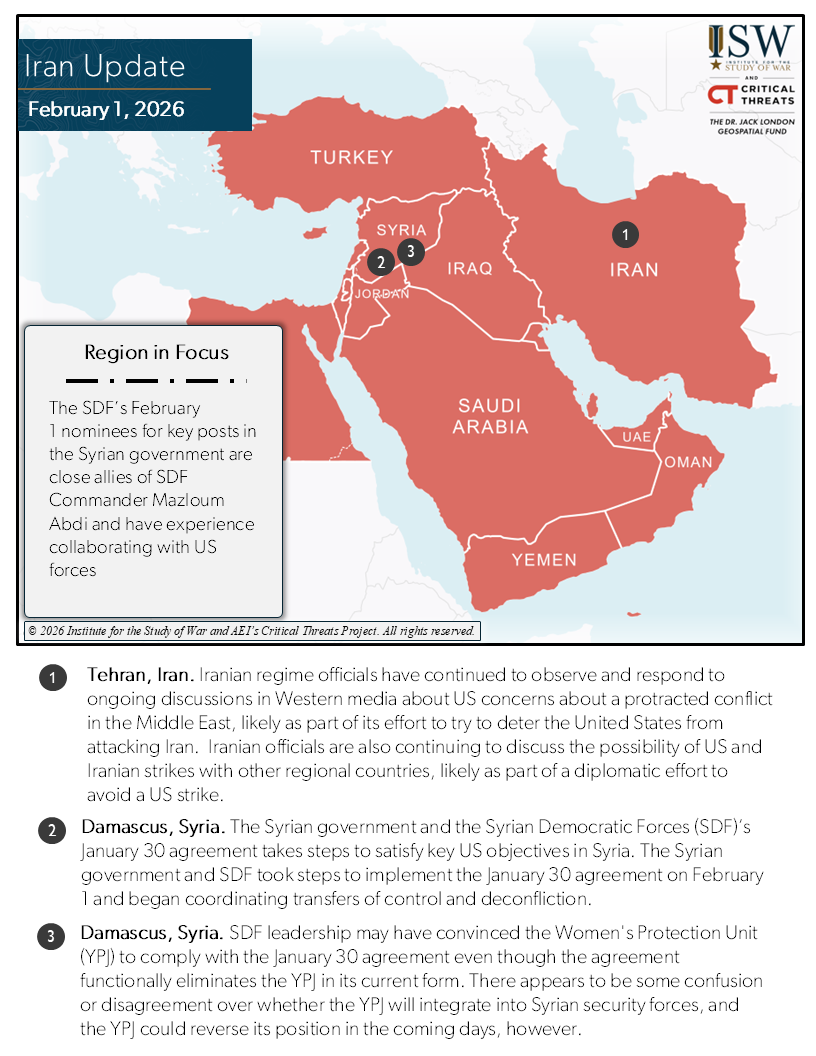
Key Takeaways
- Iran’s Efforts to Deter a US Attack: Iranian regime officials have continued to observe and respond to ongoing discussions in Western media about US concerns about a protracted conflict in the Middle East, likely as part of its effort to try to deter the United States from attacking Iran. Iranian officials are also continuing to discuss the possibility of US and Iranian strikes with other regional countries, likely as part of a diplomatic effort to avoid a US strike.
- Iranian Missile Program: The Gulf states have reportedly warned the United States that Iran’s missile program could cause significant damage to US interests in the region, according to two Western officials speaking to Washington Post.
- Syrian Government-SDF Agreement: The Syrian government and the Syrian Democratic Forces (SDF)’s January 30 agreement takes steps to satisfy key US objectives in Syria. The Syrian government and SDF took steps to implement the January 30 agreement on February 1 and began coordinating transfers of control and deconfliction.
- Internal SDF Deliberations: SDF leadership may have convinced the Women's Protection Unit (YPJ) to comply with the January 30 agreement even though the agreement functionally eliminates the YPJ in its current form. There appears to be some confusion or disagreement over whether the YPJ will integrate into Syrian security forces, and the YPJ could reverse its position in the coming days, however. There are other indications that senior SDF leadership may be convincing more hardline pro-SDF entities to moderate their positions.
- SDF Leadership Nominations: The SDF’s February 1 nominees for key posts in the Syrian government are close allies of SDF Commander Mazloum Abdi and have experience collaborating with US forces.