{{currentView.title}}
February 02, 2026
Iran Update, February 2, 2026
The Critical Threats Project (CTP) at the American Enterprise Institute and the Institute for the Study of War (ISW) publish the Iran Update, which provides insights into Iranian and Iranian-sponsored activities that undermine regional stability and threaten US forces and interests. CTP-ISW publishes the Iran Update daily.
Click here to see CTP and ISW’s interactive map of assessed control of terrain in Syria, and here to see CTP and ISW’s interactive map of Israeli ground operations. The Syria map is updated daily alongside the static Syria maps in this report. CTP-ISW ended daily maps of Israeli ground operations in February 2025.
Click here to see CTP-ISW's interactive map showing the total strikes in Iran during the Israel-Iran War, as well as an interactive timelapse showing the strikes day-by-day.
Click here to see CTP-ISW’s new interactive map showing the locations of daily protests in Iran since December 28, 2025. CTP-ISW will continue to publish daily static maps depicting the Iranian protests in forthcoming Iran Updates.
Click to see CTP-ISW's indicators of Iranian regime instability.
The Iranian regime is conducting a concerted campaign that involves diplomatic, informational, and military lines of effort to try to prevent US military action against Iran. Iranian Foreign Affairs Minister Abbas Araghchi, President Masoud Pezeshkian, and Supreme National Security Council (SNSC) Secretary Ali Larijani have conducted a flurry of diplomatic activity with regional countries in recent days.[i] Araghchi met with Turkish President Recep Tayyip Erdogan and Foreign Minister Hakan Fidan in Istanbul on January 30.[ii] Axios subsequently reported on February 2, citing two “sources with knowledge” and an unspecified US official, that Araghchi and US Special Envoy to the Middle East Steve Witkoff are expected to meet in Turkey on February 6 to discuss a possible nuclear deal.[iii] Iranian officials have signaled openness to resuming nuclear negotiations with the United States in recent days, likely to try to delay or prevent a US attack on Iran.[iv] Iran previously engaged in negotiations with the United States in the spring of 2025 to try to prevent military action against it.[v]
Iran is unlikely to accede to US President Donald Trump’s preconditions for negotiations. The United States has demanded that Iran permanently halt uranium enrichment, limit its ballistic missile program, and end “all support” for the Axis of Resistance as preconditions for negotiations.[vi] Iranian officials have repeatedly insisted that Iran will not negotiate on its ballistic missile program or support for the Axis of Resistance, which constitute the main pillars of Iran’s deterrence and defense strategies.[vii] It is possible that the regime could agree to reduce its uranium enrichment, but the regime is unlikely to accept Trump’s demand for zero enrichment. Two Iranian officials told Reuters on February 2 that the regime views Trump’s demand regarding Iran’s ballistic missile program as a “bigger obstacle” than Trump’s demand regarding uranium enrichment.[viii] This statement suggests that the regime could potentially show some flexibility on the uranium enrichment issue, particularly if it views a potential US attack against Iran as an existential threat. Iranian officials previously stated during negotiations with the United States in the spring of 2025 that Iran would be willing to reduce its uranium enrichment to 3.67 percent, which was the enrichment limit in the 2015 Joint Comprehensive Plan of Action (JCPOA).[ix]
Iran may be trying to reduce the United States’ leverage and ability to pressure the regime to accede to US demands. An unspecified Iranian official told Reuters on February 2 that Iran “wants” the United States to remove its military assets from the Middle East before Iran engages in talks with the United States.[x] CNN reported on February 1 that progress toward renewing negotiations between Iran and the United States “appear[ed] to have stumbled,” in part due to the United States’ unwillingness to reduce its military presence in the Middle East.[xi] This report suggests that Iran may have formally made the removal of US military assets from the region a precondition for negotiations, which would be consistent with Iran’s efforts to delay or prevent a US attack on Iran.
Some Iranian officials have told Western media that Iran would be willing to offer nuclear concessions to the United States. CTP-ISW has not observed any indications that the regime has altered its position on the nuclear issue. An unspecified Iranian official told Reuters on February 2 that Iran is willing to “accept zero enrichment under a consortium agreement” and hand over 400 kilograms of highly enriched uranium (HEU).[xii] Iran possessed around 440 kilograms of uranium enriched up to 60 percent before the Israel-Iran War.[xiii] The Iranian regime previously rejected a US proposal in June 2025 to establish a regional nuclear consortium because the proposal would have ultimately required Iran to halt domestic uranium enrichment.[xiv] Supreme Leader Ali Khamenei stated at the time that enrichment is an Iranian “red line” and that Iran’s nuclear program without enrichment is “practically worthless.”[xv] CTP-ISW has not observed any indications that the regime has softened its position on this issue. SNSC Foreign Policy Deputy Ali Bagheri separately emphasized on February 2 that Iran will not transfer its HEU stockpile to another country.[xvi]
The Iranian regime has continued to warn that a US attack on Iran would trigger a regional conflict. This warning is part of the regime's ongoing informational effort to exploit the United States’ concerns about a protracted regional war to try to deter a US attack. Islamic Revolutionary Guards Corps (IRGC)-affiliated Tasnim News Agency warned on February 2 that a US attack on Iran could trigger a regional war because Iran could retaliate by attacking Israel, international shipping, or US bases in regional countries.[xvii] Tasnim added that Iran would be “the center of a potential network of conflicts” if the United States attacks Iran.[xviii] Iranian Armed Forces General Staff-run media similarly warned on February 2 that a US attack on Iran would expand beyond a “limited bilateral conflict” between Iran and the United States into a “multi-level crisis with far-reaching consequences for American interests.”[xix] These Iranian media reports echo Khamenei’s warning on February 1 that a US attack on Iran would stoke a regional war.[xx]
The Iranian regime has also warned that a US attack on Iran could destabilize Middle Eastern countries that host US bases, likely to try to pressure these countries to urge the United States to refrain from attacking Iran. Tasnim stated on February 2 that Iran could respond to a US attack on Iran by attacking US bases in regional countries and argued that such retaliatory attacks could threaten the “security and stability” of countries that host US bases.[xxi] Tasnim added that regional countries that host US bases could become involved in “security challenges that have nothing to do with them” if the United States attacks Iran. This report comes amid some regional countries’ opposition to a US attack on Iran. An official from an unspecified Gulf state told the New York Times on January 15 that Qatar, Saudi Arabia, Oman, and Egypt had urged the United States not to attack Iran because they were concerned that Iran could retaliate by striking their territory.[xxii] The Washington Post separately reported on February 1 that Gulf states warned the United States that Iran retains short-range ballistic missiles and launchers that it could use to strike US interests in the Persian Gulf.[xxiii] Iran has previously struck US interests in regional countries in response to US actions, including in January 2020 when Iran attacked Ain al Asad Airbase in Iraq and in June 2025 when Iran attacked al Udeid Airbase in Qatar.[xxiv]
The Iranian regime has also highlighted its armed forces’ ability and willingness to respond to a US attack as part of its military effort to try to prevent such an attack. The IRGC Navy planned to conduct a live-fire exercise in the Strait of Hormuz on February 1 and 2.[xxv] CTP-ISW assessed on January 29 that the exercise was likely intended to try to deter US military action against Iran.[xxvi] CTP-ISW also assessed that Iran could respond to a potential US attack by harassing or attacking international shipping.[xxvii] The IRGC Navy cancelled the exercise, however, reportedly following a US warning.[xxviii] Senior Iranian military commanders, including Armed Forces General Staff Chief Major General Abdol Rahim Mousavi and Khatam ol Anbia Central Headquarters Deputy Commander Brigadier General Kiomars Heydari, have also continued to vow that Iranian forces will respond harshly to a US attack.[xxix] Iranian officials and media have repeatedly threatened in recent days and weeks that Iran could attack Israel, international shipping in the Strait of Hormuz, or US bases in the region, in response to a potential attack.[xxx]
Iran has several military capabilities that it could use to respond to a US attack, but some of its offensive capabilities are degraded. Iran could use its naval capabilities to harass and attack US vessels or international shipping in the Persian Gulf and Strait of Hormuz. Iran also retains short-range ballistic missiles and launchers that it could use to target US bases.[xxxi] Israel destroyed at least 35-45 percent of Iran’s ballistic missile stockpile during the Israel-Iran War, but Iran has reportedly reconstituted its medium-range ballistic missile stockpile to pre-war levels.[xxxii] Iran could use these medium-range missiles to attack Israel. Despite these military capabilities, Iran’s Axis of Resistance is significantly weakened and degraded. Iran has long relied on the Axis of Resistance to deter and respond to US and Israeli actions against Iran. The Axis of Resistance failed to meaningfully support Iran during the Israel-Iran War, however, and it is unclear whether the groups that comprise the Axis of Resistance would intervene in a renewed conflict between Iran and the United States.[xxxiii]
The Iranian regime seeks to deter a US attack, in part because US military action would presumably disrupt Iran’s efforts to reconstitute its nuclear and ballistic missile programs. Iran has taken steps following the Israel-Iran War to rebuild its nuclear program and harden nuclear facilities against future airstrikes. Iran is encasing a newly built facility at Taleghan 2 at the Parchin Military Complex with a concrete “sarcophagus” to harden the facility against potential airstrikes, according to the Institute for Science and International Security.[xxxiv] Israel struck Taleghan 2 in October 2024.[xxxv] Iran has also covered the anti-drone cage at the Pilot Fuel Enrichment Plant (PFEP) at the Natanz Nuclear Complex with panels.[xxxvi] Israel struck the PFEP, which contained over 1,700 centrifuges, in June 2025.[xxxvii] Recent US intelligence has also found that Iran is trying to rebuild its nuclear facilities “deeper underground,” according to a person familiar with recent US intelligence speaking to CNN on January 29.[xxxviii] It is unclear which facilities Iran is trying to rebuild deeper underground, although Iran has been conducting construction at the Mount Kolang Gaz La facility near Natanz, which unspecified analysts told the Washington Post in September 2025 could contain underground halls between 260 and 330 feet deep.[xxxix]
CTP-ISW previously assessed that Iran has been prioritizing the reconstitution of its ballistic missile program after the Israel-Iran War.[xl] Iran has sought to reconstruct buildings that previously housed planetary mixers at the Parchin and Shahroud military complexes.[xli] Planetary mixers are necessary for producing solid fuel for ballistic missiles. The United States reportedly intercepted a shipment of planetary mixers from the People’s Republic of China in the Indian Ocean in November 2025.[xlii] A US attack on Iran would presumably disrupt Iran’s efforts to reconstitute its ballistic missile program because Iran would likely expend its ballistic missile stockpile to retaliate against the United States. Israeli media has also reported that Israel asked the United States to strike Iran’s ballistic missile facilities if it decides to attack Iran in order to limit Iran’s ability to retaliate.[xliii]
The Iranian regime is also reportedly concerned that a US strike could trigger renewed internal unrest. Four current Iranian officials told Reuters on February 2 that high-level officials told Supreme Leader Ali Khamenei that public anger over the regime’s brutal crackdown on the recent protests has reached a point that “fear is no longer a deterrent.”[xliv] The officials told Khamenei that a US strike on Iran could “embolden” Iranians to resume protesting and “inflict irreparable damage to the political establishment.” One of the officials stated that a US attack combined with protests could cause the regime to collapse, adding that this is the “main concern” among senior Iranian officials. CTP-ISW previously assessed that the regime has suppressed the protest movement for now, but that the regime’s unsustainable securitization measures and refusal to address the underlying grievances that triggered the recent protest movement could cause protests to resume.[xlv]
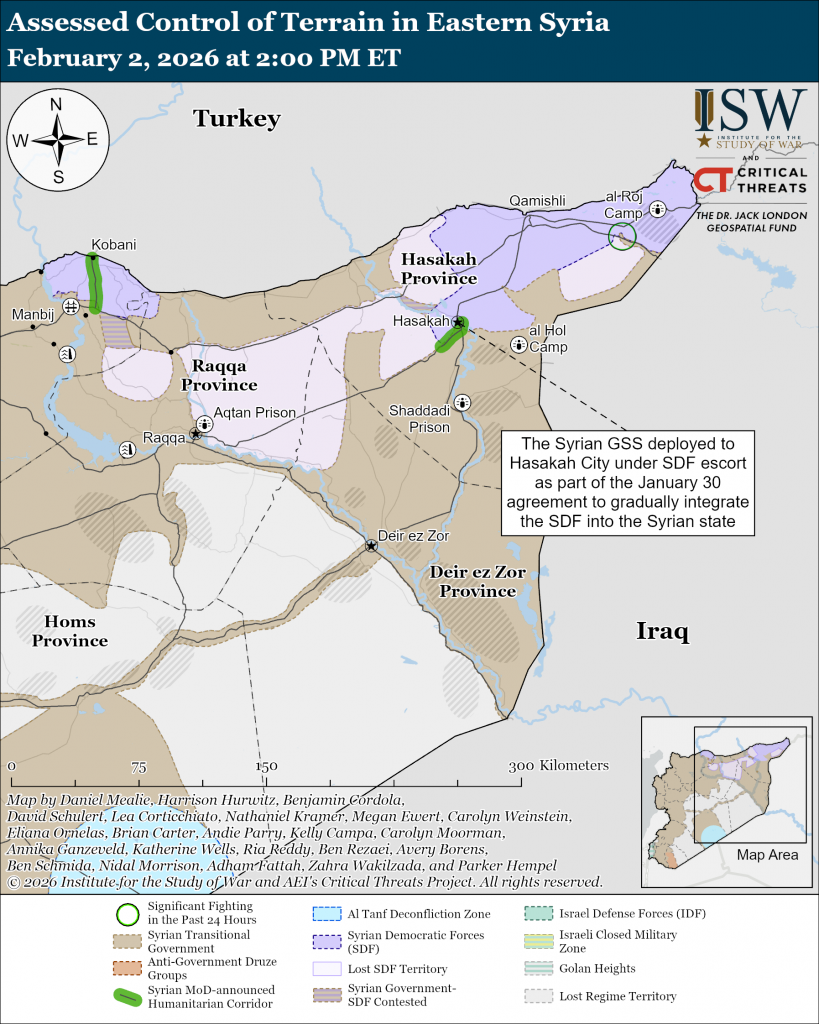
The Syrian government, in coordination with the Syrian Democratic Forces (SDF), deployed internal security forces to SDF territory, which marks the first successful collaboration between the two parties and a major step toward the SDF’s integration into the Syrian state. Syrian General Security Service (GSS) members entered Hasakah City and SDF-controlled villages south of Kobani, Aleppo Province, on February 2 under the escort of SDF internal security forces (known as Asayish).[xlvi]GSS’s deployment to Hasakah comes after the Syrian government and the SDF signed a 14-point agreement on January 30 that outlines the SDF’s gradual integration into the Syrian state.[xlvii] Hasakah Province Internal Security Commander Brigadier General Marwan al Ali led the GSS forces into Hasakah City and met with SDF leadership, including SDF commander Siamand Afrin.[xlviii] The SDF reportedly proposed Afrin for the Hasakah Province deputy director of security position to the Syrian government on February 1.[xlix] Ali told Kurdish media following his meeting with Afrin that the GSS, “in coordination with Asayish forces, will protect [Hasakah City] together.”[l] Afrin separately told Kurdish media that the Syrian government formed a committee to pursue the Asayish’s integration into the Ministry of Interior.[li] Ali told Syrian media on February 2 that the GSS plans to deploy a similar-sized GSS delegation to Qamishli on February 3, where they will begin integrating Qamishli’s Asayish units.[lii]
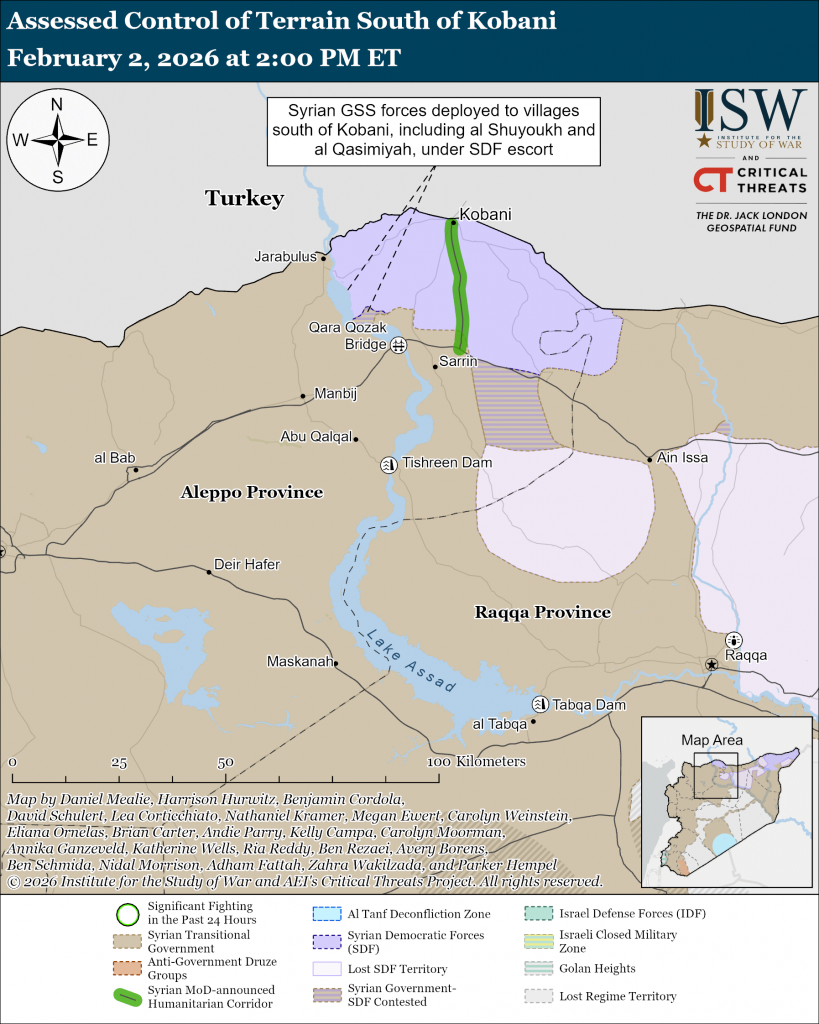
GSS forces also deployed to villages south of Kobani, including al Shuyoukh and al Qasimiyah, Aleppo Province, which were previously sites of intense MoD-SDF fighting.[liii] Colonel Mohammad Abdul Ghani, who is Aleppo Province’s internal security commander, led the GSS deployment following his meeting with Asayish leaders in Kobani on February 1.[liv] Ghani repeatedly referred to Kobani by its Kurdish name during a February 1 interview with Syrian media rather than by its Arabic name, which represents a notable shift in government rhetoric.[lv] Pro-SDF sources circulated videos of several meetings between the SDF and GSS forces in al Shuyoukh, where the SDF reportedly agreed to hand over Arab-majority villages south of Kobani, including al Shuyoukh, to the Syrian government.[lvi] The GSS and Asayish also established joint checkpoints in Shayklar village, Aleppo Province, on February 2, according to footage posted by pro-SDF media.[lvii]
The Syrian government has not yet approved the SDF’s proposed appointments for prominent Syrian government positions, but sources indicate that the government will likely approve at least some of the proposals.[lviii] The January 30 agreement stipulated that the SDF would propose several candidates for key local positions in the Syrian government.[lix] The SDF reportedly submitted its nominees, including former SDF public relations officer Noureddine al Ahmad for the Hasakah Province governor, on February 1.[lx] Syrian government sources told a Washington-based Syria analyst that Ahmad traveled to Damascus on February 2 and is expected to be formally appointed as Hasakah Province governor.[lxi] Ahmad similarly stated on February 1 that the Syrian government approved his nomination and that he would travel to Damascus soon.[lxii] Afrin’s recent meeting with Ali in Hasakah City on February 2 suggests that the Syrian government also approved the SDF’s proposal for Afrin to serve as the Hasakah Province deputy director of security. [lxiii]
Reported violations by SDF-affiliated Asayish forces during the GSS’s deployment to Hasakah City could threaten the January 30 agreement. The Asayish reportedly fired at and arrested civilians who were violating an Asayish-imposed daytime curfew in Hasakah on February 2 to greet the GSS forces deploying to the area.[lxiv] The Asayish’s reported violations could jeopardize the momentary success of the January 30 agreement. The January 30 agreement stipulates that both the Syrian government and the SDF will cease arrests related to the recent fighting.[lxv] A group of Asayish members previously refused to comply with a January 8 US-mediated ceasefire in Aleppo City, which led to renewed Syrian army efforts to capture Kurdish-majority neighborhoods there.[lxvi] The Asayish fired on government forces rather than civilians in that instance, however.[lxvii] The Asayish will reportedly impose a daytime curfew ahead of the GSS’s arrival in Qamishli on February 3.[lxviii]
Key Takeaways
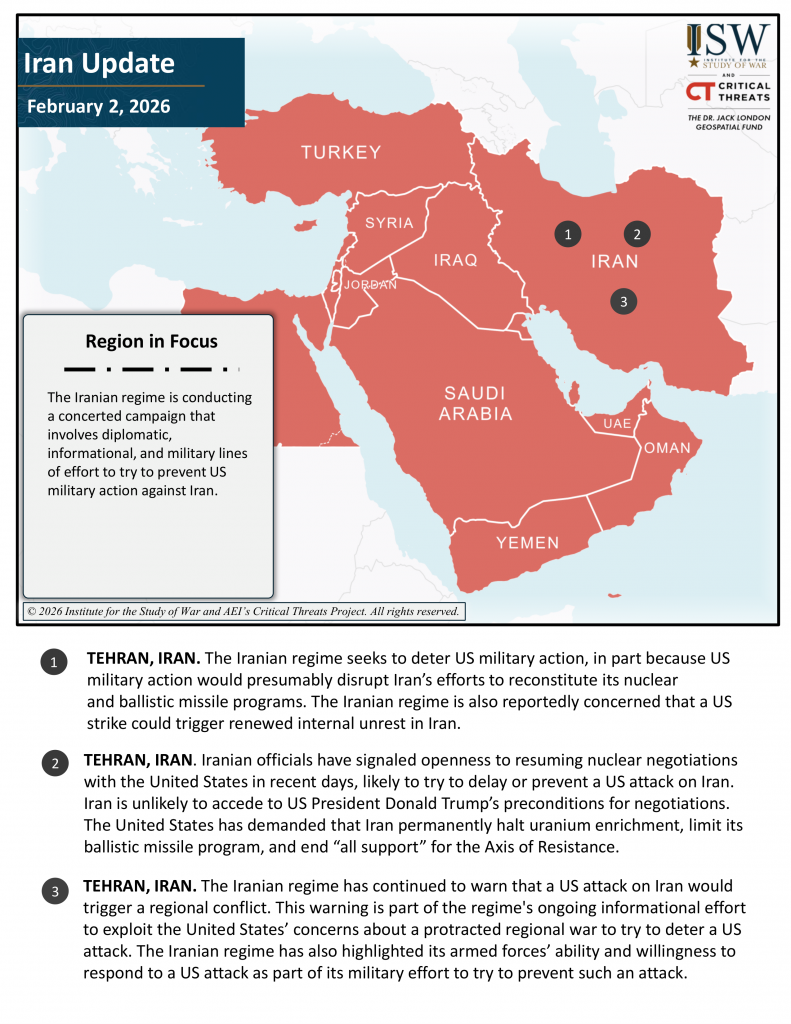
- Iranian Efforts to Prevent a US Attack on Iran: The Iranian regime is conducting a concerted campaign that involves diplomatic, informational, and military lines of effort to try to prevent US military action against Iran. The Iranian regime seeks to deter US military action, in part because US military action would presumably disrupt Iran’s efforts to reconstitute its nuclear and ballistic missile programs. The Iranian regime is also reportedly concerned that a US strike could trigger renewed internal unrest in Iran.
- US-Iran Nuclear Negotiations: Iranian officials have signaled openness to resuming nuclear negotiations with the United States in recent days, likely to try to delay or prevent a US attack on Iran. Iran is unlikely to accede to US President Donald Trump’s preconditions for negotiations. The United States has demanded that Iran permanently halt uranium enrichment, limit its ballistic missile program, and end “all support” for the Axis of Resistance.
- Iranian Threats to Retaliate: The Iranian regime has continued to warn that a US attack on Iran would trigger a regional conflict. This warning is part of the regime's ongoing informational effort to exploit the United States’ concerns about a protracted regional war to try to deter a US attack. The Iranian regime has also highlighted its armed forces’ ability and willingness to respond to a US attack as part of its military effort to try to prevent such an attack.
- SDF Integration into the Syrian Government: The Syrian government, in coordination with the Syrian Democratic Forces (SDF), deployed internal security forces to SDF territory, which marks the first successful collaboration between the two parties and a major step toward the SDF’s integration into the Syrian state.
Iran
The Iranian Artesh Ground Forces will hold a military exercise in Qasr-e Shirin County, Kermanshah Province, on February 2 and 3.[lxix] Units from the 181st Armored Brigade, which is based in Eslamabad-e Gharb, Kermanshah Province, will participate in the exercise.[lxx] The Artesh Ground Forces may conduct this exercise in response to the regime’s concerns about Kurdish opposition groups that operate in western and northwestern Iran. The regime has historically accused these groups of inciting social unrest among Iran’s Kurdish population.[lxxi] The Kurdistan Freedom Party (PAK) claimed an attack on Islamic Revolutionary Guards Corps (IRGC) positions in Kermanshah Province during the recent protests, killing an unspecified number of IRGC personnel.[lxxii] The regime deployed the IRGC Ground Forces 29th Nabi Akram Division to suppress protests in Kermanshah on January 8.[lxxiii]
Former Iranian President Hassan Rouhani warned on January 31 that the Iranian regime could face renewed nationwide protests if it does not implement major reforms to address the Iranian public’s grievances.[lxxiv] Rouhani echoed the regime’s rhetoric that “terrorists” took advantage of popular protests but added that the regime should not use such rhetoric to undermine the "legitimate demands” of the people.[lxxv] Rouhani stated that the regime should not silence people and should instead implement reforms so that the population does not seek "foreign intervention.”[lxxvi] CTP-ISW previously assessed that the regime has not indicated a willingness to address the underlying causes of the recent protest movement, which increases the probability of renewed protests.[lxxvii] Rouhani also stated that the regime should try to mitigate tensions with the United States.[lxxviii] Some hardliners, including parliamentarians, criticized Rouhani for his remarks.[lxxix] Parliamentarian Amirhossein Sabeti criticized Rouhani’s call for reform and called on the judiciary to prosecute Rouhani for his mismanagement during his presidency, for example.[lxxx]
Iraq
Some Shia Coordination Framework parties are pressuring the two main Kurdish blocs, the Kurdistan Democratic Party (KDP) and Patriotic Union of Kurdistan (PUK), to agree on a presidential candidate to accelerate the government formation process. The Shia Coordination Framework is a loose coalition of Iraqi Shia political parties, some of which Iran backs. Services Alliance parliamentarian Mahmoud Faleh al Sayed threatened on February 1 to collect signatures to dissolve parliament if parliament fails to elect a president again.[lxxxi] The Iraqi parliament postponed its second session to elect a president on February 1 due to a lack of quorum.[lxxxii] The Iraqi constitution stipulates that one-third of parliamentarians, or the prime minister with the president’s consent, can request a vote to dissolve parliament, which requires an absolute majority to pass.[lxxxiii] A framework delegation, including Prime Minister Mohammad Shia al Sudani, Badr Organization leader Hadi al Ameri, and Iraqi Foundation Coalition leader Mohsen al Mandalawi, held separate meetings with KDP and PUK leaders in Iraqi Kurdistan on February 2 to discuss the presidency.[lxxxiv] The KDP and PUK have been negotiating over which party will hold the presidency since the November 2025 elections.[lxxxv] Delays in the election of a president draw out the government formation process because the newly-elected president is responsible for selecting the prime minister-designate from the largest parliamentary bloc to form a government.[lxxxvi] Disputes between the KDP and the PUK over the presidency partly contributed to delays in government formation following the 2021 elections.[lxxxvii]
The Iraqi Security Forces (ISF) reportedly expelled Iranian-backed Iraqi militia Saraya al Jihad from its base south of Baghdad City on January 31.[lxxxviii] A security source told Iraqi media on January 31 that the ISF “forcibly evacuated” the militia, which controls the 17th Popular Mobilization Forces Brigade, after it refused to comply with an unspecified judicial order to leave the base.[lxxxix] The Popular Mobilization Forces is an Iraqi state security service that includes a large number of Iranian-backed Iraqi militias, many of which answer to Iran instead of the Iraqi prime minister.[xc] This expulsion comes as the United States is pressuring the Iraqi federal government to disarm Iranian-backed Iraqi militias.[xci]
Syria
Syrian Interior Ministry forces dismantled a Hezbollah-linked cell on February 2 that conducted multiple attacks targeting the Syrian town of Mezzeh, Rif Dimashq Province, and the Mezzeh military airport.[xcii] Syrian forces conducted a series of “precise” operations in Mezzeh and dismantled the cell, arrested all of its members, and seized weapons, including several drones.[xciii] The Syrian Interior Ministry announced that the cell received its rockets, launch platforms, and drones from Hezbollah.[xciv] The cell used Katyusha-type rockets in its recent attacks.[xcv] Hezbollah has historically used Katyusha rockets in its attacks against Israel.[xcvi] Hezbollah denied these allegations and claimed that it has no ties to any group inside Syria.[xcvii]
Arabian Peninsula
CTP-ISW has temporarily suspended its coverage of Yemen beginning on January 9 to prioritize coverage of the protests in Iran.
Palestinian Territories and Lebanon
Nothing significant to report.

[i] https://www.tasnimnews dot ir/fa/news/1404/11/13/3507091 ; https://www.wsj.com/world/middle-east/middle-east-pushes-for-iran-u-s-meeting-to-head-off-attack-f54a7b19?gaa_at=eafs&gaa_n=AWEtsqeGloU1drXrl5IqzHkshJ7xhsBxGiQO3ICbzTSeLnXf8ZdQhl87si1VuJVptaI%3D&gaa_ts=6980ce5f&gaa_sig=v6vmw8Wc1ajcqwGgzO8EmV88wARx7TkAnw8T2Ev130P34NdoFqqjHCUKhu03XtNhmjykhF18bI56TtWpfHDwOw%3D%3D ;
[ii] https://www.dailysabah dot com/politics/diplomacy/president-erdogan-meets-irans-fm-araghchi-in-istanbul-for-talks
[iii] https://www.axios.com/2026/02/02/iran-nuclear-talks-trump-military
[iv] https://x.com/alilarijani_ir/status/2017654208283963746
[v] https://www.nytimes.com/2025/04/11/world/middleeast/us-iran-talks-trump-khamenei.html
[vi] https://www.cnn.com/2026/01/28/politics/trump-threats-iran-nuclear-program-military-strike
[vii] https://www.cnn.com/2026/02/01/middleeast/iran-diplomat-araghchi-interview-intl ; https://en.mehrnews dot com/news/231130/ ; https://www.tasnimnews dot com/fa/news/1404/01/27/3292802
[viii] https://www.reuters.com/world/middle-east/iran-examines-diplomacy-with-us-hopes-results-coming-days-official-says-2026-02-02/
[ix] https://www.wsj.com/world/middle-east/u-s-iran-begin-high-stakes-nuclear-talks-in-oman-fc07cdce
[x] https://www.reuters.com/world/middle-east/iran-examines-diplomacy-with-us-hopes-results-coming-days-official-says-2026-02-02/
[xi] https://www.cnn.com/2026/02/01/middleeast/iran-diplomat-araghchi-interview-intl
[xii] https://www.reuters.com/world/middle-east/iran-examines-diplomacy-with-us-hopes-results-coming-days-official-says-2026-02-02/
[xiii] https://apnews.com/article/iran-nuclear-iaea-weapons-grade-uranium-c3ae6a8aae96d54355df73842916a324
[xiv] https://understandingwar.org/research/middle-east/iran-update-june-4-2025/
[xv] https://farsi.khamenei dot ir/news-content?id=60355
[xvi] https://t.me/sepah_pasdaran/178437 ; https://www.tasnimnews dot ir/fa/news/1404/11/13/3507570/ ; https://x.com/Entekhab_News/status/2018304170986524794?s=20
[xvii] https://www.tasnimnews dot ir/fa/news/1404/11/13/3507659
[xviii] https://www.tasnimnews dot ir/fa/news/1404/11/13/3507659
[xix] https://t.me/s/defapress_ir/47991
[xx] https://www.npr.org/2026/02/01/nx-s1-5695698/iran-khamenei-us-attack-warns-regional-war
[xxi] https://www.tasnimnews dot ir/fa/news/1404/11/13/3507326
[xxii] https://www.nytimes.com/2026/01/15/us/politics/trump-iran-israel-us.html
[xxiii] https://www.washingtonpost.com/world/2026/02/01/iran-missiles-persian-gulf-trump-military-buildup/
[xxiv] https://www.npr.org/sections/pictureshow/2020/01/14/796219386/the-aftermath-of-irans-missile-attack-on-an-iraqi-base-housing-u-s-troops ; https://www.centcom.mil/MEDIA/PRESS-RELEASES/Press-Release-View/Article/4223915/us-and-qatari-forces-successfully-defend-against-iranian-ballistic-missile-atta/
[xxv] https://x.com/CENTCOM/status/2017357050209333388
[xxvi] https://understandingwar.org/research/middle-east/iran-update-january-29-2026/
[xxvii] https://understandingwar.org/research/middle-east/iran-update-january-29-2026/
[xxviii] https://www.wsj.com/world/middle-east/middle-east-pushes-for-iran-u-s-meeting-to-head-off-attack-f54a7b19?gaa_at=eafs&gaa_n=AWEtsqeGloU1drXrl5IqzHkshJ7xhsBxGiQO3ICbzTSeLnXf8ZdQhl87si1VuJVptaI%3D&gaa_ts=6980ce5f&gaa_sig=v6vmw8Wc1ajcqwGgzO8EmV88wARx7TkAnw8T2Ev130P34NdoFqqjHCUKhu03XtNhmjykhF18bI56TtWpfHDwOw%3D%3D
[xxix] https://t.me/s/defapress_ir/47988 ; https://t.me/defapress_ir/48002
[xxx] https://www.cnn.com/2026/02/01/middleeast/iran-diplomat-araghchi-interview-intl ; https://defapress dot ir/fa/news/804871; https://tasnimnews dot ir/fa/news/1404/11/04/3499785/
[xxxi] https://www.washingtonpost.com/world/2026/02/01/iran-missiles-persian-gulf-trump-military-buildup/
[xxxii] https://t.me/moriahdoron/23179 ; https://understandingwar.org/research/middle-east/iran-update-december-12-2025/
[xxxiii] https://www.aei.org/wp-content/uploads/2025/10/The-State-of-the-Axis-of-Resistance.pdf?x85095
[xxxiv] https://isis-online.org/isis-reports/imagery-update-concrete-sarcophagus-at-taleghan-2-nears-completion
[xxxv] https://www.axios.com/2024/11/15/iran-israel-destroyed-active-nuclear-weapons-research-facility
[xxxvi] https://understandingwar.org/research/middle-east/iran-update-january-26-2026/
[xxxvii] https://x.com/TheGoodISIS/status/1933539314148823467
[xxxviii] https://www.cnn.com/2026/01/28/politics/trump-threats-iran-nuclear-program-military-strike
[xxxix] https://www.washingtonpost.com/national-security/2025/09/26/iran-underground-nuclear-us/
[xl] https://understandingwar.org/research/middle-east/iran-update-december-22-2025/
[xli] https://apnews.com/article/iran-missiles-planetary-mixers-israel-war-527bd871b691898b20eee98294dcda64
[xlii] https://t.me/moriahdoron/27646 ; https://www.nytimes.com/2025/12/12/us/politics/cargo-ship-seized-iran-china.html
[xliii] https://13tv dot co dot il/item/news/politics/security/kgjn7-904942423/?pid=7&refc=902992371
[xliv] https://www.reuters.com/world/middle-east/iran-fears-us-strike-may-reignite-protests-imperil-rule-sources-say-2026-02-02/
[xlv] https://understandingwar.org/research/middle-east/iran-update-january-15-2026/
[xlvi] https://thenewregion dot com/posts/4469; https://www.reuters.com/world/middle-east/syrian-government-forces-deploy-towards-kurdish-run-city-after-ceasefire-deal-2026-02-02/ ;
[xlvii] https://understandingwar.org/research/middle-east/iran-update-february-1-2026/ ; https://x.com/ibrahimhamidi/status/2017975310684172338 https://www.majalla dot com/node/329453/%D9%88%D8%AB%D8%A7%D8%A6%D9%82-%D9%88%D9%85%D8%B0%D9%83%D8%B1%D8%A7%D8%AA/%D8%A7%D9%84%D9%85%D8%AC%D9%84%D8%A9-%D8%AA%D9%86%D8%B4%D8%B1-%D8%A7%D9%84%D9%86%D8%B5-%D8%A7%D9%84%D8%AD%D8%B1%D9%81%D9%8A-%D9%84%D9%80%D8%A7%D9%84%D8%A7%D8%AA%D9%81%D8%A7%D9%82-%D8%A7%D9%84%D8%B4%D8%A7%D9%85%D9%84-%D8%A8%D9%8A%D9%86-%D8%A7%D9%84%D8%AD%D9%83%D9%88%D9%85%D8%A9-%D8%A7%D9%84%D8%B3%D9%88%D8%B1%D9%8A%D8%A9-%D9%88%D9%82%D8%B3%D8%AF ;
[xlviii] https://x.com/QalaatAlMudiq/status/2018336375427178599 ; https://x.com/vvanwilgenburg/status/2018340509102547074
[xlix] https://x.com/nahermedia/status/2017871877696295363
[l] https://www.kurdistan24 dot net/en/story/891496/new-hasakah-security-chief-pledges-cooperative-phased-implementation-of-damascus-sdf-accord
[li] https://x.com/vvanwilgenburg/status/2018318724571205831
[lii] https://x.com/vvanwilgenburg/status/2018404590421684389
[liii] https://www.facebook.com/share/v/14Y68oP7qjy/ ; https://x.com/vvanwilgenburg/status/2018311583701549485 ; https://www.facebook.com/share/v/16zEJbQCkS/
[liv] https://wladimirvanwilgenburg.substack.com/p/aleppo-security-chief-visits-kobani?utm_campaign=post-expanded-share&utm_medium=web&triedRedirect=true
[lv] https://www.youtube.com/watch?v=XB7etMsfhZg ; https://wladimirvanwilgenburg.substack.com/p/aleppo-security-chief-visits-kobani?utm_campaign=post-expanded-share&utm_medium=web&triedRedirect=true
[lvi] https://www.facebook.com/share/v/14Y68oP7qjy/ ; https://x.com/vvanwilgenburg/status/2018311583701549485 ; https://x.com/CdricLabrousse/status/2018383455625560491
[lvii] https://www.facebook.com/share/v/185Uq8hfMT/
[lviii] https://www.enabbaladi dot net/794075/%d8%a7%d8%aa%d9%81%d8%a7%d9%82-%d8%a7%d9%84%d8%ad%d9%83%d9%88%d9%85%d8%a9-%d8%a7%d9%84%d8%b3%d9%88%d8%b1%d9%8a%d8%a9-%d9%88%d9%82%d8%b3%d8%af-%d9%8a%d8%af%d8%ae%d9%84-%d9%85%d8%b1%d8%ad%d9%84/ ; https://x.com/Charles_Lister/status/2018326618238755072
[lix] https://understandingwar.org/research/middle-east/iran-update-february-1-2026/ ; https://x.com/ibrahimhamidi/status/2017975310684172338 https://www.majalla dot com/node/329453/%D9%88%D8%AB%D8%A7%D8%A6%D9%82-%D9%88%D9%85%D8%B0%D9%83%D8%B1%D8%A7%D8%AA/%D8%A7%D9%84%D9%85%D8%AC%D9%84%D8%A9-%D8%AA%D9%86%D8%B4%D8%B1-%D8%A7%D9%84%D9%86%D8%B5-%D8%A7%D9%84%D8%AD%D8%B1%D9%81%D9%8A-%D9%84%D9%80%D8%A7%D9%84%D8%A7%D8%AA%D9%81%D8%A7%D9%82-%D8%A7%D9%84%D8%B4%D8%A7%D9%85%D9%84-%D8%A8%D9%8A%D9%86-%D8%A7%D9%84%D8%AD%D9%83%D9%88%D9%85%D8%A9-%D8%A7%D9%84%D8%B3%D9%88%D8%B1%D9%8A%D8%A9-%D9%88%D9%82%D8%B3%D8%AF ;
[lx] https://www.enabbaladi dot net/794075/%d8%a7%d8%aa%d9%81%d8%a7%d9%82-%d8%a7%d9%84%d8%ad%d9%83%d9%88%d9%85%d8%a9-%d8%a7%d9%84%d8%b3%d9%88%d8%b1%d9%8a%d8%a9-%d9%88%d9%82%d8%b3%d8%af-%d9%8a%d8%af%d8%ae%d9%84-%d9%85%d8%b1%d8%ad%d9%84/ ; https://x.com/vvanwilgenburg/status/2017705411474755684 ; https://x.com/nahermedia/status/2017871877696295363
[lxi] https://x.com/Charles_Lister/status/2018326618238755072
[lxii] https://www.enabbaladi dot net/794075/%d8%a7%d8%aa%d9%81%d8%a7%d9%82-%d8%a7%d9%84%d8%ad%d9%83%d9%88%d9%85%d8%a9-%d8%a7%d9%84%d8%b3%d9%88%d8%b1%d9%8a%d8%a9-%d9%88%d9%82%d8%b3%d8%af-%d9%8a%d8%af%d8%ae%d9%84-%d9%85%d8%b1%d8%ad%d9%84/
[lxiii] https://x.com/Charles_Lister/status/2018326618238755072 ; https://x.com/QalaatAlMudiq/status/2018336375427178599 ; https://x.com/vvanwilgenburg/status/2018340509102547074
[lxiv] https://x.com/SimNasr/status/2018317402287522138 ; https://t.me/TelevisionSyria/76652 ; https://x.com/DeirEzzore/status/2018309297122295958 ; https://x.com/DeirEzzore/status/2018312454040690694 ; https://x.com/AJSyriaNowN/status/2018328413224735215
[lxv] https://understandingwar.org/research/middle-east/iran-update-february-1-2026/ ; https://x.com/ibrahimhamidi/status/2017975310684172338 https://www.majalla dot com/node/329453/%D9%88%D8%AB%D8%A7%D8%A6%D9%82-%D9%88%D9%85%D8%B0%D9%83%D8%B1%D8%A7%D8%AA/%D8%A7%D9%84%D9%85%D8%AC%D9%84%D8%A9-%D8%AA%D9%86%D8%B4%D8%B1-%D8%A7%D9%84%D9%86%D8%B5-%D8%A7%D9%84%D8%AD%D8%B1%D9%81%D9%8A-%D9%84%D9%80%D8%A7%D9%84%D8%A7%D8%AA%D9%81%D8%A7%D9%82-%D8%A7%D9%84%D8%B4%D8%A7%D9%85%D9%84-%D8%A8%D9%8A%D9%86-%D8%A7%D9%84%D8%AD%D9%83%D9%88%D9%85%D8%A9-%D8%A7%D9%84%D8%B3%D9%88%D8%B1%D9%8A%D8%A9-%D9%88%D9%82%D8%B3%D8%AF ;
[lxvi] https://understandingwar.org/research/middle-east/iran-update-january-9-2026/ ; https://www.reuters.com/world/middle-east/kurdish-councils-syrias-aleppo-reject-evacuation-call-2026-01-09/ ; https://x.com/QalaatAlMudiq/status/2009586124482646259
[lxvii] https://x.com/QalaatAlMudiq/status/2009581031565976057
[lxviii] https://x.com/QalaatAlMudiq/status/2018400789098590425
[lxix] https://www.mehrnews dot com/news/6737484
[lxx] https://www.criticalthreats.org/wp-content/uploads/Artesh-Ground-Forces-ORBAT-PDF-compressed-compressed.pdf
[lxxi] https://www.criticalthreats.org/analysis/irans-kurdish-insurgency ; https://amwaj.media/en/article/kurdish-militancy-in-iran-uncertain-as-armed-struggle-recedes-in-turkey
[lxxii] https://x.com/PAKenglishh/status/2011137160376959056
[lxxiii] https://t.me/mehrnews/343631
[lxxiv] https://www.rouhanihassan dot com/Fa/News/116596/
[lxxv] https://www.rouhanihassan dot com/Fa/News/116596/
[lxxvi] https://www.rouhanihassan dot com/Fa/News/116596/
[lxxvii] https://understandingwar.org/research/middle-east/iran-update-january-27-2026/
[lxxviii] https://www.rouhanihassan dot com/Fa/News/116596/
[lxxix] https://www.sharghdaily dot com/fa/tiny/news-1085104; https://www.mehrnews dot com/news/6736819/; https://www.khabaronline dot ir/news/2176394/; https://fararu dot com/fa/news/945487
[lxxx] https://www.khabaronline dot ir/news/2176394
[lxxxi] https://shafaq dot com/ar/%D8%B3%DB%8C%D8%A7%D8%B3%D8%A9/%D8%AE%D8%B1%D9%82-%D8%A7%D9%84%D8%AF%D8%B3%D8%AA%D9%88%D8%B1-%D8%AA%D9%84%D9%88%D9%8A%D8%AD-%D8%A8%D8%AD%D9%84-%D9%85%D8%AC%D9%84%D8%B3-%D8%A7%D9%84%D9%86%D9%88%D8%A7%D8%A8-%D8%A7%D9%84%D8%B9%D8%B1%D8%A7%D9%82%D9%8A
[lxxxii] https://www.alaraby dot co.uk/politics/%D8%A7%D9%84%D8%A8%D8%B1%D9%84%D9%85%D8%A7%D9%86-%D8%A7%D9%84%D8%B9%D8%B1%D8%A7%D9%82%D9%8A-%D9%8A%D8%AE%D9%81%D9%82-%D9%84%D9%84%D9%85%D8%B1%D8%A9-%D8%A7%D9%84%D8%AB%D8%A7%D9%86%D9%8A%D8%A9-%D8%A8%D8%B9%D9%82%D8%AF-%D8%AC%D9%84%D8%B3%D8%A9-%D8%A7%D9%86%D8%AA%D8%AE%D8%A7%D8%A8-%D8%B1%D8%A6%D9%8A%D8%B3-%D8%A7%D9%84%D8%AC%D9%85%D9%87%D9%88%D8%B1%D9%8A%D8%A9
[lxxxiii] https://iq.parliament dot iq/en/the-constitution/
https://www.mawazin dot net/Details.aspx?jimare=272905[lxxxiv] https://shafaq dot com/ar/%D8%B3%DB%8C%D8%A7%D8%B3%D8%A9/%D8%A8%D8%B1-%D8%A7%D8%B3%D8%A9-%D8%A7%D9%84%D8%B3%D9%88%D8%AF%D8%A7%D9%86%D9%8A-%D9%88%D9%81%D8%AF-%D8%A7%D9%84-%D8%B7%D8%A7%D8%B1-%D8%A7%D9%84%D8%AA%D9%86%D8%B3%D9%8A%D9%82%D9%8A-%D9%8A%D8%B5%D9%84-%D8%A7%D9%84%D8%B3%D9%84%D9%8A%D9%85%D8%A7%D9%86%D9%8A%D8%A9 ;
[lxxxv] https://understandingwar.org/research/middle-east/iran-update-january-9-2026/
[lxxxvi] https://www.atlanticcouncil.org/blogs/menasource/unpacking-iraqs-federal-supreme-court-chaos/ ; https://www.longwarjournal.org/archives/2025/11/with-voting-in-iraq-complete-government-formation-begins.php ; https://www.middleeastbulletin.com/iraqs-newly-elected-parliament-holds-first-session-steps-toward-government-formation
[lxxxvii] https://www.abc.net.au/news/2022-10-14/iraq-elects-new-president-and-premier-ending-stalemate/101538932
[lxxxviii] https://shafaq dot com/ar/أمـن/القوات-ال-منية-تخلي-مقرا-لفصيل-مسلح-بـ-القوة-جنوبي-بغداد
[lxxxix] https://shafaq dot com/ar/أمـن/القوات-ال-منية-تخلي-مقرا-لفصيل-مسلح-بـ-القوة-جنوبي-بغداد ; https://www.washingtoninstitute.org/policy-analysis/profile-saraya-al-jihad
[xc] https://understandingwar.org/research/middle-east/the-leadership-and-purpose-of-iraqs-popular-mobilization-forces/
[xci] https://understandingwar.org/research/middle-east/iran-update-december-12-2025/ ; https://www.newarab dot com/analysis/iraqs-elections-high-stakes-vote-amid-us-iran-tug-war ; https://www.state.gov/releases/office-of-the-spokesperson/2025/10/secretary-rubios-call-with-iraqi-prime-minister-mohammed-shiaa-al-sudani-2
[xcii] https://t.me/syrianmoi/28793 ; https://www.reuters.com/world/middle-east/shells-unknown-origin-land-near-damascus-airport-syrian-state-tv-says-2025-12-09/ ; https://x.com/nahermedia/status/1989562976622334371 ; https://t.me/sana_gov/149950 ; https://t.me/TelevisionSyria/72676 ; https://t.me/sana_gov/152836
[xciii] https://t.me/syrianmoi/28793
[xciv] https://t.me/syrianmoi/28793
[xcv] https://english dot enabbaladi.net/archives/2026/02/syria-claims-arrests-in-damascus-mezzeh-attacks-alleges-hezbollah-link/
[xcvi] https://iranpress dot com/content/288259/hezbollah-fires-barrage-katyusha-rockets-israeli-military-positions ; https://www.indiatoday dot in/world/story/katyusha-rockets-soviet-era-hezbollah-used-against-israel-2587534-2024-08-25 ; https://academic.oup.com/book/58679/chapter/485574160 ; https://english dot almanar.com.lb/2182853
[xcvii] https://www.reuters.com/world/middle-east/syria-arrests-group-behind-mezzeh-airport-attacks-weapons-traced-hezbollah-2026-02-01/
View Citations