{{currentView.title}}
February 03, 2026
Iran Update, February 3, 2026
Katherine Wells, Carolyn Moorman, Ben Rezaei, Adham Fattah, Parker Hempel, Avery Borens and Brian Carter
Data Cutoff: 2:00 PM ET
The Critical Threats Project (CTP) at the American Enterprise Institute and the Institute for the Study of War (ISW) publish the Iran Update, which provides insights into Iranian and Iranian-sponsored activities that undermine regional stability and threaten US forces and interests. CTP-ISW publishes the Iran Update daily.
Click here to see CTP and ISW’s interactive map of assessed control of terrain in Syria, and here to see CTP and ISW’s interactive map of Israeli ground operations. The Syria map is updated daily alongside the static Syria maps in this report. CTP-ISW ended daily maps of Israeli ground operations in February 2025.
Click here to see CTP-ISW's interactive map showing the total strikes in Iran during the Israel-Iran War, as well as an interactive timelapse showing the strikes day-by-day.
Click here to see CTP-ISW’s new interactive map showing the locations of daily protests in Iran since December 28, 2025. CTP-ISW will continue to publish daily static maps depicting the Iranian protests in forthcoming Iran Updates.
Click here to see CTP-ISW's indicators of Iranian regime instability.
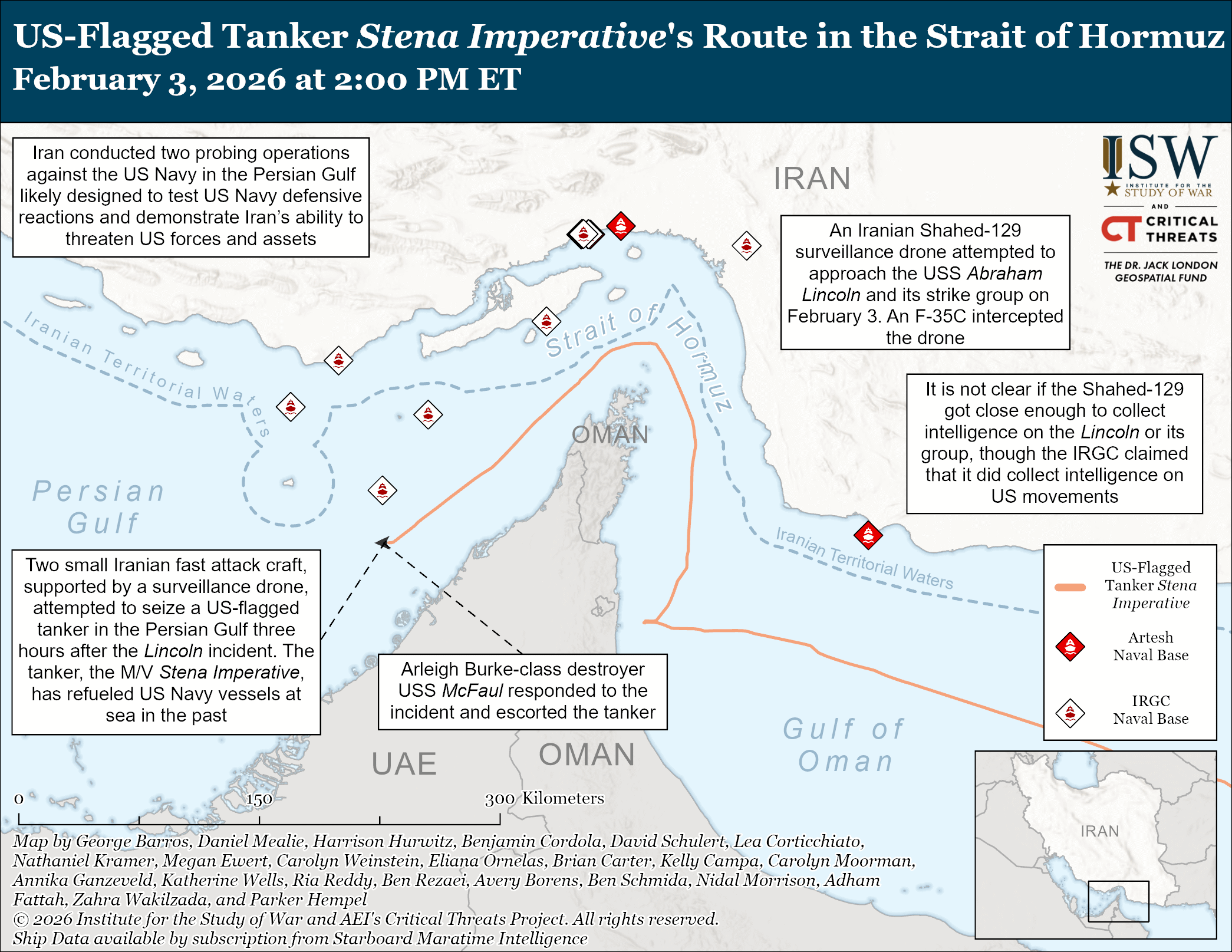
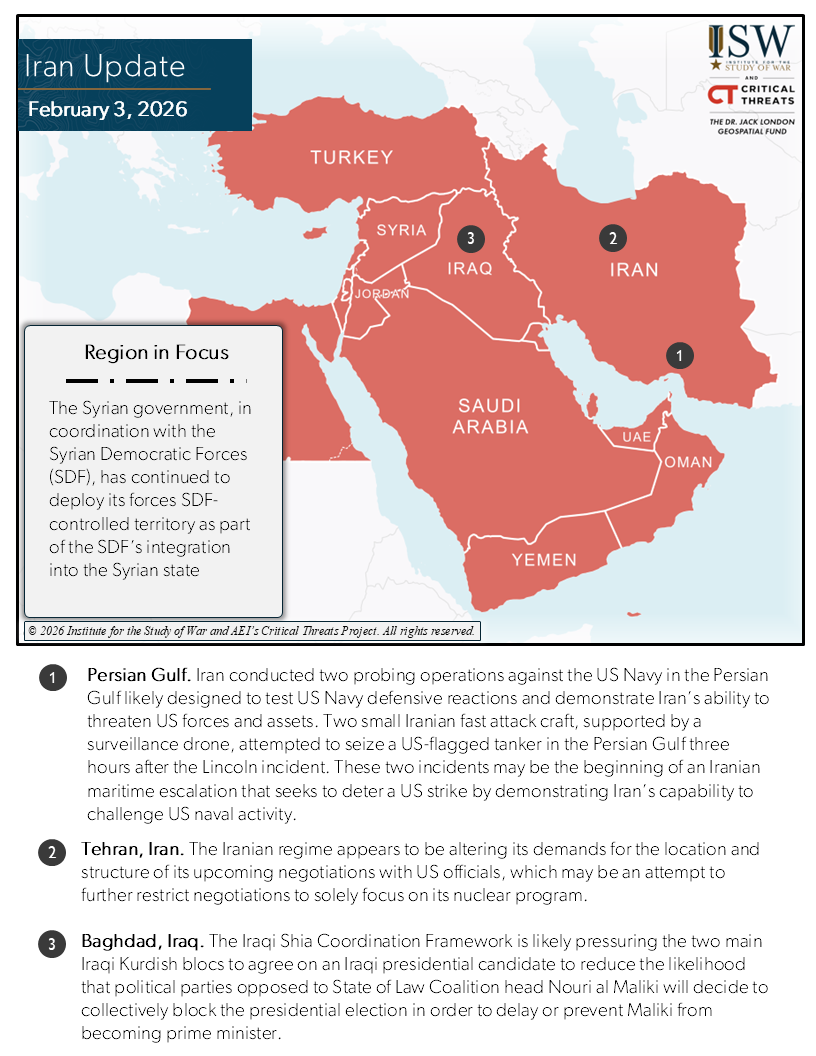
Iran conducted two probing operations against the US Navy in the Persian Gulf, likely designed to test US Navy defensive reactions and demonstrate Iran’s ability to threaten US forces and assets. An Iranian Shahed-129 surveillance drone attempted to approach the USS Abraham Lincoln and its strike group on February 3.[i] US Central Command (CENTCOM) reported that the US Navy took de-escalatory measures before a US F-35C Lightning II from the Lincoln intercepted and destroyed the drone.[ii] It is unclear how close the Shahed-129 came to the Lincoln, though the way that the Lincoln group responded to the drone’s approach can give Iran useful intelligence on how the US Navy will engage Iranian drones operating in its vicinity. A probing action seeks to test the strength, disposition, and reactions of an opposing force.
It is not clear if the Shahed-129 got close enough to collect imagery of the Lincoln or its group, though the IRGC claimed that it did collect intelligence on US movements. Islamic Revolutionary Guards Corps (IRGC)-affiliated Tasnim News Agency reported on February 3 that an Iranian Shahed-129 drone was conducting its “routine and legal” mission in international waters to identify, monitor, and film US movements and successfully transmitted imagery to its control center before losing communications.[iii] The Shahed-129 is an intelligence, surveillance, and reconnaissance (ISR) and strike drone, which differs from the Shahed-136 one-way attack drone that Russia has used in Ukraine.[iv] Iran has used Shahed-129 drones extensively across the Middle East, including to attack and collect intelligence on the United States and Israel.[v]
Two small Iranian fast attack craft, supported by a surveillance drone, attempted to seize a US-flagged tanker in the Persian Gulf three hours after the Lincoln incident. The tanker, the M/V Stena Imperative, has refueled US Navy vessels at sea in the past.[vi] Arleigh Burke-class destroyer USS McFaul responded to the incident and escorted the tanker.[vii] Iran likely targeted this specific vessel to spur a US Navy reaction and determine how and when the US Navy would react to similar provocation in the future. The IRGC probably also selected the vessel because it has refueled US naval vessels.
These two incidents may be the beginning of an Iranian maritime escalation that seeks to deter a US strike by demonstrating Iran’s capability to challenge US naval activity. Iran has previously escalated against the United States in the Persian Gulf in 2019 in response to US sanctions.[viii]
The Iranian regime appears to be altering its demands for the location and structure of its upcoming negotiations with US officials, which may be an attempt to further restrict negotiations to solely focus on its nuclear program. Regional sources told Western and regional media on February 3 that the Iranian regime demanded that the location of the United States and Iran’s upcoming negotiations on February 6 be changed from Turkey to Oman.[ix] The regime also reportedly requested that only US and Iranian officials participate in the negotiations.[x] Iran’s demand to make the talks bilateral would remove several regional states that were originally invited to participate in the talks in Turkey.[xi] Several of these regional countries have called for a broader agreement that addresses Iran’s ballistic missile program and its regional proxies, which suggests that Iran seeks to restrict negotiations to only the nuclear issue. An Axios reporter reported on February 3 that a source with knowledge of negotiations said that Iranian officials demanded a venue and format change to limit the negotiations to only nuclear issues.[xii]
Some unspecified Iranian regime officials have floated significant nuclear concessions with the United States, but other named senior regime officials speaking to non-Western outlets have floated more limited concessions, which raises doubts about the sincerity of officials speaking to Western media. Even the limited concessions do not mean US demands of zero enrichment, however. Two unspecified Iranian officials told the New York Times on February 2 that Iran is willing to shut down or suspend its nuclear program but would prefer the United States’ 2025 proposal to create a regional consortium to produce nuclear power.[xiii] An unspecified Iranian official also told Reuters on February 2 that Iran is willing to “accept zero enrichment under a consortium agreement” and hand over 400 kilograms of highly enriched uranium (HEU).[xiv] The two officials confirmed to the New York Times that Iranian Supreme Leader Ali Khamenei recently sent a message to Russian President Vladimir Putin via Iranian Supreme National Security Council (SNSC) Secretary Ali Larijani, which stated that Iran may agree to ship its enriched uranium to Russia as it did under the 2015 Joint Comprehensive Plan of Action (JPCOA).[xv] The SNSC's Deputy Foreign Policy Minister Ali Bagheri told Iranian media on February 2 that Iran does not have any intention to transfer its enriched uranium to any country, however.[xvi] Supreme Leader Representative to the SNSC's Defense Council Ali Shamkhani separately told a Lebanese Hezbollah-affiliated outlet on February 2 that Iran could reduce its enriched uranium from 60 to 20 percent and that there was “no reason” for Russia to take Iran’s enriched uranium as it did under the JCPOA.[xvii] Shamkhani’s proposal to reduce enrichment levels does not indicate that the regime’s decision makers are willing to concede to US demands of zero uranium enrichment.
Shamkhani specifically spoke to Hezbollah-affiliated media to reassure Iran’s regional partners that Iran will continue to support them and not give in to the US demand to halt its support. Shamkhani stated on February 2 that Iran is being attacked by the United States and its allies because of its resistance position and noted that Iran will continue to support the members of its Axis of Resistance.[xviii] Shamkhani added that Iran may negotiate with the United States if the United States de-escalates in the region.[xix] Shamkhani is referring to the United States’ increased military presence in the region amid threats to strike the Iranian regime. Shamkhani said that Iran is prepared for a possible war with the United States and that Iran would strike Israel if the United States attacked Iran, however.[xx]
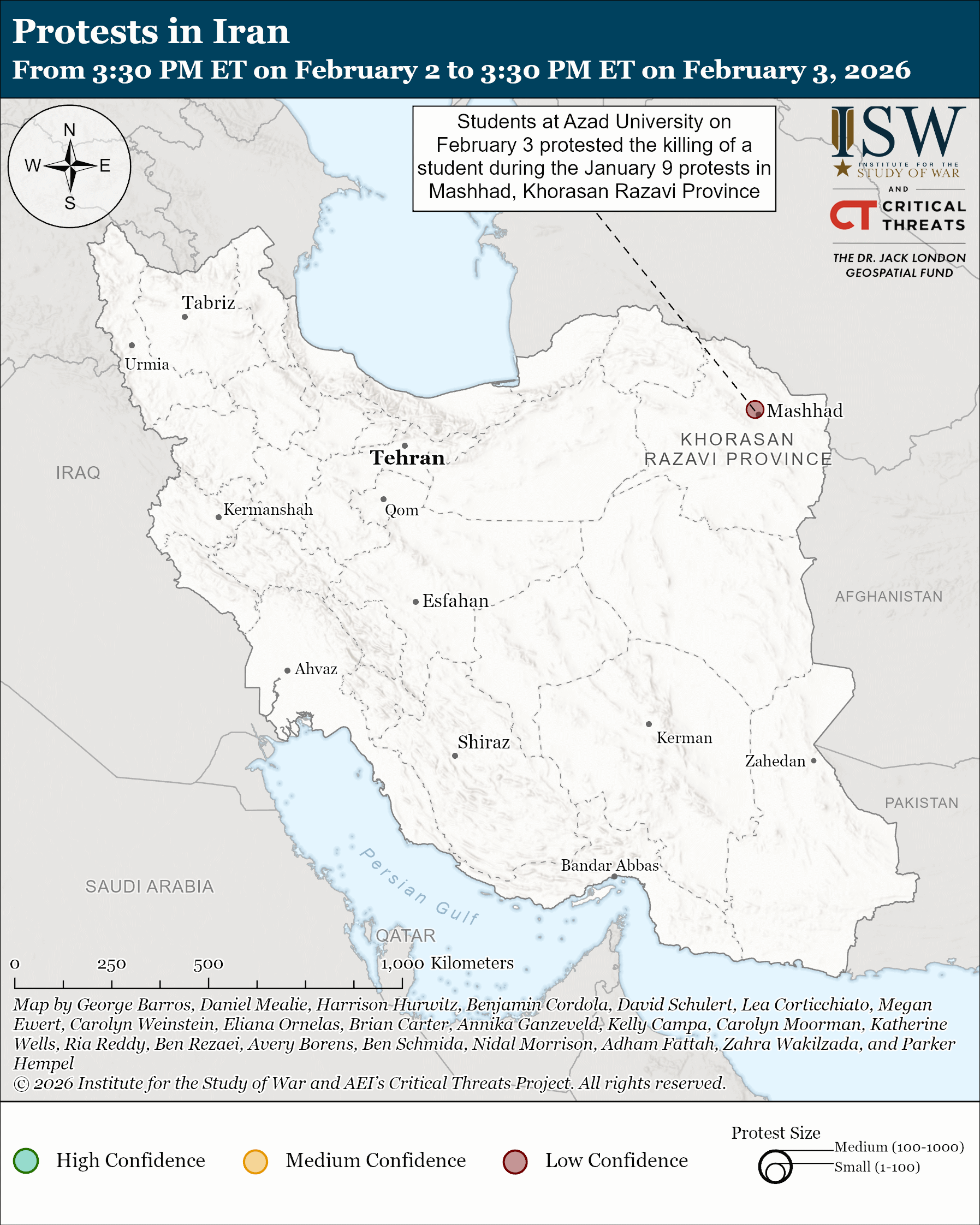
Students at a memorial for a student and protester whom the regime killed held a protest in Mashhad, Khorasan Razavi Province, on February 3, against the regime’s lethal crackdown.[xxi] The protest occurred at Azad University’s Medical Services Facility. The regime security forces killed Faezeh Hosseinnejad, the slain protester for whom students held the memorial, during the protests in Mashhad on January 9.[xxii] Protest activity peaked on January 8 and 9, during which the regime massively expanded its use of lethal force and killed thousands of protesters nationwide.[xxiii] The regime has historically tried to block funeral and commemoration ceremonies because they often turn into anti-regime protests.[xxiv]
The Iraqi Shia Coordination Framework is likely pressuring the two main Iraqi Kurdish blocs to agree on an Iraqi presidential candidate in order to reduce the likelihood that political parties opposed to State of Law Coalition head Nouri al Maliki will decide to collectively block the presidential election in order to delay or prevent Maliki from becoming prime minister. Maliki’s candidacy is backed by Iran and opposed by the United States.[xxv] The framework announced on January 31 that it still supports Maliki for the premiership amid US and domestic opposition.[xxvi] Multiple Sunni and Shia parties, including some within the framework, have rejected Maliki serving another term, however.[xxvii] Unspecified sources told Iraqi media on February 3 that the framework’s appeals to the Kurdistan Democratic Party (KDP) and the Patriotic Union of Kurdistan (PUK) to agree on a presidential candidate are part of a framework effort to prevent a “blocking third” that could impede a Maliki premiership.[xxviii] A framework delegation held separate meetings with KDP and PUK leaders in Iraqi Kurdistan on February 2 to discuss the presidency, which CTP-ISW assessed was a part of some framework parties’ efforts to accelerate the government formation process.[xxix] The KDP and PUK have been negotiating over which party will hold the presidency since the November 2025 elections.[xxx] The Iraqi Parliament postponed its second session to elect a president on February 1 due to a lack of quorum.[xxxi] A “well-informed source” told Iraqi media on February 1 that Shia and Sunni differences over candidates prevented a quorum but did not add further information.[xxxii] Parliament must elect a president via a simple majority with a two-thirds quorum requirement before the prime minister-designate can attempt to form a government.[xxxiii] Framework parties blocked the presidential election after the 2022 parliamentary elections to stop Shia nationalist cleric Muqtada al Sadr from forming a government without Iranian-backed parties.[xxxiv] One-third, or 109 seats, would block the presidential election.[xxxv] Iraqi media assessed on January 3 that the following parties could form a blocking third: the Progress Party, the National Masses Alliance, the Sovereignty Alliance, Asaib Ahl al Haq’s Sadiqoun political wing, the National State Forces Alliance, Kataib Imam Ali leader Shibl al Zaidi’s Services Alliance, the PUK, and the Iraqi Kurdish New Generation Movement.[xxxvi] If Iraqi media reporting is correct and these parties are accurate, the blocking parties only control 108 seats--one short of a blocking third.[xxxvii] A delay in the KDP and PUK’s agreement on a presidential candidate could provide these parties, and other parties opposed to Maliki, additional time to recruit other parties to join the blocking third. A relatively small blocking bloc would leave the blocking parties exposed to framework efforts to peel away one or more of the blocking parties by offering inducements.
The Iraqi State of Law Coalition is reportedly moving forward with its threats to remove Parliament Speaker and Progress Party member Hebet al Halbousi due to the Progress Party’s continued opposition to Maliki.[xxxviii] A Reconstruction and Development Coalition parliamentarian told Iraqi media on February 2 that the State of Law Coalition is moving to replace Halbousi due to “ongoing electoral deadlock.”[xxxix] This parliamentarian's statement follows a State of Law Coalition parliamentarian threatening Halbousi’s position on January 30 if the Progress Party did not support Maliki for the premiership.[xl] The Progress Party has led the Sunni opposition to Maliki.[xli]
Maliki claimed in a February 3 interview that he is able to disarm Iranian-backed Iraqi militias due to his “close ties with the groups,” almost certainly in an attempt to reduce US opposition to his nomination as prime minister.[xlii] An unspecified senior Iraqi official similarly told a Kurdish journalist in December 2025 that Maliki told the United States via unspecified mediators that Maliki would disarm Iranian-backed Iraqi militias if the United States supported his bid for the premiership.[xliii] CTP-ISW assessed at the time that Maliki would likely attempt to transform elements of the Iraqi security establishment into a force that he could use to enhance his personal power as prime minister, which the United States has also implicitly opposed in recent weeks by highlighting negative US views on Maliki’s previous administration.[xliv] Maliki pursued sectarian and authoritarian policies while in office between the US withdrawal in 2011 and 2014, which contributed to the rise of the Islamic State of Iraq and al Sham (ISIS) in Iraq.[xlv] The United States ultimately delayed support for Iraq against ISIS in 2014 until Maliki was removed from power due to his direct role in destabilizing Iraq.[xlvi]
Maliki likely claimed that he would disarm Iranian-backed Iraqi militias while in office because he believed it could garner him US support for another term. The United States has continuously pressured the Iraqi federal government to disarm Iranian-backed Iraqi militias since 2025.[xlvii] The United States has recently expressed its opposition to Maliki in multiple ways, including when the US Charge d’Affaires directly told Maliki that the US rejects him as prime minister.[xlviii] The United States has also repeatedly pressured the Iraqi federal government to exclude Iranian-backed Iraqi political actors from Iraq’s government.[xlix] Maliki’s admission of his “close ties” with Iranian-backed Iraqi militias during the February 3 interview underscores why the United States rejects him for the premiership.[l]
Current Iraqi Prime Minister Mohammad Shia al Sudani’s unwillingness to formally step down from the premiership indicates that Sudani seeks to retain power and influence in the government, despite his public support for Maliki to become prime minister. Iraqi media leaked a letter from the Iraqi Parliament to the Iraqi electoral commission on February 2, in which Sudani refused to assume his parliament seat, which would force him to relinquish his position as caretaker prime minister.[li] Sudani has headed a caretaker government with limited powers since the previous government’s mandate ended after the 2025 elections.[lii] Sudani withdrew from the premiership race on January 13, but CTP-ISW has assessed that Sudani still likely aims to receive the premiership amid US and domestic opposition to Maliki.[liii] Sudani served as a part of the framework delegation that held separate meetings with KDP and PUK leaders on February 2 in a likely attempt to pressure the KDP and PUK to agree on a presidential candidate and accelerate the government formation process.[liv] Iraqi media also did not name Sudani’s Reconstruction and Development Coalition as a party that could block the presidential election.[lv] Sudani could be supporting the framework’s current efforts, while hoping to receive the premiership if a “blocking third” were to materialize and deter the framework from selecting Maliki as prime minister. Sudani appears to be maneuvering himself to have a negotiating position in order to receive other positions in the Iraqi government, although his consistent pursuit of a second term as prime minister demonstrates that he would prefer the premiership. The framework would probably not nominate him even if the framework rejects Maliki, however, due to many framework members' long-standing opposition to Sudani.[lvi]
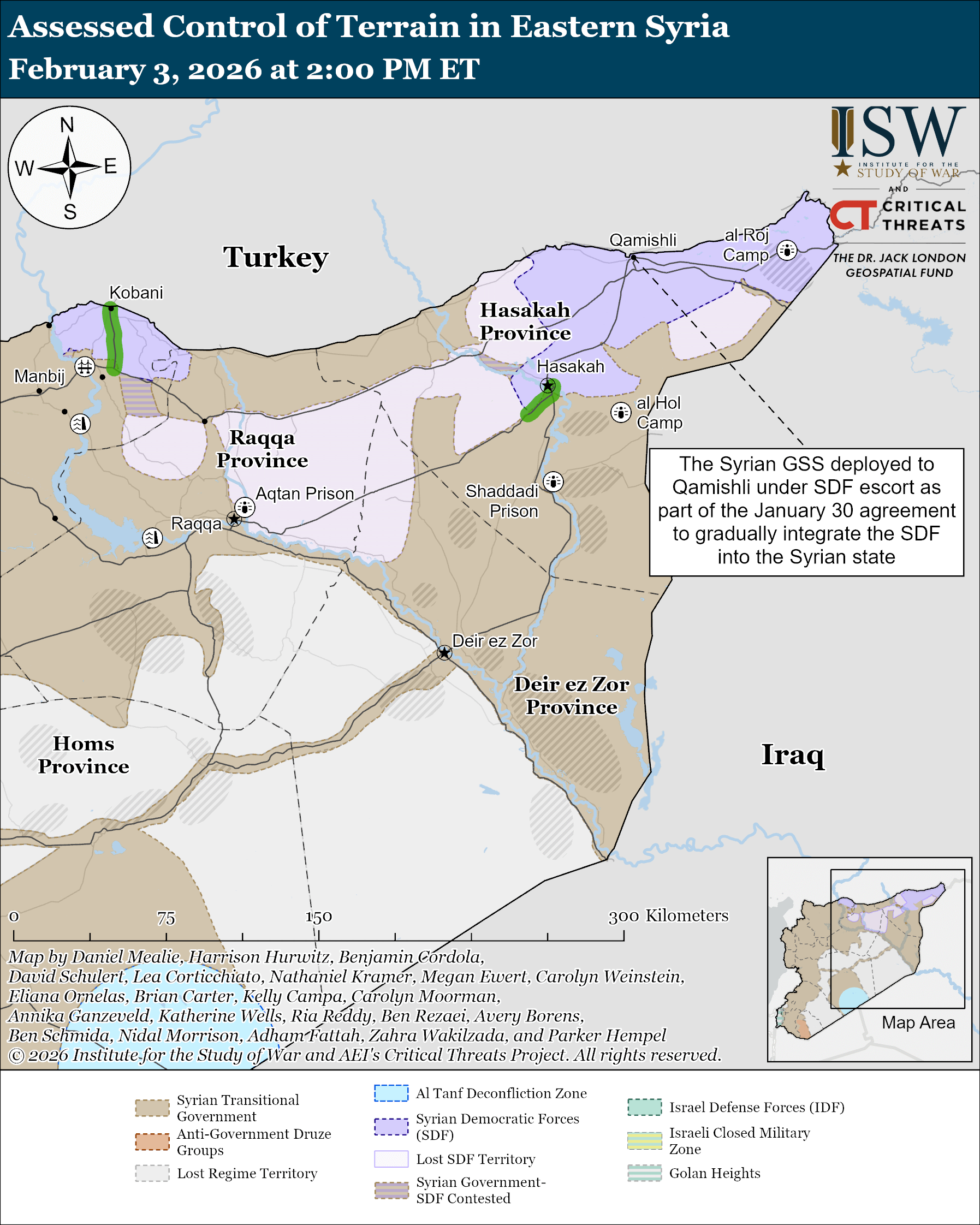
The Syrian government, in coordination with the Syrian Democratic Forces (SDF), has continued to deploy its forces in SDF-controlled territory as part of the SDF’s integration into the Syrian state. Syrian General Security Service (GSS) members entered Qamishli, Hasakah Province, on February 3 under the escort of SDF’s internal security forces (known as Asayish).[lvii] The GSS previously announced the deployment on February 2, which is part of the 14-point January 30 agreement that outlines the SDF’s gradual integration into the Syrian state.[lviii] Hasakah Province Internal Security Commander Brigadier General Marwan al Ali led the GSS convoy into Qamishli, accompanied by Syrian Ministry of Interior (MoI) spokesperson Noureddine al Baba.[lix] Ali and Baba met with SDF Asayish Commander Siaman Afrin and Asayish General Command member Halima Mahmoud Abu Bakr in Qamishli.[lx] Afrin is reportedly the SDF-proposed Hasakah Province Deputy Security Director and previously met with Ali in Hasakah City on February 2.[lxi] The Asayish imposed a curfew in Qamishli, which Baba said was necessary to rebuild trust between the SDF and the GSS in an interview with Syrian state media on February 3.[lxii] Local sources reported that the Asayish did not conduct any arrests or shootings of unarmed civilians, unlike during the GSS’s February 2 deployment to Hasakah City.[lxiii] Baba called the Asayish‘s arrests of Arab civilians in Hasakah City on February 2 “unacceptable” and noted that the Syrian government will implement measures to resolve the issue.[lxiv] The lack of arrests or shootings indicates that the government and the SDF resolved the issue. Baba did not say that the arrests affected the agreement, which indicates that the Asayish’s activity does not yet constitute a ”red line” that would spoil the agreement despite the Syrian government’s disapproval.
The Syrian government and SDF have also made gestures to build mutual trust following the January 30 agreement. Local pro-government and pro-SDF sources both reported that the Syrian government and SDF will conduct a prisoner exchange of “all prisoners without exception” at an unspecified location in February .[lxv] Multiple Syrian sources also reported that the SDF transferred the bodies of 15 people, whom the SDF had previously detained at Kobani Prison and allegedly executed, to families in Sarrin, Aleppo Province, on February 3.[lxvi] A Syrian source said the transfer was part of the implementation of the January 30 agreement.[lxvii]
The SDF’s Women’s Protection Unit (YPJ)’s reported refusal to disarm underscores the need for Syrian government and SDF negotiators to clarify whether the Syrian Ministry of Defense (MoD) will integrate the YPJ. The YPJ reportedly announced on January 31 that it disagreed with the SDF’s implementation of the January 30 agreement but noted that it would comply with it and join newly formed SDF brigades integrated into the MoD.[lxviii] The January 30 agreement did not explicitly address YPJ integration, but Western media reported on January 30 that the Syrian government had rejected forming a women’s brigade.[lxix] YPJ spokesperson Ruksen Mohammad told The Telegraph on February 3 that the YPJ has refused to lay down its arms and vowed that Syrian government forces “will only get to our land over our dead bodies.”[lxx] The YPJ also continued to mobilize and establish new units in Qamishli, Hasakah Province, on February 2.[lxxi] Mohammad added that the YPJ would continue to exist as an autonomous armed group within the four Kurdish brigades and that the YPJ would retain its armored vehicles and heavy weapons regardless of whether the ceasefire agreement holds.[lxxii] The Syrian government and the SDF’s inability to clarify the integration status of the YPJ increases the risk of unintegrated units, such as the YPJ or elements of these units, initiating a low-grade insurgency against Syrian government forces.
CTP-ISW is adjusting its January 27 assessed likely course of action (COA) to reflect the YPJ’s continued confusion over its integration, isolated reports of continued SDF mobilization in northeastern Hasakah Province, and the Syrian government and SDF’s notable progress in implementing the January 30 ceasefire agreement.[lxxiii] CTP-ISW now assesses that the most likely COA is that some Kurdish fighters may attempt to conduct a low-grade insurgency similar in scope and attack rate to the pro-Assad insurgency during the period between January and February 2025. Assadists conducted sporadic insurgent attacks targeting government forces daily from January to February 2025, with a high of six attacks on January 14 alone.[lxxiv] The sporadic Assadist attack largely occurred in Latakia, Tartous, and Hama provinces and typically targeted government military and security forces.[lxxv] Assadist insurgent activity in 2025, ultimately, culminated in an insurgent offensive in coastal Syria in March 2025, which resulted in government and affiliated forces committing massacres against the Alawite population there.[lxxvi] The rate of attacks collapsed rapidly thereafter, however, due to effective government counterinsurgency measures and a general lack of public support for the Assadist insurgents, who struggled to present themselves as defenders of the Alawites.[lxxvii] The YPJ’s previously stated confusion over their integration and a report from a Syrian source that Kurdish fighters have continued to mobilize in northeastern Hasakah Province on February 2 suggest that a low-level Kurdish insurgency is the most likely COA.[lxxviii] The progress made thus far by the January 30 agreement, especially the mutual restriction of SDF and MoD units from the frontlines, reduces the likelihood of a widespread Kurdish insurgency or even a low-grade insurgency involving large portions of the YPG and other militias.[lxxix] CTP-ISW now assesses that there will likely be a less significant insurgency than previously forecasted based on this evidence. A low-grade Kurdish insurgency could still threaten the implementation of the January 30 agreement and the SDF’s integration into the Syrian state, however.
Key Takeaways
- Iranian Navy Activity: Iran conducted two probing operations against the US Navy in the Persian Gulf, likely designed to test US Navy defensive reactions and demonstrate Iran’s ability to threaten US forces and assets. A probing action seeks to test the strength, disposition, and reactions of an opposing force. These two incidents may be the beginning of an Iranian maritime escalation that seeks to deter a US strike by demonstrating Iran’s capability to challenge US naval activity.
- Iran’s Negotiation Demands: The Iranian regime appears to be altering its demands for the location and structure of its upcoming negotiations with US officials, which may be an attempt to further restrict negotiations to solely focus on its nuclear program. Some unspecified Iranian regime officials have floated significant nuclear concessions with the United States, but other named senior regime officials speaking to non-Western outlets have floated more limited concessions, which raises doubts about the sincerity of officials speaking to Western media.
- Iraqi Actors Attempt to Secure the Premiership: The Iraqi Shia Coordination Framework is likely pressuring the two main Iraqi Kurdish blocs to agree on an Iraqi presidential candidate in order to reduce the likelihood that political parties opposed to State of Law Coalition head Nouri al Maliki will decide to collectively block the presidential election in order to delay or prevent Maliki from becoming prime minister.
- Sudani’s Role in the Iraqi Government: Current Iraqi Prime Minister Mohammad Shia al Sudani’s unwillingness to formally step down from the premiership indicates that Sudani seeks to retain power and influence in the government, despite his public support for Maliki to become prime minister.
- Syrian Government-SDF Agreement: The Syrian government, in coordination with the Syrian Democratic Forces (SDF), has continued to deploy its forces in SDF-controlled territory as part of the SDF’s integration into the Syrian state.
- Forecasting Next Steps in Northeastern Syria: CTP-ISW is adjusting its January 27 assessed most likely course of action (COA) to reflect the YPJ’s continued confusion over its integration, isolated reports of continued SDF mobilization in northeastern Hasakah Province, and the Syrian government and SDF’s notable progress in implementing the January 30 ceasefire agreement. CTP-ISW now assesses that the most likely COA is that some Kurdish fighters may attempt to conduct a low-grade insurgency similar in scope and attack rate to the pro-Assad insurgency during the period between January and February 2025.
Iran
Iranian Law Enforcement Command (LEC) Commander Brigadier General Ahmad Reza Radan appointed Brigadier General Aliakbar Javidan as the new LEC Border Guards Force commander on February 3.[lxxx] Brigadier General Ahmadali Goudarzi was the previous Border Guards Force commander.[lxxxi] The Iranian regime has not named Goudarzi to a new post. Javidan previously served as the LEC commander of Hormozgan Province since May 2023 and was the LEC commander of Golestan and Kermanshah provinces before that.[lxxxii]
The Iranian regime likely seeks to expand internet restrictions due to the recent protests. Internet monitor Filter Watch reported on February 3 that the regime will whitelist select individuals to permit them access, rather than allow internet access for all Iranians.[lxxxiii] The regime is reportedly using sophisticated service and customer segmentation to restrict civilians’ access to the internet, which enables the regime to maintain critical business services while severing the public's connection to the global web.[lxxxiv] Filter Watch noted that the recent internet disruption in Iran could be "the result of aggressive tests on the network; tests that enable switching the internet between three states: 'intelligent surveillance,' 'targeted disruption,' and 'guided shutdown'."[lxxxv] Filter Watch added that the regime is moving away from a traditional policy-making environment to an active “war room” model, shifting to a centralized state monitoring facility, in which the regime will consider technical delays in implementing network disconnections as "an act of treason.”[lxxxvi] The Iranian regime imposed a nationwide internet shutdown on January 8 to conceal its unprecedentedly brutal crackdown on protests and prevent Iranians from being able to organize protests.[lxxxvii] The regime has sustained its extreme securitization efforts, which reflect its concerns over renewed protests.[lxxxviii]
Iraq
Iranian-backed Iraqi militia Asaib Ahl al Haq head Qais al Khazali discussed Iraq-Iran relations and rejected any attacks that threaten regional security during a meeting with Iranian Ambassador to Iraq Mohammad Kazem al Sadiq on February 2.[lxxxix] This meeting comes amid efforts by members of Iran’s Axis of Resistance, including many Iranian-backed Iraqi militias, to deter a US attack on Iran.[xc] Khazali and Sadiq also likely discussed Iraqi government formation. Iran and the United States have historically exerted major influence in Iraqi government formation, particularly in the selection of prime ministers.[xci] Khazali reportedly opposes the Iranian-backed candidacy of former Prime Minister Nouri al Maliki as the new prime minister, and Sadiq may be attempting to get Khazali to support Maliki’s candidacy.[xcii]
Syria
Syrian President Ahmed al Shara met with a Kurdish National Council (KNC) delegation in Damascus on February 3 to discuss the Syrian government’s protection of Syrian Kurdish rights.[xciii] The KNC and Democratic Union Party (PYD) both supported decentralization within the Syrian state to present a unified Kurdish front to the central government in April 2025, but the KNC and PYD are long-time rivals. The KNC delegation welcomed Shara’s January 16 decree that affirmed that Syrian Kurds are an ”integral” and ”authentic” part of the Syrian people and provided Syrian Kurds with key rights.[xciv] Syrian media reported that the KNC warned SDF Commander Mazloum Abdi against any future “catastrophic” military operations and urged him to prioritize negotiations and dialogue during a January 25 meeting.[xcv] An unspecified source told Syria media that the KNC holds the SDF and PYD ”responsible” for the conflict against the Syrian government in northeastern Syria.[xcvi]
Arabian Peninsula
CTP-ISW has temporarily suspended its coverage of Yemen beginning on January 9 to prioritize coverage of the protests in Iran.
Palestinian Territories and Lebanon
An Israeli think tank reported on February 2 that the Israel Defense Forces (IDF) conducted its most extensive airstrikes in January 2026, but the strikes were concentrated north of the Litani River.[xcvii] The think tank’s report is consistent with CTP-ISW's observations and previous assessments that IDF airstrikes have largely shifted from south to north of the Litani River as LAF disarmament of Hezbollah has progressed. The IDF conducted at least 87 airstrikes targeting Hezbollah infrastructure and fighters in Lebanon in January 2026.[xcviii] The IDF conducted nearly twice the number of airstrikes in January 2026 as in December 2025, and the most IDF airstrikes in a single month since the November 2025 Israel-Hezbollah ceasefire agreement.[xcix] The Israeli think tank noted that the majority of the IDF’s airstrikes occurred north of the Litani River and in the Bekaa Valley, which is consistent with CTP-ISW's January 9 assessment.[c] CTP-ISW assessed on January 9 that the IDF airstrikes have recently shifted from south of the Litani River to north of the river, which suggests that Israel perceives a reduced threat south of the Litani.[ci] The shift in the IDF’s targeting pattern also suggests that the LAF has had some moderate success in disarming Hezbollah and reducing the threat the group poses to Israel from southern Lebanon.[cii] The IDF would presumably strike more positions south of the Litani River if Hezbollah had substantial military infrastructure there.

[i] https://www.cnn.com/2026/02/03/politics/iran-drone-uss-lincoln-tensions ;
https://www.tasnimnews dot ir/fa/news/1404/11/14/3508710
[ii] https://www.cnn.com/2026/02/03/politics/iran-drone-uss-lincoln-tensions
[iii] https://www.tasnimnews dot ir/fa/news/1404/11/14/3508710
[iv] https://www.criticalthreats.org/analysis/technical-specifications-and-historic-usage-of-iranian-drones-possibly-provided-to-russia
[v] https://www.criticalthreats.org/analysis/technical-specifications-and-historic-usage-of-iranian-drones-possibly-provided-to-russia
[vi] https://x.com/tom_bike/status/1910695684983898267 ; https://www.navy.mil/Press-Office/News-Stories/display-news/Article/4283108/strengthening-us-navy-jmsdf-interoperability-through-consolidated-cargo-repleni/
[vii] https://signalscv.com/2026/02/us-forces-shoot-down-iranian-drone-over-arabian-sea/
[viii] https://www.washingtoninstitute.org/policy-analysis/after-snapback-washington-needs-prepare-iranian-escalation-gulf
[ix] https://x.com/BarakRavid/status/2018735976852685170?s=20 ; https://www.al-monitor dot com/originals/2026/02/iran-seeks-nuclear-only-us-talks-drop-turkey-host-source
[x] https://x.com/BarakRavid/status/2018735976852685170?s=20 ; https://www.al-monitor dot com/originals/2026/02/iran-seeks-nuclear-only-us-talks-drop-turkey-host-source
[xi] https://www.reuters.com/world/middle-east/priority-iran-talks-istanbul-is-avoid-conflict-official-says-2026-02-03/
[xii] https://x.com/BarakRavid/status/2018749405696795104?s=20
[xiii] https://www.nytimes.com/2026/02/02/world/middleeast/us-iran-meeting-trump-threats.html?smid=tw-share
[xiv] https://www.reuters.com/world/middle-east/iran-examines-diplomacy-with-us-hopes-results-coming-days-official-says-2026-02-02/
[xv] https://www.nytimes.com/2026/02/02/world/middleeast/us-iran-meeting-trump-threats.html?smid=tw-share
[xvi] https://t.me/sepah_pasdaran/178437
[xvii] https://www.almayadeen dot net/news/politics/شمخاني-للميادين--المفاوضات-محصورة-بالموضوع-النووي---ولسنا-بو
[xviii] https://www.almayadeen dot net/news/politics/شمخاني-للميادين--المفاوضات-محصورة-بالموضوع-النووي---ولسنا-بو
[xix] https://www.almayadeen dot net/news/politics/شمخاني-للميادين--المفاوضات-محصورة-بالموضوع-النووي---ولسنا-بو
[xx] https://www.almayadeen dot net/news/politics/شمخاني-للميادين--المفاوضات-محصورة-بالموضوع-النووي---ولسنا-بو
[xxi] https://x.com/IranIntl/status/2018659281550148073?s=20; https://x.com/IranIntl/status/2018659865011356090?s=20; https://x.com/iranhrs99/status/2018742530440089956?s=46
[xxii] https://x.com/iranhrs99/status/2018742530440089956?s=46
[xxiii] https://www.criticalthreats.org/analysis/iran-update-january-8-2026 ; https://www.criticalthreats.org/analysis/iran-update-january-9-2026 ; https://www.criticalthreats.org/analysis/iran-update-january-8-2026 ; https://www.amnesty.org/en/latest/news/2026/01/iran-massacre-of-protesters-demands-global-diplomatic-action-to-signal-an-end-to-impunity/ ; https://www.iranintl.com/en/202601130145; https://understandingwar.org/research/middle-east/iran-update-january-16-2026/
[xxiv] https://understandingwar.org/research/middle-east/iran-update-january-16-2026/
[xxv] https://understandingwar.org/research/middle-east/iran-update-january-26-2026/ ; https://www.kurdistan24 dot net/ar/story/890035/slug ; https://almadapaper dot net/425900/ ; https://thestateofiraq.com/2026/01/28/sudanis-endgame-backed-by-trump/
[xxvi] https://almadapaper dot net/425746/
[xxvii] https://x.com/LawkGhafuri/status/2015133258476876068 ; https://shafaq dot com/ar/سیاسة/القوى-السنية-تجتمع-في-منزل-الخنجر-لبحث-الاستحقاقات;
https://shafaq dot com/ar/سیاسة/ت-كيدا-لشفق-نيوز-القوى-السنية-ت-علن-ت-سيس-المجلس-السياسي-الوطني ; https://understandingwar.org/research/middle-east/iran-update-january-28-2026/
[xxviii] https://almadapaper dot net/426000/
[xxix] https://shafaq dot com/ar/%D8%B3%DB%8C%D8%A7%D8%B3%D8%A9/%D8%A8%D8%B1-%D8%A7%D8%B3%D8%A9-%D8%A7%D9%84%D8%B3%D9%88%D8%AF%D8%A7%D9%86%D9%8A-%D9%88%D9%81%D8%AF-%D8%A7%D9%84-%D8%B7%D8%A7%D8%B1-%D8%A7%D9%84%D8%AA%D9%86%D8%B3%D9%8A%D9%82%D9%8A-%D9%8A%D8%B5%D9%84-%D8%A7%D9%84%D8%B3%D9%84%D9%8A%D9%85%D8%A7%D9%86%D9%8A%D8%A9 ; https://www.mawazin dot net/Details.aspx?jimare=272905 ; https://ina dot iq/ar/political/254157-.html ; https://understandingwar.org/research/middle-east/iran-update-february-2-2026/
[xxx] https://understandingwar.org/research/middle-east/iran-update-february-2-2026/
[xxxi] https://shafaq dot com/ar/%D8%B3%DB%8C%D8%A7%D8%B3%D8%A9/%D8%AE%D8%B1%D9%82-%D8%A7%D9%84%D8%AF%D8%B3%D8%AA%D9%88%D8%B1-%D8%AA%D9%84%D9%88%D9%8A%D8%AD-%D8%A8%D8%AD%D9%84-%D9%85%D8%AC%D9%84%D8%B3-%D8%A7%D9%84%D9%86%D9%88%D8%A7%D8%A8-%D8%A7%D9%84%D8%B9%D8%B1%D8%A7%D9%82%D9%8A
[xxxii] https://shafaq dot com/ar/%D8%B3%DB%8C%D8%A7%D8%B3%D8%A9/%D8%AE%D8%B1%D9%82-%D8%A7%D9%84%D8%AF%D8%B3%D8%AA%D9%88%D8%B1-%D8%AA%D9%84%D9%88%D9%8A%D8%AD-%D8%A8%D8%AD%D9%84-%D9%85%D8%AC%D9%84%D8%B3-%D8%A7%D9%84%D9%86%D9%88%D8%A7%D8%A8-%D8%A7%D9%84%D8%B9%D8%B1%D8%A7%D9%82%D9%8A
[xxxiii] https://www.atlanticcouncil.org/blogs/menasource/unpacking-iraqs-federal-supreme-court-chaos/ ; https://www.longwarjournal.org/archives/2025/11/with-voting-in-iraq-complete-government-formation-begins.php ; https://www.middleeastbulletin.com/iraqs-newly-elected-parliament-holds-first-session-steps-toward-government-formation
[xxxiv] https://thecradle dot co/articles-id/4804
[xxxv] https://shafaq dot com/en/Report/Iraq-begins-90-day-countdown-to-form-government-as-political-fault-lines-re-emerge#:~:text=If%20both%20parties%20put%20forward%20rival%20candidates%2C%20the,paralyzed%20Iraq%E2%80%99s%20political%20process%20after%20the%202021%20elections.
[xxxvi] https://almadapaper dot net/426000/
[xxxvii] https://public.flourish.studio/visualisation/26292786/
[xxxviii] https://www.kurdistan24 dot net/ar/story/891528/%D9%81%D9%8A-%D8%AA%D8%AD%D8%A7%D9%84%D9%81-%D8%A7%D9%84%D8%A5%D8%B9%D9%85%D8%A7%D8%B1-%D9%88%D8%A7%D9%84%D8%AA%D9%86%D9%85%D9%8A%D8%A9-%D9%87%D9%86%D8%A7%D9%83-%D9%85%D8%B3%D8%A7%D8%B9-%D9%84%D8%A5%D9%82%D8%A7%D9%84%D8%A9-%D8%B1%D8%A6%D9%8A%D8%B3-%D8%A7%D9%84%D8%A8%D8%B1%D9%84%D9%85%D8%A7%D9%86-%D8%A7%D9%84%D8%B9%D8%B1%D8%A7%D9%82%D9%8A
[xxxix] https://www.kurdistan24.net/ar/story/891528/%D9%81%D9%8A-%D8%AA%D8%AD%D8%A7%D9%84%D9%81-%D8%A7%D9%84%D8%A5%D8%B9%D9%85%D8%A7%D8%B1-%D9%88%D8%A7%D9%84%D8%AA%D9%86%D9%85%D9%8A%D8%A9-%D9%87%D9%86%D8%A7%D9%83-%D9%85%D8%B3%D8%A7%D8%B9-%D9%84%D8%A5%D9%82%D8%A7%D9%84%D8%A9-%D8%B1%D8%A6%D9%8A%D8%B3-%D8%A7%D9%84%D8%A8%D8%B1%D9%84%D9%85%D8%A7%D9%86-%D8%A7%D9%84%D8%B9%D8%B1%D8%A7%D9%82%D9%8A
[xl] https://baghdadtoday dot news/292182-.html
[xli] https://x.com/LawkGhafuri/status/2015133258476876068 ; https://shafaq dot com/ar/سیاسة/القوى-السنية-تجتمع-في-منزل-الخنجر-لبحث-الاستحقاقات;
https://shafaq dot com/ar/سیاسة/ت-كيدا-لشفق-نيوز-القوى-السنية-ت-علن-ت-سيس-المجلس-السياسي-الوطني ; https://almadapaper dot net/425525/
[xlii] https://x.com/LawkGhafuri/status/2018758862904381915?s=20
[xliii] https://x.com/LawkGhafuri/status/1996326733751210057
[xliv] https://understandingwar.org/research/middle-east/iran-update-december-4-2025/ ; https://understandingwar.org/research/middle-east/iran-update-january-26-2026/
[xlv] https://understandingwar.org/wp-content/uploads/2018/02/Malikis-Authoritarian-Regime-Web.pdf ; https://www.pbs.org/wgbh/frontline/article/in-their-own-words-sunnis-on-their-treatment-in-malikis-iraq/
[xlvi] https://www.dohainstitute dot org/en/PoliticalStudies/Pages/The_US_and_Iran_Concur_Maliki_Had_to_Go.aspx
[xlvii] https://x.com/LawkGhafuri/status/1986855209545629748 ; https://almadapaper dot net/389291/
[xlviii] https://understandingwar.org/research/middle-east/iran-update-january-26-2026/ ; https://www.kurdistan24 dot net/ar/story/890035/slug ; https://almadapaper dot net/425900/
[xlix] https://www.alaraby dot co.uk/politics/خاص-واشنطن-تلوح-بعقوبات-ضد-العراق-ومقاطعة-أيّ-رئيس-وزراء-من-الفصائل ; https://understandingwar.org/research/middle-east/iran-update-january-23-2026/
[l] https://x.com/LawkGhafuri/status/2018758862904381915?s=20
[li] https://almadapaper dot net/425943/
[lii] https://thenewregion dot com/posts/3682
[liii] https://understandingwar.org/research/middle-east/iran-update-january-30-2026/
[liv] https://shafaq dot com/ar/%D8%B3%DB%8C%D8%A7%D8%B3%D8%A9/%D8%A8%D8%B1-%D8%A7%D8%B3%D8%A9-%D8%A7%D9%84%D8%B3%D9%88%D8%AF%D8%A7%D9%86%D9%8A-%D9%88%D9%81%D8%AF-%D8%A7%D9%84-%D8%B7%D8%A7%D8%B1-%D8%A7%D9%84%D8%AA%D9%86%D8%B3%D9%8A%D9%82%D9%8A-%D9%8A%D8%B5%D9%84-%D8%A7%D9%84%D8%B3%D9%84%D9%8A%D9%85%D8%A7%D9%86%D9%8A%D8%A9 ; https://www.mawazin dot net/Details.aspx?jimare=272905 ; https://ina dot iq/ar/political/254157-.html ; https://understandingwar.org/research/middle-east/iran-update-february-2-2026/
[lv] https://almadapaper dot net/426000/
[lvi] https://understandingwar.org/research/middle-east/iraqi-government-formation-iranian-backed-iraqi-parties-are-poised-to-control-the-next-government/
[lvii] https://x.com/QalaatAlMudiq/status/2018690505069023336 ; https://www.facebook.com/share/v/1atDQgTg5x/
[lviii] https://x.com/vvanwilgenburg/status/2018404590421684389 ; https://understandingwar.org/research/middle-east/iran-update-february-1-2026/ ; https://x.com/ibrahimhamidi/status/2017975310684172338 https://www.majalla dot com/node/329453/%D9%88%D8%AB%D8%A7%D8%A6%D9%82-%D9%88%D9%85%D8%B0%D9%83%D8%B1%D8%A7%D8%AA/%D8%A7%D9%84%D9%85%D8%AC%D9%84%D8%A9-%D8%AA%D9%86%D8%B4%D8%B1-%D8%A7%D9%84%D9%86%D8%B5-%D8%A7%D9%84%D8%AD%D8%B1%D9%81%D9%8A-%D9%84%D9%80%D8%A7%D9%84%D8%A7%D8%AA%D9%81%D8%A7%D9%82-%D8%A7%D9%84%D8%B4%D8%A7%D9%85%D9%84-%D8%A8%D9%8A%D9%86-%D8%A7%D9%84%D8%AD%D9%83%D9%88%D9%85%D8%A9-%D8%A7%D9%84%D8%B3%D9%88%D8%B1%D9%8A%D8%A9-%D9%88%D9%82%D8%B3%D8%AF ;
[lix] https://wladimirvanwilgenburg.substack.com/p/interior-ministry-security-forces?utm_campaign=post-expanded-share&utm_medium=post%20viewer&triedRedirect=true
[lx] https://wladimirvanwilgenburg.substack.com/p/interior-ministry-security-forces?utm_campaign=post-expanded-share&utm_medium=post%20viewer&triedRedirect=true
[lxi] https://x.com/nahermedia/status/2017871877696295363 ; https://x.com/QalaatAlMudiq/status/2018336375427178599 ; https://x.com/vvanwilgenburg/status/2018340509102547074
[lxii] https://www.youtube.com/watch?v=LA9wWJGbKP4
[lxiii] https://x.com/vvanwilgenburg/status/2018643041918312950 ; https://x.com/SimNasr/status/2018317402287522138 ; https://t.me/TelevisionSyria/76652 ; https://x.com/DeirEzzore/status/2018309297122295958 ; https://x.com/DeirEzzore/status/2018312454040690694 ; https://x.com/AJSyriaNowN/status/2018328413224735215
[lxiv] https://www.youtube.com/watch?v=LA9wWJGbKP4
[lxv] https://www.facebook.com/share/p/1Dh4P1UkJm/ ; https://t.me/AbomosaabSharkea/165869
[lxvi] https://x.com/QalaatAlMudiq/status/2018645764264624248 ; https://x.com/SOHEB209/status/2018636069231542403 ; https://t.me/AbomosaabSharkea/165883
[lxvii] https://x.com/QalaatAlMudiq/status/2018645764264624248
[lxviii] https://x.com/AlHadath/status/2017706050414088563
[lxix] https://www.al-monitor.com/originals/2026/01/kurds-damascus-step-back-brink-sdf-signs-fresh-deal-syrian-government ; https://x.com/ibrahimhamidi/status/2017975310684172338 ; https://www.majalla dot com/node/329453/%D9%88%D8%AB%D8%A7%D8%A6%D9%82-%D9%88%D9%85%D8%B0%D9%83%D8%B1%D8%A7%D8%AA/%D8%A7%D9%84%D9%85%D8%AC%D9%84%D8%A9-%D8%AA%D9%86%D8%B4%D8%B1-%D8%A7%D9%84%D9%86%D8%B5-%D8%A7%D9%84%D8%AD%D8%B1%D9%81%D9%8A-%D9%84%D9%80%D8%A7%D9%84%D8%A7%D8%AA%D9%81%D8%A7%D9%82-%D8%A7%D9%84%D8%B4%D8%A7%D9%85%D9%84-%D8%A8%D9%8A%D9%86-%D8%A7%D9%84%D8%AD%D9%83%D9%88%D9%85%D8%A9-%D8%A7%D9%84%D8%B3%D9%88%D8%B1%D9%8A%D8%A9-%D9%88%D9%82%D8%B3%D8%AF ;
[lxx] https://www.telegraph.co.uk/world-news/2026/02/03/kurdish-female-soldiers-fight-for-qamishli/
[lxxi] https://x.com/YPJDefense/status/2018417539454288166
[lxxii] https://www.telegraph.co.uk/world-news/2026/02/03/kurdish-female-soldiers-fight-for-qamishli/
[lxxiii] https://understandingwar.org/research/middle-east/iran-update-january-27-2026/
[lxxiv] https://t.me/syria_mukawama/5356 ; https://t.me/nahermedia/43981 ;
https://x.com/HalabTodayTV/status/1879149439584985115 ;
https://x.com/SanaAjel/status/1879153789858693440 ;
https://x.com/SanaAjel/status/1879153792790479207 ; https://t.me/syria_mukawama/5368
[lxxv] https://t.me/syria_mukawama/5356 ; https://t.me/nahermedia/43981 ;
https://x.com/HalabTodayTV/status/1879149439584985115 ;
https://x.com/SanaAjel/status/1879153789858693440 ;
https://x.com/SanaAjel/status/1879153792790479207 ; https://t.me/syria_mukawama/5368
[lxxvi] https://www.criticalthreats.org/analysis/understanding-syrias-emerging-insurgency ; https://www.reuters.com/investigations/syrian-forces-massacred-1500-alawites-chain-command-led-damascus-2025-06-30/
[lxxvii] https://www.syriaweekly.com/p/weekly-data-update-april-8-15-2025
[lxxviii] https://www.telegraph.co.uk/world-news/2026/02/03/kurdish-female-soldiers-fight-for-qamishli/ ; https://x.com/QalaatAlMudiq/status/2018423415678304275?s=20
[lxxix] https://x.com/ibrahimhamidi/status/2017975310684172338 ; https://www.majalla dot com/node/329453/%D9%88%D8%AB%D8%A7%D8%A6%D9%82-%D9%88%D9%85%D8%B0%D9%83%D8%B1%D8%A7%D8%AA/%D8%A7%D9%84%D9%85%D8%AC%D9%84%D8%A9-%D8%AA%D9%86%D8%B4%D8%B1-%D8%A7%D9%84%D9%86%D8%B5-%D8%A7%D9%84%D8%AD%D8%B1%D9%81%D9%8A-%D9%84%D9%80%D8%A7%D9%84%D8%A7%D8%AA%D9%81%D8%A7%D9%82-%D8%A7%D9%84%D8%B4%D8%A7%D9%85%D9%84-%D8%A8%D9%8A%D9%86-%D8%A7%D9%84%D8%AD%D9%83%D9%88%D9%85%D8%A9-%D8%A7%D9%84%D8%B3%D9%88%D8%B1%D9%8A%D8%A9-%D9%88%D9%82%D8%B3%D8%AF ; https://understandingwar.org/research/middle-east/iran-update-january-27-2026/
[lxxx] https://www.mehrnews dot com/news/6738876/
[lxxxi] https://www.mehrnews dot com/news/6738876/
[lxxxii] https://www.qudsonline dot ir/news/872947/
[lxxxiii] https://filter.watch/english/2026/02/03/investigative-report-february-2026-exposing-the-architects-of-irans-digital-repression/
[lxxxiv] https://filter.watch/english/2026/02/03/investigative-report-february-2026-exposing-the-architects-of-irans-digital-repression/
[lxxxv] https://filter.watch/english/2026/02/03/investigative-report-february-2026-exposing-the-architects-of-irans-digital-repression/ ; https://x.com/RadioFarda_/status/2018631041770999944?s=20
[lxxxvi] https://filter.watch/english/2026/02/03/investigative-report-february-2026-exposing-the-architects-of-irans-digital-repression/
[lxxxvii] https://understandingwar.org/research/middle-east/iran-update-january-8-2026/; https://understandingwar.org/research/middle-east/iran-update-january-29-2026/
[lxxxviii] https://www.criticalthreats.org/analysis/iran-update-january-15-2026 ; https://www.criticalthreats.org/analysis/iran-update-january-17-2026 ; https://www.criticalthreats.org/analysis/iran-update-january-27-2026; https://understandingwar.org/research/middle-east/iran-update-january-29-2026/
[lxxxix] https://ina dot iq/ar/political/254174-.html ; https://www dot alahad.iq/?page=article&itemId=248320
[xc] https://understandingwar.org/research/middle-east/iran-update-january-30-2026/
[xci] https://www.dohainstitute dot org/en/PoliticalStudies/Pages/The_US_and_Iran_Concur_Maliki_Had_to_Go.aspx
[xcii] https://www.iraqinews dot com/iraq/iraq-coordination-framework-48-hour-deadline-kurdish-presidency/
[xciii] https://t.me/SyPresidency/2007
[xciv] https://t.me/SyPresidency/2007 ; https://sana dot sy/presidency/2376054/
[xcv] https://www.facebook.com/permalink.php?story_fbid=pfbid0cgam5SsNtrvuAJD4n39JpNF4QKv6YqxYgpN6Deaa6xfj5Gwb5NN43WJB9pZJJNeMl&id=100066442900211&rdid=iIUE85BxD7TqN7vH ; https://www.syria dot tv/خاص-المجلس-الوطني-الكردي-لـعبدي-خيار-الحرب-مع-دمشق-كارثي-ولن-ندعمه
[xcvi] https://www.syria dot tv/خاص-المجلس-الوطني-الكردي-لـعبدي-خيار-الحرب-مع-دمشق-كارثي-ولن-ندعمه
[xcvii] https://israel-alma dot org/monthly-summary-idf-airstrikes-in-lebanon-and-hezbollah-activity-january-2026/
[xcviii] https://israel-alma dot org/monthly-summary-idf-airstrikes-in-lebanon-and-hezbollah-activity-january-2026/
[xcix] https://israel-alma dot org/monthly-summary-idf-airstrikes-in-lebanon-and-hezbollah-activity-january-2026/
[c] https://israel-alma dot org/monthly-summary-idf-airstrikes-in-lebanon-and-hezbollah-activity-january-2026/
[ci] https://understandingwar.org/research/middle-east/iran-update-january-9-2026/
[cii] https://understandingwar.org/research/middle-east/iran-update-january-9-2026/
View Citations