{{currentView.title}}
4 hours ago
Iran Update: November 04, 2026
Data Cutoff: 2:00 PM ET
The Institute for the Study of War (ISW) and The Critical Threats Project (CTP) at the American Enterprise Institute are publishing updates Monday through Friday to provide analysis on the war with Iran and the broader Middle East. Weekday updates cover events from the past 24-hour period, whereas weekend updates are abbreviated and cover the Houthi-Saudi conflict and major breaking developments related to the war with Iran.
Key Takeaways:
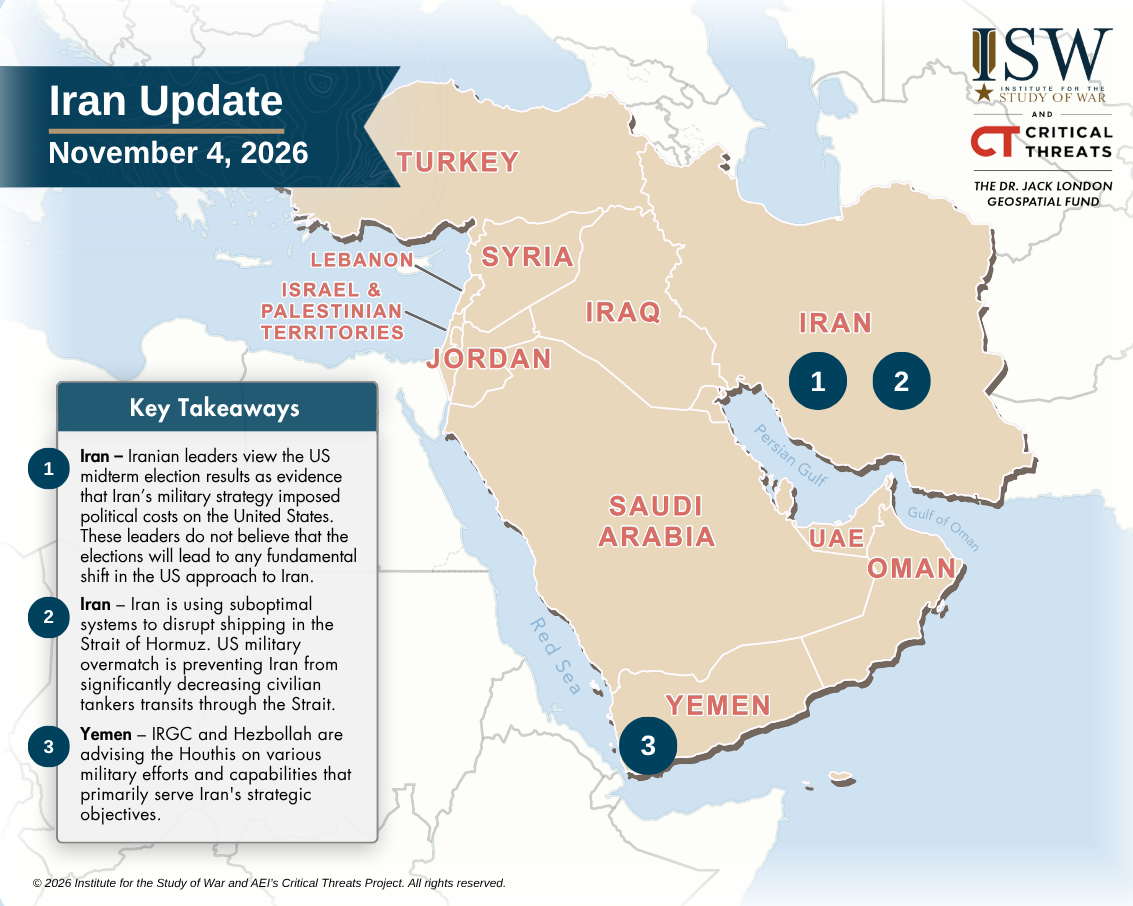
- Iranian leaders view the November 3 midterm election results as evidence that Iran’s military strategy imposed political costs on the sitting US administration. These leaders do not believe that the elections will lead to any fundamental shift in the US approach to Iran.
- Iran is using suboptimal systems to disrupt shipping in the Strait of Hormuz. US military overmatch is currently preventing Iran from significantly decreasing the transit of civilian tankers through the Strait, however.
- Iranian Islamic Revolutionary Guards Corps (IRGC) and Lebanese Hezbollah advisers are reportedly stationed within Yemen to advise the Houthis on various military efforts and capabilities that primarily serve Iran's strategic objectives.
Toplines
Iranian leaders view the November 3 midterm election results as evidence that Iran’s military strategy imposed political costs on the sitting US administration. These leaders do not believe that the elections will lead to any fundamental shift in the US approach to Iran. Iranian Supreme Leader Mojtaba Khamenei said in a November 4 statement that Iran’s actions in the Strait of Hormuz and against US military bases demonstrated US weakness and the success of Iran’s resistance.[i] Mojtaba also warned that changes in US political leadership would not alter Washington’s approach toward Iran and that even a “slight tendency” toward surrender would only encourage further US "audacity.”[ii] Mojtaba’s remarks suggest that Iran will maintain its maximalist demands regardless of the US election results, which senior Iranian officials have portrayed as evidence of the success of Iran’s strategy. Supreme National Security Council Secretary Major General Mohsen Rezaei separately said on November 4 that Iran had inflicted a "political defeat.”[iii] Parliamentary Speaker Mohammad Bagher Ghalibaf also said on November 4 that American voters had rejected the war due to concerns about morality or the cost of living.[iv] The beliefs of these senior leaders suggest that Iran will maintain its maximalist demands because Iranian leaders do not expect changes in US political leadership to alter Washington’s approach toward Iran. Iranian leaders therefore likely believe that Iran must secure its gains regardless of the result of the midterms.
Iran is using suboptimal systems to disrupt shipping in the Strait of Hormuz. US military overmatch is currently preventing Iran from significantly decreasing the transit of civilian tankers through the Strait, however. Iran has begun to use unmanned underwater vehicles (UUV), rocket-propelled grenades (RPGs), and limpet mines to attack ships in recent weeks, according to the Wall Street Journal. All of these systems are suboptimal relative to the comparatively advanced anti-ship ballistic and cruise missiles and drones Iran used earlier in the conflict. Limpet mines must be attached to a ship by a person approaching the vessel, RPGs will do only limited damage to a large vessel’s hull and lack range, and the known Iranian UUV capabilities presently lack the scale and sophistication required to be an optimal way to disrupt shipping. Iran’s ability to sense shipping is also suboptimal compared to coastal radars Iran used at the start of the conflict. Iranian military personnel on small craft are observing and relaying back the position of vessels, which is far less effective than coastal radar or other sensors if the target is moving.[v] Iran’s reliance on these suboptimal systems will only persist as long as the US military is present, however. Iran could acquire new radars, for example, if US aircraft stopped destroying them.
Iran may develop its UUVs into a more effective system if given the time to do so. UUVs are technically complex due to the requirement to control the system underwater at long range.[vi] Iran's current UUV platforms—at least as of 2022—use a combination of rudimentary guidance systems and torpedo designs with slower, longer-range specifications meant primarily for anchored targets.[vii] Iranian naval forces may have since adapted its UUVs to better hit moving targets. Iran presumably would have used UUVs earlier in the conflict if they were an optimal way to disrupt shipping.
CTP-ISW and Western media have observed an uptick in attacks on ships in the strait over the past month, which is consistent with CTP-ISW's assessment that Iran may have partially reconstituted certain capabilities or is experimenting with new methods to retain a credible threat in the strait.[viii] US military efforts have nonetheless been successful in escorting ships carrying oil through the strait. US Central Command Commander Admiral Brad Cooper stated on October 30 that US forces have escorted over 3,000 commercial vessels through the strait and have facilitated the transit of approximately 1.5 billion barrels of oil since this summer, for example.[ix] The Wall Street Journal similarly reported on October 29 that US efforts in recent weeks have enabled oil exports in the Gulf to surpass prewar levels.[x]
It is likely that Iran will invest in its unmanned capabilities in the long term as it seeks to rebuild its naval capabilities to threaten shipping in the strait given the limitations of its conventional naval capabilities against the United States. The combined US-Israeli force repeatedly struck conventional Iranian naval vessels, effectively sinking the entirety of Iran’s surface fleet by March 11.[xi] Persistent US strikes have also largely suppressed missile and drone attacks, as suggested by Iran’s reliance on these suboptimal systems. CTP-ISW assessed in March that all future attempts by the Iranian navy to blockade the Strait of Hormuz will likely employ unconventional forces such as small boats, unmanned surface vessels (USVs), and UUVs.[xii] Iran may also seek to develop, expand, and diversify its use of space, air, surface, and sub-sea sensors to improve its ability to detect and fix vessels. Iran would also likely replace its current sub-optimal manned spotting capabilities with more accurate autonomous sensors where possible in the long term. It could also use human spotters hidden among fishing vessels in the Strait of Hormuz to tip-and-cue more bespoke sensors in the future.
Iranian Islamic Revolutionary Guards Corps (IRGC) and Lebanese Hezbollah advisers are reportedly stationed within Yemen to advise the Houthis on various military efforts and capabilities that primarily serve Iran's strategic objectives.[xiii] The Yemeni Interior Ministry announced on November 3 that 14 IRGC officers and seven Hezbollah officials are currently deployed as advisers across Houthi-controlled territory in Yemen.[xiv] These advisers notably include IRGC Quds Force Brigadier General Abdolreza Shahlai, who is a long-serving emissary to the Houthis and is responsible for the deaths of US servicemembers in Iraq.[xv] Shahlai is one of several senior IRGC and Hezbollah officials who are stationed in Sanaa, the Houthi-controlled Yemeni capital, and responsible for Houthi coordination with Iran and other Axis of Resistance groups.[xvi] Iran is supporting the Houthi campaign in part because Houthi attacks on Saudi Arabia affect the global energy markets and increase the economic and political pressure on the United States to end the war against Iran.[xvii]
Most of the identified IRGC and Hezbollah advisers who are currently stationed in Yemen generally belong to one of three main advisory subject areas that correspond to Iranian objectives.[xviii] Shahlai and a diplomacy-focused adviser, Ali Mohammad Ramazani, likely advise the Houthis on the strategic level and liaise with the IRGC.[xix] A number of other officials are based in Hudaydah and focus on developing Houthi submersible and surface naval drones, maritime surveillance, and other naval capabilities.[xx] These advisers are improving Houthi technical capabilities to attack shipping both now and in the future, and Iran surely hopes that the Houthis will be able to support Iranian efforts to disrupt shipping in the Red Sea in future conflicts. The Iranian regime is currently using unmanned systems like UUVs and USVs to attack commercial vessels in the Strait of Hormuz (see above). Another set of advisers, primarily stationed in Amran and Saada governorates, focus on long-range drones and missiles, which are critical to Houthi strike campaigns against Saudi Arabia.[xxi] Current Houthi attacks on Saudi Arabia likely seek to force Saudi Arabia out of the war in Yemen or to accede to Houthi objectives, but future Iranian campaigns may seek to encourage the Houthis to disrupt the energy markets for other reasons by targeting Saudi Arabia.[xxii]
A final group of advisers supports both Iranian external and Houthi domestic objectives. Hezbollah officials such as Bilal Ahmad Chiblak and Abbas Ali Haidar specialize in military communications encryption, signals intelligence (SIGINT), and electronic warfare, for example.[xxiii] These tools can be useful for targeting shipping, for example, but are also important to Houthi ground campaigns against the Yemeni government. Houthi fighters used electronic warfare, including imitative communications deception designed to saturate Yemeni government communications channels with false orders, during efforts to capture terrain surrounding Taiz City on October 15 and during the Houthi Red Sea coastal offensive in early September.[xxiv] Hezbollah has deployed SIGINT capabilities for decades, including by intercepting Israeli military communications for psychological operations during the 2006 Lebanon War, and is likely assisting the Houthis in developing tactical electronic warfare systems.[xxv]
US and Partner Military Operations
Nothing significant to report.
Iranian Strike Campaign
-
Assessed Iranian War Aims:
- Secure international recognition of Iranian control over the Strait of Hormuz
- Degrade the US ability and willingness to continue the war
- Restore deterrence vis-à -vis the United States and its regional partners
- Divide the United States and Israel from the Arab states
Nothing significant to report.
US-Iran Negotiations
Nothing significant to report.
Iranian Domestic Affairs
The regime is continuing its efforts to expand the forces it can use to suppress domestic unrest, both from potential protests and anti-regime militancy. IRGC Mohammad Rasoul Ollah Unit Commander Brigadier General Hassan Hassanzadeh announced on November 2 that the IRGC has organized, trained, and armed the first Iranian “Janfada” (“Those Who Sacrifice Their Lives”) brigade, which has begun practical weapons training and field exercises.[xxvi] The Janfada campaign is a Basij recruitment and mobilization effort designed to bolster support for the regime during wartime and increase the number of regime’s security forces.[xxvii] Hassanzadeh added that the Basij plans to deploy fighters in this brigade to southern and western Iran, where the regime faces threats to its stability from anti-regime militant groups, from November 19 to November 25.[xxviii] IRGC Basij Organization Training Chief Ali Kowsari separately stated on November 2 that 1,500 Janfada training bases will begin operating in provinces and cities across Iran with the aim of training one million volunteers.[xxix] These latest efforts also reflect the regime’s longstanding concern with the outbreak of protests. Supreme Leader Mojtaba Khamenei appointed Hossein Taeb as Basij commander on August 10 and tasked him with making ”every Iranian a Basiji” to confront domestic security threats including the mobilization of Iranian citizens.[xxx]
Lebanon
Nothing significant to report.
Iraq
Iraqi Prime Minister Ali al Zaydi likely withdrew the draft Popular Mobilization Forces (PMF) law from parliament for further revision after his recent disagreements with multiple Shia Coordination Framework members over some the law's amendments. An informed source told Iraqi media on November 3 that Zaydi withdrew the draft PMF bill from parliament to rewrite "contentious clauses" and reach an unspecified compromise that preserves the "core" of the proposed PMF restructuring.[xxxi] The text of the draft PMF law that Zaydi withdrew is not public, but sources told Qatari-owned regional media on October 7 that the draft PMF law includes amendments that would reduce the PMF’s powers and prevent it from competing with the Iraqi Army.[xxxii] CTP-ISW previously assessed on August 26 that Zaydi is attempting to reform the PMF through an amended draft PMF Law that could fulfill US objectives regarding militia disarmament and simultaneously consolidate his individual power as prime minister.[xxxiii] Zaydi’s withdrawal of the law comes after Iraqi media reported on October 6 that Zaydi and several unidentified Shia Coordination Framework members disagreed on several amendments to the PMF draft law, despite Zaydi's office claiming on September 29 that the Iraqi government sent the bill to parliament.[xxxiv] Zaydi may, therefore, attempt to revise the draft PMF law in a way that resolves his outstanding disagreements with the framework over some of the law's amendments before re-submitting it to parliament. Zaydi may also calculate that these revisions could improve the odds that parliament will approve the draft PMF law, given that framework parties constitute the largest parliamentary bloc.[xxxv]
The Iraqi Federal Integrity Commission (FIC) launched an investigation on November 4 into Iranian-backed Iraqi militia Kataib Hezbollah’s manipulation of government contracts to serve the militia’s financial interests.[xxxvi] Unspecified sources told Saudi media on November 4 that Kataib Hezbollah has used shell companies to secure Iraqi government contracts in the aviation, transportation, and contracting sectors that funnel public funds to militia interests.[xxxvii] Kataib Hezbollah has long siphoned money from Iraqi government contracts that they previously secured using shell companies, according to the US Treasury Department.[xxxviii] The FIC’s investigation comes as Iraqi Prime Minister Zaydi attempts to disrupt Iranian-backed Iraqi militias' financial networks.[xxxix]
Arabian Peninsula
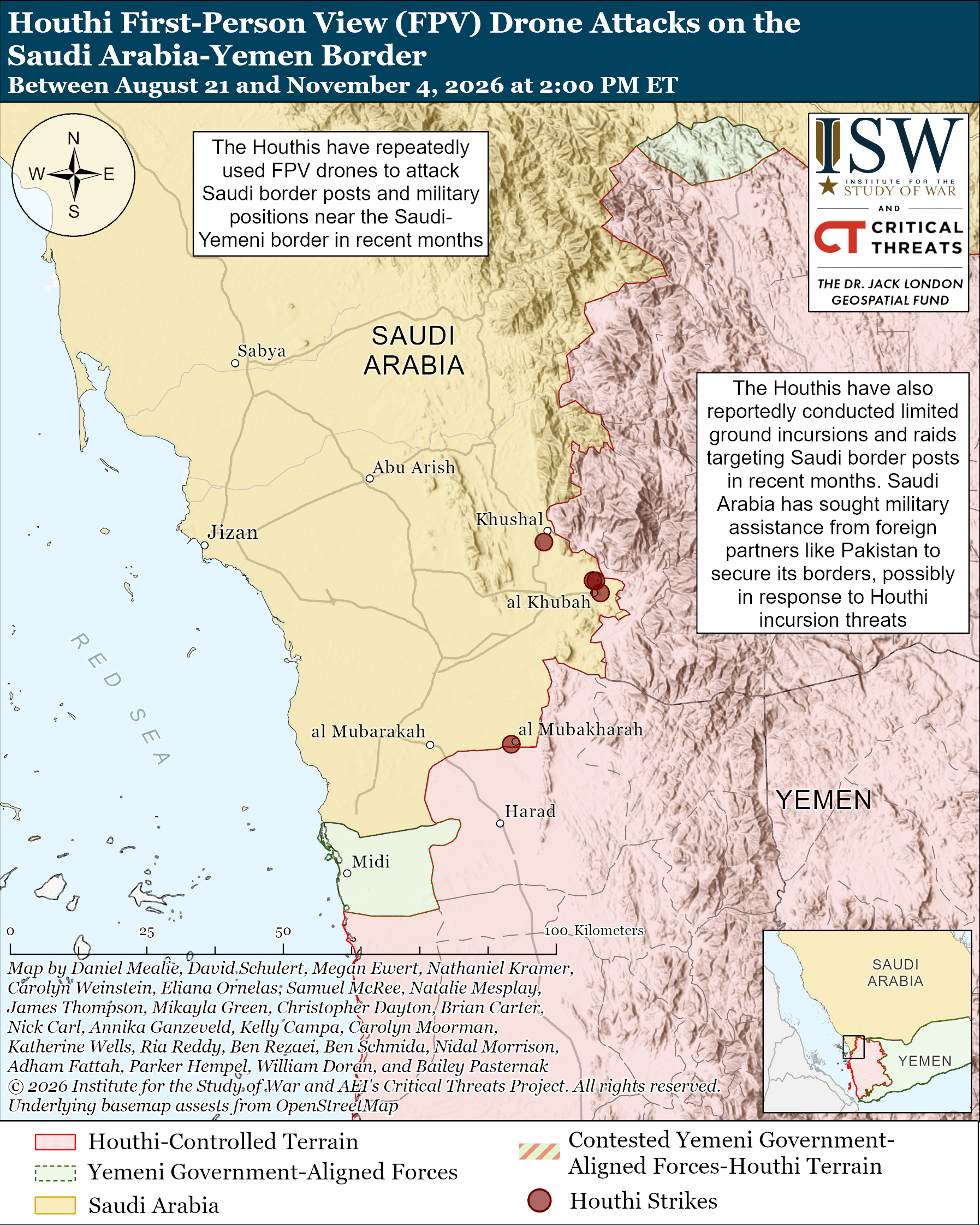
The Houthis have reportedly conducted limited cross-border raids on Saudi border security posts in southwestern Saudi Arabia in recent months. Two Western and regional officials told UK-based media on November 2 that the Houthis have conducted various attacks, including limited ground incursions and raids, targeting Saudi border security posts near the Saudi Arabia-Yemen border, most recently in late October 2026.[xl] Saudi Arabia has sought international military assistance, namely from Pakistan, to defend its borders in recent weeks, likely in response to these purported Houthi cross-border raids.[xli] The Houthis previously conducted ground incursions into Saudi Arabia during the earlier stages of the Yemeni Civil War and previous conflicts with Saudi Arabia as early as 2009.[xlii]
The Houthis are likely relying on first-person view (FPV) drone technology to provide Houthi fighters with reconnaissance and targeting data for the reported cross-border raids into Saudi territory. Houthi FPV drones have repeatedly attacked Saudi positions near the Saudi-Arabia Yemen border since August 2026, typically by dropping mortar shells or other small explosive payloads on military targets.[xliii] FPV drones can serve as both strike platforms and reconnaissance assets to collect precise imagery and video data on potential targets and then strike those targets if needed. Hezbollah has used FPV drones for reconnaissance, strikes, and battle damage assessments on Israeli military assets in southern Lebanon and northern Israel, for example.[xliv] The Houthis are likely to be exploiting FPV drones’ capabilities for similar intelligence and strike purposes along the Saudi Arabia-Yemen border.
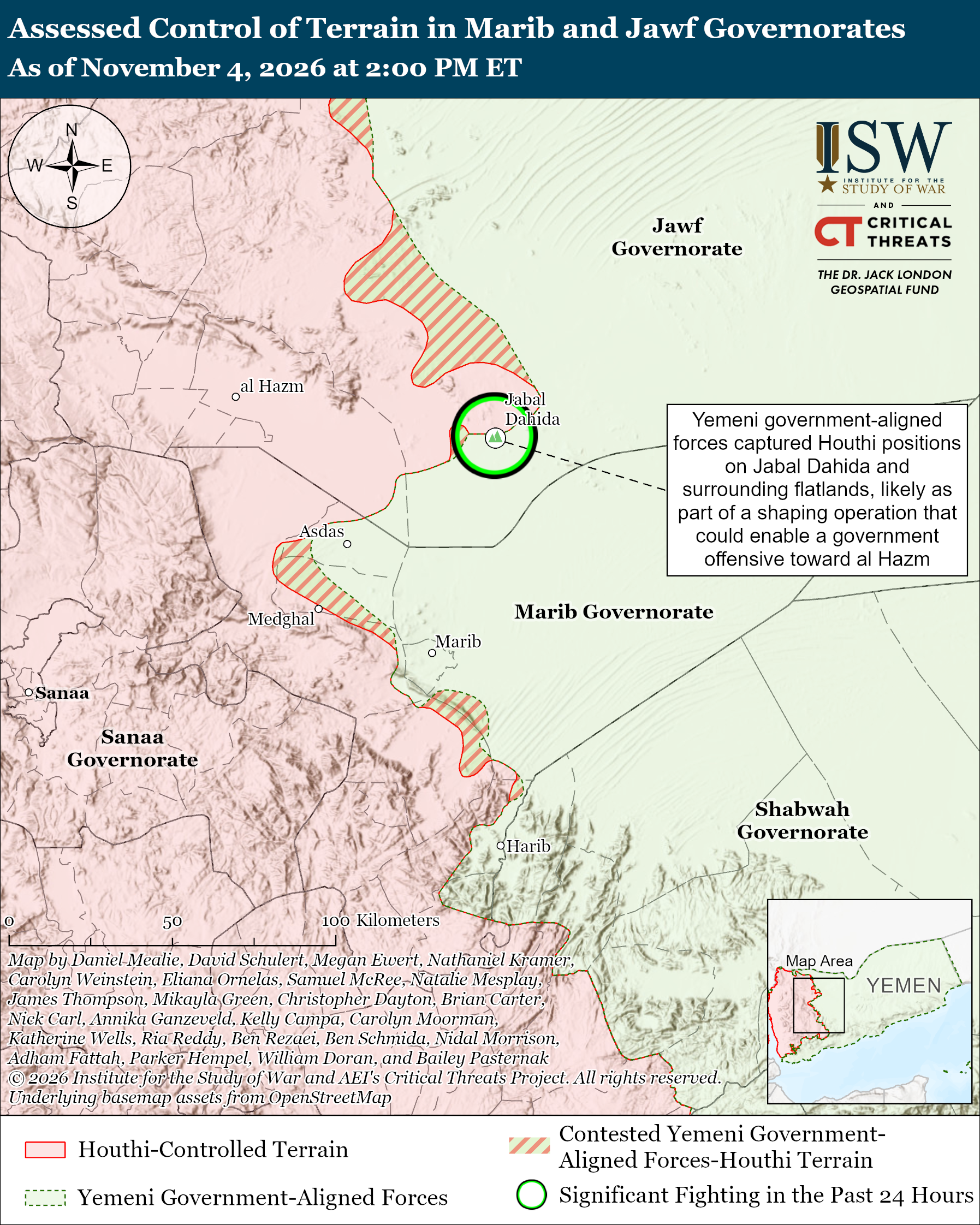
Yemeni government-aligned forces have continued to advance and capture Houthi positions with Saudi close air support (CAS) in Jawf Governorate. Geolocated video footage published on November 4 showed Yemeni government-aligned forces at several positions in the vicinity of Jabal Dahida, which is a small mountain range about 75 miles east of the Jawf Governorate capital at al Hazm.[xlv] Saudi forces also conducted airstrikes on Houthi positions in the vicinity of Jabal Dahida on November 3 and 4, which suggests that Saudi CAS may have assisted Yemeni government-aligned ground forces in capturing terrain.[xlvi] The Yemeni government likely intends to capture Jabal Dahida and other mountainous areas in central Jawf Governorate as part of a shaping operation that, if successful, could facilitate a Yemeni government offensive to recapture al Hazm.[xlvii] The Houthis could otherwise exploit positions in the mountains east of al Hazm to spot and coordinate missile and artillery fire on Yemeni government-aligned forces advancing westward through open desert toward the city.
The Houthis are continuing to conduct ballistic missile strikes on Yemeni government-aligned forces' staging areas and bases in order to disrupt the government's efforts to train forces and reinforce active frontlines. Yemeni media and independent Yemeni journalists reported on November 4 that the Houthis fired a ballistic missile targeting a Yemeni government military camp in Qatabah District, in southern Yemen's Dhalea Governorate.[xlviii] The strike reportedly killed at least 11 Yemeni government-aligned soldiers and wounded at least 60 others.[xlix] The Houthis also claimed that the group fired a ballistic missile targeting Yemeni government-aligned forces at a staging area along the Taiz-Aden ground line of communication (GLOC) in southern Lahij Governorate, about 30 kilometers northwest of Aden.[l] These strikes are consistent with the Houthis' ongoing efforts to disrupt Yemeni government efforts to organize and deploy forces for counteroffensives against the Houthis across Yemen.[li] The strikes also come amid Saudi and Yemeni government air campaign efforts to degrade Houthi front-line forces and weaken the group's ability to maintain the initiative by striking reinforcements and staging areas.[lii]
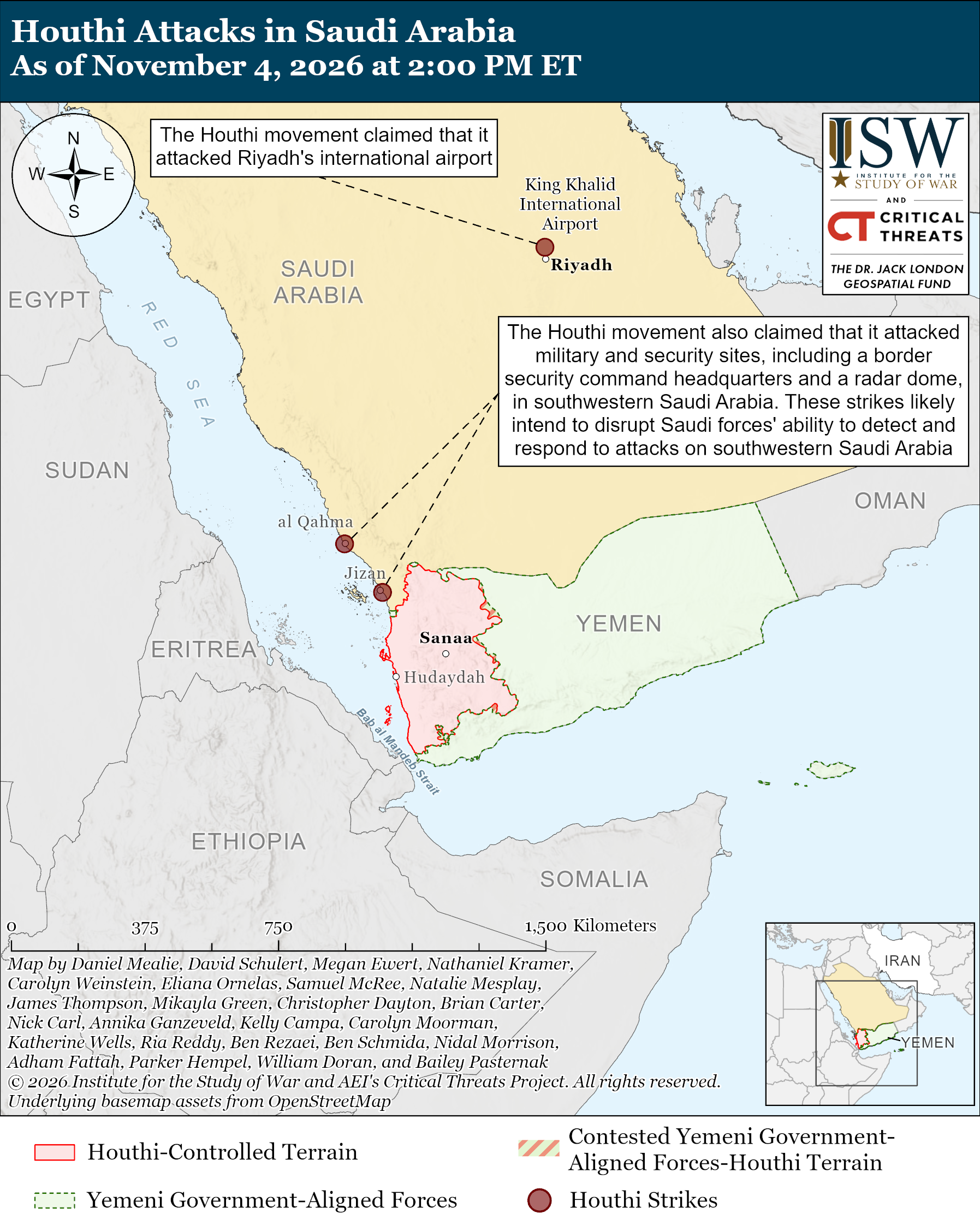
The Houthis claimed they struck King Khalid International Airport and Saudi military installations on November 4.[liii] The Houthis claimed they struck King Khalid International Airport in Riyadh, Akfa military camp in Najran Province, and a Saudi Border Guard headquarters and a radar in Jizan Province with multiple ballistic missiles and one drone.[liv] CTP-ISW cannot verify the Houthis’ claims at the time of this writing. Saudi Joint Forces Command spokesperson Major General Turki al Maliki separately announced that Saudi air defenses intercepted one Houthi drone over southern Saudi Arabia on November 3.[lv] The targets of these attacks, including command centers and radars, suggest that the Houthis may be attempting to disrupt Saudi forces' ability to detect and respond to attacks on southwestern Saudi Arabia. The Houthis have also repeatedly targeted Saudi critical infrastructure, including civilian airports, as part of an ongoing strike campaign to compel Saudi Arabia to end military operations in Yemen and accept Houthi demands.[lvi]

[i] https://rahbar dot ir/speech?cid=2330
[ii] https://rahbar dot ir/speech?cid=2330
[iii] https://x.com/ir_rezaee/status/2118021156846678139
[iv] https://x.com/mb_ghalibaf/status/2117848485580128287
[v] https://www.wsj.com/world/middle-east/iran-turns-to-guerrilla-tactics-in-bid-to-reassert-grip-on-strait-of-hormuz-f10da428?st=GxTbZ5
[vi] https://gdmissionsystems.com/underwater-vehicles
[vii] https://www.hisutton.com/Iran-IRGC-Weaponized-UUV.html
[viii] https://www.reuters.com/world/middle-east/attacks-tankers-hormuz-hit-highest-any-week-since-start-iran-war-sources-say-2026-10-07/; https://www.ukmto.org/recent-incidents ; https://www.criticalthreats.org/analysis/iran-update-october-8-2026
[ix] https://x.com/CENTCOM/status/2116128769190859099
[x] https://www.wsj.com/politics/national-security/inside-the-u-s-militarys-open-ended-mission-to-keep-gulf-oil-flowing-0f4cbbc4
[xi] https://x.com/CENTCOM/status/2031700131687379148?s=20
[xii] https://understandingwar.org/research/middle-east/iran-update-evening-special-report-march-4-2026/
[xiii] https://moi-gov-ye dot org/view/9363 ; https://x.com/AlmasdaronlineE/status/2117669714637828225?a=D1OkduiQnOwNO1CCPYk&s=20
[xiv] https://moi-gov-ye dot org/view/9363 ; https://x.com/AlmasdaronlineE/status/2117669714637828225?a=D1OkduiQnOwNO1CCPYk&s=20 ; https://x.com/alekhbariyatv/status/2117644902959886703
[xv] https://rewardsforjustice.net/rewards/abdul-reza-shahlai/ ; https://www.nytimes.com/2007/07/02/world/africa/02iht-iraq.4.6449863.html ; https://www.stimson.org/2024/houthis-red-sea-shipping-us-uk/ ; https://x.com/AlmasdaronlineE/status/2117669714637828225?a=E5z4O53y9dwwzkM_NBw&s=20
[xvi] https://x.com/AlmasdaronlineE/status/2117669714637828225?a=t7mjEZU9cfmT-yICqyc&s=20
[xvii] https://understandingwar.org/research/middle-east/iran-update-september-17-2026/ ; https://understandingwar.org/research/middle-east/iran-update-september-10-2026/
[xviii] https://moi-gov-ye dot org/view/9363 ; https://x.com/AlmasdaronlineE/status/2117669714637828225?a=D1OkduiQnOwNO1CCPYk&s=20 ; https://x.com/alekhbariyatv/status/2117644902959886703
[xix] https://x.com/AlmasdaronlineE/status/2117669714637828225?a=kY7j1frOEEk5trD1Uic&s=20
[xx] https://x.com/AlmasdaronlineE/status/2117669714637828225?a=kY7j1frOEEk5trD1Uic&s=20
[xxi] https://x.com/AlmasdaronlineE/status/2117669714637828225?a=6QJMCt4bs27tquVGJ0U&s=20 ; https://understandingwar.org/research/middle-east/iran-update-october-13-2026/ ; https://www.reuters.com/world/middle-east/loud-booms-heard-near-saudi-aramco-headquarters-dhahran-sources-say-2026-10-13/ ; https://understandingwar.org/research/middle-east/iran-update-october-15-2026/
[xxii] https://understandingwar.org/research/middle-east/iran-update-november-3-2026/ ; https://understandingwar.org/research/middle-east/iran-update-september-17-2026/
[xxiii] https://x.com/AlmasdaronlineE/status/2117669714637828225?a=U28r9z_Jmn7vi_c8_pg&s=20
[xxiv] https://understandingwar.org/research/middle-east/iran-update-october-16-2026/ ; https://x.com/Alsakaniali/status/2110889541363998883?s=20 ; https://x.com/BashaReport/status/2097862335494795579
[xxv] https://calhoun.nps.edu/server/api/core/bitstreams/853a7fcc-1d1a-443c-b038-029ad66bc3f4/content , p. 49 ; Nicholas Blanford, Warriors of God: Inside Hezbollah’s Thirty-Year Struggle Against Israel, pp. 342-44
[xxvi] https://defapress dot ir/fa/news/874363/
[xxvii] https://iranwire.com/en/news/158047-exclusive-many-military-and-government-officials-oppose-expansion-of-jan-fada-campaign/
[xxviii] https://iranwire.com/en/politics/136473-khameneis-basij-pipe-dreams-killing-netanyahu-enforcing-hijab-fighting-abortion-etc-etc/ ; https://defapress dot ir/fa/news/874363/ ; https://www.criticalthreats.org/analysis/iran-update-november-2-2026
[xxix] https://www.isna dot ir/news/1405081107328/
[xxx] https://www.criticalthreats.org/analysis/iran-update-evening-special-report-august-13-2026
[xxxi] https://964media dot com/732723
[xxxii] https://understandingwar.org/research/middle-east/iran-update-october-7-2026/ ; https://www.newarab dot com/news/exclusive-iraq-revises-pmf-law-curb-powers-after-us-pressure
[xxxiii] https://understandingwar.org/research/middle-east/iran-update-august-26-2026/
[xxxiv] https://www.kurdistan24 dot net/ar/story/944365/خلافات-حادة-حول-قانون-الحشد-الشعبي-واستحداث-قسم-للطائرات-المسيرة ; https://rudaw dot net/english/categories/iraq/1079513
[xxxv] https://understandingwar.org/research/middle-east/iran-update-november-18-2025/ ; https://experience.arcgis.com/experience/e33475ade87c41a58795bd544c7c1179
[xxxvi] https://ina dot iq/ar/local/278295-.html ; https://www.alarabiya dot net/aswaq/iraq-economy/2026/11/04/العراق-رصد-تلاعب-بعقود-وزارة-النقل-والمطارات-لصالح-جهات-مسلحة-خارجة-عن-القانون
[xxxvii] https://www.alarabiya dot net/aswaq/iraq-economy/2026/11/04/العراق-رصد-تلاعب-بعقود-وزارة-النقل-والمطارات-لصالح-جهات-مسلحة-خارجة-عن-القانون
[xxxviii] https://home.treasury.gov/news/press-releases/sb0277
[xxxix] https://understandingwar.org/research/middle-east/iran-update-special-report-june-16-2026-2/ ; https://shafaq dot com/en/Iraq/Iraqi-PM-appoints-new-central-bank-governor-investment-chief
[xl] https://www.middleeasteye.net/news/houthis-launched-cross-border-raids-saudi-arabian-military-posts-sources-say
[xli] https://www.reuters.com/world/asia-pacific/saudis-plan-assault-houthis-break-red-sea-chokehold-2026-10-02/
[xlii] https://www.newarab.com/analysis/yemen-focus-houthis-escalate-attacks-infiltrate-saudi-kingdom ; https://www.criticalthreats.org/briefs/saudi-arabia/tracker-saudi-arabias-military-operations-along-yemeni-border
[xliii] https://x.com/OSINTWarfare/status/2090790825730990287?s=20 ; https://x.com/BobMilOSINT/status/2112690188400943555?s=20 ; https://x.com/MMY1444/status/2112582381102408124?a=sgCtMS6mK9Zcq3JAg7E&s=20 ; https://x.com/BobMilOSINT/status/2117986473777475860?a=VIS0Iw90HtX7qGyzhtU&s=20
[xliv] https://understandingwar.org/research/middle-east/iran-update-special-report-may-25-2026/
[xlv] https://x.com/alkumaim_m/status/2117959938060189783 ; https://x.com/20Yusef20/status/2117903436704284915?a=lKI9AcL-mZxNR3kInlY&s=20 ; https://x.com/Me1Ray/status/2117918150675345545?a=-GdTtBL2QowGzsvzvRQ&s=20 ; https://x.com/Of3uu/status/2117959294943367642?a=lBep52ZGZO67oNIaKYE&s=20
[xlvi] https://x.com/Yem_army_media/status/2117965717517574187 ; https://x.com/tom_bike/status/2117974695655907783?a=nQb02kdJTMsgeCLp8qE&s=20
[xlvii] https://understandingwar.org/research/middle-east/iran-update-november-2-2026/
[xlviii] https://x.com/FaresALhemyari/status/2117964836508463329?s=20 ; https://almasdaronline dot com/articles/353280 ; https://x.com/almasaobl/status/2117906756177441190
[xlix] https://x.com/FaresALhemyari/status/2117964836508463329?s=20
[l] https://x.com/MMY1444/status/2117999569653076102?a=4yNHojvlUMG36_ybzwU&s=20
[li] https://understandingwar.org/research/middle-east/iran-update-october-20-2026/
[lii] https://understandingwar.org/research/middle-east/iran-update-september-30-2026/ ; https://x.com/ALyemennow/status/2117825013067772032 ; https://x.com/almasaobl/status/2117870676753420294
[liii] https://t.me/army21ye/4012 , https://t.me/army21ye/4013
[liv] https://t.me/army21ye/4012 , https://t.me/army21ye/4013
[lv] https://x.com/CJFCSpox/status/2117702041615188004
[lvi] https://understandingwar.org/research/middle-east/iran-update-november-1-2026/ ; https://understandingwar.org/research/middle-east/iran-update-october-30-2026/ ; https://www.aa dot com.tr/en/middle-east/yemens-houthis-say-they-targeted-riyadh-airport-and-saudi-oil-pipeline/4100562 ; https://t.me/army21ye/3948 ; https://t.me/army21ye/3934 ; https://www.reuters.com/world/middle-east/loud-booms-heard-near-saudi-aramco-headquarters-dhahran-sources-say-2026-10-13/ ; https://understandingwar.org/research/middle-east/iran-update-october-25-2026/ ; https://understandingwar.org/research/middle-east/iran-update-october-24-2026/
[PH1]Vertical social media: https://criticalthreats.imeetcentral.com/p/aQAAAAAFN0Rx
[PH2]https://criticalthreats.imeetcentral.com/p/aQAAAAAFN0Ry
[PH3]https://criticalthreats.imeetcentral.com/p/aQAAAAAFN0Kk
[PH4]https://criticalthreats.imeetcentral.com/p/aQAAAAAFN0KL
[PH5]https://criticalthreats.imeetcentral.com/p/aQAAAAAFN0KN