{{currentView.title}}
April 12, 2026
Iran Update Evening Special Report, April 12, 2026
Originally published in
Ben Schmida, Adham Fattah, Nidal Morrison, Will Doran, Kelly Campa, and Brian Carter
The Institute for the Study of War (ISW) and The Critical Threats Project (CTP) at the American Enterprise Institute are publishing daily updates to provide analysis on the war with Iran. The updates focus on US and Israeli strikes on Iran and Iran and the Axis of Resistance’s response to the strikes. The updates cover events from the past 24-hour period.
Key Takeaways:
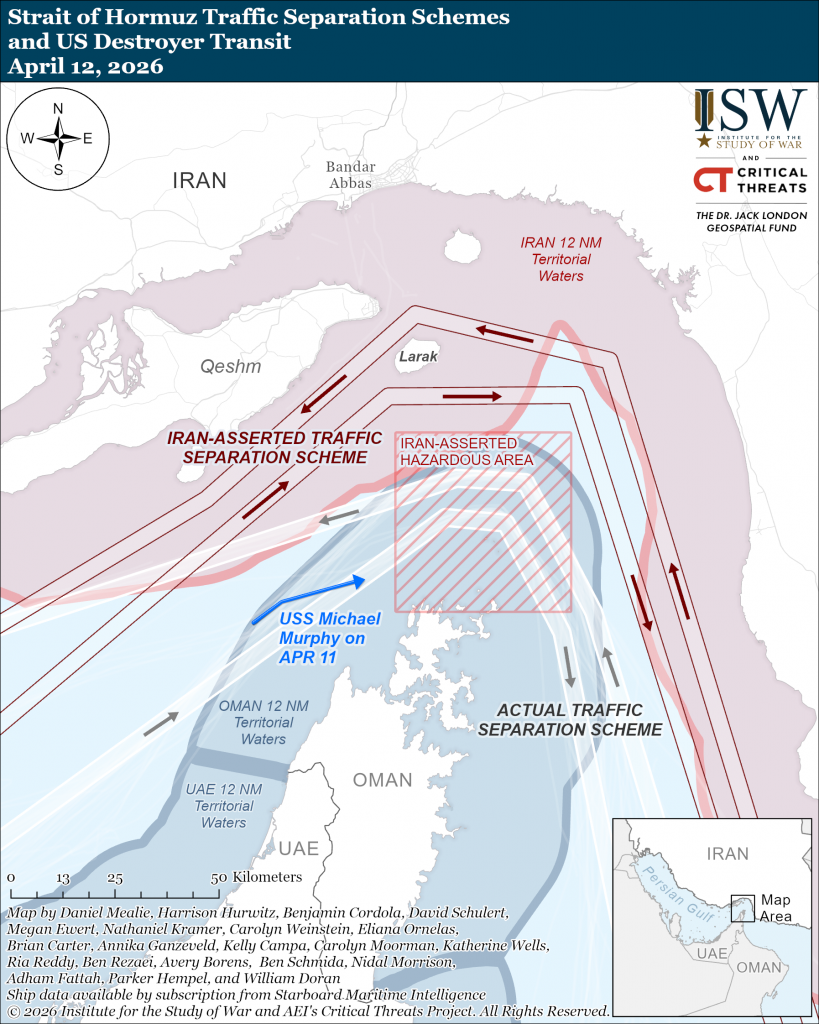
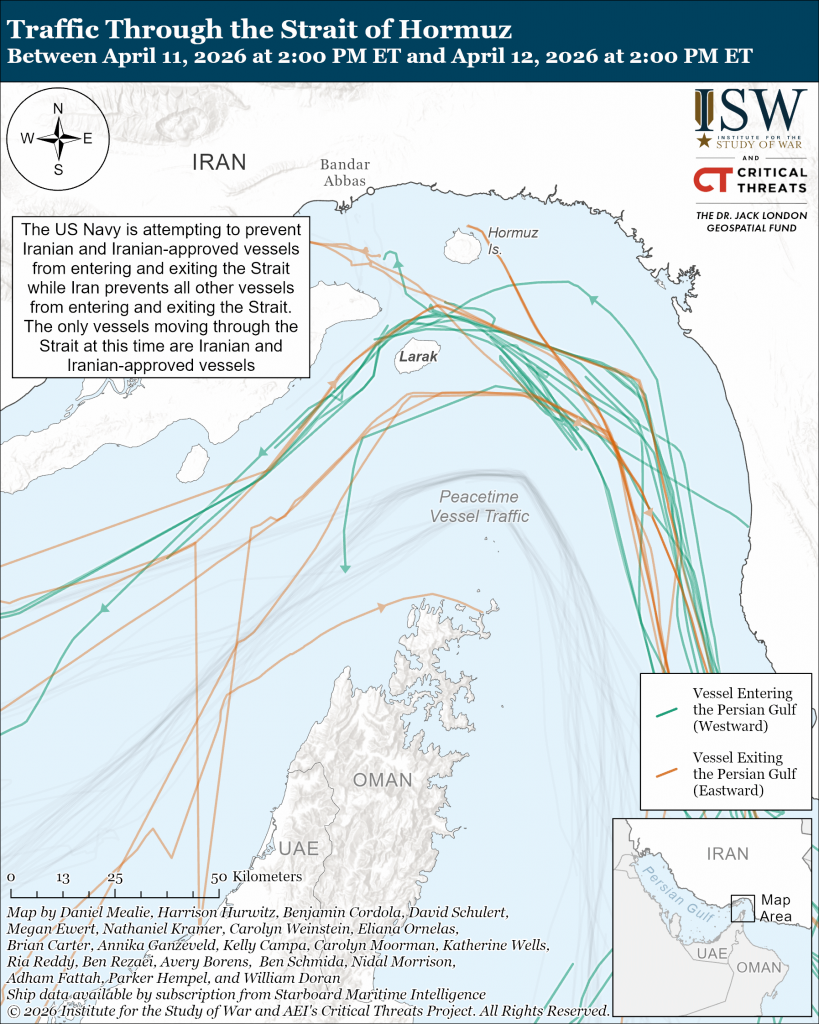
- The US Navy is attempting to prevent Iranian and Iranian-approved vessels from entering and exiting the Strait, while Iran prevents all other vessels from entering and exiting the Strait. The only vessels moving through the Strait at this time are Iranian and Iranian-approved vessels. Very few ships are transiting the Strait other than the ships moving through Iran’s territorial waters.
- The United States and Iran did not reach an agreement during talks in Islamabad, Pakistan, on April 11 and 12. US President Donald Trump emphasized on April 12 that Iran’s delegation did not make compromises on its nuclear program, but that he believed Iran would return to negotiations.
- Iran sought an all-encompassing agreement that would have transformed US-Iran relations in fundamental ways, while the United States appeared focused on specific issues related to freedom of navigation in the Strait of Hormuz and Iran’s nuclear program. The multiple competing Iranian factions with divergent priorities and objectives in negotiations that were part of the Iranian delegation also likely made reaching an agreement exceptionally difficult.
- Iran has not fired any munitions targeting the Gulf states since CTP-ISW's last data cut off on April 11. Iranian fired a declining rate of missiles and drones targeting Gulf states since the ceasefire went into effect on April 8.
Toplines
The US Navy is attempting to prevent Iranian and Iranian-approved vessels from entering and exiting the Strait, while Iran prevents all other vessels from entering and exiting the Strait.[i] The only vessels moving through the Strait at this time are Iranian and Iranian-approved vessels. These Iranian-approved vessels are acceding to Iran’s protection racket and using Iran’s unilaterally imposed traffic separation scheme that forces vessels into Iranian territorial waters. Very few ships are transiting the Strait other than the ships moving through Iran’s territorial waters. Only one ship transited the Strait on April 12 and did not use the Iranian-approved shipping lanes by skirting the southern edge of the Iran-declared hazardous area. US President Donald Trump said on April 12 that the US Navy will “interdict every vessel” that has paid Iran for passage and indicated that enforcement of the blockade will begin soon.[ii] Iran has used threats of attacks and a limited number of mines to declare a ”hazardous area” across the entire Strait of Hormuz except for Iranian territorial waters, where Iran then imposes fees.[iii] The US Navy has deployed ships to clear the remaining naval mines and restore freedom of navigation.[iv] Some Gulf countries are also supporting mine-clearing efforts, according to Trump.[v] Two US Navy destroyers transited the Strait on April 11 to set conditions for clearing mines in the Strait of Hormuz. The Islamic Revolutionary Guard Corps (IRGC) Navy threatened the destroyers but did not attack them.[vi] The IRGC Navy has threatened that any military vessels in the Strait will be subject to a ”decisive response.”[vii]
The United States and Iran did not reach an agreement during talks in Islamabad, Pakistan, on April 11 and 12.[viii] Two Iranian officials speaking to the New York Times on April 12 stated that US-Iran talks failed to reach an agreement over Iran’s stockpile of highly enriched uranium (HEU), Iran’s “control” over the Strait of Hormuz, and Iran’s demand that $27 billion in frozen revenues held abroad be released.[ix] The two officials stated that the United States demanded that Iran immediately open the Strait of Hormuz to maritime traffic, but Iran countered that it would only allow unfettered traffic in the Strait after a final peace deal.[x] The lack of a public, mutually agreed-upon document establishing the ceasefire requirements makes adherence to the ceasefire difficult to establish, but US officials said after the two-week ceasefire agreement that the ceasefire required Iran to reopen the Strait. The officials added that the US delegation demanded that Iran “hand over or sell” its entire HEU stockpile, to which Iran made an unspecified counterproposal that the United States did not accept.[xi] The officials stated that the US side refused Iran’s requests for war reparations from frozen oil revenue in various countries.[xii] US President Donald Trump emphasized on April 12 that Iran’s delegation did not make compromises on its nuclear program, but that he believed Iran would return to negotiations.[xiii] Iranian Parliament Speaker Mohammad Bagher Ghalibaf, who was the head of the Iranian delegation and has accumulated substantial power within the Iranian system in the last year, blamed the US side for the failure of the negotiations and stated that the United States must “earn” Iran’s trust, however.[xiv]
There were two principal issues that made reaching an agreement exceptionally difficult. First, as CTP-ISW noted on April 11, Iran sought an all-encompassing agreement that would have transformed US-Iran relations in fundamental ways, while the United States appeared focused on specific issues related to freedom of navigation in the Strait of Hormuz and Iran’s nuclear program.[xv] This is best reflected by Iran’s focus on the release of sanctioned funds, its hope that the United States would recognize Iran’s “sovereignty” over the Strait of Hormuz, and a region-wide ceasefire.[xvi] Iran also remains unwilling to entertain limitations to its enrichment of nuclear material, which would presumably be needed to release sanctioned funds.[xvii] Any release of sanctioned funds without serious limitations to Iranian enrichment capabilities would be a massive change in stated Trump Administration policy.
Second, the multiple competing Iranian factions with divergent priorities and objectives in negotiations were part of the Iranian delegation, as CTP-ISW also noted on April 10 and April 11.[xviii] One faction, consisting of top IRGC officials and led by IRGC Commander Major General Ahmad Vahidi, was reportedly fighting with a second faction led by Ghalibaf and Foreign Minister Abbas Araghchi—both far more pragmatic than their IRGC counterparts—about the aims of negotiations before the trip to Islamabad.[xix]
Iran has not fired any munitions targeting the Gulf states since CTP-ISW's last data cut off on April 11. Iran has fired a decreasing number of missiles and drones targeting Gulf states since the ceasefire went into effect on April 8.[xx] Iran fired a single drone targeting Bahrain on April 11.[xxi] The Gulf states did not detect or intercept any Iranian missiles or drones on April 12.
US-Israeli Air Campaign
New satellite imagery shows damage to several Iranian internal security sites in Kurdistan Province and one IRGC Ground Forces base in Alborz Province. These strikes occurred prior to the ceasefire.
- Satellite imagery from April 11 confirms that the combined force struck a Basij base in Qorveh, Kurdistan Province, between March 7 and April 9.[xxii]
- An OSINT account posted satellite imagery on April 11 that indicates the combined force struck a “police outpost” in Adinan, Kurdistan Province, between March 6 and 18.[xxiii]
- Satellite imagery posted on April 11 confirms that the combined force struck a police station in Sonateh, Kurdistan Province, between March 6 and April 12.[xxiv]
- An OSINT account posted satellite imagery on April 12 that shows that combined force strikes destroyed several buildings at the IRGC Ground Forces 10th Sayyed al Shuhada Division training base in Karaj, Alborz Province, between March 7 and 17.[xxv]
Iranian Response
See the topline section.
Israeli Campaign Against Hezbollah and Hezbollah Response
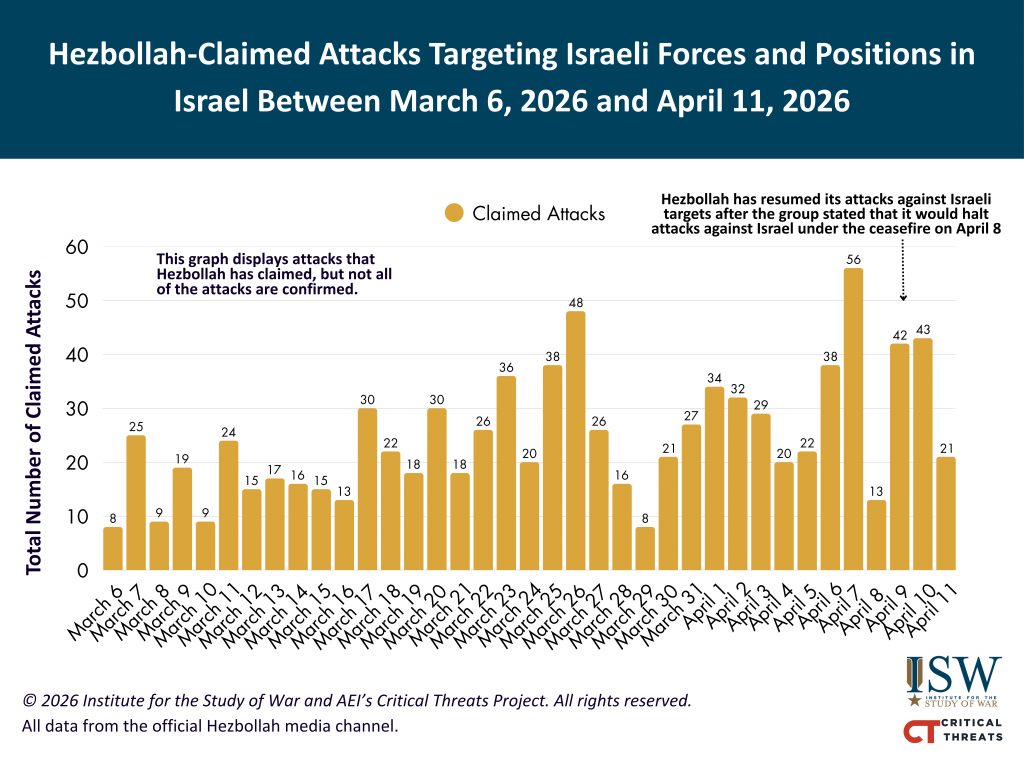
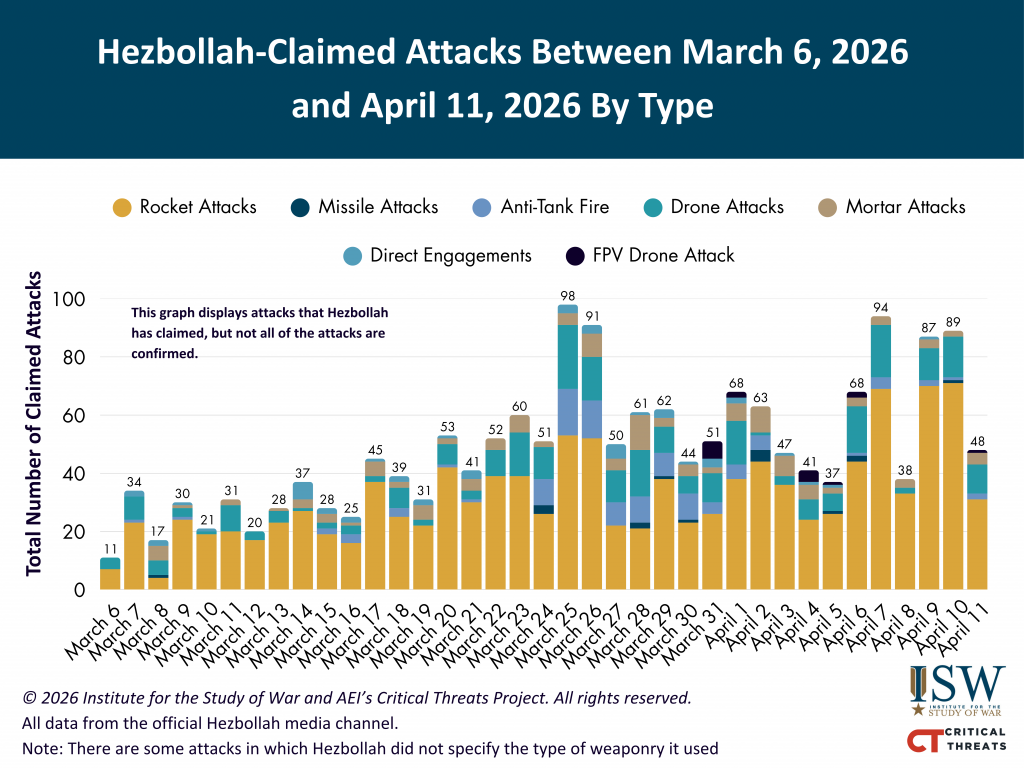
Hezbollah claimed that it conducted 17 rocket and drone attacks targeting IDF infrastructure and civilian communities in northern Israel between 2:00 PM on April 11 and 2:00 PM on April 12.[xxvi] Hezbollah’s volume of attacks on northern Israel on April 11 decreased significantly compared to its rate of fire over the past two days (see graphic below). An Israeli military correspondent reported that Hezbollah launched about 20 total rockets targeting northern Israel on April 12.[xxvii] The correspondent reported that there were no casualties from Hezbollah’s attacks and that no rockets struck any civilian or military targets.[xxviii] Hezbollah claimed that it conducted two rocket attacks and two drone attacks targeting Kiryat Shmona, which has been one of Hezbollah’s most frequent targets during the war due to its position on the Israel-Lebanon border.[xxix]
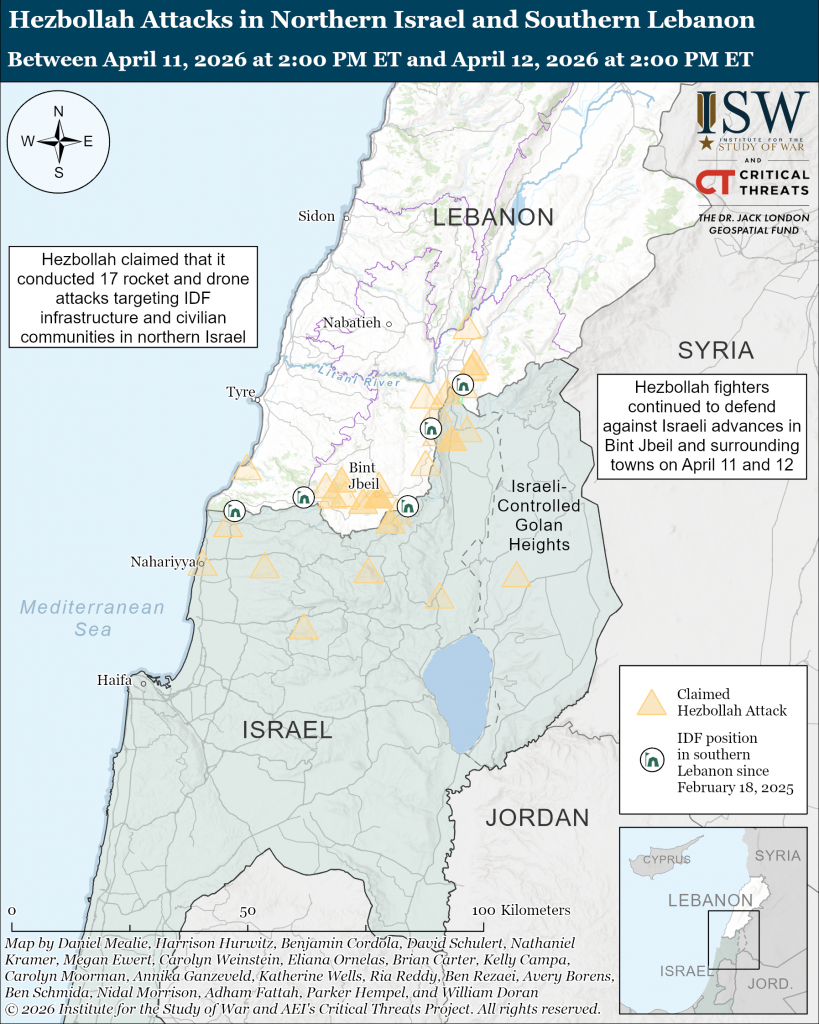
Hezbollah fighters continued to defend against Israeli advances in Bint Jbeil and surrounding towns on April 11 and 12. Hezbollah claimed to conduct several rocket attacks targeting Israeli forces and vehicles in Bint Jbeil and surrounding villages, including Ainata and Ain Ebel, on April 11 and 12.[xxx] The IDF had isolated Bint Jbeil as of April 9 and appears to be attempting to secure the town’s neighborhoods.[xxxi] The 84th (Givati) Infantry Brigade (91st Territorial Division) raided a hospital in Ainata, seized a weapons depot stored there, and killed about 20 fighters operating in the area.[xxxii]
Securing Bint Jbeil is operationally significant for the IDF because it is located at the nexus of multiple main roads in southeastern Lebanon, including the Tebnine-Bint Jbeil Road, that the IDF could use to advance north and link with Israeli forces advancing from other axes. Israeli political officials have expressed Israel's intent to create a "security zone” that extends between eight and ten kilometers north of the Israeli border.[xxxiii] A security zone of this size would encompass second- and third-line villages near the Lebanon-Israel border, including Bint Jbeil. The IDF aims to push Hezbollah forces back to limit their ability to fire anti-tank fire targeting northern Israeli towns and remove the threat of a coordinated Hezbollah cross-border infiltration into northern Israel.[xxxiv]
Bint Jbeil is also symbolically significant to Hezbollah. Former Hezbollah Secretary General Hassan Nasrallah proclaimed victory in Bint Jbeil after the Israeli withdrawal from Lebanon in 2000.[xxxv] Hezbollah has also previously fought the IDF at Bint Jbeil in previous conflicts, including in 2006 and in the October 7 War.[xxxvi]
The IDF continued to operate in southwestern Lebanon on April 12. Hezbollah claimed to target Israeli forces with rockets in al Bayyada, southwestern Lebanon.[xxxvii] Lebanese media also reported IDF artillery fire in the vicinity of Mansouri on April 12.[xxxviii] The IDF advanced into Mansouri, which is north of al Bayyada and located about 11 kilometers north of the Israel-Lebanon border, on or before April 7.[xxxix]
The IDF continued to operate near Khiam and Taybeh, southeastern Lebanon, on April 12.[xl] Hezbollah claimed to launch a first-person view (FPV) drone targeting an IDF tank in Odaisseh.[xli] The IDF 1st (Golani) Infantry Brigade (36th Armored Division) killed a Hezbollah fighter in an engagement on April 13.[xlii] The Golani Brigade has been operating in Taybeh, southeastern Lebanon, since March 24.[xliii]
The IDF has continued to conduct air operations targeting Hezbollah infrastructure and fighters across southern Lebanon. Independent Lebanese media reported that the IDF conducted at least 35 airstrikes in southern Lebanon since CTP-ISW's last data cutoff on April 11.[xliv] The IDF announced that it destroyed a Hezbollah rocket launcher preparing to fire on northern Israel in Jouaiyya, Tyre District, on April 11.[xlv]
Other Axis of Resistance Response
The Saudi Foreign Ministry summoned the Iraqi ambassador to Saudi Arabia on April 12 in response to Iranian-backed Iraqi militia drone attacks targeting Saudi Arabia and other Gulf states.[xlvi] Iranian-backed Iraqi militia front groups have claimed multiple drone attacks targeting US bases in Saudi Arabia, Bahrain, and Kuwait since the start of the war.[xlvii]

[i] https://truthsocial.com/@realDonaldTrump/posts/116392448970133700
[ii] https://truthsocial.com/@realDonaldTrump/posts/116392448970133700
[iii] https://understandingwar.org/research/middle-east/iran-update-special-report-april-11-2026/ ; https://www.lloydslist.com/LL1156694/Zombie-tankers-take-Tehran-Toll-Booth-route-as-more-vessels-make-detour ; https://youtu.be/wmwVQMWTqD0?t=360
[iv] https://youtu.be/wmwVQMWTqD0?t=360
[v] ; https://www.centcom.mil/MEDIA/PRESS-RELEASES/Press-Release-View/Article/4457220/us-forces-start-mine-clearance-mission-in-strait-of-hormuz/ https://youtu.be/wmwVQMWTqD0?t=360
[vi] https://x.com/FaytuksNetwork/status/2043072329933099023
[vii] https://x.com/FaytuksNetwork/status/2043072329933099023
[viii] https://www.nytimes.com/2026/04/11/world/middleeast/iran-strait-of-hormuz-uranium-stockpile-sticking-points.html?smid=url-share
[ix] https://www.nytimes.com/2026/04/11/world/middleeast/iran-strait-of-hormuz-uranium-stockpile-sticking-points.html?smid=url-share
[x] https://www.nytimes.com/2026/04/11/world/middleeast/iran-strait-of-hormuz-uranium-stockpile-sticking-points.html?smid=url-share
[xi] https://www.nytimes.com/2026/04/11/world/middleeast/iran-strait-of-hormuz-uranium-stockpile-sticking-points.html?smid=url-share
[xii] https://www.nytimes.com/2026/04/11/world/middleeast/iran-strait-of-hormuz-uranium-stockpile-sticking-points.html?smid=url-share
[xiii] https://www.reuters.com/world/asia-pacific/us-iran-talks-pause-now-disagreements-remain-2026-04-11/
[xiv] https://x.com/mb_ghalibaf/status/2043251936518901869
[xv] https://www.criticalthreats.org/analysis/iran-update-evening-special-report-april-11-2026
[xvi] https://www.criticalthreats.org/analysis/iran-update-evening-special-report-april-11-2026
[xvii] https://www.nytimes.com/2026/04/11/world/middleeast/iran-strait-of-hormuz-uranium-stockpile-sticking-points.html?smid=url-share
[xviii] https://www.criticalthreats.org/analysis/iran-update-evening-special-report-april-11-2026
[xix] https://understandingwar.org/research/middle-east/iran-update-special-report-april-10-2026; https://www.iranintl.com/202604104967?source=share-link
[xx] https://understandingwar.org/research/middle-east/iran-update-special-report-april-11-2026; https://understandingwar.org/research/middle-east/iran-update-special-report-april-10-2026; https://understandingwar.org/research/middle-east/iran-update-special-report-april-9-2026
[xxi] https://x.com/BDF_Bahrain/status/2042887964699607226 ; https://x.com/BDF_Bahrain/status/2042166518176211145
[xxii] https://x.com/zarGEOINT/status/2042939767977836681 ; https://wikimapia.org/#lang=en&lat=35.164687&lon=47.807908&z=15&m=w&show=/8479071/fa/%D9%86%D8%A7%D8%AD%DB%8C%D9%87-%D9%85%D9%82%D8%A7%D9%88%D9%85%D8%AA-%D8%A8%D8%B3%DB%8C%D8%AC-%D8%B3%D9%BE%D8%A7%D9%87-%D9%82%D8%B1%D9%88%D9%87&search=35.16497%2C%2047.80802
[xxiii] https://x.com/zarGEOINT/status/2042939775749935358 ; https://www.openstreetmap.org/search?lat=36.202192&lon=46.422375&zoom=17#map=19/36.202139/46.421807
[xxiv] https://x.com/zarGEOINT/status/2042939775749935358 ; https://www.openstreetmap.org/search?query=36.166650%2C+46.559910&zoom=16&minlon=50.90358495712281&minlat=35.869160272161665&maxlon=50.93710184097291&maxlat=35.88409548088375#map=18/36.166586/46.562145
[xxv] https://x.com/EpicFuryMap/status/2043336019173347736 ; https://wikimapia.org/#lang=en&lat=35.875733&lon=50.920386&z=15&m=w&show=/18783057/%D8%A7%D8%B1%D8%A7%D8%B6%DB%8C-%D8%AD%D9%81%D8%A7%D8%B8%D8%AA-%D8%A7%D8%B7%D9%84%D8%A7%D8%B9%D8%A7%D8%AA-&search=35.87662%2C%2050.92034 ; https://fa.wikipedia.org/wiki/%D9%84%D8%B4%DA%A9%D8%B1_%DB%B1%DB%B0_%D8%B3%DB%8C%D8%AF%D8%A7%D9%84%D8%B4%D9%87%D8%AF%D8%A7
[xxvi] https://t.me/mmirleb/14944 ; https://t.me/mmirleb/14960 ; https://t.me/mmirleb/14967; https://t.me/mmirleb/14974 ; https://t.me/mmirleb/14978 ; https://t.me/mmirleb/14989 ; https://t.me/mmirleb/14991 ; https://t.me/mmirleb/14993 ; https://t.me/mmirleb/14997 ; https://t.me/mmirleb/15003 ; https://t.me/mmirleb/15005; https://t.me/mmirleb/15017 ; https://t.me/mmirleb/15019 ; https://t.me/mmirleb/15021
[xxvii] https://x.com/manniefabian/status/2043350590885966096
[xxviii] https://x.com/manniefabian/status/2043350590885966096
[xxix] https://t.me/mmirleb/14944 ; https://t.me/mmirleb/14967 ; https://t.me/mmirleb/14993 ; https://t.me/mmirleb/15017
[xxx] https://t.me/mmirleb/14999; https://t.me/mmirleb/14950
[xxxi] https://x.com/manniefabian/status/2042231597781418119?s=20; https://t.me/manniefabian/57723
[xxxii] https://x.com/idfonline/status/2043313324981432475?s=20 ; https://t.me/moriahdoron/29841; https://x.com/Stinky915846091/status/2043338445372662006?s=20; https://x.com/manniefabian/status/2043313039470903593?s=20
[xxxiii] https://t.me/moriahdoron/29818 ; https://x.com/IsraeliPM_heb/status/2043026326014083410
[xxxiv] https://www.ynetnews dot com/article/skg69opcwx
[xxxv] https://time.com/archive/6939518/surveying-the-damage-in-bint-jbeil/
[xxxvi] https://time.com/archive/6939518/surveying-the-damage-in-bint-jbeil/ ; https://understandingwar.org/research/middle-east/iran-update-december-3-2024/
[xxxvii] https://t.me/mmirleb/14995
[xxxviii] https://t.me/MTVLebanoNews/63879
[xxxix] https://x.com/MarioLeb79/status/2041547257313419305
[xl] https://t.me/mmirleb/14965; https://t.me/mmirleb/14950
[xli] https://t.me/mmirleb/14946
[xlii] https://t.me/manniefabian/57725
[xliii] https://x.com/ThetiMapping/status/2036505794368143655?s=20 ; https://x.com/Me1Ray/status/2041138611878572344?s=20
[xliv] https://t.me/MTVLebanoNews/63854 ; https://t.me/MTVLebanoNews/63855 ; https://t.me/MTVLebanoNews/63857 ; https://t.me/MTVLebanoNews/63864 ; https://t.me/MTVLebanoNews/63879 ; https://t.me/MTVLebanoNews/63895 ; https://t.me/MTVLebanoNews/63917 ; https://t.me/MTVLebanoNews/63918 ; https://t.me/MTVLebanoNews/63920 ; https://t.me/MTVLebanoNews/63925 ; https://t.me/MTVLebanoNews/63927 ; https://t.me/MTVLebanoNews/63928 ; https://t.me/MTVLebanoNews/63936 ; https://t.me/MTVLebanoNews/63937 ; https://t.me/MTVLebanoNews/63938 ; https://t.me/MTVLebanoNews/63946 ; https://t.me/MTVLebanoNews/63947 ; https://t.me/MTVLebanoNews/63951 ; https://t.me/MTVLebanoNews/63954 ; https://t.me/MTVLebanoNews/63958 ; https://t.me/MTVLebanoNews/63964 ; https://t.me/MTVLebanoNews/63974 ; https://t.me/MTVLebanoNews/63986 ; https://t.me/MTVLebanoNews/64002 ; https://t.me/MTVLebanoNews/64012 ; https://t.me/MTVLebanoNews/64043 ; https://t.me/MTVLebanoNews/64051
[xlv] https://x.com/IDF/status/2043190298835132883?s=20
[xlvi] https://shafaq dot com/ar/الشرق-الأوسط/الخارجية-السعودية-تستدعي-السفيرة-العراقية-بش-ن-قصف-المسيرات
[xlvii] https://t.me/Extremedistress/861 ; https://t.me/Extremedistress/914 ; https://t.me/Jaysh_AlGhadab/77 ; https://t.me/aishab_alkahf/505 ; https://t.me/Jaysh_AlGhadab/86 ; https://t.me/Jaysh_AlGhadab/121 ; https://t.me/Jaysh_AlGhadab/128 ; https://t.me/awlialdm/346 ;
View Citations