{{currentView.title}}
April 03, 2026
Houthi Escalation Calculus Following Cautious Entry into the Iran War
Data cutoff: 10:00 a.m. ET, April 3, 2026
Key Takeaway: The Houthis have entered the Iran war but have not joined Iran’s regional economic warfare campaign, indicating a restrained approach that aims to avoid international blowback. The Houthis have threatened to join Iran’s campaign with attacks across the region, likely to coerce the United States and its allies into making concessions in negotiations with Iran and deter further military escalation against Iran and the wider Axis of Resistance. The Houthis are unlikely to follow through on these threats unless the United States and its allies cross certain Houthi or Iranian red lines, such as the Gulf states entering the war or ground operations against Iran, to avoid retaliation from the United States and its allies that would jeopardize the group’s domestic position.
The Houthis have entered the Iran war but have not joined Iran’s regional economic warfare campaign as part of a restrained approach. The Houthis have conducted several attacks targeting southern Israel since March 27, marking the group’s first involvement in the war. The Houthis launched ballistic missile attacks at Israel on March 27 and April 1, as well as a drone attack on March 28.[i] Israeli air defense systems intercepted all three attacks, which resulted in no injuries.[ii]
Strikes on Israel are the Houthis’ most conservative and lowest-risk option to enter the war. Multiple analysts have noted that attacks on Israel are low risk because they symbolically demonstrate involvement in the war while minimizing the risk of entanglement with Gulf states or the United States.[iii] International responses to Houthi campaigns since 2023 have reinforced that attacks on Israel will not trigger US and wider international involvement. The United States ended its monthslong air campaign against the Houthis in May 2025 in exchange for the Houthis ceasing attacks on US vessels. The Houthis continued carrying out missile and drone strikes on Israel throughout 2025, however, even after the group had drawn down and eventually ceased its Red Sea campaign. Attacks on Israel draw retaliatory Israeli strikes on Yemen that only temporarily damage Houthi infrastructure while further rallying popular support for the group.[iv]
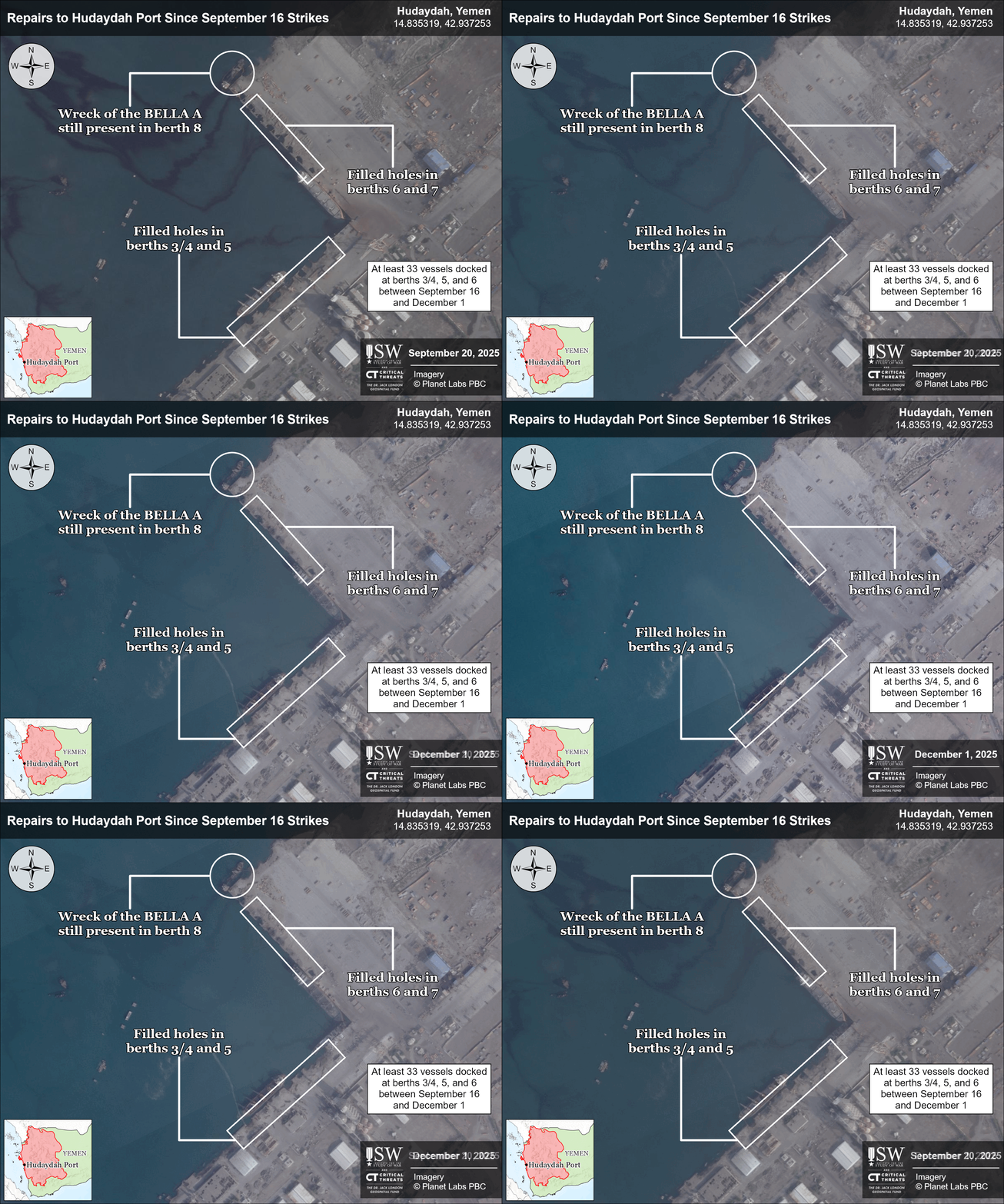
Figure 1. Repairs to Hudaydah Port Since September 16 Strikes
Source: Institute for the Study of War; Critical Threats Project; Planet Labs.
The Houthis likely aim to coerce the United States and its allies into making concessions in negotiations with Iran and to deter further military escalation against Iran and the wider Axis of Resistance. The Houthis are coordinating their operations with Iran. Islamic Revolutionary Guards Corps (IRGC)–affiliated Tasnim News Agency warned of a “new front” in the Bab el Mandeb Strait, the southern entrance to the Red Sea off the Yemeni coast, on March 25.[v] IRGC personnel reportedly arrived in Yemen days before the first Houthi attack on March 28, and the Houthis explicitly acknowledged that they coordinated the April 1 attack with Iran and Lebanese Hezbollah.[vi]
The Houthis have threatened to join Iran’s coercive regional campaign since the group began attacking Israel. Iran has targeted energy infrastructure in the Gulf states and attempted to close the Strait of Hormuz to create economic pressure that will deter continued attacks from the United States and its allies and force them into negotiations. A Houthi military spokesperson warned after the initial attacks on Israel that attacks would continue “until the aggression against all fronts of the resistance ceases.”[vii] The Houthis explicitly noted that they will not allow the U.S. and Israel to use the Red Sea for attacks on Iran.[viii] The Houthi deputy information minister said on March 28 that closing the Bab el Mandeb is “among our options,” and senior Houthi officials have continued to emphasize the importance of the Bab el Mandeb in statements.[ix]
A Gulf or Red Sea attack campaign, even if limited, would further cripple the global economy by increasing shipping and energy costs. Saudi Arabia has rerouted a significant portion of its oil exports to the coastal town of Yanbu via the East-West pipeline in response to the closure of the Straits of Hormuz. Saudi oil exports have reached nearly 70 percent of their prewar output, with most barrels from Yanbu going south through the Bab el Mandeb Strait to Asia.[x] The Bab el Mandeb was already a busy oil trade corridor, and energy consultants have warned that the closure of the strait would “very likely” cause oil prices to surpass more than $150 per barrel, which is more than double the pre-war cost, in the coming months.[xi] The Red Sea and its two entrances—the Suez Canal and Bab el Mandeb—also account for nine to 12 percent of global trade and 25 to 30 percent of global container trade, which includes energy supplies, grain, electronics, and more.[xii] Shipping firms previously responded to Houthi attacks by routing ships around Africa’s southern tip at the Cape of Good Hope, which significantly increases shipping costs and timelines.[xiii] Major carriers, including Maersk, Hapag-Lloyd, and CMA CGM, have already begun rerouting vessels along this alternative route to avoid the Red Sea.[xiv]
The Houthis are unlikely to attack Gulf energy infrastructure or Red Sea shipping, however, as doing so would jeopardize their domestic position. An expanded campaign would jeopardize the Houthis’ relationship with Saudi Arabia, which would undermine the group’s already-fragile economic position. The Houthis secured a favorable UN-brokered ceasefire with Saudi Arabia in 2022 that they are hesitant to break. Saudi Arabia spends billions of US dollars annually paying for Yemeni civil servant salaries, including in some Houthi-controlled areas, as part of the ceasefire.[xv] Israeli outlet Israel Hayom cited a Yemeni journalist who claimed that the Houthis’ delayed entry into the war at all was partially due to salary payment delays from Saudi Arabia.[xvi] The cessation of these salary transfers would fuel unrest in Houthi-controlled areas, especially as military operations and sanctions have already severely weakened the Houthi economy in recent years.[xvii] The Houthis have also demanded other financial concessions from Saudi Arabia as part of future peace talks, including Saudi reparations and reconstruction investment, as well as the Saudi-backed Republic of Yemen Government (ROYG) paying all public-sector salaries in Houthi-controlled areas.[xviii]
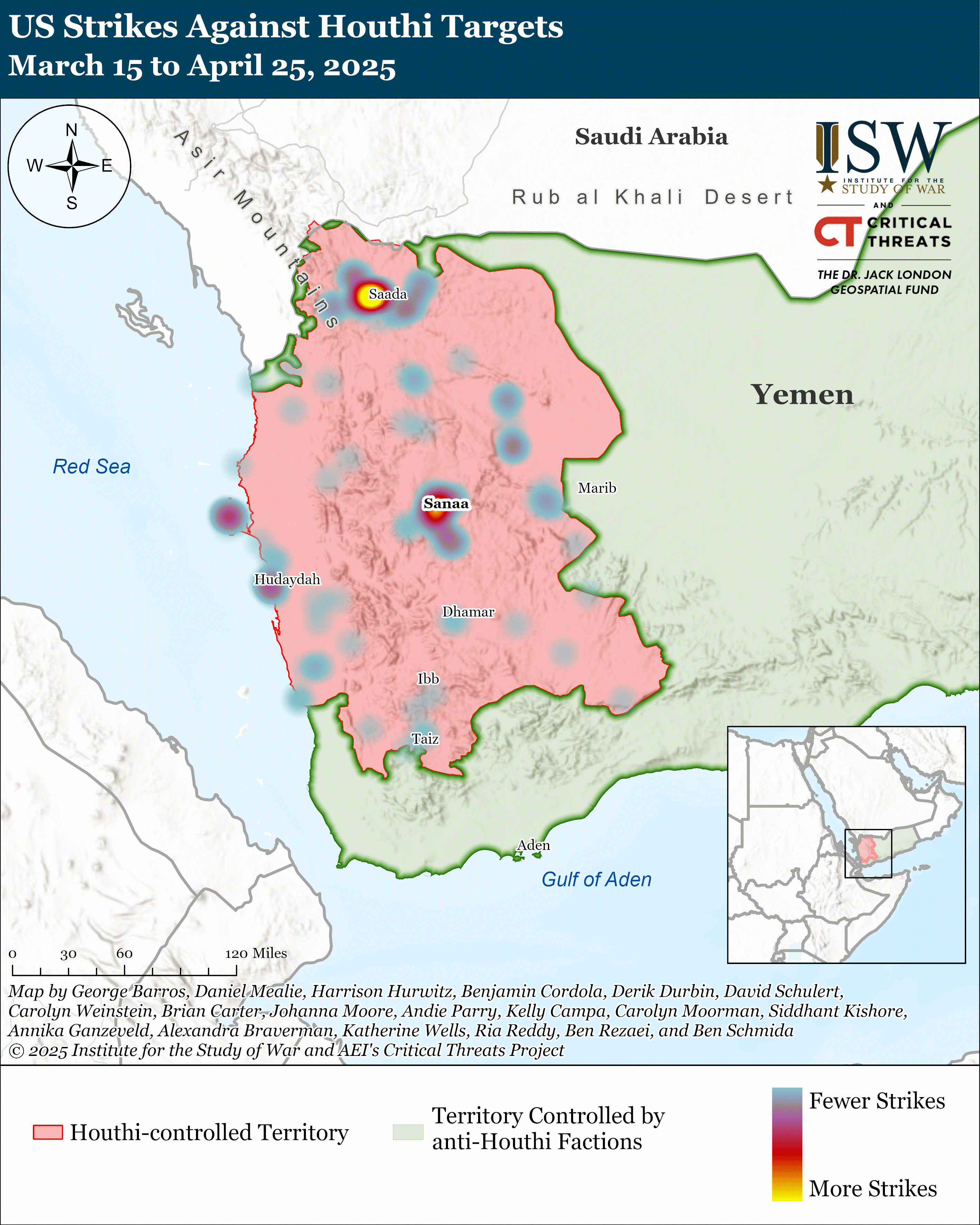
A wider campaign also risks drawing retaliation from the United States, which already inflicted severe setbacks on the Houthis in 2025 and degraded the group’s regional attack capabilities. The United States had conducted air operations against the Houthis to degrade Houthi attack capabilities since 2024 and intensified the campaign with Operation Rough Rider between March and May 2025 to render the Houthis “unable or unwilling to continue attacks that threaten US ships and freedom of navigation in the Red Sea.”[xix] Israeli and US airstrikes throughout 2024 and 2025 degraded Houthi attack capabilities by targeting radars, launch sites, and supply lines between Sanaa and Hudaydah, as well as eliminating key personnel, including central and regional commanders who coordinated attacks against international shipping and experts in missile and drone units.[xx] The campaign also targeted major economic targets, causing more than $1 billion in damage.[xxi]
Figure 2. US Strikes Against Houthi Targets
Source: Institute for the Study of War; Critical Threats Project.
Fear of US retaliation has likely deterred the Houthis from resuming Red Sea attacks and likely continues to influence Houthi decision-making in the Iran war. The US air campaign did not eliminate Houthi capabilities entirely, and the Houthis have rebuilt in the months since, but the continued lack of Red Sea attacks since September 2025 indicates that the Houthis are so far unwilling to absorb the costs of resuming the group’s attack campaign.[xxii] Houthi officials told the Associated Press that the United States warned the Houthis via Oman against participating in the ongoing war and that Houthi leaders believe they are already under surveillance in preparation for decapitation strikes.[xxiii] The Middle East Institute’s Nadwa al Dawsari, an experienced Yemen analyst with many sources in Yemen, said in March that concerns among both the Houthis and IRGC over resumed US military pressure on the Houthis were driving the Houthis’ absence from the war.[xxiv]
Wider regional involvement also threatens to jeopardize the Houthis’ domestic position. Israeli and US military operations and sanctions have severely weakened key parts of the Houthi economy over the last year, straining the patronage networks that underpin Houthi tribal alliances.[xxv] Military strikes on key infrastructure and US sanctions have decreased Houthi-controlled trade of oil and refined products, which accounted for as much as half of the Houthis’ estimated income.[xxvi] Israeli operations in Gaza after October 2023 and subsequent Israeli and US military operations in Yemen helped the Houthis generate a rally-around-the-flag effect that quieted widespread domestic unrest over Houthi governance failures in early 2023.[xxvii] Attacking Arab neighbors in support of Iran would be much less popular than attacking Israel to support Palestinians, however.[xxviii] Houthi rhetoric in the opening month of the war has tried to “carefully prepare pro-Iran mobilization” by framing Iran as a pro-Palestine ally and framing the Iran war as Israel versus the “Islamic community,” underscoring the domestic narrative challenge the Houthis now face compared to the opportunity they saw to participate in the war over Gaza.[xxix]
Regional distraction also creates an opportunity for the Houthis to strengthen their domestic position without becoming entangled in a regional conflict. The schism between Saudi Arabia and the United Arab Emirates (UAE) in early 2026 has left the anti-Houthi coalition reconstituting, with its Saudi backers now distracted by the Iranian campaign. The Houthis have not clearly mobilized to capitalize on these tensions with an offensive into southern Yemen, but several analysts have warned that the Houthis have been continuing longstanding mass recruitment campaigns that could support a future ground war.[xxx]
The Houthis could launch a limited regional attack campaign should the United States and its allies cross potential Houthi or Iranian red lines, such as Gulf involvement in the war or ground operations against Iran. Several Gulf states have reportedly lobbied for multilateral action to reopen the Strait of Hormuz by force and potential ground operations against Iran. Bahrain drafted a Gulf Cooperation Council–backed UN resolution to authorize countries to use force to secure safe passage through the strait, with the UN Security Council scheduled to vote on the resolution on April 4 after several postponements.[xxxi] The initial draft proposed that countries use “all necessary means” to secure safe passage in the Strait of Hormuz and adjacent waterways, although the latest draft only authorizes defensive action due to opposition from China, France, and Russia.[xxxii] Arab officials had told the Wall Street Journal on April 1 that the UAE was lobbying in support of the initial resolution, with Emirati officials saying that the UAE had “reviewed its capabilities” to assist any international coalition.[xxxiii] Multiple outlets have reported that Saudi Arabia and the UAE are privately encouraging the United States to continue operations, including possible ground invasion of Iran or Iranian-occupied islands near the Strait of Hormuz, until the Iranian regime is disabled, toppled, or changes its behavior.[xxxiv]
Iran lacks command and control over the Houthis, but the alliance with Iran is key to the Houthis’ regional position. The Iranian regime continues to provide the group with key equipment to sustain its military operations and shares ideological affinities with the Houthis as revolutionary Shi’ite movements. The collapse of the Iranian regime would leave the Houthis isolated, vulnerable, and under increased pressure, especially given the dismembering of most of the Axis of Resistance since October 2023.
The Houthis have the capabilities to expand strikes to target Gulf energy infrastructure, US installations in the Gulf, or Red Sea shipping. The Houthis regularly used drones and missiles to target energy infrastructure in Saudi Arabia and the UAE from 2015 until the 2022 ceasefire.[xxxv] The Houthis then shifted their focus to attacking Israel and Red Sea shipping in response to the Israel-Hamas war in October 2023. The Houthis conducted several major drone and missile attacks on Israel and a few smaller attacks in the Red Sea throughout mid-2025 despite the damage US forces inflicted in early 2025, before voluntarily slowing and eventually halting attacks in relation to the US-brokered ceasefire in Gaza.[xxxvi]
Houthi Red Sea attacks and the resulting international response could involve US and allied positions on both sides of the Red Sea. US forces regularly use airfields and ports at Yanbu to support logistics and operations across the Middle East. Camp Lemonnier in Djibouti lies less than 100 miles from the Yemeni coast and hosts more than 4,000 US personnel who support counterterrorism and maritime security initiatives in the Red Sea and Horn of Africa. Several outlets and analysts have cited flight tracking info showing flights from US bases hosting US Airborne and Special Forces units to Djibouti since late March.[xxxvii] The nearby Chabelley Airfield in Djibouti hosts drones that can cover Yemen and most of Somalia.[xxxviii] CTP has previously assessed that Djiboutian support for Palestine and Djibouti’s refusal to allow US bases to target the Houthis decreases Houthi incentives to target US installations in Djibouti, however.[xxxix] CTP has also previously assessed that the Houthis could target Emirati or potential Israeli military positions in the de facto independent Somaliland region as part of a Red Sea attack campaign.[xl]
Figure 3. Red Sea Competition in the Greater Red Sea Arena

Source: Liam Karr.
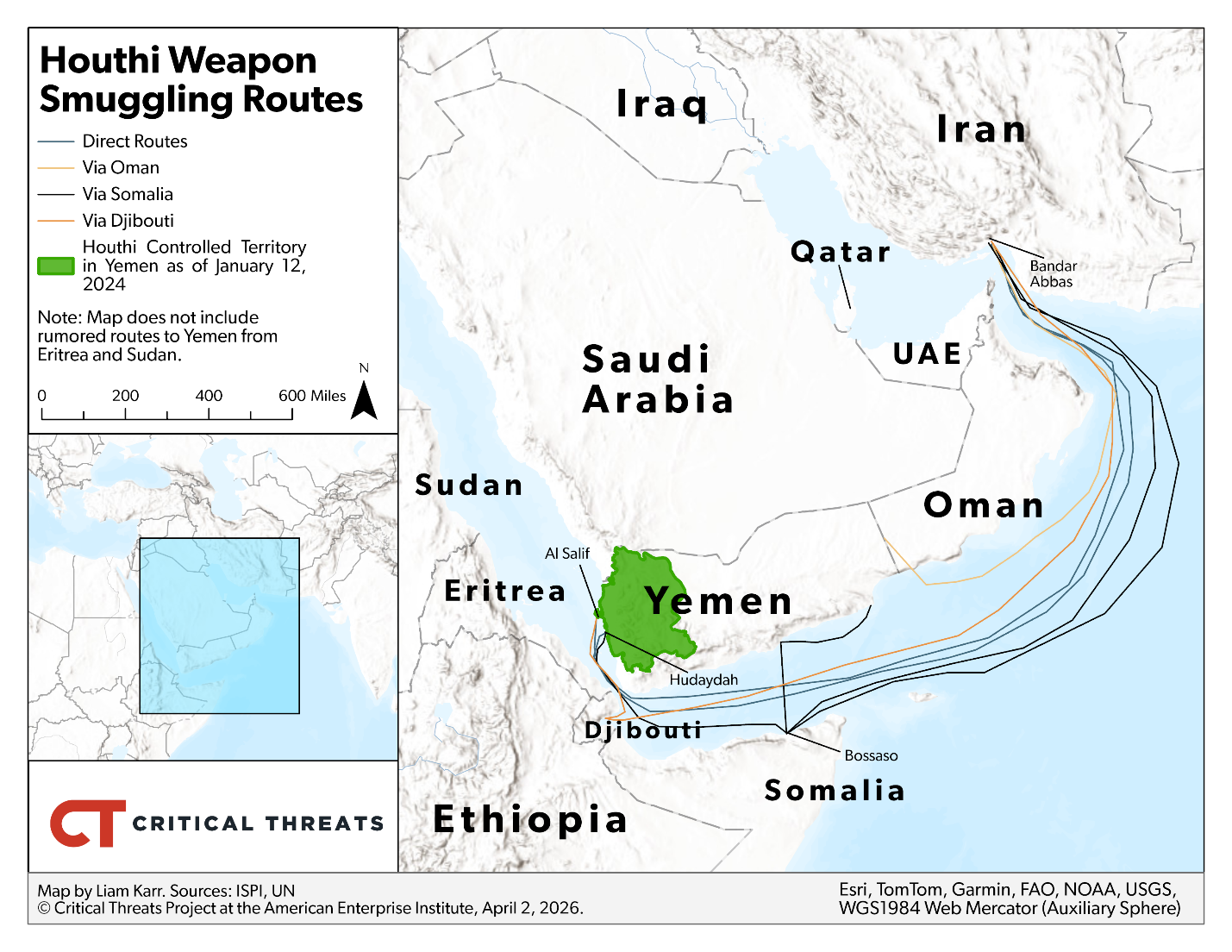
Israeli, US, and partner operations have degraded already weakened Houthi capabilities and supply chains, however, which could undermine the Houthis’ ability to sustain a regional attack campaign. US and Israeli strikes in Yemen in 2025 degraded Houthi military infrastructure and killed several senior commanders and experts in missile and drone units.[xli] The combined force has repeatedly targeted Bandar Abbas, Iran, which is the origin point of the smuggling routes to the Houthis, since the beginning of the Iran war in 2026.[xlii] Yemeni coast guard forces had already intensified counter-smuggling operations since mid-2025, resulting in several major seizures and continued pressure since the beginning of the Iran war.[xliii] The Houthis have increasingly shifted away from smuggling completed weapons toward components to support domestic weapons production in recent years, but domestic production still requires importing vital missile and drone components.[xliv] These inputs are critical, as anonymous Houthi officials told the Associated Press that the group’s missile stockpiles are running low after sustaining years of operations since October 2023, although the officials claimed that the group still had large drone stockpiles.[xlv]
Figure 4. Houthi Smuggling Networks
Source: Italian institute for International Political Studies; UN; Liam Karr.
A limited campaign would pose major risks for the Houthis, as failures to successfully follow through on their threats would reduce leverage that underpins the group's coercive regional approach.[xlvi] The Houthis rely on intimidation to project influence in the region. The Houthis used attacks on Gulf energy infrastructure to secure favorable terms in the 2022 ceasefire with Saudi Arabia. The Houthis then attempted to coerce Israel and its allies not to target other members of the Axis of Resistance after 2023 through attacks on Israel and Red Sea shipping. International shipping companies have already begun diverting traffic away from the Red Sea as a precaution since the Houthis entered the war, underscoring the impact of the Houthis’ intimidation factor. [xlvii]

[i] https://news.sky.com/story/irans-allies-could-close-second-crucial-sea-route-with-clear-and-significant-impact-on-uk-13526029; https://www.reuters.com/world/africa/moroccos-tanger-med-port-prepares-increased-traffic-amid-gulf-war-2026-03-30
[i] https://x.com/manniefabian/status/2037791120571187659?s=20; https://x.com/manniefabian/status/2037941188292952443?s=20; https://www.arabnews.com/node/2638391/middle-east
[ii] https://www.arabnews.com/node/2638391/middle-east;
[iii] https://www.bloomberg.com/news/articles/2026-03-30/houthis-iran-war-and-red-sea-why-oil-markets-are-at-risk; https://www.atlanticcouncil.org/blogs/menasource/will-the-houthis-join-the-iran-war
[iv] https://www.atlanticcouncil.org/blogs/menasource/will-the-houthis-join-the-iran-war
[v] https://www.tasnimnews dot ir/en/news/2026/03/25/3549108/opening-bab-al-mandeb-front-possible-in-case-of-enemy-provocation-in-southern-irand-source
[vi] https://www.israelhayom dot com/2026/03/29/saudi-payments-houthi-war-entry-irgc-yemen; https://x.com/AlArabiya/status/2037967964465508406?s=20; https://www.arabnews.com/node/2638391/middle-east
[vii] https://time.com/article/2026/03/28/iran-war-news-houthis-israel
[viii] https://apnews.com/article/iran-israel-us-houthis-yemen-dba2e2e2309f08547a3cbfdc2c367897
[ix] https://www.aljazeera dot com/news/2026/3/28/yemens-houthis-claim-responsibility-for-a-missile-attack-on-israel-2; https://t.me/Tasnimnews/404069
[x] https://www.bloomberg.com/news/articles/2026-03-30/houthis-iran-war-and-red-sea-why-oil-markets-are-at-risk; https://apnews.com/article/iran-israel-us-houthis-yemen-dba2e2e2309f08547a3cbfdc2c367897; https://www.cnn.com/2026/03/30/business/saudi-oil-war-strait-houthis
[xi] https://www.cnn.com/2026/03/30/business/saudi-oil-war-strait-houthis
[xii] https://time.com/article/2026/03/28/iran-war-news-houthis-israel; https://apnews.com/article/iran-israel-us-houthis-yemen-dba2e2e2309f08547a3cbfdc2c367897
[xiii] https://apnews.com/article/iran-israel-us-houthis-yemen-dba2e2e2309f08547a3cbfdc2c367897; https://www.bloomberg.com/news/articles/2026-03-30/houthis-iran-war-and-red-sea-why-oil-markets-are-at-risk
[xiv] https://news.sky.com/story/irans-allies-could-close-second-crucial-sea-route-with-clear-and-significant-impact-on-uk-13526029; https://www.reuters.com/world/africa/moroccos-tanger-med-port-prepares-increased-traffic-amid-gulf-war-2026-03-30
[xv] https://www.reuters.com/world/middle-east/saudi-arabia-deploys-cash-clout-yemen-after-ousting-uae-2026-02-05;
[xvi] https://www.israelhayom dot com/2026/03/29/saudi-payments-houthi-war-entry-irgc-yemen/
[xvii] https://ctc.westpoint.edu/will-the-center-hold-the-houthis-fraying-tribal-alliances
[xviii] https://arabcenterdc.org/resource/a-fragile-but-enduring-truce-in-yemen; https://bashareport.substack.com/p/houthi-de-facto-government-claims; https://bashareport.substack.com/p/al-houthi-unveils-27-billion-losses
[xix] https://www.criticalthreats.org/analysis/iran-update-april-4-2025
[xx] https://www.stimson.org/2025/us-airstrikes-on-yemen-tactical-wins-strategic-setbacks; https://mei.edu/publication/irans-insurance-policy-why-the-houthis-have-stayed-out-of-the-fight/
[xxi] https://www.stimson.org/2025/us-airstrikes-on-yemen-tactical-wins-strategic-setbacks
[xxii] https://www.crisisgroup.org/qna/middle-east-north-africa/yemen-iran-israelpalestine-united-states-saudi-arabia/houthis-enter-middle-east-war-what-comes-next
[xxiii] https://apnews.com/article/yemen-houthis-iran-war-gulf-us-israel-1fc2a646d0cc42131385e7e61c409565
[xxiv] https://mei.edu/publication/irans-insurance-policy-why-the-houthis-have-stayed-out-of-the-fight/
[xxv] https://ctc.westpoint.edu/will-the-center-hold-the-houthis-fraying-tribal-alliances
[xxvi] https://ctc.westpoint.edu/will-the-center-hold-the-houthis-fraying-tribal-alliances
[xxvii] https://ecfr.eu/article/the-paradox-of-intervention-how-us-strikes-in-yemen-empowered-the-houthis; https://www.amnesty.org/en/latest/news/2023/09/yemen-wave-of-arrests-by-huthi-de-facto-authorities-following-demonstrations
[xxviii] https://www.atlanticcouncil.org/blogs/menasource/will-the-houthis-join-the-iran-war
[xxix] https://www.ispionline.it/en/publication/houthis-controlled-escalation-adds-an-arabian-variable-to-the-gulf-war-234009; https://www.crisisgroup.org/qna/middle-east-north-africa/yemen-iran-israelpalestine-united-states-saudi-arabia/houthis-enter-middle-east-war-what-comes-next
[xxx] https://www.ideologymachine.com/p/the-red-death-iran-backed-houthis; https://foreignpolicy.com/2026/03/11/iran-war-houthis-yemen-military-operations-calculus-ground-force-mobilization
[xxxi] https://apnews.com/article/iran-strait-of-hormuz-un-vote-f2a2fafe3e1691b9f0be5e7d691a90d0
[xxxii] https://apnews.com/article/iran-strait-of-hormuz-un-vote-f2a2fafe3e1691b9f0be5e7d691a90d0
[xxxiii] https://www.wsj.com/world/middle-east/uae-iran-war-strait-of-hormuz-9836ecbb
[xxxiv] https://apnews.com/article/trump-iran-saudi-arabia-mbs-gulf-war-uae-89f690b952fe28d3140c537b70fa5051; https://www.wsj.com/world/middle-east/uae-iran-war-strait-of-hormuz-9836ecbb
[xxxv] https://acleddata.com/report/beyond-riyadh-houthi-cross-border-aerial-warfare-2015-2022
[xxxvi] https://www.cnn.com/2025/09/24/world/yemen-drone-attack-eilat-intl-latam; https://sanaacenter dot org/the-yemenreview/jul-sept-2025/25631
[xxxvii] https://x.com/EGYOSINT/status/2039989018297811288?s=20; https://x.com/HamidRezaAz/status/2035701273081594267?s=20; https://www.facebook.com/watch/?v=1514406243648819
[xxxviii] https://theintercept.com/2015/10/21/stealth-expansion-of-secret-us-drone-base-in-africa; https://www.usafe.af.mil/Units/406th-Air-Expeditionary-Wing/News-and-Articles/Display/Article/4437991/449th-aeg-cjtf-hoa-conduct-first-humanitarian-airdrop-from-chabelley-airfield
[xxxix] https://www.criticalthreats.org/analysis/iran-houthi-israel-us-saudi-uae-red-sea-horn-africa-file
[xl] https://www.criticalthreats.org/analysis/iran-houthi-israel-us-saudi-uae-red-sea-horn-africa-file
[xli] https://www.stimson.org/2025/us-airstrikes-on-yemen-tactical-wins-strategic-setbacks; https://mei.edu/publication/irans-insurance-policy-why-the-houthis-have-stayed-out-of-the-fight/
[xlii] https://www.criticalthreats.org/analysis/iran-update-march-25-2026; https://maritimescrimes.com/2025/08/12/yemen-iran-weapons-smuggling-houthis-routes
[xliii] https://gulfif.org/yemens-breakthrough-against-irans-arms-smuggling-to-the-houthis; https://www.ispionline.it/en/publication/yemen-counter-smuggling-is-now-key-to-tackling-the-houthis-223187
[xliv] https://www.stimson.org/2026/how-to-read-the-houthis-late-entry-into-the-iran-war; https://tcf.org/content/report/from-smugglers-to-supply-chains-how-yemens-houthi-movement-became-a-global-threat
[xlv] https://apnews.com/article/yemen-houthis-iran-war-gulf-us-israel-1fc2a646d0cc42131385e7e61c409565
[xlvi] https://foreignpolicy.com/2026/03/11/iran-war-houthis-yemen-military-operations-calculus-ground-force-mobilization
[xlvii] https://news.sky.com/story/irans-allies-could-close-second-crucial-sea-route-with-clear-and-significant-impact-on-uk-13526029; https://www.reuters.com/world/africa/moroccos-tanger-med-port-prepares-increased-traffic-amid-gulf-war-2026-03-30
View Citations