{{currentView.title}}
9 hours ago
Russian Offensive Campaign Assessment, November 1, 2026
Originally published in
Alexander Neuman, and Frederick W. Kagan
Click here to see ISW’s interactive map of the Russian invasion of Ukraine. This map is updated daily alongside the static maps present in this report.
Click here to see ISW’s 3D control of terrain topographic map of Ukraine. Use of a computer (not a mobile device) is strongly recommended for using this data-heavy tool.
Click here to access ISW’s archive of interactive time-lapse maps of the Russian invasion of Ukraine. These maps complement the static control-of-terrain map that ISW produces daily by showing a dynamic frontline. ISW will update this time-lapse map archive monthly.
For more information on ISW’s map methodology, please view our statement here.
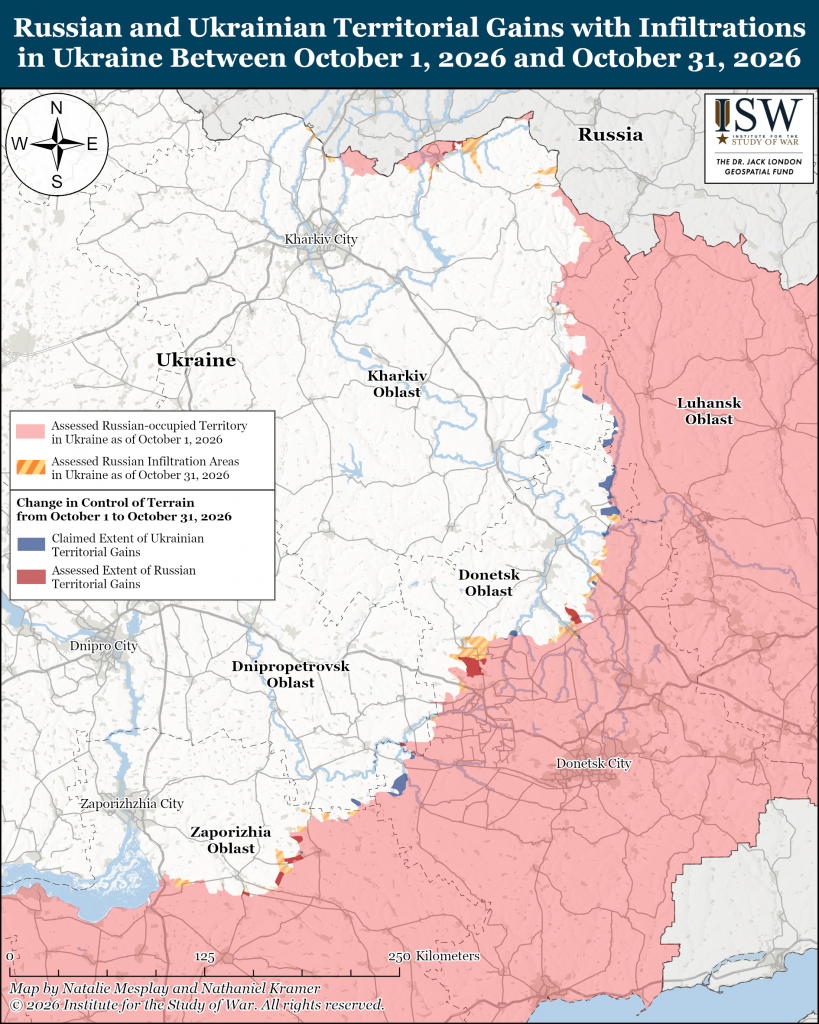
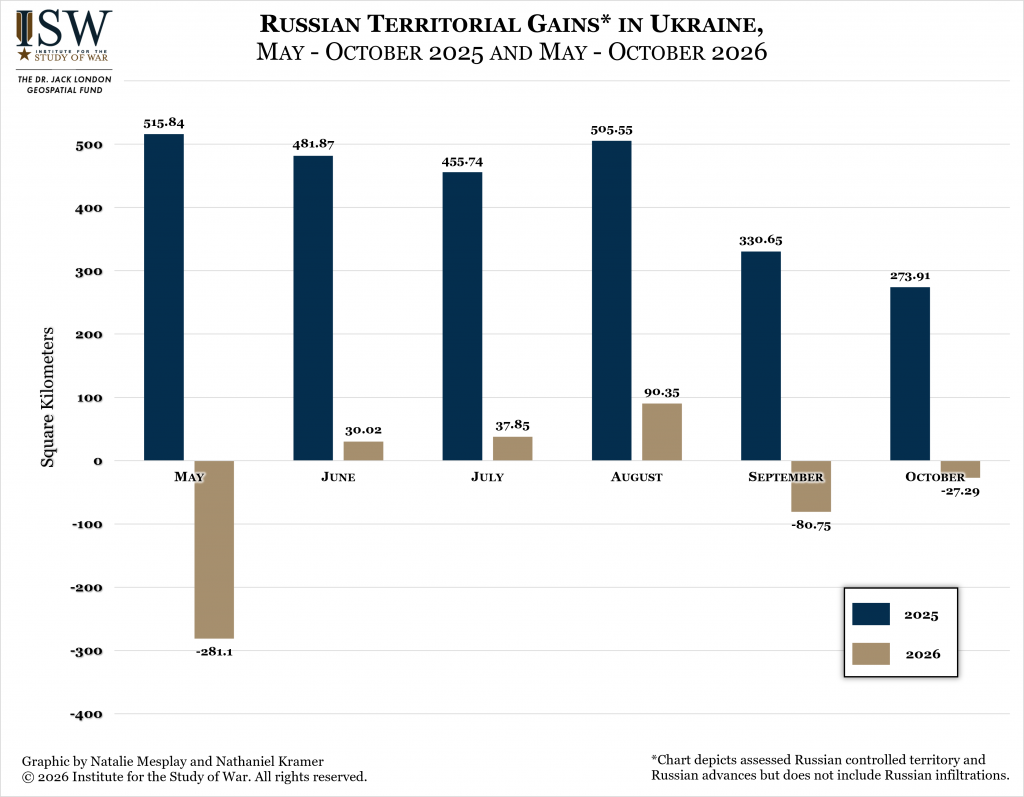
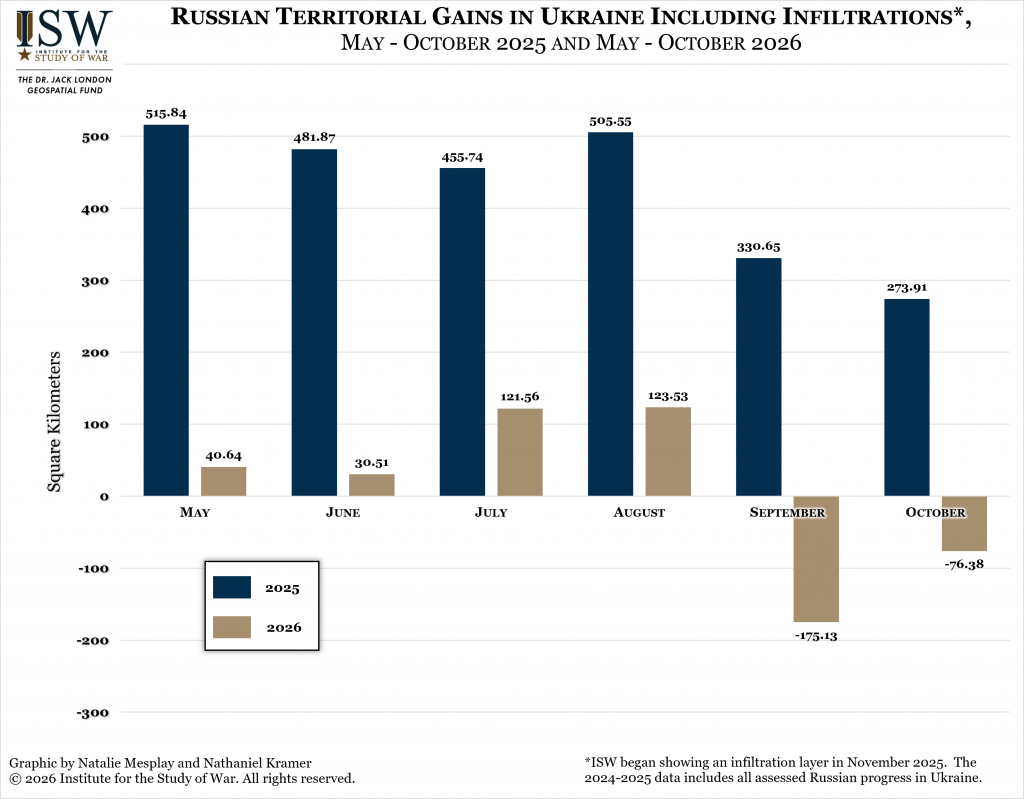
Russian forces lost ground on the battlefield in October 2026 for the second month in a row. ISW has observed evidence to assess that Russian forces consolidated positions or seized 139.85 kilometers but lost 167.14 square kilometers of territory in Ukraine in October 2026 for a net loss of 27.29 square kilometers. That is an average pace of -0.88 square kilometers per day. Russian forces only made gains in Sumy and Zaporizhia oblasts, while losing territory in all other sectors of the frontline, including their priority objective of Donetsk Oblast. Russian forces also lost ground in October when accounting for Russian infiltrations into areas over which Russian forces have not gained control, with Russian forces suffering a net loss of 76.38 square kilometers in such areas for an average pace of -2.46 square kilometers per day. Russian forces seized 10 settlements totaling 5.86 square kilometers, but Ukrainian forces liberated or cleared Russian infiltrators from 11 settlements with an area of 3.24 square kilometers.
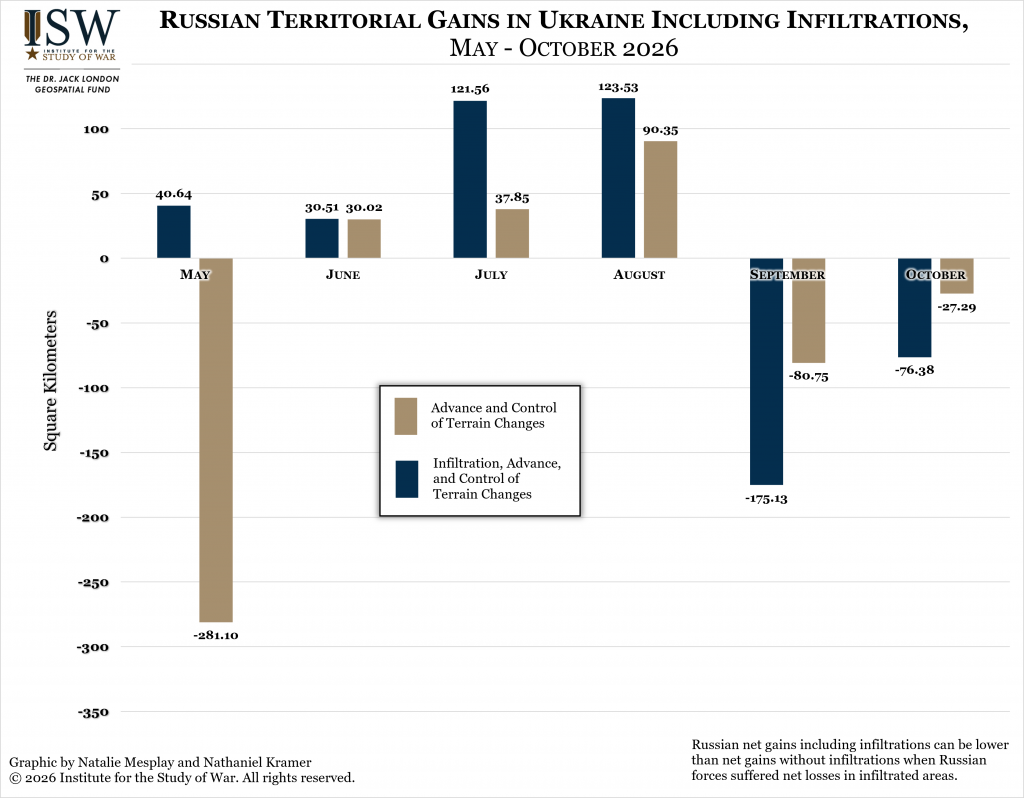
Russian forces suffered their highest monthly losses of the war thus far in October 2026, paying a growing price for their battlefield losses. The Ukrainian General Staff reported that Russian forces lost 54,400 killed or seriously wounded in October 2026 — the fourth consecutive month that Russian forces suffered over 40,000 monthly casualties and Russia’s highest monthly casualty total since the Kremlin launched its full-scale invasion in 2022.[1] Ukrainian Unmanned Systems Forces (USF) Commander Major Robert “Magyar” Brovdi noted that Russian forces suffered the highest losses in the Dobropillya, Oleksandrivka, and Hulyaipole directions.[2] Russian forces continue to sustain significant personnel losses while losing ground, and Russia’s current force generation system continues to recruit fewer soldiers than needed to replace these losses.
Russian casualty rates and territorial losses match the battlefield reality that Russian forces have lost the initiative and their offensive capabilities in much of the theater. Russian forces retain the initiative in the immediate area of Dobropillya, Donetsk Oblast, where they have concentrated the bulk of their offensive operations. But Ukrainian forces have seized the initiative in the Kupyansk, Lyman, and Oleksandrivka directions and are contesting it in western Zaporizhia Oblast.
Russian forces have managed to make marginal advances in the Dobropillya direction by committing substantial resources and personnel, but the seizure of Dobropillya would not enable sweeping Russian advances in Donetsk Oblast. Russian forces attacking toward Dobropillya are part of a broader Russian effort intended to form the southern part of the wide encirclement of the Fortress Belt together with Russian offensive operations north of Lyman.[4] The Russian military command has committed significant resources and personnel to achieving its objective of seizing Dobropillya, including deploying most of the Russian 41st Combined Arms Army (CAA, Central Military District [CMD]) to reinforce Russian elements attacking just northeast of Dobropillya and east of the Kazenyi Torets River, and deploying roughly one-third of Russia’s elite Rubikon Center for Advanced Unmanned Systems forces to the Dobropillya direction.[5] Ukrainian General Staff offensive intensity data indicates that Russian forces have consistently maintained their highest offensive tempo on the frontline in the Pokrovsk (south of Dobropillya) direction. Russian forces have concentrated their attacks in that area on Dobropillya and its immediate environs, averaging roughly 30 attacks per day through November 1, and this direction has been the highest-intensity sector since at least August 1, 2026.[6] Russian forces have maintained intensified offensive operations toward Dobropillya instead of reallocating resources to attack toward Druzhkivka, which could produce more tangible successes. Russian forces have recently made limited gains toward Dobropillya, primarily in the form of small-group infiltration missions, but have not consolidated any positions in the town.[7] Russian forces’ high offensive tempo has not translated into meaningful gains in the Dobropillya direction that will enable Russian forces to achieve their objective of seizing the Fortress Belt by Spring 2027 — the most recent of many deadlines that Putin has given the Russian military.[8]
Russian forces’ continued intensified operations toward Dobropillya likely reflect the Russian military command’s delusional belief that it will be able to restore operational maneuver on the battlefield. A Russian seizure of Dobropillya would not enable Russia to make sweeping advances in Donetsk Oblast, however. The Russian military command originally intended to use Dobropillya as the western anchor of a wide encirclement of the Fortress Belt meant to meet Russian forces that were supposed to advance on the northern flank of the Fortress Belt through Lyman to eventually meet up in Barvinkove, Kharkiv Oblast.[9] Ukraine’s Operation Vivaldi in the Lyman direction has defeated Russian forces’ attempt to develop the northern pincer, rendering the possible seizure of Dobropillya meaningless within the framework of the original campaign plan since that plan is no longer feasible.[10] The Russian command has shown no indication that it has changed its original campaign plan to account for the defeat east of Lyman, but it could conceivably hope to use a drive north from Dobropillya to cut Ukrainian ground lines of communication (GLOCs) to Kramatorsk and the rest of the fortress belt cities. Russian forces have shown none of the capabilities that would be necessary to undertake such an operation, however, as they remain unable to conduct rapid operational maneuver. An operation to seize Dobropillya and then subsequently launch an offensive against Kramatorsk from the west would require enormous quantities of manpower and resources and take years, if it is possible at all.
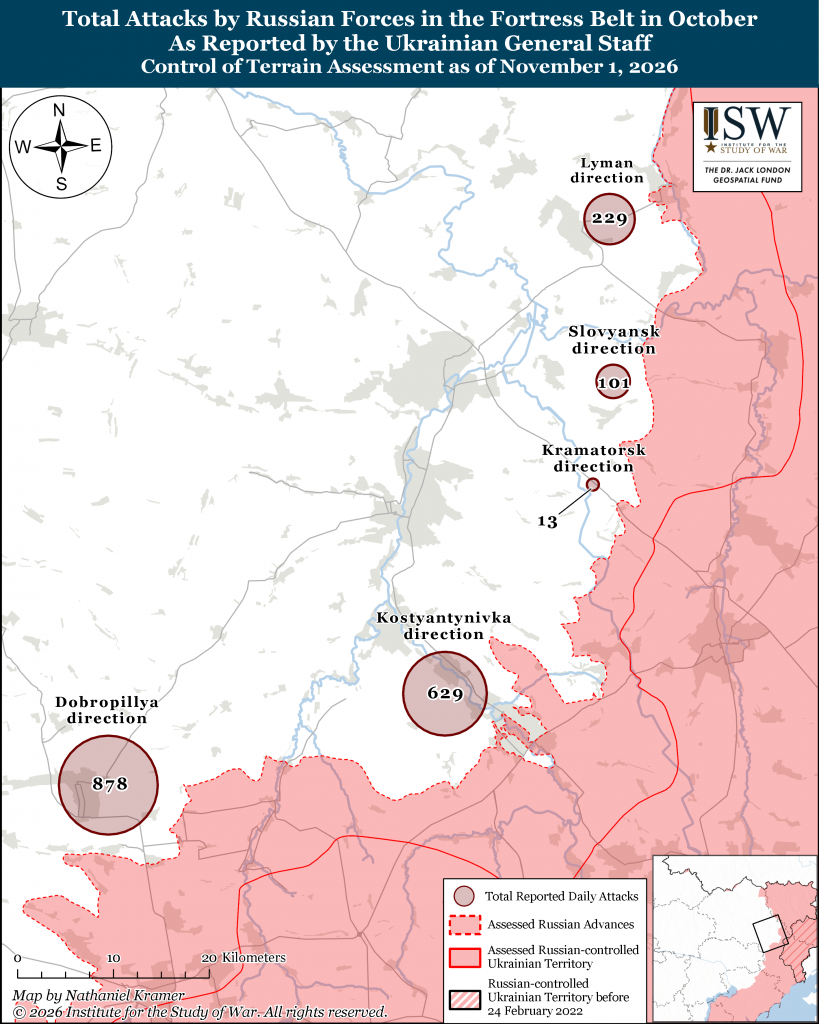
The Russian military command does not appear to have modified plans even for the forces defeated by Ukraine’s Operation Vivaldi in the Lyman direction. Operation Vivaldi collapsed the Russian salient north and northwest of Lyman that was intended to be the base of the northern pincer of the Russian encirclement of the Fortress Belt. Ukrainian counterattacks have both denied Russian forces the opportunity to conduct a wide encirclement of the Fortress Belt from the north and blocked Russian plans for enveloping Slovyansk itself from the northeast. The Russian military command nonetheless appears committed to its original campaign design even in this sector. Ukrainian General Staff reports indicate that Russian forces averaged around 7.4 attacks per day in the Lyman direction in October 2026 — down only slightly from their September average of 8.4 attacks per day.[11] The Russian military command has also redeployed elements of the Russian 1st Guards Tank Army (GTA, Moscow Military District [MMD]) from the Kupyansk direction to the Lyman direction to support offensive operations, as Ukrainian counterattacks significantly degraded the Russian 20th CAA (MMD) and 25th CAA (CMD).[12] The movement of this reinforcement to the Lyman area may have been intended in part to stabilize the Russian lines in the face of continuing Ukrainian counteroffensive operations, but Russian forces continue seeking to advance in this area and are not merely focused on stabilizing their lines.
(The Russian offensive intensity toward Lyman is likely, in fact, higher than these figures suggest, as the Ukrainian General Staff’s reporting convention includes settlements on both sides of the Siverskyi Donets River as within the Slovyansk direction, including near Ozerne and Yampil (both southeast of Lyman). ISW assesses fighting north of the Siverskyi Donets River to be a distinct operational effort under the Russian Western Grouping of Forces’ (GoF) area of responsibility (AoR), while the Russian Southern GoF is separately responsible for offensive operations south of the Siverskyi Donets River, attacking directly toward Slovyansk.)
Ukraine’s Operation Vivaldi has had cascading effects on Russian offensives against the Fortress Belt directly from the east. The Russian Southern GoF has significantly decreased its offensive tempo near the Fortress Belt’s immediate eastern and northeastern environs throughout October 2026, amid limited Ukrainian counterattacks in the area. Ukrainian General Staff reports indicate that Russian forces averaged around 14 attacks per day in the Slovyansk direction (which, in the General Staff’s reporting convention, includes settlements on both sides of the Siverskyi Donets River as noted above) in August 2026, five per day in September 2026, and around three per day in October 2026. Russian forces averaged around three attacks per day in the Kramatorsk direction in August 2026, one per day in September 2026, and only 0.4 per day in October 2026. Russian forces had prioritized attacks toward Mykolaivka (east of Slovyansk) and on the southern bank of the Siverskyi Donets River in August and early September 2026, attempting to seize local tactical heights and create more favorable conditions for an offensive against Slovyansk that bypasses difficult terrain and tough Ukrainian defenses, but Ukrainian counterattacks have disrupted these efforts.[13] Ukrainian forces have increased counterattacks along the southern bank of the Siverskyi Donets River and near Rai-Oleksandrivka east of Slovyansk and further south near Vasyutynske, Tykhonivka, and Malynivka since late September 2026.[14] Ongoing Ukrainian counterattacks in the area, combined with the defeat of Russian forces north of the Siverskyi Donets River, could disrupt the Russian offensive from the east toward Slovyansk entirely.[15] Russian forces may also have reduced their operational tempo to prepare for resuming offensive operations as part of Russia’s Fall 2026 offensive —a normal seasonal pattern.
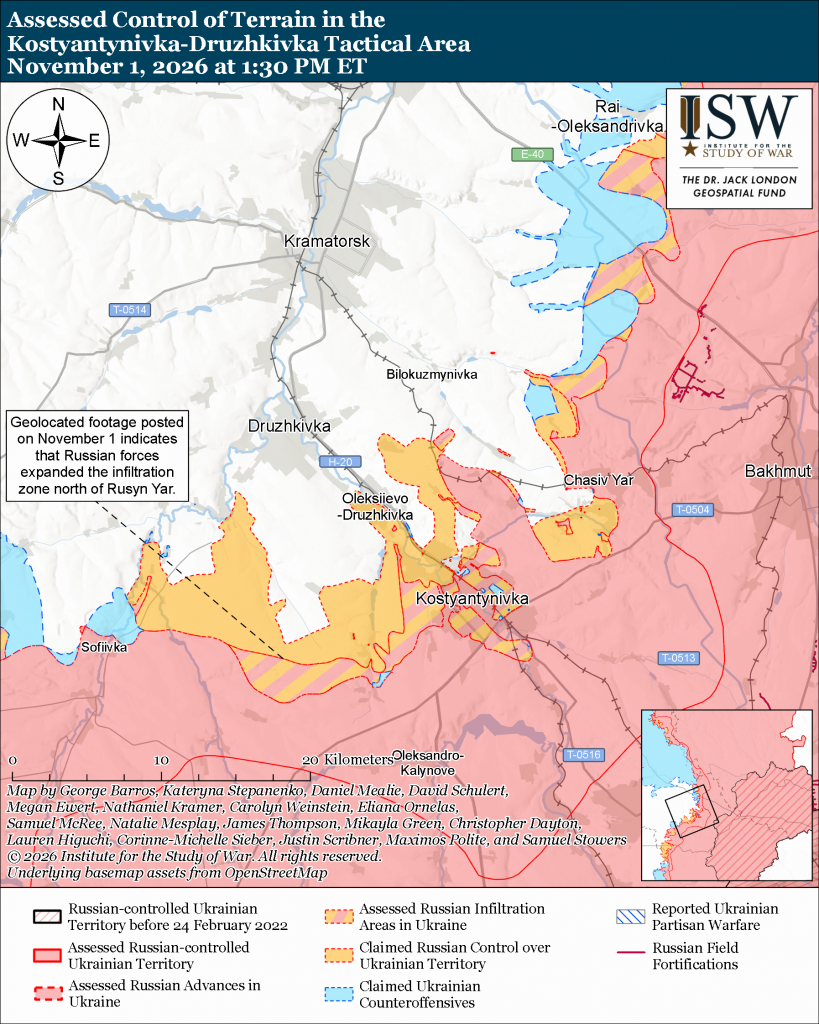
Russian forces have not yet completed the seizure of Kostyantynivka over a year after first infiltrating into the town. Russian forces first infiltrated into Kostyantynivka in October 2025 and started making significant tactical gains in the town in June 2026 but have still not been able to seize the town after a year of fighting.[16] Russian President Vladimir Putin falsely claimed in July 2026 that Russian forces had seized Kostyantynivka.[17] ISW has observed evidence to assess that Russian forces have advanced into around 36.31 percent of Kostyantynivka and have advanced or infiltrated throughout 75.54 percent of the town. Ukrainian forces hold positions within Kostyantynivka, however, and the continued Ukrainian presence in the town gives more time for Ukraine to build up and solidify defensive lines behind Kostyantynivka. Russian forces are seemingly attempting to continue infiltrations from Kostyantynivka directly to Oleksiievo-Druzhkivka without completing the seizure of Kostyantynivka or leveling the frontline south of Oleksiievo-Druzhkivka. This effort leaves the Russian southern flank open to potential Ukrainian counterattacks and risks leaving Russian forces unable to supply their forwardmost positions, however. Ukrainian forces also began counterattacking southwest and south of Druzhkivka beginning in at least late September through October 2026, likely to prevent any Russian efforts to reach Druzhkivka from the southwest.[18]
Russian forces continue to commit personnel and mechanized elements in the Hulyaipole direction and western Zaporizhia Oblast and are making limited and mostly local advances. The Hulyaipole direction remains Russia’s priority effort within southern Ukraine, with the Russian Eastern GoF aiming to advance westward and unite with the Dnepr GoF attacking toward Orikhiv from the south to subsequently advance on Zaporizhzhia City.[19] Ukrainian military sources have repeatedly reported that the Russian military command is reinforcing its 5th, 35th, and 36th CAAs (all of the Eastern Military District [EMD]) with armored vehicles and personnel and directing elements of the 76th Airborne (VDV) Division to the Hulyaipole direction.[20] Russian forces have also accepted competing risks in maintaining offensive pressure in Zaporizhia Oblast by continuing to reinforce the 5th CAA and 58th CAA (Southern Military District [SMD]) with strategic reserves in Spring 2026, despite Ukrainian counterattacks that have seized the initiative in the Oleksandrivka direction.[21] Russian forces have struggled to translate their sustained reinforcement of the Hulyaipole and western Zaporizhia directions into operationally significant advances, although they have recently made tactically significant gains near Orikhiv.[22]
Russian forces continue limited offensive efforts to expand their claimed “buffer zone” along the international border in northern Sumy and Kharkiv oblasts but have achieved only localized tactical gains. Ukrainian forces have largely stabilized the frontline in Kharkiv Oblast and are resisting Russian efforts to establish a buffer zone along Ukraine’s broader northern border.[23] Russian forces appear to be focused more on widening their advances in northern Ukraine from the flanks rather than on extending advances deeper into Ukrainian territory north of Kharkiv City.[24] The Russian Northern GoF continues to greatly exaggerate claims of advances in northern Ukraine, going so far as to invent an encirclement northeast of Kharkiv City, likely part of an effort to lie to the Kremlin about successes in its AoR.[25]
Russian forces are largely deprioritizing offensive operations in the Kupyansk and Borova directions following the recent successful Ukrainian operations Vivaldi and Veles. Ukrainian forces largely liberated Kupyansk in December 2025, but Russian forces continued to prioritize unsuccessful attempts to retake the town in Winter 2025-2026.[26] Russian forces only managed to conduct limited infiltration missions during October 2026 primarily north and south of Kupyansk, suggesting that Russian forces have largely lost the operational initiative in the Kupyansk direction.[27] Ukraine’s Operation Vivaldi has had cascading effects on the Russian Western GoF’s offensive operations in the Kupyansk and Borova directions, as the Russian military command had to redeploy assets from Kupyansk to stabilize (or continue efforts to advance in) the Lyman direction, and Russian forces continue to struggle to repel Ukrainian counterattacks northeast and southeast of Borova.[28] Ukrainian forces also recently conducted Operation Veles, which cut off Russian forces from the underground pipeline that has enabled Russian forces to conduct infiltration missions into Kupyansk and the surrounding area since at least September 2025, and the loss of which caused Russian forces to lose positions in and near northern Kupyansk.[29] Operation Veles also complicated Russian logistics routes across the Oskil River and almost completely halted Russian offensive operations northeast of Borova and south of Kupyansk, forcing Russian forces to redeploy resources and personnel from the Borova to the Kupyansk direction in order to address increasing Ukrainian counterattacks.[30] Ukraine’s successes with Operation Vivaldi, Operation Veles, and other counterattacks in the Lyman, Kupyansk, and Borova directions have likely compelled Russian military command to largely abandon offensive efforts in the Kupyansk and Borova directions, as Russian forces have failed to make any territorial gains in either direction in several months.[31] Russian forces’ reliance on small-group infiltration missions in the Kupyansk direction, coupled with the Russian command’s redeployment of forces between different areas of the Western GoF's AoR to combat Ukrainian counterattacks, suggests that Russian forces currently lack the manpower necessary to conduct large-scale offensive operations along the Oskil axis. Continued Ukrainian pressure in these sectors will likely force Russian military command to deploy additional forces to stabilize current Russian positions on the frontline.
Ukraine and Turkey are advancing joint cooperation to support a limited ceasefire in the Black Sea and secure the maritime security of global grain exports, as sea transport has become increasingly dangerous amid ongoing long-range strikes. Ukrainian President Volodymyr Zelensky stated on October 31 during a joint press conference with Turkish President Recep Tayyip Erdogan that Ukraine and Turkey agreed to support efforts to ensure the security of grain exports and vessel navigation in the Black Sea.[32] Zelensky emphasized that the 2022 Turkey-Ukraine Free Trade Agreement, which went into effect on October 1, 2026, is crucial for negotiating a Black Sea ceasefire and ensuring the maritime security of Ukrainian and Turkish vessels in the Black Sea. Zelensky and Erdogan also discussed expanding Ukrainian and Turkish cooperation in the defense, industrial, and economic sectors, and Zelensky indicated that Turkey will supply Ukraine with energy equipment and generators to mitigate the effects of Russia’s ongoing long-range strike campaign against Ukraine’s critical infrastructure.[33] US Secretary of State Marco Rubio stated on October 31 that there is growing international interest, including from the US, in a limited Black Sea ceasefire as Russian and Ukrainian strikes have caused disruptions to global grain and energy shipments.[34]
Likely Russian drones violated Moldovan and Romanian airspace on the evening of October 31, as Russia continues to normalize its increasingly frequent and intense violations of European airspace. The Moldovan Ministry of Defense (MoD) reported that two unidentified drones entered Moldovan airspace on the evening of October 31 following Russian long-range strikes against western Ukraine, including one drone that entered from the direction of Vinnytsia Oblast towards Sobor, Moldova, which stayed in Moldovan airspace for around 20 minutes.[35] The Romanian MoD reported that Romanian surveillance systems detected two unidentified drones in northeastern Romania on the evening of October 31.[36] The Romanian MoD reported that Romanian authorities deployed four F-16 aircraft and one helicopter in response to the drone threat. Neither Romanian nor Moldovan authorities have publicly blamed Russia for the incursions at the time of this writing, but the incident is consistent with the Kremlin’s continued normalization of Russian drone incursions into European airspace amidst Russia’s long-range strikes against western Ukraine.[37]
Key Takeaways:
- Russian forces lost ground on the battlefield in October 2026 for the second month in a row.
- Russian forces suffered their highest monthly losses of the war thus far in October 2026, paying a growing price for their battlefield losses.
- Russian forces have managed to make marginal advances in the Dobropillya direction by committing substantial resources and personnel, but the seizure of Dobropillya would not enable sweeping Russian advances in Donetsk Oblast.
- The Russian military command does not appear to have modified plans even for the forces defeated by Ukraine’s Operation Vivaldi in the Lyman direction.
- Ukraine’s Operation Vivaldi has had cascading effects on Russian offensives against the Fortress Belt directly from the east.
- Russian forces have not yet completed the seizure of Kostyantynivka over a year after first infiltrating into the town.
- Russian forces continue to commit personnel and mechanized elements in the Hulyaipole direction and western Zaporizhia Oblast and are making limited and mostly local advances.
- Russian forces continue limited offensive efforts to expand their claimed “buffer zone” along the international border in northern Sumy and Kharkiv oblasts but have achieved only localized tactical gains.
- Russian forces are largely deprioritizing offensive operations in the Kupyansk and Borova directions following the recent successful Ukrainian operations Vivaldi and Veles.
- Ukraine and Turkey are advancing joint cooperation to support a limited ceasefire in the Black Sea and secure the maritime security of global grain exports, as sea transport has become increasingly dangerous amid ongoing long-range strikes.
- Likely Russian drones violated Moldovan and Romanian airspace on the evening of October 31, as Russia continues to normalize its increasingly frequent and intense violations of European airspace.
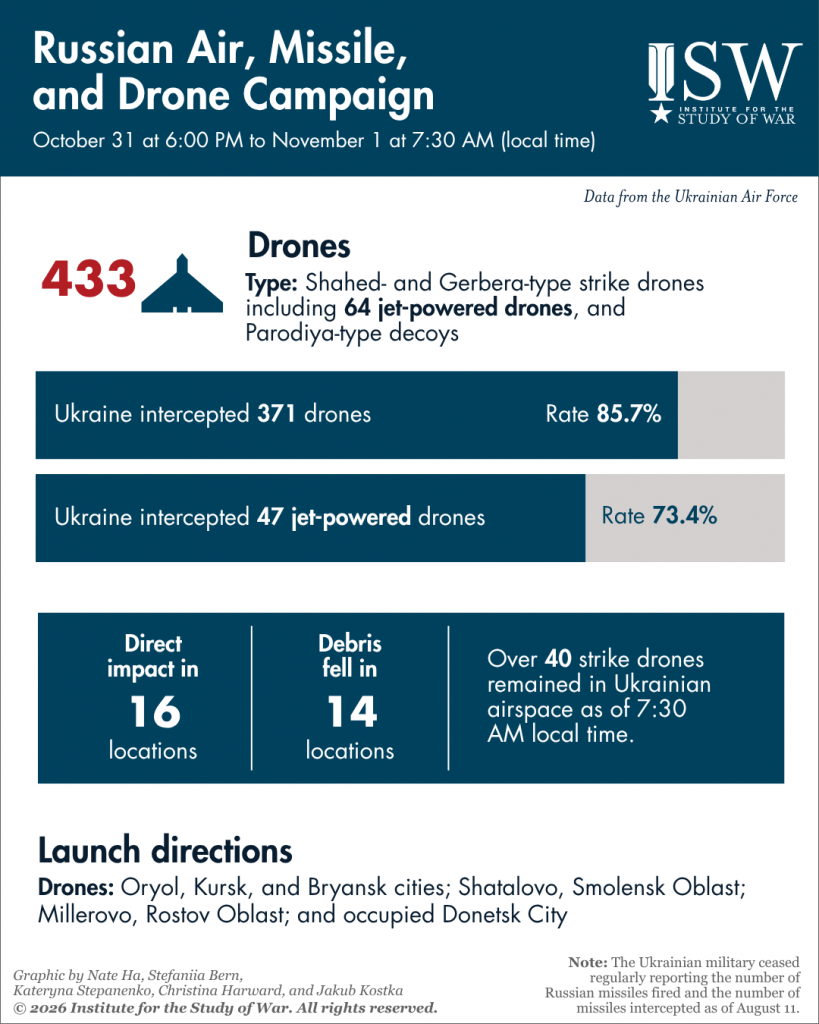
- Ukrainian forces continued their long-range strike campaign against Russian oil infrastructure overnight on October 31 to November 1. Russia launched 433 drones (including 64 jet-powered ones) against Ukraine overnight.
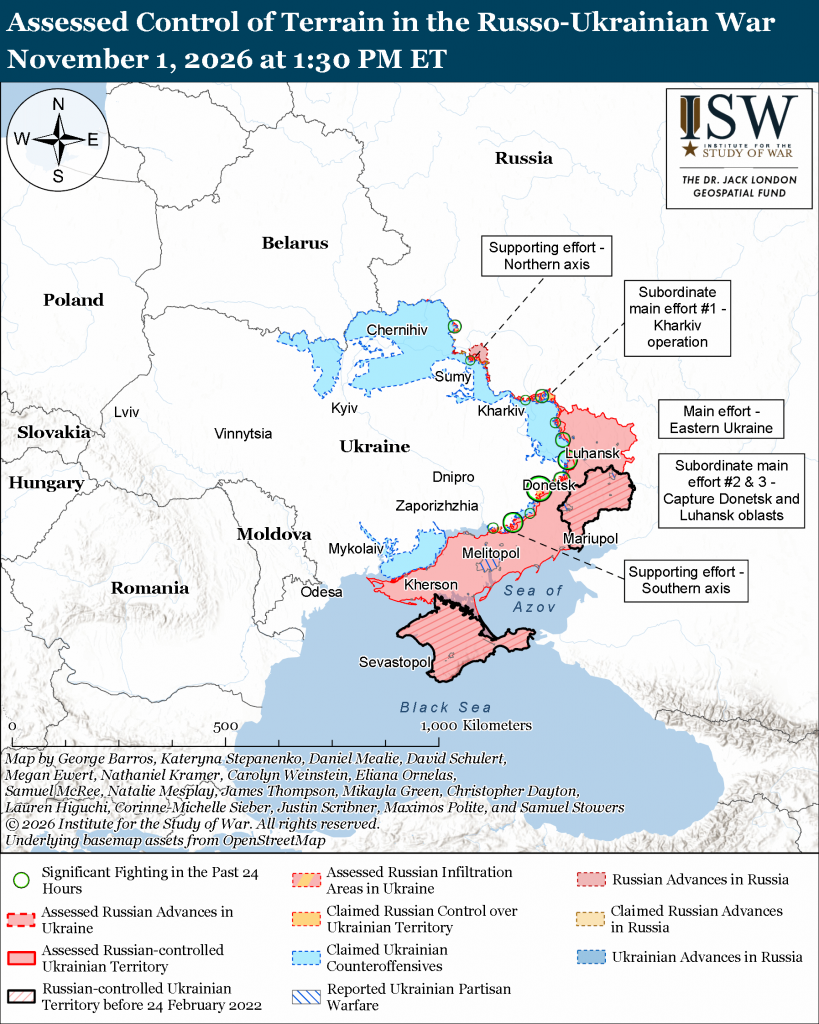
We do not report in detail on Russian war crimes because these activities are well-covered in Western media and do not directly affect the military operations we are assessing and forecasting. We will continue to evaluate and report on the effects of these criminal activities on the Ukrainian military and the Ukrainian population and specifically on combat in Ukrainian urban areas. We utterly condemn Russian violations of the laws of armed conflict and the Geneva Conventions and crimes against humanity even though we do not describe them in these reports.
- Ukrainian Operations in the Russian Federation
- Russian Supporting Effort – Northern Axis
- Russian Supporting Effort – Push Ukrainian forces back from the international border with Belgorod Oblast and approach Kharkiv City
- Russian Supporting Effort – Capture the remainder of Luhansk Oblast and push westward into eastern Kharkiv Oblast
- Russian Main Effort – Capture Ukraine's Fortress Belt and complete the seizure of Donetsk Oblast (comprised of 4 subordinate main efforts)
- Russian Subordinate Main Effort #1 – Encircle the Fortress Belt from the northwest via Lyman and Svyatohirsk (assessed objective of the Russian 25th Combined Arms Army and elements of the Western Grouping of Forces)
- Russian Subordinate Main Effort #2 – Advance on the Fortress Belt from the east (assessed objective of the Russian 3rd Combined Arms Army and Southern Grouping of Forces elements)
- Russian Subordinate Main Effort #3 – Advance on the Fortress Belt from the south (assessed Objective of the Russian 8th Combined Arms Army and Southern Grouping of Forces elements)
- Russian Subordinate Main Effort #4 – Encircle the Fortress Belt from the southwest, west of the Kazennyi Torets River (assessed objective of elements of the Russian Central Grouping of Forces)
- Russian Supporting Effort – Advance into Dnipropetrovsk Oblast
- Russian Supporting Effort – Southern Axis
- Russian Air, Missile, and Drone Campaign
- Significant Activity in Belarus
Ukrainian Operations in the Russian Federation
Ukrainian forces continued their long-range strike campaign against Russian oil infrastructure overnight on October 31 to November 1. The Ukrainian Strategic Communications Center reported on November 1 that Ukrainian forces struck the Lukoil-Nizhegorodnefteorgsintez Oil Refinery in Kstovo, Nizhny Novgorod Oblast (roughly 775 kilometers from the international border) and noted that the refinery has an annual processing capacity of approximately 17 million tons of crude oil.[38] Geolocated footage published on October 31 shows a large fire burning at the refinery following the Ukrainian strike.[39] Russian Nizhny Novgorod City and Oblast officials acknowledged on November 1 that Ukrainian forces struck an industrial facility in Kstovsky Raion, Nizhny Novgorod Oblast.[40] Ukrainian forces have struck the Lukoil-Nizhegorodnefteorgsintez Oil Refinery in Kstovo 10 times since the beginning of 2025.[41]
Ukrainian officials provided updated battle damage assessments of recent Ukrainian strikes against Russian military assets and industrial sites. The Ukrainian Ministry of Defense confirmed on October 31 that Ukrainian strikes destroyed two Russian Su-34 aircraft at the Marinovka Airfield in Volgograd Oblast worth around $100 million on October 29, destroyed an Iskander-M ballistic missile launcher in Kursk Oblast on either October 30 or 31, and damaged the Energiya Plant on October 25.[42] Zelensky reported on November 1 that Ukrainian forces struck the Kamensky Plant in Kamensk-Shakhtinsky, Rostov Oblast (approximately 180 kilometers from the frontline), a Pantsir-S2 air defense system, and an S-400 command and control vehicle overnight on October 30 to 31, causing roughly $70 million worth of damage to these air defense systems.[43]
Russian Supporting Effort – Northern Axis (Russian objective: Create defensible buffer zones in Sumy Oblast along the international border)
Russian forces continued offensive operations in northern Sumy Oblast on October 31 and November 1 but did not advance.[44]
Russian Supporting Effort – Kharkiv Oblast (Russian objective: Push Ukrainian forces back from the international border to create a defensible buffer zone with Belgorod Oblast and approach Kharkiv City)
Russian forces continued offensive operations in northern Kharkiv Oblast on October 31 and November 1 but did not advance.[45]
Neither Russian nor Ukrainian sources reported ground activity in the Velykyi Burluk direction on November 1.
Russian Supporting Effort – Oskil River (Russian objective: Cross the Oskil River in Kharkiv Oblast and push westward into eastern Kharkiv Oblast and northern Donetsk Oblast)
Russian forces recently conducted an infiltration mission southeast of Kupyansk. Ukrainian forces struck a Russian servicemember in the northeastern outskirts of Kupyansk-Vuzlovyi (southeast of Kupyansk), according to geolocated footage published on October 31, after what ISW assesses was likely a Russian infiltration mission.[46]
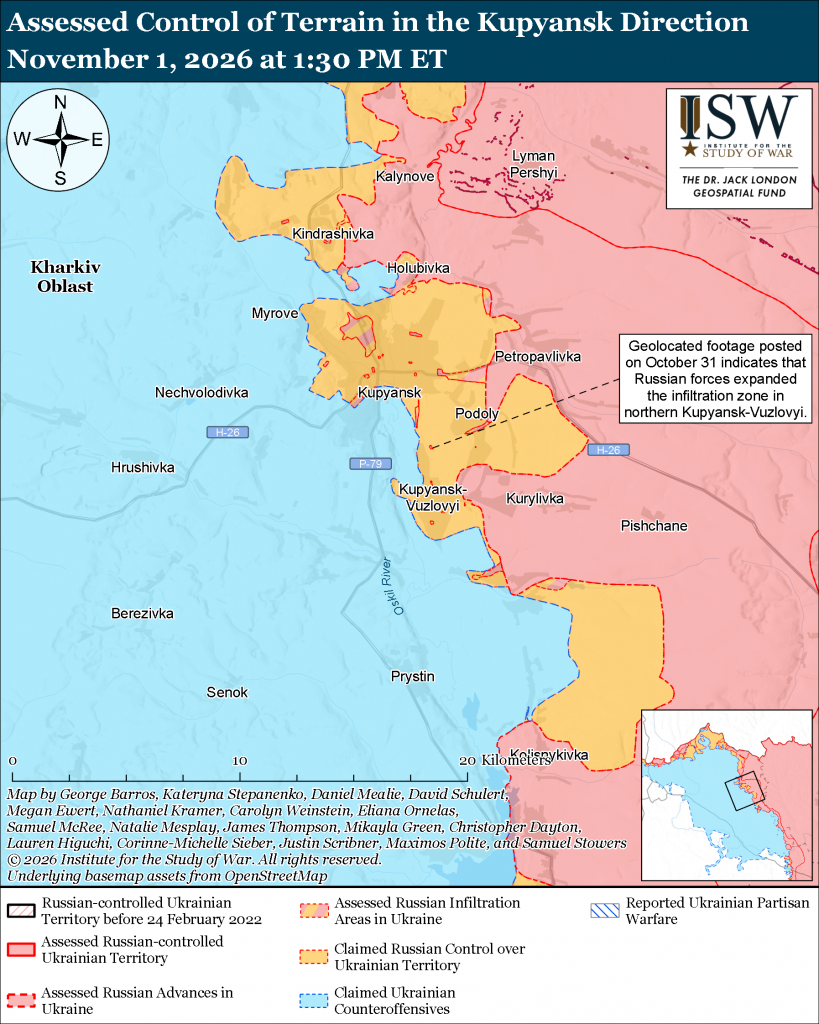
Russian milbloggers and a source reporting on the Russian Western GoF acknowledged Ukrainian advances northeast of Borova. A Kremlin-affiliated milblogger acknowledged on November 1 that Ukrainian forces advanced on the outskirts of Zelenyi Hai (northeast of Borova), likely on a prior date.[47] A source reporting on the Russian Western GoF stated on November 1 that Ukrainian forces recently advanced south of Zelenyi Hai.[48] ISW assessed on October 31 that Ukrainian forces advanced south of Zelenyi Hai, based on geolocated footage published on October 30 showing Russian forces shelling a Ukrainian position south of Zelenyi Hai.[49]
Russian Main Effort – Capture Ukraine's Fortress Belt and complete the seizure of Donetsk Oblast
Russian Subordinate Main Effort #1 – Encircle the Fortress Belt from the northwest (Russian objective: Seize Lyman and cross the Siverskyi Donets River to support a wide encirclement of the Fortress Belt – assessed objective of the Russian 25th Combined Arms Army and Western Grouping of Forces elements) Note: The Russian command does not appear to have formally abandoned its campaign plan for the Fortress Belt despite the operational defeat of that plan by Ukraine's Operation Vivaldi.
Russian forces continued offensive operations in the Lyman direction on October 31 and November 1 but did not advance, as Ukrainian forces counterattacked northeast and south of Lyman.[50]
Russian Subordinate Main Effort #2 – Advance on the Fortress Belt from the east (Russian objective: Advance on Slovyansk, Kramatorsk, and Druzhkivka from the east – assessed objective of the Russian 3rd Combined Arms Army and Southern Grouping of Forces elements)
Russian forces continued limited offensive operations east of Slovyansk and east of Kramatorsk on October 31 and November 1 but did not advance.[51]
Russian Subordinate Main Effort #3 – Advance on the Fortress Belt from the south (Russian objective: Advance on Kostyantynivka and Druzhkivka from the south and southwest, east of the Kazennyi Torets River – assessed objective of the Russian 8th Combined Arms Army and Southern Grouping of Forces elements)
Russian forces conducted an infiltration mission southwest of Kostyantynivka. Ukrainian forces struck a Russian servicemember north of Rusyn Yar (southwest of Kostyantynivka), according to geolocated footage published on November 1, after what ISW assesses was a Russian infiltration mission.[52]
Russian Subordinate Main Effort #4 – Encircle the Fortress Belt from the southwest (Russian objective: Conduct a wide encirclement of the Fortress Belt from near Dobropillya and Pokrovsk west of the Kazennyi Torets River – assessed objective of the Russian 51st Combined Arms Army and Central Grouping of Forces elements)
Russian forces continued offensive operations in the Dobropillya direction on October 31 and November 1 but did not advance, as Ukrainian forces counterattacked northeast of Dobropillya.[53]
Russian Supporting Effort – Advance into Dnipropetrovsk Oblast (Russian objective: Interdict Ukrainian ground lines of communication that support Ukrainian positions in Donetsk Oblast and envelop Ukrainian positions in southwestern Donetsk Oblast – assessed objective of elements of the Russian Central and Eastern groupings of forces)
Russian forces continued limited offensive operations in the Novopavlivka direction on October 31 and November 1 but did not advance.[54]
Russian forces continued limited offensive operations in the Oleksandrivka direction on October 31 and November 1 but did not advance.[55]
Russian Supporting Effort – Southern Axis (Russian objective: Maintain frontline positions, secure rear areas against Ukrainian strikes, and advance within tube artillery range of Zaporizhzhia City – assessed objective of the Russian Eastern and Dnepr grouping of forces)
Russian forces recently conducted an infiltration mission west of Hulyaipole. Ukrainian forces struck a Russian servicemember in the eastern outskirts of Verkhnya Tersa (west of Hulyaipole), according to geolocated footage published on October 31, after what ISW assesses was a Russian infiltration mission.[56]
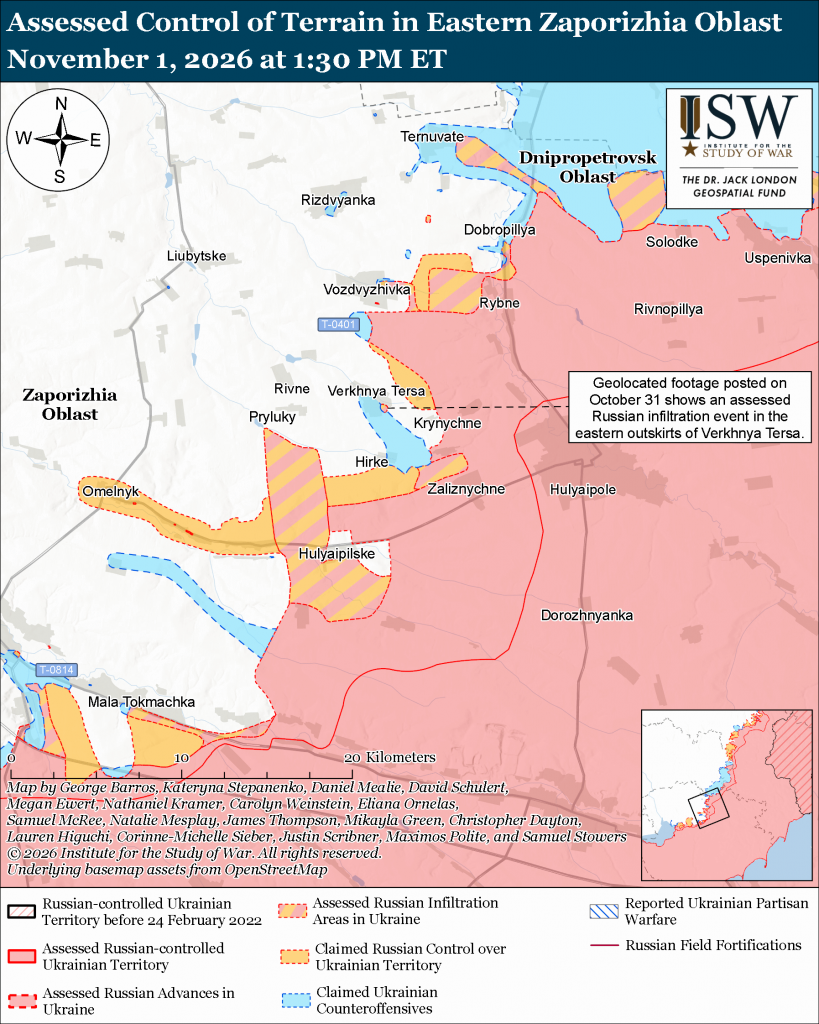
Russian forces conducted limited offensive operations west of Orikhiv on October 31 and November 1 but did not advance.[57]
Neither Ukrainian nor Russian sources reported ground activity in the Kherson direction on November 1.
The Ukrainian General Staff reported on November 1 that Ukrainian forces evacuated 167 civilians from areas on the right (west) bank of the Dnipro River in Kherson Oblast that Russian forces typically subject to daily shelling, taking advantage of the limited ceasefire in Kherson Oblast to do so.[58]
Russian Air, Missile, and Drone Campaign (Russian Objective: Target Ukrainian military and civilian infrastructure in the rear and on the frontline)
Note: The Ukrainian military ceased regularly reporting the number of Russian missiles fired and the number of missiles intercepted as of August 11.[59]
Russian forces utilized cloudy conditions over Ukraine to launch a large drone strike package including 433 drones but fewer jet-powered ones (only 64 jet-powered) against Ukraine overnight on October 31 to November 1.[60] Ukrainian Presidential Advisor on Defense Technologies Serhiy “Flash” Beskrestnov reported on October 31 that Russian forces attempted to capitalize on the presence of dense cloud cover over Ukraine to launch more conventional Shahed-type strike drones against Ukraine overnight rather than jet-powered ones, as Ukrainian air defense units would likely struggle to intercept them in these cloudy conditions.[61] It is notable that Ukrainian forces were still able to maintain a high interception rate for both the conventional (85.7 percent) and jet-powered drones (73.4 percent) overnight, despite these adverse conditions.[62] The Ukrainian Energy Ministry reported power outages in Zhytomyr, Donetsk, Zaporizhia, Kyiv, Kirovohrad, Dnipropetrovsk, Sumy, Cherkasy, and Kharkiv oblasts due to Russian strikes on October 31 to November 1.[63]
Significant activity in Belarus (Russian efforts to increase its military presence in Belarus and further integrate Belarus into Russian-favorable frameworks)
Nothing significant to report.
Note: ISW does not receive any classified material from any source, uses only publicly available information, and draws extensively on Russian, Ukrainian, and Western reporting and social media as well as commercially available satellite imagery and other geospatial data as the basis for these reports. References to all sources used are provided in the endnotes of each update.

[1] https://t.me/GeneralStaffZSU/42750
[2] https://t.me/robert_magyar/2947
[3] https://understandingwar.org/research/russia-ukraine/russian-offensive-campaign-assessment-october-1-2026/ ; https://understandingwar.org/research/russia-ukraine/russian-offensive-campaign-assessment-september-1-2026/ ; https://understandingwar.org/research/russia-ukraine/russian-offensive-campaign-assessment-may-8-2026/ ; https://understandingwar.org/research/russia-ukraine/russian-offensive-campaign-assessment-april-1-2026/; https://understandingwar.org/research/russia-ukraine/russian-offensive-campaign-assessment-april-21-2026/; https://understandingwar.org/research/russia-ukraine/russian-offensive-campaign-assessment-july-1-2026/
[4] https://understandingwar.org/research/russia-ukraine/ukraine-disrupts-russias-donetsk-offensive/
[5] https://understandingwar.org/research/russia-ukraine/russian-offensive-campaign-assessment-september-17-2026/ ; https://understandingwar.org/research/russia-ukraine/russian-offensive-campaign-assessment-september-11-2026/
[6] [Data taken from the Ukrainian General Staff’s daily 0800 SITREP between August 1, 2026, and November 1, 2026]
[7] https://understandingwar.org/research/russia-ukraine/russian-offensive-campaign-assessment-july-22-2026/; https://understandingwar.org/research/russia-ukraine/russian-offensive-campaign-assessment-august-10-2026/; https://understandingwar.org/research/russia-ukraine/russian-offensive-campaign-assessment-september-23-2026/; https://understandingwar.org/research/russia-ukraine/russian-offensive-campaign-assessment-september-24-2026/; https://understandingwar.org/research/russia-ukraine/russian-offensive-campaign-assessment-september-25-2026/; https://understandingwar.org/research/russia-ukraine/russian-offensive-campaign-assessment-october-6-2026/; https://understandingwar.org/research/russia-ukraine/russian-offensive-campaign-assessment-october-8-2026/; https://understandingwar.org/research/russia-ukraine/russian-offensive-campaign-assessment-october-20-2026/; https://understandingwar.org/research/russia-ukraine/russian-offensive-campaign-assessment-october-21-2026/; https://understandingwar.org/research/russia-ukraine/russian-offensive-campaign-assessment-october-24-2026/
[8] https://understandingwar.org/research/russia-ukraine/russian-offensive-campaign-assessment-august-29-2026/; https://understandingwar.org/research/russia-ukraine/russian-offensive-campaign-assessment-september-6-2026/; https://understandingwar.org/research/russia-ukraine/russian-offensive-campaign-assessment-september-13-2026/; https://understandingwar.org/research/russia-ukraine/russian-offensive-campaign-assessment-september-20-2026/; https://understandingwar.org/research/russia-ukraine/ukraine-disrupts-russias-donetsk-offensive/
[9] https://understandingwar.org/research/russia-ukraine/russian-offensive-campaign-assessment-september-12-2026/
[10] https://understandingwar.org/research/russia-ukraine/russian-offensive-campaign-assessment-september-12-2026/; https://understandingwar.org/research/russia-ukraine/russian-offensive-campaign-assessment-september-17-2026/; https://understandingwar.org/research/russia-ukraine/ukraine-disrupts-russias-donetsk-offensive/; https://understandingwar.org/research/russia-ukraine/russian-offensive-campaign-assessment-october-9-2026/
[11] [Data taken from the Ukrainian General Staff's 0800 daily sitrep between September 1 and October 31] https://t.me/GeneralStaffZSU/42741 ; https://t.me/GeneralStaffZSU/42733 ; https://t.me/GeneralStaffZSU/42725 ; https://t.me/GeneralStaffZSU/42084 ; https://t.me/GeneralStaffZSU/42091 ; https://t.me/GeneralStaffZSU/42100
[12] https://understandingwar.org/research/russia-ukraine/russian-offensive-campaign-assessment-october-14-2026/
[13] https://understandingwar.org/research/russia-ukraine/ukraine-disrupts-russias-donetsk-offensive/
[14] https://understandingwar.org/research/russia-ukraine/russian-offensive-campaign-assessment-october-12-2026/
[15] https://understandingwar.org/research/russia-ukraine/russian-offensive-campaign-assessment-october-14-2026/
[16] https://understandingwar.org/research/russia-ukraine/ukraine-disrupts-russias-donetsk-offensive/
[17] https://understandingwar.org/research/russia-ukraine/russian-offensive-campaign-assessment-july-3-2026/
[18] https://understandingwar.org/research/russia-ukraine/russian-offensive-campaign-assessment-september-28-2026/; https://understandingwar.org/research/russia-ukraine/russian-offensive-campaign-assessment-october-3-2026/; https://understandingwar.org/research/russia-ukraine/russian-offensive-campaign-assessment-october-6-2026/; https://understandingwar.org/research/russia-ukraine/russian-offensive-campaign-assessment-october-9-2026/; https://understandingwar.org/research/russia-ukraine/russian-offensive-campaign-assessment-october-30-2026/;
[19] https://understandingwar.org/research/russia-ukraine/russian-offensive-campaign-assessment-march-9-2026/; https://understandingwar.org/research/russia-ukraine/russian-offensive-campaign-assessment-september-15-2026/; https://understandingwar.org/research/russia-ukraine/russian-offensive-campaign-assessment-september-16-2026/; https://understandingwar.org/research/russia-ukraine/russian-offensive-campaign-assessment-october-21-2026/; https://understandingwar.org/research/russia-ukraine/russian-offensive-campaign-assessment-october-30-2026/
[20] https://understandingwar.org/research/russia-ukraine/russian-offensive-campaign-assessment-january-11-2026/; https://understandingwar.org/research/russia-ukraine/russian-offensive-campaign-assessment-september-16-2026/; https://understandingwar.org/research/russia-ukraine/russian-offensive-campaign-assessment-october-14-2026/; https://understandingwar.org/research/russia-ukraine/russian-offensive-campaign-assessment-october-21-2026/; https://understandingwar.org/research/russia-ukraine/russian-offensive-campaign-assessment-october-30-2026/
[21] https://understandingwar.org/research/russia-ukraine/russian-offensive-campaign-assessment-april-10-2026/
[22] https://understandingwar.org/research/russia-ukraine/russian-offensive-campaign-assessment-may-12-2026/; https://understandingwar.org/research/russia-ukraine/russian-offensive-campaign-assessment-july-1-2026/; https://understandingwar.org/research/russia-ukraine/russian-offensive-campaign-assessment-september-6-2026/; https://understandingwar.org/research/russia-ukraine/russian-offensive-campaign-assessment-september-13-2026/; https://understandingwar.org/research/russia-ukraine/russian-offensive-campaign-assessment-october-30-2026/
[23] https://understandingwar.org/research/russia-ukraine/the-myth-of-inevitable-russian-victory/
[24] https://understandingwar.org/research/russia-ukraine/russian-offensive-campaign-assessment-october-31-2026/
[25] https://understandingwar.org/research/russia-ukraine/russian-offensive-campaign-assessment-july-31-2026/; https://understandingwar.org/research/russia-ukraine/russian-offensive-campaign-assessment-september-4-2026/; https://understandingwar.org/research/russia-ukraine/russian-offensive-campaign-assessment-september-7-2026/; https://understandingwar.org/research/russia-ukraine/russian-offensive-campaign-assessment-september-24-2026/; https://understandingwar.org/research/russia-ukraine/the-myth-of-inevitable-russian-victory/
[26] https://understandingwar.org/research/russia-ukraine/russian-offensive-campaign-assessment-october-31-2026/ ; https://understandingwar.org/research/russia-ukraine/russian-offensive-campaign-assessment-october-1-2026/ ; https://understandingwar.org/research/russia-ukraine/russian-offensive-campaign-assessment-october-28-2026/ ; https://understandingwar.org/research/russia-ukraine/russian-offensive-campaign-assessment-october-21-2026/ ; https://understandingwar.org/research/russia-ukraine/russian-offensive-campaign-assessment-october-7-2026/
[27] https://understandingwar.org/research/russia-ukraine/russian-offensive-campaign-assessment-october-1-2026/ ; https://understandingwar.org/research/russia-ukraine/russian-offensive-campaign-assessment-october-8-2026/ ; https://understandingwar.org/research/russia-ukraine/russian-offensive-campaign-assessment-october-9-2026/ ; https://understandingwar.org/research/russia-ukraine/russian-offensive-campaign-assessment-october-10-2026/ ; https://understandingwar.org/research/russia-ukraine/russian-offensive-campaign-assessment-october-18-2026/ ; https://understandingwar.org/research/russia-ukraine/russian-offensive-campaign-assessment-october-30-2026/ ; https://understandingwar.org/research/russia-ukraine/russian-offensive-campaign-assessment-october-21-2026/ ; https://understandingwar.org/research/russia-ukraine/russian-offensive-campaign-assessment-october-19-2026/
[28] https://understandingwar.org/research/russia-ukraine/russian-offensive-campaign-assessment-october-6-2026/
[29] https://understandingwar.org/research/russia-ukraine/russian-offensive-campaign-assessment-october-22-2026/ ; https://understandingwar.org/research/russia-ukraine/russian-offensive-campaign-assessment-october-28-2026/
[30] https://understandingwar.org/research/russia-ukraine/russian-offensive-campaign-assessment-october-22-2026/
[31] https://understandingwar.org/research/russia-ukraine/russian-offensive-campaign-assessment-october-16-2026/ ; https://understandingwar.org/research/russia-ukraine/russian-offensive-campaign-assessment-october-4-2026/
[32] https://www.president dot gov.ua/news/nastupnogo-tizhnya-ukrayina-ochikuye-zbilshennya-postachanny-107101
[33] https://www.president dot gov.ua/news/nastupnogo-tizhnya-ukrayina-ochikuye-zbilshennya-postachanny-107101
[34] https://www.rferl dot org/a/rubio-atlanta-ukraine-russia-putin-lavrov-20/33888075.html
[35] https://www.army dot md/ro/comunicate-de-presa/informeaza-34
[36] https://www.mapn dot ro/cpresa/19461_comunicat-de-presa
[37] https://understandingwar.org/research/defense-of-europe/the-russian-military-campaign-against-europe-current-objectives-and-efforts/ ; https://understandingwar.org/research/russia-ukraine/russian-offensive-campaign-assessment-october-11-2026/ ; https://understandingwar.org/research/russia-ukraine/russian-offensive-campaign-assessment-october-16-2026/
[38] https://x.com/StratcomCentre/status/2116804321568321997
[39] https://x.com/Exilenova_plus/status/2116717743357780219?a=h8xbZC_GPb6Qau3rjB0; https://x.com/neonhandrail/status/2116733026143277234?a=NHVdM_jCy_Uhs0aHkMw; https://t.me/supernova_plus/62302
[40] https://t.me/glebnikitin_nn/10695 ; https://t.me/yuriy_shalabaev/7286
[41] https://understandingwar.org/research/russia-ukraine/russian-offensive-campaign-assessment-january-29-2025/; https://understandingwar.org/research/russia-ukraine/russian-offensive-campaign-assessment-august-3-2025/; https://understandingwar.org/research/russia-ukraine/russian-offensive-campaign-assessment-october-16-2025/; https://understandingwar.org/research/russia-ukraine/russian-offensive-campaign-assessment-november-4-2025/; https://understandingwar.org/research/russia-ukraine/russian-offensive-campaign-assessment-april-5-2026/; https://understandingwar.org/research/russia-ukraine/russian-offensive-campaign-assessment-may-19-2026/; https://understandingwar.org/research/russia-ukraine/russian-offensive-campaign-assessment-may-20-2026/; https://understandingwar.org/research/russia-ukraine/russian-offensive-campaign-assessment-june-26-2026/; https://understandingwar.org/research/russia-ukraine/russian-offensive-campaign-assessment-july-2-2026/; https://understandingwar.org/research/russia-ukraine/russian-offensive-campaign-assessment-august-26-2026/
[42] https://t.me/ministry_of_defense_ua/16490 ; https://understandingwar.org/research/russia-ukraine/russian-offensive-campaign-assessment-october-25-2026/ ; https://understandingwar.org/research/russia-ukraine/russian-offensive-campaign-assessment-october-26-2026/ ; https://understandingwar.org/research/russia-ukraine/russian-offensive-campaign-assessment-october-30-2026/
[43] https://t.me/V_Zelenskiy_official/21595 ; https://understandingwar.org/research/russia-ukraine/russian-offensive-campaign-assessment-october-31-2026/
[44]https://t.me/GeneralStaffZSU/42747 ; https://t.me/GeneralStaffZSU/42745 ; https://t.me/wargonzo/38065 ; https://t.me/severnnyi/9803
[45]https://t.me/severnnyi/9803 ; https://t.me/GeneralStaffZSU/42747 ; https://t.me/GeneralStaffZSU/42745 ; https://t.me/wargonzo/38065
[46] https://x.com/Bielitzling/status/2116553538541404455; https://t.me/skyraders/1328; https://x.com/RoadtoMars9/status/2116638412820361474
[47] https://t.me/rybar/84321
[48] https://t.me/grvZapad/20249
[49] https://understandingwar.org/research/russia-ukraine/russian-offensive-campaign-assessment-october-31-2026/
[50]https://t.me/GeneralStaffZSU/42747 ; https://t.me/GeneralStaffZSU/42745 ; https://t.me/wargonzo/38065 ; https://t.me/grvZapad/20249
[51] https://t.me/GeneralStaffZSU/42745 ; https://t.me/GeneralStaffZSU/42747
[52] https://x.com/93OMBr1/status/2116804152235856097 ; https://x.com/moklasen/status/2116849346557730994
[53] https://t.me/GeneralStaffZSU/42745 ; https://t.me/GeneralStaffZSU/42747 ; https://t.me/wargonzo/38065 ; https://t.me/rybar/84321
[54] https://t.me/GeneralStaffZSU/42745 ; https://t.me/GeneralStaffZSU/42747
[55] https://t.me/GeneralStaffZSU/42745 ; https://t.me/GeneralStaffZSU/42747 ; https://t.me/voin_dv/21859
[56]https://t.me/OSHP_225/5548 ; https://t.me/creamy_caprice/13346
[57] https://t.me/GeneralStaffZSU/42745 ; https://t.me/GeneralStaffZSU/42747
[58]https://www.facebook.com/GeneralStaff.ua/posts/pfbid024H88GyUvTUUD67XuBFPSdUy3CADJR7v8yHsh4xQL8JnbtTpmjwD2xLGwGbXd6S18l
[59] https://www.bloomberg.com/news/articles/2026-08-11/ukraine-stops-reporting-russia-missile-data-as-defenses-struggle?srnd=homepage-americas; https://understandingwar.org/research/russia-ukraine/russian-offensive-campaign-assessment-august-11-2026/
[60] https://t.me/kpszsu/92012
[61] https://t.me/serhii_flash/7836
[62] https://t.me/kpszsu/92012
[63] https://t.me/energyofukraine/8195
[GM3]Fred add AO 10/25
View Citations