{{currentView.title}}
July 28, 2026
Iran Update Special Report, July 28, 2026
The Institute for the Study of War (ISW) and The Critical Threats Project (CTP) at the American Enterprise Institute are publishing daily updates to provide analysis on the war with Iran. The updates cover events from the past 24-hour period.
Key Takeaways:
- There are three competing groups within the regime that are attempting to influence negotiations policy. The group currently arguing for negotiations and total control over the strait is likely guiding policy at this time. This group is likely led by elements of the Islamic Revolutionary Guards Corps (IRGC), including IRGC commander Major General Ahmad Vahidi.
- The “IRGC-Vahidi" group is under pressure from a pro-negotiations and pro-compromise group that likely includes but is not limited to President Masoud Pezeshkian, Foreign Affairs Minister Abbas Araghchi, and Parliament Speaker Mohammad Bagher Ghalibaf. This group primarily disagrees with the IRGC-Vahidi group over means, not ends. This group also seeks “control” of the strait, though its definition of control may be less expansive.
- The third group is an ultra-hardline faction, the Paydari Front, which opposes all negotiations with the United States. This group is a small minority, but its proximity to power through regime insiders like Saeed Jalili, who is currently a Supreme Leader representative on Iran’s top national security decision-making body — the Supreme National Security Council — and previously chaired the council, would likely require Vahidi and other policymakers to take note of its views.
- Concerns from pro-negotiation corners in Iran over continued US sanctions, the US blockade, and economic damage from the war underscore the risk Iran faces in continuing the war indefinitely. Economic challenges caused by the US blockade were one of the reasons Pezeshkian argued the MoU’s case to the supreme leader in June, according to the New York Times, which indicates that at least some regime actors believe the present situation is untenable for Iran.
- Iran continues to reject compromises to Iranian control of the Strait of Hormuz because hardline decisionmakers perceive control of the waterway as the regime’s most reliable means of preserving future leverage. Iran is refusing to give up control of the strait in talks with Omani mediators as the mediators have proposed a formal 10-day truce, according to a US official and mediators speaking to Western media on July 27.
- The Houthis claimed to have struck a Saudi vessel on July 28, marking their third claimed attack on Saudi shipping since July 22. Houthi military spokesperson Yahya Sarea announced on July 28 that the Houthis fired several ballistic missiles targeting the Saudi-flagged oil and chemical tanker NCC Ghazal for "violating" the Houthi blockade.
- The People's Republic of China (PRC) reportedly asked the Houthis to facilitate safe passage for Chinese-owned oil tankers through the Red Sea, according to six informed sources speaking to Reuters on July 28. Reuters, citing commercial ship tracking data, reported on July 28 that at least four tankers transporting Saudi oil to China transited the Bab al Mandeb since the Houthis announced their blockade on July 20.
Toplines
There are three competing groups within the regime that are attempting to influence negotiations policy. The group currently arguing for negotiations and total control over the strait is likely guiding policy at this time. This group is likely led by elements of the Islamic Revolutionary Guards Corps (IRGC), including IRGC commander Major General Ahmad Vahidi.[i] The IRGC-Vahidi group appears willing to negotiate with the United States but is totally unwilling to end the war on terms that preclude complete control of the strait. This group acquiesced to the MoU in June, but the IRGC again began firing on shipping after it became clear that Iran could not achieve complete control.[ii] An IRGC-affiliated outlet, Tasnim, summarized this viewpoint in an op-ed on July 28, stating that the strait is “not something that can be easily replaced,” and noted that some people have said that abandoning the strait will be equal to failure for Iran in this conflict.[iii]
The IRGC-Vahidi group is under pressure from a pro-negotiations and pro-compromise group that likely includes but is not limited to President Masoud Pezeshkian, Foreign Affairs Minister Abbas Araghchi, and Parliament Speaker Mohammad Bagher Ghalibaf. This group primarily disagrees with the IRGC-Vahidi group over means, not ends. This group also seeks “control” of the strait, though its definition of control may be less expansive. It sees negotiations as a way to secure some degree of control over the strait without suffering further economic pain. The New York Post, citing regional sources, reported on July 26 that the pro-negotiations camp was frustrated with IRGC “escalation” after it derailed “dialogue” with the United States during an unspecified period.[iv] Pezeshkian also successfully convinced the supreme leader—who is close to the IRGC—to agree to the MoU, according to the New York Times.[v] Tasnim’s July 28 op-ed noted that others in Iran have warned against not compromising over the strait because of the “consequences” it will inflict on Iran.[vi] The op-ed is almost certainly referring to Iran’s economic hardship from the continued US naval blockade, sanctions, and frozen assets, which the United States has offered to lift in exchange for the freedom of navigation through the strait.[vii] The op-ed implies that some element of the regime is arguing for compromise in policy circles.[viii] An Iranian outlet previously linked to chief negotiator and Parliament Speaker Mohammad Bagher Ghalibaf argued on July 15 that insinuated that Iran should avoid overcommitting resources to controlling the strait if doing so comes at the expense of regime stability or preserving its nuclear capabilities.[ix] An Iranian Parliament National Security and Foreign Policy committee member similarly urged hardliners to relax their policies regarding the strait during a parliamentary debate on July 23.[x] President Masoud Pezeshkian has consistently warned the regime and public about the consequences this war is having on the Iranian economy.[xi]
The third group is an ultra-hardline faction, the Paydari Front, which opposes all negotiations with the United States. This group is a small minority, but its proximity to power through regime insiders like Saeed Jalili, who is currently a Supreme Leader representative on Iran’s top national security decision-making body — the Supreme National Security Council — previously chaired the council, would likely require Vahidi and other policymakers to take note of its views.[xii] The faction advocates for a strict no-negotiation policy with the United States rooted in its interpretation of revolutionary principles.[xiii] The call back to revolutionary principles can create challenges for regime leaders as they attempt to advance talks due to concerns about revolutionary credibility.[xiv]
Concerns from pro-negotiation corners in Iran over continued US sanctions, the US blockade, and economic damage from the war underscore the risk Iran faces in continuing the war indefinitely. Economic challenges caused by the US blockade were one of the reasons Pezeshkian argued the MoU’s case to the supreme leader in June, according to the New York Times, which indicates that at least some regime actors believe the present situation is untenable for Iran.[xv] On-again-off-again airstrikes have precluded any serious economic reconstruction in Iran. Many Iranians have been laid off since the war began, including, presumably, regime supporters whom the regime would like to satisfy.[xvi] These layoffs also come amid recent US intelligence assessments that the Iranian regime is struggling to pay its armed forces due to US sanctions.[xvii] The rial has collapsed, unemployment rates remain high, and the Iranian people endure shortages of basic goods.[xviii] The economic challenges across the country also pose a real risk to internal security—given recent mass protests—especially during a major war. Iran’s top national security decision-making body – the Supreme National Security Council – is aware of the risk of renewed anti-regime protest.[xix] CTP-ISW recorded the first mass gathering of protesters on July 28 since the regime suppressed the protests in January. At least 100 residents in Malekshahr, Esfahan Province, protested the Judiciary’s execution of three protesters involved in the December 2025-January 2026 protests on July 28.[xx] These protests are notable because it is a public display of support for individuals killed for protesting economic conditions, not necessarily because the protests will spread. Iran is concurrently attempting to manage the ongoing threat of Kurdish insurgent activity in northwestern Iran.[xxi] It is impossible to assess when or if any, all, or some of these issues will threaten regime stability, however.
Iran continues to reject compromises to Iranian control of the Strait of Hormuz because hardline decisionmakers perceive control of the waterway as the regime’s most reliable means of preserving future leverage. Iran is refusing to give up control of the strait in talks with Omani mediators as the mediators have proposed a formal 10-day truce, according to a US official and mediators speaking to Western media on July 27.[xxii] The proposal reportedly requires Iran to reopen the strait and, in exchange, the United States would lift the naval blockade on Iranian ports and consider unfreezing Iranian assets.[xxiii] Oman also proposed a regional consortium to manage the strait and reproposed donations for shipping companies for strait maintenance as part of this plan.[xxiv] Oman’s proposal to establish a regional consortium aligns with the defunct US-Iran memorandum of understanding, which required Iran to consult Oman and other Gulf states on Strait of Hormuz management.[xxv] Oman previously proposed voluntary fees from shipping firms before the US and Iran’s most recent wave of strikes in July, according to the Wall Street Journal on July 2.[xxvi] Iran rejected the proposal and maintained its demand to levy fees.[xxvii] Iran’s rejection of this reported deal shows that Iran may calculate that it can pressure the United States into lifting the blockade or extract further economic concessions without giving up the strait. Iran’s top wartime operations coordination body, the Khatam ol Anbia Central Headquarters, called the US naval blockade an escalation in the war on July 27 and stated the Iranian armed forces will respond accordingly.[xxviii]
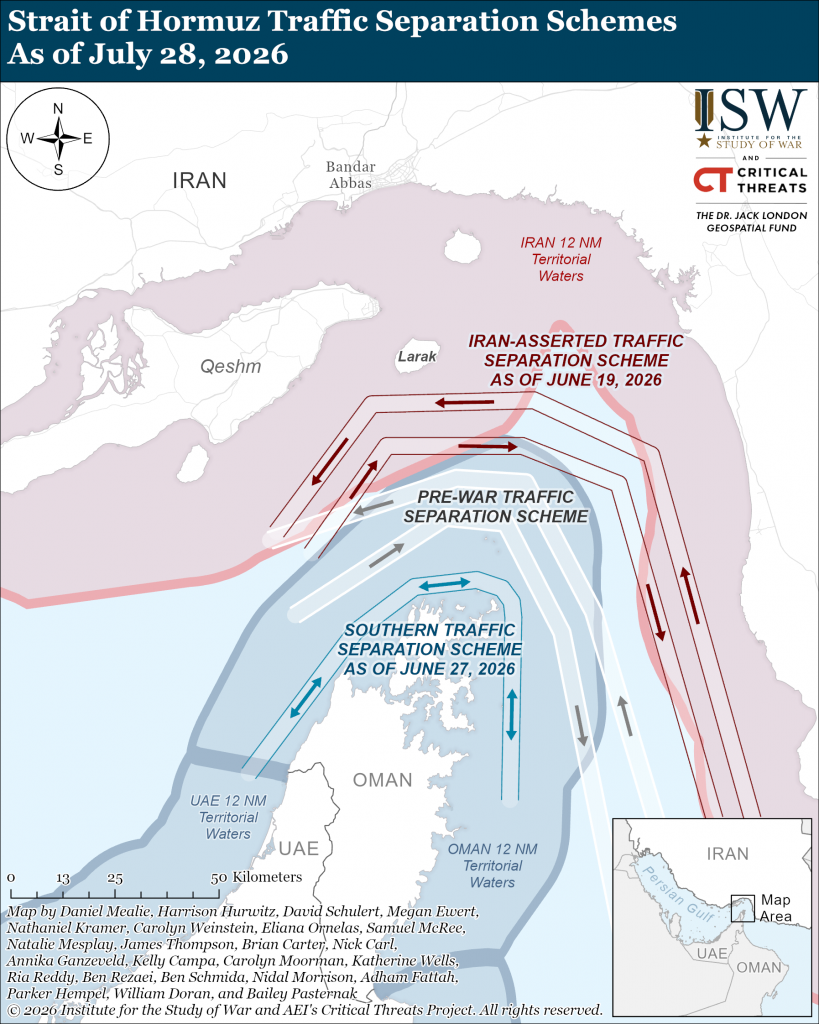
Iranian regime officials and media continue to highlight how important the strait is in retaining Iran’s long-term security. Iranian Deputy Foreign Affairs Minister for Legal and International Affairs Kazem Gharibabadi called the strait a very important indicator for assessing Iran’s success in war, as any arrangements on the strait will “ensure” Iran’s long term security, and stated that Iran “is not afraid of any action to establish its sovereignty” in the strait or of the resumption of war in an interview with regime media on July 28.[xxix]
The Houthis claimed to have struck a Saudi vessel on July 28, marking their third claimed attack on Saudi shipping since July 22.[xxx] Houthi military spokesperson Yahya Sarea announced on July 28 that the Houthis fired several ballistic missiles targeting the Saudi-flagged oil and chemical tanker NCC Ghazal for "violating" the Houthi blockade.[xxxi] United Kingdom Maritime Operations Center has not confirmed the attack at the time of this writing. The Ghazal departed Yanbu Port on July 23 and has turned off its automatic identification system, according to commercially available ship tracking data.[xxxii] The Houthi blockade and attacks on Saudi oil infrastructure support Iran's effort to coerce the United States and Gulf states into accepting Iranian control over the Strait of Hormuz by disrupting alternative export routes.[xxxiii] These attacks also support the Houthis’ objective of coercing Saudi Arabia to lift its blockade on Houthi-controlled ports and airports and deter future Saudi strikes on Houthi targets in Yemen.[xxxiv]
The People's Republic of China (PRC) reportedly asked the Houthis to facilitate safe passage for Chinese-owned oil tankers through the Red Sea, according to six informed sources speaking to Reuters on July 28.[xxxv] One source said that unspecified Chinese officials “have cleared each ship individually“ with the Houthis.[xxxvi] Reuters, citing commercial ship tracking data, reported on July 28 that at least four tankers transporting Saudi oil to China transited the Bab al Mandeb since the Houthis announced their blockade on July 20.[xxxvii] The Houthis similarly said that they refrained from attacking Chinese vessels during their attacks on Red Sea shipping from 2023 to 2025.[xxxviii] Western media reported in March 2024 that Chinese and Russian diplomats reached an agreement with the Houthis in Oman to ensure that the Houthis would not target their ships.[xxxix]
US and Partner Military Operations
Nothing significant to report.
Iranian Strike Campaign
-
Assessed Iranian War Aims:
- Secure international recognition of Iranian control over the Strait of Hormuz
- Degrade the US ability and willingness to continue the war
- Restore deterrence vis-à -vis the United States and its regional partners
- Divide the United States and Israel from the Arab states
The Iranian regime’s English-language media outlet, Press TV, reported on July 28 that Iranian forces used “358” missiles, “Majid” air defense systems, and “Ghaem-118” interceptor missiles to down US MQ-9 Reaper drones during the conflict.[xl] The IRGC Aerospace Force designed the 358 surface-to-air cruise missile in 2019 to intercept low-altitude and low-speed aerial threats such as drones and helicopters, according to Iranian media.[xli] The 358 missile has a 100-kilometer range, an 8,500-meter ceiling, and a cruise speed of about 700 kilometers per hour.[xlii] The AD-08 Majid is a short-range, low-altitude air defense system that can reportedly engage up to four targets at ranges of 700 meters to 8 kilometers and altitudes of 20 meters to 6 kilometers.[xliii] The Ghaem 118 has a 25-kilometer range and uses radar, electro-optical, and thermal guidance.[xliv]
US-Iran Negotiations
See topline section.
Iranian Domestic Affairs
See topline section.
Lebanon
The Lebanese Armed Forces (LAF) seized a Hezbollah weapons cache in one of the “pilot zones” in southern Lebanon for the first time on July 27, according to an Israeli public news outlet.[xlv] This marks the first LAF clearing operation under the June 26 Trilateral Framework Agreement, which requires the LAF to disarm Hezbollah in the pilot zones in coordination with the Military Coordination Group for Lebanon, which includes the Israel Defense Forces (IDF).[xlvi] The LAF reportedly notified the Coordination Group of the seizure on July 27.[xlvii] CTP-ISW has not observed any documented evidence of the reported Hezbollah weapons cache seizure, however. It is also unclear whether the LAF searched private property to find the cache. Saudi media reported on July 22 that the Lebanese judiciary was considering implementing legal mechanisms that would allow the LAF to search private property in the “pilot zones,” but it remains unclear whether this mechanism has been implemented.[xlviii] The LAF conducted limited private property searches during previous efforts to disarm Hezbollah after the November 2024 ceasefire.[xlix] US, Israeli, and Lebanese delegations are expected to meet in Rome from August 4 to August 6 to discuss expanding the ”pilot zones,” according to an unspecified State Department official speaking to Axios on July 27.[l] The delegations previously convened in Rome to discuss the ”pilot zones” and the Agreement from July 14 to July 15.[li]
Iraq
The Islamic Resistance in Iraq denied Saudi “accusations” that attacks on oil facilities in Riyadh and eastern Saudi Arabia originated from Iraq on July 27.[lii] The Islamic Resistance in Iraq is a coalition of Iranian-backed Iraqi militias.[liii] Saudi Arabia stated on July 27 that it shot down drones launched from Iraq that targeted oil facilities in Saudi Arabia’s Eastern Province and in Riyadh.[liv] An attack by an unidentified projectile also caused a fire at the Abqaiq oil facility in the Eastern Province on July 27, but no actor has claimed responsibility for the attack at the time of this writing.[lv] The Islamic Resistance in Iraq added in its statement on July 27 that the group would respond “harshly” to any “foolish” Saudi action.[lvi] Iranian-backed Iraqi militias conducted multiple attacks on Saudi Arabia in March and April during the war and, in response, Saudi Arabia reportedly struck militia targets in Iraq in April.[lvii] Iraqi National Security Advisor Qasim al Aboudi said on July 28 that there is “no evidence” that the drones used in recent attacks against Gulf states originated from Iraq.[lviii] Iranian-backed Iraqi militias also likely conducted a drone attack on July 23 that targeted Kuwait’s Abdali border crossing with Iraq.[lix] Iraqi Prime Minister Ali al Zaydi directed the Iraqi security agencies to investigate Saudi Arabia’s July 27 claims of attacks launched from Iraq, and the committee involved in the investigation held high-level talks with Saudi officials on July 28.[lx]
Jordan intercepted a drone in its eastern desert near Iraq on July 28 that was likely launched by the Iraqi militias.[lxi] Jordanian air defenses also intercepted two drones on July 27, which Israeli media reported were launched from areas of Iraq controlled by Iraqi militias.[lxii] Recent attacks by Iranian partners and proxies, including against Saudi Arabia, allow Iran to maintain plausible deniability while pressuring the United States to accept terms favorable to Iran, including Iranian control over the Strait of Hormuz.
A Kurdistan Democratic Party (KDP) member claimed on July 28 that an unspecified brigade of the Iranian-backed Popular Mobilization Forces (PMF) located in the Ninewa Plains is conducting rocket and drone attacks targeting Iraqi Kurdistan.[lxiii] The KDP member is likely referring to the Kataib Hezbollah and Harakat Hezbollah al Nujaba-affiliated 50th PMF Brigade and the Badr-affiliated 30th PMF Brigade, which both supported militia attacks on Iraqi Kurdistan in March and April.[lxiv] The PMF is an Iraqi state security service that includes many Iranian-backed Iraqi militias, such as Asaib Ahl al Haq and the Badr Organization, that answer to Iran instead of the Iraqi Prime Minister.[lxv] The United States sanctioned the senior officials within the 30th and 50th PMF Brigades for human rights abuses in July 2019.[lxvi] US-led international coalition forces separately intercepted multiple drones launched by unidentified actors in Iraqi Kurdistan on July 27, according to Iraqi media.[lxvii] A local source said that initial information indicates that the drones were targeting the US Consulate in Erbil.[lxviii] US-led international coalition forces have intercepted numerous drones that targeted the US Consulate in Erbil and the Erbil International Airport, which hosts a US base, in recent days.[lxix] Iranian-backed Iraqi militias also frequently attacked these targets in March and April.[lxx]
Iraqi National Security Advisor Qasim Aboudi said on July 28 that the Iraqi federal government has requested the continued presence of NATO Training Mission-Iraq military advisors to assist the Iraqi Security Forces (ISF) with military planning, training, and development.[lxxi] US-led international coalition forces are expected to withdraw from Iraq by the end of September as their mission to counter the Islamic State in Iraq and al Sham (ISIS) ends.[lxxii] NATO began its mission in Iraq in 2018 to focus on training and advising the ISF.[lxxiii] NATO Training Mission-Iraq troops withdrew from Iraq in March due to the war and still appear to be based in Naples, Italy.[lxxiv] Arabian Peninsula
The Bahrain Defense Force began conducting a combined Gulf Cooperation Council (GCC) military exercise on July 30 that will continue until July 30.[lxxv] It is unclear what specific exercises the GCC militaries will conduct.[lxxvi] The GCC previously conducted the Gulf Shield Exercise 2026 to improve air and air defense cooperation, operational integration, and command-and-control systems among member states.[lxxvii] Iran has concentrated attacks on the Gulf states and threatened their oil exports through its illegal control of the Strait of Hormuz.[lxxviii]

[i] https://understandingwar.org/research/middle-east/iran-update-special-report-june-8-2026/
[ii] https://www.npr.org/2026/06/18/nx-s1-5863027/us-iran-trump-memorandum-of-understanding-full-text
[iii] https://www.tasnimnews dot ir/fa/news/1405/05/06/3658224/
[iv] https://nypost.com/2026/07/25/world-news/irans-leaders-at-war-with-each-other-as-hardliners-push-for-wider-conflict/)
[v] https://www.nytimes.com/2026/06/19/world/middleeast/mojtaba-khamenei-iran-deal-reaction.html
[vi] https://www.tasnimnews dot ir/fa/news/1405/05/06/3658224/
[vii] https://www.wsj.com/world/middle-east/iran-and-oman-seek-agreement-on-the-hormuz-in-bid-to-jumpstart-peace-talks-d4c442ac
[viii] https://www.wsj.com/world/middle-east/iran-and-oman-seek-agreement-on-the-hormuz-in-bid-to-jumpstart-peace-talks-d4c442ac
[ix] https://understandingwar.org/research/middle-east/iran-update-special-report-july-16-2026/; https://www.asriran dot com/fa/news/1177470/
[x] https://x.com/IranIntl/status/2080237223933313449?s=20
[xi] https://iranwire.com/en/news/150515-exclusive-irgc-has-no-post-war-plan-pezeshkian-warns/; https://www.nytimes.com/2026/04/11/world/middleeast/iran-economy-war.html https://www.nytimes.com/2026/04/23/world/middleeast/iran-new-leadership-generals.html
[xii] https://www.unitedagainstnucleariran.com/saeed-jalili-former-secretary-of-supreme-national-security-council; https://iranwire.com/en/features/151703-what-is-happening-in-tehran-the-dispute-over-the-path-and-meaning-of-negotiations/#google_vignette
[xiii] https://www.cnn.com/2026/05/09/middleeast/iran-conflict-politics-hardline-intl
[xiv] https://iranwire.com/en/features/151703-what-is-happening-in-tehran-the-dispute-over-the-path-and-meaning-of-negotiations/#google_vignette; https://www.iranintl.com/en/202607165993; https://x.com/IranIntl/status/2080237223933313449?s=20
[xv] https://www.nytimes.com/2026/06/19/world/middleeast/mojtaba-khamenei-iran-deal-reaction.html
[xvi] https://www.bbc.com/news/articles/ce84e31376zo
[xvii] https://www.axios.com/2026/07/27/iran-war-trump-sanctions-blockade-economy
[xviii] https://www.cnbc.com/2026/04/23/iran-economy-war-charts-rial-oil-strait-hormuz-blockade.html; https://www.theatlantic.com/international/2026/06/iran-economy-crisis/687489/; https://www.iranintl.com/en/202607145906
[xix] https://iranwire.com/en/news/155412-nour-news-reveals-details-of-khameneis-final-meeting/
[xx] https://x.com/IranIntl/status/2082090940777316464?s=20; https://x.com/IranIntl/status/2082026177808449788?s=20;
[xxi] https://t.me/farsna/452947
[xxii] https://www.wsj.com/world/middle-east/iran-and-oman-seek-agreement-on-the-hormuz-in-bid-to-jumpstart-peace-talks-d4c442ac; https://www.reuters.com/world/asia-pacific/gulf-states-back-plan-let-iran-collect-voluntary-fees-use-hormuz-2026-07-28/
[xxiii] https://www.wsj.com/world/middle-east/iran-and-oman-seek-agreement-on-the-hormuz-in-bid-to-jumpstart-peace-talks-d4c442ac
[xxiv] https://www.wsj.com/world/middle-east/iran-and-oman-seek-agreement-on-the-hormuz-in-bid-to-jumpstart-peace-talks-d4c442ac
[xxv] https://www.bbc.com/news/articles/c4gy700j0eko
[xxvi] https://www.wsj.com/world/middle-east/u-s-dangles-rewards-for-opening-the-strait-of-hormuz-iran-isnt-budging-07d99135
[xxvii] https://www.reuters.com/world/asia-pacific/gulf-states-back-plan-let-iran-collect-voluntary-fees-use-hormuz-2026-07-28/
[xxviii] https://t.me/Nournews_ir/379371
[xxix] https://www.tabnak dot ir/fa/news/1387026/
[xxx] https://x.com/MMY1444/status/2082152059734995159 ; https://t.me/army21ye/3588 ; https://x.com/UK_MTO/status/2080043376351535532 ; https://understandingwar.org/research/middle-east/iran-update-special-report-july-23-2026/
[xxxi] https://x.com/MMY1444/status/2082152059734995159 ; https://www.marinetraffic.com/en/ais/details/ships/shipid:714580/mmsi:403038000/imo:9685205/vessel:NCC%20GHAZAL
[xxxii] Starboard Maritime Intelligence. Available by subscription at https://www.starboardintelligence.com/
[xxxiii] https://understandingwar.org/research/middle-east/iran-update-special-report-july-27-2026/ ; https://understandingwar.org/research/middle-east/iran-update-special-report-july-23-2026/ ; https://x.com/MMY1444/status/2080986931974787307?s=20 ; https://x.com/MT_Anderson/status/2081508491727085967?s=20 ; https://apnews.com/article/iran-us-hormuz-strait-war-25-july-2026-df3790320c595f3e599fb1dd69423e77 ; https://x.com/BashaReport/status/2080948398375453128?s=20
[xxxiv] https://understandingwar.org/research/middle-east/iran-update-special-report-july-27-2026/ ; https://x.com/MMY1444/status/2081725503187124259?s=20 ; https://x.com/abdusalamsalah/status/2080623640953974907?s=20 ; https://www.bbc.com/news/articles/cpw9xzx9r4ko ; https://x.com/MMY1444/status/2081010307627913645?s=20
[xxxv] https://www.reuters.com/world/china/china-touch-with-yemens-houthis-allow-ships-sail-through-red-sea-sources-say-2026-07-28/
[xxxvi] https://www.reuters.com/world/china/china-touch-with-yemens-houthis-allow-ships-sail-through-red-sea-sources-say-2026-07-28/
[xxxvii] https://www.reuters.com/world/china/china-touch-with-yemens-houthis-allow-ships-sail-through-red-sea-sources-say-2026-07-28/
[xxxviii] https://www.atlanticcouncil.org/blogs/menasource/how-china-turned-the-red-sea-into-a-strategic-trap-for-the-us/ ; https://www.bbc.com/news/articles/cvgve0vxy1yo
[xxxix] https://www.bloomberg.com/news/articles/2024-03-21/china-russia-reach-agreement-with-yemen-s-houthis-on-red-sea-ships
[xl] https://www.presstv dot co.uk/Detail/2026/07/28/773227/iranian-skies-turn-graveyard-america-most-famed-combat-drone-mq9-repear
[xli] https://www.rouydad24 dot ir/fa/news/459341/
[xlii] https://www.rouydad24 dot ir/fa/news/459341/
[xliii] https://www.unmannedairspace.info/counter-uas-systems-and-policies/iran-unveils-ad-08-majid-c-uas-system-with-15km-range/
[xliv] https://defapress dot ir/fa/news/727860/
[xlv] https://www.kan dot org.il/content/kan-news/defense/1082109/
[xlvi] https://www.state.gov/releases/office-of-the-spokesperson/2026/06/trilateral-framework-between-the-united-states-of-america-the-state-of-israel-and-the-republic-of-lebanon/ ; https://x.com/HibaNasr/status/2071617895331746115
[xlvii] https://www.kan dot org.il/content/kan-news/defense/1082109/
[xlviii] https://aawsat dot com/العالم-العربي/المشرق-العربي/5298995-الجيش-اللبناني-يتقصى-المخاطر-بالمناطق-التجريبية-لتأمين-عودة
[xlix] https://understandingwar.org/research/middle-east/iran-update-special-report-july-15-2026/ ; https://www.reuters.com/world/middle-east/israel-pushes-lebanon-army-search-more-intrusively-hezbollah-arms-sources-say-2025-11-10/ ; https://understandingwar.org/research/middle-east/iran-update-december-15-2025/ ; https://www.washingtoninstitute.org/policy-analysis/operationalizing-trilateral-framework-agreement
[l] https://x.com/BarakRavid/status/2081899364809662508
[li] https://www.reuters.com/world/europe/lebanon-israel-hold-us-brokered-talks-rome-implement-framework-deal-2026-07-14/
[lii] https://t.me/centerkaf/5728
[liii] https://www.washingtoninstitute.org/policy-analysis/profile-islamic-resistance-iraq
[liv] https://x.com/modgovksa/status/2081713360127570277?s=20 ; https://www.reuters.com/world/middle-east/iran-says-it-still-controls-strait-not-seeking-talks-after-trump-halts-bombing-2026-07-27/
[lv] https://x.com/ariel_oseran/status/2081768090811985990
[lvi] https://t.me/centerkaf/5728
[lvii] https://www.reuters.com/world/middle-east/saudi-warplanes-struck-militias-iraq-during-war-sources-say-2026-05-13/ ; https://www.al-monitor.com/originals/2026/05/majority-attacks-saudi-arabia-carried-out-pro-iran-militias-iraq
[lviii] https://www.rudaw dot net/english/categories/iraq/1078558
[lix] https://understandingwar.org/research/middle-east/iran-update-special-report-july-23-2026/ ; https://t.me/mehrnews/399220; https://t.me/mehrnews/399219; https://x.com/acceladealer/status/2080251282153980044?s=20; https://x.com/acceladealer/status/2080251285773684935?s=20;
[lx] https://964media dot com/702602/ ; https://shafaq dot com/ar/سیاسة/الزيدي-يوجه-بالتحقيق-باستهداف-السعودية-بمسيرات-من-العراق
[lxi] https://english.aawsat dot com/arab-world/5300780-jordan-army-says-it-downed-drone-eastern-desert
[lxii] https://nypost.com/2026/07/27/world-news/saudi-arabia-jordan-and-iraq-report-drone-attacks/ ; https://x.com/kann_news/status/2081802342026854452
[lxiii] https://www.alsumaria dot tv/news/politics/571629/الديمقراطي-الكردستاني-لواء-في-الحشد-بسهل-نينوى-يرسل-المسيرات-والكاتيوش
[lxiv] https://ctc.westpoint.edu/wp-content/uploads/2026/06/CTC-SENTINEL-062026_cover-article.pdf pg 14 ; https://www.washingtoninstitute.org/policy-analysis/profile-hashd-al-shabak-30th-pmf-brigade ; https://www.washingtoninstitute.org/policy-analysis/profile-kataib-babiliyoun-50th-pmf-brigade
[lxv] https://understandingwar.org/research/middle-east/the-leadership-and-purpose-of-iraqs-popular-mobilization-forces/
[lxvi] https://www.washingtoninstitute.org/policy-analysis/profile-hashd-al-shabak-30th-pmf-brigade ;https://www.washingtoninstitute.org/policy-analysis/profile-kataib-babiliyoun-50th-pmf-brigade
[lxvii] https://shafaq dot com/ar/كوردســتانيات/التحالف-الدولي-يدمر-طا-رة-مسيرة-في-سما-ربيل
[lxviii] https://shafaq dot com/ar/كوردســتانيات/التحالف-الدولي-يدمر-طا-رة-مسيرة-في-سما-ربيل
[lxix] https://x.com/Osint613/status/2080569480049012952 ; https://t.me/mehrnews/397914 ; https://x.com/KurdistanWatch/status/2077491979881980255 ; https://x.com/KurdistanWatch/status/2077462290816000177 ; https://shafaq dot com/en/Kurdistan/Three-drones-downed-near-US-Consulate-in-Erbil
[lxx] https://understandingwar.org/research/middle-east/iran-update-special-report-july-21-2026/ ; https://shafaq dot com/ar/كوردســتانيات/سقاط-مسي-رة-جديدة-حاولت-استهداف-مطار-ربيل ; https://t.me/ElamAlmoqawama/1616 ; https://shafaq dot com/ar/كوردســتانيات/دفاعات-السفارة-ال-ميركية-في-ربيل-تتصدى-لـ3-مسي-رات ; https://www.timesofisrael dot com/liveblog_entry/3-explosive-laden-drones-said-shot-down-near-us-consulate-in-iraqs-erbil/
[lxxi] https://www.kurdistan24 dot net/en/story/928752/iraq-seeks-continued-presence-of-foreign-military-advisors-security-chief-says
[lxxii] https://apnews.com/article/iraq-trump-islamic-state-group-military-45e64c99d07939951c86308f95dd02ef ; https://www.kurdistan24 dot net/en/story/928752/iraq-seeks-continued-presence-of-foreign-military-advisors-security-chief-says
[lxxiii] https://www.nato.int/en/what-we-do/operations-and-missions/nato-mission-iraq
[lxxiv] https://www.nato.int/en/what-we-do/operations-and-missions/nato-mission-iraq
[lxxv] https://x.com/BDF_Bahrain/status/2081669438940581888?s=20 ; https://x.com/BDF_Bahrain/status/2082057884687290615?s=20
[lxxvi] https://www.spa dot gov.sa/en/N2485206
[lxxvii] https://www.spa dot gov.sa/en/N2485206
[lxxviii] https://www.reuters.com/world/asia-pacific/iran-declares-strait-hormuz-closed-unauthorised-vessel-hit-2026-07-11/ https://www.npr.org/2026/03/07/nx-s1-5736527/the-impact-of-irans-attacks-on-the-uae ; https://www.theguardian.com/world/2026/jul/15/trump-iran-power-plants-strike-threat-strait-of-hormuz
View Citations