{{currentView.title}}
September 15, 2026
Iran Update, September 15, 2026
Data Cutoff: 2:00 PM ET
The Institute for the Study of War (ISW) and The Critical Threats Project (CTP) at the American Enterprise Institute are publishing updates Monday through Friday to provide analysis on the war with Iran. Most updates cover events from the past 24-hour period, whereas Monday updates also include events from the preceding weekend, collected after ISW-CTP's 2:00 PM ET Friday data cutoff. ISW-CTP may publish special updates on Saturdays and Sundays if events warrant, however.
Key Takeaways:
- The Houthis are likely expanding their strike campaign into Saudi Arabia to erode Saudi support for military operations in Yemen and compel Riyadh to accept Houthi demands.
- The Houthis’ likely expansion of attacks farther into Saudi Arabia may be tied to recent Saudi efforts to reroute oil exports through the Strait of Hormuz.
- Saudi Arabia’s ability to increase oil exports through the Strait of Hormuz may reflect recent US successes in US efforts to restore freedom of navigation to the strait.
- Several current and former Iranian officials who spoke to the New York Times on September 13 are likely advancing an Iranian information operation that seeks to preserve negotiations with the United States by distancing senior regime decisionmakers from responsibility for Iranian attacks in the Strait of Hormuz in early July 2026.
- Iranian officials’ accounts of regime decision-making confirm that hardline actors remain the principal decisionmakers within the regime. These actors have demonstrated their willingness to risk military conflict with the United States in order to achieve key Iranian objectives, such as retaining Iranian control over the strait.
Toplines
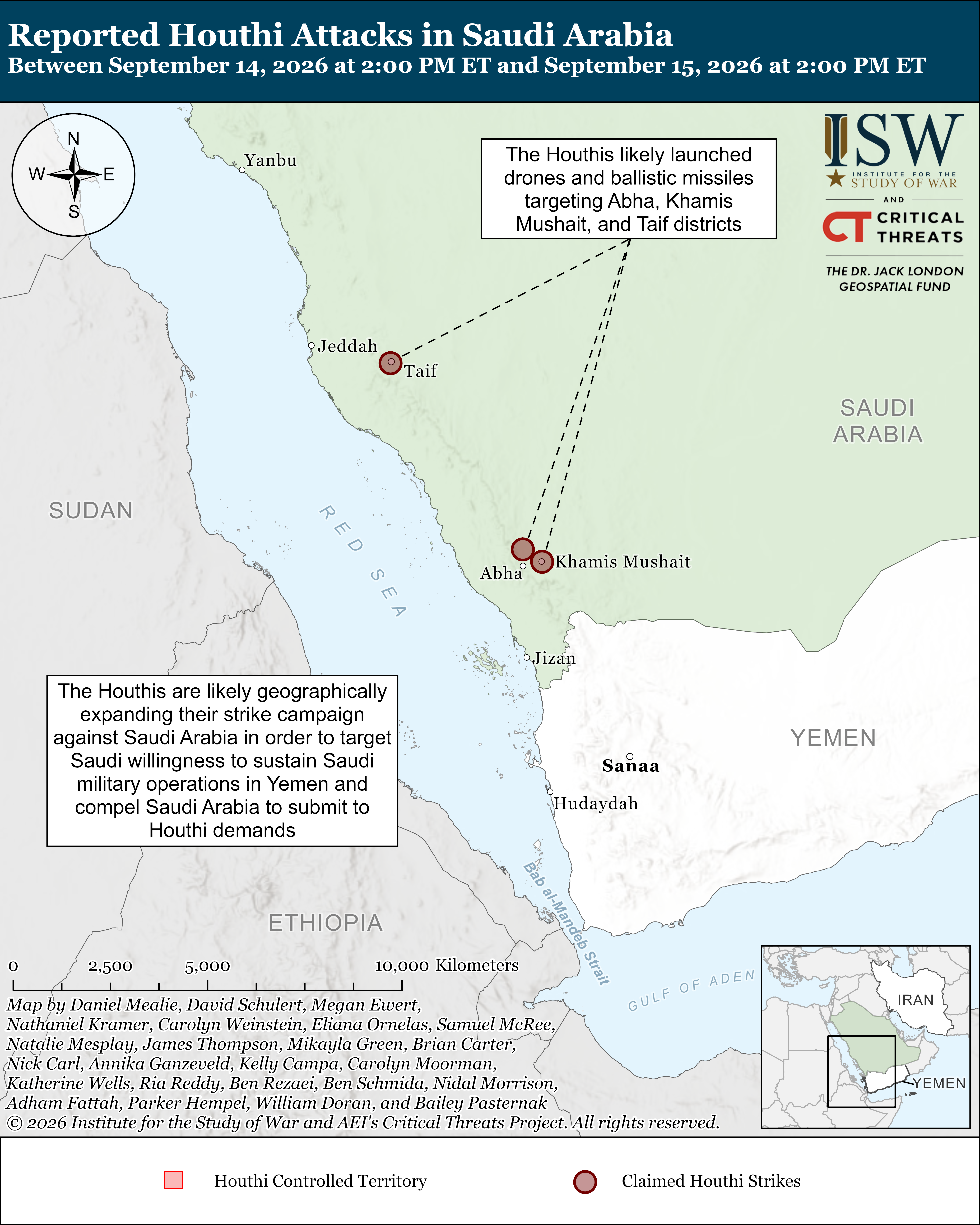
The Houthis are likely expanding their strike campaign into Saudi Arabia to erode Saudi support for military operations in Yemen and compel Riyadh to accept Houthi demands. The Saudi Civil Defense issued more early warning attack alerts in a single 24-hour period between September 14 and 15 than on any other such period since the start of the Houthi blockade in late July 2026.[i] The Saudi Civil Defense issued warnings over several Saudi towns and districts that the Houthis have attacked in recent days, including Najran, Khamis Mushait, Abha, and Jizan districts.[ii] The Saudi coalition spokesperson Major General Turki al Maliki announced on September 14 that the Houthis launched “a number” of ballistic missiles and drones at Khamis Mushait, Abha, and Taif districts, injuring 13 civilians and damaging seven houses.[iii] The civil defense agency also issued alerts for areas farther north along Saudi Arabia’s Red Sea coast that the Houthis have rarely, if ever, targeted under this current campaign, including Yanbu, Jeddah, al Ula, and Mecca.[iv] The Saudi Civil Defense did not confirm whether the Houthis conducted strikes targeting the locations under alert, but the alerts suggest that the agency detected a legitimate threat from incoming Houthi munitions.
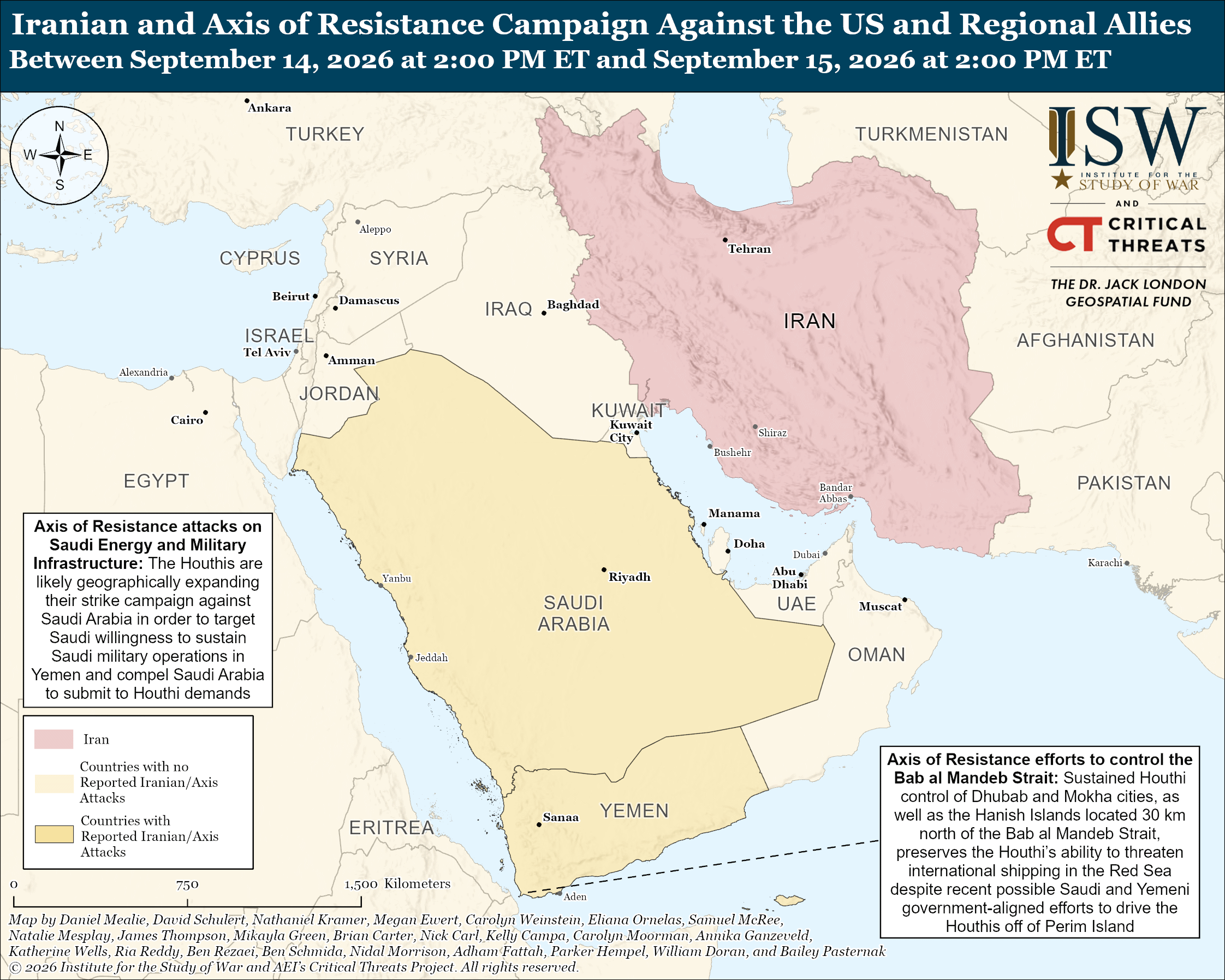
The likely geographic expansion of Houthi attacks follows repeated Houthi warnings that the Houthis will continue to expand their strikes on Saudi Arabia until Saudi Arabia ends its military operations in Yemen.[v] The director of the Houthis‘ military media center directly threatened on September 14 that the Houthi will strike Jeddah, Yanbu, and more distant targets.[vi] The director warned that Houthi strikes will only cease when Saudi ceases its attacks on Yemen.[vii] Houthi political council member Hezam al Asad similarly warned Saudi Arabia on September 14 that the Houthis will continue to respond and “escalate” against Saudi Arabia as long as Saudi Arabia continues its “aggression” against Yemen.[viii] Saudi Arabia has likely conducted airstrikes since late July to support Saudi-backed Yemeni government forces, prevent the Houthis’ consolidation along Yemen’s western coast, and halt advances along the southern coastal plain and in Taiz Governorate (see below).[ix] Ending Saudi military operations in Yemen is one of the Houthis’ four primary objectives at this time, which also include lifting the Saudi blockade of Houthi-controlled Yemeni ports and airports, securing Saudi support for Houthi civil servant salaries, and securing Saudi reparations to Yemeni civilians.[x]
The Houthis’ likely expansion of attacks farther into Saudi Arabia may be tied to recent Saudi efforts to reroute oil exports through the Strait of Hormuz. US Energy Secretary Chris Wright told Western media on September 15 that the US military is supporting Saudi efforts to increase oil exports through the Strait of Hormuz as Saudi Arabia diverts oil away from the East-West Pipeline.[xi] Saudi Arabia is currently repairing this pipeline, which shut down after Axis of Resistance-affiliated actors based in Iraq struck the pipeline and pumping stations south of Medina with a drone on September 10.[xii] A US official told Axios on September 15 that Saudi Arabia has “significantly” increased the number of oil tankers that it is sending through the Strait of Hormuz as fighting with the Houthis has intensified.[xiii] Saudi Arabia’s commitment and ability to send shipments through the Strait of Hormuz limits Houthi leverage over Saudi oil exports. The Houthis have previously adapted their tactics to maintain pressure on Saudi Arabia when Saudi Arabia has adjusted its oil export routes, including by shifting from efforts to disrupt Red Sea shipping to direct Houthi attacks on Saudi oil infrastructure after Saudi Arabia began to divert shipments through the Suez Canal to avoid the Bab al Mandeb.[xiv]
Saudi Arabia’s ability to increase oil exports through the Strait of Hormuz may reflect recent US successes in efforts to restore freedom of navigation to the strait.[xv] US officials told Axios that an average of 40 vessels and 14 million barrels of oil reportedly transited through the strait per day under US military guidance and protection with the support of Gulf allies.[xvi] Recent US strikes have degraded Iranian coastal radars and surveillance equipment, mine-laying capabilities, and other systems that the IRGC has relied on to monitor and threaten commercial shipping, and recent US demining operations in the strait have removed a key intimidation mechanism that Iran has used to divert vessels into its own territorial waters.[xvii] CTP-ISW has observed that Iran appears to be facing several operational constraints that are limiting its ability to control shipping through the strait, including constraints on its mine-laying capabilities and targeting cycles.[xviii]
The constraints on Iran’s ability to enforce its control over the strait at this time appear to have driven Iran's decision to launch its wider regional campaign to compel the US and its allies to surrender to Iranian demands, which include Iranian management of the Strait of Hormuz.[xix] These constraints have limited Iran’s ability to achieve its positive strategic objective of securing sovereignty over the Strait of Hormuz. Iranian decision-makers continue to appear dissatisfied with the trajectory of the conflict and are trying to change it through a broader regional campaign that includes Iranian-backed Axis of Resistance attacks on regional US allies such as Saudi Arabia.[xx] Houthi efforts to consolidate control over the Bab al Mandeb and Yemen‘s Red Sea coastline are also a component of this campaign that aims to increase oil prices and, therefore, pressure on the United States to surrender.[xxi]
Saudi Arabia is intensifying diplomatic efforts to secure international support to address Houthi threats to international shipping and energy markets. Saudi Crown Prince Mohammad bin Salman (MBS) met US Central Command (CENTCOM) Commander Admiral Brad Cooper in Riyadh on September 14 to discuss “regional developments,” which almost certainly included Houthi attacks in Saudi Arabia, the Houthi offensive in Yemen, and current US military support for Saudi Arabia.[xxii] The United States is reportedly providing air defense, targeting data, and intelligence support on the ground to forces in Saudi Arabia.[xxiii] MBS also discussed security cooperation and freedom of navigation in the Red Sea with Egyptian officials in Cairo on September 15.[xxiv] Saudi engagement with key allies takes place as Saudi officials request further support from the United States, United Kingdom, and other European countries in combatting the Houthis and Iranian-backed Iraqi militias.[xxv] Three unspecified officials told a DC-based Yemen analyst that US Secretary of State Marco Rubio called on Oman to pressure the Houthis to halt their attacks on Saudi Arabia and prevent further escalation in a call with Omani Foreign Minister Badr al Busaidi on September 15.[xxvi] A source with knowledge of the matter told Axios on September 15 that Israel and Saudi Arabia are discussing the possibility of Israel providing intelligence support to the Saudis in their fight against the Houthis that would resemble Israel's current intelligence support relationship with the United Arab Emirates.[xxvii]
Several current and former Iranian officials who spoke to the New York Times on September 13 are likely advancing an Iranian information operation that seeks to preserve negotiations with the United States by distancing senior regime decisionmakers from responsibility for Iranian attacks in the Strait of Hormuz in early July 2026.[xxviii] Eight Iranian officials, three Islamic Revolutionary Guards Corps (IRGC) members, and four former Iranian officials described the circumstances under which Iran attacked three vessels in the Strait of Hormuz on July 6 and 7, which nearly led to the resumption of large-scale conflict between the United States and Iran.[xxix] Iran struck these vessels because some of them reportedly violated Iranian procedures for transit through the strait.[xxx] The United States responded to the attacks by striking at least 170 targets in Iran on July 7 and 9.[xxxi] Five Iranian officials and two IRGC members familiar with the events said that Iranian President Masoud Pezeshkian called IRGC Commander Major General Ahmad Vahidi and demanded to know why Iranian forces attacked the three commercial vessels.[xxxii] Vahidi reportedly told Pezeshkian that he “neither authorized nor had advance knowledge” of the attacks on vessels.[xxxiii] Vahidi, as commander of the IRGC, would presumably be at least aware of all major IRGC attacks, particularly those that risked intensifying the conflict with the United States. Vahidi also reportedly told Pezeshkian that the Supreme National Security Council (SNSC) was not informed.[xxxiv] The SNSC’s reported lack of advance knowledge is less unusual than Vahidi‘s own lack of foreknowledge given that the Iranian military chain of command does not run through the SNSC.[xxxv] Unspecified officials familiar with Pezeshkian’s discussions said that Pezeshkian learned that Iranian field commanders were under standing orders to attack vessels that violated Iranian rules without further approval from up the chain of command.[xxxvi] The report subsequently characterized the actors responsible for the July attacks as a “fringe hardline faction.”[xxxvii]
These Iranian sources may be attempting to shift culpability for the July attacks and characterize Vahidi as a more moderate actor in order to preserve negotiations with the United States. This portrayal of Vahidi would mark a substantial departure from Vahidi’s observed behavior since assuming command in March 2026.[xxxviii] Vahidi’s faction has repeatedly constrained more pro-concessions officials and driven the regime’s hardline negotiating and military posture.[xxxix] Iranian negotiators previously blamed an “errant“ faction of hardliners—which CTP-ISW assessed at the time referred to Vahidi and his allies—for trying to undermine negotiations through the July attacks.[xl] An effort to absolve Vahidi of his responsibility in perpetrating the July attacks could reflect the efforts of certain factions within Iran that seek to maintain negotiations with the United States in order to acquire relief for Iran‘s deteriorating economy.[xli]
It is also possible that Vahidi may have indeed been unaware of the July attacks before they occurred, which would suggest that Mojtaba Khamenei or another senior hardline actor, such as Basij Commander Hossein Taeb, bypassed his authority as IRGC commander. Three Iranian officials separately said that government and security inquiries traced the decision to conduct the July attacks to Taeb.[xlii] Taeb held no formal position at the time of the July attacks, although he served as an adviser to previous and current IRGC commanders and maintained close ties with Supreme Leader Mojtaba Khamenei.[xliii] Taeb was reportedly dissatisfied with the decision to end the war and sign the MOU and made this known to the supreme leader, accoridng to the Iranian officials.[xliv] A Switzerland-based Iran analyst separately stated on September 13 that Mojtaba Khamenei bypassed senior regime leaders and directly ordered the IRGC Navy to conduct the attack, citing an unspecified source in Iran.[xlv] CTP-ISW cannot verify the claim, but it is consistent with the three Iranian officials’ accounts that Taeb, who is close to Mojtaba, was involved.
Iranian officials’ accounts confirm that hardliners remain the principal decisionmakers within the regime. These actors have demonstrated their willingness to risk military conflict with the United States in order to achieve key Iranian objectives, such as retaining Iranian control over the strait. It remains unclear whether Vahidi was aware of the July attacks before they took place. The resulting conclusion from either possibility—whether Vahidi knew or he did not—is that those with the authority to make consequential decisions for Iran are hardliners that are willing to use force to achieve their objectives.[xlvi] This implies that this group is not a “fringe hardline faction" but actors with an extremely consequential degree of authority within regime decision-making circles.[xlvii] The New York Times, citing Iranian officials, reported on September 13 that Iranian leaders and generals have debated two options to break the US naval blockade: resume negotiations or intensify attacks on US targets, including naval vessels, to kill US troops and raise global oil prices.[xlviii] The regime elected to intensify attacks on US naval vessels and bases in recent weeks, which is another indicator that hardliners continue to dominate Iranian decision-making.[xlix]
US and Partner Military Operations
Iran reportedly attempted to seize a US naval drone in the Strait of Hormuz. US forces responded by striking two Iranian vessels on September 14, according to a US official speaking to Axios.[l] The US official stated that CENTCOM conducted a drone strike on two Iranian vessels that attempted to seize a US naval drone.[li] The Hormozgan Province Governor claimed that the US struck two fishing boats on September 14.[lii]
Iranian Strike Campaign
-
Assessed Iranian War Aims:
- Secure international recognition of Iranian control over the Strait of Hormuz
- Degrade the US ability and willingness to continue the war
- Restore deterrence vis-à -vis the United States and its regional partners
- Divide the United States and Israel from the Arab states
See topline section.
US-Iran Negotiations
See topline section.
Iranian Domestic Affairs
Iranian security forces raided an anti-regime Baloch separatist fighters’ hideout in Saravan, Sistan and Baluchistan Province, in southeastern Iran on September 12.[liii] IRGC Ground Forces confirmed that a prolonged exchange of fire killed three IRGC soldiers and five Baloch fighters during the raid in northern Saravan.[liv] The Mobarizoun Popular Front (MPF)—a coalition of Baloch anti-regime groups— claimed that four MPF fighters and nine regime forces were killed in a nine-hour engagement, which is longer than a standard exchange of fire between these forces in this area.[lv] Other anti-regime outlets claimed that the exchange of fire lasted between seven and nine hours and caused extensive damage to the area.[lvi] Iranian authorities routinely conduct counterinsurgency operations against Baloch militant groups in Saravan.[lvii]
An unknown gunman killed a prominent Sunni cleric in Sistan and Baluchistan Province for the second time in three months.[lviii] The unknown gunman killed Zahedan Friday Prayer Leader Molavi Yousef Gargij outside his residence in Zahedan, Sistan and Baluchistan Province on September 12.[lix] This assassination follows the recent assassination of a Sunni cleric and Friday Prayer Leader Molavi Mohammad Anvar Rigi by unknown actors in Mirjaveh, Sistan and Baluchistan Province in July.[lx] Anti-regime media noted at the time that the Supreme Leader’s representative in Sistan and Baluchistan Province had appointed Rigi to his position, which suggests that Rigi may have been close to the regime.[lxi]
Lebanon
Nothing significant to report.
Iraq
The Iraqi Prime Minister’s senior financial advisor denied to Kurdish media on September 15 that the United States has threatened to suspend monthly dollar transfers to Iraq if Iraqi militias do not surrender their weapons by the September 30 disarmament deadline.[lxii] The same Kurdish outlet reported on September 14 that the United States issued the threat during Iraqi Prime Minister Ali al Zaydi’s July 2026 visit to Washington, DC.[lxiii] The United States cut off Iraq’s access to its oil revenue, which sits in the US Federal Reserve, due to militia activity in April 2026 and only fully resumed the dollar shipments in July 2026.[lxiv] About 90 percent of Iraq’s state budget comes from its oil revenue.[lxv]
Arabian Peninsula
Saudi Arabia or Yemeni government-affiliated forces are attempting to prevent Houthi forces from consolidating their new positions along the Red Sea coast. Yemeni government-aligned forces released footage of at least 11 Saudi or Yemeni government-affiliated airstrikes on Houthi command centers, supply lines, positions, and equipment near Mokha and Dhubab, Taiz Governorate, on September 14 and 15.[lxvi] A Marib-based anti-Houthi journalist reported on September 14 that Yemeni government-aligned airstrikes targeted Houthi positions in Hays, Hudaydah Governorate, as well as Mokha and Dhubab cities.[lxvii] The Houthis separately claimed that Saudi airstrikes targeted Hajjah, Taiz, and Lahij governorates on September 14.[lxviii] Yemeni government-aligned forces designated a fire coordination area near Mocha and Dhubab on September 10 to target Houthi positions.[lxix] These strikes likely intend to prevent Houthi forces from consolidating control over positions that the group has seized since September 9 and 10 on Yemen’s Red Sea coastal plain.[lxx]

[i] https://www.nytimes.com/2026/09/15/world/middleeast/yemen-saudi-arabia-houthis-attacks.html ; https://x.com/SaudiDCD/status/2099570640231469242 ;
https://x.com/SaudiDCD/status/2099573628027228168 ;
https://x.com/SaudiDCD/status/2099619966601359469 ;
https://x.com/SaudiDCD/status/2099620280096231477 ;
https://x.com/SaudiDCD/status/2099674953826132258 ;
https://x.com/SaudiDCD/status/2099675217018671286 ;
https://x.com/SaudiDCD/status/2099676045234376961
https://x.com/SaudiDCD/status/2099676265229766877 ;
https://x.com/SaudiDCD/status/2099676502270824492 ;
https://x.com/SaudiDCD/status/2099677186085069252 ;
https://x.com/SaudiDCD/status/2099756180931240228 ;
https://x.com/SaudiDCD/status/2099756488470233246 ;
https://x.com/SaudiDCD/status/2099789273486467343 ;
https://x.com/SaudiDCD/status/2099789832276811908 ;
https://x.com/SaudiDCD/status/2099790600098721984 ;
[ii] https://x.com/SaudiDCD/status/2099570640231469242 ;
https://x.com/SaudiDCD/status/2099573628027228168 ;
https://x.com/SaudiDCD/status/2099619966601359469 ;
https://x.com/SaudiDCD/status/2099676265229766877 ;
https://x.com/SaudiDCD/status/2099676502270824492 ;
https://x.com/SaudiDCD/status/2099756180931240228 ;
https://x.com/SaudiDCD/status/2099756488470233246
[iii] https://x.com/CJFCSpox/status/2099633676954808429
[iv] https://x.com/SaudiDCD/status/2099674953826132258 ;
https://x.com/SaudiDCD/status/2099675217018671286;
https://x.com/SaudiDCD/status/2099676045234376961 ;
https://x.com/SaudiDCD/status/2099677186085069252;
https://x.com/SaudiDCD/status/2099789273486467343 ;
https://x.com/SaudiDCD/status/2099789832276811908 ;
https://x.com/SaudiDCD/status/2099790600098721984 ;
[v] https://x.com/zakaria_sharabi/status/2099676512953741653 ; https://x.com/zakaria_sharabi/status/2099693186033570215 ; https://x.com/hezamalasad/status/2099648828995776864
[vi] https://x.com/zakaria_sharabi/status/2099676512953741653 ; https://x.com/zakaria_sharabi/status/2099693186033570215
[vii] https://x.com/zakaria_sharabi/status/2099676512953741653 ; https://x.com/zakaria_sharabi/status/2099693186033570215
[viii] https://x.com/hezamalasad/status/2099648828995776864
[ix] https://www.nytimes.com/live/2026/07/25/world/iran-war-us-strikes-trump-oil/cea35631-f9f5-5f24-a9ab-ead73219f5bb?smid=url-share
[x] https://understandingwar.org/research/middle-east/iran-update-september-14-2026/ ; https://x.com/TvAlmasirah/status/2089422249862590886?s=20 ; https://sarabic dot ae/20260723/أنصار-الله-تحدد-شرطين-لإنهاء-التصعيد-مع-السعودية-1115450869.html ; https://t.me/army21ye/3691
[xi] https://www.cnbc.com/2026/09/15/saud-arabia-east-west-pipeline-iran-war-chris-wright.html#:~:text=Saudi%20Arabia%27s%20critical%20East-West%20crude%20oil%20pipeline%20will,%22This%20will%20be%20a%20brief%20and%20temporary%20interruption.?msockid=27a6e0a071d568b3191cf7c770b16939
[xii] https://x.com/KSAMOFA/status/2098502379821830599 ;
https://www.reuters.com/world/middle-east/yemens-houthis-reach-strategic-island-mouth-vital-shipping-lane-2026-09-11/
[xiii] https://www.axios.com/2026/09/15/us-iran-boats-navy-drone-strait-hormuz
[xiv] https://understandingwar.org/research/middle-east/iran-update-september-8-2026/ ; https://www.nytimes.com/2026/08/26/business/saudi-oil-houthis-iran.html ; https://www.cnbc.com/2026/08/12/saudi-arabia-iran-oil-red-sea-houthi-suez-canal-strait-hormuz.html ; https://www.nytimes.com/2026/08/26/business/saudi-oil-houthis-iran.html
[xv] https://www.axios.com/2026/09/15/us-iran-boats-navy-drone-strait-hormuz
[xvi] https://www.axios.com/2026/09/15/us-iran-boats-navy-drone-strait-hormuz
[xvii] https://www.axios.com/2026/09/15/us-iran-boats-navy-drone-strait-hormuz; https://x.com/CENTCOM/status/2093131928023023729?s=20; https://www.axios.com/2026/07/07/us-strikes-iran-hormuz-ship-attacks
[xviii] https://www.nytimes.com/2026/08/31/us/politics/us-strikes-iran-new-naval-mine.html; https://understandingwar.org/research/middle-east/iran-update-august-31-2026/; https://understandingwar.org/research/middle-east/iran-update-september-14-2026/; https://www.isna dot ir/news/1405062315855/; https://t.me/defapress_ir/67557; https://x.com/CENTCOM/status/2099591186583371830; https://www.axios.com/2026/07/07/us-strikes-iran-hormuz-ship-attacks; https://www.criticalthreats.org/analysis/iran-update-september-4-2026; https://x.com/TreyYingst/status/2094854875154731098?s=20; https://understandingwar.org/research/middle-east/iran-update-august-31-2026/;
https://x.com/MartinKelly/status/2094129711483891783?s=20; https://understandingwar.org/research/middle-east/iran-update-september-9-2026/; https://www.reuters.com/world/middle-east/seafarer-oil-products-tanker-killed-incident-off-dubai-peninsula-says-2026-09-09/ ;
https://www.reuters.com/world/middle-east/iran-attacks-us-base-jordan-ships-near-hormuz-after-tankers-sunk-2026-09-09/
[xix] https://understandingwar.org/research/middle-east/iran-update-september-10-2026/; https://understandingwar.org/research/middle-east/iran-update-september-9-2026/; https://understandingwar.org/research/middle-east/iran-update-september-4-2026/
[xx] https://understandingwar.org/research/middle-east/iran-update-september-4-2026/
[xxi] https://understandingwar.org/research/middle-east/iran-update-september-10-2026/
[xxii] https://x.com/KSAMOFA/status/2099442080544072189 ; https://www.al-monitor.com/originals/2026/09/centcom-chief-meets-saudi-arabias-mbs-amid-houthi-gains-yemen
[xxiii] https://www.al-monitor.com/originals/2026/09/centcom-chief-meets-saudi-arabias-mbs-amid-houthi-gains-yemen
[xxiv] https://x.com/KSAMOFA/status/2099854834002219295
[xxv] https://www.bloomberg.com/news/articles/2026-09-14/burnham-mulls-saudi-support-amid-uk-fears-of-houthi-economic-hit ; https://www.nytimes.com/2026/09/14/world/middleeast/saudi-iran-trump-yemen-houthis.html ; https://x.com/KSAMOFA/status/2099180016332333486 ;
[xxvi] https://x.com/BashaReport/status/2099859164092600614 ; https://x.com/OmanNewsAgency/status/2099841546858238075
[xxvii] https://www.axios.com/2026/09/15/military-commanders-us-israel-arab-countries-iran-meeting-germany
[xxviii] https://www.nytimes.com/2026/09/13/world/middleeast/iran-hard-liners-sabotaged-peace-deal.html ;
https://www.nytimes.com/2026/07/07/world/middleeast/iran-war-oman-hormuz-tanker.html
[xxix] https://understandingwar.org/research/middle-east/iran-update-special-report-july-8-2026/ ;
https://understandingwar.org/research/middle-east/iran-update-special-report-july-9-2026/
[xxx] https://understandingwar.org/research/middle-east/iran-update-special-report-july-8-2026/ ;
https://understandingwar.org/research/middle-east/iran-update-special-report-july-9-2026/
[xxxi] https://www.nytimes.com/2026/07/10/us/politics/iran-war-escalation.html
[xxxii] https://www.nytimes.com/2026/09/13/world/middleeast/iran-hard-liners-sabotaged-peace-deal.html ;
https://www.nytimes.com/2026/07/07/world/middleeast/iran-war-oman-hormuz-tanker.html
[xxxiii] https://www.nytimes.com/2026/09/13/world/middleeast/iran-hard-liners-sabotaged-peace-deal.html
[xxxiv] https://www.nytimes.com/2026/09/13/world/middleeast/iran-hard-liners-sabotaged-peace-deal.html
[xxxv] https://www.unitedagainstnucleariran.com/government-institution/supreme-national-security-council-snsc
[xxxvi] https://www.nytimes.com/2026/09/13/world/middleeast/iran-hard-liners-sabotaged-peace-deal.html
[xxxvii] https://www.nytimes.com/2026/09/13/world/middleeast/iran-hard-liners-sabotaged-peace-deal.html
[xxxviii] https://understandingwar.org/research/middle-east/iran-update-special-report-april-18-2026/
[xxxix] https://understandingwar.org/research/middle-east/iran-update-special-report-april-24-2026 ;
https://understandingwar.org/research/middle-east/iran-update-special-report-july-29-2026
[xl] https://www.cbsnews.com/news/iran-privately-said-made-a-mistake-in-shooting-at-ships-in-strait-of-hormuz/
[xli] https://understandingwar.org/research/middle-east/iran-update-special-report-july-28-2026/
[xlii] https://www.nytimes.com/2026/09/13/world/middleeast/iran-hard-liners-sabotaged-peace-deal.html
[xliii] https://amwaj.media/en/media-monitor/irgc-s-taeb-reemerges-challenges-claims-of-deep-israeli-infiltration ;
https://www.criticalthreats.org/analysis/iran-update-special-report-august-10-2026 ;
https://www.iranintl.com/en/202608104371
[xliv] https://www.nytimes.com/2026/09/13/world/middleeast/iran-hard-liners-sabotaged-peace-deal.html
[xlv] https://x.com/IranWonk/status/2099209594262229033?s=20
[xlvi] https://www.nytimes.com/2026/09/13/world/middleeast/iran-hard-liners-sabotaged-peace-deal.html
[xlvii] https://www.nytimes.com/2026/09/13/world/middleeast/iran-hard-liners-sabotaged-peace-deal.html
[xlviii] https://www.nytimes.com/2026/09/13/world/middleeast/iran-hard-liners-sabotaged-peace-deal.html
[xlix] https://understandingwar.org/research/middle-east/iran-update-september-10-2026/
[l] https://www.axios.com/2026/09/15/us-iran-boats-navy-drone-strait-hormuz
[li] https://www.axios.com/2026/09/15/us-iran-boats-navy-drone-strait-hormuz
[lii] https://t.me/Tasnimnews/444356
[liii] https://t.me/farsna/461617; https://t.me/defapress_ir/67369
[liv] https://t.me/farsna/461617; https://t.me/defapress_ir/67369
[lv] https://t.me/jmmfront/181; https://understandingwar.org/research/middle-east/iran-update-december-15-2025/=
[lvi] https://x.com/TheBalochWorld/status/2098735880017936595; https://t.me/IranintlTV/356933; https://www.instagram.com/reel/DdOVxPPOsLg/
[lvii] https://understandingwar.org/research/middle-east/iran-update-december-15-2025/; https://www.criticalthreats.org/analysis/iran-update-august-28-2025
[lviii] https://t.me/Tasnimnews/444321 ; https://understandingwar.org/research/middle-east/iran-update-special-report-july-20-2026/ ; https://x.com/IranIntl/status/2079075177166487943?s=20
[lix] https://t.me/Tasnimnews/444321
[lx] https://understandingwar.org/research/middle-east/iran-update-special-report-july-20-2026/; https://x.com/IranIntl/status/2079075177166487943?s=20
[lxi] https://x.com/IranIntl/status/2079075177166487943
[lxii] https://www.kurdistan24 dot net/en/story/939590/iraqi-pm-adviser-denies-us-plans-to-halt-dollar-shipments
[lxiii] https://www.kurdistan24 dot net/en/story/939335/us-warns-iraq-disarm-militias-by-sept-30-or-dollar-transfers-stop
[lxiv] https://www.wsj.com/world/middle-east/iraq-us-dollar-shipments-iran-eccef82f ; https://www.wsj.com/world/middle-east/u-s-blocks-iraqs-dollar-shipments-to-squeeze-its-iran-backed-militias-3270d5af
[lxv] https://www.reuters.com/business/energy/how-us-controls-iraqs-oil-revenues-2026-01-23/ ; https://www.imf.org/en/-/media/files/publications/cr/2025/english/1irqea2025001-source-pdf.pdf
[lxvi] https://x.com/Yem_army_media/status/2099575543611924694 ; https://x.com/Yem_army_media/status/2099880967812866380
[lxvii] https://x.com/Alsakaniali/status/2099649608783626307
[lxviii] https://t.me/army21ye/3708
[lxix] https://x.com/Yemenarmyeng/status/2098102034301906956
[lxx] https://understandingwar.org/research/middle-east/iran-update-september-10-2026/
View Citations