{{currentView.title}}
3 hours ago
Iran Update: October 29, 2026
Data Cutoff: 2:00 PM ET
The Institute for the Study of War (ISW) and The Critical Threats Project (CTP) at the American Enterprise Institute are publishing updates Monday through Friday to provide analysis on the war with Iran and the broader Middle East. Weekday updates cover events from the past 24-hour period, whereas weekend updates are abbreviated and cover the Houthi-Saudi conflict and major breaking developments related to the war with Iran.
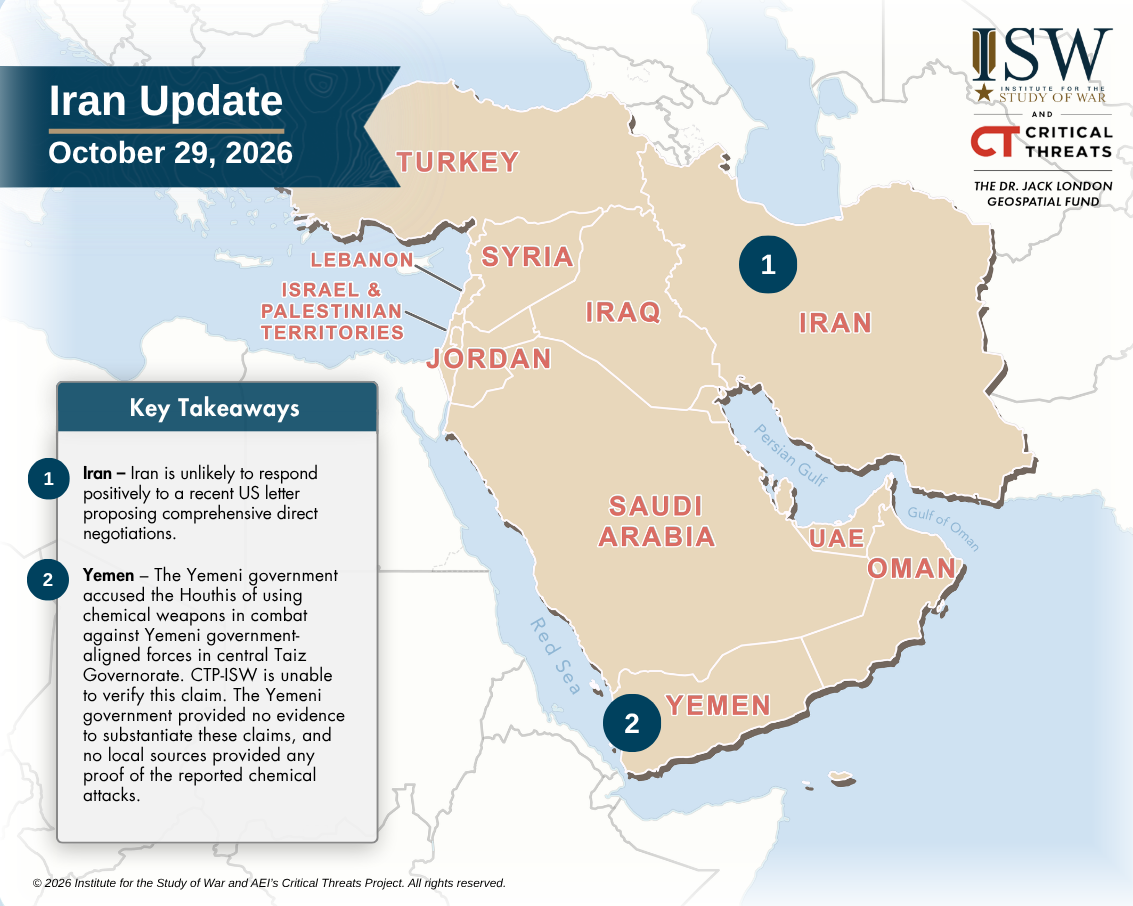
Key Takeaways:
- Iran is unlikely to respond positively to a recent US letter proposing comprehensive direct negotiations. A senior US official and an Iranian official told the New York Times on October 28 that US Vice President JD Vance sent Supreme National Security Council (SNSC) Secretary Major General Mohsen Rezaei a letter through Qatari mediators that proposed comprehensive direct negotiations. Rezaei recently reiterated hardline negotiating positions, which were demands that the United States end the war on all fronts, release frozen assets, and lift the naval blockade before negotiations over anything else resume. These views are consistent with official Iranian state positions.
- The Yemeni government accused the Houthis of using chemical weapons in combat against Yemeni government-aligned forces in central Taiz Governorate on October 28. The Yemeni government provided no evidence to substantiate these claims, and no local sources provided any proof of the reported chemical attacks. The seriousness of these claims nonetheless requires reporting, and CTP-ISW will continue to monitor the Yemeni news and social media space for indications that chemical attacks occurred.
- Iraqi Prime Minister Ali al Zaydi is continuing his attempts to balance between the United States and Iranian-backed Iraqi actors. Zaydi's efforts to balance competing pressures also support his aims of increasing his personal power as prime minister.
Toplines
Iran is unlikely to respond positively to a recent US letter proposing comprehensive direct negotiations. A senior US official and an Iranian official told the New York Times on October 28 that US Vice President JD Vance sent Supreme National Security Council (SNSC) Secretary Major General Mohsen Rezaei a letter through Qatari mediators that proposed comprehensive direct negotiations.[i] An unspecified US official added that US officials reportedly addressed the letter to Rezaei because the United States assessed that he could influence Islamic Revolutionary Guards Corps (IRGC) officials and hardliners who oppose an agreement with the United States.[ii] It is unclear how the United States reached this assessment. Rezaei recently reiterated hardline negotiating positions, which were demands that the United States end the war on all fronts, release frozen assets, and lift the naval blockade before negotiations over anything else resume.[iii] The SNSC is Iran’s highest national security and foreign policy decision-making body.[iv] Supreme Leader Mojtaba Khamenei appointed Rezaei—his former senior military adviser and a former IRGC commander—as SNSC secretary on August 9, which may have strengthened Mojtaba’s control over the SNSC and reinforced the regime’s hardline orientation.[v] The officials also told the New York Times that Vance stated in the letter to Rezaei that negotiations must address Iran’s nuclear program from the outset, which is antithetical to Rezaei’s stated positions on negotiations. Rezaei‘s views are consistent with the Iranian official view, which demands that the United States first implement Iran’s conditions, which include lifting the US naval blockade, releasing Iranian frozen assets, and recognizing Iran’s claimed authority over the Strait of Hormuz.[vi] IRGC-affiliated Tasnim News Agency reported on October 29 that Iran had not yet responded to the letter and still considers any departure from its seven conditions ”unacceptable.”[vii]
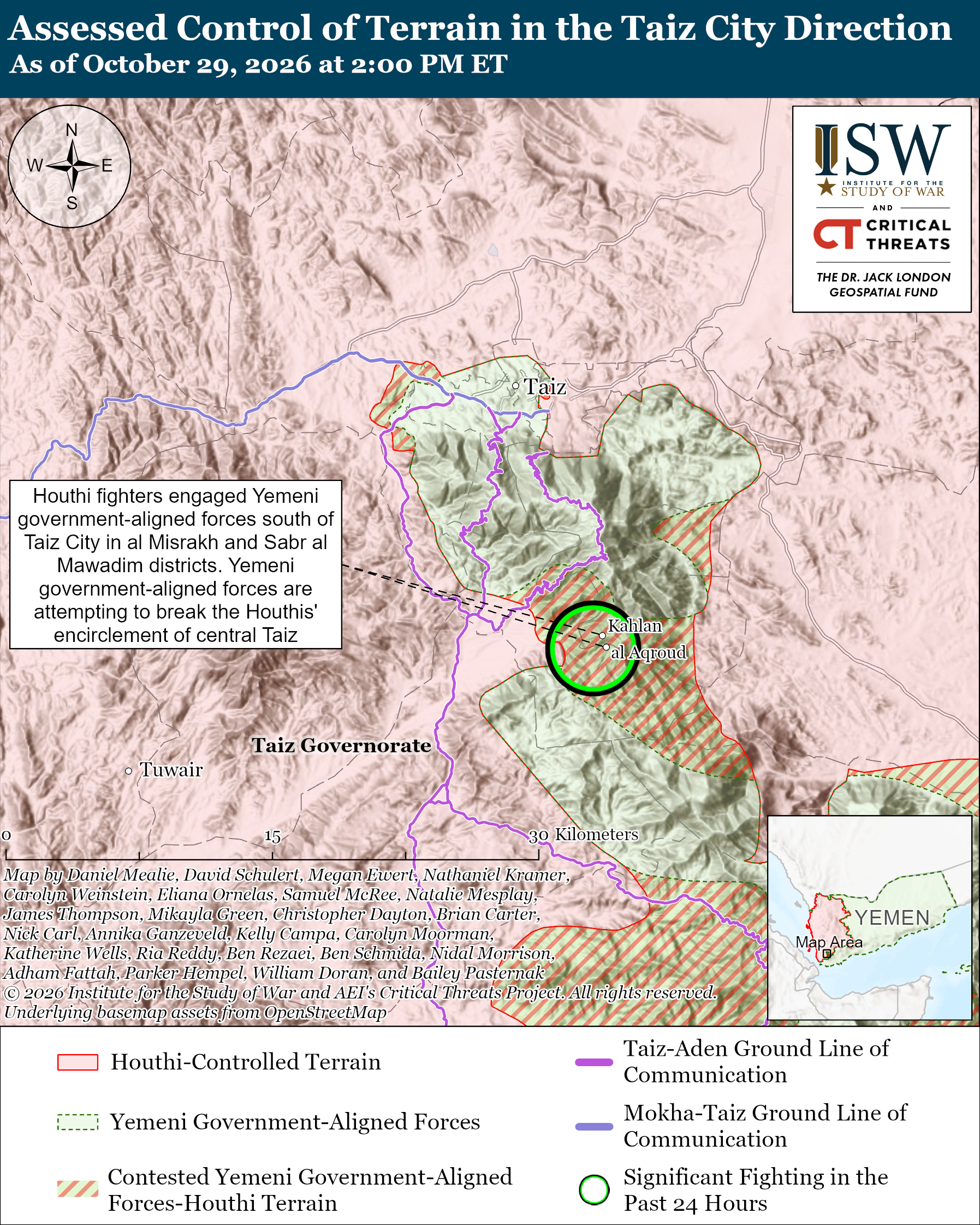
The Yemeni government accused the Houthis of using chemical weapons in combat against Yemeni government-aligned forces in central Taiz Governorate on October 28.[viii] The Yemeni government provided no evidence to substantiate these claims, and no local sources provided any proof of the reported chemical attacks. The seriousness of these claims nonetheless requires reporting, and CTP-ISW will continue to monitor the Yemeni news and social media space for indications that chemical attacks occurred. The Yemeni government’s Media Office in Taiz Governorate cited combat reports that the Houthis fired artillery shells that may have contained "internationally banned toxic substances" while engaging Yemeni government-aligned forces near Kahlan, Sabr al Mawadim District, and al Aqroud, al Misrakh District, both in central Taiz Governorate.[ix] The Houthis have repeatedly failed to consolidate control over these combat areas in recent days amid Yemeni government-aligned forces' efforts to recapture nearby territory and break the Houthis' encirclement of central Taiz Governorate.[x] The media office also claimed that local civilians, including pro-government local resistance forces, experienced respiratory complications and loss of consciousness in “previous incidents” but did not provide further detail.[xi] Respiratory effects from a chemical attack would suggest that the Houthis used tear gas, chlorine gas, or a similar typically non-lethal chemical compound, but that the chemical was present in sufficient concentration to cause unconsciousness.[xii]
Yemeni government officials, including Information Minister Muammar Eryani, have previously accused the Houthis of procuring materials for a chemical warfare program and manufacturing chemical weapons.[xiii] CTP-ISW cannot verify the veracity of these claims, however. CTP-ISW has also not observed any reports of Houthi chemical weapons use in other major combat areas, such as Taiz City or the Red Sea coastal plain.
Iraqi Prime Minister Ali al Zaydi is continuing his attempts to balance between the United States and Iranian-backed Iraqi actors. Unspecified Iranian-backed Iraqi militias have reached an "understanding" with Zaydi to disarm in exchange for "key" government positions, according to sources speaking to Iraqi media on October 29.[xiv] The sources said that Zaydi would soon appoint a militia-linked figure as the secretary-general of the Council of Ministers, a position that a figure aligned with Shia nationalist cleric Muqtada al Sadr has held for more than two administrations.[xv] CTP-ISW similarly assessed that the federal government agreed to grant three Iraqi militias control over some government ministries on October 15 to both incentivize the militias that have agreed to disarm to fully comply while motivating militias that have refused to disarm to agree to the government's still unreleased disarmament plan.[xvi] The Shia Coordination Framework approved some details of this plan, which aims to disarm the militias by June 2027, in late September.[xvii] It is unclear if the militias that reached the "understanding" with Zaydi will actually fully comply with disarmament, given the amount of room the framework's agreement leaves for militia exploitation, per the plan's publicly available details. CTP-ISW has outlined militia attempts to avoid disarmament in an October 28 special report: Iranian-backed Iraqi Militias Undermine Disarmament Efforts | ISW). The United States has continuously rejected militia-affiliated individuals serving in high-level positions within the Iraqi federal government.[xviii]
Zaydi's efforts to balance competing pressures also support his aims of increasing his personal power as prime minister. An unspecified framework leader told Iraqi media on October 28 that Zaydi is making changes to his administration independent of the framework.[xix] Zaydi replaced the director of his office, who was a member of the former prime minister‘s party, with a technocrat who had been on an Iraqi government committee that designated the Houthis and Hezbollah as terrorist organizations in 2025 and froze their assets.[xx] The federal government quickly backtracked on the decision to designate the Houthis and Hezbollah, reportedly due to pressure from Iranian-backed actors.[xxi] Zaydi's appointment of an individual affiliated with an Iraqi federal government decision that broadly supports US efforts to counter Iran's Axis of Resistance could be an attempt by Zaydi to counter these militia appointments. This appointment could also be in line with Zaydi's attempt to replace government officials affiliated with his predecessor. The framework leader said that Zaydi is to fire 69 advisors associated with Sudani.[xxii] The framework leader also criticized Zaydi's independent negotiations with the militias for undermining the framework's own negotiations.[xxiii] Zaydi has reportedly called the framework negotiating with the militias "biased," in that the framework includes militia members and other Iranian-backed actors.[xxiv] Zaydi pursuing his own negotiations reflects his desire to make decisions independent of the framework but could also support US aims for the development of a sovereign and independent Iraq.
US and Partner Military Operations
Nothing significant to report.
Iranian Strike Campaign
-
Assessed Iranian War Aims:
- Secure international recognition of Iranian control over the Strait of Hormuz
- Degrade the US ability and willingness to continue the war
- Restore deterrence vis-à -vis the United States and its regional partners
- Divide the United States and Israel from the Arab states
Nothing significant to report.
US-Iran Negotiations
Nothing significant to report.
Iranian Domestic Affairs
Lebanon
Nothing significant to report.
Iraq
See topline section.
Arabian Peninsula
Saudi and Yemeni government-aligned forces are likely attempting to disrupt Houthi maritime sustainment and resupply efforts on the Red Sea coastal plain by targeting Houthi-controlled ports and vessels. Houthi and Yemeni government-aligned media reported on October 28 and 29 that Saudi or Yemeni government-aligned forces conducted several rounds of airstrikes targeting Houthi positions in Mokha and Dhubab, on the Red Sea coast.[xxv] Houthi media reported that at least some of the strikes targeted the port of Mokha on October 28.[xxvi] Yemeni government-aligned media previously reported on October 28 that strikes by Saudi or Yemeni government-aligned forces destroyed two Houthi vessels in the southern Red Sea that were likely transporting weapons from the primary Houthi port in Hudaydah to other Houthi positions near Mokha, Dhubab, or along the Red Sea Coast.[xxvii] These reported strikes on Houthi-controlled ports and vessels are consistent with CTP-ISW's assessment that Saudi Arabia and the Yemeni government intend to weaken Houthi forces that are engaged in frontline combat by disrupting the group's sustainment and logistics efforts.[xxviii] Saudi and Yemeni government-aligned forces have struck various logistical targets, including Houthi weapons depots, food storehouses, and reinforcement convoys, in recent weeks in pursuit of this objective.[xxix]
Reported Saudi or Yemeni government airstrikes on Houthi vessels carrying weapons transiting the southern Red Sea indicate that these forces are still capable of threatening Houthi smuggling and maritime capabilities in the Red Sea to a limited extent following their substantial territorial losses in September 2026.[xxx] CTP-ISW previously assessed during the Houthi Red Sea coastal plain offensive on September 10 that the Houthis' capture of Mokha and all remaining Red Sea ports would inhibit the Yemeni government's ability to interdict Houthi smuggling vessels.[xxxi] Yemeni government-aligned forces have recaptured some territory on the southern Red Sea coastal plain since September 10, including areas near the Bab al Mandeb Strait, but do not control a port from which to dispatch naval counter-smuggling and reconnaissance patrols in the Red Sea.[xxxii]
These reports also suggest that the Houthis are using sea lines of communication (SLOC) in the southern Red Sea to resupply and equip front-line forces on the coastal plain and near the Bab al Mandeb. The Houthis are likely transporting munitions along an SLOC from Hudaydah to Mokha or Dhubab because major Houthi ground lines of communication (GLOC) between Hudaydah and Dhubab are highly exposed to Saudi and Yemeni government airstrikes. Saudi and Yemeni government-aligned forces have conducted battlefield air interdiction along the coast since the offensive began.[xxxiii]

[i] https://www.nytimes.com/2026/10/28/us/politics/vance-peace-talks-letter-iran.html
[ii] https://www.nytimes.com/2026/10/28/us/politics/vance-peace-talks-letter-iran.html
[iii] https://www.bbc.com/persian/articles/cqdr7mm0dn7ko ; https://www.aljazeera dot com/news/2026/9/19/iran-says-conditions-to-re-engage-in-talks-end-war-sent-to-us-via-qatar
[iv] https://www.unitedagainstnucleariran.com/government-institution/supreme-national-security-council-snsc
[v] https://t.me/rahbar_ir/922 ;
https://understandingwar.org/research/middle-east/iran-update-special-report-august-10-2026/
[vi] https://www.nytimes.com/2026/10/28/us/politics/vance-peace-talks-letter-iran.html ;
https://x.com/ir_rezaee/status/2112613104903209434 ;
https://x.com/ir_rezaee/status/2109382985619587460 ;
https://x.com/mb_ghalibaf/status/2115858780134998374
[vii] https://t.me/Tasnimnews/455060
[viii] https://x.com/ERYANIM/status/2115580269050663164?s=20 ; https://www.facebook.com/story.php?story_fbid=122144131593099275&id=61582978275696&rdid=zlqUTewKeYShtGWP
[ix] https://www.facebook.com/story.php?story_fbid=122144131593099275&id=61582978275696&rdid=zlqUTewKeYShtGWP
[x] https://x.com/Yem_army_media/status/2114674417355591948 ; https://x.com/ALyemennow/status/2112898717464285548 ; https://x.com/BashaReport/status/2115389873414721867?s=20
[xi] https://www.facebook.com/story.php?story_fbid=122144131593099275&id=61582978275696&rdid=zlqUTewKeYShtGWP ; https://x.com/FaresALhemyari/status/2115525226817843258
[xii] https://www.cdc.gov/chemical-emergencies/chemical-fact-sheets/chlorine.html ; https://www.cdc.gov/chemical-emergencies/chemical-fact-sheets/riot-control-agents.html
[xiii] https://x.com/ERYANIM/status/2115580269050663164?s=20 ; https://www.thenationalnews dot com/news/mena/2025/09/04/yemeni-minister-accuses-houthi-rebels-of-manufacturing-chemical-weapons/
[xiv] https://x.com/alssaanetwork/status/2115515575896018976 ; https://almadapaper dot net/458712/
[xv] https://almadapaper dot net/458712/
[xvi] https://understandingwar.org/research/middle-east/iran-update-october-19-2026/
[xvii] https://understandingwar.org/research/middle-east/iran-update-september-23-2026/ ; https://www.nytimes.com/2026/09/21/world/middleeast/iraq-prime-minister-interview-disarm-militias.html
[xviii] https://almadapaper dot net/437645/
[xix] https://almadapaper dot net/458712/
[xx] https://almadapaper dot net/458712/
[xxi] https://apnews.com/article/iraq-government-lebanon-hezbollah-yemen-houthis-d58389bf49876f07927ed1916ce3cc41
[xxii] https://almadapaper dot net/458712/
[xxiii] https://almadapaper dot net/458712/
[xxiv] https://english.aawsat dot com/arab-world/5318393-arsenal-iraqi-armed-factions-‘remaining-until-2028’
[xxv] https://x.com/Almasirah_YE/status/2115529226443235334?a=JK8uEePzkYtwwA6unP4&s=20 ; https://x.com/ALyemennow/status/2115568731849986215?a=_0osawoMNgTSWLHUzNA&s=20 ; https://x.com/ALyemennow/status/2115693299101032537?a=9Ijvhluy1VnYkf5YdIc&s=20
[xxvi] https://x.com/Almasirah_YE/status/2115529226443235334?a=JK8uEePzkYtwwA6unP4&s=20
[xxvii] https://x.com/ALyemennow/status/2115462438044795354?a=fBU2ijvx24Ml8KaD0tc&s=20 ; https://x.com/ALyemennow/status/2115495267185332443?s=20
[xxviii] https://understandingwar.org/research/middle-east/iran-update-september-30-2026/
[xxix] https://x.com/ALyemennow/status/2104491037477450043 ; https://x.com/war_cube/status/2104476729116897382?s=20 ; https://x.com/Alsakaniali/status/2104208497051394412?s=20 ; https://x.com/AlArabiya_Brk/status/2109659682629423186
[xxx] https://understandingwar.org/research/middle-east/iran-update-september-10-2026/
[xxxi] https://understandingwar.org/research/middle-east/iran-update-september-10-2026/
[xxxii] https://x.com/diralwatan/status/2110816582452834424 ; https://x.com/FaresALhemyari/status/2113219321472094682?s=20
[xxxiii] https://irp.fas.org/doddir/dod/dictionary.pdf , p. 125 ; https://x.com/Yem_army_media/status/2098098116834586756?s=20
View Citations