{{currentView.title}}
1 hour ago
Iran Update: November 18, 2026
Data Cutoff: 2:00 PM ET
The Institute for the Study of War (ISW) and The Critical Threats Project (CTP) at the American Enterprise Institute are publishing updates Monday through Friday to provide analysis on the war with Iran and the broader Middle East. Weekday updates cover events from the past 24-hour period, whereas weekend updates are abbreviated and cover the Houthi-Saudi conflict and major breaking developments related to the war with Iran.
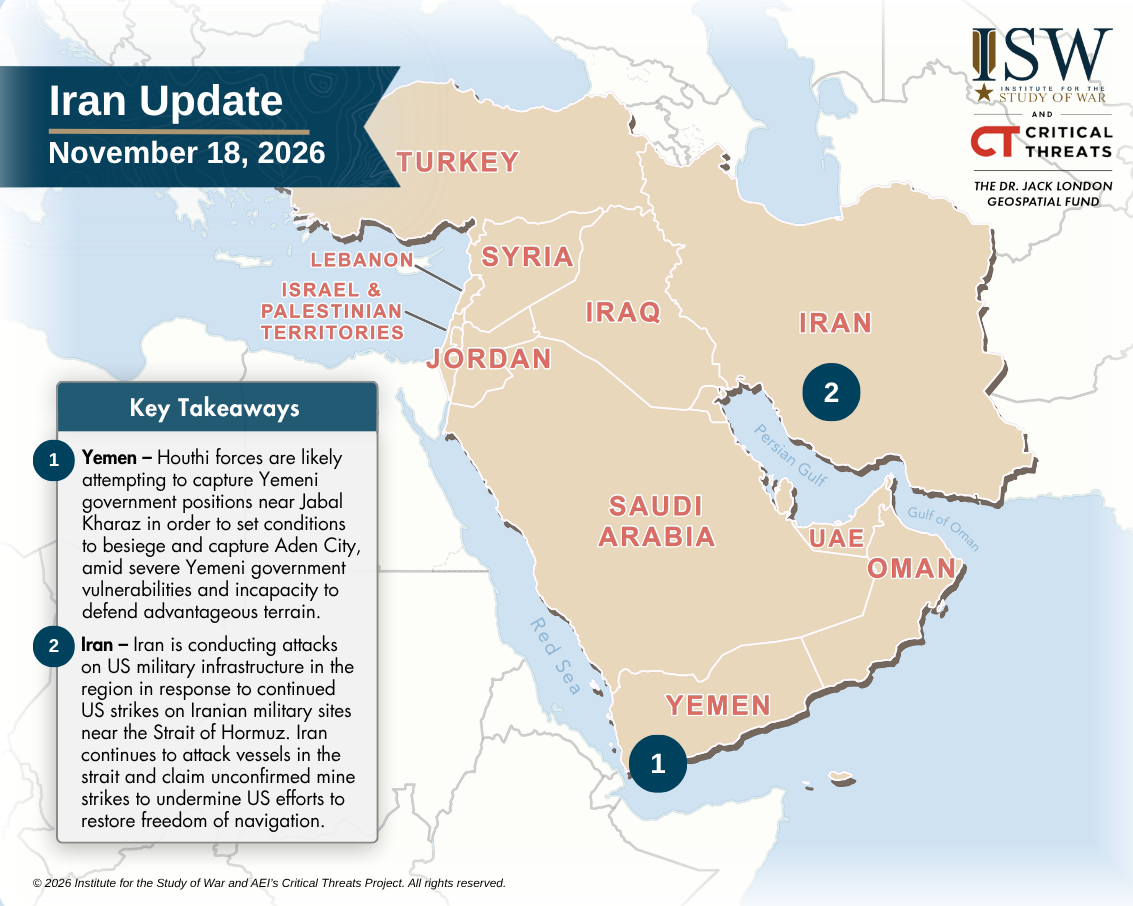
Key Takeaways:
- Houthi forces are likely attempting to capture Yemeni government positions on advantageous terrain near Jabal Kharaz, which supports Houthi efforts to establish control over Lahij Governorate and set conditions to besiege and capture Aden City. The Yemeni government’s failure to hold a highly defensible position near Jabal Kharaz indicates that government-aligned forces are incapable of mounting an effective defense in southern Lahij Governorate.
- Iran is conducting near-daily attacks on US military infrastructure in the region in response to continued US strikes on Iranian military sites near the Strait of Hormuz. Iran also continues to attack commercial vessels in the strait and claim that vessels are striking mines in the strait’s shipping lanes in order to undermine US efforts to ensure freedom of
Toplines
Houthi forces are likely attempting to capture Yemeni government positions on advantageous terrain near Jabal Kharaz, which supports Houthi efforts to establish control over Lahij Governorate and set conditions to besiege and capture Aden City. Geolocated footage showed that Houthi forces captured a Yemeni government defensive position east of Khour Umairah and south of Jabal Kharaz, along the Mokha-Aden ground line of communication (GLOC) in Lahij Governorate, on November 16.[i] The footage, along with commercially available satellite imagery, indicates that Houthi forces likely conducted ballistic missile strikes on the position before capturing it.[ii] The Houthis have often fired ballistic missiles targeting Yemeni government positions and staging areas to weaken and disorganize defending forces before attempting to maneuver.[iii]
A Houthi capture of Jabal Kharaz would deny Yemeni government-aligned forces a very strong position along the Mokha-Aden coastal road from which to defend Aden City's western flank. Jabal Kharaz's position near the Gulf of Aden and its surrounding terrain should allow Yemeni government-aligned forces to canalize advancing Houthi forces further eastward to narrow lines of advance north or south of the mountain, provided that government-aligned forces are capable of mounting a tactical defense. Houthi forces and commanders would be forced to choose between advancing either along a two-kilometer-wide strip of beach along the Mokha-Aden GLOC to the south of Jabal Kharaz, or along a narrow valley road that connects al Shatt to Am Surayh to the north of Jabal Kharaz. Houthi advances along either or both of these routes simultaneously would render Houthi forces extremely vulnerable to Yemeni government spotting and fire from elevated positions on Jabal Kharaz that should, in theory, prevent further Houthi advances. The Houthis’ capture of the Yemeni government-aligned defensive position east of Khour Umairah on November 16 could indicate that government-aligned forces are unable or unwilling to effectively defend Jabal Kharaz and the Mokha-Aden GLOC.[iv]
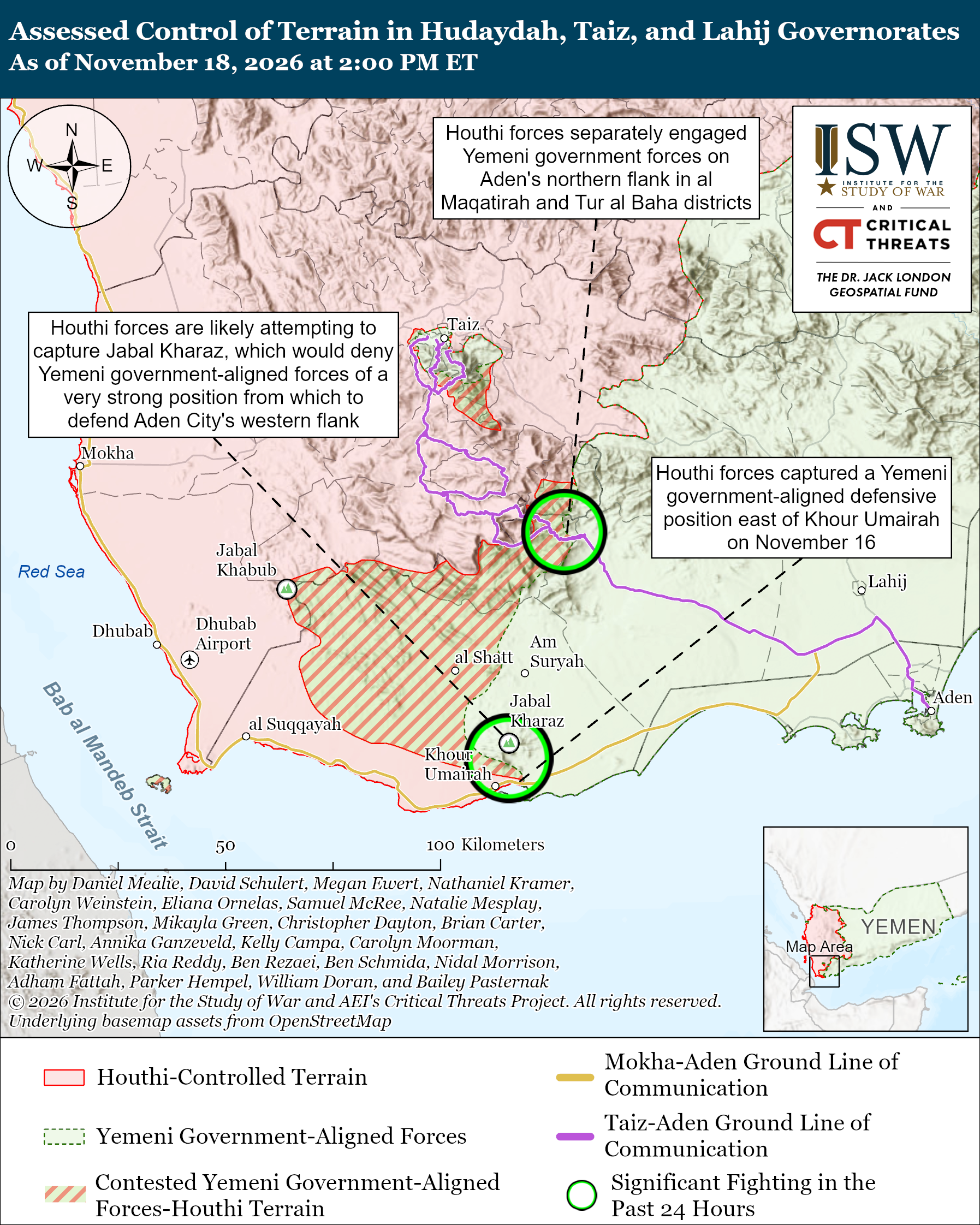
Houthi forces separately engaged Yemeni government forces on Aden's northern flank in al Maqatirah and Tur al Bahah districts. Several anti-Houthi Yemeni sources reported that Houthi fighters engaged Yemeni government-aligned forces in northern Lahij Governorate’s al Maqatirah and Tur al Bahah districts on November 17 and 18, which suggests that Houthi forces are simultaneously attempting to advance on Aden's northern and western flanks.[v] An anti-Houthi Yemeni source also reported that Yemeni government-aligned forces captured two Houthi fighters that attempted to infiltrate al Raja, which lies approximately 45 kilometers south of the al Maqatirah frontline and 50 kilometers north of Aden City.[vi] The infiltration highlights that the Yemeni government-aligned forces remain highly vulnerable to overextension and infiltration through a wide, exposed rear area, particularly because Houthi fighters can fix Yemeni government-aligned forces along frontlines while infiltrating their rear.
US and Partner Military Operations
See "Iranian Strike Campaign" section below.
Iranian Strike Campaign
-
Assessed Iranian War Aims:
- Secure international recognition of Iranian control over the Strait of Hormuz
- Degrade the US ability and willingness to continue the war
- Restore deterrence vis-à -vis the United States and its regional partners
- Divide the United States and Israel from the Arab states
Iran is conducting near-daily attacks on US military infrastructure in the region in response to continued US strikes on Iranian military sites near the Strait of Hormuz. Two unspecified US officials told NBC News on November 17 that US forces have recently conducted discreet attacks on Iranian military sites and that Iran has responded by attacking US military sites nearly every day.[vii] The officials said that the Pentagon has not publicly acknowledged most strikes and that US forces often target missile launchers and other systems that Iranian forces use to attack vessels and Gulf states.[viii] An unspecified US military official added that US aircraft struck an Islamic Revolutionary Guards Corps (IRGC) missile launch site on Qeshm Island on November 17 after Iran targeted a US radar in Bahrain.[ix] Iran also attacked Kuwait and Bahrain again the following day. The Iranian Artesh claimed that its drones targeted Patriot air defense systems and drone and missile launchers at Ali al Salem Air Base on November 18.[x] The Kuwaiti Army General Staff announced that Kuwaiti air defenses intercepted the Iranian drones, however.[xi] The Bahrain Defense Force separately said on November 18 that its air defenses repelled several Iranian aerial attacks.[xii] Iranian attacks on US military infrastructure in the region are part of an Iranian regional campaign that aims to weaken the resolve of the United States—and its regional allies that host US troops—to continue the war.
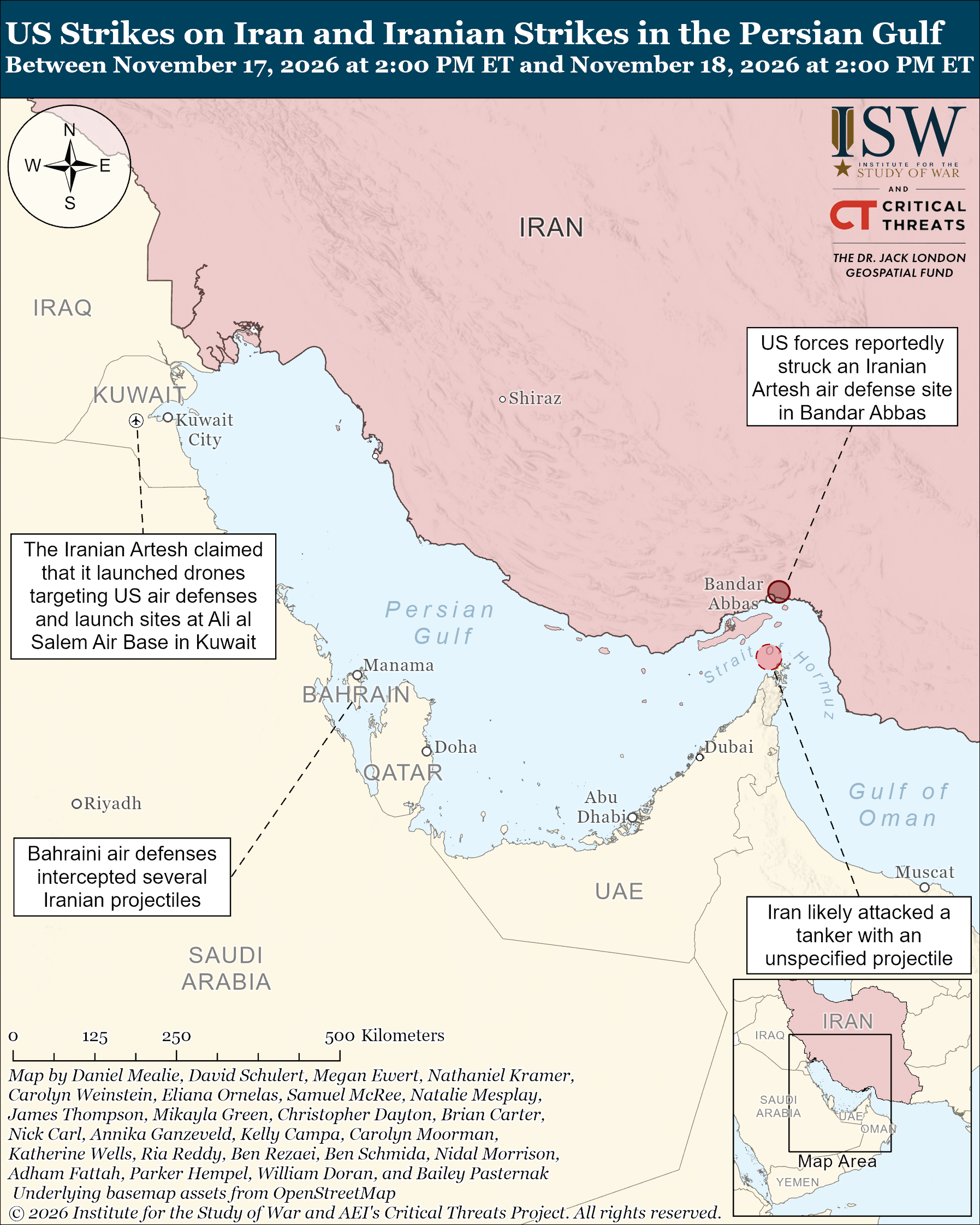
Iranian forces also continue to attack commercial vessels in the Strait of Hormuz and claim that these vessels are striking mines in the strait’s southern transit route in order to undermine US operations to ensure safety for civilian maritime traffic. United Kingdom Maritime Trade Operations (UKMTO) reported that an unknown projectile struck a tanker 13 nautical miles north of Khasab, Oman, in the Strait of Hormuz on November 17.[xiii] The IRGC Navy claimed on November 18 that a vessel struck a naval mine and exploded along an unauthorized route through the Strait of Hormuz.[xiv] CTP-ISW has not observed any indicators that Iran has successfully re-mined the southern route.
US-Iran Negotiations
Nothing significant to report.
Iranian Domestic Affairs
The Iranian regime appears to be expanding domestic intelligence and counterinsurgency efforts amid continued anti-regime militant activity in northwestern and southeastern Iran. Islamic Development Organization (IDO)-affiliated Mehr News Agency argued in an op-ed on November 18 that concurrent activities by anti-regime groups in these regions could reflect a coordinated effort to “disperse” Iranian security forces across several hotspots.[xv] The op-ed urged authorities to monitor and investigate any connections between separate incidents in both regions and to treat Iran’s information domain as a "military field."[xvi] The op-ed's publication indicates an effort by some elements of the regime to frame separate incidents of anti-regime unrest as part of a broader, externally organized pressure campaign that is designed to overwhelm internal security forces and weaken the regime’s ability to respond. Basij Commander Hossein Taeb separately called on November 18 for Basij bases to strengthen their neighborhood intelligence networks and mobilize residents to identify militant and espionage networks in their communities.[xvii] Taeb’s remarks corroborate Iranian Supreme Leader Mojtaba Khamenei’s August 10 directive to make “every Iranian a Basiji” and strengthen domestic intelligence and informant networks through training and modern technology.[xviii] The regime likely seeks to expand local Basij networks to provide early warning for formal security forces and reduce the strain of simultaneous militant threats on these forces.
Iranian security forces have recently conducted several counterinsurgency operations targeting anti-regime Kurdish groups in northwestern Iran.[xix] The Iranian Ministry of Intelligence said on November 17 that it dismantled two armed “separatist” cells in Kurdistan Province, arrested nine members, and seized several rifles, ammunition, and 70 Starlink devices.[xx] Kurdistan Province border guards separately announced on November 17 that they seized 21 firearms near Baneh, Kurdistan Province.[xxi] Iranian media also reported that Kurdish Free Life Party (PJAK) fighters killed one border guard near Baneh on November 17.[xxii] These anti-regime activities have likely reinforced regime concerns about militant networks and weapons trafficking along Iran’s northwestern border.
Anti-regime militant activity has also continued in southeastern Iran in recent days.[xxiii] Iranian media reported on November 18 that unspecified armed militants killed a local Sunni Basij member in Zahedan, Sistan and Baluchistan Province.[xxiv] No group has claimed responsibility for the attack at the time of this writing. The attack comes amid an uptick in insurgent activity by the Mobarizoun Popular Front (MPF), a coalition of Baloch anti-regime groups, in southeastern Iran. MPF fighters have recently conducted attacks using small arms and improvised explosive devices (IED) to target internal security infrastructure and regime forces, including Law Enforcement Command (LEC) posts and purported IRGC Quds Force-controlled Fatemiyoun fighters.[xxv]
Lebanon
The Lebanese government is likely attempting to thwart Hezbollah's efforts to infiltrate and develop military capabilities in areas of Lebanon beyond its traditional areas of influence. Lebanese Government Commissioner to the Military Court Claude Ghanem charged five suspected Hezbollah members with conspiracy to establish and equip illegal armed groups on November 18.[xxvi] It is unclear whether Ghanem's charges specifically accuse the suspects of arming existing Hezbollah units in the area or creating additional Hezbollah or sympathizer militia cells. Lebanese Internal Security Forces (ISF) personnel previously arrested the five suspects in Bcharre District, in northern Lebanon's Tripoli Governorate, on November 10.[xxvii] The prosecution effort is part of a broader Lebanese government effort to hold Hezbollah accountable for its criminal activities, which began when the ISF confiscated a Hezbollah truck carrying nearly 800 kilograms of high explosives from the Bekaa Valley to Beirut's southern suburbs on October 5.[xxviii] Ghanem's latest charges indicate that the government is continuing to restrict Hezbollah's criminal activities despite the group's political leverage and threats of unrest.[xxix]
The presence of suspected Hezbollah fighters conducting illegal militant activities in Bcharre District, whose inhabitants are almost entirely Maronite Christian, suggests that Hezbollah is attempting to expand its operations beyond its traditional, Shia-majority operational areas in southern Lebanon, the Bekaa Valley, and Beirut's southern suburbs.[xxx] Hezbollah fighters may seek to conceal weapons caches in Bcharre District and other rural Christian areas to avoid exposure to Israeli airstrikes or Lebanese government interdictions.[xxxi] Hezbollah also very likely maintains some smuggling routes through northwestern Lebanon's Akkar and Tripoli governorates, which it may increasingly depend upon to circumvent Lebanese authorities operating along the Beirut-Damascus Highway from the Bekaa Valley to Beirut.[xxxii] It is also possible, albeit less likely, that the suspects sought to develop non-Shia militant cells that Hezbollah could attempt to leverage as a future threat to the Lebanese government's efforts to disarm the group. Hezbollah has long equipped and organized an auxiliary, non-denominational militia called the Lebanese Resistance Brigades, but it is very unlikely that many members of Bcharre District's overwhelmingly Maronite population are willing to organize armed cells subservient to Hezbollah.[xxxiii]
Iraq
Nothing significant to report.
Arabian Peninsula
The Houthi movement likely launched missiles and drones targeting Saudi critical infrastructure on November 17 and 18 as part of its ongoing campaign to compel Saudi Arabia to end military operations in Yemen and submit to the Houthis’ economic demands. Saudi Joint Forces Command spokesperson Major General Turki al Maliki announced that Saudi air defenses intercepted three Houthi cruise missiles and drones near Riyadh and one Houthi drone over southern Saudi Arabia on November 17 and 18.[xxxiv] The Houthis have not claimed any attacks on Saudi Arabia since ISW-CTP's last data cutoff on November 17, however. The Houthis seek to impose economic and political costs on Saudi Arabia in order to compel the kingdom to submit to Houthi demands, which include ending Saudi support for Yemen’s legitimate government, lifting Saudi controls on Houthi-controlled ports and airports, and granting the Houthis control over Yemen’s oil and gas resources.[xxxv]

[i] https://x.com/strategicbakery/status/2122904853634765291 ; https://t.me/Alibk3/41674
[ii] https://x.com/strategicbakery/status/2122904853634765291 ; https://t.me/Alibk3/41674 ; https://x.com/war_cube/status/2123069570957353080
[iii] https://understandingwar.org/research/middle-east/iran-update-november-12-2026/ ; https://t.me/army21ye/4062 ;
[iv] https://x.com/strategicbakery/status/2122904853634765291 ; https://t.me/Alibk3/41674
[v] https://x.com/almasaobl/status/2122843282577203521 ; https://x.com/almasaobl/status/2122837565870903600 ; https://x.com/ALyemennow/status/2123088716658880973
[vi] https://x.com/almasaobl/status/2122851343350321504
[vii] https://www.nbcnews.com/politics/national-security/us-iran-trade-attacks-almost-daily-pentagon-doesnt-always-acknowledge-rcna609685#selection-1571.0-2888.0
[viii] https://www.nbcnews.com/politics/national-security/us-iran-trade-attacks-almost-daily-pentagon-doesnt-always-acknowledge-rcna609685#selection-1571.0-2888.0
[ix] https://www.nbcnews.com/politics/national-security/us-iran-trade-attacks-almost-daily-pentagon-doesnt-always-acknowledge-rcna609685#selection-1571.0-2888.0
[x] https://t.me/farsna/475212
[xi] https://x.com/KuwaitArmyGHQ/status/2122806978611134580
[xii] https://x.com/BDF_Bahrain/status/2122864607622725881
[xiii] https://x.com/UK_MTO/status/2122993996255338573
[xiv] https://t.me/Tasnimnews/459682
[xv] https://www.mehrnews dot com/news/7015303
[xvi] https://www.mehrnews dot com/news/7015303
[xvii] https://defapress dot ir/fa/news/879045
[xviii] https://rahbar dot ir/speech?cid=1768 ;
https://defapress dot ir/fa/news/879045
[xix] https://t.me/sepah_pasdaran/216133 ;
https://t.me/MyAsriran/808439 ;
https://t.me/entekhab_ir/386332 ;
https://t.me/MyAsriran/808768 ;
https://t.me/SaberinFa/89793 ;
[xx] https://t.me/MyAsriran/808768
[xxi] https://t.me/Nournews_ir/413700
[xxii] https://t.me/Tasnimnews/459719
[xxiii] https://t.me/farsna/475309
[xxiv] https://t.me/farsna/475309
[xxv] https://www.criticalthreats.org/analysis/iran-update-november-3-2026 ;
https://understandingwar.org/research/middle-east/iran-update-november-2-2026/ ;
https://understandingwar.org/research/middle-east/iran-update-october-28-2026/ ;
https://understandingwar.org/research/middle-east/iran-update-october-9-2026/ ;
https://understandingwar.org/research/middle-east/iran-update-october-8-2026/ ;
https://understandingwar.org/research/middle-east/iran-update-october-5-2026/
[xxvi] https://www.mtv dot com.lb/news/1759611
[xxvii] https://www.mtv dot com.lb/en/news/1757062
[xxviii] https://understandingwar.org/research/middle-east/iran-update-october-23-2026/ ; https://apnews.com/article/lebanon-israel-hezbollah-explosives-truck-beirut-f36ef1b24e3b505136d76e4fdfdcdcb6
[xxix] https://understandingwar.org/research/middle-east/how-hezbollah-is-preventing-its-disarmament-again/ ; https://understandingwar.org/research/middle-east/iran-update-october-23-2026/
[xxx] https://the961 dot com/en-lb/facts-about-bcharre
[xxxi] https://www.timesofisrael dot com/israel-targets-arms-shipment-in-rare-strike-in-lebanons-eastern-beqaa-valley/ ; https://apnews.com/article/lebanon-israel-hezbollah-explosives-truck-beirut-f36ef1b24e3b505136d76e4fdfdcdcb6
[xxxii] https://today.lorientlejour dot com/article/1554832/arrests-in-lebanons-christian-north-documents-fuel-suspicions-about-hezbollahs-intentions.html
[xxxiii] https://ctc.westpoint.edu/hizb-allahs-lebanese-resistance-brigades/ ; https://today.lorientlejour dot com/article/1355343/who-are-the-resistance-brigades-the-hezbollah-allied-sunni-militia.html
[xxxiv] https://x.com/CJFCSpox/status/2122907534361268650 ;
https://x.com/CJFCSpox/status/2122979306137894997 ;
https://x.com/CJFCSpox/status/2123083351053721868 ;
https://x.com/CJFCSpox/status/2123083351053721868
[xxxv] https://understandingwar.org/research/middle-east/iran-update-november-9-2026/ ; https://understandingwar.org/research/middle-east/iran-update-october-11-2026/ ; https://t.me/army21ye/3948
[WD1]Vertical graphic: https://criticalthreats.imeetcentral.com/p/aQAAAAAFN43e
[WD2]Horizontal Graphic: https://criticalthreats.imeetcentral.com/p/aQAAAAAFN43h
[BS3]https://criticalthreats.imeetcentral.com/p/aQAAAAAFN40v
[BR4]https://criticalthreats.imeetcentral.com/p/aQAAAAAFN42d
View Citations