{{currentView.title}}
August 11, 2026
Iran Update Evening Special Report: August 11, 2026
Data Cutoff: 2:00 PM ET
The Institute for the Study of War (ISW) and The Critical Threats Project (CTP) at the American Enterprise Institute are publishing daily updates to provide analysis on the war with Iran. The updates cover events from the past 24-hour period.
Key Takeaways:
- Some observed indicators suggest that the Iraqi federal government is considering a major crackdown on Iranian-backed Iraqi militias, including by entering and retaking militia-controlled strongholds. Such an effort would require major mobilization, and the militias would likely be aware of any pending crackdown.
- Previous Iraqi administrations, particularly under former Prime Minister Mustafa al Kadhimi, have conducted limited crackdowns on militia activity, but the combination of the Iranian infiltration of Iraqi government institutions and the strength of the Iraqi militias limited the scale of such efforts.
- The US’ pressure on Zaydi to disarm the militias could compel him to act against the militias despite these limitations. US efforts to compel Baghdad to disarm the groups have only increased due to militia attacks against US and foreign targets in Iraq and the region in March and April, as well as in recent months.
- Islamic Revolutionary Guards Corps (IRGC) Quds Force Commander Brigadier General Esmail Ghaani warned Iraqi militia leaders against armed confrontation with the Iraqi government and to reach a settlement to avoid handing over militia weapons to the state during an August 10 visit to Baghdad, according to informed sources speaking to Iraqi media. Ghaani likely discussed Iranian-backed Iraqi militias' recent attacks on Gulf states, namely Saudi Arabia, during his visit to Baghdad.
- Iranian leaders, including Ghaani, are likely attempting to draw the Iraqi government away from developing alternative oil export corridors to the Strait of Hormuz. Iranian leaders also almost certainly intend to preserve Iran’s leverage over regional states, the United States, and the global economy by promoting an arrangement that would offer Iraq short-term economic relief and reduce Iraq’s incentive to develop alternative oil export corridors to the Strait.
- A sustained US naval blockade could increase economic and political pressure on Iran and may eventually compel at least some regime officials to accept greater concessions in negotiations. The Iranian regime’s recent appointments suggest that the officials who currently dominate decision-making may be less responsive to that pressure and more inclined to maintain maximalist positions, however.
Toplines
Some observed indicators suggest that the Iraqi federal government is considering a major crackdown on Iranian-backed Iraqi militias, including by entering and retaking militia-controlled strongholds. Such an effort would require major mobilization, and the militias would likely be aware of any pending crackdown. Saudi media reported on August 11 that Iraqi Prime Minister Ali al Zaydi is considering two options for disarming the militias as part of the federal government’s efforts to restrict arms to the state.[i] The Iraqi state could either reach agreements with the militias or take more “decisive measures,” such as sending security forces to control Jurf al Sakhr, south of Baghdad.[ii] Kataib Hezbollah has refused to allow the Iraqi government to exercise sovereignty over Jurf al Sakhr for over a decade and has used the area to store weapons and launch attacks against US and foreign targets in Iraq and the region, including in March and April.[iii] The Iraqi government is also taking other steps to rein in the militias. The Iraqi Interior Ministry has reportedly closed 71 ”fake” Popular Mobilization Forces (PMF) offices throughout Iraq as part of federal efforts to gain control over militia arms.[iv] The PMF claimed that it had closed these offices itself, however.[v] The Interior Ministry closed two more offices in al Dora, Baghdad, on August 11.[vi] The Iraqi Counter-Terrorism Service—a premier, US-trained force that has been increasingly penetrated by the militias in recent years—conducted other counter-militia raids in Baghdad in recent weeks.[vii]
The Iranian-backed Iraqi militias are responding to these developments by threatening the Iraqi government. Iranian-backed Iraqi militias likely conducted a drone strike that destroyed shells for US-provided Iraqi tanks and armored vehicles at Camp Taji, north of Baghdad, on August 2.[viii] ISIS is inactive in Iraq and lacks the technical know-how to conduct a drone strike, and there are no other plausible culprits currently operating in Iraq other than Iranian-backed or Iranian actors. An unspecified intelligence official also assessed that the attacks indicate that some militias opposed to disarmament are conducting spoiling attacks to slow or stop the crackdown.[ix]
Previous Iraqi administrations, particularly under former Prime Minister Mustafa al Kadhimi, have conducted limited crackdowns on militia activity, but the combination of the Iranian infiltration of Iraqi government institutions and the strength of the Iraqi militias limited the scale of such efforts. Kadhimi opposed the militias but failed repeatedly to crack down on them. He reformed the Iraqi intelligence and security forces (a process undone by the Iranian-backed actors under the Sudani administration), which placed him in opposition to the militias.[x] Kadhimi repeatedly attempted to hold Iranian-backed militias, including Kataib Hezbollah, responsible for actions in Iraq that subverted Iraqi sovereignty.[xi] Kataib Hezbollah repeatedly attacked the US Embassy and assassinated their Iraqi critics close to the government and protest movement.[xii] Iraqi authorities in each Kadhimi-initiated crackdown would arrest several militia members but later release them in each instance under militia pressure.[xiii] Sudani—Kadhimi's successor—did launch an investigation into Kataib Hezbollah clashes with the Federal Police in July 2025 that ultimately led to the removal of two Kataib Hezbollah PMF brigade commanders.[xiv] Sudani likely had more flexibility in pursuing Kataib Hezbollah given his backing from other militia factions, however. His effort was not part of a cohesive anti-militia strategy.
The US’ pressure on Zaydi to disarm the militias could compel him to act against the militias despite these limitations. US efforts to compel Baghdad to disarm the groups have only increased due to militia attacks against US and foreign targets in Iraq and the region in March and April, as well as in recent months.[xv] The United States temporarily limited the Iraqi federal government’s access to its oil revenue in the initial months of the war.[xvi] Oil accounts for over 90% of the Iraqi state’s budget.[xvii] Western, regional, and Iraqi media have reported on the United States conditioning additional US support for and investment in the Iraqi state on Zaydi’s lessening of Iranian influence in Iraq, including via disarming the militias.[xviii] Iraqi media reported on August 11 that Zaydi is reportedly considering making “sweeping” leadership changes to the PMF, which is almost certainly related to US pressure against the militias.[xix] Zaydi is reportedly considering appointing figures from the Iraqi army and the Counter-terrorism Service to leadership positions within the PMF, which would be unlikely to blunt the Iranian influence within the organization.[xx] This is especially the case given indications that Baghdad may either integrate the militias into the PMF or have the militias give their weapons to the PMF.[xxi] None of these options would necessarily address the allegiance of the Iraqi militias to Iran and their willingness and ability to attack US and foreign interests in Iraq and the region, both issues being vital to secure US interests in Iraq.
Islamic Revolutionary Guards Corps (IRGC) Quds Force Commander Brigadier General Esmail Ghaani warned Iraqi militia leaders against armed confrontation with the Iraqi government and to reach a settlement to avoid handing over militia weapons to the state during an August 10 visit to Baghdad, according to informed sources speaking to Iraqi media.[xxii] Ghaani reportedly also met with political and security officials and Shia Coordination Framework officials, including Badr Organization leader Hadi al Ameri.[xxiii] Ghaani’s reported emphasis on avoiding conflict with the Iraqi government could indicate Tehran’s concern over such a scenario. Iraqi, Western, and regional reports in recent months have described both Iranian pressure on some Iraqi militias to pursue politics over military activity as well as Iran’s refusal for the militias to give their weapons to the federal government.[xxiv] It is plausible that Iran may support the disarmament of Iraqi militias that Iran has had less control over in recent years, such as Asaib Ahl al Haq. The group played a role in the assassination attempt against Kadhimi and announced its willingness to disarm on June 2.[xxv]
Ghaani likely discussed Iranian-backed Iraqi militias' recent attacks on Gulf states, namely Saudi Arabia, during his visit to Baghdad. Iraqi militias initially warned that they would attack US and Saudi interests in response to US-Saudi strikes on militia positions in Iraq on July 28.[xxvi] The Islamic Resistance in Iraq, which is a coalition of Iranian-backed Iraqi militias, later announced on August 7 that it would postpone its planned attacks following mediation from Ameri.[xxvii] The IRGC has coordinated Iraqi militias’ attacks on Gulf states throughout the war, and Reuters reported on June 19 that the IRGC Quds Force formed cells within Iraqi militias to report directly to Iran and attack Gulf states under IRGC orders as early as April.[xxviii] Iranian state media also reported that US-Saudi strikes in Iraq on July 28 also killed four IRGC Quds Force officers, which indicates that the IRGC and the Quds Force, which is specifically responsible for maintaining Iran’s Axis of Resistance, play an outsized role in determining Iraqi militia attacks on Gulf states.[xxix] Publicly reported information from Ghaani's meetings in Baghdad provided no indication of what stance, if any, Ghaani may have expressed on recent Iraqi militia threats to attack Saudi Arabia, however.
Iranian leaders, including Ghaani, are likely attempting to draw the Iraqi government away from developing alternative oil export corridors to the Strait of Hormuz. An unspecified informed source told Iraqi media on August 10 that Ghaani also discussed prospects for Iran to permit Iraqi oil tankers to transit the Strait of Hormuz with militia leaders and Shia Coordination Framework leaders in Baghdad.[xxx] Iraqi media did not report whether Ghaani discussed any mechanism through which Iran would ensure safe passage for Iraqi vessels through the Strait or whether Iran intends to charge Iraqi vessels with transit fees.[xxxi] Iran’s offer to provide safe passage for Iraqi tankers would require Iraq to recognize Iranian control over the Strait, and thereby lend legitimacy to Iran’s illegal efforts to codify its domination of the waterway. The arrangement would also cement Iraq's economic and political dependence on Iran because Iraq would need to rely on Iranian terms to export its oil, which accounts for up to 90 percent of the Iraqi government’s revenues.[xxxii]
Iranian leaders also almost certainly intend to preserve Iran’s leverage over regional states, the United States, and the global economy by promoting an arrangement that would offer Iraq short-term economic relief and reduce Iraq’s incentive to develop alternative oil export corridors to the Strait. Iraq is currently facing a liquidity crisis, primarily because of its inability to export oil through the Strait, and is unable to pay government employees as a result.[xxxiii] Ghaani’s discussion also comes amid Iraqi consultations with the United States and regional partners in recent weeks to develop pipelines and overland transit corridors through Iraq that could export oil to the Mediterranean and Red Seas, amid Iran’s ongoing attempts to control the Strait of Hormuz.[xxxiv] The Iraqi Oil Ministry announced plans on August 10 to develop a new pipeline that will extend from Basra to the Syrian Mediterranean port of Baniyas with investment from US corporations, for example.[xxxv] These projects challenge Iran’s leverage over the global economy by creating alternatives for major oil-producing regional states to export fuel through the Strait, thereby reducing the waterway’s importance to global commerce. Iranian leaders also likely intend to undercut regional rivals and adversaries, including Saudi Arabia, Turkey, and Syria, that are collaborating with Iraq to develop pipelines that would draw economic activity and oil exports away from the Strait.[xxxvi]
A sustained US naval blockade could increase economic and political pressure on Iran and may eventually compel at least some regime officials to accept greater concessions in negotiations. The Wall Street Journal reported on August 10 that US President Donald Trump has settled, “at least for now,” on allowing sanctions and the naval blockade time to impose economic costs on Iran, according to unspecified US officials.[xxxvii] The sources added that administration officials argued that sustained pressure could eventually force the regime to change its position.[xxxviii] The Iranian regime’s recent appointments suggest that the officials who currently dominate decision-making may be less responsive to that pressure and more inclined to maintain maximalist positions, however.[xxxix] Iranian President Masoud Pezeshkian previously pressured Supreme Leader Mojtaba Khamenei to approve the US-Iran memorandum of understanding as the first US naval blockade between April and June 2026 worsened Iran’s economic conditions.[xl] Mojtaba’s reported willingness to accept Pezeshkian’s resignation if Pezeshkian again tried to use that threat to influence policy suggests that Mojtaba may be less willing to accept pressure from pragmatist officials over deteriorating economic conditions.[xli] Mojtaba’s recent appointment of former IRGC Commander Major General Mohsen Rezaei as Supreme National Security Council secretary and his elevation of other hardline security officials further separately indicate that the regime is consolidating decision-making around officials who are less inclined to quickly compromise.[xlii] Rezaei stated on August 11 that Iran will not reopen the Strait of Hormuz until the United States ends the war and naval blockade, releases Iran’s frozen assets, and agrees to a region-wide ceasefire, including in Lebanon and Gaza.[xliii]
US and Partner Military Operations
Nothing significant to report.
Iranian Strike Campaign
-
Assessed Iranian War Aims:
- Secure international recognition of Iranian control over the Strait of Hormuz
- Degrade the US ability and willingness to continue the war
- Restore deterrence vis-à -vis the United States and its regional partners
- Divide the United States and Israel from the Arab states
Nothing significant to report.
US-Iran Negotiations
See topline section.
Iranian Domestic Affairs
Iran is continuing to expand military pressure on Iranian Kurdish opposition groups in Iraqi Kurdistan Region. Iran launched three missile strikes against Komala’s headquarters near Erbil on August 11, according to a Komala Party official.[xliv] Komala claimed that Iran has now fired more than 103 missiles and drones at opposition camps since the war began.[xlv] Iranian Foreign Affairs Minister Abbas Araghchi and Patriotic Union of Kurdistan (PUK) head Bafel Talabani agreed on August 11 to strengthen the existing security coordination along the Iran-Iraq border and cooperate against “threats” under the existing Iran-Iraq security agreement.[xlvi] Iran and Iraq signed a border security agreement in March 2023 aimed primarily at tightening security along the frontier with the Iraqi Kurdistan Region, including an Iraqi commitment to prevent armed Kurdish groups from using Iraqi territory to launch cross-border attacks against Iran.[xlvii]
Lebanon
Nothing significant to report.
Iraq
See topline section.
Arabian Peninsula
IRGC officers are “supervising” the Houthis' military operations in Yemen, according to unspecified Yemeni sources speaking to UK-based, Saudi-owned media on August 11.[xlviii] The sources stated that Iran's envoy to Yemen, Ali Mohammad Rezaei, reportedly supervises an "operations room" that monitors field developments and promotes media narratives about a Saudi "siege" on Yemen.[xlix] The Houthis have cited an alleged Saudi blockade on Houthi-controlled ports and airports to justify their blockade on Saudi ports and attacks on Saudi vessels in the Red Sea since late July.[l] Reuters reported on July 23 that Iran previously transported IRGC commanders, military advisers, and missile and drone-related equipment to the Houthis in Yemen on July 13.[li] Reports of IRGC supervision of Houthi activity in Yemen follow a recent New York Times report that the IRGC used the US-Iran ceasefire in April 2026 to coordinate with the Houthis and other members of the Axis of Resistance to expand the conflict against the US-Israel combined force.[lii] CTP-ISW previously assessed on July 21 that the Houthis likely decided to impose their blockade on Saudi Arabia to advance their own interests, though Iran probably encouraged them to impose the blockade for Tehran's own purposes.[liii]
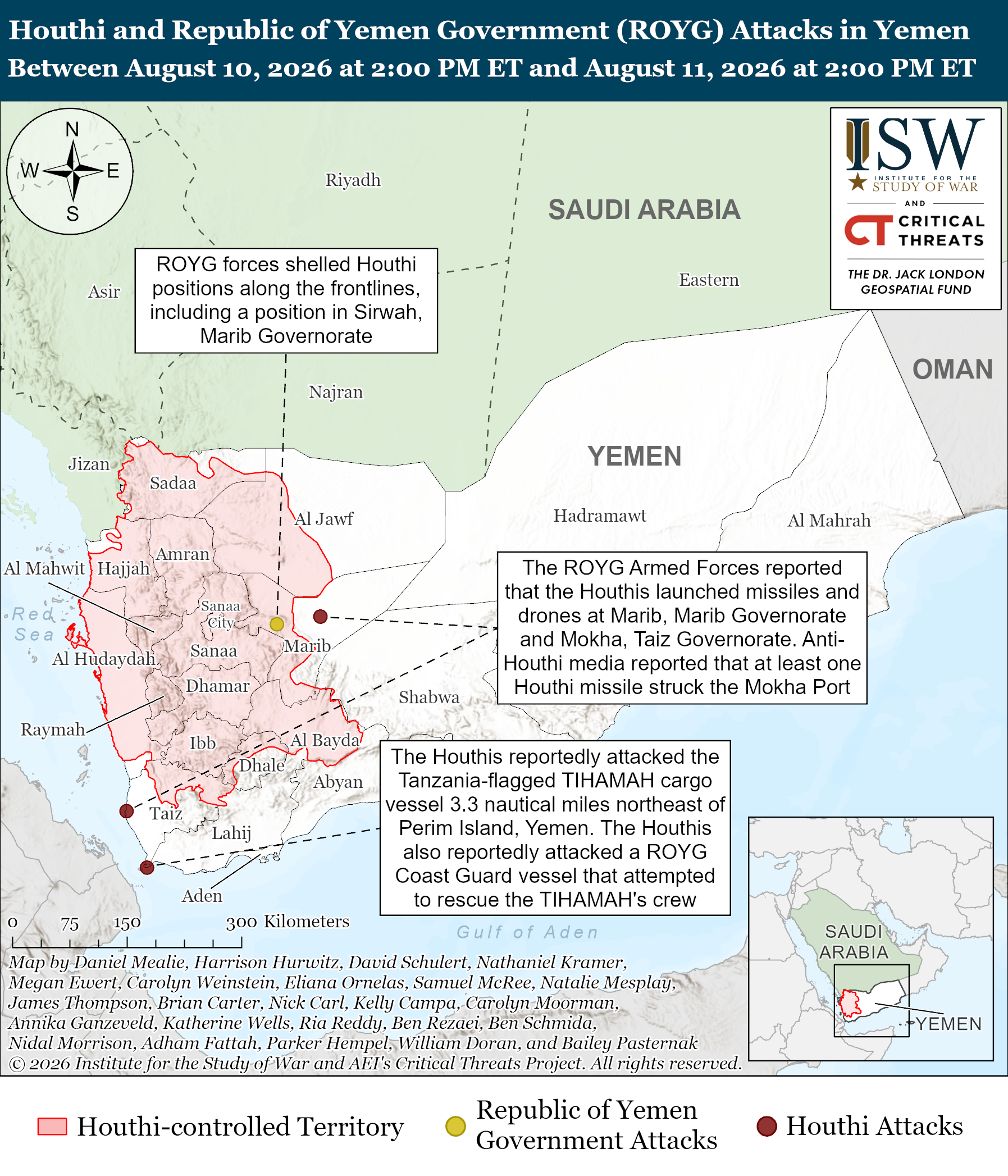
The Houthis attacked the Tanzania-flagged, Egyptian-owned cargo ship TIHAMAH in the Red Sea off the coast of Mokha, Yemen, on August 11, and killed four crew members.[liv] United Kingdom Maritime Trade Operations confirmed on August 11 that unspecified actors fired an unknown projectile at an unnamed stationary cargo vessel near Mokha.[lv] The ROYG Transport Ministry also stated on August 11 that the Houthis fired three ballistic missiles at the cargo ship and a fourth at the ROYG Coast Guard vessel that arrived to support the ship.[lvi] The Houthis claimed on August 11 that they targeted a cargo ship transporting “Saudi military equipment” in the Bab al Mandeb Strait and posted images of the TIHAMAH following the attack.[lvii] This attack comes after the Houthis have attacked several vessels transiting the Red Sea since July 22 as part of their effort to enforce their blockade on Saudi ports.[lviii] It also comes amid a recent escalation in fighting between Houthi and ROYG forces.[lix]

[i] https://www.alarabiya dot net/arab-and-world/iraq/2026/08/11/العراق-الزيدي-يتمسك-بحصر-السلاح-ويبحث-السيطرة-على-جرف-الصخر
[ii] https://www.alarabiya dot net/arab-and-world/iraq/2026/08/11/العراق-الزيدي-يتمسك-بحصر-السلاح-ويبحث-السيطرة-على-جرف-الصخر
[iii] https://alhurra dot com/en/14420 ; https://ctc.westpoint.edu/standing-with-iran-the-integrated-combat-performance-of-iraqi-militias-during-operation-epic-fury/
[iv] https://shafaq dot com/ar/أمـن/الداخلية-العراقية-تعلن-غلاق-71-مقرا-وهميا-للحشد-الشعبي
[v] https://shafaq dot com/ar/سیاسة/الحشد-الشعبي-ينوه-بش-ن-المقرات-الوهمية-لاتمت-لينا-بصلة
[vi] https://shafaq dot com/ar/أمـن/عملية-منية-في-منطقة-خاصة-بالفصا-ل-جنوبي-بغداد-اعتقال-4-و-غلاق-مقرين
[vii] https://understandingwar.org/research/middle-east/iran-update-special-report-july-6-2026/ ; https://aawsat dot com/العالم-العربي/المشرق-العربي/5291747-مكافحة-الإرهاب-يشتبك-مع-فصيل-في-بغداد-واعتقال-مهربي-نفط
[viii] https://aawsat dot com/العالم-العربي/المشرق-العربي/5305345-العراق-يشتبه-بمسيّرة-فجرت-مخزون-دبابات-وسط-معركة-صامتة-مع
[ix] https://aawsat dot com/العالم-العربي/المشرق-العربي/5305345-العراق-يشتبه-بمسيّرة-فجرت-مخزون-دبابات-وسط-معركة-صامتة-مع
[x] https://www.washingtoninstitute.org/policy-analysis/kadhimi-commander-chief-first-steps-iraqi-security-sector-reform ; https://mei.edu/publication/maintaining-best-thing-us-built-iraq-continued-support-iraqi-counterterrorism-service/ ; https://www.washingtoninstitute.org/policy-analysis/iraqs-watergate-and-fallout-us-relations ; https://plausibledenial.org/iraq/inis
[xi] https://www.nytimes.com/2021/05/27/world/middleeast/iraq-milita-arrest.html ; https://www.washingtonpost.com/world/middle_east/new-iraqi-leader-tries-to-rein-in-iran-backed-militias-but-task-proves-daunting/2020/07/02/4963bcaa-baea-11ea-97c1-6cf116ffe26c_story.html
[xii] https://www.nytimes.com/2021/05/27/world/middleeast/iraq-milita-arrest.html ; https://www.nytimes.com/2020/07/07/world/middleeast/iraq-hashimi-killing.html
[xiii] https://www.nytimes.com/2021/05/27/world/middleeast/iraq-milita-arrest.html ; https://www.washingtonpost.com/world/middle_east/new-iraqi-leader-tries-to-rein-in-iran-backed-militias-but-task-proves-daunting/2020/07/02/4963bcaa-baea-11ea-97c1-6cf116ffe26c_story.html
[xiv] https://almadapaper dot net/410578/ ; https://www.arabnews dot com/node/2611300/middle-east ; https://understandingwar.org/research/middle-east/the-leadership-and-purpose-of-iraqs-popular-mobilization-forces/
[xv] https://almadapaper dot net/441014/ ; https://www.alaraby.co dot uk/economy/خاص-وصول-دفعتين-من-الدولار-نقداً-إلى-بغداد-تزامنا-مع-زيارة-توم-براك ; https://x.com/SecWar/status/2077182768602132823
[xvi] https://www.wsj.com/world/middle-east/u-s-blocks-iraqs-dollar-shipments-to-squeeze-its-iran-backed-militias-3270d5af
[xvii] https://www.reuters.com/business/energy/how-us-controls-iraqs-oil-revenues-2026-01-23/ ; https://www.imf.org/en/-/media/files/publications/cr/2025/english/1irqea2025001-source-pdf.pdf
[xviii] https://www.newarab dot com/news/us-sends-dollar-shipment-iraq-threatens-sanctions ; https://www.wsj.com/world/middle-east/u-s-blocks-iraqs-dollar-shipments-to-squeeze-its-iran-backed-militias-3270d5af ; https://www.newarab dot com/news/us-sends-dollar-shipment-iraq-threatens-sanctions; https://shafaq dot com/ar/سیاسة/حصري-اميركا-تشترط-تفكيك-الفصا-ل-مقابل-تحرير-30-مليار-دولار-من-موال-صدام
[xix] https://shafaq dot com/ar/سیاسة/خاص-الزيدي-يدرس-تغييرات-واسعة-في-قيادات-الحشد-الشعبي)
[xx] https://shafaq dot com/ar/سیاسة/خاص-الزيدي-يدرس-تغييرات-واسعة-في-قيادات-الحشد-الشعبي)
[xxi] https://shafaq dot com/ar/سیاسة/سلاح-الفصا-ل-لى-الحشد-اتفاق-على-التسليم-قبل-نهاية-يلول-خاص ; https://rudaw dot net/english/categories/iraq/1077800
[xxii] https://shafaq dot com/ar/سیاسة/حصري-قا-ني-يرسم-خطا-حمر-في-بغداد-لا-حصر-لسلاح-الفصا-ل-ولا-صدام-مع-الدولة ; https://shafaq dot com/ar/سیاسة/خاص-قا-ني-في-بغداد-لبحث-سلاح-الفصا-ل-ومسار-تصدير-النفط-عبر-هرمز
[xxiii] https://shafaq dot com/ar/سیاسة/حصري-قا-ني-يرسم-خطا-حمر-في-بغداد-لا-حصر-لسلاح-الفصا-ل-ولا-صدام-مع-الدولة ; https://shafaq dot com/ar/سیاسة/خاص-قا-ني-في-بغداد-لبحث-سلاح-الفصا-ل-ومسار-تصدير-النفط-عبر-هرمز
[xxiv] https://amwaj.media/en/article/what-s-left-unsaid-about-iran-s-influence-in-iraq ; https://almadapaper dot net/434016/ ; https://almadapaper dot net/445497/ ; https://alhurra dot com/en/22220
[xxv] https://shafaq dot com/ar/سیاسة/بعد-العصا-ب-كتا-ب-ال-مام-علي-تقرر-فك-الارتباط-بتشكيلات-الحشد-الشعبي ; https://ctc.westpoint.edu/standing-with-iran-the-integrated-combat-performance-of-iraqi-militias-during-operation-epic-fury/
[xxvi] https://understandingwar.org/research/middle-east/iran-update-special-report-july-29-2026/ ; https://t.me/Smedia1/1951 ; https://t.me/Al_Nojaba/1397 ; https://t.me/aishab_alkahf/664 ; https://t.me/aishab_alkahf/664 ; https://www dot al-akhbar.com/NewspaperArticles/arab/900355
[xxvii] https://t.me/ElamAlmoqawama/1646
[xxviii] https://www.reuters.com/world/middle-east/irans-revolutionary-guards-set-up-covert-iraqi-cells-attack-gulf-neighbors-2026-06-19/
[xxix] https://www.mehrnews dot com/news/6903100/شهادت-۴-پاسدار-از-کاشان-در-حمله-شب-گذشته-آمریکا-و-رژیم-سعودی ; https://understandingwar.org/research/middle-east/iran-update-special-report-july-29-2026/
[xxx] https://shafaq dot com/ar/سیاسة/خاص-قا-ني-في-بغداد-لبحث-سلاح-الفصا-ل-ومسار-تصدير-النفط-عبر-هرمز
[xxxi] https://shafaq dot com/ar/سیاسة/خاص-قا-ني-في-بغداد-لبحث-سلاح-الفصا-ل-ومسار-تصدير-النفط-عبر-هرمز
[xxxii] https://www.reuters.com/business/energy/how-us-controls-iraqs-oil-revenues-2026-01-23/ ; https://shafaq dot com/en/Economy/Oil-generates-four-fifths-of-Iraq-s-revenue-through-May
[xxxiii] https://shafaq dot com/en/society/Iraq-salary-delays-spark-market-slowdown-family-hardship ; https://www.marineradar.com/trends/iraq-delays-july-salaries-as-hormuz-blockade-cuts-oil-2026-08-06
[xxxiv] https://understandingwar.org/research/middle-east/iran-update-special-report-august-7-2026/ ; https://understandingwar.org/research/middle-east/iran-update-special-report-august-5-2026/ ; https://understandingwar.org/research/middle-east/iran-update-special-report-july-15-2026/
[xxxv] https://www.iraqinews dot com/iraq/iraq-unveils-dual-pipeline-faysh-khabur-baniyas-chevron-2026/
[xxxvi] https://www.reuters.com/world/asia-pacific/saudi-arabia-turkey-pakistan-sign-joint-defence-deal-amid-regional-turmoil-2026-08-07/ ; https://understandingwar.org/research/middle-east/iran-update-special-report-august-5-2026/
[xxxvii] https://www.wsj.com/world/middle-east/trump-shifts-to-economic-pressure-again-as-iran-wont-meet-his-demands-4445c840?mod=middle-east_more_article_pos1
[xxxviii] https://www.wsj.com/world/middle-east/trump-shifts-to-economic-pressure-again-as-iran-wont-meet-his-demands-4445c840?mod=middle-east_more_article_pos1
[xxxix] https://understandingwar.org/research/middle-east/iran-update-special-report-august-10-2026/
[xl] https://www.nytimes.com/2026/07/04/world/middleeast/iran-supreme-leader-funeral-divisions.html
[xli] https://understandingwar.org/research/middle-east/iran-update-special-report-august-3-2026/
[xlii] https://t.me/rahbar_ir/922 ;
https://understandingwar.org/research/middle-east/iran-update-special-report-august-10-2026/
[xliii] https://x.com/ir_rezaee/status/2087223141630132399?s=20
[xliv] https://shafaq dot com/en/Kurdistan/Iran-strikes-Kurdish-opposition-party-bases-in-Erbil
[xlv] https://x.com/IranIntl/status/2087135218264060309
[xlvi] https://t.me/Tasnimnews/437638
[xlvii] https://www.reuters.com/world/middle-east/iraq-iran-sign-deal-tighten-border-security-2023-03-19/
[xlviii] https://aawsat dot com/العالم-العربي/5305719-الحرس-الإيراني-يعيد-رسم-خريطة-تحصينات-الحوثيين
[xlix] https://aawsat dot com/العالم-العربي/5305719-الحرس-الإيراني-يعيد-رسم-خريطة-تحصينات-الحوثيين
[l] https://saba dot ye/ar/news3746630.htm ; https://understandingwar.org/research/middle-east/iran-update-special-report-august-10-2026/ ; https://understandingwar.org/research/middle-east/iran-update-special-report-august-7-2026/ ; https://understandingwar.org/research/middle-east/iran-update-special-report-july-21-2026/
[li] https://www.reuters.com/world/middle-east/iran-flew-irgc-commanders-missile-gear-yemens-houthis-sources-say-2026-07-23/ ; https://understandingwar.org/research/middle-east/iran-update-special-report-july-23-2026/
[lii] https://www.nytimes.com/2026/08/01/world/middleeast/iran-proxies-war-oil.html
[liii] https://understandingwar.org/research/middle-east/iran-update-special-report-july-21-2026/
[liv] https://www.sabanew dot net/story/ar/150667 ; https://www.reuters.com/world/china/three-killed-attacks-ships-red-sea-gulf-sources-say-2026-08-11/ ; Starboard Maritime Intelligence. Available by subscription at https://www.starboardintelligence.com/
[lv] https://www.ukmto.org/-/media/ukmto/products/jmic-advisory-update-083-26.pdf?rev=8dadfbfa0f264c5ca5ffc90b5c41e44d
[lvi] https://www.sabanew dot net/story/ar/150667
[lvii] https://x.com/MMY1444/status/2087233749260050929 ; https://x.com/DocMMY/status/2087262443127070736
[lviii] https://understandingwar.org/research/middle-east/iran-update-special-report-august-5-2026/ ; https://x.com/MMY1444/status/2084897649467986298 ; https://x.com/MMY1444/status/2085066984690188700 ; https://understandingwar.org/research/middle-east/iran-update-special-report-july-28-2026/ ; https://x.com/MMY1444/status/2082152059734995159 ; https://t.me/army21ye/3588 ; https://x.com/UK_MTO/status/2080043376351535532 ; https://understandingwar.org/research/middle-east/iran-update-special-report-july-23-2026/
[lix] https://understandingwar.org/research/middle-east/iran-update-special-report-august-10-2026/ ; https://understandingwar.org/research/middle-east/iran-update-special-report-august-6-2026/
View Citations