{{currentView.title}}
April 21, 2026
Iran Update Evening Special Report, April 21, 2026
Data Cutoff: 2:00 PM ET
The Institute for the Study of War (ISW) and The Critical Threats Project (CTP) at the American Enterprise Institute are publishing daily updates to provide analysis on the war with Iran. The updates focus on US and Israeli strikes on Iran and Iran and the Axis of Resistance’s response to the strikes. The updates cover events from the past 24-hour period.
Key Takeaways:
- The United States extended its ceasefire with Iran “until such time as [the Iranian] proposal is submitted and discussions are concluded.” Trump confirmed that Washington will maintain its blockade of Iranian ports.
- Conflicting reports on April 20 and 21 about Iran's participation in the scheduled negotiations and Iran's failure to produce a unified proposal reflect the ongoing intra-regime power struggle between Parliament Speaker Mohammad Bagher Ghalibaf and Islamic Revolutionary Guards Corps (IRGC) Commander Major General Ahmad Vahidi. CTP-ISW continues to assess that Vahidi appears to have the upper hand over Ghalibaf at the moment.
- Iranian-backed Iraqi militias conducted up to half of the roughly 1,000 drone attacks targeting Saudi Arabia during the war, according to unnamed sources speaking to the Wall Street Journal on April 21. CTP-ISW previously assessed that it very unlikely that Iranian-backed Iraqi militias would conduct drone attacks against regional states if the Iranian regime opposed such attacks, which suggests that Iran has not ordered its militia partners to cease attacking regional states
- Hezbollah attacked Israeli forces in southern Lebanon and northern Israel for the first time since the Israel-Lebanon ceasefire took effect on April 16. The IDF struck the Hezbollah rocket launcher responsible for the attack on Israeli forces in Rab el Thalathine
Toplines
The United States extended its ceasefire with Iran “until such time as [the Iranian] proposal is submitted and discussions are concluded.”[i] US President Donald Trump stated on April 21 that Pakistani mediators urged the United States not to resume attacks while Iranian leaders work to produce a “unified proposal.”[ii] The reference to a ”unified” proposal appears to imply that previous proposals were not unified in some way, which is consistent with CTP-ISW's assessment that one challenge with the ongoing negotiations is the divided nature of Iran’s negotiating team. The ceasefire extension comes after a second round of US–Iran negotiations scheduled for April 21 in Islamabad, Pakistan, were cancelled because Iran did not confirm its participation and did not respond to US positions.[iii] Trump confirmed that Washington will maintain its blockade of Iranian ports.[iv]
Conflicting reports on April 20 and 21 about Iran's participation in the scheduled negotiations and Iran's failure to produce a unified proposal reflect the ongoing intra-regime power struggle between Parliament Speaker Mohammad Bagher Ghalibaf and Islamic Revolutionary Guards Corps (IRGC) Commander Major General Ahmad Vahidi. CTP-ISW continues to assess that Vahidi appears to have the upper hand over Ghalibaf at the moment. The Wall Street Journal, citing unspecified sources, reported on April 21 that Iranian officials initially signaled that they would attend the talks but later introduced a precondition following pressure from the IRGC that the United States lift its blockade before negotiations begin.[v] That the regime then adopted this precondition as official regime policy suggests that senior-most IRGC commander Vahidi and aligned actors currently wield significant influence on Iranian decision-making. This dynamic is consistent with reporting that Vahidi is the only senior official who maintains direct access to Mojtaba Khamenei and relays key decisions, which gives him significant power.[vi] Ghalibaf has publicly supported negotiations and has not explicitly called for preconditions.[vii] The Trump administration seems to have been willing to negotiate in talks without preconditions.
The reported precondition that the United States lift its blockade before talks would only lift the blockade before and during the talks. The United States could then reimpose the blockade at any later time. This precondition is thus not a major concession because the blockade would be extremely time limited. The limited nature of the precondition suggests that Vahidi and those around him may have sought to derail negotiations rather than secure meaningful economic relief.
Iranian officials and IRGC-affiliated media are signaling readiness for the imminent resumption of war. IRGC-affiliated Tasnim News Agency reported on April 21 that Iran has prepared for a new phase of fighting.[viii] Tasnim added that Iran has assessed the likelihood of renewed conflict as high over the past two weeks and has conducted certain military redeployments and prepared new target lists accordingly.[ix] Iranian Judiciary Chief Gholam Hossein Mohseni Ejei separately assessed on April 21 that the likelihood of renewed US and Israeli attacks is high and emphasized the need for preparation.[x] An unspecified senior Israeli security official told Israel's state broadcaster on April 21 that Israel is preparing for the resumption of fighting with Iran as well.[xi] The official assessed that the United States and Iran will fail to reach any understandings and noted that Israel is ready to immediately resume the war.[xii]
Some senior Iranian clerical and political figures have expressed support for negotiations and for the negotiating team, but this support remains limited and does not yet reflect a unified shift within the regime. Prominent Iranian Sunni cleric Moulana Abdol Hamid publicly advocated for a negotiated resolution and criticized hardline Iranian officials for risking renewed conflict.[xiii] Abdol Hamid is the most prominent Sunni cleric in Iran and the Friday prayer leader in Zahedan, Sistan and Baluchistan Province, and he openly challenged the regime during the 2022 Mahsa Amini protests.[xiv] Abdol Hamid stated on April 21 that a “fair agreement” is the only viable solution and warned that hardliners obstructing such an outcome will bear responsibility for the “homeland's devastation.”[xv] Abdol Hamid previously called for “strong diplomacy with full authority” during his sermon on April 17 and emphasized that Iranian diplomacy should not be constrained by hardliners.[xvi] These remarks support the broader line that some Iranian political and clerical figures favor diplomacy and may be pushing back, at least indirectly, against the IRGC-centered camp that has constrained negotiations. Abdol Hamid remains an influential clerical figure, but his position is unlikely to meaningfully affect Iran's foreign policy decision-making. Prominent Shia cleric Grand Ayatollah Hossein Nouri Hamedani separately cautioned against actions that undermine negotiators and explicitly praised the role of Parliament Speaker Mohammad Bagher Ghalibaf.[xvii] Expediency Discernment Council member Mohammad Reza Bahonar emphasized confidence in Iranian negotiators and in Ghalibaf, stating that Ghalibaf is defending Iran’s achievements with commitment and calling on political factions and the public to support negotiators.[xviii] CTP-ISW has observed that Ghalibaf appears to be engaged in a serious internal dispute with IRGC Commander Major General Ahmad Vahidi (see above).[xix]
Maritime Developments
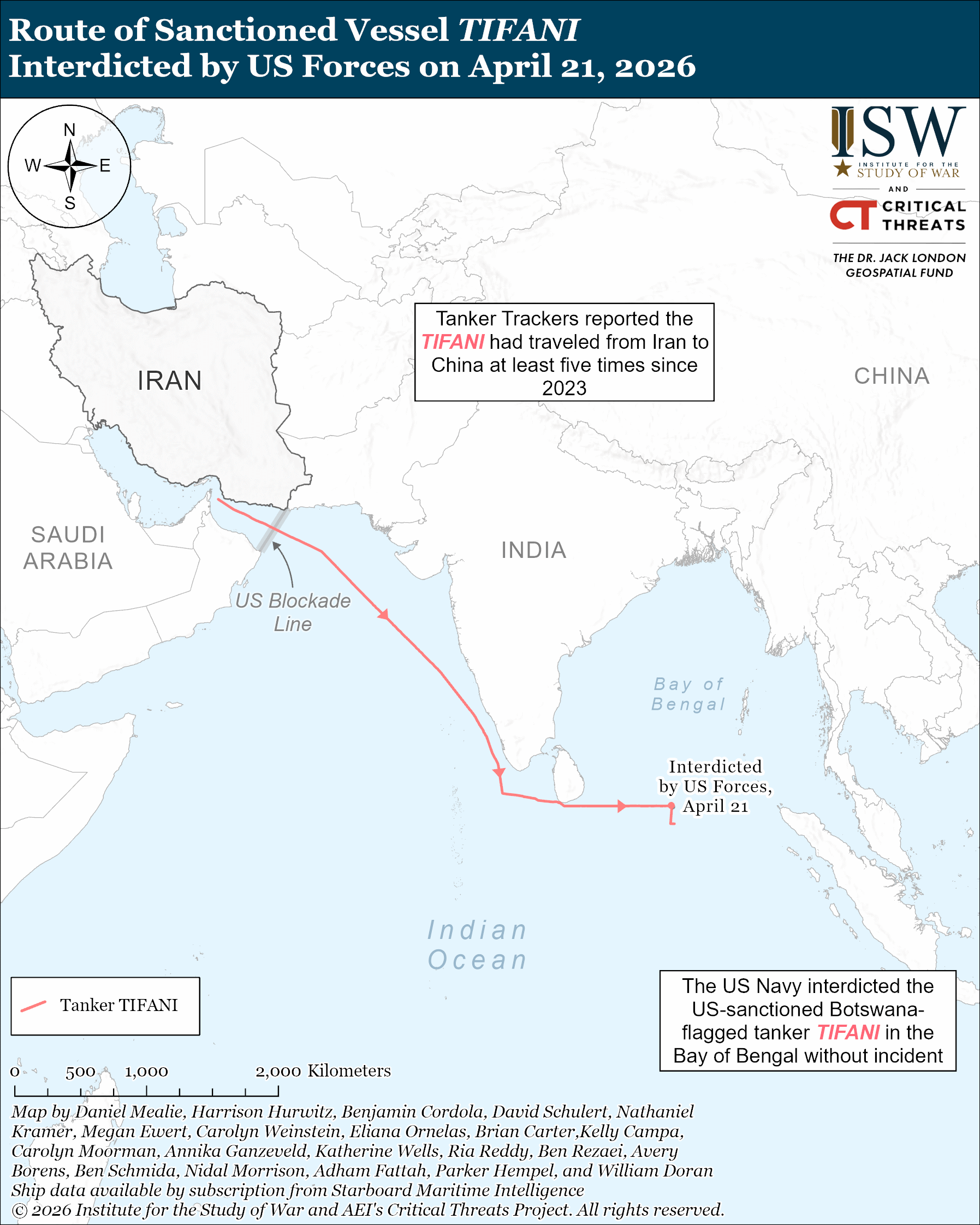
The US Navy’s interdiction of the US-sanctioned Tifani oil tanker in the Bay of Bengal on April 20 and 21 illustrates that US forces can interdict any vessel that violates the US blockade on Iranian ports far beyond the Gulf of Oman.[xx] The US Navy interdicted the US-sanctioned Botswana-flagged tanker Tifani in the US Indo-Pacific Command (INDOPACOM) area of responsibility in the Bay of Bengal overnight on April 20 and 21 without incident.[xxi] A US military official told the New York Times on April 21 that the White House would decide on the disposition of the sanctioned vessel and its cargo after US forces took it into custody.[xxii] Commercially available shipping data shows the Tifani vessel abruptly made a sharp turn south and moved out of a popular shipping lane in the Bay of Bengal.[xxiii] This could indicate that US forces are escorting the Tifani to a port in order to impound the vessel. The maritime intelligence organization Tanker Trackers said on April 21 that the Tifani had traveled from Iran to China at least five times since 2023.[xxiv]
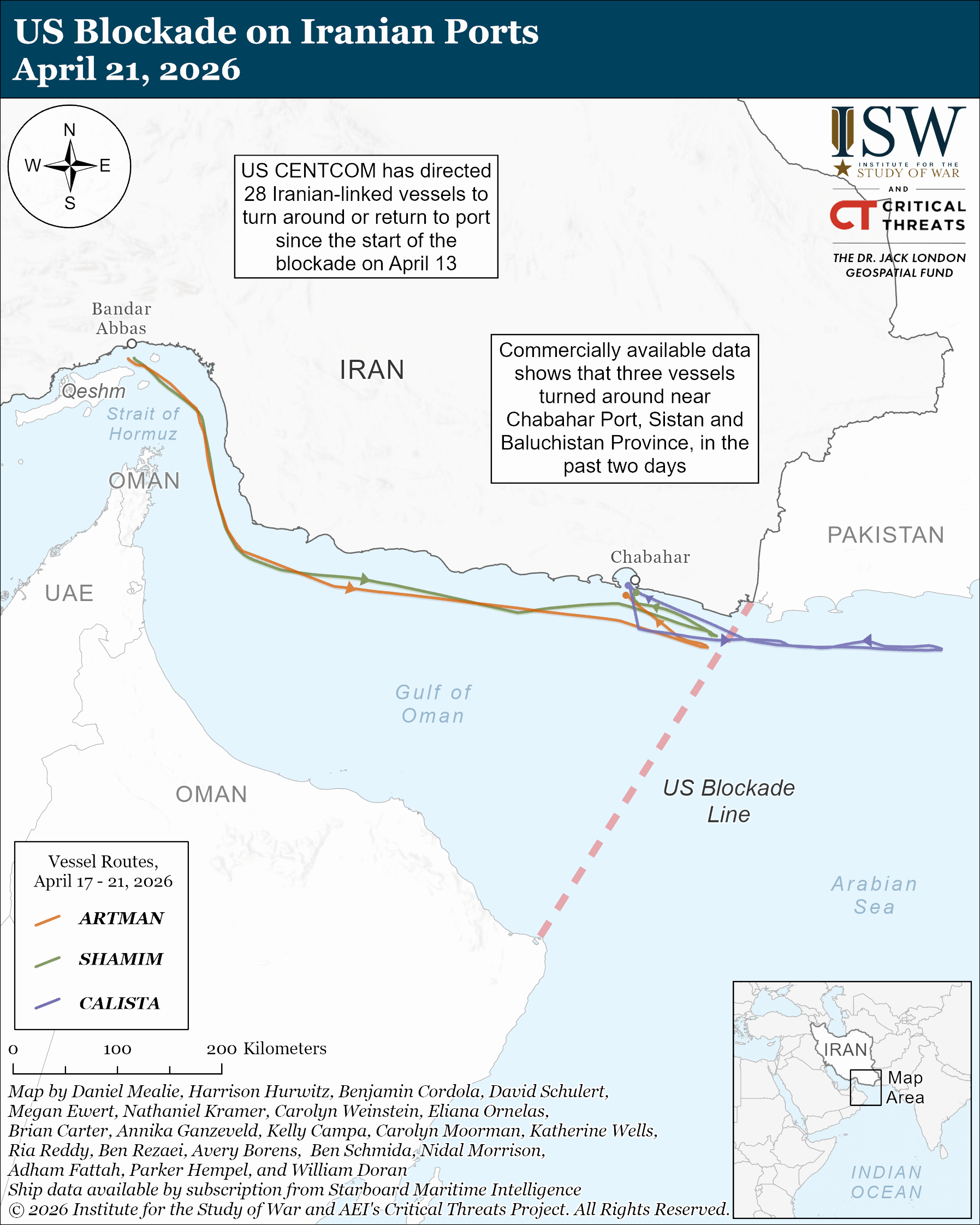
US Central Command (CENTCOM) stated on April 21 that US forces have directed 28 Iranian-linked vessels to turn around or return to port since the start of the blockade on April 13.[xxv] Commercially available data shows that three vessels turned around near Chabahar Port, Sistan and Baluchistan Province, in the past two days.[xxvi] Two of the three vessels, the Iranian-flagged and US-sanctioned Artman and Shamim, turned back towards Chabahar after approaching the US blockade line.[xxvii] The third vessel, the Comoros-flagged Calista, left from Chabahar towards Karachi, Pakistan, but turned around and returned to Chabahar.[xxviii]
Iranian media claimed on April 21 that one of its vessels, the Felicity, bypassed the US blockade with the support of the Artesh Navy.[xxix] The Felicity delivered two million barrels of Iranian crude oil to India around April 12 following a US sanctions waiver, one day before the start of the blockade.[xxx] Commercially available data shows that the Felicity stayed in the Gulf of Kutch, India, for about three days before heading back towards the Strait of Hormuz on April 18.[xxxi] It is theoretically possible for the Felicity to have turned off its transponder on April 18 and crossed the US blockade line in about four days, but there is no evidence that this occurred.
US-Israeli Air Campaign
The United States continues to degrade Iran’s ability to reconstitute its drone and missile program through economic sanctions. The US Treasury sanctioned 14 individuals, entities, and aircraft based in Iran, Turkey, and the United Arab Emirates (UAE) on April 21 for their roles in procuring and transporting drones, missiles, and key components on behalf of the Iranian regime.[xxxii] The US Treasury sanctions targeted procurement agents, front companies, and logistics facilitators involved in acquiring servomotors, propellant precursors, and aircraft parts for Iran’s drone and ballistic missile programs. The US Treasury also imposed sanctions on entities that enabled the transfer of Iranian weapons and drones abroad, including shipments to Venezuela under former Venezuela President Nicolas Maduro in coordination with a Venezuelan state-owned airline.[xxxiii] The US Treasury also identified two Boeing 777 aircraft owned by regime-run Mahan Air as blocked property, reinforcing US efforts to disrupt Iran’s proliferation pathways and international weapons transport networks.[xxxiv]
Satellite imagery confirmed that the US-Israeli combined force conducted multiple strikes on an IRGC Aerospace Force missile base and launch site in Bid Ganeh, Tehran Province, between February 28 and March 17.[xxxv] Open-source intelligence (OSINT) analysts identified damage to several buildings at the Amir al Momenin missile launch site, Imam Sajjad Missile Base, and nearby barracks in Bid Ganeh, south of Tehran City.[xxxvi] Anti-regime media reported airstrikes in Bid Ganeh, where an IRGC base and site are located, on March 2.[xxxvii] Iran likely housed medium-range missiles at Amir al Momenin missile launch site—also known as the Bid Ganeh Missile Facility—based on the presence of 17-meter-long truck-mounted containers seen in satellite imagery, according to a weapons expert assessing Israeli airstrikes during the June 2025 Israel-Iran War.[xxxviii]
Israeli Campaign Against Hezbollah and Hezbollah Response
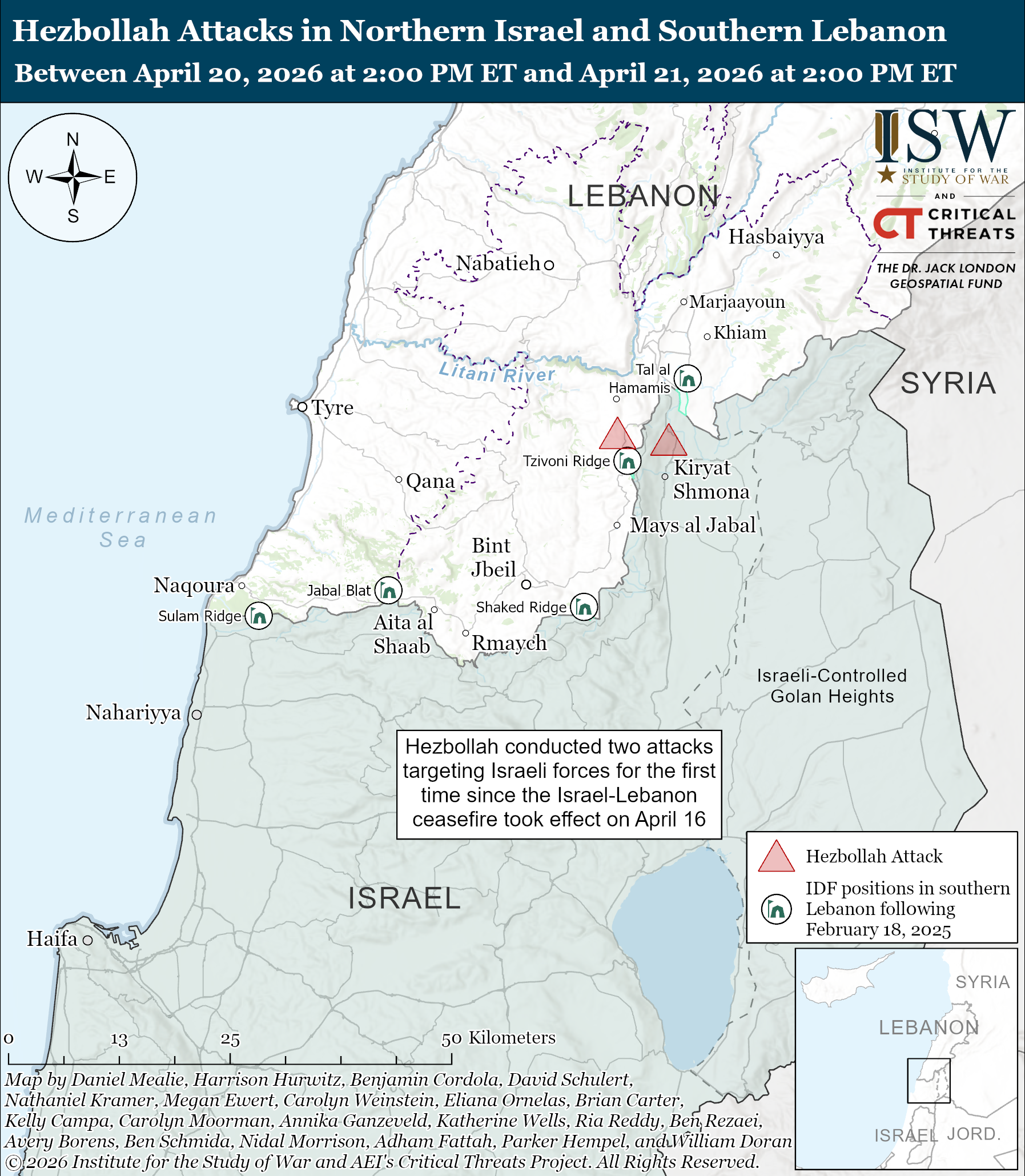
Hezbollah attacked Israeli forces in southern Lebanon and northern Israel for the first time since the Israel-Lebanon ceasefire took effect on April 16.[xxxix] The Israel Defense Forces (IDF) reported that Hezbollah fired rockets targeting Israeli forces in the vicinity of Rab el Thalathine in southeastern Lebanon’s Marjaayoun District, near the Israel-Lebanon border.[xl] Hezbollah also claimed that it fired rockets and drones targeting an IDF artillery position in Kfar Giladi, in northern Israel.[xli] The attacks caused no reported casualties.[xlii] Hezbollah accused Israel of over 200 ceasefire “violations” in southern Lebanon since the ceasefire took effect on April 16 in its explanation of the attack.[xliii] The IDF called Hezbollah’s rocket and drone attacks “blatant violations” of the ceasefire.[xliv] The IDF struck the Hezbollah rocket launcher responsible for the attack on Israeli forces in Rab el Thalathine.[xlv]
The IDF conducted at least six airstrikes targeting Hezbollah fighters in southern Lebanon since CTP-ISW's last data cutoff on April 20.[xlvi] The temporary ceasefire agreement permits Israel to act in self-defense against any “planned, imminent, or ongoing” Hezbollah threats against Israel.[xlvii] The IDF stated that it conducted three airstrikes targeting groups of Hezbollah fighters crossing Israel's ”forward defense line” into Israeli-held territory in southern Lebanon on the night of April 20 and the morning of April 21.[xlviii]
The IDF has continued to conduct ground operations in southern Lebanon in accordance with the temporary ceasefire agreement. The 35th Paratrooper Brigade (98th Division) commander stated on April 21 that Israeli forces are in “intense” fighting in Bint Jbeil, southeastern Lebanon, and are now operating with ”full force.”[xlix] The commander specified that Israeli forces are engaging with Hezbollah fighters in the city’s central district and at Bint Jbeil Stadium, which the IDF seized on April 13.[l] Bint Jbeil has consistently been a hotspot of fighting between Israeli forces and Hezbollah fighters over the past several weeks.[li] Bint Jbeil is operationally significant for the IDF because it is located at the nexus of multiple main roads in southeastern Lebanon, including the Tebnine-Bint Jbeil road, which the IDF could use to advance north and link with Israeli forces advancing from other axes. Bint Jbeil is also symbolically significant to Hezbollah because it is where former Hezbollah Secretary General Hassan Nasrallah proclaimed Hezbollah’s “victory” in 2000.[lii] IDF Northern Command Commander Major General Rafi Milo stated on April 21 that hundreds of Israeli forces are operating across southern Lebanon to remove every threat to northern Israel.[liii] Israeli forces are currently positioned and operating up to Israel’s ”forward defense line,” which runs between five to ten kilometers deep inside Lebanese territory.[liv] A geospatial intelligence analyst and Lebanese media also reported that Israeli forces demolished buildings and fired artillery shells in several areas of southern Lebanon, particularly in southwestern Lebanon, on April 20 and 21.[lv]
Israeli officials have reaffirmed that Israel’s campaign in Lebanon ultimately aims to disarm Hezbollah and eliminate threats to northern Israeli communities. Israeli Defense Minister Israel Katz stated on April 21 that Israel is working to achieve these objectives through “a combination of military and political steps.”[lvi] Katz warned that the IDF would act on these objectives by continuing its military operations in Lebanon if the Lebanese government does not take steps to disarm Hezbollah.[lvii] Israeli Prime Minister Benjamin Netanyahu similarly noted that Israel’s goal of disarming and dismantling Hezbollah requires ”sustained effort, patience, and endurance” by Israeli forces and will not be achieved in the short-term.[lviii] Netanyahu added that Israel’s goal also requires Israel to wisely navigate “the diplomatic field.”[lix]
Israeli and Lebanese officials continue to disagree on long-standing issues, which will continue to pose a challenge to US efforts to reach a long-term agreement between the two countries. The IDF recently defined its three core conditions that must be met to reach any agreement with Lebanon.[lx] Israel’s three core conditions include the creation of a buffer zone in southern Lebanon up to the Litani River that does not have any Hezbollah presence or infrastructure, the preservation of full operational freedom to act against any threats in any area of Lebanon, and the initiation of a long-term process to disarm Hezbollah under US supervision.[lxi] The Lebanese government, on the other hand, has continuously stated that its conditions are a complete Israeli withdrawal from all Lebanese territory, the cessation of Israeli operations in Lebanon, and the return of Lebanese prisoners held in Israel.[lxii] Israeli officials have not specified any conditions for an Israeli withdrawal from southern Lebanese territory, however. Israeli Defense Minister Israeli Katz noted in March that Israeli forces would maintain control over ”the entire area” between the Israel-Lebanon border and the Litani River even after Israel concludes its operation in Lebanon.[lxiii] Israeli Prime Minister Benjamin Netanyahu similarly noted that Israeli forces are not leaving southern Lebanon.[lxiv] These outstanding issues have previously caused US diplomatic efforts to stall.[lxv]
Other Axis of Resistance Response
Iran allowed some Iranian-backed Iraqi militias to conduct attacks without the Iranian regime’s approval during the war, according to three Iraqi militia members and two other unspecified officials speaking to Western media on April 21.[lxvi] An Iraqi militia member stated that “various forces” now have the authority to conduct operations based on their own “field assessments without referring back to a central command.”[lxvii] The sources added that “hardline factions” are operating under a decentralized command structure with Iranian advisers.[lxviii] These ”hardline” factions could refer to Iranian-backed Iraqi militias Kataib Hezbollah and Harakat Hezbollah al Nujaba, both of which are relatively more subordinate to Iran than other militias.[lxix]
Iranian-backed Iraqi militias conducted up to half of the roughly 1,000 drone attacks targeting Saudi Arabia during the war, according to unnamed sources speaking to the Wall Street Journal on April 21.[lxx] Some of these sources added that Iraqi militias launched drones targeting Bahrain after US President Donald Trump announced the US-Iran ceasefire on April 8.[lxxi] CTP-ISW assessed on April 13 that Iranian-backed Iraqi militias are responsible for at least some of the recent drone attacks against Gulf states.[lxxii] CTP-ISW also assessed that it very unlikely that Iranian-backed Iraqi militias would conduct drone attacks against regional states if the Iranian regime opposed such attacks, which suggests that Iran has not ordered its militia partners to cease attacking regional states.[lxxiii] Bahrain’s Foreign Ministry summoned the Iraqi charge d’affaires on April 13 in response to “continued” Iraqi militia drone attacks targeting Bahrain and other Gulf Cooperation Council states.[lxxiv] Saudi Arabia similarly summoned the Iraqi ambassador to Saudi Arabia on April 12 for the same reason.[lxxv]
A Harakat Hezbollah al Nujaba political council member reportedly confirmed that Iranian-backed Iraqi militias have sent personnel and financial support to Iran during the war.[lxxvi] Harakat Hezbollah al Nujaba political council member Firas al Yasser said Iranian-backed Iraqi militias sent “support convoys” and financial aid to Iran from Iraq, according to anti-Iranian regime media on April 21.[lxxvii] Yasser said the Iranian-backed Iraqi militia support was a sign of Iraq’s solidarity with Iran.[lxxviii] An Iraqi official speaking to anti- Iranian regime media claimed on March 30 that Popular Mobilization Forces (PMF) fighters have deployed to Basij bases in Khorramshahr and Abadan in Khuzestan Province.[lxxix] The same outlet previously reported that PMF fighters had entered Iran via the Shalamcheh crossing.[lxxx] The PMF is an Iraqi state security service that includes many Iranian-backed Iraqi militias that tend to report to Iran instead of the Iraqi prime minister.[lxxxi] Harakat Hezbollah al Nujaba is affiliated with the 12th PMF Brigade, for example.[lxxxii] CTP-ISW previously assessed that the regime may be mobilizing PMF fighters, in part, to strengthen control over previous protest hotspots.[lxxxiii]
Axis of Resistance groups, including Iranian-backed Iraq militias and the Houthis, have signaled their preparedness to resume operations against the United States, Israel, and other regional countries if the war resumes between Iran and the United States. Likely Iranian-backed militia front group Saraya Awliya al Dam warned on April 20 that the group is “fully prepared” to resume attacks against US interests in Iraq and the region.[lxxxiv] The militia said that it is ready for a “long war” and threatened to conduct attacks with “more advanced weapons.”[lxxxv] It also urged the supporters of the “resistance” to support Iran and Lebanon.[lxxxvi] This warning comes after Iranian-backed Iraqi militia Kataib Hezbollah appeared to confirm on April 18 that IRGC Quds Force Commander Brigadier General Esmail Ghaani discussed preparations for renewed conflict with the United States and Israel during his meetings with Iraqi militia leaders in Baghdad, Iraq, on April 18.[lxxxvii] Iranian-backed Iraqi militias have launched drone and rocket attacks targeting US and foreign interests in Iraq, as well as the Gulf countries, during the war.[lxxxviii] Houthi Supreme Leader Abdulmalik al Houthi warned on April 21 that the Houthis will not remain neutral and would ”escalate” if the United States and Israel escalate against Iran.[lxxxix] Abdulmalik warned that the current fragile truce is coming to an end and the possibility for escalation is “high.”[xc]

[i] https://truthsocial.com/@realDonaldTrump/116444507618729432
[ii] https://truthsocial.com/@realDonaldTrump/116444507618729432
[iii] https://www.nytimes.com/live/2026/04/21/world/iran-us-war-trump-news/heres-the-latest?smid=url-share ; https://www.wsj.com/livecoverage/iran-war-israel-us-strait-hormuz-2026/card/iran-foreign-minister-says-u-s-blockade-is-act-of-war-violates-cease-fire-KBORpg1OjKZNJRJXvrZm
[iv] https://truthsocial.com/@realDonaldTrump/116444507618729432
[v] https://www.wsj.com/livecoverage/iran-war-israel-us-strait-hormuz-2026/card/iran-foreign-minister-says-u-s-blockade-is-act-of-war-violates-cease-fire-KBORpg1OjKZNJRJXvrZm ; https://www.axios.com/2026/04/21/iran-us-war-peace-talks-vance-pakistan
[vi] https://x.com/DBalazada/status/2045935588839129399?s=20
[vii] https://t.me/iribnews/333454; https://t.me/iribnews/333455; https://x.com/hamidrezaaz/status/2045637243704897552?s=46
[viii] https://t.me/Tasnimnews/409485
[ix] https://t.me/Tasnimnews/409485
[x] https://t.me/iribnews/333965
[xi] https://x.com/kann_news/status/2046622848794374174
[xii] https://x.com/kann_news/status/2046622848794374174
[xiii] https://x.com/AbdolhamidNet/status/2046598368135098748?s=20 ;
https://x.com/AbdolhamidNet/status/2045177350606741718?s=20
[xiv] https://iranwire.com/en/religious-minorities/109933-molavi-abdolhamid-ismaeelzahi-irans-most-prominent-sunni-cleric/ ; https://www.washingtonpost.com/world/2022/12/02/iran-baluchistan-protests-hijab-amini/ ; https://www.hrw.org/news/2022/12/22/iran-bloody-friday-crackdown-years-deadliest ; https://understandingwar.org/research/middle-east/iran-crisis-update-december-16/
[xv] https://x.com/AbdolhamidNet/status/2046598368135098748?s=20
[xvi] https://x.com/AbdolhamidNet/status/2045177350606741718
[xvii] https://t.me/farsna/430596
[xviii] https://t.me/Tasnimnews/409431
[xix] https://understandingwar.org/research/middle-east/iran-update-special-report-april-20-2026/
[xx] https://x.com/DeptofWar/status/2046544038812156177?s=20&sort_replies=likes
[xxi] https://x.com/DeptofWar/status/2046544038812156177?s=20 ; https://www.marinetraffic.com/en/ais/details/ships/shipid:708507
[xxii] https://www.nytimes.com/2026/04/21/world/middleeast/iran-oil-tanker-mt-tifani-us-indian-ocean.html?smid=url-share
[xxiii] https://x.com/FaytuksNetwork/status/2046608762874601595 ; https://www.marinetraffic.com/en/ais/details/ships/shipid:708507 ; Starboard Maritime Intelligence. Available by subscription at https://www.starboardintelligence.com.
[xxiv] https://x.com/TankerTrackers/status/2046617260228227379 ; https://x.com/TankerTrackers/status/2046624308693278985
[xxv] https://x.com/CENTCOM/status/2046607900987035697
[xxvi] Starboard Maritime Intelligence. Available by subscription at https://www.starboardintelligence.com.
[xxvii] Starboard Maritime Intelligence. Available by subscription at https://www.starboardintelligence.com ; https://www.marinetraffic.com/en/ais/details/ships/shipid:657727/mmsi:422026500/imo:9270658/vessel:SHAMIM ; https://www.criticalthreats.org/analysis/iran-update-evening-special-report-april-20-2026
[xxviii] Starboard Maritime Intelligence. Available by subscription at https://www.starboardintelligence.com ; https://www.marinetraffic.com/en/ais/details/ships/shipid:653578
[xxix] https://t.me/Tasnimnews/409440
[xxx] https://x.com/TankerTrackers/status/2043462971142152619
[xxxi] Starboard Maritime Intelligence. Available by subscription at https://www.starboardintelligence.com
[xxxii] https://home.treasury.gov/news/press-releases/sb0465
[xxxiii] https://home.treasury.gov/news/press-releases/sb0465
[xxxiv] https://home.treasury.gov/news/press-releases/sb0465
[xxxv] https://x.com/HpwWJVafCv83954/status/2046462099015205295; https://x.com/EpicFuryMap/status/2046528221097669026?s=20; https://x.com/WillUnderhill23/status/2046522820532768984
[xxxvi] https://x.com/HpwWJVafCv83954/status/2046462099015205295; https://x.com/EpicFuryMap/status/2046528221097669026?s=20; https://x.com/WillUnderhill23/status/2046522820532768984
[xxxvii] https://x.com/IranIntl/status/2028533301724557433?s=20 ; https://understandingwar.org/research/middle-east/iran-update-evening-special-report-march-2-2026/
[xxxviii] https://x.com/fab_hinz/status/1933930436083724602?s=20; https://understandingwar.org/research/middle-east/iran-update-special-report-june-16-2025-evening-edition/
[xxxix] https://x.com/idfonline/status/2046628027279331741?s=20 ; https://t.me/mmirleb/15495
[xl] https://x.com/idfonline/status/2046628027279331741?s=20
[xli] https://t.me/mmirleb/15495
[xlii] https://x.com/idfonline/status/2046628027279331741?s=20
[xliii] https://t.me/mmirleb/15495
[xliv] https://x.com/idfonline/status/2046628027279331741?s=20
[xlv] https://x.com/idfonline/status/2046628027279331741?s=20
[xlvi] https://x.com/janoub24website/status/2046575145901342852 ; https://t.me/MTVLebanoNews/65738 ; https://x.com/idfonline/status/2046606157632934165 ; https://x.com/idfonline/status/2046628027279331741?s=20
[xlvii] https://www.state.gov/releases/office-of-the-spokesperson/2026/04/ten-day-cessation-of-hostilities-to-enable-peace-negotiations-between-israel-and-lebanon
[xlviii] https://x.com/idfonline/status/2046606157632934165?s=20
[xlix] https://x.com/idfonline/status/2046476859433422952
[l] https://x.com/idfonline/status/2046476859433422952 ; https://t.me/BenTzionM/7413 ;
https://t.me/manniefabian/57741
[li] https://www.newarab.com/analysis/battle-bint-jbeil-israels-war-south-lebanon
[lii] https://time.com/archive/6939518/surveying-the-damage-in-bint-jbeil/
; https://t.me/manniefabian/57741
[liii] https://x.com/idfonline/status/2046518628414099728
[liv] https://www.reuters.com/world/middle-east/israeli-military-publishes-map-south-lebanon-territory-under-its-control-2026-04-19/
[lv] https://x.com/Me1Ray/status/2046507718031417792 ; https://x.com/Me1Ray/status/2046537429914669171 ; https://t.me/MTVLebanoNews/65709 ; https://t.me/MTVLebanoNews/65766 ; https://t.me/MTVLebanoNews/65769 ; https://t.me/MTVLebanoNews/65772 ; https://t.me/MTVLebanoNews/65772
[lvi] https://www.i24news dot tv/en/news/israel/defense/artc-he-will-pay-with-his-head-as-his-predecessor-israel-s-dm-threatens-hezbollah-chief
[lvii] https://www.i24news dot tv/en/news/israel/defense/artc-he-will-pay-with-his-head-as-his-predecessor-israel-s-dm-threatens-hezbollah-chief ; https://www.jpost dot com/middle-east/article-893763
[lviii] https://www.gov dot il/en/pages/statement-from-pm-netanyahu-17-april-2026
[lix] https://www.gov dot il/en/pages/statement-from-pm-netanyahu-17-april-2026
[lx] https://www.ynetnews dot com/opinions-analysis/article/hkof8ar3wx
[lxi] https://www.ynetnews dot com/opinions-analysis/article/hkof8ar3wx
[lxii] https://x.com/LBpresidency/status/2046546137159467242 ; https://x.com/LBpresidency/status/2045188320808915131 ; https://x.com/nawafsalam/status/2046567817265250681
[lxiii] https://www.nytimes.com/2026/03/31/world/middleeast/israel-lebanon-ground-invasion.html
[lxiv] https://www.abc.net.au/news/2026-04-21/israel-occupation-south-lebanon-bleak-future-despite-ceasefire/106582110
[lxv] https://aawsat dot com/العالم-العربي/المشرق-العربي/5199054-عون-أطلق-مبادرته-لحضّ-واشنطن-على-التدخل-لإنقاذ-مفاوضات-الناقورة
[lxvi] https://apnews.com/article/iraq-militias-iran-war-c2fce96e2769bc8b3be43a729da5517b
[lxvii] https://apnews.com/article/iraq-militias-iran-war-c2fce96e2769bc8b3be43a729da5517b
[lxviii] https://apnews.com/article/iraq-militias-iran-war-c2fce96e2769bc8b3be43a729da5517b
[lxix] https://www.washingtoninstitute.org/policy-analysis/profile-harakat-hezbollah-al-nujaba ; https://www.washingtoninstitute.org/policy-analysis/profile-kataib-hezbollah
[lxx] https://www.wsj.com/world/middle-east/saudi-arabia-iraq-conflict-iran-war-0d9dd8d8?mod=middle-east_news_article_pos2
[lxxi] https://www.wsj.com/world/middle-east/saudi-arabia-iraq-conflict-iran-war-0d9dd8d8?mod=middle-east_news_article_pos2
[lxxii] https://understandingwar.org/research/middle-east/iran-update-special-report-april-13-2026/
[lxxiii] https://understandingwar.org/research/middle-east/iran-update-special-report-april-13-2026/
[lxxiv] https://shafaq dot com/en/Iraq/Bahrain-summons-Iraq-s-Charg-d-Affaires-over-drone-attacks
[lxxv] https://shafaq dot com/ar/الشرق-الأوسط/الخارجية-السعودية-تستدعي-السفيرة-العراقية-بش-ن-قصف-المسيرات
[lxxvi] https://x.com/IranIntl/status/2046530451595014254?s=20
[lxxvii] https://x.com/IranIntl/status/2046530451595014254?s=20
[lxxviii] https://x.com/IranIntl/status/2046530451595014254?s=20
[lxxix] https://x.com/IranIntl/status/2038637015466455218?s=20
[lxxx] https://x.com/IranIntl/status/2038334232284549277?s=20
[lxxxi] https://understandingwar.org/research/middle-east/the-leadership-and-purpose-of-iraqs-popular-mobilization-forces/; https://www.iranintl.com/en/202210160416
[lxxxii] https://understandingwar.org/wp-content/uploads/2024/02/Iraq20-20ISF20PMF20Orders20of20Battle_0_0.pdf
[lxxxiii] https://understandingwar.org/research/middle-east/iran-update-special-report-march-30-2026/
[lxxxiv] https://t.me/awlialdm/359
[lxxxv] https://t.me/awlialdm/359
[lxxxvi] https://t.me/awlialdm/359
[lxxxvii] https://t.me/AbumujahidAlasaf/10 ; https://understandingwar.org/research/middle-east/iran-update-special-report-april-19-2026/
[lxxxviii] https://understandingwar.org/research/middle-east/iran-update-special-report-april-13-2026/ ; https://english.alarabiya dot net/News/middle-east/2026/03/29/two-drones-targeting-us-embassy-in-baghdad-intercepted-security-officials ; https://x.com/ariel_oseran/status/2032257902489075975
[lxxxix] https://x.com/MMY1444/status/2046602206494023698
[xc] https://x.com/MMY1444/status/2046602206494023698
View Citations