{{currentView.title}}
December 22, 2025
Iran Update, December 22, 2025
Information Cutoff: 2:00 PM ET
The Critical Threats Project (CTP) at the American Enterprise Institute and the Institute for the Study of War (ISW) publish the Iran Update, which provides insights into Iranian and Iranian-sponsored activities that undermine regional stability and threaten US forces and interests. CTP-ISW publishes the Iran Update daily.
Click here to see CTP and ISW’s interactive map of assessed control of terrain in Syria, and here to see CTP and ISW’s interactive map of Israeli ground operations. The Syria map is updated daily alongside the static Syria maps in this report. CTP-ISW ended daily maps of Israeli ground operations in February 2025.
Click here to see ISW-CTP's interactive map showing the total strikes in Iran during the Israel-Iran War, as well as an interactive timelapse showing the strikes day-by-day.
Iran is likely prioritizing ballistic missile production due to both organizational inertia within the Iranian defense apparatus and the need to restore deterrence in what it views as an ongoing war with Israel. The reconstitution appears to be an effort to restore deterrence against Israeli attack, though a reconstituted ballistic missile program could be used to attack Israel. One former senior Iranian official has doubled down on investment in the ballistic missile program after the Israel-Iran War to “restore deterrence,” while a current senior official advocated for new technical improvements to the missiles, for example.[i] These officials probably calculate that more and higher-quality missiles are needed to penetrate Israeli defenses, given the effectiveness of Israeli ballistic missile interceptors and the decreasing Israeli interceptor stockpile. The reconstitution of Iran’s ballistic missile capabilities is nonetheless increasing anxiety in Israel over the quantity of missiles Iran now possesses (see below).
An Israeli journalist reported on December 9 that Iran had reconstituted its missile stockpile to around 2,000 “heavy” ballistic missiles, which presumably refers to medium-range ballistic missiles capable of striking Israel. This rapid reconstitution indicates that Israel either failed to destroy all of Iran’s planetary mixers or that Iran has acquired or built new planetary mixers used to produce solid fuel ballistic missiles. The United States intercepted a shipment with components for Iran’s ballistic missile program, which could have included mixers, in the Indian Ocean in November 2025 (more on this incident below). Iran is reportedly prioritizing the rapid restoration of its ballistic missile production capabilities over other defense priorities. Iran has begun rebuilding the Parchin and Shahroud missile production facilities, which Israel damaged during the Israel-Iran War, and reconstructing buildings at these sites that previously housed planetary mixers.[ii] Planetary mixers are essential for turning a chemical precursor of solid fuel, sodium percolate, into ballistic missile fuel.[iii] Israel destroyed Iran’s planetary mixers in October 2024, and Western media assessed in September 2025 that Iran still did not have the necessary planetary mixers to produce solid missile fuel.[iv] Western diplomats also told Israeli media on December 8 that Iran is using older manufacturing methods to continue producing ballistic missiles, which may refer to the less efficient “trough-type mixers” that can also produce solid fuel.[v]
Iranian defense officials view ballistic missiles as a critical piece of their defense strategy, and a hypothetical Iranian decision to abandon the ballistic missile program would be antithetical to the way that Iranian commanders view their capabilities and relative strengths. Iran’s decision to prioritize ballistic missiles after their failure to penetrate Israeli defenses during the Iran-Israel War in June 2025 may appear unwise to Western observers, but this ignores the primacy with which Iranian officials view ballistic missiles in their defense strategy. Iranian officials would probably find it extremely difficult to come to a personal conclusion and then convince the bureaucracy to conclude that ballistic missiles must be abandoned, given that most of Iran’s defense community has long viewed and continues to view ballistic missiles as a critical element of their defense strategy both now and in the future. Missiles, in addition to Iran’s Axis of Resistance, have long acted as the central pillar of Iran’s regional defense strategy, and Iranian officials have long considered the ballistic missile program to be a crucial deterrent to Israel and the United States.
Senior Iranian officials have continued to laud Iran’s missile capabilities as an essential piece of Iranian defense strategy, even after the Israel-Iran War.[vi] A former IRGC Navy commander said that the missile program contributed to Iran’s ”success” during the war.[vii] Former Islamic Revolutionary Guards Corps (IRGC) Commander Mohammad Ali Jafari argued in October 2025 that Iran’s missile program is its main form of deterrence and that Iran deliberately prioritized developing its missile and drone capabilities over its air and ground forces to counter the superior capabilities of the United States and Israel.[viii] Another senior official illustrated the need for more investment in the program by calling for various technical improvements to the missiles to improve their ability to penetrate ballistic missile defenses.[ix] Iranian military officials would need to garner enormous political backing in order to alter a pillar of Iranian defense strategy for decades, and so far, no sizeable group of officials has challenged the importance of the missile program in the public discourse.
Iran’s ability to produce ballistic missiles at scale only six months after the end of the Israel-Iran War in June 2025 is causing Israeli anxieties over Iranian capabilities and intent to attack Israel. Israeli Prime Minister Benjamin Netanyahu is planning to brief US President Donald Trump on the United States’ options for joining or assisting future Israeli attacks on Iranian ballistic missile sites during Netanyahu’s upcoming visit to the United States on December 29, according to an unspecified source and four former US officials.[x] Israeli officials reportedly view Iran’s efforts to rebuild ballistic missile production facilities and repair air defense systems as “more immediate concerns” than Iran reconstituting its nuclear enrichment sites.[xi] Axios reported on December 21 that Israeli military intelligence and Mossad do not assess that the pace at which Iran is rebuilding its ballistic missile capabilities necessitates "urgency to take military action” within the next two to three months. The Israeli sources stressed that Iran’s ballistic missiles could “become a more urgent issue later in the year,” presumably referring to late 2026.[xii] Israeli media highlighted Israel’s threat perception and noted that the Iranian regime may only need between one and two years to acquire enough ballistic missiles to overwhelm Israeli air defenses. This calculation is based on Iran reaching a production rate of about 300 ballistic missiles per month.[xiii] The Wall Street Journal reported in June 2025, during the war, that Israel was “running low on defensive Arrow interceptors.”[xiv] Defensive Arrow interceptors enable Israel to counter long-range ballistic missiles.[xv] Israel used 52.3 percent of its interceptor stockpile during the war, according to the Jewish Institute for National Security of America (JINSA).[xvi]
Reports about a possible Islamic Revolutionary Guards Corps (IRGC) Aerospace Force missile exercise coordinated across multiple bases in Iran have also contributed to Israeli fears of a rising Iranian ballistic missile threat.[xvii] IRGC-affiliated media reported on December 22 that the IRGC Aerospace Force launched missiles as part of its missile exercise in unspecified locations in five provinces.[xviii] The exercise reportedly spanned across Khorramabad, Lorestan Province, Mahabad, West Azerbaijan Province, Mashhad, Khorasan Razavi Province, Tehran Province, and Esfahan Province.[xix] Iranian media did not provide any more specific details on the exercise, such as the types of missiles launched.
The regime may have been rehearsing the synchronization and coordination of large-scale missile strikes from bases spread across the country through the exercise. Iran’s ability to launch coordinated, large-scale missile attacks targeting Israel during the June 2025 war grew constrained as Israel destroyed Iranian missile launchers across different regions of Iran, according to an Israeli Army Radio correspondent in June 2025.[xx] Unspecified sources told anti-Iranian regime media on December 20 that Western intelligence agencies detected “unusual” IRGC Aerospace Force activity, including irregular drone, missile, and air defense units' command-and-control signals, deployments, and logistical movements.[xxi] These activities, if accurate, would also be consistent with Iranian efforts to rehearse the synchronized deployments of missile, drone, and air defense assets. Exercises to improve coordination and synchronization do not necessarily need to involve missile launches.
The regime may be attempting to obscure details about the exercise and therefore downplay the extent to which the IRGC may be preparing for future conflict. Iranian state media denied the IRGC-affiliated news report on the IRGC exercise, calling it “not accurate.”[xxii] Another Iranian media outlet affiliated with Supreme Leader’s representative to the Defense Council circulated a news report about the exercise before later removing the article.
IDF Chief of Staff Lieutenant General Eyal Zamir warned US Central Command Commander Admiral Brad Cooper on December 20 that the IRGC Aerospace Force missile exercise and other operational steps could be ”cover for a surprise attack“ on Israel.[xxiii] Zamir referred to an IRGC exercise that “began several days ago.“[xxiv] Israeli Prime Minister Benjamin Netanyahu also stated on December 22 that Israel is "aware that Iran is conducting military exercises" and "making the necessary preparations,“ warning that any attacks on Israel will be met with a ”very harsh response."[xxv] An unspecified US source told Axios on December 22 that US intelligence agencies have no indication that Iran is preparing for an attack.[xxvi]
The People’s Republic of China (PRC) continues to support Iranian missile production. An Israeli Army Radio correspondent reported on December 22 that a shipment of planetary mixers was expected to travel from the PRC to Iran in recent weeks but that the “shipment ultimately did not reach its destination,” citing Western intelligence sources.[xxvii] US officials told the Wall Street Journal on December 12 that US special forces recently boarded and seized a vessel in the Indian Ocean carrying PRC-made components destined for Iran's missile program.[xxviii] It is possible that this vessel was carrying the planetary mixers shipment that the Israeli Army Radio correspondent reported. Iran currently lacks planetary mixers. The PRC has previously helped Iran rebuild its ballistic missile program by supplying Iran with sodium perchlorate, which is a chemical precursor for solid missile propellant. The PRC previously sent two shipments of sodium perchlorate to Iran in February and June 2025, and European intelligence sources have been tracking a further 10 to 12 shipments following the Israel-Iran War.[xxix]
Iran may retaliate against the United States’ attempted seizure of an Iranian-linked tanker in the Caribbean Sea with disruptive activity in the Persian Gulf.[xxx] US authorities obtained a seizure warrant for the Bella 1 tanker on December 21 due to the vessel's “previous involvement in the Iranian oil trade.”[xxxi] The Bella 1 loaded oil in August 2025 at Kharg Island, which is Iran’s primary oil export hub, and later offloaded its cargo to another tanker near Oman before continuing to the Caribbean Sea.[xxxii] The United States has not seized the Bella 1 as of this writing. Senior Iranian officials have threatened to close the Strait of Hormuz if the United States and its allies seize Iranian exports in recent months.[xxxiii] The IRGC also conducted various combat operations in the Persian Gulf as part of their annual naval exercise in the Persian Gulf in early December as a warning to its adversaries that Iran will confront any “miscalculations” with “a decisive response.”[xxxiv] The IRGC Navy also named this year’s exercise after deceased IRGC Navy commander Mohammad Nazeri, who was reportedly involved in the seizure of two US patrol boats and 10 US personnel in the Persian Gulf in January 2016.[xxxv] Iran responded to US seizures of Iranian weapons shipments under US President Donald Trump's first maximum pressure campaign in 2019 by threatening international shipping, including by seizing a British oil tanker, harassing vessels transiting the Strait of Hormuz, and conducting an attack targeting Saudi oil facilities.[xxxvi]
Senior Turkish and Syrian officials met in Damascus on December 22, very likely to discuss the Syrian Democratic Forces’ (SDF) response to a recent government integration proposal.[xxxvii] Syrian President Ahmed al Shara, Foreign Minister Asaad Shaibani, Defense Minister Major General Marhaf Abu Qasra, and intelligence head Hussein Salama met with a Turkish delegation in Damascus on December 22. The Turkish delegation included Turkish Foreign Minister Hakan Fidan, Turkish Defense Minister Yasar Guler, and intelligence chief Ibrahim Kalin.[xxxviii] Shaibani announced in a post-meeting press conference with Fidan that the Syrian government is reviewing a recent SDF response to the integration proposal.[xxxix] Reuters reported on December 18 that the Syrian government recently sent a new integration proposal to the SDF that will facilitate the SDF integration into the Syrian army as three divisions and smaller brigades in exchange for reduced SDF command authority and the entry of other Syrian army units into SDF-held areas.[xl] Syrian officials almost certainly discussed the SDF’s response to this proposal with Turkish officials. Turkey has repeatedly threatened to attack the SDF if it fails to integrate into the Syrian state and has expressed security concerns about the future of northeastern Syria under SDF influence.[xli] Turkish Defense Minister Guler reiterated the Turkish demand that the SDF must integrate individually rather than as a single unit as recently as December 20.[xlii] It is unclear whether Guler or other Turkish officials have moderated their red lines on the terms of the SDF’s integration at this time. Fidan, who plays a large role in Turkey‘s Syria file, recently expressed optimism about the negotiations and said that Turkey would not resort to military action against the SDF.[xliii]
Syria and Turkey have imposed a deadline for the SDF to integrate into the state by December 31, 2025. Shaibani declared that the Syrian government has not seen ”any serious steps“ from the SDF towards implementing the integration agreement on December 22.[xliv] A Western source and a Kurdish source added that an extension of the March 10 integration agreement’s December 31 deadline is probably imminent.[xlv]
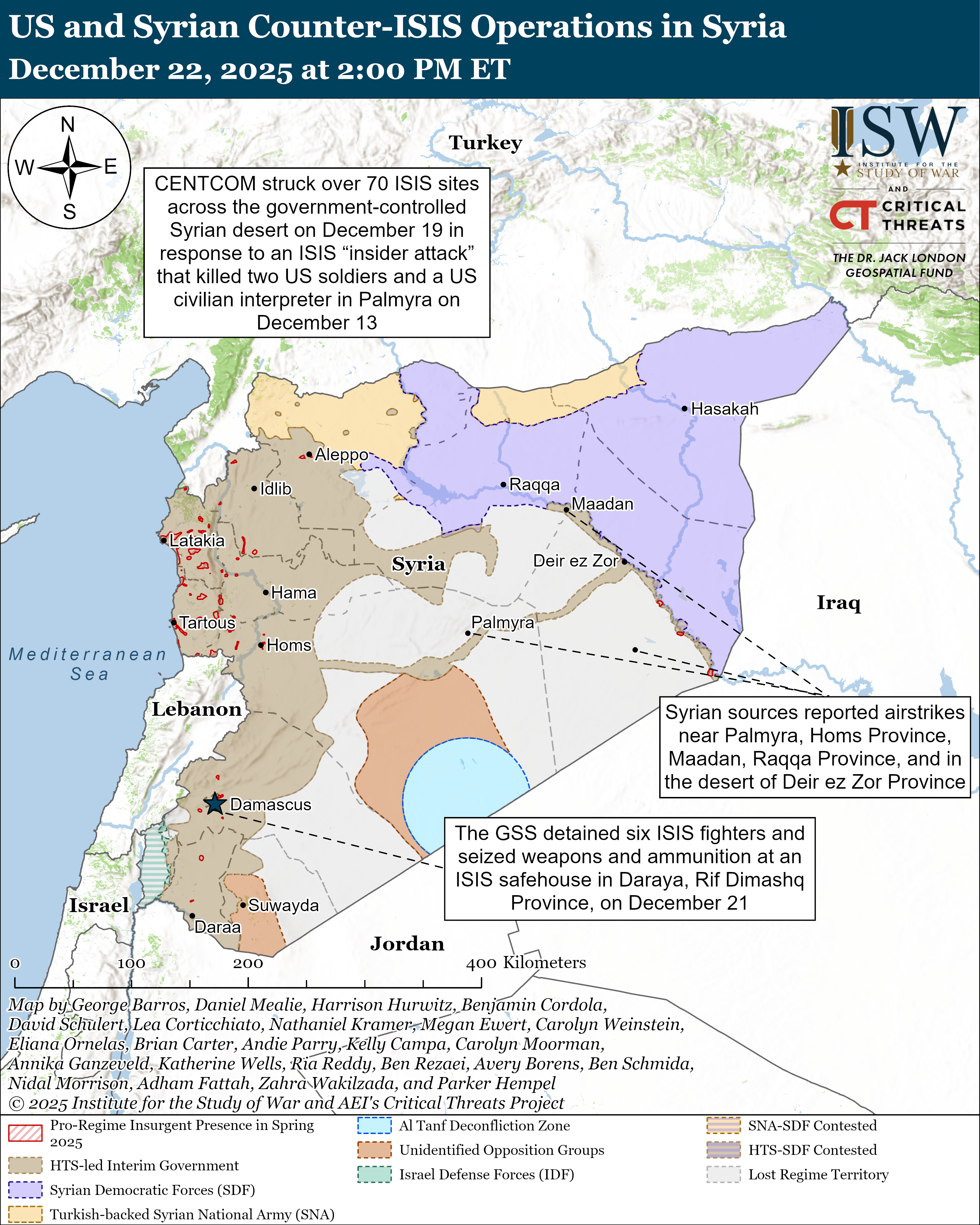
The recent US strikes targeting the Islamic State in Iraq and al Sham (ISIS) in Syria illustrate how US cooperation with the Syrian government enables the United States to deny ISIS sanctuary in government-controlled territory. ISIS previously used Assad-held areas west of the Euphrates River as a sanctuary largely free from persistent US interference. CENTCOM struck more than 70 ISIS sites across the government-controlled central Syrian desert on December 19 and 20 near Palmyra in Homs Province, Maadan in Raqqa Province, and in the desert regions of Deir ez Zor Province.[xlvi] CENTCOM conducted the strikes in response to an ISIS-inspired insider attack that killed two US soldiers and a US civilian interpreter in Palmyra on December 13.[xlvii] A US official told the New York Times that unspecified US partner forces conducted 10 counter-ISIS raids in Syria and Iraq following the Palmyra attack that provided intelligence for CENTCOM’s December 19 air operation.[xlviii] Jordanian fighter aircraft supported the operation as part of Jordan’s first counter-ISIS strikes in Syria since 2018.[xlix]
ISIS previously used central Syria as an area to reconstitute itself, free from US interference. The Assad regime, which previously controlled central Syria, conducted ineffective counter-ISIS operations that failed to disrupt ISIS reconstitution. US forces were unable to enter Assad-held areas, given the hostility between Assad and the United States. The fall of Assad, combined with US cooperation with the Syrian government, has now enabled the United States to conduct strikes and other operations to disrupt ISIS reconstitution. A US official told NBC News on December 19 that the operation intended to strike areas where ISIS is attempting to reorganize to destroy their positions and forces on a large scale.[l] Two unspecified US sources told Western media that US retaliatory strikes may continue for several weeks or even a month.[li]
The Syrian General Security Service (GSS) arrested an ISIS “leader,” six ISIS fighters, and seized weapons and ammunition from an ISIS safehouse in Daraya, a Damascus suburb, on December 21.[lii] Rif Dimashq Province GSS commander Major General Ahmed al Dalati told Syrian media that the security forces arrested an active ISIS “leader” and six fighters who were prepared for “terrorist” activities.[liii] The counter-ISIS raid in Daraya corresponds to a rising number of counter-ISIS operations in the Damascus area. The GSS previously arrested three ISIS fighters and seized several improvised explosive devices (IEDs) and other munitions from an ISIS safehouse in Kanaker, Rif Dimashq Province, on December 3.[liv] The GSS also arrested an ISIS fighter in Damascus City on December 17 and seized IEDs and several commercial quadcopter drones that ISIS could easily convert into FPV one-way attack drones to use against government forces or civilians.[lv] ISIS has increased the rate and geographic range of its attacks in government-controlled territory since Syria joined the Global Coalition to Defeat ISIS on November 10.[lvi]
The Iraqi Resistance Coordination Committee is divided over calls from some of its factions to disarm and restrict weapons to the Iraqi state, according to committee sources and the militia leaders’ diverging public statements.[lvii] The Iraqi Resistance Coordination Committee is a coordinating body comprised of several Iranian-backed Iraqi militias.[lviii] These divisions are visible in the factions’ recent statements and represent different approaches to dealing with a reported plan by the Shia Coordination Framework to disarm the militias.[lix]
- Accept disarmament: Kataib Imam al Ali leader Shibl al Zaidi and Harakat Ansar Allah al Awfiya leader Haider al Gharawi issued separate statements on December 18 and 19, respectively, that called for Iranian-backed Iraqi militias to disarm and restrict weapons to the Iraqi state.[lx] Asaib Ahl al Haq leader Qais al Khazali also appeared to support disarmament in a December 19 speech to his supporters.[lxi] The group's military spokesperson denied on December 22 that it intends to surrender its weapons, however.[lxii]
- Obfuscate the militia-state relationship: Kataib Sayyid al Shuhada Spokesperson Kazem al Fartousi claimed in a December 20 interview with Iraqi media that the militia does not need to call for restricting weapons to the state because they “are basically within it.”[lxiii] Fartousi’s claim that weapons are already restricted to the Iraqi state is false because it ignores the reality that many Iranian-backed Iraqi militias—such as his faction Kataib Sayyid al Shuhada—possess weapons and are neither integrated into the Iraqi security forces nor answer to the Iraqi prime minister.[lxiv]
- Refuse disarmament: Kataib Hezbollah and Harakat Hezbollah al Nujaba each issued statements on December 20 that rejected calls to disarm and restrict weapons to the state due to the ongoing presence of foreign forces in Iraq.[lxv] Kataib Hezbollah claimed on December 20 that the group will only discuss disarmament after “all occupation forces,” including US and Turkish forces, withdraw from Iraq.[lxvi] Harakat Hezbollah al Nujaba military aide Abdul Qadir Karbalai similarly claimed on December 20 that the presence of US troops in Iraq justifies the militia’s retention of arms.[lxvii] The United States and Iraq agreed in September 2024 that hundreds of US forces would withdraw from Iraq by September 2025 and that the remaining forces would withdraw by the end of 2026. Iraqi Prime Minister Mohammad Shia al Sudani announced in October 2025 that between 250 and 350 US advisers would remain at Ain al Asad airbase in Anbar Province to support US counter-ISIS operations in Syria.[lxviii] Both militias’ ideological commitment to armed resistance suggests that both groups would resist disarmament even if all US and Turkish troops withdraw from Iraq, however.[lxix]
Key Takeaways
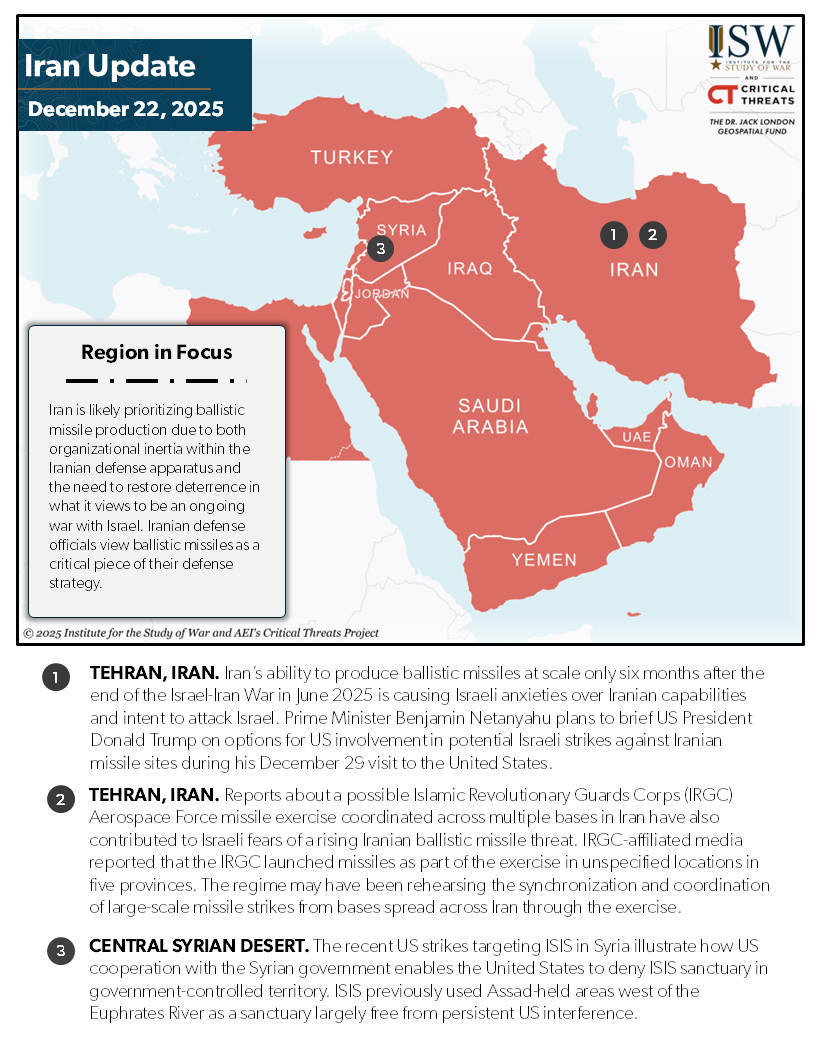
- Iranian Ballistic Missile Program: Iran is likely prioritizing ballistic missile production due to both organizational inertia within the Iranian defense apparatus and the need to restore deterrence in what it views as an ongoing war with Israel. Iranian defense officials view ballistic missiles as a critical piece of their defense strategy. A hypothetical Iranian decision to abandon the ballistic missile program would be antithetical to the way that Iranian commanders view their capabilities and relative strengths.
- Israeli Threat Perceptions: Iran’s ability to produce ballistic missiles at scale only six months after the end of the Israel-Iran War in June 2025 is causing Israeli anxieties over Iranian capabilities and intent to attack Israel. Prime Minister Benjamin Netanyahu plans to brief US President Donald Trump on options for US involvement in potential Israeli strikes against Iranian missile sites during his December 29 visit to the United States. Israeli intelligence agencies do not believe Iran’s current missile production pace requires urgent military action within the next few months, but warn it could become a more urgent issue later in 2026.
- IRGC Missile Exercise: Reports about a possible Islamic Revolutionary Guards Corps (IRGC) Aerospace Force missile exercise coordinated across multiple bases in Iran have also contributed to Israeli fears of a rising Iranian ballistic missile threat. IRGC-affiliated media reported on December 22 that the IRGC Aerospace Force launched missiles as part of its missile exercise in unspecified locations in five provinces. The regime may have been rehearsing the synchronization and coordination of large-scale missile strikes from bases spread across the country through the exercise.
- Syrian-Turkish-SDF Negotiations: Senior Turkish and Syrian officials met in Damascus on December 22, very likely to discuss the SDF’s response to a recent proposal that will facilitate the SDF’s integration into the Syrian army as three divisions and smaller brigades. It is unclear whether Turkish officials have moderated their red lines on the terms of the SDF’s integration at this time.
- US Strikes in Syria: CENTCOM struck more than 70 ISIS sites across the central Syrian desert on December 19 and 20 near Palmyra in Homs Province, Maadan in Raqqa Province, and in the desert regions of Deir ez Zor Province. The recent US strikes targeting ISIS in Syria illustrate how US cooperation with the Syrian government enables the United States to deny ISIS sanctuary in government-controlled territory. ISIS previously used Assad-held areas west of the Euphrates River as a sanctuary largely free from persistent US interference.
Iran
See topline section.
Iraq
See topline section.
Syria
See topline section.
Arabian Peninsula
The Yemeni 2nd Military Region publicly endorsed the United Arab Emirates-backed Southern Transitional Council (STC) on December 22.[lxx] The STC launched an offensive in southern Yemen on December 3 to seize key areas of Wadi Hadramawt and al Mahra Governorate and successfully extended its presence to all eight governorates in southern Yemen.[lxxi] The STC has since sought to legitimize its authority over these areas and frame its recent military action as necessary to fight the Houthis.[lxxii] The Second Military Region announced its full support for the STC's backing for “any political position” taken by STC President and Presidential Leadership Council (PLC) Vice President Aidarous al Zubaidi.[lxxiii] The 2nd Military Region operates along the Hadramawt coast and plateau in eastern Yemen, in an area that includes al Rayyan Air Base in Hadramawt Governorate.[lxxiv]
Palestinian Territories and Lebanon
Ongoing US efforts to promote dialogue and reduce tensions between Israel and Lebanon have led to limited instances of Israeli-Lebanon cooperation. Israeli and Lebanese officials have held two direct meetings under US auspices since December 3 to discuss outstanding issues, including Hezbollah’s disarmament and the return of southern Lebanese residents to their homes.[lxxv] A United Nations official and an unspecified Israeli official told the New York Times on December 20 that Israel shared some intelligence with the Lebanese Armed Forces (LAF) during these meetings to help it identify buildings that contain hidden Hezbollah weapons caches.[lxxvi] The United Nations official noted that Lebanese military officers provided Israeli officials with video evidence of LAF raids on Hezbollah weapons sites during these meetings.[lxxvii] Israeli and Lebanese officials usually rely on the ceasefire monitoring committee only to communicate about ceasefire violations and disarmament, and share intelligence.[lxxviii] Israel and the Lebanese government have frequently accused each other of failing to provide evidence for their complaints surrounding Hezbollah disarmament operations, making these limited trust-building exchanges of video evidence proving that the LAF is disarming Hezbollah notable.[lxxix] US Secretary of State Marco Rubio noted on December 20 that the United States is ”hopeful” that the talks will lead to a deal between Israel and Lebanon.[lxxx] Other US State Department sources told Lebanese media on December 21 that the talks are an opportunity to prevent escalation but that their success depends on ”clear internal political decisions.”[lxxxi] Israeli and Lebanese officials will reportedly meet again on January 7, 2026.[lxxxii]

[i] https://www.kebnanews dot ir/news/505392; https://nournews dot ir/fa/news/250551
[ii] https://apnews.com/article/iran-missiles-planetary-mixers-israel-war-527bd871b691898b20eee98294dcda64
[iii] https://www.cnn.com/2025/10/29/middleeast/iran-rebuilding-ballistic-weapons-program-intl
[iv] https://apnews.com/article/iran-missiles-planetary-mixers-israel-war-527bd871b691898b20eee98294dcda64
[v] https://www.ynetnews dot com/article/h1bncknm11l; https://www.globalsecurity.org/wmd/intro/bm-planetary-mixer.htm#:~:text=For%20mixing%20the%20equipment%20mainly,plant%20of%20conventional%20helical%20structure ; https://www.axios.com/2024/10/26/israel-strike-iran-missile-production
[vi] https://www.kebnanews dot ir/news/505392; https://www.youtube.com/watch?v=trj_0JJkl3g; https://nournews dot ir/fa/news/250551 ;
https://understandingwar.org/research/middle-east/iran-update-october-20-2025/
[vii] https://nournews dot ir/fa/news/248481
[viii] https://www.youtube.com/watch?v=trj_0JJkl3g
[ix] https://understandingwar.org/research/middle-east/iran-update-october-28-2025/
[x] https://www.nbcnews.com/politics/white-house/netanyahu-plans-brief-trump-possible-new-iran-strikes-rcna250112
[xi] https://www.nbcnews.com/politics/white-house/netanyahu-plans-brief-trump-possible-new-iran-strikes-rcna250112
[xii] https://www.axios.com/2025/12/21/israel-iran-missile-drill-trump-warning
[xiii] https://www.jpost dot com/middle-east/article-880931
[xiv] https://www.wsj.com/world/middle-east/israel-is-running-low-on-defensive-interceptors-official-says-fd64163d?gaa_at=eafs&gaa_n=AWEtsqeBhyI-O89pYDZB0jiqv2Oxh6QLFXFBlYa3tXFJtdEIssR4VHk1Zc76&gaa_ts=6949aad9&gaa_sig=IaUpgnAE-npcgUgP6MB2pG2VN60OBu6s1oz5SVxs_9dE3NekyxiI_CbsNJ1Hdw9NlOGYoRjPjow2D1OjabanUA%3D%3
[xv] https://www.wsj.com/world/middle-east/israel-is-running-low-on-defensive-interceptors-official-says-fd64163d?gaa_at=eafs&gaa_n=AWEtsqeBhyI-O89pYDZB0jiqv2Oxh6QLFXFBlYa3tXFJtdEIssR4VHk1Zc76&gaa_ts=6949aad9&gaa_sig=IaUpgnAE-npcgUgP6MB2pG2VN60OBu6s1oz5SVxs_9dE3NekyxiI_CbsNJ1Hdw9NlOGYoRjPjow2D1OjabanUA%3D%3D
[xvi] https://jinsa.org/jinsa_report/missile-and-interceptor-cost-estimates-during-the-u-s-israel-iran-war/
[xvii] https://farsnews dot ir/M_r7726/1766404424519783770
[xviii] https://farsnews dot ir/M_r7726/1766404424519783770
[xix] https://farsnews dot ir/M_r7726/1766404424519783770
[xx] https://understandingwar.org/research/middle-east/iran-update-special-report-june-18-2025-evening-edition/; https://t.me/moriahdoron/23179
[xxi] https://www.iranintl.com/en/202512207170
[xxii] https://en.mehrnews dot com/news/240068
[xxiii] https://www.axios.com/2025/12/21/israel-iran-missile-drill-trump-warning
[xxiv] https://www.axios.com/2025/12/21/israel-iran-missile-drill-trump-warning
[xxv] https://x.com/BarakRavid/status/2003159472097956173?s=20
[xxvi] https://www.axios.com/2025/12/21/israel-iran-missile-drill-trump-warning
[xxvii] https://t.me/moriahdoron/27646
[xxviii] https://www.wsj.com/world/middle-east/u-s-forces-raid-ship-seize-cargo-headed-to-iran-from-china-35a1e2ac
[xxix] https://www.cnn.com/2025/10/29/middleeast/iran-rebuilding-ballistic-weapons-program-intl#:~:text=European%20intelligence%20sources%20say%20several%20shipments%20of,the%20production%20of%20the%20solid%20propellant%20that
[xxx] https://www.nytimes.com/2025/12/21/us/politics/us-coast-guard-venezuela-oil-tankers.html
[xxxi] https://www.nytimes.com/2025/12/21/us/politics/us-coast-guard-venezuela-oil-tankers.html
[xxxii] https://www.nytimes.com/2025/12/21/us/politics/us-coast-guard-venezuela-oil-tankers.html
[xxxiii] https://defapress dot ir/fa/news/784716; https://defapress dot ir/fa/news/784429/;; https://defapress dot ir/fa/news/784716; https://defapress dot ir/fa/news/784429/
[xxxiv] https://www.presstv dot ir/Detail/2025/12/04/760015/IRGC-navy-launches-major-Persian-Gulf-drill-with-warnings-to-US-ships; https://www.axios.com/2025/12/21/israel-iran-missile-drill-trump-warning
https://www.presstv dot ir/Detail/2025/12/04/760015/IRGC-navy-launches-major-Persian-Gulf-drill-with-warnings-to-US-ships; https://news.usni.org/2016/06/30/seizure-u-s-sailors-blames-chain-failures
[xxxvi] https://www.washingtoninstitute.org/policy-analysis/after-snapback-washington-needs-prepare-iranian-escalation-gulf ; https://defapress dot ir/fa/news/783269 ;https://www.reuters.com/business/energy/us-mulls-plan-disrupt-irans-oil-by-halting-vessels-sea-2025-03-06/ ; https://www.stimson.org/2025/irans-oil-exports-resilience-amid-sanctions-and-snapback/#:~:text=UN%20sanctions%20target%20the%20financial,they%20lower%20per%2Dbarrel%20income
[xxxvii] https://www.enabbaladi dot net/789109/%d9%85%d8%a7-%d8%a7%d9%84%d9%85%d9%84%d9%81%d8%a7%d8%aa-%d8%a7%d9%84%d8%aa%d9%8a-%d9%86%d8%a7%d9%82%d8%b4%d9%87%d8%a7-%d8%a7%d9%84%d9%88%d9%81%d8%af-%d8%a7%d9%84%d8%aa%d8%b1%d9%83%d9%8a-%d9%81%d9%8a/
[xxxviii] https://www.enabbaladi dot net/789109/%d9%85%d8%a7-%d8%a7%d9%84%d9%85%d9%84%d9%81%d8%a7%d8%aa-%d8%a7%d9%84%d8%aa%d9%8a-%d9%86%d8%a7%d9%82%d8%b4%d9%87%d8%a7-%d8%a7%d9%84%d9%88%d9%81%d8%af-%d8%a7%d9%84%d8%aa%d8%b1%d9%83%d9%8a-%d9%81%d9%8a/
[xxxix] https://www.enabbaladi dot net/789109/%d9%85%d8%a7-%d8%a7%d9%84%d9%85%d9%84%d9%81%d8%a7%d8%aa-%d8%a7%d9%84%d8%aa%d9%8a-%d9%86%d8%a7%d9%82%d8%b4%d9%87%d8%a7-%d8%a7%d9%84%d9%88%d9%81%d8%af-%d8%a7%d9%84%d8%aa%d8%b1%d9%83%d9%8a-%d9%81%d9%8a/ ; https://www.reuters.com/world/middle-east/high-level-turkish-team-visit-damascus-monday-talks-sdf-integration-2025-12-22/
[xl] https://www.reuters.com/world/middle-east/syria-kurdish-forces-race-save-integration-deal-ahead-deadline-2025-12-18/
[xli] https://understandingwar.org/research/middle-east/iran-update-october-23-2025-2/ ; https://www.reuters.com/world/middle-east/sectarian-violence-risks-dividing-syria-despite-sharaas-diplomacy-2025-09-15
[xlii] https://www.enabbaladi dot net/788778/%d8%a7%d9%84%d8%af%d9%81%d8%a7%d8%b9-%d8%a7%d9%84%d8%aa%d8%b1%d9%83%d9%8a%d8%a9-%d8%b3%d9%86%d9%81%d8%b9%d9%84-%d9%85%d8%a7-%d9%87%d9%88-%d8%b6%d8%b1%d9%88%d8%b1%d9%8a-%d8%a5%d8%b0-%d8%b1%d9%81/
[xliii] https://understandingwar.org/research/middle-east/iran-update-december-18-2025/ ; https://english.aawsat dot com/arab-world/5220300-fidan-barrack-discuss-merging-sdf-syrian-army-erdogan-warns-israeli-violations ; https://youtu.be/l3n-wWWZgrQ?t=753
[xliv] https://www.enabbaladi dot net/789109/%d9%85%d8%a7-%d8%a7%d9%84%d9%85%d9%84%d9%81%d8%a7%d8%aa-%d8%a7%d9%84%d8%aa%d9%8a-%d9%86%d8%a7%d9%82%d8%b4%d9%87%d8%a7-%d8%a7%d9%84%d9%88%d9%81%d8%af-%d8%a7%d9%84%d8%aa%d8%b1%d9%83%d9%8a-%d9%81%d9%8a/
[xlv] https://www.reuters.com/world/middle-east/syria-kurdish-forces-race-save-integration-deal-ahead-deadline-2025-12-18/
[xlvi] https://www.enabbaladi dot net/788769/%d8%a3%d9%85%d8%b1%d9%8a%d9%83%d8%a7-%d8%aa%d8%b7%d9%84%d9%82-%d8%b9%d9%85%d9%84%d9%8a%d8%a9-%d8%b9%d8%b3%d9%83%d8%b1%d9%8a%d8%a9-%d8%b6%d8%af-%d8%aa%d9%86%d8%b8%d9%8a%d9%85-%d8%a7%d9%84%d8%af%d9%88/ ; https://x.com/QalaatAlMudiq/status/2002309457108242900 ; https://x.com/QalaatAlMudiq/status/2002309457108242900
[xlvii] https://www.centcom.mil/MEDIA/PRESS-RELEASES/Press-Release-View/Article/4365803/centcom-launches-operation-hawkeye-strike-against-isis-in-syria/ ; https://understandingwar.org/research/middle-east/iran-update-december-15-2025/ ; https://x.com/QalaatAlMudiq/status/2002333204523495760
[xlviii] https://www.nytimes.com/2025/12/19/us/politics/us-islamic-state-strikes-syria.html
[xlix] https://www.centcom.mil/MEDIA/PRESS-RELEASES/Press-Release-View/Article/4365803/centcom-launches-operation-hawkeye-strike-against-isis-in-syria/ ; https://www.nytimes.com/2015/11/08/world/middleeast/as-us-escalates-air-war-on-isis-allies-slip-away.html?_r=0
[l] https://www.nbcnews.com/world/syria/us-forces-launch-strike-isis-syria-retaliation-attack-killed-3-america-rcna250163
[li] https://www.nbcnews.com/world/syria/us-forces-launch-strike-isis-syria-retaliation-attack-killed-3-america-rcna250163
[lii] https://www.enabbaladi dot net/788947/%d8%a7%d9%84%d8%af%d8%a7%d8%ae%d9%84%d9%8a%d8%a9-%d8%aa%d8%b9%d9%84%d9%86-%d8%aa%d9%81%d9%83%d9%8a%d9%83-%d8%ae%d9%84%d9%8a%d8%a9-%d9%84%d8%aa%d9%86%d8%b8%d9%8a%d9%85-%d8%a7%d9%84%d8%af%d9%88/ ; https://t.me/syrianmoi/27789 ; https://t.me/syrianmoi/27797 ; https://t.me/syrianmoi/27780
[liii] https://www.enabbaladi dot net/788947/%d8%a7%d9%84%d8%af%d8%a7%d8%ae%d9%84%d9%8a%d8%a9-%d8%aa%d8%b9%d9%84%d9%86-%d8%aa%d9%81%d9%83%d9%8a%d9%83-%d8%ae%d9%84%d9%8a%d8%a9-%d9%84%d8%aa%d9%86%d8%b8%d9%8a%d9%85-%d8%a7%d9%84%d8%af%d9%88/
[liv] https://understandingwar.org/research/middle-east/iran-update-december-3-2025/ ; https://www.enabbaladi dot net/786788/%d8%a7%d9%84%d8%af%d8%a7%d8%ae%d9%84%d9%8a%d8%a9-%d8%aa%d9%86%d9%81%d8%b0-%d8%b9%d9%85%d9%84%d9%8a%d8%a9-%d8%b6%d8%af-%d8%ae%d9%84%d8%a7%d9%8a%d8%a7-%d9%84%d8%aa%d9%86%d8%b8%d9%8a%d9%85-%d8%a7/
[lv] https://understandingwar.org/research/middle-east/iran-update-december-17-2025/ ; https://t.me/syrianmoi/27719?single ; https://ctc.westpoint.edu/the-rising-threat-of-non-state-actor-commercial-drone-use-emerging-capabilities-and-threats/
[lvi] https://understandingwar.org/research/middle-east/iran-update-december-15-2025/
[lvii] https://www.shafaq dot com/ar/سیاسة/نزع-السلاح-ي-جج-الخلافات-داخل-المقاومة-ودعوة-لاجتماع-عاجل
[lviii] https://www.washingtoninstitute.org/policy-analysis/harakat-al-nujaba-identifies-iraqi-resistance-coordination-committee
[lix] https://x.com/LawkGhafuri/status/1986855752368005355
[lx] https://x.com/alzaidyshibl/status/2001748150617276757/photo/1 ; https://x.com/Haider_Gharawi/status/2002095869471146231
[lxi] https://www.alahad dot iq/?page=article&itemId=244148
[lxii] https://www.shafaq dot com/ar/سیاسة/عصا-ب-هل-الحق-لا-لتسليم-السلاح-و-التنازل-عن-المقاومة ; https://964media dot com/635401
[lxiii] https://ultrairaq.ultrasawt dot com/خاص-كتائب-سيد-الشهداء-لا-نحتاج-أنّ-ندعو-إلى-حصر-السلاح-سلاحنا-بداخل-الدولة-وبيدها/فريق-التحرير
[lxiv] https://understandingwar.org/research/middle-east/the-leadership-and-purpose-of-iraqs-popular-mobilization-forces/
[lxv] https://t.me/centerkaf/5339 ; https://t.me/abd_alqadeer/277
[lxvi] https://t.me/centerkaf/5339
[lxvii] https://t.me/abd_alqadeer/277
[lxviii] https://apnews.com/article/iraq-islamic-state-sudani-us-military-advisers-2180dbaf3ea209bd6af32b43c266603d ; https://2021-2025.state.gov/joint-statement-announcing-the-timeline-for-the-end-of-the-military-mission-of-the-global-coalition-to-defeat-isis-in-iraq ; https://www.reuters.com/world/us-iraq-deal-would-see-hundreds-troops-withdraw-first-year-sources-say-2024-09-06/
[lxix] https://www.washingtoninstitute.org/policy-analysis/profile-harakat-hezbollah-al-nujaba ; https://t.me/centerkaf/5272 ; https://t.me/abualaskary/135
[lxx] https://x.com/defenseliney/status/2003095645683318793?s=20
[lxxi] https://en.stcaden dot com/posts/12587
[lxxii] https://understandingwar.org/research/middle-east/iran-update-december-15-2025/
[lxxiii] https://x.com/defenseliney/status/2003095645683318793?s=20
[lxxiv] https://english.iswnews dot com/39354/latest-updates-from-the-eastern-and-southern-fronts-of-yemen-december-17-2025-map/
[lxxv] https://lb.usembassy.gov/pentalateral-members-convene-for-15th-meeting-security-and-economic-tracks-advance-in-parallel/
[lxxvi] https://www.nytimes.com/2025/12/20/world/middleeast/hezbollah-lebanon-israel.html
[lxxvii] https://www.nytimes.com/2025/12/20/world/middleeast/hezbollah-lebanon-israel.html
[lxxviii] https://www.nytimes.com/2025/12/20/world/middleeast/hezbollah-lebanon-israel.html
[lxxix] https://www.washingtonpost.com/world/2025/12/15/israel-lebanon-hezbollah-airstrikes-escalation/ ;
[lxxx] https://www.naharnet dot com/stories/en/317301-rubio-says-us-hopeful-lebanon-israel-talks-will-lead-to-deal
[lxxxi] https://t.me/MTVLebanoNews/47846
[lxxxii] https://x.com/LBpresidency/status/2001988972034032069
View Citations