{{currentView.title}}
6 hours ago
Iran Update, November 28, 2026
Data Cutoff: 2:00 PM ET
The Institute for the Study of War (ISW) and The Critical Threats Project (CTP) at the American Enterprise Institute are publishing updates Monday through Friday to provide analysis on the war with Iran and the broader Middle East. Weekday updates cover events from the past 24-hour period, whereas weekend updates are abbreviated and cover the Houthi-Saudi conflict and major breaking developments related to the war with Iran.
Key Takeaways:
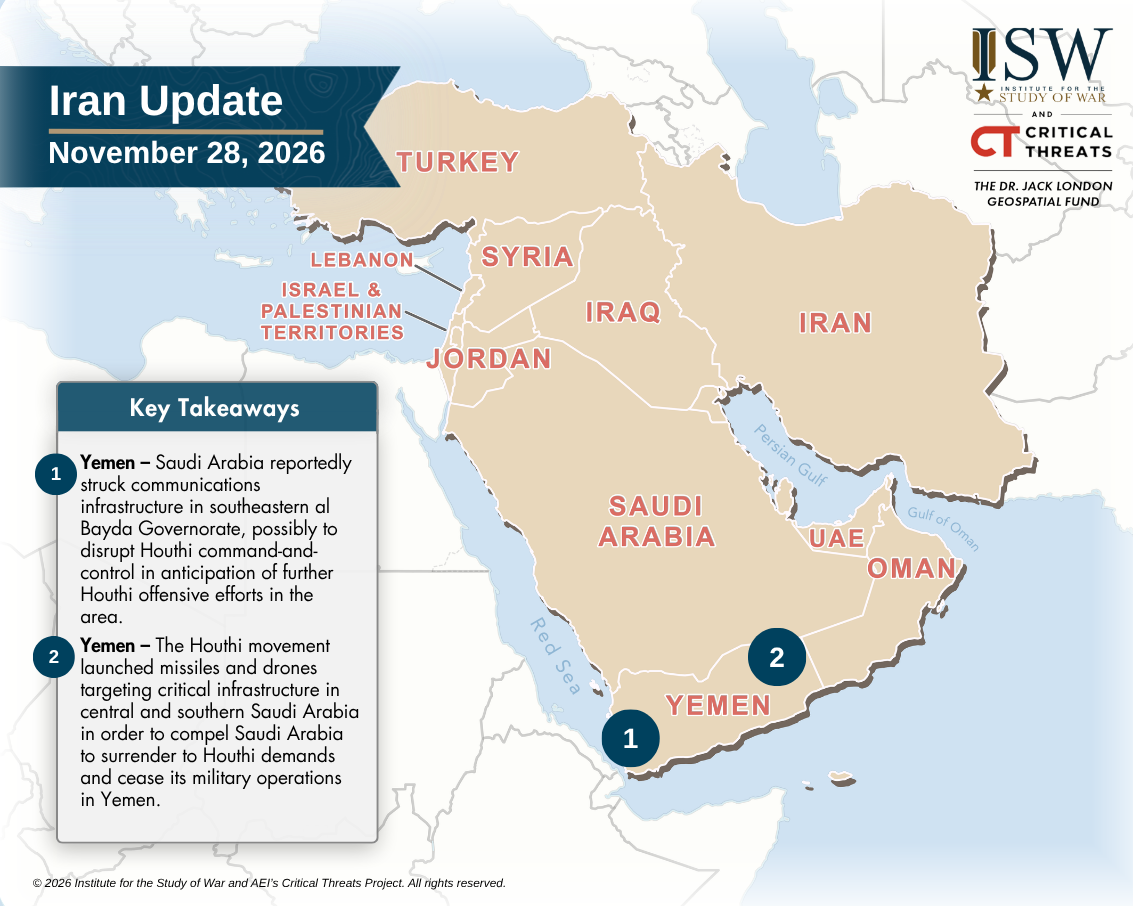
- Saudi Arabia reportedly struck communications infrastructure in southeastern al Bayda Governorate on November 27, possibly to disrupt Houthi command-and-control (C2) in anticipation of further Houthi offensive efforts in the area.
- The Houthi movement launched missiles and drones targeting critical infrastructure in central and southern Saudi Arabia on November 27 and 28 in order to compel Saudi Arabia to surrender to Houthi demands and cease its military operations in Yemen.
Toplines
See "Arabian Peninsula" section.
US and Partner Military Operations
Nothing significant to report.
Iranian Strike Campaign
-
Assessed Iranian War Aims:
- Secure international recognition of Iranian control over the Strait of Hormuz
- Degrade the US ability and willingness to continue the war
- Restore deterrence vis-à -vis the United States and its regional partners
- Divide the United States and Israel from the Arab states
Nothing significant to report.
US-Iran Negotiations
Nothing significant to report.
Iranian Domestic Affairs
Nothing significant to report.
Lebanon
Nothing significant to report.
Iraq
Nothing significant to report.
Arabian Peninsula
Saudi Arabia reportedly struck communications infrastructure in southeastern al Bayda Governorate on November 27, possibly to disrupt Houthi command-and-control (C2) in anticipation of further Houthi offensive efforts in the area.[i] Houthi media reported on November 27 that Saudi aircraft struck communications infrastructure on the outskirts of al Bayda City and in Mukayras and al Sawmaa districts, near the frontline on the Abyan-al Bayda governorate border.[ii] Saudi forces may have attacked communications infrastructure in the area to disrupt Houthi C2, which relies upon secure and unimpeded communications between combat units and commanders. The Houthis began a limited ground offensive into Abyan Governorate from southeastern al Bayda Governorate on November 18, and Saudi aircraft repeatedly attacked Houthi forces and staging areas in Mukayras District in recent days after the offensive began.[iii] CTP-ISW has assessed that the Houthis may be attempting to threaten the Yemeni government's defense of Aden City by opening a new front in southeastern Yemen, which could be intended to fix government-aligned forces in the area or overextend the government's defensive lines.[iv]
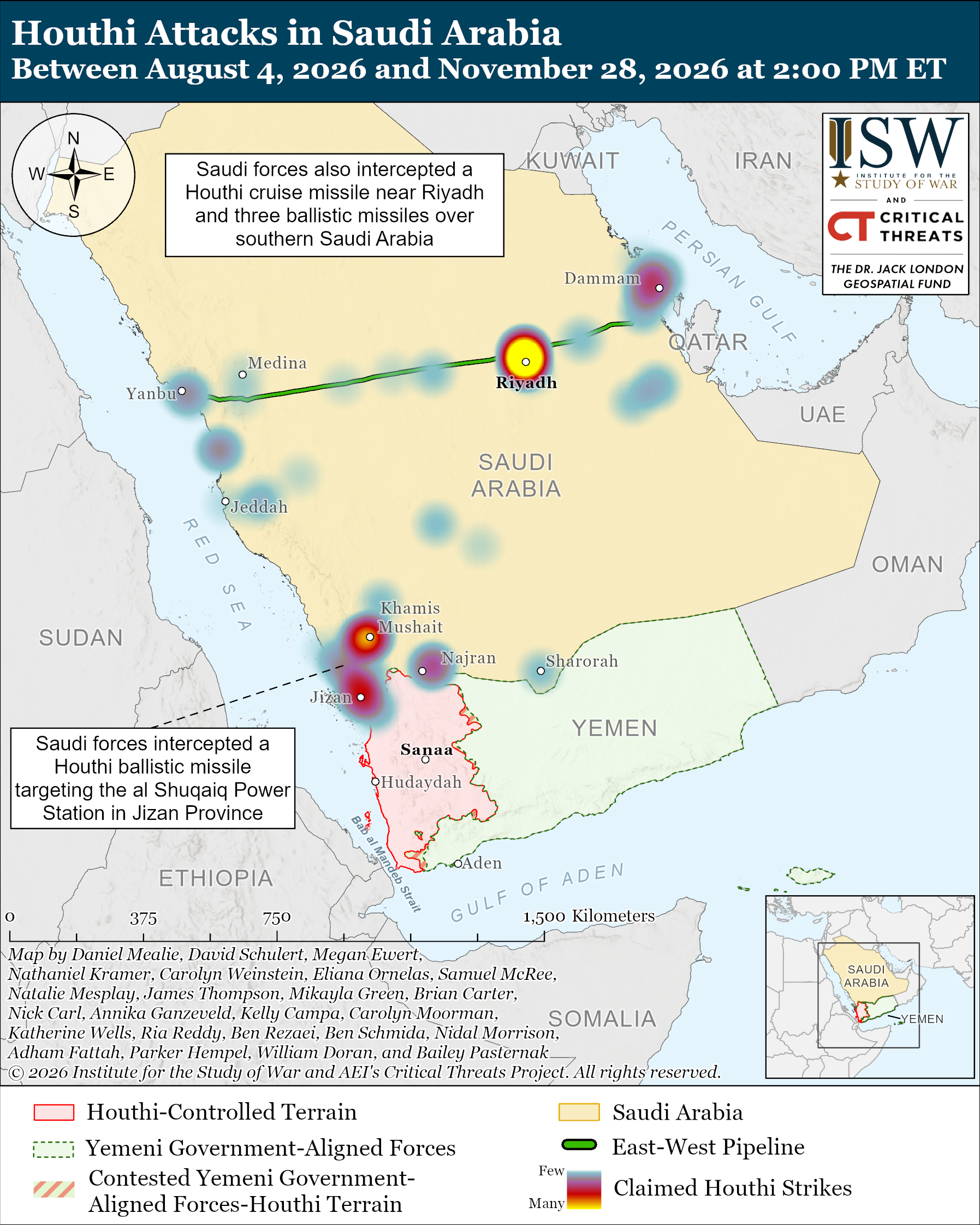
The Houthi movement launched missiles and drones targeting critical infrastructure in central and southern Saudi Arabia on November 27 and 28 in order to compel Saudi Arabia to surrender to Houthi demands and cease its military operations in Yemen. Saudi Joint Forces Command Spokesperson Turki al Maliki announced on November 28 that Saudi air defenses intercepted a Houthi ballistic missile over al Shuqaiq, Jizan Province.[v] Houthi media claimed on November 28 that the strike targeted the al Shuqaiq Power Station but did not explicitly claim responsibility for the attack.[vi] Maliki also announced that Saudi air defenses intercepted a Houthi cruise missile near Riyadh on November 27 and three ballistic missiles over southern Saudi Arabia on November 28.[vii] The Houthis have persistently attacked critical infrastructure in Saudi Arabia since July 2026 in order to maximize the kingdom's economic and political costs and compel Saudi leaders to capitulate to Houthi demands, which include ceasing all military support for the Yemeni government and action against the Houthis.[viii]

[i] https://x.com/Almasirah_YE/status/2126509889929584925
[ii] https://x.com/Almasirah_YE/status/2126509889929584925?a=YvAAM6qzgQ2mpdNaL0M&s=20
[iii] https://understandingwar.org/research/middle-east/iran-update-november-19-2026/ ; https://x.com/almasaobl/status/2123192347508777197 ; https://www.alaraby.co dot uk/politics/اليمن-سباق-تعزيزات-إلى-الشرق-ينذر-بمعارك-عنيفة ; https://x.com/Almasirah_YE/status/2124191645738365382?a=BTOpwWu7vDKHNOLUxJo&s=20 ; https://x.com/BashaReport/status/2123226132552044840
[iv] https://understandingwar.org/research/middle-east/iran-update-november-19-2026/
[v] https://x.com/CJFCSpox/status/2126679731965661340?a=-wJkViWbRPCB1JMKyMI&s=20
[vi] https://x.com/Almasirah_YE/status/2126683697034547356?s=20
[vii] https://x.com/CJFCSpox/status/2126608379602985028?a=2GO_XJi1ahbhfEbYCgc&s=20 ; https://x.com/CJFCSpox/status/2126651272485126176?a=fhqtbJLs5lDYzn7YtDw&s=20 ; https://x.com/CJFCSpox/status/2126514230325035094?a=nh3eGzHasV-cMYAAfsk&s=20
[viii] https://understandingwar.org/research/middle-east/iran-update-november-27-2026/
View Citations