{{currentView.title}}
12 hours ago
Iran Update, November 20, 2026
Data Cutoff: 2:00 PM ET
The Institute for the Study of War (ISW) and The Critical Threats Project (CTP) at the American Enterprise Institute are publishing updates Monday through Friday to provide analysis on the war with Iran and the broader Middle East. Weekday updates cover events from the past 24-hour period, whereas weekend updates are abbreviated and cover the Houthi-Saudi conflict and major breaking developments related to the war with Iran.
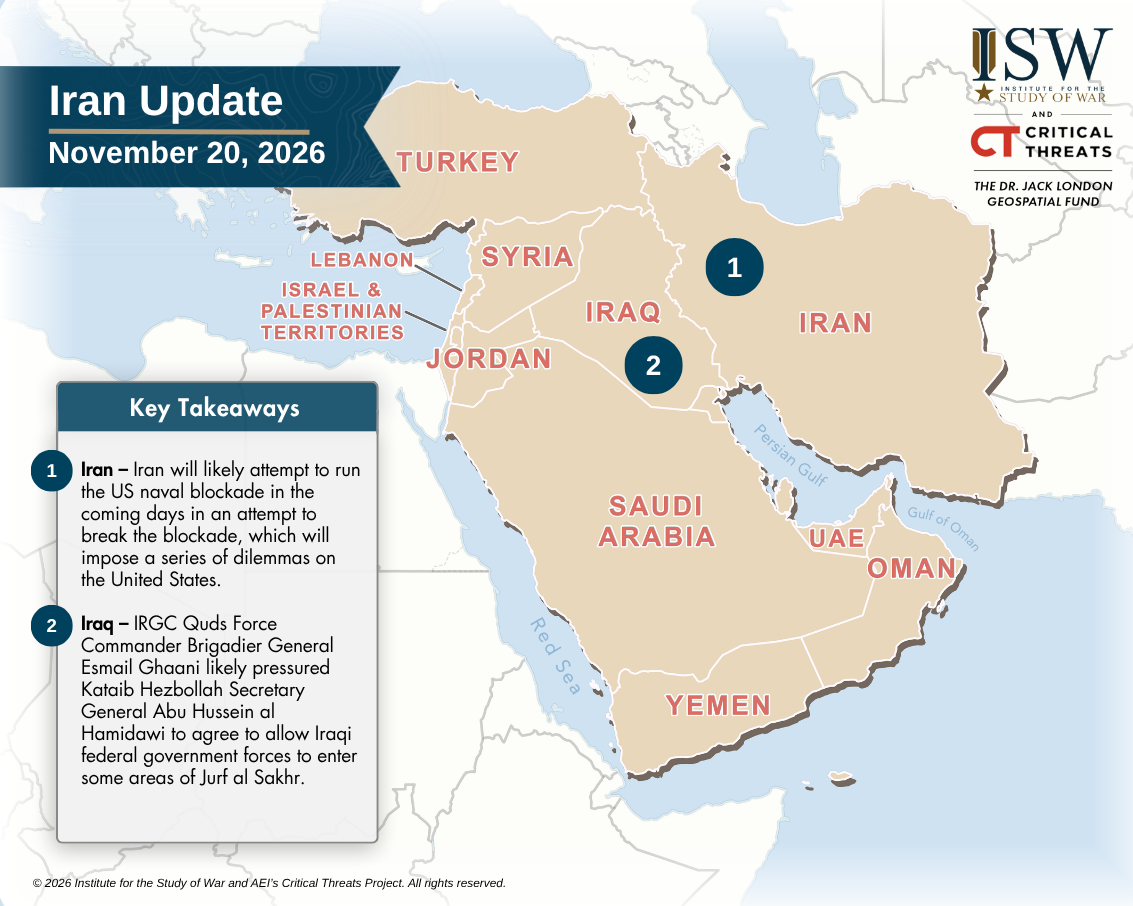
Key Takeaways:
- Iran will likely attempt to run the US naval blockade in the coming days in an attempt to break the blockade. Iranian attempts to run the blockade impose a series of dilemmas on the United States by either collapsing the blockade or returning to a war that imposes unideal political costs on the United States by straining its relationships with Gulf allies.
- Islamic Revolutionary Guards Corps (IRGC) Quds Force Commander Brigadier General Esmail Ghaani likely pressured Kataib Hezbollah Secretary General Abu Hussein al Hamidawi to agree to allow Iraqi federal government forces to enter some areas of Jurf al Sakhr, Babil Province. It is unclear whether Kataib Hezbollah has withdrawn its forces from any areas of Jurf al Sakhr at the time of this writing, however. Kataib Hezbollah could still attempt to coerce the Iraqi government to abandon its demand that it withdraws from Jurf al Sakhr.
- Saudi Arabia is conducting strategic interdiction efforts and airstrikes on Houthi energy infrastructure in order to render the Houthi movement unable or unwilling to continue its attacks on Saudi Arabia and ground offensives in Yemen, respectively. These efforts will likely fail to achieve Saudi objectives given that Yemeni government-aligned ground forces are incapable of halting Houthi advances, however.
Toplines
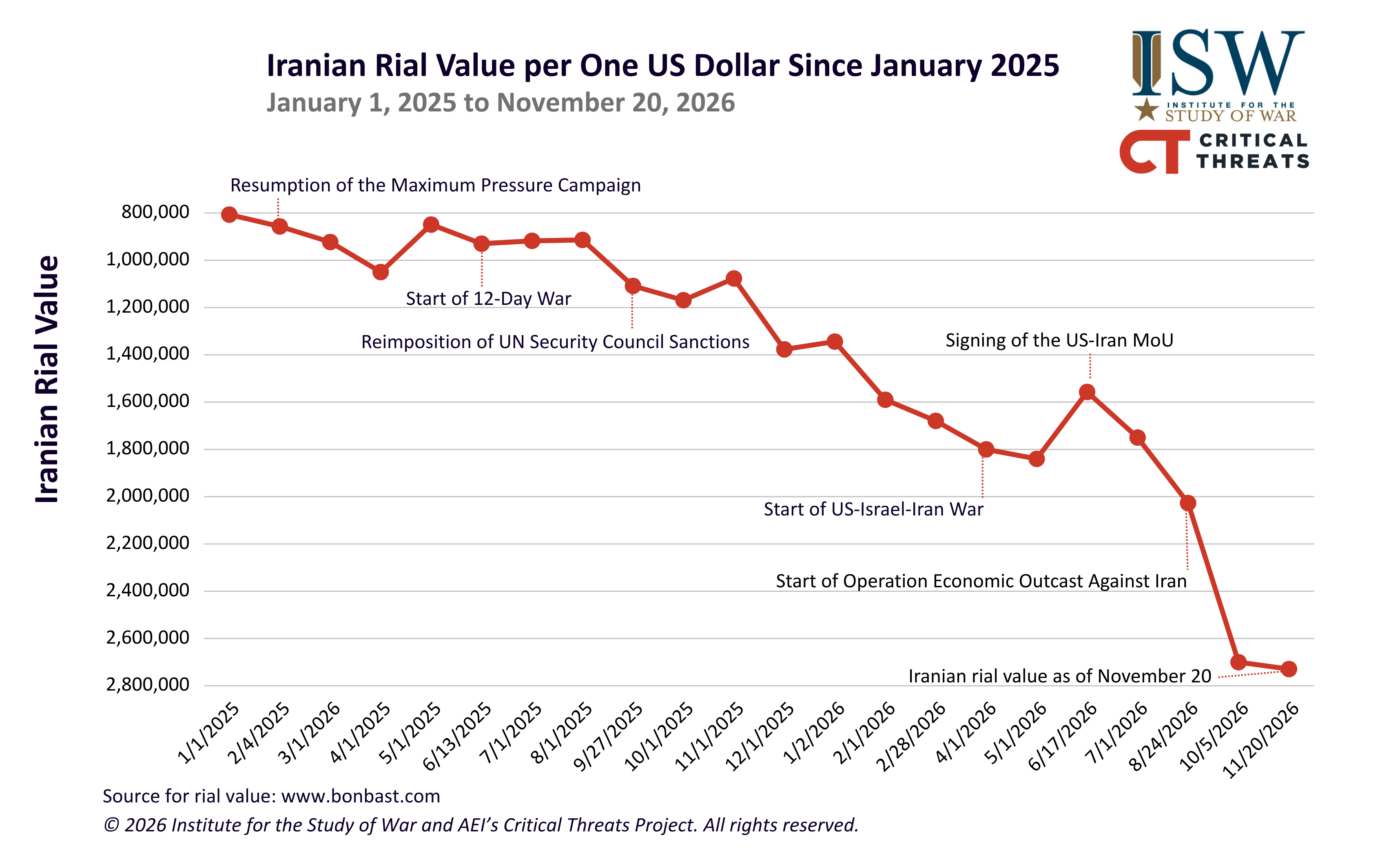
Iran will likely attempt to run the US naval blockade in the coming days in an attempt to break the blockade. Iran’s deteriorating economic situation is increasingly dire, which is forcing Iranian officials to reckon with the necessity of breaking the US blockade.[i] Tehran municipality-affiliated outlet Hamshahri claimed on November 20 that Iran has staged 14 tankers at Kharg Island to attempt to run the blockade.[ii] Attempting to run the blockade would expose Iran to significant risk that ranges from the destruction of a tanker fleet at minimum to possibly resuming a larger-scale conflict with the United States, or both. Iran’s willingness to accept these risks demonstrates the degree to which the regime views the current economic situation as both dire and unsustainable. This view and the degree of risk acceptance suggests that maintaining the blockade is putting the regime in an increasingly untenable situation, at least from the regime‘s perspective. The US blockade has prevented Iran from moving substantial amounts of crude oil from the Persian Gulf to global markets.[iii] Iran is experiencing worsening inflation, rising living costs, and continued depreciation of its currency as a result of its inability to move substantial amounts of crude.[iv] The United States has taken several recent steps to further restrict any Iranian attempts to move oil out of the country. The Joint Maritime Information Center announced on November 18 that the blockade will now include vessels that have received cargo via a ship-to-ship transfer from a vessel carrying cargo loaded at an Iranian port or coastline.[v]
Running the blockade will force the United States to either stop the blockade runners by force or let them pass, which renders the blockade ineffective and therefore invalid. The Iranian regime’s optimal scenario would be that the United States allows the blockade runners to pass to avoid a resumption of conflict, given that doing so would collapse the blockade’s effectiveness (in addition to its validity). Iran could believe that the United States will be unwilling to allow blockade running (and its consequences). Iran would then respond by attacking infrastructure in the Gulf. Islamic Revolutionary Guards Corps (IRGC)-affiliated Fars News Agency argued on November 18 that Iran should publicly dispatch a tanker convoy and retaliate against regional energy and technology infrastructure if US forces enforce the blockade and interdict the convoy.[vi] This would increase the military and political costs necessary to maintain the blockade, even if it did not end the blockade.
Iran may calculate that the Gulf states would pressure the United States to end the war prematurely if the fighting resumed. This would create diplomatic challenges for the United States as it seeks to sustain the support of its allies for a renewed strike campaign that would almost certainly result in Iran targeting critical Gulf infrastructure. Iran could calculate that further Iranian attacks or the threat of such attacks would cause the Gulf states to pressure the United States to end the war. Iran could also calculate that the threat will compel Gulf states to pressure the United States to allow Iranian tankers to pass. Iranian attempts to run the blockade, therefore, impose a series of dilemmas on the United States by either collapsing the blockade or returning to a war that imposes undesirable political costs on the United States by straining its relationships with Gulf allies. CTP-ISW makes no assessment about whether this Iranian theory of the case would be successful or unsuccessful.
Islamic Revolutionary Guards Corps (IRGC) Quds Force Commander Brigadier General Esmail Ghaani likely pressured Kataib Hezbollah Secretary General Abu Hussein al Hamidawi to agree to allow Iraqi federal government forces to enter some areas of Jurf al Sakhr, Babil Province. Iraqi security forces, including Federal Police, Popular Mobilization Forces (PMF), and Iraqi Army units, entered Jurf al Sakhr on November 20, according to Iraqi and Western media as well as footage from the area.[vii] Kataib Hezbollah has controlled Jurf al Sakhr since 2014 and has denied the Iraqi federal government access to the area for over a decade.[viii] The Iraqi government previously demanded that Kataib Hezbollah withdraw from Jurf al Sakhr by November 20 after a government-led investigation found further evidence to corroborate claims of Kataib Hezbollah’s involvement in oil smuggling in Jurf al Sakhr.[ix] Kataib Hezbollah has generated millions of dollars in illicit revenue from oil smuggling in the Jurf al Sakhr area since 2021, according to the leaked Iraqi Interior Ministry report.[x]
Iraqi security forces' entry into Jurf al Sakhr despite Hamidawi's previous public opposition to allowing any Iraqi government presence in Jurf al Sakhr suggests that Ghaani likely pressured Hamidawi into an agreement.[xi] Iraqi forces notably entered Jurf al Sakhr after Ghaani met with Hamidawi on November 19. Ghaani wields significant influence over Iranian-backed Iraqi militias and has previously successfully pressured Iranian-backed Iraqi militias to take actions against their wishes.[xii] CTP-ISW previously assessed that Ghaani could condition the resumption of material and financial support to Kataib Hezbollah on Hamidawi agreeing to a deal with the Iraqi government regarding Jurf al Sakhr.[xiii] It is unclear what incentives Ghaani may have used to pressure Hamidawi into accepting the agreement.
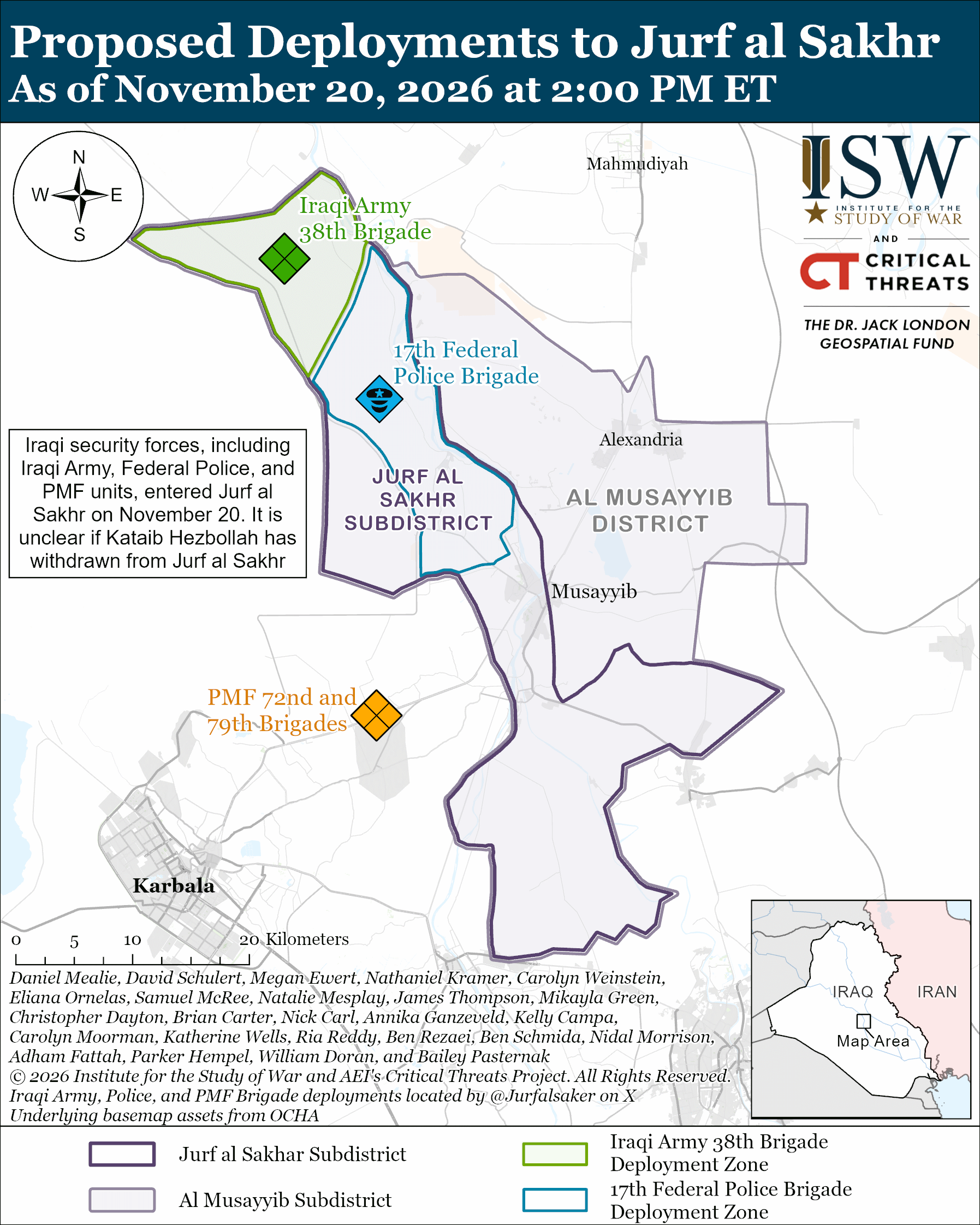
It is unclear whether Kataib Hezbollah has withdrawn its forces from any areas of Jurf al Sakhr at the time of this writing, however. An Iraqi government source told Qatari-owned media on November 20 that the militia will "gradually" withdraw to areas within Anbar and Muthanna provinces.[xiv] Security and military sources also claimed to Saudi-owned media on November 20 that three Kataib Hezbollah brigades have left Jurf al Sakhr.[xv] CTP-ISW cannot verify the reported withdrawals at the time of this writing. A political source told Saudi-owned media on November 20 that a limited Kataib Hezbollah force remains in ”locations of importance” to the militia.[xvi] Iraqi media footage separately showed Kataib Hezbollah members standing near and meeting with Iraqi officers on November 20 following the deadline for the militia to withdraw.[xvii] The remaining Kataib Hezbollah presence in Jurf al Sakhr could indicate that the deal that Ghaani brokered between the militia and Baghdad is intentionally designed to prevent the Iraqi federal government from fully exerting control over Jurf al Sakhr.
Kataib Hezbollah could still attempt to coerce the Iraqi government to abandon its demand that it withdraws from Jurf al Sakhr. A Kataib Hezbollah spokesperson rejected on November 19 that the militia would withdraw from Jurf al Sakhr.[xviii] Hamidawi stated on November 19 that it would settle its issues with the Iraqi government via "private channels," which suggests that the militia will attempt to coerce the Iraqi government to abandon its demand for the militia to withdraw from Jurf al Sakhr.[xix] Iranian-backed Iraqi militias have historically used force, and the threat of force, to compel the Iraqi government to meet militia demands.[xx] Militia units that have reportedly departed from the area could also attempt to return, thereby undermining the agreement.
Ghaani likely pressured Hamidawi into accepting a limited Iraqi federal deployment into Jurf al Sakhr to avoid an armed conflict between Kataib Hezbollah and the Iraqi federal government and preserve the militia. An armed conflict would almost certainly further divide the Shia Coordination Framework, a loose coalition of Iraqi Shia parties, given that the framework was already divided over Prime Minister Ali al Zaydi's earlier threats to force Kataib Hezbollah to withdraw from Jurf al Sakhr.[xxi] The Iranian regime has historically pressured the framework to remain unified in order to ensure that the framework retains control of the Iraqi government.[xxii] Ghaani may also calculate that an armed confrontation between Kataib Hezbollah and the Iraqi government in Jurf al Sakhr could weaken the militia or damage its image as a fighting force if the Iraqi government is able to inflict serious damage on the militia.
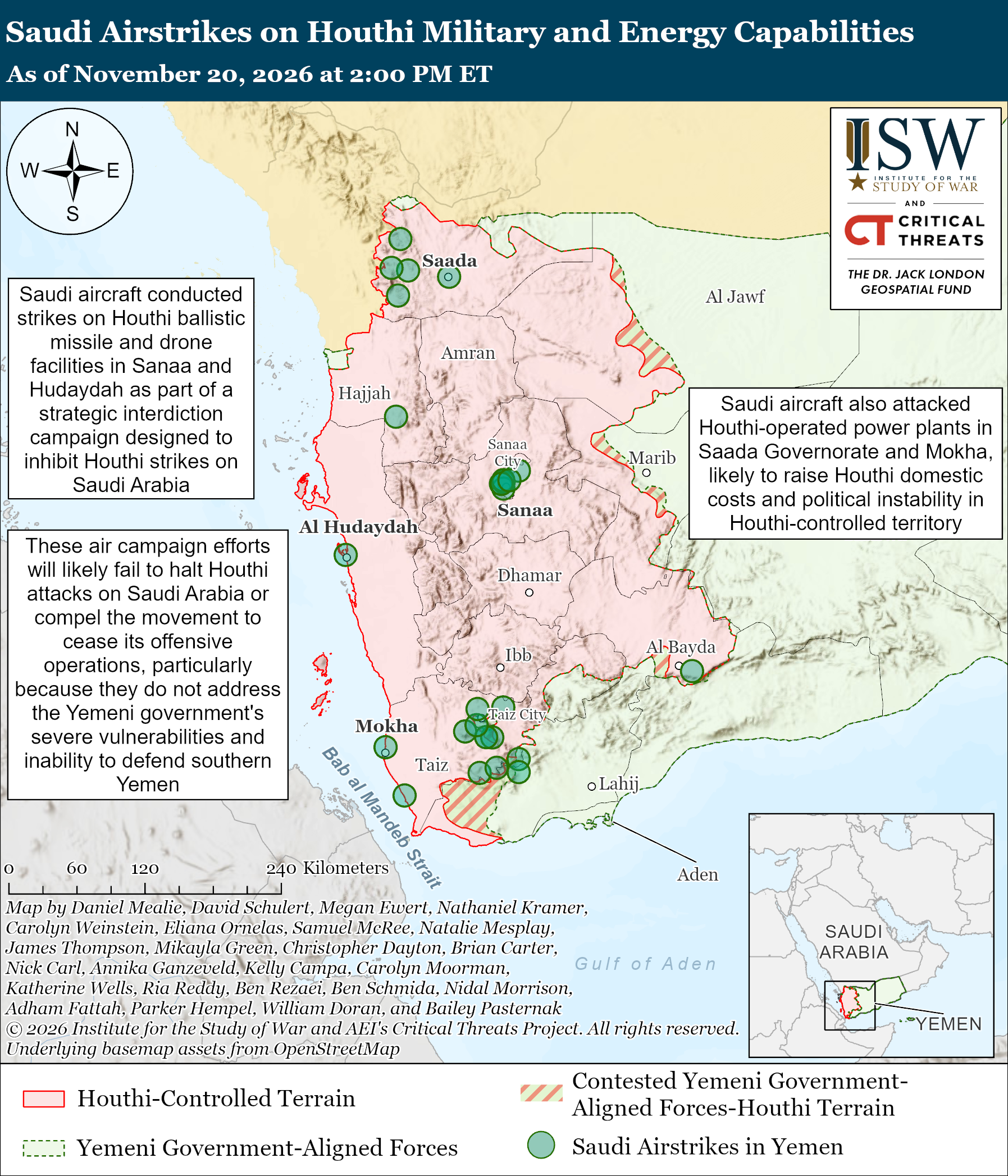
Saudi Arabia is conducting strategic interdiction efforts and airstrikes on Houthi energy infrastructure in order to render the Houthi movement unable or unwilling to continue its attacks on Saudi Arabia and ground offensives in Yemen, respectively. The Saudi Joint Forces Command announced on November 20 that Saudi forces conducted numerous airstrikes targeting Houthi ballistic missile and drone components and facilities in major Houthi-controlled Yemeni cities, including Hudaydah and Sanaa.[xxiii] These strikes appear to constitute a strategic interdiction operation that is likely designed to prevent the Houthis from attacking Saudi Arabia by threatening critical nodes in the Houthis’ weapons supply chain, including the movement’s smuggling hub at Hudaydah and its military command and stockpiles in Sanaa.[xxiv] Saudi Arabia seeks to relieve the significant political and economic pressure that the Houthi strike campaign is imposing on the kingdom by degrading the Houthis’ ability to conduct attacks on Saudi oil facilities, civilian airports, and other critical infrastructure.[xxv]
Saudi aircraft also likely struck energy infrastructure in Houthi-controlled parts of Yemen on November 20 in order to raise the Houthis' domestic costs and generate political instability in Houthi-controlled territory. Houthi media and a DC-based Yemen analyst reported on November 20 that Saudi aircraft struck Houthi-controlled power stations in Qahza, Saada Governorate, and in Mokha near the Bab al Mandeb Strait.[xxvi] Saudi Arabia may intend to exacerbate dire economic conditions in Houthi-controlled territory in order to destabilize Houthi control over most of Yemen and compel the group to abandon its offensive campaigns.[xxvii] The Houthis initially resumed their war with Saudi Arabia in July 2026 to extract mostly economic concessions that would alleviate these dire, largely self-imposed economic conditions, for instance.[xxviii] Saudi Arabia previously struck Houthi oil storage facilities in Yemen on October 13, likely to impose a similar effect.[xxix] Saudi Arabia had not made any concerted effort until now to continue those patterns of strikes on Houthi energy infrastructure.
These efforts will likely fail to achieve Saudi objectives given that Yemeni government-aligned ground forces are incapable of halting Houthi advances, however. The Saudi air campaign most crucially fails to compensate for Yemeni government-aligned ground forces' incapacity to effectively defend territory against Houthi advances, which is the most salient factor in the Houthis' current success.[xxx] The Houthis have captured vast swaths of territory in Lahij Governorate in recent days, despite clear Yemeni government defensive advantages in some instances and are threatening to besiege and capture the Yemeni government's temporary capital at Aden in the near term.[xxxi] Houthi forces' recent attempted advances northeast of Aden in Abyan Governorate add to this near-term threat to the Yemeni government's survival by opening a new front for overstretched government-aligned forces to defend (see below in ”Arabian Peninsula” section).[xxxii] Air power, even if well-coordinated with local ground forces for close air support (CAS), cannot take the place of a ground force that must competently hold terrain. The urgency of the Houthis' near-term threat to Aden similarly denies Saudi Arabia a longer timeframe that would likely be necessary to meaningfully degrade Houthi capabilities and break Houthi will through air operations.
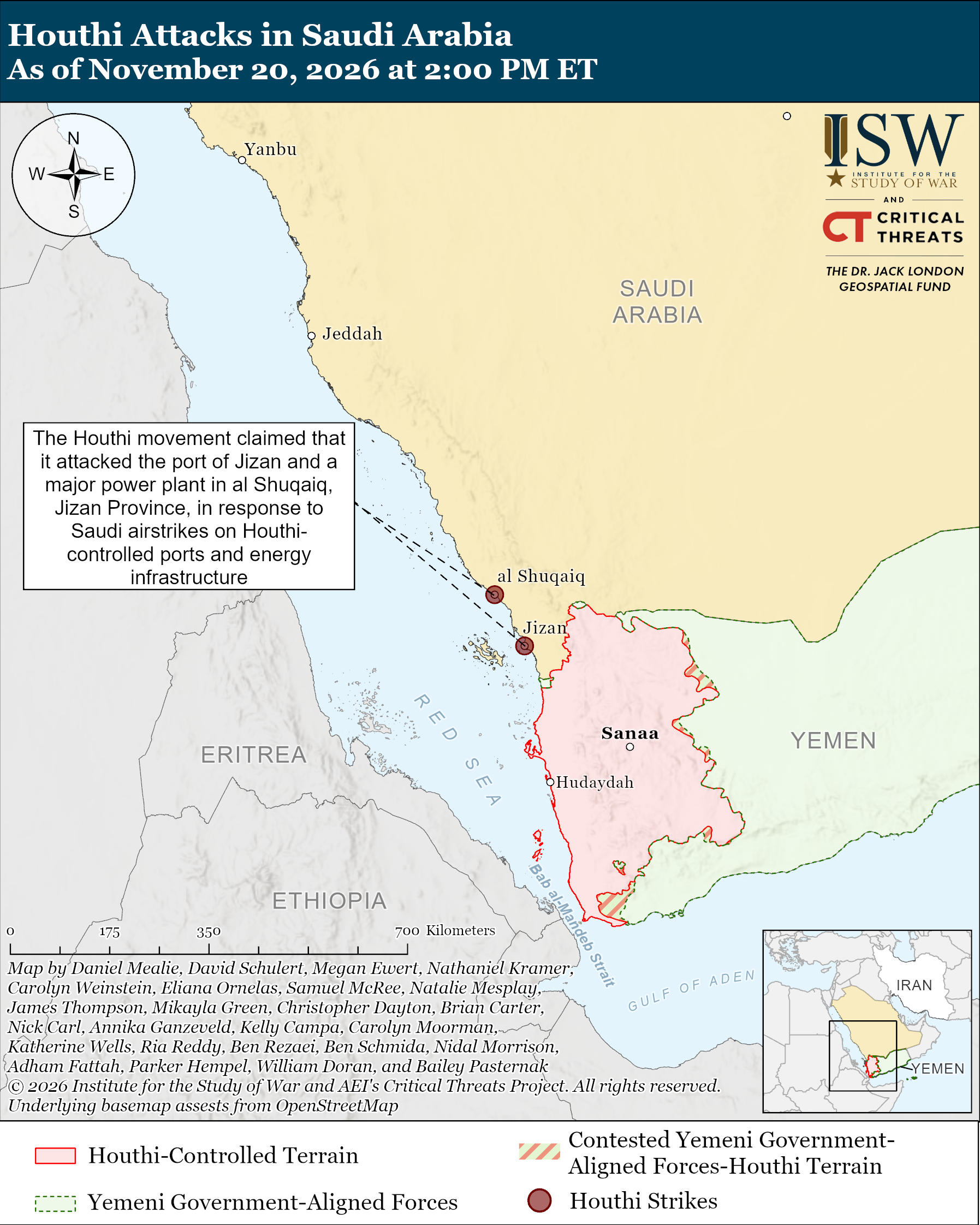
Saudi strategic interdiction efforts are therefore unlikely to succeed in compelling the Houthis to abandon their offensive campaigns because the Houthis likely believe that they are relatively close to defeating Saudi Arabia and the Yemeni government.[xxxiii] Similar patterns of Saudi airstrikes in recent months have failed to break the Houthis' will to continue attacking Saudi Arabia, as the group has steadily expanded the scope and scale of its strike campaign on Saudi infrastructure.[xxxiv] Houthi military spokesperson Yahya Sarea most recently announced on November 20 that the Houthis attacked a major power plant in al Shuqaiq, Jizan Governorate, and the port of Jizan in response to Saudi airstrikes on Houthi-controlled power plants and the port of Hudaydah.[xxxv]
US and Partner Military Operations
See topline section.
Iranian Strike Campaign
-
Assessed Iranian War Aims:
- Secure international recognition of Iranian control over the Strait of Hormuz
- Degrade the US ability and willingness to continue the war
- Restore deterrence vis-à -vis the United States and its regional partners
- Divide the United States and Israel from the Arab states
See topline section.
US-Iran Negotiations
Nothing significant to report.
Iranian Domestic Affairs
Nothing significant to report.
Lebanon
Nothing significant to report.
Iraq
See topline section.
Arabian Peninsula
The Houthi movement and Yemeni government-aligned forces have deployed additional reinforcements to Abyan Governorate on November 20 after the Houthis initiated a new offensive in the area in recent days. UK-based, Qatari-owned media reported on November 20 that Yemeni government-aligned Homeland Shield Forces and Southern Giants Brigades units deployed reinforcements near Thara, Lawdar District, Abyan Governorate, and other areas in Abyan and Shabwa governorates on November 20.[xxxvi] Thara is located along the al Bayda-Aden ground line of communication (GLOC). The Support and Reinforcement Brigades, another Yemeni-government aligned faction, similarly deployed forces to Lawdar District, on November 19, according to southern Yemeni media.[xxxvii] Saudi aircraft also reportedly continued to strike Houthi staging areas in neighboring Mukayras District, al Bayda Governorate, on November 20.[xxxviii] Saudi aircraft previously attacked Houthi forces in Mukayras District on November 19 that likely supported the Houthi advance in the area.[xxxix]
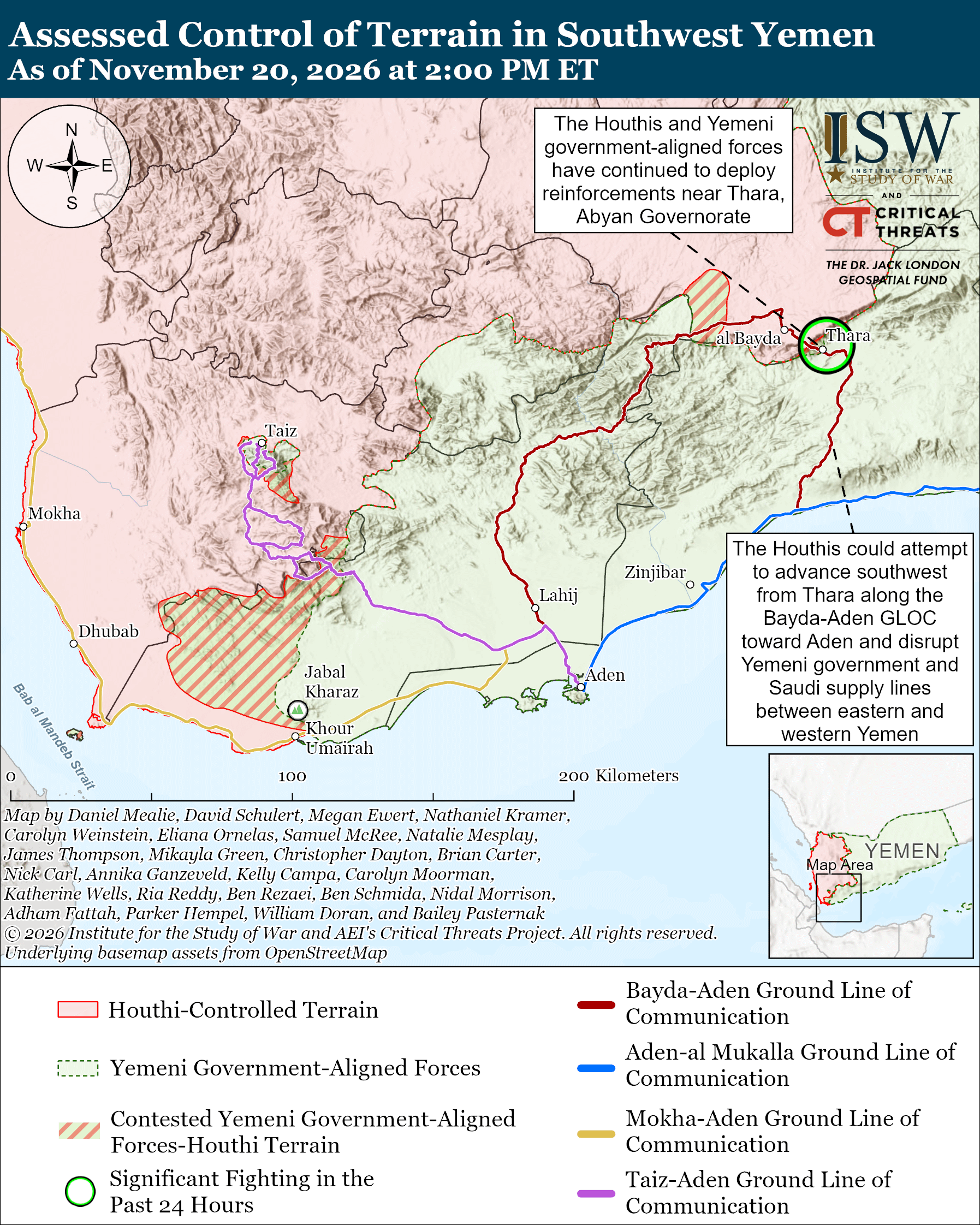
Houthi forces attempting to advance into Abyan Governorate via Thara will likely face geographic challenges as the topography between Houthi-controlled territory in Mukayras District and Thara canalizes Houthis forces along a small and exposed mountain road that descends to lower terrain in Lawdar District. Houthi advances down the Thara road would likely render Houthi forces, particularly vehicles, vulnerable to Saudi airstrikes. Houthi advances along this road also pose a threat to government forces in that the high ground provides Houthi forces with a direct fire advantage over Yemeni government-aligned forces attempting to counter the Houthi advances, however.
Houthi advances along the al Bayda-Aden GLOC may also represent a Houthi effort to open another front from which the movement could threaten Aden City from the east. Current Houthi positions on the al Bayda-Aden GLOC are over 160 kilometers from Aden City, but the Houthis may be attempting to fix government aligned forces and prevent these forces from redeploying to support other Yemeni government-aligned forces currently defending Aden City, the de facto Yemeni capital.[xl] The Houthi effort may also seek to draw Yemeni government-aligned forces away from the fronts in southwestern Yemen, particularly fronts along the routes to Aden City.[xli] The Southern Giants Brigades, Homeland Shield Forces, and Support and Reinforcement Brigades are the primary Yemeni government-aligned factions currently fighting against Houthi advances west of Aden City.[xlii]
[i] https://www.sarpoosh dot com/politics/government-news/government-news1405080778.html ;
https://www.aljazeera dot com/economy/2026/11/11/can-tehran-survive-a-zero-oil-budget-if-us-blockade-on-iran-persists ;
[ii] https://www.hamshahrionline dot ir/news/1087841
[iii] https://www.bloomberg.com/graphics/2026-us-iran-war-blockade/ ;
[iv] https://www.reuters.com/world/middle-east/iranians-cut-essentials-put-dreams-hold-as-war-hit-economy-bites-2026-10-28/
[v] https://www.ukmto.org/-/media/ukmto/products/jmic-advisory-note-01726-blockade-update.pdf?rev=ca07d9284c0d484db848d59387f671d0
[vi] https://farsnews dot ir/aa_mir78/1794984624104955086
[vii] https://www.nytimes.com/2026/11/20/world/middleeast/iraq-militia-iran-kataib-hezbollah.html ; https://x.com/alssaanetwork/status/2123754907945615851 ; https://x.com/vvanwilgenburg/status/2123710020420583753 ; https://almadapaper dot net/461830
[viii] https://alhurra dot com/32845 ; https://alhurra dot com/en/14420 ; https://ctc.westpoint.edu/standing-with-iran-the-integrated-combat-performance-of-iraqi-militias-during-operation-epic-fury/
[ix] https://understandingwar.org/research/middle-east/iran-update-november-19-2026/ ; https://x.com/IraqiPMO/status/2121671517734117837 ; https://alhurra dot com/55082 ; https://shafaq dot com/ar/سیاسة/الزيدي-يمهل-كتا-ب-حزب-الله-لتسليم-الجرف-ويستعد-لتحريك-جهاز-مكافحة-ال-رهاب ; https://www.shafaq dot com/ar/أمـن/جرف-الصخر-انفجارات-ما-قبل-مهلة-الجمعة ; https://shafaq dot com/ar/سیاسة/الكتا-ب-تنفي-تقرير-لجنة-التحقيق-بتهريب-النفط-الجرف-والسلاح-خارج-الصراع-السياسي
[x] https://alhurra dot com/53527
[xi] https://964media dot com/737310/
[xii] https://www.reuters.com/world/middle-east/iraqi-armed-groups-dial-down-us-attacks-request-iran-commander-2024-02-18/
[xiii] https://understandingwar.org/research/middle-east/iran-update-november-19-2026/ ; https://x.com/alssaanetwork/status/2123346471822950900
[xiv] https://www.alaraby dot co.uk/politics/الجيش-العراقي-يدخل-جرف-الصخر-وسط-وعود-بعودة-الأهالي-قريباً
[xv] https://aawsat dot com/العالم-العربي/المشرق-العربي/5343643-القوات-العراقية-في-جرف-الصخر-بعد-12-عاماً-من-سيطرة-الكتائب
[xvi] https://aawsat dot com/العالم-العربي/المشرق-العربي/5343643-القوات-العراقية-في-جرف-الصخر-بعد-12-عاماً-من-سيطرة-الكتائب
[xvii] https://x.com/alssaanetwork/status/2123810290085064862 ; https://x.com/alssaanetwork/status/2123754907945615851 ; https://x.com/vvanwilgenburg/status/2123710020420583753
[xviii] https://almadapaper dot net/461820/
[xix] https://t.me/centerkaf/5956 ; https://t.me/centerkaf/5957
[xx] https://ctc.westpoint.edu/iraqs-new-regime-change-how-tehran-backed-terrorist-organizations-and-militias-captured-the-iraqi-state/
[xxi] https://almadapaper dot net/461590/ ; https://almadapaper dot net/461439/
[xxii] https://understandingwar.org/research/middle-east/iran-update-april-30-2025/ ; https://understandingwar.org/research/middle-east/iran-update-july-28-2025/
[xxiii] https://x.com/BashaReport/status/2123786142042476613?a=Fg_nnVdiYJEVrw_Z0-o&s=20 ; https://x.com/CJFCSpox/status/2123775980661789083?a=IK7lOf4_P6kOajMTe7s&s=20 ; https://x.com/CJFCSpox/status/2123771820545605702?a=XEVQynvLJxllurKzlPw&s=20 ; https://x.com/IbrahimJalalYE/status/2123831376713752824?a=ci9JyP08Gfw_QSMrUOY&s=20
[xxiv] https://x.com/IbrahimJalalYE/status/2123831376713752824?a=ci9JyP08Gfw_QSMrUOY&s=20 ; https://x.com/IbrahimJalalYE/status/2123757260648202488?a=-Ga_YFZ3iqvyD-E4_jA&s=20
[xxv] https://understandingwar.org/research/middle-east/iran-update-november-19-2026/
[xxvi] https://t.me/army21ye/4123 ; https://x.com/Almasirah_YE/status/2123736551687700606 ; https://x.com/BashaReport/status/2123789869814095949?a=KfQGQB5ZKPQcIfrYBTo&s=20
[xxvii] https://understandingwar.org/research/middle-east/iran-update-september-18-2026/ ; https://www.state.gov/reports/2022-country-reports-on-human-rights-practices/yemen/
[xxviii] https://understandingwar.org/research/middle-east/iran-update-september-18-2026/ ; https://www.aei.org/foreign-and-defense-policy/ending-us-support-to-the-saudi-led-coalition-will-not-end-the-war-in-yemen/ ; https://www.state.gov/reports/2022-country-reports-on-human-rights-practices/yemen/
[xxix] https://understandingwar.org/research/middle-east/iran-update-october-13-2026/ ; https://x.com/CJFCSpox/status/2110063548936184029?s=20
[xxx] https://understandingwar.org/research/middle-east/iran-update-november-18-2026/
[xxxi] https://understandingwar.org/research/middle-east/iran-update-november-16-2026/ ; https://understandingwar.org/research/middle-east/iran-update-november-18-2026/ ; https://x.com/strategicbakery/status/2122904853634765291 ; https://t.me/Alibk3/41674
[xxxii] https://www dot alaraby.co.uk/politics/اليمن-سباق-تعزيزات-إلى-الشرق-ينذر-بمعارك-عنيفة
[xxxiii] https://understandingwar.org/research/middle-east/iran-update-september-18-2026/ ; https://understandingwar.org/research/middle-east/iran-update-november-16-2026/
[xxxiv] https://understandingwar.org/research/middle-east/iran-update-september-15-2026/ ; https://understandingwar.org/research/middle-east/iran-update-september-30-2026/ ; https://understandingwar.org/research/middle-east/iran-update-october-25-2026/
[xxxv] https://t.me/army21ye/4131
[xxxvi] https://www.alaraby.co dot uk/politics/اليمن-سباق-تعزيزات-إلى-الشرق-ينذر-بمعارك-عنيفة
[xxxvii] https://crater-sky dot com/posts/243901
[xxxviii] https://www.alaraby.co dot uk/politics/اليمن-سباق-تعزيزات-إلى-الشرق-ينذر-بمعارك-عنيفة
[xxxix] https://understandingwar.org/research/middle-east/iran-update-november-19-2026/
[xl] https://www.alaraby.co dot uk/politics/اليمن-سباق-تعزيزات-إلى-الشرق-ينذر-بمعارك-عنيفة; https://understandingwar.org/research/middle-east/iran-update-november-19-2026/; https://x.com/almasaobl/status/2123192347508777197
[xli] https://understandingwar.org/research/middle-east/iran-update-november-18-2026/
[xlii] https://understandingwar.org/research/middle-east/iran-update-november-13-2026/ ; https://x.com/FaresALhemyari/status/2120983999938003135 ; https://x.com/FaresALhemyari/status/2121230561511666118 ; https://x.com/almasaobl/status/2121235444285296991
View Citations