
Data Cutoff: 2:00 PM ET
The Institute for the Study of War (ISW) and The Critical Threats Project (CTP) at the American Enterprise Institute are publishing updates Monday through Friday to provide analysis on the war with Iran and the broader Middle East. Weekday updates cover events from the past 24-hour period, whereas weekend updates are abbreviated and cover the Houthi-Saudi conflict and major breaking developments related to the war with Iran.
Key Takeaways:
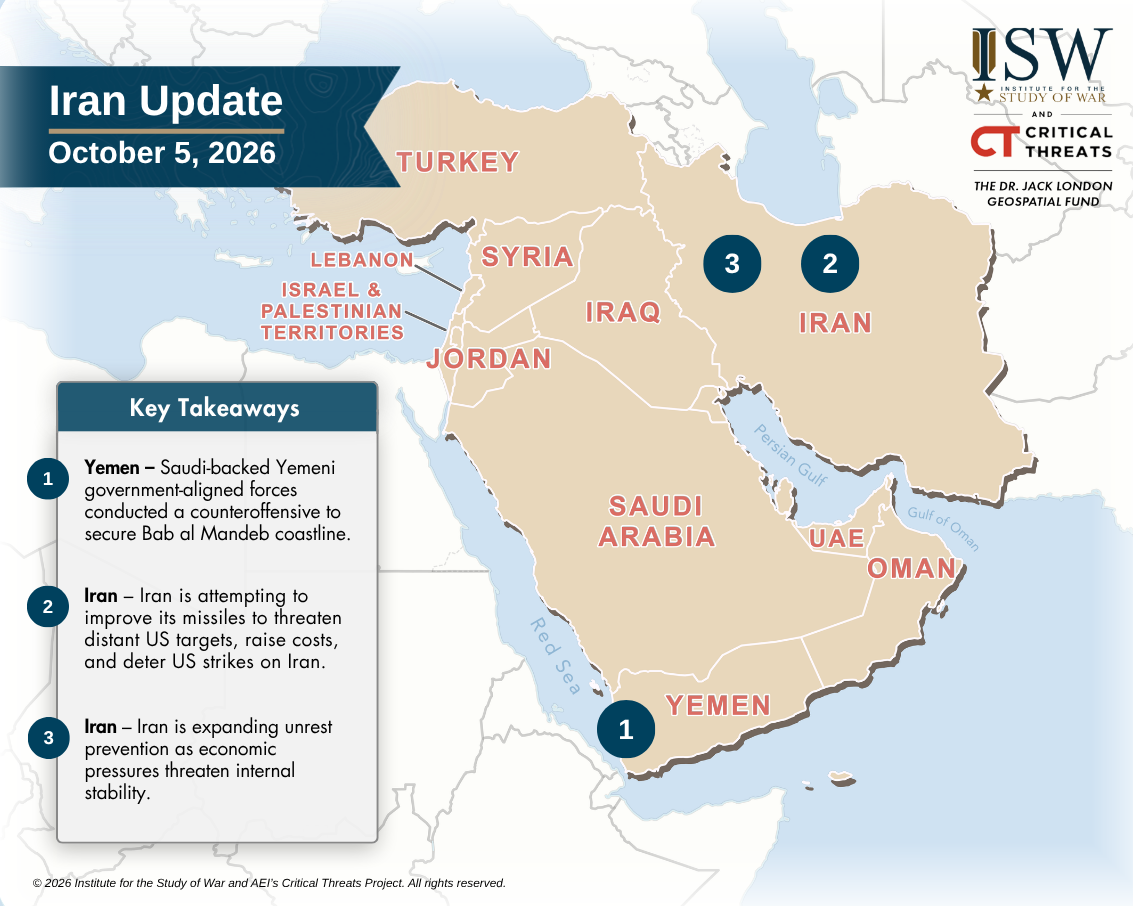
- The Yemeni government, backed by Saudi air power and international coalition military support, launched an offensive to capture Mokha city and secure the coastline along the Bab al Mandeb Strait on October 4. This offensive will likely succeed in capturing Mokha in the short term. Saudi Arabia and the Yemeni government likely launched the offensive to accomplish the limited objective of securing the Bab al Mandeb.
- Yemeni government-aligned forces will likely stop offensive operations within the next seven to 14 days to rest, resupply, and consolidate their positions to prevent a Houthi counteroffensive.
- The Yemeni government will need to secure its own defensible line before its offensive culminates in order to ensure it can repel Houthi attacks combining drones and ground forces, which the Houthis employed in early September.
- Allied air and intelligence support almost certainly made this offensive possible. Over 100 Saudi aircraft provided air support to Yemeni government-aligned forces during the initial assault, and US intelligence is reportedly supporting the air campaign.
- Saudi’s allies in the Mecca Pact are providing military aid to Saudi Arabia, and Saudi Arabia announced on October 5 that Pakistan and Turkey are taking “practical measures” to defend Saudi Arabia pursuant to the Mecca Pact requirements.
- The Iranian regime appears increasingly concerned that mounting economic pressure could threaten internal stability and is combining its attempts to manage its wartime economy with expanded efforts to deter and prepare to suppress possible unrest.
- Iran is likely reconstituting and enhancing its ability to target distant US regional military targets and commercial shipping through improvements in missile accuracy, range, speed, and targeting capabilities.
- Iran is likely aiming to increase its ability to deter US airstrikes targeting Iranian assets, impose costs on the United States, and preserve strategic initiative in the conflict by prioritizing improving its missile capabilit
Toplines
The Yemeni government, backed by Saudi air power and international coalition military support, launched an offensive to capture Mokha city and secure the coastline along the Bab al Mandeb Strait on October 4.[i] The government will likely succeed in capturing Mokha in the coming days. Government-aligned forces are already at Dhubab Airport, which is 54km from Mokha, and some local media have published uncorroborated footage of government-aligned forces entering Mokha after reported Houthi withdrawals.[ii] The retreat of Houthi lines at Mayyun (Perim) Peninsula northwards to at least Dhubab (a distance of approximately 30 km) suggests a major collapse, and there is no evidence currently that the Houthis have halted the collapse of their forces. This collapse indicates that Yemeni government forces will be able to push the routed Houthis further north rapidly, possibly to and beyond Mokha if conditions hold. Indications that the Houthis have successfully brought the collapse under control south of Mokha would include sustained fighting in the same locations over some period along the coast. CTP-ISW will continue to watch for indications that the Houthis have reestablished defensive positions. Local Yemeni media posted unverified footage reportedly showing Houthi fighters leaving Houthi-held positions north and east of Mokha city on October 5, suggesting that the collapse is ongoing and that the Houthis have not reestablished defensive positions after the initial collapse.[iii]
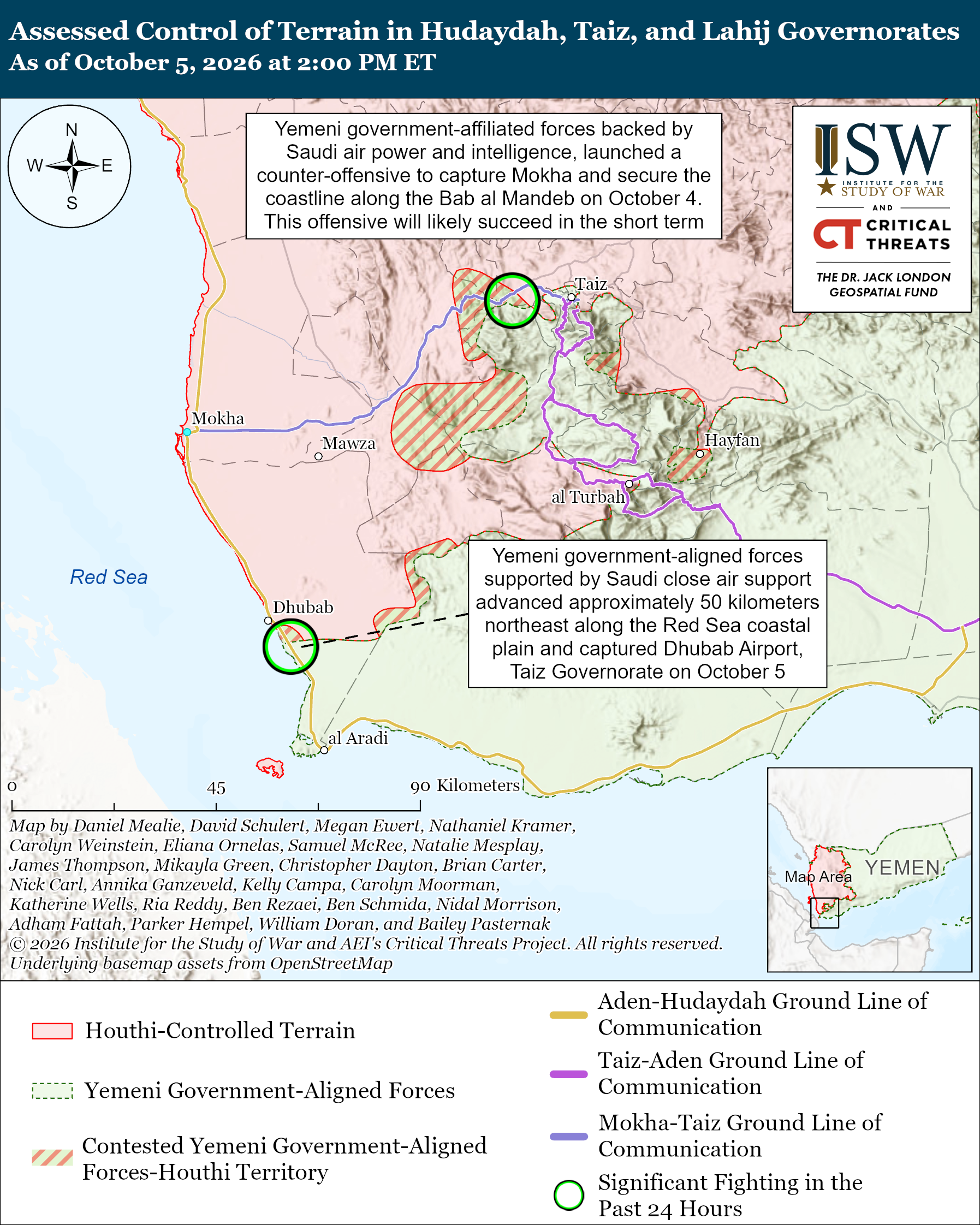
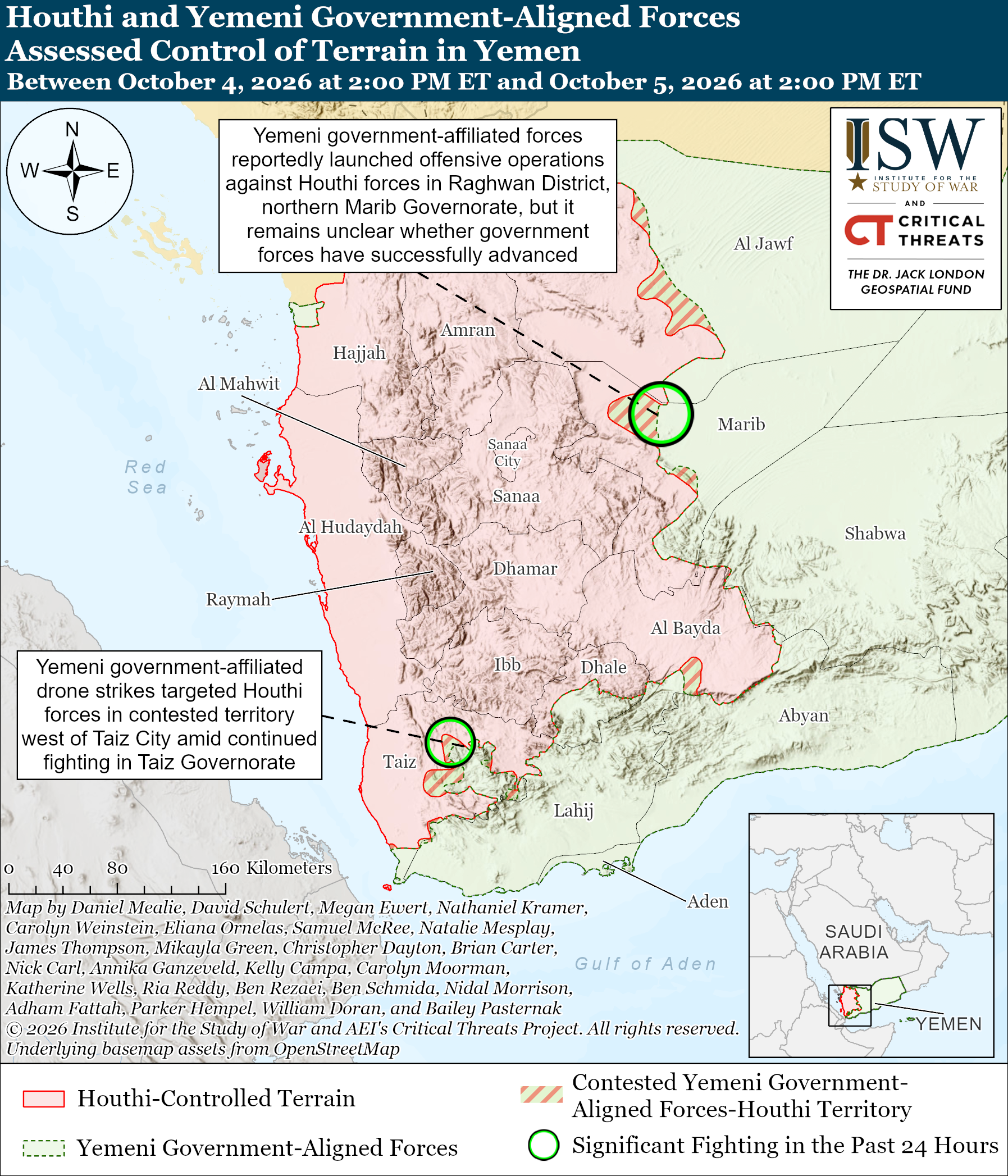
Saudi Arabia and the Yemeni government likely launched the offensive to accomplish the limited objective of securing the Bab al Mandeb. Western and regional officials told Reuters on October 2 that Saudi Arabia was planning to coordinate ground operations and provide air support to Yemeni government-aligned forces in an offensive to recapture territory and ports on the Red Sea coast that the Houthis captured between September 9 and 11.[iv] The sources implied that Saudi Arabia’s primary goal is to reverse Houthi control of the Bab al Mandeb before entering any truce negotiations with the Houthis, which is significantly less expansive than the Yemeni government’s stated objectives.[v] Other events, including engagements in and around Marib and Taiz cities, indicate that government-aligned forces are attempting to pressure the Houthis in multiple areas at once to prevent the movement of reserves, which was also implied as a possibility in the Reuters article.[vi] The Yemeni government announced on October 4 and 5 that it launched this offensive to recapture all Houthi-controlled territory in Yemen, but such an objective would require multiple successive campaigns over weeks, months, and possibly years.[vii] CTP-ISW has observed no indications that the Yemeni government will attempt to recapture the whole country in one decisive battle, and doing so is almost impossible in any case.
Yemeni government-aligned forces will likely stop offensive operations within the next seven to 14 days to rest, resupply, and consolidate their positions to prevent a Houthi counteroffensive. One of the operational dynamics that imperiled Houthi gains in early September was that the Houthi advance to the Bab al Mandeb lacked a defensible line that could not be attacked by a combined air-ground assault.[viii] The Yemeni government will need to secure its own defensible line before its offensive culminates in order to ensure it can repel Houthi attacks combining drones and ground forces, which the Houthis employed in early September. A failure to secure a defensible line along the coast will enable successful Houthi counterattacks, both now and in the future.
Allied air and intelligence support almost certainly made this offensive possible. Over 100 Saudi aircraft provided air support to Yemeni government-aligned forces during the initial assault. These aircraft would have been essential to destroying Houthi defensive positions, like earthen berms, and disrupting the Houthis’ ability to stop government breakthroughs.[ix] Saudi AH-64 Apache attack helicopters are also providing air support to Yemeni government-aligned forces.[x] US intelligence is reportedly supporting the air campaign.[xi] US and French air-to-air refuelers are also reportedly helping maintain the Saudi ability to conduct strikes over Yemen.[xii]
Saudi’s allies in the Mecca Pact are providing military aid to Saudi Arabia, and Saudi Arabia announced on October 5 that Pakistan and Turkey are taking “practical measures” to defend Saudi Arabia pursuant to the Mecca Pact requirements.[xiii] Pakistani and regional officials told Reuters on October 2 that Pakistan and Turkey have recently supplied military aid to Saudi Arabia to the Houthis.[xiv]
Iran is likely reconstituting and enhancing its ability to target distant US regional military targets and commercial shipping through improvements in missile accuracy, range, speed, and targeting capabilities. Iranian Artesh Spokesperson Brigadier General Mohammad Akraminia stated that Iran is improving the accuracy, range, and speed of all of its missiles in an interview with Iranian media on October 4.[xv] Akraminia added that the Artesh should increase missile ranges to target US forces in the region and acknowledged that US forces had moved as far as 1,000 kilometers (km) farther away from Iran.[xvi] US officials assessed in July that Iran had deployed advanced variants of the Kheybar Shekan medium-range ballistic missile against US bases, according to the Wall Street Journal.[xvii] These US officials noted that Iran had adapted these missiles to evade US defenses through varied flight paths, speeds, and terminal-phase maneuvers, and the missile's mobile-launch capability to enhance the missile’s survivability and effectiveness.[xviii] Iran also launched missiles with cluster munition warheads in their last attack on US forces in Jordan on September 9.[xix] Cluster munitions disperse over a wide area and are intended to maximize the spread of damage, though they minimize the impact of individual submunitions.[xx] Iran has used cluster munitions in previous strikes against Israel, mostly to compensate for the lack of accuracy in Iranian ballistic missile attacks.[xxi]
Akraminia’s comments also follow Iran's Supreme National Security Council Secretary Major General Mohsen Rezaei's September 21 announcement that Iran had recently tested a new anti-ship missile with a cluster-munition warhead in an attack targeting the USS George Washington, saying the weapon struck near the carrier.[xxii] Cluster submunitions almost certainly could not sink a supercarrier, but they could damage the deck and thereby affect flight operations to some degree and for some period. Rezaei was likely referring to Iran’s attack on the US aircraft carrier on September 9.[xxiii] Iranian media reported at the time that Iran used a Qassem Basir medium-range ballistic missile, which has a 1,200-km range and a maneuverable reentry vehicle designed to evade air defenses.[xxiv] People familiar with the matter separately described three Iranian ballistic missile attacks on US Navy warships in early September as “much closer calls” to the Wall Street Journal on September 9.[xxv]
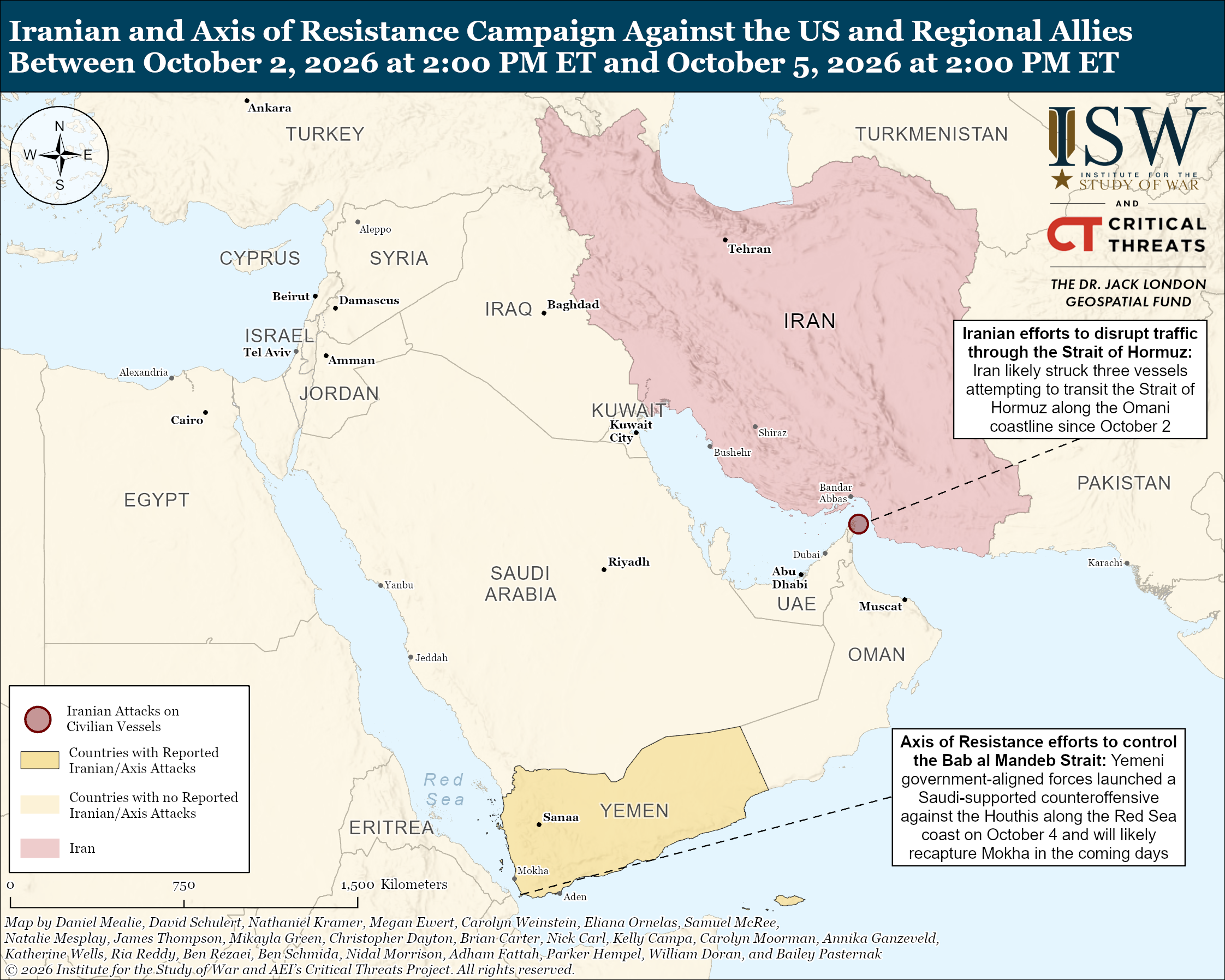
Iran may be applying these missile adaptations to their missile attacks on shipping the Strait of Hormuz. Iran has launched near daily attacks on vessels transiting the strait since September 29.[xxvi] A US official also told the Wall Street Journal on October 4 that Iran has improved its ability to target ships and increased the risk to shipping in the strait in recent weeks.[xxvii] Iran may be receiving support from partners to improve its targeting capabilities, as Russia has reportedly provided targeting intelligence and the People’s Republic of China provided satellite imagery to Iran likely aiding Iran’s targeting throughout this conflict.[xxviii]
Iran is likely aiming to increase its ability to deter US airstrikes targeting Iranian assets, impose costs on the United States, and preserve strategic initiative in the conflict by prioritizing improving its missile capabilities. The same US official also told the Wall Street Journal on October 4 that the United States stopped its campaign targeting Iranian oil tankers in response to Iranian attacks on commercial shipping after Iran launched the attack on the US air base in Jordan.[xxix] The official is likely referring to Iran’s cluster munition missile attack on Muwaffaq Salti Air Base in Jordan on September 9.[xxx]
The Iranian regime appears increasingly concerned that mounting economic pressure could threaten internal stability and is combining its attempts to manage its wartime economy with expanded efforts to deter and prepare to suppress possible unrest. Iranian President Masoud Pezeshkian acknowledged on October 3 that economic pressure had increased and said that his government had adopted unspecified measures to manage unspecified “special circumstances.”[xxxi] Pezeshkian and Supreme National Security Council (SNSC) Secretary Major General Mohsen Rezaei also attended an economic coordination meeting on October 3 that addressed currency volatility, government finances, and essential goods supplies.[xxxii] Rezaei notably described Iran’s current economic period as its most difficult.[xxxiii] The last time CTP-ISW observed the SNSC meeting to discuss Iran’s economy was in April, when officials expressed their concern about dire conditions reigniting unrest after the Winter 2026 protests.[xxxiv] Pezeshkian separately met with Parliament Speaker Mohammad Bagher Ghalibaf and Judiciary Chief Gholam Hossein Mohseni Ejei on October 4, likely to discuss the regime’s economic challenges and coordinate its response to mounting domestic pressure.[xxxv] These senior-level meetings and the involvement of the SNSC—Iran’s highest formal national security body—suggest that the regime increasingly views economic deterioration as a national security issue and that some officials may see negotiations and economic relief as necessary to prevent further decline.[xxxvi]
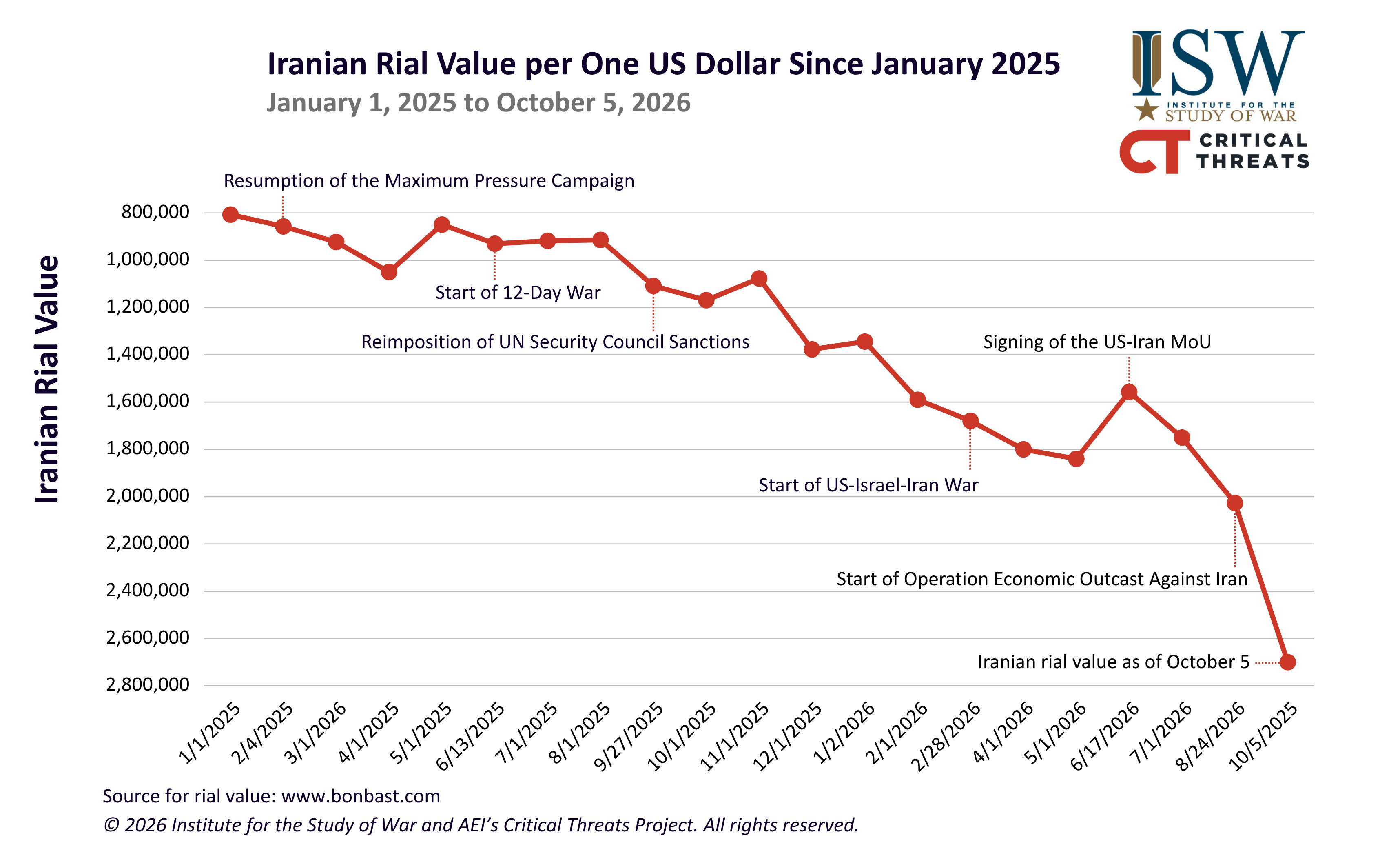
The regime’s recent measures have not stabilized the economy and may be increasing concerns about public discontent, however. The Iranian Central Bank recently injected two billion US dollars on September 30 to support the rial amid ongoing foreign currency shortages due to the US blockade on Iranian ports and sanctions on air travel, among other things, hindering Iranian trade.[xxxvii] The Iranian rial continued to depreciate, reaching 2,7000,000 rials per US dollar on October 4 (see below), which suggests that the regime’s short-term measures have not restored confidence in the currency. Ejei warned on October 5 that Iran’s adversaries could exploit sanctions and domestic discontent and urged officials to avoid angering the public.[xxxviii]
Economic pressure may also affect the security force personnel whom the regime relies on to maintain internal security. A parliamentarian described some military and law enforcement salaries as “embarrassing” on October 4, which suggests that economic pressure may be affecting the personnel whom the regime relies on to maintain internal security.[xxxix]
The regime is simultaneously expanding the forces and networks that it could use not only to prepare to suppress renewed unrest but to deter potential protesters. One of these efforts is the Basij’s recruitment and mobilization initiative, Janfada (“Those Who Sacrifice Their Lives”) Campaign, designed to bolster domestic support for the regime during wartime.[xl] The Janfada spokesperson claimed on October 2 that more than 500,000 people had registered for new neighborhood-based “national resistance battalions” and that the Basij and armed forces had begun organizing and training them.[xli]
Security forces are simultaneously conducting preemptive arrests of potential protesters and publicizing these arrests, likely to deter Iranians from protesting. The Iranian Intelligence Ministry announced on October 3 that it arrested 31 members of four networks in Kerman Province that recruited young people for nationwide protests and prepared Molotov cocktails and tools to disable surveillance cameras.[xlii] Regime security forces also claimed on October 5 that they dismantled a cell in Fars Province connected to the Winter 2026 protests.[xliii] The regime may calculate that fear of renewed mass arrests and brutal suppression similar to their crackdown in the Winter 2026 protests, during which security forces likely killed thousands of people and arrested tens of thousands more, may deter Iranians from protesting.[xliv]
US and Partner Military Operations
Nothing significant to report.
Iranian Strike Campaign
-
Assessed Iranian War Aims:
- Secure international recognition of Iranian control over the Strait of Hormuz
- Degrade the US ability and willingness to continue the war
- Restore deterrence vis-à -vis the United States and its regional partners
- Divide the United States and Israel from the Arab states
See topline section.
US-Iran Negotiations
Nothing significant to report.
Iranian Domestic Affairs
The Mobarizoun Popular Front (MPF)—a coalition of Baloch anti-regime groups—continues to pose a threat to the Iranian regime by attacking regime security forces in southeastern Iran. The MPF claimed responsibility for an attack targeting Iranian Law Enforcement Command (LEC) personnel in Bampur, Sistan and Baluchistan Province, on October 5.[xlv] The group attacked an LEC patrol on the Bampur-Iranshahr road, killing two officers and injuring another.[xlvi] Iranian media separately reported on October 5 that regime security forces launched a counterinsurgency operation targeting alleged militants in Rask, Sistan and Baluchistan Province—another MPF attack zone.[xlvii] A Baloch human rights organization reported on October 5 that unspecified gunmen attacked a vehicle carrying alleged plainclothes regime security personnel near the Jakigur Bridge in Rask.[xlviii] It added that the attack killed at least three occupants, but Iranian media confirmed only one death.[xlix] These attacks are part of a recent uptick in armed anti-regime activity and regime counterinsurgency operations in southeastern Iran.[l] The recent MPF attacks demonstrate that the group retains the ability to target regime security forces despite increased security operations. The regime will likely intensify security operations in southeastern Iran in response.
Lebanon
Nothing significant to report.
Iraq
Nothing significant to report.
Arabian Peninsula
See topline section.

[i] https://www.reuters.com/world/yemeni-government-forces-seize-district-by-bab-el-mandeb-military-sources-say-2026-10-05/ ; https://www.nytimes.com/2026/10/05/world/middleeast/saudi-arabia-yemen-houthis-bab-al-mandab-strait.html ; https://www.sabanew dot net/story/ar/153517 ; https://x.com/Yem_army_media/status/2106719916615201119
[ii] https://x.com/LayBay_ish/status/2107050820722364505?s=20 ; https://x.com/Alsakaniali/status/2107038701825994834?s=20 ; https://x.com/ALyemennow/status/2107101907399405692 ; https://x.com/BashaReport/status/2107144637345632301
[iii] https://x.com/ALyemennow/status/2107155576145015202 ; https://x.com/ALyemennow/status/2107143285403754783
[iv] https://understandingwar.org/research/middle-east/iran-update-october-2-2026/ ; https://www.reuters.com/world/asia-pacific/saudis-plan-assault-houthis-break-red-sea-chokehold-2026-10-02/
[v] https://understandingwar.org/research/middle-east/iran-update-october-2-2026/ ; https://www.reuters.com/world/asia-pacific/saudis-plan-assault-houthis-break-red-sea-chokehold-2026-10-02/
[vi] https://www.reuters.com/world/asia-pacific/saudis-plan-assault-houthis-break-red-sea-chokehold-2026-10-02/ ; https://x.com/Alsakaniali/status/2107165587353071978 ; https://www.aljazeera dot com/news/2026/10/5/yemen-war-escalates-whats-the-latest-on-the-battlefield ; https://x.com/Me1Ray/status/2107058808317260105?s=20 ; https://x.com/Yem_army_media/status/2107037201469001733?s=20
[vii] https://www.sabanew dot net/story/ar/153517 ; https://x.com/Yem_army_media/status/2106719916615201119
[viii] https://understandingwar.org/research/middle-east/iran-update-september-10-2026/ ; https://understandingwar.org/research/middle-east/iran-update-september-17-2026/ ; https://x.com/Osint613/status/2100596574543917534 ; https://x.com/BashaReport/status/2100600411602206777 ; https://x.com/war_cube/status/2106024434788192532
[ix] https://x.com/CJFCSpox/status/2107034669305004345 ; https://understandingwar.org/research/middle-east/iran-update-september-17-2026/ ; https://x.com/Osint613/status/2100596574543917534 ; https://x.com/BashaReport/status/2100600411602206777 ; https://x.com/war_cube/status/2106024434788192532
[x] https://x.com/ALyemennow/status/2107132268179243399
[xi] https://www.nytimes.com/2026/10/04/world/middleeast/houthis-oil-attack-saudi-arabia-yemen.html
[xii] https://x.com/BashaReport/status/2107024453960110146
[xiii] https://x.com/modgovksa/status/2107170842509488460
[xiv] https://understandingwar.org/research/middle-east/iran-update-october-2-2026/ ; https://www.reuters.com/world/asia-pacific/saudis-plan-assault-houthis-break-red-sea-chokehold-2026-10-02/
[xv] https://defapress dot ir/fa/news/867620
[xvi] https://defapress dot ir/fa/news/867620
[xvii] https://understandingwar.org/research/middle-east/iran-update-special-report-july-25-2026/ ; https://www.wsj.com/world/middle-east/iran-kheibar-shekan-missile-5776a6e4
[xviii] https://understandingwar.org/research/middle-east/iran-update-special-report-july-25-2026/; https://www.wsj.com/world/middle-east/iran-kheibar-shekan-missile-5776a6e4
[xix] https://understandingwar.org/research/middle-east/iran-update-september-9-2026/; https://www.foxnews.com/video/6404785881112
[xx] https://understandingwar.org/research/middle-east/iran-update-september-9-2026/; https://www.foxnews.com/video/6404785881112
[xxi] https://understandingwar.org/research/middle-east/iran-update-september-21-2026/
[xxii] https://understandingwar.org/research/middle-east/iran-update-september-21-2026/ ; https://www.aljazeera dot net/news/2026/9/19/عاجل-أمين-مجلس-الأمن-القومي-الإيراني-3
[xxiii] https://understandingwar.org/research/middle-east/iran-update-september-21-2026/
https://understandingwar.org/research/middle-east/iran-update-september-21-2026/ ; https://www.telegraph.co.uk/us/news/2026/09/09/us-forces-destroy-five-iranian-oil-carriers/ ; https://www.javanonline dot ir/fa/news/1378032/
[xxv] https://www.wsj.com/world/middle-east/with-close-calls-on-u-s-warships-iran-shows-new-appetite-for-escalation-e2758bbd
[xxvi] https://x.com/UK_MTO/status/2104881435123339274 ;
https://x.com/UK_MTO/status/2105229649693266101 ;
https://x.com/UK_MTO/status/2105230089768357958 ;
https://x.com/UK_MTO/status/2105246915625701554 ;
https://x.com/UK_MTO/status/2105751363166806443 ;
https://x.com/UK_MTO/status/2106048975740481770 ;
https://x.com/UK_MTO/status/2106161186681004388?s=20 ;
https://x.com/UK_MTO/status/2107053238755131393 ;
https://x.com/UK_MTO/status/2107114873301729289 ;
https://x.com/UK_MTO/status/2107115693292347705 ;
https://x.com/UK_MTO/status/2107116479342653952 ;
https://x.com/UK_MTO/status/2107170906338460097
[xxvii] https://www.wsj.com/world/middle-east/oil-was-pouring-through-the-strait-of-hormuz-again-then-attacks-on-shipping-resurged-fe9f0dd9?mod=middle-east_news_article_pos5
[xxviii] https://understandingwar.org/research/middle-east/iran-update-special-report-july-23-2026/; https://www.reuters.com/world/middle-east/iran-strikes-cia-facilities-prompt-questions-about-possible-russian-role-2026-07-22/; https://understandingwar.org/research/middle-east/iran-update-september-9-2026/; https://www.state.gov/releases/office-of-the-spokesperson/2026/05/disrupting-irans-overseas-military-procurement-networks ;
https://understandingwar.org/research/middle-east/iran-update-special-report-may-9-2026/
[xxix] https://www.wsj.com/world/middle-east/oil-was-pouring-through-the-strait-of-hormuz-again-then-attacks-on-shipping-resurged-fe9f0dd9?mod=middle-east_news_article_pos5
[xxx] https://understandingwar.org/research/middle-east/iran-update-september-9-2026/ ; https://www.foxnews.com/video/6404785881112
[xxxi] https://x.com/drpezeshkian/status/2106464983458390268?s=20
[xxxii] https://tasnimnews dot ir/fa/news/1405/07/11/3712831
[xxxiii] https://tasnimnews dot ir/fa/news/1405/07/11/3712831
[xxxiv] https://understandingwar.org/research/middle-east/iran-update-special-report-april-28-2026/
[xxxv] https://www.asriran dot com/fa/news/1196338
[xxxvi] https://www.unitedagainstnucleariran.com/government-institution/supreme-national-security-council-snsc
[xxxvii] https://fararu dot com/fa/news/1006267/;
https://iranintl.com/en/202610047130 ;
[xxxviii] https://www.mehrnews dot com/news/6968456
[xxxix] https://tasnimnews dot ir/fa/news/1405/07/12/3713265
[xl] https://iranwire.com/en/news/158047-exclusive-many-military-and-government-officials-oppose-expansion-of-jan-fada-campaign/ ; https://blogs.timesofisrael dot com/iran-tells-its-diaspora-to-die-for-the-country/
[xli] https://t.me/defapress_ir/69071 ;
[xlii] https://www.irib-news dot ir/fa/news/5928628/
[xliii] https://t.me/defapress_ir/69092
[xliv] https://www.hrw.org/news/2026/02/04/iran-human-rights-situation-spirals-deeper-into-crisis ;
[xlv] https://t.me/jmmfront/190
[xlvi] https://t.me/mehrnews/419537
[xlvii] https://t.me/mehrnews/418550
[xlviii] https://t.me/haalvsh/36876
[xlix] https://t.me/haalvsh/36876 ;
https://t.me/Tasnimnews/449210
[l] https://tasnimnews dot ir/3704779 ;
https://x.com/IranIntl/status/2104964689855734178?s=20 ;
https://x.com/haalvsh/status/2104962057712136358?s=20 ;
https://t.me/mehrnews/418230 ;
https://t.me/mehrnews/418259 ;
https://x.com/bbcpersian/status/2106012124145213865 ;