
Data Cutoff: 2:00 PM ET
The Institute for the Study of War (ISW) and The Critical Threats Project (CTP) at the American Enterprise Institute are publishing updates Monday through Friday to provide analysis on the war with Iran and the broader Middle East. Weekday updates cover events from the past 24-hour period, whereas weekend updates are abbreviated and cover the Houthi-Saudi conflict and major breaking developments related to the war with Iran.
Key Takeaways:
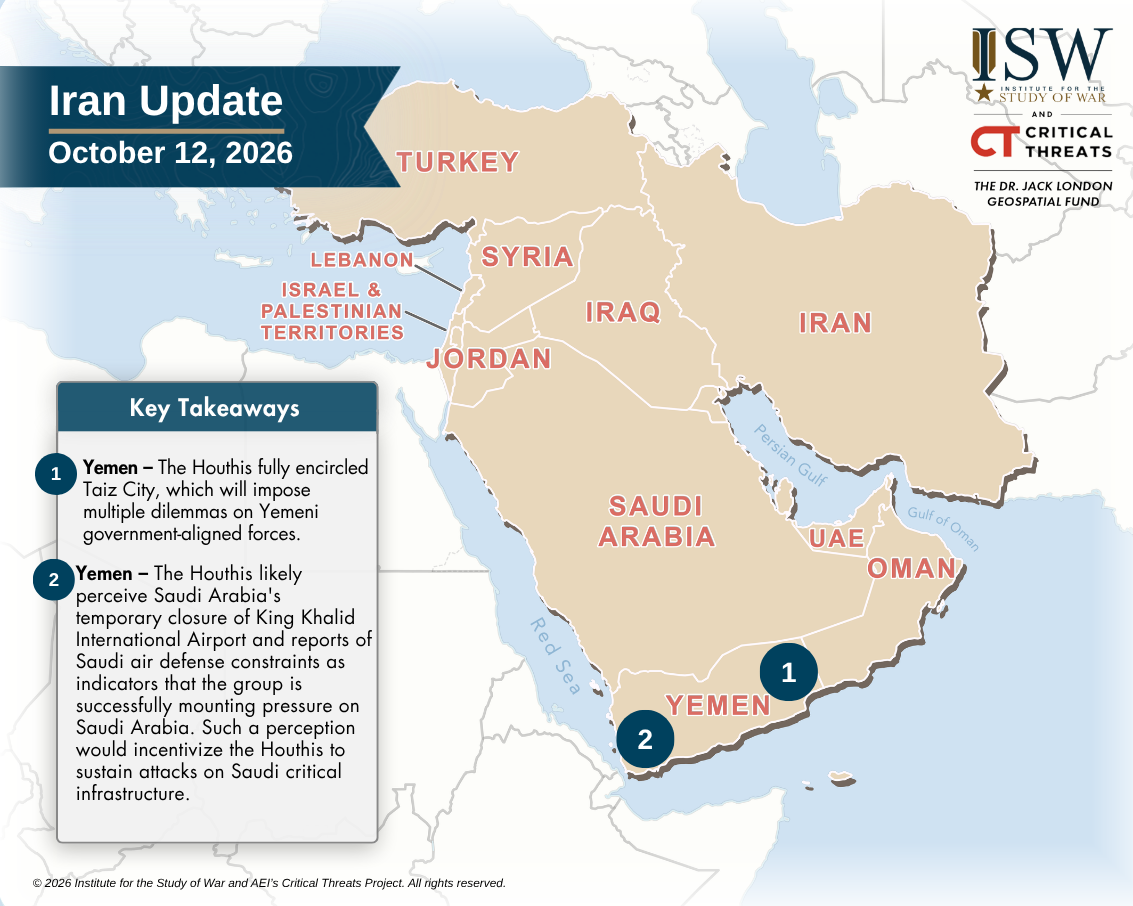
- The Houthis fully encircled Taiz City on October 12, which will impose multiple dilemmas on Yemeni government-aligned forces. A complete encirclement further restricts Yemeni government-aligned forces' ability to reinforce and resupply their positions, withdraw forces, and sustain defensive operations in and around Taiz City.
- The Houthis likely perceive Saudi Arabia's temporary closure of King Khalid International Airport and reports of Saudi Arabia's air defense constraints as indicators that the group is successfully mounting pressure on Saudi Arabia. Such a perception would incentivize the Houthis to sustain attacks on Saudi critical infrastructure. Saudi Arabia has not indicated any willingness to agree to Houthi demands at the time of this writing, however.
- Iran appears to be targeting commercial vessels conducting ship-to-ship oil transfers in and near the Strait of Hormuz in order to try to undermine vessels’ ability to move energy through the strait.
- Iran has increased its threats against vessels in the strait, likely to reinforce the Iranian threat to shipping and reestablish control over the waterway by deterring vessels from using non-Iranian-approved routes.
- Iran may be developing its anti-ship missile capabilities to improve its ability to target vessels.
- Iran is threatening to attack US-linked digital infrastructure in response to potential future US strikes, likely in order to try to deter the United States from resuming military action against Iran. Iran likely seeks to threaten to expand the potential US targets for Iranian attacks in order to raise the United States’ perceived costs of renewed conflict with Iran.
Toplines
The Houthis fully encircled Taiz City on October 12, which will impose multiple dilemmas on Yemeni government-aligned forces. The Houthis captured al Misrakh District on October 12, which is approximately 13 kilometers south of Taiz City.[i] Geolocated footage indicates that the Houthis also consolidated control over territory on October 12 that was previously contested by the Houthis and Yemeni government-aligned forces in eastern Jabal Habashi District, which connects to al Misrakh.[ii] Taiz City is now fully encircled by either Houthi-held territory or Houthi-Yemeni government contested terrain. The Houthis’ consolidation of control over territory in eastern Jabal Habashi will likely strengthen the Houthis' ability to defend al Misrakh and maintain the encirclement of Taiz City by establishing contiguous Houthi control over territory south of the city.
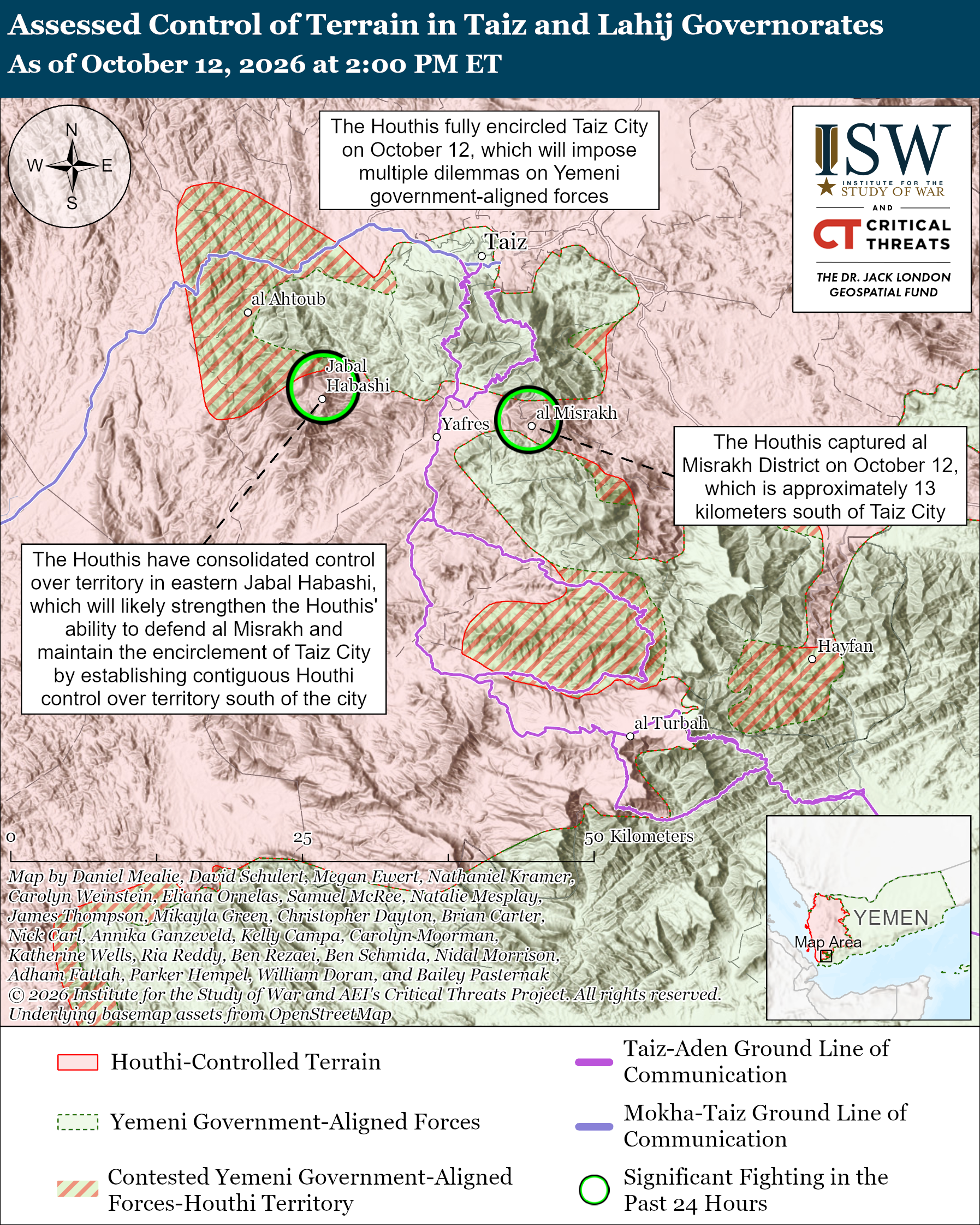
The encirclement of Taiz advances the Houthis’ ability to pursue multiple military objectives in Yemen. The Houthis effectively encircled Taiz City on October 6 after severing the last Yemeni government ground line of communication (GLOC) into central Taiz Governorate.[iii] A complete encirclement further restricts Yemeni government-aligned forces' ability to reinforce and resupply their positions, withdraw forces, and sustain defensive operations in and around Taiz City.[iv] CTP-ISW continues to assess that the encirclement of Taiz City could:
- Free up Houthi forces to pursue other military objectives, including recapturing territory along the Red Sea coastal plain, where the Houthis have failed to reverse Yemeni government advances to Dhubab Airport since October 5.[v]
- Enhance the Houthis’ ability to threaten Aden City. An operation against Aden City would likely follow the seizure of Taiz Governorate because the Houthis could not currently advance against Aden City without exposing their rear to government forces in Taiz Governorate.[vi]
- Secure a propaganda victory by capturing a governorate whose population has historically opposed Houthi rule.[vii] The Houthis have historically made several unsuccessful attempts to seize Taiz Governorate.[viii]
- Reestablish most of the former pre-unification Yemen Arab Republic’s borders, excluding parts of Marib and Jawf governorates.[ix]
- Strengthen the Houthis’ negotiating position in potential peace settlement talks with the Yemeni government and Saudi Arabia.[x]
The Houthis' encirclement of Taiz City will simultaneously impose multiple dilemmas on Yemeni government-aligned forces. Yemeni government-aligned forces face the dilemma of whether to redirect forces from other frontlines to break the Houthi encirclement of Taiz City or maintain their current positions and risk further Houthi advances in Taiz Governorate. Redirecting forces from the Red Sea coastal plain to Taiz Governorate would likely weaken Yemeni government positions near Dhubab Airport and create opportunities for the Houthis to reverse recent Yemeni government gains by the Bab al Mandeb Strait.[xi] It is also uncertain how Yemeni government-aligned forces could effectively redeploy from other fronts to Taiz Governorate, given the Houthis’ control of GLOCs into Taiz Governorate.[xii]
The Houthis likely perceive Saudi Arabia's temporary closure of King Khalid International Airport and reports of Saudi Arabia's air defense constraints as indicators that the group is successfully mounting pressure on Saudi Arabia. Such a perception would incentivize the Houthis to sustain attacks on Saudi critical infrastructure. Saudi Arabia temporarily suspended operations at King Khalid Airport on October 10 following a Houthi attack on the airport that killed at least 12 people.[xiii] Saudi Arabia extended its temporary closure of King Khalid Airport on October 12 following another Houthi attack on the airport earlier that day.[xiv] The Houthis have repeatedly targeted the airport, along with other Saudi critical infrastructure, in recent weeks as part of the group's campaign to degrade Saudi willingness to sustain military operations against the Houthis and accept Houthi demands, which include lifting Saudi controls on Houthi-controlled ports and airports and granting the Houthis control over Yemen’s oil and gas resources.[xv] Saudi Arabia may have extended the airport's closure due to damage from the strikes or to reduce material and civilian risk from future Houthi strikes. The closure, nonetheless, demonstrates the Houthis’ ability to impose costs on Saudi Arabia. Sources familiar with Saudi deliberations separately told the Wall Street Journal on October 12 that Saudi Arabia is facing challenges in defending the entire country from Houthi attacks and has repositioned its air defense batteries to prioritize the protection of palaces and energy infrastructure.[xvi] Saudi Arabia’s reported air defense constraints likely further reinforce the Houthis’ perception that their attacks are successfully increasing pressure on Saudi Arabia to concede to Houthi demands.
Saudi Arabia has not indicated any willingness to agree to Houthi demands at the time of this writing, however. Saudi leaders previously signaled that they were unwilling to enter any truce negotiations with the Houthis as long as the group controls the Bab al Mandeb Strait, according to Western and regional sources speaking to Reuters on October 2.[xvii] The Houthis will, therefore, almost certainly continue to attack Saudi critical infrastructure, including airports, to further degrade Saudi willingness to continue the conflict. Houthi military spokesperson Yahya Saree reiterated on October 11 that the group will continue to target Saudi airports until the Houthis achieve their objectives.[xviii]
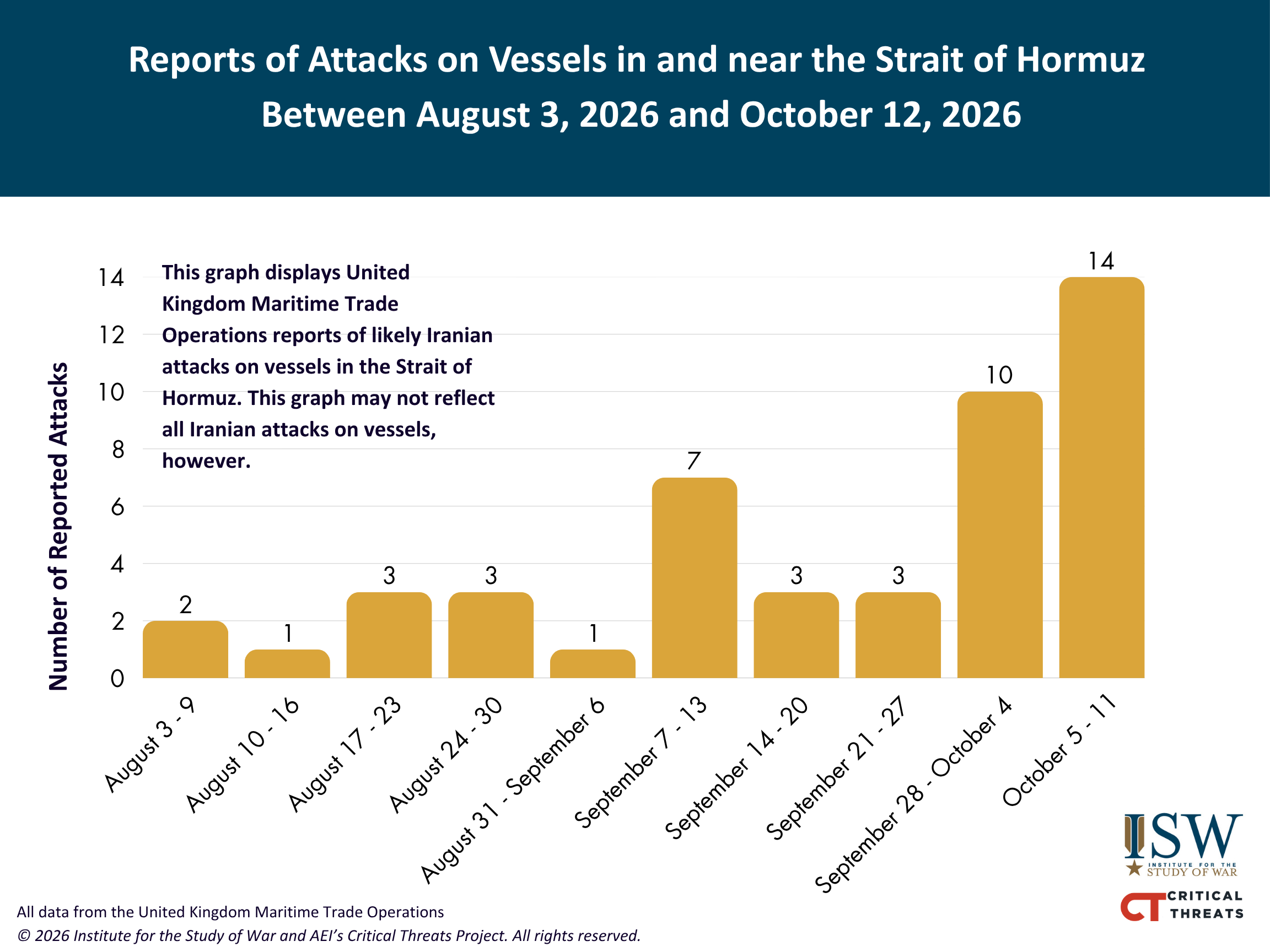
Iran appears to be targeting commercial vessels conducting ship-to-ship oil transfers in and near the Strait of Hormuz in order to try to undermine vessels’ ability to move energy through the strait. Supreme National Security Council (SNSC) Secretary Major General Mohsen Rezaei claimed on October 11 that Iranian forces have attacked around five small vessels conducting ship-to-ship transfers with larger tankers each night over the past two to three months.[xix] Rezaei likely exaggerated the number of vessels that Iran has struck, but his comments nevertheless suggest that Iran may specifically be targeting ship-to-ship transfers, which Gulf countries have increasingly relied on in recent months to evade Iranian detection and bypass Iranian control of the strait.[xx] Energy firm Kpler separately told Reuters on October 8 that crude flow through the strait had fallen by 27 percent compared to the previous week, largely due to a decline in ship-to-ship transfers in the Gulf of Oman.[xxi] This data suggests that recent Iranian attacks may have caused the decline in such transfers and the subsequent drop in oil flow through the strait. United Kingdom Maritime Trade Operations (UKMTO) confirmed that a drone struck a tanker near Sohar, Oman, on October 11.[xxii] Sohar is a key hub for ship-to-ship transfers, although it is unclear if the tanker was involved in such a transfer when it was attacked.[xxiii]
Iran has increased its threats against vessels in the strait, likely to reinforce the Iranian threat to shipping and reestablish control over the waterway by deterring vessels from using non-Iranian-approved routes. The IRGC Navy threatened on October 9 to attack vessels “throughout the region” if they pass through non-Iranian-approved routes in the strait.[xxiv] IRGC Navy Commander Rear Admiral Ali Ozmaei separately warned on October 11 that Iran will treat vessels that disable their navigation or identification systems to transit the strait as hostile and respond “severely and decisively.”[xxv] The IRGC Navy simultaneously continues to claim that vessels using “unauthorized” routes have struck naval mines, likely to portray these routes as dangerous and deter shipping companies from using them.[xxvi] The United States previously announced on August 25 that it had cleared the strait of mines.[xxvii] Iran is likely increasing its threats to vessels in response to the United States’ recent success in facilitating the flow of oil out of the strait, which has undermined Iran’s claims of control over the waterway.
Iran may be developing its anti-ship missile capabilities to improve its ability to target vessels. IRGC Spokesperson Brigadier General Hossein Mohebbi published an English-language image on October 11 that showed Iranian ballistic missiles, including the Kheibar Shekan and Paveh, as well as the Abu Mahdi anti-ship cruise missile, targeting a US aircraft carrier.[xxviii] Iranian Armed Forces General Staff-run outlet Defa Press assessed that the image suggests that Iran has developed an anti-ship variant of the Kheibar Shekan ballistic missile and implied that Iran may have used this variant in its September 5 attack on US naval forces.[xxix] Defa Press’s assessment is consistent with a recent statement from Brigadier General Ali Balali, an adviser to the IRGC Aerospace Force commander, who claimed on October 1 that Iran had tested a “long-range ballistic missile against a moving target.”[xxx]
Iran is threatening to attack US-linked digital infrastructure in response to potential future US strikes, likely in order to try to deter the United States from resuming military action against Iran. Rezaei warned on October 11 that Iran could target undersea cables, data centers, and artificial intelligence infrastructure in the Middle East in a future military conflict with the United States.[xxxi] Rezaei notably issued the threat through the Iranian regime’s English-language state broadcaster Press TV, which suggests that Iran intended the message for a Western audience.[xxxii] Islamic Revolutionary Guards Corps (IRGC)-affiliated Tasnim News Agency recirculated Rezaei’s comments and identified digital and energy infrastructure in Gulf countries, particularly the United Arab Emirates (UAE), as possible Iranian targets.[xxxiii] Iran likely seeks to threaten to expand the potential US targets for Iranian attacks in order to raise the United States’ perceived costs of renewed conflict with Iran. Iran may also calculate that threats to Gulf states will coerce those states to pressure the United States to refrain from conducting renewed strikes against Iran.
US and Partner Military Operations
Nothing significant to report.
Iranian Strike Campaign
-
Assessed Iranian War Aims:
- Secure international recognition of Iranian control over the Strait of Hormuz
- Degrade the US ability and willingness to continue the war
- Restore deterrence vis-à -vis the United States and its regional partners
- Divide the United States and Israel from the Arab states
See topline section.
US-Iran Negotiations
Nothing significant to report.
Iranian Domestic Affairs
See topline section.
Lebanon
Nothing significant to report.
Iraq
Iraqi Prime Minister Ali al Zaydi will likely discuss the Iraqi federal government’s efforts to prevent Iranian-backed Iraqi militia attacks on neighboring countries during his upcoming visits to Saudi Arabia, Kuwait, and other unspecified Gulf countries on October 14. Iraqi media reported on October 10 that Zaydi will visit several Gulf countries, including Saudi Arabia and Kuwait, on October 14.[xxxiv] Zaydi cancelled his planned trip to Saudi Arabia in July 2026 after the United States and Saudi Arabia struck several Iranian-backed Iraqi militia targets in Iraq in response to militia attacks on Saudi oil infrastructure.[xxxv] Saudi Arabia has repeatedly urged the Iraqi federal government to punish the perpetrators of attacks on Saudi Arabia and prevent Iranian-backed Iraqi militias from launching attacks on neighboring countries.[xxxvi] Zaydi’s upcoming visit comes as the Iraqi federal government has taken limited steps to prevent such attacks, such as by forming a new Iraqi Security Forces operations command to enhance coordination between Iraqi forces deployed to the Muthanna desert near the borders with Saudi Arabia and Kuwait.[xxxvii] Iranian-backed Iraqi militias have repeatedly launched attacks on neighboring countries from the Muthanna desert.[xxxviii]
Arabian Peninsula
See topline section.

[i] https://x.com/war_cube/status/2109600897907175660 ; https://www.alhadath dot net/yemen/2026/10/12/غارات-على-مواقع-حوثية-في-محافظات-تعز-وصنعاء-واب ; https://x.com/AB4_Ali3/status/2109367591412097228 ; https://t.me/Almasirah_En/96415
[ii] https://x.com/MMY1444/status/2109705926546686108?s=20 ;
https://www.alhadath dot net/yemen/2026/10/12/غارات-على-مواقع-حوثية-في-محافظات-تعز-وصنعاء-واب |
[iii] https://understandingwar.org/research/middle-east/iran-update-october-8-2026/ ; https://understandingwar.org/research/middle-east/iran-update-october-9-2026/
[iv] https://understandingwar.org/research/middle-east/iran-update-october-8-2026/ ; https://understandingwar.org/research/middle-east/iran-update-october-9-2026/
[v] https://www.criticalthreats.org/analysis/iran-update-october-11-2026
[vi] https://understandingwar.org/research/middle-east/iran-update-october-4-2026/
[vii] https://www.aljazeera dot com/news/2026/9/14/why-the-houthi-advance-towards-yemens-marib-taiz-matters ; https://understandingwar.org/research/middle-east/iran-update-october-4-2026/
[viii] https://www.aljazeera dot com/news/2026/9/14/why-the-houthi-advance-towards-yemens-marib-taiz-matters ; https://understandingwar.org/research/middle-east/iran-update-october-4-2026/
[ix] https://ecfr dot eu/archive/page/-/Mapping_Yemen_(1).pdf ; https://understandingwar.org/research/middle-east/iran-update-october-4-2026/
[x] https://understandingwar.org/research/middle-east/iran-update-october-4-2026/
[xi] https://understandingwar.org/research/middle-east/iran-update-october-9-2026/ ; https://www.criticalthreats.org/analysis/iran-update-october-11-2026
[xii] https://understandingwar.org/research/middle-east/iran-update-october-7-2026/
[xiii] https://x.com/ksagaca/status/2108965535421489565 ; https://x.com/ksagaca/status/2109039231968383000
[xiv] https://x.com/ksagaca/status/2109564392455250075 ; https://x.com/ksagaca/status/2109320328388202840
[xv] https://t.me/army21ye/3847 ; https://t.me/army21ye/3838 ; https://t.me/army21ye/3768
[xvi] https://www.wsj.com/world/middle-east/iran-backed-militants-are-tightening-the-screws-on-saudi-arabias-crown-prince-e7b9e789?mod=middle-east_news_article_pos2
[xvii] https://www.reuters.com/world/asia-pacific/saudis-plan-assault-houthis-break-red-sea-chokehold-2026-10-02/
[xviii] https://t.me/army21ye/3862
[xix] https://tasnimnews dot ir/fa/news/1405/07/19/3720316/
[xx] https://www.jpost.com/middle-east/article-899598
[xxi] https://www.reuters.com/business/energy/hormuz-transits-lowest-over-two-months-after-attacks-data-shows-2026-10-08/
[xxii] https://x.com/UK_MTO/status/2109389244301205557?s=20
[xxiii] https://www.aljazeera dot com/news/2026/9/18/oman-oil-escape-route-how-ship-to-ship-transfers-work-despite-big
[xxiv] https://t.me/iribnews/365700 ;
https://understandingwar.org/research/middle-east/iran-update-october-9-2026/
[xxv] https://t.me/farsna/467820
[xxvi] https://t.me/Tasnimnews/450634 ;
[xxvii] https://www.reuters.com/world/trump-says-strait-hormuz-has-been-demined-warns-iran-not-plant-more-2026-08-25/
[xxviii] https://x.com/Irgcspeaker/status/2109368992863273124
[xxix] https://defapress dot ir/fa/news/869399/
[xxx] https://www.iranintl.com/en/202610012937
[xxxi] https://tasnimnews dot ir/fa/news/1405/07/19/3720316/
[xxxii] https://www.presstv.co dot uk/Detail/2026/10/11/778085/Exclusive--Rezaei-says-%E2%80%98Powers-greater-than-US-tried-to-conquer-Iran,-but-ended-up-in-dustbin-of-history%E2%80%99 ;
https://x.com/PressTV/status/2109242170876346586?s=20
[xxxiii] https://t.me/Tasnimnews/450600
[xxxiv] https://en.964media dot com/53589/
[xxxv] https://www.al-monitor.com/originals/2026/07/zaidi-cancels-riyadh-trip-after-us-saudi-strikes-iran-backed-militias-iraq
[xxxvi] https://www.al-monitor.com/originals/2026/08/saudi-arabia-wants-iran-backed-militia-heads-roll-iraq-amid-talks-tehran ; https://today.lorientlejour dot com/article/1542629/saudi-calls-on-iraq-to-prevent-attacks-from-its-territory.html ; https://www.arabnews dot com/saudi-arabia/saudi-arabia-five-other-countries-demand-iraq-stops-attacks-by-pro-iran-groups-from-its-territory-2637665
[xxxvii] https://understandingwar.org/research/middle-east/iran-update-september-14-2026/ ; https://understandingwar.org/research/middle-east/iran-update-special-report-august-10-2026/ ; https://www.alaraby dot co.uk/politics/خاص-العراق-يشكل-قيادة-عمليات-البادية-لمنع-الهجمات-على-دول-الجوار
[xxxviii] https://www.alaraby dot co.uk/politics/خاص-العراق-يشكل-قيادة-عمليات-البادية-لمنع-الهجمات-على-دول-الجوار ; https://ctc.westpoint.edu/standing-with-iran-the-integrated-combat-performance-of-iraqi-militias-during-operation-epic-fury/
[RR1]Graphic for social media: https://criticalthreats.imeetcentral.com/p/aQAAAAAFNqZj
[RR2]https://criticalthreats.imeetcentral.com/p/aQAAAAAFNqZi
[CM3]Login / Sign In - Critical Threats and Institute for the Study of War
[BR4]https://criticalthreats.imeetcentral.com/p/aQAAAAAFNqZJ